Hofgarten
Rennweg / Karl-Kapfererstraße
Worth knowing
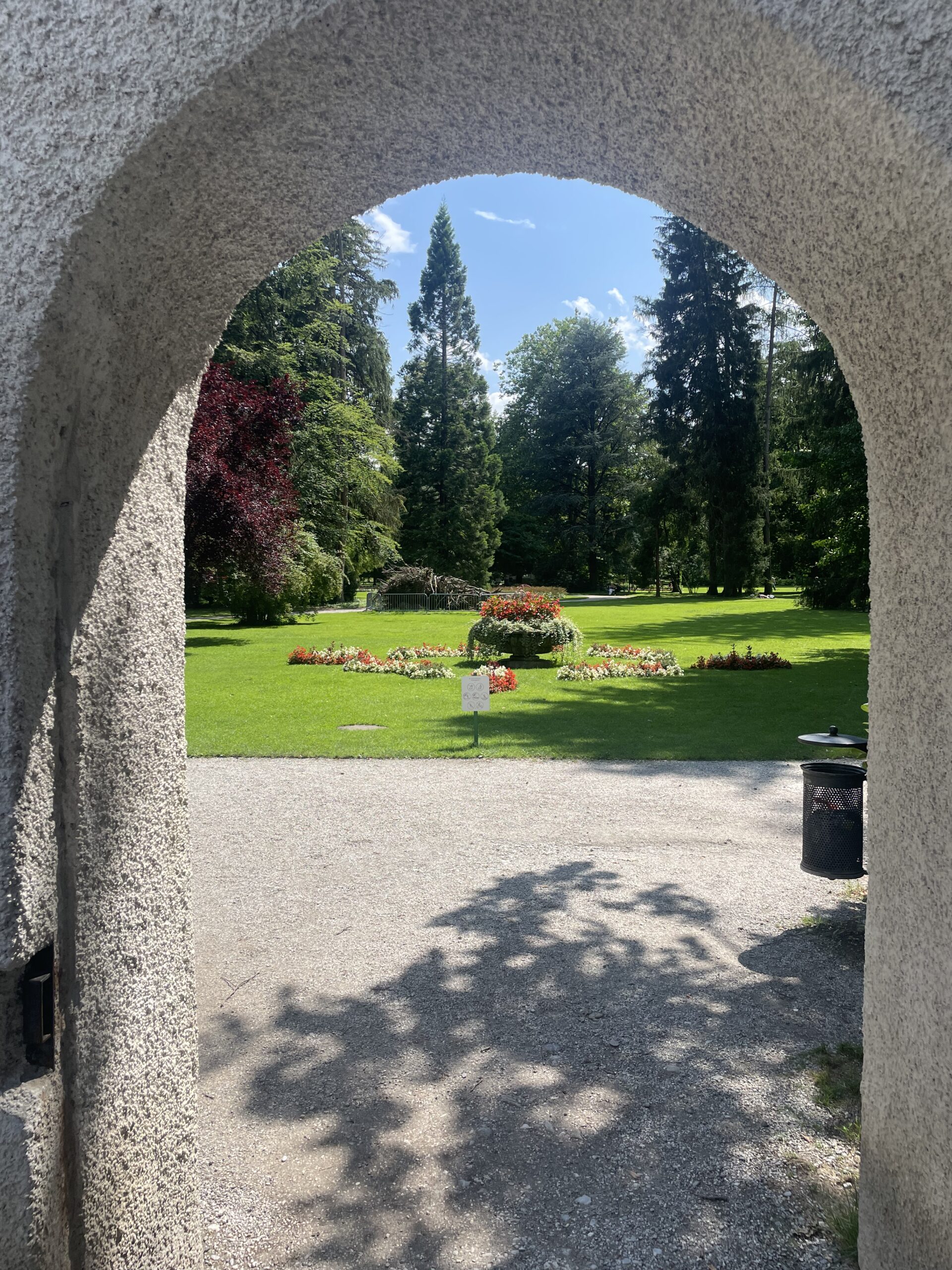
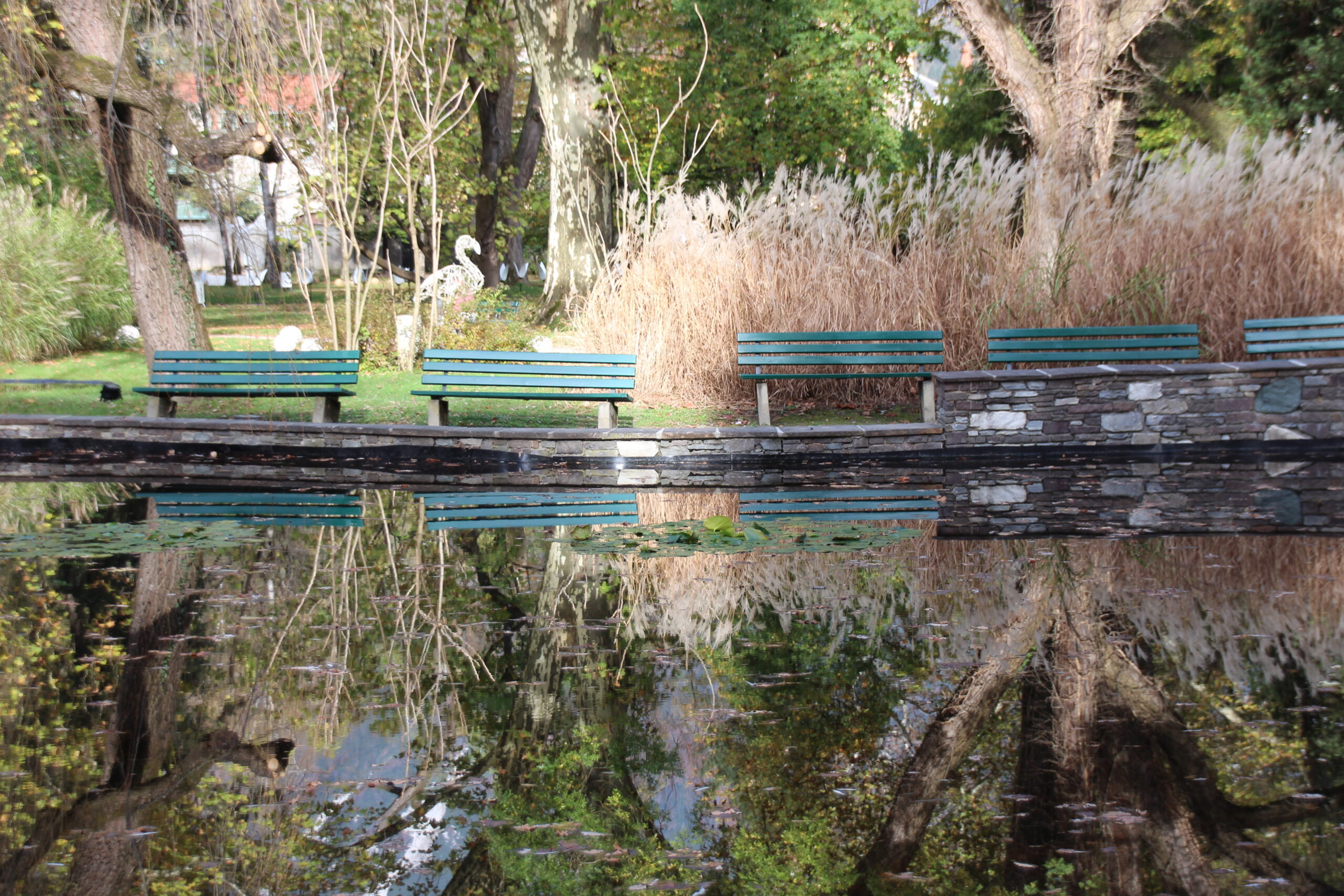
Behind the high walls surrounding the Hofgarten lies Innsbruck’s most carefully maintained oasis of tranquility. Walking paths lead through the inner-city garden past ancient trees and manicured lawns. Benches invite visitors to pause during errands or strolls. But the Hofgarten is not only a popular recreational area—it is also part of Innsbruck’s city history. Since the 15th century, landscape culture has been documented here. East of the racecourse stretched the sovereign’s racing meadows. The Maximilian Fishery Book of 1504 mentions a lake that the enthusiastic hunter and angler had created on his estates. The Hofgarten is thus one of the oldest documented garden complexes in Europe. While the Inn meadows under Maximilian were still mainly cultivated as hunting grounds, the art-loving sovereign Ferdinand II transformed the Hofgarten into a Renaissance garden—the Würtz and Lustgärten. The pheasant garden with its pheasant house was home not only to 3,000 of these birds, considered particularly noble, but also to “bears, lions, tigers, and guenons.” Exotic animals were the rule rather than the exception at princely courts of the time. Most of these unfortunate creatures changed hands as gifts among nobles and had to live behind bars as symbols of power and prestige. Ordinary Innsbruck residents had no access to these foreign animals, but the mere knowledge of their presence, their sounds, and smells must have been spectacular. On April 14, 1636, two of the sovereign’s lions met their end when their enclosure caught fire after an explosion at the nearby powder mill. The former inn “Löwenhaus” on the Inn still recalls its original purpose. Also consumed by flames that day was the sovereign’s summer residence “Ruhelust,” located in the Hofgarten. Although the Tyrolean Estates and the Chamber for Court Finances tried to force Regent Claudia de Medici to economize, she did not abandon her plan to build a new court building opposite the Hofburg. The Tyrolean sovereign commissioned Christoph Gumpp to design a new structure. Some of the statues originally intended for this building now adorn the Leopoldsbrunnen in front of the State Theater. In 1728, this palace too fell victim to flames.
The new era under Maria Theresa also brought changes to the Hofgarten’s design. Gothic Innsbruck was no longer a residential city, yet this administrative seat was to meet the demands of modern times. The garden received a Baroque makeover like the Hofburg opposite, though without grand and costly new constructions. The foundation for today’s Hofgarten was influenced by the rational frugality of the enlightened regent. Legend has it that some plants in the Hofgarten were planted by her own hands.
In the 19th century, Friedrich Ludwig Schell redesigned the Hofgarten in the style of an English garden, in keeping with Victorian fashion. Parks and gardens were springing up in many European cities at this time. At the same time, the garden began to open socially. Although there had been a tavern within the Hofgarten since the early 18th century, its clientele was mainly aristocrats. Before 1800, about 50% of Innsbruck’s residents belonged to the nobility, clergy, or their administration. Only 50 years later, this share had significantly declined thanks to the influx of workers and craftsmen with their families, who worked in factories on the city’s outskirts. Society after 1848 had changed—and with it, the rules by which it functioned—so that ordinary citizens could now spend their leisure time here.
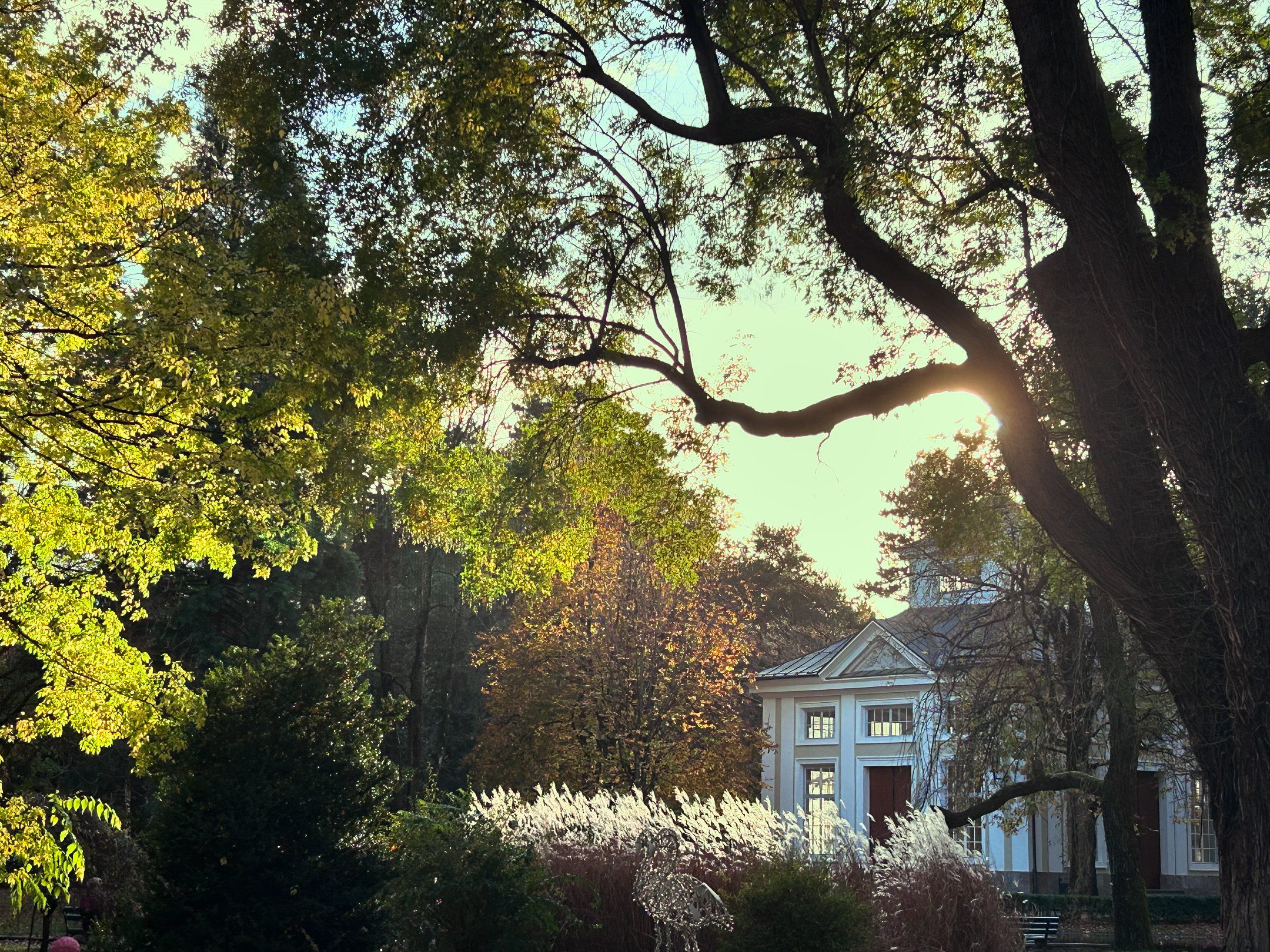
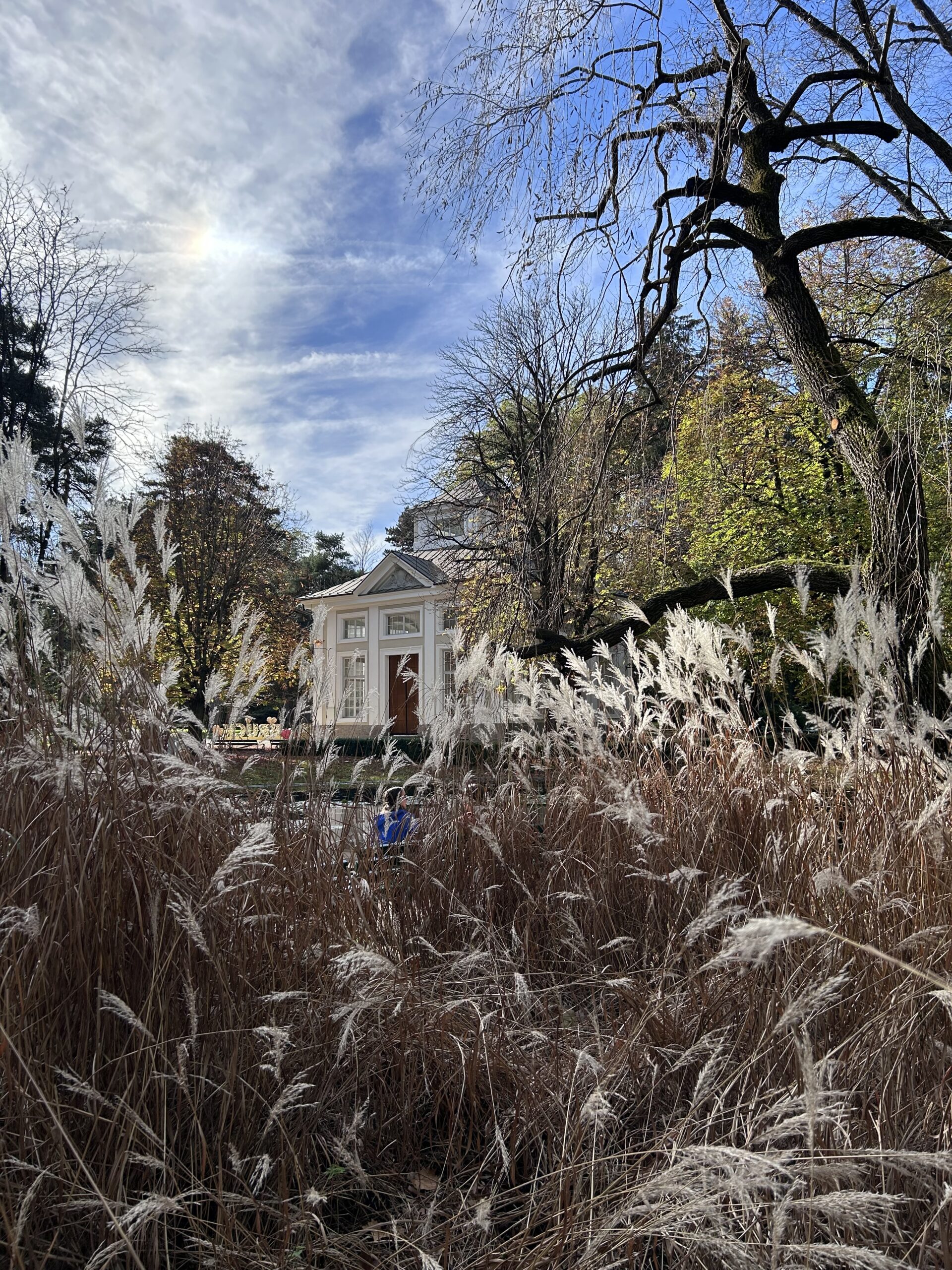
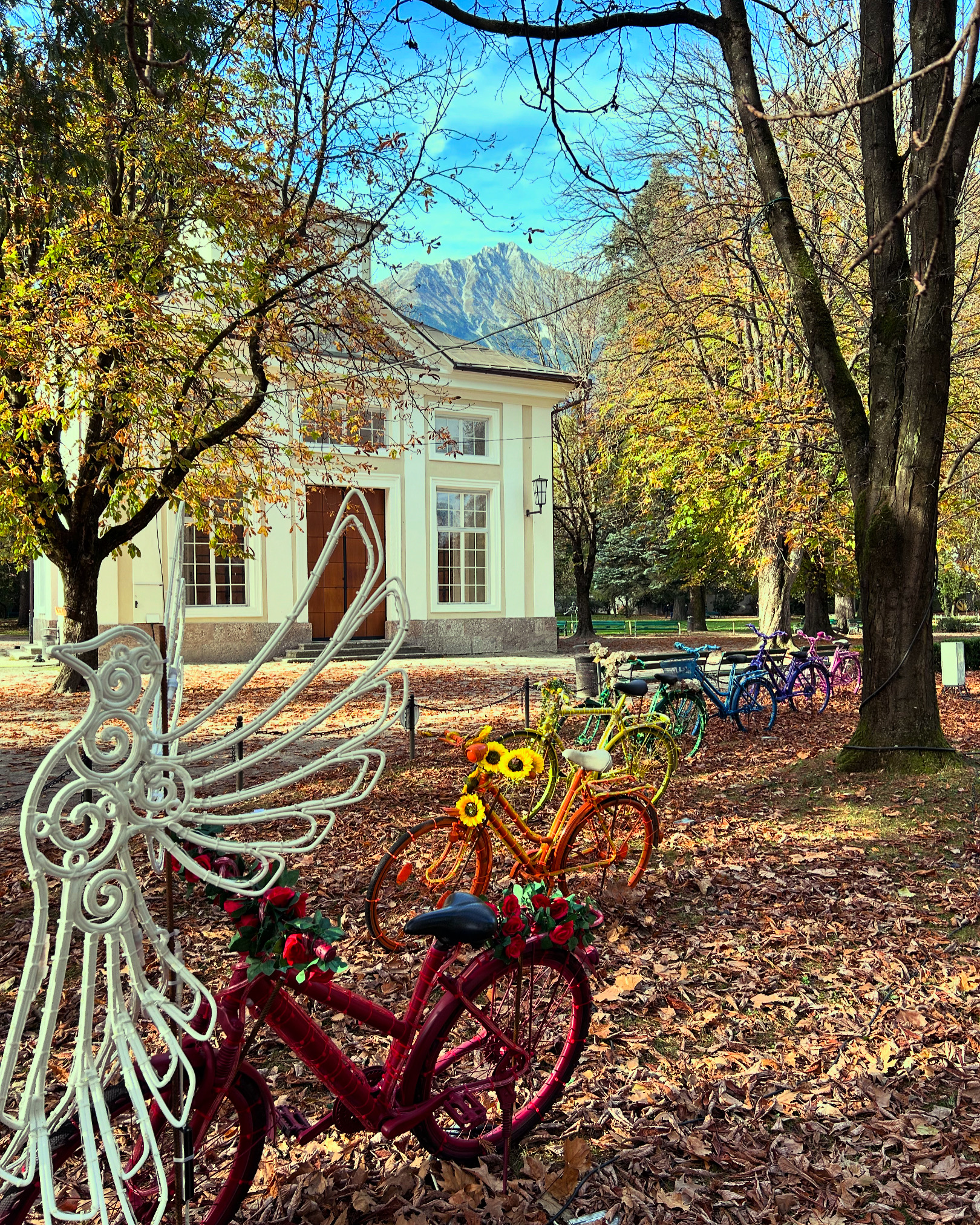
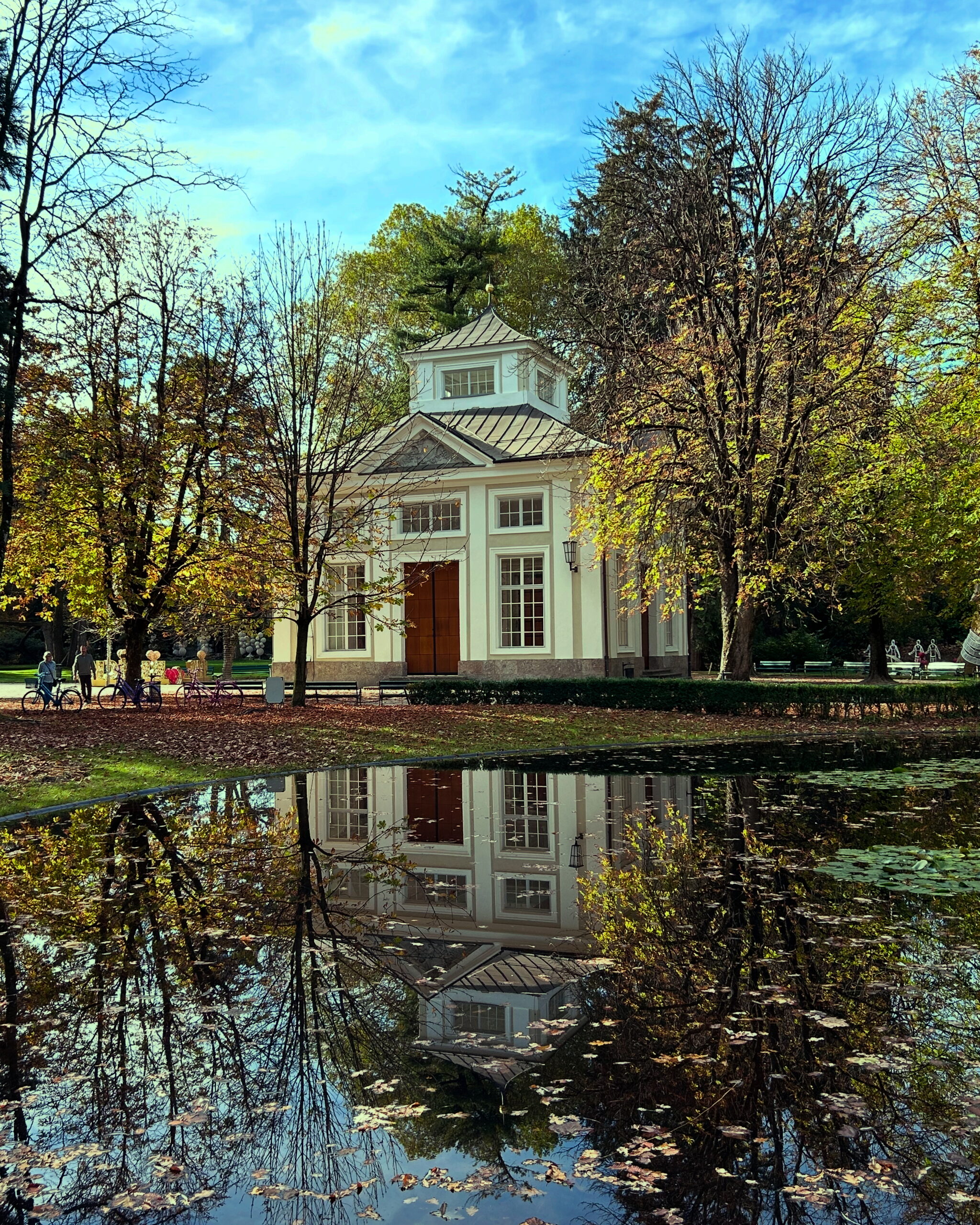
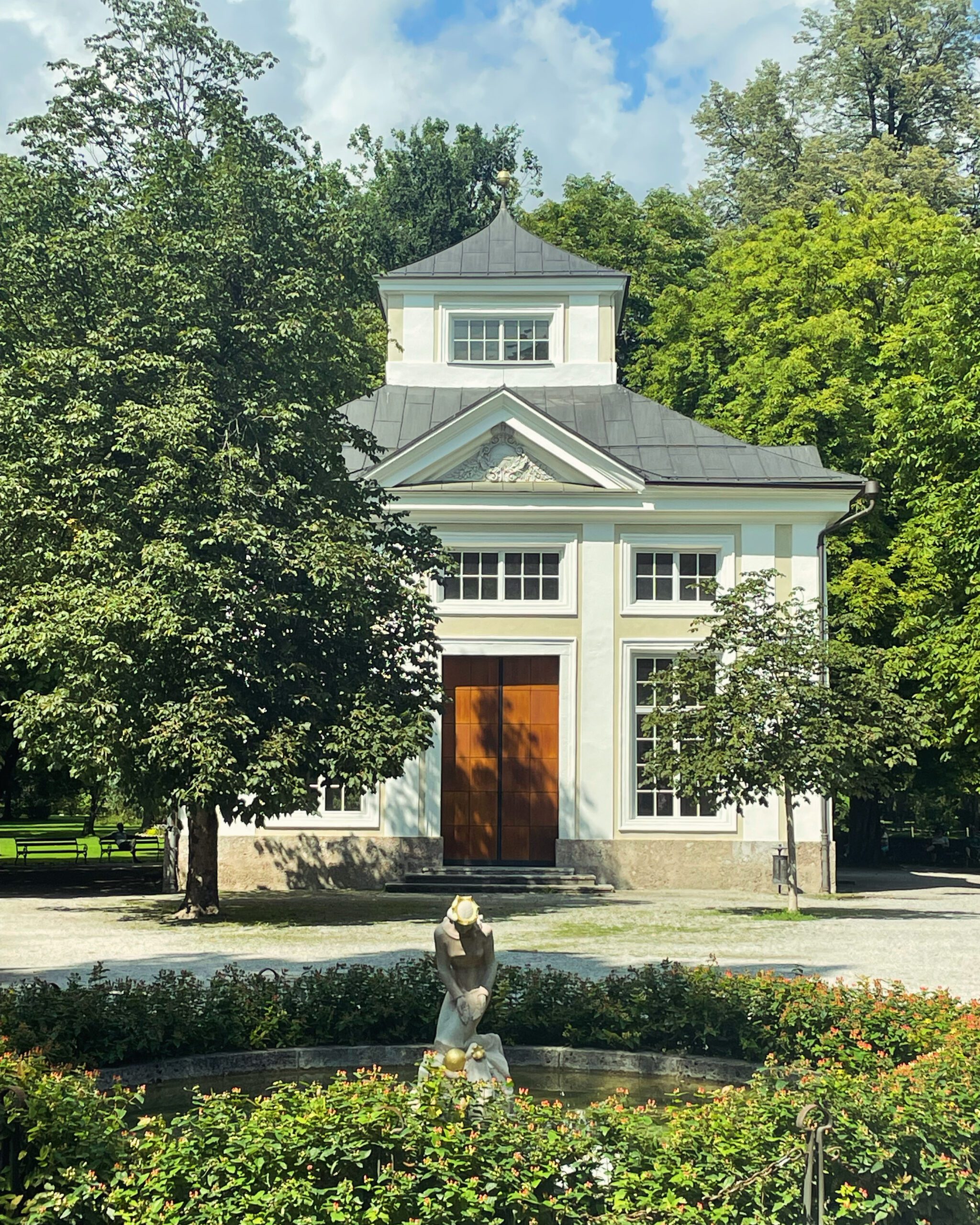
The center of the garden has been the music pavilion of the former imperial garden house since 1773. Free concerts are still held here regularly. In the small pond in front of the pavilion resides the Frog King—at least as a stone statue. It was designed by South Tyrolean sculptor Alexander Lanner, who was also responsible for the “Meraner” in the South Tyrolean settlement Wilten West and the bust of Adolf Hitler in the Golden Roof’s wedding hall during the Nazi era. As with the Salige-Fräulein fountain in Rapoldipark, this artwork still lacks contextualization. The palm house on the northwest edge of the Hofgarten offers over 5,000 tropical plants. It can be seen as a continuation of Ferdinand II’s Würtz and Lustgärten and Innsbruck’s early spirit of research. Unfortunately, in true public-service fashion, it is only open on weekdays.
Even today, the Hofgarten continues to spark debate. After years of lawns being intended more for viewing than for walking on, the Hofgarten has recently opened up more to the needs of a modern public. With the fire that destroyed the old Hofgarten café, gastronomy was lost. Coordination between the Federal Gardens, to which the Hofgarten belongs, and the city often causes head-shaking among Innsbruck residents. The accusation that the Federal Gardens institution remains elitist in the Habsburg style and far removed from the public’s expectations of use is probably not entirely unfounded, given the poverty of events and usage opportunities in the Hofgarten.
The year 1848 and its consequences
The year 1848 occupies a mythical place in European history. Innsbruck was not one of the hotspots like Paris, Vienna, Budapest, Milan or Berlin, but even in the “Holy Land” of Tyrol the revolutionary year left its mark. In contrast to the rural surroundings, an enlightened educated bourgeoisie had developed in Innsbruck. Enlightened people no longer wanted to be subjects of a monarch or territorial prince, but citizens with rights and duties in relation to a modern state. Students and members of the liberal professions demanded political participation, freedom of the press and civil rights. Workers demanded better wages and working conditions. Particularly radical liberals and nationalists even questioned the absolute authority of the Church. In March 1848 this socially and politically highly explosive mixture erupted in uprisings and street fighting in many cities. In Innsbruck, some students and professors celebrated the newly granted freedom of the press with a torchlight procession. On the whole, however, the revolution proceeded quietly in the rather leisurely Tyrol. To speak of a spontaneous outburst of emotion or even a revolution would already be an exaggeration: the date of the procession was postponed from 20 to 21 March because of bad weather. There were hardly any anti-Habsburg riots or violent incidents; a stray stone thrown into a Jesuit window was one of the highlights of the Alpine version of the Revolution of 1848. The students even supported the city magistrate in maintaining public order, thereby demonstrating their gratitude to the monarch for the newly granted freedoms and their loyalty.
The initial enthusiasm for change among the bourgeois elites was soon replaced in Innsbruck by a surge of German-national patriotism. On April 6, 1848, the governor of Tyrol led a ceremonial procession in which the German flag was displayed. A German tricolour was also hoisted on the city tower. While students, workers, liberal-national citizens, republicans, supporters of a constitutional monarchy, and Catholic conservatives could not agree on social issues such as press freedom, they shared a common hostility toward the Italian independence movement, which had spread across northern Italy from Piedmont and Milan. Innsbruck students and riflemen, with the support of the imperial army leadership, marched into the Trentino to suppress unrest and uprisings at an early stage. Notable members of this corps included the already elderly Father Haspinger, who had fought alongside Andreas Hofer in 1809, and Adolf Pichler. Johann Nepomuk Mahl-Schedl, a wealthy owner of Büchsenhausen Castle, even equipped his own company and marched over the Brenner Pass to secure the border. However, the war did not remain confined to the southern borders. Innsbruck itself, as the political and economic center of the multinational crown land of Tyrol and home to many Italian speakers, became an arena of the conflict between nationalities. Combined with ample alcohol consumption, anti-Italian sentiment posed a greater threat to public order than the demand for civil liberties. A dispute between a German-speaking craftsman and an Italian-speaking Ladin escalated to such an extent that it nearly triggered a pogrom against the numerous businesses and inns of Italian-speaking Tyroleans.
The relative calm of Innsbruck suited the imperial court in Vienna, which was under pressure. As unrest in the capital continued after March, Emperor Ferdinand fled to Tyrol in May. According to contemporary press reports, he was enthusiastically welcomed by the population.
"“What is the name of the land to which such an honour falls, what is the people that enjoys such trust in these fateful times? Does the peace and security here rest solely on legend from ancient times, or is there also in the present a foundation on which one can build, which the wind cannot blow away and the storm cannot shake? This Alpine land is called Tyrol, do you like it? Yes, the Tyrolean people alone prove, in the midst of a shaken Europe, reverence and loyalty, courage and strength for their hereditary ruling house, while all around rebellion, contradiction, defiance and demands, often even revolt and upheaval rage; Tyrol alone stands firmly without wavering in custom and obedience, in religion, truth and law, while elsewhere insolence and falsehood, madness and passions prevail …”"
In June, a young Franz Joseph—still not yet emperor—also stopped at the Hofburg on his return from the battlefields of northern Italy instead of traveling directly to Vienna. Innsbruck once again became a royal residence, albeit only for one summer. While blood was shed in Vienna, Milan, and Budapest, the imperial family enjoyed rural Tyrolean life. Ferdinand, Franz Karl, his wife Sophie, and Franz Joseph received guests from foreign courts and were driven by carriage to excursion destinations such as Weiherburg, Stefansbrücke, Kranebitten, and even up to Heiligwasser, and went on hikes. This calm did not last long. Ferdinand, considered no longer fit to rule, handed over power under gentle pressure to Franz Joseph I. In July 1848, the first parliamentary session was held in Vienna, and a constitution came into force. However, the monarchy’s willingness to reform soon waned. The new parliament—the Reichsrat—could not pass binding laws, the emperor never attended it, and he did not understand why a monarchy ordained by God needed such a council.
The subtly initiated liberalization nevertheless ran its course in the cities. Innsbruck was granted the status of a city with its own independent charter (Statutarstadt). In 1850, the "Provisorische Gemeindegesetz für die Landeshauptstadt Innsbruck" ("Provisional Municipal Code for the State Capital of Innsbruck") came into force:
"The municipality is to provide for the sanitation police; it takes care of the paving and maintenance of streets, alleys, and paths, with the exception of those whose maintenance is the responsibility of the Imperial Treasury, as well as for street lighting, the maintenance and cleaning of the main drainage canals, and the maintenance of municipal bridges, fountains, aqueducts, and other facilities, as well as public bathing establishments. It administers the health, fire, market, building, and traffic police, oversees land boundaries, measures, and weights; it is charged with the provision of food supplies, and takes police precautions to avert threats to personal safety and property posed by flooding or other natural disasters."
Innsbruck's municipal law provided for citizenship rights that, while tied to property ownership or tax payments, legally guaranteed certain rights to members of the community. Right of domicile (Heimatrecht) could be acquired through birth, marriage, or extraordinary conferral, granting voting rights at the municipal level to at least adult males. If one fell into financial hardship, one was entitled to basic welfare provided by the city. Within the city government, the Greater German-liberal faction prevailed thanks to the census-based majority voting system, with merchants, tradesmen, industrialists, and innkeepers setting the tone. On June 2, 1848, the first edition of the liberal and Greater German-leaning Innsbrucker Zeitung was published—from which the above article on the emperor's arrival in Innsbruck is taken. Conservatives, on the other hand, read the Volksblatt für Tirol und Vorarlberg. Moderate readers who favored a constitutional monarchy preferred to consume the Bothe für Tirol und Vorarlberg. However, freedom of the press was short-lived. The previously abolished censorship was partially reinstated. Newspaper publishers were subjected to various forms of harassment by the authorities, and newspapers were strictly forbidden from printing content critical of the state government, the monarchy, or the Church.
"Anyone who, by means of printed matter, incites, instigates or attempts to incite others to take action which would bring about the violent separation of a part from the unified state... of the Austrian Empire... or the general Austrian Imperial Diet or the provincial assemblies of the individual crown lands.... Imperial Diet or the Diet of the individual Crown Lands... violently disrupts... shall be punished with severe imprisonment of two to ten years."
After Innsbruck had officially replaced Meran as the provincial capital in 1849 and had thus finally become the political centre of Tyrol, parties began to form. With the establishment of the Catholic-conservative faction and the liberals, a pair of opposing ideas emerged that would shape politics not only until the First World War. Associations of all kinds as political organisations in advance of parties, and newspapers, formed the lines along which society split in all questions of life from the cradle to the grave. From 1868 onwards, the liberal, greater German-oriented party provided the mayor of the city of Innsbruck. The influence of the Church declined in Innsbruck in contrast to the surrounding municipalities. Individualism, capitalism, nationalism and consumption stepped into the breach. New worlds of work, department stores, theatres, cafés and dance halls did not displace religion entirely even in the city, but the weighting shifted as a result of the civil freedoms won in 1848.
The probably most important legal change of 1848 was the land relief patent. In Innsbruck the clergy, especially Wilten Abbey, owned a large part of the agricultural land. The Church and the nobility were exempt from taxes. In 1848/49 feudal lordship and the relationship of subjection were abolished in Austria. Ground rents, tithes and compulsory labour were thus removed. The landowners received one third of the value of their land from the state within the framework of the reform, one third was regarded as tax relief, and one third of the compensation had to be borne by the peasants themselves. They could pay this amount in instalments over twenty years. The after-effects can still be felt today. The descendants of the peasants who were successful at the time enjoy, through inherited land ownership resulting from the 1848 reforms, the fruits of prosperity and also political influence through land sales for housing, leases and compensation payments by public authorities for infrastructure projects. The landowning nobility of the past had to come to terms with the humiliation of taking up bourgeois occupations. The transition from privilege by birth to privileged status within society through financial means, networks and education often succeeded. Many Innsbruck dynasties of academics have their origins in the decades after 1848.
Life also changed for the broader population. The previously unknown phenomenon of leisure time emerged and, together with disposable income available to a greater number of people, fostered hobbies. Civil organisations and associations—from reading circles to choral societies, fire brigades and sports clubs—were founded. The revolutionary year also manifested itself in the cityscape. Parks such as the English Garden at Ambras Castle or the Hofgarten were no longer reserved exclusively for the aristocracy but served citizens as local recreational areas. In St. Nikolaus the Waltherpark was created as a small oasis of calm. One floor above, the first swimming and bathing facility in Tyrol opened at Büchsenhausen Castle; soon afterwards another bath followed in Dreiheiligen. Excursion inns around Innsbruck flourished. Alongside high-end restaurants and hotels, a scene of taverns emerged in which workers and employees could also afford pleasant evenings with theatre, music and dancing.
Maximilian I. and his times
Maximilian ranks among the most significant figures not only in the history of Innsbruck, but in European history as a whole. Of this mountainous land he is said to have remarked: “Tyrol is a coarse peasant’s coat, but one that keeps you warm.” There were many reasons for this special affection. His father, Frederick III, had been born in Innsbruck in 1415, before the city became a princely residence. Like many of his peers in the high aristocracy, Maximilian was an enthusiastic hunter, and the city’s location amid floodplains, forests, and mountains is said to have exerted on him a particular appeal—much as it still does today on German students. Despite these convincing “soft facts,” it was probably more tangible reasons that led him to conduct a considerable part of his governmental business from Innsbruck. In 1490, at the request of the Estates of the Land, he assumed the government of Tyrol from his predecessor Sigismund. The powerful Habsburg was unwilling to relinquish the important assets the region had to offer from the Habsburg portfolio. Maximilian transformed the former trading settlement on the Inn into one of the most important centers of the Holy Roman Empire, thereby permanently shaping its destiny. Innsbruck’s strategically advantageous location close to the Italian theaters of war also made the city highly attractive to the Emperor. Many Tyroleans were compelled to enforce the imperial will on the battlefield instead of tending their own fields. This changed only toward the end of his reign. In 1511, Maximilian granted the Tyroleans the Tyrolean Landlibell, a kind of constitution, which stipulated that they could only be called upon for military service in defense of their own land. What admirers of Maximilian—who like to regard the document as a charter of liberty—often overlook are the associated obligations, such as the levying of special taxes in the event of war. For Innsbruck the arrangement paid off in any case—if not financially, then at least culturally. “Whoever does not create a memory for himself in life will have no memory after death, and such a person will be forgotten with the peal of the bell.” Maximilian countered this fear quite successfully and deliberately through the erection of highly visible symbols of imperial power, such as the Golden Roof. Propaganda, imagery, and media played an increasingly important role, not least due to the emergence of printing. Maximilian made deliberate use of art and culture to maintain his presence. He kept a Reich Chapel Choir, a musical ensemble that performed primarily at public appearances and receptions of international envoys. A veritable cult of personality was staged around him through coins, books, printed works, and paintings.
For all the romance cultivated by this lover of courtly traditions and classical chivalry, Maximilian was a cool-headed power politician. His cultural policy and propaganda may have drawn on medieval models, but in realpolitik terms he was forward-looking. During his reign, political institutions such as the Imperial Diet (Reichstag), the Imperial Aulic Council (Reichshofrat), and the Imperial Chamber Court (Reichskammergericht) emerged, strictly regulating the relationship between subjects, territorial lords, and monarchy. Around 1500, Tyrol had approximately 300,000 inhabitants. More than 80 percent worked in agriculture and lived largely from the yields of their farms. In a veritable frenzy of new legislation, Maximilian curtailed peasant rights to the commons. Timber harvesting, hunting, and fishing were subordinated to the territorial lord and were no longer communal rights. This had negative effects on peasant self-sufficiency. Thanks to the new laws, hunters became poachers. Meat and fish, long staples of the medieval diet, became luxuries that could often only be obtained illegally. As a result, Maximilian was unpopular among large segments of the population during his lifetime.
Restrictions on self-sufficiency were joined by new taxes. It had always been customary for sovereigns to impose additional taxes on the population in the event of war. Maximilian's warfare differed from medieval conflicts. The auxiliary troops and their noble, chivalrous landlords were supplemented or completely replaced by mercenaries who knew how to use modern firearms.
This new way of waging war consumed enormous sums. When revenues from princely rights—such as minting, market, mining, and customs monopolies—were no longer sufficient, various population groups were taxed according to their estate and wealth. The system, however, was still far removed from today’s differentiated taxation models and consequently produced injustice and resentment. One example was Maximilian’s Gemeiner Pfennig. This wealth tax ranged from 0.1 to 0.5 percent of assets but was capped at one gulden. Jews, irrespective of their wealth, were required to pay a poll tax of one gulden. For the first time, princes were also obliged to contribute, but due to the cap they paid no more than a middle-class Jew. The proclamation and execution of the tax fell to prelates, parish priests, and secular lords. Priests were required to announce the tax from the pulpit on three successive Sundays, collect contributions together with court representatives, and enter them into the imperial tax register. It soon became clear that this method of taxation was unworkable. A modern system and tax model were required. A collegial chamber, the Regiment, centrally supervised Tyrol and Further Austria following the modern model of Burgundian financial administration that Maximilian had encountered during his time in the Netherlands. Innsbruck became the financial and accounting center of the Austrian lands. The Audit Chamber (Raitkammer) and the Privy Treasury (Hauskammer) were located in the Neuhof, where today the Golden Roof looks down over the old town. In 1496, the financial resources of the Austrian hereditary lands were consolidated in the treasury in Innsbruck. The head of the Court Chamber was the Bishop of Brixen, Melchior von Meckau, who increasingly involved the Fugger family as creditors. Officials such as Jakob Villinger (1480–1529) handled financial transactions with banking houses across Europe using the Italian-influenced method of double-entry bookkeeping and attempted to keep imperial finances under control. Talented minor nobles and citizens, trained jurists, and professional administrators replaced the high nobility in leading roles. Financial experts from Burgundy held the commercial leadership of the Regiment. The boundaries between finance and other fields such as war planning and domestic policy became fluid, granting this new administrative class considerable power. Where once equilibrium between territorial lord, church, landlord, and subject had rested on a balance of contributions and military protection, this system was now enforced through coercion from above. Maximilian argued that it was the duty of every Christian, regardless of estate, to defend the Holy Roman Empire against external enemies. The records surrounding disputes between king, nobility, clergy, peasants, and towns over tax obligations strongly resemble modern political debates on power and wealth distribution. The crucial difference from earlier centuries lay in the fact that the modern administrative apparatus now made it possible to enforce and collect these taxes. Comparisons to mandatory cash registers, the taxation of tips in the hospitality industry, or debates over abolishing cash transactions suggest themselves. Capital followed political significance to Innsbruck as well. During his reign, Maximilian employed 350 councillors. Nearly a quarter of these well-paid officials came from Tyrol. Envoys and politicians from across Europe, extending as far as the Ottoman Empire, as well as nobles, built residences in Innsbruck or stayed in its inns. Much like today’s oil wealth draws specialists of all kinds to Dubai, Schwaz silver and the financial economy it generated once attracted experts of all kinds to Innsbruck—a small city amid the inhospitable Alps.
Under Maximilian’s rule, Innsbruck underwent architectural and infrastructural transformation on an unprecedented scale. In addition to constructing the prestigious Golden Roof, he remodeled the Imperial Palace, began construction of the Court Church, and created the Innsbruck Arsenal, Europe’s leading weapons manufactory. Streets through the old town were reinforced and paved for the refined members of the court. As a pious Christian in the chivalric tradition, the Emperor also aided the poorest members of society. In 1499 he renovated and expanded the Salvator Chapel, a hospital for destitute Innsbruck residents who had no claim to a place in the municipal hospital. In 1509, the inner-city cemetery was relocated from today’s Cathedral Square to behind the municipal hospital, at what is now Adolf-Pichler-Platz. Maximilian rerouted the trade road through present-day Mariahilf and improved the city’s water supply. A fire ordinance for Innsbruck followed in 1510. He also began to curtail the privileges of Wilten Abbey, the largest landowner in what is today the city area. Infrastructure owned by the monastery—such as mills, sawmills, and the Sill Canal—was to come under stronger princely control.
The imperial court and the affluent administrative class resident in Innsbruck transformed the city’s appearance and demeanor. Maximilian had introduced the refined courtly culture of Burgundy to Central Europe through his first wife. Culturally, however, it was above all his second wife, Bianca Maria Sforza, who promoted Innsbruck. Not only was their royal wedding celebrated there, she also resided in the city for long periods, as it lay closer to her native Milan than Maximilian’s other residences. She brought her entire court from the Renaissance metropolis into the German lands north of the Alps. Art and entertainment in all forms flourished.
Under Maximilian, Innsbruck not only became a cultural centre of the empire, the city also boomed economically. Among other things, Innsbruck was the centre of the postal service in the empire. Maximilian was able to build on the expertise of the gunsmiths who had already established themselves in the foundries in Hötting under his predecessor Siegmund. Platers, foundry operators, powder stampers and cutlers settled in Neustadt, St. Nikolaus, Mühlau, Hötting and along the Sill Canal. The Fugger merchant dynasty maintained an office in Innsbruck. In addition to his favoured love of Tyrolean nature, the treasures such as salt from Hall and silver from Schwaz were at least as dear and useful to him. Maximilian financed his lavish court, his election as king by the electors and the eight-year war against the Republic of Venice by mortgaging the country's mineral resources, among other things.
Assessing Maximilian’s impact on Innsbruck is challenging. Expressions of affection by an emperor naturally flatter the popular imagination to this day. His material legacy, with its many monumental buildings, reinforces this positive image. He made Innsbruck an imperial residence and advanced infrastructural modernization. Thanks to the arsenal, the city became a center of the arms industry, the treasury of the Empire, and expanded both economically and spatially. Yet the debts he incurred and the regional assets he pledged to the Fugger family shaped Tyrol after his death just as profoundly as the strict laws he imposed on the common population. He is said to have left debts amounting to five million gulden—an amount his Austrian territories could have earned over twenty years. Outstanding payments ruined many businesses and service providers after his death, leaving them stranded on imperial promises. Early modern rulers were not bound by their predecessors’ liabilities; only agreements with the Fugger family constituted an exception, as these involved collateral rights. In the legends surrounding the Emperor, these harsh realities are far less present than the Golden Roof and the soft facts learned in school. In 2019, celebrations marking the 500th anniversary of the death of what was arguably the most important Habsburg for Innsbruck were held under the slogan “Tyrolean at heart, European in spirit.” The Viennese-born ruler was benevolently naturalized. Salzburg has Mozart; Innsbruck has Maximilian—a Emperor whom Tyroleans have adapted to fit the desired identity of Innsbruck as a rugged character happiest in the mountains. His distinctive face today adorns all manner of consumer goods, from cheese to ski lifts; the Emperor serves as patron for all kinds of the profane. Only for political agendas is he less easily harnessed than Andreas Hofer. For the average citizen, it is probably easier to identify with a revolutionary innkeeper than with an emperor.
Ferdinand II: Principe and Renaissance prince
Archduke Ferdinand II of Austria (1529–1595) ranks among the most colourful figures in Tyrolean regional history. His father, Emperor Ferdinand I, ensured that he received an excellent education. Ferdinand grew up at the Spanish court of his uncle, Emperor Charles V. The years of his formal education coincided with the early phase of Jesuit influence at the Habsburg courts. The young statesman was educated by these devout scholars entirely in the spirit of Christian humanism, complemented by instruction in the customs and etiquette of the High Renaissance aristocracy. In his youth, Ferdinand travelled extensively through Italy and Burgundy, where he became acquainted with a refined and luxurious courtly lifestyle that had not yet been established among the German aristocracy. He also spent several formative years in Innsbruck. Ferdinand was what one might today describe as a globetrotter, a member of the educational elite, or a cosmopolitan. He was regarded as intelligent, charming, and artistically inclined. Among contemporaries less enamoured of his eccentricity, however, he was reputed to be immoral and hedonistic. Even during his lifetime, rumours circulated that he hosted extravagant and indecent orgies. This reputation was likely connected to his private life. In a first, “semi‑morganatic” marriage, Ferdinand was wed to the commoner Philippine Welser. After the death of his first wife, Ferdinand married at the age of fifty‑three the deeply religious Anna Caterina Gonzaga, a sixteen‑year‑old princess of Mantua. Mutual affection between the two appears to have been limited, not least because Anna Caterina was Ferdinand’s niece. The Habsburgs were far less squeamish about marriages within the family than about unions between nobles and commoners. From this marriage, too, Ferdinand “only” fathered three daughters.
After the rarely Ferdinand I, Innsbruck once again gained a resident ruler. Ferdinand’s father divided his realm among his sons. Maximilian II, suspected by his parents of heresy and sympathy with Protestant doctrines, inherited Upper and Lower Austria as well as Bohemia and Hungary. Ferdinand’s younger brother Charles ruled Inner Austria—Carinthia, Styria, and Carniola. The middle son received Tyrol, which at the time extended as far as the Engadin, along with the fragmented Habsburg possessions west of the central European core lands. The golden age of silver mining in Tyrol was already fading. The mines of Schwaz were becoming unprofitable due to cheap silver imports from the Americas. The influx of precious metals from the Habsburg territories in New Spain led to inflation. These financial challenges did not deter Ferdinand from commissioning extensive public and private infrastructure projects. Innsbruck benefited enormously—economically and culturally—from once again becoming the seat of an active ruler after years of neglect following Maximilian’s death. Ferdinand’s archducal presence attracted aristocrats and officials back to the city. By the late 1560s, the administrative apparatus had grown once again to around one thousand people, whose spending stimulated local commerce. Bakers, butchers, and inns flourished after leaner years. By the end of the sixteenth century, Innsbruck had an above‑average number of taverns compared to other cities, profiting handsomely from merchants, travellers, and guests. Wine taverns also functioned as storage and trading centres.
The Italian cities of Florence, Venice and Milan were trendsetters in terms of culture, art and architecture. Ferdinand's Tyrolean court was to be in no way inferior to them. Gone were the days when Germans were considered uncivilised in the more beautiful cities south of the Alps, barbaric or even as Pigs were labelled. To this end, he had Innsbruck remodelled in the spirit of the Renaissance. In keeping with the trend of the time, he imitated the Italian aristocratic courts. Court architect Giovanni Lucchese assisted him in this endeavour. Ferdinand spent a considerable part of his life at Ambras Castle near Innsbruck, where he amassed one of the most valuable collections of works of art and armour in the world. Ferdinand transformed the castle above the village of Amras into a modern court. His parties, masked balls and parades were legendary. During the wedding of a nephew, he had 1800 calves and 130 oxen roasted. Wine is said to have flowed from the wells instead of water for 10 days.
The transformation of Innsbruck did not end with Ambras Castle. West of the city, an archway still commemorates Ferdinand’s game reserve, complete with a pleasure pavilion (Lusthaus), also designed by Lucchese. To allow the sovereign access to his weekend residence, a road was laid through the marshy Höttinger floodplains, forming the basis of today’s Kranebitter Allee. The Lusthaus was replaced in 1786 by the structure now known as the Powder Tower (Pulverturm), which today houses parts of the University of Innsbruck’s Faculty of Sport Science. In the city centre, Ferdinand commissioned the princely Comedihaus on today’s Rennweg. To improve Innsbruck’s water supply, the Mühlau Bridge was constructed, allowing water from the Mühlau stream to be channelled into the city. The Jesuits, who had arrived in Innsbruck shortly before Ferdinand’s accession to counter reformers and critics of the Church and to reorganise education, were granted a new church in Silbergasse. Numerous new buildings—including the monasteries of the Jesuits, Franciscans, Capuchins, and Servite nuns—stimulated crafts and construction. These new orders supported Ferdinand’s emphasis on the confessional conformity of his subjects. In the Tyrolean Provincial Ordinance of 1573, Ferdinand not only sought to curb fornication, profanity, and prostitution, but also obliged his subjects to live a God‑fearing—i.e. Catholic—life. The “Prohibition of Sorcery and Superstitious Divination” outlawed any deviation from the true faith under threat of imprisonment, corporal punishment, and confiscation of property. Jews were required to wear a clearly visible yellow ring on the left side of their clothing. At the same time, Ferdinand brought a Jewish financier to Innsbruck to manage the court’s complex finances. Samuel May and his family lived in the city as protected court Jews; Daniel Levi entertained the archduke with dance and harp music, while Elieser Lazarus served as his personal physician.
To live lavishly, tax the population heavily, tolerate Protestant advisers at court while suppressing Protestantism among the populace posed no contradiction for a Renaissance prince. Ferdinand saw himself as Advocatus Ecclesiae, the secular representative of the Church, responsible in an absolutist confessional sense for the salvation of his subjects’ souls. At the age of fifteen, he had already marched into battle with his uncle Charles V during the Schmalkaldic War against the enemies of the Roman Church. Coercive measures, the founding of churches and monasteries—such as those of the Franciscans and Capuchins in Innsbruck—improved pastoral care, and Jesuit theatrical productions like The Beheading of John were among the preferred weapons against Protestantism. Ferdinand’s piety was sincere, yet like most of his contemporaries he was adept at adapting to circumstances. His policies reflected the influence of contemporary Italian avant‑garde thought. Machiavelli’s Il Principe argued that rulers were permitted whatever was necessary for success—and could be deposed if they failed. Ferdinand II sought to embody this early absolutist style of leadership and, with his Provincial Ordinance, introduced a comparatively modern legal framework. For his subjects, however, this meant higher taxes, as well as significant restrictions on common land usage, fishing, and hunting rights. Miners, mining entrepreneurs, and foreign trading companies with their counting houses in Innsbruck further drove up food prices. In summary, while Ferdinand enjoyed exclusive hunting privileges on his estates, his subjects endured hardship caused by rising burdens, inflation, and game damage exacerbated by hunting bans. Owing largely to his architectural legacy, Ferdinand continues to enjoy a favourable reputation today. The eccentric archduke found his final resting place—fittingly according to his own tastes—in the Silver Chapel, beside his first wife, Philippine Welser.
Maria Theresia, Mother of the Nation and Reformer
Maria Theresa ranks among the most important figures in Austrian history. Particularly significant were her domestic reforms, many of which had a tangible impact on the everyday lives of Innsbruck’s inhabitants and are still visible today in the city’s built environment. Together with her most influential advisers—Friedrich Wilhelm von Haugwitz, Joseph von Sonnenfels, and Wenzel Anton Kaunitz—she succeeded in transforming the so‑called Austrian hereditary lands into a modern state. Instead of governing her territories through the local nobility, she relied on a centralized, professional administration. In keeping with Enlightenment thought, her advisers recognized that the welfare of the state depended on the health and level of education of its individual subjects. An early healthcare reform of 1742 obliged the professors of medicine at the University of Innsbruck not only to teach but also to ensure the operation of the municipal hospital in the Neustadt district. A school reform likewise reshaped the educational landscape within the city walls, both spatially and conceptually. Due to a lack of space, the school was relocated from Domplatz to Kiebachgasse, and its educational mission was redefined. Subjects were expected to remain Catholic, but their loyalty was to be directed toward the state. Education was placed under centralized state control in order to develop talents in a targeted manner. The aim was not to raise critical, humanistic intellectuals, but rather to train personnel for the state administrative apparatus. This reform laid the foundation for later social mobility. Through military service and civil administration, non‑nobles were now able to pursue careers and climb the social ladder. Any improvement of the individual was regarded as a gain for the whole. Further measures followed that affected not only the national economy but also the daily lives of most people. The standardization of weights and measures made the tax system more precise and less susceptible to abuse. For farmers, the harmonization of laws meant that their livelihoods were less dependent on local landlords and their arbitrary decisions. The Robot—the unpaid compulsory labor owed by peasants to their landlords—was also abolished under Maria Theresa. A shift in thinking likewise took place in criminal prosecution and the judicial system. In 1747, a small police force was established in Innsbruck to oversee market regulation, trade and guild regulations, control of foreigners, and public morals. Above all, this served to regulate the provision of goods in favor of consumers. Not only poor quality but also price gouging was punished. The strictness of early food inspections is illustrated by a police record from 1748, in which a butcher from Pradl was fined for exceeding the legally fixed meat prices. This denser network of regulations and improved law enforcement went hand in hand with a more humane system of punishment. Although the criminal code Constitutio Criminalis Theresiana did not abolish torture, it did strictly regulate its use. Yet despite Maria Theresa’s self‑presentation as a pious mother of the land and her reputation today as an Enlightenment ruler, the devoutly Catholic sovereign was uncompromising when it came to power and religion. In keeping with Enlightenment thought, she ordered critical investigations into superstitions such as vampirism, which was widespread in the eastern parts of her realm, and initiated the final end of the witch trials. At the same time, however, Protestants were ruthlessly expelled from the country. Many Tyroleans were forced to leave their homeland and resettle in more remote regions of the Habsburg monarchy.
In crown lands such as Tyrol, which had previously enjoyed a high degree of autonomy, Maria Theresa’s reforms were met with little approval. Centralization remains a sensitive issue in Austrian politics to this day. With the exception of a few liberals, people saw themselves more as an independent, autonomous land and less as part of a modern territorial state. The clergy also resented their new subordinate role, which was further intensified under Joseph II. For the local nobility, the reforms meant not only a loss of status and autonomy but also higher taxes and levies. Taxes, duties, and customs revenues that had long provided Innsbruck with reliable income were now collected centrally and only partially returned through fiscal redistribution. To mitigate the social decline of sons from impoverished noble families and prepare them for state service, Maria Theresa founded the Theresianum, which also had a branch in Innsbruck from 1775 onward. As so often, time smoothed over former conflicts, and today Innsbruck’s inhabitants take pride in having hosted one of the most significant rulers in Austrian history. Not only the Triumphal Arch and the Imperial Palace (Hofburg), but also the Turnvereinshaus and the New City School recall the Theresian era, a period in which the state began to intervene ever more deeply in the lives of its citizens from the moment they entered school.