Turnusvereinshaus & Waltherpark
Innstraße 2
Worth knowing
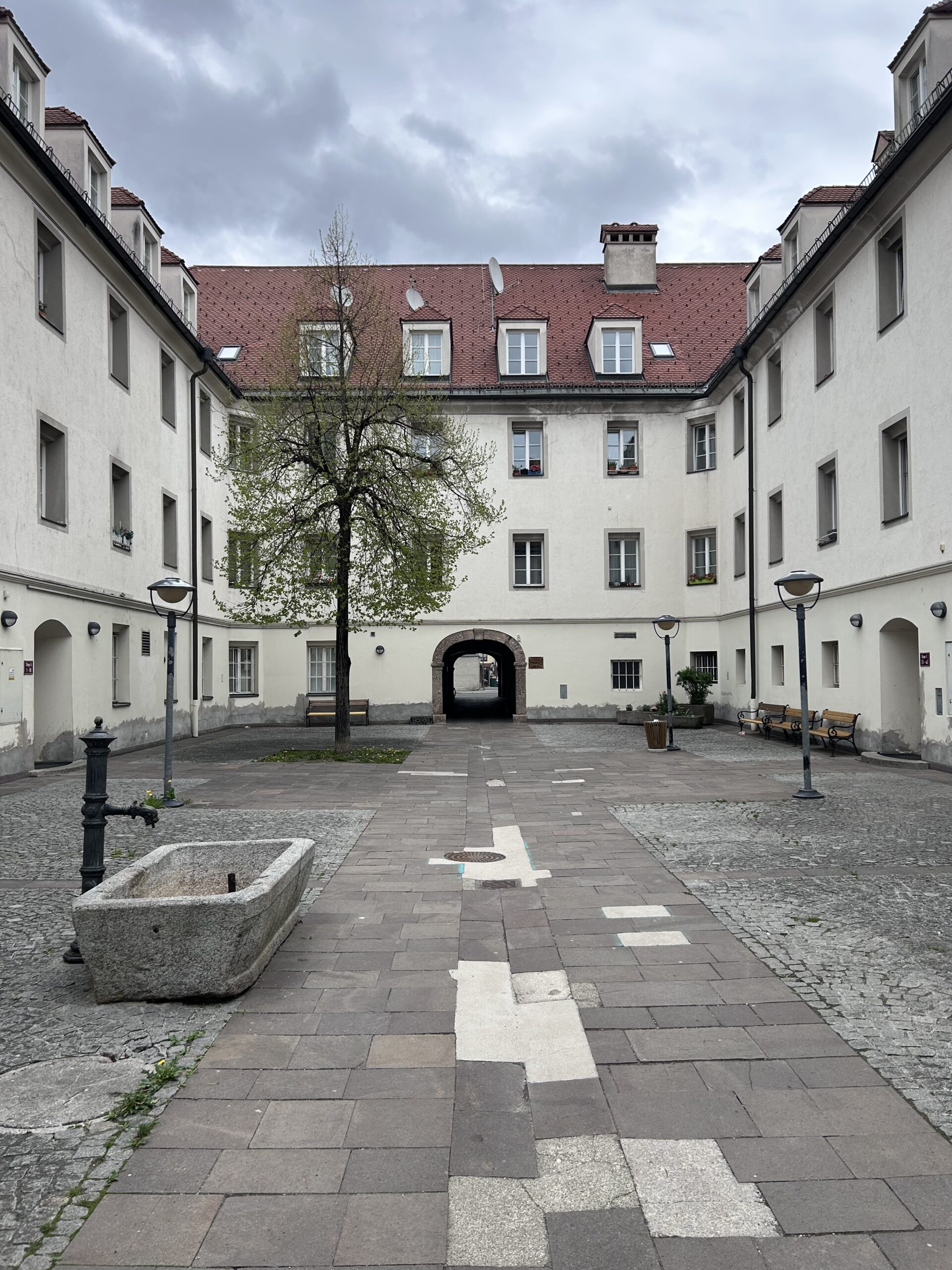
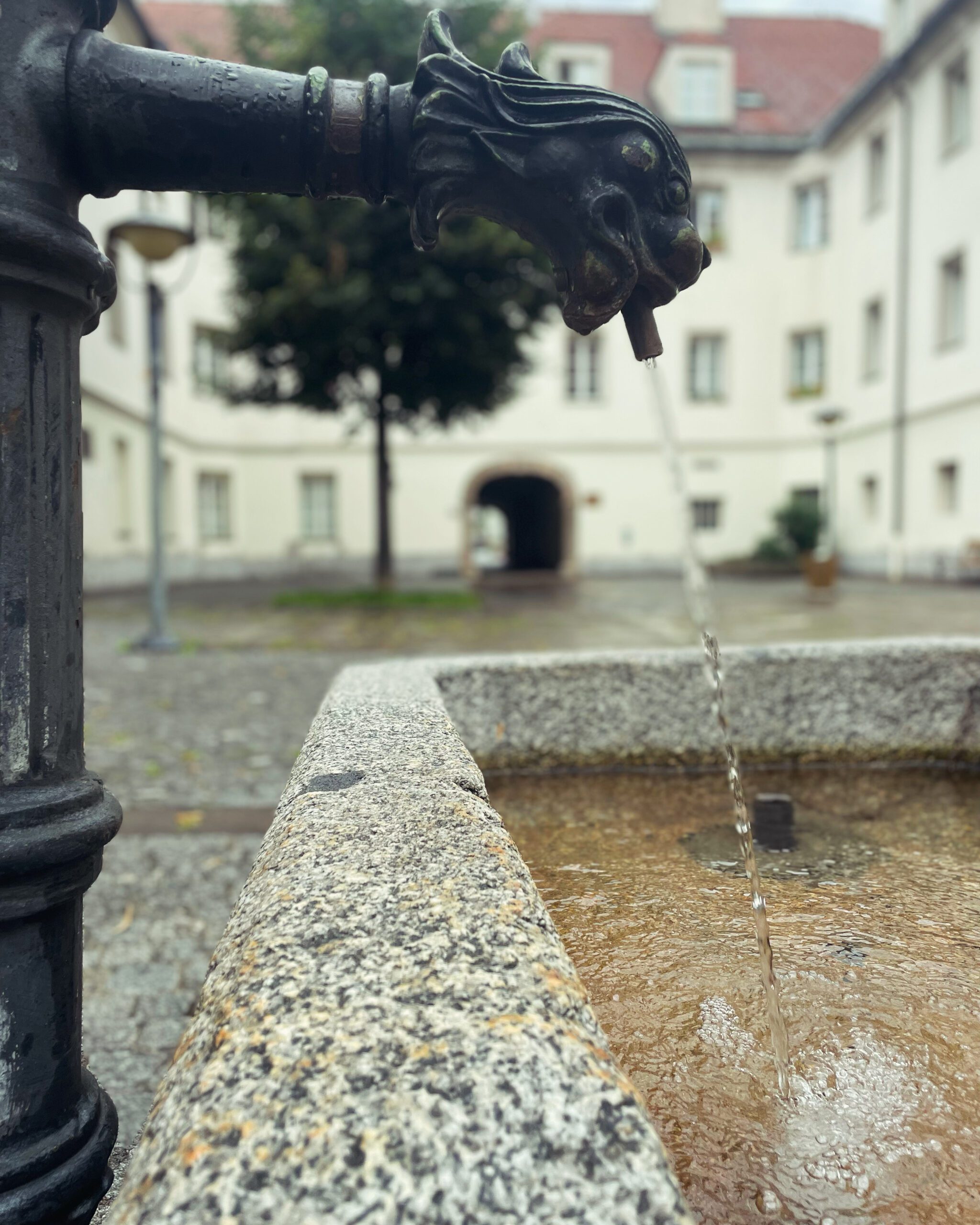
Hier ist die Übersetzung des Abschnitts: Where apartments and shops are located today, a penitentiary once stood. The core of the house dates back to the 18th century in terms of its appearance. The three-story building stretches along the Innrain. A small turret crowns the barracks-like structure with an arcade gallery that nowadays houses shops and restaurants. With its notable fountain and barred windows, the inner courtyard still retains the look and feel of the Turnusvereinshaus's past uses today. In the 18th century, it was not only the number of citizens that grew; the rate of beggars and alms recipients also skyrocketed. Paired with the emergence of a new, more enlightened understanding of the law, the need arose "to detain work-shy and dissolute people and to receive individuals arriving via deportation orders (Schub)." The Kräuterturm on the eastern side of the city wall had not been a prison, but rather a detention facility. Long-term deprivation of liberty was not standard practice; a stay in prison served merely as a transition until the court date, where the actual sentence was handed down. For a long time, the plan to open a penal institution failed due to lack of financing. Only through the scheme of offsetting construction costs through forced labor could the detention facility finally be completed. In 1725, after nearly fifteen years of construction work, the penitentiary opened its doors. The new penal institution was not a prison, but a workhouse: inmates were expected to pay for their stay through the labor of their own hands. Around 300 individuals worked under the most difficult conditions in the linen factory, and later in the loden factory. The most common offenses were theft, assault, murder, and infanticide—which essentially represented post-birth abortion. It was not only convicts who were housed here; beggars were also expected to earn their keep. While these "dissolute people" had still been under the patronage of church institutions such as the Sondersiechenhaus (leper house) during the Middle Ages and Early Modern Period, attitudes toward individuals unable to work shifted during the all-rationalizing Enlightenment. Entirely in line with Enlightenment ideals, this was meant to serve both the good of society and to bring about individual reform and reintegration for the offender. In 1859, the City of Innsbruck purchased the building and passed it on to the city's Turnusverein (Billeting Association). At that time, it was customary and obligatory for citizens of the city to host soldiers passing through in their own homes. With the Italian Wars of Independence, the number of marching soldiers transported over the Brenner Pass to the battlefields increased. Those who could afford it became members of the Einquartierungs-Turnusverein and could thus transfer the soldiers who were supposed to stay in their private apartments to the Turnusvereinshaus. In 1869, this civic duty was abolished. With the opening of the railway line over the Brenner Pass, the stopover in Innsbruck vanished. The drastically reduced time required to move troops from point A to point B not only revolutionized warfare, but also rendered facilities like the Turnusvereinshaus obsolete. Following the reorganization of the police force in 1866, the Turnusvereinshaus was converted into the State Gendarmerie Headquarters (Landesgendarmeriekommando). The Turnusvereinshaus was the ideal property to accommodate the new authority. The empire-wide decree that granted state capitals control over the executive force was a very elegant way to relieve the state treasury.
"His Imperial and Royal Apostolic Majesty has been most graciously pleased, by Most High Resolution of January 19, to approve the dissolution of the Imperial and Royal Police Directorate in Innsbruck. Pursuant to a decree by the Imperial and Royal Ministry of Police dated January 23, this dissolution will take effect on April 1 of this year. Starting from that date, the state police duties previously handled by the Police Directorate will be transferred to the Office of the State Governor (Statthaltereipräsidium), whereas local police matters—in accordance with Article V of the Law of March 5, 1862—will be assumed by the municipality of the provincial capital and by the municipalities of Wilten, Hötting, Pradl, and Mühlau."
During the First World War, the building served as a temporary transit camp for Italian prisoners of war. The Turnusvereinshaus had once again turned into a prison. Most of the detained soldiers remained in Innsbruck only briefly for holding purposes before being relocated to larger camps in eastern Austria, including Mauthausen. Today, Innsbruck's correctional facility is located on the western outskirts of the city. In local vernacular, it is commonly known as the "Ziegelstadl" (brick barn).Zieglstadl“. Der Name rührt von einer Ziegelbrennerei, die vor der Übersiedlung des Gefängnisses 1964 seit 90 Jahren ihren Dienst getan hatte. Der Umzug in die moderne Haftanstalt an den Stadtrand brachte vorerst allerdings nur örtlich eine Veränderung mit sich. Bei allen Neuerungen, die Österreichs Strafvollzug durch die Jahrhunderte und die verschiedenen Regierungsformen hinweg erfuhr, mag es erstaunen, wie kurz der Ansatz der Wiedereingliederung von Tätern in die Gesellschaft erst in Kraft ist. Noch in den 1970ern war es üblich, Menschen in den Kerker mit Lichtentzug oder in Einzelhaft zu stecken und sie regelmäßig Nahrungsentzug zusätzlich zu bestrafen.
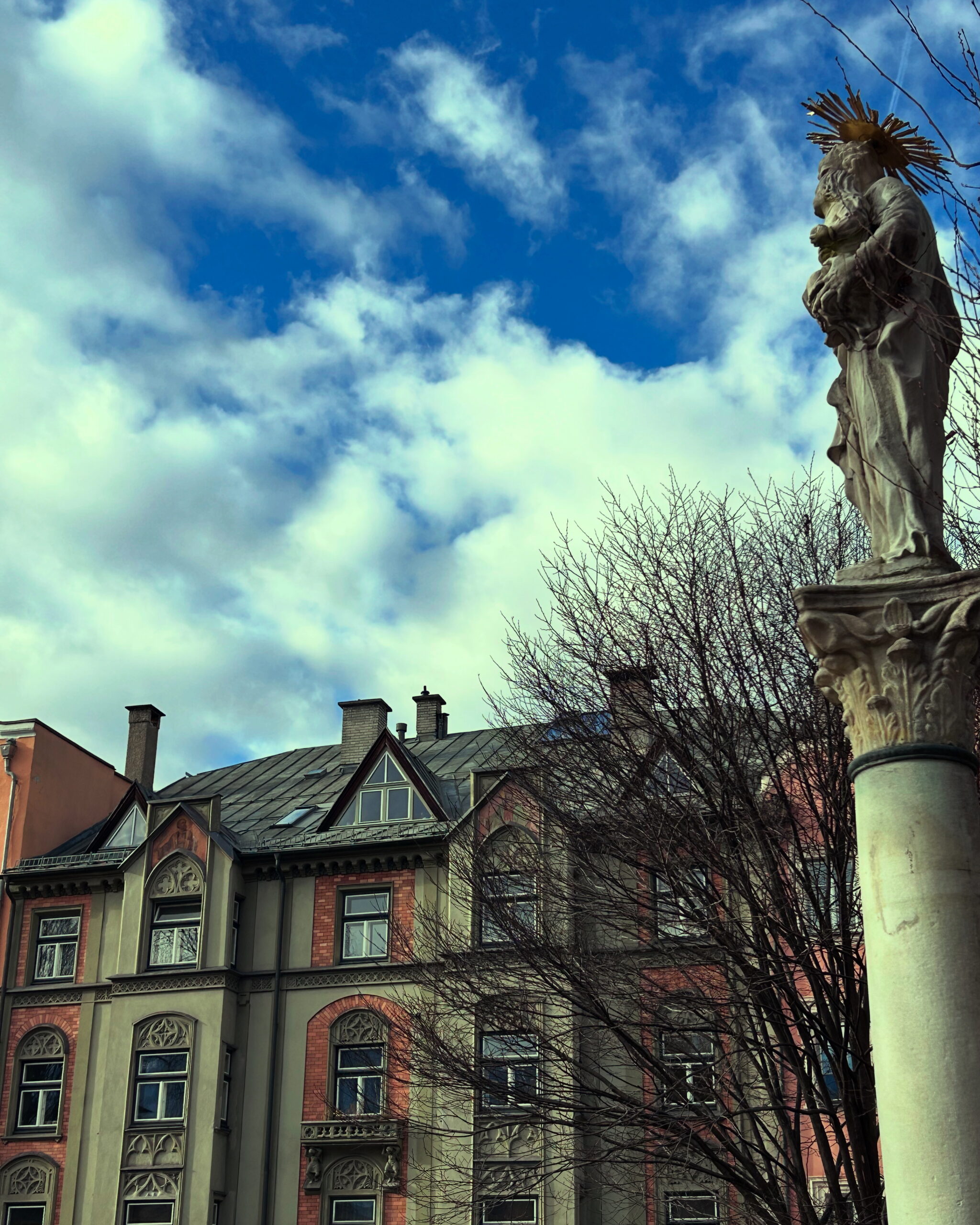
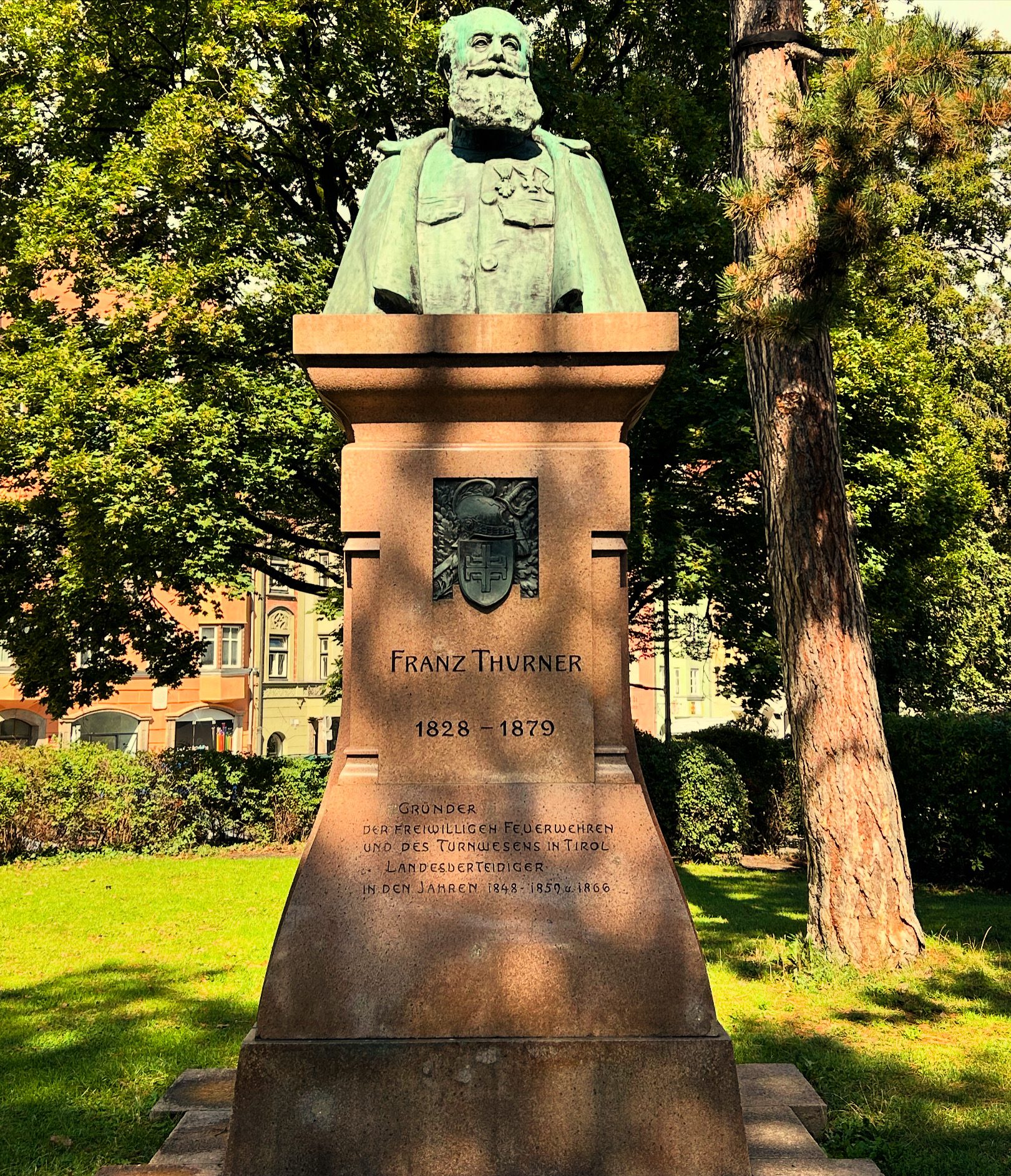
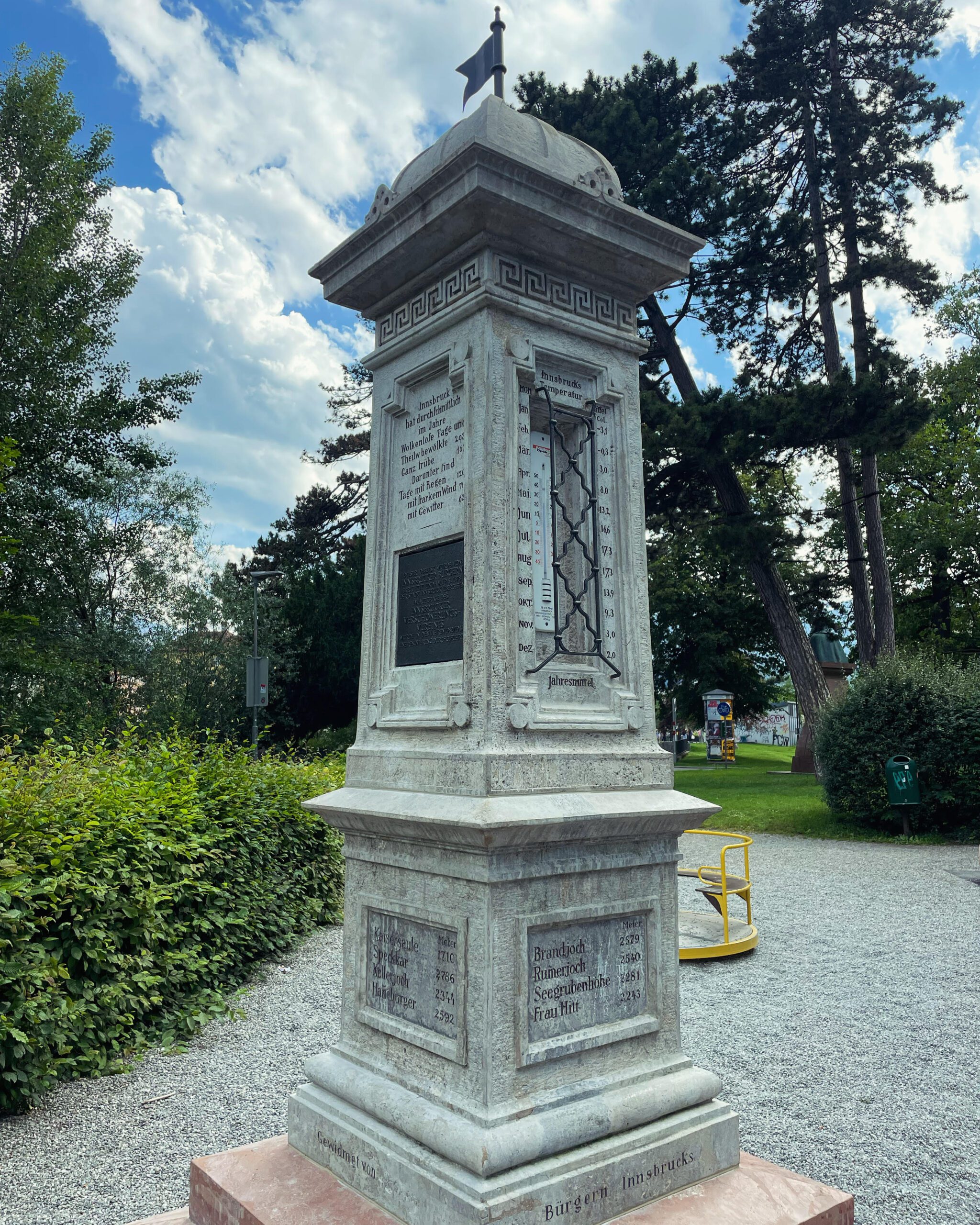
To the east of the former penitentiary, Waltherpark features a remarkable collection of curiosities alongside a sports field and green spaces. When the last rafters ceased operations in the 1870s and the landing site on the Inn River closed, a small urban oasis—then still known as Innpark—was created in the course of the river regulation works. The so-called "Dürerblick" (Dürer view) on the banks of the Inn offers a picturesque panoramic view of the Old Town. Albrecht Dürer allegedly sat here in 1495 when he drafted the sketches for his famous watercolor of the city of Innsbruck. The artwork itself was created later in his workshop in Nuremberg. The original of the painting "Innsprugg von Norden" ("Innsbruck from the North") hangs today in the Albertina in Vienna. The oldest monument in the park is the Joachimsbrunnen (Joachim Fountain), which migrated via several intermediate stops from the Old Town to St. Nikolaus. In 1878, a decorative obelisk known as the Geographensäule (Geographers' Column) was erected, providing curiously calculated information about Innsbruck's weather and climate. Just a few steps away stands a prominent bust of Franz Thurner, the founder of organized Tyrolean gymnastics (Turnen) and the Volunteer Fire Department. Innsbruck was a pioneer in the field of firefighting in the mid-19th century, if one is to believe the city's own historical accounts:
"The Volunteer Fire Department has always proudly pointed out that it was the oldest institution of its kind in the former monarchy, and naturally remains so in today's Federal State of Austria. In 1927, it was able to celebrate its 70th anniversary..."
The largest monument in the park is the pompous statue of the mythical German minnesinger Walther von der Vogelweide, erected in 1877. The medieval bard was the ideal projection screen for Innsbruck's German-nationalist city officials. Because—aside from his songs, poems, and drinking toasts written in Middle High German—scarcely any confirmed historical facts about Walther could be found in source materials, any ideology could be projected onto him. Not only was he considered the greatest German-language poet of the High Middle Ages—and thus a representative of early Germanic identity—thanks to his extensive catalog of works, but his pope-critical stance also made him appealing to the liberal city council. A similar statue was erected 12 years later in Bozen by the culturally north-oriented bourgeoisie, serving much like a marker of the city against the Italian-speaking "Welschtiroler" of Trentino. The Waltherpark received its present-day name in 1930. This time, the intention was less to emphasize Innsbruck's Germanic character and more to highlight the lost unity of the region of Tyrol following its division at the Brenner Pass, which the German-speaking minnesinger Walther von der Vogelweide symbolized.
Romance, sunless summers and apology cards
Thanks to the university, its professors and the young people it attracted and produced, Innsbruck also sniffed the morning air of the Enlightenment in the 18th century in the era of Maria Theresa, even if the Jesuit faculty leadership put the brakes on it. 1741 saw the founding of the Societas Academica Litteraria a circle of scholars in the Taxispalais. The masonic lodge was founded in 1777 To the three mountains, four years later, the Tyrolean Society for Arts and Science was founded. The spirit of reason in the time of Maria Theresa and Emperor Joseph also found its way into Innsbruck's elite. Spurred on by the French Revolution, some students even declared their allegiance to the Jacobins. Under Emperor Franz, all these associations were banned and strictly monitored after the declaration of war on France in 1794. Enlightenment ideas were frowned upon by large sections of the population even before the French Revolution. At the latest after the beheading of Marie Antoinette, the Emperor's sister, and the outbreak of war between the French Republic and the monarchies of Europe, they were considered dangerous. Who wanted to be considered a Jacobin when it came to defending their homeland?
After the Napoleonic Wars, Innsbruck was slow to recover, both economically and mentally. Adalbert Stifter (1805 -1868), probably the most famous writer of Austrian Romanticism, described Innsbruck in the 1830s in his travelogue Tyrol and Vorarlberg as follows:
„The inns were bad, the pavements wretched, long gutters overhung the narrow streets, which were bordered on both sides by dull arches... the beautiful banks of the Inn were unpaved, but covered with heaps of rubbish and criss-crossed by cesspools.“
Die kleine Stadt am Rande des Kaiserreiches hatte etwas mehr als 12.000 Einwohner, „ohne die Soldaten, Studenten und Fremden zu rechnen“. University, grammar school, Reading casino, music club, theatre and museum were evidence of a developing, modern urban culture. There was a Deutsches Kaffeehaus, a Restoration in the courtyard garden and several traditional inns such as the White cross, the Österreichischen Hofwhich Grape, das Katzung, das Mouthingeach of which Goldenen Adler, Stern und Hirsch. After 1830, the open sewers were blocked and made more hygienic, roads were repaired and bridges renovated. The overdue straightening and taming of the Inn and Sill rivers, which had begun before the turmoil of war, was also tackled. The biggest innovation for the population came in 1830, when oil lamps lit up the town at night. It was probably just a dim twilight created by the more than 150 lamps mounted on pillars and arm chandeliers, but for contemporaries it was a true revolution.
Die bayerische Besatzung war verschwunden, die Ideen der Denker der Aufklärung und der Französischen Revolution hatten sich aber in einigen Köpfen des städtischen Milieus verfangen. Natürlich waren es keine atheistischen, sozialistischen oder gar umstürzlerischen Gedanken, die sich breit machten. Es ging vor allem um wirtschaftliche, politische und gesellschaftliche Teilhabe des Bürgertums. Das Vereinswesen feierte eine Renaissance. Was heute wenig spektakulär klingt, war zur Regierungszeit Metternichs aufsehenerregend. Zwischen dem Beginn der Napoleonischen Kriege mit dem revolutionären Frankreich 1797 und dem Wiener Kongress waren Vereine allgemein verboten gewesen. Wer auf sich hielt, trat nun einer dieser neuartigen Gesellschaften bei. "Innsbruck has a music society, an agricultural society and a mining and geological society." stand etwa im Reiseführer Beda Webers wie ein Qualitätssiegel für die Stadt zu lesen. Es galt das tugendhafte Miteinander zum Wohl der weniger Begüterten und die Erziehung der Massen mit dem Treiben in den Vereinen zu forcieren. Wissenschaft, Literatur, Theater und Musik, aber auch Initiativen wie der Innsbruck Beautification Association, but also practical institutions such as the voluntary fire brigade established themselves as pillars of a previously unknown civil society. One of the first associations to be formed was the Innsbruck Music Society, from which the Tyrolean State Conservatory emerged. In keeping with the spirit of the times, men and women were not members of the same organisations. Women were mainly involved in charitable organisations such as the Women's association for the promotion of infant care centres and female industrial schools. Female participation in the political discourse was not desired.
In addition to Christian charity, a thirst for recognition and prestige were probably also major incentives for members to get involved in the clubs. People met to see and be seen. Good deeds, demonstrating education and leading a virtuous life were then, as now, the best PR for oneself.
Club life also served as entertainment on long evenings without electric light, television and the internet. Students, civil servants, members of the lower nobility and academics met in the pubs and coffee houses to exchange ideas. This was not only about highly intellectual and abstract matters, but also about profane realpolitik such as the suspension of internal tariffs, which made people's lives unnecessarily expensive. Culturally, the bourgeois educated elite in the Romantic and Biedermeier periods discovered the cultural escape into an intact past for themselves. After decades of political confusion, war and hardship, people wanted a distraction from the recent past, just as they did after 1945. Antiquity and its thinkers celebrated a second renaissance in Innsbruck, as in the rest of Europe. Romantic thinkers of the 18th and early 19th centuries such as Winckelmann, Lessing and Hegel were influential. The Greeks were „Noble simplicity and quiet greatness" attested. Goethe wanted the "Search the land of the Greeks with your soul" and travelled to Italy in search of his longing for the good, pre-Christian times in which the people of the Golden Age cultivated an informal relationship with their gods. Roman Stoic virtues were transported into the modern age as role models and formed the basis for bourgeois frugality and patriotism, which became very fashionable. Philologists combed through the texts of ancient writers and philosophers and conveyed a pleasing "Best of" into the 19th century. Columns, sphinxes, busts and statues with classical proportions adorned palaces, administrative buildings and museums such as the Ferdinandeum. Students and intellectuals such as the Briton Lord Byron were so inspired by the Panhellenism and the idea of nationalism that they risked their lives in the Greek struggle for independence against the Ottoman Empire. After the end of the Holy Roman Empire, Pan-Germanism became the political fashion of the liberal bourgeoisie in Innsbruck.
Kanzler Clemens von Metternichs (1773 – 1859) Polizeistaat hielt diese gesellschaftlichen Regungen lange Zeit unter Kontrolle. Zeitungen, Flugblätter, Schriften mussten sich an die Vorgaben der strengen Zensur anpassen oder im Untergrund verbreitet werden. Autoren wie Hermann von Gilm (1812 – 1864) und Johann Senn (1792 – 1857), an beide erinnern heute Straßen in Innsbruck, verbreiteten in Tirol anonym politisch motivierte Literatur. Der vielleicht bekannteste Public Intellectual des Vormärz war wahrscheinlich Adolf Pichler (1819 – 1900), dem bereits kurz nach seinem Ableben unter gänzlich anderen Vorzeichen in der Stadtpolitik der späten Monarchie ein Denkmal gewidmet wurde und nach dem heute das Bundesrealgymnasium am gleichnamigen Platz gewidmet ist. Bücher und Vereine standen unter Generalverdacht. Der Innsbrucker Musikverein lehrte im Rahmen seiner Ausbildung auch die Deklamation, das Vortragen von Texten, Musik und Reden, die Inhalte wurden von der Obrigkeit streng überwacht. Alle Arten von Vereinen wie die Innsbrucker Liedertafel and student fraternities, even the members of the Ferdinandeum were spied on. The social movements forming in the working-class neighbourhoods were particularly targeted by Metternich's secret police. Despite their demonstrative loyalty to the emperor, the marksmen were also on the list of institutions to be observed. They were considered too rebellious, not only towards foreign powers, but also towards the Viennese central government. The mix of Greater German nationalist ideas and Tyrolean patriotism presented with the pathos of Romanticism seems strangely harmless today, but was neither comfortable nor acceptable to the Metternich state apparatus.
However, political activism was a marginal phenomenon that only occupied a small elite. After the mines and salt works had lost their profitability in the 17th century and transit lost its economic importance due to the new trade routes across the Atlantic, Tyrol had become a poor region. The Napoleonic Wars had raged for over 20 years. The year 1809 went down as Tyrolean heroic age in the historiography of the 19th and early 20th centuries, the consequences of heroism were barely highlighted. Although the Austrian Empire was one of the victorious powers after the Congress of Vienna, its economic situation was miserable. As after the world wars of the 20th century, many men had not returned home during the coalition wars. The university, which drew young aristocrats into the city's economic cycle, was not reopened until 1826. Unlike industrial locations in Bohemia, Moravia, Prussia or England, the hard-to-reach city in the Alps was only just beginning to develop into a modern labour market. Tourism was also still in its infancy and was not a Cash Cow. It is no wonder that hardly any buildings in the Biedermeier style have survived in Innsbruck. And then there was a volcano on the other side of the world that had an undue influence on the fate of the city of Innsbruck. In 1815, Tambora erupted in Indonesia and sent a huge cloud of dust, sulphur and ash around the world. In 1816 Year without summer into history. All over Europe, there were freak weather conditions, floods and failed harvests. The Alps, an already difficult part of the world to farm, were not exempt from this.
The economic upheavals and price increases led to hardship and misery, especially among the poorer sections of the population. In the 19th century, caring for the poor was a task for the communities, usually with the support of wealthy citizens as patrons with the idea of Christian charity. The state, the community, the church and the newly emerging civil society in the form of associations began to look after the welfare of the poorest sections of the population. Charity concerts, collections and appeals for donations were organised. The measures often contained an enlightened component, even if the means to an end seem strange and alien today. In Innsbruck, for example, a begging ordinance came into force that banned dispossessed people from marrying. Almost 1000 citizens were categorised as alms recipients and beggars.
As the need grew and the city coffers became emptier, Innsbruck came up with an innovation that was to last for over 100 years: The New Year's apology card. Even back then, it was customary to visit relatives on the first day of the year to give each other a Happy New Year to make a wish. It was also customary for needy families and beggars to knock on the doors of wealthy citizens to ask for alms at New Year. The introduction of the New Year's relief card killed several birds with one stone. The buyers of the card were able to institutionalise and support their poorer members in a regulated way, similar to the way street newspapers are bought today. Twenty is possible. At the same time, the New Year's apology card served as a way of avoiding the unpopular obligatory visits to relatives. Those who hung the card on their front door also signalled to those in need that no further requests for alms were necessary, as they had already paid their contribution. Last but not least, the noble donors were also favourably mentioned in the media so that everyone could see how much they cared for their less fortunate fellow human beings in the name of charity.
The New Year's apology cards were a complete success. At their premiere at the turn of the year from 1819 to 1820, 600 were sold. Many communities adopted the Innsbruck recipe. In the magazine "The Imperial and Royal Privileged Bothe of and for Tyrol and Vorarlberg", the proceeds for Bruneck, Bozen, Trient, Rovereto, Schwaz, Imst, Bregenz and Innsbruck were published on 12 February. Other institutions such as fire brigades and associations also adopted the well-functioning custom to raise funds for their cause. The construction of the new Höttinger parish church was financed to a large extent from the proceeds of specially issued apology cards in addition to donations. The varied designs ranged from Christian motifs to portraits of well-known personalities, official buildings, new buildings, sights and curiosities. Many of the designs can still be seen in the Innsbruck City Archives.
Maria Theresia, Mother of the Nation and Reformer
Maria Theresa ranks among the most important figures in Austrian history. Particularly significant were her domestic reforms, many of which had a tangible impact on the everyday lives of Innsbruck’s inhabitants and are still visible today in the city’s built environment. Together with her most influential advisers—Friedrich Wilhelm von Haugwitz, Joseph von Sonnenfels, and Wenzel Anton Kaunitz—she succeeded in transforming the so‑called Austrian hereditary lands into a modern state. Instead of governing her territories through the local nobility, she relied on a centralized, professional administration. In keeping with Enlightenment thought, her advisers recognized that the welfare of the state depended on the health and level of education of its individual subjects. An early healthcare reform of 1742 obliged the professors of medicine at the University of Innsbruck not only to teach but also to ensure the operation of the municipal hospital in the Neustadt district. A school reform likewise reshaped the educational landscape within the city walls, both spatially and conceptually. Due to a lack of space, the school was relocated from Domplatz to Kiebachgasse, and its educational mission was redefined. Subjects were expected to remain Catholic, but their loyalty was to be directed toward the state. Education was placed under centralized state control in order to develop talents in a targeted manner. The aim was not to raise critical, humanistic intellectuals, but rather to train personnel for the state administrative apparatus. This reform laid the foundation for later social mobility. Through military service and civil administration, non‑nobles were now able to pursue careers and climb the social ladder. Any improvement of the individual was regarded as a gain for the whole. Further measures followed that affected not only the national economy but also the daily lives of most people. The standardization of weights and measures made the tax system more precise and less susceptible to abuse. For farmers, the harmonization of laws meant that their livelihoods were less dependent on local landlords and their arbitrary decisions. The Robot—the unpaid compulsory labor owed by peasants to their landlords—was also abolished under Maria Theresa. A shift in thinking likewise took place in criminal prosecution and the judicial system. In 1747, a small police force was established in Innsbruck to oversee market regulation, trade and guild regulations, control of foreigners, and public morals. Above all, this served to regulate the provision of goods in favor of consumers. Not only poor quality but also price gouging was punished. The strictness of early food inspections is illustrated by a police record from 1748, in which a butcher from Pradl was fined for exceeding the legally fixed meat prices. This denser network of regulations and improved law enforcement went hand in hand with a more humane system of punishment. Although the criminal code Constitutio Criminalis Theresiana did not abolish torture, it did strictly regulate its use. Yet despite Maria Theresa’s self‑presentation as a pious mother of the land and her reputation today as an Enlightenment ruler, the devoutly Catholic sovereign was uncompromising when it came to power and religion. In keeping with Enlightenment thought, she ordered critical investigations into superstitions such as vampirism, which was widespread in the eastern parts of her realm, and initiated the final end of the witch trials. At the same time, however, Protestants were ruthlessly expelled from the country. Many Tyroleans were forced to leave their homeland and resettle in more remote regions of the Habsburg monarchy.
In crown lands such as Tyrol, which had previously enjoyed a high degree of autonomy, Maria Theresa’s reforms were met with little approval. Centralization remains a sensitive issue in Austrian politics to this day. With the exception of a few liberals, people saw themselves more as an independent, autonomous land and less as part of a modern territorial state. The clergy also resented their new subordinate role, which was further intensified under Joseph II. For the local nobility, the reforms meant not only a loss of status and autonomy but also higher taxes and levies. Taxes, duties, and customs revenues that had long provided Innsbruck with reliable income were now collected centrally and only partially returned through fiscal redistribution. To mitigate the social decline of sons from impoverished noble families and prepare them for state service, Maria Theresa founded the Theresianum, which also had a branch in Innsbruck from 1775 onward. As so often, time smoothed over former conflicts, and today Innsbruck’s inhabitants take pride in having hosted one of the most significant rulers in Austrian history. Not only the Triumphal Arch and the Imperial Palace (Hofburg), but also the Turnvereinshaus and the New City School recall the Theresian era, a period in which the state began to intervene ever more deeply in the lives of its citizens from the moment they entered school.
1796 - 1866: Vom Herzen Jesu bis Königgrätz
The period between the French Revolution and the Battle of Königgrätz in 1866 was a highly warlike era. Many of the later political attitudes, animosities toward other groups, and the European nationalism of the nineteenth and twentieth centuries—which would also shape the history of Innsbruck—had their roots in the conflicts of this time. The monarchies of Europe, led by the Catholic Habsburgs, declared war on the French Republic. Although revolutionary Paris was far away and no comprehensive press system existed for the dissemination of news, the alleged godlessness of the murderers of Marie Antoinette was effectively spread through pamphlets and sermons from church pulpits. Fear arose that the revolutionary slogan “Liberté, Égalité, Fraternité,” along with its principles, might spread throughout Europe. During the Coalition Wars, a young general named Napoleon Bonaparte advanced across the Alps in 1796 with his Italian army and encountered Austrian troops. This was not merely a war over territory and power—it was a clash of systems. The Grande Armée of revolutionary France confronted the forces of the conservative and Catholic Habsburgs. Tyrolean riflemen (Schützen) actively participated in the fighting, defending the province’s borders against the advancing French. The men were accustomed to handling weapons and were considered skilled marksmen. The historian Ludwig Denk described this in a publication from 1860:
"...The Tyrolean's main passion is shooting. Early on, the father takes his son hunting. It is not uncommon to see boys running around with loaded rifles, climbing high mountains and shooting birds or squirrels..."
The strength of units such as the Hötting Rifle Company, established in 1796, lay not in open field battles but in guerrilla warfare. Moreover, they believed they had a secret weapon against the most advanced army of the time: the Sacred Heart of Jesus. Since 1719, Jesuit missionaries had spread devotion to the Sacred Heart even in the most remote valleys, successfully establishing it as a unifying force in the struggle against pagan customs and Protestantism. Faced with the godless revolutionary French, it seemed only natural that the Sacred Heart would once again—after 1703—watch protectively over the Tyrolean warriors of God. In desperate circumstances, the Tyrolean troops renewed their covenant. Against all odds, the riflemen succeeded in their defensive efforts. The abbot of Stams Abbey petitioned the provincial estates that, henceforth, “the Feast of the Divine Heart of Jesus should be celebrated annually with a solemn church service, if Tyrol were freed from the threat of enemy danger.”
Victory in this battle did not change the outcome of the war against Napoleon’s overwhelming forces, nor did it alter the territorial expansion of Tyrol—while Innsbruck’s population declined. During the turmoil of war, the Habsburg territory had expanded without notable military success—and likely without the help of the Sacred Heart. The archiepiscopal territory of Trentino became part of the crown lands through a territorial settlement known as the Reichsdeputationshauptschluss in the final phase of the Holy Roman Empire before its dissolution in 1803. Innsbruck, however, shrank. Fallen soldiers and war-related economic hardship led to a decline in the population from over 9,500 around 1750 to approximately 8,800 in the early decades of the nineteenth century. While this may seem modest in absolute numbers, the consequences were severe: stagnation in urban life. Young men were missing—as labourers, husbands, and fathers. This wartime recession remains largely underrepresented in the city’s historiography. Perhaps the near absence of Biedermeier architecture in Innsbruck can be seen as a subtle reminder of these difficult years.
After the Napoleonic Wars and the reorganisation of Europe at the Congress of Vienna, Tyrol’s borders remained largely peaceful for around thirty years. This changed with the Italian Risorgimento, the national movement led by Sardinia‑Piedmont and France. In 1848, 1859, and 1866, the so‑called Italian Wars of Unification took place. Over the course of the nineteenth century—at the latest since 1848—a fervent nationalist enthusiasm spread among young men of the upper classes across Europe. Volunteer armies sprang up everywhere. Students and academics formed associations; gymnasts and riflemen alike sought to prove their newfound national identity on the battlefield, supporting official armies against their respective enemies. During this time, Innsbruck served as an important logistical hub as a garrison town. Following the Congress of Vienna, the Tyrolean Jäger Corps became the Imperial and Royal Tyrolean Kaiserjäger Regiment, an elite unit deployed in these conflicts. Volunteer formations such as the Innsbruck Academics and the Stubai Riflemen also fought in Italy. Thousands fell in battle against a coalition consisting of the traditional enemy France, the particularly “godless” Redshirts under Giuseppe Garibaldi, and the emerging Kingdom of Italy, formed at Austria’s expense under the leadership of the Francophile House of Savoy from Piedmont. The media further inflamed sentiment behind the front lines. The Innsbrucker Zeitung preached loyalty to the emperor and a Greater German‑Tyrolean nationalism, railed against Italians and the French, and celebrated the bravery of Tyrolean soldiers. One report stated:
“The strong occupation of the heights at the exit of the Valsugana near Primolano and Le Tezze has often given the Innsbruck Academics I and the Stubai riflemen cause to undertake voluntary excursions against Le Tezze, Fonzago, and Fastro, as well as to the right bank of the Brenta and the heights opposite the small camps of the Sette Comuni… On the 19th, the Stubai riflemen had already struck down several enemies when they ventured down for the first time, creeping up on them…”
Probably the most famous battle of the Wars of unification fand in Solferino 1859 in der Nähe des Gardasees statt. Entsetzt vom blutigen Geschehen entschloss sich Henry Durant das Rote Kreuz zu gründen. Der Schriftsteller Joseph Roth beschrieb das Geschehen auf den ersten Seiten seines Romans Radetzkymarsch.
"In the battle of Solferino, he (note: Lieutenant Trotta) commanded a platoon as an infantry lieutenant. The battle had been going on for half an hour. Three paces in front of him he saw the white backs of his soldiers. The first row of his platoon was kneeling, the second was standing. Everyone was cheerful and certain of victory. They had eaten copiously and drunk brandy at the expense and in honour of the emperor, who had been in the field since yesterday. Here and there one fell out of line."
The year 1866 proved particularly catastrophic for the Austrian Empire. In Italy, Venetia and Lombardy were lost. In the north, the Habsburg army suffered a devastating defeat at the Battle of Königgrätz. After this short “brother’s war,” Prussia took over leadership of the German Confederation from the Habsburgs. Austria’s reorientation toward the east meant that Innsbruck definitively became a city on the western periphery of the empire. This shift was accompanied by a resurgence of nationalist ideas, particularly among Innsbruck’s liberal upper bourgeoisie. Support for the “Greater German solution”—a united state with the German Empire rather than the Austro‑Hungarian Monarchy—was especially strong. The extent to which this German Question divided the city became apparent more than thirty years later, when the Innsbruck city council proposed naming a street after Otto von Bismarck. While conservative loyalists reacted with outrage, the liberal Greater German faction around Mayor Wilhelm Greil welcomed the idea. After the Second World War, the defeat at Königgrätz supported Austria’s narrative of being the first victim of National Socialism, as it had already been excluded from a unified German state in 1866.
To this day, the conflicts at Tyrol’s southern borders continue to shape tradition and the cityscape. The Sacred Heart celebrations were long marked by great pomp and, especially in the nineteenth and early twentieth centuries, developed into a volatile mixture of superstition, Catholicism, and ethnic nationalism directed against French and Italian influences. Countless soldiers continued to entrust their fate to the Sacred Heart even amidst the shellfire of the First World War. Alongside Cranach’s Madonna of Mercy, the flaming Sacred Heart remains one of the most popular Christian motifs in Tyrol and adorns the façades of countless buildings. With sites such as the Tummelplatz, the Pradl Military Cemetery, and the Kaiserjäger Museum on Bergisel, Innsbruck preserves several places of remembrance for these bloody conflicts, in which many of its residents marched off to war and never returned.
The First World War
An Innsbruck student nearly changed the course of world history instead of Gavrilo Princip. In 1913, the young man boasted to a waitress about his plans to shoot the heir to the throne, but he was arrested before he could carry them out. Only when the world-changing shots were actually fired in Sarajevo a year later did an article appear in the Innsbrucker Nachrichten on June 30 about the events. The consequences that the First World War, which subsequently broke out, would have for the world and for people's everyday lives could not yet be foreseen after the assassination of Franz Ferdinand on June 28. Two days after the murder of the Habsburg heir in Sarajevo, readers in Innsbruck were already reading prophetic words in their newspaper: “We have arrived at a turning point – perhaps the turning point – in the destiny of this empire.” In Innsbruck, too, enthusiasm for war was widespread in 1914. Driven by the slogan of the time, “God, Emperor, and Fatherland,” the vast majority of people unanimously welcomed the attack on Serbia. Politicians, the clergy, and the press fuelled the general jubilation. Particularly “deserving” in promoting the war were the two theologians Joseph Seeber (1856–1919) and Anton Müllner, known as Brother Willram (1870–1919), who, through their sermons and writings such as The Bloody Year, elevated the war into a crusade against France and Italy. In addition to the imperial proclamation To My Peoples, which appeared throughout the media of the Empire, the Innsbrucker Nachrichten published an article on July 29, the day after Austria-Hungary declared war on Serbia, about Prince Eugene's capture of Belgrade in 1717. The tone in the media was celebratory, although not entirely without dark forebodings of what was to come.
"The Emperor's appeal to his people will be deeply felt. The internal strife has been silenced and the speculations of our enemies about unrest and similar things have been miserably put to shame. Above all, the Germans stand by the Emperor and the Empire in their old and well-tried loyalty: this time, too, they are ready to stand up for dynasty and fatherland with their blood. We are facing difficult days; no one can even guess what fate will bring us, what it will bring to Europe, what it will bring to the world. We can only trust with our old Emperor in our strength and in God and cherish the confidence that, if we find unity and stick together, we must be granted victory, for we did not want war and our cause is that of justice!"
Many Innsbruck residents volunteered for the campaign against Serbia, which was believed to be a matter of only a few weeks or months. So many volunteers poured into Innsbruck from outside the city to report to the recruitment commissions that the city was almost bursting at the seams. No one could imagine how differently things would turn out. After the first battles in distant Galicia, it became clear that this would not be over within a few months. The Imperial Riflemen (Kaiserjäger) and other Tyrolean troops were effectively sacrificed. Poor equipment, inadequate supplies, and the catastrophic leadership of the High Command under Conrad von Hötzendorf led thousands either to their deaths or into captivity, where hunger, abuse, and forced labour awaited them. In 1915, Italy entered the war on the side of France and Britain. Under the infamous secret Treaty of London, the young kingdom had been promised generous territorial gains in return for supporting the Entente against Germany and Austria. On May 23, the former ally declared war on the Habsburg Empire. Until regular troops could be transferred from the Eastern Front, regional defence depended on the Standschützen, a force consisting of men under 21, over 42, or those deemed unfit for regular military service. Correspondingly, casualties were high. Fighting in the mountain war stretched from the Ortler in the west across the northern shore of Lake Garda to the Sexten Dolomites. Innsbruck itself was not directly affected by military operations. At the very least, however, the sounds of war could be heard in the provincial capital, as reported in the newspaper of July 7, 1915:
“Soon after the Italians commenced hostilities, cannon fire could clearly be heard in the region of the Serles peak, coming from one of the battlefields in southern Tyrol, probably the Vielgereut plateau. In recent days, the sound of artillery fire has also undoubtedly been detected in Innsbruck itself and in the northeastern parts of the city — individual powerful blasts, dull rather than rolling and resonant, echoing across the Brenner Pass. There can be no mistake. In Innsbruck itself, the thunder of the guns is more difficult to detect because of the noise of the city, but on one occasion, around 9 p.m., when there was some degree of quiet, this unmistakable thunder, originating from our mortars, was clearly heard.”
Although the front was far away, the war increasingly penetrated civilian life. This total involvement of society in warfare was a new phenomenon. The mass mobilization of a large proportion of the working male population brought many businesses to a complete standstill. Shop shelves remained empty, public transport services ceased, and craftsmen and labourers were called up for military service. Companies still able to operate were subordinated to the wartime economy. By the “Hunger Winter” of 1917, Innsbruck’s economy had almost completely collapsed. Food, coal, and firewood were in short supply, and hunger and cold became bitter enemies of women, children, the wounded, and those unfit for military service. During the final years of the war, provisions were distributed through ration cards. The basic weekly allowance per person amounted to 500 grams of meat, 60 grams of butter, and 2 kilograms of potatoes. Archive photographs show long queues of desperate and hungry people outside food shops. Protests and strikes repeatedly broke out. Politicians, trade unionists, workers, and returning soldiers saw an opportunity for change. Under the slogan “Peace, Bread, and Suffrage,” parties of many different political backgrounds united in opposition to the war. The cityscape also changed. Barracks were erected in Höttinger Au to house prisoners of war. Wounded soldiers arrived in such large numbers that civilian buildings, including the university library then under construction and Ambras Castle, were converted into military hospitals. A predecessor of today’s Tram Line 3 was established to transport the wounded from the railway station to the new garrison hospital, today’s Conrad Barracks in Pradl. To cope with the large number of fallen soldiers, the Pradl Military Cemetery was created.
As the war neared its end, the front also drew closer. In February 1918, the Italian air force succeeded in dropping three bombs on Innsbruck. The Neue Freie Presse reported for the first time on the secret Treaty of London, heightening Tyrolean anxiety over the threatened loss of territory south of the Brenner Pass. By then, most people already knew the war was lost and sensed the fate that awaited Tyrol, as this article of October 6, 1918, demonstrates:
“External and internal enemies are gambling today with the land of Andreas Hofer. The latest throw of the dice is even more cruel; never before has a free land been bartered away so disgracefully. The blood of our fathers, sons, and brothers has been shed in vain if this shameful plan becomes reality. The final throw has not yet been made. Therefore, Tyroleans, attend the Tyrolean People’s Assembly in Brixen on October 13, 1918 (next Sunday). German soil must remain German; Tyrolean soil must remain Tyrolean. Tyroleans, decide your own future!”
On November 4, Austria-Hungary and the Kingdom of Italy finally agreed to an armistice. Part of the agreement granted Italy the right to occupy territory of the monarchy. Alarm bells immediately rang among Austria-Hungary’s allies in the German Empire. On the very next day, Bavarian troops entered Innsbruck. Germany was still at war with Italy and feared that the front might shift into North Tyrol, bringing it closer to German territory. Fortunately for Innsbruck and the surrounding region, Germany also capitulated one week later on November 11. As a result, major military engagements between regular armies were avoided.
Nevertheless, Innsbruck remained in danger. Massive convoys of military vehicles, trains packed with soldiers, and thousands of exhausted troops making their way home on foot passed through the city. Anyone who could jumped onto overcrowded trains or military vehicles to leave the front behind and return home. In November 1918 alone, more than 270 soldiers lost their lives during these reckless attempts or had to be admitted to one of the city’s hospitals. The city not only had to maintain order among its own citizens and ensure food supplies but also protect itself against looting. To preserve public order, the Tyrolean National Council established a citizens’ militia on November 5 composed of pupils, students, workers, and ordinary citizens. On November 23, 1918, Italian troops occupied the city and its surroundings. More than 80,000 Italian soldiers were stationed in Tyrol, around 5,000 of whom required accommodation in the starving and destitute city. Schools were turned into barracks. Mayor Greil’s conciliatory appeal to surrender the city peacefully succeeded. There were isolated disturbances, food riots, and incidents of looting, but there were no armed clashes with the occupation troops and no Bolshevik revolution such as the one that occurred in Munich.
The consequences of the First World War for Innsbruck’s population were devastating. More than 1,200 people lost their lives on battlefields or in military hospitals, while approximately 600 were wounded. Memorials to the First World War and its victims can be found throughout Innsbruck, particularly at churches and cemeteries. The Kaiserjäger Museum on Bergisel displays uniforms, weapons, and photographs from the war. The theologians Anton Müllner and Josef Seeber have streets named after them in Innsbruck. A street was also named after Archduke Eugene, commander-in-chief of the Austro-Hungarian Army on the Southern Front. A monument to the unsuccessful military leader stands in front of the Hofgarten. The eastern section of the Amras Military Cemetery commemorates the Italian occupation.
Wilhelm Greil: DER Bürgermeister Innsbrucks
One of the most important figures in Innsbruck's municipal history was Wilhelm Greil (1850–1928). The entrepreneur held the office of mayor from 1896 to 1923, having previously helped shape the city's fortunes as vice mayor. His tenure was not only long, but also took place during a particularly dynamic era. The four decades between the economic crisis of 1873 and the First World War were marked by unprecedented growth and rapid modernization. It was a time of incorporating entire city districts, technical innovations, and new media. Private investments in infrastructure such as railways, energy, and electricity were encouraged by the state and given tax incentives in order to lead the provinces and cities of the struggling Danube Monarchy into modernity. The city's economy was booming. Businesses emerged in the new districts of Pradl and Wilten, attracting a labor force. Tourism also brought fresh capital into the city. Innsbruck's city council was dominated by the liberal and Pan-German nationalist 'Deutsche Volkspartei' (German People's Party), to which Greil also belonged. It was only with the incorporation of Wilten and Pradl in 1904 that the conservatives were able to gain ground, though they could not fully catch up. Social Democracy played almost no role until 1918. Due to an electoral system based on voting rights categorized by wealth classes, only about 10% of Innsbruck's population could step up to the ballot box. Women were fundamentally excluded. Furthermore, relative voting rights applied within the three electoral colleges, which effectively meant: winner takes it all. Appropriately enough, Mayor Greil lived much like a Renaissance prince. He hailed from the upper-class haute bourgeoisie. His father was able to afford establishing the family's home base in the Palais Lodron on Maria-Theresien-Straße. Thanks to this electoral statute, Mayor Greil could rely on 100% support in the city council well into the era of the First Republic, which naturally simplified decision-making and governance considerably. For all the efficiency that Innsbruck's mayors displayed on a superficial level, one should not forget that this was only possible because, as part of an elite composed of entrepreneurs, merchants, and professionals, they ruled through a form of elected dictatorship—without any significant opposition or consideration for other population groups such as workers, artisans, and employees. The Imperial Municipal Act of 1862 granted cities like Innsbruck, and thus its mayors, far-reaching powers. It is hardly surprising that the chain of office presented to Greil on his 60th birthday by his colleagues on the city council bore an astonishing resemblance to the collar orders of the old nobility. However, Greil was also a skillful politician who adeptly navigated the established power structures and media landscape of his time. Article 17 of the Austrian Basic Law of 1867, known as the December Constitution, secured freedom of expression in the press without prior censorship for the first time—excluding, of course, punishable content such as blasphemy or insulting the authorities. Consequently, a variety of newspapers established themselves, such as the conservative Neue Tiroler Stimme, the social democratic Volkszeitung, or the liberal Innsbrucker Nachrichten, shaping a worldview according to their publishers' preferences. Thanks to the reach of the Innsbrucker Nachrichten, Wilhelm Greil was able to effectively project his view of local politics. Despite his at times fierce speeches—modeled on the platform of Georg Ritter von Schönerer (1842–1921), the founding figure of the Pan-German nationalists—he managed to reach arrangements with conservative forces in the region, even if things frequently clashed in the media and elsewhere. Taxes, social policy, education, housing, and the design of public spaces were debated with passion and zeal, often enough with violence as the ultimate argument.
Unter Greils Ägide und dem allgemeinen wirtschaftlichen Aufschwung erweiterte sich Innsbruck im Eiltempo. Der Gemeinderat kaufte ganz im Stil eines Kaufmanns vorausschauend Grund an, um der Stadt Neuerungen zu ermöglichen. Der Politiker Greil konnte sich bei den großen Bauprojekten der Zeit auf die Beamten und Stadtplaner Eduard Klingler, Jakob Albert und Theodor Prachensky stützen. Infrastrukturprojekte wie das neue Rathaus in der Maria-Theresienstraße 1897, die Eröffnung der Mittelgebirgsbahn, die Hungerburgbahn und die Karwendelbahn wurden während seiner Regierungszeit umgesetzt. Weitere gut sichtbare Meilensteine waren die Erneuerung des Marktplatzes und der Bau der Markthalle. Neben den prestigeträchtigen Großprojekten revolutionierte vor allem Unsichtbares in den letzten Jahrzehnten des 19. Jahrhunderts das Leben vieler Innsbrucker. Bereits Greils Vorgänger Bürgermeister Heinrich Falk (1840 – 1917) hatte erheblich zur Modernisierung der Stadt und zur Besiedelung des Saggen beigetragen. Seit 1859 war die Beleuchtung der Stadt mit Gasrohrleitungen stetig vorangeschritten. Mit dem Wachstum der Stadt und der Modernisierung wurden die Senkgruben, die in Hinterhöfen der Häuser als Abort dienten und nach Entleerung an umliegende Landwirte als Dünger verkauft wurden, zu einer Unzumutbarkeit für immer mehr Menschen. 1880 wurde das Ragging, so der Name im Volksmund für die Entleerung der Aborte, in den Verantwortungsbereich der Stadt übertragen. Zwei pneumatische Maschinen sollten den Vorgang zumindest etwas hygienischer gestalten. Zwischen 1887 und 1891 wurde Innsbruck mit einer modernen Hochdruckwasserleitung ausgestattet, über die auch Wohnungen in höher gelegenen Stockwerken mit frischem Wasser versorgt werden konnten. Wer auf sich hielt und es sich leisten konnte, hatte damit erstmals die Gelegenheit eine Spültoilette im Eigenheim zu installieren. Greil setzte diesen Feldzug der Modernisierung mit einer Vielzahl an Infrastrukturprojekten fort. Die Ansammlung an Menschen auf enger werdendem Raum unter teils prekären Hygieneverhältnissen hatte viele Probleme mit sich. Die Randbezirke der Stadt und die umliegenden Dörfer wurden regelmäßig von Typhus heimgesucht. Nach jahrzehntelangen Diskussionen wurde 1903 mit dem Bau einer modernen Schwemmkanalisation begonnen. Ausgehend von der Innenstadt wurden immer mehr Stadtteile an diesen heute alltäglichen Luxus angeschlossen. 1908 waren nur die Koatlackler Mariahilf und St. Nikolaus nicht an das Kanalsystem angeschlossen. Auch der neue Schlachthof im Saggen erhöhte Hygiene und Sauberkeit in der Stadt. Schlecht kontrollierte Hofschlachtungen gehörten mit wenigen Ausnahmen der Vergangenheit an. Das Vieh kam im Zug am Sillspitz an und wurde in der modernen Anlage fachgerecht geschlachtet. Greil überführte das Gaswerk in Pradl und das Elektrizitätswerk in Mühlau in städtischen Besitz. Die Straßenbeleuchtung wurde im 20. Jahrhundert von den Gaslaternen auf elektrisches Licht umgestellt. 1888 übersiedelte das Krankenhaus von der Maria-Theresienstraße an seinen heutigen Standort. Bürgermeister und Gemeinderat konnten sich bei dieser Innsbrucker Renaissance neben der wachsenden Wirtschaftskraft in der Vorkriegszeit auch auf Mäzen aus dem Bürgertum stützen. Waren technische Neuerungen und Infrastruktur Sache der Liberalen, verblieb die Fürsorge der Ärmsten weiterhin bei klerikal gesinnten Kräften, wenn auch nicht mehr bei der Kirche selbst. Freiherr Johann von Sieberer stiftete das Greisenasyl und das Waisenhaus im Saggen. Leonhard Lang stiftete das Gebäude in der Maria-Theresienstraße, in der sich bis heute das Rathaus befindet gegen das Versprechen der Stadt ein Lehrlingsheim zu bauen.
In contrast to the booming pre-war era, Greil’s leadership after 1914 was marked by crisis management. In his final years in office, he guided Innsbruck through the transition from the Habsburg monarchy to the republic—a time characterized above all by hunger, hardship, scarcity of resources, and insecurity. He was 68 years old when Tyrol was divided at the Brenner Pass after the war. During his political career, Greil had often exploited general hostility toward Italians (“Walsche”) in a similarly populist manner to his Christian Social counterpart in Vienna, Karl Lueger, who used antisemitic rhetoric. At the end of his career, he had to witness the Italian occupation of Innsbruck. With the introduction of the republic, the census-based voting system was abolished, marking the beginning of the end of liberal dominance in the municipal council. In 1919, the Social Democrats won elections in Innsbruck for the first time. Only due to council majorities and a coalition of Greater German-liberal and conservative-clerical politicians did Greil remain mayor. He died in 1928 at the age of 78 as an honorary citizen of the city of Innsbruck. Wilhelm-Greil-Straße had already been named after him during his lifetime.
Big City Life in early Innsbruck
During the Middle Ages, Innsbruck officially developed into a city. Formal recognition by the territorial prince in 1239 brought with it an entirely new system for its citizens. Market rights, building rights, customs rights, and an independent jurisdiction were gradually transferred to the city. Urban citizens were no longer subject to their feudal lord, but to the city’s jurisdiction—at least within the city walls. The well-known saying “city air makes one free” derives from the fact that after one year of residence in the city, a person was released from all obligations to their former lord. Unlike unfree peasants and servants, citizens could freely dispose of their property and determine their way of life. Naturally, they also had rights and obligations. Citizens did not pay tithes, but instead paid taxes to the city. Which group within the city was required to pay which taxes could be determined by the city government itself. The city, in turn, did not have to pass these taxes on directly, but could freely dispose of its budget after paying a fixed levy to the territorial prince. In addition to city defense, expenditures included care for the sick and the poor. Needy citizens could obtain meals from the “boiling kitchen” (Siedeküche), provided they held civic rights. The city government paid particular attention to contagious diseases such as the plague, which periodically tormented the population. In return for their rights, every citizen had to swear the civic oath. This oath included the obligation to pay taxes and perform military service. In addition to defending the city, citizens were also deployed beyond its walls. In 1406, a contingent together with mercenaries confronted an Appenzell army to defend the Upper Inn Valley. From 1511 onward, according to Emperor Maximilian’s Landlibell, the city council was also obliged to provide a contingent of conscripts for territorial defense. In addition, there were volunteers who could enlist for military service in the city’s Freifähnlein; for example, Innsbruck citizens were among the defenders of Vienna during the Ottoman siege of 1529.
In the 15th century, space became scarce in the rapidly growing city of Innsbruck. Citizenship became an exclusive commodity. Only free subjects born of legitimate birth were able to obtain city rights. To become a citizen, one had to prove either house ownership or skills in a craft in which the city's guilds were interested. The debate over who is a "true" Innsbrucker and who is not persists to this day. That migration and exchange with others have always been the guarantee for prosperity—and made Innsbruck into the livable city it is today—is often forgotten in the process. Because of these restrictions, Innsbruck had a completely different social structure than the surrounding villages. Craftsmen, merchants, civil servants, and domestic servants defined the cityscape. Traveling traders, officials, and court retainers also came to Innsbruck for short periods in the entourage of a prince and held no citizenship rights. The craftsmen exerted the greatest political power at the municipal level. Unlike peasants, they belonged to the socially mobile classes of the Middle Ages and the Early Modern Period. After completing their apprenticeship, they went on the Walz (journeyman years) before undergoing the master's examination, subsequently either returning home or settling in another city. Craftsmen were responsible not only for the transfer of technical knowledge, but also for spreading cultural, social, and political ideas. The individual trades—such as blacksmiths, coppersmiths, goldsmiths, furriers, bagmakers, cloth shearers, shoemakers, locksmiths, tanners, armorers, carpenters, bakers, and butchers—each had their own guild headed by a master. These craft guilds sometimes exercised their own jurisdiction over their members alongside the municipal court system. Wages, prices, and social life were regulated by the guilds under the supervision of the sovereign. One could speak of an early form of social partnership, as the guilds also provided security for their members in the event of illness or disability.
From the 14th century onward, Innsbruck demonstrably possessed a city council—the so-called Gemain—and a mayor. The elections, held annually after the turn of the year, were not secret, but public. Innsbruck had a population of around 5,000, of whom only a small fraction held citizenship rights. Propertyless individuals, itinerant folk, the unemployed, domestic servants, diplomats, employees, women, and later students were not eligible to vote. Casting a vote was an exclusive privilege of the male upper class. In the Innsbrucker Geschichtsalmanach of 1948, one can find records regarding the election of the year 1598.
The Feast of St. Erhard, i.e., January 8th, played a significant role in the lives of the citizens of Innsbruck each year. On this day, they gathered to elect the city officials, namely the mayor, city judge, public orator, and the twelve-member council. A detailed account of the election process between 1598 and 1607 is provided by a protocol preserved in the city archive: "... The ringing of the great bell summoned the council and the citizenry to the town hall, and once the honorable council and the entire community were assembled at the town hall, the honorable council first convened in the council chamber and heard the farewell of the outgoing mayor of the previous year, Augustin Tauscher."
The mayor represented the city to the other estates and the sovereign, who exercised supreme authority over the town with varying degrees of intensity depending on the era. Each city councilor was assigned specific, clearly defined tasks, such as overseeing market rights and the quality of offered goods, managing the hospital and poor relief, or administering the customs regulations, which were particularly vital for Innsbruck. The city council was also tasked with maintaining discipline, social order, and prevailing moral standards. The consumption of alcohol and staying in taverns were regulated differently at various times. For poorer social classes, going to inns was not only too expensive, but they were also restricted to visiting them only during specific hours. This was intended to prevent excessive drunkenness and begging directed at the upper class. Much like an early market authority, the city council monitored the quality and standard of food, as cities were keen on maintaining the reputation of their businesses to remain attractive as economic hubs and for visiting guests.
Contrary to popular belief, the Middle Ages were not a lawless era of arbitrariness. At both municipal and territorial levels, there were codes that very precisely regulated what was permitted and what was forbidden. Depending on the ruler and prevailing moral standards, these could vary significantly. Carrying weapons, swearing, prostitution, making noise, playing music, blasphemy, children playing—anything and anyone could end up in the crosshairs of law enforcement. Considering the regulations for trade, customs, professional practice by guilds, and price-fixing for all sorts of goods by the magistrate, pre- and early modern cohabitation was no less regulated than it is today. The difference lay in monitoring and enforcement power, which the authorities often lacked. If someone was caught in an unlawful or immoral act, judicial bodies existed to hand down sentences. Medieval court days were held outdoors at the "Dingstätte." The tradition of the Ding dates back to the ancient Germanic Thing, where all free men gathered to administer justice. The city council appointed a judge responsible for all offenses not subject to blood justice (Blutgericht). He was assisted by a panel of several jurors. Penalties ranged from fines to the pillory and imprisonment. The city also monitored adherence to religious order. There was no police force, but the city judge employed bailiffs, and city guards were stationed at the gates to maintain order. It was a civic duty to assist in capturing criminals; vigilantism was strictly prohibited. Law enforcement included methods far less humane than those common today, though torture was not applied randomly or arbitrarily. Torture as part of formal procedure in particularly severe cases was also regulated. Up until the 17th century, suspects and criminals in Innsbruck were detained and interrogated in the Kräuterturm (Herb Tower) at the southeastern corner of the city wall, along present-day Herzog-Otto-Ufer. Both trials and sentence executions were public affairs. Minor offenses brought mild yet humiliating punishments: in front of the City Tower stood the Narrenhäusel (fools' house), a cage in which offenders were locked up and put on display for several hours or days. On the wooden Schandesel (donkey of shame), one was paraded through the city. The pillory stood in the suburb—today's Maria-Theresien-Straße. The jurisdictional boundaries between municipal and territorial justice had been regulated in the land register (Urbarbuch) since 1288. "Heretics" and dissidents were sentenced not by the Church, but by the city government. Only severe crimes remained under the jurisdiction of the territorial court (Landesgericht). Offenses such as theft, murder, or arson fell under this high justice (Blutrecht). The territorial court for all communities south of the Inn between Ampass and Götzens was based at the Sonnenburg, situated on the hill south above Innsbruck. In the 14th century, the Sonnenburg court relocated to the Upper Town Square in front of the Innsbruck City Tower, later to the Town Hall, and in the early modern period to Götzens. With the centralization of law in the 18th century, the Sonnenburg court returned to Innsbruck, taking shelter under various names and in different buildings—such as the Leuthaus in Wilten, on the Innrain, or at the Ansitz Ettnau (known as the Malfatti-Schlössl) in Höttinger Gasse.
From the late 15th century onward, Innsbruck’s executioner was centralized and responsible for several courts, residing in Hall. Execution sites changed over time. A gallows long stood on a hill in today’s Dreiheiligen district directly by the main road. The Köpflplatz was located until 1731 at today’s corner of Fallbachgasse and Weiherburggasse in Anpruggen. In Hötting, the gallows stood behind the Chapel of the Great God. The present chapel, which alongside a Baroque crucifix features ceramic figures by the renowned artist Max Spielmann (1906–1984), was relocated during roadworks in the 1960s. While Spielmann’s Dance of Death memorial commemorates those killed in the Second World War, those sentenced to death once sent a final prayer heavenward here before the noose was placed around their necks or their heads were severed—depending on social status and the nature of the crime. It was not uncommon for the condemned to give their executioner a kind of gratuity so that he would aim as precisely as possible to make the execution as painless as possible. Much could go wrong: if the sword missed its mark, the noose was improperly placed, or the rope broke, the suffering of the condemned increased. For authorities and public order, particularly dangerous offenders such as the “heretic” Jakob Hutter or the captured leaders of the Peasants’ Revolts of 1525 and 1526 were publicly executed in front of the Golden Roof. “Aggravated” punishments such as quartering or breaking on the wheel—derived from the Latin poena—were not routine but could be ordered in special cases. Executions were public demonstrations of authority and served as a form of purification of society and as a deterrent. Large crowds gathered to accompany the condemned on their final journey. On execution days, university lectures were suspended to allow students to attend and be morally instructed. The bodies of those executed were often left hanging and buried outside consecrated cemetery grounds or handed over to the university for study purposes. The last public execution in Austrian history took place in 1868. Although executions thereafter were still far from gentle, killings by strangulation at the gallows—used until the 1950s—were no longer public spectacles.
With the centralisation of law under Maria Theresa and Joseph II in the 18th century and the General Civil Code in the 19th century under Franz I, the law passed from cities and sovereigns to the monarch and their administrative bodies at various levels. Torture was abolished. The Enlightenment had fundamentally changed the concept of law, punishment and rehabilitation. The collection of taxes was also centralised, which resulted in a great loss of importance for the local nobility and an increase in the status of the civil service. With the increasing centralisation under Maria Theresa and Joseph II, taxes and customs duties were also gradually centralised and collected by the Imperial Court Chamber. As a result, Innsbruck, like many municipalities at the time, lost a large amount of revenue, which was only partially offset by equalisation.
Die Eisenbahn als Entwicklungshelfer Innsbrucks
In 1830, the world’s first public railway line for passenger traffic, operated by a steam locomotive, was put into service between Liverpool and Manchester. Shortly thereafter, this new means of transport rapidly spread across the entire continent. Until then, travel had been expensive, long, and arduous—undertaken by carriage, on horseback, or on foot—something that hardly anyone did at all, and certainly not with pleasure. Innsbruck’s mayor, Joseph Valentin Maurer (1797–1843), recognized the importance of the railway as an opportunity for the Alpine region at an early stage. In 1836, he advocated the construction of a railway line in order to make the beautiful but hard-to-reach region accessible to as broad and affluent a public as possible and to re-establish Innsbruck as a European transport hub during economically difficult times for the city. The first practical pioneer of railway transport in Tyrol was Alois von Negrelli (1799–1858). At the end of the 1830s, when the first railway lines of the Danube Monarchy were being put into operation in the eastern parts of the empire, he presented an “Expert Report on the Route of a Railway from Innsbruck via Kufstein to the Royal Bavarian Border at the Otto Chapel near Kiefersfelden.” Negrelli, later one of the many intellectual fathers of the Suez Canal, had served in his youth in the Imperial and Royal Building Directorate in Innsbruck and knew the city well. His report already contained sketches and a cost estimate. As a location for the main railway station, he had proposed the area around the Triumphal Arch and the Hofgarten. In a letter, he expressed himself about the railway line through his former home city as follows:
"...I also hear with the deepest sympathy that the railway from Innsbruck to Kufstein is being taken seriously, as the Laage is very suitable for this and the area along the Inn is so rich in natural products and so populated that I cannot doubt its success, nor will I fail to take an active part in it myself and through my business friends when it comes to the purchase of shares. You have no idea of the new life that such an endeavour will awaken in the other side..."
Hier ist die Übersetzung des gesamten Abschnitts: Friedrich List (1789–1846), known as the father of the German railway, put forward the plan for a rail link from the North German Hanseatic cities through Tyrol to the Italian Adriatic. The intellectual liberal economist and advocate of the largest possible customs union in Central Europe saw the expansion of the railway network as the key to economic prosperity. On the Austrian side, Carl Ritter von Ghega (1802–1860) inherited overall responsibility for the railway project within the sprawling Habsburg Empire from the early-deceased Negrelli. List would not live to see his dream of a sensibly connected Central European economic area realized; in 1846, driven to despair by the conservative political situation in the German states, he shot himself on Tyrolean soil in Kufstein. Five years later, Austria and Bavaria expressed their intent in a treaty to build a railway line to the Tyrolean state capital. In May 1855, construction began on what was until then the largest building site Innsbruck had ever seen. The station area took shape between Museumstraße, Pradl, and Wilten, and the station forecourt subsequently became one of the city's new focal points. Modern hotels were no longer located in the Old Town, but right here. To the east, the tracks led out of the city along newly constructed viaducts. On November 24, 1858, after just three years of construction, the railway line between Innsbruck and Kufstein—and onward via Rosenheim to Munich—went into operation. The line was ahead of its time: unlike the rest of the railway system, which was only privatized in 1860, it opened right from the start as a private railway, operated by the previously founded k.k. privilegierte südliche Staats-, Lombardisch-, Venetianisch- und Zentral-italienische Eisenbahngesellschaft (Imperial Royal Privileged Southern State, Lombard, Venetian, and Central Italian Railway Company). With this strategic move, the costly construction of the railway could be kept off the books of Austria’s chronically cash-strapped state budget. With this opening toward the eastern parts of the monarchy and, above all, toward Munich, the first step toward modernizing Tyrol had been taken. Goods and passengers could now be transported quickly and comfortably from Bavaria to the Alps and back. In South Tyrol, the first trains began rolling along the tracks between Verona and Trento in the spring of 1859. For the time being, the north-south corridor remained incomplete. The first serious considerations regarding the Brenner Railway were made in 1847. Conflicts south of the Brenner Pass and the commercial necessity of connecting the two parts of the province prompted the Permanente Central-Befestigungs-Commission (Permanent Central Fortification Commission) to step in by 1854. However, the loss of Lombardy following the war with France and Sardinia-Piedmont in 1859 delayed the project in a now politically unstable Northern Italy. In 1860, the k.k. privilegierte südliche Staats-, Lombardisch-, Venetianisch- und Zentral-italienische Eisenbahngesellschaft had to be reorganized into the k.k. privilegierte Südbahngesellschaft (Imperial Royal Privileged Southern Railway Company) to begin detailed planning. The following year, the mastermind behind this outstanding infrastructural achievement of the era, Engineer Carl von Etzel (1812–1865), began surveying the terrain and drafting concrete plans for laying the tracks. The planner was instructed by the private company’s investors to keep costs as low as possible and avoid large viaducts and bridges. Contrary to earlier considerations by Ghega—who had suggested starting the route in Hall to soften the incline up to the pass at 1,370 meters above sea level—Etzel developed a plan that included Innsbruck. Together with his site manager Achilles Thommen, he selected the Sill Gorge (Sillschlucht) as the best route. This not only saved seven kilometers of track length and a significant amount of money, but also secured Innsbruck's crucial status as a transport hub. The alpine terrain, mudslides, snowstorms, and floods posed immense challenges for the construction crews. River courses had to be diverted, rock faces blasted, earthworks excavated, and walls constructed to master the environment. However, the severe outbreak of war in Italy in 1866 caused the greatest disruptions. Particularly patriotic German-speaking workers refused to work alongside the "enemy." As a result, 14,000 Italian-speaking laborers had to be dismissed before work could resume. Nevertheless, what was then the world's highest standard-gauge railway line, featuring 22 tunnels blasted out of the solid rock, was completed in a remarkably short construction period. How many men lost their health and lives while working on the Brenner Railway remains unknown.
Die Eröffnung ging bemerkenswert unspektakulär über die Bühne. Viele Menschen waren sich nicht sicher ob der technischen Neuerung. Wirtschaftszweige wie das Rodfuhrwesen und die Poststationen entlang der neuen Brennerstraße, die nach 20 Jahren Bauzeit erst 1850 vollendet worden war, swaren dem Untergang geweiht, wie das Sterben der Flößerei nach der Eröffnung der Bahnlinie ins Unterland gezeigt hatte. Schon während der Bauarbeiten war es zu Protesten der Bauern, die ob des drohenden Imports landwirtschaftlicher Güter um ihren Gewinn fürchteten, gekommen. Auf eine dem Ereignis würdige Feier wurde, wie bereits zuvor beim Bau der Bahnstrecke verzichtet. Wegen der Hinrichtung des ehemaligen Kaisers Maximilians von Mexiko, dem Bruder Franz Josef I., vor einem revolutionären Kriegsgericht, war Österreich in Staatstrauer. Anstelle einer priesterlichen Weihe und festlicher Taufe spendete die Southern railway company 6000 guilders to the poor relief fund. Also in the Innsbrucker Nachrichten there is not a word about the revolution in transport, apart from the announcement of the last express train over the Brenner Pass and the publication of the timetable for the Southern Railway.
(The last express coach). Yesterday evening at half past seven the last express coach to South Tyrol departed from here. The oldest postilion in Innsbruck was driving the horses, his hat was fluttered with mourning, and the carriage was decorated with branches of weeping willows for the last journey. Two marksmen travelling to Matrei were the only passengers to pay their last respects to the express coach. In the last days of 1797, the beautiful, otherwise so lively and now deserted road was conspicuously dead.
Until the opening of the railway line over the Brenner Pass on 24 August 1867, Innsbruck was a terminus station of regional importance. The new, spectacular Brenner railway across the Alps connected the northern and southern parts of the country as well as Germany and Italy. The new Brenner road had already opened the year before. The Alps had lost their divisive character and their terror for transit, at least a little. While an estimated 20,000 people crossed the Brenner in 1865, three years later in the first full year of operation of the railway line there were around ten times as many. In addition, a whole flood of goods found their way across the new north-south axis, boosting trade and consumption.
The second alpine obstacle that had to be overcome for territorial unity was the Arlberg. Initial plans for a railway line connecting the Lake Constance region with the rest of the Danube Monarchy existed as early as 1847, but the project was repeatedly postponed. In 1871, export bans on food due to the Franco‑Prussian War led to famine in Vorarlberg, because supplies could not be transported quickly enough from the eastern parts of the vast empire to the far west. The economic crisis of 1873 delayed construction yet again. Only seven years later did parliament decide to realize the railway line. In the same year, complex construction work began east and west of the Arlberg massif. A total of 38 mountain streams and 54 avalanche-prone zones had to be secured with 3,100 structures under precarious alpine weather conditions. The most remarkable achievement was the ten-kilometer-long tunnel carrying two tracks. On June 30, 1883, the last transport of mail by horse-drawn carriage departed from Innsbruck to Landeck in a ceremonially mournful setting. The very next day, the railway took over this service. With the opening of the railway from Innsbruck to Landeck and the final completion of the Arlberg Railway to Bludenz in 1884—including the breakthrough of the Arlberg tunnel—Innsbruck was once again definitively established as a transport hub between Germany and Italy, France, Switzerland, and Vienna. In 1904 the Stubai Valley Railway, and in 1912 the Mittenwald Railway, were opened. Both projects were planned by Josef Riehl (1842–1917).
For a large part of the population, the railway was the most directly perceptible sign of progress. The railway viaducts, built from Hötting breccia quarried nearby, formed a physical and visible boundary to the east of the city toward Pradl. However, the railway did not change the region only from a technical perspective—it brought immense social transformation. Workers, students, soldiers, and tourists streamed into the city in large numbers, bringing new ways of life and ideas with them. Josef Leitgeb described this transformation in his novel The Untouched Year as follows:
“Even then, the railway had already brought many newcomers to Wilten. They lived in the new tall buildings that were springing up everywhere on land where grain had grown for centuries. Yet they were still perceived as outsiders; their Czech, Slovenian, and Hungarian names did not fit into the familiar sounds. They wore cheap ready-made clothing bought on installment, avoided church services, and instead attended meetings where the established citizens felt out of place. Seen clearly, they were quiet, hardworking, thrifty people who had simply brought different ways of life from the large cities and the lowlands. Anyone who looked at them askance could claim no other justification than that they did not want spectators for their own comfort. Nevertheless, the rejection of newcomers by the locals was still clearly palpable at the time; the father once heard a sermon in which the priest assured that all people could attain eternal salvation—‘even robbers and murderers, yes, even railwaymen.’”
The Federal Railway Directorate of the Imperial and Royal General Directorate of the Austrian State Railways in Innsbruck was one of only three directorates in Cisleithania. New social classes emerged as a result of the railway as an employer. People from all strata of society were needed to keep railway operations running. Workers and craftsmen could experience social advancement within the railway, similar to opportunities in state administration or the military. New professions such as track keeper, conductor, stoker, or locomotive driver emerged. Working for the railway carried a certain prestige. Not only was one part of the most modern industry of the time; titles and uniforms turned employees and workers into figures of respect. By 1870, Innsbruck’s population had grown from 12,000 to 17,000, largely due to the economic impulses generated by the railway. Local producers benefited from the ability to import and export goods quickly and at low cost. The labor market changed. Before the railway lines were opened, nine out of ten Tyroleans worked in agriculture; after the opening of the Brenner Railway, this figure dropped to below 70%. The new mode of transport contributed to social democratization and the rise of a bourgeois society. Not only wealthy tourists but also ordinary subjects—those who did not belong to the upper class—could now take excursions into the surrounding area. New foods altered people’s diets. The first department stores appeared with the arrival of consumer goods that had previously been unavailable. The appearance of Innsbruck’s inhabitants changed with new, fashionable clothing that became affordable for many for the first time. Not everyone welcomed this development. Shipping on the Inn River, previously an important transport route, almost immediately came to a standstill. The already weakened lower nobility and particularly strict clergy feared the collapse of local agriculture and a final moral decline due to the presence of strangers in the city.
The railway was worth its weight in gold for tourism. It was now possible to reach the remote and exotic mountain world of the Tyrolean Alps. Health resorts such as Igls and entire valleys such as the Stubaital, as well as Innsbruck city transport, benefited from the development of the railway. 1904 years later, the Stubai Valley Railway was the first Austrian railway with alternating current to connect the side valley with the capital. On 24 December 1904, 780,000 crowns, the equivalent of around 6 million euros, were subscribed as capital stock for tram line 1. In the summer of the following year, the line connected the new districts of Pradl and Wilten with Saggen and the city centre. Three years later, Line 3 opened the next inner-city public transport connection, which only ran to the remote village in 1942 after Amras was connected to Innsbruck.
The railway was also of great importance to the military. As early as 1866, at the Battle of Königgrätz between Austria and Prussia, it was clear how important troop transport would be in the future. Until 1918, Austria was a huge empire that stretched from Vorarlberg and Tyrol in the south-west to Galicia, an area in what is now Poland, and Ukraine in the east. The Brenner Railway was needed to reinforce the turbulent southern border with its new neighbour, the Kingdom of Italy. Tyrolean soldiers were also deployed in Galicia during the first years of the First World War until Italy declared war on Austria. When the front line was opened up in South Tyrol, the railway was important for moving troops quickly from the east of the empire to the southern front.
Carl von Etzel, who did not live to see the opening of the Brenner railway, is commemorated today by Ing.-Etzel-Straße in Saggen along the railway viaducts. Josef Riehl is commemorated by Dr.-Ing.-Riehl-Straße in Wilten near the Westbahnhof railway station. There is also a street dedicated to Achilles Thommen. As a walker or cyclist, you can cross the Karwendel Bridge in the Höttinger Au one floor below the Karwendel railway and admire the steel framework. You can get a good impression of the golden age of the railway by visiting the ÖBB administration building in Saggen or the listed Westbahnhof railway station in Wilten. In the viaduct arches in Saggen, you can enjoy Innsbruck's nightlife in one of the many pubs covered by history.