Mountain Isel
Mountain Isel 1
Worth knowing
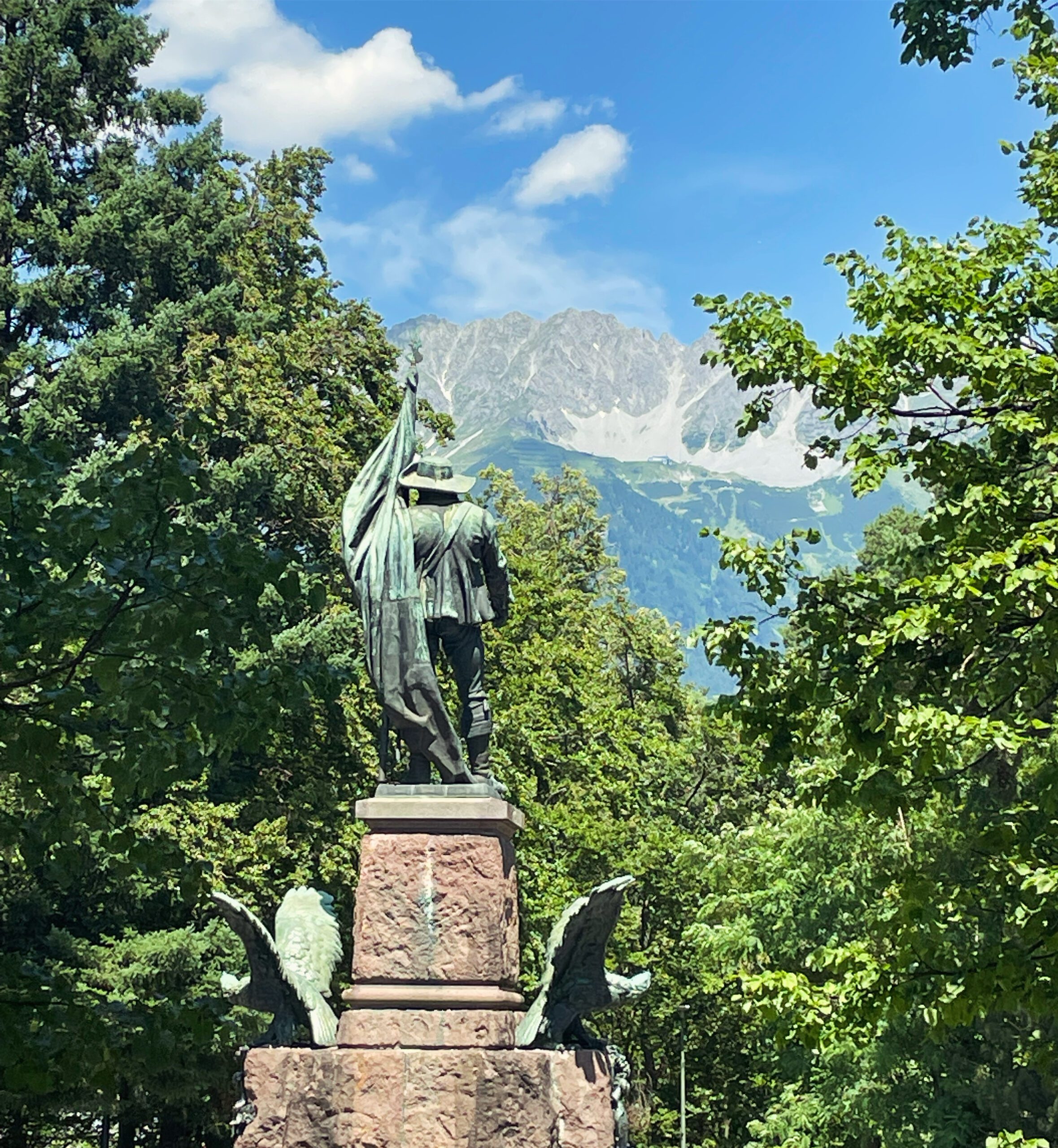
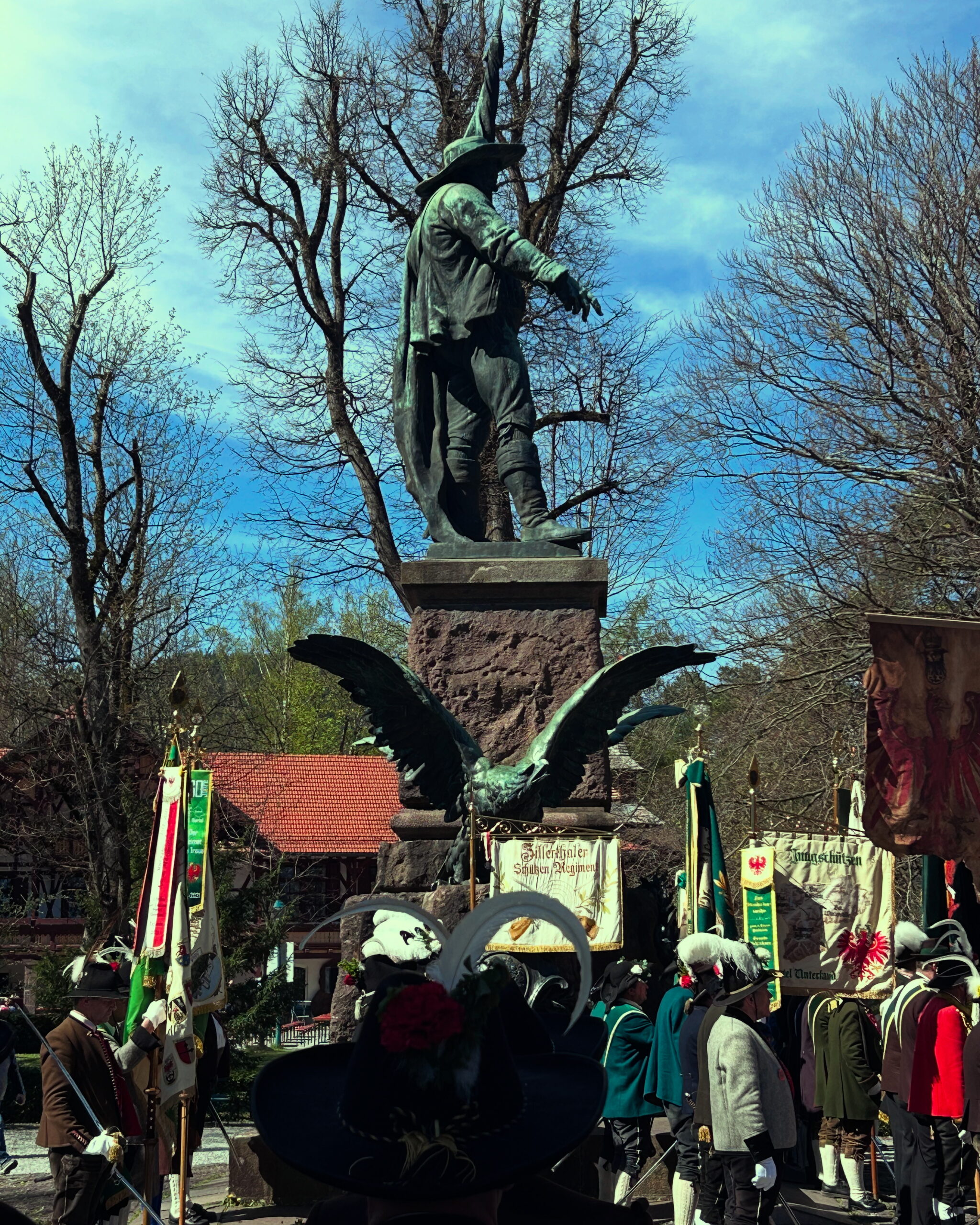
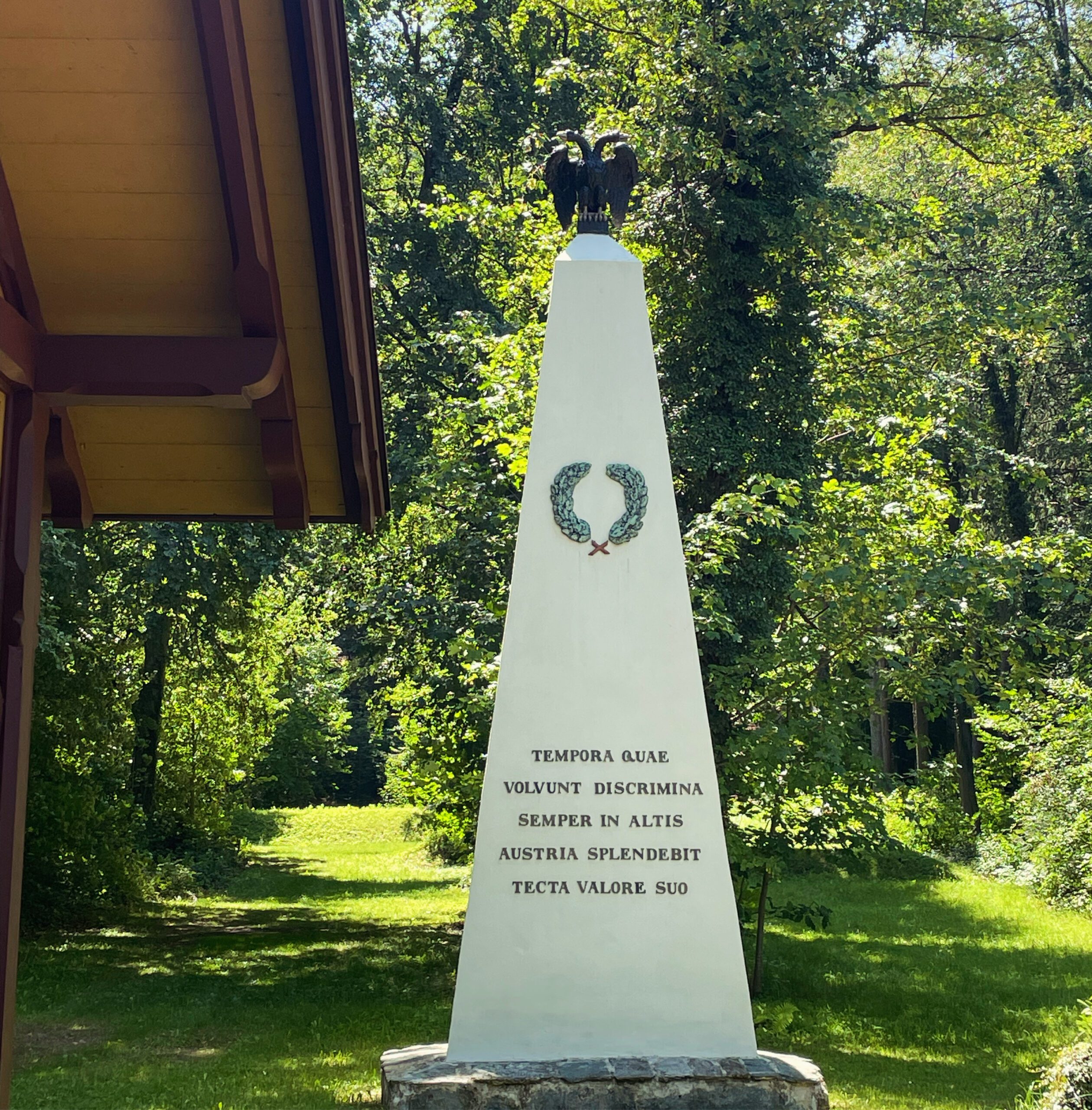
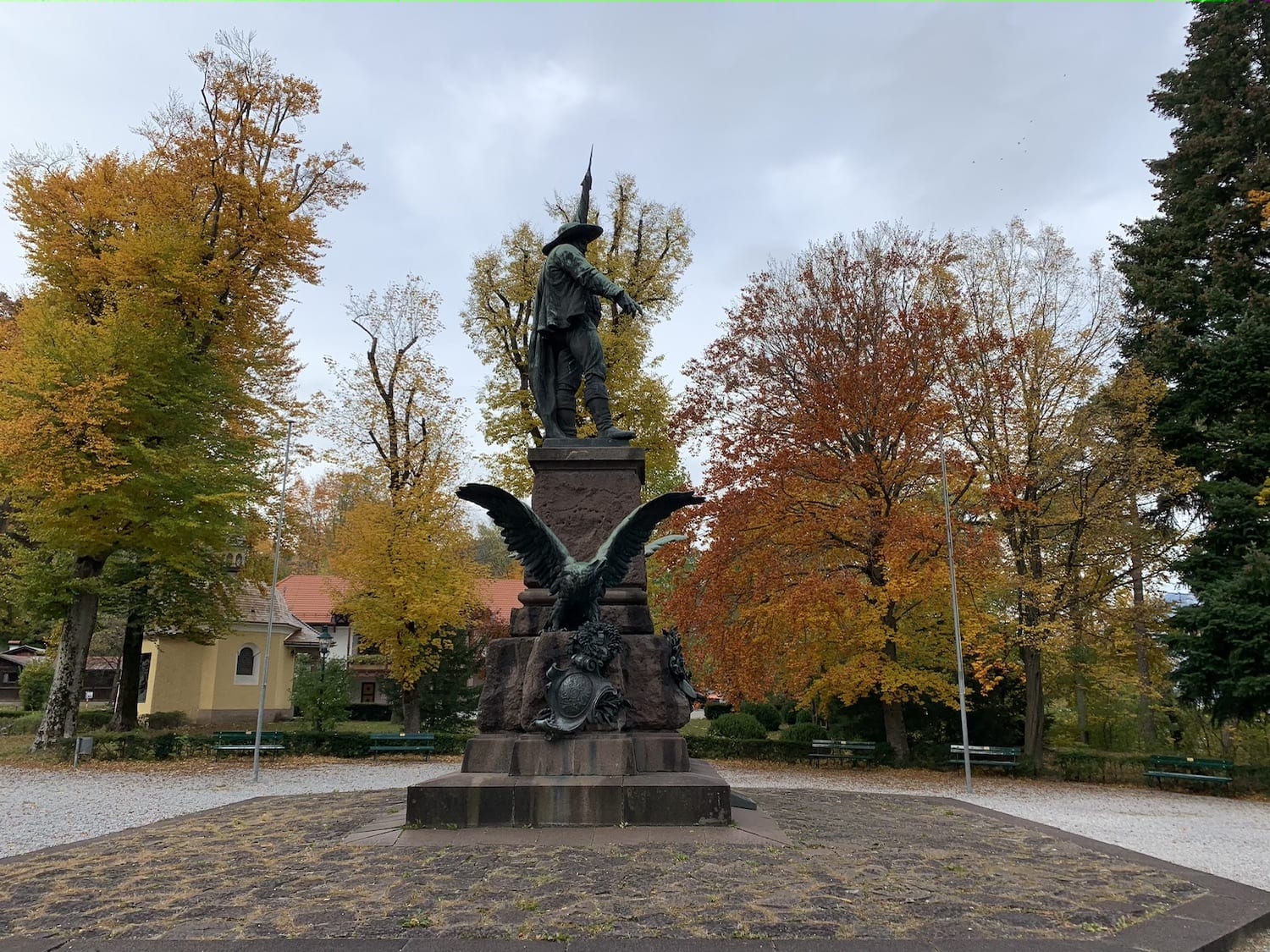
The Bergisel is arguably the most important site of remembrance for conservative Tyrolean identity. In 1809, the sharpshooters under Captain Andreas Hofer defeated the Bavarian and French armies that had occupied the region during the Napoleonic Wars. Hofer, initially not highly regarded by the Metternich government and considered a rebel, gradually transformed over the course of the 19th century into a martyr for the Tyrolean cause and is still considered a folk hero by many Tyroleans today. Bergisel became a place of pilgrimage. The Andreas Hofer monument occupies the central position in the park at Bergisel. A specially founded committee collected donations for the construction of the oversized bronze statue of Hofer. Emperor Franz Joseph himself attended the ceremonial unveiling in 1893. Bergisel was intended to serve as a “mountain of heroes,” representing an idealized, conservative Tyrolean identity as a Catholic German land within the monarchy. Flanked by two eagles, Hofer—flag in hand—looks northward.
After 1918 and the separation of South Tyrol from Austria, the monument became a memorial to the lost unity of the former crown land. The quasi‑holy South Tyrolean innkeeper and the “freedom‑loving Tyrolean resistance” were elevated to almost sacred status on both sides of the Brenner Pass. In 1961, at the height of the bomb attacks by the radical South Tyrolean Liberation Committee on Italian facilities, the statue again made headlines. Unknown perpetrators blew up the bronze figure on Bergisel. One interpretation still circulating today holds that it was an act of retaliation orchestrated by the Italian government in response to the attacks by South Tyrolean activists. The museum also addresses the Tyrolean uprising of 1809. The Tirol Panorama houses Tyrol’s largest artwork: a large‑scale depiction of the Battle of Bergisel. Until 2011, the painting was located in the rotunda near the former lower station of the Hungerburgbahn in Saggen before being moved to the newly constructed museum at Bergisel. Covering more than 1,000 square meters, it depicts the Third Battle of Bergisel. It was painted by the Munich artist Dino Ziemer under the supervision of the Tyrolean painter Franz Defregger. Their collaboration, taking place before the First World War, also symbolized reconciliation between Tyrol and Bavaria and their new allies, the German Empire and the Austro‑Hungarian monarchy. The painting follows the familiar pattern of glorifying the brave Tyrolean sharpshooters and their leaders. In reality, the stoically portrayed Hofer was likely not even in the heat of battle but behind the front line at the inn Schupfen, where the Tyrolean command center was located. The depiction otherwise adheres only loosely to historical facts—though this does not detract from the pleasure of viewing the panorama. Rich in detail, it not only presents a heroic interpretation of the events of August 13 but also offers a glimpse of Innsbruck and its surroundings in the 19th century.
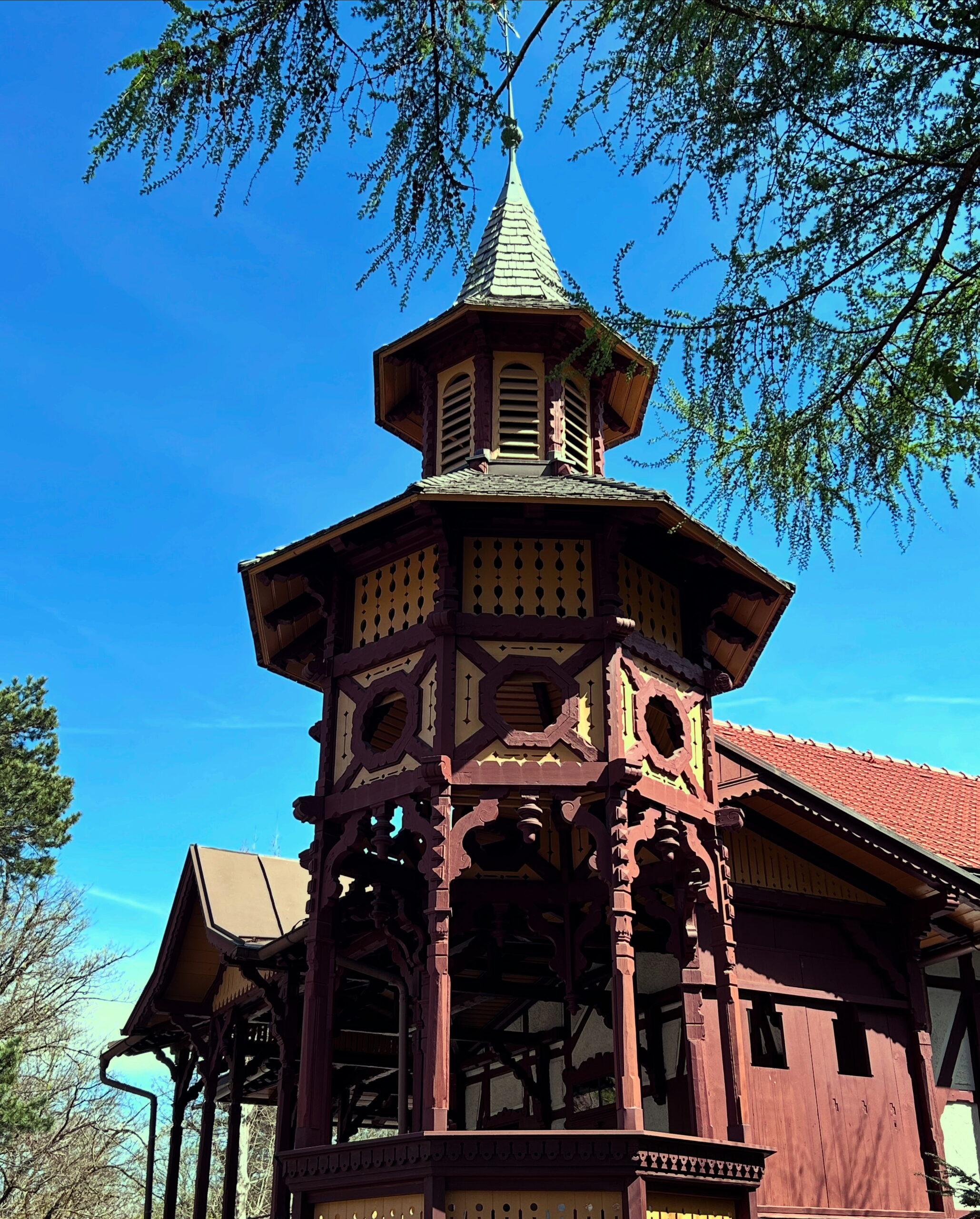
To the south of the square, shooting ranges were long used for regular exercises and competitions. For centuries, it was customary for subjects to train in military skills and weapons handling. Sharpshooter associations continue this tradition today, though they are increasingly scrutinized for their interpretation of Tyrolean culture. The striking building at the west end of the square, the Urichhaus, was built between 1893 and 1895 in the Heimatstil according to the plans of Eduard Klingler. It served from 1893 onward as an officers’ casino and administrative building. Today it houses the local chapter of the Tyrolean Kaiserjäger association, the Old Kaiserjäger Club, and a military science library. In front of it stand a chapel and a bronze statue of Emperor Franz Joseph I. The statue was originally erected across from the Kaiserjäger Museum to mark the emperor’s 100th birthday on August 18, 1830. It was later moved to its current location. Around the military buildings and shooting ranges, a recreational area with walking paths developed. The pavilion at the northeastern edge of the grounds, known for its wonderful view, was especially popular. Unmarried couples in particular appreciated the seclusion for discreet flirting away from prying eyes. Pavilions were a common feature of parks and promenades in the 19th and early 20th centuries until the First World War. They offered a place to rest, and young couples found shelter from overly curious gazes. In private gardens, pavilions had long been symbols of aristocratic prestige before being adopted by the bourgeoisie as a mark of prosperity.
Opposite the giant panorama painting stands the Kaiserjäger Museum. It was built in 1848 as a military facility with an officers’ casino but was converted into a museum in 1880 to document the history of the Tyrolean Kaiserjäger. These regiments were established after the Napoleonic Wars by Emperor Francis I, the first Austrian emperor. In the 19th century, the Kaiserjäger fought in the Italian Wars of Independence and in the Bosnian campaign. During the First World War, they were deployed as regular troops of the Habsburg monarchy—first in Galicia, then in the mountain war against Italy on the southern front. The museum displays paintings, uniforms, weapons, and models illustrating their history. The Book of Honor, on display here, contains 157 volumes with handwritten names of Tyroleans who died in 1809 and in the two world wars. The Books of Honor of the Tyrolean Kaiserjäger were ceremonially placed under a crown of thorns—symbolizing the suffering of divided Tyrol—and a laurel wreath in honor of the fallen during the final years of the Austrian corporatist state. Also on display is the Iron Flower Devil. To raise money for the families of fallen soldiers, special funds were established in the monarchy; donors could drive a nail into the sculpture. Shortly after the outbreak of war in July 1914, the press appealed for public support:
“The nailing of the ‘Iron Flower Devil,’ dedicated to the creation of a fund for widows and orphans of fallen Tyrolean soldiers, is making great progress. The cap, chest, backpack, and part of the left arm are already fully covered and, as can be seen, nailed under expert supervision. By Sunday, 31,000 nails had already been driven in—a remarkable testament to the generosity of our population, especially considering recent reports from Vienna that their ‘Man of Iron’ had already been fitted with 100,000 nails.”
Since 1930, Bergisel has been a foundation dedicated to the eternal commemoration of the four Tyrolean Kaiserjäger regiments. In 1959, the Tyrolean provincial government expanded the Kaiserjäger Hall of Honor by adding the memorial chapel “Our High Lady of Tyrol.”
Berg Isel Sprungschanze
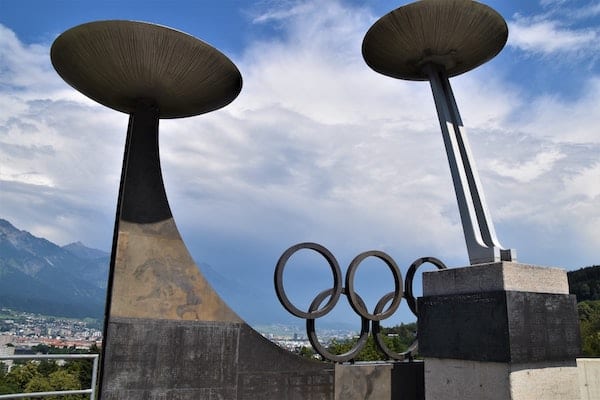
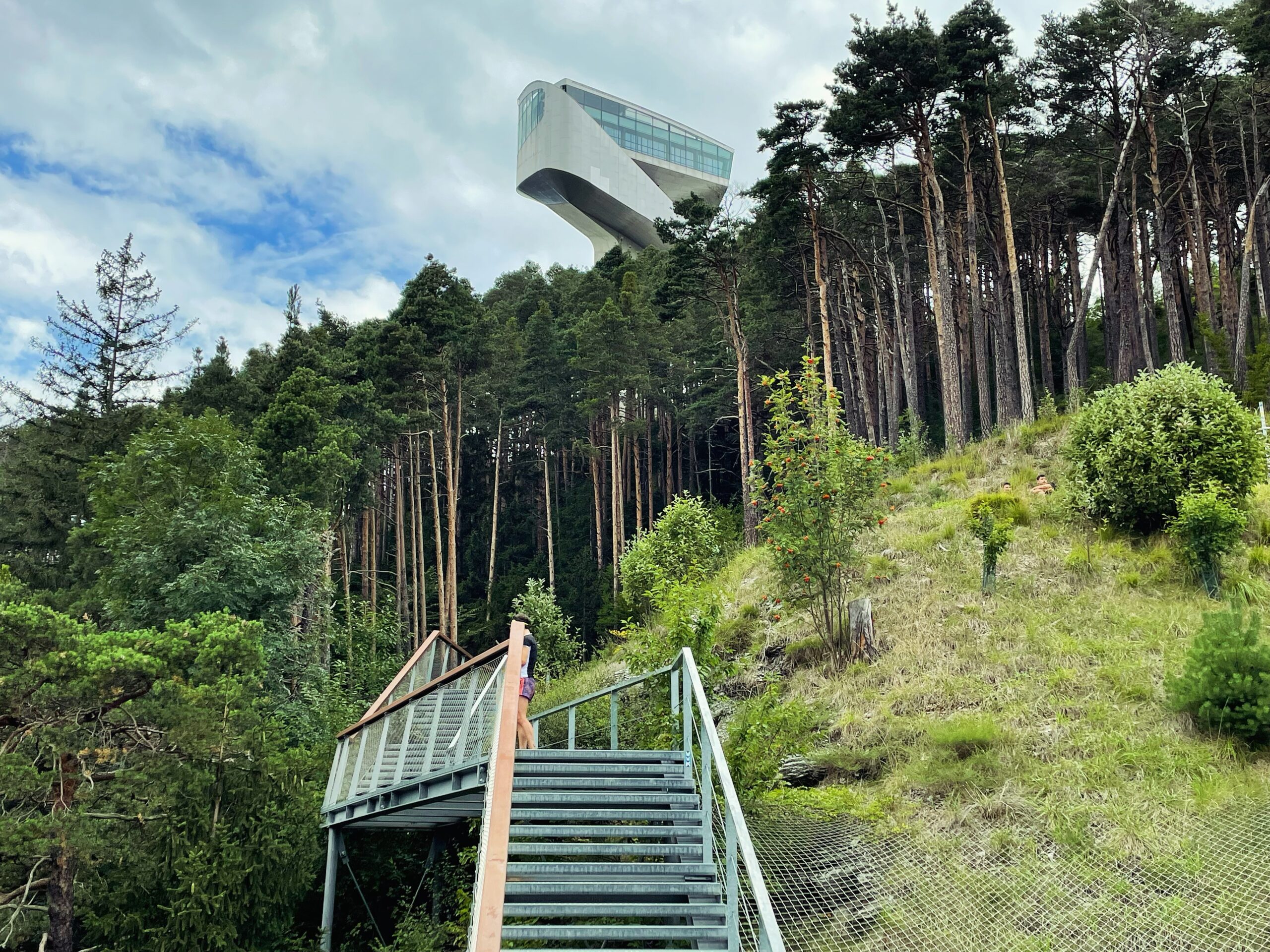
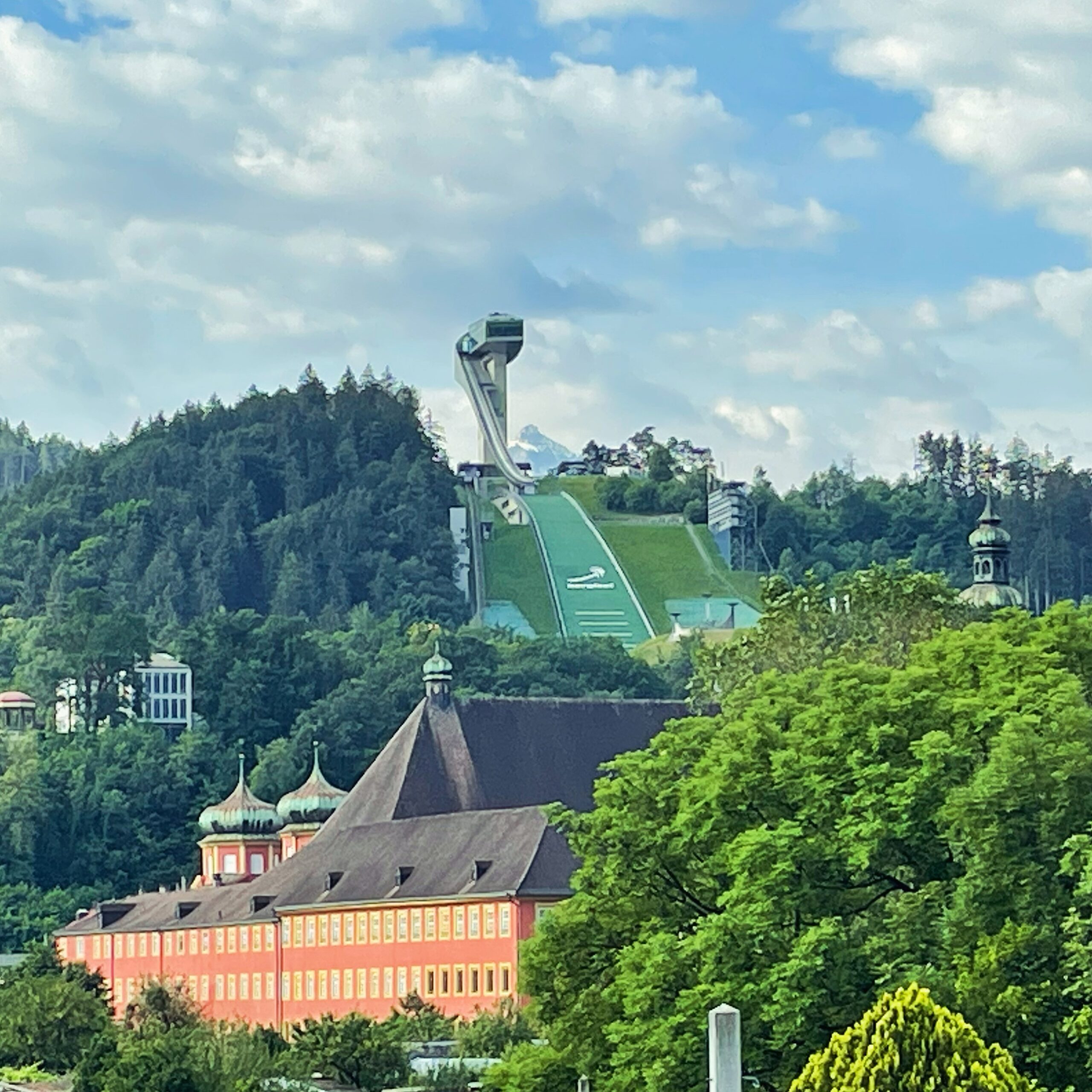
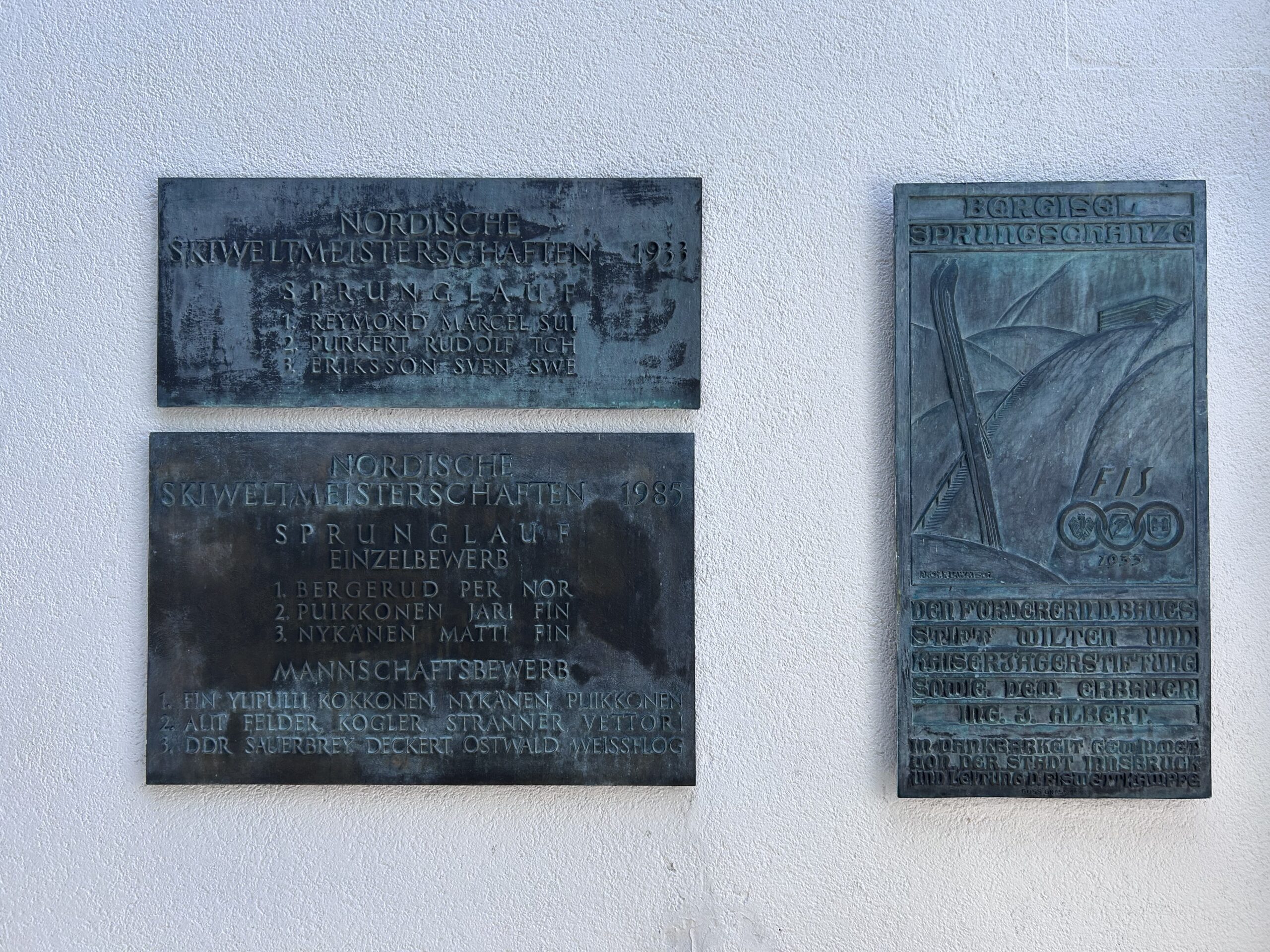
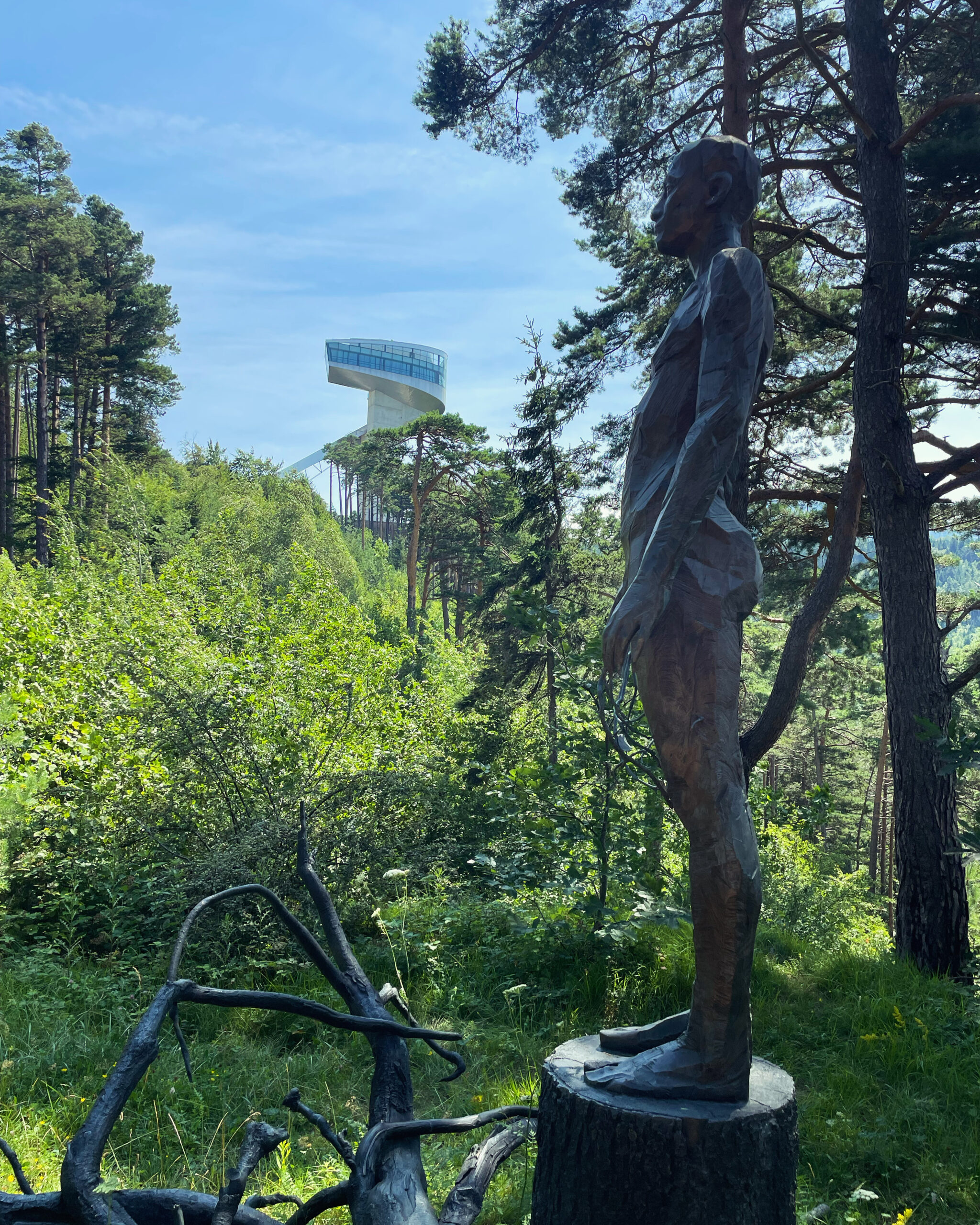
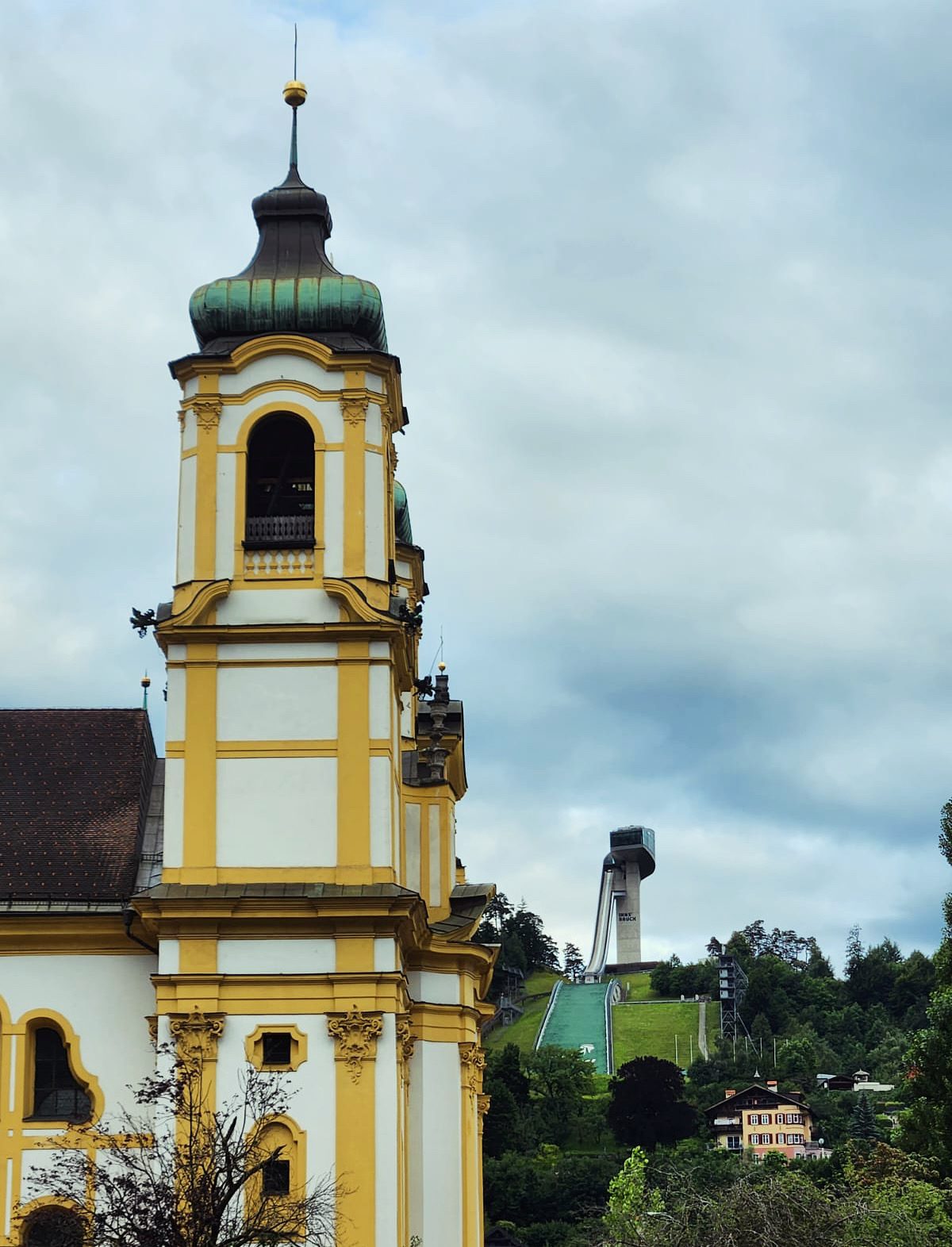
On the western side of Bergisel lies Innsbruck’s Olympic landmark: the ski jump. Majestically, the large ramp and the oval stadium with its unusual landing zone built into the opposite slope tower above the city, offering a magnificent panorama. Both in 1964 and in 1976, the opening ceremonies of the Olympic Winter Games were held on Bergisel. The Olympic rings at the landing area still commemorate these historic events for Bergisel and Innsbruck. Ski jumping has a long tradition in Tyrol. In the early 1920s, the sport— invented by Norwegians—was practiced by daring athletes on the hills in Seefeld or near Heiligwasser on the Patscherkofel. In 1927, the first official ski jumping competition on Bergisel was held as part of the Tyrolean Ski Championships. In its first year, athletes and spectators had to make do with a natural hill. The following year, a tower was constructed. For the 1933 Ski World Championships in Innsbruck, the facility was expanded—not only to surpass the record distance of 63 meters, but also to accommodate the large crowds. Jakob Albert played a key role in the planning. During the war, the jump tower collapsed and was only rebuilt after the Second World War. The major sporting highlights at Bergisel were the Olympic Games of 1964 and 1976. After its reconstruction, the jump enabled even greater distances. Bergisel also hosted other major events such as the World Championships in 1985 and, indirectly, in 2019 (Seefeld). Every year, ski jumping fans from around the world flock to Innsbruck for the Four Hills Tournament, when the best athletes throw themselves down the inrun and leap into the electrifying atmosphere of the Bergisel Stadium. For the sporting rivalry between Tyrol and Bavaria, Andreas Hofer and the Tyrolean “War of Liberation” of 1809 are often evoked as comparisons. The facility has also served as a stage outside the world of sports. In 1988, Pope John Paul II celebrated Mass there before tens of thousands of worshippers. A dark chapter in Innsbruck’s history occurred in 1999 during the Air & Style snowboard festival, when a mass panic injured 40 people, five of whom died.
Many Innsbruck residents were there live as spectators from the Olympic Bridge in 2002 when the concrete tower collapsed to make way for the new ski jump. The design of the ski jump as it looks today is the work of star architect Zaha Hadid, who was also in charge of the new Hungerburgbahn. A lift takes you up to the ski jump where you can enjoy coffee and cake high above Innsbruck with a fantastic panorama.
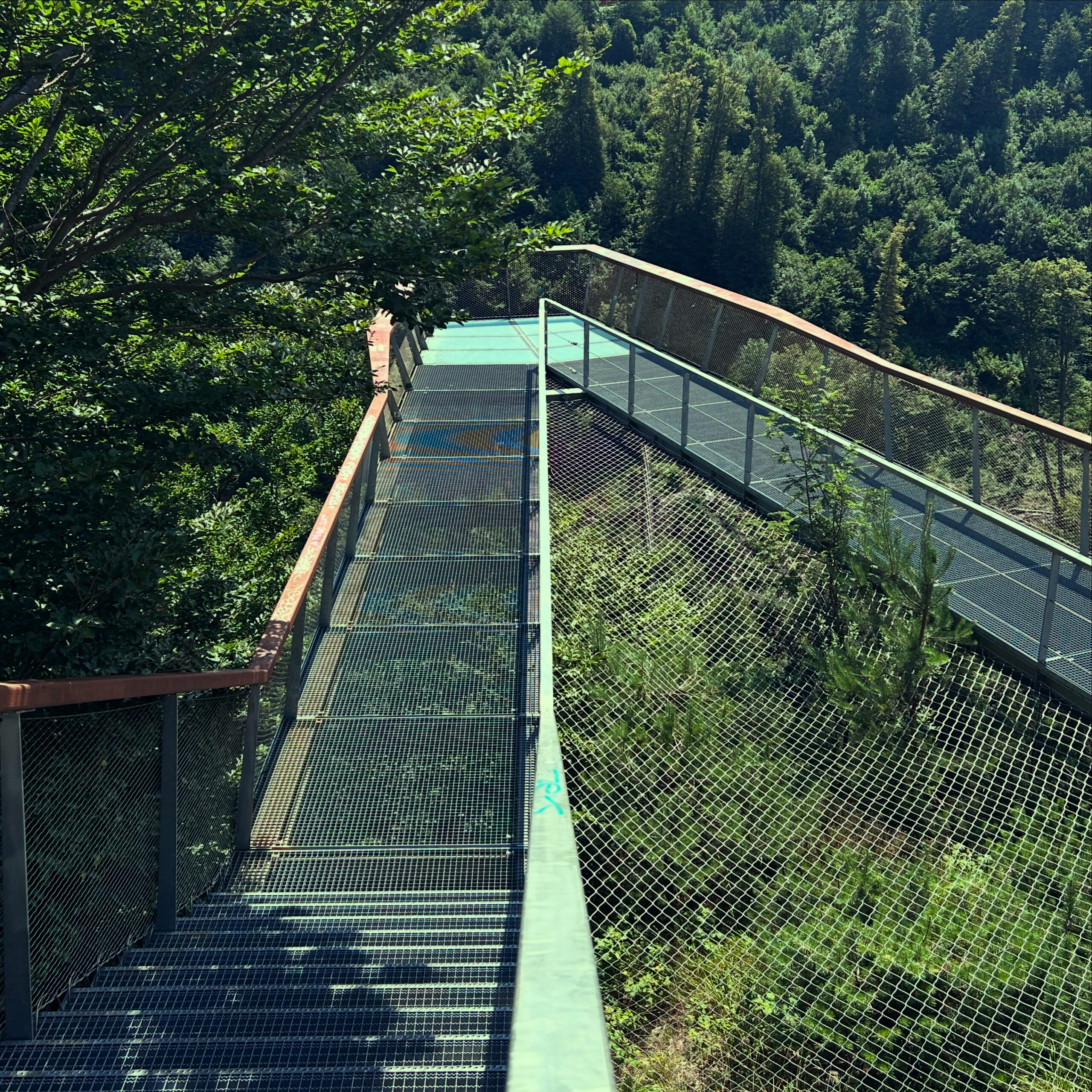
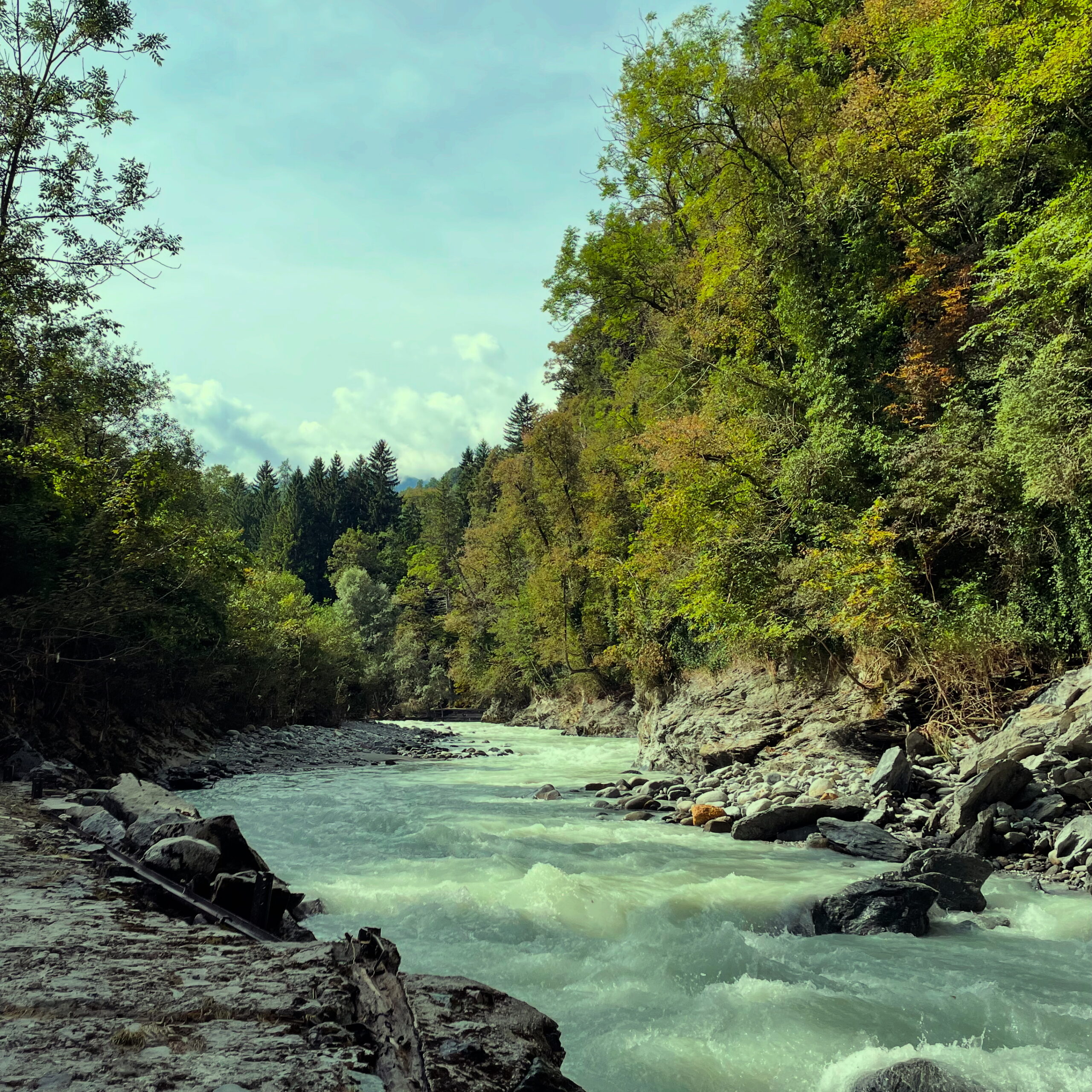
The sports facilities are best experienced actively. A hiking trail leads from the museum’s parking area around Bergisel. The path is easy to walk and offers wonderful vistas. The highlight is the “Sonnendeck” viewing platform, where visitors can gaze down into the steep Sill Gorge from dizzying heights. The roughly 2‑kilometer route is manageable for anyone with average fitness, and families with children can also enjoy this circular walk.
Innsbruck's Olympic renaissance
There are events that remain in the collective memory of a community for generations. You don't have to have been there, or even be in the world, to know that Franz Klammer raced to the gold medal in the Olympic downhill on the Patscherkofel on 5 February 1976 in his yellow one-piece suit. Franz Josef I may have climbed the Patscherkofel in 1848, but he became a legend on this mountain. Kaiser Franz Bracket. "Jawoll! 1;45,73 für unseren Franzi Klammer," could be heard from countless TV sets in Austria at the time. In order to be able to follow the national hero Klammer on his devil's ride, the schoolchildren were allowed to stay at home on the day of the men's downhill, just like in 1964. The streets were also empty during this hellish ride. Klammer achieved what many emperors, kings and politicians had failed to do. He united the nation of Austria. "Mi hats obageibtlt von oben bis unten, I hatt nie gedacht, dass i Bestzeit foa,“ gab Klammer im Kärntner Dialekt beim Siegerinterview zu Protokoll. Kein Tiroler, nobody is perfect, aber die Olympischen Spiele waren für die Gastgebernation Österreich schon am zweiten Tag gerettet. 1976 fanden die Olympischen Winterspiele bereits zum zweiten Mal in Innsbruck statt. Eigentlich wäre Denver an der Reihe gewesen, wegen eines Referendums auf Grund finanzieller und ökologischer Bedenken trat man in Colorado als Ausrichter zurück. Innsbruck setzte sich als Gastgeber im zweiten Versuch gegen Lake Placid, Chamoix und Tampere durch. Zum ersten Mal war man 12 Jahre zuvor Ausrichter der Olympiade gewesen. Vom 29. Januar bis zum 9. Februar 1964 war Innsbruck der Nabel gewesen, nachdem man sich mit der Bewerbung gegen Calgary und Lahti durchgesetzt hatte. Erheblicher Schneemangel bereitete Probleme bei der Durchführung etlicher Events. Nur mit Hilfe des Bundesheeres, das Schnee und Eis aus dem Hochgebirge zu den Wettkampfstätten brachte, konnten die 34 Bewerbe über die Bühne gehen.
The opening ceremony in the packed Berg Isel Stadium can be clearly seen in archive photos. Unlike the elaborate ceremonies of today's Olympic Games, the procedure in the 1960s was still unspectacular. The Wilten town music erfreute die internationalen Gäste mit Tiroler Blasmusik. Beim Einmarsch der Fahnen konnten Besucher zum ersten Mal im Rahmen von olympischen Spielen die Flagge Nordkoreas erblicken. Die Tiroler Schützen überwachten mit Argusaugen die olympische Flamme. Als Logo wurden lediglich die Olympischen Ringe über das Wappen der Stadt gelegt, ein Maskottchen gab es noch nicht.Auch die Sportbewerbe waren weniger professionell organisiert als bei heutigen olympischen Spielen. Das Bobrennen fand zum ersten Mal auf einer Kunsteisbahn statt, wenn auch noch nicht im heutigen Igler Eiskanal. Die Eishockeyspiele wurden zum Teil noch in der Messehalle in sehr moderatem Rahmen abgehalten. Skibewerbe, wie der Slalom und Riesenslalom der Damen, in dem sich in jeweils anderer Konstellation die französischen Schwestern Christine und Marielle Goitschel Gold und Silber umhängen ließen, fanden in der Axamer Lizum statt. Am Berg Isel verfolgten laut offiziellen Angaben 80.000 Zuschauer das Spektakel, als sich der Finne Veikko Kankonnen Gold im Skisprung sicherte. Im Eishockeyfinale triumphierte die Sowjetunion vor Schweden. Mit 11 Goldmedaillen sicherte sich die UDSSR auch Platz 1 im Medaillenspiegel, mit vier Goldenen wurde Österreich sensationell Zweiter.
The opening of the 1976 Games also took place on Berg Isel. In memory of 1964, two flames were lit on Mount Isel during the opening ceremony. Most of the 37 competitions this time took place at the same venues in Innsbruck, Axams, Igls and Seefeld as in 1964. The ice stadium and ski jumping arena were still suitable for the Olympics. A new artificial ice rink was built in Igls. The Axamer Lizum was given a new standing track to allow the athletes to start on the Hoadl zu bringen. Schnee war erneut Mangelware im Vorfeld und man bangte erneut, rechtzeitig schlug das Wetter im letzten Moment aber um und bescherte Innsbruck das Weiße Gold. Das Schneemanndla round snowman with a carrot nose and Tyrolean hat, the mascot of the 1976 Games was probably a good omen.
Die größte Veränderung zwischen den beiden olympischen Spielen innerhalb von zwölf Jahren war der Status der Athleten. Waren bei den ersten Spielen offiziell nur Amateure am Start, also Sportler, die einem Beruf nachgingen, konnten 1976 Profisportler antreten. Auch die Übertragungs- und Fotoqualität war um einiges höher als bei der ersten Innsbrucker Edition. Fernsehen hatte dem Radio mittlerweile den Rang abgelaufen. Die deutsche Skirennläuferin Rosi Mittermaier wurde perfekt in Szene gesetzt bei ihren Fahrten zu Doppelgold und Silber bei den Damenskirennen. Das Eishockeyturnier gewann erneut die Sowjetunion vor Schweden, bereits zum vierten Mal in Folge. Auch der Medaillenspiegel sah am Ende die UDSSR wieder ganz oben, diesmal vor der DDR. Österreich konnte nur zwei Goldene erringen. Mit Klammers Gold in der Abfahrt war dies allerdings nur Nebensache. Der Patscherkofel und Österreichs Franzi sind seither untrennbar miteinander verbunden. Und auch wenn die Innsbrucker nicht ganz so sportlich sind, wie sie gerne wären, den Titel der Olympiastadt kann nach zwei Ausgaben plus einer Universiade und den Youth Olympic Games niemand wegdiskutieren.
The city, supported by federal funds, was also very generous with the non-sporting infrastructure for both games. Following the rapid reconstruction of the city after the war, the city was modernised in the run-up to the Games. Innsbruck's first Olympic edition took place during the period of the economic miracle. In 1963, the Olympic Bridge, which connected the west of the city with the competition venues, was built. Until then, Innsbruck's east-west traffic had travelled through the city centre in a complicated manner. The individual streets between Amraser-See-Straße in the east and Bachlechnerstraße in the west, which make up the Südring arterial road today, were only subsequently developed and were previously quiet parts of the suburbs. Meadows and fields characterised the scenery. The comparison of aerial photographs from 1960 and 2020 is fascinating. In Amras, where today the daily Rush Hour abspielt, bis in die 1970er Jahre Bauernhöfe und einzelne Wohnhäuser. In der heutigen Egger-Lienz-Straße beim Westbahnhof verlief das Bahnviadukt der Westbahn. Alte Fotos zeigen die Gleise, daneben Bäume und spielende Kinder. Rund um die heutige Graßmayr junction a new neighbourhood was created almost in passing. The Department stores' forumwhich today houses a cinema, was a sensation and a sign of Innsbruck's modernisation.
An Olympic village was built twice and living space was created that is still in use today. Part of the former village of Arzl, which had belonged to Innsbruck since 1940, was chosen for this purpose. Today's district O-Village im Osten der Stadt fungierte während der Spiele als Olympisches Dorf für die Athleten, das durch die Reichenauer Brücke über den Inn mit der Innenstadt und den Wettkampfstätten verbunden wurde. In der kaum besiedelten Arzler Au wurde 1961 mit dem Bau der ersten Wohnblöcke begonnen. Der Arzler Schießstand, den man auf einer Landkarte von 1960 noch sehen kann, wurde eine Talstufe weiter nach oben verlegt. In den 1970er Jahren kamen weitere Blöcke dazu. Heute ist das O-Dorf, trotz der wenig beschaulichen Hochhäuser im Stil der 1960er und 1970er Jahre, dank seiner Lage am Inn, den Grünflächen und der guten Anbindung an den öffentlichen Verkehr ein lebenswertes Grätzel. Viele weitere Bauten in Innsbruck, die während der Olympiade als Infrastruktur für Presse und Medien genutzt wurden, gehen ebenfalls auf die Olympischen Spiele zurück. Die Pädagogische Akademie PÄDAK in Wilten, die IVB-Halle und das Landessportheim können als olympisches Erbe betrachtet werden. Der wenig prächtige Bau, der das ehemalige Hotel Holiday Inn neben der Triumphpforte beherbergt, das in den letzten Jahrzehnten eine Vielzahl an Betreiberwechseln durchmachte, entstand ebenfalls im Rahmen der olympischen Renaissance. Auch ein Erbe der olympischen Spiele ist etwas, das man heute verzweifelt zu ändern versucht: Das olympiabedingte Wachstum fiel mit den 60er und 70er Jahren in die frühe Blütezeit des Automobils.
For Innsbruck, the Olympic Games were not only a starting point for modernity in terms of winter sports and infrastructure. The events also mentally put an end to the stale atmosphere of the grey post-war period and spread a feeling of departure from the status of a provincial nest. It may no longer have been a royal seat as in Maximilian's time, but at least it was back on the international map. Thanks be to Emperor Franz!
Andreas Hofer and the Tyrolean uprising of 1809
The period of the Napoleonic Wars provided Tyrol with a national epic and, in Andreas Hofer, a hero whose legacy continues to resonate to this day. Anyone searching for a Tyrolean national founding narrative—voilà! However, if one sets aside the carefully constructed legend of the Tyrolean uprising against foreign rule, the years before and after 1809 emerge as a darker chapter in Innsbruck’s urban history, marked by economic hardship, wartime devastation, and widespread looting. During the Napoleonic Wars, the Kingdom of Bavaria was allied with France and, through several conflicts between 1796 and 1805, succeeded in taking Tyrol from the Habsburgs. Innsbruck was no longer the capital of a crown land, but merely one of many district capitals within the administrative unit of the Innkreis. Revenues from tolls and customs duties, as well as income from Hall salt production, were redirected northwards. The British continental blockade against Napoleon caused the collapse of long‑established and prosperity‑generating sectors of the Innsbruck economy, particularly long‑distance trade and transport. Innsbruck’s citizens were required to quarter Bavarian soldiers in their homes. The abolition of the Tyrolean provincial government, the gubernium, and the Tyrolean parliament meant not only a loss of status, but also a loss of jobs and financial resources. While the city suffered financially under war and the new regime, the upheaval also opened up new socio‑political opportunities. War, as the saying goes, is the father of all things, and many citizens did not entirely oppose the fresh winds of change. Inspired by the spirit of the Enlightenment, reason, and the French Revolution, the new rulers set about dismantling traditional structures. Measures such as street‑cleaning regulations and compulsory smallpox vaccination aimed to improve hygiene and public health. At the beginning of the nineteenth century, a considerable number of people still died from diseases caused by poor sanitation and contaminated drinking water. A modern tax system was introduced, and the powers of the nobility were further curtailed in line with the emerging administrative state. The Bavarian authorities reinstated the right to form associations, which had been banned in 1797. The reduction of the Church’s influence over education was also welcomed by the liberal-minded population of Innsbruck. A telling example of these reforms was the appointment of the Benedictine monk Martin Goller—later co‑founder of the Innsbruck Music Society—to promote musical and cultural education in the city. However, Catholic processions and religious festivals fell victim to the Enlightenment-inspired agenda of the new rulers. In 1808, the Bavarian king introduced the Municipal Edict across his territories, obliging subjects to maintain public buildings, fountains, roads, bridges, and other infrastructure.
These reforms were unpopular with large segments of the Tyrolean population. For Tyrolean farmers, who had long been largely exempt from compulsory labour, the new obligations represented an additional burden and an affront to their sense of status. The immediate trigger for the uprising was the conscription of young men into the Bavarian-Napoleonic army, despite the fact that Tyroleans, according to the Landlibell issued by Emperor Maximilian, were only obliged to defend their own borders. On 10 April 1809, a disturbance during a conscription in Axams near Innsbruck escalated into a full uprising. Under the banner of “God, Emperor, and Fatherland,” Tyrolean militia units assembled to drive the Bavarian troops and administrators out of Innsbruck. The riflemen were led by Andreas Hofer (1767–1810), an innkeeper as well as a wine and horse trader from the Passeier Valley near Merano. He was supported not only by fellow Tyroleans such as Father Haspinger, Peter Mayr, and Josef Speckbacher, but also—behind the scenes—by Archduke Johann of Habsburg. Upon entering Innsbruck, the insurgents did not limit themselves to official targets. As in the Peasants’ War of 1525, their zeal was driven not only by adrenaline but also by alcohol. The unruly mob proved more damaging to the city than Bavarian rule had been since 1805. Particularly severe riots were directed against bourgeois women and the small Jewish population—carried out by the very “liberators.”
n July 1809, following the Peace of Znaim concluded with the Habsburgs—still regarded by many Tyroleans today as Vienna’s betrayal of Tyrol—Bavarian and French forces regained control of Innsbruck. What followed entered the history books as the Tyrolean Uprising under Andreas Hofer, who had by then assumed supreme command of the Tyrolean militia. In total, the insurgents achieved victory three times on the battlefield, most famously in the Third Battle of Bergisel in August 1809. “Innsbruck sees and hears what it has never seen or heard before: a battle involving 40,000 combatants…” For a brief period, Andreas Hofer effectively ruled Tyrol in the absence of regular administrative structures, even in civilian matters. The city’s dire financial situation, however, did not improve. Instead of Bavarian and French soldiers, Innsbruck citizens now had to house and feed their own compatriots from the peasant regiments and pay levies to the new provincial government. The liberal and affluent urban elites were particularly unhappy with the new rulers. The decrees issued by Hofer in his role as provincial commander resembled a theocratic order more than nineteenth‑century legislation. Women were required to appear in public only modestly veiled, dances were banned, and “immodest” monuments—such as the nymphs at the Leopold Fountain—were removed from public space. Educational responsibilities were to be returned to the clergy. Liberals and intellectuals were arrested, while the recitation of the rosary became compulsory. In the autumn of 1809, the fourth and final Battle of Bergisel ended in a decisive defeat at the hands of overwhelming French forces. The government in Vienna had used the Tyrolean insurgents primarily as a tactical buffer in the war against Napoleon. Even earlier, the emperor had already been forced to cede Tyrol again in the Treaty of Schönbrunn. Between 1810 and 1814, Innsbruck once more came under Bavarian administration. The population, too, was only moderately motivated to continue fighting. Wilten suffered severe damage from the fighting, shrinking from over 1,000 inhabitants to fewer than 700. By this time, Hofer himself was a man broken by exhaustion and alcohol. He was captured and executed in Mantua on 20 January 1810. To make matters worse, Tyrol was divided. The Adige Valley and Trentino became part of the Kingdom of Italy established by Napoleon, while the Puster Valley was annexed to the French‑controlled Illyrian Provinces.
The “fight for freedom” continues to symbolise the Tyrolean self‑image to this day. For a long time, Andreas Hofer was regarded as an undisputed hero and the prototype of the resilient, patriotic, and steadfast Tyrolean—the underdog who resisted foreign domination and unholy customs. In reality, Hofer was likely a charismatic leader, but politically inept, conservative‑clerical, and simple‑minded. His tactical principle at the Third Battle of Mount Isel—“Grad nit aufferlassen tiat sie” (“You just must not let them come up”)—captures his character quite well. In conservative Tyrolean circles such as the marksmen (Schützen), Hofer continues to be venerated in an uncritical and quasi‑cultic manner. The Tyrolean marksmen tradition is a living form of heritage that has modernised in some respects, yet in many darker corners remains reactionary in orientation. To this day, marksmen from Wilten, Amras, Pradl, and Hötting march in harmony alongside clergy, traditional costume associations, and brass bands in church processions, firing rifles into the air to drive all evil away from Tyrol and the Catholic Church. Throughout the city, numerous monuments commemorate the year 1809. During the second half of the nineteenth century, the fighters were increasingly heroised as a German bulwark against foreign peoples. Mount Isel was made available to the city for the veneration of the freedom fighters by Wilten Abbey, the Catholic authority in Innsbruck. Streets in the Wilten district—incorporated into Innsbruck in 1904 during a period dominated by a Greater German liberal city council and long administered by the Abbey—were named after Andreas Hofer and his comrades Josef Speckbacher, Peter Mayr, Father Haspinger, and Kajetan Sweth. The short Rote Gassl (Red Alley) in the historic centre of Wilten commemorates the Tyrolean marksmen who—supposedly clad in red uniforms, probably erroneously attributed to them—are said to have paid mass homage at this spot to the victorious commander Hofer after the second Battle of Mount Isel. To this day, Andreas Hofer is frequently invoked in Tyrol in support of a wide range of initiatives and agendas. Especially during the nationalism of the nineteenth century, repeated reference was made to the idealised hero Andreas Hofer. Through paintings, pamphlets, and theatrical performances he was elevated to iconic status. Even today, one can still see the likeness of the senior marksman when Tyroleans protest against unpopular measures of the federal government, EU transit regulations, or—somewhat incongruously—when FC Wacker Innsbruck faces away teams. The slogan in such cases is: “Men, it’s time!” The legend of the battle‑hardened Tyrolean farmer—working the fields by day and training in the evening at the shooting range as a sharpshooter and defender of the homeland—is repeatedly revived to reinforce an image of “authentic” Tyrolean identity. The commemorations marking the anniversary of Andreas Hofer’s death on 20 February continue to draw large crowds from all parts of Tyrol to Innsbruck. Only in recent decades has a more critical reassessment emerged of this staunchly conservative marksman captain, likely overwhelmed by his role as Tyrol’s provincial commander, who—encouraged by elements of the Habsburg dynasty and the Catholic Church—sought not only to repel French and Bavarian forces but also to keep the liberal ideas of the Enlightenment firmly out of Tyrol.
1796 - 1866: Vom Herzen Jesu bis Königgrätz
The period between the French Revolution and the Battle of Königgrätz in 1866 was a highly warlike era. Many of the later political attitudes, animosities toward other groups, and the European nationalism of the nineteenth and twentieth centuries—which would also shape the history of Innsbruck—had their roots in the conflicts of this time. The monarchies of Europe, led by the Catholic Habsburgs, declared war on the French Republic. Although revolutionary Paris was far away and no comprehensive press system existed for the dissemination of news, the alleged godlessness of the murderers of Marie Antoinette was effectively spread through pamphlets and sermons from church pulpits. Fear arose that the revolutionary slogan “Liberté, Égalité, Fraternité,” along with its principles, might spread throughout Europe. During the Coalition Wars, a young general named Napoleon Bonaparte advanced across the Alps in 1796 with his Italian army and encountered Austrian troops. This was not merely a war over territory and power—it was a clash of systems. The Grande Armée of revolutionary France confronted the forces of the conservative and Catholic Habsburgs. Tyrolean riflemen (Schützen) actively participated in the fighting, defending the province’s borders against the advancing French. The men were accustomed to handling weapons and were considered skilled marksmen. The historian Ludwig Denk described this in a publication from 1860:
"...The Tyrolean's main passion is shooting. Early on, the father takes his son hunting. It is not uncommon to see boys running around with loaded rifles, climbing high mountains and shooting birds or squirrels..."
The strength of units such as the Hötting Rifle Company, established in 1796, lay not in open field battles but in guerrilla warfare. Moreover, they believed they had a secret weapon against the most advanced army of the time: the Sacred Heart of Jesus. Since 1719, Jesuit missionaries had spread devotion to the Sacred Heart even in the most remote valleys, successfully establishing it as a unifying force in the struggle against pagan customs and Protestantism. Faced with the godless revolutionary French, it seemed only natural that the Sacred Heart would once again—after 1703—watch protectively over the Tyrolean warriors of God. In desperate circumstances, the Tyrolean troops renewed their covenant. Against all odds, the riflemen succeeded in their defensive efforts. The abbot of Stams Abbey petitioned the provincial estates that, henceforth, “the Feast of the Divine Heart of Jesus should be celebrated annually with a solemn church service, if Tyrol were freed from the threat of enemy danger.”
Victory in this battle did not change the outcome of the war against Napoleon’s overwhelming forces, nor did it alter the territorial expansion of Tyrol—while Innsbruck’s population declined. During the turmoil of war, the Habsburg territory had expanded without notable military success—and likely without the help of the Sacred Heart. The archiepiscopal territory of Trentino became part of the crown lands through a territorial settlement known as the Reichsdeputationshauptschluss in the final phase of the Holy Roman Empire before its dissolution in 1803. Innsbruck, however, shrank. Fallen soldiers and war-related economic hardship led to a decline in the population from over 9,500 around 1750 to approximately 8,800 in the early decades of the nineteenth century. While this may seem modest in absolute numbers, the consequences were severe: stagnation in urban life. Young men were missing—as labourers, husbands, and fathers. This wartime recession remains largely underrepresented in the city’s historiography. Perhaps the near absence of Biedermeier architecture in Innsbruck can be seen as a subtle reminder of these difficult years.
After the Napoleonic Wars and the reorganisation of Europe at the Congress of Vienna, Tyrol’s borders remained largely peaceful for around thirty years. This changed with the Italian Risorgimento, the national movement led by Sardinia‑Piedmont and France. In 1848, 1859, and 1866, the so‑called Italian Wars of Unification took place. Over the course of the nineteenth century—at the latest since 1848—a fervent nationalist enthusiasm spread among young men of the upper classes across Europe. Volunteer armies sprang up everywhere. Students and academics formed associations; gymnasts and riflemen alike sought to prove their newfound national identity on the battlefield, supporting official armies against their respective enemies. During this time, Innsbruck served as an important logistical hub as a garrison town. Following the Congress of Vienna, the Tyrolean Jäger Corps became the Imperial and Royal Tyrolean Kaiserjäger Regiment, an elite unit deployed in these conflicts. Volunteer formations such as the Innsbruck Academics and the Stubai Riflemen also fought in Italy. Thousands fell in battle against a coalition consisting of the traditional enemy France, the particularly “godless” Redshirts under Giuseppe Garibaldi, and the emerging Kingdom of Italy, formed at Austria’s expense under the leadership of the Francophile House of Savoy from Piedmont. The media further inflamed sentiment behind the front lines. The Innsbrucker Zeitung preached loyalty to the emperor and a Greater German‑Tyrolean nationalism, railed against Italians and the French, and celebrated the bravery of Tyrolean soldiers. One report stated:
“The strong occupation of the heights at the exit of the Valsugana near Primolano and Le Tezze has often given the Innsbruck Academics I and the Stubai riflemen cause to undertake voluntary excursions against Le Tezze, Fonzago, and Fastro, as well as to the right bank of the Brenta and the heights opposite the small camps of the Sette Comuni… On the 19th, the Stubai riflemen had already struck down several enemies when they ventured down for the first time, creeping up on them…”
Probably the most famous battle of the Wars of unification fand in Solferino 1859 in der Nähe des Gardasees statt. Entsetzt vom blutigen Geschehen entschloss sich Henry Durant das Rote Kreuz zu gründen. Der Schriftsteller Joseph Roth beschrieb das Geschehen auf den ersten Seiten seines Romans Radetzkymarsch.
"In the battle of Solferino, he (note: Lieutenant Trotta) commanded a platoon as an infantry lieutenant. The battle had been going on for half an hour. Three paces in front of him he saw the white backs of his soldiers. The first row of his platoon was kneeling, the second was standing. Everyone was cheerful and certain of victory. They had eaten copiously and drunk brandy at the expense and in honour of the emperor, who had been in the field since yesterday. Here and there one fell out of line."
The year 1866 proved particularly catastrophic for the Austrian Empire. In Italy, Venetia and Lombardy were lost. In the north, the Habsburg army suffered a devastating defeat at the Battle of Königgrätz. After this short “brother’s war,” Prussia took over leadership of the German Confederation from the Habsburgs. Austria’s reorientation toward the east meant that Innsbruck definitively became a city on the western periphery of the empire. This shift was accompanied by a resurgence of nationalist ideas, particularly among Innsbruck’s liberal upper bourgeoisie. Support for the “Greater German solution”—a united state with the German Empire rather than the Austro‑Hungarian Monarchy—was especially strong. The extent to which this German Question divided the city became apparent more than thirty years later, when the Innsbruck city council proposed naming a street after Otto von Bismarck. While conservative loyalists reacted with outrage, the liberal Greater German faction around Mayor Wilhelm Greil welcomed the idea. After the Second World War, the defeat at Königgrätz supported Austria’s narrative of being the first victim of National Socialism, as it had already been excluded from a unified German state in 1866.
To this day, the conflicts at Tyrol’s southern borders continue to shape tradition and the cityscape. The Sacred Heart celebrations were long marked by great pomp and, especially in the nineteenth and early twentieth centuries, developed into a volatile mixture of superstition, Catholicism, and ethnic nationalism directed against French and Italian influences. Countless soldiers continued to entrust their fate to the Sacred Heart even amidst the shellfire of the First World War. Alongside Cranach’s Madonna of Mercy, the flaming Sacred Heart remains one of the most popular Christian motifs in Tyrol and adorns the façades of countless buildings. With sites such as the Tummelplatz, the Pradl Military Cemetery, and the Kaiserjäger Museum on Bergisel, Innsbruck preserves several places of remembrance for these bloody conflicts, in which many of its residents marched off to war and never returned.
Wilhelm Greil: DER Bürgermeister Innsbrucks
Einer der wichtigsten Akteure der Innsbrucker Stadtgeschichte war Wilhelm Greil (1850 – 1928). Von 1896 bis 1923 bekleidete der Unternehmer das Amt des Bürgermeisters, nachdem er vorher bereits als Vizebürgermeister die Geschicke der Stadt mitgestaltet hatte. Sein Wirken war nicht nur lange, sondern fand auch in einer besonders dynamischen Zeit statt. Die vier Jahrzehnte zwischen der Wirtschaftskrise 1873 und dem Ersten Weltkrieg von einem nie dagewesenen Wachstum und einer rasenden Modernisierung gekennzeichnet. Es war die Zeit der Eingemeindung ganzer Stadtviertel, technischer Innovationen und neuer Medien. Private Investitionen in Infrastruktur wie Eisenbahn, Energie und Strom waren vom Staat gewünscht und wurden steuerlich begünstigt, um die Länder und Städte der kränkelnden Donaumonarchie in die Moderne zu führen. Die Wirtschaft der Stadt boomte. Betriebe in den neuen Stadtteilen Pradl und Wilten entstanden und lockten Arbeitskräfte an. Auch der Tourismus brachte frisches Kapital in die Stadt.
The political landscape of the late Austro-Hungarian Monarchy was, broadly speaking, shaped by liberal nationalist parties representing the various ethnic groups of the multi-ethnic empire, as well as by conservatives and social democrats. The Catholic conservative party had already lost influence and was considered outdated, retaining support mainly among the petty bourgeoisie and farmers, but in Tyrol it formed a bloc with the reform Catholic Christian Socials. Social Democrats, Christian Socials, and German Nationalists can, in a sense, be seen as the precursors of today’s parliamentary parties SPÖ, ÖVP, and FPÖ. Innsbruck’s municipal council was long dominated by the liberal and Greater German-oriented “German People’s Party,” to which Greil also belonged. What appears contradictory today—being both liberal and nationalist—was a common and functional pairing of ideas in the 19th century. Pan-Germanism was not a political peculiarity of a right-wing extremist minority; rather, especially in German-speaking cities of the empire, it was a centrist current that retained influence in varying forms across almost all parties well into the post-Second World War period. Anyone examining newspaper articles from around the turn of the century will find countless pieces emphasizing the commonalities between the German Empire and the German-speaking territories. Innsbruck residents who prided themselves referred to themselves not as Austrians but as Germans. Only after the incorporation of Wilten and Pradl in 1904 were conservatives able to make gains, though not enough to catch up entirely. Social democracy played hardly any role before 1918. Due to an electoral system based on property classes, only about 10% of Innsbruck’s population was entitled to vote, while women were fundamentally excluded. Within the three electoral bodies, a majority voting system applied—essentially meaning: the winner takes it all. Mayor Greil lived, fittingly, in a manner similar to a Renaissance prince. He came from the upper class of the large bourgeoisie. His father could afford to establish the family’s home base in the Palais Lodron on Maria-Theresien-Straße. Thanks to this electoral system, Mayor Greil could rely on 100% support in the municipal council until the period of the First Republic, which naturally made decision-making and governance considerably easier. Despite the apparent efficiency displayed by Innsbruck’s mayors at first glance, one should not forget that this was only possible because, as part of an elite of entrepreneurs, merchants, and professionals, they governed without significant opposition and without consideration for other population groups such as workers, craftsmen, and employees—in what might be described as an elected dictatorship. The Imperial Municipal Act of 1862 granted cities like Innsbruck, and thus their mayors, greater powers. It is hardly surprising that the chain of office presented to Greil on his 60th birthday by his colleagues in the municipal council closely resembled the chains of orders of the old nobility. Nevertheless, Greil was also a skillful politician who navigated the power structures and media landscape of his time with great adeptness. Article 17 of the Austrian Basic Law of 1867, also known as the December Constitution, guaranteed freedom of expression in the press for the first time without prior censorship—excluding criminal offenses such as blasphemy or insults to the authorities, of course. As a result, a wide range of newspapers emerged, such as the conservative Neue Tiroler Stimme, the social democratic Volkszeitung, and the liberal Innsbrucker Nachrichten, each shaping a worldview in line with the preferences of their publishers. Thanks to the reach of the Innsbrucker Nachrichten, Wilhelm Greil was able to promote his views. Despite sometimes vehement speeches inspired by the program of the German nationalist founding figure Georg Ritter von Schönerer (1842–1921), he managed to come to terms with conservative forces in the region, even though conflicts were often fierce, especially in the media. Issues such as taxation, social policy, education, housing, and the design of public spaces were debated with passion and zeal—often with violence as the ultimate argument.
Under Greil’s leadership and fueled by the general economic upswing driven by private investment, Innsbruck expanded at a rapid pace. Acting in a forward-looking manner like a merchant, the municipal council acquired land in anticipation of future developments. As a politician, Greil was able to rely on civil servants and urban planners such as Eduard Klingler, Jakob Albert, and Theodor Prachensky for the major construction projects of the time. Infrastructure projects such as the new town hall on Maria-Theresien-Straße in 1897, the opening of the Mittelgebirgsbahn, the Hungerburg Funicular, and the Karwendel Railway were implemented during his tenure. Other visible milestones included the redesign of the marketplace and the construction of the market hall. Alongside these prestigious large-scale projects, however, many inconspicuous revolutions took place in the final decades of the 19th century. Much of what was advanced in the second half of the century is now part of everyday life, but for people at the time these changes were sensational and life-changing. Greil’s predecessor, Mayor Heinrich Falk (1840–1917), had already contributed significantly to the modernization of the city and the development of the Saggen district. Since 1859, the expansion of gas pipeline lighting in the city had progressed steadily. With urban growth and modernization, cesspits—used as latrines in building courtyards and emptied and sold to nearby farmers as fertilizer—became unacceptable to an increasing number of residents. In 1880, the emptying of these latrines, colloquially known as “Raggeln,” was transferred to municipal responsibility. Two pneumatic machines were intended to make the process at least somewhat more hygienic. Between 1887 and 1891, Innsbruck was equipped with a modern high-pressure water supply system, which made it possible to supply even upper-floor apartments with fresh water. Those who could afford it now had the opportunity to install flush toilets in their homes for the first time. Greil continued this campaign of modernization with numerous infrastructure projects. The growing concentration of people in increasingly confined spaces, often under precarious hygienic conditions, brought many problems. The city’s outskirts and surrounding villages were regularly plagued by typhus. After decades of discussion, construction of a modern sewer system began in 1903. Starting from the city center, more and more districts were connected to what is now a commonplace utility. By 1908, only the districts of Mariahilf and St. Nikolaus—nicknamed “Koatlackler”—remained unconnected. The new slaughterhouse in Saggen also improved hygiene and cleanliness in the city. Poorly controlled private slaughtering largely became a thing of the past. Livestock arrived by train at Sillspitz and was professionally processed in the modern facility. Greil brought the gasworks in Pradl and the power plant in Mühlau into municipal ownership. Street lighting was converted from gas lamps to electric light in the 20th century. In 1888, the hospital was relocated from Maria-Theresien-Straße to its current site. During this “Innsbruck Renaissance,” the mayor and municipal council were supported not only by the growing economic strength of the pre-war years but also by patrons from the bourgeoisie. While technical innovations and infrastructure were the domain of the liberals, care for the poorest remained in the hands of clerically oriented forces—though no longer directly with the Church itself. Baron Johann von Sieberer donated the old people’s home and orphanage in Saggen. Leonhard Lang donated the building on Maria-Theresien-Straße—where the town hall is still located today—in return for the city’s promise to build an apprentice residence.
In contrast to the booming pre-war era, Greil’s leadership after 1914 was marked by crisis management. In his final years in office, he guided Innsbruck through the transition from the Habsburg monarchy to the republic—a time characterized above all by hunger, hardship, scarcity of resources, and insecurity. He was 68 years old when Tyrol was divided at the Brenner Pass after the war. During his political career, Greil had often exploited general hostility toward Italians (“Walsche”) in a similarly populist manner to his Christian Social counterpart in Vienna, Karl Lueger, who used antisemitic rhetoric. At the end of his career, he had to witness the Italian occupation of Innsbruck. With the introduction of the republic, the census-based voting system was abolished, marking the beginning of the end of liberal dominance in the municipal council. In 1919, the Social Democrats won elections in Innsbruck for the first time. Only due to council majorities and a coalition of Greater German-liberal and conservative-clerical politicians did Greil remain mayor. He died in 1928 at the age of 78 as an honorary citizen of the city of Innsbruck. Wilhelm-Greil-Straße had already been named after him during his lifetime.
Tourism: From Alpine summer retreat to Piefke Saga
In the 1990s, an Austrian television series caused a scandal. Die Piefke Saga, written by the Tyrolean author Felix Mitterer, portrayed in four darkly humorous and revealing episodes the relationship between the German tourist family Sattmann and their hosts in a fictional Tyrolean holiday resort. Despite all justified criticism of modern tourism and its sometimes extreme excesses, one should not forget that tourism in the nineteenth century was an important driving force for the development of Innsbruck and its surroundings—not only economically. The first travellers to visit Innsbruck were pilgrims and “business people” of the early modern period. Merchants, journeymen on their travels, officials, soldiers, entourages of visiting nobility, skilled labourers, miners, clergy, pilgrims, and scholars were the earliest “tourists” attracted to the city between Italy and the German lands. Travel was expensive, dangerous, and arduous. Moreover, many subjects were not permitted to leave their place of origin without the consent of their feudal lord or abbot. Those who travelled usually did so on foot. Although Innsbruck’s inns and taverns profited from travellers as early as the Middle Ages and the early modern period, tourism in the modern sense did not yet exist. This began only when a few eccentrics were first drawn to mountain peaks. For this to happen, not only was a growing middle class required, but also a new perception of the Alps. For a long time, mountains had been regarded purely as a threat. It was primarily the British who, having explored the world’s oceans, now sought to conquer its mountain ranges as well. From the late eighteenth century onward, during the Romantic period, travel accounts began to spread the idea of the natural beauty of the Alps. The first foreign-language travel guide to Tyrol, Travels through the Rhaetian Alps by Jean François Beaumont, appeared in 1796. In addition to the alpine scenery, it was also the “wild and exotic natives” of Tyrol that fascinated international audiences. The bearded rebel Andreas Hofer, who had managed to challenge Napoleon’s army with a peasant force, attracted as much attention in Britain—the traditional enemy of France—as among German nationalists north of the Alps, who saw in him a kind of proto-German figure. Tyroleans were perceived as a stubborn, archetypal, and untamed people, comparable to the Germanic tribes under Arminius who had once resisted the Roman Empire. Descriptions of Innsbruck by authors such as Beda Weber (1798–1858), along with other travel accounts in the rapidly expanding press landscape, helped shape an attractive image of the city.
The next step was to make the wild Alpine environment accessible to a growing number of tourists who wished to emulate early adventurers, even if their willingness to take risks and their physical fitness fell short. In 1869, the German Alpine Club established a section in Innsbruck, following the relatively unsuccessful founding of the Austrian Alpine Club in 1862. Driven by the Greater German idea shared by many members, the two associations merged in 1873. To this day, the Alpine Club retains a largely bourgeois character, while its social-democratic counterpart is the organisation Naturfreunde. The network of hiking trails expanded, as did the number of mountain huts capable of hosting guests. As a transit region, Tyrol already possessed numerous mule tracks and footpaths that had existed for centuries and now formed the basis for alpine tourism. Small inns, farms, and stations along postal routes served as accommodation. Key figures such as the Tyrolean theologian Franz Senn (1831–1884) and Adolf Pichler (1819–1900) were instrumental in surveying Tyrol and creating maps. Contrary to popular belief, the Tyroleans were not born mountaineers but had to learn how to master the alpine environment; previously, mountains had been viewed mainly as dangerous obstacles in agricultural life. The Alpine clubs also trained mountain guides. Around the turn of the century, skiing began to gain popularity alongside hiking and mountaineering. Ski lifts did not yet exist; to climb mountains, skins were attached to skis—a practice still used in ski touring today. Only from the 1920s onward, with the construction of cable cars to the Nordkette and Patscherkofel, did a wealthier clientele begin to enjoy the modern luxury of mechanised mountain access.
This development required new hotels, cafés, inns, shops, and modes of transport to meet the needs of visitors. Guests accustomed to running water and telephones in cities like London or Paris were not willing to accept basic conditions such as outdoor toilets. Inns of the first and second class were suitable for transit travellers but not equipped for more discerning tourists. Until the nineteenth century, innkeepers in Innsbruck and the surrounding villages belonged to the upper middle class in terms of income, but their profession was not considered particularly prestigious. Many were farmers who supplemented their income by serving food and drink. As local meeting points and hubs in postal and goods networks, inns were centres of information, yet innkeeping did not carry the status of a guild profession or bourgeois occupation. This changed with the professionalisation of tourism. Entrepreneurs such as Robert Nißl, who acquired Büchsenhausen Castle in 1865 and transformed it into a brewery, or Johann Gruber of the inn Zum Riesen Haymon, invested in tourism infrastructure. Former aristocratic estates such as Weiherburg were converted into inns and hotels. In Innsbruck, the true transformation did not occur on the barricades of 1848 but later, within the tourism sector, as ambitious citizens replaced aristocrats as owners of estates.
The Österreichischer Hof, opened in 1849, dominated early modern hospitality but was not yet a true grand hotel. That distinction only came with the opening of the Grand Hotel Europa in 1869. In 1892, the Habsburger Hof followed, offering modern comforts such as electric lighting—a sensation at the time. Hotels like the Kaiserhof and Arlberger Hof were located near the railway station, which at the time represented the centre of modern urban life rather than the congested traffic hubs of today.
Visitor numbers grew steadily. Shortly before the First World War, Innsbruck recorded around 200,000 guests annually. A report from June 1896 noted:
“Tourism in Innsbruck in the month of May amounted to 5,647 persons, including 2,763 from Austria-Hungary, 1,974 from the German Empire, 282 English, 65 Italians, 68 French, 53 Americans, 51 Russians, and 388 from various other countries.”
In addition to the sheer number of travellers influencing life in the small town of Innsbruck, it was also the international character of its visitors that gradually gave the city a new face. Beyond purely tourist infrastructure, general modern developments were also accelerated. Wealthy guests could hardly be expected to frequent inns with cesspits behind the building. While a sewage system would inevitably have been built sooner or later, the economic importance of tourism enabled and accelerated the allocation of funds for the major infrastructure projects of the turn of the century. This transformation affected not only the city’s appearance but also the everyday lives and working conditions of its inhabitants. Enterprising individuals such as Heinrich Menardi succeeded in expanding the value chain by offering paid leisure activities in addition to accommodation and food. In 1880, he founded the carriage hire and later automobile rental service Heinrich Menardi for excursions into the Alpine surroundings. Initially using horse-drawn carriages, and after the First World War buses and cars, affluent tourists were transported as far as Venice. The company still exists today and is now headquartered in the Menardi building at Wilhelm‑Greil‑Straße 17, opposite Landhausplatz, although it has since shifted from transport and trade to the more lucrative real estate sector. Local retail also benefited from the affluent international clientele. By 1909, there were already three dedicated tourist equipment shops in the city, alongside the fashionable department stores that had opened just a few years earlier.
Innsbruck and its surrounding areas also became known for spa tourism—the precursor of today’s wellness industry—where wealthy guests recovered from a wide range of ailments in an alpine environment. Spa facilities existed in Egerdach near Amras, in Mentlberg, and in Mühlau. Establishments such as the Igler Hof (then the Grand Hotel Igler Hof) and the Sporthotel Igls still retain some of the charm of that era. Michael Obexer, founder of the spa resort in Igls and owner of the grand hotel, was a pioneer of tourism. Although these facilities never achieved the international fame of major spa destinations such as Bad Ischl, Marienbad, or Baden near Vienna—as evidenced by historical photographs and postcards—the treatments offered, including brine baths, steam therapies, gymnastics, and even “magnetism,” corresponded to what was considered state of the art at the time and still partially resonates in today’s wellness practices. Perhaps the most spectacular tourism project Innsbruck ever experienced was “Hoch‑Innsbruck,” today known as the Hungerburg. Not only the funicular railway and hotels were built there; even an artificial lake was created after the turn of the century to attract visitors.
One of the former landowners in the Hungerburg area and a pioneer of Innsbruck tourism, Richard von Attlmayr, played a key role in the predecessor organisation of today’s tourism association. Since 1881, the Innsbruck Beautification Association had been concerned with meeting the growing needs of visitors. The association developed walking and hiking paths, installed benches, and opened up hard-to-access areas such as the Mühlauer Gorge and the Sill Gorge. The distinctive green benches along many paths still serve as a reminder of this organisation, which continues to exist today. Seven years later, in 1888, those benefiting from tourism in Innsbruck founded the Commission for the Promotion of Tourism, the predecessor of today’s tourism board. Through joint efforts in marketing and quality assurance among accommodation providers, businesses hoped to further stimulate tourism.
“Each year the number of overseas pilgrims visiting our country and its glacier-crowned mountains increases, much to the annoyance of our friendly Swiss neighbours, and many a fine dollar is left behind. The English are beginning to find Tyrol just as interesting as Switzerland, and the number of French and Dutch visitors spending the summer here grows year by year.”
Postcards became the first mass-market “influencers” in the history of tourism. Many businesses produced their own postcards, and publishers created countless images of the city’s most popular sights. It is striking what was considered worth seeing at the time. Unlike today, it was primarily the modern achievements of the city that were depicted: the Leopold Fountain, the city café near the theatre, the chain bridge, the cog railway to the Hungerburg, or the Stefansbrücke (opened in 1845), a stone arch bridge crossing the Sill. Andreas Hofer also served as an effective testimonial on postcards: the Schupfen inn, where he had established his headquarters, and the Bergisel with the large Andreas Hofer monument were popular motifs.
In 1914, Innsbruck had 17 hotels attracting visitors, supplemented by summer and winter holidaymakers in Igls and the Stubai Valley. The First World War abruptly brought this first wave of tourism to an end. Just as tourism began to recover in the late 1920s, the global economic crisis and Hitler’s 1,000-mark travel restriction in 1933—introduced to pressure the Austrian government into lifting the ban on the Nazi Party—dealt further blows.
It took the economic boom of the 1950s and 1960s to revive tourism in Innsbruck after the destruction. Between 1955 and 1972, overnight stays in Tyrol increased fivefold. Following the hardships of the war years and the reconstruction of Europe’s economy, tourism became a stable source of income for Tyrol and Innsbruck, extending even beyond official hotels and guesthouses. Many Innsbruck families crowded more tightly into their already small apartments in order to rent out beds to foreign guests and supplement their income. Tourism not only brought foreign currency but also enabled locals to develop a new sense of identity, both internally and externally. At the same time, increasing prosperity allowed more Innsbruck residents to travel abroad themselves. The beaches of Italy became particularly popular destinations. Former wartime enemies thus became guests and hosts to one another.
Sporty Innsbruck
Anyone seeking proof that the people of Innsbruck have always been an active bunch might turn to the painting Winter Landscape by the Dutch artist Pieter Bruegel (c. 1525–1569) from the sixteenth century. On his return journey north from Italy, the master likely stopped in Innsbruck and observed the local population ice skating on the frozen Lake Ambras. In his Handbook for Travellers in Tyrol (1851), Beda Weber described the leisure habits of Innsbruck’s inhabitants, including ice skating at Lake Ambras: “The lake nearby (note: Amras), a pool in the marshy area, is used by skaters in winter.” To this day, wearing sports clothing in almost any situation is perfectly normal for Innsbruck residents. While in other cities functional clothing or hiking and sports shoes might draw raised eyebrows in restaurants or offices, at the foot of the Nordkette such attire hardly stands out. This was not always the case, however. The path from the ice-skating peasant to the active citizen was a long one. In the Middle Ages and early modern period, leisure and free time for activities such as hunting or riding were largely privileges of the aristocracy. Only with the changing living conditions of the nineteenth century did a significant portion of the population—especially in urban areas—experience something resembling leisure for the first time. Increasingly, people no longer worked in agriculture but as workers and employees in offices, workshops, and factories according to regulated schedules. Industrialised England played a pioneering role, where workers and employees gradually began freeing themselves from the excessive demands of early industrial capitalism. Sixteen‑hour workdays were not only detrimental to workers’ health; employers also realised that overwork reduced productivity. Since the 1860s, efforts had been made to introduce an eight-hour working day. In 1873, Austrian printers established a ten-hour working day, and in 1918 Austria adopted a 48-hour workweek. By 1930, a 40-hour week had become standard in industrial enterprises. People from all social classes—not just the aristocracy—now had the time and energy for hobbies, club life, and sport. English tourists, in particular, introduced new sports, disciplines, and equipment. The cost of equipment largely determined whether a sport remained reserved for the bourgeoisie or was accessible to workers. Sledding, for example, became widespread around the turn of the century, while bobsleigh and skeleton remained elite sports. Sport was not only a leisure activity but also a marker of social distinction: the working class, bourgeoisie, and aristocracy all shaped their identities through the sports they practised. Nobles maintained traditions such as riding and hunting; the bourgeoisie displayed individuality and wealth through expensive equipment like bicycles; and the working class played football or engaged in wrestling and physical contests.
By the mid-nineteenth century, athletes, like singers, museum and theatre enthusiasts, scientists, and lovers of literature, began to come together in associations. Gymnasts were the pioneers of organized club sport in Innsbruck. Gymnastics was considered the quintessential form of sport in the German-speaking world. Competition was not the primary focus; rather, members were expected to train their bodies in order to serve the national body effectively in times of war. As sedentary professions—especially academic ones—became more common, gymnastics was seen as a form of balance. Looking at historical images of gymnasts practicing and performing their exercises, one cannot fail to notice the distinctly military character of these events. Friedrich Ludwig Jahn (1778–1852), commonly known as “Turnvater Jahn,” was not only a leading advocate of physical exercise but also the intellectual founder of the Lützow Free Corps, which fought against Napoleon as a kind of all-German volunteer army. One of the best-known mottos attributed to him is: “Hatred of all foreign things is the German’s duty.” In Saggen, Jahnstraße and a small park with a monument still commemorate Friedrich Ludwig Jahn. The German gymnastics clubs, much like student fraternities, played a significant role in the emergence of the national movement. It therefore took some time before the first official gymnastics club could be established. Gymnasts, who were regarded as particularly liberal and aligned with the Greater German idea, were viewed with suspicion by the Habsburg authorities under Metternich. The founding of gymnastics clubs was banned throughout the German-speaking world. Only one year after the social upheavals of 1848 was the Innsbruck Gymnastics Club (ITV) officially founded. After a conservative backlash in 1850, during which gymnastics clubs were once again banned, the development of the Austrian Imperial Council in the 1860s spurred the formation of political parties. Sports clubs benefited from this as their precursor organisations. In 1863, the ITV was founded for the second time and continues to exist to this day. Soon, Christian, socialist, and Greater German associations emerged, with people gathering in different clubs depending on their ideological and social affiliations.
Among the earliest sports facilities were swimming baths. The first bathing establishment welcomed swimmers from 1833 onward in Hötting, at the open-air pool by the Gießen stream. Additional facilities soon followed near Büchsenhausen Castle, as well as a complex next to what is now the Sillpark site, which was divided into separate areas for women and men. Particularly beautifully situated was the Schönruh outdoor pool above Ambras Castle, which opened in 1929 shortly after the indoor swimming pool in Pradl had been built. The population had grown significantly, and so too had people’s enthusiasm for swimming as a leisure activity. In 1961, the range of sports facilities at Tivoli was expanded with the addition of the Tivoli outdoor pool. In 1883, cyclists founded the Bicycle Club. The first cycling races had been held in France and Great Britain from 1869 onward. The English city of Coventry was also a pioneer in the production of the elegant “steel steeds,” which were extremely expensive. In the same year, the Innsbruck press reported on these modern means of individual transport, when “several gentlemen ventured onto the streets with multiple velocipedes ordered from the firm Peterlongo.” In 1876, cycling was temporarily banned in Innsbruck due to repeated accidents. Cycling was also quickly recognised by the authorities as a form of physical training that could be used for military purposes. A decree from the Imperial Ministry of War was reported in the press:
“It is intended, as in previous years, to also employ cyclists in this year’s exercises involving combined arms… The commands of the infantry and Tyrolean rifle regiments, as well as the field rifle battalions, are to call upon those individuals who are registered as cyclists and are obliged to participate in military exercises this year to report for duty with their bicycles.”
Unter der Regie des Münchners Anton Schlumpeter entwickelte sich die Szene vor der Jahrhundertwende weiter. Schlumpeter deckte mit einer Fahrschule, einem Geschäft für Fahrräder samt Werkstatt und schließlich mit den in seiner Wiltener Fabrik produzierten Fahrradmarke Veldidena die Wertschöpfungskette komplett ab. Die Velocipedisten siedelten sich 1896 im Rahmen der „Internationalen Ausstellung für körperliche Erziehung, Gesundheitspflege und Sport“ im Saggen nahe der Viaduktbögen mit einer Radrennbahn samt Tribüne an. Die Innsbrucker Nachrichten berichteten begeistert von dieser Neuerung, war doch der Radsport bis zu den ersten Autorennen europaweit die beliebteste Sportdisziplin:
“The Innsbruck cycling track, which is to be opened in the coming weeks in connection with the international exhibition, will have a length of 400 metres and a width of 6 metres… The velocipede racing track, the construction of which is chiefly due to the efforts of the President of the Tyrolean Cyclists’ Association, State Railway Chief Engineer R. von Weinong, will be one of the most outstanding and best-equipped cycling tracks on the continent. On the 29th of this month (June 1896), a major international cycling competition will be held on the Innsbruck track for the first time, and in the future, regular annual velocipede prize races are to follow, which will undoubtedly be of considerable benefit to both the promotion of cycling as a sport and tourism in Innsbruck.”
The cement railway was used for daily training in the warm season. The smoke-filled air as the locomotives passed by was probably not good for the lungs. After initial enthusiasm, Schlumpeter had to step in to save the railway. The enterprising entrepreneur realised that the cyclists were not providing enough activity and, on his own initiative, began to build a kind of predecessor to today's Olympiaworld at the Tivoli with several facilities for sport. In addition to cycling races, boxers could compete in the ring. He also had tennis courts built in Saggen. Despite all his efforts, the facility was demolished again in 1901.
Football proved more sustainable than cycling in establishing itself in Innsbruck. For a long time, it was regarded as an English sport and therefore as “un-German.” Unlike gymnastics, it was considered too focused on commerce and professionalisation, and it was seen as offering too little military, educational, or societal value. It was only with the International Exhibition of 1896 in Saggen that football began to gain a certain level of acceptance. There were already interregional matches, for example a 1–1 draw between the team of the Innsbruck Gymnastics Club and Bayern Munich. In order to compete against other teams, the footballers were required to leave their parent organisation, the ITV. The “Aryan clause” embedded there not only prohibited the admission of Jewish players, but also banned matches against teams that included Jewish players. In 1903, the club Fußball Innsbruck was founded, which would later develop into SVI. Matches were played on a football field in front of the Sieberer orphanage. In Wilten, by then part of Innsbruck, SK Wilten was established in 1910. The football ground Besele, which still exists today next to the West Cemetery, was equipped with grandstands to accommodate growing numbers of spectators. In 1913, Wacker Innsbruck was officially founded, the club that remains the most successful football team in Tyrol to this day. For a long time, successful football remained largely confined to Vienna. While the Austrian “Wunderteam” gained international recognition in the 1930s and even won the precursor to today’s European Championship, football in Tyrol was played at a more modest level. It was only after the Second World War that national and international successes began to emerge. Ten Austrian championship titles and reaching the semi-finals of the European Cup testify to the deep-rooted enthusiasm for football among the people of Innsbruck.
In addition to the various summer sports, winter sports also became increasingly popular. Sledding had already become a popular leisure activity by the mid-nineteenth century on the hills surrounding Innsbruck. The first ice rink opened in 1870 as a winter alternative to swimming, on the grounds of the outdoor pool in Höttinger Au. Unlike water sports, ice skating was an activity that could be enjoyed jointly by men and women. Instead of meeting during Sunday strolls, young couples could arrange to meet at the ice rink without parental supervision. In 1884, the Ice Skating Club was founded and used the exhibition grounds as its rink. With facilities such as the ice rink in front of the Imperial and Royal shooting range in Mariahilf, Lake Lans, Lake Ambras, the swimming complex in Höttinger Au, and the Sill Canal in Kohlstatt, Innsbruck offered numerous opportunities for ice skating. As early as 1908, the first ice hockey club was established with the IEV. Skiing, initially a Nordic-style pastime practiced in the valleys, soon spread as a downhill discipline as well. The Academic Alpine Club Innsbruck was founded in 1893 and organised the first ski race on Tyrolean soil two years later, running from Sistrans to Ambras Castle. The sports shop Witting, established in 1867 on Maria-Theresien-Straße, demonstrated strong business acumen by selling ski equipment to a well-to-do clientele even before 1900. Following St. Anton and Kitzbühel, the first Innsbruck ski club was founded in 1906. Equipment remained simple for a long time, allowing skiing primarily on relatively gentle slopes, combining alpine and Nordic techniques similar to cross-country skiing. Nevertheless, skiers ventured to descend slopes in places such as Mutters or the Ferrari meadow. From 1928 onward, two cable cars led up to both the Nordkette and the Patscherkofel, making skiing significantly more attractive. Skiing achieved its breakthrough as a national sport with the World Ski Championships held in Innsbruck in February 1933. On an unmarked course, participants had to cover 10 kilometres and 1,500 metres of elevation between the Glungezer and Tulfes. The two local athletes Gustav Lantschner and Inge Wersin‑Lantschner won multiple medals in these competitions, further fuelling the growing enthusiasm for alpine winter sports in Innsbruck.
Competitions in various sports—above all cycling, boxing, athletics, and football—had become mass phenomena by the interwar period at the latest. In 1924, Joseph Roth (1894–1939) wrote his praise poem dedicated to sport:
The zeitgeist stretches the biceps and fulfils,
with knockout and belly kick the century,
if there is someone who wonders about it,
never read the newspaper Sport im Bild.
After the Second World War, sport finally became a mass phenomenon. While footballers were no longer able to build on the successes of the pre-war period, it was above all skiers who contributed to the slowly emerging sense of national identity among Austrians. Innsbruck remains strongly identified with sport to this day. With events such as the UEFA European Championship in 2008, the UCI Road World Championships in 2018, and the Climbing World Championships in 2018, the city has been able to reconnect—also at the elite level—with the “golden years” of the 1930s, which saw two World Ski Championships, as well as with the Olympic Games of 1964 and 1976. However, it is less elite sport than grassroots participation that contributes to Innsbruck’s reputation as the self-proclaimed “sports capital of Austria.” There are hardly any residents who do not at least strap on alpine skis from time to time. Mountain biking on the numerous alpine pastures around Innsbruck, ski touring, sport climbing, and hiking are exceptionally popular among the local population and are deeply embedded in everyday life.
Klingler, Huter, Retter & Co: master builders of expansion
The final decades of the 19th century became known in Austrian history as the Gründerzeit (Founders’ Era). After the economic crisis of 1873, the financial situation recovered and an unprecedented construction boom began. Innsbruck also established a modern banking system. Financial institutions such as the Savings Bank founded in 1821 and the Creditanstalt, whose building erected in 1910 still towers over Maria-Theresien-Straße like a small palace, made it possible to obtain loans, without which entrepreneurship and commerce as we know them today would not have been possible. In some cases, these financial institutions even acted as developers themselves. Between 1880 and 1900, Innsbruck’s population grew from 20,000 to 26,000 inhabitants, while Wilten, incorporated into the city in 1904, even tripled its population from 4,000 to 12,000. The number of buildings increased from 600 to more than 900. Most of them, unlike previous buildings, were multi-story apartment houses. Infrastructure was also modernized. Gas, running water, and electricity became part of everyday life for an increasing number of people. These buildings represented the new society. Entrepreneurs, professionals, employees, and workers had different needs than the legally dependent subjects of previous centuries. The urban lifestyle demanded apartments with several rooms and open spaces for recreation after working hours. Apartment buildings made a modern lifestyle possible even for people who did not own property. Unlike the rural regions of Tyrol, where farming families lived together with servants in farmhouses as part of an extended kinship community, life in the city was already quite close to our present-day understanding of family life. Although the upper middle class had not yet surpassed the nobility, it had reduced the gap considerably and, through its new position on the municipal council, was able not only to commission private building projects but also to decide on public construction projects. The old city hospital in the center of town was replaced by a modern hospital in the west; Sieberer’s orphanage and retirement home were established in Saggen, and a new urban center emerged around the railway station.
The forty years preceding the First World War were a gold rush era for the construction industry. The architecture of the buildings reflected the worldview of their owners. Master builders often assumed several roles and frequently replaced architects altogether. Most clients had very clear ideas about what they wanted. They were not seeking breathtaking new creations but rather copies of or adaptations based on existing buildings. In keeping with the spirit of the age, Innsbruck’s master builders designed structures according to the wishes of their financially powerful clients in the styles of Historicism, Classicism, and the Tyrolean Heimatstil. The style chosen for a home was often not merely an aesthetic decision but also an ideological statement by the owner. Liberals generally preferred Classicism, while conservatives were drawn to the Tyrolean Heimatstil. Whereas the Heimatstil presented itself in a Neo-Baroque form with abundant paintings, clear forms, statues, and columns were characteristic elements of Classical-inspired architecture. In what was sometimes a rather wild mixture of styles, people realized their ideas of classical Greece and ancient Rome. Not only railway stations and public buildings but also large apartment buildings, entire streets, churches, and even cemeteries were built along former country roads in this design. Academics—and those wishing to appear as such—demonstrated their fascination with antiquity through neoclassical façades. Catholic traditionalists commissioned murals depicting saints and scenes from Tyrolean history on their Heimatstil houses. While Neoclassicism predominates in Saggen and Wilten, the district of Pradl is largely characterized by conservative Heimatstil architecture. For a long time, many architectural experts looked down upon the tastes of social climbers and the newly rich. Heinrich Hammer wrote in his standard work Art History of the City of Innsbruck:
"Of course, this first rapid expansion of the city took place in an era that was unfruitful in terms of architectural art, in which architecture, instead of developing an independent, contemporary style, repeated the architectural styles of the past one after the other."
The era of grand villas, which imitated the aristocratic residences of former times with a bourgeois touch, came to an end after several exuberant decades simply because space became scarce. Further development of the city with detached houses was no longer possible. Even today, the area around Falkstraße, Gänsbachstraße, and Bienerstraße is known as Villensaggen, while the areas further east are referred to as Blocksaggen. Wilten and Pradl, however, never experienced this kind of development. Nevertheless, in their gold-rush enthusiasm, developers sealed ever more land with construction. In 1907, Albert Gruber delivered a warning speech about this growth, cautioning against unchecked urban expansion and land speculation.
"It is the most difficult and responsible task facing our city fathers. Up until the 1980s (note: 1880), let's say in view of our circumstances, a certain slow pace was maintained in urban expansion. Since the last 10 years, however, it can be said that cityscapes have been expanding at a tremendous pace. Old houses are being torn down and new ones erected in their place. Of course, if this demolition and construction is carried out haphazardly, without any thought, only for the benefit of the individual, then disasters, so-called architectural crimes, usually occur. In order to prevent such haphazard building, which does not benefit the general public, every city must ensure that individuals cannot do as they please: the city must set a limit to unrestricted speculation in the area of urban expansion. This includes above all land speculation."
A handful of master builders, together with the Innsbruck Building Authority, guided this development. If Wilhelm Greil can be called the mayor of Innsbruck’s expansion, then the Vienna-born Eduard Klingler (1861–1916) certainly deserves the title of its architect. As a public official and master builder, Klingler left a profound mark on Innsbruck’s cityscape. He began working for the Province of Tyrol in 1883. In 1889 he joined the municipal building authority, which he headed from 1902 onward. Among the projects attributed to Klingler as head of the building authority are the Commercial Academy, the Leitgeb School, Pradl Cemetery, the Dermatological Clinic within the hospital complex, the Municipal Kindergarten on Michael-Gaismair-Straße, the Train Barracks (today a residential building), the Market Hall, and the Tyrolean State Conservatory. One particularly noteworthy Heimatstil building designed by him is the Ulrich House on Bergisel, which today serves as the headquarters of the Old Kaiserjäger Club.
The most important construction company in Innsbruck was Johann Huter & Sons. Johann Huter took over his father’s brickworks. In 1856 he acquired the company’s first property, the Huter Grounds, on Innrain. Three years later the first business headquarters was established on Meranerstraße. The company’s official founding came in 1860 when it was registered together with his sons Josef and Peter. Like many of its competitors, Huter & Sons saw itself as a full-service provider. The company included its own brickworks, cement factory, carpentry shop, metal workshop, design office, and construction firm. By the outbreak of the First World War, it employed more than 700 people. In 1906/07, the Huter family built their residential and business headquarters at Kaiser-Josef-Straße 15 in the typical style of the late pre-war years. This stately house combines the Tyrolean Heimatstil, surrounded by gardens and nature, with Neo-Gothic and Neo-Romanesque elements. Well-known buildings erected by Huter & Sons in Innsbruck include the Monastery of Perpetual Adoration, St. Nicholas Parish Church, the first building of the new hospital complex, and several buildings on Claudiaplatz.
The second major player was Josef Retter (1872–1954). Born in Lower Austria with Tyrolean roots, he completed an apprenticeship as a mason before attending the Imperial-Royal State Trade School in Vienna and the master craftsman school of its construction department. After gaining professional experience throughout the Habsburg Monarchy—in Vienna, Croatia, and Bolzano—he was able, thanks to his wife’s dowry, to establish his own construction company in Innsbruck at the age of 29. Like Huter’s company, his enterprise also included a sawmill, a sand and gravel works, and a stonemasonry workshop. In 1904 he built his residential and office building. The dark Neo-Gothic Retter House at Schöpfstraße 23a, with its distinctive bay window supported by columns and a turret, is decorated with a remarkable mosaic representing an allegory of architecture. The relief on the gable depicts the union of art and craftsmanship, symbolizing Retter’s career path. Retter’s buildings particularly shaped Wilten and Saggen. Through projects such as the new Academic Gymnasium, the castle-like Commercial Academy building, the Protestant Christ Church in Saggen, the Zelger House on Anichstraße, Sonnenburg in Wilten, and the Neo-Gothic Mentlberg Castle in Sieglanger, he created many of the most important buildings of this era in Innsbruck.
Late in life but with a similarly practice-orientated background that was typical of 19th century master builders, Anton Fritz started his construction company in 1888. He grew up remotely in Graun in the Vinschgau Valley. After working as a foreman, plasterer and bricklayer, he decided to attend the trade school in Innsbruck at the age of 36. Talent and luck brought him his breakthrough as a planner with the country-style villa at Karmelitergasse 12. In its heyday, his construction company employed 150 people. In 1912, shortly before the outbreak of the First World War and the resulting slump in the construction industry, he handed over his company to his son Adalbert. Anton Fritz's legacy includes his own home at Müllerstraße 4, the Mader house in Glasmalereistraße and houses on Claudiaplatz and Sonnenburgplatz.
With Carl Kohnle, Carl Albert, Karl Lubomirski, and Simon Tommasi, Innsbruck possessed several other master builders who left their mark on the cityscape through typical buildings of the late 19th century. Together, they shaped Innsbruck’s new streets in the prevailing architectural spirit of the final thirty years of the Habsburg Monarchy. Residential houses, railway stations, government buildings, and churches throughout the vast empire stretching from Ukraine to Tyrol looked remarkably similar. New movements such as Art Nouveau gained acceptance only slowly. In Innsbruck, it was the Munich architect Josef Bachmann who introduced a new accent to bourgeois design with the redesign of the façade of the Winkler House. With the outbreak of the First World War, construction activity largely ceased. After the war, the era of neoclassical Historicism and the Heimatstil was definitively over. Times had become harsher, and the requirements for housing had changed. In the period of severe housing shortages in the young Republic of German-Austria, affordable housing and modern sanitary facilities became more important than representative façades and grand rooms. The increasingly professional education of master builders and architects at the Imperial-Royal State Trade School also contributed to a new understanding of construction, replacing the often self-taught veterans of the gold-rush era of Classicism. A stroll through Saggen and parts of Wilten and Pradl still transports visitors back to the Gründerzeit. Claudiaplatz and Sonnenburgplatz are among the most impressive examples. The construction company Huter & Sons still exists today. The company is now located in Sieglanger on Josef-Franz-Huter-Straße, named after its founder. Although the residential building on Kaiser-Josef-Straße no longer bears the company’s name, it remains, in all its opulence, a remarkable relic of the period that permanently transformed Innsbruck’s appearance. In addition to his residence on Schöpfstraße, the district of Wilten contains a second building associated with the Retter family. Opposite the university on Innrain stands Villa Retter. Josef Retter’s eldest daughter, Maria Josefa, who herself had been educated according to the principles of the reform educator Maria Montessori, opened Innsbruck’s first Haus des Kindes (“House of the Child”) in 1932. Above the entrance, a portrait depicts the benefactor Josef Retter. The south façade is adorned with a mosaic in the characteristic style of the 1930s, referring to the building’s original purpose. A smiling blond girl embraces her mother, who is holding a book, and her father, who carries a hammer. The family crypt at Westfriedhof Cemetery is another notable legacy of the Retter family.
Wilten Abbey as a Structuring Authority
“Austria is a democratic republic. Its law emanates from the people,” as stated today in Article 1 of the Austrian Federal Constitutional Law. Ministries and their local representatives, the magistrates, are representatives of a secular republic. Unlike in many other regions, church and state are separated in Austria. This was not always the case. For centuries, it was the clergy who exercised jurisdiction and administration. Ecclesiastical institutions such as monasteries, thanks to their educated and literate brethren, were the most important administrative units in Late Antiquity, orchestrating structures of power, governance, law, property ownership, infrastructure, and public order. In Wilten, a small community of pastors managed the affairs of the region between the Nordkette mountain range and the Brenner Pass. As early as the sixth century, a church can be documented in what is now Wilten. The Bavarian dukes, who counted the Inn Valley among their dominions in the early Middle Ages, were more than willing to make use of these educated churchmen to keep the administration of the territory on an orderly footing. In 1128, Bishop Reginbert of Brixen transferred the monastery to the then newly founded Premonstratensian Order. The charter confirming the transfer to the Premonstratensians in 1138 has been preserved in the archive of Wilten Abbey to this day. Considering that the mother monastery in Prémontré in France was founded only in 1120 by the order’s founder, Norbert of Xanten, the spread of the order to Tyrol occurred remarkably quickly. Originating in France, the order managed to establish itself throughout Europe within just a few decades. The ideal of poverty was less pronounced among the Premonstratensians than among the contemporaneously emerging Franciscans or Dominicans. Norbert, venerated as a saint from 1582 onward, was indeed a church reformer; yet, despite all his spirituality, he could not deny his noble lineage or his political role as Archbishop of Magdeburg and advisor to the king. With the assumption of ecclesiastical rights and duties came lordship over extensive lands at the abbey’s disposal. In 1140, the Prince-Bishopric of Brixen transferred all its landholdings between Bergisel, the Sill River, and the Inn River to Wilten Abbey. The powerful Bavarian Duke Henry the Lion donated a hereditary farm from his own possessions to the abbey. In addition, Mentlberg and lands in the Sellrain Valley were added. One of Tyrol’s most beautiful valley termini, Lüsens, remains in ecclesiastical ownership to this day, as does the Heiligwasser inn in Igls.
Thanks to its extensive landholdings, the abbey also became a political actor. On these lands, the abbey held lower jurisdiction, encompassing all matters not subject to blood justice. In 1180, it was Wilten Abbey that transferred the lands south of the Inn to the Counts of Andechs—lands on which Innsbruck was founded. Not only in 1180, but also in 1339 and 1453, the expansion of Innsbruck was possible only after the acquisition of land from Wilten. In matters of pastoral care and liturgical service, the city was dependent on the abbot. Thus, for a long time, the right to conduct burials was a privilege of Wilten Abbey. Only in the late Middle Ages did Innsbruck acquire this privilege itself. The parish church of St James was merely a filial church. With considerable foresight, Wilten Abbey secured not only ecclesiastical but also secular special rights contractually in return for the sale of land. The Kleine Sill, a canal constructed in the High Middle Ages, supplied the city with water indispensable to its craft workshops. As the canal ran through abbey lands, the abbot retained authority over its use rights—along with many other matters—until the sixteenth century. The abbey also possessed the important milling rights. During the Middle Ages, farmers from Amras, Pradl, and Innsbruck were required to bring their grain to the Wilten mills along the Sill to have it ground. When medieval cities ran out of bread, unrest and uprisings threatened, as grain formed the staple of the daily diet. The well-being of Innsbruck’s city council depended on Wilten; in many respects, the city relied on the abbot’s goodwill. The relationship between ecclesiastical authority in Wilten, embodied by the abbot, and secular power in Innsbruck, embodied by the territorial prince, resembled the enduring struggle between pope and emperor in the Middle Ages.
In addition to economic matters, Innsbruck also remained dependent on Wilten Abbey in educational affairs for a long time. A monastic school is mentioned as early as 1313. Ruedger the schoolmaster appears in Wilten’s chronicles even ten years earlier, noted as village schoolmaster. Alongside lively panel painting, the pupils likely also copied books. The city school at the Church of St James, a filial church of Wilten Abbey, likewise stood indirectly under the abbot’s authority. Until 1561, the abbots successfully prevented the settlement of further religious orders in Innsbruck in order to maintain the abbey’s sphere of influence within the city. Only during the Counter-Reformation did the territorial prince—originating from Spain, disregarding many local customs, and later Emperor Ferdinand I—succeed, together with the Jesuits, in establishing a religious order in the city itself, thereby making the residential city more independent. Nevertheless, masses on major feast days such as Christmas and Easter, as well as baptisms, continued to be celebrated in Wilten. From the sixteenth century onward, the influence of the church gradually began to wane, even though it persisted in one form or another for centuries. Well into the twentieth century, disputes between church and state over supremacy in various aspects of subjects’ and citizens’ lives shaped power structures and social policy. During the interwar period, the Catholic faith was still raison d’état of the corporative state under Federal Chancellors Dollfuss and Schuschnigg, and even today, in many fundamental questions of education policy, the church remains unavoidable. Today, the abbots of Wilten no longer wield political power; however, the landownership and the wealth reflected in the abbey’s buildings have by no means been lost.