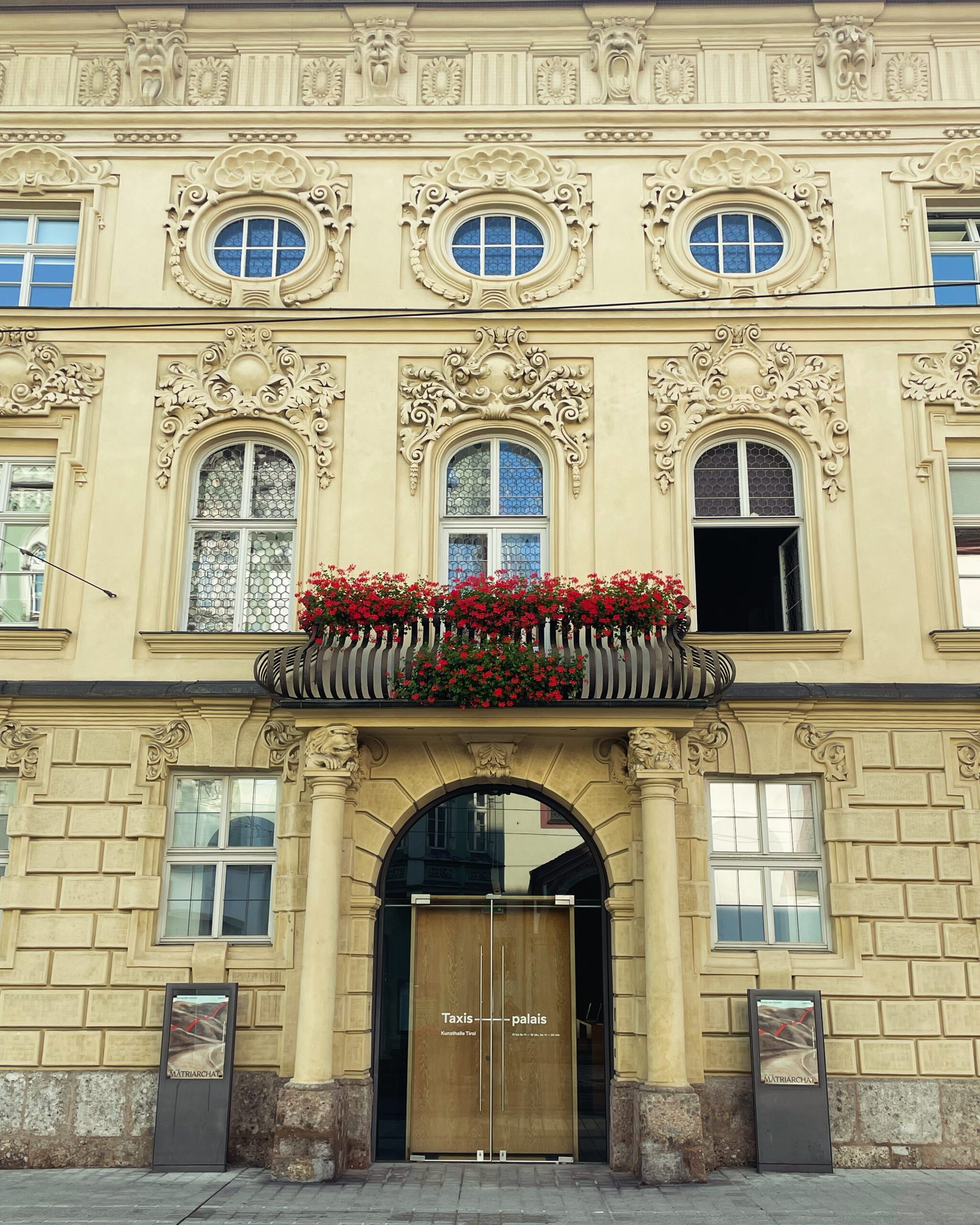
Palais Fugger - Taxis
Worth knowing...
Jakob Fugger: the richest man in history
There were hardly any uncrowned individuals who exerted a greater influence on European history well into the twentieth century than Jakob Fugger (1459–1525). Fugger came from a merchant family in Augsburg. His birth was recorded in the city’s tax register with the linguistically amusing entry “Fucker advenit,” which—when read today—transcends modern language boundaries. That the little “Fucker” would one day build an unprecedented, globally operating financial empire out of the family business was by no means foreseeable. Following long-standing family tradition, Jakob and his brothers initially traded cotton with the wealthy cities of northern Italy. In the region between Florence, Venice, and Milan, an early form of financial capitalism had emerged. From there, banking began its triumphant advance across Europe in the late Middle Ages. This system soon crossed the Alps; Innsbruck, too, had branches of Italian financial institutions from the High Middle Ages onward. Merchants who did not wish to carry vast amounts of cash required so‑called bills of exchange to conduct their transactions. In the major trading cities, commercial offices modeled on Italian examples were established. In Venice—the center of long-distance trade in the eastern Mediterranean—Jakob Fugger learned the art of double-entry bookkeeping and the subtleties of advanced Italian economic management. He quickly realized that far more profit could be made through financial transactions and lending than through cotton trading.
The financial-political system prevailing at the time, combined with new demands on power politics, formed the framework within which early capitalism could grow. During the Middle Ages, Europe’s monarchs and aristocrats financed their courts and wars through the tithe, a levy paid by peasants within the feudal system. Modern warfare, driven by the introduction of firearms, became increasingly expensive in the fifteenth century, and the tithe was more and more often insufficient to finance armies. Generous contributions from investors in the growing private economy were required, providing funds in exchange for collateral and interest. For centuries it had been sufficient to know that God’s blessing was on one’s side; at the transition to the modern era, the realization emerged that having a powerful house bank was also no disadvantage. The Fugger trading and financial network expanded rapidly in this fertile climate. For their textile business, branch offices were established in Venice, Bolzano, Milan, Nuremberg, Frankfurt, Bruges, and Antwerp. These branches were multifunctional hybrids comprising sales outlets, bank branches, horse stations, warehouses, postal and news offices, and diplomatic representations. Capital and politics did not remain separate for long. Jakob Fugger’s connection with the House of Habsburg—and with Tyrol in particular—began to intensify in 1487. The Tyrolean ruler Archduke Sigismund suffered defeat in a military conflict with the Republic of Venice. To repay his debts to the Mediterranean power, amounting to 100,000 guilders, he borrowed money from the Fuggers. In return, he issued promissory notes secured by pledging the silver mine at Schwaz to his creditors. Prior to the exploitation of the American silver mines, Schwaz was the largest silver mine in the world. The Fuggers sold the Schwaz silver to the mint at Hall, which they themselves also operated, and then lent these newly minted coins back to Duke Sigismund. A cycle of a very special kind was born. This did not mark the end of the Fuggers’ political influence on world affairs; rather, it was only the starting signal. When the Tyrolean estates deposed Sigismund in 1490 because of his disastrous financial management, Maximilian I succeeded him as ruler of Tyrol. Not only did Maximilian’s lifespan coincide with that of Jakob Fugger, but the destinies of the two men were closely intertwined. The history of Tyrol itself was shaped by the most significant financial magnate of his age. Fugger was astute enough to place his trust in the new ruler. The word “credit,” derived from the Latin credere—to believe—finds clear expression in this decision. Fugger believed that a powerful Maximilian was his most valuable asset. In 1493, Fugger financed Maximilian’s election as Emperor of the Holy Roman Empire, thereby securing his influence and elevation to the nobility. Fugger was also the sponsor of the Viennese double marriage—Maximilian’s masterpiece of dynastic marriage policy—through which Hungary became part of the Habsburg realm. When Maximilian died in 1519, Fugger repeated this strategy, using his financial power to ensure the election of Maximilian’s grandson Charles V as emperor. A loan of 540,000 guilders was extended by the Fuggers to the Habsburgs to cover campaign and bribery expenses. In return, Charles V granted Fugger rights to mines in Spain and South America, where enslaved people worked under inhumane conditions to keep this cycle of exploitation and corruption in motion.
Between 1487 and 1525 alone, the Fuggers granted the Habsburgs an estimated two million guilders in loans. One guilder was equivalent to sixty crowns, while a day laborer earned approximately six crowns per day. With this sum, nearly 55,000 people could have been employed daily for an entire year. A significant portion of these debts was repaid through usage rights to Tyrolean assets and increased taxation. It is estimated that at the time of Jakob Fugger’s death, his financial empire handled around 50 percent of Tyrol’s state budget and controlled 10 percent of the assets of the Holy Roman Empire. His officials managed mines in Tyrol, Bohemia, Slovakia, and Spain, financed trading expeditions throughout the entire known world of the time, and funded numerous wars across Europe. To some historians, Jakob Fugger is considered the richest man in world history. The exact extent of his wealth is difficult to translate into modern terms; when the Frankfurter Allgemeine Zeitung attempted such a calculation in 2016, it arrived at a figure of 300 billion US dollars. Like Maximilian I, Jakob Fugger was both a power-driven individual and an educated, devout Catholic. Corruption, exploitation, the financing of wars, and—out of piety and fear of purgatory—the founding of the Fuggerei, the world’s first social housing complex in Augsburg, were not mutually exclusive in his worldview. In Innsbruck, the Palais Fugger‑Taxis as well as a small alley between Maria‑Theresien‑Strasse and Landhausplatz still commemorate the Fugger family.