Tivoli
Anton-Eder-Straße - Stadionstraße - Sillufer
Worth knowing
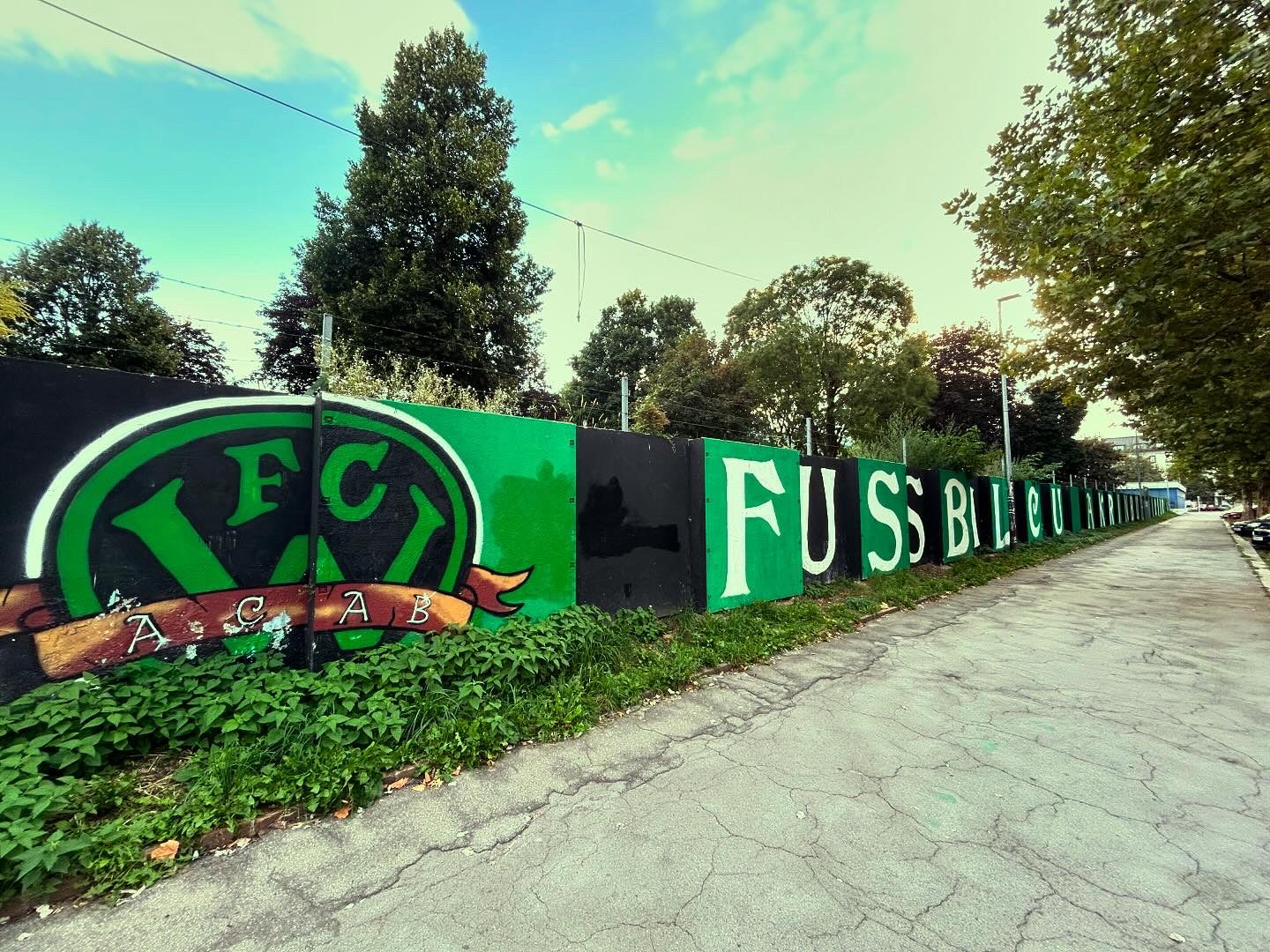
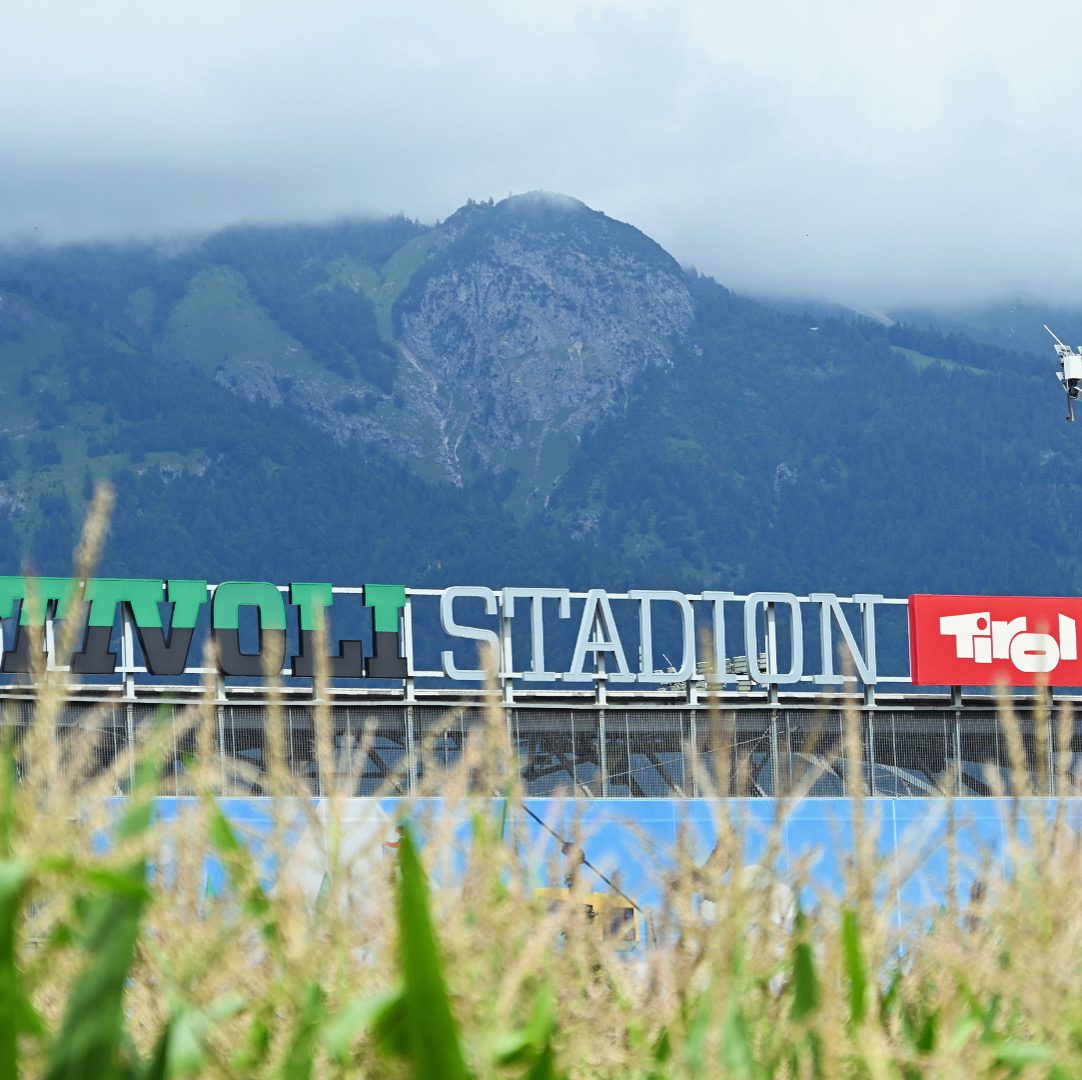
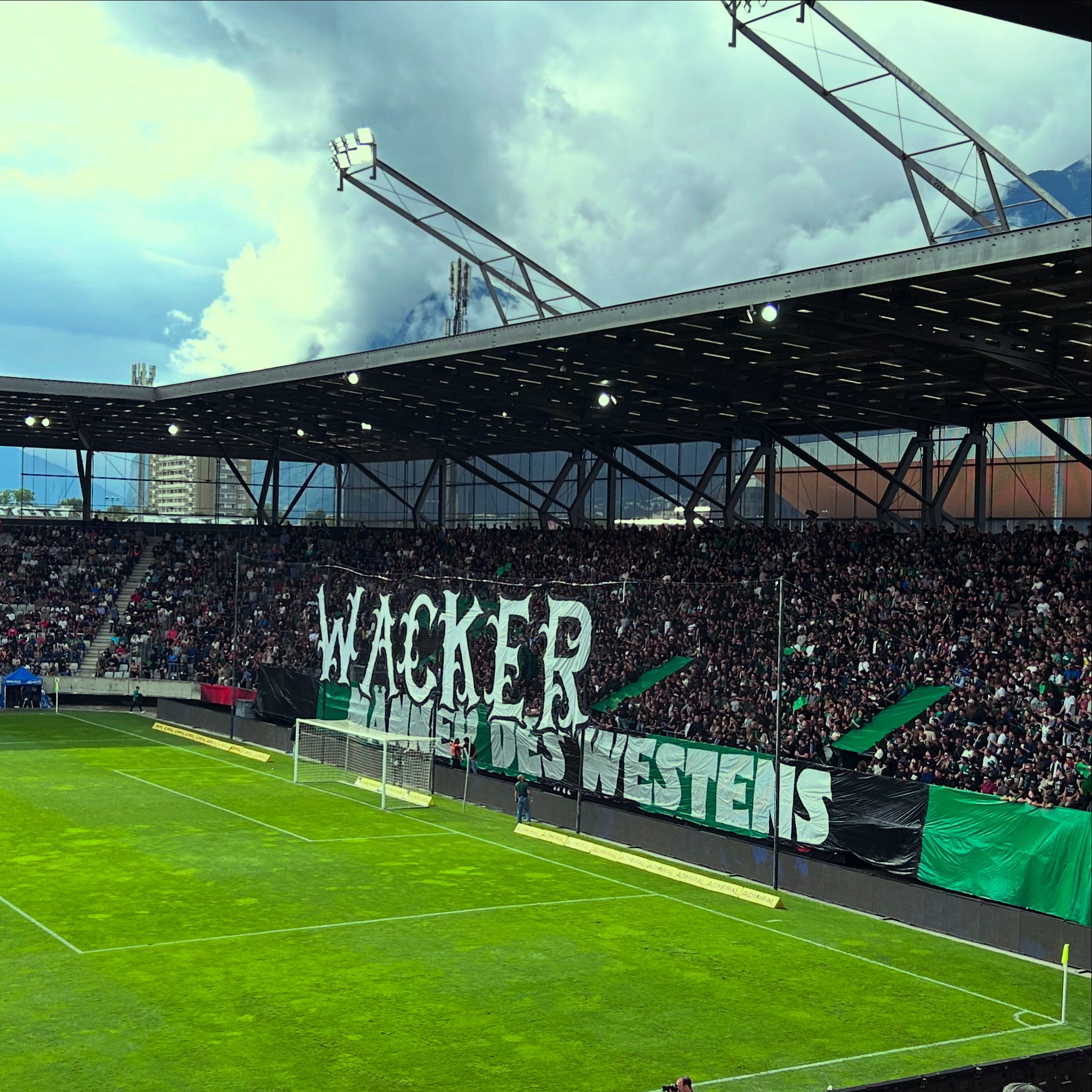
In Pradl, the sporting heart of Innsbruck beats. East of the Sill River lie the city’s largest sports and recreational facilities. Together with the residential blocks built since the early 2000s, a hotel, shopping opportunities, and associated infrastructure such as a youth center and a kindergarten, they now form a new urban district: the Tivoli. For a long time, the area was primarily an economic zone. Once a year, from the early modern period onward, a livestock market was held here. The Sill served as the power source for the monastery mill, which processed the grain not only from nearby fields but also from farmers who lived farther away. Various craft workshops settled early on along the Sill Canal. In 1809, the fighting during the Tyrolean uprising expanded from Bergisel to the strategically important bridge over the Sill near St. Bartlmä. Only in the decades that followed did the area between Wilten, Pradl, and Amras become a popular destination for city dwellers. In the second half of the 19th century, sports increasingly became part of everyday life for more and more people. The development of sports grounds aligned perfectly with the spirit of the age. The first facilities were built on the exhibition grounds—today’s Messe—in the Saggen district. However, the scarce space between the viaduct arches and the city center was soon encroached upon by new housing developments. In 1925, the city built the first sports fields near the Sillhöfe. The original Tivoli consisted of two football pitches with an ash running track, surrounded by a wooden, barricade‑like enclosure. The sports grounds were even equipped with lighting to allow for evening training sessions and events. But like the ideas of the great cycling tours, the FIFA World Cup, and the Olympic Games, Innsbruck’s sports facilities fell victim to World War II: the Tivoli was destroyed by air raids. In the scarce years after 1945, Innsbruck residents used the newly cleared land for gardens and small agricultural plots. Once the most severe supply crisis had passed, the renaissance of sport began. As part of Innsbruck’s general reconstruction programme, the Tivoli football stadium opened in 1953. In front of more than 15,000 spectators, FC Wacker celebrated eight of its ten championship titles here—under various club names. In 2000, the team moved a few hundred metres south to the new Tivoli stadium. The new, modern arena proved to be both a blessing and a curse. Older Innsbruck football purists still mourn the unique atmosphere of the tight, old stadium. After two seasons in the top division, including two further championship titles, the club was forced into relegation. The highlight of the otherwise rather bleak years for Innsbruck football fans was the 2008 European Championship.
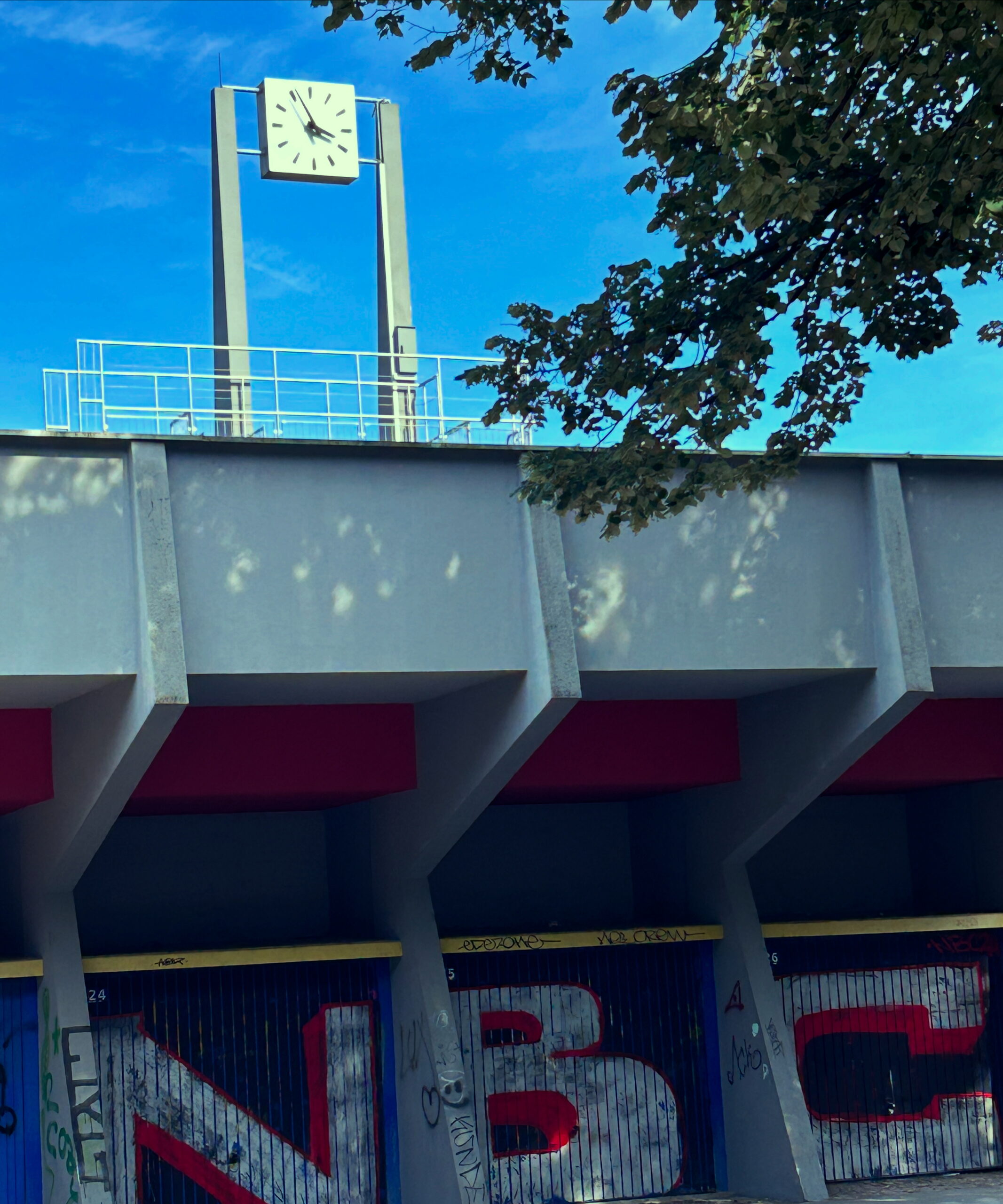
The post-war economic boom brought additional amenities to the city. Planning for the Tivoli outdoor swimming pool (Freischwimmbad Tivoli) began in 1958. Architect Norbert Heltschl achieved a small masterpiece with the recreational facility, combining competitive sports—thanks to its 50-meter lanes and diving tower—with swimming pleasure, relaxation, and dining right in the heart of the city. Through the "Kunst am Bau" (Percent for Art) initiative, several functional artworks were integrated into the individual structures. Heltschl, who was stationed in Stalingrad during the Second World War, was an early representative of Brutalism. Countering the post-war trend in which architecture sought to feign an idyllic world, he relied on exposed, raw elements on the buildings and small artworks. The Polar Bear Fountain (Eisbärbrunnen), the colorful design of the changing cubicles, the Crocodile Mosaic on the restaurant, and the curved statue at the playground only catch the practiced eye, yet they have accompanied bathers for decades. Iconic is the diving tower featuring a numberless clock in the style of New Objectivity (Neue Sachlichkeit). Apart from a few renovations and restructuring due to the construction of surrounding residential complexes, the swimming pool has existed in its core form according to Heltschl's designs since 1961. The pool was not merely a structural turning point in the city's history, however. In the prudish atmosphere of the 1960s, boys and girls bathing together in increasingly skimpy outfits was a thorn in the side of many respectable Tyroleans. Generations of young people learned not only how to swim here, but also made their first romantic endeavors.
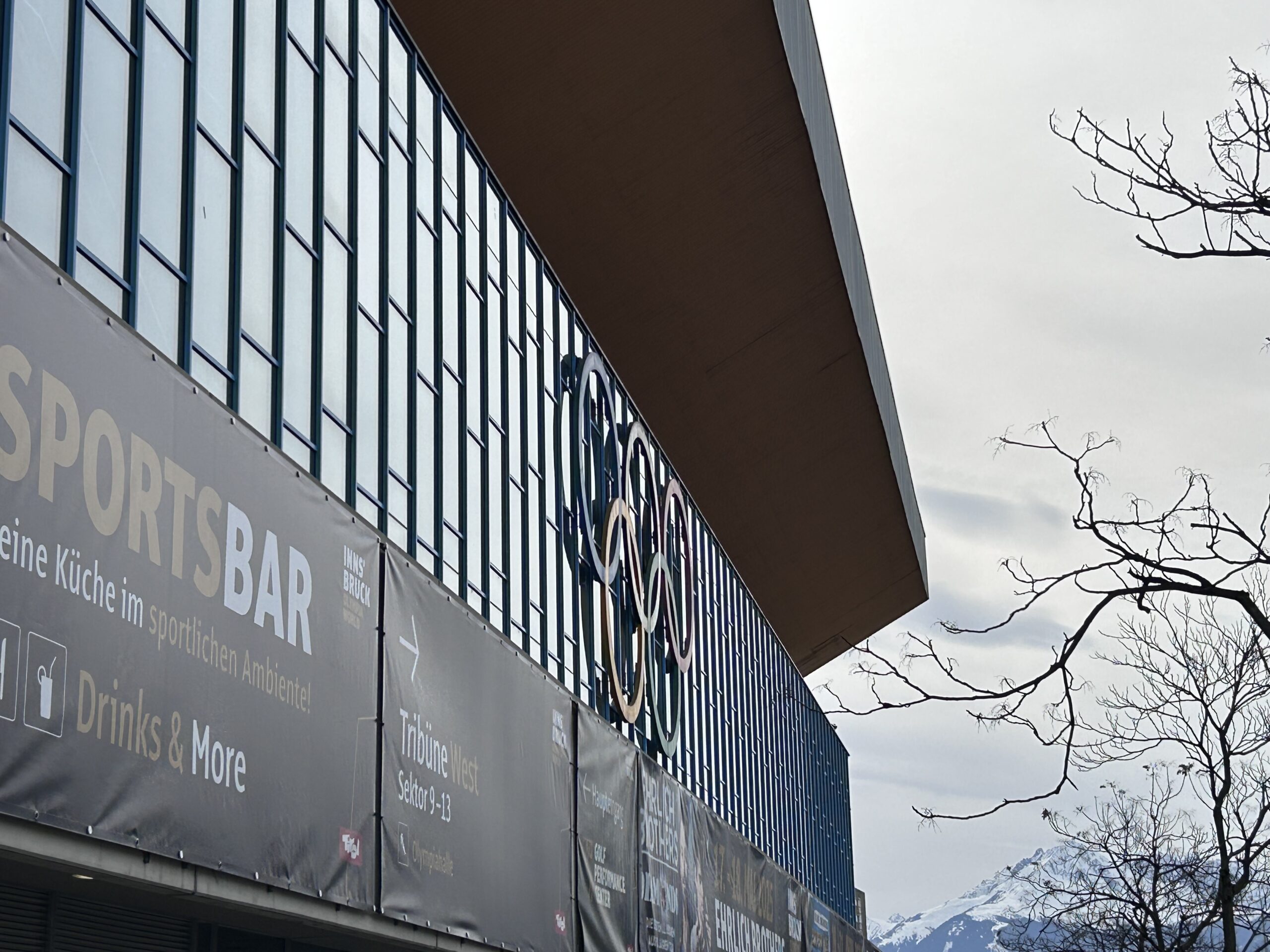
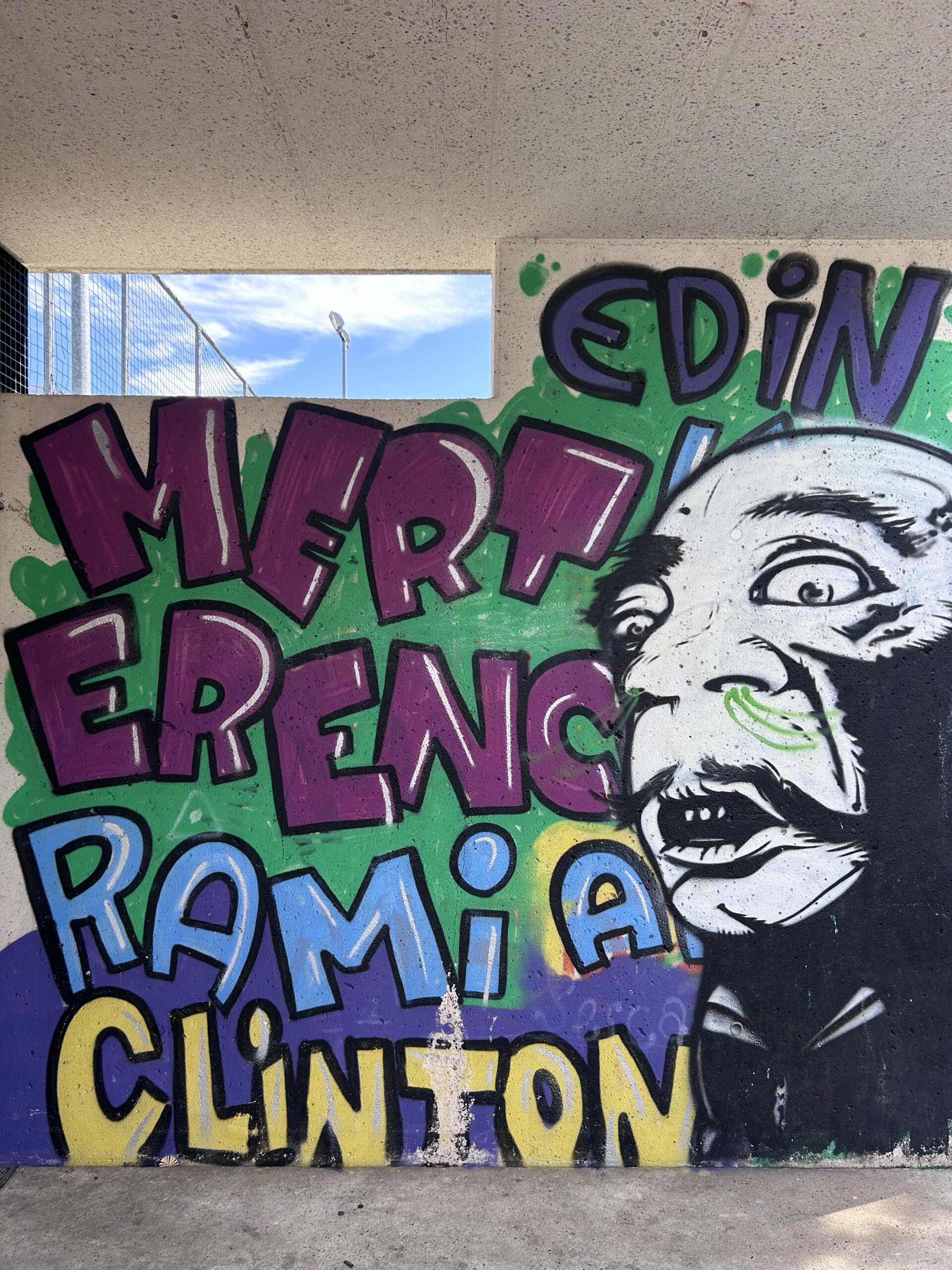
Separated from the swimming pool only by the Südring, the Olympiaworld and its various sports facilities lie just a few meters to the south. The venerable, monumentally Olympic ice stadium (Eishalle) built in 1964 accommodates over 10,000 spectators. On two occasions, the Soviet Union secured Olympic gold in ice hockey here. Meanwhile, the outdoor speed skating rink served as the venue for the Olympic speed skating competitions. The Olympiahalle is at least as important for concerts as it is for sporting events. Ever since the legendary year 1973, when Deep Purple and The Rolling Stones ushered Innsbruck into the rock 'n' roll era, international superstars have regularly performed in the arena and at the outdoor rink. In 2005, a second, smaller ice arena was constructed for the IIHF World Championship held in Innsbruck. During the winter months, ice skaters of all ages look forward to the daily public skating sessions. In the Wiesengasse at Tivoli, Innsbruck's American football team was given a home stadium. Since the early 1990s, this sport—relatively young in Austria—has firmly established itself in Innsbruck. Alongside the volleyball players, the Raiders Tirol (formerly Tyrolean Raiders) are arguably the city's most successful team sports organization. While the local soccer club (FC Wacker Innsbruck) bounced back and forth between the 1st and 4th divisions starting in 2002, the Raiders captured several European titles in addition to their national championships. Recreational sports also find a home among these competitive venues. Amateurs and hobby athletes can take advantage of an athletics facility, soccer pitches, tennis and beach volleyball courts, as well as a skatepark distributed across the Tivoli grounds.
Sporty Innsbruck
Anyone seeking proof that the people of Innsbruck have always been an active bunch might turn to the painting Winter Landscape by the Dutch artist Pieter Bruegel (c. 1525–1569) from the sixteenth century. On his return journey north from Italy, the master likely stopped in Innsbruck and observed the local population ice skating on the frozen Lake Ambras. In his Handbook for Travellers in Tyrol (1851), Beda Weber described the leisure habits of Innsbruck’s inhabitants, including ice skating at Lake Ambras: “The lake nearby (note: Amras), a pool in the marshy area, is used by skaters in winter.” To this day, wearing sports clothing in almost any situation is perfectly normal for Innsbruck residents. While in other cities functional clothing or hiking and sports shoes might draw raised eyebrows in restaurants or offices, at the foot of the Nordkette such attire hardly stands out. This was not always the case, however. The path from the ice-skating peasant to the active citizen was a long one. In the Middle Ages and early modern period, leisure and free time for activities such as hunting or riding were largely privileges of the aristocracy. Only with the changing living conditions of the nineteenth century did a significant portion of the population—especially in urban areas—experience something resembling leisure for the first time. Increasingly, people no longer worked in agriculture but as workers and employees in offices, workshops, and factories according to regulated schedules. Industrialised England played a pioneering role, where workers and employees gradually began freeing themselves from the excessive demands of early industrial capitalism. Sixteen‑hour workdays were not only detrimental to workers’ health; employers also realised that overwork reduced productivity. Since the 1860s, efforts had been made to introduce an eight-hour working day. In 1873, Austrian printers established a ten-hour working day, and in 1918 Austria adopted a 48-hour workweek. By 1930, a 40-hour week had become standard in industrial enterprises. People from all social classes—not just the aristocracy—now had the time and energy for hobbies, club life, and sport. English tourists, in particular, introduced new sports, disciplines, and equipment. The cost of equipment largely determined whether a sport remained reserved for the bourgeoisie or was accessible to workers. Sledding, for example, became widespread around the turn of the century, while bobsleigh and skeleton remained elite sports. Sport was not only a leisure activity but also a marker of social distinction: the working class, bourgeoisie, and aristocracy all shaped their identities through the sports they practised. Nobles maintained traditions such as riding and hunting; the bourgeoisie displayed individuality and wealth through expensive equipment like bicycles; and the working class played football or engaged in wrestling and physical contests.
By the mid-nineteenth century, athletes, like singers, museum and theatre enthusiasts, scientists, and lovers of literature, began to come together in associations. Gymnasts were the pioneers of organized club sport in Innsbruck. Gymnastics was considered the quintessential form of sport in the German-speaking world. Competition was not the primary focus; rather, members were expected to train their bodies in order to serve the national body effectively in times of war. As sedentary professions—especially academic ones—became more common, gymnastics was seen as a form of balance. Looking at historical images of gymnasts practicing and performing their exercises, one cannot fail to notice the distinctly military character of these events. Friedrich Ludwig Jahn (1778–1852), commonly known as “Turnvater Jahn,” was not only a leading advocate of physical exercise but also the intellectual founder of the Lützow Free Corps, which fought against Napoleon as a kind of all-German volunteer army. One of the best-known mottos attributed to him is: “Hatred of all foreign things is the German’s duty.” In Saggen, Jahnstraße and a small park with a monument still commemorate Friedrich Ludwig Jahn. The German gymnastics clubs, much like student fraternities, played a significant role in the emergence of the national movement. It therefore took some time before the first official gymnastics club could be established. Gymnasts, who were regarded as particularly liberal and aligned with the Greater German idea, were viewed with suspicion by the Habsburg authorities under Metternich. The founding of gymnastics clubs was banned throughout the German-speaking world. Only one year after the social upheavals of 1848 was the Innsbruck Gymnastics Club (ITV) officially founded. After a conservative backlash in 1850, during which gymnastics clubs were once again banned, the development of the Austrian Imperial Council in the 1860s spurred the formation of political parties. Sports clubs benefited from this as their precursor organisations. In 1863, the ITV was founded for the second time and continues to exist to this day. Soon, Christian, socialist, and Greater German associations emerged, with people gathering in different clubs depending on their ideological and social affiliations.
Among the earliest sports facilities were swimming baths. The first bathing establishment welcomed swimmers from 1833 onward in Hötting, at the open-air pool by the Gießen stream. Additional facilities soon followed near Büchsenhausen Castle, as well as a complex next to what is now the Sillpark site, which was divided into separate areas for women and men. Particularly beautifully situated was the Schönruh outdoor pool above Ambras Castle, which opened in 1929 shortly after the indoor swimming pool in Pradl had been built. The population had grown significantly, and so too had people’s enthusiasm for swimming as a leisure activity. In 1961, the range of sports facilities at Tivoli was expanded with the addition of the Tivoli outdoor pool. In 1883, cyclists founded the Bicycle Club. The first cycling races had been held in France and Great Britain from 1869 onward. The English city of Coventry was also a pioneer in the production of the elegant “steel steeds,” which were extremely expensive. In the same year, the Innsbruck press reported on these modern means of individual transport, when “several gentlemen ventured onto the streets with multiple velocipedes ordered from the firm Peterlongo.” In 1876, cycling was temporarily banned in Innsbruck due to repeated accidents. Cycling was also quickly recognised by the authorities as a form of physical training that could be used for military purposes. A decree from the Imperial Ministry of War was reported in the press:
“It is intended, as in previous years, to also employ cyclists in this year’s exercises involving combined arms… The commands of the infantry and Tyrolean rifle regiments, as well as the field rifle battalions, are to call upon those individuals who are registered as cyclists and are obliged to participate in military exercises this year to report for duty with their bicycles.”
Unter der Regie des Münchners Anton Schlumpeter entwickelte sich die Szene vor der Jahrhundertwende weiter. Schlumpeter deckte mit einer Fahrschule, einem Geschäft für Fahrräder samt Werkstatt und schließlich mit den in seiner Wiltener Fabrik produzierten Fahrradmarke Veldidena die Wertschöpfungskette komplett ab. Die Velocipedisten siedelten sich 1896 im Rahmen der „Internationalen Ausstellung für körperliche Erziehung, Gesundheitspflege und Sport“ im Saggen nahe der Viaduktbögen mit einer Radrennbahn samt Tribüne an. Die Innsbrucker Nachrichten berichteten begeistert von dieser Neuerung, war doch der Radsport bis zu den ersten Autorennen europaweit die beliebteste Sportdisziplin:
“The Innsbruck cycling track, which is to be opened in the coming weeks in connection with the international exhibition, will have a length of 400 metres and a width of 6 metres… The velocipede racing track, the construction of which is chiefly due to the efforts of the President of the Tyrolean Cyclists’ Association, State Railway Chief Engineer R. von Weinong, will be one of the most outstanding and best-equipped cycling tracks on the continent. On the 29th of this month (June 1896), a major international cycling competition will be held on the Innsbruck track for the first time, and in the future, regular annual velocipede prize races are to follow, which will undoubtedly be of considerable benefit to both the promotion of cycling as a sport and tourism in Innsbruck.”
The cement railway was used for daily training in the warm season. The smoke-filled air as the locomotives passed by was probably not good for the lungs. After initial enthusiasm, Schlumpeter had to step in to save the railway. The enterprising entrepreneur realised that the cyclists were not providing enough activity and, on his own initiative, began to build a kind of predecessor to today's Olympiaworld at the Tivoli with several facilities for sport. In addition to cycling races, boxers could compete in the ring. He also had tennis courts built in Saggen. Despite all his efforts, the facility was demolished again in 1901.
Football proved more sustainable than cycling in establishing itself in Innsbruck. For a long time, it was regarded as an English sport and therefore as “un-German.” Unlike gymnastics, it was considered too focused on commerce and professionalisation, and it was seen as offering too little military, educational, or societal value. It was only with the International Exhibition of 1896 in Saggen that football began to gain a certain level of acceptance. There were already interregional matches, for example a 1–1 draw between the team of the Innsbruck Gymnastics Club and Bayern Munich. In order to compete against other teams, the footballers were required to leave their parent organisation, the ITV. The “Aryan clause” embedded there not only prohibited the admission of Jewish players, but also banned matches against teams that included Jewish players. In 1903, the club Fußball Innsbruck was founded, which would later develop into SVI. Matches were played on a football field in front of the Sieberer orphanage. In Wilten, by then part of Innsbruck, SK Wilten was established in 1910. The football ground Besele, which still exists today next to the West Cemetery, was equipped with grandstands to accommodate growing numbers of spectators. In 1913, Wacker Innsbruck was officially founded, the club that remains the most successful football team in Tyrol to this day. For a long time, successful football remained largely confined to Vienna. While the Austrian “Wunderteam” gained international recognition in the 1930s and even won the precursor to today’s European Championship, football in Tyrol was played at a more modest level. It was only after the Second World War that national and international successes began to emerge. Ten Austrian championship titles and reaching the semi-finals of the European Cup testify to the deep-rooted enthusiasm for football among the people of Innsbruck.
In addition to the various summer sports, winter sports also became increasingly popular. Sledding had already become a popular leisure activity by the mid-nineteenth century on the hills surrounding Innsbruck. The first ice rink opened in 1870 as a winter alternative to swimming, on the grounds of the outdoor pool in Höttinger Au. Unlike water sports, ice skating was an activity that could be enjoyed jointly by men and women. Instead of meeting during Sunday strolls, young couples could arrange to meet at the ice rink without parental supervision. In 1884, the Ice Skating Club was founded and used the exhibition grounds as its rink. With facilities such as the ice rink in front of the Imperial and Royal shooting range in Mariahilf, Lake Lans, Lake Ambras, the swimming complex in Höttinger Au, and the Sill Canal in Kohlstatt, Innsbruck offered numerous opportunities for ice skating. As early as 1908, the first ice hockey club was established with the IEV. Skiing, initially a Nordic-style pastime practiced in the valleys, soon spread as a downhill discipline as well. The Academic Alpine Club Innsbruck was founded in 1893 and organised the first ski race on Tyrolean soil two years later, running from Sistrans to Ambras Castle. The sports shop Witting, established in 1867 on Maria-Theresien-Straße, demonstrated strong business acumen by selling ski equipment to a well-to-do clientele even before 1900. Following St. Anton and Kitzbühel, the first Innsbruck ski club was founded in 1906. Equipment remained simple for a long time, allowing skiing primarily on relatively gentle slopes, combining alpine and Nordic techniques similar to cross-country skiing. Nevertheless, skiers ventured to descend slopes in places such as Mutters or the Ferrari meadow. From 1928 onward, two cable cars led up to both the Nordkette and the Patscherkofel, making skiing significantly more attractive. Skiing achieved its breakthrough as a national sport with the World Ski Championships held in Innsbruck in February 1933. On an unmarked course, participants had to cover 10 kilometres and 1,500 metres of elevation between the Glungezer and Tulfes. The two local athletes Gustav Lantschner and Inge Wersin‑Lantschner won multiple medals in these competitions, further fuelling the growing enthusiasm for alpine winter sports in Innsbruck.
Competitions in various sports—above all cycling, boxing, athletics, and football—had become mass phenomena by the interwar period at the latest. In 1924, Joseph Roth (1894–1939) wrote his praise poem dedicated to sport:
The zeitgeist stretches the biceps and fulfils,
with knockout and belly kick the century,
if there is someone who wonders about it,
never read the newspaper Sport im Bild.
After the Second World War, sport finally became a mass phenomenon. While footballers were no longer able to build on the successes of the pre-war period, it was above all skiers who contributed to the slowly emerging sense of national identity among Austrians. Innsbruck remains strongly identified with sport to this day. With events such as the UEFA European Championship in 2008, the UCI Road World Championships in 2018, and the Climbing World Championships in 2018, the city has been able to reconnect—also at the elite level—with the “golden years” of the 1930s, which saw two World Ski Championships, as well as with the Olympic Games of 1964 and 1976. However, it is less elite sport than grassroots participation that contributes to Innsbruck’s reputation as the self-proclaimed “sports capital of Austria.” There are hardly any residents who do not at least strap on alpine skis from time to time. Mountain biking on the numerous alpine pastures around Innsbruck, ski touring, sport climbing, and hiking are exceptionally popular among the local population and are deeply embedded in everyday life.
Innsbruck's Olympic renaissance
There are events that endure in a community’s collective memory across generations. You don't have to have been there—nor even born yet—to know how Franz Klammer raced to a gold medal in his yellow jumpsuit during the Olympic downhill at the Patscherkofel on February 5, 1976. Franz Joseph I may have climbed the Patscherkofel in 1848, but it was "Kaiser Franz" Klammer who became a legend on this mountain. "Jawoll! 1:45.73 for our Franzi Klammer!" echoed from countless TV sets across Austria that day. To allow people to watch national hero Klammer on his hell-for-leather run, schoolchildren were permitted to stay home on the day of the men's downhill—just as they had been in 1964. Elsewhere, the streets were completely deserted during this wild ride. Klammer accomplished what scores of emperors, kings, and politicians had failed to do: he united the nation of Austria. "Mi hats obageibtlt von oben bis unten, I hatt nie gedacht, dass i Bestzeit foa" ("I was thrown all over the place from top to bottom, I never thought I'd set the fastest time"), Klammer admitted in his Carinthian dialect during the winner's interview. Not a Tyrolean—nobody's perfect—but for host nation Austria, the Olympic Games were saved on just the second day. In 1976, the Olympic Winter Games were held in Innsbruck for the second time. Denver was originally slated to host, but withdrew as organizer following a referendum sparked by financial and environmental concerns. Innsbruck prevailed in its second hosting bid over Lake Placid, Chamonix, and Tampere. The city had previously hosted the Olympics 12 years earlier; from January 29 to February 9, 1964, Innsbruck had been the center of the world after winning its bid against Calgary and Lahti. A severe lack of snow caused major problems during several events in 1964. Only with the help of the Austrian Armed Forces, who hauled snow and ice down from the high mountains to the venues, could the 34 competitions take place. Archival footage offers a good glimpse of the opening ceremony in the packed Bergisel Stadium. Unlike the elaborate ceremonies of modern Olympic Games, proceedings in the 1960s were still relatively unspectacular. The Wiltener Stadtmusik entertained international guests with traditional Tyrolean brass music. During the parade of flags, visitors caught their first glimpse of the North Korean flag at an Olympic Games. The Tyrolean Schützen watched over the Olympic flame with eagle eyes. For the logo, the Olympic rings were simply superimposed over the city's coat of arms, and there was no mascot yet. The sporting competitions were far less professionally organized than today's Olympics. The bobsleigh race took place on an artificial ice track for the first time, though not yet in today's Igls Ice Canal. Some of the ice hockey games were held in the exhibition hall on a very modest scale. Alpine skiing events, such as the women's slalom and giant slalom—where French sisters Christine and Marielle Goitschel swept gold and silver in alternating order—took place in the Axamer Lizum. At Bergisel, an official crowd of 80,000 spectators watched the spectacle as Finland's Veikko Kankkonen secured gold in ski jumping. In the ice hockey final, the Soviet Union triumphed over Sweden. With 11 gold medals, the USSR also took top spot in the medal table, while Austria finished a sensational second with four golds.
The opening ceremony of the 1976 Games also took place at Bergisel. In memory of 1964, two Olympic flames were lit at Bergisel during the opening. This time around, the 37 events were largely held at the same venues in Innsbruck, Axams, Igls, and Seefeld as in 1964. The ice stadium and ski jumping arena were still up to Olympic standards. In Igls, a new artificial ice track was built. The Axamer Lizum received a new funicular railway to transport the athletes to the start at the *Hoadl*. Once again, snow was in short supply in the lead-up, leading to renewed anxieties, but the weather turned just in the nick of time, blessing Innsbruck with plenty of snowfall. *Schneemanndl*—a round snowman with a carrot nose and a Tyrolean hat, serving as the mascot for the 1976 Games—proved to be a good omen. The biggest change between the two Olympic Games within twelve years was the status of the athletes. While the first Games officially featured only amateurs—sportsmen and sportswomen who held regular jobs—1976 allowed professional athletes to compete. The broadcast and photo quality were also significantly higher than in the first Innsbruck edition, with television having superseded radio by then. German alpine skier Rosi Mittermaier was captured perfectly on screen as she raced to two gold medals and a silver in the women's events. The ice hockey tournament was won once again by the Soviet Union ahead of Sweden—their fourth consecutive title. The USSR also topped the final medal table once more, this time ahead of East Germany. Austria was only able to secure two golds, but with Klammer's downhill victory, that was merely a side note. The Patscherkofel and Austria's "*Franzi*" have been inextricably linked ever since. And even if the people of Innsbruck are not quite as athletic as they like to think, no one can argue away the title of Olympic City after hosting two Winter Games, plus a Universiade and the Youth Olympic Games.
Even when it came to non-sporting infrastructure, the city—backed by federal funds—spared no expense for either Games. Following the city's rapid postwar reconstruction, the run-up to the Games triggered a major wave of modernization. Innsbruck's first Olympic edition fell right in the era of the *Wirtschaftswunder* (economic miracle). On two occasions, an Olympic Village was built from scratch, creating housing that remains in use to this day. A portion of the former village of Arzl, which had been incorporated into Innsbruck in 1940, was chosen as the location. Today's *O-Dorf* district in the east of the city served as the Olympic Village for the athletes during the Games, connected to the city center and venues via the Reichenauer Bridge over the Inn River. Construction on the first apartment blocks began in 1961 in the sparsely populated Arzler Au. The Arzl shooting range, still visible on a 1960 map, was relocated one tier higher up the valley. Additional blocks were added in the 1970s. Today, despite its less-than-picturesque 1960s and 70s style high-rises, the O-Dorf is a livable neighborhood thanks to its location along the Inn, its green spaces, and its good public transport links. Many other buildings in Innsbruck that were used as media and press infrastructure during the Games also date back to the Olympics. The Teacher Training College (PÄDAK) in Wilten, the IVB hall, and the Landessportheim can all be considered part of this Olympic legacy. The far-from-splendid building housing the former *Hotel Holiday Inn* next to the Triumphal Arch, which has undergone numerous operator changes in recent decades, was likewise born out of this Olympic renaissance. Despite all the fine new buildings, improvisation was necessary at every turn. Visiting youths and many a lesser-ranked official found accommodation in one of the schools, which were closed to serve as dormitories. Another infrastructural legacy of the Olympic Games is something people are desperately trying to change today: the city's expansion during the 1960s and 70s coincided with the early boom of the automobile. The fact that the city grew during this specific period is likely a key reason why Innsbruck, relative to its size, is considered above-average car-centric. In 1963, the Olympiabrücke was built to connect the western part of the city with the venues. Until then, east-west traffic in Innsbruck had to navigate a convoluted route through the city center. The individual streets between Amraser-See-Straße in the east and Bachlechnerstraße in the west—which today make up the major traffic artery known as the *Südring*—were only expanded subsequently; until then, they had been quiet suburban roads surrounded by meadows and fields. Comparing aerial photographs from 1960 and 2020 is fascinating: in Amras, where daily rush-hour traffic plays out today, farms and scattered residential houses stood well into the 1970s. On what is now Egger-Lienz-Straße near the West Station, the railway viaduct of the Westbahn once ran. Old photos show the tracks flanked by trees and playing children. Around today's *Graßmayrkreuzung* intersection, a new district emerged almost casually with the opening of the *Kaufhaus Forum*.
For Innsbruck, however, the Olympic Games were not merely a launching pad into modernity regarding winter sports, tourism, and infrastructure. On a psychological level, the events also swept away the stale air of the somber postwar era, spreading a sense of renewal and helping the city shed its reputation as a provincial backwater. Less than 20 years after the end of the war, Innsbruck hosted one of the world's premier sporting events. Within a single generation, the *Olympic Village* reached into the sky on the grounds of the former Reichenau concentration camp. The city may no longer have been an imperial residence as in the days of Emperor Maximilian, but it was once again firmly on the international map. All thanks to "*Kaiser Franz*!"
Josef Prachensky: Lebensreform und Sozialdemokratie
Industrialisation and the rise of the bourgeoisie in the 19th century transformed society for better and for worse. Urbanisation was increasingly perceived by many people as a burden. Although many workers and employees in Innsbruck had, in absolute terms, more resources at their disposal than ever before, the pressure to participate socially also grew. From the 1890s onwards, several advertising columns (Litfaßsäulen) appeared in Innsbruck, on which artistically designed posters promoted the new variety of products. Department stores and fashion retailers made social differences within an increasingly differentiated society more visible than ever. Anyone who wanted to keep up in the new bourgeois class had to be able to afford membership in this emerging consumer society. At the same time, the strains of industrialisation increased. Traffic on the streets, factory emissions, cramped living conditions in tenement blocks, and the previously unknown haste brought about by the strict structuring of time—which made new illnesses such as neurasthenia socially acceptable—gave rise to counter-movements. Although Innsbruck could not be compared with Paris or London in terms of size or intensity of industrialisation, the social gap was nonetheless enormous for many residents of formerly rural villages such as Pradl and for workers who had migrated from the countryside.
„Light air and sun“ war das Motto der Lebensreform, einer Sammelbewegung alternativer Lebensmodelle, die im späten 19. Jahrhundert in Deutschland im Gleichschritt mit der Entwicklung der Sozialdemokratie ihren Anfang nahm. Beide Ideen waren Reaktionen auf die Lebensbedingungen in den rasant wachsenden Städten. Schon vor der politischen Teilhabe beeinflussten Lebensreform und Sozialdemokratie Gesellschaft, Kunst und Architektur. Man wollte sich von dem, was Max Weber als protestantische Ethik beschrieb, der Industrie, den Stechuhren, ganz allgemein dem rasenden technischen Fortschritt mit allen Auswirkungen auf den Menschen und das Sozialgefüge, abgrenzen. Der Mensch als Individuum, nicht seine Wirtschaftsleistung, sollte wieder im Mittelpunkt stehen. Was dem Arbeiter Karl Marx´ Schriften, waren der gehobenen Bürgerschaft Kunst und Architektur. Der Jugendstil war der künstlerische Ausdruck auf dieses „Back to the origin“ der Jahrhundertwende. Das verspielte Element war das Gegenteil zum stets symmetrischen und aufgeräumten Historismus. Das Winklerhaus ist eines der wenigen im Stadtbild erhaltenen Zeugnisse dieses Zeitgeistes. Seit 1869 erschien die German Quarterly Journal for Public Health Care, which focussed on improving nutrition, hygiene and living space. In 1881 the Austrian Society for Healthcare gegründet. Private Vereine veranstalteten Aufklärungsveranstaltungen zum sauberen und gesunden Leben. Man betrieb politisches Lobbying zur Errichtung von Parks im öffentlichen Raum und der Verbesserung der Infrastruktur wie Bädern, Krankenhäusern, Kanalisation und Wasserleitungen. Assanation und Sozialhygiene waren Schlagwörter einer bürgerlichen Elite, die um ihre Mitmenschen und die Volksgesundheit besorgt war. Anstelle der sozialistischen Revolution sollte der christliche Gedanke der Nächstenliebe die Gesellschaft voranbringen. Wie alle elitären Bewegungen nahm auch die Lebensreform teils absurde und sektenartige Blüten an. Bewegungen wie der Vegetarismus, FKK, Gartenstädte, verschiedene esoterische Strömungen und andere alternative Lebensformen, die sich bis heute in der einen oder anderen Form erhalten konnten, entstanden in dieser Zeit. Auch Orientalismus und Spiritismus feierten in der Upper Class ein fröhliches Dasein.
This often well-intentioned but eccentric lifestyle remained largely inaccessible to workers; however, it formed, in many respects, the ideological core of the realpolitik of a then-young political party. Early Social Democrats confronted the everyday realities of workers and sought practical improvements beyond theoretical doctrine. Their basic demands are strikingly similar to today’s, albeit at a different level. Improving working conditions and housing ranked high on most people’s wish lists. Many tenement blocks were dreary, overcrowded environments lacking infrastructure such as sports facilities or parks. Modern housing estates were to be functional, comfortable, affordable, and integrated with green spaces. These ideas had also taken hold in public institutions. In 1907, Albert Gruber, a professor at the Innsbruck vocational school, wrote:
"I've often heard people say that we don't need plants in Innsbruck, that nature provides us with everything, but that's not true. What could be nicer than when professionals can walk from their place of work to their home through a series of plants. It turns the journey to and from work into a relaxing walk. Incidentally, there are many reasons why planting trees and gardens in urban areas is beneficial. I do not want to emphasise the interaction between people and plants, which is probably well known. In another way, plants improve the air we breathe by reducing dust."
Even before the First World War, changes occurred in everyday political life. Social Democracy had existed as a political party since 1889, but under the Habsburg monarchy its scope for political influence was very limited. Socialism was considered unchristian and viewed with suspicion in the “Holy Land” of Tyrol. Nevertheless, the labour movement was significant as a secularly organised social counterweight and alternative to the Catholic structures that dominated Tyrol. In 1865, the first Tyrolean Workers’ Educational Association was founded in Innsbruck. Workers were to become aware of their position within society in preparation for the impending world revolution. For this, it was essential to possess at least a basic level of education and to be able to read and write. Ten years later, Franz Reisch founded the General Workers’ Association in Innsbruck. Two years after that, the empire-wide “General Workers’, Sick, and Invalids’ Fund” was launched. Despite state repression, considerable gatherings of “radicals” repeatedly took place. From 1893 onwards, the Social Democratic Volkszeitung für Tirol und Vorarlberg was published in Innsbruck as a countervoice to the Catholic press. It was here that a young printer from the eastern part of the Austro-Hungarian monarchy began his career in Innsbruck’s local politics. The Bohemian-born Josef Prachensky (1861–1931) had discovered the labour movement during the printers’ strike in Vienna while on his journeyman travels. It is no longer entirely clear whether he first fell in love with the city or with his future wife. What is known is that he took over the management of the printing house that published the Social Democratic workers’ newspaper. Prachensky played a key role in founding the Social Democratic Party of Tyrol in 1890. In 1899, he was a driving force behind the opening of the First Tyrolean Workers’ Bakery (Erste Tiroler Arbeiter-Bäckerei, ETAB) on what is now Maximilianstraße. This cooperative aimed to produce high-quality bread under good working and hygienic conditions at fair prices. After several relocations, the ETAB settled on Hallerstraße, where it produced fresh baked goods daily until 1999. With his views and business initiatives, Prachensky quickly gained a reputation as an anarchist—a current within the political left that enjoyed a certain popularity around the turn of the century, but was also feared and discredited due to its often violent activism. In addition to the ETAB, Prachensky supported the “Workers’ Consumers’ Association” and founded the alcohol-free beverage hall at Museumstraße 16, a venue that, in keeping with the ideals of the Lebensreform movement and socialism, sought to improve the general health of the working class. Where people had once fasted according to the Christian calendar, abstinence was now to purify body and mind according to the measure of individual reason and personal well-being. Friedrich Engels (1820–1895), co-author of the Communist Manifesto, had already recognised spirits and hard liquor as a social ill of the working class in the first half of the 19th century. The aim of steering people away from alcohol was shared by socialism and, in many respects, by various Christian organisations that preached abstinence. Alcoholics, after all, could neither launch a world revolution nor lead a God-fearing life according to church ideals—whether Catholic, Lutheran, or Calvinist. How little this approach succeeded in Innsbruck during the Belle Époque is illustrated by the rapid renaming of the establishment from Alcohol-Free to Reform, accompanied by the introduction of alcohol sales and Prachensky’s subsequent bankruptcy. One of his particular political concerns was to limit the influence of the Church within the school system, which in the 19th and early 20th centuries remained very strong even in nominally liberal Innsbruck, which was bound to follow national educational regulations. Although the liberal educational reform of 1869 was intended to push the clergy out of schools, their influence remained considerable in practice. Prachensky advocated giving children from working-class families at least a decent education, in order to provide them with a minimum chance of improving their living conditions. His demands around the turn of the century—for better and more uniform teacher salaries, a reduction in the proportion of religious instruction, support for less affluent children, and smaller class sizes—seem strikingly modern today.
The first free elections to the Imperial Council (Reichsrat) of the Austro-Hungarian monarchy for all male citizens in 1907 altered the political and social balance of power and gave Social Democrats new momentum, even though the census-based voting system still applied at the municipal level. The “common people” (Pöbel, colloquially referred to as Pofl) now had political representation. Important legislation—such as limits on working hours and improvements in working conditions—could now be demanded with greater force. The Crown Land of Tyrol, together with Upper Austria, had the longest working hours in the entire Danube Monarchy. Although trade union membership grew in number, Tyrol remained too heavily shaped by rural structures outside small urban centres to exert significant pressure. After the proclamation of the republic in 1918 and the introduction of universal suffrage at the municipal level, Social Democrats won the most votes in Innsbruck for the first time. However, the fulfilment of their demands still had to wait even after the first municipal elections following 1918. Innsbruck was “red,” but decisive authority over major political issues remained with the conservative provincial government. Although Innsbruck did not experience civil war–like conditions as seen in industrial strongholds such as Vienna, Linz, or Steyr, brawls, assassination attempts, and violence were nonetheless frequent. Prachensky—who, as a Social Democrat, had always resisted being labelled a “radical”—was drawn into the entrenched conflicts of the interwar period and founded the Tyrolean branch of the Republican Protection League (Republikanischer Schutzbund, RESCH), the counterpart to the right-wing paramilitary Heimwehr units.
The Red Bishop and Innsbruck's moral decay
In the 1950s, Innsbruck began to recover from the crisis and war years of the first half of the 20th century. On May 15, 1955, Chancellor Leopold Figl officially declared a political turning point with his famous words, "*Austria is free*," and the signing of the Austrian State Treaty. During the years that went down in history as the *Wirtschaftswunder* (economic miracle), moderate prosperity established itself in many households. Between 1953 and 1962, an annual economic growth rate of over 6% allowed an increasing portion of the population to dream of exotic luxuries like refrigerators, a private bathroom, or even a vacation in the South. This era brought not only material but also social change. People's desires became more elaborate with rising prosperity and the lifestyle promoted in advertising and media. The phenomenon of a new youth culture began to take root amidst the somber postwar society of small-town Austria. Previously unknown terms like *teenager* and *latchkey kid* (*Schlüsselkind*) entered everyday vocabulary in the 1950s. In 1956, the magazine *BRAVO* launched. For the first time, a media outlet catered directly to the interests of young people. Marilyn Monroe was featured on the first cover, under the headline: "*Did Marilyn's curves get married too?*" The biggest stars of those early years were James Dean and Peter Kraus, before the Beatles took over in the 1960s. After the *Summer of Love*, the advice column "Dr. Sommer" began educating youth on love and sex. The church's all-powerful authority over the moral conduct of adolescents began to crumble, albeit slowly—the first photo love story featuring nudity did not follow until 1982. Up until the 1970s, opportunities for young people in Innsbruck were largely limited to traditional inns (*Wirtshausstuben*), the marksmanship club (*Schützenverein*), and brass bands (*Blasmusik*). Only gradually did bars, discos, nightclubs, pubs, and event venues begin to open. Events like the *5 Uhr Tanztee* (5 o'clock tea dance) at the Sporthotel Igls attracted young singles looking to socialize. *Café Central* became the "second home of long-haired youths," as the *Tiroler Tageszeitung* horrifiedly observed in 1972. Establishments such as the *Falknerkeller* on Gilmstraße, the *Uptown Jazzsalon* in Hötting, the Jazzclub in Hofgasse, the *Clima Club* in Saggen, the *Scotch Club* on Angerzellgasse, and the *Tangente* on Bruneckerstraße had nothing in common with the traditional tavern. The performances by The Rolling Stones and Deep Purple at the Olympiahalle in 1973 marked the temporary peak of Innsbruck's cultural awakening. While this did not turn Innsbruck into London or San Francisco, locals had at least caught a breath of rock 'n' roll. By contrast, what remains anchored in cultural memory as the 1968 revolution barely took place in the "*Heiliges Land*" (Holy Land of Tyrol). Neither workers nor students took to the barricades in large numbers. Though a few radical student groups eventually emerged to protest social injustice, the Vietnam War, and traditional gender roles, there was no comparison to the unrest seen in Prague, Paris, or the distant USA. The historian Fritz Keller famously described Austria's '68 movement as a mere "*Mailüfterl*" (gentle May breeze). Nevertheless, society was undergoing a quiet transformation. A look at the annual music charts offers a clue: While the top 10 in 1964 was still dominated by *Kaplan Alfred Flury* and *Freddy* with "Lass die kleinen Dinge" and "Gib mir dein Wort," alongside the Beatles with their German version of "Komm, gib mir deine Hand," musical tastes were shifting. Although Peter Alexander and Mireille Mathieu could still be found on the charts, from 1967 onward, international acts with foreign-language tracks—such as *The Rolling Stones, Tom Jones, The Monkees, Scott McKenzie, Adriano Celentano*, and *Simon & Garfunkel*—dominated the top spots with increasingly socially critical lyrics.
This change sparked a backlash. The spearhead of the conservative counter-revolution was the Bishop of Innsbruck, Paulus Rusch. Cigarettes, alcohol, overly revealing fashion, trips abroad, working women, nightclubs, premarital sex, the 40-hour workweek, Sunday sports events, dance nights, mixed-gender education and leisure—all of this was deeply abhorrent to the strict clergyman and devoted follower of the Sacred Heart of Jesus cult. Peter Paul Rusch was born in Munich in 1903 and grew up in Vorarlberg as the youngest of three children in an upper-middle-class household. Both of his parents and his older sister died of tuberculosis before he reached adulthood. Forced to fend for himself at the young age of 17 during the lean post-war years, inflation wiped out his father's inheritance—which was meant to finance his university studies—in no time. Rusch worked for six years at the Bank für Tirol und Vorarlberg to fund his theology degree. In 1927, he entered the Collegium Canisianum, and six years later, he was ordained as a priest of the Jesuit order. His meteoric career led the intelligent young man to serve as a chaplain in Lech am Arlberg and Hohenems. He then returned to Innsbruck as head of the partial seminary. In 1938, he became Titular Bishop of Lycopolis and Apostolic Administrator for Tyrol and Vorarlberg—two imaginative titles intended to replace the authority of the bishop in North Tyrol. As the youngest de facto bishop in Europe, he had to endure the harrassment of the National Socialist rulers against the Church. Although his critical stance on National Socialism was well known, Rusch himself was never imprisoned; the authorities feared turning the popular young bishop into a martyr. After the war, the socially and politically active bishop was at the forefront of the reconstruction effort. With hands-on dedication, he sought to strengthen the influence of the Church. His father had worked his way up from carpenter to architect, passing down a passion for construction. Added to this was Rusch's own experience in banking: thanks to his background in the private sector, he recognized the opportunities for the Church to step in and distinguish itself as a helper in times of need. Under Rusch's leadership, the Katholische Jugend (Catholic Youth) volunteered without pay to construct the Heiligjahrsiedlung (Holy Year Settlement) in Höttinger Au. The diocese purchased the plot of land from the Ursuline Order, and interest-free loans were advanced to the settlers by the Church. His pragmatic, hands-on approach to the housing shortage earned him the nickname the "Red Bishop." In these modest houses with self-sufficiency gardens—built according to the vision of the dogmatic and frugal "worker's bishop"—41 families, with preference given to those with many children, found a new home. Alleviating the housing shortage was meant to keep the greatest threats of the Cold War away from his congregation. Both the state-mandated atheism of communism and the consumer-driven capitalism spilling over from the US into Western Europe were anathema to him. In 1953, Rusch published his book "Junger Arbeiter, wohin?" ("Young Worker, Whither Bound?"). What sounded like revolutionary, left-wing literature was actually an exposition of Christian Social Teaching, which condemned both capitalism and socialism. Families were expected to live modestly, managing in Christian harmony on the moderate income of a single breadwinning father. Employers, employees, and laborers were to form a peaceful unit—cooperation instead of class struggle, laying the groundwork for today's social partnership. Everyone had their place in a Christian sense: a sort of modern feudal system, which had already been envisioned for implementation under Dollfuss's Austrofascist Corporate State (Ständestaat). He shared his political views with State Governor Eduard Wallnöfer and Mayor Alois Lugger, who together with the bishop formed the "Holy Trinity" of conservative Tyrol during the economic miracle era. To this, Rusch added a latent Catholic antisemitism that remained widespread in Tyrol even after 1945, enduring as a supposed tradition through aberrations like the veneration of Anderle von Rinn.
Besondere Anliegen waren dem streitbaren Jesuiten Erziehung und Bildung. Die gesellschaftliche Formung quer durch alle Klassen durch die Soldaten Christi konnte in Innsbruck auf eine lange Tradition zurückblicken. Der Jesuitenpater und vormalige Gefängnisseelsorger Alois Mathiowitz (1853 – 1922) gründete 1909 in Pradl den Peter-Mayr-Bund. His approach was to put young people on the right path through leisure activities and sport and adults from working-class backgrounds through lectures and popular education. The workers' youth centre in Reichenauerstraße, which was built under his aegis, still serves as a youth centre and kindergarten today. Rusch also had experience with young people. In 1936, he was elected regional field master of the scouts in Vorarlberg. Despite a speech impediment, he was a charismatic guy and extremely popular with his young colleagues and teenagers. In his opinion, only a sound education under the wing of the church according to the Christian model could save the salvation of young people. In order to give young people a perspective and steer them in an orderly direction with a home and family, the Youth building society savings strengthened. In the parishes, kindergartens, youth centres and educational institutions such as the House of encounter am Rennweg errichtet, um von Anfang an die Erziehung in kirchlicher Hand zu haben. Der allergrößte Teil des sozialen Lebens der Stadtjugend spielte sich nicht in verruchten Spelunken ab. Den meisten Jugendlichen fehlte schlicht und ergreifend das Geld, um regelmäßig in Lokalen zu verkehren. Viele fanden ihren Platz in den halbwegs geordneten Bahnen der katholischen Jugendorganisationen.
Hier ist die Übersetzung des letzten Teils: Rusch failed to foresee that the clergy itself was changing with the times. Alongside the conservative bishop, a generation of liberal clerics was emerging and immersing themselves in youth work. In the 1960s and 70s, two church youth movements wielded immense influence in Innsbruck. Responsible for this were Sigmund Kripp and Meinrad Schumacher, who won over teenagers and young adults through new pedagogical approaches and a more open handling of sensitive topics like sexuality and substances. In Innsbruck, the Marianische Kongregation (Marian Congregation)—known to this day as the MK—had been shaping the minds of the elite according to the principles of the Jesuit Order since 1578. This youth organization catered to high school students (Gymnasiasten). The MK was strictly hierarchical, designed to teach young "Soldiers of Christ" obedience from the outset. In 1959, Father Sigmund Kripp took over the leadership of the organization. Under his direction—and supported by financial contributions from the Church, the state, parents, and substantial volunteer labor—the youth built projects such as the Mittergrathütte along with its own material ropeway in Kühtai, as well as the legendary youth center Kennedyhaus on Sillgasse. Federal Chancellor Klaus and members of the US Embassy attended the cornerstone laying of this youth center—which would become the largest of its kind in Europe with nearly 1,500 members—as the building was dedicated to the first Catholic, recently assassinated President of the United States. Innsbruck's second church youth organization was Z6. City youth chaplain Father Meinrad Schumacher took care of all those young people who had no place in the MK or the Katholische Hochschülerschaft (Catholic Students' Association) through the Aktion 4-5-6. Working-class children and apprentices met in various youth centers in Pradl or Reichenau until a new center opened in 1971 at its namesake Zollerstraße 6, also built by the members themselves. Josef Windischer took over as director. Z6 had much more in common with what Denis Hopper and Peter Fonda displayed on movie screens riding their motorcycles in Easy Rider. Things were rougher here than in the MK. Rocker gangs, petty criminals, and drug addicts also spent their free time at Z6. While Schumacher ran his program with the "well-behaved" youth upstairs, Windischer populated the basement with the "outsiders" to support these lost sheep as best as possible. By the late 1960s, both the MK and Z6 decided to open their doors to non-members. Girls' and boys' groups were partially merged, and non-members were admitted. Although the two youth centers targeted different demographics, their overall concept was identical: theological knowledge and Christian morality were imparted in a playful, age-appropriate environment. Sections dedicated to chess, soccer, hockey, basketball, music, movies, and a party cellar addressed young people's desires for play, sports, and destigmatizing their first sexual experiences. The youth centers offered a space where adolescents of both genders could mingle. However, the MK in particular remained an institution that had little to do with the wild lifestyle of the 1968 movement as commonly portrayed in films. For instance, dance classes were not held during Advent, Carnival, or on Saturdays, and they remained forbidden fruit for anyone under 17. Nonetheless, the youth centers went too far for Bishop Rusch. The critical articles in the MK magazine Wir diskutieren ("We Discuss")—which reached a circulation of over 2,000 copies—increasingly met with his displeasure. Solidarity with Vietnam was one thing, but criticism of the Schützen (traditional Tyrolean marksmanship guilds) and the Austrian Armed Forces (Bundesheer) could not be tolerated. After years of disputes between the bishop and the youth center, the showdown arrived in 1973. When Father Kripp published his book Abschied von morgen ("Farewell to Tomorrow"), detailing his pedagogical concept and work in the MK, closed-door proceedings were launched against the head of the youth center within the diocese and the Jesuit Order. Despite massive protests from parents and members, Kripp was removed from his post. Neither inner-church intervention by the prominent theologian Karl Rahner, nor a petition initiated by artist Paul Flora, nor regional and national outrage in the press could save the overly liberal priest from the wrath of Rusch—who even secured the papal blessing from Rome for Kripp's dismissal. In July 1974, Z6 also came to a temporary end. Articles about the birth control pill and the Z6 newspaper's criticism of the Catholic Church were too much for the strict bishop. Rusch simply had the locks to the youth center changed—a method he had previously used against the Katholische Hochschülerschaft when it drifted too close to a left-wing activist group. On August 1, 1974, the Tiroler Tageszeitung noted in an article on the matter:
"In recent weeks, there had been profound disputes between the educators and the bishop over fundamental issues. According to the bishop, the views expressed in "Z 6" were "no longer in line with church teaching". For example, the leadership of the centre granted young people absolute freedom of conscience without simultaneously recognising objective norms and also permitted sexual relations before marriage."
It was his adherence to conservative values and his stubbornness that damaged Rusch's reputation during the last 20 years of his life. When he was consecrated as the first bishop of the newly founded Diocese of Innsbruck in 1964, times were changing. The progressive clergyman with practical life experience of the past was overtaken by the modern lifestyle of a new generation and the demands of an establishing consumer society. The bishop's constant criticism of his flock's lifestyle and his stubborn refusal to abandon his overly conservative values—paired with occasionally bizarre statements—transformed the young, hands-on bishop of the reconstruction era into a reason for many Tyroleans to leave the Catholic Church. His concept of repentance and penance produced surreal results. For instance, while he demanded admissions of guilt and atonement for transgressions during the Nazi era, he simultaneously criticized the denazification laws as too far-reaching and severe. Responding to changing sexual norms and the abortion law reforms under Chancellor Kreisky, he claimed that girls and young women who engaged in premature sexual relations were up to twelve times more likely to suffer from cancers of the reproductive organs. Rusch referred to Hamburg as a "den of sin" (Sündenbabel) and suggested that the simple minds of the Tyrolean population were ill-equipped to handle phenomena like tourism and nightlife, which lured them into immoral behavior. He feared that technology and progress would make people far too independent of God. He was adamantly opposed to the new trend of dual-income households: individuals were expected to be content with a modest "spiritual single-family home" complete with a vegetable garden rather than striving for more, while women were expected to dedicate themselves strictly to their traditional role as housewives and mothers.
In 1973, after 35 years at the head of the church community of Tyrol and Innsbruck, Bishop Rusch was named an honorary citizen of the City of Innsbruck. He resigned from his office in 1981. In 1986, Innsbruck's first bishop was laid to rest in St. James' Cathedral (Dom St. Jakob). The Bischof-Paulus-Studentenheim (Bishop Paulus Student Residence), located near the Petrus Canisius Church built under his leadership in Höttinger Au, serves as a reminder of his legacy. Following its closure in 1974, the Z6 youth center relocated to Andreas-Hofer-Straße 11 before finding its current home on Dreiheiligenstraße, right in the heart of the early modern working-class district opposite the Plague Church (Pestkirche). After his involvement in social projects in Brazil, Jussuf Windischer remained in Innsbruck. The father of four continued to work with marginalized social groups, served as a lecturer at the Social Academy, worked as a prison chaplain, and headed the Caritas Integration House in Innsbruck. The MK also continues to exist today, even though the Kennedyhaus—which was renamed Sigmund-Kripp-Haus by its members immediately following Kripp's departure—no longer exists. In 2005, Kripp was named an honorary citizen of the City of Innsbruck by his former sodalis and later vice mayor—just like Bishop Rusch before him.
A republic is born
Hardly any era is more difficult to grasp than the interwar period. The Roaring Twenties, jazz, and automobiles come to mind just as readily as inflation and economic crisis. In major cities like Berlin, young women carrying themselves as flappers with bobbed hair, cigarettes, and short skirts danced lasciviously to the new sounds. In Innsbruck, American drinks were served during Five O'Clock Tea at the bar in the Knights' Hall (Rittersaal) of the Cafe Gasthaus Zur Annasäule, which later became the Alt-Innsbruck. The suits of armor can still be admired in the bay window from Maria-Theresien-Straße. For the most part, however, as part of the young Republic of German-Austria, Innsbruck’s population belonged to the faction of poverty, economic crisis, and political polarization. Right from the start, the proclamation of the republic in front of the parliament in Vienna before more than 100,000 people—who were less enthusiastic than they were curious and unsettled—was anything but smooth, accompanied by riots, shootouts, two deaths, and 40 injuries. No one knew how things were supposed to continue after the end of the monarchy and the loss of a large part of the state territory. The new Austria seemed too small and incapable of surviving. The bureaucratic apparatus of the Austro-Hungarian Empire carried on seamlessly under a new flag and name. In the constitution, the federal states, as successors to the old crown lands, were granted a great deal of leeway in legislation and administration under the framework of federalism. However, enthusiasm for the new state among the population remained limited. Not only was the supply situation miserable after the loss of the vast majority of the former giant Habsburg empire, but people also distrusted the underlying concept of the republic. The monarchy had not been perfect, but very few people could relate to the idea of democracy. Instead of being subjects of the Emperor, people were now citizens, but only citizens of a dwarf state with an oversized capital that was little loved in the federal states, rather than citizens of a great empire. In the former crown lands, which were largely governed by the Christian Social Party, people frequently spoke of the "Viennese hydrocephalus" (Wiener Wasserkopf) that let itself be fed by the yields of the hardworking rural population. Other federal states also toyed with the idea of breaking away from the republic after the plan to join Germany, which was supported by all parties, was banned by the victorious powers of the First World War. The various Tyrolean plans, however, were particularly spectacular. From a neutral alpine state with other federal states, a free state consisting of Tyrol and Bavaria, or extending from Kufstein to Salurn, an annexation to Switzerland, all the way to a Catholic church-state under papal leadership, many options were considered. The most obvious solution was particularly popular. Feeling German was nothing new. So why not also attach oneself politically to the big brother to the north? This desire was highly pronounced, especially among urban elites and students. The annexation plan (Anschlussplan) received 98% approval in a vote in Tyrol, but it never came to fruition. In Innsbruck, the Tyrolean National Assembly (Tiroler Nationalversammlung) and the Tyrolean National Council (Tiroler Nationalrat)—a concentration government with members from all parties—constituted themselves in the autumn of 1918 from the members of the former provincial parliament (Landtag). The National Council had authority over the people's and citizens' militias (Volks- und Bürgerwehren), which had formed at the municipal level to maintain public order, at least on paper. Primarily between Innsbruck and the Brenner Pass, up to 50,000 soldiers were stationed at the railway stations, causing problems while waiting for their transport home.
Instead of becoming a part of Germany, Tyrol was occupied by the hated Wallsche (Italian forces). For nearly two years after the end of the war, Italian troops occupied Innsbruck. Following the complex and lengthy peace negotiations in Paris, it finally became a certainty: on October 10, 1920, the formal annexation of South Tyrol took place. At the Brenner Pass, the barrier gate went down. On the North Tyrolean side, only a few administrative and customs buildings were erected, but in the southern part of the village, large barracks shot out of the ground to secure the new border militarily. Historical Tyrol was split in two. In Innsbruck and many other Tyrolean municipalities, pompous mourning ceremonies were organized annually on this date for years. In 1924, the Innsbruck city council decided to name squares and streets around the main railway station after South Tyrolean cities. Bozner Platz as well as Brixner Straße and Salurner Straße still bear their names today. Many people on both sides of the Brenner felt betrayed. Although they had by no means won the war, they did not see themselves as losers to Italy. Hatred toward Italians reached its peak in the interwar period, even though the occupying forces acted with pronounced mildness. A passage from the 1930s short story collection "The Front Above the Peaks" (Die Front über den Gipfeln) by Karl Springenschmid reflects the general mood:
"The young girl says, 'Becoming Italian would be the worst thing.
Old Tappeiner just nods and grumbles: "I know it myself and we all know it: becoming a whale would be the worst thing."
Trouble was also brewing in domestic politics. The revolution in Russia and the subsequent civil war with millions of fatalities, expropriation, and a complete reversal of the system cast its long shadow all the way to Austria. The prospect of "Soviet conditions" terrified people. Austria was deeply divided. Capital and federal states, city and countryside, citizens, workers, and peasants—in the vacuum of the first postwar years, each group wanted to shape the future according to its own ideas. The cultural struggles of the late monarchy between conservatives, liberals, and socialists continued seamlessly. The rift existed not only on a political level. Morals, family, leisure activities, education, faith, legal understanding—every sphere of life was affected. Who should govern? How should wealth, rights, and duties be distributed? Liberals and the Tyrolean People's Party (Tiroler Volkspartei), which had emerged from the Peasants' League (Bauernbund), the People's Association (Volksverein), and the Catholic Working Class (Katholische Arbeiterschaft), were at least as hostile toward Social Democracy as they were toward the federal capital of Vienna and the Italian occupiers. A communist overthrow was not a real danger, especially in Tyrol, but it was effectively instrumentalized in the media as a threat to bring Social Democracy into disrepute. Although a workers', peasants', and soldiers' council (Arbeiter-, Bauern- und Soldatenrat) modeled on the Soviet system had proclaimed itself in Innsbruck in 1919, its influence remained minimal and it was supported by no political party. From 1920 onward, so-called soldiers' councils were officially formed, but like the rest of politics, they were dominated by the Christian Socials. The conservative peasant and bourgeois camp right of center militarized itself more professionally with the Tyrolean Homeland Guard (Tiroler Heimatwehr) and enjoyed a stronger influx of members than leftist groups, also thanks to church support. From church pulpits and in conservative media, Social Democracy was referred to as the "party of Jews" (Judenpartei) and homeless traitors to the fatherland. People were all too eager to blame them for the lost war and its consequences. The Tiroler Anzeiger summed up the public fears: "Woe to the Christian people if the Jew-Socialists win the elections!".
While the Tyrolean People's Party dominated in rural districts, Social Democracy in Innsbruck under the leadership of Martin Rapoldi always managed to win between 30% and 50% of the vote in elections from 1919 onward, despite the strong headwinds. Under the new municipal code of 1919, which provided for universal suffrage for all adults, the city council comprised 40 members. Out of 24,644 citizens called to the ballot box, an incredible 24,060 exercised their right to vote. A certain degree of emancipation also became noticeable. Right from the first city council with free elections, three women were represented. The fact that the Social Democrats did not secure the mayoral seat was due to the majorities in the city council formed by alliances among the other parties.
High politics, however, was merely the backdrop to the actual misery. Martin Rapoldi got straight to the point in September 1919: "Gentlemen, for the moment the constitutional question is completely secondary to the population, as is whether the province has more rights or fewer rights. More potatoes is the slogan in our province." Time and again, looting and hunger riots broke out in the provincial capital. Those who had money could supply themselves with food on the black market; the rest depended on charity from foreign aid shipments. Long after the war, the province of Tyrol still required outside help to feed its population. Under the headline "Significant Expansion of the American Child Relief Action in Tyrol," the Innsbrucker Nachrichten reported on April 9, 1921: "Taking into account the needs of the province of Tyrol, the American representatives for Austria have most generously increased the daily number of meals to 18,000 portions." Alongside hunger, medical care was a major issue. The epidemic that went down in history as the Spanish Flu also took its toll in Innsbruck in the years after the war. Exact numbers were not recorded; worldwide, the number of fatalities is estimated at 27 to 50 million. In Innsbruck, at the height of the Spanish Flu, around 100 victims are said to have succumbed to the disease daily. Many Innsbruckers had not returned home from the battlefields and were missing as fathers, husbands, and workers. Many of those who did make it back were wounded and scarred by the horrors of war. As late as February 1920, the "Tyrolean Committee of Siberians" (Tiroler Ausschuss der Sibirier) organized a benefit evening at the Gasthof Breinößl "…in favor of the fund for the repatriation of our prisoners of war…". On top of this came unemployment. Civil servants and public sector employees in particular had lost their jobs after the League of Nations tied its loan to harsh austerity measures. Public sector salaries were cut. Strikes occurred repeatedly. Tourism as an economic factor was nonexistent due to the problems in the surrounding countries, which were likewise ravaged by the war. The construction industry, which had been booming before the war, collapsed completely. Innsbruck’s largest company, Huter & Söhne, had over 700 employees in 1913; at the peak of the economic crisis in 1933, only 18 remained. The middle class largely collapsed. The average Innsbrucker was destitute and malnourished. Often, no more than 800 calories per day could be scraped together. In this climate of poverty, the crime rate was higher than ever before. Many people lost their homes. In 1922, 3,000 families in Innsbruck were looking for accommodation despite a municipal emergency housing program that had already been in effect for several years. Apartments were built into every available property. On February 11, 1921, a long list in the Innsbrucker Nachrichten detailing the individual projects under way included this item:
"The municipal hospital has vacated the epidemic barracks in Pradl and placed them at the disposal of the municipality for the creation of emergency housing. The necessary credit of 295 K (Editor's note: Kronen) was approved for the construction of 7 emergency apartments."
In the early years, there was hardly any improvement in people's everyday lives. The central government had little enforcement power in distant federal states like Tyrol. For a time, Innsbruck, like many other Austrian municipalities, even began printing its own money. The amount of money in circulation rose from 12 billion kronen to over 3 trillion kronen between 1920 and 1922. An epochal inflation was the result. Then, politics woke up from its lethargy. Under Chancellor Ignaz Seipel, the Republic managed to secure a League of Nations loan. The krone, a relic of the monarchy, was replaced by the schilling as the official currency of Austria on January 1, 1925. Between 1918 and 1922, the old currency had lost more than 95% of its value against the dollar relative to the pre-war exchange rate. With the currency stabilization following the League of Nations loan, however, not only did banks and citizens recover, but public sector construction orders also picked up again. Innsbruck modernized. What economists call a sham boom (Scheinblüte) occurred. This short-term economic recovery was a bubble, but it brought major residential construction and infrastructure projects to the city of Innsbruck. In Innsbruck, there are no deliberate places of remembrance dedicated to the creation of the First Republic. The heritage-protected residential complexes such as the Schlachthofblock, the Pembaurblock, the Mandelsbergerblock, the Pembaurschule, the municipal indoor swimming pool (Städtisches Hallenbad), the Höhenstraße up to the Hungerburg, and the cable cars onto the Patscherkofel and Nordkette are contemporary witnesses that remain in operation to this day. The city purchased the Achensee lake and, as the main shareholder of TIWAG, built the power plant in Jenbach. In 1930, the Universitätsbrücke bridge connected the clinic in Wilten with the Höttinger Au. On the Sill river, the Pembaurbrücke and the Prinz-Eugen-Brücke were constructed. In Reichenau, the first airfield opened on June 1, 1925, involving Innsbruck in air traffic 65 years after the opening of the railway line. Many interested onlookers gathered on the meadow east of the city to witness the event. A monument to the pilots who fell in the World War was unveiled before the German airline Aero Lloyd took off for Munich in a single-engine Fokker-Grulich F III. In the autumn, the integration of the new airfield into the Strasbourg – Zurich – Innsbruck – Vienna route by the French Compagnie Internationale de Navigation followed. Thanks to the daring efforts of pilot Raoul Stojsawljewic, remote regions and alpine mountain huts could now also be supplied with food from Innsbruck, as a report in the Innsbrucker Nachrichten from June 7, 1926, shows:
"In fine weather yesterday morning, Major Stojsawljewic from German Lufthansa took off with his aircraft and flew toward Kühtai, where he dropped free beer, donated by the 'Löwenbräu' brewery, by parachute from a low altitude. At 10 o'clock, the Patscherkofelhaus was approached and beer from the Zipf brewery was dropped..."
Trotz der kurzzeitigen Höhenflüge war die Erste Republik auch auf lokaler Ebene eine schwere Geburt und sie sollte nicht lange Bestand haben, obwohl viel Positives seinen Anfang nahm. Aus Untertanen wurden Bürger. Was in der Zeit Maria Theresias begann, wurde nun unter neuen Vorzeichen weitergeführt. Der Wechsel vom Untertanen zum Bürger zeichnete sich nicht nur durch ein neues Wahlrecht, sondern vor allem durch die verstärkte Obsorge des Staates aus. Staatliche Regelungen, Schulen, Kindergärten, Arbeitsämter, Krankenhäuser und städtische Wohnanlagen traten an die Stelle des Wohlwollens von Grundherrn, Landesfürsten, wohlhabender Bürger, der Monarchie und der Kirche. Bis heute basiert vieles im österreichischen Staatswesen sowie im Innsbrucker Stadtbild und der Infrastruktur auf dem, was nach dem Zusammenbruch der Monarchie entstanden war. Auch gesellschaftliche Bräuche und alltägliche Lebenseinstellungen veränderten sich in der Republik nach dem Zusammenbruch der Monarchie. Der 1925 eingeführte Weltspartag erinnert alljährlich an die Einführung des Schillings und die Mahnung an Kinder und Erwachsene zum verantwortungsvollen Umgang mit Geld. Die Handschrift der jungen Massenparteien und das neue Verhältnis zwischen Zentralstaat und Bürger sind bei allem Lokalpatriotismus unübersehbar.
Air raids on Innsbruck
The appearance of a city is subject to constant change. Certain eras left particularly visible changes in Innsbruck's cityscape. The political, economic, and social upheavals from the 15th century onward, as well as in the second half of the 19th century, are also reflected in buildings and monuments. However, the most drastic event with the greatest impact on the cityscape was likely the air raids on the city during World War II, when the "home front" became an actual theater of war. For centuries, its location at the foot of the Brenner Pass had been a blessing for the city; now, it became its undoing. Innsbruck was an important supply station for reinforcements for the Italian front. On the night of December 15–16, 1943, the first Allied air raid struck the ill-prepared city. 269 people fell victim to the bombs, 500 were injured, and more than 1,500 were left homeless. Over 300 buildings, primarily in Wilten and the inner city, were destroyed and damaged. On Monday, December 18, the front page of the Innsbrucker Nachrichten—the predecessor to the Tiroler Tageszeitung—featured all kinds of propagandistic reports about the successful and heroic defensive struggle of the German Wehrmacht on all fronts against the alliance of the "Anglo-Americans" and "the Russian," but made no mention of the bombing raid on Innsbruck.
"Bombing Terror over Innsbruck"
December 16 will remain recorded in the history of Innsbruck as the day on which the air terror of the Anglo-Americans struck the Gau capital with all the severity of this mean and brutal method of warfare, which can no longer be called conduct of war. In several waves, enemy bomber formations approached the city and directed their attacks with numerous high-explosive and incendiary bombs against residential areas. Severe damage to residential buildings, hospitals, and other community facilities was the sad result—exceeding all previous damage—of this criminal assault, which brought severe suffering to numerous families in our city, a heavy burden on their way of life, the bitter fate of the destruction of cherished property, the destruction of hearth and home, and homelessness. Boundless hatred and the burning desire to retaliate against this inhuman atrocity with relentless severity are the sole sentiments moving all minds, alongside dealing with personal and community hardships. We all look upon our soldiers with complete trust and await with confidence the day on which the Führer will give the command to deploy their concentrated power with new weapons against the enemy in the West, who through his terror of murder and arson against the defenseless has once again proven that he differs in no way from the Asiatic beasts in the East—unless it be through greater cowardice. The city's air-raid protection facilities have proven their worth, as has the air-raid discipline of the population. Up to this hour, 26 fallen have been reported, a number that in all likelihood should not increase significantly. Relief measures began immediately and effectively under the leadership of the Party and with the active cooperation of the Wehrmacht.
This imaginatively crafted report barely made it onto page 3. The city's poor preparation for the foreseeable bombardment was likely something they preferred not to display too prominently, given the immense scale of the damage to the city and the tragic personal losses among the population. That the mortal remains of the victims of the December 15, 1943 air raid were laid out in state on what is today's Landhausplatz, directly in front of the newly constructed *Gauhaus*—the symbol of National Socialist power—carries a sad irony of fate. In January 1944, construction began on air-raid shelters and other protective measures. A large portion of the work was carried out by prisoners from the Reichenau concentration camp.
In total, Innsbruck was attacked twenty-two times between 1943 and 1945. In the process, nearly 3,833—almost 50%—of the buildings in the city were damaged, and 504 people died. In the final months of the war, any sense of normalcy had ceased to exist. The population lived in constant fear. Schools were closed as early as the morning hours. A regular daily routine was out of the question. Fortunately, the city was only subject to targeted attacks. German cities like Hamburg or Dresden were completely flattened by Allied firestorms within a matter of hours, leaving tens of thousands dead. Nevertheless, the toll was devastating. Many buildings, such as the Jesuit Church, Wilten Abbey, the Servite Church, and the public indoor pool on Amraserstraße, were hit. The attack on December 16, 1944—one year after the first strike—devastated the Cathedral and the Town Hall. Historical buildings and monuments in Innsbruck received special care and protection. The *Golden Roof* was protected with a specialized structure, as was Maximilian's sarcophagus in the Court Church (*Hofkirche*). The statues of the Court Church, the "*Schwarze Mander*" (Black Men), were relocated to Kundl. The painting of the Virgin of Succor by Lucas Cranach from the Innsbruck Cathedral was transferred to the Ötztal during the war.
Many years after the war, the city was still characterized by the rubble and damage of the air raids; today, very little remains to remind us of these events that were traumatic for so many Innsbruck residents. The air-raid shelter south of Innsbruck along the Brennerstraße and the markings on houses indicating air-raid cellars—with their black squares, white circles, and arrows—can still be seen today. Two of the anti-aircraft gun positions, now merely overgrown masonry ruins, can be visited on the *Lanser Köpfl* above Innsbruck. In Pradl, where along with Wilten most of the buildings were damaged, bronze plaques on the affected houses point to their post-war reconstruction. On the old Innsbruck Town Hall, a wall painting commemorates the direct bomb hit in December 1944.
Art in architecture: the post-war period in Innsbruck
Just as after the First World War, the housing shortage was one of the most pressing issues after 1945. Innsbruck had been severely affected by air raids, and funds for new construction were scarce. When the first residential complexes were built in the 1950s, frugality was the order of the day. While many of the buildings erected from the 1950s onward are architecturally unremarkable, they house quite interesting works of art. Starting in 1949, Austria introduced the "Kunst am Bau" (Percent for Art) initiative. For state-funded construction projects, 2% of the total expenditure was to be allocated to artistic design. Implementing building legislation—and thus managing these budgets—was the responsibility of the federal states, then as now. In the frugal postwar years, even successful and practical artists like Oswald Haller (1908–1981), who made his living from commercial art and tourism posters, had fallen on hard times. Public procurement was meant to offer them financial support. This concept had first emerged in the Weimar Republic in 1919 and was continued by the National Socialists from 1934 onward. Austria readopted Kunst am Bau after the war to shape public spaces as part of the reconstruction effort. The public sector, replacing the aristocracy and the bourgeoisie as the property developers of past centuries, was under intense financial pressure. Nevertheless, residential projects—though primarily focused on functionality—were not meant to look entirely plain. The Tyrolean artists entrusted with creating these artworks were chosen through open competitions. The most renowned among them was Max Weiler, perhaps the most prominent artist in postwar Tyrol, who was responsible for the frescoes in the Theresienkirche on the Hungerburg in Innsbruck, among other works. Other prominent names include Helmut Rehm (1911–1991), Walter Honeder (1906–2006), Fritz Berger (1916–2002), and Emmerich Kerle (1916–2010). Many of these artists were shaped not only by the Bundesgewerbeschule Innsbruck (today's HTL) and the Academy of Fine Arts Vienna, but also by their collective experience during National Socialism and the war. Fritz Berger had lost his right arm and an eye, forcing him to learn to work with his left hand. Emmerich Kerle served as a war painter in Finland. In Vienna, he was taught by Josef Müllner, an artist who made his mark on art history with busts of Adolf Hitler, Siegfried from the Nibelungen saga, and the still-controversial Karl Lueger Monument in Vienna. Like a large portion of the Tyrolean population, these artists—along with politicians and civil servants—longed for peace and quiet after the harsh and painful war years, wanting to let bygones be bygones regarding the events of recent decades. The works created under Kunst am Bau reflect this attitude toward a new self-image and moral code. It was the first time that abstract, non-representational art entered Innsbruck's public space, albeit only within an uncritical framework. Fairytales, legends, and religious symbols were popular motifs immortalized in sgraffito, mosaics, murals, and statues. One could speak of a sort of second wave of Biedermeier art, symbolizing the petty-bourgeois lifestyle of the postwar population. The art was also intended to create a new awareness and image of what was considered "typically Austrian." As late as 1955, every second Austrian still considered themselves German. The diverse motifs depict leisure activities, clothing styles, and the concepts of social order and norms of the postwar era. Women were frequently portrayed in traditional costume (Tracht and Dirndl), men in Lederhosen. Conservative ideals of gender roles were processed through this art: hardworking fathers, dutiful wives tending to home and hearth, and children eagerly studying in school remained the ideal well into the 1970s. Anyone walking attentively through the city will find many of these artworks still visible on buildings in Pradl and Wilten today. The contrast between plain architecture and contemporary art from a postwar era—often suppressed, yet long romanticized and glorified in films and stories—is well worth seeing. Particularly fine examples can be found on the facades along Pacherstraße, Hunoldstraße, Ing.-Thommenstraße, Innrain, the Landesberufsschule Mandelsbergerstraße, or in the courtyard between Landhausplatz and Maria-Theresien-Straße.