Tyrolean State Conservatory
Paul-Hofhaimer-Gasse 6
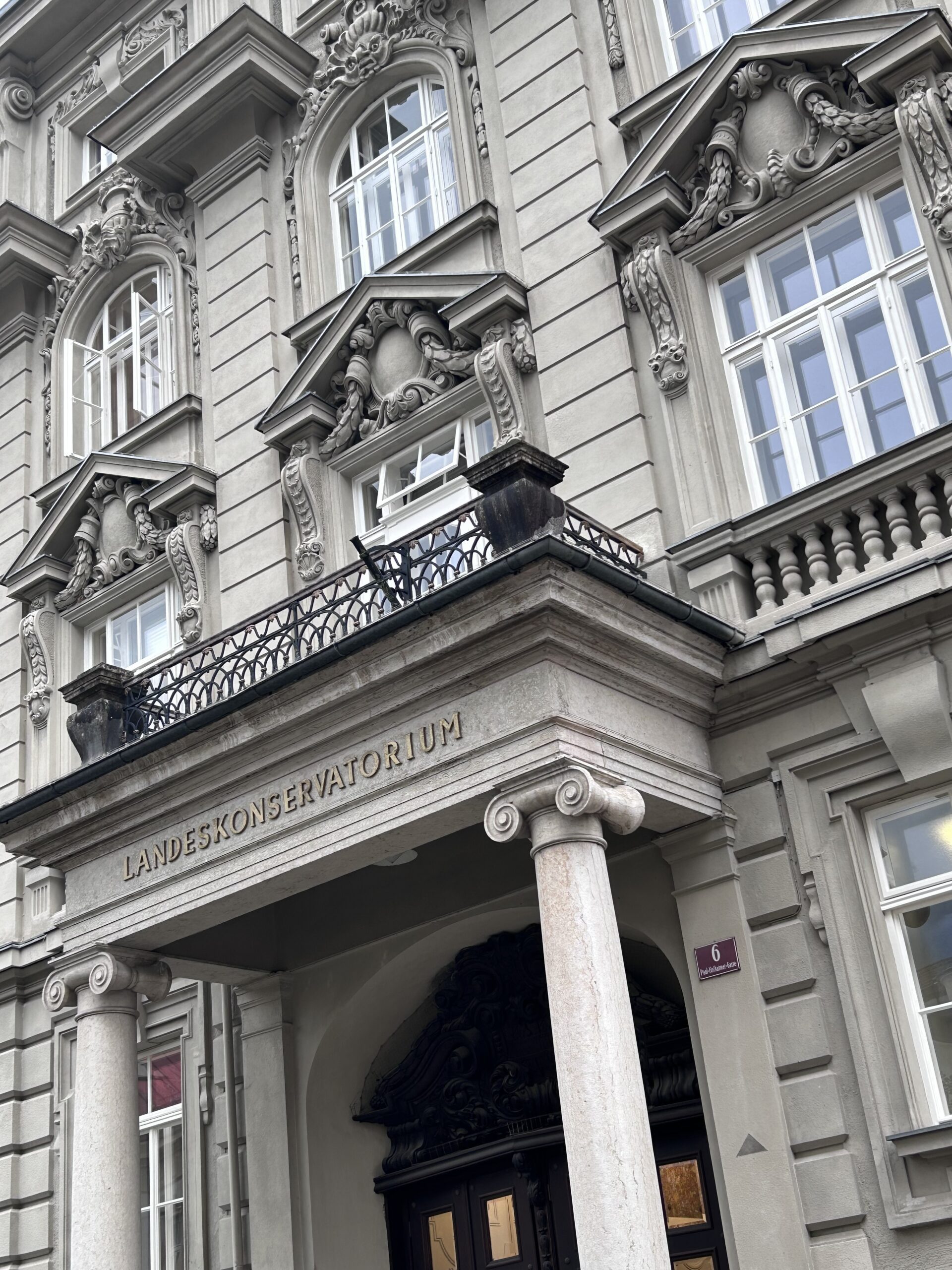
Worth knowing
Together with the Tyrolean State Theatre and the Ferdinandeum State Museum, the Tyrolean State Conservatory is the third landmark of bourgeois emancipation in Innsbruck. Although construction of the now somewhat hidden building did not begin until 1910, its architecture and history are characteristic of the 19th century. Eduard Klingler designed the compact neo-Baroque structure in a style typical of the late monarchy. Like many buildings, the foundation of the conservatory is made of Höttinger Breccia. A balcony crowns the classical columns at the entrance. The central part of the façade features richly decorated window arches with small capitals in the popular antique style of the time. Proper accommodation for Innsbruck’s musical elite was long overdue. When Klingler’s building was completed shortly before the outbreak of World War I, the Music Society was already nearly 100 years old. In 1816, Johann Herzog, Franz Craffonara, and Benedictine Father Martin Goller founded the Academic Music Society. A year later, they applied to the Imperial-Royal Provincial Government for permission to establish a music association. Not only were associations generally suspected of subversive tendencies, but the bureaucratic wheels of the Police Court Office in Vienna turned slowly—the review and official approval for founding the registered association took more than a year before the Innsbruck Music Society could officially be inaugurated in July 1818.
It wasn’t just the founding of the association that was controversial; music itself carried a certain stigma. The new generation of artists was considered difficult and rebellious. For centuries, aristocracy and the Church held a monopoly on music. In Innsbruck, the Jesuit order was responsible for selecting and producing religious pieces, which could only be performed with the approval of the provincial rulers. Outside of churches, refined musical enjoyment was reserved for aristocratic patrons who maintained court musicians. This began to change with Mozart—and even more so with Beethoven—who saw themselves as free-spirited entrepreneurs rather than submissive court artists. The social transformation and increasing professionalization of the music business exemplified how the new bourgeois elites appropriated and adopted aristocratic traditions. The Innsbruck Music Society aimed to ensure musical quality in the city through proper education. Lessons began in November 1818 in the former Jesuit Lyceum. In addition to music, declamation—“speech, gestures, and facial expression”—was taught. This subject was heavily censored and closely monitored by the authorities before being completely banned for several decades in 1827.
After ten years, the association had over 100 members, consisting of financially supportive honorary members and active musicians. The society was divided into an educational institution and a “Society for the Promotion of Means of Pleasure.” Sons of members had priority for the limited spots, while women were not allowed to enroll in the early years. Except for impoverished theology students, who received free lessons, tuition fees applied. Supporting members financed instruments and performances. At least four public productions were to be held annually. The Music Society also provided church music in the Jesuit church and organized benefit concerts for the poor fund with the conservative Casino Society. Musicians also enlivened official events and receptions. Thus, the bourgeoisie, Church, monarchy, and army came together in shaping the city’s musical life. One of the first members alongside Goller and Craffonara—and the first conductor—was Lieutenant Johann Gänsbacher (1778–1844). He rose socially through a military career. The son of a schoolmaster from Sterzing, he was sent early by his father to train in the choir of St. Jakob parish in Innsbruck. From 1797, he fought in the Coalition Wars before being stationed in Innsbruck as an Imperial Rifleman. In 1822, Gänsbacher composed the Alexander March to honor the visit of Tsar Alexander, Emperor Franz, and Clemens von Metternich in Innsbruck. Unable to secure a permanent position in Innsbruck, he moved to Vienna as cathedral music director of St. Stephen’s.
Under one of its most prominent and influential directors, Josef Pembaur (1848–1923), the Music Society relocated to its current site in Angerzell. Growing membership and rising demands for modern instruction required several moves before the city decided in 1906 to grant the society land behind the Ferdinandeum for its own home. In 1912, the small neo-classical palace next to the State Museum was finally inaugurated.
Even after the end of the monarchy, music remained in conservative hands. Following the rise to power of the Christian Social Party under Chancellor Engelbert Dollfuß and the accompanying changes in Austria’s education and cultural policies, the now well-established institution gained new prestige. In “recognition of more than a hundred years of successful activity as Tyrol’s first music teaching institute,” it was allowed in 1934 to call itself a conservatory, in line with Austria’s identity politics of the time. The National Socialists dissolved the association and continued the training facility as the “Music School of the Gau Capital Innsbruck.” In 1987, the conservatory and music school were separated, with the latter moving to the Ursuline School building. Today, future musicians, conductors, and classical singers study at the “Kons” in various disciplines. The Innsbruck Symphony Orchestra also emerged from the Music Society. Two former members, Josef Gänsbacher and Josef Pembaur, have streets in Innsbruck named after them.
Romance, sunless summers and apology cards
Thanks to the university, its professors and the young people it attracted and produced, Innsbruck also sniffed the morning air of the Enlightenment in the 18th century in the era of Maria Theresa, even if the Jesuit faculty leadership put the brakes on it. 1741 saw the founding of the Societas Academica Litteraria a circle of scholars in the Taxispalais. The masonic lodge was founded in 1777 To the three mountains, four years later, the Tyrolean Society for Arts and Science was founded. The spirit of reason in the time of Maria Theresa and Emperor Joseph also found its way into Innsbruck's elite. Spurred on by the French Revolution, some students even declared their allegiance to the Jacobins. Under Emperor Franz, all these associations were banned and strictly monitored after the declaration of war on France in 1794. Enlightenment ideas were frowned upon by large sections of the population even before the French Revolution. At the latest after the beheading of Marie Antoinette, the Emperor's sister, and the outbreak of war between the French Republic and the monarchies of Europe, they were considered dangerous. Who wanted to be considered a Jacobin when it came to defending their homeland?
After the Napoleonic Wars, Innsbruck was slow to recover, both economically and mentally. Adalbert Stifter (1805 -1868), probably the most famous writer of Austrian Romanticism, described Innsbruck in the 1830s in his travelogue Tyrol and Vorarlberg as follows:
„The inns were bad, the pavements wretched, long gutters overhung the narrow streets, which were bordered on both sides by dull arches... the beautiful banks of the Inn were unpaved, but covered with heaps of rubbish and criss-crossed by cesspools.“
Die kleine Stadt am Rande des Kaiserreiches hatte etwas mehr als 12.000 Einwohner, „ohne die Soldaten, Studenten und Fremden zu rechnen“. University, grammar school, Reading casino, music club, theatre and museum were evidence of a developing, modern urban culture. There was a Deutsches Kaffeehaus, a Restoration in the courtyard garden and several traditional inns such as the White cross, the Österreichischen Hofwhich Grape, das Katzung, das Mouthingeach of which Goldenen Adler, Stern und Hirsch. After 1830, the open sewers were blocked and made more hygienic, roads were repaired and bridges renovated. The overdue straightening and taming of the Inn and Sill rivers, which had begun before the turmoil of war, was also tackled. The biggest innovation for the population came in 1830, when oil lamps lit up the town at night. It was probably just a dim twilight created by the more than 150 lamps mounted on pillars and arm chandeliers, but for contemporaries it was a true revolution.
Die bayerische Besatzung war verschwunden, die Ideen der Denker der Aufklärung und der Französischen Revolution hatten sich aber in einigen Köpfen des städtischen Milieus verfangen. Natürlich waren es keine atheistischen, sozialistischen oder gar umstürzlerischen Gedanken, die sich breit machten. Es ging vor allem um wirtschaftliche, politische und gesellschaftliche Teilhabe des Bürgertums. Das Vereinswesen feierte eine Renaissance. Was heute wenig spektakulär klingt, war zur Regierungszeit Metternichs aufsehenerregend. Zwischen dem Beginn der Napoleonischen Kriege mit dem revolutionären Frankreich 1797 und dem Wiener Kongress waren Vereine allgemein verboten gewesen. Wer auf sich hielt, trat nun einer dieser neuartigen Gesellschaften bei. "Innsbruck has a music society, an agricultural society and a mining and geological society." stand etwa im Reiseführer Beda Webers wie ein Qualitätssiegel für die Stadt zu lesen. Es galt das tugendhafte Miteinander zum Wohl der weniger Begüterten und die Erziehung der Massen mit dem Treiben in den Vereinen zu forcieren. Wissenschaft, Literatur, Theater und Musik, aber auch Initiativen wie der Innsbruck Beautification Association, but also practical institutions such as the voluntary fire brigade established themselves as pillars of a previously unknown civil society. One of the first associations to be formed was the Innsbruck Music Society, from which the Tyrolean State Conservatory emerged. In keeping with the spirit of the times, men and women were not members of the same organisations. Women were mainly involved in charitable organisations such as the Women's association for the promotion of infant care centres and female industrial schools. Female participation in the political discourse was not desired.
In addition to Christian charity, a thirst for recognition and prestige were probably also major incentives for members to get involved in the clubs. People met to see and be seen. Good deeds, demonstrating education and leading a virtuous life were then, as now, the best PR for oneself.
Club life also served as entertainment on long evenings without electric light, television and the internet. Students, civil servants, members of the lower nobility and academics met in the pubs and coffee houses to exchange ideas. This was not only about highly intellectual and abstract matters, but also about profane realpolitik such as the suspension of internal tariffs, which made people's lives unnecessarily expensive. Culturally, the bourgeois educated elite in the Romantic and Biedermeier periods discovered the cultural escape into an intact past for themselves. After decades of political confusion, war and hardship, people wanted a distraction from the recent past, just as they did after 1945. Antiquity and its thinkers celebrated a second renaissance in Innsbruck, as in the rest of Europe. Romantic thinkers of the 18th and early 19th centuries such as Winckelmann, Lessing and Hegel were influential. The Greeks were „Noble simplicity and quiet greatness" attested. Goethe wanted the "Search the land of the Greeks with your soul" and travelled to Italy in search of his longing for the good, pre-Christian times in which the people of the Golden Age cultivated an informal relationship with their gods. Roman Stoic virtues were transported into the modern age as role models and formed the basis for bourgeois frugality and patriotism, which became very fashionable. Philologists combed through the texts of ancient writers and philosophers and conveyed a pleasing "Best of" into the 19th century. Columns, sphinxes, busts and statues with classical proportions adorned palaces, administrative buildings and museums such as the Ferdinandeum. Students and intellectuals such as the Briton Lord Byron were so inspired by the Panhellenism and the idea of nationalism that they risked their lives in the Greek struggle for independence against the Ottoman Empire. After the end of the Holy Roman Empire, Pan-Germanism became the political fashion of the liberal bourgeoisie in Innsbruck.
Kanzler Clemens von Metternichs (1773 – 1859) Polizeistaat hielt diese gesellschaftlichen Regungen lange Zeit unter Kontrolle. Zeitungen, Flugblätter, Schriften mussten sich an die Vorgaben der strengen Zensur anpassen oder im Untergrund verbreitet werden. Autoren wie Hermann von Gilm (1812 – 1864) und Johann Senn (1792 – 1857), an beide erinnern heute Straßen in Innsbruck, verbreiteten in Tirol anonym politisch motivierte Literatur. Der vielleicht bekannteste Public Intellectual des Vormärz war wahrscheinlich Adolf Pichler (1819 – 1900), dem bereits kurz nach seinem Ableben unter gänzlich anderen Vorzeichen in der Stadtpolitik der späten Monarchie ein Denkmal gewidmet wurde und nach dem heute das Bundesrealgymnasium am gleichnamigen Platz gewidmet ist. Bücher und Vereine standen unter Generalverdacht. Der Innsbrucker Musikverein lehrte im Rahmen seiner Ausbildung auch die Deklamation, das Vortragen von Texten, Musik und Reden, die Inhalte wurden von der Obrigkeit streng überwacht. Alle Arten von Vereinen wie die Innsbrucker Liedertafel and student fraternities, even the members of the Ferdinandeum were spied on. The social movements forming in the working-class neighbourhoods were particularly targeted by Metternich's secret police. Despite their demonstrative loyalty to the emperor, the marksmen were also on the list of institutions to be observed. They were considered too rebellious, not only towards foreign powers, but also towards the Viennese central government. The mix of Greater German nationalist ideas and Tyrolean patriotism presented with the pathos of Romanticism seems strangely harmless today, but was neither comfortable nor acceptable to the Metternich state apparatus.
However, political activism was a marginal phenomenon that only occupied a small elite. After the mines and salt works had lost their profitability in the 17th century and transit lost its economic importance due to the new trade routes across the Atlantic, Tyrol had become a poor region. The Napoleonic Wars had raged for over 20 years. The year 1809 went down as Tyrolean heroic age in the historiography of the 19th and early 20th centuries, the consequences of heroism were barely highlighted. Although the Austrian Empire was one of the victorious powers after the Congress of Vienna, its economic situation was miserable. As after the world wars of the 20th century, many men had not returned home during the coalition wars. The university, which drew young aristocrats into the city's economic cycle, was not reopened until 1826. Unlike industrial locations in Bohemia, Moravia, Prussia or England, the hard-to-reach city in the Alps was only just beginning to develop into a modern labour market. Tourism was also still in its infancy and was not a Cash Cow. It is no wonder that hardly any buildings in the Biedermeier style have survived in Innsbruck. And then there was a volcano on the other side of the world that had an undue influence on the fate of the city of Innsbruck. In 1815, Tambora erupted in Indonesia and sent a huge cloud of dust, sulphur and ash around the world. In 1816 Year without summer into history. All over Europe, there were freak weather conditions, floods and failed harvests. The Alps, an already difficult part of the world to farm, were not exempt from this.
The economic upheavals and price increases led to hardship and misery, especially among the poorer sections of the population. In the 19th century, caring for the poor was a task for the communities, usually with the support of wealthy citizens as patrons with the idea of Christian charity. The state, the community, the church and the newly emerging civil society in the form of associations began to look after the welfare of the poorest sections of the population. Charity concerts, collections and appeals for donations were organised. The measures often contained an enlightened component, even if the means to an end seem strange and alien today. In Innsbruck, for example, a begging ordinance came into force that banned dispossessed people from marrying. Almost 1000 citizens were categorised as alms recipients and beggars.
As the need grew and the city coffers became emptier, Innsbruck came up with an innovation that was to last for over 100 years: The New Year's apology card. Even back then, it was customary to visit relatives on the first day of the year to give each other a Happy New Year to make a wish. It was also customary for needy families and beggars to knock on the doors of wealthy citizens to ask for alms at New Year. The introduction of the New Year's relief card killed several birds with one stone. The buyers of the card were able to institutionalise and support their poorer members in a regulated way, similar to the way street newspapers are bought today. Twenty is possible. At the same time, the New Year's apology card served as a way of avoiding the unpopular obligatory visits to relatives. Those who hung the card on their front door also signalled to those in need that no further requests for alms were necessary, as they had already paid their contribution. Last but not least, the noble donors were also favourably mentioned in the media so that everyone could see how much they cared for their less fortunate fellow human beings in the name of charity.
The New Year's apology cards were a complete success. At their premiere at the turn of the year from 1819 to 1820, 600 were sold. Many communities adopted the Innsbruck recipe. In the magazine "The Imperial and Royal Privileged Bothe of and for Tyrol and Vorarlberg", the proceeds for Bruneck, Bozen, Trient, Rovereto, Schwaz, Imst, Bregenz and Innsbruck were published on 12 February. Other institutions such as fire brigades and associations also adopted the well-functioning custom to raise funds for their cause. The construction of the new Höttinger parish church was financed to a large extent from the proceeds of specially issued apology cards in addition to donations. The varied designs ranged from Christian motifs to portraits of well-known personalities, official buildings, new buildings, sights and curiosities. Many of the designs can still be seen in the Innsbruck City Archives.
Klingler, Huter, Retter & Co: master builders of expansion
The final decades of the 19th century became known in Austrian history as the Gründerzeit (Founders’ Era). After the economic crisis of 1873, the financial situation recovered and an unprecedented construction boom began. Innsbruck also established a modern banking system. Financial institutions such as the Savings Bank founded in 1821 and the Creditanstalt, whose building erected in 1910 still towers over Maria-Theresien-Straße like a small palace, made it possible to obtain loans, without which entrepreneurship and commerce as we know them today would not have been possible. In some cases, these financial institutions even acted as developers themselves. Between 1880 and 1900, Innsbruck’s population grew from 20,000 to 26,000 inhabitants, while Wilten, incorporated into the city in 1904, even tripled its population from 4,000 to 12,000. The number of buildings increased from 600 to more than 900. Most of them, unlike previous buildings, were multi-story apartment houses. Infrastructure was also modernized. Gas, running water, and electricity became part of everyday life for an increasing number of people. These buildings represented the new society. Entrepreneurs, professionals, employees, and workers had different needs than the legally dependent subjects of previous centuries. The urban lifestyle demanded apartments with several rooms and open spaces for recreation after working hours. Apartment buildings made a modern lifestyle possible even for people who did not own property. Unlike the rural regions of Tyrol, where farming families lived together with servants in farmhouses as part of an extended kinship community, life in the city was already quite close to our present-day understanding of family life. Although the upper middle class had not yet surpassed the nobility, it had reduced the gap considerably and, through its new position on the municipal council, was able not only to commission private building projects but also to decide on public construction projects. The old city hospital in the center of town was replaced by a modern hospital in the west; Sieberer’s orphanage and retirement home were established in Saggen, and a new urban center emerged around the railway station.
The forty years preceding the First World War were a gold rush era for the construction industry. The architecture of the buildings reflected the worldview of their owners. Master builders often assumed several roles and frequently replaced architects altogether. Most clients had very clear ideas about what they wanted. They were not seeking breathtaking new creations but rather copies of or adaptations based on existing buildings. In keeping with the spirit of the age, Innsbruck’s master builders designed structures according to the wishes of their financially powerful clients in the styles of Historicism, Classicism, and the Tyrolean Heimatstil. The style chosen for a home was often not merely an aesthetic decision but also an ideological statement by the owner. Liberals generally preferred Classicism, while conservatives were drawn to the Tyrolean Heimatstil. Whereas the Heimatstil presented itself in a Neo-Baroque form with abundant paintings, clear forms, statues, and columns were characteristic elements of Classical-inspired architecture. In what was sometimes a rather wild mixture of styles, people realized their ideas of classical Greece and ancient Rome. Not only railway stations and public buildings but also large apartment buildings, entire streets, churches, and even cemeteries were built along former country roads in this design. Academics—and those wishing to appear as such—demonstrated their fascination with antiquity through neoclassical façades. Catholic traditionalists commissioned murals depicting saints and scenes from Tyrolean history on their Heimatstil houses. While Neoclassicism predominates in Saggen and Wilten, the district of Pradl is largely characterized by conservative Heimatstil architecture. For a long time, many architectural experts looked down upon the tastes of social climbers and the newly rich. Heinrich Hammer wrote in his standard work Art History of the City of Innsbruck:
"Of course, this first rapid expansion of the city took place in an era that was unfruitful in terms of architectural art, in which architecture, instead of developing an independent, contemporary style, repeated the architectural styles of the past one after the other."
The era of grand villas, which imitated the aristocratic residences of former times with a bourgeois touch, came to an end after several exuberant decades simply because space became scarce. Further development of the city with detached houses was no longer possible. Even today, the area around Falkstraße, Gänsbachstraße, and Bienerstraße is known as Villensaggen, while the areas further east are referred to as Blocksaggen. Wilten and Pradl, however, never experienced this kind of development. Nevertheless, in their gold-rush enthusiasm, developers sealed ever more land with construction. In 1907, Albert Gruber delivered a warning speech about this growth, cautioning against unchecked urban expansion and land speculation.
"It is the most difficult and responsible task facing our city fathers. Up until the 1980s (note: 1880), let's say in view of our circumstances, a certain slow pace was maintained in urban expansion. Since the last 10 years, however, it can be said that cityscapes have been expanding at a tremendous pace. Old houses are being torn down and new ones erected in their place. Of course, if this demolition and construction is carried out haphazardly, without any thought, only for the benefit of the individual, then disasters, so-called architectural crimes, usually occur. In order to prevent such haphazard building, which does not benefit the general public, every city must ensure that individuals cannot do as they please: the city must set a limit to unrestricted speculation in the area of urban expansion. This includes above all land speculation."
A handful of master builders, together with the Innsbruck Building Authority, guided this development. If Wilhelm Greil can be called the mayor of Innsbruck’s expansion, then the Vienna-born Eduard Klingler (1861–1916) certainly deserves the title of its architect. As a public official and master builder, Klingler left a profound mark on Innsbruck’s cityscape. He began working for the Province of Tyrol in 1883. In 1889 he joined the municipal building authority, which he headed from 1902 onward. Among the projects attributed to Klingler as head of the building authority are the Commercial Academy, the Leitgeb School, Pradl Cemetery, the Dermatological Clinic within the hospital complex, the Municipal Kindergarten on Michael-Gaismair-Straße, the Train Barracks (today a residential building), the Market Hall, and the Tyrolean State Conservatory. One particularly noteworthy Heimatstil building designed by him is the Ulrich House on Bergisel, which today serves as the headquarters of the Old Kaiserjäger Club.
The most important construction company in Innsbruck was Johann Huter & Sons. Johann Huter took over his father’s brickworks. In 1856 he acquired the company’s first property, the Huter Grounds, on Innrain. Three years later the first business headquarters was established on Meranerstraße. The company’s official founding came in 1860 when it was registered together with his sons Josef and Peter. Like many of its competitors, Huter & Sons saw itself as a full-service provider. The company included its own brickworks, cement factory, carpentry shop, metal workshop, design office, and construction firm. By the outbreak of the First World War, it employed more than 700 people. In 1906/07, the Huter family built their residential and business headquarters at Kaiser-Josef-Straße 15 in the typical style of the late pre-war years. This stately house combines the Tyrolean Heimatstil, surrounded by gardens and nature, with Neo-Gothic and Neo-Romanesque elements. Well-known buildings erected by Huter & Sons in Innsbruck include the Monastery of Perpetual Adoration, St. Nicholas Parish Church, the first building of the new hospital complex, and several buildings on Claudiaplatz.
The second major player was Josef Retter (1872–1954). Born in Lower Austria with Tyrolean roots, he completed an apprenticeship as a mason before attending the Imperial-Royal State Trade School in Vienna and the master craftsman school of its construction department. After gaining professional experience throughout the Habsburg Monarchy—in Vienna, Croatia, and Bolzano—he was able, thanks to his wife’s dowry, to establish his own construction company in Innsbruck at the age of 29. Like Huter’s company, his enterprise also included a sawmill, a sand and gravel works, and a stonemasonry workshop. In 1904 he built his residential and office building. The dark Neo-Gothic Retter House at Schöpfstraße 23a, with its distinctive bay window supported by columns and a turret, is decorated with a remarkable mosaic representing an allegory of architecture. The relief on the gable depicts the union of art and craftsmanship, symbolizing Retter’s career path. Retter’s buildings particularly shaped Wilten and Saggen. Through projects such as the new Academic Gymnasium, the castle-like Commercial Academy building, the Protestant Christ Church in Saggen, the Zelger House on Anichstraße, Sonnenburg in Wilten, and the Neo-Gothic Mentlberg Castle in Sieglanger, he created many of the most important buildings of this era in Innsbruck.
Late in life but with a similarly practice-orientated background that was typical of 19th century master builders, Anton Fritz started his construction company in 1888. He grew up remotely in Graun in the Vinschgau Valley. After working as a foreman, plasterer and bricklayer, he decided to attend the trade school in Innsbruck at the age of 36. Talent and luck brought him his breakthrough as a planner with the country-style villa at Karmelitergasse 12. In its heyday, his construction company employed 150 people. In 1912, shortly before the outbreak of the First World War and the resulting slump in the construction industry, he handed over his company to his son Adalbert. Anton Fritz's legacy includes his own home at Müllerstraße 4, the Mader house in Glasmalereistraße and houses on Claudiaplatz and Sonnenburgplatz.
With Carl Kohnle, Carl Albert, Karl Lubomirski, and Simon Tommasi, Innsbruck possessed several other master builders who left their mark on the cityscape through typical buildings of the late 19th century. Together, they shaped Innsbruck’s new streets in the prevailing architectural spirit of the final thirty years of the Habsburg Monarchy. Residential houses, railway stations, government buildings, and churches throughout the vast empire stretching from Ukraine to Tyrol looked remarkably similar. New movements such as Art Nouveau gained acceptance only slowly. In Innsbruck, it was the Munich architect Josef Bachmann who introduced a new accent to bourgeois design with the redesign of the façade of the Winkler House. With the outbreak of the First World War, construction activity largely ceased. After the war, the era of neoclassical Historicism and the Heimatstil was definitively over. Times had become harsher, and the requirements for housing had changed. In the period of severe housing shortages in the young Republic of German-Austria, affordable housing and modern sanitary facilities became more important than representative façades and grand rooms. The increasingly professional education of master builders and architects at the Imperial-Royal State Trade School also contributed to a new understanding of construction, replacing the often self-taught veterans of the gold-rush era of Classicism. A stroll through Saggen and parts of Wilten and Pradl still transports visitors back to the Gründerzeit. Claudiaplatz and Sonnenburgplatz are among the most impressive examples. The construction company Huter & Sons still exists today. The company is now located in Sieglanger on Josef-Franz-Huter-Straße, named after its founder. Although the residential building on Kaiser-Josef-Straße no longer bears the company’s name, it remains, in all its opulence, a remarkable relic of the period that permanently transformed Innsbruck’s appearance. In addition to his residence on Schöpfstraße, the district of Wilten contains a second building associated with the Retter family. Opposite the university on Innrain stands Villa Retter. Josef Retter’s eldest daughter, Maria Josefa, who herself had been educated according to the principles of the reform educator Maria Montessori, opened Innsbruck’s first Haus des Kindes (“House of the Child”) in 1932. Above the entrance, a portrait depicts the benefactor Josef Retter. The south façade is adorned with a mosaic in the characteristic style of the 1930s, referring to the building’s original purpose. A smiling blond girl embraces her mother, who is holding a book, and her father, who carries a hammer. The family crypt at Westfriedhof Cemetery is another notable legacy of the Retter family.
Wilhelm Greil: DER Bürgermeister Innsbrucks
One of the most important figures in Innsbruck's municipal history was Wilhelm Greil (1850–1928). The entrepreneur held the office of mayor from 1896 to 1923, having previously helped shape the city's fortunes as vice mayor. His tenure was not only long, but also took place during a particularly dynamic era. The four decades between the economic crisis of 1873 and the First World War were marked by unprecedented growth and rapid modernization. It was a time of incorporating entire city districts, technical innovations, and new media. Private investments in infrastructure such as railways, energy, and electricity were encouraged by the state and given tax incentives in order to lead the provinces and cities of the struggling Danube Monarchy into modernity. The city's economy was booming. Businesses emerged in the new districts of Pradl and Wilten, attracting a labor force. Tourism also brought fresh capital into the city. Innsbruck's city council was dominated by the liberal and Pan-German nationalist 'Deutsche Volkspartei' (German People's Party), to which Greil also belonged. It was only with the incorporation of Wilten and Pradl in 1904 that the conservatives were able to gain ground, though they could not fully catch up. Social Democracy played almost no role until 1918. Due to an electoral system based on voting rights categorized by wealth classes, only about 10% of Innsbruck's population could step up to the ballot box. Women were fundamentally excluded. Furthermore, relative voting rights applied within the three electoral colleges, which effectively meant: winner takes it all. Appropriately enough, Mayor Greil lived much like a Renaissance prince. He hailed from the upper-class haute bourgeoisie. His father was able to afford establishing the family's home base in the Palais Lodron on Maria-Theresien-Straße. Thanks to this electoral statute, Mayor Greil could rely on 100% support in the city council well into the era of the First Republic, which naturally simplified decision-making and governance considerably. For all the efficiency that Innsbruck's mayors displayed on a superficial level, one should not forget that this was only possible because, as part of an elite composed of entrepreneurs, merchants, and professionals, they ruled through a form of elected dictatorship—without any significant opposition or consideration for other population groups such as workers, artisans, and employees. The Imperial Municipal Act of 1862 granted cities like Innsbruck, and thus its mayors, far-reaching powers. It is hardly surprising that the chain of office presented to Greil on his 60th birthday by his colleagues on the city council bore an astonishing resemblance to the collar orders of the old nobility. However, Greil was also a skillful politician who adeptly navigated the established power structures and media landscape of his time. Article 17 of the Austrian Basic Law of 1867, known as the December Constitution, secured freedom of expression in the press without prior censorship for the first time—excluding, of course, punishable content such as blasphemy or insulting the authorities. Consequently, a variety of newspapers established themselves, such as the conservative Neue Tiroler Stimme, the social democratic Volkszeitung, or the liberal Innsbrucker Nachrichten, shaping a worldview according to their publishers' preferences. Thanks to the reach of the Innsbrucker Nachrichten, Wilhelm Greil was able to effectively project his view of local politics. Despite his at times fierce speeches—modeled on the platform of Georg Ritter von Schönerer (1842–1921), the founding figure of the Pan-German nationalists—he managed to reach arrangements with conservative forces in the region, even if things frequently clashed in the media and elsewhere. Taxes, social policy, education, housing, and the design of public spaces were debated with passion and zeal, often enough with violence as the ultimate argument.
Unter Greils Ägide und dem allgemeinen wirtschaftlichen Aufschwung erweiterte sich Innsbruck im Eiltempo. Der Gemeinderat kaufte ganz im Stil eines Kaufmanns vorausschauend Grund an, um der Stadt Neuerungen zu ermöglichen. Der Politiker Greil konnte sich bei den großen Bauprojekten der Zeit auf die Beamten und Stadtplaner Eduard Klingler, Jakob Albert und Theodor Prachensky stützen. Infrastrukturprojekte wie das neue Rathaus in der Maria-Theresienstraße 1897, die Eröffnung der Mittelgebirgsbahn, die Hungerburgbahn und die Karwendelbahn wurden während seiner Regierungszeit umgesetzt. Weitere gut sichtbare Meilensteine waren die Erneuerung des Marktplatzes und der Bau der Markthalle. Neben den prestigeträchtigen Großprojekten revolutionierte vor allem Unsichtbares in den letzten Jahrzehnten des 19. Jahrhunderts das Leben vieler Innsbrucker. Bereits Greils Vorgänger Bürgermeister Heinrich Falk (1840 – 1917) hatte erheblich zur Modernisierung der Stadt und zur Besiedelung des Saggen beigetragen. Seit 1859 war die Beleuchtung der Stadt mit Gasrohrleitungen stetig vorangeschritten. Mit dem Wachstum der Stadt und der Modernisierung wurden die Senkgruben, die in Hinterhöfen der Häuser als Abort dienten und nach Entleerung an umliegende Landwirte als Dünger verkauft wurden, zu einer Unzumutbarkeit für immer mehr Menschen. 1880 wurde das Ragging, so der Name im Volksmund für die Entleerung der Aborte, in den Verantwortungsbereich der Stadt übertragen. Zwei pneumatische Maschinen sollten den Vorgang zumindest etwas hygienischer gestalten. Zwischen 1887 und 1891 wurde Innsbruck mit einer modernen Hochdruckwasserleitung ausgestattet, über die auch Wohnungen in höher gelegenen Stockwerken mit frischem Wasser versorgt werden konnten. Wer auf sich hielt und es sich leisten konnte, hatte damit erstmals die Gelegenheit eine Spültoilette im Eigenheim zu installieren. Greil setzte diesen Feldzug der Modernisierung mit einer Vielzahl an Infrastrukturprojekten fort. Die Ansammlung an Menschen auf enger werdendem Raum unter teils prekären Hygieneverhältnissen hatte viele Probleme mit sich. Die Randbezirke der Stadt und die umliegenden Dörfer wurden regelmäßig von Typhus heimgesucht. Nach jahrzehntelangen Diskussionen wurde 1903 mit dem Bau einer modernen Schwemmkanalisation begonnen. Ausgehend von der Innenstadt wurden immer mehr Stadtteile an diesen heute alltäglichen Luxus angeschlossen. 1908 waren nur die Koatlackler Mariahilf und St. Nikolaus nicht an das Kanalsystem angeschlossen. Auch der neue Schlachthof im Saggen erhöhte Hygiene und Sauberkeit in der Stadt. Schlecht kontrollierte Hofschlachtungen gehörten mit wenigen Ausnahmen der Vergangenheit an. Das Vieh kam im Zug am Sillspitz an und wurde in der modernen Anlage fachgerecht geschlachtet. Greil überführte das Gaswerk in Pradl und das Elektrizitätswerk in Mühlau in städtischen Besitz. Die Straßenbeleuchtung wurde im 20. Jahrhundert von den Gaslaternen auf elektrisches Licht umgestellt. 1888 übersiedelte das Krankenhaus von der Maria-Theresienstraße an seinen heutigen Standort. Bürgermeister und Gemeinderat konnten sich bei dieser Innsbrucker Renaissance neben der wachsenden Wirtschaftskraft in der Vorkriegszeit auch auf Mäzen aus dem Bürgertum stützen. Waren technische Neuerungen und Infrastruktur Sache der Liberalen, verblieb die Fürsorge der Ärmsten weiterhin bei klerikal gesinnten Kräften, wenn auch nicht mehr bei der Kirche selbst. Freiherr Johann von Sieberer stiftete das Greisenasyl und das Waisenhaus im Saggen. Leonhard Lang stiftete das Gebäude in der Maria-Theresienstraße, in der sich bis heute das Rathaus befindet gegen das Versprechen der Stadt ein Lehrlingsheim zu bauen.
In contrast to the booming pre-war era, Greil’s leadership after 1914 was marked by crisis management. In his final years in office, he guided Innsbruck through the transition from the Habsburg monarchy to the republic—a time characterized above all by hunger, hardship, scarcity of resources, and insecurity. He was 68 years old when Tyrol was divided at the Brenner Pass after the war. During his political career, Greil had often exploited general hostility toward Italians (“Walsche”) in a similarly populist manner to his Christian Social counterpart in Vienna, Karl Lueger, who used antisemitic rhetoric. At the end of his career, he had to witness the Italian occupation of Innsbruck. With the introduction of the republic, the census-based voting system was abolished, marking the beginning of the end of liberal dominance in the municipal council. In 1919, the Social Democrats won elections in Innsbruck for the first time. Only due to council majorities and a coalition of Greater German-liberal and conservative-clerical politicians did Greil remain mayor. He died in 1928 at the age of 78 as an honorary citizen of the city of Innsbruck. Wilhelm-Greil-Straße had already been named after him during his lifetime.
The Bocksiedlung and Austrofascism
Political violence, alongside hunger and a severe housing shortage, shaped Austria throughout the 1920s and 1930s. The two major mass parties of the young republic, the Social Democrats and the Christian Socials, regarded each other with hostility. Both parties established paramilitary organizations to enforce their political agendas on the streets if necessary. The Republikanischer Schutzbund on the Social Democratic side and various Christian Social or even monarchist-oriented Heimwehr groups, which for simplicity may be grouped under this collective term, watched one another like opposing sides in a civil war. Many politicians and functionaries on both sides had fought on the front during the war and had become deeply militarized as a result. The Tyrolean Heimwehr enjoyed superior infrastructure and political connections due to the support of the Catholic Church. On November 12, 1928, the tenth anniversary of the founding of the Republic, 18,000 Heimwehr members marched through the city in the first nationwide Heimwehr rally, demonstrating their strength on what was the most important holiday for Austrian Social Democrats. From 1930 onward, the Nazi Party (NSDAP) also became increasingly visible in public life. It found supporters particularly among students and disillusioned young workers. By 1932, the party already had 2,500 members in Innsbruck. Violent clashes between the hostile political factions occurred repeatedly. The most notorious of these became known as the Hötting Hall Battle (Höttinger Saalschlacht) of May 27, 1932. At that time, Hötting was still independent and not yet part of Innsbruck. The community was inhabited mainly by workers. In this “red” stronghold of Tyrol, National Socialists planned a rally at the Goldener Bär Inn, a traditional meeting place of Social Democrats. This provocation escalated into a fight that left more than thirty people injured and one National Socialist dead. The violence spread across the entire city; even in the hospital, the injured continued fighting each other. Only the intervention of the gendarmerie and the army succeeded in separating the opposing sides.
After these years that resembled a civil war, the Christian Social Party prevailed in 1933 under Chancellor Engelbert Dollfuß (1892–1934). His goal was the establishment of the so-called Austrian Corporate State (Österreichischer Ständestaat), today better known under the term Austrofascism. The entire state apparatus was to be unified under the Fatherland Front (Vaterländische Front), modeled on Mussolini’s fascism in Italy: anti-socialist, authoritarian, socially conservative, anti-democratic, antisemitic, and militarized. Quite a few people welcomed the replacement of parliament and the multi-party system by a strong leader who promised peace and order. In Innsbruck, unlike in many Austrian cities where this political upheaval was at times accompanied by bloodshed, no significant fighting occurred. On 15 March, the headquarters of the Tyrolean Social Democratic Workers' Party (Sozialdemokratische Arbeiterpartei Tirol) in the Hotel Sonne was cleared out. The leader of the Republican Protection League (Republikanischer Schutzbund), Gustav Kuprian, was arrested on charges of high treason, and the individual units of the Schutzbund were disarmed. The Tiroler Wochenzeitung was established as the party newspaper. Innsbruck’s municipal council was reduced from forty to twenty-eight members. Instead of being elected through free elections, council members were appointed by the provincial governor. The Social Democrats, who had previously held strong representation, were removed from the city government. Dollfuß was extraordinarily popular in Tyrol, as photographs of the crowded square in front of the Hofburg during one of his speeches in 1933 demonstrate. His policies came closer than any other contemporary system to the traditions of the Habsburg Monarchy. As early as 1931, several Tyrolean mayors had joined forces in an effort to lift the ban on the Habsburg family entering Austria. This policy was supported by the Catholic Church and was even incorporated into the Constitution of 1934: “In the name of God, the Almighty, from whom all law proceeds, the Austrian people receive this Constitution for their Christian, German federal state founded on a corporative basis.” The close relationship with the Church provided the government with access to infrastructure, media organizations, and affiliated institutions. The Fatherland Front, together with its paramilitary units, took harsh action against the despised Socialists. It did not hesitate to employ repression and violence against both individuals and institutions associated with the political opposition. Suspected and actual Socialists, Social Democrats, trade unionists, and Communists were repeatedly arrested. The press was politically controlled and censored, while newspaper articles glorified the idyllic nature of rural life. Large families received financial support. Schools were segregated by gender, and the curricula differed accordingly: domestic work for girls and pre-military training for boys. Cultural policy deliberately distinguished itself from that of the National Socialist and anti-clerical neighbor to the north. Theatre and music were intended to present Austria as the “better and more civilized” German state.
tion Austrofascism, however, brought peace and order only briefly, if at all. On 25 July 1934, a coup attempt by the banned National Socialists took place in Vienna, during which Chancellor Engelbert Dollfuß was killed. Hitler, who had not ordered the attacks, initially distanced himself publicly from the events, helping to suppress the planned overthrow before it could gain momentum. An attempted coup also occurred in Innsbruck. During an effort by a group of National Socialists to seize control of the city, a police officer was shot and killed in Herrengasse. In memory of the murdered Federal Chancellor, who was subsequently elevated to the status of a martyr, the square in front of the theatre, where he had met with Richard Steidl only two weeks earlier, was renamed Dollfuß Square (Dollfußplatz) by “order of the Government Commissioner of the Provincial Capital of Tyrol.” Dollfuß’s successor as head of state was Kurt Schuschnigg (1897–1977), a native Tyrolean. The war veteran, who came from the lower nobility of the former Austro-Hungarian Empire, was a member of the Innsbruck student fraternity Austria. In 1930, Schuschnigg, then a lawyer and member of parliament, founded the Ostmärkische Sturmschar, a Catholic and antisemitic paramilitary organization intended to serve as a counterweight to the more radical Heimwehr groups. As Minister of Education and Minister of Justice, Schuschnigg played a key role in the rightward shift of society under the Corporate State. Among other measures, he reintroduced the death penalty. For the people of Innsbruck, however, little changed under the new Chancellor in terms of everyday hardship. Economically, the Corporate State was unable to reverse the situation during the 1930s. Government investment in major infrastructure projects came to a halt following the economic crisis of 1931. By 1933, the unemployment rate had reached 25 percent. The reduction of social welfare measures that had been introduced at the beginning of the First Republic had dramatic consequences. Long-term unemployed individuals were excluded from receiving social benefits as so-called “Ausgesteuerte” (persons whose entitlement to benefits had expired). Poverty led to rising crime rates, and assaults, robberies, and thefts became commonplace. As in previous decades, housing remained a particularly serious problem. Despite the city's efforts to provide modern housing, many Innsbruck residents still lived in dilapidated dwellings. Private bathrooms or even a separate bedroom for each person were rare exceptions. Since Innsbruck’s rapid growth beginning in the 1880s, housing conditions had remained precarious for a large part of the population. The railway, industrialization, refugees from the German-speaking regions of Italy, and the economic crisis had pushed the city to the limits of its capacity. After Vienna, Innsbruck had the second-highest number of residents per house in Austria. Housing rents were so high that workers often slept in shifts in order to share the costs. Although new apartment blocks and homeless shelters had been built, especially in Pradl, including the Workers’ Residence (Wohnheim für Arbeiter) on Amthorstraße in 1907 and the Hostel (Herberge) on Hunoldstraße, these measures were insufficient to bring the situation under control.
In this climate of social dictatorship and economic hardship, several shantytowns and barrack settlements emerged on the outskirts of the city. They were founded by the excluded, the desperate, and those left behind who could find no place within the system. The former prisoner-of-war camp in Höttinger Au, west of the city, served as emergency accommodation for homeless people. The most famous and notorious inner-city enclave, remembered to this day, was the Bocksiedlung ("Bock Settlement") in the area of present-day Reichenau. Beginning around 1930, several families settled there between the airport then located on the site and the concentration camp that would later be built in Reichenau. According to local legend, Otto and Josefa Rauth were the founders of the settlement after their caravan became stranded there. In the Innsbruck of the Corporate State, having the wrong party affiliation was enough to make affordable housing unattainable. As an openly declared Communist, Rauth possessed what was arguably the most disadvantageous party membership of all. His raft, the Ark Noah (Arche Noah), with which he planned to travel via the Inn and Danube rivers to the Soviet Union, remained moored on the riverbank in front of the Sandwirt Inn (Gasthof Sandwirt) and never actually set sail. Gradually, a settlement developed that existed both physically on the edge of the city and socially on the margins of society. It was run like an independent commune by its unofficial mayor, Johann Bock (1900–1975). He managed everyday life within his sphere of influence in a rough but warm-hearted manner. The air raids of the Second World War further worsened Innsbruck's housing situation and caused the Bocksiedlung to grow. At its peak, it is said to have contained around fifty dwellings. Even the barracks of the Reichenau concentration camp were used as sleeping quarters after the last National Socialists held there had been transferred or released. The Bockala, as the inhabitants were known, had a terrible reputation among the respectable citizens of the rest of the city, and despite later attempts to romanticize or soften its history, that reputation was probably not entirely undeserved. Many, though not all, residents were unemployed or involved in criminal activities. Often, however, they were simply people who had fallen through the cracks of society and found refuge in the Bocksiedlung. As helpful and supportive as the often eccentric residents could be toward one another, physical violence and petty crime were part of everyday life. Excessive alcohol consumption was commonplace. There were no paved roads, no sewage system, no sanitary facilities, and no regular electricity supply. Even access to drinking water remained precarious for a long time, creating a constant risk of disease outbreaks. The dwellings themselves were as diverse as their inhabitants. They included caravans, circus wagons, wooden barracks, corrugated metal huts, brick houses, and concrete buildings. Within the Bocksiedlung, houses and wagons were rented out and sold. With the tacit tolerance of the City of Innsbruck, property rights acquired through long-term occupation even emerged under Johann Bock's leadership. The residents cultivated self-sufficiency gardens and kept livestock. In difficult times, even dogs and cats occasionally appeared on the menu. There were no fixed boundaries to the settlement; in Innsbruck, being a Bockala was as much a social status as it was a place of residence.
The beginning of the end for the Bocksiedlung (“Bock Settlement”) came with the 1964 Olympic Games and a fire that had occurred in the settlement the year before. An urban legend claims that the fire was deliberately set by the municipal authorities in order to accelerate the clearance of the neighborhood and make way for the construction of the Olympic Village (Olympisches Dorf). In 1967, Mayor Alois Lugger and Johann Bock negotiated the future of the settlement and compensation payments from the municipality for its evacuation. According to local accounts, these discussions took place in a rather alcohol-laden atmosphere. Nevertheless, it would take several more years before the settlement effectively came to an end. It was not until 1976 that the last remaining dwellings were forcibly vacated due to unsanitary conditions. Many of the Bockala were relocated to municipal apartments in Pradl, Reichenau, and the newly constructed Olympic Village (O-Dorf). The customs and lifestyle associated with the Bocksiedlung continued there under a new address for several years, contributing in large part to the negative reputation that these neighborhoods still carry today. Less firmly embedded in the collective memory of many Innsbruck residents than the legends of the Bocksiedlung is the interwar period. Yet this era often remains a much greater part of everyday culture than we realize. In churches such as St. Jakob in Defereggen in East Tyrol or the parish church of Fritzens, images depicting Dollfuß as the protector of the Catholic Church can still be seen, more or less without comment. Even today, there are “red” and “black” motorists’ clubs, sports associations, rescue organizations, and Alpine clubs whose roots can be traced back to this period. The history of the Bocksiedlung has been painstakingly reconstructed by the Innsbruck City Archive through numerous interviews and extensive archival research, and was published in a highly readable form in the book: Bocksiedlung. Ein Stück Innsbruck (Bocksiedlung: A Piece of Innsbruck) published by the Innsbruck City Archive. The book provides a valuable account of both the settlement itself and the social realities of Innsbruck in the twentieth century.
Andreas Hofer and the Tyrolean uprising of 1809
The period of the Napoleonic Wars provided Tyrol with a national epic and, in Andreas Hofer, a hero whose legacy continues to resonate to this day. Anyone searching for a Tyrolean national founding narrative—voilà! However, if one sets aside the carefully constructed legend of the Tyrolean uprising against foreign rule, the years before and after 1809 emerge as a darker chapter in Innsbruck’s urban history, marked by economic hardship, wartime devastation, and widespread looting. During the Napoleonic Wars, the Kingdom of Bavaria was allied with France and, through several conflicts between 1796 and 1805, succeeded in taking Tyrol from the Habsburgs. Innsbruck was no longer the capital of a crown land, but merely one of many district capitals within the administrative unit of the Innkreis. Revenues from tolls and customs duties, as well as income from Hall salt production, were redirected northwards. The British continental blockade against Napoleon caused the collapse of long‑established and prosperity‑generating sectors of the Innsbruck economy, particularly long‑distance trade and transport. Innsbruck’s citizens were required to quarter Bavarian soldiers in their homes. The abolition of the Tyrolean provincial government, the gubernium, and the Tyrolean parliament meant not only a loss of status, but also a loss of jobs and financial resources. While the city suffered financially under war and the new regime, the upheaval also opened up new socio‑political opportunities. War, as the saying goes, is the father of all things, and many citizens did not entirely oppose the fresh winds of change. Inspired by the spirit of the Enlightenment, reason, and the French Revolution, the new rulers set about dismantling traditional structures. Measures such as street‑cleaning regulations and compulsory smallpox vaccination aimed to improve hygiene and public health. At the beginning of the nineteenth century, a considerable number of people still died from diseases caused by poor sanitation and contaminated drinking water. A modern tax system was introduced, and the powers of the nobility were further curtailed in line with the emerging administrative state. The Bavarian authorities reinstated the right to form associations, which had been banned in 1797. The reduction of the Church’s influence over education was also welcomed by the liberal-minded population of Innsbruck. A telling example of these reforms was the appointment of the Benedictine monk Martin Goller—later co‑founder of the Innsbruck Music Society—to promote musical and cultural education in the city. However, Catholic processions and religious festivals fell victim to the Enlightenment-inspired agenda of the new rulers. In 1808, the Bavarian king introduced the Municipal Edict across his territories, obliging subjects to maintain public buildings, fountains, roads, bridges, and other infrastructure.
These reforms were unpopular with large segments of the Tyrolean population. For Tyrolean farmers, who had long been largely exempt from compulsory labour, the new obligations represented an additional burden and an affront to their sense of status. The immediate trigger for the uprising was the conscription of young men into the Bavarian-Napoleonic army, despite the fact that Tyroleans, according to the Landlibell issued by Emperor Maximilian, were only obliged to defend their own borders. On 10 April 1809, a disturbance during a conscription in Axams near Innsbruck escalated into a full uprising. Under the banner of “God, Emperor, and Fatherland,” Tyrolean militia units assembled to drive the Bavarian troops and administrators out of Innsbruck. The riflemen were led by Andreas Hofer (1767–1810), an innkeeper as well as a wine and horse trader from the Passeier Valley near Merano. He was supported not only by fellow Tyroleans such as Father Haspinger, Peter Mayr, and Josef Speckbacher, but also—behind the scenes—by Archduke Johann of Habsburg. Upon entering Innsbruck, the insurgents did not limit themselves to official targets. As in the Peasants’ War of 1525, their zeal was driven not only by adrenaline but also by alcohol. The unruly mob proved more damaging to the city than Bavarian rule had been since 1805. Particularly severe riots were directed against bourgeois women and the small Jewish population—carried out by the very “liberators.”
n July 1809, following the Peace of Znaim concluded with the Habsburgs—still regarded by many Tyroleans today as Vienna’s betrayal of Tyrol—Bavarian and French forces regained control of Innsbruck. What followed entered the history books as the Tyrolean Uprising under Andreas Hofer, who had by then assumed supreme command of the Tyrolean militia. In total, the insurgents achieved victory three times on the battlefield, most famously in the Third Battle of Bergisel in August 1809. “Innsbruck sees and hears what it has never seen or heard before: a battle involving 40,000 combatants…” For a brief period, Andreas Hofer effectively ruled Tyrol in the absence of regular administrative structures, even in civilian matters. The city’s dire financial situation, however, did not improve. Instead of Bavarian and French soldiers, Innsbruck citizens now had to house and feed their own compatriots from the peasant regiments and pay levies to the new provincial government. The liberal and affluent urban elites were particularly unhappy with the new rulers. The decrees issued by Hofer in his role as provincial commander resembled a theocratic order more than nineteenth‑century legislation. Women were required to appear in public only modestly veiled, dances were banned, and “immodest” monuments—such as the nymphs at the Leopold Fountain—were removed from public space. Educational responsibilities were to be returned to the clergy. Liberals and intellectuals were arrested, while the recitation of the rosary became compulsory. In the autumn of 1809, the fourth and final Battle of Bergisel ended in a decisive defeat at the hands of overwhelming French forces. The government in Vienna had used the Tyrolean insurgents primarily as a tactical buffer in the war against Napoleon. Even earlier, the emperor had already been forced to cede Tyrol again in the Treaty of Schönbrunn. Between 1810 and 1814, Innsbruck once more came under Bavarian administration. The population, too, was only moderately motivated to continue fighting. Wilten suffered severe damage from the fighting, shrinking from over 1,000 inhabitants to fewer than 700. By this time, Hofer himself was a man broken by exhaustion and alcohol. He was captured and executed in Mantua on 20 January 1810. To make matters worse, Tyrol was divided. The Adige Valley and Trentino became part of the Kingdom of Italy established by Napoleon, while the Puster Valley was annexed to the French‑controlled Illyrian Provinces.
The “fight for freedom” continues to symbolise the Tyrolean self‑image to this day. For a long time, Andreas Hofer was regarded as an undisputed hero and the prototype of the resilient, patriotic, and steadfast Tyrolean—the underdog who resisted foreign domination and unholy customs. In reality, Hofer was likely a charismatic leader, but politically inept, conservative‑clerical, and simple‑minded. His tactical principle at the Third Battle of Mount Isel—“Grad nit aufferlassen tiat sie” (“You just must not let them come up”)—captures his character quite well. In conservative Tyrolean circles such as the marksmen (Schützen), Hofer continues to be venerated in an uncritical and quasi‑cultic manner. The Tyrolean marksmen tradition is a living form of heritage that has modernised in some respects, yet in many darker corners remains reactionary in orientation. To this day, marksmen from Wilten, Amras, Pradl, and Hötting march in harmony alongside clergy, traditional costume associations, and brass bands in church processions, firing rifles into the air to drive all evil away from Tyrol and the Catholic Church. Throughout the city, numerous monuments commemorate the year 1809. During the second half of the nineteenth century, the fighters were increasingly heroised as a German bulwark against foreign peoples. Mount Isel was made available to the city for the veneration of the freedom fighters by Wilten Abbey, the Catholic authority in Innsbruck. Streets in the Wilten district—incorporated into Innsbruck in 1904 during a period dominated by a Greater German liberal city council and long administered by the Abbey—were named after Andreas Hofer and his comrades Josef Speckbacher, Peter Mayr, Father Haspinger, and Kajetan Sweth. The short Rote Gassl (Red Alley) in the historic centre of Wilten commemorates the Tyrolean marksmen who—supposedly clad in red uniforms, probably erroneously attributed to them—are said to have paid mass homage at this spot to the victorious commander Hofer after the second Battle of Mount Isel. To this day, Andreas Hofer is frequently invoked in Tyrol in support of a wide range of initiatives and agendas. Especially during the nationalism of the nineteenth century, repeated reference was made to the idealised hero Andreas Hofer. Through paintings, pamphlets, and theatrical performances he was elevated to iconic status. Even today, one can still see the likeness of the senior marksman when Tyroleans protest against unpopular measures of the federal government, EU transit regulations, or—somewhat incongruously—when FC Wacker Innsbruck faces away teams. The slogan in such cases is: “Men, it’s time!” The legend of the battle‑hardened Tyrolean farmer—working the fields by day and training in the evening at the shooting range as a sharpshooter and defender of the homeland—is repeatedly revived to reinforce an image of “authentic” Tyrolean identity. The commemorations marking the anniversary of Andreas Hofer’s death on 20 February continue to draw large crowds from all parts of Tyrol to Innsbruck. Only in recent decades has a more critical reassessment emerged of this staunchly conservative marksman captain, likely overwhelmed by his role as Tyrol’s provincial commander, who—encouraged by elements of the Habsburg dynasty and the Catholic Church—sought not only to repel French and Bavarian forces but also to keep the liberal ideas of the Enlightenment firmly out of Tyrol.