Adambräu & Ansitz Windegg
Adamgasse 23 / Lois-Welzenbacher Platz 1
Worth knowing
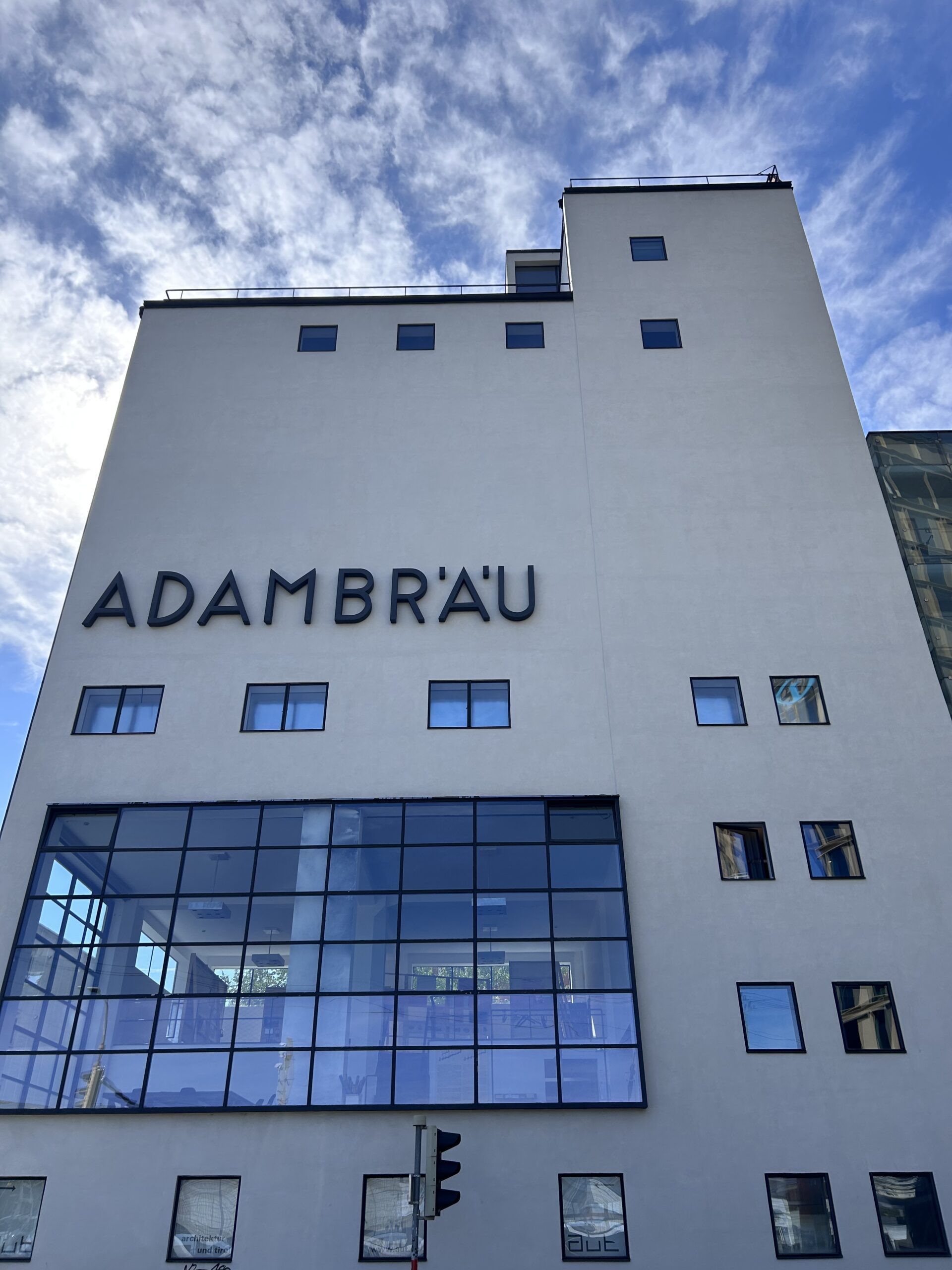
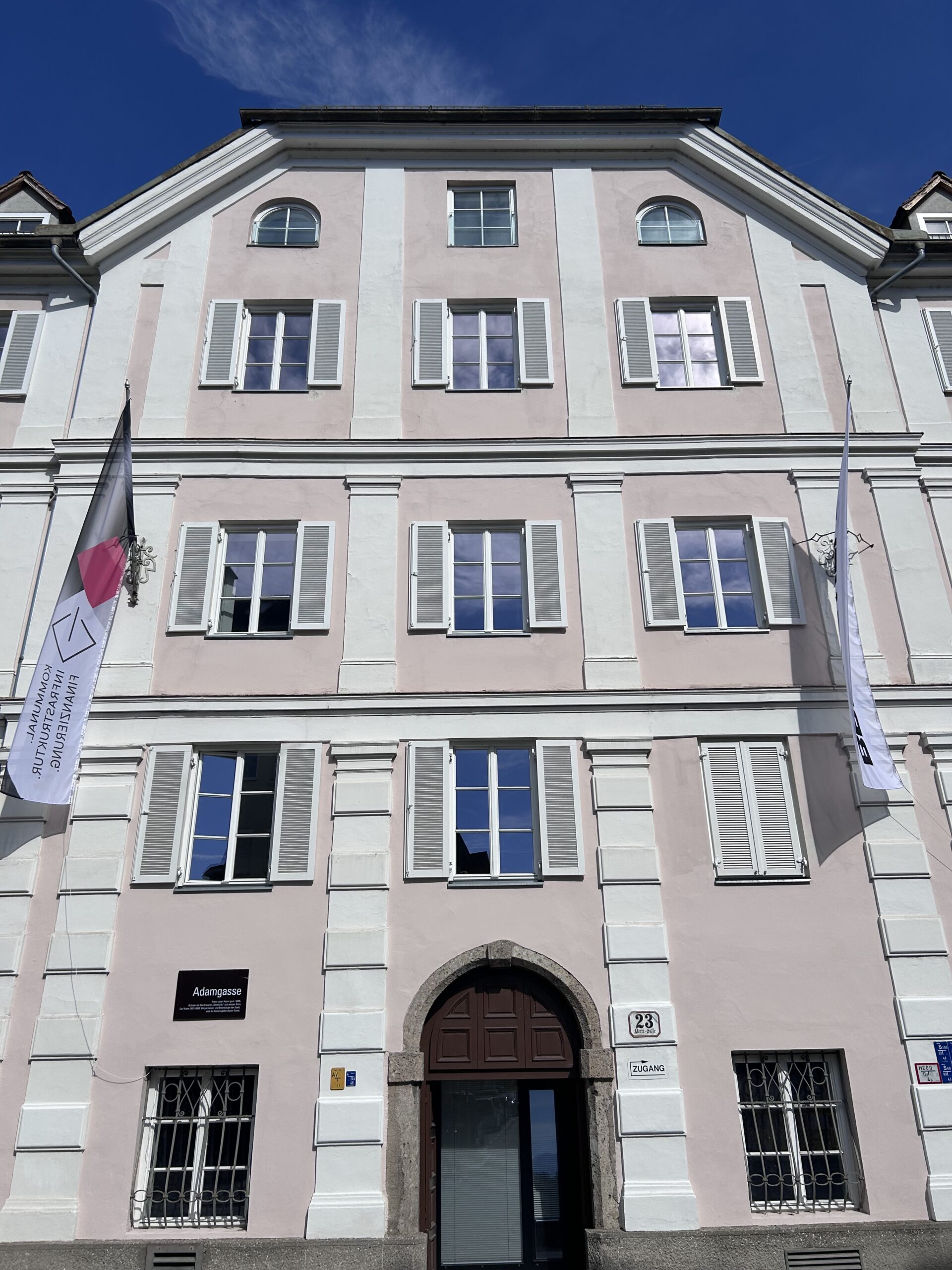
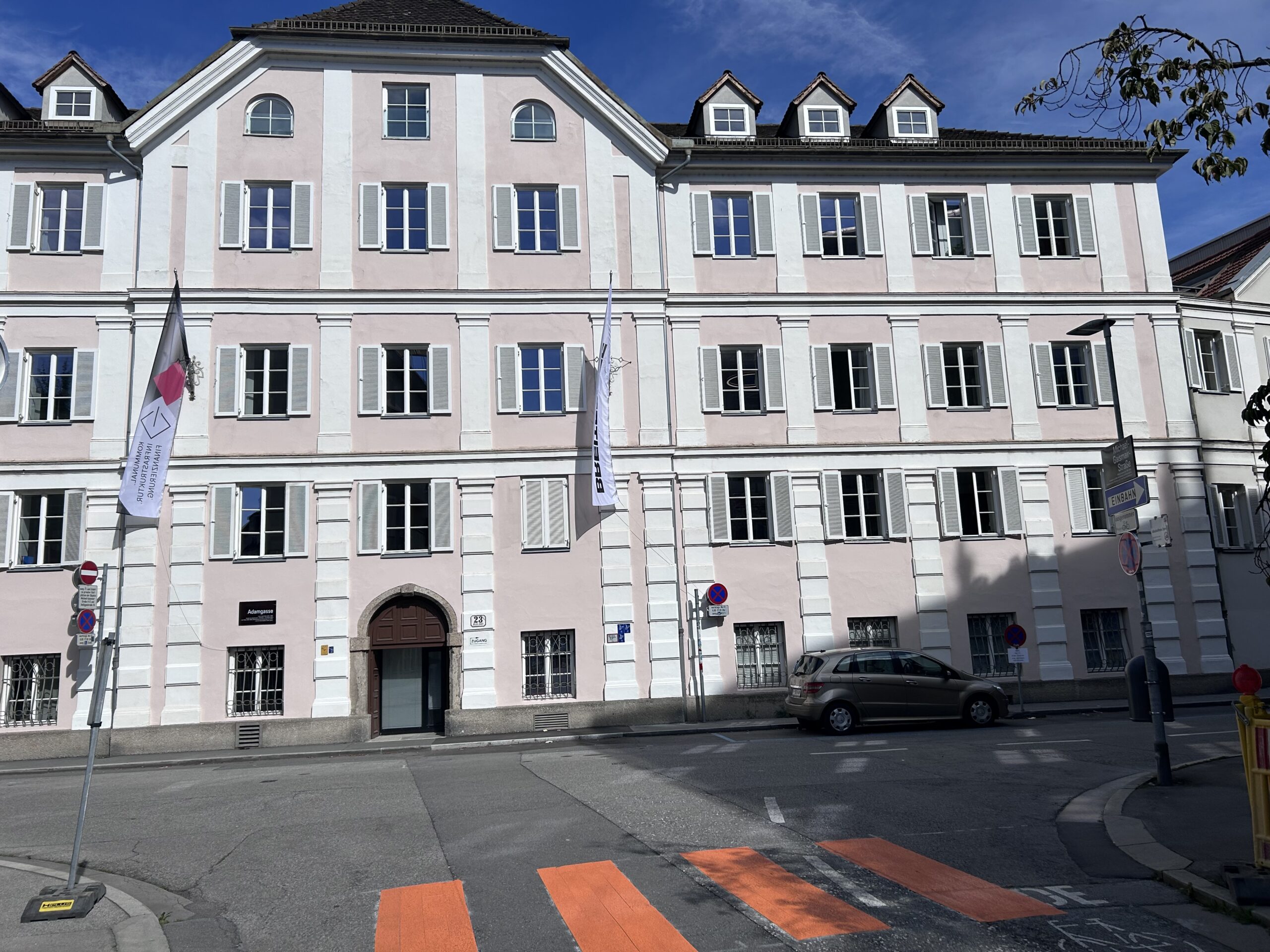
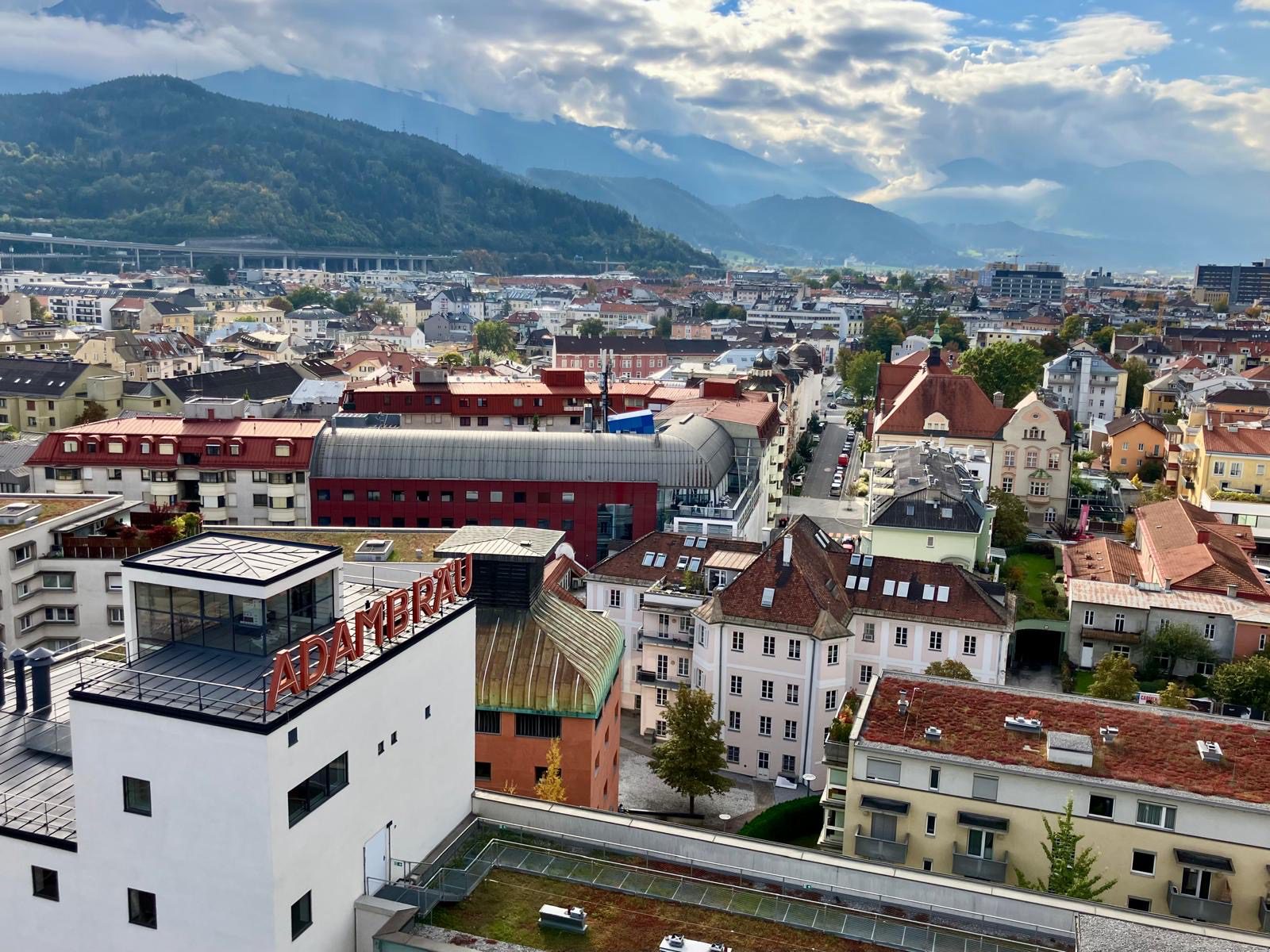
People in Innsbruck born before the 1990s may still nostalgically remember the omnipresent logo of Innsbruck’s Adambräu beer that once adorned countless taps across the city. Until recently, a large mural featuring the iconic Adambräu lettering—showing two men cheerfully clinking glasses—could still be seen on a residential building in Knollerstraße. Unlike today, when any reputable bar offers a fine selection of domestic and international beers, nightlife in earlier days often meant choosing only between Zipfer and Adambräu. The brand has now disappeared from bar counters and supermarket shelves, but parts of the brewery buildings still exist. The story of Adambräu began in Wilten, at the estate of Windegg, better known as Palais Stachelburg. With a Gothic building core dating back to the 15th century, the property was once the residence of the Counts of Stachelburg. Their successors, the Barons of Sternbach, gave the house its Baroque appearance in 1730 and expanded the main building by adding side wings. Anyone with the opportunity to visit can admire the elaborate stucco decorations and the house chapel inside. At least since 1820, spirits were distilled and served in the Stachelburg. In 1825, Franz Josef Adam purchased the estate and opened his brewery and restaurant. A few years earlier, he had moved from Mals in the South Tyrolean Vinschgau to Innsbruck, where he worked as a silk manufacturer and general goods merchant, eventually obtaining full citizenship in the city. Adam redesigned the façade into its present form and added a fourth story. After his death in 1830, his equally enterprising wife Elisabeth took over the business. She also commissioned the construction of the Bretterkeller inn above Wilten Abbey, which still exists today. Their children initiated a long period of frequent ownership changes when they sold the property in 1835. In 1886, the owners Heinrich Jenewein and Hermann Winter—operating as Adambräu Wilten OHG—expanded the Stachelburg with a loggia that served as a salon and stage. A garden pavilion for concerts, in line with the fashion of the time, was also added. The Exl-Bühne theater troupe even performed at Adambräu in its early years. Thanks to high‑quality furnishings, ample beer, music, and theater, the establishment grew into one of the city's most popular venues. Shooting festivals, singing evenings, and club meetings filled both the seats and the coffers of the brewery.
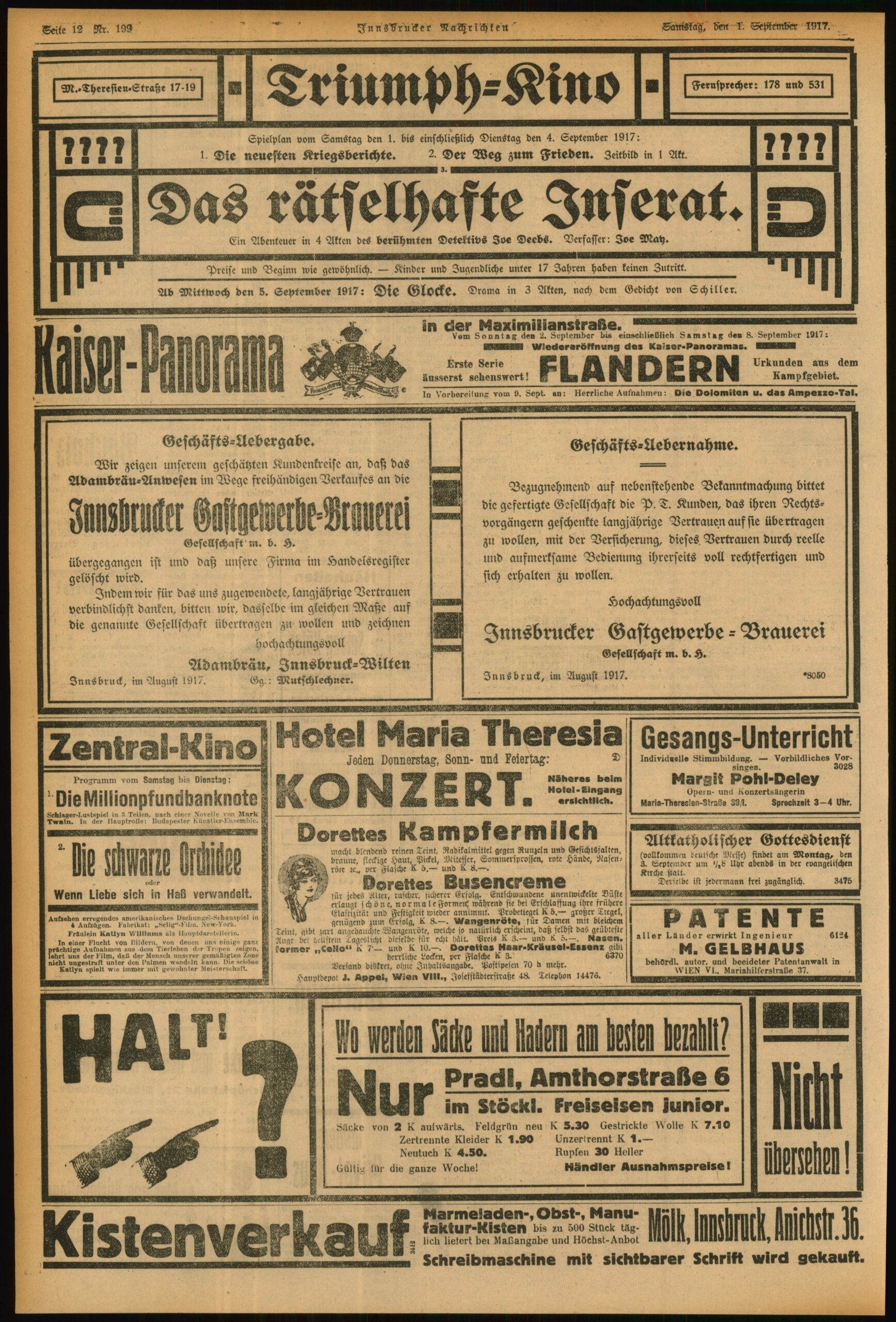
The First World War changed the business dramatically. During the lean years of wartime, consumption in Innsbruck’s restaurants declined sharply. By the end of the war, the brewery’s output had fallen to just 614 hectoliters. In 1917, a cooperative of 20 Innsbruck restaurateurs took over the struggling company as Gastwirtegenossenschaft Adambräu Gesellschaft mbH to secure the city’s beer supply. On 20 February 1918, during the first air raid on Innsbruck, several bombs struck the brewery grounds. The nearby wooden bridge over the Sill canal was hit, and more than 700 windowpanes shattered from the blast. The greatest damage occurred when a direct hit destroyed the cooling house’s irrigation condenser. The leaking ammonia gas led the terrified population to believe they were under a large‑scale gas attack, provoking panic throughout the city.
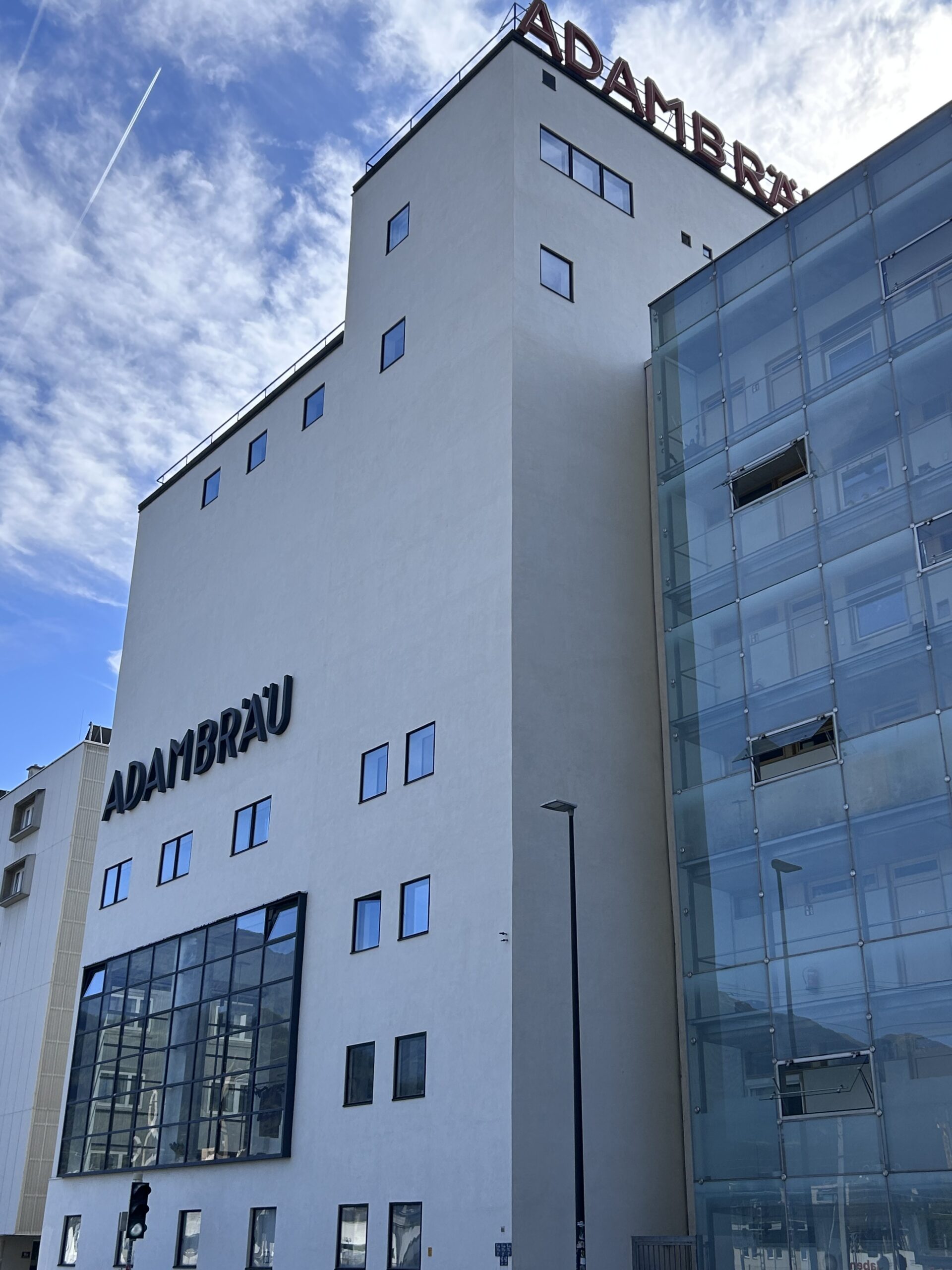
Eight years after the bombing, the most striking and most debated alteration to Innsbruck’s cityscape took place: the reconstruction of Adambräu. Following plans by Lois Welzenbacher, the cooperative had a new brewhouse built in the style of White Tyrolean Modernism. The asymmetrical building—with its sharp, jagged form, smooth white surface, and irregular metal-framed windows—provoked strong reactions. The red cooling house with its industrial crown beside it also stood out prominently. Welzenbacher’s design, together with the administrative building of the Innsbruck Electric Works, was intended to mark a new architectural era beyond historicism and to create a clear contrast between the modern, industrialized city and the old one. While the building’s exterior underwent a dramatic transformation between 1926 and 1931, the brewery itself maintained its traditional focus: supplying Innsbruck’s gastronomy. In the economically booming 1950s, festivities returned with new optimism. Adambräu became one of the most sought‑after venues for balls and celebrations. In the 1960s, now operating under the name Adambräu Gesellschaft m.b.H., the company began selling its beer through retail outlets. In 1994, the Adambräu was taken over by Brauunion, which dominates the Austrian beer market. Although the brand survived for some time, the brewery in Innsbruck eventually ceased production.
Welzenbacher’s modern buildings were placed under historic protection in 1996. The former cooling hall was unfortunately converted into office space without much sensitivity, losing much of its distinctive character. The brewhouse, by contrast, was carefully restored in 2005. Rainer Köberl and his team from aut.architektur und tirol placed great value on preserving the industrial identity of the space, both inside and out. Today, the University of Innsbruck’s Archive for Architecture is housed in the historic brewhouse. True to Welzenbacher’s vision, the renovation embraces form follows function and the unique aesthetics of White Tyrolean Modernism. On the otherwise unremarkable Südbahnstraße, the ADAMBRÄU signage on the façade still recalls the building’s history. In the former Ansitz Windegg, visitors can admire the 15th‑century Gothic vaults while enjoying a game of billiards.
Franz Baumann and Tyrolean modernism
The First World War not only brought states and ruling dynasties to an end; it also marked a turning point for art, music, literature, and architecture. In Innsbruck, a handful of planners transformed the cityscape during the two decades of the First Republic. Inspired by new design movements such as the Bauhaus style from Germany, skyscrapers from the United States, Italian Futurism, and Soviet Modernism from the revolutionary USSR, remarkable architectural projects emerged in Innsbruck. The best-known representatives of the avant-garde who introduced this new approach to shaping public space in Tyrol were Lois Welzenbacher, Siegfried Mazagg, Theodor Prachensky, and Clemens Holzmeister. Each of these architects had distinct characteristics, making the Tyrolean Modern Movement (Tiroler Moderne) difficult to define precisely. Their common feature was a departure from the classical architecture of the pre-war era while retaining typical Alpine materials and architectural elements, following the principle of “Form Follows Function.” In a 1920 article for the magazine Tiroler Hochland, Lois Welzenbacher wrote about the architecture of his time:
"As far as we can judge today, it is clear that the 19th century lacked the strength to create its own distinct style. It is the age of stillness... Thus details were reproduced with historical accuracy, mostly without any particular meaning or purpose, and without a harmonious overall picture that would have arisen from factual or artistic necessity."
The most prominent and visually influential representative of the so-called Tyrolean Modern Movement in Innsbruck was Franz Baumann (1892–1974). Unlike Holzmeister or Welzenbacher, he never received an academic education. Baumann was born in Innsbruck in 1892, the son of a postal official. His religious education teacher, the now controversial theologian and writer Anton Müller, known by the pseudonym Brother Willram, recognized the young Franz Baumann’s talent for drawing and enabled him to attend the Imperial-Royal State Trade School (k.k. Staatsgewerbeschule) at the age of fourteen. There he met his future brother-in-law Theodor Prachensky, who would also play a significant role in his professional life. During his school years, Baumann gained practical experience as a bricklayer with the construction company Huter & Söhne and began producing landscape drawings around Innsbruck together with his sister Maria and Prachensky. In 1910, Baumann followed his friend to Merano to take up employment with the renowned construction firm Musch & Lun. The former Tyrolean capital was then the most important tourist destination in Tyrol, attracting an international clientele of spa visitors. Under Adalbert Erlebach, who would later play a key role in the development of Hungerburg, Baumann gained his first experience in planning large-scale projects such as hotels and cable cars. Important for his later career was not only his technical education but also his first encounters with the Tyrolean Heritage Protection Association (Tiroler Heimatschutzverband). Kunibert Zimmeter had founded this organization together with Gotthard Graf Trapp. Since building regulations were a provincial matter, the Tyrolean Heritage Protection Association, together with the district authorities, acted as the final authority responsible for evaluating and approving construction projects. In many Tyrolean villages, hotels had replaced churches as the largest buildings in the local skyline. The aim was to prevent tourism and industrial developments from overwhelming traditional village character. In Our Tyrol: A Homeland Protection Book, Zimmeter wrote:
"Let us look at the flattening of our private lives, our amusements, at the centre of which, significantly, is the cinema, at the literary ephemera of our newspaper reading, at the hopeless and costly excesses of fashion in the field of women's clothing, let us take a look at our homes with the miserable factory furniture and all the dreadful products of our so-called gallantry goods industry, Things that thousands of people work to produce, creating worthless bric-a-brac in the process, or let us look at our apartment blocks and villas with their cement façades simulating palaces, countless superfluous towers and gables, our hotels with their pompous façades, what a waste of the people's wealth, what an abundance of tastelessness we must find there."
After four years, Baumann’s career was abruptly interrupted. Like most of his generation, the First World War tore him away from both work and everyday life. While serving on the Italian Front, he suffered a gunshot wound to the abdomen and recovered in a military hospital in Prague. During this otherwise inactive period, he painted cityscapes depicting buildings in and around Prague. These urban views, which later helped him visualize architectural designs, were exhibited at his only exhibition in 1919. His breakthrough in construction came the following year. Baumann unexpectedly won the competitions for the renovation of the Weinhaus Happ in Innsbruck’s Old Town and for the Nordkette Cable Railway. Besides his creativity, his success stemmed from the alignment between his architectural philosophy and the requirements of both the Tyrolean Heritage Protection Association and the public tenders issued by the young First Republic. In the economic upswing of the late 1920s, a new class of customers and visitors emerged in tourism. The aristocratic distance toward the mountains had given way to a middle-class enthusiasm for sports. No longer were grand hotels built at elevations of 1,500 meters for health resorts; instead, functional infrastructure for skiers in high alpine terrain, such as on the Nordkette, was constructed. Buildings were expected to blend harmoniously into their surroundings while remaining attractive and practical. Despite the social and artistic innovations of the era, architects still had to take regional character into account. This was precisely where Baumann’s approach to holistic building in a Tyrolean context excelled. From exterior lighting to furniture, Baumann designed even the smallest details and integrated them into his overall concept of the Tyrolean Modern Movement. Every technical function and detail, as well as environmental conditions, topography, and sunlight, played a role for him. Although he was officially not permitted to use the professional title of architect, he followed the principles outlined by architect Adolf Loos (1870–1933) in his essay Rules for the Person Building in the Mountains:
Don't build picturesquely. Leave such effects to the walls, the mountains and the sun. The man who dresses picturesquely is not picturesque, but a buffoon. The farmer does not dress picturesquely. But he is...
Pay attention to the forms in which the farmer builds. For they are ancestral wisdom, congealed substance. But seek out the reason for the mould. If advances in technology have made it possible to improve the mould, then this improvement should always be used. The flail will be replaced by the threshing machine."
Beginning in 1927, Baumann operated his own studio on Schöpfstraße in the Wilten district. At the height of its success, his office employed fourteen staff members. Time and again, his professional path crossed with that of his friend and brother-in-law Theodor Prachensky. Together, beginning in 1929, they planned the new secondary school in Hötting on Fürstenweg. Although separate wings for boys and girls still had to be included according to contemporary conventions, the building otherwise fully embodied the style of New Objectivity (Neue Sachlichkeit) and the principle of “Light, Air, and Sun.” Thanks to his modern approach, which combined functionality, aesthetics, tradition, and economical construction, Baumann weathered the economic crisis that began in the late 1920s relatively well. It was only the 1,000-Mark Blockade, imposed by Hitler on Austria in 1933 in an attempt to place financial pressure on the Republic, that caused serious problems for his architectural practice. Not only did unemployment in the tourism sector triple within a short period of time, but the construction industry also entered a severe downturn. In 1935, Baumann became head of the Central Association of Architects, after receiving a special exemption allowing him to use the professional title of architect despite lacking a formal academic qualification. With Austria’s annexation by Germany in 1938, he quickly joined the National Socialist German Workers’ Party (NSDAP). On the one hand, like his colleague Lois Welzenbacher, he may have been sympathetic to certain ideas of National Socialism. On the other hand, membership enabled him to advance his career as chairman of the Reich Chamber of Fine Arts in Tyrol. In this position, however, he repeatedly opposed the radical alterations to Innsbruck’s cityscape that the Nazi authorities wished to implement. Innsbruck’s mayor, Egon Denz, wanted the Triumphal Arch and St. Anne’s Column removed in order to create more space for traffic in Maria-Theresien-Straße. At that time, the city center still served as the principal traffic route connecting the Brenner Pass in the south with the federal highway leading east and west along what is now the Innrain. A statue of Adolf Hitler was intended to replace St. Anne’s Column. Gauleiter Franz Hofer also planned to have the towers of the Court Church blown up. In his official capacity, Baumann assessed both projects negatively. When the matter eventually reached the desk of Albert Speer, Speer agreed with Baumann’s assessment. From that point onward, Gauleiter Hofer no longer awarded Baumann any public projects. However, this courageous stance probably spared him more serious consequences after the war. After being questioned during the denazification process following the war, Baumann began working in the municipal building department, likely also on the recommendation of his brother-in-law Theodor Prachensky. Although Baumann was fully exonerated, partly due to testimony from the abbot of Wilten, whose church towers he had helped save, his reputation as an architect could no longer be fully restored. Another setback was the destruction of his studio on Schöpfstraße, which was hit by a bomb in 1944. In his postwar career, Baumann became responsible for the restoration of buildings damaged during the war. Under his supervision, the Boznerplatz and its Rudolf Fountain were rebuilt, while the Burggraben area and the New City Halls (Neue Stadtsäle) behind the Tyrolean State Theatre were redesigned. Franz Baumann died in 1974. Today, his paintings, sketches, and drawings are highly sought after and command substantial prices on the art market. Anyone who carefully examines more recent large-scale projects in Innsbruck, such as the City Library, the PEMA Towers, and many of the city’s residential developments, can still recognize elements of the Tyrolean Modern Movement today.
Theatres, country stages, cinemas & Kuno
The Tyrolean State Theatre, opposite the Imperial Palace, remains to this day the most striking monument to the city's educated middle-class evening entertainment. Since its existence began, however, this house of high culture has, for the most part, led a rather dreary existence when it comes to audience numbers. From Baroque plays centered on the suffering of Christ in the 16th century to daring productions nearly 500 years later that were often rewarded with little applause by audiences, activity at the State Theatre has always been the passion of a small elite. The majority of Innsbruck’s inhabitants, by contrast, spent their leisure time with more down-to-earth amusements. Travelling performers had already been welcome guests during the Middle Ages, although only under certain conditions. Just as today, public performances in earlier times were subject to strict censorship. What age restrictions for cinema films are today were once limitations placed on performances deemed displeasing to God, extending even to complete bans on theatre and acting under particularly devout provincial rulers. As society became increasingly bourgeois and moral attitudes more enlightened, these rules gradually became less restrictive. This marked the beginning of the institutionalization of theatre. According to its own records, the Pradl Farmers’ Theatre (Pradler Bauerntheater), the oldest folk theatre group in Innsbruck that still exists as an institution today, was founded in 1762. Although its first venue was an open-air stage in the Hötting meadows, and although craftsmen and students as well as farmers were part of the ensemble, this should not diminish either the honour of its name or its origins. While performances at the State Theatre were often staged before half-empty audiences, the amateur actors of the farmers’ theatre enjoyed great popularity with their comedies. Innsbruck residents of all social classes made weekend pilgrimages from the city to performance venues in the surrounding villages or enjoyed the evening entertainment in local inns. Especially popular were the so-called knights’ plays, featuring abducted princesses, heroic rescuers, and clumsy villains. Unlike the serious productions presented in bourgeois theatre, the performers of the farmers’ theatres interacted directly with the audience. Interjections from the spectators were not suppressed but spontaneously incorporated into the play. It could even happen that the audience, not always entirely sober, physically intervened in the action of the performance. In 1870, the Pradl Farmers’ Theatre moved into a hay barn at the Lodron Estate (Lodronischer Hof) on Egerdachstraße that had been converted into a stage. In 1898, the company even toured Vienna. By that time, Innsbruck already possessed a whole range of theatres and venues that entertained audiences with plays and music. In 1892, the Löwenhaus Stage (Löwenhaus-Bühne) opened on Rennweg, on the site where the Tyrolean regional ORF broadcasting centre is located today. The wooden building burned down in the late 1950s, just as state broadcasting was beginning its rise.
From the large number of theatre troupes, one particularly ambitious showman emerged. Ferdinand Exl (1875–1942) broke new ground with part of the Pradl Farmers’ Theatre (Pradler Bauerntheater). For a long time, the accepted wisdom had been: "Anyone who wants to go to a farmers’ theatre will not find what they are looking for in the theatre, and anyone who seeks not merely entertainment but literary inspiration in the theatre does not go to a farmers’ theatre." Exl recognized the trend of the times. Clerks and workers could not afford the exorbitant ticket prices of the State Theatre, nor did they wish to sit through lengthy Wagner operas or plays such as The Sorrows of Young Werther. Nevertheless, audiences did expect a certain level of quality in both content and performance. With the so-called literary folk plays by renowned local authors such as Ludwig Anzengruber, Franz Kranewitter, and Karl Schönherr, Exl succeeded in combining entertainment with artistic quality. Anzengruber summarized this development as follows:
Anzengruber's Tyroleans not only sing Schnaderhüpfel, platteln d'Schuh, swear like Croats and scuffle, but they are also people with a subtle psyche who have their own thoughts about various problems and develop their own philosophy.
The first play staged by Exl, The Priest of Kirchfeld (Der Pfarrer von Kirchfeld) by Ludwig Anzengruber, was performed in 1902 at the Österreichischer Hof in Wilten. In 1903, the Exl Stage (Exl Bühne) moved to the Adambräu brewery in Adamgasse. From 1904 to 1915, audience favourites such as Franz Kranewitter’s plays Michael Gaismair and Andre Hofer were performed at the Löwenhaus near the Court Garden (Hofgarten). In addition to theatrical productions, tourists were offered traditional Tyrolean entertainment, including zither performances and “genuine, lively Tyrolean Schuhplattler dancing.” In 1904, the company embarked on its first international tour, travelling to Switzerland and Germany. Both the press and audiences were enthusiastic about the nationalist-leaning plays, performed by sturdy Tyrolean young men and attractive young women. In 1910, Exl finally abandoned amateur status and, in addition to long-serving members of his own family and the Auer family, increasingly hired townspeople and professional actors. The First World War and the resulting travel restrictions put a stop to further touring activities. The troupe became part of the Innsbruck Municipal Theatre (Innsbrucker Stadttheater), whose audiences, during those difficult years, were also receptive to lighter entertainment. After the most difficult post-war years had passed, the company’s fortunes improved once again. Beginning in 1924, the Exl Stage performed regularly not only at the Municipal Theatre during the winter season but also at Vienna’s Raimund Theatre and the Vienna Comedy House (Wiener Komödienhaus). The political developments of the 1930s greatly benefited the German nationalist spirit that permeated many of the plays Exl brought to the stage. Exl had already joined the National Socialist German Workers’ Party (NSDAP), which was banned in Austria at the time, in 1933. Although Austria’s Christian Social corporative state prohibited the excessively German-nationalist troupe from performing, they received an even more enthusiastic reception during their tours in National Socialist Germany. In 1935, the Exl Stage performed Karl Schönherr’s play Faith and Homeland (Glaube und Heimat) in Berlin. The Berliner Morgenpost of 4 April 1935 described it as: “...art that flows from the depths of German folk culture and returns to the hearts of moved and grateful listeners.” Following Austria’s annexation by Nazi Germany in 1938 (Anschluss), Exl once again enjoyed favourable media attention in his homeland and was celebrated as: “...a counterweight to the completely Judaized, artistically Bolshevized theatre establishment...” In 1942, the founder of the Exl Stage passed away. His wife and son took over the company and, after the war, became part of the Tyrolean State Theatre. During the 1950s, the troupe enjoyed one final successful tour through both West and East Germany before the theatre company was dissolved in 1956.
Times had changed. Cinema killed the theatre star. Motion pictures shown in cinemas began to compete with the stage. Ferdinand Exl had foreseen this development early on. In 1912, his ensemble appeared in the French film Speckbacher, which portrayed the Tyrolean Uprising in a heroic light. The first motion picture had already flickered across a screen in Innsbruck’s Stadtsaal in 1896, only one year after the world’s first public film screenings, before a fascinated audience. Cinema quickly became part of everyday life for many people. In addition to silent films, audiences were shown newsreels that were considered politically desirable, especially during wartime and often served propagandistic purposes. In the following decades, cinemas sprang up like mushrooms. In 1909, a movie theatre opened at Maria-Theresien-Straße 10 and later moved to Maria-Theresien-Straße 37, where it became known as the Zentral. After the war it was transformed into a Nonstop Cinema, where visitors bought a ticket for a continuous programme of newsreels, cartoons, advertisements, and feature films that repeated in an endless cycle. In 1928, the Innsbruck Red Cross opened the Kammer-Lichtspiele cinema in Wilhelm-Greil-Straße in order to finance its new association headquarters. At Maria-Theresien-Straße 17 stood the Triumph, which survived under the name Central until the 1990s. The site now occupied by the youth centre Z6 was once home to the Forum Cinema. In 1933, the Löwenkino opened in Höttinger Gasse. In 1959, it moved as the Metropol into the protected historic Malfatti House opposite the Inn Bridge, where it still exists today. During the final phase of the Second World War, Innsbruck’s largest cinema auditorium opened its doors with the Laurin-Lichtspiele, located in the middle of the South Tyrolean settlement on Gumppstraße. Robert and Walter Kinigadner, two South Tyrolean optants who had already gained experience in the cinema business in Brixen (Bressanone), took over operations of the hall, which could seat 800 viewers. Harmless homeland films alternated with National Socialist propaganda productions. The Exl Stage also used the Laurin, which served as a theatre venue until the 1970s, for theatrical performances. Today, a supermarket occupies the space behind the columns of what was once the building’s grand entrance. Above the checkout area, visitors can still see murals depicting the legend of the mythical dwarf king Laurin and the Germanic hero Dietrich von Bern, executed in the characteristic style of National Socialist art. In 1958, the Leokino opened in the premises of the former Catholic Workers’ Association (Katholischer Arbeiterverein). It remains in operation to this day and is a permanent fixture of Innsbruck’s film scene. At their peak in 1958, Innsbruck’s cinemas recorded an astonishing 3.5 million tickets sold. The most popular films were homeland movies and light-hearted comedies such as Sissi starring Romy Schneider and The White Horse Inn (Im Weißen Rössl) starring Peter Alexander. In the 1970s, cinema also assumed a role in public enlightenment when bare breasts first appeared on the screen. Films such as Schoolgirl Report (Schulmädchen-Report) and Josefine Mutzenbacher brought the sexual revolution a little closer to the people of Tyrol as well.
These moral transgressions came at a time when cinema had already begun to pass the peak of its economic success. The television set in the living room was starting to provide both information and evening entertainment. When the Austrian Broadcasting Corporation (Österreichischer Rundfunk, ORF) began operations in 1955, hardly anyone yet owned a television set capable of receiving its rather limited programming. That was to change quickly. The audience figures achieved during the post-war period have never been surpassed. From the long list of cinemas that once existed, only a trio remains. The Metropol, housed in the historic Malfatti House (Malfattihaus), attracts audiences with blockbuster films, while the Cinematograph and the Leokino cater to a more alternative crowd. Every August, an open-air cinema takes place at the Zeughaus (the former armoury). Of the many folk theatres, the Pradl troupe has survived to this day, albeit under a new name. In 1958, they found a new home at the cultural inn Bierstindl. The amateur troupe Innsbrucker Ritterspiele (Innsbruck Knights’ Plays) continues to enjoy immense popularity and regularly performs to full houses. The play The Villainous Kuno of Drachenfels (Der Schurkische Kuno von Drachenfels) revives the traditions of past centuries every year, complete with the repeated beheading scene and humorous interaction with the audience. The Landhaus Alpenheim in the Saggen district, now better known as Villa Exl, where the Exl family once lived, is a notable example of Tyrolean vernacular architecture. It features murals by Raphael Thaler and is well worth a visit. Ferdinand Exl is also commemorated by a street bearing his name in the Höttinger Au district. The times had changed. Folk theatre, once a central form of popular entertainment, had to compete first with cinema and later with television. Yet despite these transformations, elements of Innsbruck’s theatrical tradition have endured. While the grand touring companies and the multitude of cinemas have largely disappeared, institutions such as the Leokino, the Metropol, and the successors of the Pradl Farmers’ Theatre continue to preserve and reinterpret a cultural heritage that stretches back centuries.
The First World War
An Innsbruck student nearly changed the course of world history instead of Gavrilo Princip. In 1913, the young man boasted to a waitress about his plans to shoot the heir to the throne, but he was arrested before he could carry them out. Only when the world-changing shots were actually fired in Sarajevo a year later did an article appear in the Innsbrucker Nachrichten on June 30 about the events. The consequences that the First World War, which subsequently broke out, would have for the world and for people's everyday lives could not yet be foreseen after the assassination of Franz Ferdinand on June 28. Two days after the murder of the Habsburg heir in Sarajevo, readers in Innsbruck were already reading prophetic words in their newspaper: “We have arrived at a turning point – perhaps the turning point – in the destiny of this empire.” In Innsbruck, too, enthusiasm for war was widespread in 1914. Driven by the slogan of the time, “God, Emperor, and Fatherland,” the vast majority of people unanimously welcomed the attack on Serbia. Politicians, the clergy, and the press fuelled the general jubilation. Particularly “deserving” in promoting the war were the two theologians Joseph Seeber (1856–1919) and Anton Müllner, known as Brother Willram (1870–1919), who, through their sermons and writings such as The Bloody Year, elevated the war into a crusade against France and Italy. In addition to the imperial proclamation To My Peoples, which appeared throughout the media of the Empire, the Innsbrucker Nachrichten published an article on July 29, the day after Austria-Hungary declared war on Serbia, about Prince Eugene's capture of Belgrade in 1717. The tone in the media was celebratory, although not entirely without dark forebodings of what was to come.
"The Emperor's appeal to his people will be deeply felt. The internal strife has been silenced and the speculations of our enemies about unrest and similar things have been miserably put to shame. Above all, the Germans stand by the Emperor and the Empire in their old and well-tried loyalty: this time, too, they are ready to stand up for dynasty and fatherland with their blood. We are facing difficult days; no one can even guess what fate will bring us, what it will bring to Europe, what it will bring to the world. We can only trust with our old Emperor in our strength and in God and cherish the confidence that, if we find unity and stick together, we must be granted victory, for we did not want war and our cause is that of justice!"
Many Innsbruck residents volunteered for the campaign against Serbia, which was believed to be a matter of only a few weeks or months. So many volunteers poured into Innsbruck from outside the city to report to the recruitment commissions that the city was almost bursting at the seams. No one could imagine how differently things would turn out. After the first battles in distant Galicia, it became clear that this would not be over within a few months. The Imperial Riflemen (Kaiserjäger) and other Tyrolean troops were effectively sacrificed. Poor equipment, inadequate supplies, and the catastrophic leadership of the High Command under Conrad von Hötzendorf led thousands either to their deaths or into captivity, where hunger, abuse, and forced labour awaited them. In 1915, Italy entered the war on the side of France and Britain. Under the infamous secret Treaty of London, the young kingdom had been promised generous territorial gains in return for supporting the Entente against Germany and Austria. On May 23, the former ally declared war on the Habsburg Empire. Until regular troops could be transferred from the Eastern Front, regional defence depended on the Standschützen, a force consisting of men under 21, over 42, or those deemed unfit for regular military service. Correspondingly, casualties were high. Fighting in the mountain war stretched from the Ortler in the west across the northern shore of Lake Garda to the Sexten Dolomites. Innsbruck itself was not directly affected by military operations. At the very least, however, the sounds of war could be heard in the provincial capital, as reported in the newspaper of July 7, 1915:
“Soon after the Italians commenced hostilities, cannon fire could clearly be heard in the region of the Serles peak, coming from one of the battlefields in southern Tyrol, probably the Vielgereut plateau. In recent days, the sound of artillery fire has also undoubtedly been detected in Innsbruck itself and in the northeastern parts of the city — individual powerful blasts, dull rather than rolling and resonant, echoing across the Brenner Pass. There can be no mistake. In Innsbruck itself, the thunder of the guns is more difficult to detect because of the noise of the city, but on one occasion, around 9 p.m., when there was some degree of quiet, this unmistakable thunder, originating from our mortars, was clearly heard.”
Although the front was far away, the war increasingly penetrated civilian life. This total involvement of society in warfare was a new phenomenon. The mass mobilization of a large proportion of the working male population brought many businesses to a complete standstill. Shop shelves remained empty, public transport services ceased, and craftsmen and labourers were called up for military service. Companies still able to operate were subordinated to the wartime economy. By the “Hunger Winter” of 1917, Innsbruck’s economy had almost completely collapsed. Food, coal, and firewood were in short supply, and hunger and cold became bitter enemies of women, children, the wounded, and those unfit for military service. During the final years of the war, provisions were distributed through ration cards. The basic weekly allowance per person amounted to 500 grams of meat, 60 grams of butter, and 2 kilograms of potatoes. Archive photographs show long queues of desperate and hungry people outside food shops. Protests and strikes repeatedly broke out. Politicians, trade unionists, workers, and returning soldiers saw an opportunity for change. Under the slogan “Peace, Bread, and Suffrage,” parties of many different political backgrounds united in opposition to the war. The cityscape also changed. Barracks were erected in Höttinger Au to house prisoners of war. Wounded soldiers arrived in such large numbers that civilian buildings, including the university library then under construction and Ambras Castle, were converted into military hospitals. A predecessor of today’s Tram Line 3 was established to transport the wounded from the railway station to the new garrison hospital, today’s Conrad Barracks in Pradl. To cope with the large number of fallen soldiers, the Pradl Military Cemetery was created.
As the war neared its end, the front also drew closer. In February 1918, the Italian air force succeeded in dropping three bombs on Innsbruck. The Neue Freie Presse reported for the first time on the secret Treaty of London, heightening Tyrolean anxiety over the threatened loss of territory south of the Brenner Pass. By then, most people already knew the war was lost and sensed the fate that awaited Tyrol, as this article of October 6, 1918, demonstrates:
“External and internal enemies are gambling today with the land of Andreas Hofer. The latest throw of the dice is even more cruel; never before has a free land been bartered away so disgracefully. The blood of our fathers, sons, and brothers has been shed in vain if this shameful plan becomes reality. The final throw has not yet been made. Therefore, Tyroleans, attend the Tyrolean People’s Assembly in Brixen on October 13, 1918 (next Sunday). German soil must remain German; Tyrolean soil must remain Tyrolean. Tyroleans, decide your own future!”
On November 4, Austria-Hungary and the Kingdom of Italy finally agreed to an armistice. Part of the agreement granted Italy the right to occupy territory of the monarchy. Alarm bells immediately rang among Austria-Hungary’s allies in the German Empire. On the very next day, Bavarian troops entered Innsbruck. Germany was still at war with Italy and feared that the front might shift into North Tyrol, bringing it closer to German territory. Fortunately for Innsbruck and the surrounding region, Germany also capitulated one week later on November 11. As a result, major military engagements between regular armies were avoided.
Nevertheless, Innsbruck remained in danger. Massive convoys of military vehicles, trains packed with soldiers, and thousands of exhausted troops making their way home on foot passed through the city. Anyone who could jumped onto overcrowded trains or military vehicles to leave the front behind and return home. In November 1918 alone, more than 270 soldiers lost their lives during these reckless attempts or had to be admitted to one of the city’s hospitals. The city not only had to maintain order among its own citizens and ensure food supplies but also protect itself against looting. To preserve public order, the Tyrolean National Council established a citizens’ militia on November 5 composed of pupils, students, workers, and ordinary citizens. On November 23, 1918, Italian troops occupied the city and its surroundings. More than 80,000 Italian soldiers were stationed in Tyrol, around 5,000 of whom required accommodation in the starving and destitute city. Schools were turned into barracks. Mayor Greil’s conciliatory appeal to surrender the city peacefully succeeded. There were isolated disturbances, food riots, and incidents of looting, but there were no armed clashes with the occupation troops and no Bolshevik revolution such as the one that occurred in Munich.
The consequences of the First World War for Innsbruck’s population were devastating. More than 1,200 people lost their lives on battlefields or in military hospitals, while approximately 600 were wounded. Memorials to the First World War and its victims can be found throughout Innsbruck, particularly at churches and cemeteries. The Kaiserjäger Museum on Bergisel displays uniforms, weapons, and photographs from the war. The theologians Anton Müllner and Josef Seeber have streets named after them in Innsbruck. A street was also named after Archduke Eugene, commander-in-chief of the Austro-Hungarian Army on the Southern Front. A monument to the unsuccessful military leader stands in front of the Hofgarten. The eastern section of the Amras Military Cemetery commemorates the Italian occupation.
Innsbruck's industrial revolutions
Innsbruck has always seen itself primarily as a city of trade, tourism, and academia. In reality, however, manufacturing and productive industries have played a significant role in its history. As early as the fifteenth century, a proto‑industrial form of production began to emerge from traditional crafts. Metalworking flourished in the booming residential city, driven by the construction boom and the demand for weapons and armour. A combination of factors made this possible: the city’s favourable transport connections, the availability of water power, Innsbruck’s political rise, the craftsmanship of its artisans, and access to capital under Maximilian all contributed to the development of necessary infrastructure. Bell founders and armaments manufacturers such as the Löffler family established workshops in Hötting, Mühlau, and Dreiheiligen that ranked among the leading enterprises of their time in Europe. Along the Sill Canal, mills and workshops harnessed water power as an energy source. Powder mills and silver smelting works were located in Silbergasse, today’s Universitätsstraße. In what is now Adamgasse, close to the city, a munitions factory once stood, which exploded in 1636.
The wealth generated by metalworking stimulated other sectors of the economy. By the early seventeenth century, around 270 businesses were operating in Innsbruck, providing employment for masters, journeymen, and apprentices. Although most of the population was still engaged in administration, trade and craft industries—and the money they generated—began to attract a new social stratum. This led to a redistribution within the city. Citizens and businesses gradually displaced officials and members of the aristocracy from the Neustadt. Many of the Baroque palazzi that now line Maria‑Theresien‑Straße were built during this period, while districts such as Dreiheiligen and St. Nikolaus developed into industrial and working‑class quarters. In addition to metalworking in the Silbergasse area, tanners, carpenters, wagon makers, builders, stonemasons, and other crafts associated with early industrialisation settled here.
Industrial development reshaped not only the social structure through the influx of new workers and their families, but also the physical appearance of Innsbruck. Workers, unlike peasants, were not subjects bound to a feudal lord, even if they remained subordinate to the strict authority of their employers. Entrepreneurs were not of noble birth, yet often possessed greater financial resources than the aristocracy. Traditional hierarchies still existed but began to show signs of strain. The new bourgeoisie introduced new fashions and dressed differently. Capital from outside flowed into the city. Housing and churches were built for the incoming population. The working‑class districts outside the city walls were viewed with suspicion by long‑time residents, not least because overcrowded conditions were believed to foster outbreaks of plague. Large workshops altered both the smell and soundscape of the city. Industrial sites were noisy, and smoke from furnaces polluted the air. Innsbruck had evolved from a small settlement at the Inn Bridge into a proto‑industrial town.
Growth was interrupted for several decades at the end of the eighteenth century by the Napoleonic Wars. Compared to other parts of Europe, the second wave of industrialisation arrived relatively late in Innsbruck. One reason was the delayed development of a functioning banking system. For devout Catholics, bankers were still regarded as “usurers and moneylenders,” and financial dealings were considered morally questionable. Without access to credit, however, large enterprises could not be established. Although the Tyrolean provincial government had founded the Banko as early as 1715 and a private bank operated in Herzog‑Friedrich‑Straße, it was only with the establishment of a branch of the savings bank that people no longer had to keep their money hidden at home. From around 1850 onwards, credit became available, enabling the creation of larger local enterprises. Traditional crafts—both urban guild-based workshops and seasonal rural production—came under pressure from modern industrial manufacturing. Modern factories emerged in St. Nikolaus, Wilten, Mühlau, and Pradl along the Mühlbach and Sill Canal. Many innovative entrepreneurs came from outside Innsbruck. In what is now Innstraße 23, Peter Walde, who had moved from Lusatia to Innsbruck, founded a business in 1777 producing goods derived from fats, such as tallow candles and soap. Eight generations later, Walde remains one of Austria’s oldest family businesses, and its historic headquarters—with its Gothic vaulted ceilings—still sells soaps and candles today. Franz Josef Adam, originally from the Vinschgau, established what became the city’s largest brewery in a former aristocratic residence. In 1838, the spinning machine arrived in Pradl via the Dornbirn firm Herrburger & Rhomberg, bringing textile production into the region. The company had acquired land along the Sill floodplain, where water power provided ideal conditions for operating heavy machinery. Alongside wool, cotton was now also processed.
As 400 years earlier, the Second Industrial Revolution fundamentally transformed both the city and the daily lives of its inhabitants. Districts such as Mühlau, Pradl, and Wilten expanded rapidly. Factories were often located directly within residential areas. Around 1900, more than twenty enterprises were still using the Sill Canal. The Haidmühle in Salurnerstraße operated from 1315 to 1907. A textile factory in Dreiheiligenstraße was also powered by the canal. Noise and emissions from machinery placed heavy burdens on residents, as described in a newspaper article from 1912:
“The installation of an explosion engine in the Hibler fig‑coffee factory near the main railway station has caused outrage among the residents of the surrounding district. The noise produced by this machine throughout most of the day is extremely disturbing and diminishes the value of nearby dwellings. The once highly sought-after garden rooms in hotels on Bahnhofplatz are now scarcely rentable. Even worse than the noise, however, is the smoke and stench produced by the new machine…”
Aristocrats who had relied too long on inherited wealth were increasingly forced to sell their estates to the rising bourgeoisie. For example, Palais Sarnthein—originally built in 1689—was later used by a weapons manufacturer and merchant, Johann Peterlongo. Some members of the aristocracy adapted successfully, investing their resources in industrial ventures. The growing demand for labour was met by former farmhands and landless peasants. While wealthy entrepreneurs built villas in Wilten, Pradl, and Saggen, and middle-class employees occupied urban housing, workers were often accommodated in dormitories or mass housing. Twelve-hour shifts in cramped, noisy, and polluted conditions placed heavy demands on labourers. Child labour was not restricted until the 1840s, and women earned only a fraction of men’s wages. Workers were often dependent on company-owned housing and lacked legal protections. Social security systems did not yet exist; those unable to work depended on charitable support from their home communities. It should be noted that these harsh conditions were not entirely new but evolved from rural life, where inequality, child labour, and precarious work had been common.
However, industrialisation did not only affect everyday material life. Innsbruck experienced the kind of gentrification that can be observed today in trendy urban neighbourhoods such as Prenzlauer Berg in Berlin. The change from the rural life of the village to the city involved more than just a change of location. In one of his texts, the Innsbruck writer Josef Leitgeb tells us how people experienced the urbanisation of what was once a rural area:
“…a great many strangers, poorly dressed, crowded into growing housing blocks, filling the streets morning, noon, and evening as they went to and from work… faces pale and prematurely aged, lacking individuality in posture, speech, and clothing—no longer individuals, but a uniform, endlessly repeatable urban working class… The railway station and the gasworks seemed to be the core of this new and profoundly alien landscape.”
After 1848, many Innsbruck residents experienced a process of “bourgeoisification.” Stories of upward mobility through diligence, talent, and opportunity became more common. Notable examples still in existence include the Tyrolean glass painting workshop, the Hörtnagl food business, and the Walde soap factory. Successful entrepreneurs came to occupy roles once held by the landed nobility, forming вместе with academics a new influential social class. Even workers experienced a degree of bourgeois emancipation. Unlike peasants bound to feudal lords, they now received wages instead of subsistence and gained some autonomy over their private lives. Together with the many academics, they formed a new social class that increasingly gained political influence. As early as 1851, Beda Weber remarked approvingly: “Their social circles are unforced; one already senses something distinctly metropolitan, something not easily found elsewhere in Tyrol.”
The workers also became bourgeois. While the landlord in the countryside was still master of the private lives of his farmhands and maidservants and was able to determine their lifestyle up to and including sexuality via the release for marriage, the labourers were now at least somewhat freer individually. They were poorly paid, but at least they now received their own wages instead of board and lodging and were able to organise their private affairs for themselves without the landlord's guardianship.
However, the downside of this newly gained autonomy became particularly apparent in the early decades of industrialisation. There was little state infrastructure for healthcare or family support. Health insurance, pensions, retirement homes, and childcare facilities did not yet exist; previously, these functions had largely been fulfilled within extended rural families. In working-class districts, unsupervised children were a common sight during the day—especially the youngest, who were not yet subject to compulsory schooling. In response, a women’s association was founded in 1834 following an appeal by the Tyrolean provincial governor. It established childcare institutions in working-class districts such as St. Nikolaus, Dreiheiligen, and Angerzell (today’s Museumstraße). Their aim was not only to keep children off the streets and provide them with food and clothing, but also to instill manners, modest behaviour, and moral discipline. Under strict supervision, caretakers ensured “cleanliness, order, and obedience,” thereby providing at least a basic level of care. The former childcare institution in Paul‑Hofhaimer‑Gasse behind the Ferdinandeum still exists today. The neoclassical building now houses a Caritas integration kindergarten and a daycare center for employees of the State of Tyrol.
Innsbruck never became a traditional industrial working‑class city. Even so, a significant labour movement—such as that found in Vienna—never truly developed in Tyrol. While there were Social Democrats and a small number of Communists, the working class remained too small to exert substantial political influence. May Day marches, for example, are attended by many primarily for inexpensive food and free beer rather than political engagement. More broadly, there are few memorial sites dedicated to industrialisation and the achievements of the working class. Only in places such as St.-Nikolaus-Gasse or in some tenement buildings in Wilten and Pradl have structures survived that offer a glimpse into the everyday life of Innsbruck’s workers.