Old & New Parish Church / Plague Cemetery Hötting
Schulgasse / Schneeburggasse / Höhenstraße 3
Worth knowing
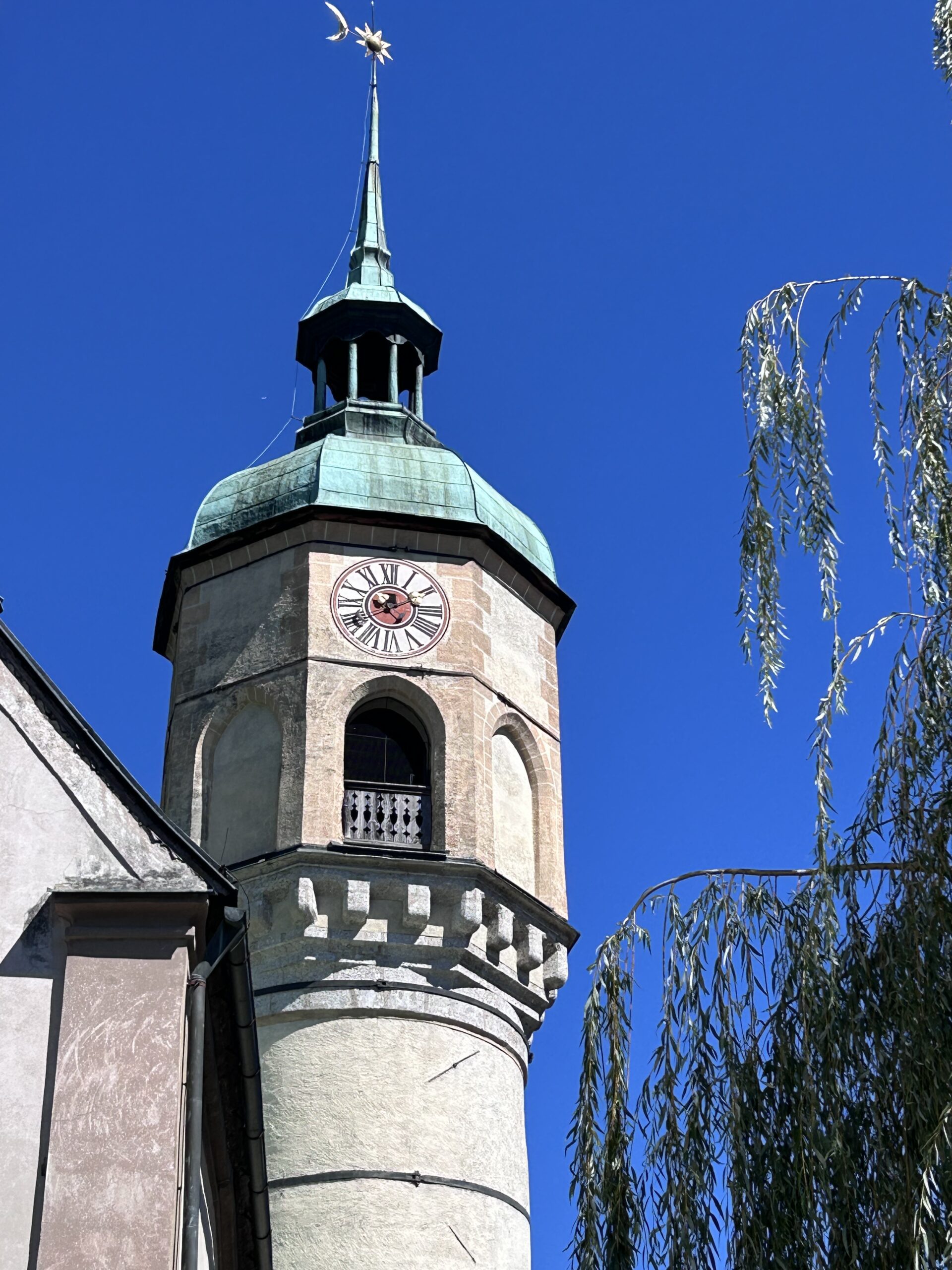
No fewer than three churches shape the center of Hötting. The Old Parish Church, located on what is now Schulgasse, is built on the remains of one of the oldest sacred buildings in the region around Innsbruck. Excavations by Wilhelm von Sydow on the site were able to date graves back to the 7th century. It must have been very early Bavarian Christians or a remaining Breonian settlement who operated a church at this location. Over this early Innsbruck burial ground, the first Romanesque church building was erected in the 10th century. Just as Gothic architecture later did, or Baroque architecture in the early modern period, Romanesque was an artistic and architectural style that dominated Europe between late antiquity and the High Middle Ages. The patron saints of the parish were as contemporary as the architecture of the building. Saints Ingenuin and Albuin took on the patronage. Both were highly relevant figures for their contemporaries. Albuin was likely serving as Bishop of Brixen at the time the church was built. Around the year 1000, the relics of his predecessor Ingenuin—who had died centuries earlier—were transferred to Brixen Cathedral. The Hötting church was first mentioned in 1286, when it appeared in a letter concerning indulgences. Paying an indulgence—essentially a contribution to the church to reduce one’s time in purgatory after death—was common practice. Many medieval churches would likely never have been built without the financial possibilities provided by indulgences. The present core of the Gothic nave and the tower date back to the 15th century, which still sets the structure apart from most other churches in Innsbruck. In 1641 the tower was rebuilt after a fire. During the 18th century, the interior was remodeled in the Baroque style.
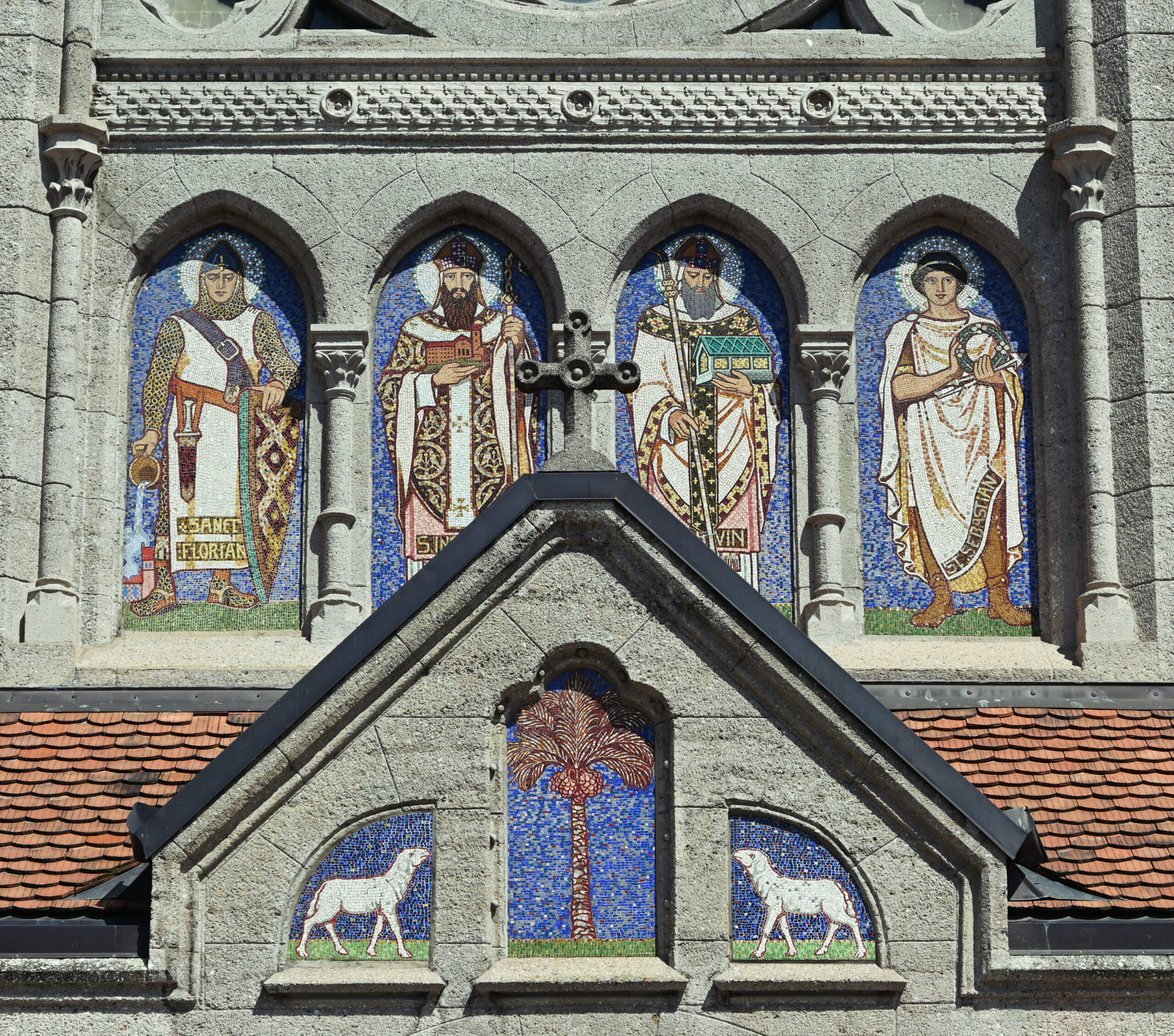
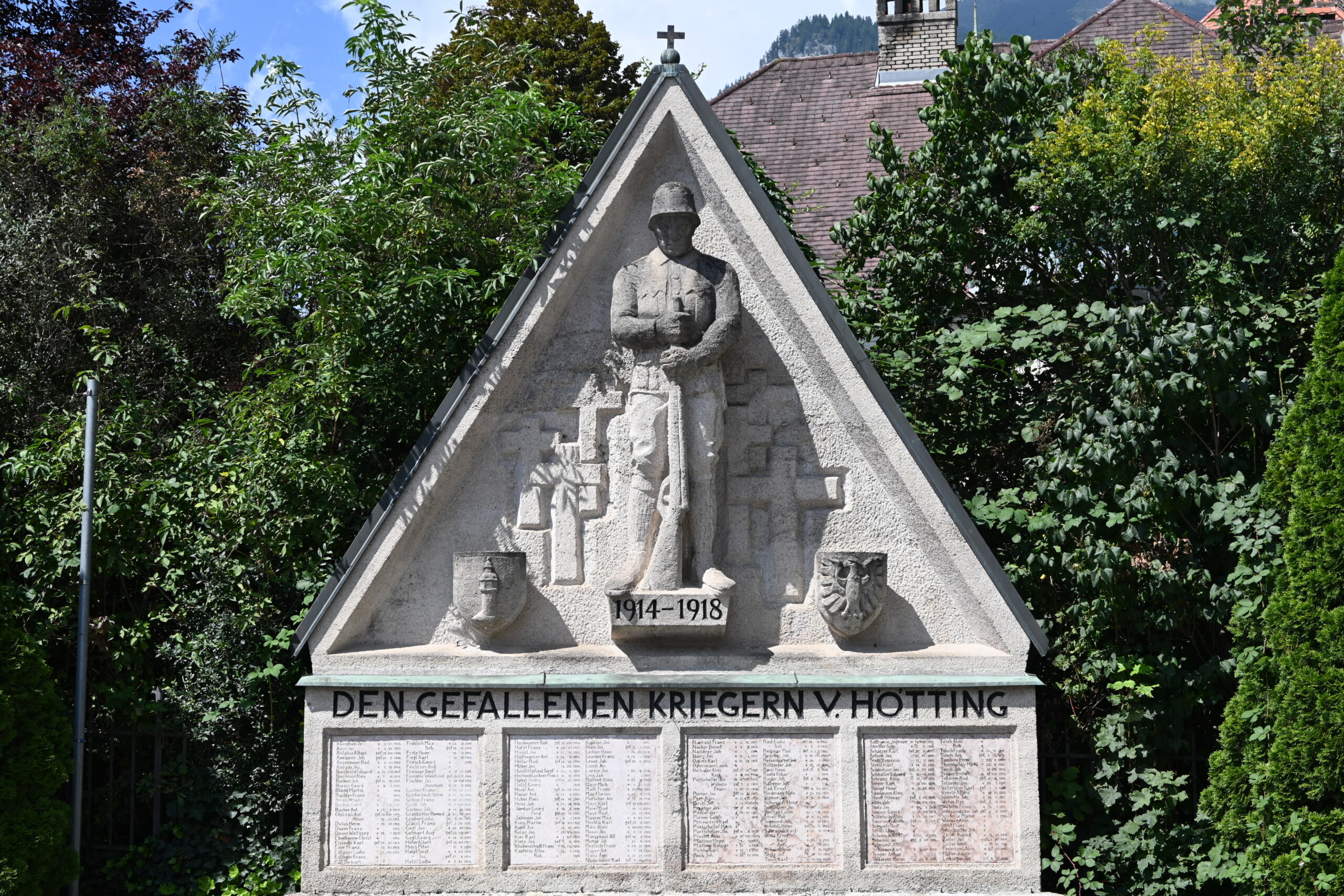
In 1853, Hötting—until then under the ecclesiastical care of Wilten Abbey—was elevated to an independent parish. The population of Hötting grew at an unprecedented rate during the 19th century. The 400 seats of the old church were no longer sufficient, and the cemetery also became too small for the municipality, which at that time did not yet belong to Innsbruck. In 1888, the parish priest of Hötting founded the Pope Leo Church Building Association to finance a new building. Pope Leo XIII (1810–1903) was a politically active pontiff. By strengthening the Christian workers’ movement, he sought to reestablish the Church as a major player on the political stage. Neo-Gothic church buildings were meant to revive and manifest the ancient medieval bonds between European ruling houses and the papacy. His rejection of republicanism, of the state as the highest social institution, and of socialism, along with his devotion to the veneration of the Holy Mother of God, made him popular in conservative circles in Innsbruck. One of the major initiators and donors was Robert Nißl, brewer, restaurateur, and owner of Büchsenhausen Castle. He provided the land for the project. Although indulgences were no longer common practice in the Catholic Church, donations to the parish still benefitted both one’s salvation after death and one’s social standing within the community. Five years after the association was founded, the first part of the complex—the cemetery and chapel—was built. Through further donations and the sale of popular New Year’s “apology cards,” the industrious parish community raised funds for the church over the next 15 years. In 1909, the construction company Josef Huter & Söhne began building the New Hötting Parish Church. A little over 20 years earlier, the same builder had been commissioned with the construction of the Church of St. Nicholas. It is therefore unsurprising that the two churches bear strong resemblance. Neo-Romanesque arches and Neo-Gothic pointed arches and turrets define the façade. Above the portal, Saints Florian and Sebastian as well as Hötting’s patron saints Ingenuin and Albuin were immortalized in mosaic. The gable features statues of Jesus and the two founders of the Christian Church, Peter and Paul. The shell of the building was solemnly blessed in 1911, and before the outbreak of the First World War, the interior furnishings were gradually added. Particularly striking are the artistically crafted windows produced by the Tyrolean stained-glass workshop. Due to the turmoil of war, the church could only be fully completed and consecrated in 1924. The current high altar was created in 1989 by Innsbruck artist Helmut Millonig, whose studio is located directly across from the Old Hötting Parish Church. The war also brought another artwork to the forecourt: the war memorial by Clemens Holzmeister.
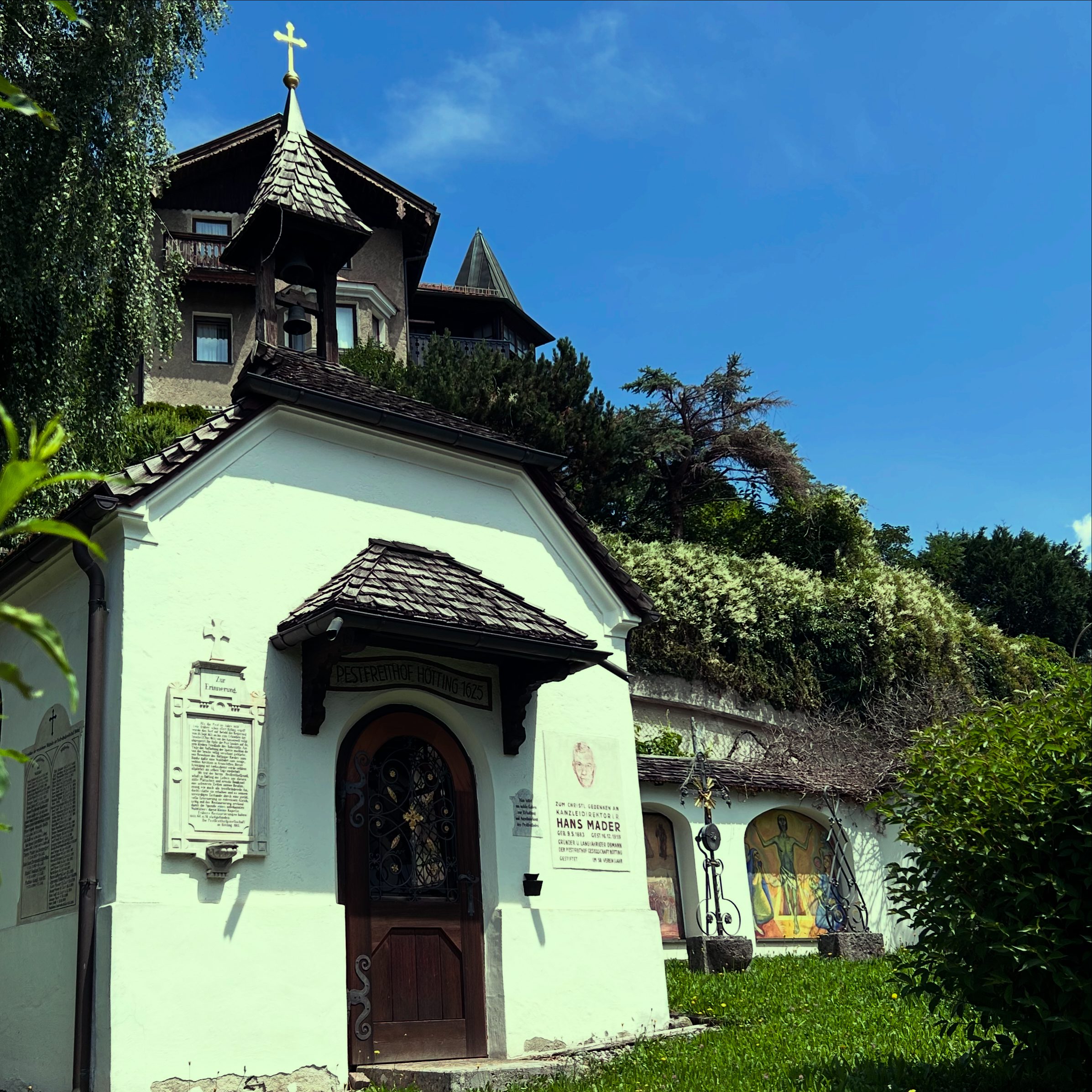
Just a few meters from the New Hötting Parish Church lies the Hötting Plague Cemetery. It was established during an outbreak of the plague in Hötting, separate from the regular burial grounds. During the Thirty Years’ War, the plague struck Tyrol not only more frequently, but the lack of supplies also led to an exceptionally high number of deaths. Those who could afford it locked themselves in their homes with enough provisions to avoid infection. Exact numbers of plague victims have not survived, but the outbreak of 1625 left a particularly strong mark on local memory. In typical Baroque fashion, people not only prayed fervently, promised to build chapels, churches, and votive images, and undertook pilgrimages; superstition also thrived. According to legend, every night at midnight, the Grim Reaper would approach Hötting from the west carrying a scythe, while his female helper, the “Death Woman,” would approach from Büchsenhausen in the east with broom and rake. While Death carried souls to the afterlife, the Death Woman was said to sweep up the remains. Despite the devout population’s promise to undertake an annual pilgrimage to Kranebitten and the newly built Chapel of the Visitation of Mary (constructed the same year) to keep the eerie pair away from Hötting in the future, the plague cemetery fell into oblivion. In 1912, the small walled chapel was built according to plans by master builder Leopold Heiss, and the iron grave crosses were installed. Its current appearance evolved through several stages and renovations. Inside stands a Baroque-style crucifixion group. The modern images on the wall behind the chapel were added after the two world wars. Anton Kirchmayr and Josef Prantl each created modern interpretations of the great dying in 1925 and in the 1950s.
Klingler, Huter, Retter & Co: master builders of expansion
The final decades of the 19th century became known in Austrian history as the Gründerzeit (Founders’ Era). After the economic crisis of 1873, the financial situation recovered and an unprecedented construction boom began. Innsbruck also established a modern banking system. Financial institutions such as the Savings Bank founded in 1821 and the Creditanstalt, whose building erected in 1910 still towers over Maria-Theresien-Straße like a small palace, made it possible to obtain loans, without which entrepreneurship and commerce as we know them today would not have been possible. In some cases, these financial institutions even acted as developers themselves. Between 1880 and 1900, Innsbruck’s population grew from 20,000 to 26,000 inhabitants, while Wilten, incorporated into the city in 1904, even tripled its population from 4,000 to 12,000. The number of buildings increased from 600 to more than 900. Most of them, unlike previous buildings, were multi-story apartment houses. Infrastructure was also modernized. Gas, running water, and electricity became part of everyday life for an increasing number of people. These buildings represented the new society. Entrepreneurs, professionals, employees, and workers had different needs than the legally dependent subjects of previous centuries. The urban lifestyle demanded apartments with several rooms and open spaces for recreation after working hours. Apartment buildings made a modern lifestyle possible even for people who did not own property. Unlike the rural regions of Tyrol, where farming families lived together with servants in farmhouses as part of an extended kinship community, life in the city was already quite close to our present-day understanding of family life. Although the upper middle class had not yet surpassed the nobility, it had reduced the gap considerably and, through its new position on the municipal council, was able not only to commission private building projects but also to decide on public construction projects. The old city hospital in the center of town was replaced by a modern hospital in the west; Sieberer’s orphanage and retirement home were established in Saggen, and a new urban center emerged around the railway station.
The forty years preceding the First World War were a gold rush era for the construction industry. The architecture of the buildings reflected the worldview of their owners. Master builders often assumed several roles and frequently replaced architects altogether. Most clients had very clear ideas about what they wanted. They were not seeking breathtaking new creations but rather copies of or adaptations based on existing buildings. In keeping with the spirit of the age, Innsbruck’s master builders designed structures according to the wishes of their financially powerful clients in the styles of Historicism, Classicism, and the Tyrolean Heimatstil. The style chosen for a home was often not merely an aesthetic decision but also an ideological statement by the owner. Liberals generally preferred Classicism, while conservatives were drawn to the Tyrolean Heimatstil. Whereas the Heimatstil presented itself in a Neo-Baroque form with abundant paintings, clear forms, statues, and columns were characteristic elements of Classical-inspired architecture. In what was sometimes a rather wild mixture of styles, people realized their ideas of classical Greece and ancient Rome. Not only railway stations and public buildings but also large apartment buildings, entire streets, churches, and even cemeteries were built along former country roads in this design. Academics—and those wishing to appear as such—demonstrated their fascination with antiquity through neoclassical façades. Catholic traditionalists commissioned murals depicting saints and scenes from Tyrolean history on their Heimatstil houses. While Neoclassicism predominates in Saggen and Wilten, the district of Pradl is largely characterized by conservative Heimatstil architecture. For a long time, many architectural experts looked down upon the tastes of social climbers and the newly rich. Heinrich Hammer wrote in his standard work Art History of the City of Innsbruck:
"Of course, this first rapid expansion of the city took place in an era that was unfruitful in terms of architectural art, in which architecture, instead of developing an independent, contemporary style, repeated the architectural styles of the past one after the other."
The era of grand villas, which imitated the aristocratic residences of former times with a bourgeois touch, came to an end after several exuberant decades simply because space became scarce. Further development of the city with detached houses was no longer possible. Even today, the area around Falkstraße, Gänsbachstraße, and Bienerstraße is known as Villensaggen, while the areas further east are referred to as Blocksaggen. Wilten and Pradl, however, never experienced this kind of development. Nevertheless, in their gold-rush enthusiasm, developers sealed ever more land with construction. In 1907, Albert Gruber delivered a warning speech about this growth, cautioning against unchecked urban expansion and land speculation.
"It is the most difficult and responsible task facing our city fathers. Up until the 1980s (note: 1880), let's say in view of our circumstances, a certain slow pace was maintained in urban expansion. Since the last 10 years, however, it can be said that cityscapes have been expanding at a tremendous pace. Old houses are being torn down and new ones erected in their place. Of course, if this demolition and construction is carried out haphazardly, without any thought, only for the benefit of the individual, then disasters, so-called architectural crimes, usually occur. In order to prevent such haphazard building, which does not benefit the general public, every city must ensure that individuals cannot do as they please: the city must set a limit to unrestricted speculation in the area of urban expansion. This includes above all land speculation."
A handful of master builders, together with the Innsbruck Building Authority, guided this development. If Wilhelm Greil can be called the mayor of Innsbruck’s expansion, then the Vienna-born Eduard Klingler (1861–1916) certainly deserves the title of its architect. As a public official and master builder, Klingler left a profound mark on Innsbruck’s cityscape. He began working for the Province of Tyrol in 1883. In 1889 he joined the municipal building authority, which he headed from 1902 onward. Among the projects attributed to Klingler as head of the building authority are the Commercial Academy, the Leitgeb School, Pradl Cemetery, the Dermatological Clinic within the hospital complex, the Municipal Kindergarten on Michael-Gaismair-Straße, the Train Barracks (today a residential building), the Market Hall, and the Tyrolean State Conservatory. One particularly noteworthy Heimatstil building designed by him is the Ulrich House on Bergisel, which today serves as the headquarters of the Old Kaiserjäger Club.
The most important construction company in Innsbruck was Johann Huter & Sons. Johann Huter took over his father’s brickworks. In 1856 he acquired the company’s first property, the Huter Grounds, on Innrain. Three years later the first business headquarters was established on Meranerstraße. The company’s official founding came in 1860 when it was registered together with his sons Josef and Peter. Like many of its competitors, Huter & Sons saw itself as a full-service provider. The company included its own brickworks, cement factory, carpentry shop, metal workshop, design office, and construction firm. By the outbreak of the First World War, it employed more than 700 people. In 1906/07, the Huter family built their residential and business headquarters at Kaiser-Josef-Straße 15 in the typical style of the late pre-war years. This stately house combines the Tyrolean Heimatstil, surrounded by gardens and nature, with Neo-Gothic and Neo-Romanesque elements. Well-known buildings erected by Huter & Sons in Innsbruck include the Monastery of Perpetual Adoration, St. Nicholas Parish Church, the first building of the new hospital complex, and several buildings on Claudiaplatz.
The second major player was Josef Retter (1872–1954). Born in Lower Austria with Tyrolean roots, he completed an apprenticeship as a mason before attending the Imperial-Royal State Trade School in Vienna and the master craftsman school of its construction department. After gaining professional experience throughout the Habsburg Monarchy—in Vienna, Croatia, and Bolzano—he was able, thanks to his wife’s dowry, to establish his own construction company in Innsbruck at the age of 29. Like Huter’s company, his enterprise also included a sawmill, a sand and gravel works, and a stonemasonry workshop. In 1904 he built his residential and office building. The dark Neo-Gothic Retter House at Schöpfstraße 23a, with its distinctive bay window supported by columns and a turret, is decorated with a remarkable mosaic representing an allegory of architecture. The relief on the gable depicts the union of art and craftsmanship, symbolizing Retter’s career path. Retter’s buildings particularly shaped Wilten and Saggen. Through projects such as the new Academic Gymnasium, the castle-like Commercial Academy building, the Protestant Christ Church in Saggen, the Zelger House on Anichstraße, Sonnenburg in Wilten, and the Neo-Gothic Mentlberg Castle in Sieglanger, he created many of the most important buildings of this era in Innsbruck.
Late in life but with a similarly practice-orientated background that was typical of 19th century master builders, Anton Fritz started his construction company in 1888. He grew up remotely in Graun in the Vinschgau Valley. After working as a foreman, plasterer and bricklayer, he decided to attend the trade school in Innsbruck at the age of 36. Talent and luck brought him his breakthrough as a planner with the country-style villa at Karmelitergasse 12. In its heyday, his construction company employed 150 people. In 1912, shortly before the outbreak of the First World War and the resulting slump in the construction industry, he handed over his company to his son Adalbert. Anton Fritz's legacy includes his own home at Müllerstraße 4, the Mader house in Glasmalereistraße and houses on Claudiaplatz and Sonnenburgplatz.
With Carl Kohnle, Carl Albert, Karl Lubomirski, and Simon Tommasi, Innsbruck possessed several other master builders who left their mark on the cityscape through typical buildings of the late 19th century. Together, they shaped Innsbruck’s new streets in the prevailing architectural spirit of the final thirty years of the Habsburg Monarchy. Residential houses, railway stations, government buildings, and churches throughout the vast empire stretching from Ukraine to Tyrol looked remarkably similar. New movements such as Art Nouveau gained acceptance only slowly. In Innsbruck, it was the Munich architect Josef Bachmann who introduced a new accent to bourgeois design with the redesign of the façade of the Winkler House. With the outbreak of the First World War, construction activity largely ceased. After the war, the era of neoclassical Historicism and the Heimatstil was definitively over. Times had become harsher, and the requirements for housing had changed. In the period of severe housing shortages in the young Republic of German-Austria, affordable housing and modern sanitary facilities became more important than representative façades and grand rooms. The increasingly professional education of master builders and architects at the Imperial-Royal State Trade School also contributed to a new understanding of construction, replacing the often self-taught veterans of the gold-rush era of Classicism. A stroll through Saggen and parts of Wilten and Pradl still transports visitors back to the Gründerzeit. Claudiaplatz and Sonnenburgplatz are among the most impressive examples. The construction company Huter & Sons still exists today. The company is now located in Sieglanger on Josef-Franz-Huter-Straße, named after its founder. Although the residential building on Kaiser-Josef-Straße no longer bears the company’s name, it remains, in all its opulence, a remarkable relic of the period that permanently transformed Innsbruck’s appearance. In addition to his residence on Schöpfstraße, the district of Wilten contains a second building associated with the Retter family. Opposite the university on Innrain stands Villa Retter. Josef Retter’s eldest daughter, Maria Josefa, who herself had been educated according to the principles of the reform educator Maria Montessori, opened Innsbruck’s first Haus des Kindes (“House of the Child”) in 1932. Above the entrance, a portrait depicts the benefactor Josef Retter. The south façade is adorned with a mosaic in the characteristic style of the 1930s, referring to the building’s original purpose. A smiling blond girl embraces her mother, who is holding a book, and her father, who carries a hammer. The family crypt at Westfriedhof Cemetery is another notable legacy of the Retter family.
The success story of the Innsbruck glass painters
The United States of America were regarded in the pre-war period as the land of unlimited opportunity, where dishwashers could become millionaires. Yet such success stories are not exclusive to the New World. In the not yet fully regulated society of the Danube Monarchy, capable and diligent individuals from farming backgrounds, the working class, or artisanal trades—often without formal education, certification, or state approval—could achieve remarkable upward mobility. The three founders of the Tyrolean Stained Glass and Mosaic Institute, Josef von Stadl, Georg Mader, and Albert Neuhauser, are exemplary of such a success story from Innsbruck’s urban history. While most Innsbruck industrial and craft enterprises focused on supplying the local market with solid, well‑established goods and consumer products, stained glass production stood out as one of the few innovative and export‑oriented industries of its time.
Each of the founders’ personal histories, their differing skills and life paths, is noteworthy. Josef von Stadl (1828–1893) grew up on his parents’ farm and inn in Steinach am Brenner. From an early age, he had to help in the family business. This heavy labour resulted in an inflammation of the periosteum in his arm at the age of nine, making physical work impossible thereafter. Instead, the artistically talented boy attended the model secondary school in Innsbruck, today’s BORG. In 1848, he joined the Tyrolean sharpshooters of his hometown, though he was not deployed at the front. He later gained practical experience as a locksmith and turner. In 1853, he contributed to rebuilding the church in Steinach after a fire. His skills were soon recognised, and he steadily rose from labourer to master builder. Georg Mader (1824–1881), also from Steinach, began working as a farmhand at a young age. Through the patronage of his brother, a clergyman, the devout youth was able to train as a painter, though he initially had to abandon his passion to assist in the family mill. After completing his journeyman travels, he decided to devote himself fully to painting. In Munich, he refined his skills with the firms Kaulbach and Schraudolph. After working on the cathedral in Speyer, he returned to Tyrol, where he supported himself mainly through commissions for ecclesiastical art. Albert Neuhauser (1832–1901) trained in his father’s glazing and sheet‑metal workshop. However, he too had to abandon his intended career path early due to health issues—lung problems that appeared when he was just ten years old. Instead of continuing in the successful family business, he travelled to Venice. The island of Murano had been home for centuries to the finest glassmaking workshops. Fascinated by this craft, he defied his father’s wishes and attended a stained glass workshop in Munich. The products of the recently established Bavarian factory, however, did not meet his quality standards. Back in his father’s apartment in Herzog‑Friedrich‑Strasse, he began experimenting with glass—much like the “garage innovators” who, a century later, would lay the foundations for the personal computer.
Neuhauser’s experiments and tinkering aroused the curiosity of his friend von Stadl, who in turn introduced him to the artistically inclined Mader. In 1861, the three decided to combine their expertise in a formal business venture—what today might be called a startup. Neuhauser took responsibility for technical and commercial aspects as well as product development, von Stadl handled decorative design and contacts with builders, and Mader focused on figurative design, particularly for ecclesiastical commissions. Their first workshop, staffed by two painters and a kiln operator, was located on the third floor of the Gasthof zur Rose in the Old Town. Raw materials had to be imported from England, as domestic glass did not meet Neuhauser’s standards, and imports were subject to a 25% tariff. Together with a chemistry teacher, Neuhauser eventually succeeded—after a trip to Birmingham and extensive experimentation—in producing glass of the desired quality himself.
In 1867, Josef von Stadl married the painter Maria Pfefferer, the daughter of a physician. The former farmer’s son from the Wipptal had not only risen into the upper bourgeoisie; his wife’s dowry also gave him financial independence. In 1869, supported financially by Neuhauser’s father, the partners decided to expand their successful enterprise. The dynamism and lack of regulation characteristic of the Gründerzeit boom is illustrated by the example of the glassworks established in the fields of Wilten, which went into operation in 1872. Production began just 110 days after construction—officially never approved by the municipal authorities of Wilten—had commenced. Due to health reasons, Neuhauser withdrew from the company as early as 1874, and although the founders handed over management of their flourishing business relatively soon, they remained shareholders. At the same time, each continued to work successfully on independent projects within their respective fields.
Von Stadl, in particular, left a lasting imprint on Innsbruck. At the height of its success, the stained glass workshop employed over 70 people. In 1878, according to von Stadl’s plans, housing was built for employees, workers, artists, and craftsmen associated with the company. This “Glassworks Settlement” included the buildings at Müllerstraße 39–57, Schöpfstraße 18–24, and Speckbacherstraße 14–16, which still exist today. Their architecture differs markedly from the surrounding Gründerzeit buildings: von Stadl used less ornamentation but placed emphasis on small front gardens. Workers and employees were meant to feel in no way inferior to the residents of the cottage‑style villas in Saggen. While it was not uncommon for large companies to build their own housing—Siemensstadt in Berlin being a well-known example—this development reflects a particular corporate self‑image and forward-looking vision: the company saw itself not only as an employer but also as a provider of housing and social support. Another major project by von Stadl in Innsbruck was the Provincial Maternity Clinic in Wilten. After completing the Vinzentinum in 1878, he was named an honorary citizen and diocesan architect of Brixen. Pope Leo XIII awarded him the Order of St. Gregory for his services. The St. Nikolaus Church—whose windows had been produced by the Tyrolean Glass Painting Institute—became his final resting place.
Georg Mader continued to work as a painter on sacred buildings. He became a member of the Vienna Academy of Art as early as 1868. When he suffered a stroke in 1881, he was taken to Badgastein for rehabilitation. The spa town in Salzburg was a meeting place for the European aristocracy and upper middle classes at the time. In the midst of high society, the former journeyman miller died a wealthy man.
The restless and creative Neuhauser returned to Venice after resigning as director and went on to establish Austria’s first mosaic institute. The merger of the two companies in 1900 expanded the range of artistic possibilities. For his achievements, he was awarded the Order of Franz Joseph. In Wilten, Neuhauserstraße was named in his honour. Franz-Josephs-Orden. In Wilten wurde die Neuhauserstraße nach ihm benannt.
Romance, sunless summers and apology cards
Thanks to the university, its professors and the young people it attracted and produced, Innsbruck also sniffed the morning air of the Enlightenment in the 18th century in the era of Maria Theresa, even if the Jesuit faculty leadership put the brakes on it. 1741 saw the founding of the Societas Academica Litteraria a circle of scholars in the Taxispalais. The masonic lodge was founded in 1777 To the three mountains, four years later, the Tyrolean Society for Arts and Science was founded. The spirit of reason in the time of Maria Theresa and Emperor Joseph also found its way into Innsbruck's elite. Spurred on by the French Revolution, some students even declared their allegiance to the Jacobins. Under Emperor Franz, all these associations were banned and strictly monitored after the declaration of war on France in 1794. Enlightenment ideas were frowned upon by large sections of the population even before the French Revolution. At the latest after the beheading of Marie Antoinette, the Emperor's sister, and the outbreak of war between the French Republic and the monarchies of Europe, they were considered dangerous. Who wanted to be considered a Jacobin when it came to defending their homeland?
After the Napoleonic Wars, Innsbruck was slow to recover, both economically and mentally. Adalbert Stifter (1805 -1868), probably the most famous writer of Austrian Romanticism, described Innsbruck in the 1830s in his travelogue Tyrol and Vorarlberg as follows:
„The inns were bad, the pavements wretched, long gutters overhung the narrow streets, which were bordered on both sides by dull arches... the beautiful banks of the Inn were unpaved, but covered with heaps of rubbish and criss-crossed by cesspools.“
Die kleine Stadt am Rande des Kaiserreiches hatte etwas mehr als 12.000 Einwohner, „ohne die Soldaten, Studenten und Fremden zu rechnen“. University, grammar school, Reading casino, music club, theatre and museum were evidence of a developing, modern urban culture. There was a Deutsches Kaffeehaus, a Restoration in the courtyard garden and several traditional inns such as the White cross, the Österreichischen Hofwhich Grape, das Katzung, das Mouthingeach of which Goldenen Adler, Stern und Hirsch. After 1830, the open sewers were blocked and made more hygienic, roads were repaired and bridges renovated. The overdue straightening and taming of the Inn and Sill rivers, which had begun before the turmoil of war, was also tackled. The biggest innovation for the population came in 1830, when oil lamps lit up the town at night. It was probably just a dim twilight created by the more than 150 lamps mounted on pillars and arm chandeliers, but for contemporaries it was a true revolution.
Die bayerische Besatzung war verschwunden, die Ideen der Denker der Aufklärung und der Französischen Revolution hatten sich aber in einigen Köpfen des städtischen Milieus verfangen. Natürlich waren es keine atheistischen, sozialistischen oder gar umstürzlerischen Gedanken, die sich breit machten. Es ging vor allem um wirtschaftliche, politische und gesellschaftliche Teilhabe des Bürgertums. Das Vereinswesen feierte eine Renaissance. Was heute wenig spektakulär klingt, war zur Regierungszeit Metternichs aufsehenerregend. Zwischen dem Beginn der Napoleonischen Kriege mit dem revolutionären Frankreich 1797 und dem Wiener Kongress waren Vereine allgemein verboten gewesen. Wer auf sich hielt, trat nun einer dieser neuartigen Gesellschaften bei. "Innsbruck has a music society, an agricultural society and a mining and geological society." stand etwa im Reiseführer Beda Webers wie ein Qualitätssiegel für die Stadt zu lesen. Es galt das tugendhafte Miteinander zum Wohl der weniger Begüterten und die Erziehung der Massen mit dem Treiben in den Vereinen zu forcieren. Wissenschaft, Literatur, Theater und Musik, aber auch Initiativen wie der Innsbruck Beautification Association, but also practical institutions such as the voluntary fire brigade established themselves as pillars of a previously unknown civil society. One of the first associations to be formed was the Innsbruck Music Society, from which the Tyrolean State Conservatory emerged. In keeping with the spirit of the times, men and women were not members of the same organisations. Women were mainly involved in charitable organisations such as the Women's association for the promotion of infant care centres and female industrial schools. Female participation in the political discourse was not desired.
In addition to Christian charity, a thirst for recognition and prestige were probably also major incentives for members to get involved in the clubs. People met to see and be seen. Good deeds, demonstrating education and leading a virtuous life were then, as now, the best PR for oneself.
Club life also served as entertainment on long evenings without electric light, television and the internet. Students, civil servants, members of the lower nobility and academics met in the pubs and coffee houses to exchange ideas. This was not only about highly intellectual and abstract matters, but also about profane realpolitik such as the suspension of internal tariffs, which made people's lives unnecessarily expensive. Culturally, the bourgeois educated elite in the Romantic and Biedermeier periods discovered the cultural escape into an intact past for themselves. After decades of political confusion, war and hardship, people wanted a distraction from the recent past, just as they did after 1945. Antiquity and its thinkers celebrated a second renaissance in Innsbruck, as in the rest of Europe. Romantic thinkers of the 18th and early 19th centuries such as Winckelmann, Lessing and Hegel were influential. The Greeks were „Noble simplicity and quiet greatness" attested. Goethe wanted the "Search the land of the Greeks with your soul" and travelled to Italy in search of his longing for the good, pre-Christian times in which the people of the Golden Age cultivated an informal relationship with their gods. Roman Stoic virtues were transported into the modern age as role models and formed the basis for bourgeois frugality and patriotism, which became very fashionable. Philologists combed through the texts of ancient writers and philosophers and conveyed a pleasing "Best of" into the 19th century. Columns, sphinxes, busts and statues with classical proportions adorned palaces, administrative buildings and museums such as the Ferdinandeum. Students and intellectuals such as the Briton Lord Byron were so inspired by the Panhellenism and the idea of nationalism that they risked their lives in the Greek struggle for independence against the Ottoman Empire. After the end of the Holy Roman Empire, Pan-Germanism became the political fashion of the liberal bourgeoisie in Innsbruck.
Kanzler Clemens von Metternichs (1773 – 1859) Polizeistaat hielt diese gesellschaftlichen Regungen lange Zeit unter Kontrolle. Zeitungen, Flugblätter, Schriften mussten sich an die Vorgaben der strengen Zensur anpassen oder im Untergrund verbreitet werden. Autoren wie Hermann von Gilm (1812 – 1864) und Johann Senn (1792 – 1857), an beide erinnern heute Straßen in Innsbruck, verbreiteten in Tirol anonym politisch motivierte Literatur. Der vielleicht bekannteste Public Intellectual des Vormärz war wahrscheinlich Adolf Pichler (1819 – 1900), dem bereits kurz nach seinem Ableben unter gänzlich anderen Vorzeichen in der Stadtpolitik der späten Monarchie ein Denkmal gewidmet wurde und nach dem heute das Bundesrealgymnasium am gleichnamigen Platz gewidmet ist. Bücher und Vereine standen unter Generalverdacht. Der Innsbrucker Musikverein lehrte im Rahmen seiner Ausbildung auch die Deklamation, das Vortragen von Texten, Musik und Reden, die Inhalte wurden von der Obrigkeit streng überwacht. Alle Arten von Vereinen wie die Innsbrucker Liedertafel and student fraternities, even the members of the Ferdinandeum were spied on. The social movements forming in the working-class neighbourhoods were particularly targeted by Metternich's secret police. Despite their demonstrative loyalty to the emperor, the marksmen were also on the list of institutions to be observed. They were considered too rebellious, not only towards foreign powers, but also towards the Viennese central government. The mix of Greater German nationalist ideas and Tyrolean patriotism presented with the pathos of Romanticism seems strangely harmless today, but was neither comfortable nor acceptable to the Metternich state apparatus.
However, political activism was a marginal phenomenon that only occupied a small elite. After the mines and salt works had lost their profitability in the 17th century and transit lost its economic importance due to the new trade routes across the Atlantic, Tyrol had become a poor region. The Napoleonic Wars had raged for over 20 years. The year 1809 went down as Tyrolean heroic age in the historiography of the 19th and early 20th centuries, the consequences of heroism were barely highlighted. Although the Austrian Empire was one of the victorious powers after the Congress of Vienna, its economic situation was miserable. As after the world wars of the 20th century, many men had not returned home during the coalition wars. The university, which drew young aristocrats into the city's economic cycle, was not reopened until 1826. Unlike industrial locations in Bohemia, Moravia, Prussia or England, the hard-to-reach city in the Alps was only just beginning to develop into a modern labour market. Tourism was also still in its infancy and was not a Cash Cow. It is no wonder that hardly any buildings in the Biedermeier style have survived in Innsbruck. And then there was a volcano on the other side of the world that had an undue influence on the fate of the city of Innsbruck. In 1815, Tambora erupted in Indonesia and sent a huge cloud of dust, sulphur and ash around the world. In 1816 Year without summer into history. All over Europe, there were freak weather conditions, floods and failed harvests. The Alps, an already difficult part of the world to farm, were not exempt from this.
The economic upheavals and price increases led to hardship and misery, especially among the poorer sections of the population. In the 19th century, caring for the poor was a task for the communities, usually with the support of wealthy citizens as patrons with the idea of Christian charity. The state, the community, the church and the newly emerging civil society in the form of associations began to look after the welfare of the poorest sections of the population. Charity concerts, collections and appeals for donations were organised. The measures often contained an enlightened component, even if the means to an end seem strange and alien today. In Innsbruck, for example, a begging ordinance came into force that banned dispossessed people from marrying. Almost 1000 citizens were categorised as alms recipients and beggars.
As the need grew and the city coffers became emptier, Innsbruck came up with an innovation that was to last for over 100 years: The New Year's apology card. Even back then, it was customary to visit relatives on the first day of the year to give each other a Happy New Year to make a wish. It was also customary for needy families and beggars to knock on the doors of wealthy citizens to ask for alms at New Year. The introduction of the New Year's relief card killed several birds with one stone. The buyers of the card were able to institutionalise and support their poorer members in a regulated way, similar to the way street newspapers are bought today. Twenty is possible. At the same time, the New Year's apology card served as a way of avoiding the unpopular obligatory visits to relatives. Those who hung the card on their front door also signalled to those in need that no further requests for alms were necessary, as they had already paid their contribution. Last but not least, the noble donors were also favourably mentioned in the media so that everyone could see how much they cared for their less fortunate fellow human beings in the name of charity.
The New Year's apology cards were a complete success. At their premiere at the turn of the year from 1819 to 1820, 600 were sold. Many communities adopted the Innsbruck recipe. In the magazine "The Imperial and Royal Privileged Bothe of and for Tyrol and Vorarlberg", the proceeds for Bruneck, Bozen, Trient, Rovereto, Schwaz, Imst, Bregenz and Innsbruck were published on 12 February. Other institutions such as fire brigades and associations also adopted the well-functioning custom to raise funds for their cause. The construction of the new Höttinger parish church was financed to a large extent from the proceeds of specially issued apology cards in addition to donations. The varied designs ranged from Christian motifs to portraits of well-known personalities, official buildings, new buildings, sights and curiosities. Many of the designs can still be seen in the Innsbruck City Archives.
Glaube, Kirche und Obrigkeit
The abundance of churches, chapels, crucifixes, statues, and paintings in public spaces strikes many visitors to Innsbruck from other countries as unusual. Not only places of worship, but also many private houses are decorated with depictions of Jesus, Mary, saints, and biblical scenes. For centuries, the Christian faith and its institutions shaped everyday life throughout Europe, and Innsbruck—as a residence city of the strictly Catholic Habsburgs and the capital of the self-proclaimed Holy Land of Tyrol—was particularly richly endowed with ecclesiastical buildings. In terms of number and scale relative to the conditions of earlier times, churches appear as gigantic features in the cityscape. In the 16th century, Innsbruck, with its approximately 5,000 inhabitants, possessed several churches whose splendor and size surpassed every other building, including the palaces of the aristocracy. Wilten Abbey was a vast complex in the midst of a small farming village that had developed around it.
The spatial dimensions of these places of worship reflect their importance within the political and social structure. For many inhabitants of Innsbruck, the Church was not only a moral authority but also a secular landowner. The Bishop of Brixen was formally equal in rank to the territorial prince. Peasants worked on the bishop’s estates just as they did on those of a secular ruler. The clergy exercised both taxation and judicial authority over their subjects, and ecclesiastical landowners were often regarded as particularly demanding. At the same time, it was also the clergy in Innsbruck who were largely responsible for social welfare, healthcare, care for the poor and orphans, food distribution, and education. The Church’s influence extended into the material world in a way comparable to how the modern state operates today through tax offices, police, schools, and employment services. What democracy, parliament, and the market economy represent for us today, bishops, the Bible, Christian devotional literature, and parish priests represented for people of earlier centuries: a reality that maintained order.
It would be incorrect to believe that all clergymen were cynical power-hungry figures who exploited their uneducated subjects. The majority of both clergy and nobility were devout and God-fearing, albeit in a manner that is difficult to comprehend from today’s perspective. It was not the case that every superstition was blindly accepted or that people were arbitrarily executed based on anonymous accusations. In the early modern period, violations of religion and morals were tried before secular courts and punished severely. Charges were brought under the term heresy, which encompassed a wide range of offenses. Sodomy—meaning any sexual act not serving reproduction—sorcery, witchcraft, and blasphemy, in short any deviation from the correct faith, could be punished by burning. The act of burning was intended both to purify the condemned and to destroy them and their sinful behavior completely, thereby removing evil from the community. For a long time, the Church regulated everyday social life down to the smallest details. Church bells structured people’s daily schedules. Their sound called people to work or worship, or informed the community of a death through tolling. People were able to distinguish individual bell signals and their meanings. Sundays and holidays structured time. Fasting days regulated diet. Family life, sexuality, and individual behavior were expected to conform to Church-prescribed morality. For many people, salvation in the afterlife was more important than happiness on earth, which was seen as predetermined by the course of time and divine will. Purgatory, the Last Judgment, and the torments of hell were real and served to frighten and discipline even adults.
While parts of Innsbruck’s bourgeoisie were at least gently awakened by the ideas of the Enlightenment after the Napoleonic Wars, the majority of the population remained deeply attached to a blend of conservative Catholicism and superstitious folk piety. Religiosity was not necessarily a question of background and social status, as the social, media, and political debates along the fault line between liberals and conservatives repeatedly demonstrated. Although the freedom of religious practice had been legally enshrined since the December Constitution (Dezemberverfassung) of 1867, state and religion remained closely intertwined. Thanks to the 1855 concordat between the Pope and the Emperor, marriage law and the school system were under the control of the Catholic Church. It was only under pressure from liberals in parliament that these bastions of everyday social life began to crumble, yet particularly in Tyrol, the pastor's word remained sacrosanct. In the First Republic, a conservative backlash occurred. Ignaz Seipel, a Christian Social politician who went down in history as the Iron Prelate (Eiserner Prälat), rose to the highest office of the state in the 1920s. Federal Chancellor Engelbert Dollfuß saw his Corporate State (Ständestaat)—a construct built on a Catholic foundation—as a bulwark against socialism. In 1933, the concordat with the Vatican was renewed. Even after World War II, church and politics in Tyrol formed a powerful double act in the persons of Bishop Rusch and Governor Wallnöfer. In 1957, the government of the Second Republic reconfirmed the agreement, which formally remains valid to this day. A genuine separation of church and state did not begin until the 1970s. Although people leaving the church in recent decades have dented official membership figures and recreational events draw larger crowds than Sunday masses, faith and the church still hold a fixed place in the daily lives of Innsbruck’s residents, even if often unnoticed. The Roman Catholic Church still owns a vast amount of land in and around Innsbruck, even beyond the walls of its monasteries and educational institutions. A number of schools in and around Innsbruck also remain under the influence of conservative forces and the church. And whoever enjoys a public holiday, cracks Easter eggs against one another, or lights a candle on a Christmas tree does not have to be a Christian to act in the name of Jesus—disguised as tradition.
The First World War
An Innsbruck student nearly changed the course of world history instead of Gavrilo Princip. In 1913, the young man boasted to a waitress about his plans to shoot the heir to the throne, but he was arrested before he could carry them out. Only when the world-changing shots were actually fired in Sarajevo a year later did an article appear in the Innsbrucker Nachrichten on June 30 about the events. The consequences that the First World War, which subsequently broke out, would have for the world and for people's everyday lives could not yet be foreseen after the assassination of Franz Ferdinand on June 28. Two days after the murder of the Habsburg heir in Sarajevo, readers in Innsbruck were already reading prophetic words in their newspaper: “We have arrived at a turning point – perhaps the turning point – in the destiny of this empire.” In Innsbruck, too, enthusiasm for war was widespread in 1914. Driven by the slogan of the time, “God, Emperor, and Fatherland,” the vast majority of people unanimously welcomed the attack on Serbia. Politicians, the clergy, and the press fuelled the general jubilation. Particularly “deserving” in promoting the war were the two theologians Joseph Seeber (1856–1919) and Anton Müllner, known as Brother Willram (1870–1919), who, through their sermons and writings such as The Bloody Year, elevated the war into a crusade against France and Italy. In addition to the imperial proclamation To My Peoples, which appeared throughout the media of the Empire, the Innsbrucker Nachrichten published an article on July 29, the day after Austria-Hungary declared war on Serbia, about Prince Eugene's capture of Belgrade in 1717. The tone in the media was celebratory, although not entirely without dark forebodings of what was to come.
"The Emperor's appeal to his people will be deeply felt. The internal strife has been silenced and the speculations of our enemies about unrest and similar things have been miserably put to shame. Above all, the Germans stand by the Emperor and the Empire in their old and well-tried loyalty: this time, too, they are ready to stand up for dynasty and fatherland with their blood. We are facing difficult days; no one can even guess what fate will bring us, what it will bring to Europe, what it will bring to the world. We can only trust with our old Emperor in our strength and in God and cherish the confidence that, if we find unity and stick together, we must be granted victory, for we did not want war and our cause is that of justice!"
Many Innsbruck residents volunteered for the campaign against Serbia, which was believed to be a matter of only a few weeks or months. So many volunteers poured into Innsbruck from outside the city to report to the recruitment commissions that the city was almost bursting at the seams. No one could imagine how differently things would turn out. After the first battles in distant Galicia, it became clear that this would not be over within a few months. The Imperial Riflemen (Kaiserjäger) and other Tyrolean troops were effectively sacrificed. Poor equipment, inadequate supplies, and the catastrophic leadership of the High Command under Conrad von Hötzendorf led thousands either to their deaths or into captivity, where hunger, abuse, and forced labour awaited them. In 1915, Italy entered the war on the side of France and Britain. Under the infamous secret Treaty of London, the young kingdom had been promised generous territorial gains in return for supporting the Entente against Germany and Austria. On May 23, the former ally declared war on the Habsburg Empire. Until regular troops could be transferred from the Eastern Front, regional defence depended on the Standschützen, a force consisting of men under 21, over 42, or those deemed unfit for regular military service. Correspondingly, casualties were high. Fighting in the mountain war stretched from the Ortler in the west across the northern shore of Lake Garda to the Sexten Dolomites. Innsbruck itself was not directly affected by military operations. At the very least, however, the sounds of war could be heard in the provincial capital, as reported in the newspaper of July 7, 1915:
“Soon after the Italians commenced hostilities, cannon fire could clearly be heard in the region of the Serles peak, coming from one of the battlefields in southern Tyrol, probably the Vielgereut plateau. In recent days, the sound of artillery fire has also undoubtedly been detected in Innsbruck itself and in the northeastern parts of the city — individual powerful blasts, dull rather than rolling and resonant, echoing across the Brenner Pass. There can be no mistake. In Innsbruck itself, the thunder of the guns is more difficult to detect because of the noise of the city, but on one occasion, around 9 p.m., when there was some degree of quiet, this unmistakable thunder, originating from our mortars, was clearly heard.”
Although the front was far away, the war increasingly penetrated civilian life. This total involvement of society in warfare was a new phenomenon. The mass mobilization of a large proportion of the working male population brought many businesses to a complete standstill. Shop shelves remained empty, public transport services ceased, and craftsmen and labourers were called up for military service. Companies still able to operate were subordinated to the wartime economy. By the “Hunger Winter” of 1917, Innsbruck’s economy had almost completely collapsed. Food, coal, and firewood were in short supply, and hunger and cold became bitter enemies of women, children, the wounded, and those unfit for military service. During the final years of the war, provisions were distributed through ration cards. The basic weekly allowance per person amounted to 500 grams of meat, 60 grams of butter, and 2 kilograms of potatoes. Archive photographs show long queues of desperate and hungry people outside food shops. Protests and strikes repeatedly broke out. Politicians, trade unionists, workers, and returning soldiers saw an opportunity for change. Under the slogan “Peace, Bread, and Suffrage,” parties of many different political backgrounds united in opposition to the war. The cityscape also changed. Barracks were erected in Höttinger Au to house prisoners of war. Wounded soldiers arrived in such large numbers that civilian buildings, including the university library then under construction and Ambras Castle, were converted into military hospitals. A predecessor of today’s Tram Line 3 was established to transport the wounded from the railway station to the new garrison hospital, today’s Conrad Barracks in Pradl. To cope with the large number of fallen soldiers, the Pradl Military Cemetery was created.
As the war neared its end, the front also drew closer. In February 1918, the Italian air force succeeded in dropping three bombs on Innsbruck. The Neue Freie Presse reported for the first time on the secret Treaty of London, heightening Tyrolean anxiety over the threatened loss of territory south of the Brenner Pass. By then, most people already knew the war was lost and sensed the fate that awaited Tyrol, as this article of October 6, 1918, demonstrates:
“External and internal enemies are gambling today with the land of Andreas Hofer. The latest throw of the dice is even more cruel; never before has a free land been bartered away so disgracefully. The blood of our fathers, sons, and brothers has been shed in vain if this shameful plan becomes reality. The final throw has not yet been made. Therefore, Tyroleans, attend the Tyrolean People’s Assembly in Brixen on October 13, 1918 (next Sunday). German soil must remain German; Tyrolean soil must remain Tyrolean. Tyroleans, decide your own future!”
On November 4, Austria-Hungary and the Kingdom of Italy finally agreed to an armistice. Part of the agreement granted Italy the right to occupy territory of the monarchy. Alarm bells immediately rang among Austria-Hungary’s allies in the German Empire. On the very next day, Bavarian troops entered Innsbruck. Germany was still at war with Italy and feared that the front might shift into North Tyrol, bringing it closer to German territory. Fortunately for Innsbruck and the surrounding region, Germany also capitulated one week later on November 11. As a result, major military engagements between regular armies were avoided.
Nevertheless, Innsbruck remained in danger. Massive convoys of military vehicles, trains packed with soldiers, and thousands of exhausted troops making their way home on foot passed through the city. Anyone who could jumped onto overcrowded trains or military vehicles to leave the front behind and return home. In November 1918 alone, more than 270 soldiers lost their lives during these reckless attempts or had to be admitted to one of the city’s hospitals. The city not only had to maintain order among its own citizens and ensure food supplies but also protect itself against looting. To preserve public order, the Tyrolean National Council established a citizens’ militia on November 5 composed of pupils, students, workers, and ordinary citizens. On November 23, 1918, Italian troops occupied the city and its surroundings. More than 80,000 Italian soldiers were stationed in Tyrol, around 5,000 of whom required accommodation in the starving and destitute city. Schools were turned into barracks. Mayor Greil’s conciliatory appeal to surrender the city peacefully succeeded. There were isolated disturbances, food riots, and incidents of looting, but there were no armed clashes with the occupation troops and no Bolshevik revolution such as the one that occurred in Munich.
The consequences of the First World War for Innsbruck’s population were devastating. More than 1,200 people lost their lives on battlefields or in military hospitals, while approximately 600 were wounded. Memorials to the First World War and its victims can be found throughout Innsbruck, particularly at churches and cemeteries. The Kaiserjäger Museum on Bergisel displays uniforms, weapons, and photographs from the war. The theologians Anton Müllner and Josef Seeber have streets named after them in Innsbruck. A street was also named after Archduke Eugene, commander-in-chief of the Austro-Hungarian Army on the Southern Front. A monument to the unsuccessful military leader stands in front of the Hofgarten. The eastern section of the Amras Military Cemetery commemorates the Italian occupation.
Baroque: art movement and art of living
Anyone traveling through Austria is familiar with the domes and onion-shaped towers of churches in towns and villages. They are the characteristic hallmark of the Baroque architectural style, which reached its peak during the Counter-Reformation and continues to shape the cityscape of Innsbruck to this day. The most prominent churches—such as the Cathedral, St. John’s Church, or the Jesuit Church—are built in the Baroque style. Places of worship were meant to be splendid and magnificent, symbols of the triumph of the true faith. The exuberant, all-encompassing piety of elites and subjects alike was reflected in art and culture: great drama, pathos, suffering, splendor, and glory combined to form the Baroque—a style that left a lasting imprint on the entire Catholic sphere of influence of the Habsburgs and their allies between Spain and Hungary. From the seventeenth century onward, the Gumpp family of master builders and Johann Georg Fischer fundamentally transformed Innsbruck’s cityscape. The Old Provincial Government Building in the Old Town, the New Provincial Government Building on Maria-Theresien-Strasse, countless palazzi, paintings, and sculptures—the Baroque was the defining stylistic force of the House of Habsburg in the seventeenth and eighteenth centuries and became embedded in everyday life. The bourgeoisie did not wish to lag behind the nobility and princes and therefore had their private residences built in the Baroque style as well. Farmhouses were adorned with images of saints, depictions of the Virgin Mary, and representations of the Sacred Heart of Jesus.
Yet the Baroque was more than an architectural style; it was a way of life that emerged in the aftermath of the Thirty Years’ War. The Ottoman threat from the east, culminating in the two sieges of Vienna, dominated the empire’s foreign policy, while the Reformation shaped domestic affairs. Baroque culture became a central element of Catholicism and its political self-representation in public space—a countermodel to the austere and rigorous way of life advocated by Calvin and Luther. Christian holidays were introduced to brighten everyday life. Architecture, music, and painting were rich, full, and exuberant. In theatres such as the Comedihaus in Innsbruck, dramas with religious themes were performed. Ways of the Cross with chapels and representations of the crucified Christ crisscrossed the landscape. Popular piety, expressed through pilgrimages and the veneration of Mary and the saints, became firmly embedded in everyday church life. Multiple crises shaped daily existence. In addition to war and famine, plague epidemics occurred particularly frequently in the seventeenth century. Baroque piety was used as a means of educating subjects, teaching them to interpret these calamities as expressions of God’s dissatisfaction—misfortunes that could be remedied through a devout and virtuous way of life. Although the sale of indulgences was no longer common practice in the Catholic Church after the sixteenth century, vivid notions of heaven and hell persisted. Through a virtuous life—that is, living in accordance with Catholic values and displaying proper conduct as a subject within the divine order—one could come significantly closer to paradise. So-called Christian devotional literature became the most popular reading material following the educational reforms of the eighteenth century and the rising literacy of the population. The suffering of the Crucified for humanity was regarded as a symbol of the hardship endured by subjects on earth within the feudal system. Through votive paintings, people sought assistance in times of hardship or expressed gratitude—most often to the Virgin Mary—for surviving dangers and illnesses. Particularly impressive votive paintings can be admired in the Wilten Basilica. The historian Ernst Hanisch described the Baroque and its influence on the Austrian way of life as follows:
“Austria emerged in its modern form as a crusading imperialism—externally against the Turks and internally against the Reformers. This brought bureaucracy and the military, and externally a multiethnic society. State and Church attempted to control the intimate sphere of citizens’ lives. Everyone had to reform themselves through the confessional; sexuality was restricted, norm-compliant sexuality enforced. People were systematically trained to dissemble.”
Rituals and submissive behavior toward authority left deep traces in everyday culture, distinguishing Catholic countries such as Austria and Italy to this day from Protestant-influenced regions such as Germany, England, or Scandinavia. Austrians’ passion for academic titles has its roots in Baroque hierarchies. The term Baroque prince refers to a particularly patriarchal and patronizing politician who knows how to captivate an audience with grand gestures. While political sobriety is valued in Germany, the style of Austrian politicians remains theatrical—entirely in keeping with the Austrian adage “Schaumamal” (“let’s see”).