Old Schoolhouse
Domplatz 5
Worth knowing
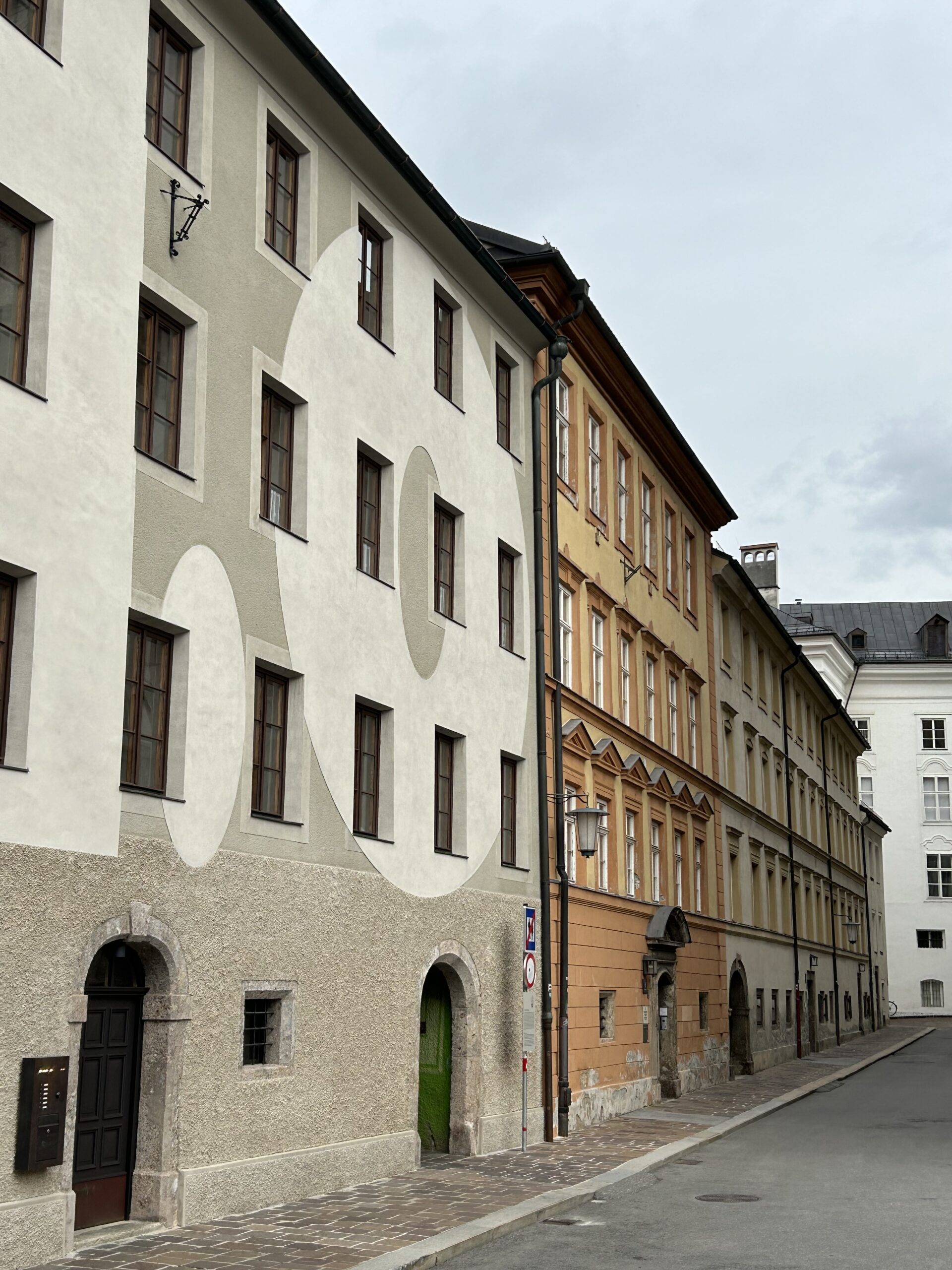
In the shadow of St. James’ Cathedral stands the building that housed Innsbruck’s first city school. The plain structure, which today serves as the residence of the Bishop of Innsbruck, probably accommodated the first educational institution as early as the 13th century. With Innsbruck becoming a city, it no longer wanted to lag behind its neighbor Wilten. At that time, however, only clerics were trained in reading, writing, and Latin for serving at Mass and copying manuscripts—there was no talk of a true public school. A more general educational institution was first mentioned in the city chronicles in the 14th century. As Innsbruck transformed from a village into a city, new professions emerged, bringing new demands for education. Increasingly, craftsmen needed at least basic skills in reading, writing, and arithmetic for commercial activities. Of course, not every child attended medieval school. It was mainly the children of the bourgeoisie and the upper ranks of the craft guilds who were expected to learn reading, writing, religion, some Latin, and arithmetic for their future careers. The aristocracy was usually taught by private tutors in their own chambers. It is no coincidence that the school was located near the church. Although the schoolmaster, or Scolasticus, was appointed by the Innsbruck city council, the supervision of the pupils’ education lay with the church. The costs of the city school were borne by citizens who could afford to pay tuition for their offspring. Gifted children from less affluent families or orphans—the so-called pauperes—often lived in the school building and had to perform church service in return for their education. Their living expenses were partly covered by wealthy townspeople. In return, the boys had to pray for the souls of their benefactors. In hard times, these pauperes had to beg for food. Pupils also contributed to school operations by cleaning classrooms and collecting items such as firewood. Unsurprisingly, strict discipline prevailed at the school. A note from the 16th century admonished the Scolasticus to refrain from using “…fists, hair-pulling, and blows to the head.” In addition to catechism, reading, writing, and arithmetic, pupils were also trained in choral singing. Especially during the cold winter months, the schoolmaster would go with the singers to wealthy citizens and nobles to ask for alms. From this practice developed the tradition of Sternsingen (star singing), which remains a fixed custom around Epiphany to this day. Both parish and city benefited from this intertwining of education and church. The quality of worship and pastoral care was not solely a concern of the church but also of the city council. Innsbruck wanted to grow and attract skilled craftsmen and merchants. Religion played an important role in people’s lives and thus in their choice of residence. With the growing importance and social developments that the city experienced after 1500, the education system also became more differentiated. With the Jesuit college and the Latin school established in Innsbruck in the 16th century, the city school lost significance. The next major change came with the early Enlightenment. Until the 18th century, only boys enjoyed formal education. A separate school for girls was established only in the 17th century thanks to the generous endowment of Count Hieronymus Bernardo Ferrari d’Occhieppo to the Ursuline order. German schools, the so-called Normalschulen, such as the one in St. Nikolaus, gradually competed with the first city school during the Reformation. With the reforms of the Theresian School Ordinance, the city school moved not only ideologically but also physically away from the church and relocated to the other end of the old town.
It is no coincidence that the school was located near the church. Although the schoolmaster, or Scolasticus, was appointed by the Innsbruck city council, the supervision of the pupils’ education lay with the church. The costs of the city school were borne by citizens who could afford to pay tuition for their offspring. Gifted children from less affluent families or orphans—the so-called pauperes—often lived in the school building and had to perform church service in return for their education. Their living expenses were partly covered by wealthy townspeople. In return, the boys had to pray for the souls of their benefactors. In hard times, these pauperes had to beg for food. Pupils also contributed to school operations by cleaning classrooms and collecting items such as firewood. Unsurprisingly, strict discipline prevailed at the school. A note from the 16th century admonished the Scolasticus to refrain from using “…fists, hair-pulling, and blows to the head.” In addition to catechism, reading, writing, and arithmetic, pupils were also trained in choral singing. Especially during the cold winter months, the schoolmaster would go with the singers to wealthy citizens and nobles to ask for alms. From this practice developed the tradition of Sternsingen (star singing), which remains a fixed custom around Epiphany to this day. Both parish and city benefited from this intertwining of education and church. The quality of worship and pastoral care was not solely a concern of the church but also of the city council. Innsbruck wanted to grow and attract skilled craftsmen and merchants. Religion played an important role in people’s lives and thus in their choice of residence.
With the growing importance and social developments that the city experienced after 1500, the education system also became more differentiated. With the Jesuit college and the Latin school established in Innsbruck in the 16th century, the city school lost significance. The next major change came with the early Enlightenment. Until the 18th century, only boys enjoyed formal education. A separate school for girls was established only in the 17th century thanks to the generous endowment of Count Hieronymus Bernardo Ferrari d’Occhieppo to the Ursuline order. German schools, the so-called Normalschulen, such as the one in St. Nikolaus, gradually competed with the first city school during the Reformation. With the reforms of the Theresian School Ordinance, the city school moved not only ideologically but also physically away from the church and relocated to the other end of the old town.
Glaube, Kirche und Obrigkeit
The abundance of churches, chapels, crucifixes, statues, and paintings in public spaces strikes many visitors to Innsbruck from other countries as unusual. Not only places of worship, but also many private houses are decorated with depictions of Jesus, Mary, saints, and biblical scenes. For centuries, the Christian faith and its institutions shaped everyday life throughout Europe, and Innsbruck—as a residence city of the strictly Catholic Habsburgs and the capital of the self-proclaimed Holy Land of Tyrol—was particularly richly endowed with ecclesiastical buildings. In terms of number and scale relative to the conditions of earlier times, churches appear as gigantic features in the cityscape. In the 16th century, Innsbruck, with its approximately 5,000 inhabitants, possessed several churches whose splendor and size surpassed every other building, including the palaces of the aristocracy. Wilten Abbey was a vast complex in the midst of a small farming village that had developed around it.
The spatial dimensions of these places of worship reflect their importance within the political and social structure. For many inhabitants of Innsbruck, the Church was not only a moral authority but also a secular landowner. The Bishop of Brixen was formally equal in rank to the territorial prince. Peasants worked on the bishop’s estates just as they did on those of a secular ruler. The clergy exercised both taxation and judicial authority over their subjects, and ecclesiastical landowners were often regarded as particularly demanding. At the same time, it was also the clergy in Innsbruck who were largely responsible for social welfare, healthcare, care for the poor and orphans, food distribution, and education. The Church’s influence extended into the material world in a way comparable to how the modern state operates today through tax offices, police, schools, and employment services. What democracy, parliament, and the market economy represent for us today, bishops, the Bible, Christian devotional literature, and parish priests represented for people of earlier centuries: a reality that maintained order.
It would be incorrect to believe that all clergymen were cynical power-hungry figures who exploited their uneducated subjects. The majority of both clergy and nobility were devout and God-fearing, albeit in a manner that is difficult to comprehend from today’s perspective. It was not the case that every superstition was blindly accepted or that people were arbitrarily executed based on anonymous accusations. In the early modern period, violations of religion and morals were tried before secular courts and punished severely. Charges were brought under the term heresy, which encompassed a wide range of offenses. Sodomy—meaning any sexual act not serving reproduction—sorcery, witchcraft, and blasphemy, in short any deviation from the correct faith, could be punished by burning. The act of burning was intended both to purify the condemned and to destroy them and their sinful behavior completely, thereby removing evil from the community. For a long time, the Church regulated everyday social life down to the smallest details. Church bells structured people’s daily schedules. Their sound called people to work or worship, or informed the community of a death through tolling. People were able to distinguish individual bell signals and their meanings. Sundays and holidays structured time. Fasting days regulated diet. Family life, sexuality, and individual behavior were expected to conform to Church-prescribed morality. For many people, salvation in the afterlife was more important than happiness on earth, which was seen as predetermined by the course of time and divine will. Purgatory, the Last Judgment, and the torments of hell were real and served to frighten and discipline even adults.
While parts of Innsbruck’s bourgeoisie were at least gently awakened by the ideas of the Enlightenment after the Napoleonic Wars, the majority of the population remained deeply attached to a blend of conservative Catholicism and superstitious folk piety. Religiosity was not necessarily a question of background and social status, as the social, media, and political debates along the fault line between liberals and conservatives repeatedly demonstrated. Although the freedom of religious practice had been legally enshrined since the December Constitution (Dezemberverfassung) of 1867, state and religion remained closely intertwined. Thanks to the 1855 concordat between the Pope and the Emperor, marriage law and the school system were under the control of the Catholic Church. It was only under pressure from liberals in parliament that these bastions of everyday social life began to crumble, yet particularly in Tyrol, the pastor's word remained sacrosanct. In the First Republic, a conservative backlash occurred. Ignaz Seipel, a Christian Social politician who went down in history as the Iron Prelate (Eiserner Prälat), rose to the highest office of the state in the 1920s. Federal Chancellor Engelbert Dollfuß saw his Corporate State (Ständestaat)—a construct built on a Catholic foundation—as a bulwark against socialism. In 1933, the concordat with the Vatican was renewed. Even after World War II, church and politics in Tyrol formed a powerful double act in the persons of Bishop Rusch and Governor Wallnöfer. In 1957, the government of the Second Republic reconfirmed the agreement, which formally remains valid to this day. A genuine separation of church and state did not begin until the 1970s. Although people leaving the church in recent decades have dented official membership figures and recreational events draw larger crowds than Sunday masses, faith and the church still hold a fixed place in the daily lives of Innsbruck’s residents, even if often unnoticed. The Roman Catholic Church still owns a vast amount of land in and around Innsbruck, even beyond the walls of its monasteries and educational institutions. A number of schools in and around Innsbruck also remain under the influence of conservative forces and the church. And whoever enjoys a public holiday, cracks Easter eggs against one another, or lights a candle on a Christmas tree does not have to be a Christian to act in the name of Jesus—disguised as tradition.