Hotel Weisses Kreuz
Herzog-Friedrich-Straße 31

Worth knowing
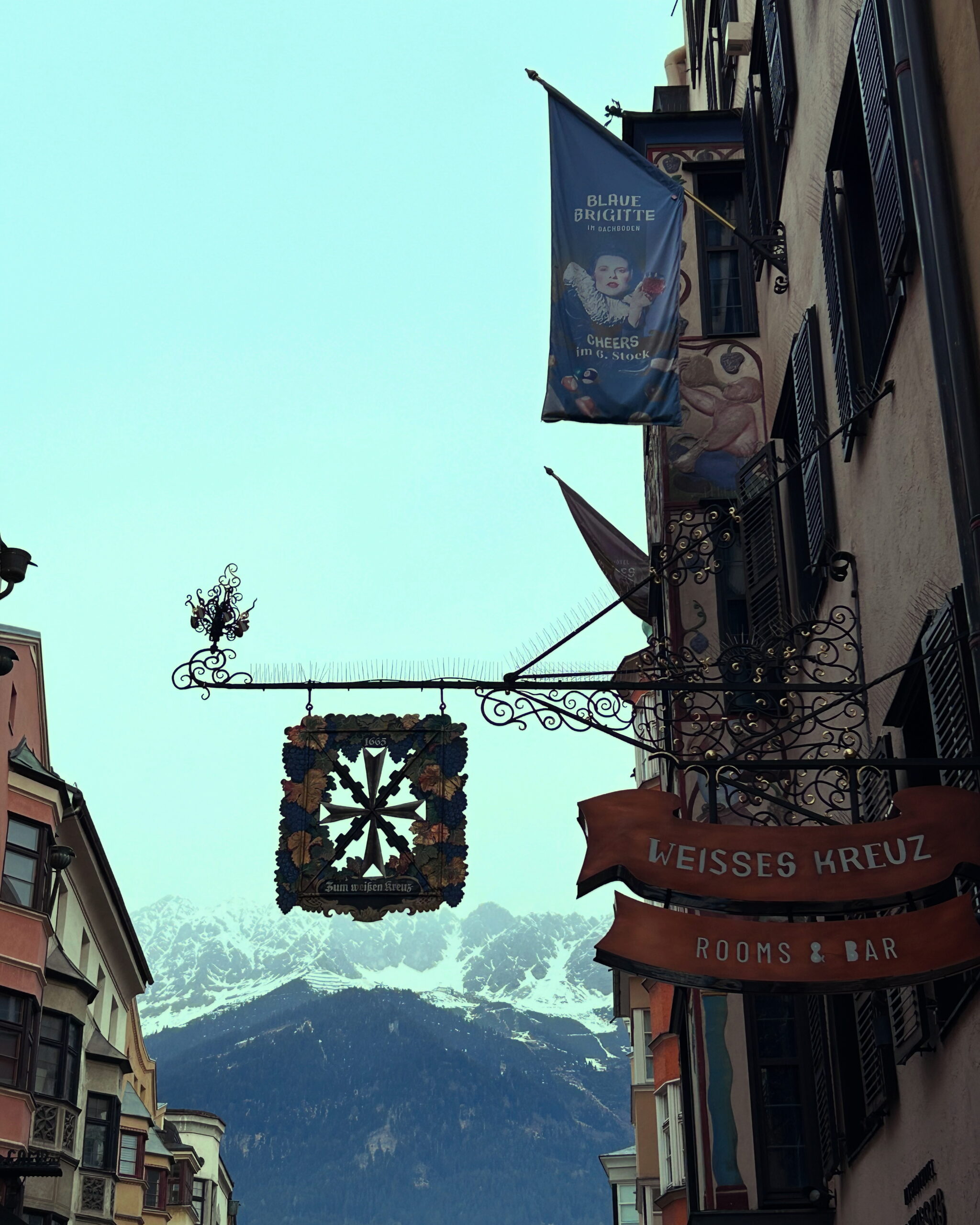
The White cross zählt zu den ältesten Gasthäusern Innsbrucks. Glaubt man der hoteleigenen Chronik, so öffnete es seine Pforten bereits 1465, als Innsbruck unter Siegmund dem Münzreichen zur wichtigsten Stadt Tirols aufzusteigen begann. Das schmale Haus bildete einen Teil der Laubengänge der Herzog-Friedrich-Straße, der damaligen Hauptverkehrsader durch die Stadt. Verlässlich bestätigt ist das Gasthaus am Upper town square since the 16th century under its former owner Achazi Zürler. The most famous guest in the history of the hotel was Wolfgang Amadeus Mozart (1756 - 1791), who stayed here on one of his trips to Italy. His manager and father wanted to showcase the talents of the young genius, who was already known throughout the empire in his youth, in Tyrol. Perhaps Austria's most successful export gave a concert in the Palais Trapp in Innsbruck on 17 December 1769 at the tender age of 13. Although this one performance was not enough to make Innsbruck a lasting tourist attraction on the subject of Mozart, the hotel is still recognised as an important tourist destination thanks to a plaque commemorating the highly talented guest. Mozart House known. Six years Post Mozartem The inn received its official name under the ownership of Nikolaus Benz White Cross Inn. Wie viele Lokale wurde auch die altehrwürdige Gaststätte in der Altstadt im Laufe des 19. Jahrhunderts dank der gesellschaftlichen Umbrüche zum Treffpunkt von Bürgern und Studenten. Es wurde nicht nur fröhlich getrunken und getanzt. 1904 nahmen die als Fatti di Innsbruck events that have gone down in history have their origin in the White cross. An artist was killed in the violent street fighting between the police and German and Italian-speaking students. In the aftermath of the clashes, the furnishings and interior of the inn were completely destroyed by the wild mob in a patriotic storm of indignation, with the exception of a portrait of Emperor Franz Josef.
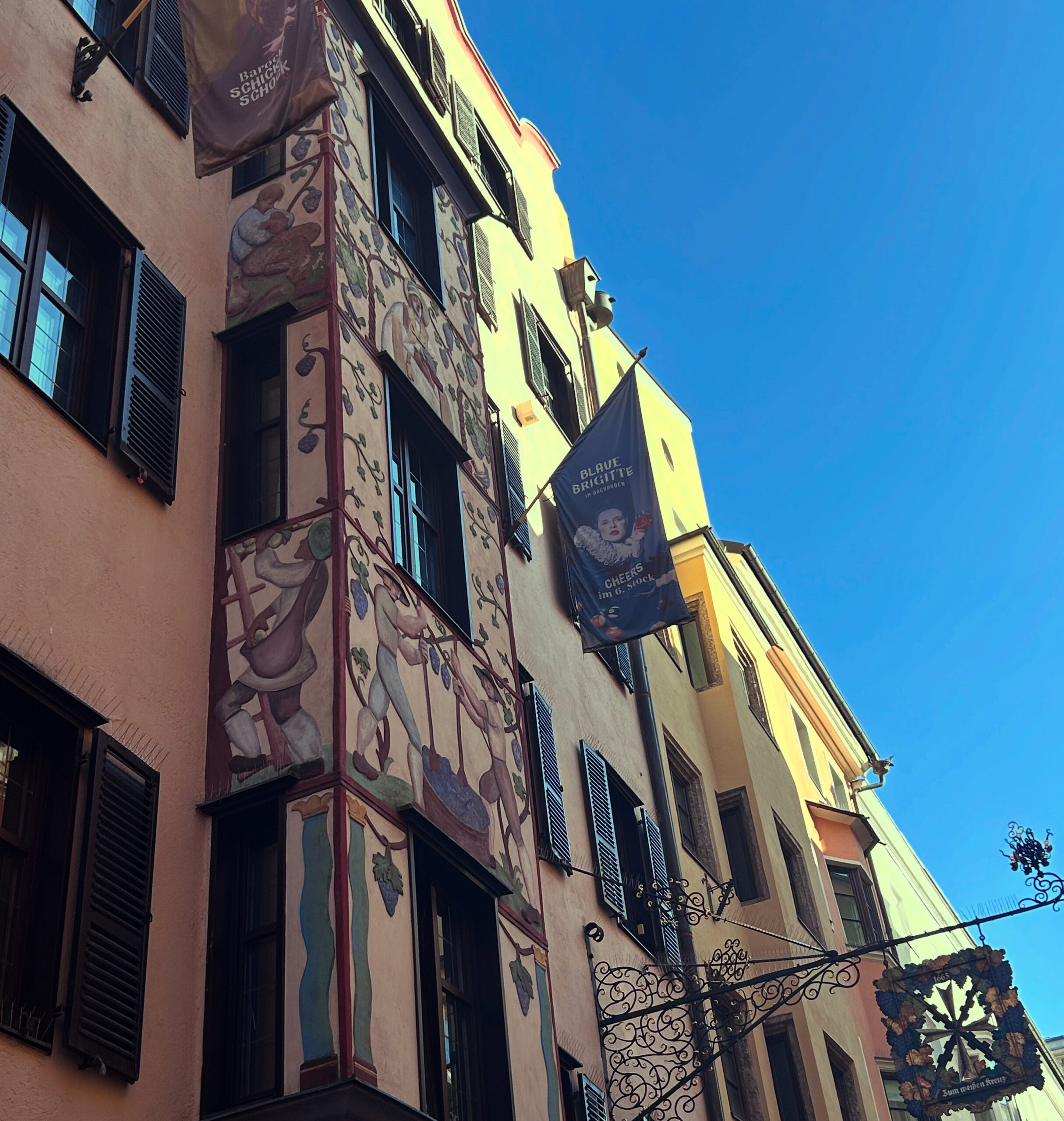
Due to many renovations to the interior, little remains of the old Gothic structure. In 1926, Rudolf Stolz gave the façade the striking plaster relief in the typical style of the interwar period, Tyrolean Modernism. The similarity with the painting on the opposite façade, which was completed only a short time later Weinhaus Happ is amazing. The typical bay windows of the old town are proudly adorned with grapevines and two winegrowers. St Urban, the patron saint of winegrowers and protector against drunkenness, watches over the scenery. The colourful painting blends in harmoniously with the old town and the street sign of the White cross on. Renovations were carried out again in 1952 and 2020. The pub was moved from the ground floor to the top floor. The bar Blue Brigitte im Dachgeschoss des sechsstöckigen Gebäudes zählt zu Innsbrucks beliebtesten Lounge Bars samt tollem Ausblick über die Dächer der Altstadt.
The Wallschen and the Fatti di Innsbruck
Prejudice and racism toward immigrants were and remain common practice in Innsbruck, as in all societies. Whether Syrian refugees since 2015 or Turkish guest workers in the 1970s and 80s, 'the foreign' usually generates little goodwill in the average Tyrolean. Today, Italy may be the favorite travel destination of Innsbruckers and pizzerias a part of everyday dining, but for a long time, our southern neighbors were the most suspiciously eyed population group. What Jews and Bohemian brickmakers ('Ziegelböhmen') were to the Viennese around 1900, the 'Wallsche' (Italians) were to the Tyrolean. The aversion to Italians in Innsbruck can look back on a long tradition. Although Italy did not exist as an independent state—instead, many small counties, city-states, and principalities between Lake Garda and Sicily shaped the political landscape, with individual regions also differing linguistically and culturally—people gradually began to see themselves as Italians over time and were perceived as such abroad. Most of those with whom Innsbruckers interacted belonged to the upper class, which automatically generated a certain resentment. During the Middle Ages and the Early Modern period, they resided in Innsbruck as members of the civil service, the court staff, bankers, wholesalers, or wives of various local rulers. The mutual dislike between 'Italians' and 'Germans' went both ways: one side viewed the other as dishonorable, unreliable, arrogant, vain, morally corrupt, and lazy; the other side viewed them as uncivilized, barbaric, uneducated, and 'pigs.' With the wars between 1848 and 1866, hatred of all things Italian reached a new peak in the 'Holy Land of Tyrol,' even though many 'Wallsche' served in the Imperial-Royal (k.u.k.) Army and the rural Italian-speaking Tyrolean population largely remained loyal to the monarchy. Italians—especially Garibaldi's troops—were considered godless insurgents and republicans, and were lambasted from church pulpits between Kufstein and Riva del Garda in both Italian and German. The Tyrolean press landscape played a major role in the conflict. The Innsbrucker Nachrichten, with a circulation of around 15,000 copies, was Tyrol's widest-reaching media outlet at the turn of the century; while it had no explicit political orientation, it was considered Pan-German liberal-leaning. On the Italian side, Cesare Battisti (1875–1916) stood out—he was later executed by hanging for high treason by the Austrian military during the war. The publicist and politician from Trento had begun studying at the German-language university in Vienna before transferring to the University of Florence. With a sharp pen in the two Italian newspapers Il Popolo and L’Avvenire, he repeatedly fueled the nationalities conflict within the country's borders. Thanks to his blend of socialist ideology and Italian patriotism, he was considered public enemy and traitor number one by many Tyroleans. Clubs and associations also played a supporting role in the hardening of positions. In 1867, not only were the press laws liberalized, but so was the right of association, triggering a genuine boom in new foundations. Sports clubs, gymnastics societies, theater groups, marksmen companies (Schützen), or the Innsbrucker Liedertafel often served not just for recreation, but as political front organizations. Student fraternities were particularly extreme. Facing them were the Italian-speaking students, who were inferior both in terms of numbers and organization. Due to the loss of Padua, Italian-descended Tyroleans no longer had the opportunity to complete university studies in their native language within the empire, leading many to orient themselves toward Innsbruck—where they met with little affection. One of the main political bones of contention between Italian- and German-speaking students was the opening of an Italian faculty or university. The discussion over whether to target a university in Trieste (the preferred location for Italian-speaking representatives), Innsbruck, Trento, or Rovereto played out over years. Although attending university was actually a matter for a small elite, irredentist, anti-Austrian-minded Tyrolean deputies from the Trentino were able to repeatedly inject emotional charge into the issue as a symbol for sought-after autonomy—given that by law, all language groups within the monarchy were to be treated equally after 1867. Pan-German nationalist politicians, such as Innsbruck Mayor Wilhelm Greil (who was repeatedly admonished by Tyrol's Imperial-Royal Governor for his improper conduct toward the Italian population), used the emotions surrounding the issue to whip up sentiment about impending 'foreign infiltration' (Überfremdung). Added to the ethnic and racial resentment toward their southern neighbors—especially among conservatives—was the fear of figures like Cesare Battisti, who as a socialist embodied living evil anyway.
Demographic data shows how inflated the fear of Innsbruck being "Italianized" by Trentino students actually was. As is so often the case, facts back then were replaced by gut feeling and racially motivated populism. After the incorporation of Pradl and Wilten in 1904, Innsbruck had just over 50,000 inhabitants. With slightly over 1,000 students, the student population accounted for less than 2%. Of the roughly 3,000 people of Italian descent—most of them Welschtiroler from the Trentino—only just over 100 were enrolled at the university. The vast majority of the Wallsche consisted of workers, innkeepers, merchants, and soldiers. Many had been living in and around Innsbruck for a long time. In the somewhat cheaper district of Wilten, a sort of Little Italy had emerged. Anton Gutmann sold Italian wines at his winery cooperative Riva at Leopoldstraße 30, while across the street one could eat well and affordably at Gasthaus Steneck. As subjects of the monarchy, most immigrants spoke excellent German; only a small fraction came from Dalmatia or Trieste and was genuinely foreign-speaking. The differences were socio-cultural. There were separate associations such as the Club Ciclistico and the Unione Ginnastica, socialist-oriented workers' and consumer organizations, music societies, and student fraternities. Although students made up only a small fraction among the Italian population, disproportionate attention was focused on them and their demand for an institute with Italian as the language of examination and instruction. After much back-and-forth, it was decided in September 1904 to establish a provisional faculty of law in Innsbruck. This was intended to separate the students without alienating either group. From the outset, however, the project was ill-fated. No one was willing to rent the necessary premises to the university. Finally, the enterprising builder Anton Fritz made an apartment available in one of his tenement buildings at Liebeneggstraße 8. At the inaugural lecture and the festive evening event at Gasthaus zum Weißen Kreuz on November 3, prominent figures such as Battisti and the future Italian Prime Minister Alcide De Gasperi were present. As the night wore on, the mood grew increasingly boisterous. When taunts such as "Porchi tedeschi" and "Abbasso Austria" ("German pigs" and "Down with Austria") were shouted, the situation escalated. A mob of German-speaking students armed with sticks, knives, and revolvers besieged the Weißen Kreuz, where the Italians—likewise largely armed—had barricaded themselves. A squad of Kaiserjäger successfully dispersed the initial turmoil, and several Italians were detained. In the process, the painter August Pezzey (1875–1904) was mistakenly fatally wounded by a bayonet thrust from an overly nervous soldier. Following the night's events, the Innsbrucker Nachrichten appeared on November 4 under the headline: "German Blood Has Flowed!". The reporter on site claimed that 100 to 200 revolver shots were fired by the Italians at the "host of German students," reporting Pezzey's death. News of what transpired sparked a wave of revenge acts and violence. Joining those who were politically motivated—as in any riot—were onlookers and rioters who simply enjoyed causing havoc under the cover of the crowd, without holding any genuine political convictions. While the detained Italians sang the martial song Inno di Garibaldi in the city's hopelessly overcrowded prison, severe riots broke out across the city against Italian establishments and businesses. The premises of Gasthaus zum Weißen Kreuz were completely devastated in monarchist fashion, leaving nothing intact except a portrait of Emperor Franz Joseph. Rioters threw stones at the residence of the already unpopular Governor at Palais Trapp because his wife had Italian roots. The building on Liebeneggstraße provided to the university by Anton Fritz was destroyed, as was his private home. Once the initial turmoil had settled, myth-making around the event began rapidly. August Pezzey, who hailed from a Ladin family and died in the chaos, was proclaimed a "German Hero" in a nationalistic frenzy by politicians and the press. He was given an honorary grave at Innsbruck's Westfriedhof cemetery. At his funeral, attended by thousands of mourners, Mayor Greil delivered a melodramatic speech:
"...A gloriously beautiful death was granted to you on the field of honour for the German people... In the fight against impudent acts of violence you breathed your last as a martyr for the German cause..."
Reports of the Fatti di Innsbruck reached the international press and contributed significantly to the resignation of the Austrian Minister-President Ernest von Koerber. Depending on the medium, Italians were portrayed either as dishonorable bandits or as courageous national heroes, while Austrians were depicted as pangermanist barbarians or as a bulwark against the “Welsch.” On 17 November, just two weeks after its ceremonial opening, the Italian faculty in Innsbruck was dissolved again. A university of their own remained denied to this linguistic group within Austria-Hungary until the end of the monarchy in 1918. The long tradition of viewing Italians as dishonorable and lazy was further intensified by Italy’s entry into the war in 1915 on the side of France and England. To this day, many Tyroleans continue to maintain negative prejudices toward their southern neighbors with great persistence.
Franz Baumann and Tyrolean modernism
The First World War not only brought states and ruling dynasties to an end; it also marked a turning point for art, music, literature, and architecture. In Innsbruck, a handful of planners transformed the cityscape during the two decades of the First Republic. Inspired by new design movements such as the Bauhaus style from Germany, skyscrapers from the United States, Italian Futurism, and Soviet Modernism from the revolutionary USSR, remarkable architectural projects emerged in Innsbruck. The best-known representatives of the avant-garde who introduced this new approach to shaping public space in Tyrol were Lois Welzenbacher, Siegfried Mazagg, Theodor Prachensky, and Clemens Holzmeister. Each of these architects had distinct characteristics, making the Tyrolean Modern Movement (Tiroler Moderne) difficult to define precisely. Their common feature was a departure from the classical architecture of the pre-war era while retaining typical Alpine materials and architectural elements, following the principle of “Form Follows Function.” In a 1920 article for the magazine Tiroler Hochland, Lois Welzenbacher wrote about the architecture of his time:
"As far as we can judge today, it is clear that the 19th century lacked the strength to create its own distinct style. It is the age of stillness... Thus details were reproduced with historical accuracy, mostly without any particular meaning or purpose, and without a harmonious overall picture that would have arisen from factual or artistic necessity."
The most prominent and visually influential representative of the so-called Tyrolean Modern Movement in Innsbruck was Franz Baumann (1892–1974). Unlike Holzmeister or Welzenbacher, he never received an academic education. Baumann was born in Innsbruck in 1892, the son of a postal official. His religious education teacher, the now controversial theologian and writer Anton Müller, known by the pseudonym Brother Willram, recognized the young Franz Baumann’s talent for drawing and enabled him to attend the Imperial-Royal State Trade School (k.k. Staatsgewerbeschule) at the age of fourteen. There he met his future brother-in-law Theodor Prachensky, who would also play a significant role in his professional life. During his school years, Baumann gained practical experience as a bricklayer with the construction company Huter & Söhne and began producing landscape drawings around Innsbruck together with his sister Maria and Prachensky. In 1910, Baumann followed his friend to Merano to take up employment with the renowned construction firm Musch & Lun. The former Tyrolean capital was then the most important tourist destination in Tyrol, attracting an international clientele of spa visitors. Under Adalbert Erlebach, who would later play a key role in the development of Hungerburg, Baumann gained his first experience in planning large-scale projects such as hotels and cable cars. Important for his later career was not only his technical education but also his first encounters with the Tyrolean Heritage Protection Association (Tiroler Heimatschutzverband). Kunibert Zimmeter had founded this organization together with Gotthard Graf Trapp. Since building regulations were a provincial matter, the Tyrolean Heritage Protection Association, together with the district authorities, acted as the final authority responsible for evaluating and approving construction projects. In many Tyrolean villages, hotels had replaced churches as the largest buildings in the local skyline. The aim was to prevent tourism and industrial developments from overwhelming traditional village character. In Our Tyrol: A Homeland Protection Book, Zimmeter wrote:
"Let us look at the flattening of our private lives, our amusements, at the centre of which, significantly, is the cinema, at the literary ephemera of our newspaper reading, at the hopeless and costly excesses of fashion in the field of women's clothing, let us take a look at our homes with the miserable factory furniture and all the dreadful products of our so-called gallantry goods industry, Things that thousands of people work to produce, creating worthless bric-a-brac in the process, or let us look at our apartment blocks and villas with their cement façades simulating palaces, countless superfluous towers and gables, our hotels with their pompous façades, what a waste of the people's wealth, what an abundance of tastelessness we must find there."
After four years, Baumann’s career was abruptly interrupted. Like most of his generation, the First World War tore him away from both work and everyday life. While serving on the Italian Front, he suffered a gunshot wound to the abdomen and recovered in a military hospital in Prague. During this otherwise inactive period, he painted cityscapes depicting buildings in and around Prague. These urban views, which later helped him visualize architectural designs, were exhibited at his only exhibition in 1919. His breakthrough in construction came the following year. Baumann unexpectedly won the competitions for the renovation of the Weinhaus Happ in Innsbruck’s Old Town and for the Nordkette Cable Railway. Besides his creativity, his success stemmed from the alignment between his architectural philosophy and the requirements of both the Tyrolean Heritage Protection Association and the public tenders issued by the young First Republic. In the economic upswing of the late 1920s, a new class of customers and visitors emerged in tourism. The aristocratic distance toward the mountains had given way to a middle-class enthusiasm for sports. No longer were grand hotels built at elevations of 1,500 meters for health resorts; instead, functional infrastructure for skiers in high alpine terrain, such as on the Nordkette, was constructed. Buildings were expected to blend harmoniously into their surroundings while remaining attractive and practical. Despite the social and artistic innovations of the era, architects still had to take regional character into account. This was precisely where Baumann’s approach to holistic building in a Tyrolean context excelled. From exterior lighting to furniture, Baumann designed even the smallest details and integrated them into his overall concept of the Tyrolean Modern Movement. Every technical function and detail, as well as environmental conditions, topography, and sunlight, played a role for him. Although he was officially not permitted to use the professional title of architect, he followed the principles outlined by architect Adolf Loos (1870–1933) in his essay Rules for the Person Building in the Mountains:
Don't build picturesquely. Leave such effects to the walls, the mountains and the sun. The man who dresses picturesquely is not picturesque, but a buffoon. The farmer does not dress picturesquely. But he is...
Pay attention to the forms in which the farmer builds. For they are ancestral wisdom, congealed substance. But seek out the reason for the mould. If advances in technology have made it possible to improve the mould, then this improvement should always be used. The flail will be replaced by the threshing machine."
Beginning in 1927, Baumann operated his own studio on Schöpfstraße in the Wilten district. At the height of its success, his office employed fourteen staff members. Time and again, his professional path crossed with that of his friend and brother-in-law Theodor Prachensky. Together, beginning in 1929, they planned the new secondary school in Hötting on Fürstenweg. Although separate wings for boys and girls still had to be included according to contemporary conventions, the building otherwise fully embodied the style of New Objectivity (Neue Sachlichkeit) and the principle of “Light, Air, and Sun.” Thanks to his modern approach, which combined functionality, aesthetics, tradition, and economical construction, Baumann weathered the economic crisis that began in the late 1920s relatively well. It was only the 1,000-Mark Blockade, imposed by Hitler on Austria in 1933 in an attempt to place financial pressure on the Republic, that caused serious problems for his architectural practice. Not only did unemployment in the tourism sector triple within a short period of time, but the construction industry also entered a severe downturn. In 1935, Baumann became head of the Central Association of Architects, after receiving a special exemption allowing him to use the professional title of architect despite lacking a formal academic qualification. With Austria’s annexation by Germany in 1938, he quickly joined the National Socialist German Workers’ Party (NSDAP). On the one hand, like his colleague Lois Welzenbacher, he may have been sympathetic to certain ideas of National Socialism. On the other hand, membership enabled him to advance his career as chairman of the Reich Chamber of Fine Arts in Tyrol. In this position, however, he repeatedly opposed the radical alterations to Innsbruck’s cityscape that the Nazi authorities wished to implement. Innsbruck’s mayor, Egon Denz, wanted the Triumphal Arch and St. Anne’s Column removed in order to create more space for traffic in Maria-Theresien-Straße. At that time, the city center still served as the principal traffic route connecting the Brenner Pass in the south with the federal highway leading east and west along what is now the Innrain. A statue of Adolf Hitler was intended to replace St. Anne’s Column. Gauleiter Franz Hofer also planned to have the towers of the Court Church blown up. In his official capacity, Baumann assessed both projects negatively. When the matter eventually reached the desk of Albert Speer, Speer agreed with Baumann’s assessment. From that point onward, Gauleiter Hofer no longer awarded Baumann any public projects. However, this courageous stance probably spared him more serious consequences after the war. After being questioned during the denazification process following the war, Baumann began working in the municipal building department, likely also on the recommendation of his brother-in-law Theodor Prachensky. Although Baumann was fully exonerated, partly due to testimony from the abbot of Wilten, whose church towers he had helped save, his reputation as an architect could no longer be fully restored. Another setback was the destruction of his studio on Schöpfstraße, which was hit by a bomb in 1944. In his postwar career, Baumann became responsible for the restoration of buildings damaged during the war. Under his supervision, the Boznerplatz and its Rudolf Fountain were rebuilt, while the Burggraben area and the New City Halls (Neue Stadtsäle) behind the Tyrolean State Theatre were redesigned. Franz Baumann died in 1974. Today, his paintings, sketches, and drawings are highly sought after and command substantial prices on the art market. Anyone who carefully examines more recent large-scale projects in Innsbruck, such as the City Library, the PEMA Towers, and many of the city’s residential developments, can still recognize elements of the Tyrolean Modern Movement today.
Siegmund der Münzreiche
Auf den Landesfürsten Friedl mit der leeren Tasche folgte sein Sohn Siegmund der Münzreiche (1427 – 1496). Der Start des jungen Mannes an der Spitze des Landes war holprig. Als sein Vater starb, war Siegmund erst 12 Jahre alt. Deshalb nahm ihn sein Onkel Friedrich III., der Kaiser of the Holy Roman Empire und Vater Maximilians I., in unfreiwillige Obhut und Vormundschaft. Man könnte sagen, Siegmund startete seine Karriere als Geisel des Kaisers, seines eigenen Vetters. Tirol war mittlerweile eine reiche Grafschaft, die direkte Kontrolle darüber wollte der Kaiser nur ungern aufgeben. Der Tiroler Landtag hatte zwischenzeitlich die Regierungsgeschäfte in Ermangelung eines Landesfürsten übernommen und damit politisches Gewicht bewiesen. Erst als die Landstände gegen diese Bevormundung protestierten, konnte Siegmund sein Amt antreten. Mit 18 Jahren zog er in Innsbruck ein, um seine Karriere als CEO Tirols zu starten. Unter seiner Ägide kam es zu vielen Innovationen auf der einen Seite, zu einem aufgeblähten und teuren Hofstaat auf der anderen. In Innsbruck und Umgebung zog das städtische Leben neues Handwerk an. 1453 eröffnete in der heutigen Universitätsstraße die Landesfürstliche Silberschmelze. 1484 ließ Siegmund die Münzprägeanstalt von Meran in Südtirol nach Hall verlegen, was ihm den Beinamen Siegmund der Münzreiche brought in. Two years later, a princely mill was built on the Sill Canal, which was to form the basis for the early industrialisation that developed in the following years. He issued the Schwaz mountain regulations, die zum Vorbild für alle Bergwerke der Habsburger werden sollte. Den Bergbeamten wurden, ähnlich den Universitäten, mehr Rechte innerhalb ihres Wirkungsbereiches gegeben. Für die Bergarbeiter gab es Sonderregelungen innerhalb der Gesellschaft, waren sie doch heiß begehrte Arbeitskräfte. Man kann von einer frühen sozial- und arbeitsrechtlichen Vereinbarung sprechen. Die Bergleute arbeiteten hart, verdienten aber verhältnismäßig gut. Dasselbe galt für die Prägeanstalt und die Haller Salinen. Eine frühe Form bürgerlicher Mittelschicht begann sich durch diese Möglichkeiten am Arbeitsmarkt herauszubilden.
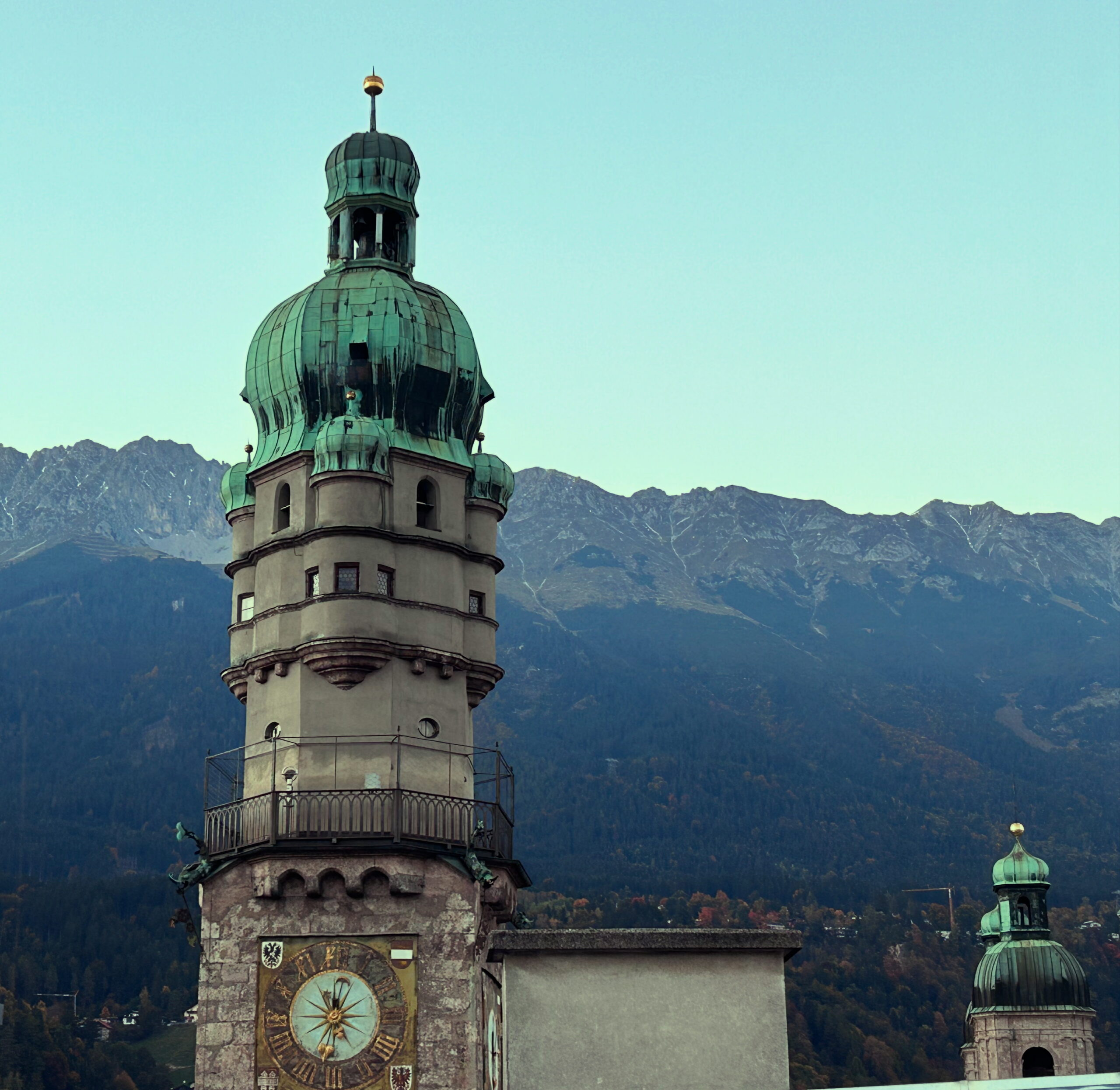
During his opulent reign, Innsbruck had become a centre of attraction for craftsmen, goldsmiths and artists. The immigrants often came from the aristocracy and did not want to give up their lifestyle in Innsbruck. A special form of metal industry established itself in Mühlau. Plattner schufen Rüstungen und Harnische für Adelige, die sich sowohl auf Kriegszügen wie auch auf Turnieren standesgemäß präsentieren wollten. Siegmund war ihr bester Kunde. Er kaufte etliche Turnierharnische für sich selbst und als anerkennende Geschenke für Aristokraten ausländischer Höfe und Ehrengäste. Die Werkstätten am Mühlaubach wurden zu den führenden Betrieben ihrer Art weltweit. Erst im 17. Jahrhundert kamen die reich verzierten Rüstungen aus der Mode. Der Stadtturm beim Alten Rathaus als Ausdruck des städtischen Wohlstands und erste Teile der Hofburg wurden unter Siegmund erbaut. Ein Glasmaler siedete sich in Innsbruck an. Dieses Mäzenatentum war wohl auch ein wenig Kompensation für Siegmunds Eheleben. Er hatte in seinen ersten Jahren als Landesfürst Eleonore von Schottland (1433 – 1480), die optisch wenig attraktive 16 Jahre alte Tochter Königs Jakob aus dem Hause Stewart, geheiratet. Die Ehe sollte ohne Kinder bleiben, dafür aber kulturell umso fruchtbarer sein. Die Hofbibliothek wuchs im Gleichschritt mit Siegmunds und Eleonores humanistisch gelehrten Gästen. Beide galten als kunstsinnig und literarisch interessiert. Bücher waren in der Zeit vor der Erfindung des Buchdrucks ein teures Hobby. Auch fahrendes Volk und Schausteller waren am Hof gerne gesehen, um die einheimischen und internationalen Gäste zu unterhalten.
During his opulent reign, Innsbruck became a magnet for craftsmen, goldsmiths, and artists. Many of the immigrants came from aristocratic backgrounds and did not wish to abandon their lifestyle upon settling in Innsbruck. In Mühlau, a special form of metalworking industry took hold. Armorers produced suits of armor for nobles who wanted to present themselves appropriately on military campaigns as well as at tournaments. Sigismund was their best customer. He purchased numerous tournament armors for himself and as tokens of appreciation for aristocrats from foreign courts and distinguished guests. The workshops along the Mühlau stream became the leading enterprises of their kind worldwide. Only in the seventeenth century did the richly decorated armors fall out of fashion. The city tower next to the Old Town Hall, as an expression of urban prosperity, and the first parts of the Hofburg were built under Sigismund’s rule. A glass painter settled in Innsbruck. This patronage was perhaps also a form of compensation for Sigismund’s married life. In his early years as territorial prince, he married Eleanor of Scotland (1433–1480), the sixteen-year-old, physically rather unattractive daughter of King James of the House of Stewart. The marriage would remain childless, but culturally it proved all the more fruitful. The court library grew in step with the humanistically educated guests welcomed by Sigismund and Eleanor. Both were considered artistically inclined and interested in literature. Books were an expensive hobby in the era before the invention of printing. Traveling performers and entertainers were also welcome at court, helping to amuse domestic and international guests. Sigismund’s opulent lifestyle cost him not only a great deal of money but also political reputation—and ultimately, probably, his princely throne. In his second marriage, he wed Catherine of Saxony (1468–1524), a lady from a high-ranking princely electoral house. It was likely due to the influence and courtly expenditures of Sigismund and his two wives that the Coin-Rich’s expenses eventually exceeded income from taxes, salt works, and mines. At the princely wedding in 1484, the bride’s procession alone consisted of fifty-four wagons. Guests had to be housed and fed in Innsbruck. Even with a wife forty years his junior, the now senile Sigismund was not granted a male heir—an especially bitter fact considering the thirty illegitimate children attributed to him. At the same time, conditions grew harsher for those unable to keep pace with the city’s new rhythm of life. At that time, Innsbruck had approximately 2,000 citizens. Sigismund’s court comprised 500 people, not including his wife’s household. These “outsiders” attracted considerable attention in Innsbruck. The gap between social classes widened, and the estates grew concerned about the strained state finances. By the end of his reign, Sigismund’s court had become excessively bloated and costly. A lost war against the Swiss Confederates obligated him to make payments, and a conflict with Venice also ended unfavorably. Sigismund was forced to mortgage Habsburg possessions in Alsace and the present-day Breisgau to Charles the Bold of Burgundy, the future father-in-law of Maximilian I. He sold the Austrian Forelands to the Duchy of Bavaria at a bargain price and pledged the Tyrolean silver mines to Jakob Fugger. The Bavarian Wittelsbachs sought to regain control of Tyrol through an inheritance treaty with the age-related mentally diminished Sigismund. Only imperial pressure and the swift intervention of the Tyrolean Estates and Maximilian made it possible for the country to remain in the hands of the House of Habsburg. In 1490, Maximilian assumed the office of territorial prince, even though Sigismund was still alive. This reunited all Habsburg hereditary lands under one ruler. Sigismund was not the most successful ruler Tyrol ever had, but thanks to his clearly visible contributions to Innsbruck’s cultural rise, he continues to enjoy a measure of respect in popular memory.
Crown Prince Rudolf & the mores of the upper class
The smart and liberal Crown Prince Rudolf (1858–1889) was considered the favorite of the peoples of the Habsburg Empire. In many respects, his life can be read as exemplary for the period between 1848 and the outbreak of the First World War—a time when technical ideas developed at a breakneck pace, newspapers distributed the political ideas of various factions in unprecedented circulation, and yet Catholicism, superstition, and spiritism were commonplace. The vast majority of Innsbruck's citizens did not possess the material means or status of a Habsburg, but the fashions and trends under which they lived were the same. The bourgeoisie aspired to the same ideals as the Crown Prince, just as Rudolf always saw himself as part of this bourgeoisie. He was regarded as a well-read, educated humanist and, completely in tune with the spirit of the times, was interested in a wide spectrum of topics. In his role as a member of the ruling house of a multinational empire, he spoke French, Hungarian, Czech, and Croatian in addition to Greek and Latin. As a private individual, he dedicated himself to science and traveling through the lands of the monarchy. Rudolf initiated the publication of the Kronprinzenwerk (The Crown Prince's Work), a scientific encyclopedia; Volume 13, which covered the crown land of Tyrol, was published in 1893. He also authored liberal articles in the Neues Wiener Tagblatt under a pseudonym. Among other things, he wished to push forward land reforms by heavily taxing large landowners, and he wanted to grant more rights to the individual nationalities within the Habsburg Empire. He was extremely unpopular, particularly in conservative, rural Tyrol and among the military. Conversely, among the liberal-minded citizens of Innsbruck, he was seen as the hope for a renewal of the monarchy in the sense of a modern, federal state. Although the Rudolfsbrunnen (Rudolf's Fountain) on Boznerplatz in Innsbruck does not actually commemorate the Crown Prince, he was present at its inauguration. As a champion of rationalism and the Enlightenment, Rudolf despised the widespread belief in supernatural beings and spirits, even as new churches sprouted like mushrooms all around him and the upper class indulged in seances and spiritist superstition. The popular piety of the late monarchy led to major projects such as the parish churches of St. Nikolaus and Hötting.
Despite, or perhaps because of his aristocratic background, Rudolf's private life was turbulent, but not atypical of the time, in which parents and teachers were less approachable educators and more distant figures of respect. Children were brought up strictly. Neither teachers nor parents shied away from corporal punishment, even if there were limits, laws and rules for the use of domestic violence. Militarism and a focus on future gainful employment prevented the kind of childhood and youth we know today. Young men from the upper classes lived out their soldierly daydreams as armed and uniformed members of student fraternities. It is no wonder that the enthusiasm for war, God, Emperor and Fatherland was great in the birth cohorts of the last decades of the 19th century. Rudolf's early years, when he had to undergo a military education under General Gondrecourt at the request of Emperor Franz Josef, were also less than luxurious. It was only after his mother Elisabeth intervened that harassment such as water cures, drill in the rain and snow and being woken up with pistol shots were removed from the six-year-old crown prince's daily programme.
Like many of his contemporaries, Rudolf found himself as a member of the upper class trapped in an unhappy, arranged marriage. The 19th century was not the age of love matches, even if the Romantic and Biedermeier eras are often fondly glorified as such. Marriages among farming folk were frequently concluded based on financial considerations. Aristocrats and members of the high bourgeoisie married out of class snobbery and with the goal of preserving the dynasty. In upper-class circles, wives were often mere ornaments to their husbands and heads of the household. Only after the—often older—husband had passed away could widows enjoy their lives outside of this role. For a long time, servants, housemaids, farmhands, and maids were forbidden from marrying. The danger that those without assets would be unable to feed their children, thereby becoming a burden on the public, was deemed too great by the municipalities. This double standard held by the aristocracy and bourgeoisie toward the common folk (Pofl) meant that illegal abortions, full orphanages, and children growing up with relatives in the countryside instead of with their parents were a part of everyday reality. Throughout his life, Rudolf was also not averse to the fair sex outside of marriage. In the final months of his life, he maintained an affair with Mary Vetsera, a girl of only 17 from the wealthy Hungarian nobility who was considered exceptionally beautiful. Many of his subjects acted just as Rudolf did. Granted, hardly anyone could boast of claiming a Hungarian aristocrat as a mistress. Yet, even in Innsbruck's high society, it was common practice to listen to the priest’s sermon from the pulpit on Sundays while simultaneously maintaining an extramarital relationship or visiting a brothel.
Rudolf's life ended tragically. On January 30, 1889, deeply depressed and ravaged by alcohol, morphine, and gonorrhea, Rudolf met with Vetsera, having spent the previous night with his long-term mistress, the prostitute Maria "Mizzi" Kaspar. Under circumstances that have never been fully cleared up, he first killed the young woman and then himself with a shot to the head. The suicide was never recognized by the Habsburg family. Zita (1892–1989), the widow of the last Emperor Karl, was still speaking of an assassination plot as late as the 1980s. The debate surrounding the burial of the heir to the throne and his mistress exposed the double standards of society. Suicide was considered a grave sin and technically precluded a Christian burial. Vetsera was buried discreetly in a small grave by the cemetery wall at the cemetery in Heiligenkreuz near Mayerling, whereas Rudolf, following imperial intervention with the Pope, received a state funeral and was laid to his final rest in the Imperial Crypt (Kapuzinergruft) in Vienna.