Haymon Giant Inn
Haymongasse 4
Worth knowing
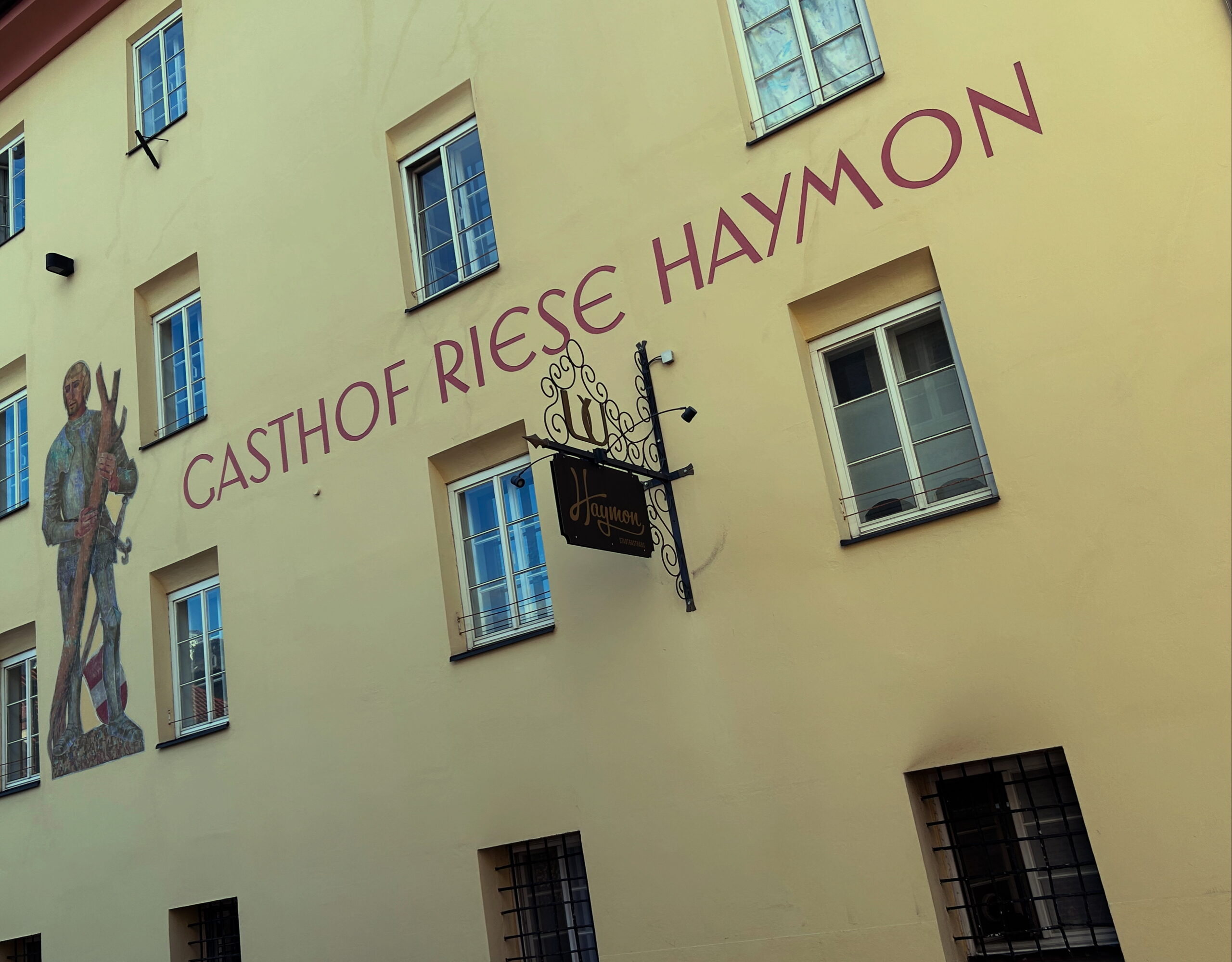
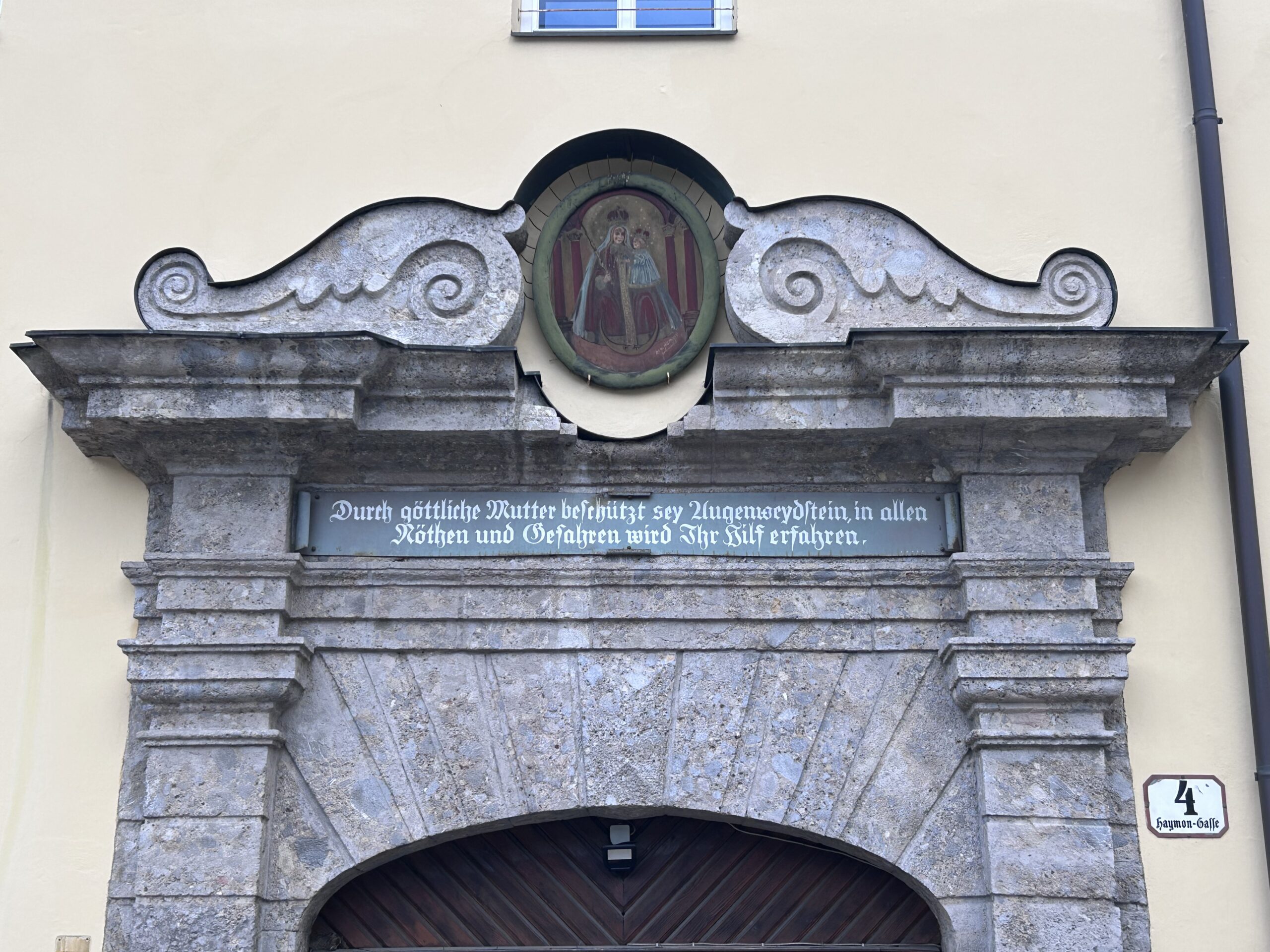
The inn “Gasthaus zum Riesen Haymon” is a fixed and defining part of Wilten. When examining the development of this traditional establishment, one can trace the history of the district from the Middle Ages to the present day. Unlike the Golden Eagle or the White Cross, the Haymon did not emerge in the early modern period as an inn for travelers and merchants. For a long time, a farmhouse stood on this site—one of the many agricultural properties under the rule of the Abbot of Wilten. In the 15th century, the building was expanded in the Gothic style, and the mighty cross vaults inside still bear witness to this today. In 1679 the Counts of Lodron transformed the farmhouse into the manor “Augenweidstein.” The stone entrance gate is a remnant of this expansion. A votive image of the Blessed Virgin, venerated in Wilten since late antiquity, offers visitors a pious blessing in the Baroque style of the time:
„Protected by the divine mother, Augenweydstein will be helped in all hardships and dangers.“
It was not until 1840 that a tavern opened in the Augenweidstein manor. At that time, many property owners from the aristocracy found both the need and the opportunity to turn their real estate into profitable businesses in the hospitality and leisure industries or to lease them out as inns. South of the monastery, an establishment had already existed since the 17th century—today’s Bierstindl. As the city grew, the number of holiday visitors on church feast days and walkers on the Bergisel increased, making it possible for a second inn to thrive. Twelve years later, Johann Gruber purchased the Haymon at auction and operated it under the approval of the Abbot of Wilten. To make use of the space in the former palazzo, several of the many rooms were rented out as apartments, as shown by a lodging advertisement in the 1857 issue of the Innsbrucker Nachrichten:
„Im Gasthause zum Haymon Nr. 6 in Wilten… zwei schöne Quartiere im 3. Stock, jedes mit drei heizbaren Zimmer, Küche und Speisgewölbe, Holzhütten und Waschkuceh-Antehei, Estrichkammer… zu vermiethen.“
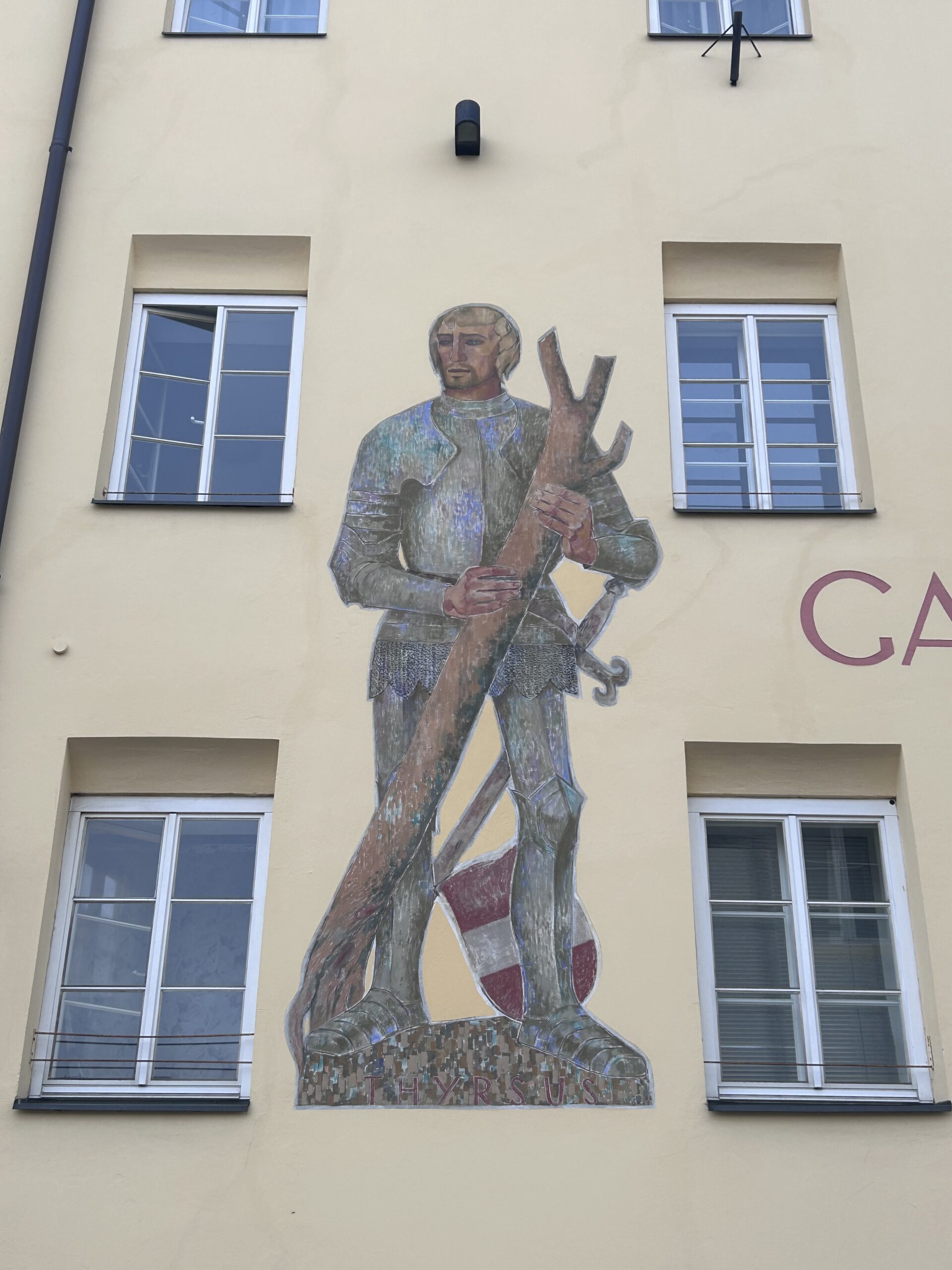
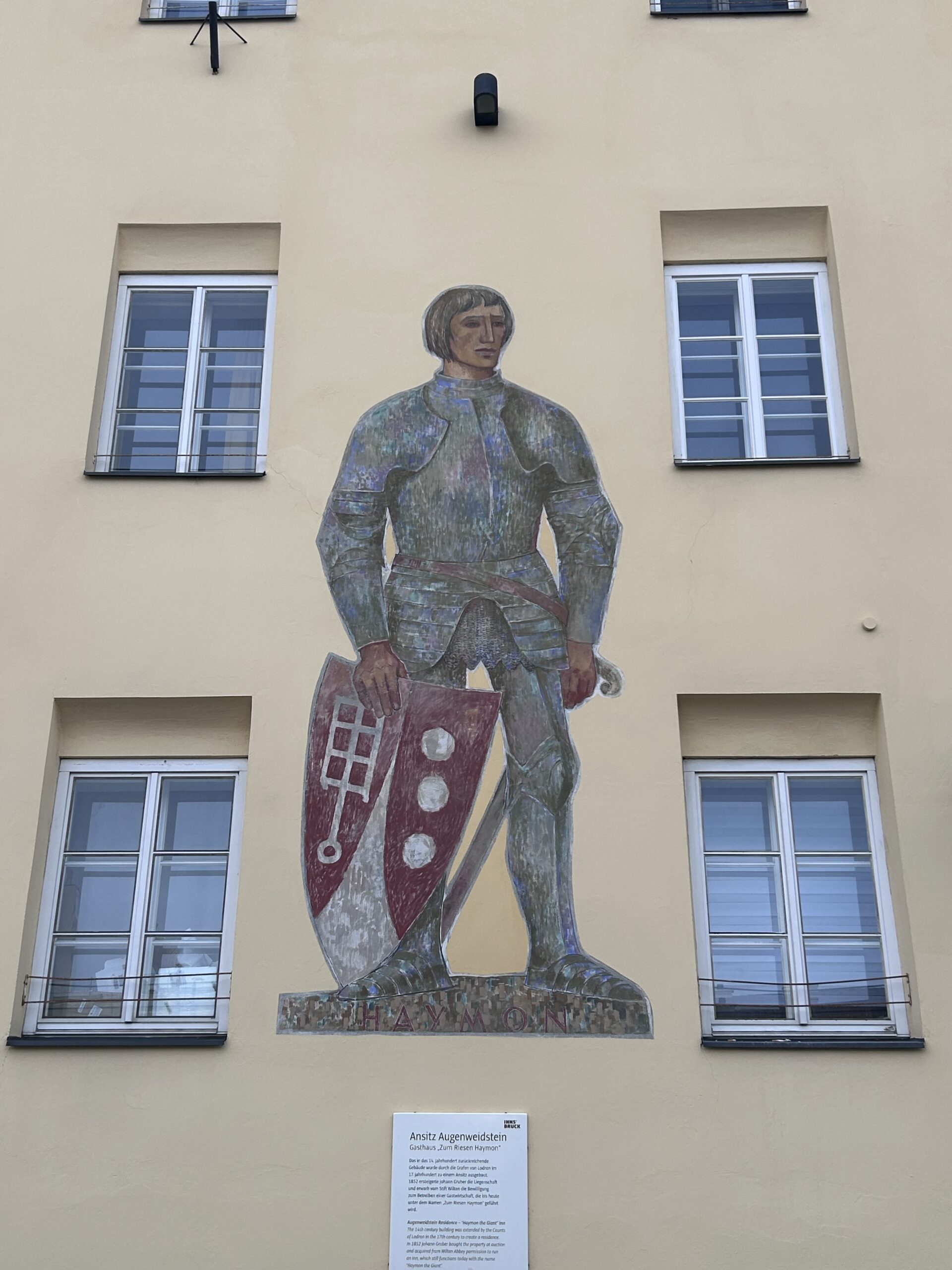
In the following decades, the inn frequently changed owners and tenants. What remained stable—and survived even the end of the monarchy—was its popularity among the Innsbruck bourgeoisie as well as its close connection to the Wilten Abbey and, by extension, to conservative political associations and affiliated organizations. During the economically difficult interwar years, these two factors were essential for the business’s survival. The Haymon housed the Catholic youth club of Wilten. Associations and institutions such as the Archduke Karl Ludwig Veterans’ Association, the Tyrolean Homeland Society, the Wilten Riflemen, and Catholic student fraternities like Cimbria chose the inn as their meeting place. On its house stage, plays with politically fitting themes and telling titles such as “One’s Own Blood” were performed. During the years of Austrofascism under Chancellors Dollfuß and Schuschnigg, the local chapter of the Fatherland Front—the unified political party—held consultations at the Haymon and organized lectures for groups such as the Maternity Protection League. As part of the church-political network, the Haymon accommodated visiting members of the Homeland Defense during events and parades. Between 1938 and 1945, the inn also remained connected to the Church. While Catholic associations and monasteries were dissolved immediately after the Nazi takeover, the Gasthaus zum Riesen Haymon initially persisted as a thorn in the side of the anti-clerical regime. The innkeeper Heinrich Pfeifer lost his license only after several reports accusing him of “political unreliability,” including his refusal to decorate the house for the Führer’s birthday. After the war, this led to a trial before the Innsbruck People’s Court between Pfeifer and the former block warden who had denounced him. Such cases occupied prosecutors and judges to a large extent during the denazification process. Business at the Haymon soon recovered. During the years of economic growth in the 1950s, the inn was able to flourish again. The chestnut garden, the cozy dining rooms, and the traditionally Austrian dishes served there met the Innsbruck population’s longing for the “good old days.” The newly designed exterior also fit this nostalgia. The large-scale façade paintings by Raimund Wörle (1896–1979), created in 1956, depict Thyrsus and Haymon—two knights who, according to legend, are tied to the founding of the Wilten Abbey. The post-war representation of these legendary figures is particularly interesting. Wörle, who had received instruction from the well-known painter Rafael Thaler during his school years at the Innsbruck State Trade School, had been a member of the Innsbruck Secession before the war. The shimmering armor of the two figures and the cubist rendering of their faces reflect late influences of Art Nouveau. Next to Thyrsus, who holds a tree trunk—said to be a native Tyrolean slain in single combat by the northern immigrant Haymon—stands the Austrian coat of arms. Although Thyrsus is still portrayed as a blond giant, he now has Austrian nationality. Germanic he was meant to appear, but after the years of National Socialism he was no longer necessarily to be associated with “German” identity. When business declined in the 1990s and the inn closed its doors, residents of Innsbruck collected signatures to preserve the Riese Haymon. After several changes of tenants and various culinary concepts, people can once again enjoy traditional Austrian cuisine within the old walls of the Wiltener Oberdorf.
Thyrsus, Haymon and the Bavarians
After the disappearance of the Western Roman Empire and its associated administrative structures, Germanic tribes took control of the territory of what is now Innsbruck. In North Tyrol, between the rule of the Imperium Romanum and that of Emperor Charles (748–814)—that is, during the period known as the Migration Period, Late Antiquity, or the Early Middle Ages—a whole range of different peoples were active. Alongside the Romanised Breones, Goths, Lombards, Bavarians (Bajuwarians), Suebi, and Slavs settled in the regions north of the Brenner Pass, living alongside, behind, and intermingled with one another. In the central Inn Valley, the Bavarians were able to establish themselves as the dominant regional power. Although the Roman fort of Veldidena was destroyed during the process of settlement, the transition for the Breonic‑Romanised population was probably less sudden and violent than gradual and fluid. The Bavarians were not barbaric destroyers; rather, they had been in contact with the Roman world for centuries in one form or another. Armed conflict was likely the exception. Over time, the cultures merged during a period in which political authority was relatively loose in nature. The everyday spoken language was a form of Germanic, while Latin had already established itself early on as the written language. The most important legacy of Rome—and soon a unifying element—was Christianity. From the 8th century onward, the Bavarians were Christianised. Under Emperor Charles, the “barbarian” Bavarians became Christian dukes of Bavaria, and with them the Inn Valley became part of the Holy Roman Empire, which extended over large parts of Central Europe and northern Italy. In administration, they relied on the church structures inherited from the Romans, as clerics were often the only literate members of society. Instead of the regional magistrates of the Roman emperors, an armoured aristocracy now ruled as feudal lords of the Frankish king Charles, anointed by the Pope, governing in God’s name over subjects who continued—largely undisturbed—to toil in agriculture. The Christian Church Father Paul had laid the theological foundation for this system in his Letter to the Romans:
Let everyone be subject to the governing authorities, for there is no authority except that which God has established. The authorities that exist have been established by God. Consequently, whoever rebels against authority is rebelling against what God has instituted, and those who do so will bring judgment on themselves. For rulers hold no terror for those who do right, but for those who do wrong. Do you want to be free from fear of the authority? Then do what is right and you will be commended. For the one in authority is God’s servant for your good. But if you do wrong, be afraid, for rulers do not bear the sword for no reason. They are God’s servants, agents of wrath to bring punishment on the wrongdoer. Therefore, it is necessary to submit to the authorities, not only because of possible punishment but also as a matter of conscience. This is also why you pay taxes, for the authorities are God’s servants, who give their full time to governing.
Culturally, Christianity in the Alpine region proved adaptable to existing traditions and customs. Christian martyrs and saints replaced pagan polytheism. Ancient festivals such as the winter solstice, harvest celebrations, or the beginning of spring were integrated into the Christian calendar and replaced by Christmas, All Saints’ Day, and Easter. Popular legends surrounding miraculous plants, ominous mountain peaks, magical beings such as the Salige Fräulein, enchanted kings, and other mythical figures could continue to be revered alongside Christianity without difficulty.
Two of the most popular legendary figures in Innsbruck to this day play the central roles in the foundation myth of Wilten Abbey. An extraordinarily strong knight, known as the giant Haymon, travelled to Tyrol at some point between Late Antiquity and the Early Middle Ages. There he encountered the long‑established giant Thyrsus of Seefeld. While the Germanic Haymon was equipped in modern fashion with sword and shield, Thyrsus—who bore a Romanised name but is portrayed in legend as a wild Alpine inhabitant—had only a tree trunk as his weapon. As fate would have it, the sword struck down the wooden club, and Thyrsus lay slain on the ground in his own blood. Filled with remorse over his deed, Haymon converted to Christianity and was baptised by the Bishop of Chur. Instead of constructing a military fortress as originally planned, the repentant warrior built a monastery on the ruins of the Roman fort of Veldidena. Despite his newfound piety, his time of heroic deeds was not yet over. In the nearby Sill Gorge there dwelled a fearsome dragon that not only devastated the new construction every night but also made meaningful settlement of the region impossible. Haymon slew the monster, cut out its tongue, and bequeathed it to his own foundation. After his career as a dragon slayer, Haymon handed the monastery over to the Benedictine monks from Tegernsee and himself entered the order as a lay brother. The people of the region were so grateful to the giant for liberating them from the dragon that they willingly placed themselves under the tithe‑paying protection of Wilten Abbey, cultivating the formerly wild land as farmers. And the moral of the story? Haymon represents the initially violent but later noble and benevolent Germanic settlers; Thyrsus stands for the brave and wild, yet ultimately defeated inhabitants of the region between the Seefeld Plateau and the Brenner Pass. The dragon symbolises the evil, destructive, and unchristian paganism that is eradicated by the converted German. The monastery brothers—richly endowed by the valiant knight—are the organising force without which nothing would function. Over the centuries, the Haymon legend and its moral proved just as flexible as Christianity itself during its introduction in Late Antiquity. At times, Haymon was portrayed as a nobleman from the Rhine who came to Tyrol after the death of Charlemagne; at other times, he appeared as a follower of the Ostrogothic king Theoderic—better known as Dietrich of Bern—travelling between Ravenna and Germany. From the Middle Ages until the 19th century, the focus lay on Haymon’s conversion, the protection of the peasant subjects by Christian knighthood, and the foundation of the monastery, all serving to legitimise the benevolent feudal system. In an article in the Innsbrucker Nachrichten of 2 October, however, the author Dr Franz Wöß almost entirely set aside the Catholic aspect of the monastery’s construction and instead emphasised the heroic German element, before turning to the healing properties of Thyrsus oil, which the farmers of Seefeld had extracted from oil‑bearing shale stones since the Middle Ages. In this version of the legend, after his heroic deeds Haymon withdrew into the wilderness of Seefeld as a hermit rather than ending his life as a cleric at Wilten Abbey. After the Second World War, there was once again a desire to distance oneself as much as possible from Germanic identity. The mural created in 1956 on the façade of the “Gasthaus zum Riesen Haymon” depicts the defeated Thyrsus, bearing the Austrian coat of arms—entirely in keeping with the post‑war victim narrative.
Denunciation before the Innsbruck People's Court
Published: Tiroler Tageszeitung / 14 June 1946
Chairman: OLGR. Dr Pfaundler
Assessor: Dr Sternbach.
Public prosecutor: Dr Riccabona
Secretary: Dr Gög1.
Representative of the French Directorate of Justice; Capt Hinsberger
Defence counsel: Dr Kellner, candidate lawyer.
Defendant: Franz Wolf, Federal Railway Secretary, 46 years old, resident in Innsbruck-Wilten.
Facts: The 46-year-old former federal railway secretary Franz Wolf from Innsbruck-Wilten has been a member of the NSDAP since 23 May 1938 with the number 7.295.000 and became block leader in the Wilten-Ost local group in August 1938, cell leader of the NSDAP in 1941 and was also a member of the SA since 1942. His wife, sister and brother-in-law were also party members. Wolf lived in the "Riesen Haymon" inn in Wilten and repeatedly reported the innkeeper Heinrich Pfeifer to the local group leader about political matters. He told him: "This black brood must be removed and reported to the local group leader that Pfeifer had not put up flags on Hitler's birthday and had displayed "cynical behaviour completely unworthy of a businessman" at party meetings; moreover, the "Riese Haymon" was a black stronghold and stomping ground for the black brothers and he urged him to take remedial action. Following repeated complaints from the block leader, the restaurant was closed on 1 April 1943 and Pfeifer's licence was revoked in March 1945 for political unreliability. The local group leader Machek, who frequented the "Riesen Haymon" a lot and was not rebellious towards the landlord, once said: "Pfeifer, what's with you and the wolf, he's always making reports. Why don't you get along?"
Responsibility: Admits at the outset that he used to work at the Free trade union and then at the Vaterländischen Front to have been. He had been an SA man from 1942 to 1944. Asked by the presiding judge why he had made the charges against Pfeifer, Wolf explained that this had been done on the orders of the then local group leader Feuerstein, to whom he then talked his way out during the further interrogation. Incidentally, he then had to admit that he had filed the various charges against Pfeifer. What was new was that Wolf also reported Pfeifer because there had been singing in Pfeifer's pub on the day of mourning for Stalingrad. He had not intended that his complaint should cause serious damage to Pfeifer.
Witness testimony: Innkeeper Pfeifer confirmed as a witness that he had suffered economic damage as a result of the closure and the subsequent revocation of his licence due to Wolf's reports. A flag was not flown on Hitler's birthday because the window frames were under reconstruction. The flagging of the building was the responsibility of the caretaker.
Another witness described the defendant as the "chequer of the whole Haymongasse", because Wolf ran to the local group with everything he thought was worth reporting.
Adjournment: By decision of the People's Court, the trial was adjourned indefinitely for the purpose of hearing further witnesses, obtaining new files and conducting further enquiries with the criminal investigation department.
The quarters of the foreign home defence men
Published: Innsbrucker Nachrichten / 8 November 1928
The regional leadership of the Tyrolean Home Guard announces: The many enquiries we have received are proof of the lively interest in the upcoming Heimatwehr parade in all patriotic circles of the population. Many people expect to see old friends and acquaintances again on this day, or to be able to welcome relatives from other provinces to Innsbruck on this occasion. In order to make it easier for the people of Innsbruck to communicate with our guests, we are today announcing the accommodation allocated to the individual provincial services for their people:
Styria: Wilten Monastery, Servite Monastery, St Bartlmä Youth Centre, Bierstindl Inns, Riese Haymon, Tivoli, Buchhof, Sonnenburgerhof, Ferrarihof, Airport, Amras Castle
Change in ownership
Published: Innsbrucker Tagblatt / 13 October 1877
The Gasthaus zum Riesen Haymon in Wilten is to be purchased by the current tenant of the Stindlwirtschschaft.
The Bocksiedlung and Austrofascism
In addition to hunger, political polarisation characterised people's lives in the 1920s and 1930s. Although the collapse of the monarchy had brought about a republic, the two major popular parties, the Social Democrats and the Christian Socials, were as hostile to each other as two scorpions. Both parties set up paramilitary blocs to back up their political agenda with violence on the streets if necessary. The Republican Defence League on the side of the Social Democrats and various Christian-social or even monarchist-orientated Home defenceFor the sake of simplicity, the different groups will be summarised under this collective term, were like civil war parties. Many politicians and functionaries on both sides had fought at the front during the war and were correspondingly militarised. The Tiroler Heimatwehr was able to rely on better infrastructure and a political network in rural Tyrol thanks to the support of the Catholic Church. On 12 November 1928, the tenth anniversary of the founding of the Republic, 18,000 members of the Austrian armed forces marched through the city on the First All-Austrian Homeland March to underline their superiority on the highest holiday of the domestic social democracies. The Styrian troops were quartered in Wilten Abbey, among other places.
From 1930, the NSDAP also became increasingly present in the public sphere. It was able to gain supporters, particularly among students and young, disillusioned workers. By 1932, the party already had 2,500 members in Innsbruck. There were repeated violent clashes between the opposing political groups. The so-called Höttinger Saalschlacht Hötting was not yet part of Innsbruck at that time. The community was mainly inhabited by labourers. In this red National Socialists planned a rally in the Tyrolean bastion at the Gasthof Golden Beara meeting place for the Social Democrats. This provocation ended in a fight that resulted in over 30 people being injured and one death from a stab wound on the National Socialist side. The riots spread throughout the city, with the injured even clashing in the hospital. Only with the help of the gendarmerie and the army was it possible to separate the opponents.
After years of civil war-like conditions, the Christian Socialists under Chancellor Engelbert Dollfuß (1892 - 1934) prevailed in 1933 and eliminated parliament. There was no significant fighting in Innsbruck. On 15 March, the party house of the Social Democratic Labour Party Tyrol im Hotel Sonne The Republican Protection League leader Gustav Kuprian was arrested for high treason and the individual groups disarmed. Dollfuß's goal was to establish the so-called Austrian corporative statea one-party state without opposition, curtailing elementary rights such as freedom of the press and freedom of assembly. In Tyrol in 1933, the Tiroler Wochenzeitung was newly founded to function as a party organ. The entire state apparatus was to be organised along the lines of Mussolini's fascism in Italy under the Vaterländischen Front united: Anti-socialist, authoritarian, conservative in its view of society, anti-democratic, anti-Semitic and militarised. The Innsbruck municipal council was reduced from 40 to 28 members. Instead of free elections, they were appointed by the provincial governor, which meant that only conservative councillors were represented.
Dollfuß was extremely popular in Tyrol, as pictures of the packed square in front of the Hofburg during one of his speeches in 1933 show. His policies were the closest thing to the Habsburg monarchy. His political course was supported by the Catholic Church. This gave him access to infrastructure, press organs and front organisations. Against the hated socialists, the Patriotic Front with their paramilitary units. They did not shy away from repression and acts of violence against life and limb and the facilities of political opponents. Socialists, social democrats, trade unionists and communists were repeatedly arrested. In 1934, members of the Heimwehr destroyed the monument to the Social Democrat Martin Rapoldi in Kranebitten. The press was politically controlled and censored. The articles glorified the idyllic rural life. Families with many children were supported financially. The segregation of the sexes in schools and the reorganisation of the curriculum for girls, combined with pre-military training for boys, was in the interests of a large part of the population. The traditionally orientated cultural policy, with which Austria presented itself as the better Germany under the anti-clerical National Socialist leadership appealed to the conservative part of society. As early as 1931, some Tyrolean mayors had joined forces to have the entry ban for the Habsburgs lifted, so the unspoken long-term goal of reinstalling the monarchy by the Christian Socials enjoyed broad support.
On 25 July 1934, the banned National Socialists attempted a coup in Vienna, in which Dollfuß was killed. There was also an attempted coup in Innsbruck. A policeman was shot dead in Herrengasse when a group of National Socialists attempted to take control of the city. Hitler, who had not ordered the attacks, distanced himself, and the Austrian groups of the banned party were restricted as a result. In Innsbruck, the "Verfügung des Regierungskommissärs der Landeshauptstadt Tirols“ der Platz vor dem Tiroler Landestheater als Dollfußplatz led. Dollfuß had met with the Tyrolean Heimwehr leader Richard Steidle at a rally here two weeks before his death. Steidle himself had been the victim of political violence on several occasions. In 1932, he was attacked on the tram after the Höttinger Saalschlacht, and the following year he was the victim of an assassination attempt in front of his house in Leopoldstraße. After the NSDAP seized power, he was sent to Buchenhausen concentration camp, where he died in 1940.
Dollfuß' successor as Chancellor Kurt Schuschnigg (1897 - 1977) was a Tyrolean by birth and a member of the Innsbruck student fraternity Austria. He ran a law firm in Innsbruck for a long time. In 1930, he founded a paramilitary unit called Ostmärkische Sturmscharenwhich formed the counterweight of the Christian Socials to the radical Heimwehr groups. After the February Uprising in 1934, as Minister of Justice in the Dollfuß cabinet, he was jointly responsible for the execution of several Social Democrats.
However, Austrofascism was unable to turn the tide in the 1930s, especially economically. The economic crisis, which also hit Austria in 1931 and fuelled the radical, populist policies of the NSDAP, hit hard. State investment in major infrastructure projects came to a standstill. The unemployment rate in 1933 was 25%. The restriction of social welfare, which was introduced at the beginning of the First Republick was introduced had dramatic effects. The long-term unemployed were excluded from receiving social benefits as "Discontinued" excluded. Poverty caused the crime rate to rise, and robberies, muggings and thefts became more frequent.
As in previous decades, the housing situation was a particular problem. Despite the city's efforts to create modern living space, many Innsbruck residents still lived in shacks. Bathrooms or one bedroom per person were the exception. Since the great growth of Innsbruck from the 1880s onwards, the housing situation was precarious for many people. The railways, industrialisation, refugees from the German-speaking regions of Italy and the economic crisis had pushed Innsbruck to the brink of the possible. After Vienna, Innsbruck had the second highest number of residents per house. Rents for housing were so high that workers often slept in stages in order to share the costs. Although new blocks of flats and homeless shelters were built, especially in Pradl, such as the workers' hostel in Amthorstraße in 1907, the hostel in Hunoldstraße and the Pembaurblock, this was not enough to deal with the situation. Out of this need and despair, several shanty towns and settlements emerged on the outskirts of the city, founded by the marginalised, the desperate and those left behind who found no place in the system. In the prisoner-of-war camp in the Höttinger Au, people took up residence in the barracks after they had been invalided out. The best known and most notorious to this day was the Bocksiedlung on the site of today's Reichenau. From 1930, several families settled in barracks and caravans between the airport, which was located there at the time, and the barracks of the Reichenau concentration camp. The legend of its origins speaks of Otto and Josefa Rauth as the founders, whose caravan was stranded here. Rauth was not only economically poor, but also morally poor as an avowed communist in Tyrolean terms. His raft, the Noah's Ark, which he wanted to use to reach the Soviet Union via the Inn and Danube, anchored in front of Gasthof Sandwirt.
Gradually, an area emerged on the edge of both the town and society, which was run by the unofficial mayor of the estate, Johann Bock (1900 - 1975), like an independent commune. He regulated the agendas in his sphere of influence in a rough and ready manner.
The Bockala had a terrible reputation among the good citizens of the city. And despite all the historical smoothing and nostalgia, probably not without good reason. As helpful and supportive as the often eccentric residents of the estate could be among themselves, physical violence and petty crime were commonplace. Excessive alcohol consumption was common practice. The streets were unpaved. There was no running water, sewage system or sanitary facilities, nor was there a regular electricity supply. Even the supply of drinking water was precarious for a long time, which brought with it the constant risk of epidemics.
Many, but not all, of the residents were unemployed or criminals. In many cases, it was people who had fallen through the system who settled in the Bocksiedlung. Having the wrong party membership could be enough to prevent you from getting a flat in Innsbruck in the 1930s. Karl Jaworak, who carried out an assassination attempt on Federal Chancellor Prelate Ignaz Seipel in 1924, lived at Reichenau 5a from 1958 after his imprisonment and deportation to a concentration camp during the Nazi regime.
The furnishings of the Bocksiedlung dwellings were just as heterogeneous as the inhabitants. There were caravans and circus wagons, wooden barracks, corrugated iron huts, brick and concrete houses. The Bocksiedlung also had no fixed boundaries. Bockala In Innsbruck, being a citizen was a social status that largely originated in the imagination of the population.
Within the settlement, the houses and carriages built were rented out and sold. With the toleration of the city of Innsbruck, inherited values were created. The residents cultivated self-sufficient gardens and kept livestock, and dogs and cats were also on the menu in meagre times.
The air raids of the Second World War exacerbated the housing situation in Innsbruck and left the Bocksiedlung grow. At its peak, there are said to have been around 50 accommodations. The barracks of the Reichenau concentration camp were also used as sleeping quarters after the last imprisoned National Socialists held there were transferred or released, although the concentration camp was not part of the Bocksiedlung in the narrower sense.
The beginning of the end was the 1964 Olympic Games and a fire in the settlement a year earlier. Malicious tongues claim that this was set to speed up the eviction. In 1967, Mayor Alois Lugger and Johann Bock negotiated the next steps and compensation from the municipality for the eviction, reportedly in an alcohol-fuelled atmosphere. In 1976, the last quarters were evacuated due to hygienic deficiencies.
Many former residents of the Bocksiedlung were relocated to municipal flats in Pradl, the Reichenau and in the O-Village quartered here. The customs of the Bocksiedlung lived on for a number of years, which accounts for the poor reputation of the urban apartment blocks in these neighbourhoods to this day.
A reappraisal of what many historians call the Austrofascism has hardly ever happened in Austria. In the church of St Jakob im Defereggen in East Tyrol or in the parish church of Fritzens, for example, pictures of Dollfuß as the protector of the Catholic Church can still be seen, more or less without comment. In many respects, the legacy of the divided situation of the interwar period extends to the present day. To this day, there are red and black motorists' clubs, sports associations, rescue organisations and alpine associations whose roots go back to this period.
The history of the Bocksiedlung was compiled in many interviews and painstaking detail work by the city archives for the book "Bocksiedlung. A piece of Innsbruck" of the city archive.
Risen from the ruins
Nach Kriegsende kontrollierten US-Truppen für zwei Monate Tirol. Anschließend übernahm die Siegermacht Frankreich die Verwaltung. Den Tirolern blieb die sowjetische Besatzung, die über Ostösterreich hereinbrach, erspart. Besonders in den ersten drei Nachkriegsjahren war der Hunger der größte Feind der Menschen. Der Mai 1945 brachte nicht nur das Kriegsende, sondern auch Schnee. Der Winter 1946/47 ging als besonders kalt und lang in die Tiroler Klimageschichte ein, der Sommer als besonders heiß und trocken. Es kam zu Ernteausfällen von bis zu 50%. Die Versorgungslage war vor allem in der Stadt in der unmittelbaren Nachkriegszeit katastrophal. Die tägliche Nahrungsmittelbeschaffung wurde zur lebensgefährlichen Sorge im Alltag der Innsbrucker. Neben den eigenen Bürgern mussten auch tausende von Displaced PersonsThe Tyrolean government had to feed a large number of people, freed forced labourers and occupying soldiers. To accomplish this task, the Tyrolean provincial government had to rely on outside help. The chairman of the UNRRA (Note: United Nations Relief and Rehabilitation Administration), which supplied war zones with essentials, Fiorello La Guardia counted Austria "to those peoples of the world who are closest to starvation." Milk, bread, eggs, sugar, flour, fat - there was too little of everything. The French occupation was unable to meet the demand for the required kilocalories per capita, as the local population and the emergency services often lacked supplies. Until 1946, they even took goods from the Tyrolean economy.
Die Lebensmittelversorgung erfolgte schon wenige Wochen nach Kriegsende über Lebensmittelkarten. Erwachsene mussten eine Bestätigung des Arbeitsamtes vorlegen, um an diese Karten zu kommen. Die Rationen unterschieden sich je nach Kategorie der Arbeiter. Schwerstarbeiter, Schwangere und stillende Mütter erhielten Lebensmittel im „Wert“ von 2700 Kalorien. Handwerker mit leichten Berufen, Beamte und Freiberufler erhielten 1850 Kilokalorien, Angestellte 1450 Kalorien. Hausfrauen und andere „Normalverbraucher“ konnten nur 1200 Kalorien beziehen. Zusätzlich gab es Initiativen wie Volksküchen oder Ausspeisungen für Schulkinder, die von ausländischen Hilfsorganisationen übernommen wurden. Aus Amerika kamen Carepakete von der Wohlfahrtsorganisation Cooperative for American Remittances to Europe. Many children were sent to foster homes in Switzerland in the summer to regain their strength and put a few extra kilos on their ribs.
However, all these measures were not enough for everyone. Housewives and other "normal consumers" in particular suffered from the low allocations. Despite the risk of being arrested, many Innsbruck residents travelled to the surrounding villages to hoard. Those who had money paid sometimes utopian prices to the farmers. Those who had none had to beg for food. In extreme cases, women whose husbands had been killed, captured or were missing saw no other way out than to prostitute themselves. These women, especially the unfortunate ones who became pregnant, had to endure the worst abuse for themselves and their offspring. Austria was still 30 years away from legalised abortion.
Politicians were largely powerless in the face of this. Even in normal times, it was impossible to pacify all interests. Many decisions between the parliament in Vienna, the Tyrolean provincial parliament and Innsbruck town hall were incomprehensible to the people. While children had to do without fruit and vitamins, some farmers legally distilled profitable schnapps. Official buildings and commercial enterprises were given free rein by the Innsbruck electricity company, while private households were restricted access to electricity at several times of the day from October 1945. The same disadvantage for households compared to businesses applied to the supply of coal. The old rifts between town and country grew wider and more hateful. Innsbruckers accused the surrounding population of deliberately withholding food for the black market. There were robberies, thefts and woodcutting. Transports at the railway station were guarded by armed units. Obtaining food from a camp was both illegal and commonplace. Children and young people roamed the city hungry and took every opportunity to get something to eat or fuel. The first Tyrolean governor Gruber, himself an illegal member of the resistance during the war, understood the situation of the people who rebelled against the system, but was unable to do anything about it. The mayor of Innsbruck, Anton Melzer, also had his hands tied. Not only was it difficult to reconcile the needs of all interest groups, there were repeated cases of corruption and favours to relatives and acquaintances among the civil servants. Gruber's successor in the provincial governor's chair, Alfons Weißgatterer, had to survive several small riots when popular anger was vented and stones were thrown in the direction of the Landhaus. Tiroler Tageszeitung. The paper was founded in 1945 under the administration of the US armed forces for the purposes of democratisation and denazification, but was transferred the following year to Schlüssel GmbH under the management of ÖVP politician Joseph Moser. Thanks to the high circulation and its almost direct influence on the content, the Tyrolean provincial government was able to steer the public mood:
„Are the broken windows that clattered from the country house into the street yesterday suitable arguments to prove our will to rebuild? Shouldn't we remember that economic difficulties have never been resolved by demonstrations and rallies in any country?“
The housing situation was at least as bad. An estimated 30,000 Innsbruck residents were homeless, living in cramped conditions with relatives or in shanty towns such as the former labour camp in Reichenau, the shanty town for displaced persons from the former German territories of Europe, popularly known as the "Ausländerlager", or the "Ausländerlager". Bocksiedlung. Weniges erinnert noch an den desaströsen Zustand, in dem sich Innsbruck nach den Luftangriffen der letzten Kriegsjahre in den ersten Nachkriegsjahren befand. Zehntausende Bürger halfen mit, Schutt und Trümmer von den Straßen zu schaffen. Die Maria-Theresien-Straße, die Museumstraße, das Bahnhofsviertel, Wilten oder die Pradlerstraße wären wohl um einiges ansehnlicher, hätte man nicht die Löcher im Straßenbild schnell stopfen müssen, um so schnell als möglich Wohnraum für die vielen Obdachlosen und Rückkehrer zu schaffen. Ästhetik aber war ein Luxus, den man sich in dieser Situation nicht leisten konnte. Die ausgezehrte Bevölkerung benötigte neuen Wohnraum, um den gesundheitsschädlichen Lebensbedingungen, in denen Großfamilien teils in Einraumwohnungen einquartiert waren, zu entfliehen.
"The emergency situation jeopardises the comfort of the home. It eats away at the roots of joie de vivre. No one suffers more than the woman whose happiness is to see a contented, cosy family circle around her. What a strain on mental strength is required by the daily gruelling struggle for a little shopping, the hardship of queuing, the disappointment of rejections and refusals and the look of discouragement on the faces of loved ones tormented by deprivation."
What is in the Tiroler Tageszeitung was only part of the harsh reality of everyday life. As after the First World War, when the Spanish flu claimed many victims, there was also an increase in dangerous infections in 1945. Vaccines against tuberculosis could not be delivered in the first winter. Hospital beds were also in short supply. Even though the situation eased after 1947, living conditions in Tyrol remained precarious. It took years before there were any noticeable improvements. Food rationing was discontinued on 1 July 1953. In the same year, Mayor Greiter was able to announce that all the buildings destroyed during the air raids had been repaired.
This was also thanks to the occupying forces. The French troops under Emile Bethouart behaved very mildly and co-operatively towards the former enemy and were friendly and open-minded towards the Tyrolean culture and population. Initially hostile towards the occupying power - yet another war had been lost - the scepticism of the people of Innsbruck gradually gave way. The soldiers were particularly popular with the children because of the chocolates and sweets they handed out. Many people were given jobs within the French administration. Thanks to the uniformed soldiers, many a Tyrolean saw of the 4th Moroccan Mountain Division, die bis September 1945 den Großteil der Soldaten stellten, zum ersten Mal dunkelhäutige Menschen. Die Besatzer stellten, soweit dies in ihren Möglichkeiten lag, auch die Versorgung sicher. Zeitzeugen erinnern sich mit Grauen an die Konservendosen, die sie als Hauptnahrungsmittel erhielten. Um die Logistik zu erleichtern legten die Franzosen bereits 1946 den Grundstein für den neuen Flughafen auf der Ulfiswiese in der Höttinger Au, der den 20 Jahre zuvor eröffneten in der Reichenau nach zwei Jahren Bauzeit ersetzte. Das Franzosendenkmal am Landhausplatz erinnert an die französische Besatzungszeit. Am Emile Bethouart footbridgeThe memorial plaque on the river Inn, which connects St. Nikolaus and the city centre, is a good expression of the relationship between the occupation and the population:
"Arrived as a winner.
Remained as a protector.
Returned home as a friend."
In addition to material hardship, society was characterised by the collective trauma of war. The adults of the 1950s were products of the education of the interwar period and National Socialism. Men who had fought at the front could only talk about their horrific experiences in certain circles as war losers; women usually had no forum at all to process their fears and worries. Domestic violence and alcoholism were widespread. Teachers, police officers, politicians and civil servants often came from National Socialist supporters, who did not simply disappear with the end of the war, but were merely hushed up in public. On Innsbruck People's Court Although there were a large number of trials against National Socialists under the direction of the victorious powers, the number of convictions did not reflect the extent of what had happened. The majority of those accused went free. Particularly incriminated representatives of the system were sent to prison for some time, but were able to resume their old lives relatively undisturbed after serving their sentences, at least professionally. It was not just a question of drawing a line under the past decades; yesterday's perpetrators were needed to keep today's society running.
The problem with this strategy of suppression was that no one took responsibility for what had happened, even if there was great enthusiasm and support for National Socialism, especially at the beginning. There was hardly a family that did not have at least one member with a less than glorious history between 1933 and 1945. Shame about what had happened since 1938 and in Austria's politics over the years was mixed with the fear of being treated as a war culprit by the occupying powers of the USA, Great Britain, France and the USSR in a similar way to 1918. A climate arose in which no one, neither those involved nor the following generation, spoke about what had happened. For a long time, this attitude prevented people from coming to terms with what had happened since 1933. The myth of Austria as the first victim of National Socialism, which only began to slowly crumble with the Waldheim affair in the 1980s, was born. Police officers, teachers, judges - they were all left in their jobs despite their political views. Society needed them to keep going.
An example of the generously spread cloak of oblivion with a strong connection to Innsbruck is the life of the doctor Burghard Breitner (1884-1956). Breitner grew up in a well-to-do middle-class household. The Villa Breitner at Mattsee was home to a museum about the German nationalist poet Josef Viktor Scheffel, who was honoured by his father. After graduating from high school, Breitner decided against a career in literature in favour of studying medicine. He then decided to do his military service and began his career as a doctor. In 1912/13 he served as a military doctor in the Balkan War. In 1914, he was sent to the Eastern Front, where he was taken prisoner of war by the Russians. As a doctor, he sacrificially cared for his comrades in the prison camp. It was not until 1920 that he was recognised as a hero and "Angel of Siberia" returned to Austria from the prison camp. In 1932, he began his career at the University of Innsbruck. In 1938, Breitner was faced with the problem that, due to his paternal grandmother's Jewish background, he had to take the "Great Aryan proof" could not provide. However, thanks to his good relationship with the Rector of Innsbruck University and important National Socialists, he was ultimately able to continue working at the university hospital. During the Nazi regime, Breitner was responsible for forced sterilisations and "Voluntary emasculation", even though he probably did not personally carry out any of the operations. After the war, the "Angel of Siberia" managed to wriggle through the denazification process with some difficulty. In 1951, he was nominated as a candidate for the VDUa political rallying point for staunch National Socialists, as a candidate for the federal presidential election. Breitner became Rector of the University of Innsbruck in 1952. After his death, the city of Innsbruck dedicated a grave of honour to him at Innsbruck West Cemetery. In Reichenau, a street is dedicated to him in the immediate vicinity of the site of the former concentration camp.
Innsbruck and National Socialism
In the 1920s and 30s, the NSDAP also grew and prospered in Tyrol. The first local branch of the NSDAP in Innsbruck was founded in 1923. With "Der Nationalsozialist - Combat Gazette for Tyrol and Vorarlberg“ published its own weekly newspaper. In 1933, the NSDAP also experienced a meteoric rise in Innsbruck with the tailwind from Germany. The general dissatisfaction and disenchantment with politics among the citizens and theatrically staged torchlight processions through the city, including swastika-shaped bonfires on the Nordkette mountain range during the election campaign, helped the party to make huge gains. Over 1800 Innsbruck residents were members of the SA, which had its headquarters at Bürgerstraße 10. While the National Socialists were only able to win 2.8% of the vote in their first municipal council election in 1921, this figure had already risen to 41% by the 1933 elections. Nine mandataries, including the later mayor Egon Denz and the Gauleiter of Tyrol Franz Hofer, were elected to the municipal council. It was not only Hitler's election as Reich Chancellor in Germany, but also campaigns and manifestations in Innsbruck that helped the party, which had been banned in Austria since 1934, to achieve this result. As everywhere else, it was mainly young people in Innsbruck who were enthusiastic about National Socialism. They were attracted by the new, the clearing away of old hierarchies and structures such as the Catholic Church, the upheaval and the unprecedented style. National Socialism was particularly popular among the big German-minded lads of the student fraternities and often also among professors.
When the annexation of Austria to Germany took place in March 1938, civil war-like scenes ensued. Already in the run-up to the invasion, there had been repeated marches and rallies by the National Socialists after the ban on the party had been lifted. Even before Federal Chancellor Schuschnigg gave his last speech to the people before handing over power to the National Socialists with the words "God bless Austria" had closed on 11 March 1938, the National Socialists were already gathering in the city centre to celebrate the invasion of the German troops. The police of the corporative state were partly sympathetic to the riots of the organised manifestations and partly powerless in the face of the goings-on. Although the Landhaus and Maria-Theresien-Straße were cordoned off and secured with machine-gun posts, there was no question of any crackdown by the executive. "One people - one empire - one leader" echoed through the city. The threat of the German military and the deployment of SA troops dispelled the last doubts. More and more of the enthusiastic population joined in. At the Tiroler Landhaus, then still in Maria-Theresienstraße, and at the provisional headquarters of the National Socialists in the Gasthaus Old Innspruggthe swastika flag was hoisted.
On 12 March, the people of Innsbruck gave the German military a frenetic welcome. To ensure hospitality towards the National Socialists, Mayor Egon Denz had each worker paid a week's wages. On 5 April, Adolf Hitler personally visited Innsbruck to be celebrated by the crowd. Archive photos show a euphoric crowd awaiting the Führer, the promise of salvation. Mountain fires in the shape of swastikas were lit on the Nordkette. The referendum on 10 April resulted in a vote of over 99% in favour of Austria's annexation to Germany. After the economic hardship of the interwar period, the economic crisis and the governments under Dollfuß and Schuschnigg, people were tired and wanted change. What kind of change was initially less important than the change itself. "Showing them up there", that was Hitler's promise. The Wehrmacht and industry offered young people a perspective, even those who had little to do with the ideology of National Socialism in and of itself. The fact that there were repeated outbreaks of violence was not unusual for the interwar period in Austria anyway. Unlike today, democracy was not something that anyone could have got used to in the short period between the monarchy in 1918 and the elimination of parliament under Dollfuß in 1933, which was characterised by political extremes. There is no need to abolish something that does not actually exist in the minds of the population.
Tyrol and Vorarlberg were combined into a Reichsgau with Innsbruck as its capital. Even though National Socialism was viewed sceptically by a large part of the population, there was hardly any organised or even armed resistance, as the Catholic resistance OE5 and the left in Tyrol were not strong enough for this. There were isolated instances of unorganised subversive behaviour by the population, especially in the arch-Catholic rural communities around Innsbruck. The power apparatus dominated people's everyday lives too comprehensively. Many jobs and other comforts of life were tied to an at least outwardly loyal attitude to the party. The majority of the population was spared imprisonment, but the fear of it was omnipresent.
The regime under Hofer and Gestapo chief Werner Hilliges also did a great job of suppression. In Tyrol, the church was the biggest obstacle. During National Socialism, the Catholic Church was systematically combated. Catholic schools were converted, youth organisations and associations were banned, monasteries were closed, religious education was abolished and a church tax was introduced. Particularly stubborn priests such as Otto Neururer were sent to concentration camps. Local politicians such as the later Innsbruck mayors Anton Melzer and Franz Greiter also had to flee or were arrested. It would go beyond the scope of this article to summarise the violence and crimes committed against the Jewish population, the clergy, political suspects, civilians and prisoners of war. The Gestapo headquarters were located at Herrengasse 1, where suspects were severely abused and sometimes beaten to death with fists. In 1941, the Reichenau labour camp was set up in Rossau near the Innsbruck building yard. Suspects of all kinds were kept here for forced labour in shabby barracks. Over 130 people died in this camp consisting of 20 barracks due to illness, the poor conditions, labour accidents or executions. Prisoners were also forced to work at the Messerschmitt factory in the village of Kematen, 10 kilometres from Innsbruck. These included political prisoners, Russian prisoners of war and Jews. The forced labour included, among other things, the construction of the South Tyrolean settlements in the final phase or the tunnels to protect against air raids in the south of Innsbruck. In the Innsbruck clinic, disabled people and those deemed unacceptable by the system, such as homosexuals, were forcibly sterilised.
The memorials to the National Socialist era are few and far between. The Tiroler Landhaus with the Liberation Monument and the building of the Old University are the two most striking memorials. The forecourt of the university and a small column at the southern entrance to the hospital were also designed to commemorate what was probably the darkest chapter in Austria's history.
Believe, Church and Power
The abundance of churches, chapels, crucifixes, statues, and paintings in public spaces strikes many visitors to Innsbruck from other countries as unusual. Not only places of worship, but also many private houses are decorated with depictions of Jesus, Mary, saints, and biblical scenes. For centuries, the Christian faith and its institutions shaped everyday life throughout Europe, and Innsbruck—as a residence city of the strictly Catholic Habsburgs and the capital of the self-proclaimed Holy Land of Tyrol—was particularly richly endowed with ecclesiastical buildings. In terms of number and scale relative to the conditions of earlier times, churches appear as gigantic features in the cityscape. In the 16th century, Innsbruck, with its approximately 5,000 inhabitants, possessed several churches whose splendor and size surpassed every other building, including the palaces of the aristocracy. Wilten Abbey was a vast complex in the midst of a small farming village that had developed around it.
The spatial dimensions of these places of worship reflect their importance within the political and social structure. For many inhabitants of Innsbruck, the Church was not only a moral authority but also a secular landowner. The Bishop of Brixen was formally equal in rank to the territorial prince. Peasants worked on the bishop’s estates just as they did on those of a secular ruler. The clergy exercised both taxation and judicial authority over their subjects, and ecclesiastical landowners were often regarded as particularly demanding. At the same time, it was also the clergy in Innsbruck who were largely responsible for social welfare, healthcare, care for the poor and orphans, food distribution, and education. The Church’s influence extended into the material world in a way comparable to how the modern state operates today through tax offices, police, schools, and employment services. What democracy, parliament, and the market economy represent for us today, bishops, the Bible, Christian devotional literature, and parish priests represented for people of earlier centuries: a reality that maintained order.
It would be incorrect to believe that all clergymen were cynical power-hungry figures who exploited their uneducated subjects. The majority of both clergy and nobility were devout and God-fearing, albeit in a manner that is difficult to comprehend from today’s perspective. It was not the case that every superstition was blindly accepted or that people were arbitrarily executed based on anonymous accusations. In the early modern period, violations of religion and morals were tried before secular courts and punished severely. Charges were brought under the term heresy, which encompassed a wide range of offenses. Sodomy—meaning any sexual act not serving reproduction—sorcery, witchcraft, and blasphemy, in short any deviation from the correct faith, could be punished by burning. The act of burning was intended both to purify the condemned and to destroy them and their sinful behavior completely, thereby removing evil from the community. For a long time, the Church regulated everyday social life down to the smallest details. Church bells structured people’s daily schedules. Their sound called people to work or worship, or informed the community of a death through tolling. People were able to distinguish individual bell signals and their meanings. Sundays and holidays structured time. Fasting days regulated diet. Family life, sexuality, and individual behavior were expected to conform to Church-prescribed morality. For many people, salvation in the afterlife was more important than happiness on earth, which was seen as predetermined by the course of time and divine will. Purgatory, the Last Judgment, and the torments of hell were real and served to frighten and discipline even adults.
While parts of the Innsbruck bourgeoisie were at least gently awakened by Enlightenment ideas after the Napoleonic Wars, the majority of the population remained committed to a mixture of conservative Catholicism and superstitious popular piety. Religiosity was not necessarily a matter of origin or social class, as repeatedly demonstrated by social, media, and political conflicts along the fault line between liberals and conservatives. Although freedom of religion was legally enshrined in the December Constitution of 1867, the state and religion remained closely linked. The Wahrmund Affair, which originated at the University of Innsbruck in the early 20th century and spread throughout the Austro-Hungarian Empire, was just one of many examples of the influence the Church exercised well into the 1970s. Shortly before the First World War, this political crisis, which would affect the entire monarchy, began in Innsbruck. Ludwig Wahrmund (1861–1932) was Professor of Canon Law at the Faculty of Law of the University of Innsbruck. Originally selected by the Tyrolean governor to strengthen Catholicism at what was considered an overly liberal university, Wahrmund was a proponent of enlightened theology. Unlike conservative representatives in the clergy and politics, reform Catholics viewed the Pope as a spiritual leader but not as a secular authority. In Wahrmund’s view, students should reduce the gap and tensions between Church and modernity rather than cement them. Since 1848, divisions between liberal-national, socialist, conservative, and reform-oriented Catholic interest groups and parties had deepened. Greater German nationalist-minded Innsbruck citizens oriented themselves toward the modern Prussian state under Chancellor Bismarck, who sought to curtail the influence of the Church or subordinate it to the state. One of the fiercest fault lines ran through the education and higher education system, centered on the question of how the supernatural practices and views of the Church—still influential in universities—could be reconciled with modern science. Liberal and Catholic students despised one another and repeatedly clashed. Until 1906, Wahrmund was a member of the Leo Society, which aimed to promote science on a Catholic basis, before becoming chairman of the Innsbruck local branch of the Association for Free Schools, which advocated complete de-clericalization of the education system. He evolved from a reform Catholic into an advocate of a complete separation of Church and state. His lectures repeatedly attracted the attention of the authorities. Fueled by the media, the culture war between liberal German nationalists, conservatives, Christian Socials, and Social Democrats found an ideal projection surface in the person of Ludwig Wahrmund. What followed were riots, strikes, brawls between student fraternities of different political orientations, and mutual defamation among politicians. The “Away from Rome” movement of the German radical Georg Ritter von Schönerer (1842–1921) collided on the stage of the University of Innsbruck with the political Catholicism of the Christian Socials. German nationalist academics were supported by the likewise anti-clerical Social Democrats and by Mayor Greil, while the Tyrolean provincial government sided with the conservatives. The Wahrmund Affair reached the Imperial Council as a culture-war debate. For the Christian Socials, it was a “struggle of liberal-minded Jewry against Christianity,” in which “Zionists, German culture warriors, Czech and Ruthenian radicals” presented themselves as an “international coalition,” a “liberal ring of Jewish radicalism and radical Slavic movements.” Wahrmund, on the other hand, in the generally heated atmosphere, referred to Catholic students as “traitors and parasites.” When Wahrmund had one of his speeches printed in 1908, in which he questioned God, Christian morality, and Catholic veneration of saints, he was charged with blasphemy. After further, sometimes violent assemblies on both conservative and anti-clerical sides, student riots, and strikes, university operations even had to be suspended temporarily. Wahrmund was first placed on leave and later transferred to the German University in Prague. Even in the First Republic, the connection between Church and state remained strong. Ignaz Seipel, a Christian Social politician known as the “Iron Prelate,” rose in the 1920s to the highest office of the state. Federal Chancellor Engelbert Dollfuss viewed his corporative state as a construct based on Catholicism and as a bulwark against socialism. After the Second World War, Church and politics in Tyrol were still closely linked in the persons of Bishop Rusch and Chancellor Wallnöfer. Only then did a serious separation begin. Faith and the Church still have a fixed place in the everyday life of Innsbruck’s residents, even if often unnoticed. Church withdrawals in recent decades have dented official membership numbers, and leisure events are better attended than Sunday Mass. Nevertheless, the Roman Catholic Church still owns extensive land in and around Innsbruck, including outside the walls of monasteries and educational institutions. Numerous schools in and around Innsbruck are also influenced by conservative forces and the Church. And anyone who enjoys a public holiday, taps Easter eggs together, or lights a candle on a Christmas tree does not need to be Christian to act—disguised as tradition—in the name of Jesus.
Baroque: art movement and art of living
Anyone travelling in Austria will be familiar with the domes and onion domes of churches in villages and towns. This form of church tower originated during the Counter-Reformation and is a typical feature of the Baroque architectural style. They are also predominant in Innsbruck's cityscape. Innsbruck's most famous places of worship, such as the cathedral, St John's Church and the Jesuit Church, are in the Baroque style. Places of worship were meant to be magnificent and splendid, a symbol of the victory of true faith. Religiousness was reflected in art and culture: grand drama, pathos, suffering, splendour and glory combined to create the Baroque style, which had a lasting impact on the entire Catholic-oriented sphere of influence of the Habsburgs and their allies between Spain and Hungary.
The cityscape of Innsbruck changed enormously. The Gumpps and Johann Georg Fischer as master builders as well as Franz Altmutter's paintings have had a lasting impact on Innsbruck to this day. The Old Country House in the historic city centre, the New Country House in Maria-Theresien-Straße, the countless palazzi, paintings, figures - the Baroque was the style-defining element of the House of Habsburg in the 17th and 18th centuries and became an integral part of everyday life. The bourgeoisie did not want to be inferior to the nobles and princes and had their private houses built in the Baroque style. Pictures of saints, depictions of the Mother of God and the heart of Jesus adorned farmhouses.
Baroque was not just an architectural style, it was an attitude to life that began after the end of the Thirty Years' War. The Turkish threat from the east, which culminated in the two sieges of Vienna, determined the foreign policy of the empire, while the Reformation dominated domestic politics. Baroque culture was a central element of Catholicism and its political representation in public, the counter-model to Calvin's and Luther's brittle and austere approach to life. Holidays with a Christian background were introduced to brighten up people's everyday lives. Architecture, music and painting were rich, opulent and lavish. In theatres such as the Comedihaus dramas with a religious background were performed in Innsbruck. Stations of the cross with chapels and depictions of the crucified Jesus dotted the landscape. Popular piety in the form of pilgrimages and the veneration of the Virgin Mary and saints found its way into everyday church life. Multiple crises characterised people's everyday lives. In addition to war and famine, the plague broke out particularly frequently in the 17th century. The Baroque piety was also used to educate the subjects. Even though the sale of indulgences was no longer a common practice in the Catholic Church after the 16th century, there was still a lively concept of heaven and hell. Through a virtuous life, i.e. a life in accordance with Catholic values and good behaviour as a subject towards the divine order, one could come a big step closer to paradise. The so-called Christian edification literature was popular among the population after the school reformation of the 18th century and showed how life should be lived. The suffering of the crucified Christ for humanity was seen as a symbol of the hardship of the subjects on earth within the feudal system. People used votive images to ask for help in difficult times or to thank the Mother of God for dangers and illnesses they had overcome.
The historian Ernst Hanisch described the Baroque and the influence it had on the Austrian way of life as follows:
„Österreich entstand in seiner modernen Form als Kreuzzugsimperialismus gegen die Türken und im Inneren gegen die Reformatoren. Das brachte Bürokratie und Militär, im Äußeren aber Multiethnien. Staat und Kirche probierten den intimen Lebensbereich der Bürger zu kontrollieren. Jeder musste sich durch den Beichtstuhl reformieren, die Sexualität wurde eingeschränkt, die normengerechte Sexualität wurden erzwungen. Menschen wurden systematisch zum Heucheln angeleitet.“
The rituals and submissive behaviour towards the authorities left their mark on everyday culture, which still distinguishes Catholic countries such as Austria and Italy from Protestant regions such as Germany, England or Scandinavia. The Austrians' passion for academic titles has its origins in the Baroque hierarchies. The expression Baroque prince describes a particularly patriarchal and patronising politician who knows how to charm his audience with grand gestures. While political objectivity is valued in Germany, the style of Austrian politicians is theatrical, in keeping with the Austrian bon mot of "Schaumamal".
Tourism: From Alpine summer retreat to Piefke Saga
In the 1990s, an Austrian television series caused a scandal. The Piefke Saga written by the Tyrolean author Felix Mitterer, describes the relationship between the German holidaymaker family Sattmann and their hosts in a fictitious Tyrolean holiday resort in four bizarrely amusing episodes. Despite all the scepticism about tourism in its current, sometimes extreme, excesses, it should not be forgotten that tourism was an important factor in Innsbruck and the surrounding area in the 19th century, driving the region's development in the long term, and not just economically.
The first travellers to Innsbruck were pilgrims and business people. Traders, journeymen on the road, civil servants, soldiers, entourages of aristocratic guests at court, skilled workers from various trades, miners, clerics, pilgrims and scientists were the first tourists to be drawn to the city between Italy and Germany. Travelling was expensive, dangerous and arduous. In addition, a large proportion of the subjects were not allowed to leave their own land without the permission of their landlord or abbot. Those who travelled usually did so on the cobbler's pony. Although Innsbruck's inns and innkeepers were already earning money from travellers in the Middle Ages and early modern times, there was no question of tourism as we understand it today. It began when a few crazy travellers were drawn to the mountain peaks for the first time. In addition to a growing middle class, this also required a new attitude towards the Alps. For a long time, the mountains had been a pure threat to people. It was mainly the British who set out to conquer the world's mountains after the oceans. From the late 18th century, the era of Romanticism, news of the natural beauty of the Alps spread through travelogues. The first foreign-language travel guide to Tyrol, Travells through the Rhaetian Alps by Jean Francois Beaumont was published in 1796.
In addition to the alpine attraction, it was the wild and exotic Natives Tirols, die international für Aufsehen sorgten. Der bärtige Revoluzzer namens Andreas Hofer, der es mit seinem Bauernheer geschafft hatte, Napoleons Armee in die Knie zu zwingen, erzeugte bei den Briten, den notorischen Erzfeinden der Franzosen, ebenso großes Interesse wie bei deutschen Nationalisten nördlich der Alpen, die in ihm einen frühen Protodeutschen sahen. Die Tiroler galten als unbeugsamer Menschenschlag, archetypisch und ungezähmt, ähnlich den Germanen unter Arminius, die das Imperium Romanum herausgefordert hatten. Die Beschreibungen Innsbrucks aus der Feder des Autors Beda Weber (1798 – 1858) und andere Reiseberichte in der boomenden Presselandschaft dieser Zeit trugen dazu bei, ein attraktives Bild Innsbrucks zu prägen.
Nun mussten die wilden Alpen nur noch der Masse an Touristen zugänglich gemacht werden, die zwar gerne den frühen Abenteurern auf ihren Expeditionen nacheifern wollten, deren Risikobereitschaft und Fitness mit den Wünschen nicht schritthalten konnten. Der German Alpine Club eröffnete 1869 eine Sektion Innsbruck, nachdem der 1862 Österreichische Alpenverein was not very successful. Driven by the Greater German idea of many members, the two institutions merged in 1873. Alpine Club is still bourgeois to this day, while its social democratic counterpart is the Naturfreunde. The network of paths grew as a result of its development, as did the number of huts that could accommodate guests. The transit country of Tyrol had countless mule tracks and footpaths that had existed for centuries and served as the basis for alpinism. Small inns, farms and stations along the postal routes served as accommodation. The Tyrolean theologian Franz Senn (1831 - 1884) and the writer Adolf Pichler (1819 - 1900) were instrumental in the surveying of Tyrol and the creation of maps. Contrary to popular belief, the Tyroleans were not born mountaineers, but had to be taught the skills to conquer the mountains. Until then, mountains had been one thing above all: dangerous and arduous in everyday agricultural life. Climbing them had hardly occurred to anyone before. The Alpine clubs also trained mountain guides. From the turn of the century, skiing came into fashion alongside hiking and mountaineering. There were no lifts yet, and to get up the mountains you had to use the skins that are still glued to touring skis today. It was not until the 1920s, following the construction of the cable cars on the Nordkette and Patscherkofel mountains, that a wealthy clientele was able to enjoy the modern luxury of mountain lifts while skiing.
New hotels, cafés, inns, shops and means of transport were needed to meet the needs of guests. Anyone who had running water and a telephone connection at home in London or Paris did not want to make do with an outhouse in the corridor or in front of the house when on holiday. The so-called first and second class inns were suitable for transit traffic, but they were not equipped to receive upscale tourists. Until the 19th century, innkeepers in the city and in the villages around Innsbruck belonged to the upper middle class in terms of income. They were often farmers who ran a pub on the side and sold food. As the example of Andreas Hofer shows, they also had a good reputation and influence within local society. As meeting places for the locals and hubs for postal and goods traffic, they were often well informed about what was happening in the wider world. However, as they were neither members of a guild nor counted among the middle classes, the profession of innkeeper was not one of the most honourable professions. This changed with the professionalisation of the tourism industry. Entrepreneurs such as Robert Nißl, who took over Büchsenhausen Castle in 1865 and converted it into a brewery, invested in the infrastructure. Former aristocratic residences such as Weiherburg Castle became inns and hotels. The revolution in Innsbruck did not take place on the barricades in 1848, but in tourism a few decades later, when resourceful citizens replaced the aristocracy as owners of castles such as Büchsenhausen and Weiherburg.
Opened in 1849, the Österreichischer Hof was long regarded as the top dog of the modern hotel industry, but was officially just a copy of a grand hotel. Only with the Grand Hotel Europa had opened a first-class establishment in Innsbruck in 1869. The heyday of the inns in the old town was over. In 1892, the zeitgeisty Reformhotel Habsburger Hof a second large business. Where the Metropolkino cinema stands today, the Kaiserhof was built as a new building. The Habsburg Court already offered its guests electric light, an absolute sensation. Also on the previously unused area in front of the railway station was the Arlberger Hof settled. What would be seen as a competitive disadvantage today was a selling point at the time. Railway stations were the centres of modern cities. Station squares were not overcrowded transport hubs as they are today, but sophisticated and well-kept places in front of the architecturally sophisticated halls where the trains arrived.
The number of guests increased slowly but steadily. Shortly before the outbreak of the First World War, Innsbruck had 200,000 guests. In June 1896, the Innsbrucker Nachrichten:
„Der Fremdenverkehr in Innsbruck bezifferte sich im Monat Mai auf 5647 Personen. Darunter befanden sich (außer 2763 Reisenden aus Oesterreich-Ungarn) 1974 Reichsdeutsche, 282 Engländer, 65 Italiener, 68 Franzosen, 53 Amerikaner, 51 Russen und 388 Personen aus verschiedenen anderen Ländern.“
In addition to the number of travellers who had an impact on life in the small town of Innsbruck, it was also the internationality of the visitors who gradually gave Innsbruck a new look. In addition to the purely touristic infrastructure, the development of general innovations was also accelerated. The wealthy guests could hardly socialise in pubs with cesspits behind their houses. Of course, a sewerage system would have been on the agenda anyway, but the economic factor of tourism made it possible and accelerated the release of funds for the major projects at the turn of the century. This not only changed the appearance of the town, but also people's everyday and working lives. Resourceful entrepreneurs such as Heinrich Menardi managed to expand the value chain to include paid holiday pleasures in addition to board and lodging. In 1880, he opened the Lohnkutscherei und Autovermietung Heinrich Menardi for excursions in the Alpine surroundings. Initially with carriages, and after the First World War with coaches and cars, wealthy tourists were chauffeured as far as Venice. The company still exists today and is now based in the Menardihaus at Wilhelm-Greil-Strasse 17 opposite Landhausplatz, even though over time the transport and trading industry shifted to the more lucrative property sector. Local trade also benefited from the wealthy clientele from abroad. In 1909, there were already three dedicated Tourist equipment shops next to the fashionable department stores that had just opened a few years earlier.
Innsbruck and the surrounding towns were also known for spa holidays, the predecessor of today's wellness, where well-heeled clients recovered from a wide variety of illnesses in an Alpine environment. The Igler Hof, back then Grandhotel Igler Hof and the Sporthotel Igls, still partly exude the chic of that time. Michael Obexer, the founder of the spa town of Igls and owner of the Grand Hotel, was a tourism pioneer. There were two spas in Egerdach near Amras and in Mühlau. The facilities were not as well-known as the hotspots of the time in Bad Ischl, Marienbad or Baden near Vienna, as can be seen on old photos and postcards, but the treatments with brine, steam, gymnastics and even magnetism were in line with the standards of the time, some of which are still popular with spa and wellness holidaymakers today. Bad Egerdach near Innsbruck had been known as a healing spring since the 17th century. The spring was said to cure gout, skin diseases, anaemia and even the nervous disorder known in the 19th century as neurasthenia, the predecessor of burnout. The institution's chapel still exists today opposite the SOS Children's Village. The bathing establishment in Mühlau has existed since 1768 and was converted into an inn and spa in the style of the time in the course of the 19th century. The former bathing establishment is now a residential building worth seeing in Anton-Rauch-Straße. However, the most spectacular tourist project that Innsbruck ever experienced was probably Hoch Innsbruck, today's Hungerburg. Not only the Hungerburg railway and hotels, but even its own lake was created here after the turn of the century to attract guests.
One of the former owners of the land of the Hungerburg and Innsbruck tourism pioneer, Richard von Attlmayr, was significantly involved in the predecessor of today's tourism association. Since 1881, the Innsbruck Beautification Association to satisfy the increasing needs of guests. The association took care of the construction of hiking and walking trails, the installation of benches and the development of impassable areas such as the Mühlauer Klamm or the Sillschlucht gorge. The striking green benches along many paths are a reminder of the still existing association. 1888 years later, the profiteers of tourism in Innsbruck founded the Commission for the promotion of tourismthe predecessor of today's tourism association. By joining forces in advertising and quality assurance at the accommodation establishments, the individual businesses hoped to further boost tourism.
„Alljährlich mehrt sich die Zahl der überseeischen Pilger, die unser Land und dessen gletscherbekrönte Berge zum Verdrusse unserer freundnachbarlichen Schweizer besuchen und manch klingenden Dollar zurücklassen. Die Engländer fangen an Tirol ebenso interessant zu finden wie die Schweiz, die Zahl der Franzosen und Niederländer, die den Sommer bei uns zubringen, mehrt sich von Jahr zu Jahr.“
Postkarten waren die ersten massentauglichen Influencer der Tourismusgeschichte. Viele Betriebe ließen ihre eigenen Postkarten drucken. Verlage produzierten unzählige Sujets der beliebtesten Sehenswürdigkeiten der Stadt. Es ist interessant zu sehen, was damals als sehenswert galt und auf den Karten abgebildet wurde. Anders als heute waren es vor allem die zeitgenössisch modernen Errungenschaften der Stadt: der Leopoldbrunnen, das Stadtcafé beim Theater, die Kettenbrücke, die Zahnradbahn auf die Hungerburg oder die 1845 eröffnete Stefansbrücke an der Brennerstraße, die als Steinbogen aus Quadern die Sill überquerte, waren die Attraktionen. Auch Andreas Hofer war ein gut funktionierendes Testimonial auf den Postkarten: Der Gasthof Schupfen in dem Andreas Hofer sein Hauptquartier hatte und der Berg Isel mit dem großen Andreas-Hofer-Denkmal waren gerne abgebildete Motive.
1914 gab es in Innsbruck 17 Hotels, die Gäste anlockten. Dazu kamen die Sommer- und Winterfrischler in Igls und dem Stubaital. Der Erste Weltkrieg ließ die erste touristische Welle mit einem Streich versanden. Gerade als sich der Fremdenverkehr Ende der 1920er Jahre langsam wieder erholt hatte, kamen mit der Wirtschaftskrise und Hitlers 1000 Mark blockThe next setback came in 1933, when he tried to put pressure on the Austrian government to end the ban on the NSDAP.
It required the Economic miracle in the 1950s and 1960s to revitalise tourism in Innsbruck after the destruction. Between 1955 and 1972, the number of overnight stays in Tyrol increased fivefold. After the arduous war years and the reconstruction of the European economy, Tyrol and Innsbruck were able to slowly but steadily establish tourism as a stable source of income, even away from the official hotels and guesthouses. Many Innsbruck families moved together in their already cramped flats to supplement their household budgets by renting out beds to guests from abroad. Tourism not only brought in foreign currency, but also enabled the locals to create a new image of themselves both internally and externally. At the same time, the economic upturn made it possible for more and more Innsbruck residents to go on holiday abroad. The beaches of Italy were particularly popular. The wartime enemies of previous decades became guests and hosts.