Hungerburg
Worth knowing
Looking up from Innsbruck toward the Nordkette, one notices a striking structure: a yellow, somewhat bulky-looking cube situated on the plateau nearly 300 meters above the city. Today, hikers, mountain bikers, and tourists gather there to enjoy majestic views of the surrounding peaks and to wait for the cable car taking them to the Seegrube and the Hafelekar. In the early 20th century, however, this area was home to a kind of artificial wonderland for affluent travelers as well as an exclusive planned community. What Dubai accomplished in the 21st century with its fantastical tourism project The Palm had already been attempted on Innsbruck’s Hungerburg more than a century earlier—indeed, the history of its creation reaches back even further. The journey from the no‑man’s‑land between the formerly independent municipalities of Hötting and Mühlau to a popular tourist hotspot was a long one. For centuries, the area stretching from Gramartboden in the west across the quarry below it to Mühlau in the east was largely undeveloped forestland. The steep, pale rock formations gave the region the field name Grauenstein (“grey rock”). In 1840, after clearing some of the forest, Joseph von Attlmayr—owner of Weiherburg Castle—purchased significant portions of land on the plateau overlooking the city. A shrewd businessman, Attlmayr was already operating part of his residence as a lodging establishment. According to legend, while standing above the quarry and looking across the valley toward Heiligwasser, he struck the ground with his walking stick. When water emerged from the soil, he decided to dedicate the site to the Virgin Mary and the miraculous water. He piously named the farmstead he built there Mariabrunn. Attlmayr leased the building as an inn, laying the foundation for the Hungerburg’s rise as a beloved holiday and excursion destination. Another legend claims that the food served there was so poor that locals mockingly called the place Hungerburg (“Hunger Fortress”), but the name actually predates the inn’s opening.
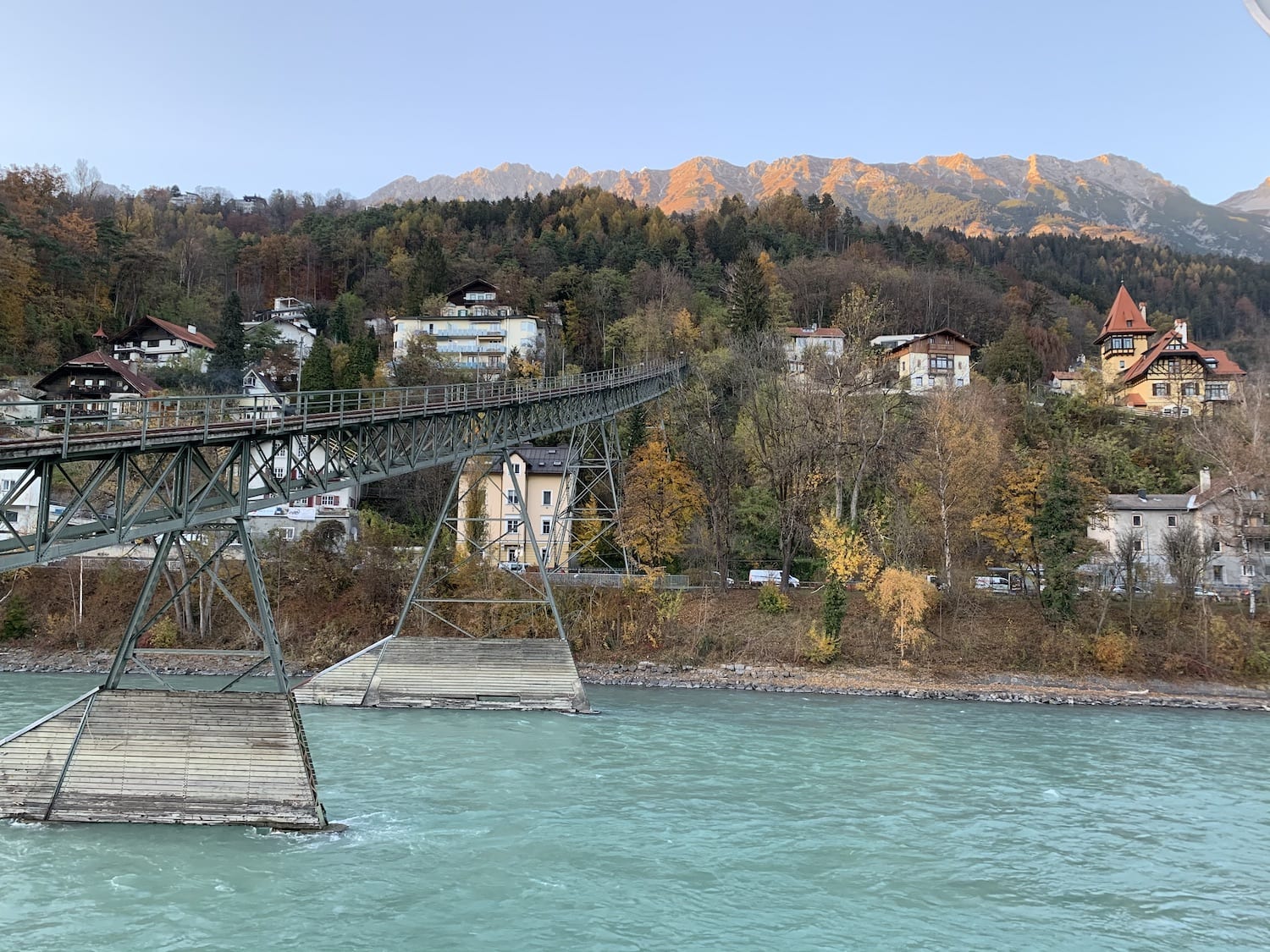
In the second half of the 19th century, tourism became an important economic sector in Innsbruck. The Hungerburg—blessed with its supposedly health‑giving air at over 800 meters above sea level and its panoramic view—had great potential, but with no accessible road, it could only be reached on foot. Wealthy travelers of the era arrived with heavy luggage and stayed for weeks. It took a visionary pioneer to unlock the area’s potential, and this figure was the Kaiserjäger officer Sebastian Kandler (1863–1928). Before becoming an early tourism entrepreneur, Kandler had led an eventful career. He joined the military at 18 and later worked in the canteen of the Klosterkaserne. In 1902, he built what is now Villa St. Georg in the Saggen district and opened the restaurant Klaudia. After just a year, he sold it and purchased the Mariabrunn estate from Attlmayr’s descendants. Kandler didn’t just see the Hungerburg’s potential—he actively developed it. He expanded the Hotel Mariabrunn in an exotic mixture of architectural styles, giving it the appearance of a small castle. Under his direction, more hotels were built: Villa Karwendel, Villa Felsen, and Villa Kandlerheim. Since the construction of villas and cottage-style homes had been banned in the Saggen since 1898, the new trendy hillside district attracted wealthy citizens seeking their dream of an exclusive single-family residence. To make the Hungerburg appealing to visitors, Kandler also created infrastructure. He transformed the steep path from Weiherburg—once climbed by Emperor Ferdinand in 1848—into the safe, easily accessible Wilhelm‑Greil promenade. The Café Bahnhof at the Hungerburgbahn mountain station, the Karwendelhof, and the Waldschenke provided refreshments. The crowning achievement of his efforts was the opening of the Hungerburg Railway in 1906. Starting at the Kettenbrücke in Saggen, the spectacular line connected the city to the upscale hillside district. From downtown, one could now ascend effortlessly to the plateau—spending several weeks as a wealthy tourist or a few hours as a day‑trip visitor, elevated physically and socially above the city.
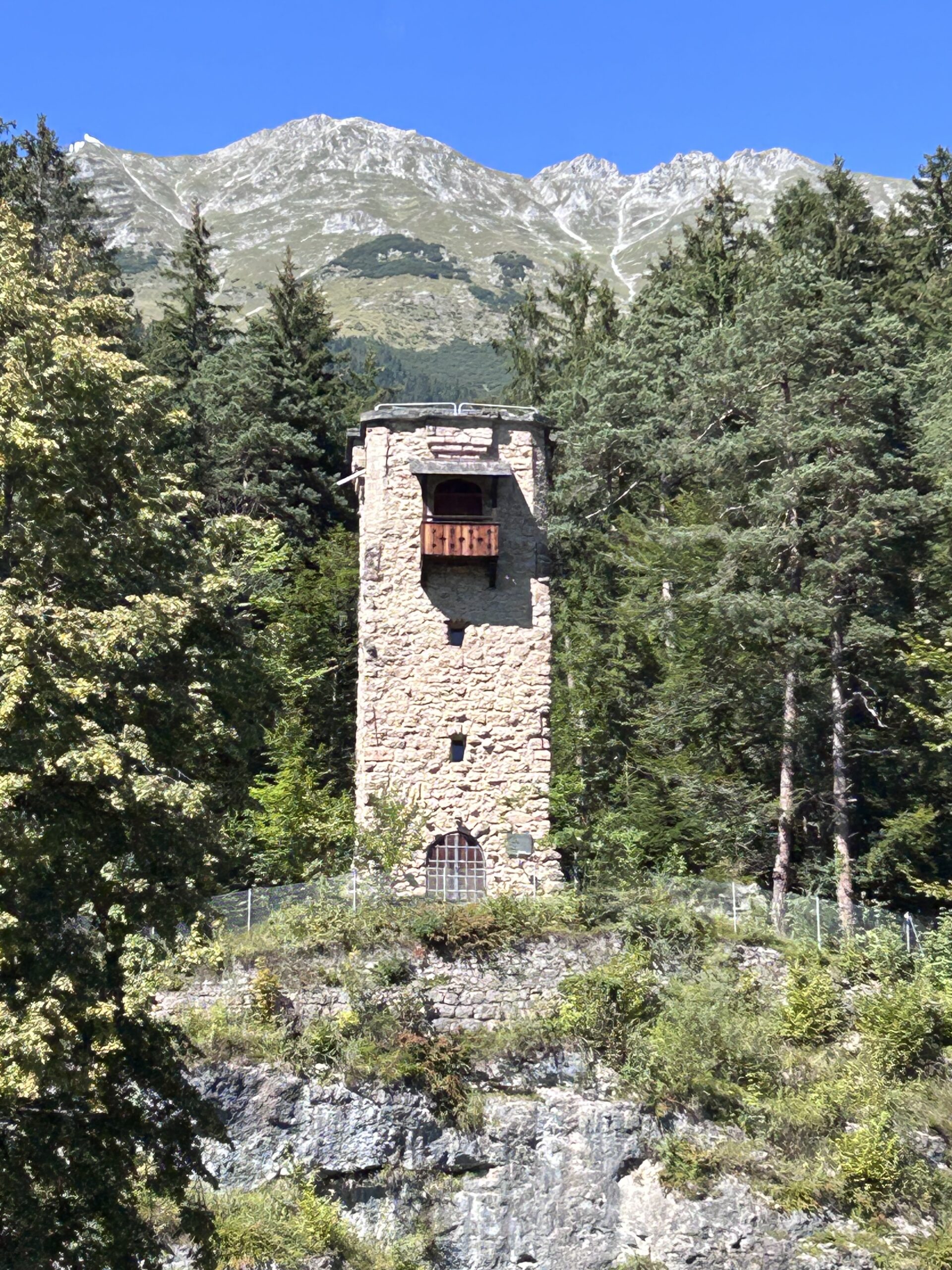
The second major investor in Hoch‑Innsbruck was Franz Schwärzler, who had acquired one of the exclusive villas on the Hungerburg. A dynamic businessman, he didn’t stop at hotels or his Tyrolean Specialty House, where visitors could purchase Tyrolean arts, crafts, and local products as souvenirs. In 1911, he developed the idea of creating an artificial lake in the former Spörr quarry. Together with his brother, he began the ambitious project in February 1912. Above the 3,500 m² lake, they constructed a medieval-style tower with a viewing terrace and a rocky promenade. On August 4, Mayor Wilhelm Greil and the imperial‑royal governor of Tyrol, Markus Freiherr von Spiegelfeld, officially opened the attraction. In summer, swimmers and would-be captains in rowboats filled the lake; in winter, it became an ice-skating rink. Its banks featured not only an artificial cave—heightening the Alpine romanticism—but also the Hotel Hungerburgseehof. At its beachfront tables, aristocrats from the old world and the nouveau riche of the international jet set drank fine wines and champagne. Although the remote Hungerburg hosted only a handful of homes and hotels, a gendarmerie post was established to protect its affluent residents and visitors. With the outbreak of World War I, the exclusive spectacle came to an abrupt halt. Like many who had invested in luxury ventures or war bonds, Kandler and Schwärzler lost their fortunes. Schwärzler’s widow was forced to sell the Seehof, which later served the Social Democratic Party, the Fatherland Front, and eventually—under National Socialism—as an elementary school. Kandler sold his Hotel Mariabrunn to an industrialist from Vorarlberg. His final years resembled his youth: he spent his days in the Halleranger, desperately searching for silver.
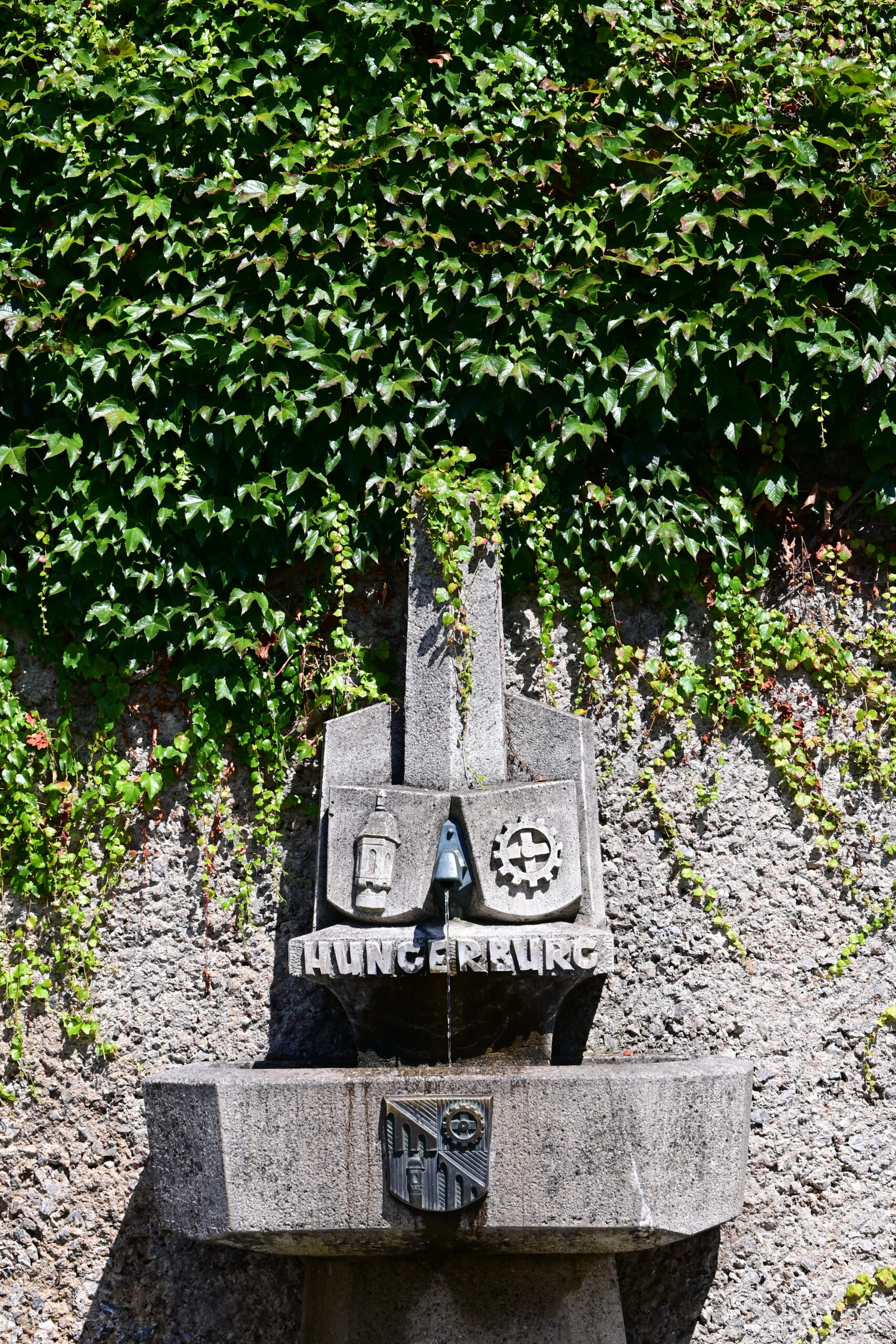
The Hungerburg received new momentum with the construction of the Höhenstraße mountain road. As the economy recovered in the mid‑1920s and major projects resumed, the long‑planned road connection—independent of the Hungerburgbahn—was finally realized. Builder Fritz Konzert had already proposed a route in 1906, while Schwärzler, at the height of his imaginative endeavors, had also envisioned a road in 1911. The Höhenstraße, winding from Hötting Church through what is now a densely developed area and up to the Hungerburg in several switchbacks over 3.5 km, opened in 1930 after a little more than a year of construction under Viktor Berger. Not only was the Hungerburg now linked to Innsbruck by road; with the incorporation of Hötting and Mühlau in 1938, it officially became part of the city. The district emblem near the cableway, the Gasthaus zur Linde, and the Seehof commemorates the Hungerburg’s origins, combining the old Hötting church tower, Mühlau’s millwheel, and the pillars of the original Hungerburgbahn in the Inn River at Saggen.
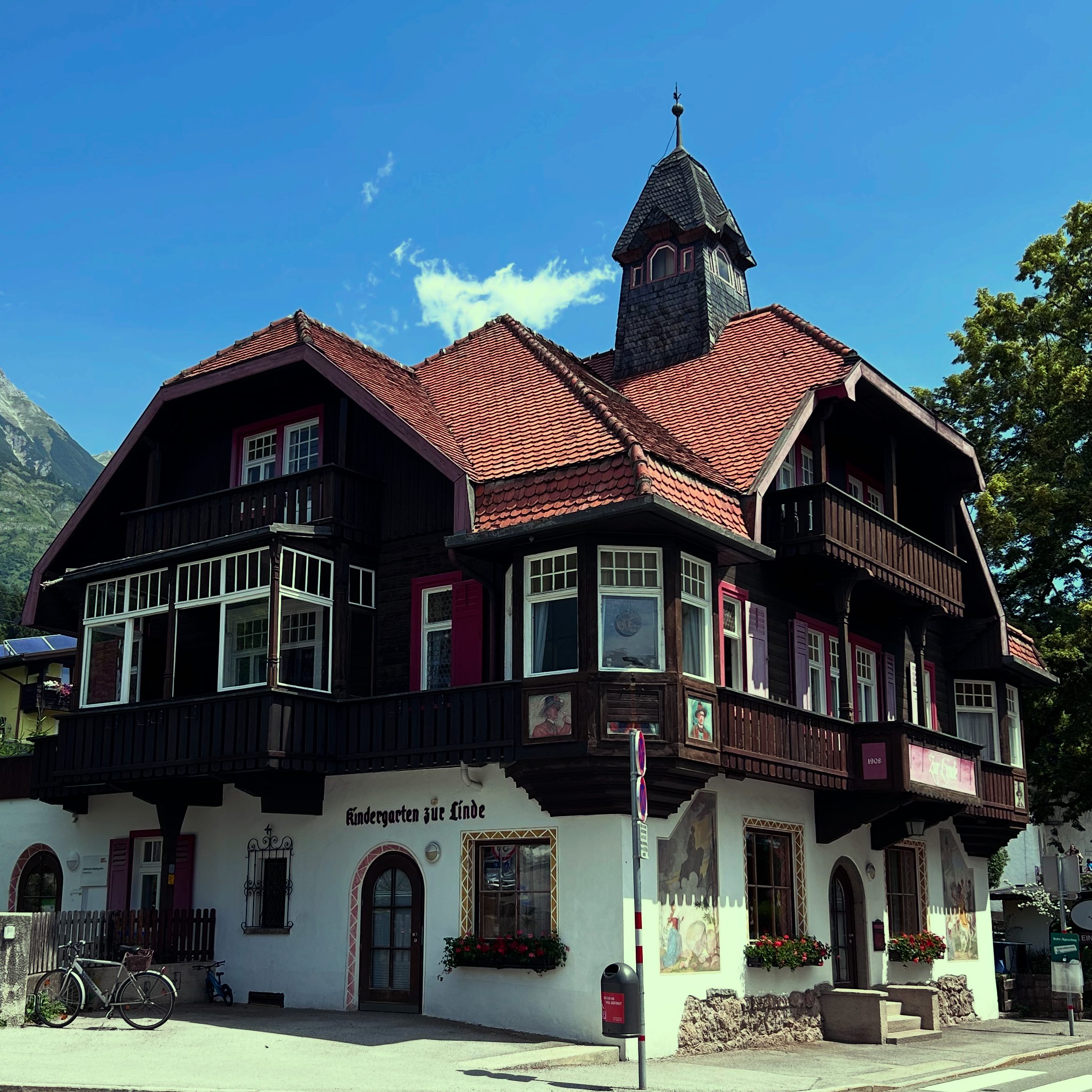
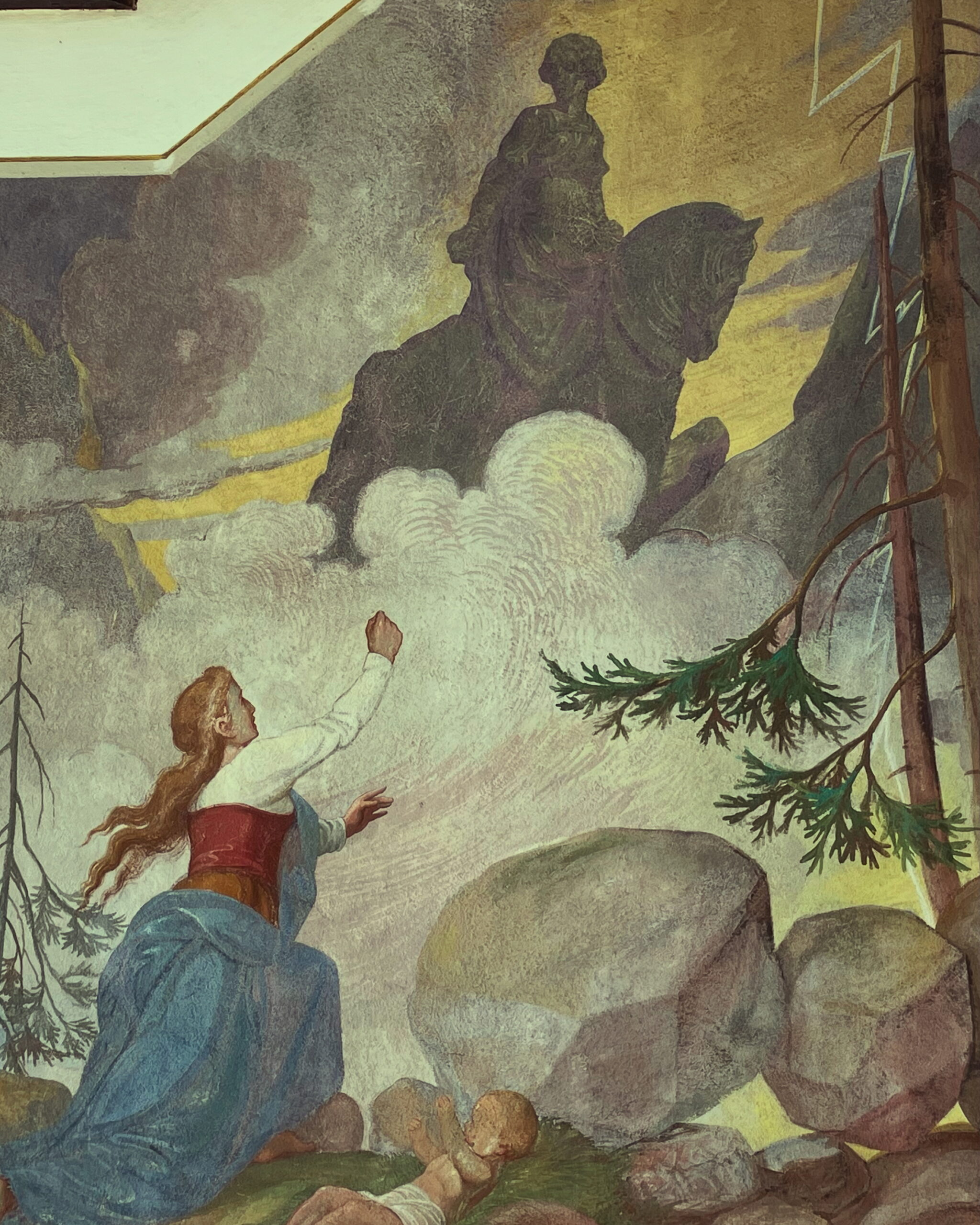
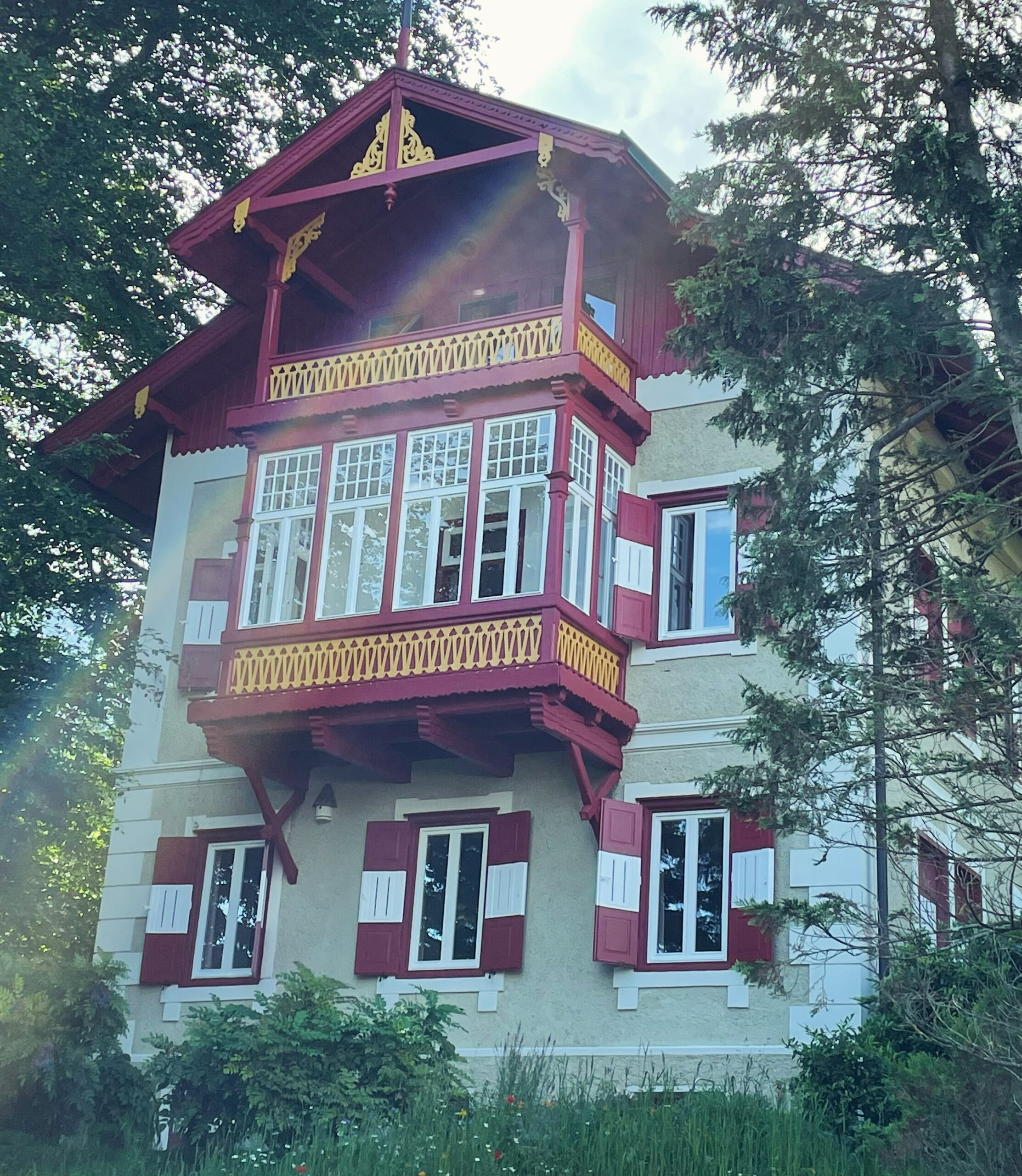
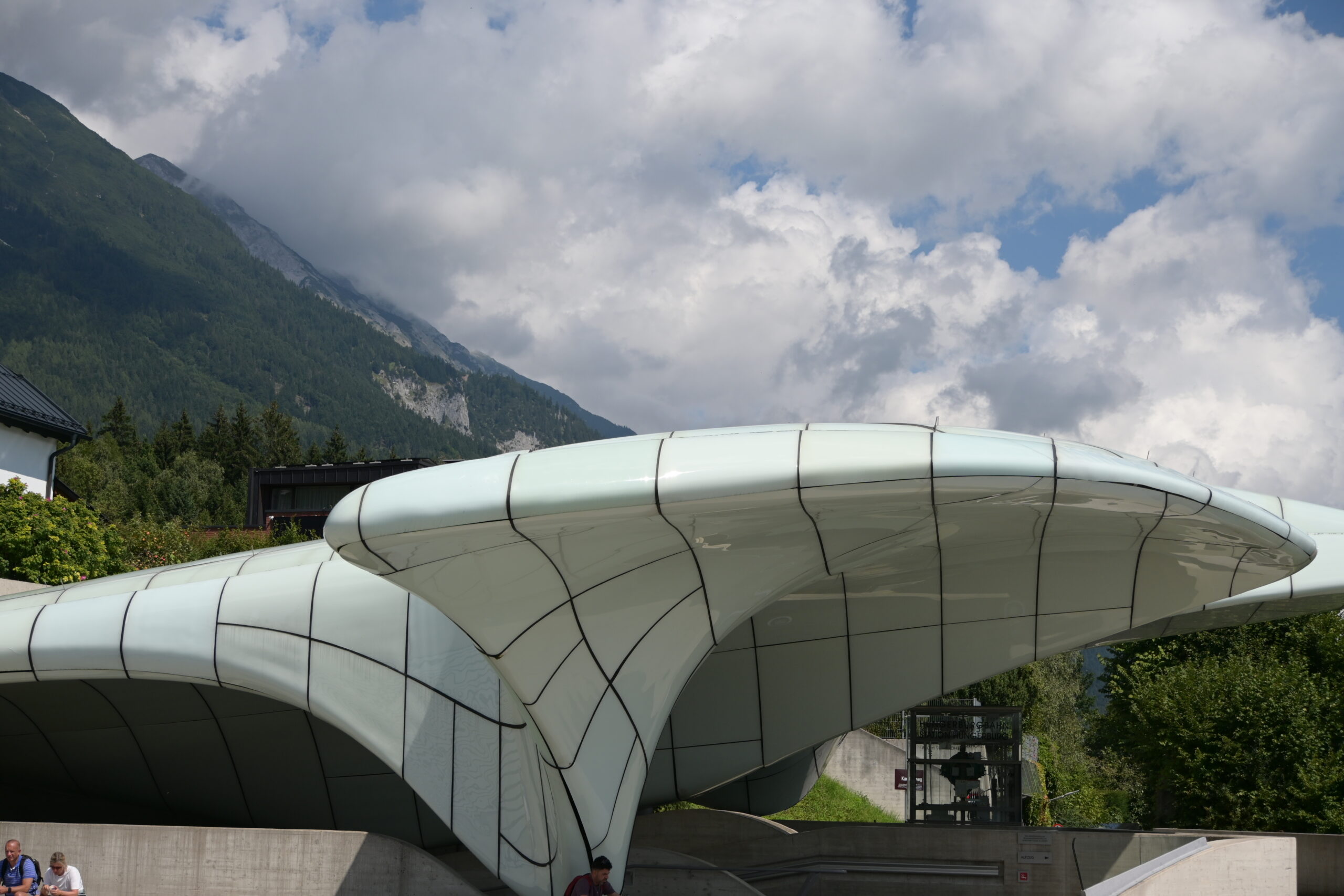
But what is behind the striking yellow building that catches every eye from the valley? It is the former Hotel Mariabrunn Kandlers. 1930 brannte das späthistoristische ehemalige Hotel in Teilen ab. Der neue Besitzer ließ den Neubau vom jungen, aufstrebenden Architektenstar Siegfried Mazagg komplett umbauen. Die kubischen, asymmetrischen Elemente erinnern an andere Bauten der Zeit im Stil der Neuen Sachlichkeit wie das Städtische Hallenbad. 1988 planten die beiden Brüder Hubert und Michael Prachensky das Innere des Hauses zu einem Wohngebäude um, ohne Mazaggs Außenbild zu zerstören. Auf der Westseite prangt noch gut sichtbar der Schriftzug Mariabrunn. Heute dominiert die futuristische, von der iranischen Architektin Zaha Hadid entworfene Bergstation der Hungerburgbahn das Stadtviertel. Der Platz davor, von dem aus man das Inntal und die umliegende Bergwelt überblickt, wurde nach dem Innsbrucker Bergsteiger Hermann Buhl (1924 – 1957) benannt. Vom touristischen Märchenland im Stil der Jahrhundertwende, das Kandler und Schwärzler im Optimismus der Belle Epoque ersannen, sind in Innsbrucks teuerster Wohngegend einige Spuren erhalten geblieben. Der Aussichtsturm überragt noch den wasserlosen ehemaligen Steinbruch, im Haus des Hotel Seehof are the premises of the Chamber of Labour. Despite the intensive development of the post-war period, some houses from the noughties of the 20th century have been preserved. The villa next to the Theresienkirche church, with its red-white-red shutters, patriotically resembles the Ottoburg in the old town centre. The façade of the Gasthauses zur Lindeformerly known as Villa Tiroler Haus part of Schwärzler's empire, is reminiscent of the legend of the Mrs Hitt noch an die Zeit, als auf der Hungerburg eine Art Tiroler Disneyland entstand. Vielleicht ist es bezeichnend, dass ausgerechnet diese Geschichte von Hybris und daraus folgender Vergänglichkeit bis heute in High Innsbruck überlebte. Entworfen wurde das Tiroler Haus vom Architekten Adalbert Erlebach (1876 – 1945), unter dessen Obhut der junge Franz Baumann erste Erfahrungen in der Branche sammelte. Heute beherbergt das sehenswerte Gebäude im typischen Tyrolean home style der späten Monarchie einen Kindergarten. Dass die beiden Innsbrucker Tourismus-Pioniere Kandler und Schwärzler mit dem Potential der Nordkette als Hotspot für Gäste und beliebtem Ausflugsziel der Einheimischen Recht hatten, beweisen die vollen Busse, Wagons und Gondeln, die jeden Tag Tausende Schaulustige, Wanderer, Skifahrer und Biker nach High Innsbruck bringen.
Das wiedererstandene Hotel "Mariabrunn" auf der Hungerburg
Erschienen: Allgemeiner Tiroler Anzeiger / 1. Juni 1931
Nun leuchtet in warmem Gelb das neue „Mariabrunn“-Hotel von der Hungerburg ins Tal herab und lockt nach Gästen. Im einfachen Stil neuer Bauformen steht es wieder da und es ist, wer das Bauwerk vor dem Brande in Erinnerung hat, kaum wieder zu erkennen. Gewiß, es gibt viele Leute, die sich vom kitschigen Aeußeren der alten Bauform mit dem unmöglichen Türmchen nicht trennen können und das ehemalige „Mariabrunn“ schöner finden; doch diese Leute sind nicht zu bekehren. Wer mit der Baukunst weiterlebt und wer das neue Bauen nicht in die Formen alter Baustile zwängen will, sondern das neue Bauen auch im Sinner neuer Baugedanken verwirklich wissen will, der wird das wiedererstandene „Mariabrunn“ wenn auch die Einteilung des Erdgeschosses ziemlich unverändert blieb, als eine schöne Leistung eines modernen Umbaus werten müssen. Die einfachen Bauformen geben dem „Mariabrunn“ nun ein angenehmes Aeußere und die weißen Mauersöller legen sich schmiegsam wie Bänder um das architektonisch trefflich gegliederte gelbschimmernde Haus; westlich sind es zwei Söller, während östlich nur ein Söller über dem Vorbau mit dem Speisesaal sich dahinzieht.
Und so schön der Bau außen ist, so schön ist er auch innen. Am Samstag abends wurden die Restaurationsräumlichkeiten im Erdgeschoß mit Konzert und Ball eröffnet. Die in Rose gehaltene Halle mit Kamin nimmt uns auf, dann treten wir in das in Gelb gestrichene Bürgerzimmer, das Restaurant ist blau-meer-grün in der Decke. Das dunkle Lindenholz der Täfelung der Türen und Fensterrahmen sowie der Deckenbalken wirkt überall wie abwechslungsvolle Zier. Der repräsentative Speisesaal prunkt ebenfalls mit dem Farbenspiel des Weiß seiner Wände und der Decke und mit dem Dunkel des Eichenholzes, aus dem die Täfelung, die Pfeilerverkleidung und die Deckenbalken bestehen. Das große Mittelfenster mit den beiden übereck gestellten rechteckigen Erkern geben dem großen Saale einen vornehmen Charakter. Was allen Räumen besondere Eigenart verleiht, das sind die schönen neuen Formen der Beleuchtungskörper.
Der Gesamtentwurf des ganzen Umbaues einschließlich der Innenausstattung stammt vom Innsbrucker Architekten Siegfried Mazagg, während die Bauausführung die Firma Pümpel u. Söhne in Hall besorgte.
Es ist selbstverständlich, daß Küche und Schank mit allen Einzelheiten neuzeitlicher Ausstattung schon versehen sind oder noch versehen werden. Der Garten wird ein ganz modernes Tanzparkett mit Plachenbedachung erhalten, die je nach dem Wetter aufgezogen oder eingerollt werden kann. Jeden Sonntag nachmittags wird dort Tanz im Freien möglich sein, während am Samstag abends eine Reunion im Speisesaal stattfinden wird.
Währen die Restaurationsräumlichkeiten nun seit Samstag abends geöffnet sind, wird der Hotelbetrieb selbst erst Mitte Juni aufgenommen werden können. Das Hotel wir 28 Zimmer mit 50 Betten erhalten, sämtliche Zimmer fließendem Wasser und Warmwasser und Zentralheizung ausgestattet, 15 Zimmer außerdem mit eigenem Bad, wie auch jedes mit moderner Lichtsignalanlage und Telephon versehene Stockwerk ein Extrabad aufweisen wird. Besonders angenehm wird es empfunden werden, daß jedes Zimmer Balkonanteil hat. Der Pensionspreis wird in der Hochsaison 12 bis 16 S(chilling) betragen.
Der neue Pächter Herr Paul Ponzle gibt schon durch seine sachliche Vergangenheit die Gewähr, daß das Hotel in zufriedenstellender Weise den Anforderungen gerecht werden wird. Herr Ponzle, ein gebürtiger Rheinländer, hat eine 20jährige Schulung als Hotelfachmann hinter sich. im Jahre 1918 und 1914 war er Pächter des Kurhauses des Grafen in Bad Liebwerda bei Reichenberg und in den letzten Jahren bekanntlich Direktor des großen und schönen Strandhotels in Lochau am Bodensee. Das freundliche und sympathische Ehepaar Ponzle wird es sicherlich nicht fehlen lassen, die sonst etwas kühl und kritisch veranlagten Innsbrucker sowie die Fremden so warm zu machen, daß sie sich auf „Mariabrunn“ recht herzlich willkommen fühlen.
Tourism: From Alpine summer retreat to Piefke Saga
In the 1990s, an Austrian television series caused a scandal. Die Piefke Saga, written by the Tyrolean author Felix Mitterer, portrayed in four darkly humorous and revealing episodes the relationship between the German tourist family Sattmann and their hosts in a fictional Tyrolean holiday resort. Despite all justified criticism of modern tourism and its sometimes extreme excesses, one should not forget that tourism in the nineteenth century was an important driving force for the development of Innsbruck and its surroundings—not only economically. The first travellers to visit Innsbruck were pilgrims and “business people” of the early modern period. Merchants, journeymen on their travels, officials, soldiers, entourages of visiting nobility, skilled labourers, miners, clergy, pilgrims, and scholars were the earliest “tourists” attracted to the city between Italy and the German lands. Travel was expensive, dangerous, and arduous. Moreover, many subjects were not permitted to leave their place of origin without the consent of their feudal lord or abbot. Those who travelled usually did so on foot. Although Innsbruck’s inns and taverns profited from travellers as early as the Middle Ages and the early modern period, tourism in the modern sense did not yet exist. This began only when a few eccentrics were first drawn to mountain peaks. For this to happen, not only was a growing middle class required, but also a new perception of the Alps. For a long time, mountains had been regarded purely as a threat. It was primarily the British who, having explored the world’s oceans, now sought to conquer its mountain ranges as well. From the late eighteenth century onward, during the Romantic period, travel accounts began to spread the idea of the natural beauty of the Alps. The first foreign-language travel guide to Tyrol, Travels through the Rhaetian Alps by Jean François Beaumont, appeared in 1796. In addition to the alpine scenery, it was also the “wild and exotic natives” of Tyrol that fascinated international audiences. The bearded rebel Andreas Hofer, who had managed to challenge Napoleon’s army with a peasant force, attracted as much attention in Britain—the traditional enemy of France—as among German nationalists north of the Alps, who saw in him a kind of proto-German figure. Tyroleans were perceived as a stubborn, archetypal, and untamed people, comparable to the Germanic tribes under Arminius who had once resisted the Roman Empire. Descriptions of Innsbruck by authors such as Beda Weber (1798–1858), along with other travel accounts in the rapidly expanding press landscape, helped shape an attractive image of the city.
The next step was to make the wild Alpine environment accessible to a growing number of tourists who wished to emulate early adventurers, even if their willingness to take risks and their physical fitness fell short. In 1869, the German Alpine Club established a section in Innsbruck, following the relatively unsuccessful founding of the Austrian Alpine Club in 1862. Driven by the Greater German idea shared by many members, the two associations merged in 1873. To this day, the Alpine Club retains a largely bourgeois character, while its social-democratic counterpart is the organisation Naturfreunde. The network of hiking trails expanded, as did the number of mountain huts capable of hosting guests. As a transit region, Tyrol already possessed numerous mule tracks and footpaths that had existed for centuries and now formed the basis for alpine tourism. Small inns, farms, and stations along postal routes served as accommodation. Key figures such as the Tyrolean theologian Franz Senn (1831–1884) and Adolf Pichler (1819–1900) were instrumental in surveying Tyrol and creating maps. Contrary to popular belief, the Tyroleans were not born mountaineers but had to learn how to master the alpine environment; previously, mountains had been viewed mainly as dangerous obstacles in agricultural life. The Alpine clubs also trained mountain guides. Around the turn of the century, skiing began to gain popularity alongside hiking and mountaineering. Ski lifts did not yet exist; to climb mountains, skins were attached to skis—a practice still used in ski touring today. Only from the 1920s onward, with the construction of cable cars to the Nordkette and Patscherkofel, did a wealthier clientele begin to enjoy the modern luxury of mechanised mountain access.
This development required new hotels, cafés, inns, shops, and modes of transport to meet the needs of visitors. Guests accustomed to running water and telephones in cities like London or Paris were not willing to accept basic conditions such as outdoor toilets. Inns of the first and second class were suitable for transit travellers but not equipped for more discerning tourists. Until the nineteenth century, innkeepers in Innsbruck and the surrounding villages belonged to the upper middle class in terms of income, but their profession was not considered particularly prestigious. Many were farmers who supplemented their income by serving food and drink. As local meeting points and hubs in postal and goods networks, inns were centres of information, yet innkeeping did not carry the status of a guild profession or bourgeois occupation. This changed with the professionalisation of tourism. Entrepreneurs such as Robert Nißl, who acquired Büchsenhausen Castle in 1865 and transformed it into a brewery, or Johann Gruber of the inn Zum Riesen Haymon, invested in tourism infrastructure. Former aristocratic estates such as Weiherburg were converted into inns and hotels. In Innsbruck, the true transformation did not occur on the barricades of 1848 but later, within the tourism sector, as ambitious citizens replaced aristocrats as owners of estates.
The Österreichischer Hof, opened in 1849, dominated early modern hospitality but was not yet a true grand hotel. That distinction only came with the opening of the Grand Hotel Europa in 1869. In 1892, the Habsburger Hof followed, offering modern comforts such as electric lighting—a sensation at the time. Hotels like the Kaiserhof and Arlberger Hof were located near the railway station, which at the time represented the centre of modern urban life rather than the congested traffic hubs of today.
Visitor numbers grew steadily. Shortly before the First World War, Innsbruck recorded around 200,000 guests annually. A report from June 1896 noted:
“Tourism in Innsbruck in the month of May amounted to 5,647 persons, including 2,763 from Austria-Hungary, 1,974 from the German Empire, 282 English, 65 Italians, 68 French, 53 Americans, 51 Russians, and 388 from various other countries.”
In addition to the sheer number of travellers influencing life in the small town of Innsbruck, it was also the international character of its visitors that gradually gave the city a new face. Beyond purely tourist infrastructure, general modern developments were also accelerated. Wealthy guests could hardly be expected to frequent inns with cesspits behind the building. While a sewage system would inevitably have been built sooner or later, the economic importance of tourism enabled and accelerated the allocation of funds for the major infrastructure projects of the turn of the century. This transformation affected not only the city’s appearance but also the everyday lives and working conditions of its inhabitants. Enterprising individuals such as Heinrich Menardi succeeded in expanding the value chain by offering paid leisure activities in addition to accommodation and food. In 1880, he founded the carriage hire and later automobile rental service Heinrich Menardi for excursions into the Alpine surroundings. Initially using horse-drawn carriages, and after the First World War buses and cars, affluent tourists were transported as far as Venice. The company still exists today and is now headquartered in the Menardi building at Wilhelm‑Greil‑Straße 17, opposite Landhausplatz, although it has since shifted from transport and trade to the more lucrative real estate sector. Local retail also benefited from the affluent international clientele. By 1909, there were already three dedicated tourist equipment shops in the city, alongside the fashionable department stores that had opened just a few years earlier.
Innsbruck and its surrounding areas also became known for spa tourism—the precursor of today’s wellness industry—where wealthy guests recovered from a wide range of ailments in an alpine environment. Spa facilities existed in Egerdach near Amras, in Mentlberg, and in Mühlau. Establishments such as the Igler Hof (then the Grand Hotel Igler Hof) and the Sporthotel Igls still retain some of the charm of that era. Michael Obexer, founder of the spa resort in Igls and owner of the grand hotel, was a pioneer of tourism. Although these facilities never achieved the international fame of major spa destinations such as Bad Ischl, Marienbad, or Baden near Vienna—as evidenced by historical photographs and postcards—the treatments offered, including brine baths, steam therapies, gymnastics, and even “magnetism,” corresponded to what was considered state of the art at the time and still partially resonates in today’s wellness practices. Perhaps the most spectacular tourism project Innsbruck ever experienced was “Hoch‑Innsbruck,” today known as the Hungerburg. Not only the funicular railway and hotels were built there; even an artificial lake was created after the turn of the century to attract visitors.
One of the former landowners in the Hungerburg area and a pioneer of Innsbruck tourism, Richard von Attlmayr, played a key role in the predecessor organisation of today’s tourism association. Since 1881, the Innsbruck Beautification Association had been concerned with meeting the growing needs of visitors. The association developed walking and hiking paths, installed benches, and opened up hard-to-access areas such as the Mühlauer Gorge and the Sill Gorge. The distinctive green benches along many paths still serve as a reminder of this organisation, which continues to exist today. Seven years later, in 1888, those benefiting from tourism in Innsbruck founded the Commission for the Promotion of Tourism, the predecessor of today’s tourism board. Through joint efforts in marketing and quality assurance among accommodation providers, businesses hoped to further stimulate tourism.
“Each year the number of overseas pilgrims visiting our country and its glacier-crowned mountains increases, much to the annoyance of our friendly Swiss neighbours, and many a fine dollar is left behind. The English are beginning to find Tyrol just as interesting as Switzerland, and the number of French and Dutch visitors spending the summer here grows year by year.”
Postcards became the first mass-market “influencers” in the history of tourism. Many businesses produced their own postcards, and publishers created countless images of the city’s most popular sights. It is striking what was considered worth seeing at the time. Unlike today, it was primarily the modern achievements of the city that were depicted: the Leopold Fountain, the city café near the theatre, the chain bridge, the cog railway to the Hungerburg, or the Stefansbrücke (opened in 1845), a stone arch bridge crossing the Sill. Andreas Hofer also served as an effective testimonial on postcards: the Schupfen inn, where he had established his headquarters, and the Bergisel with the large Andreas Hofer monument were popular motifs.
In 1914, Innsbruck had 17 hotels attracting visitors, supplemented by summer and winter holidaymakers in Igls and the Stubai Valley. The First World War abruptly brought this first wave of tourism to an end. Just as tourism began to recover in the late 1920s, the global economic crisis and Hitler’s 1,000-mark travel restriction in 1933—introduced to pressure the Austrian government into lifting the ban on the Nazi Party—dealt further blows.
It took the economic boom of the 1950s and 1960s to revive tourism in Innsbruck after the destruction. Between 1955 and 1972, overnight stays in Tyrol increased fivefold. Following the hardships of the war years and the reconstruction of Europe’s economy, tourism became a stable source of income for Tyrol and Innsbruck, extending even beyond official hotels and guesthouses. Many Innsbruck families crowded more tightly into their already small apartments in order to rent out beds to foreign guests and supplement their income. Tourism not only brought foreign currency but also enabled locals to develop a new sense of identity, both internally and externally. At the same time, increasing prosperity allowed more Innsbruck residents to travel abroad themselves. The beaches of Italy became particularly popular destinations. Former wartime enemies thus became guests and hosts to one another.
A republic is born
Hardly any era is more difficult to grasp than the interwar period. The Roaring Twenties, jazz, and automobiles come to mind just as readily as inflation and economic crisis. In major cities like Berlin, young women carrying themselves as flappers with bobbed hair, cigarettes, and short skirts danced lasciviously to the new sounds. In Innsbruck, American drinks were served during Five O'Clock Tea at the bar in the Knights' Hall (Rittersaal) of the Cafe Gasthaus Zur Annasäule, which later became the Alt-Innsbruck. The suits of armor can still be admired in the bay window from Maria-Theresien-Straße. For the most part, however, as part of the young Republic of German-Austria, Innsbruck’s population belonged to the faction of poverty, economic crisis, and political polarization. Right from the start, the proclamation of the republic in front of the parliament in Vienna before more than 100,000 people—who were less enthusiastic than they were curious and unsettled—was anything but smooth, accompanied by riots, shootouts, two deaths, and 40 injuries. No one knew how things were supposed to continue after the end of the monarchy and the loss of a large part of the state territory. The new Austria seemed too small and incapable of surviving. The bureaucratic apparatus of the Austro-Hungarian Empire carried on seamlessly under a new flag and name. In the constitution, the federal states, as successors to the old crown lands, were granted a great deal of leeway in legislation and administration under the framework of federalism. However, enthusiasm for the new state among the population remained limited. Not only was the supply situation miserable after the loss of the vast majority of the former giant Habsburg empire, but people also distrusted the underlying concept of the republic. The monarchy had not been perfect, but very few people could relate to the idea of democracy. Instead of being subjects of the Emperor, people were now citizens, but only citizens of a dwarf state with an oversized capital that was little loved in the federal states, rather than citizens of a great empire. In the former crown lands, which were largely governed by the Christian Social Party, people frequently spoke of the "Viennese hydrocephalus" (Wiener Wasserkopf) that let itself be fed by the yields of the hardworking rural population. Other federal states also toyed with the idea of breaking away from the republic after the plan to join Germany, which was supported by all parties, was banned by the victorious powers of the First World War. The various Tyrolean plans, however, were particularly spectacular. From a neutral alpine state with other federal states, a free state consisting of Tyrol and Bavaria, or extending from Kufstein to Salurn, an annexation to Switzerland, all the way to a Catholic church-state under papal leadership, many options were considered. The most obvious solution was particularly popular. Feeling German was nothing new. So why not also attach oneself politically to the big brother to the north? This desire was highly pronounced, especially among urban elites and students. The annexation plan (Anschlussplan) received 98% approval in a vote in Tyrol, but it never came to fruition. In Innsbruck, the Tyrolean National Assembly (Tiroler Nationalversammlung) and the Tyrolean National Council (Tiroler Nationalrat)—a concentration government with members from all parties—constituted themselves in the autumn of 1918 from the members of the former provincial parliament (Landtag). The National Council had authority over the people's and citizens' militias (Volks- und Bürgerwehren), which had formed at the municipal level to maintain public order, at least on paper. Primarily between Innsbruck and the Brenner Pass, up to 50,000 soldiers were stationed at the railway stations, causing problems while waiting for their transport home.
Instead of becoming a part of Germany, Tyrol was occupied by the hated Wallsche (Italian forces). For nearly two years after the end of the war, Italian troops occupied Innsbruck. Following the complex and lengthy peace negotiations in Paris, it finally became a certainty: on October 10, 1920, the formal annexation of South Tyrol took place. At the Brenner Pass, the barrier gate went down. On the North Tyrolean side, only a few administrative and customs buildings were erected, but in the southern part of the village, large barracks shot out of the ground to secure the new border militarily. Historical Tyrol was split in two. In Innsbruck and many other Tyrolean municipalities, pompous mourning ceremonies were organized annually on this date for years. In 1924, the Innsbruck city council decided to name squares and streets around the main railway station after South Tyrolean cities. Bozner Platz as well as Brixner Straße and Salurner Straße still bear their names today. Many people on both sides of the Brenner felt betrayed. Although they had by no means won the war, they did not see themselves as losers to Italy. Hatred toward Italians reached its peak in the interwar period, even though the occupying forces acted with pronounced mildness. A passage from the 1930s short story collection "The Front Above the Peaks" (Die Front über den Gipfeln) by Karl Springenschmid reflects the general mood:
"The young girl says, 'Becoming Italian would be the worst thing.
Old Tappeiner just nods and grumbles: "I know it myself and we all know it: becoming a whale would be the worst thing."
Trouble was also brewing in domestic politics. The revolution in Russia and the subsequent civil war with millions of fatalities, expropriation, and a complete reversal of the system cast its long shadow all the way to Austria. The prospect of "Soviet conditions" terrified people. Austria was deeply divided. Capital and federal states, city and countryside, citizens, workers, and peasants—in the vacuum of the first postwar years, each group wanted to shape the future according to its own ideas. The cultural struggles of the late monarchy between conservatives, liberals, and socialists continued seamlessly. The rift existed not only on a political level. Morals, family, leisure activities, education, faith, legal understanding—every sphere of life was affected. Who should govern? How should wealth, rights, and duties be distributed? Liberals and the Tyrolean People's Party (Tiroler Volkspartei), which had emerged from the Peasants' League (Bauernbund), the People's Association (Volksverein), and the Catholic Working Class (Katholische Arbeiterschaft), were at least as hostile toward Social Democracy as they were toward the federal capital of Vienna and the Italian occupiers. A communist overthrow was not a real danger, especially in Tyrol, but it was effectively instrumentalized in the media as a threat to bring Social Democracy into disrepute. Although a workers', peasants', and soldiers' council (Arbeiter-, Bauern- und Soldatenrat) modeled on the Soviet system had proclaimed itself in Innsbruck in 1919, its influence remained minimal and it was supported by no political party. From 1920 onward, so-called soldiers' councils were officially formed, but like the rest of politics, they were dominated by the Christian Socials. The conservative peasant and bourgeois camp right of center militarized itself more professionally with the Tyrolean Homeland Guard (Tiroler Heimatwehr) and enjoyed a stronger influx of members than leftist groups, also thanks to church support. From church pulpits and in conservative media, Social Democracy was referred to as the "party of Jews" (Judenpartei) and homeless traitors to the fatherland. People were all too eager to blame them for the lost war and its consequences. The Tiroler Anzeiger summed up the public fears: "Woe to the Christian people if the Jew-Socialists win the elections!".
While the Tyrolean People's Party dominated in rural districts, Social Democracy in Innsbruck under the leadership of Martin Rapoldi always managed to win between 30% and 50% of the vote in elections from 1919 onward, despite the strong headwinds. Under the new municipal code of 1919, which provided for universal suffrage for all adults, the city council comprised 40 members. Out of 24,644 citizens called to the ballot box, an incredible 24,060 exercised their right to vote. A certain degree of emancipation also became noticeable. Right from the first city council with free elections, three women were represented. The fact that the Social Democrats did not secure the mayoral seat was due to the majorities in the city council formed by alliances among the other parties.
High politics, however, was merely the backdrop to the actual misery. Martin Rapoldi got straight to the point in September 1919: "Gentlemen, for the moment the constitutional question is completely secondary to the population, as is whether the province has more rights or fewer rights. More potatoes is the slogan in our province." Time and again, looting and hunger riots broke out in the provincial capital. Those who had money could supply themselves with food on the black market; the rest depended on charity from foreign aid shipments. Long after the war, the province of Tyrol still required outside help to feed its population. Under the headline "Significant Expansion of the American Child Relief Action in Tyrol," the Innsbrucker Nachrichten reported on April 9, 1921: "Taking into account the needs of the province of Tyrol, the American representatives for Austria have most generously increased the daily number of meals to 18,000 portions." Alongside hunger, medical care was a major issue. The epidemic that went down in history as the Spanish Flu also took its toll in Innsbruck in the years after the war. Exact numbers were not recorded; worldwide, the number of fatalities is estimated at 27 to 50 million. In Innsbruck, at the height of the Spanish Flu, around 100 victims are said to have succumbed to the disease daily. Many Innsbruckers had not returned home from the battlefields and were missing as fathers, husbands, and workers. Many of those who did make it back were wounded and scarred by the horrors of war. As late as February 1920, the "Tyrolean Committee of Siberians" (Tiroler Ausschuss der Sibirier) organized a benefit evening at the Gasthof Breinößl "…in favor of the fund for the repatriation of our prisoners of war…". On top of this came unemployment. Civil servants and public sector employees in particular had lost their jobs after the League of Nations tied its loan to harsh austerity measures. Public sector salaries were cut. Strikes occurred repeatedly. Tourism as an economic factor was nonexistent due to the problems in the surrounding countries, which were likewise ravaged by the war. The construction industry, which had been booming before the war, collapsed completely. Innsbruck’s largest company, Huter & Söhne, had over 700 employees in 1913; at the peak of the economic crisis in 1933, only 18 remained. The middle class largely collapsed. The average Innsbrucker was destitute and malnourished. Often, no more than 800 calories per day could be scraped together. In this climate of poverty, the crime rate was higher than ever before. Many people lost their homes. In 1922, 3,000 families in Innsbruck were looking for accommodation despite a municipal emergency housing program that had already been in effect for several years. Apartments were built into every available property. On February 11, 1921, a long list in the Innsbrucker Nachrichten detailing the individual projects under way included this item:
"The municipal hospital has vacated the epidemic barracks in Pradl and placed them at the disposal of the municipality for the creation of emergency housing. The necessary credit of 295 K (Editor's note: Kronen) was approved for the construction of 7 emergency apartments."
In the early years, there was hardly any improvement in people's everyday lives. The central government had little enforcement power in distant federal states like Tyrol. For a time, Innsbruck, like many other Austrian municipalities, even began printing its own money. The amount of money in circulation rose from 12 billion kronen to over 3 trillion kronen between 1920 and 1922. An epochal inflation was the result. Then, politics woke up from its lethargy. Under Chancellor Ignaz Seipel, the Republic managed to secure a League of Nations loan. The krone, a relic of the monarchy, was replaced by the schilling as the official currency of Austria on January 1, 1925. Between 1918 and 1922, the old currency had lost more than 95% of its value against the dollar relative to the pre-war exchange rate. With the currency stabilization following the League of Nations loan, however, not only did banks and citizens recover, but public sector construction orders also picked up again. Innsbruck modernized. What economists call a sham boom (Scheinblüte) occurred. This short-term economic recovery was a bubble, but it brought major residential construction and infrastructure projects to the city of Innsbruck. In Innsbruck, there are no deliberate places of remembrance dedicated to the creation of the First Republic. The heritage-protected residential complexes such as the Schlachthofblock, the Pembaurblock, the Mandelsbergerblock, the Pembaurschule, the municipal indoor swimming pool (Städtisches Hallenbad), the Höhenstraße up to the Hungerburg, and the cable cars onto the Patscherkofel and Nordkette are contemporary witnesses that remain in operation to this day. The city purchased the Achensee lake and, as the main shareholder of TIWAG, built the power plant in Jenbach. In 1930, the Universitätsbrücke bridge connected the clinic in Wilten with the Höttinger Au. On the Sill river, the Pembaurbrücke and the Prinz-Eugen-Brücke were constructed. In Reichenau, the first airfield opened on June 1, 1925, involving Innsbruck in air traffic 65 years after the opening of the railway line. Many interested onlookers gathered on the meadow east of the city to witness the event. A monument to the pilots who fell in the World War was unveiled before the German airline Aero Lloyd took off for Munich in a single-engine Fokker-Grulich F III. In the autumn, the integration of the new airfield into the Strasbourg – Zurich – Innsbruck – Vienna route by the French Compagnie Internationale de Navigation followed. Thanks to the daring efforts of pilot Raoul Stojsawljewic, remote regions and alpine mountain huts could now also be supplied with food from Innsbruck, as a report in the Innsbrucker Nachrichten from June 7, 1926, shows:
"In fine weather yesterday morning, Major Stojsawljewic from German Lufthansa took off with his aircraft and flew toward Kühtai, where he dropped free beer, donated by the 'Löwenbräu' brewery, by parachute from a low altitude. At 10 o'clock, the Patscherkofelhaus was approached and beer from the Zipf brewery was dropped..."
Trotz der kurzzeitigen Höhenflüge war die Erste Republik auch auf lokaler Ebene eine schwere Geburt und sie sollte nicht lange Bestand haben, obwohl viel Positives seinen Anfang nahm. Aus Untertanen wurden Bürger. Was in der Zeit Maria Theresias begann, wurde nun unter neuen Vorzeichen weitergeführt. Der Wechsel vom Untertanen zum Bürger zeichnete sich nicht nur durch ein neues Wahlrecht, sondern vor allem durch die verstärkte Obsorge des Staates aus. Staatliche Regelungen, Schulen, Kindergärten, Arbeitsämter, Krankenhäuser und städtische Wohnanlagen traten an die Stelle des Wohlwollens von Grundherrn, Landesfürsten, wohlhabender Bürger, der Monarchie und der Kirche. Bis heute basiert vieles im österreichischen Staatswesen sowie im Innsbrucker Stadtbild und der Infrastruktur auf dem, was nach dem Zusammenbruch der Monarchie entstanden war. Auch gesellschaftliche Bräuche und alltägliche Lebenseinstellungen veränderten sich in der Republik nach dem Zusammenbruch der Monarchie. Der 1925 eingeführte Weltspartag erinnert alljährlich an die Einführung des Schillings und die Mahnung an Kinder und Erwachsene zum verantwortungsvollen Umgang mit Geld. Die Handschrift der jungen Massenparteien und das neue Verhältnis zwischen Zentralstaat und Bürger sind bei allem Lokalpatriotismus unübersehbar.
Franz Baumann and Tyrolean modernism
The First World War not only brought states and ruling dynasties to an end; it also marked a turning point for art, music, literature, and architecture. In Innsbruck, a handful of planners transformed the cityscape during the two decades of the First Republic. Inspired by new design movements such as the Bauhaus style from Germany, skyscrapers from the United States, Italian Futurism, and Soviet Modernism from the revolutionary USSR, remarkable architectural projects emerged in Innsbruck. The best-known representatives of the avant-garde who introduced this new approach to shaping public space in Tyrol were Lois Welzenbacher, Siegfried Mazagg, Theodor Prachensky, and Clemens Holzmeister. Each of these architects had distinct characteristics, making the Tyrolean Modern Movement (Tiroler Moderne) difficult to define precisely. Their common feature was a departure from the classical architecture of the pre-war era while retaining typical Alpine materials and architectural elements, following the principle of “Form Follows Function.” In a 1920 article for the magazine Tiroler Hochland, Lois Welzenbacher wrote about the architecture of his time:
"As far as we can judge today, it is clear that the 19th century lacked the strength to create its own distinct style. It is the age of stillness... Thus details were reproduced with historical accuracy, mostly without any particular meaning or purpose, and without a harmonious overall picture that would have arisen from factual or artistic necessity."
The most prominent and visually influential representative of the so-called Tyrolean Modern Movement in Innsbruck was Franz Baumann (1892–1974). Unlike Holzmeister or Welzenbacher, he never received an academic education. Baumann was born in Innsbruck in 1892, the son of a postal official. His religious education teacher, the now controversial theologian and writer Anton Müller, known by the pseudonym Brother Willram, recognized the young Franz Baumann’s talent for drawing and enabled him to attend the Imperial-Royal State Trade School (k.k. Staatsgewerbeschule) at the age of fourteen. There he met his future brother-in-law Theodor Prachensky, who would also play a significant role in his professional life. During his school years, Baumann gained practical experience as a bricklayer with the construction company Huter & Söhne and began producing landscape drawings around Innsbruck together with his sister Maria and Prachensky. In 1910, Baumann followed his friend to Merano to take up employment with the renowned construction firm Musch & Lun. The former Tyrolean capital was then the most important tourist destination in Tyrol, attracting an international clientele of spa visitors. Under Adalbert Erlebach, who would later play a key role in the development of Hungerburg, Baumann gained his first experience in planning large-scale projects such as hotels and cable cars. Important for his later career was not only his technical education but also his first encounters with the Tyrolean Heritage Protection Association (Tiroler Heimatschutzverband). Kunibert Zimmeter had founded this organization together with Gotthard Graf Trapp. Since building regulations were a provincial matter, the Tyrolean Heritage Protection Association, together with the district authorities, acted as the final authority responsible for evaluating and approving construction projects. In many Tyrolean villages, hotels had replaced churches as the largest buildings in the local skyline. The aim was to prevent tourism and industrial developments from overwhelming traditional village character. In Our Tyrol: A Homeland Protection Book, Zimmeter wrote:
"Let us look at the flattening of our private lives, our amusements, at the centre of which, significantly, is the cinema, at the literary ephemera of our newspaper reading, at the hopeless and costly excesses of fashion in the field of women's clothing, let us take a look at our homes with the miserable factory furniture and all the dreadful products of our so-called gallantry goods industry, Things that thousands of people work to produce, creating worthless bric-a-brac in the process, or let us look at our apartment blocks and villas with their cement façades simulating palaces, countless superfluous towers and gables, our hotels with their pompous façades, what a waste of the people's wealth, what an abundance of tastelessness we must find there."
After four years, Baumann’s career was abruptly interrupted. Like most of his generation, the First World War tore him away from both work and everyday life. While serving on the Italian Front, he suffered a gunshot wound to the abdomen and recovered in a military hospital in Prague. During this otherwise inactive period, he painted cityscapes depicting buildings in and around Prague. These urban views, which later helped him visualize architectural designs, were exhibited at his only exhibition in 1919. His breakthrough in construction came the following year. Baumann unexpectedly won the competitions for the renovation of the Weinhaus Happ in Innsbruck’s Old Town and for the Nordkette Cable Railway. Besides his creativity, his success stemmed from the alignment between his architectural philosophy and the requirements of both the Tyrolean Heritage Protection Association and the public tenders issued by the young First Republic. In the economic upswing of the late 1920s, a new class of customers and visitors emerged in tourism. The aristocratic distance toward the mountains had given way to a middle-class enthusiasm for sports. No longer were grand hotels built at elevations of 1,500 meters for health resorts; instead, functional infrastructure for skiers in high alpine terrain, such as on the Nordkette, was constructed. Buildings were expected to blend harmoniously into their surroundings while remaining attractive and practical. Despite the social and artistic innovations of the era, architects still had to take regional character into account. This was precisely where Baumann’s approach to holistic building in a Tyrolean context excelled. From exterior lighting to furniture, Baumann designed even the smallest details and integrated them into his overall concept of the Tyrolean Modern Movement. Every technical function and detail, as well as environmental conditions, topography, and sunlight, played a role for him. Although he was officially not permitted to use the professional title of architect, he followed the principles outlined by architect Adolf Loos (1870–1933) in his essay Rules for the Person Building in the Mountains:
Don't build picturesquely. Leave such effects to the walls, the mountains and the sun. The man who dresses picturesquely is not picturesque, but a buffoon. The farmer does not dress picturesquely. But he is...
Pay attention to the forms in which the farmer builds. For they are ancestral wisdom, congealed substance. But seek out the reason for the mould. If advances in technology have made it possible to improve the mould, then this improvement should always be used. The flail will be replaced by the threshing machine."
Beginning in 1927, Baumann operated his own studio on Schöpfstraße in the Wilten district. At the height of its success, his office employed fourteen staff members. Time and again, his professional path crossed with that of his friend and brother-in-law Theodor Prachensky. Together, beginning in 1929, they planned the new secondary school in Hötting on Fürstenweg. Although separate wings for boys and girls still had to be included according to contemporary conventions, the building otherwise fully embodied the style of New Objectivity (Neue Sachlichkeit) and the principle of “Light, Air, and Sun.” Thanks to his modern approach, which combined functionality, aesthetics, tradition, and economical construction, Baumann weathered the economic crisis that began in the late 1920s relatively well. It was only the 1,000-Mark Blockade, imposed by Hitler on Austria in 1933 in an attempt to place financial pressure on the Republic, that caused serious problems for his architectural practice. Not only did unemployment in the tourism sector triple within a short period of time, but the construction industry also entered a severe downturn. In 1935, Baumann became head of the Central Association of Architects, after receiving a special exemption allowing him to use the professional title of architect despite lacking a formal academic qualification. With Austria’s annexation by Germany in 1938, he quickly joined the National Socialist German Workers’ Party (NSDAP). On the one hand, like his colleague Lois Welzenbacher, he may have been sympathetic to certain ideas of National Socialism. On the other hand, membership enabled him to advance his career as chairman of the Reich Chamber of Fine Arts in Tyrol. In this position, however, he repeatedly opposed the radical alterations to Innsbruck’s cityscape that the Nazi authorities wished to implement. Innsbruck’s mayor, Egon Denz, wanted the Triumphal Arch and St. Anne’s Column removed in order to create more space for traffic in Maria-Theresien-Straße. At that time, the city center still served as the principal traffic route connecting the Brenner Pass in the south with the federal highway leading east and west along what is now the Innrain. A statue of Adolf Hitler was intended to replace St. Anne’s Column. Gauleiter Franz Hofer also planned to have the towers of the Court Church blown up. In his official capacity, Baumann assessed both projects negatively. When the matter eventually reached the desk of Albert Speer, Speer agreed with Baumann’s assessment. From that point onward, Gauleiter Hofer no longer awarded Baumann any public projects. However, this courageous stance probably spared him more serious consequences after the war. After being questioned during the denazification process following the war, Baumann began working in the municipal building department, likely also on the recommendation of his brother-in-law Theodor Prachensky. Although Baumann was fully exonerated, partly due to testimony from the abbot of Wilten, whose church towers he had helped save, his reputation as an architect could no longer be fully restored. Another setback was the destruction of his studio on Schöpfstraße, which was hit by a bomb in 1944. In his postwar career, Baumann became responsible for the restoration of buildings damaged during the war. Under his supervision, the Boznerplatz and its Rudolf Fountain were rebuilt, while the Burggraben area and the New City Halls (Neue Stadtsäle) behind the Tyrolean State Theatre were redesigned. Franz Baumann died in 1974. Today, his paintings, sketches, and drawings are highly sought after and command substantial prices on the art market. Anyone who carefully examines more recent large-scale projects in Innsbruck, such as the City Library, the PEMA Towers, and many of the city’s residential developments, can still recognize elements of the Tyrolean Modern Movement today.