Karwendel bridge
Karwendel arches
Worth knowing
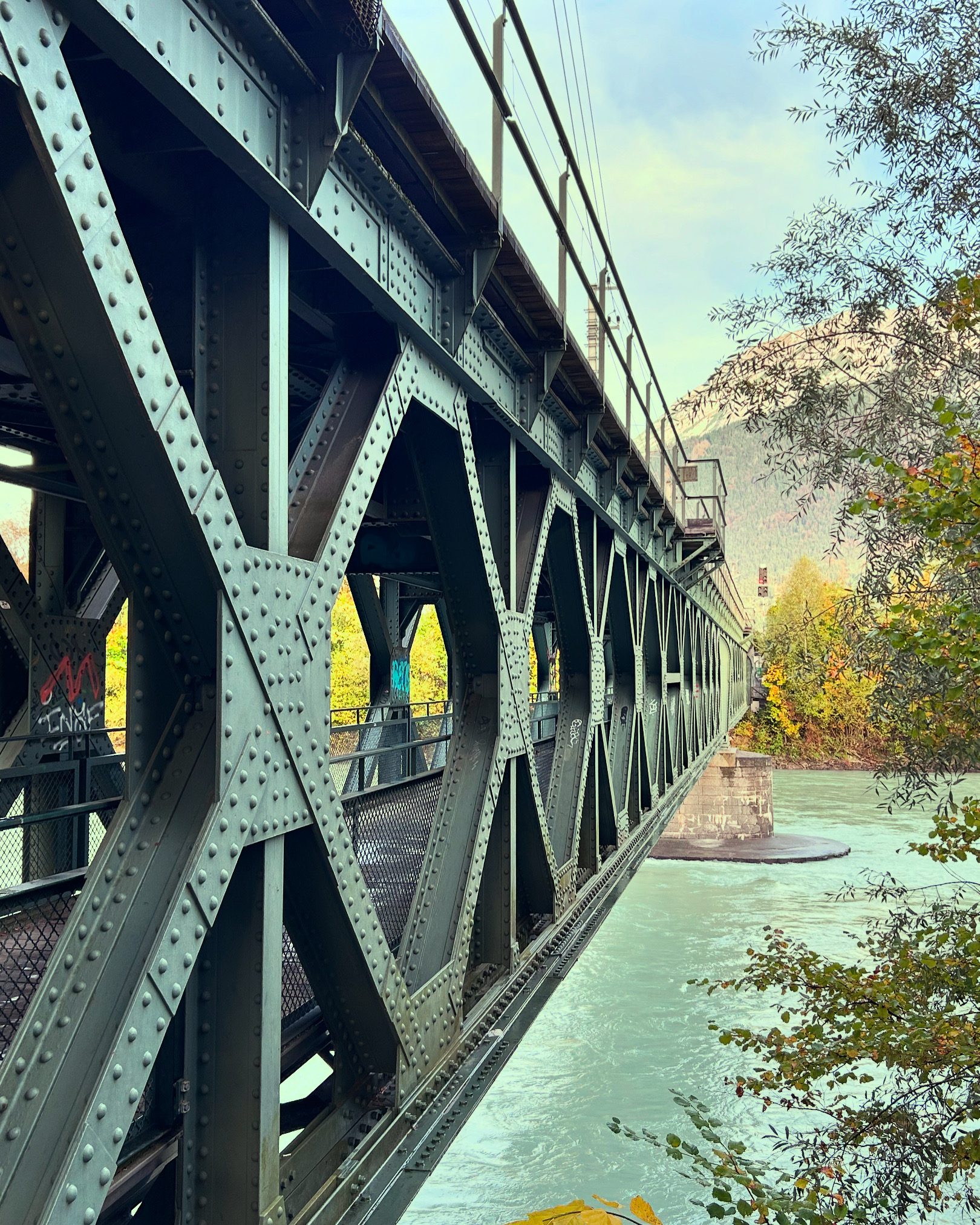
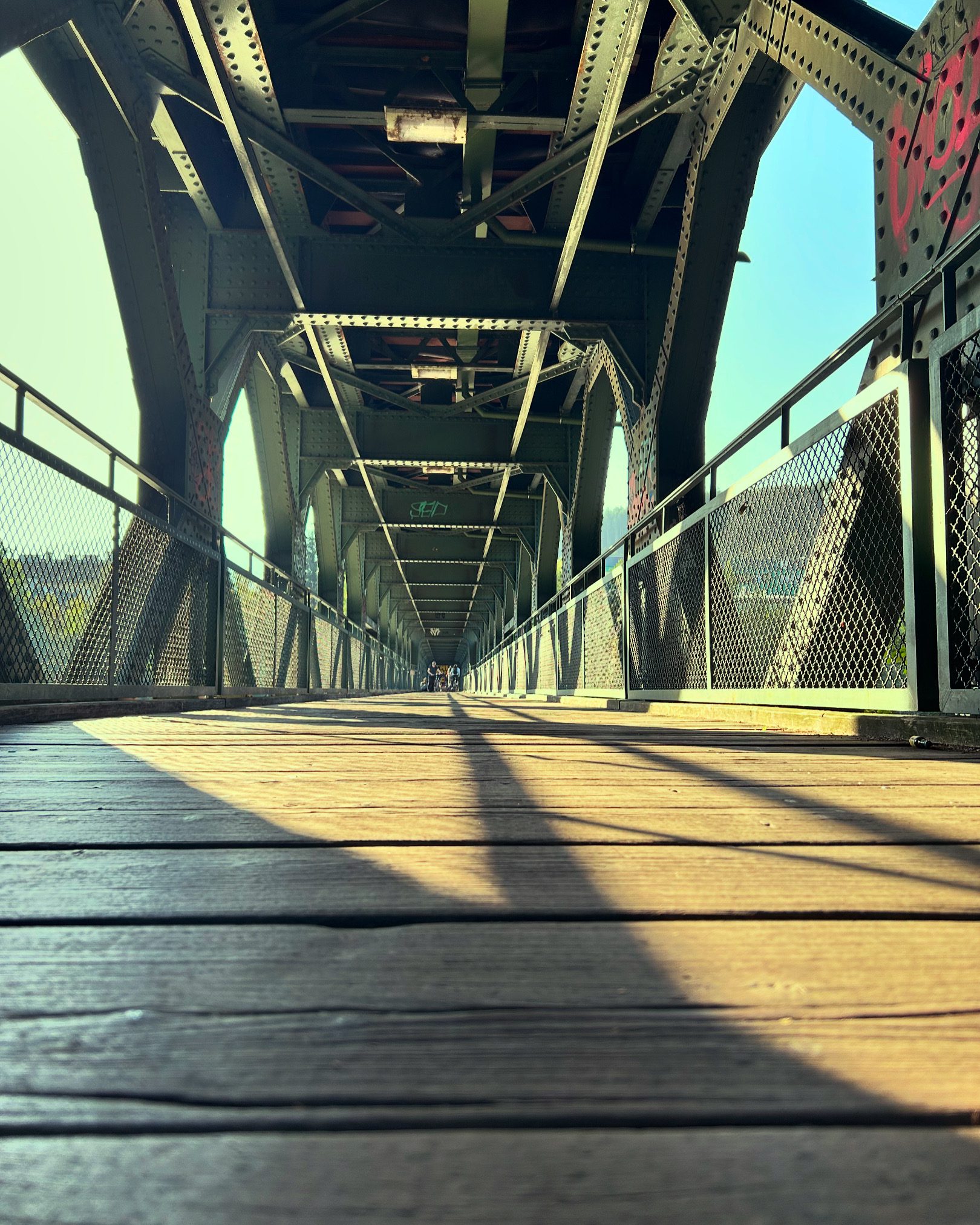
In the district of Höttinger Au, an unobtrusive structure spans the Inn, representing a small but significant piece of Tyrolean and European transportation history. The 104‑meter‑long Karwendel Bridge is part of a technical masterpiece of the fin‑de‑siècle era, connecting Innsbruck with southern Bavaria. The box‑girder bridge, built from riveted steel truss elements, requires only a single pier in the river to carry the heavy weight of rail traffic across the water. The bridge was renovated in 2007. One quickly realizes the forces acting on it when standing on the wooden pedestrian walkway as a train thunders overhead. As part of the Mittenwald Railway—also known as the Karwendel Railway—this photogenic steel truss bridge stands as an impressive testament to the outstanding engineering achievements of the time, achievements we take for granted today. The line connects Innsbruck via Seefeld and Mittenwald with Garmisch‑Partenkirchen. Engineer Josef Riehl (1842–1917) succeeded in conquering the 600‑meter elevation gain up to the Seefeld plateau thanks to the spectacular routing of the railway across the Martinswand high above Zirl. The son of an innkeeper from Bolzano, Riehl skillfully exploited the new possibilities of modern engineering and finance. As a young man, following his studies in Karlsruhe and Munich, he gained his first experience in railway construction on the Brenner Railway, the Puster Valley line, and several routes in the eastern parts of the empire. At only 28, he founded his own company in 1870, using his private assets as start-up capital. He recognized the need for secondary and tertiary railway lines in addition to the major routes in the vast Austro‑Hungarian Empire—needs that public authorities were financially unable to meet. Riehl took responsibility for financing and for the entire value chain of construction, which he then delivered as turnkey projects. Roads, railways, power plants, and even the necessary railway stations were built under his leadership. With the Hungerburgbahn, the Puster Valley Railway, and the Stubai Valley Railway, Riehl opened up much of the inner‑Alpine Tyrolean region to residents, tourism, and commerce. In total, he realized 250 kilometers of railway lines in Tyrol alone. One of his masterpieces was the highly challenging Karwendel Railway. Plans to connect Innsbruck and Garmisch had existed since the late 19th century. One of the most ardent advocates for linking Tyrol with Bavaria was Mayor Greil, beginning in 1890. In 1904, Austria and Bavaria reached an agreement to build the routes between Reutte and Kempten as well as Innsbruck and Garmisch. On the Austro‑Hungarian side, the State of Austria, the Province of Tyrol, the city of Innsbruck, and several other municipalities—financed by the Creditanstalt für Handel und Verkehr—formed the Mittenwaldbahn AG, with a total project volume of just under 24 million crowns. According to the Austrian National Bank’s currency calculator, this corresponds to more than 170 million euros today. Josef Riehl, together with Wilhelm Ritter von Doderer, received the concession from the Ministry of Railways for the construction of the line. The particular challenge lay in overcoming the steep elevation difference between the Inn Valley and the Seefeld plateau over a short distance, and doing so without the use of steam locomotives—relying instead solely on an electrified railway. The project required far more than laying tracks in mountainous terrain. The breathtaking route from Innsbruck up to the Seefeld plateau cut directly through the Alps and required the blasting of several tunnels, the construction of viaducts, stations such as the Westbahnhof in Wilten, and even a dedicated power plant on the Ruetz stream. In 1912, Riehl was able to hand over the project to its operator, the city of Innsbruck, within the agreed budget. To this day, the Karwendel Railway operates as a single‑track regional line and is popular among hikers, skiers, and cross‑country enthusiasts who want to reach the Seefeld plateau without the traffic congestion on the Zirler Berg. The best view of the Karwendel Bridge can be enjoyed from the Freiburger Bridge, located further east.
Die Eisenbahn als Entwicklungshelfer Innsbrucks
In 1830, the world’s first public railway line for passenger traffic, operated by a steam locomotive, was put into service between Liverpool and Manchester. Shortly thereafter, this new means of transport rapidly spread across the entire continent. Until then, travel had been expensive, long, and arduous—undertaken by carriage, on horseback, or on foot—something that hardly anyone did at all, and certainly not with pleasure. Innsbruck’s mayor, Joseph Valentin Maurer (1797–1843), recognized the importance of the railway as an opportunity for the Alpine region at an early stage. In 1836, he advocated the construction of a railway line in order to make the beautiful but hard-to-reach region accessible to as broad and affluent a public as possible and to re-establish Innsbruck as a European transport hub during economically difficult times for the city. The first practical pioneer of railway transport in Tyrol was Alois von Negrelli (1799–1858). At the end of the 1830s, when the first railway lines of the Danube Monarchy were being put into operation in the eastern parts of the empire, he presented an “Expert Report on the Route of a Railway from Innsbruck via Kufstein to the Royal Bavarian Border at the Otto Chapel near Kiefersfelden.” Negrelli, later one of the many intellectual fathers of the Suez Canal, had served in his youth in the Imperial and Royal Building Directorate in Innsbruck and knew the city well. His report already contained sketches and a cost estimate. As a location for the main railway station, he had proposed the area around the Triumphal Arch and the Hofgarten. In a letter, he expressed himself about the railway line through his former home city as follows:
"...I also hear with the deepest sympathy that the railway from Innsbruck to Kufstein is being taken seriously, as the Laage is very suitable for this and the area along the Inn is so rich in natural products and so populated that I cannot doubt its success, nor will I fail to take an active part in it myself and through my business friends when it comes to the purchase of shares. You have no idea of the new life that such an endeavour will awaken in the other side..."
Hier ist die Übersetzung des gesamten Abschnitts: Friedrich List (1789–1846), known as the father of the German railway, put forward the plan for a rail link from the North German Hanseatic cities through Tyrol to the Italian Adriatic. The intellectual liberal economist and advocate of the largest possible customs union in Central Europe saw the expansion of the railway network as the key to economic prosperity. On the Austrian side, Carl Ritter von Ghega (1802–1860) inherited overall responsibility for the railway project within the sprawling Habsburg Empire from the early-deceased Negrelli. List would not live to see his dream of a sensibly connected Central European economic area realized; in 1846, driven to despair by the conservative political situation in the German states, he shot himself on Tyrolean soil in Kufstein. Five years later, Austria and Bavaria expressed their intent in a treaty to build a railway line to the Tyrolean state capital. In May 1855, construction began on what was until then the largest building site Innsbruck had ever seen. The station area took shape between Museumstraße, Pradl, and Wilten, and the station forecourt subsequently became one of the city's new focal points. Modern hotels were no longer located in the Old Town, but right here. To the east, the tracks led out of the city along newly constructed viaducts. On November 24, 1858, after just three years of construction, the railway line between Innsbruck and Kufstein—and onward via Rosenheim to Munich—went into operation. The line was ahead of its time: unlike the rest of the railway system, which was only privatized in 1860, it opened right from the start as a private railway, operated by the previously founded k.k. privilegierte südliche Staats-, Lombardisch-, Venetianisch- und Zentral-italienische Eisenbahngesellschaft (Imperial Royal Privileged Southern State, Lombard, Venetian, and Central Italian Railway Company). With this strategic move, the costly construction of the railway could be kept off the books of Austria’s chronically cash-strapped state budget. With this opening toward the eastern parts of the monarchy and, above all, toward Munich, the first step toward modernizing Tyrol had been taken. Goods and passengers could now be transported quickly and comfortably from Bavaria to the Alps and back. In South Tyrol, the first trains began rolling along the tracks between Verona and Trento in the spring of 1859. For the time being, the north-south corridor remained incomplete. The first serious considerations regarding the Brenner Railway were made in 1847. Conflicts south of the Brenner Pass and the commercial necessity of connecting the two parts of the province prompted the Permanente Central-Befestigungs-Commission (Permanent Central Fortification Commission) to step in by 1854. However, the loss of Lombardy following the war with France and Sardinia-Piedmont in 1859 delayed the project in a now politically unstable Northern Italy. In 1860, the k.k. privilegierte südliche Staats-, Lombardisch-, Venetianisch- und Zentral-italienische Eisenbahngesellschaft had to be reorganized into the k.k. privilegierte Südbahngesellschaft (Imperial Royal Privileged Southern Railway Company) to begin detailed planning. The following year, the mastermind behind this outstanding infrastructural achievement of the era, Engineer Carl von Etzel (1812–1865), began surveying the terrain and drafting concrete plans for laying the tracks. The planner was instructed by the private company’s investors to keep costs as low as possible and avoid large viaducts and bridges. Contrary to earlier considerations by Ghega—who had suggested starting the route in Hall to soften the incline up to the pass at 1,370 meters above sea level—Etzel developed a plan that included Innsbruck. Together with his site manager Achilles Thommen, he selected the Sill Gorge (Sillschlucht) as the best route. This not only saved seven kilometers of track length and a significant amount of money, but also secured Innsbruck's crucial status as a transport hub. The alpine terrain, mudslides, snowstorms, and floods posed immense challenges for the construction crews. River courses had to be diverted, rock faces blasted, earthworks excavated, and walls constructed to master the environment. However, the severe outbreak of war in Italy in 1866 caused the greatest disruptions. Particularly patriotic German-speaking workers refused to work alongside the "enemy." As a result, 14,000 Italian-speaking laborers had to be dismissed before work could resume. Nevertheless, what was then the world's highest standard-gauge railway line, featuring 22 tunnels blasted out of the solid rock, was completed in a remarkably short construction period. How many men lost their health and lives while working on the Brenner Railway remains unknown.
Die Eröffnung ging bemerkenswert unspektakulär über die Bühne. Viele Menschen waren sich nicht sicher ob der technischen Neuerung. Wirtschaftszweige wie das Rodfuhrwesen und die Poststationen entlang der neuen Brennerstraße, die nach 20 Jahren Bauzeit erst 1850 vollendet worden war, swaren dem Untergang geweiht, wie das Sterben der Flößerei nach der Eröffnung der Bahnlinie ins Unterland gezeigt hatte. Schon während der Bauarbeiten war es zu Protesten der Bauern, die ob des drohenden Imports landwirtschaftlicher Güter um ihren Gewinn fürchteten, gekommen. Auf eine dem Ereignis würdige Feier wurde, wie bereits zuvor beim Bau der Bahnstrecke verzichtet. Wegen der Hinrichtung des ehemaligen Kaisers Maximilians von Mexiko, dem Bruder Franz Josef I., vor einem revolutionären Kriegsgericht, war Österreich in Staatstrauer. Anstelle einer priesterlichen Weihe und festlicher Taufe spendete die Southern railway company 6000 guilders to the poor relief fund. Also in the Innsbrucker Nachrichten there is not a word about the revolution in transport, apart from the announcement of the last express train over the Brenner Pass and the publication of the timetable for the Southern Railway.
(The last express coach). Yesterday evening at half past seven the last express coach to South Tyrol departed from here. The oldest postilion in Innsbruck was driving the horses, his hat was fluttered with mourning, and the carriage was decorated with branches of weeping willows for the last journey. Two marksmen travelling to Matrei were the only passengers to pay their last respects to the express coach. In the last days of 1797, the beautiful, otherwise so lively and now deserted road was conspicuously dead.
Until the opening of the railway line over the Brenner Pass on 24 August 1867, Innsbruck was a terminus station of regional importance. The new, spectacular Brenner railway across the Alps connected the northern and southern parts of the country as well as Germany and Italy. The new Brenner road had already opened the year before. The Alps had lost their divisive character and their terror for transit, at least a little. While an estimated 20,000 people crossed the Brenner in 1865, three years later in the first full year of operation of the railway line there were around ten times as many. In addition, a whole flood of goods found their way across the new north-south axis, boosting trade and consumption.
The second alpine obstacle that had to be overcome for territorial unity was the Arlberg. Initial plans for a railway line connecting the Lake Constance region with the rest of the Danube Monarchy existed as early as 1847, but the project was repeatedly postponed. In 1871, export bans on food due to the Franco‑Prussian War led to famine in Vorarlberg, because supplies could not be transported quickly enough from the eastern parts of the vast empire to the far west. The economic crisis of 1873 delayed construction yet again. Only seven years later did parliament decide to realize the railway line. In the same year, complex construction work began east and west of the Arlberg massif. A total of 38 mountain streams and 54 avalanche-prone zones had to be secured with 3,100 structures under precarious alpine weather conditions. The most remarkable achievement was the ten-kilometer-long tunnel carrying two tracks. On June 30, 1883, the last transport of mail by horse-drawn carriage departed from Innsbruck to Landeck in a ceremonially mournful setting. The very next day, the railway took over this service. With the opening of the railway from Innsbruck to Landeck and the final completion of the Arlberg Railway to Bludenz in 1884—including the breakthrough of the Arlberg tunnel—Innsbruck was once again definitively established as a transport hub between Germany and Italy, France, Switzerland, and Vienna. In 1904 the Stubai Valley Railway, and in 1912 the Mittenwald Railway, were opened. Both projects were planned by Josef Riehl (1842–1917).
For a large part of the population, the railway was the most directly perceptible sign of progress. The railway viaducts, built from Hötting breccia quarried nearby, formed a physical and visible boundary to the east of the city toward Pradl. However, the railway did not change the region only from a technical perspective—it brought immense social transformation. Workers, students, soldiers, and tourists streamed into the city in large numbers, bringing new ways of life and ideas with them. Josef Leitgeb described this transformation in his novel The Untouched Year as follows:
“Even then, the railway had already brought many newcomers to Wilten. They lived in the new tall buildings that were springing up everywhere on land where grain had grown for centuries. Yet they were still perceived as outsiders; their Czech, Slovenian, and Hungarian names did not fit into the familiar sounds. They wore cheap ready-made clothing bought on installment, avoided church services, and instead attended meetings where the established citizens felt out of place. Seen clearly, they were quiet, hardworking, thrifty people who had simply brought different ways of life from the large cities and the lowlands. Anyone who looked at them askance could claim no other justification than that they did not want spectators for their own comfort. Nevertheless, the rejection of newcomers by the locals was still clearly palpable at the time; the father once heard a sermon in which the priest assured that all people could attain eternal salvation—‘even robbers and murderers, yes, even railwaymen.’”
The Federal Railway Directorate of the Imperial and Royal General Directorate of the Austrian State Railways in Innsbruck was one of only three directorates in Cisleithania. New social classes emerged as a result of the railway as an employer. People from all strata of society were needed to keep railway operations running. Workers and craftsmen could experience social advancement within the railway, similar to opportunities in state administration or the military. New professions such as track keeper, conductor, stoker, or locomotive driver emerged. Working for the railway carried a certain prestige. Not only was one part of the most modern industry of the time; titles and uniforms turned employees and workers into figures of respect. By 1870, Innsbruck’s population had grown from 12,000 to 17,000, largely due to the economic impulses generated by the railway. Local producers benefited from the ability to import and export goods quickly and at low cost. The labor market changed. Before the railway lines were opened, nine out of ten Tyroleans worked in agriculture; after the opening of the Brenner Railway, this figure dropped to below 70%. The new mode of transport contributed to social democratization and the rise of a bourgeois society. Not only wealthy tourists but also ordinary subjects—those who did not belong to the upper class—could now take excursions into the surrounding area. New foods altered people’s diets. The first department stores appeared with the arrival of consumer goods that had previously been unavailable. The appearance of Innsbruck’s inhabitants changed with new, fashionable clothing that became affordable for many for the first time. Not everyone welcomed this development. Shipping on the Inn River, previously an important transport route, almost immediately came to a standstill. The already weakened lower nobility and particularly strict clergy feared the collapse of local agriculture and a final moral decline due to the presence of strangers in the city.
The railway was worth its weight in gold for tourism. It was now possible to reach the remote and exotic mountain world of the Tyrolean Alps. Health resorts such as Igls and entire valleys such as the Stubaital, as well as Innsbruck city transport, benefited from the development of the railway. 1904 years later, the Stubai Valley Railway was the first Austrian railway with alternating current to connect the side valley with the capital. On 24 December 1904, 780,000 crowns, the equivalent of around 6 million euros, were subscribed as capital stock for tram line 1. In the summer of the following year, the line connected the new districts of Pradl and Wilten with Saggen and the city centre. Three years later, Line 3 opened the next inner-city public transport connection, which only ran to the remote village in 1942 after Amras was connected to Innsbruck.
The railway was also of great importance to the military. As early as 1866, at the Battle of Königgrätz between Austria and Prussia, it was clear how important troop transport would be in the future. Until 1918, Austria was a huge empire that stretched from Vorarlberg and Tyrol in the south-west to Galicia, an area in what is now Poland, and Ukraine in the east. The Brenner Railway was needed to reinforce the turbulent southern border with its new neighbour, the Kingdom of Italy. Tyrolean soldiers were also deployed in Galicia during the first years of the First World War until Italy declared war on Austria. When the front line was opened up in South Tyrol, the railway was important for moving troops quickly from the east of the empire to the southern front.
Carl von Etzel, who did not live to see the opening of the Brenner railway, is commemorated today by Ing.-Etzel-Straße in Saggen along the railway viaducts. Josef Riehl is commemorated by Dr.-Ing.-Riehl-Straße in Wilten near the Westbahnhof railway station. There is also a street dedicated to Achilles Thommen. As a walker or cyclist, you can cross the Karwendel Bridge in the Höttinger Au one floor below the Karwendel railway and admire the steel framework. You can get a good impression of the golden age of the railway by visiting the ÖBB administration building in Saggen or the listed Westbahnhof railway station in Wilten. In the viaduct arches in Saggen, you can enjoy Innsbruck's nightlife in one of the many pubs covered by history.
Wilhelm Greil: DER Bürgermeister Innsbrucks
One of the most important figures in Innsbruck's municipal history was Wilhelm Greil (1850–1928). The entrepreneur held the office of mayor from 1896 to 1923, having previously helped shape the city's fortunes as vice mayor. His tenure was not only long, but also took place during a particularly dynamic era. The four decades between the economic crisis of 1873 and the First World War were marked by unprecedented growth and rapid modernization. It was a time of incorporating entire city districts, technical innovations, and new media. Private investments in infrastructure such as railways, energy, and electricity were encouraged by the state and given tax incentives in order to lead the provinces and cities of the struggling Danube Monarchy into modernity. The city's economy was booming. Businesses emerged in the new districts of Pradl and Wilten, attracting a labor force. Tourism also brought fresh capital into the city. Innsbruck's city council was dominated by the liberal and Pan-German nationalist 'Deutsche Volkspartei' (German People's Party), to which Greil also belonged. It was only with the incorporation of Wilten and Pradl in 1904 that the conservatives were able to gain ground, though they could not fully catch up. Social Democracy played almost no role until 1918. Due to an electoral system based on voting rights categorized by wealth classes, only about 10% of Innsbruck's population could step up to the ballot box. Women were fundamentally excluded. Furthermore, relative voting rights applied within the three electoral colleges, which effectively meant: winner takes it all. Appropriately enough, Mayor Greil lived much like a Renaissance prince. He hailed from the upper-class haute bourgeoisie. His father was able to afford establishing the family's home base in the Palais Lodron on Maria-Theresien-Straße. Thanks to this electoral statute, Mayor Greil could rely on 100% support in the city council well into the era of the First Republic, which naturally simplified decision-making and governance considerably. For all the efficiency that Innsbruck's mayors displayed on a superficial level, one should not forget that this was only possible because, as part of an elite composed of entrepreneurs, merchants, and professionals, they ruled through a form of elected dictatorship—without any significant opposition or consideration for other population groups such as workers, artisans, and employees. The Imperial Municipal Act of 1862 granted cities like Innsbruck, and thus its mayors, far-reaching powers. It is hardly surprising that the chain of office presented to Greil on his 60th birthday by his colleagues on the city council bore an astonishing resemblance to the collar orders of the old nobility. However, Greil was also a skillful politician who adeptly navigated the established power structures and media landscape of his time. Article 17 of the Austrian Basic Law of 1867, known as the December Constitution, secured freedom of expression in the press without prior censorship for the first time—excluding, of course, punishable content such as blasphemy or insulting the authorities. Consequently, a variety of newspapers established themselves, such as the conservative Neue Tiroler Stimme, the social democratic Volkszeitung, or the liberal Innsbrucker Nachrichten, shaping a worldview according to their publishers' preferences. Thanks to the reach of the Innsbrucker Nachrichten, Wilhelm Greil was able to effectively project his view of local politics. Despite his at times fierce speeches—modeled on the platform of Georg Ritter von Schönerer (1842–1921), the founding figure of the Pan-German nationalists—he managed to reach arrangements with conservative forces in the region, even if things frequently clashed in the media and elsewhere. Taxes, social policy, education, housing, and the design of public spaces were debated with passion and zeal, often enough with violence as the ultimate argument.
Unter Greils Ägide und dem allgemeinen wirtschaftlichen Aufschwung erweiterte sich Innsbruck im Eiltempo. Der Gemeinderat kaufte ganz im Stil eines Kaufmanns vorausschauend Grund an, um der Stadt Neuerungen zu ermöglichen. Der Politiker Greil konnte sich bei den großen Bauprojekten der Zeit auf die Beamten und Stadtplaner Eduard Klingler, Jakob Albert und Theodor Prachensky stützen. Infrastrukturprojekte wie das neue Rathaus in der Maria-Theresienstraße 1897, die Eröffnung der Mittelgebirgsbahn, die Hungerburgbahn und die Karwendelbahn wurden während seiner Regierungszeit umgesetzt. Weitere gut sichtbare Meilensteine waren die Erneuerung des Marktplatzes und der Bau der Markthalle. Neben den prestigeträchtigen Großprojekten revolutionierte vor allem Unsichtbares in den letzten Jahrzehnten des 19. Jahrhunderts das Leben vieler Innsbrucker. Bereits Greils Vorgänger Bürgermeister Heinrich Falk (1840 – 1917) hatte erheblich zur Modernisierung der Stadt und zur Besiedelung des Saggen beigetragen. Seit 1859 war die Beleuchtung der Stadt mit Gasrohrleitungen stetig vorangeschritten. Mit dem Wachstum der Stadt und der Modernisierung wurden die Senkgruben, die in Hinterhöfen der Häuser als Abort dienten und nach Entleerung an umliegende Landwirte als Dünger verkauft wurden, zu einer Unzumutbarkeit für immer mehr Menschen. 1880 wurde das Ragging, so der Name im Volksmund für die Entleerung der Aborte, in den Verantwortungsbereich der Stadt übertragen. Zwei pneumatische Maschinen sollten den Vorgang zumindest etwas hygienischer gestalten. Zwischen 1887 und 1891 wurde Innsbruck mit einer modernen Hochdruckwasserleitung ausgestattet, über die auch Wohnungen in höher gelegenen Stockwerken mit frischem Wasser versorgt werden konnten. Wer auf sich hielt und es sich leisten konnte, hatte damit erstmals die Gelegenheit eine Spültoilette im Eigenheim zu installieren. Greil setzte diesen Feldzug der Modernisierung mit einer Vielzahl an Infrastrukturprojekten fort. Die Ansammlung an Menschen auf enger werdendem Raum unter teils prekären Hygieneverhältnissen hatte viele Probleme mit sich. Die Randbezirke der Stadt und die umliegenden Dörfer wurden regelmäßig von Typhus heimgesucht. Nach jahrzehntelangen Diskussionen wurde 1903 mit dem Bau einer modernen Schwemmkanalisation begonnen. Ausgehend von der Innenstadt wurden immer mehr Stadtteile an diesen heute alltäglichen Luxus angeschlossen. 1908 waren nur die Koatlackler Mariahilf und St. Nikolaus nicht an das Kanalsystem angeschlossen. Auch der neue Schlachthof im Saggen erhöhte Hygiene und Sauberkeit in der Stadt. Schlecht kontrollierte Hofschlachtungen gehörten mit wenigen Ausnahmen der Vergangenheit an. Das Vieh kam im Zug am Sillspitz an und wurde in der modernen Anlage fachgerecht geschlachtet. Greil überführte das Gaswerk in Pradl und das Elektrizitätswerk in Mühlau in städtischen Besitz. Die Straßenbeleuchtung wurde im 20. Jahrhundert von den Gaslaternen auf elektrisches Licht umgestellt. 1888 übersiedelte das Krankenhaus von der Maria-Theresienstraße an seinen heutigen Standort. Bürgermeister und Gemeinderat konnten sich bei dieser Innsbrucker Renaissance neben der wachsenden Wirtschaftskraft in der Vorkriegszeit auch auf Mäzen aus dem Bürgertum stützen. Waren technische Neuerungen und Infrastruktur Sache der Liberalen, verblieb die Fürsorge der Ärmsten weiterhin bei klerikal gesinnten Kräften, wenn auch nicht mehr bei der Kirche selbst. Freiherr Johann von Sieberer stiftete das Greisenasyl und das Waisenhaus im Saggen. Leonhard Lang stiftete das Gebäude in der Maria-Theresienstraße, in der sich bis heute das Rathaus befindet gegen das Versprechen der Stadt ein Lehrlingsheim zu bauen.
In contrast to the booming pre-war era, Greil’s leadership after 1914 was marked by crisis management. In his final years in office, he guided Innsbruck through the transition from the Habsburg monarchy to the republic—a time characterized above all by hunger, hardship, scarcity of resources, and insecurity. He was 68 years old when Tyrol was divided at the Brenner Pass after the war. During his political career, Greil had often exploited general hostility toward Italians (“Walsche”) in a similarly populist manner to his Christian Social counterpart in Vienna, Karl Lueger, who used antisemitic rhetoric. At the end of his career, he had to witness the Italian occupation of Innsbruck. With the introduction of the republic, the census-based voting system was abolished, marking the beginning of the end of liberal dominance in the municipal council. In 1919, the Social Democrats won elections in Innsbruck for the first time. Only due to council majorities and a coalition of Greater German-liberal and conservative-clerical politicians did Greil remain mayor. He died in 1928 at the age of 78 as an honorary citizen of the city of Innsbruck. Wilhelm-Greil-Straße had already been named after him during his lifetime.