Palais Ferrari & Old Garrison Hospital
Weinhartstrasse 2 - 4
Worth knowing
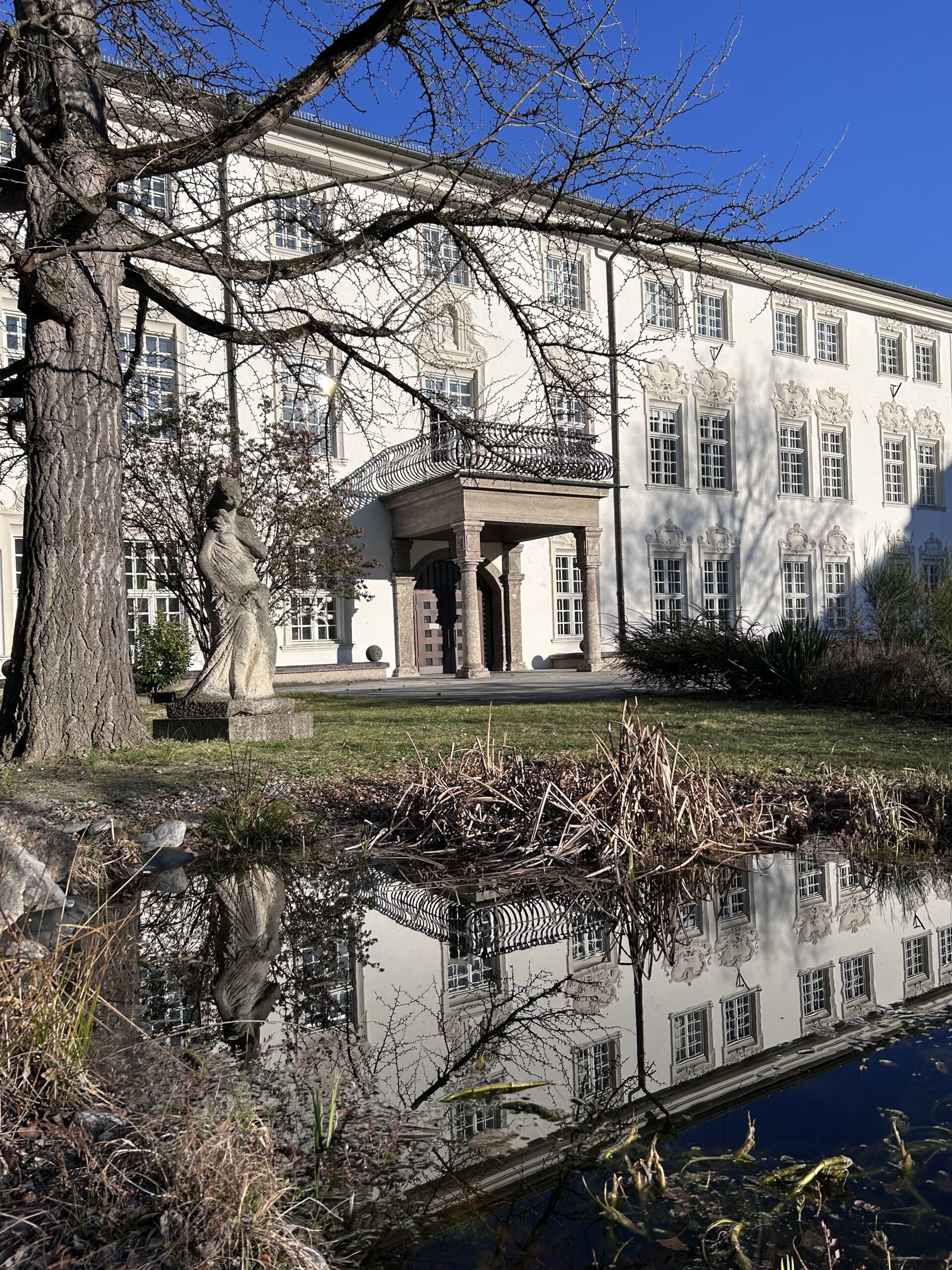
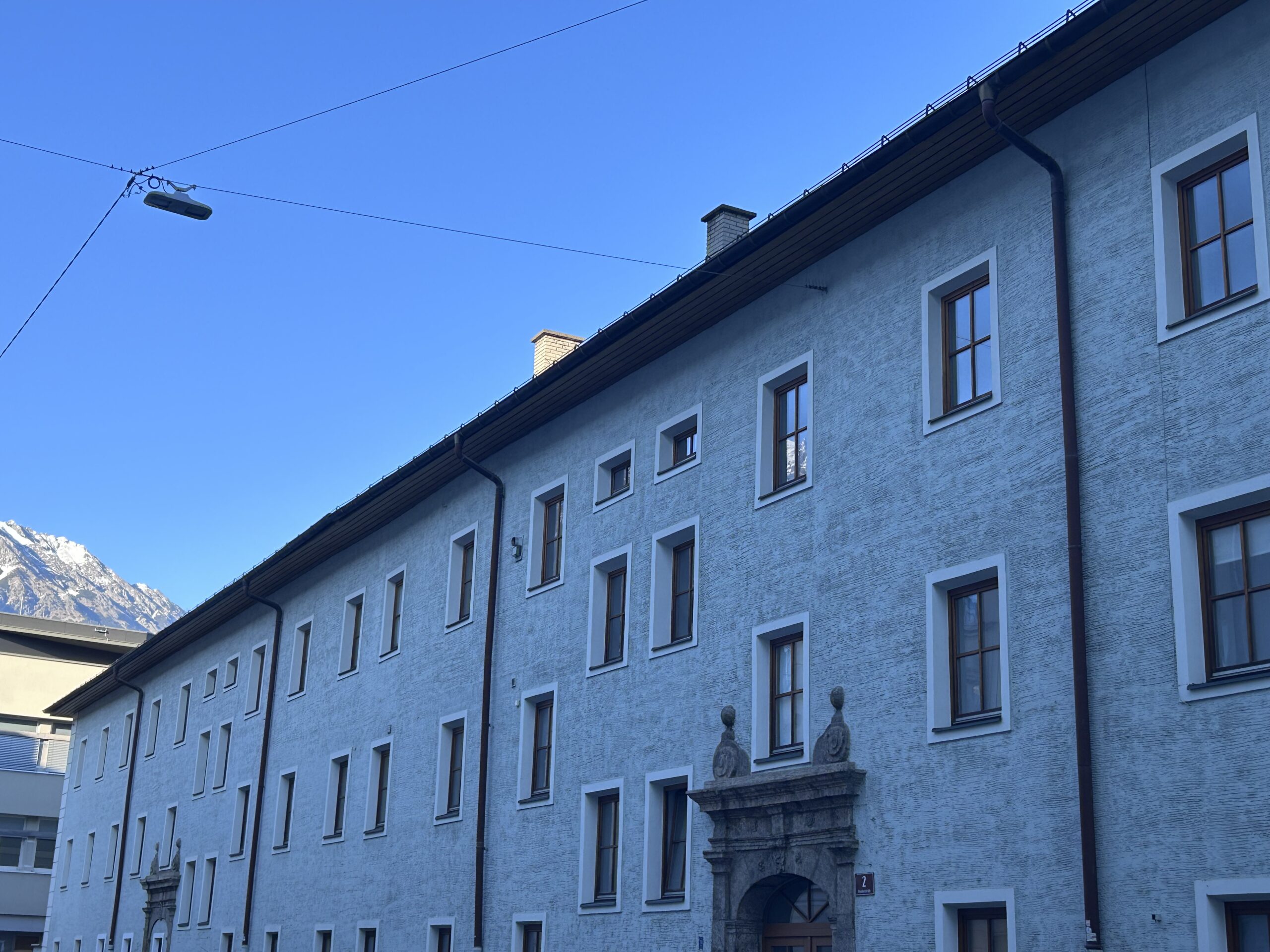
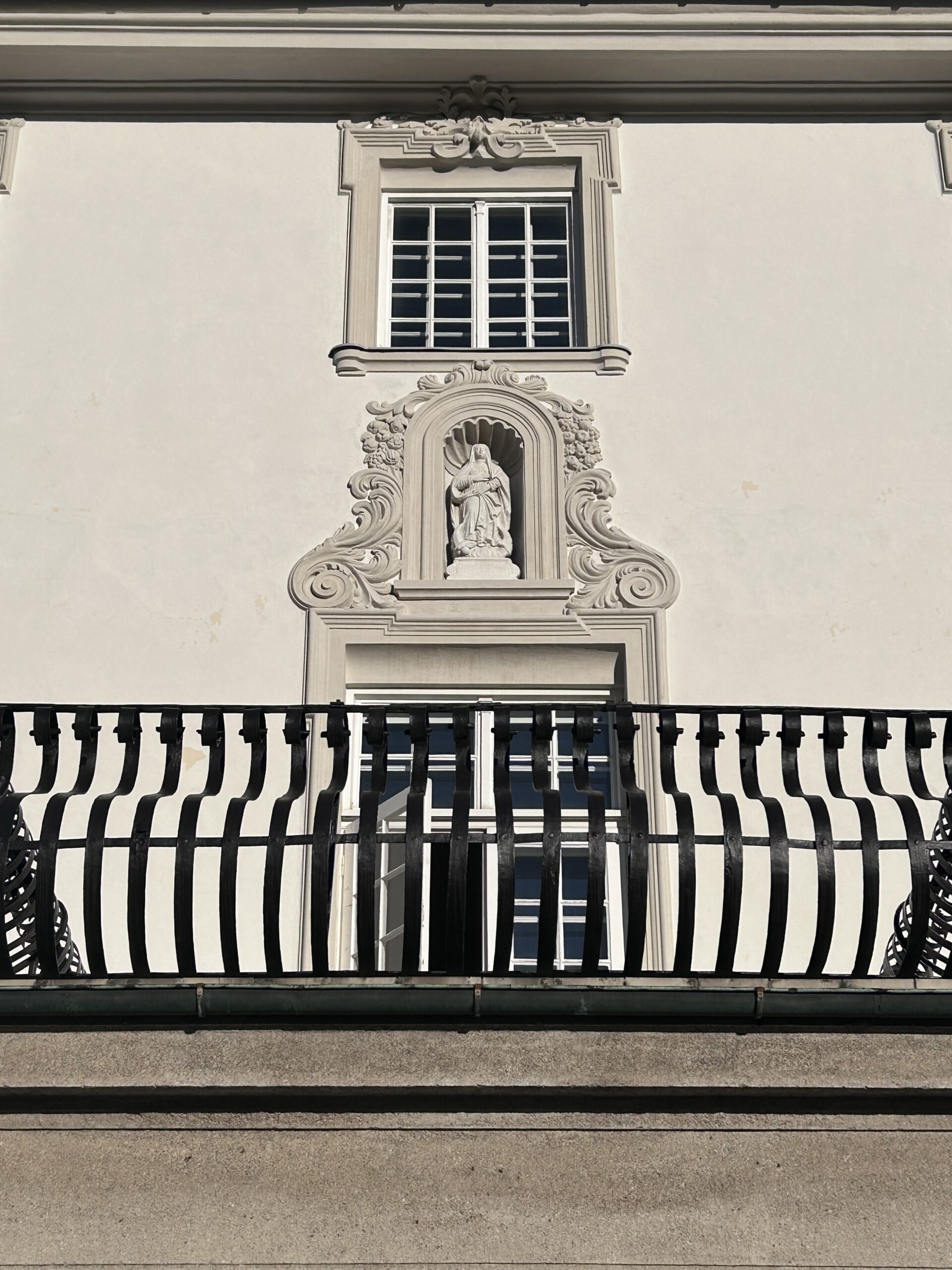
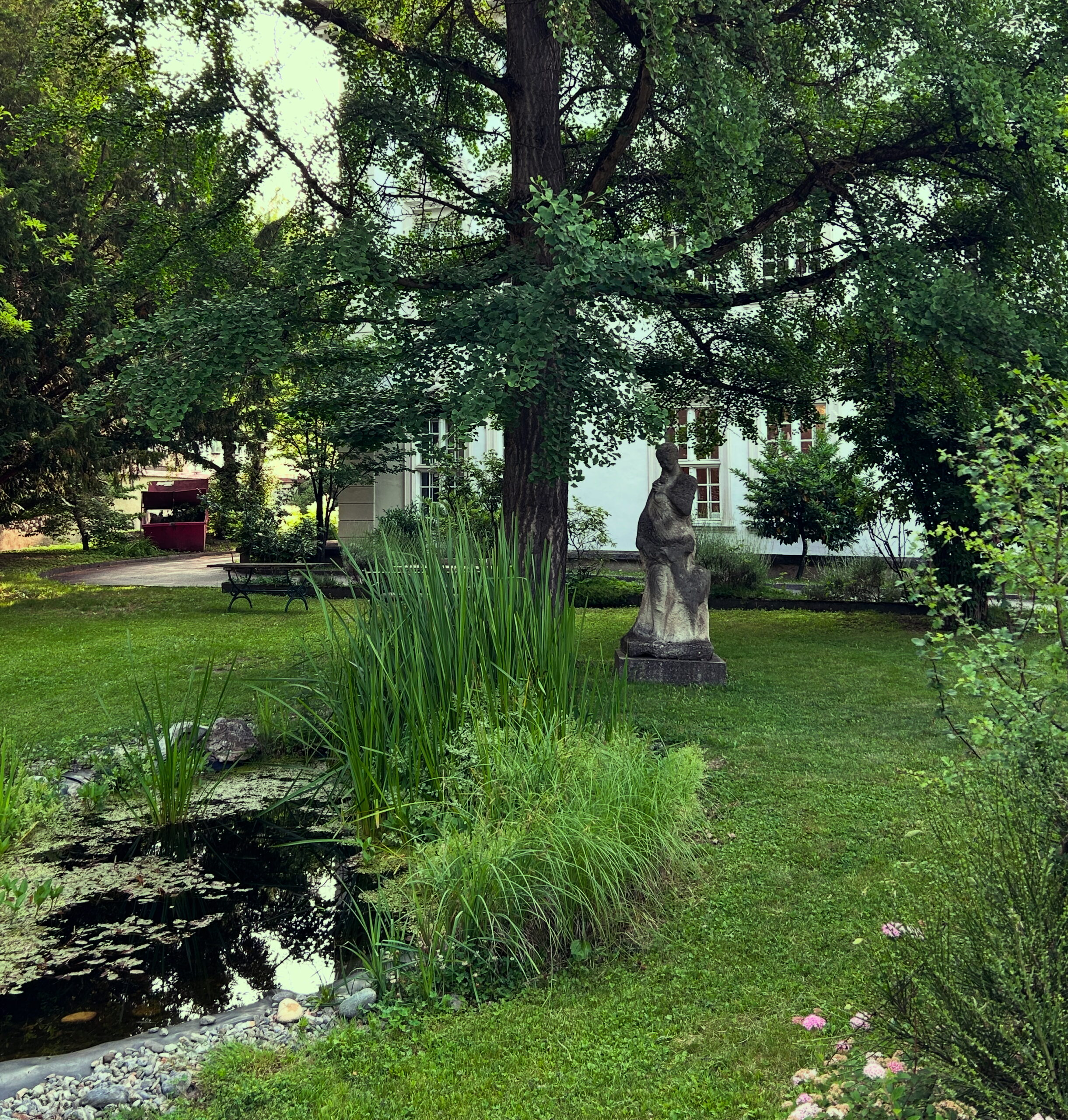
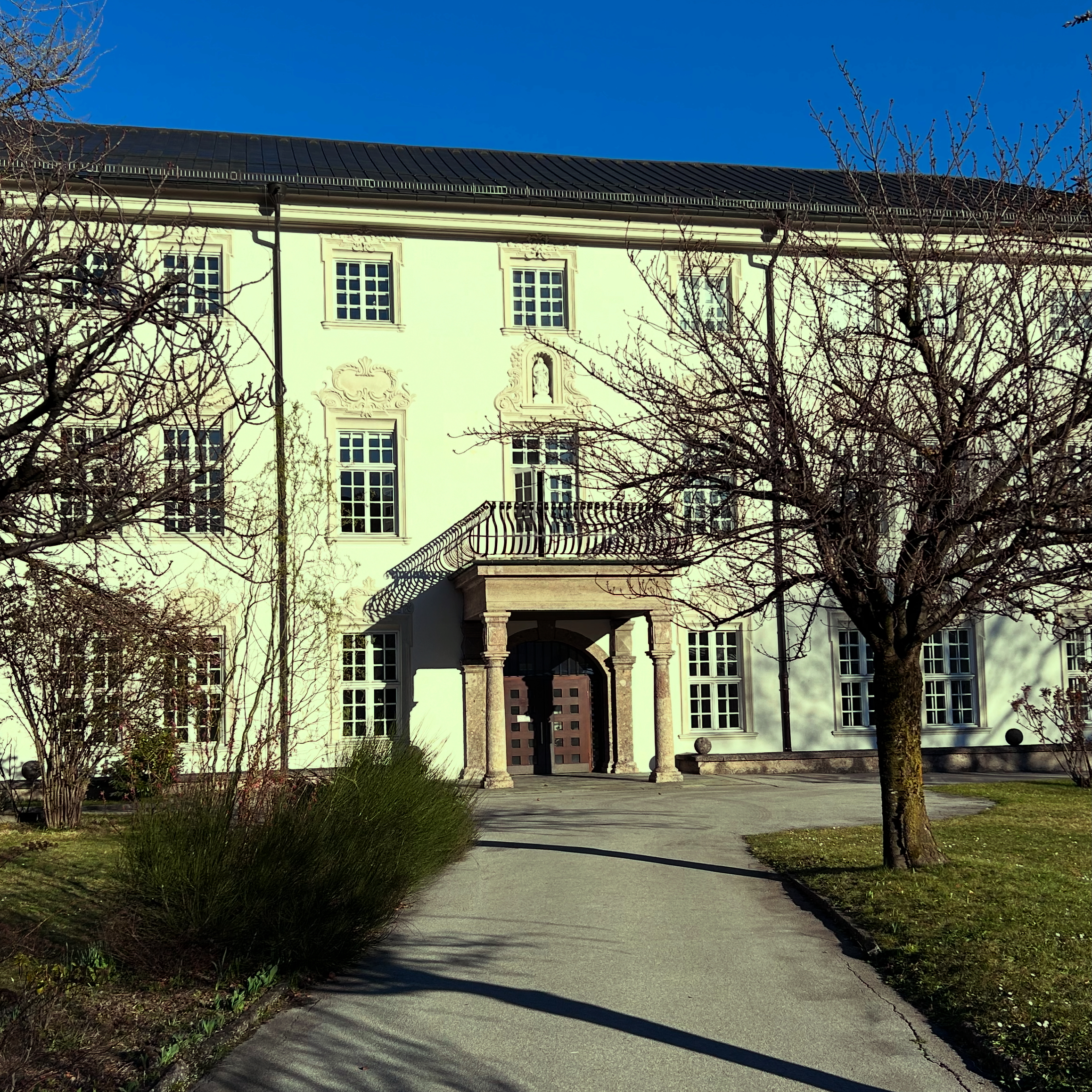
In the border area between the city center, Dreiheiligen, and Pradl lies, like a small island surrounded by König-Laurin-Straße, Dreiheiligenstraße, and Weinhartstraße, the former Imperial and Royal Garrison Hospital and the Palais Ferrari. Both buildings look back on a long history marked by numerous turning points. The first owner of the palace was Hieronymus Bernardo Ferrari d’Occhieppo (1615–1691). The Piedmontese nobleman entered the service of the House of Habsburg as the chief steward of Archduchess Anna of Austria, wife of the last Tyrolean sovereign, Ferdinand Karl. Later, as a member of Emperor Leopold I’s Privy Council, he belonged to the highest governmental circles of the monarchy. For his services, the devout official received permission from Emperor Leopold to build his Tyrolean residence along the Sill River. In the midst of a spacious park, the three-story Palais Ferrari was built in 1686, based on the plans of Johann Martin Gumpp, in the typical Baroque style of the period. Despite several alterations and renovations, the flair of the 17th century has been preserved to this day. Above the small balcony on the first floor still stands the statue of Maria Immaculata. To shorten his path to heaven, the pious Count Ferrari—who, in addition to his political activities, also served as Commander of the Order of Saints Maurice and Lazarus—donated part of his fortune to the Church and the city of Innsbruck. This sum of 30,000 guilders enabled representatives of the Society of Saint Ursula from Bavaria to be brought to Tyrol, where they founded the city’s first school for girls behind the hospital church. At the entrance to the Ursuline Passage, the order—which dedicated itself primarily to the education of girls—is still prominently visible in the cityscape. As virtuous as the first of the Innsbruck Ferraris was, his descendants were known mainly for their extravagant lifestyle. Within 200 years, the once vast fortune had been squandered. In 1893, the city of Innsbruck took over the estate and leased it to the military. The palace was of interest to the army because, since the Napoleonic Wars, a garrison hospital had been located in the neighboring building at what is now Weinhartstraße 2. As early as the early modern period, a hospital had been established in this industrial district near the Zeughaus. The infirmary and almshouse were first mentioned in 1541. During the plague outbreak of 1611, Innsbruck’s congregational physician Weinhart—after whom the street is named—had the hospital expanded. With measures such as fumigation, improved hygiene, and the popular practice of bloodletting, doctors and clergy attempted to combat the Black Death. In the 19th century, the plague was no longer an issue, but the new style of warfare required modern medical care for an increasing number of wounded and disabled soldiers. The administrative offices of the military hospital were moved into the elegant Palais Ferrari. Before World War I, the garrison hospital relocated to Amras, to what is now Conradstraße. After the war, the Austrian army was drastically reduced, while housing shortages grew. Empty rooms in the former hospital building were converted into municipal apartments. In 1924, the Austrian Federal Railways took over the building to house employees near the train station. Despite several renovations, the core of the building, including the massive entrance gates, still dates back to the 17th century.
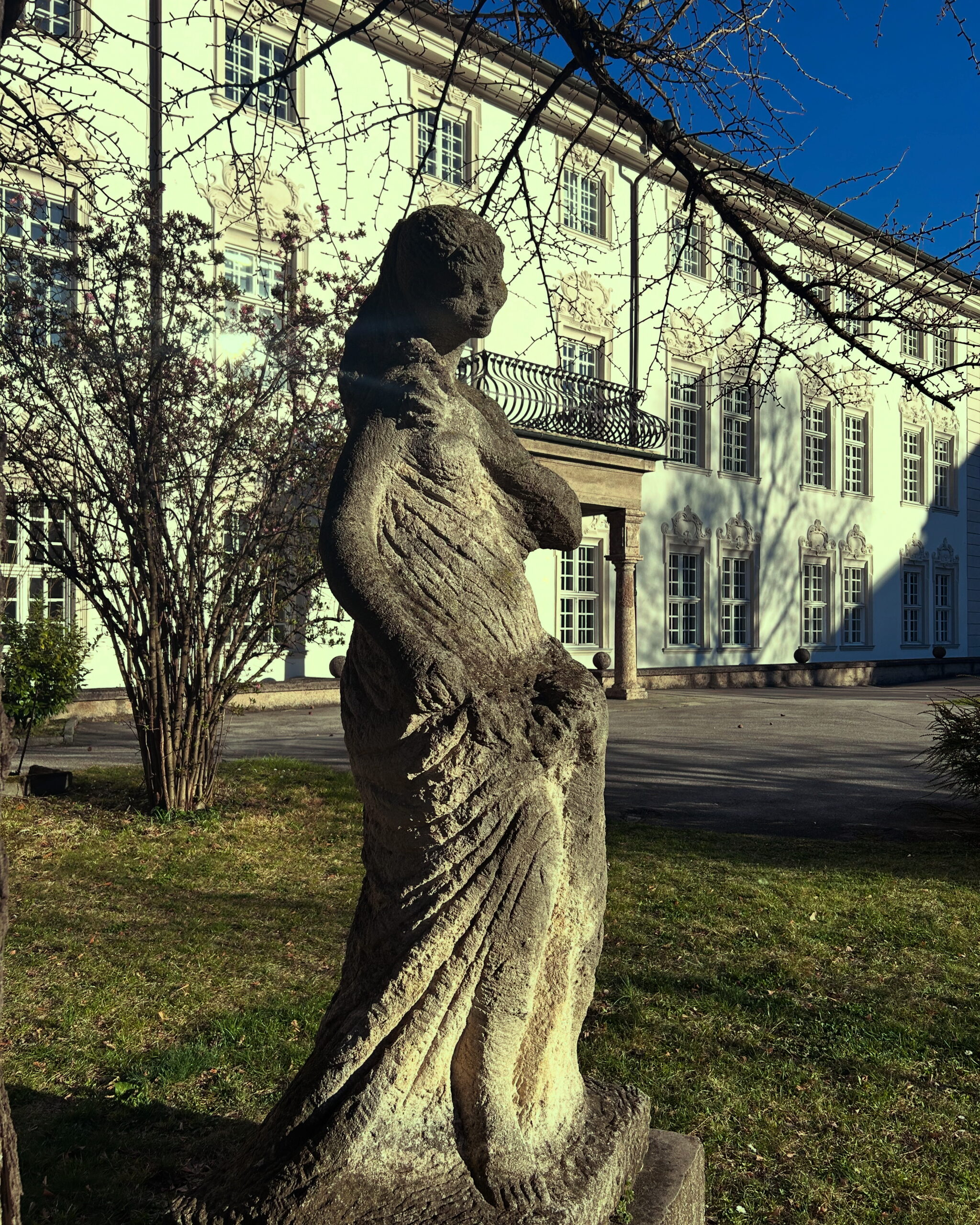
The now deteriorating Palais Ferrari was also transferred from military to civilian use. Under the leadership of the later headmistress Adolfine Sieberer, Ministerial Director Herta von Sprung of the First Republic, and Mayor Wilhelm Greil, the School for Domestic and Vocational Training of Women found its new home here. In 1922, the school was expanded to include a horticulture program and came under federal administration. The strained state budget during the years of the global economic crisis also affected the school: only through sales of fruit and vegetables from its own garden and scholarships from the local savings bank could operations be maintained during the 1930s. The following decades were hardly easier. War and air raids took their toll. During World War II, refugees were housed in the upper floor of the Palais Ferrari. To protect them from bombardments, the students were relocated to Imst. In the decades after the war, the garden and school were renovated and modernized, and they flourished anew. Rudi Wach, the artist behind the controversial crucifix on the Inn Bridge, created the stone statue Flora with Deer, which, along with other 1950s artworks, still adorns the garden. To meet the requirements of modern education, several extensions and additions were made to the Baroque palace. The countless changes in the school’s structure throughout the 20th century reflect the slowly developing and shifting professional opportunities available to young women. Despite official efforts, the school was perceived well into the postwar period primarily as a training institution for future housewives and mothers. Only with its transformation into a fashion school did vocational training move to the forefront. Today, young men may also take their final exams here, and in addition to traditional areas of study, the curriculum now includes nursing and media design. The builder of the original palace—who in 1689 also endowed the Ursuline order with the means to found the first girls’ school in Innsbruck—would surely take satisfaction in knowing that his palazzo and the Ursulines, more than three centuries later and affectionately mocked by the public as the “Putz- und Knödelakademie” (“Cleaning and Dumpling Academy”), continue to be pillars of Innsbruck’s educational landscape.
Articles on girls & education - 1931
A strange phenomenon is becoming more and more apparent that could give pause for thought. A survey of all the domestic schools in the country and beyond shows that girls almost everywhere go to school rather than to the actual female schools, the domestic schools. The commercial schools, it is said, are overcrowded; the colleges of higher studies dismiss a good number of female graduates every year; on the other hand, factories and offices also provide many, many unemployed women: but if one asks for girls who train themselves in housekeeping, they are rare, and apparently becoming rarer and rarer.
Why this? "Oh," you hear, "I don't want to be a housemaid!" "Good jobs as a servant are very rare!" "Who's going to cook for themselves when there are cafeterias. Communal kitchens, etc., where you can have everything much faster and more conveniently!" "Well, it's really never worth having your own business!"
This is the modern way of thinking and slowly but inexorably something of the most precious thing that still glorified life as something sacred is being lost: the caring, loving home. Certainly, in many, very many cases it has already been destroyed by hard hardship, and even where there is still an honest will to be at home, it has torn open ugly oases and brought haste and insecurity where fine contemplation and prudent, intelligent efficiency and love should be in charge. Hundreds and hundreds go out to earn money because there is not enough at home, and people do not know how to manage what they have earned. They haven't learnt to do it, and why should they? - Things are going downhill! Many people complain silently and loudly about the economic hardship, but where you could start to improve on a small scale, that's where the local, Tyrolean way of thinking turns round!
The home economics schools are almost empty. Is the expansion, the curriculum to blame? Is too much theory being taught, which is less suited to girls with a practical sense? Can they not use what they have learnt at school in life? Is the teaching not adapted enough to the actual circumstances of individual groups of girls and is not enough attention paid to the difference between rural and urban, the rough heavy labourer's kitchen and that of the intellectual worker? Perhaps a reorganisation, a re-learning is needed here and there: but certainly a reorganisation on the part of some parents and girls is also necessary, so that the economic development on a large scale is first preceded by work on the small and smallest scale. Only when the individual household is run rationally, economically and yet profitably, and such households multiply in town and country, will there be a viable foundation for a healthy national economy that strives outwards. Otherwise we are heading towards a Bolshevik, family-dissolving collective economy, towards mass impoverishment.
Prudent parents may ask themselves whether it would not be appropriate to let their daughters go through a proper year of economics (not just an occasional sip, as is not otherwise possible alongside the other secondary school subjects, for example!) before they enter a professional position, and prudent girls may consider whether it would not still be possible, despite everything to the contrary, to include such a year before entering as a machinist or any other profession, if this has to be done. In many cases, it will not be easy for young girls to give up earning a living or earning their own money, but it is quite certain that they will be more capable of living and more stable in their modern jobs with the domestic training than without it. And if sooner or later the girl does start a family of her own? - What will benefit her more then? So foresight! Many people have to relearn in this day and age. Why not quietly educate parents, young women and, hand in hand with them, also home economics schools where necessary?
*
Following on from the above thoughts, which should not be dismissed out of hand, we should point out the opportunities for domestic training that we have in Tyrol. Apart from the professional higher education offered by the household seminary of the reverend Ursuline nuns in Innsbruck and the so-called "Ferrari School" in Fabriksgasse (also in Innsbruck), there are household schools with ten-month courses in the two aforementioned institutions, as well as in the girls' institute in Pfaffenhofen, at the reverend Terziar Sisters in Hall (municipal school! There is also a private housekeeping school with its own curriculum in the refuge in Hall. Winter courses lasting five months with an emphasis on home economics for rural girls are offered by the agricultural provincial training centres: a three-month day course with a very practical approach, especially for middle-class girls, starts in September in Innsbruck at the Ursuline nuns. The Vinzenzheim in Ried and the convent of the Sisters of Mercy in Ried offer girls six to eight-week internal winter courses in sewing and cookery with the most necessary theoretical instruction, while exclusively practical cookery courses are held over the winter at Miss Staudacher in Stams. So there is undoubtedly enough opportunity for every relevant demand in the country. May the consistently hard-working and efficient leaders of these courses also experience the satisfaction that their efforts are appreciated by the people and all circles of the same according to our time of need!
From the Tyrolean Girls' Association.
Articles about the Ferrari family - 1937
A republic is born
Hardly any era is more difficult to grasp than the interwar period. The Roaring Twenties, jazz, and automobiles come to mind just as readily as inflation and economic crisis. In major cities like Berlin, young women carrying themselves as flappers with bobbed hair, cigarettes, and short skirts danced lasciviously to the new sounds. In Innsbruck, American drinks were served during Five O'Clock Tea at the bar in the Knights' Hall (Rittersaal) of the Cafe Gasthaus Zur Annasäule, which later became the Alt-Innsbruck. The suits of armor can still be admired in the bay window from Maria-Theresien-Straße. For the most part, however, as part of the young Republic of German-Austria, Innsbruck’s population belonged to the faction of poverty, economic crisis, and political polarization. Right from the start, the proclamation of the republic in front of the parliament in Vienna before more than 100,000 people—who were less enthusiastic than they were curious and unsettled—was anything but smooth, accompanied by riots, shootouts, two deaths, and 40 injuries. No one knew how things were supposed to continue after the end of the monarchy and the loss of a large part of the state territory. The new Austria seemed too small and incapable of surviving. The bureaucratic apparatus of the Austro-Hungarian Empire carried on seamlessly under a new flag and name. In the constitution, the federal states, as successors to the old crown lands, were granted a great deal of leeway in legislation and administration under the framework of federalism. However, enthusiasm for the new state among the population remained limited. Not only was the supply situation miserable after the loss of the vast majority of the former giant Habsburg empire, but people also distrusted the underlying concept of the republic. The monarchy had not been perfect, but very few people could relate to the idea of democracy. Instead of being subjects of the Emperor, people were now citizens, but only citizens of a dwarf state with an oversized capital that was little loved in the federal states, rather than citizens of a great empire. In the former crown lands, which were largely governed by the Christian Social Party, people frequently spoke of the "Viennese hydrocephalus" (Wiener Wasserkopf) that let itself be fed by the yields of the hardworking rural population. Other federal states also toyed with the idea of breaking away from the republic after the plan to join Germany, which was supported by all parties, was banned by the victorious powers of the First World War. The various Tyrolean plans, however, were particularly spectacular. From a neutral alpine state with other federal states, a free state consisting of Tyrol and Bavaria, or extending from Kufstein to Salurn, an annexation to Switzerland, all the way to a Catholic church-state under papal leadership, many options were considered. The most obvious solution was particularly popular. Feeling German was nothing new. So why not also attach oneself politically to the big brother to the north? This desire was highly pronounced, especially among urban elites and students. The annexation plan (Anschlussplan) received 98% approval in a vote in Tyrol, but it never came to fruition. In Innsbruck, the Tyrolean National Assembly (Tiroler Nationalversammlung) and the Tyrolean National Council (Tiroler Nationalrat)—a concentration government with members from all parties—constituted themselves in the autumn of 1918 from the members of the former provincial parliament (Landtag). The National Council had authority over the people's and citizens' militias (Volks- und Bürgerwehren), which had formed at the municipal level to maintain public order, at least on paper. Primarily between Innsbruck and the Brenner Pass, up to 50,000 soldiers were stationed at the railway stations, causing problems while waiting for their transport home.
Instead of becoming a part of Germany, Tyrol was occupied by the hated Wallsche (Italian forces). For nearly two years after the end of the war, Italian troops occupied Innsbruck. Following the complex and lengthy peace negotiations in Paris, it finally became a certainty: on October 10, 1920, the formal annexation of South Tyrol took place. At the Brenner Pass, the barrier gate went down. On the North Tyrolean side, only a few administrative and customs buildings were erected, but in the southern part of the village, large barracks shot out of the ground to secure the new border militarily. Historical Tyrol was split in two. In Innsbruck and many other Tyrolean municipalities, pompous mourning ceremonies were organized annually on this date for years. In 1924, the Innsbruck city council decided to name squares and streets around the main railway station after South Tyrolean cities. Bozner Platz as well as Brixner Straße and Salurner Straße still bear their names today. Many people on both sides of the Brenner felt betrayed. Although they had by no means won the war, they did not see themselves as losers to Italy. Hatred toward Italians reached its peak in the interwar period, even though the occupying forces acted with pronounced mildness. A passage from the 1930s short story collection "The Front Above the Peaks" (Die Front über den Gipfeln) by Karl Springenschmid reflects the general mood:
"The young girl says, 'Becoming Italian would be the worst thing.
Old Tappeiner just nods and grumbles: "I know it myself and we all know it: becoming a whale would be the worst thing."
Trouble was also brewing in domestic politics. The revolution in Russia and the subsequent civil war with millions of fatalities, expropriation, and a complete reversal of the system cast its long shadow all the way to Austria. The prospect of "Soviet conditions" terrified people. Austria was deeply divided. Capital and federal states, city and countryside, citizens, workers, and peasants—in the vacuum of the first postwar years, each group wanted to shape the future according to its own ideas. The cultural struggles of the late monarchy between conservatives, liberals, and socialists continued seamlessly. The rift existed not only on a political level. Morals, family, leisure activities, education, faith, legal understanding—every sphere of life was affected. Who should govern? How should wealth, rights, and duties be distributed? Liberals and the Tyrolean People's Party (Tiroler Volkspartei), which had emerged from the Peasants' League (Bauernbund), the People's Association (Volksverein), and the Catholic Working Class (Katholische Arbeiterschaft), were at least as hostile toward Social Democracy as they were toward the federal capital of Vienna and the Italian occupiers. A communist overthrow was not a real danger, especially in Tyrol, but it was effectively instrumentalized in the media as a threat to bring Social Democracy into disrepute. Although a workers', peasants', and soldiers' council (Arbeiter-, Bauern- und Soldatenrat) modeled on the Soviet system had proclaimed itself in Innsbruck in 1919, its influence remained minimal and it was supported by no political party. From 1920 onward, so-called soldiers' councils were officially formed, but like the rest of politics, they were dominated by the Christian Socials. The conservative peasant and bourgeois camp right of center militarized itself more professionally with the Tyrolean Homeland Guard (Tiroler Heimatwehr) and enjoyed a stronger influx of members than leftist groups, also thanks to church support. From church pulpits and in conservative media, Social Democracy was referred to as the "party of Jews" (Judenpartei) and homeless traitors to the fatherland. People were all too eager to blame them for the lost war and its consequences. The Tiroler Anzeiger summed up the public fears: "Woe to the Christian people if the Jew-Socialists win the elections!".
While the Tyrolean People's Party dominated in rural districts, Social Democracy in Innsbruck under the leadership of Martin Rapoldi always managed to win between 30% and 50% of the vote in elections from 1919 onward, despite the strong headwinds. Under the new municipal code of 1919, which provided for universal suffrage for all adults, the city council comprised 40 members. Out of 24,644 citizens called to the ballot box, an incredible 24,060 exercised their right to vote. A certain degree of emancipation also became noticeable. Right from the first city council with free elections, three women were represented. The fact that the Social Democrats did not secure the mayoral seat was due to the majorities in the city council formed by alliances among the other parties.
High politics, however, was merely the backdrop to the actual misery. Martin Rapoldi got straight to the point in September 1919: "Gentlemen, for the moment the constitutional question is completely secondary to the population, as is whether the province has more rights or fewer rights. More potatoes is the slogan in our province." Time and again, looting and hunger riots broke out in the provincial capital. Those who had money could supply themselves with food on the black market; the rest depended on charity from foreign aid shipments. Long after the war, the province of Tyrol still required outside help to feed its population. Under the headline "Significant Expansion of the American Child Relief Action in Tyrol," the Innsbrucker Nachrichten reported on April 9, 1921: "Taking into account the needs of the province of Tyrol, the American representatives for Austria have most generously increased the daily number of meals to 18,000 portions." Alongside hunger, medical care was a major issue. The epidemic that went down in history as the Spanish Flu also took its toll in Innsbruck in the years after the war. Exact numbers were not recorded; worldwide, the number of fatalities is estimated at 27 to 50 million. In Innsbruck, at the height of the Spanish Flu, around 100 victims are said to have succumbed to the disease daily. Many Innsbruckers had not returned home from the battlefields and were missing as fathers, husbands, and workers. Many of those who did make it back were wounded and scarred by the horrors of war. As late as February 1920, the "Tyrolean Committee of Siberians" (Tiroler Ausschuss der Sibirier) organized a benefit evening at the Gasthof Breinößl "…in favor of the fund for the repatriation of our prisoners of war…". On top of this came unemployment. Civil servants and public sector employees in particular had lost their jobs after the League of Nations tied its loan to harsh austerity measures. Public sector salaries were cut. Strikes occurred repeatedly. Tourism as an economic factor was nonexistent due to the problems in the surrounding countries, which were likewise ravaged by the war. The construction industry, which had been booming before the war, collapsed completely. Innsbruck’s largest company, Huter & Söhne, had over 700 employees in 1913; at the peak of the economic crisis in 1933, only 18 remained. The middle class largely collapsed. The average Innsbrucker was destitute and malnourished. Often, no more than 800 calories per day could be scraped together. In this climate of poverty, the crime rate was higher than ever before. Many people lost their homes. In 1922, 3,000 families in Innsbruck were looking for accommodation despite a municipal emergency housing program that had already been in effect for several years. Apartments were built into every available property. On February 11, 1921, a long list in the Innsbrucker Nachrichten detailing the individual projects under way included this item:
"The municipal hospital has vacated the epidemic barracks in Pradl and placed them at the disposal of the municipality for the creation of emergency housing. The necessary credit of 295 K (Editor's note: Kronen) was approved for the construction of 7 emergency apartments."
In the early years, there was hardly any improvement in people's everyday lives. The central government had little enforcement power in distant federal states like Tyrol. For a time, Innsbruck, like many other Austrian municipalities, even began printing its own money. The amount of money in circulation rose from 12 billion kronen to over 3 trillion kronen between 1920 and 1922. An epochal inflation was the result. Then, politics woke up from its lethargy. Under Chancellor Ignaz Seipel, the Republic managed to secure a League of Nations loan. The krone, a relic of the monarchy, was replaced by the schilling as the official currency of Austria on January 1, 1925. Between 1918 and 1922, the old currency had lost more than 95% of its value against the dollar relative to the pre-war exchange rate. With the currency stabilization following the League of Nations loan, however, not only did banks and citizens recover, but public sector construction orders also picked up again. Innsbruck modernized. What economists call a sham boom (Scheinblüte) occurred. This short-term economic recovery was a bubble, but it brought major residential construction and infrastructure projects to the city of Innsbruck. In Innsbruck, there are no deliberate places of remembrance dedicated to the creation of the First Republic. The heritage-protected residential complexes such as the Schlachthofblock, the Pembaurblock, the Mandelsbergerblock, the Pembaurschule, the municipal indoor swimming pool (Städtisches Hallenbad), the Höhenstraße up to the Hungerburg, and the cable cars onto the Patscherkofel and Nordkette are contemporary witnesses that remain in operation to this day. The city purchased the Achensee lake and, as the main shareholder of TIWAG, built the power plant in Jenbach. In 1930, the Universitätsbrücke bridge connected the clinic in Wilten with the Höttinger Au. On the Sill river, the Pembaurbrücke and the Prinz-Eugen-Brücke were constructed. In Reichenau, the first airfield opened on June 1, 1925, involving Innsbruck in air traffic 65 years after the opening of the railway line. Many interested onlookers gathered on the meadow east of the city to witness the event. A monument to the pilots who fell in the World War was unveiled before the German airline Aero Lloyd took off for Munich in a single-engine Fokker-Grulich F III. In the autumn, the integration of the new airfield into the Strasbourg – Zurich – Innsbruck – Vienna route by the French Compagnie Internationale de Navigation followed. Thanks to the daring efforts of pilot Raoul Stojsawljewic, remote regions and alpine mountain huts could now also be supplied with food from Innsbruck, as a report in the Innsbrucker Nachrichten from June 7, 1926, shows:
"In fine weather yesterday morning, Major Stojsawljewic from German Lufthansa took off with his aircraft and flew toward Kühtai, where he dropped free beer, donated by the 'Löwenbräu' brewery, by parachute from a low altitude. At 10 o'clock, the Patscherkofelhaus was approached and beer from the Zipf brewery was dropped..."
Trotz der kurzzeitigen Höhenflüge war die Erste Republik auch auf lokaler Ebene eine schwere Geburt und sie sollte nicht lange Bestand haben, obwohl viel Positives seinen Anfang nahm. Aus Untertanen wurden Bürger. Was in der Zeit Maria Theresias begann, wurde nun unter neuen Vorzeichen weitergeführt. Der Wechsel vom Untertanen zum Bürger zeichnete sich nicht nur durch ein neues Wahlrecht, sondern vor allem durch die verstärkte Obsorge des Staates aus. Staatliche Regelungen, Schulen, Kindergärten, Arbeitsämter, Krankenhäuser und städtische Wohnanlagen traten an die Stelle des Wohlwollens von Grundherrn, Landesfürsten, wohlhabender Bürger, der Monarchie und der Kirche. Bis heute basiert vieles im österreichischen Staatswesen sowie im Innsbrucker Stadtbild und der Infrastruktur auf dem, was nach dem Zusammenbruch der Monarchie entstanden war. Auch gesellschaftliche Bräuche und alltägliche Lebenseinstellungen veränderten sich in der Republik nach dem Zusammenbruch der Monarchie. Der 1925 eingeführte Weltspartag erinnert alljährlich an die Einführung des Schillings und die Mahnung an Kinder und Erwachsene zum verantwortungsvollen Umgang mit Geld. Die Handschrift der jungen Massenparteien und das neue Verhältnis zwischen Zentralstaat und Bürger sind bei allem Lokalpatriotismus unübersehbar.
The Teutonic Order & Maximilian III.
Maximilian the German master (1558 - 1618) officially took up his post as Gubernator of Tyrol and Vorderösterreich in 1602. Unlike his predecessors, he was the administrator of the land and not its owner. This was reflected in his demeanour. He was a pious and deeply religious man who had to reconcile Christian charity with the political office of regent in a peculiar way. He regularly withdrew for long periods into the seclusion of his study in the Capuchin monastery, founded in 1594, in order to live there in the most modest and austere conditions. He did not organise any lavish parties. He cut Ferdinand's bloated court almost in half. Under Maximilian, strict customs were introduced in Innsbruck. According to legend, children were forbidden to play in the streets. As a fervent representative of the Counter-Reformation, the enforcement of the Catholic faith was of particular concern to him. Unlike his predecessors, he wanted to achieve this through moral rigour rather than ostentatious building projects. He limited himself to completing churches that had already been started, such as the Servite Church or the Jesuit Church, instead of burdening the Tyrolean treasury with new projects. The Innsbruck district of St Nicholas was given its own parish priest, who watched over the salvation of the less well-off but all the more hard-working subjects. Maximilian did not organise lavish concerts in theatres, but together with the widow of his predecessor, Anna Katharina Gonzaga, promoted church singing. Nativity scenes and Easter graves began to establish themselves as an expression of popular faith. Whether it was his example as a pious sovereign, his moderate and prudent religious policy or counter-reformatory suppression, Protestant ideas died a quiet death in the Holy Land of Tyrol under Maximilian's reign, while they continued to simmer in many German principalities.
However, his piety did not exclude scientific interest and the practical measures derived from it for the good of the city. The 17th century was a time when open-minded aristocrats turned to alchemists to replenish the state coffers and had horoscopes cast by scientists such as Johannes Keppler, while they violently campaigned against the "heresy" of the Protestants. The Jesuit, physicist and astronomer Christoph Scheiner, one of the discoverers of sunspots alongside Galileo Galilei, spent three years at Maximilian's court in Innsbruck and researched the function of the human eye at the Inn. Maximilian had him set up a telescope and carried out astronomical research together with Scheiner. Educational institutions also benefited from him. During his reign, the Jesuits expanded their educational mission to include the study of theology and dialectics, which was the first step towards a university.
However, the beginning of the Enlightenment was not just a matter for the princely study room, but was also reflected in the everyday life of the citizens of Innsbruck. The city's fire-fighting system and the hygiene of the Ritschenwhich served as a sewerage system and water source within the city walls, were improved under Maximilian according to the latest knowledge of the time. The second measure in particular was intended to protect the city from a repeat of the great catastrophe under Maximilian's aegis. During his reign, he had to deal with the outbreak of a plague epidemic. The Dreiheiligenkirche church in Kohlstatt, the working-class neighbourhood of the early modern period near the Zeughaus, was built under his patronage to ensure heavenly patronage as well as protection through better hygiene.
The year of Maximilian's death in 1618 marked the beginning of the Thirty Years' War in Europe. As boring as his pious and peaceful reign without ostentation and drama may seem today, the years of peace were probably a blessing for his contemporaries. The moralising Habsburg took the thankless middle seat between the eccentrics Ferdinand II and Leopold V and could hardly leave his mark on the city's memory. Alongside the Dreiheiligenkirche, his final resting place is his most conspicuous legacy. Maximilian's tomb in Innsbruck Cathedral is one of the most remarkable tombs of the Baroque period.
It also tells the interesting story of the Teutonic Order. Maximilian was not only Gubernator of Tyrol and Vorderösterreich, but also Archduke of Austria, Administrator of Prussia and Grand Master of the Teutonic Order. Another Grand Master of the Teutonic Order from the House of Habsburg with a connection to Innsbruck is also buried next to him. Archduke Eugene was the supreme commander of the Austro-Hungarian army on the Italian front during the First World War. The German Orders vividly illustrates the theological mindset and the connection between pious faith and secular power in the early modern period. In the period up to 1500, devout piety and the fear of God were often combined with the exercise of secular power. The order was founded as an order of knights in Jerusalem around 1120 as part of the Crusades. Church and chivalry united to enable pilgrims to visit the holy cities, especially the Church of the Holy Sepulchre, without danger. After the expulsion from Palestine, the knights of the Teutonic Order became involved on the side of Christian Magyars in Transylvania in what is now Romania against pagan tribes. In the 13th century, the Order under Hermann von Salza was able to gain a lot of land in the Baltic region in the fight against the pagan Prussians and conquer the Teutonic Order state establish. This brotherhood acted as a kind of state that, like religious fundamentalists today, invoked God and wanted to establish his order on earth. It was ideals such as Christian charity and the protection of the poor and helpless that also characterised the Teutonic Order at its core. This made it an ideal fit for the Habsburg dynasty. After the decline of the Order in north-east Europe in the 15th century, the Order retained its possessions and power through skilful liaison with the nobility and the military, particularly in the Habsburg Empire.
The master builders Gumpp and the baroqueisation of Innsbruck
The works of the Gumpp family still strongly characterise the appearance of Innsbruck today. The baroque parts of the city in particular can be traced back to them. The founder of the dynasty in Tyrol, Christoph Gumpp (1600-1672), was actually a carpenter. However, his talent had chosen him for higher honours. The profession of architect or artist did not yet exist at that time; even Michelangelo and Leonardo da Vinci were considered craftsmen. After working on the Holy Trinity Church, the Swabian-born Gumpp followed in the footsteps of the Italian master builders who had set the tone under Ferdinand II. At the behest of Leopold V, Gumpp travelled to Italy to study theatre buildings and to learn from his contemporary style-setting colleagues his expertise for the planned royal palace. Comedihaus aufzupolieren. Seine offizielle Tätigkeit als Hofbaumeister begann 1633. Neue Zeiten bedurften eines neuen Designs, abseits des architektonisch von der Gotik geprägten Mittelalters und den Schrecken des Dreißigjährigen Krieges. Über die folgenden Jahrzehnte wurde Innsbruck unter der Regentschaft Claudia de Medicis einer kompletten Renovierung unterzogen. Gumpp vererbte seinen Titel an die nächsten beiden Generationen innerhalb der Familie weiter. Die Gumpps traten nicht nur als Baumeister in Erscheinung. Sie waren Tischler, Maler, Kupferstecher und Architekten, was ihnen erlaubte, ähnlich der Bewegung der Tiroler Moderne rund um Franz Baumann und Clemens Holzmeister Anfang des 20. Jahrhunderts, Projekte ganzheitlich umzusetzen. Auch bei der Errichtung der Schanzwerke zur Landesverteidigung während des Dreißigjährigen Krieges waren sie als Planer beteiligt. Christoph Gumpps Meisterstück aber war die Errichtung des Comedihaus im ehemaligen Ballhaus. Die überdimensionierten Maße des damals richtungsweisenden Theaters, das in Europa zu den ersten seiner Art überhaupt gehörte, erlaubte nicht nur die Aufführung von Theaterstücken, sondern auch Wasserspiele mit echten Schiffen und aufwändige Pferdeballettaufführungen. Das Comedihaus war ein Gesamtkunstwerk an und für sich, das in seiner damaligen Bedeutung wohl mit dem Festspielhaus in Bayreuth des 19. Jahrhunderts oder der Elbphilharmonie in Hamburg heute verglichen werden muss.
His descendants Johann Martin Gumpp the Elder, Georg Anton Gumpp and Johann Martin Gumpp the Younger were responsible for many of the buildings that still characterise the townscape today. The Wilten collegiate church, the Mariahilfkirche, the Johanneskirche and the Spitalskirche were all designed by the Gumpps. In addition to designing churches and their work as court architects, they also made a name for themselves as planners of secular buildings. Many of Innsbruck's town houses and city palaces, such as the Taxispalais or the Altes Landhaus in Maria-Theresien-Straße, were designed by them. With the loss of the city's status as a royal seat, the magnificent large-scale commissions declined and with them the fame of the Gumpp family. Their former home is now home to the Munding confectionery in the historic city centre. In the Pradl district, Gumppstraße commemorates the Innsbruck dynasty of master builders.
Wilhelm Greil: DER Bürgermeister Innsbrucks
One of the most important figures in Innsbruck's municipal history was Wilhelm Greil (1850–1928). The entrepreneur held the office of mayor from 1896 to 1923, having previously helped shape the city's fortunes as vice mayor. His tenure was not only long, but also took place during a particularly dynamic era. The four decades between the economic crisis of 1873 and the First World War were marked by unprecedented growth and rapid modernization. It was a time of incorporating entire city districts, technical innovations, and new media. Private investments in infrastructure such as railways, energy, and electricity were encouraged by the state and given tax incentives in order to lead the provinces and cities of the struggling Danube Monarchy into modernity. The city's economy was booming. Businesses emerged in the new districts of Pradl and Wilten, attracting a labor force. Tourism also brought fresh capital into the city. Innsbruck's city council was dominated by the liberal and Pan-German nationalist 'Deutsche Volkspartei' (German People's Party), to which Greil also belonged. It was only with the incorporation of Wilten and Pradl in 1904 that the conservatives were able to gain ground, though they could not fully catch up. Social Democracy played almost no role until 1918. Due to an electoral system based on voting rights categorized by wealth classes, only about 10% of Innsbruck's population could step up to the ballot box. Women were fundamentally excluded. Furthermore, relative voting rights applied within the three electoral colleges, which effectively meant: winner takes it all. Appropriately enough, Mayor Greil lived much like a Renaissance prince. He hailed from the upper-class haute bourgeoisie. His father was able to afford establishing the family's home base in the Palais Lodron on Maria-Theresien-Straße. Thanks to this electoral statute, Mayor Greil could rely on 100% support in the city council well into the era of the First Republic, which naturally simplified decision-making and governance considerably. For all the efficiency that Innsbruck's mayors displayed on a superficial level, one should not forget that this was only possible because, as part of an elite composed of entrepreneurs, merchants, and professionals, they ruled through a form of elected dictatorship—without any significant opposition or consideration for other population groups such as workers, artisans, and employees. The Imperial Municipal Act of 1862 granted cities like Innsbruck, and thus its mayors, far-reaching powers. It is hardly surprising that the chain of office presented to Greil on his 60th birthday by his colleagues on the city council bore an astonishing resemblance to the collar orders of the old nobility. However, Greil was also a skillful politician who adeptly navigated the established power structures and media landscape of his time. Article 17 of the Austrian Basic Law of 1867, known as the December Constitution, secured freedom of expression in the press without prior censorship for the first time—excluding, of course, punishable content such as blasphemy or insulting the authorities. Consequently, a variety of newspapers established themselves, such as the conservative Neue Tiroler Stimme, the social democratic Volkszeitung, or the liberal Innsbrucker Nachrichten, shaping a worldview according to their publishers' preferences. Thanks to the reach of the Innsbrucker Nachrichten, Wilhelm Greil was able to effectively project his view of local politics. Despite his at times fierce speeches—modeled on the platform of Georg Ritter von Schönerer (1842–1921), the founding figure of the Pan-German nationalists—he managed to reach arrangements with conservative forces in the region, even if things frequently clashed in the media and elsewhere. Taxes, social policy, education, housing, and the design of public spaces were debated with passion and zeal, often enough with violence as the ultimate argument.
Unter Greils Ägide und dem allgemeinen wirtschaftlichen Aufschwung erweiterte sich Innsbruck im Eiltempo. Der Gemeinderat kaufte ganz im Stil eines Kaufmanns vorausschauend Grund an, um der Stadt Neuerungen zu ermöglichen. Der Politiker Greil konnte sich bei den großen Bauprojekten der Zeit auf die Beamten und Stadtplaner Eduard Klingler, Jakob Albert und Theodor Prachensky stützen. Infrastrukturprojekte wie das neue Rathaus in der Maria-Theresienstraße 1897, die Eröffnung der Mittelgebirgsbahn, die Hungerburgbahn und die Karwendelbahn wurden während seiner Regierungszeit umgesetzt. Weitere gut sichtbare Meilensteine waren die Erneuerung des Marktplatzes und der Bau der Markthalle. Neben den prestigeträchtigen Großprojekten revolutionierte vor allem Unsichtbares in den letzten Jahrzehnten des 19. Jahrhunderts das Leben vieler Innsbrucker. Bereits Greils Vorgänger Bürgermeister Heinrich Falk (1840 – 1917) hatte erheblich zur Modernisierung der Stadt und zur Besiedelung des Saggen beigetragen. Seit 1859 war die Beleuchtung der Stadt mit Gasrohrleitungen stetig vorangeschritten. Mit dem Wachstum der Stadt und der Modernisierung wurden die Senkgruben, die in Hinterhöfen der Häuser als Abort dienten und nach Entleerung an umliegende Landwirte als Dünger verkauft wurden, zu einer Unzumutbarkeit für immer mehr Menschen. 1880 wurde das Ragging, so der Name im Volksmund für die Entleerung der Aborte, in den Verantwortungsbereich der Stadt übertragen. Zwei pneumatische Maschinen sollten den Vorgang zumindest etwas hygienischer gestalten. Zwischen 1887 und 1891 wurde Innsbruck mit einer modernen Hochdruckwasserleitung ausgestattet, über die auch Wohnungen in höher gelegenen Stockwerken mit frischem Wasser versorgt werden konnten. Wer auf sich hielt und es sich leisten konnte, hatte damit erstmals die Gelegenheit eine Spültoilette im Eigenheim zu installieren. Greil setzte diesen Feldzug der Modernisierung mit einer Vielzahl an Infrastrukturprojekten fort. Die Ansammlung an Menschen auf enger werdendem Raum unter teils prekären Hygieneverhältnissen hatte viele Probleme mit sich. Die Randbezirke der Stadt und die umliegenden Dörfer wurden regelmäßig von Typhus heimgesucht. Nach jahrzehntelangen Diskussionen wurde 1903 mit dem Bau einer modernen Schwemmkanalisation begonnen. Ausgehend von der Innenstadt wurden immer mehr Stadtteile an diesen heute alltäglichen Luxus angeschlossen. 1908 waren nur die Koatlackler Mariahilf und St. Nikolaus nicht an das Kanalsystem angeschlossen. Auch der neue Schlachthof im Saggen erhöhte Hygiene und Sauberkeit in der Stadt. Schlecht kontrollierte Hofschlachtungen gehörten mit wenigen Ausnahmen der Vergangenheit an. Das Vieh kam im Zug am Sillspitz an und wurde in der modernen Anlage fachgerecht geschlachtet. Greil überführte das Gaswerk in Pradl und das Elektrizitätswerk in Mühlau in städtischen Besitz. Die Straßenbeleuchtung wurde im 20. Jahrhundert von den Gaslaternen auf elektrisches Licht umgestellt. 1888 übersiedelte das Krankenhaus von der Maria-Theresienstraße an seinen heutigen Standort. Bürgermeister und Gemeinderat konnten sich bei dieser Innsbrucker Renaissance neben der wachsenden Wirtschaftskraft in der Vorkriegszeit auch auf Mäzen aus dem Bürgertum stützen. Waren technische Neuerungen und Infrastruktur Sache der Liberalen, verblieb die Fürsorge der Ärmsten weiterhin bei klerikal gesinnten Kräften, wenn auch nicht mehr bei der Kirche selbst. Freiherr Johann von Sieberer stiftete das Greisenasyl und das Waisenhaus im Saggen. Leonhard Lang stiftete das Gebäude in der Maria-Theresienstraße, in der sich bis heute das Rathaus befindet gegen das Versprechen der Stadt ein Lehrlingsheim zu bauen.
In contrast to the booming pre-war era, Greil’s leadership after 1914 was marked by crisis management. In his final years in office, he guided Innsbruck through the transition from the Habsburg monarchy to the republic—a time characterized above all by hunger, hardship, scarcity of resources, and insecurity. He was 68 years old when Tyrol was divided at the Brenner Pass after the war. During his political career, Greil had often exploited general hostility toward Italians (“Walsche”) in a similarly populist manner to his Christian Social counterpart in Vienna, Karl Lueger, who used antisemitic rhetoric. At the end of his career, he had to witness the Italian occupation of Innsbruck. With the introduction of the republic, the census-based voting system was abolished, marking the beginning of the end of liberal dominance in the municipal council. In 1919, the Social Democrats won elections in Innsbruck for the first time. Only due to council majorities and a coalition of Greater German-liberal and conservative-clerical politicians did Greil remain mayor. He died in 1928 at the age of 78 as an honorary citizen of the city of Innsbruck. Wilhelm-Greil-Straße had already been named after him during his lifetime.
Die Eisenbahn als Entwicklungshelfer Innsbrucks
In 1830, the world’s first public railway line for passenger traffic, operated by a steam locomotive, was put into service between Liverpool and Manchester. Shortly thereafter, this new means of transport rapidly spread across the entire continent. Until then, travel had been expensive, long, and arduous—undertaken by carriage, on horseback, or on foot—something that hardly anyone did at all, and certainly not with pleasure. Innsbruck’s mayor, Joseph Valentin Maurer (1797–1843), recognized the importance of the railway as an opportunity for the Alpine region at an early stage. In 1836, he advocated the construction of a railway line in order to make the beautiful but hard-to-reach region accessible to as broad and affluent a public as possible and to re-establish Innsbruck as a European transport hub during economically difficult times for the city. The first practical pioneer of railway transport in Tyrol was Alois von Negrelli (1799–1858). At the end of the 1830s, when the first railway lines of the Danube Monarchy were being put into operation in the eastern parts of the empire, he presented an “Expert Report on the Route of a Railway from Innsbruck via Kufstein to the Royal Bavarian Border at the Otto Chapel near Kiefersfelden.” Negrelli, later one of the many intellectual fathers of the Suez Canal, had served in his youth in the Imperial and Royal Building Directorate in Innsbruck and knew the city well. His report already contained sketches and a cost estimate. As a location for the main railway station, he had proposed the area around the Triumphal Arch and the Hofgarten. In a letter, he expressed himself about the railway line through his former home city as follows:
"...I also hear with the deepest sympathy that the railway from Innsbruck to Kufstein is being taken seriously, as the Laage is very suitable for this and the area along the Inn is so rich in natural products and so populated that I cannot doubt its success, nor will I fail to take an active part in it myself and through my business friends when it comes to the purchase of shares. You have no idea of the new life that such an endeavour will awaken in the other side..."
Hier ist die Übersetzung des gesamten Abschnitts: Friedrich List (1789–1846), known as the father of the German railway, put forward the plan for a rail link from the North German Hanseatic cities through Tyrol to the Italian Adriatic. The intellectual liberal economist and advocate of the largest possible customs union in Central Europe saw the expansion of the railway network as the key to economic prosperity. On the Austrian side, Carl Ritter von Ghega (1802–1860) inherited overall responsibility for the railway project within the sprawling Habsburg Empire from the early-deceased Negrelli. List would not live to see his dream of a sensibly connected Central European economic area realized; in 1846, driven to despair by the conservative political situation in the German states, he shot himself on Tyrolean soil in Kufstein. Five years later, Austria and Bavaria expressed their intent in a treaty to build a railway line to the Tyrolean state capital. In May 1855, construction began on what was until then the largest building site Innsbruck had ever seen. The station area took shape between Museumstraße, Pradl, and Wilten, and the station forecourt subsequently became one of the city's new focal points. Modern hotels were no longer located in the Old Town, but right here. To the east, the tracks led out of the city along newly constructed viaducts. On November 24, 1858, after just three years of construction, the railway line between Innsbruck and Kufstein—and onward via Rosenheim to Munich—went into operation. The line was ahead of its time: unlike the rest of the railway system, which was only privatized in 1860, it opened right from the start as a private railway, operated by the previously founded k.k. privilegierte südliche Staats-, Lombardisch-, Venetianisch- und Zentral-italienische Eisenbahngesellschaft (Imperial Royal Privileged Southern State, Lombard, Venetian, and Central Italian Railway Company). With this strategic move, the costly construction of the railway could be kept off the books of Austria’s chronically cash-strapped state budget. With this opening toward the eastern parts of the monarchy and, above all, toward Munich, the first step toward modernizing Tyrol had been taken. Goods and passengers could now be transported quickly and comfortably from Bavaria to the Alps and back. In South Tyrol, the first trains began rolling along the tracks between Verona and Trento in the spring of 1859. For the time being, the north-south corridor remained incomplete. The first serious considerations regarding the Brenner Railway were made in 1847. Conflicts south of the Brenner Pass and the commercial necessity of connecting the two parts of the province prompted the Permanente Central-Befestigungs-Commission (Permanent Central Fortification Commission) to step in by 1854. However, the loss of Lombardy following the war with France and Sardinia-Piedmont in 1859 delayed the project in a now politically unstable Northern Italy. In 1860, the k.k. privilegierte südliche Staats-, Lombardisch-, Venetianisch- und Zentral-italienische Eisenbahngesellschaft had to be reorganized into the k.k. privilegierte Südbahngesellschaft (Imperial Royal Privileged Southern Railway Company) to begin detailed planning. The following year, the mastermind behind this outstanding infrastructural achievement of the era, Engineer Carl von Etzel (1812–1865), began surveying the terrain and drafting concrete plans for laying the tracks. The planner was instructed by the private company’s investors to keep costs as low as possible and avoid large viaducts and bridges. Contrary to earlier considerations by Ghega—who had suggested starting the route in Hall to soften the incline up to the pass at 1,370 meters above sea level—Etzel developed a plan that included Innsbruck. Together with his site manager Achilles Thommen, he selected the Sill Gorge (Sillschlucht) as the best route. This not only saved seven kilometers of track length and a significant amount of money, but also secured Innsbruck's crucial status as a transport hub. The alpine terrain, mudslides, snowstorms, and floods posed immense challenges for the construction crews. River courses had to be diverted, rock faces blasted, earthworks excavated, and walls constructed to master the environment. However, the severe outbreak of war in Italy in 1866 caused the greatest disruptions. Particularly patriotic German-speaking workers refused to work alongside the "enemy." As a result, 14,000 Italian-speaking laborers had to be dismissed before work could resume. Nevertheless, what was then the world's highest standard-gauge railway line, featuring 22 tunnels blasted out of the solid rock, was completed in a remarkably short construction period. How many men lost their health and lives while working on the Brenner Railway remains unknown.
Die Eröffnung ging bemerkenswert unspektakulär über die Bühne. Viele Menschen waren sich nicht sicher ob der technischen Neuerung. Wirtschaftszweige wie das Rodfuhrwesen und die Poststationen entlang der neuen Brennerstraße, die nach 20 Jahren Bauzeit erst 1850 vollendet worden war, swaren dem Untergang geweiht, wie das Sterben der Flößerei nach der Eröffnung der Bahnlinie ins Unterland gezeigt hatte. Schon während der Bauarbeiten war es zu Protesten der Bauern, die ob des drohenden Imports landwirtschaftlicher Güter um ihren Gewinn fürchteten, gekommen. Auf eine dem Ereignis würdige Feier wurde, wie bereits zuvor beim Bau der Bahnstrecke verzichtet. Wegen der Hinrichtung des ehemaligen Kaisers Maximilians von Mexiko, dem Bruder Franz Josef I., vor einem revolutionären Kriegsgericht, war Österreich in Staatstrauer. Anstelle einer priesterlichen Weihe und festlicher Taufe spendete die Southern railway company 6000 guilders to the poor relief fund. Also in the Innsbrucker Nachrichten there is not a word about the revolution in transport, apart from the announcement of the last express train over the Brenner Pass and the publication of the timetable for the Southern Railway.
(The last express coach). Yesterday evening at half past seven the last express coach to South Tyrol departed from here. The oldest postilion in Innsbruck was driving the horses, his hat was fluttered with mourning, and the carriage was decorated with branches of weeping willows for the last journey. Two marksmen travelling to Matrei were the only passengers to pay their last respects to the express coach. In the last days of 1797, the beautiful, otherwise so lively and now deserted road was conspicuously dead.
Until the opening of the railway line over the Brenner Pass on 24 August 1867, Innsbruck was a terminus station of regional importance. The new, spectacular Brenner railway across the Alps connected the northern and southern parts of the country as well as Germany and Italy. The new Brenner road had already opened the year before. The Alps had lost their divisive character and their terror for transit, at least a little. While an estimated 20,000 people crossed the Brenner in 1865, three years later in the first full year of operation of the railway line there were around ten times as many. In addition, a whole flood of goods found their way across the new north-south axis, boosting trade and consumption.
The second alpine obstacle that had to be overcome for territorial unity was the Arlberg. Initial plans for a railway line connecting the Lake Constance region with the rest of the Danube Monarchy existed as early as 1847, but the project was repeatedly postponed. In 1871, export bans on food due to the Franco‑Prussian War led to famine in Vorarlberg, because supplies could not be transported quickly enough from the eastern parts of the vast empire to the far west. The economic crisis of 1873 delayed construction yet again. Only seven years later did parliament decide to realize the railway line. In the same year, complex construction work began east and west of the Arlberg massif. A total of 38 mountain streams and 54 avalanche-prone zones had to be secured with 3,100 structures under precarious alpine weather conditions. The most remarkable achievement was the ten-kilometer-long tunnel carrying two tracks. On June 30, 1883, the last transport of mail by horse-drawn carriage departed from Innsbruck to Landeck in a ceremonially mournful setting. The very next day, the railway took over this service. With the opening of the railway from Innsbruck to Landeck and the final completion of the Arlberg Railway to Bludenz in 1884—including the breakthrough of the Arlberg tunnel—Innsbruck was once again definitively established as a transport hub between Germany and Italy, France, Switzerland, and Vienna. In 1904 the Stubai Valley Railway, and in 1912 the Mittenwald Railway, were opened. Both projects were planned by Josef Riehl (1842–1917).
For a large part of the population, the railway was the most directly perceptible sign of progress. The railway viaducts, built from Hötting breccia quarried nearby, formed a physical and visible boundary to the east of the city toward Pradl. However, the railway did not change the region only from a technical perspective—it brought immense social transformation. Workers, students, soldiers, and tourists streamed into the city in large numbers, bringing new ways of life and ideas with them. Josef Leitgeb described this transformation in his novel The Untouched Year as follows:
“Even then, the railway had already brought many newcomers to Wilten. They lived in the new tall buildings that were springing up everywhere on land where grain had grown for centuries. Yet they were still perceived as outsiders; their Czech, Slovenian, and Hungarian names did not fit into the familiar sounds. They wore cheap ready-made clothing bought on installment, avoided church services, and instead attended meetings where the established citizens felt out of place. Seen clearly, they were quiet, hardworking, thrifty people who had simply brought different ways of life from the large cities and the lowlands. Anyone who looked at them askance could claim no other justification than that they did not want spectators for their own comfort. Nevertheless, the rejection of newcomers by the locals was still clearly palpable at the time; the father once heard a sermon in which the priest assured that all people could attain eternal salvation—‘even robbers and murderers, yes, even railwaymen.’”
The Federal Railway Directorate of the Imperial and Royal General Directorate of the Austrian State Railways in Innsbruck was one of only three directorates in Cisleithania. New social classes emerged as a result of the railway as an employer. People from all strata of society were needed to keep railway operations running. Workers and craftsmen could experience social advancement within the railway, similar to opportunities in state administration or the military. New professions such as track keeper, conductor, stoker, or locomotive driver emerged. Working for the railway carried a certain prestige. Not only was one part of the most modern industry of the time; titles and uniforms turned employees and workers into figures of respect. By 1870, Innsbruck’s population had grown from 12,000 to 17,000, largely due to the economic impulses generated by the railway. Local producers benefited from the ability to import and export goods quickly and at low cost. The labor market changed. Before the railway lines were opened, nine out of ten Tyroleans worked in agriculture; after the opening of the Brenner Railway, this figure dropped to below 70%. The new mode of transport contributed to social democratization and the rise of a bourgeois society. Not only wealthy tourists but also ordinary subjects—those who did not belong to the upper class—could now take excursions into the surrounding area. New foods altered people’s diets. The first department stores appeared with the arrival of consumer goods that had previously been unavailable. The appearance of Innsbruck’s inhabitants changed with new, fashionable clothing that became affordable for many for the first time. Not everyone welcomed this development. Shipping on the Inn River, previously an important transport route, almost immediately came to a standstill. The already weakened lower nobility and particularly strict clergy feared the collapse of local agriculture and a final moral decline due to the presence of strangers in the city.
The railway was worth its weight in gold for tourism. It was now possible to reach the remote and exotic mountain world of the Tyrolean Alps. Health resorts such as Igls and entire valleys such as the Stubaital, as well as Innsbruck city transport, benefited from the development of the railway. 1904 years later, the Stubai Valley Railway was the first Austrian railway with alternating current to connect the side valley with the capital. On 24 December 1904, 780,000 crowns, the equivalent of around 6 million euros, were subscribed as capital stock for tram line 1. In the summer of the following year, the line connected the new districts of Pradl and Wilten with Saggen and the city centre. Three years later, Line 3 opened the next inner-city public transport connection, which only ran to the remote village in 1942 after Amras was connected to Innsbruck.
The railway was also of great importance to the military. As early as 1866, at the Battle of Königgrätz between Austria and Prussia, it was clear how important troop transport would be in the future. Until 1918, Austria was a huge empire that stretched from Vorarlberg and Tyrol in the south-west to Galicia, an area in what is now Poland, and Ukraine in the east. The Brenner Railway was needed to reinforce the turbulent southern border with its new neighbour, the Kingdom of Italy. Tyrolean soldiers were also deployed in Galicia during the first years of the First World War until Italy declared war on Austria. When the front line was opened up in South Tyrol, the railway was important for moving troops quickly from the east of the empire to the southern front.
Carl von Etzel, who did not live to see the opening of the Brenner railway, is commemorated today by Ing.-Etzel-Straße in Saggen along the railway viaducts. Josef Riehl is commemorated by Dr.-Ing.-Riehl-Straße in Wilten near the Westbahnhof railway station. There is also a street dedicated to Achilles Thommen. As a walker or cyclist, you can cross the Karwendel Bridge in the Höttinger Au one floor below the Karwendel railway and admire the steel framework. You can get a good impression of the golden age of the railway by visiting the ÖBB administration building in Saggen or the listed Westbahnhof railway station in Wilten. In the viaduct arches in Saggen, you can enjoy Innsbruck's nightlife in one of the many pubs covered by history.
The First World War
An Innsbruck student nearly changed the course of world history instead of Gavrilo Princip. In 1913, the young man boasted to a waitress about his plans to shoot the heir to the throne, but he was arrested before he could carry them out. Only when the world-changing shots were actually fired in Sarajevo a year later did an article appear in the Innsbrucker Nachrichten on June 30 about the events. The consequences that the First World War, which subsequently broke out, would have for the world and for people's everyday lives could not yet be foreseen after the assassination of Franz Ferdinand on June 28. Two days after the murder of the Habsburg heir in Sarajevo, readers in Innsbruck were already reading prophetic words in their newspaper: “We have arrived at a turning point – perhaps the turning point – in the destiny of this empire.” In Innsbruck, too, enthusiasm for war was widespread in 1914. Driven by the slogan of the time, “God, Emperor, and Fatherland,” the vast majority of people unanimously welcomed the attack on Serbia. Politicians, the clergy, and the press fuelled the general jubilation. Particularly “deserving” in promoting the war were the two theologians Joseph Seeber (1856–1919) and Anton Müllner, known as Brother Willram (1870–1919), who, through their sermons and writings such as The Bloody Year, elevated the war into a crusade against France and Italy. In addition to the imperial proclamation To My Peoples, which appeared throughout the media of the Empire, the Innsbrucker Nachrichten published an article on July 29, the day after Austria-Hungary declared war on Serbia, about Prince Eugene's capture of Belgrade in 1717. The tone in the media was celebratory, although not entirely without dark forebodings of what was to come.
"The Emperor's appeal to his people will be deeply felt. The internal strife has been silenced and the speculations of our enemies about unrest and similar things have been miserably put to shame. Above all, the Germans stand by the Emperor and the Empire in their old and well-tried loyalty: this time, too, they are ready to stand up for dynasty and fatherland with their blood. We are facing difficult days; no one can even guess what fate will bring us, what it will bring to Europe, what it will bring to the world. We can only trust with our old Emperor in our strength and in God and cherish the confidence that, if we find unity and stick together, we must be granted victory, for we did not want war and our cause is that of justice!"
Many Innsbruck residents volunteered for the campaign against Serbia, which was believed to be a matter of only a few weeks or months. So many volunteers poured into Innsbruck from outside the city to report to the recruitment commissions that the city was almost bursting at the seams. No one could imagine how differently things would turn out. After the first battles in distant Galicia, it became clear that this would not be over within a few months. The Imperial Riflemen (Kaiserjäger) and other Tyrolean troops were effectively sacrificed. Poor equipment, inadequate supplies, and the catastrophic leadership of the High Command under Conrad von Hötzendorf led thousands either to their deaths or into captivity, where hunger, abuse, and forced labour awaited them. In 1915, Italy entered the war on the side of France and Britain. Under the infamous secret Treaty of London, the young kingdom had been promised generous territorial gains in return for supporting the Entente against Germany and Austria. On May 23, the former ally declared war on the Habsburg Empire. Until regular troops could be transferred from the Eastern Front, regional defence depended on the Standschützen, a force consisting of men under 21, over 42, or those deemed unfit for regular military service. Correspondingly, casualties were high. Fighting in the mountain war stretched from the Ortler in the west across the northern shore of Lake Garda to the Sexten Dolomites. Innsbruck itself was not directly affected by military operations. At the very least, however, the sounds of war could be heard in the provincial capital, as reported in the newspaper of July 7, 1915:
“Soon after the Italians commenced hostilities, cannon fire could clearly be heard in the region of the Serles peak, coming from one of the battlefields in southern Tyrol, probably the Vielgereut plateau. In recent days, the sound of artillery fire has also undoubtedly been detected in Innsbruck itself and in the northeastern parts of the city — individual powerful blasts, dull rather than rolling and resonant, echoing across the Brenner Pass. There can be no mistake. In Innsbruck itself, the thunder of the guns is more difficult to detect because of the noise of the city, but on one occasion, around 9 p.m., when there was some degree of quiet, this unmistakable thunder, originating from our mortars, was clearly heard.”
Although the front was far away, the war increasingly penetrated civilian life. This total involvement of society in warfare was a new phenomenon. The mass mobilization of a large proportion of the working male population brought many businesses to a complete standstill. Shop shelves remained empty, public transport services ceased, and craftsmen and labourers were called up for military service. Companies still able to operate were subordinated to the wartime economy. By the “Hunger Winter” of 1917, Innsbruck’s economy had almost completely collapsed. Food, coal, and firewood were in short supply, and hunger and cold became bitter enemies of women, children, the wounded, and those unfit for military service. During the final years of the war, provisions were distributed through ration cards. The basic weekly allowance per person amounted to 500 grams of meat, 60 grams of butter, and 2 kilograms of potatoes. Archive photographs show long queues of desperate and hungry people outside food shops. Protests and strikes repeatedly broke out. Politicians, trade unionists, workers, and returning soldiers saw an opportunity for change. Under the slogan “Peace, Bread, and Suffrage,” parties of many different political backgrounds united in opposition to the war. The cityscape also changed. Barracks were erected in Höttinger Au to house prisoners of war. Wounded soldiers arrived in such large numbers that civilian buildings, including the university library then under construction and Ambras Castle, were converted into military hospitals. A predecessor of today’s Tram Line 3 was established to transport the wounded from the railway station to the new garrison hospital, today’s Conrad Barracks in Pradl. To cope with the large number of fallen soldiers, the Pradl Military Cemetery was created.
As the war neared its end, the front also drew closer. In February 1918, the Italian air force succeeded in dropping three bombs on Innsbruck. The Neue Freie Presse reported for the first time on the secret Treaty of London, heightening Tyrolean anxiety over the threatened loss of territory south of the Brenner Pass. By then, most people already knew the war was lost and sensed the fate that awaited Tyrol, as this article of October 6, 1918, demonstrates:
“External and internal enemies are gambling today with the land of Andreas Hofer. The latest throw of the dice is even more cruel; never before has a free land been bartered away so disgracefully. The blood of our fathers, sons, and brothers has been shed in vain if this shameful plan becomes reality. The final throw has not yet been made. Therefore, Tyroleans, attend the Tyrolean People’s Assembly in Brixen on October 13, 1918 (next Sunday). German soil must remain German; Tyrolean soil must remain Tyrolean. Tyroleans, decide your own future!”
On November 4, Austria-Hungary and the Kingdom of Italy finally agreed to an armistice. Part of the agreement granted Italy the right to occupy territory of the monarchy. Alarm bells immediately rang among Austria-Hungary’s allies in the German Empire. On the very next day, Bavarian troops entered Innsbruck. Germany was still at war with Italy and feared that the front might shift into North Tyrol, bringing it closer to German territory. Fortunately for Innsbruck and the surrounding region, Germany also capitulated one week later on November 11. As a result, major military engagements between regular armies were avoided.
Nevertheless, Innsbruck remained in danger. Massive convoys of military vehicles, trains packed with soldiers, and thousands of exhausted troops making their way home on foot passed through the city. Anyone who could jumped onto overcrowded trains or military vehicles to leave the front behind and return home. In November 1918 alone, more than 270 soldiers lost their lives during these reckless attempts or had to be admitted to one of the city’s hospitals. The city not only had to maintain order among its own citizens and ensure food supplies but also protect itself against looting. To preserve public order, the Tyrolean National Council established a citizens’ militia on November 5 composed of pupils, students, workers, and ordinary citizens. On November 23, 1918, Italian troops occupied the city and its surroundings. More than 80,000 Italian soldiers were stationed in Tyrol, around 5,000 of whom required accommodation in the starving and destitute city. Schools were turned into barracks. Mayor Greil’s conciliatory appeal to surrender the city peacefully succeeded. There were isolated disturbances, food riots, and incidents of looting, but there were no armed clashes with the occupation troops and no Bolshevik revolution such as the one that occurred in Munich.
The consequences of the First World War for Innsbruck’s population were devastating. More than 1,200 people lost their lives on battlefields or in military hospitals, while approximately 600 were wounded. Memorials to the First World War and its victims can be found throughout Innsbruck, particularly at churches and cemeteries. The Kaiserjäger Museum on Bergisel displays uniforms, weapons, and photographs from the war. The theologians Anton Müllner and Josef Seeber have streets named after them in Innsbruck. A street was also named after Archduke Eugene, commander-in-chief of the Austro-Hungarian Army on the Southern Front. A monument to the unsuccessful military leader stands in front of the Hofgarten. The eastern section of the Amras Military Cemetery commemorates the Italian occupation.