Pfarre Mariahilf
Dr.-Sigismund-Epp-Weg
Worth knowing
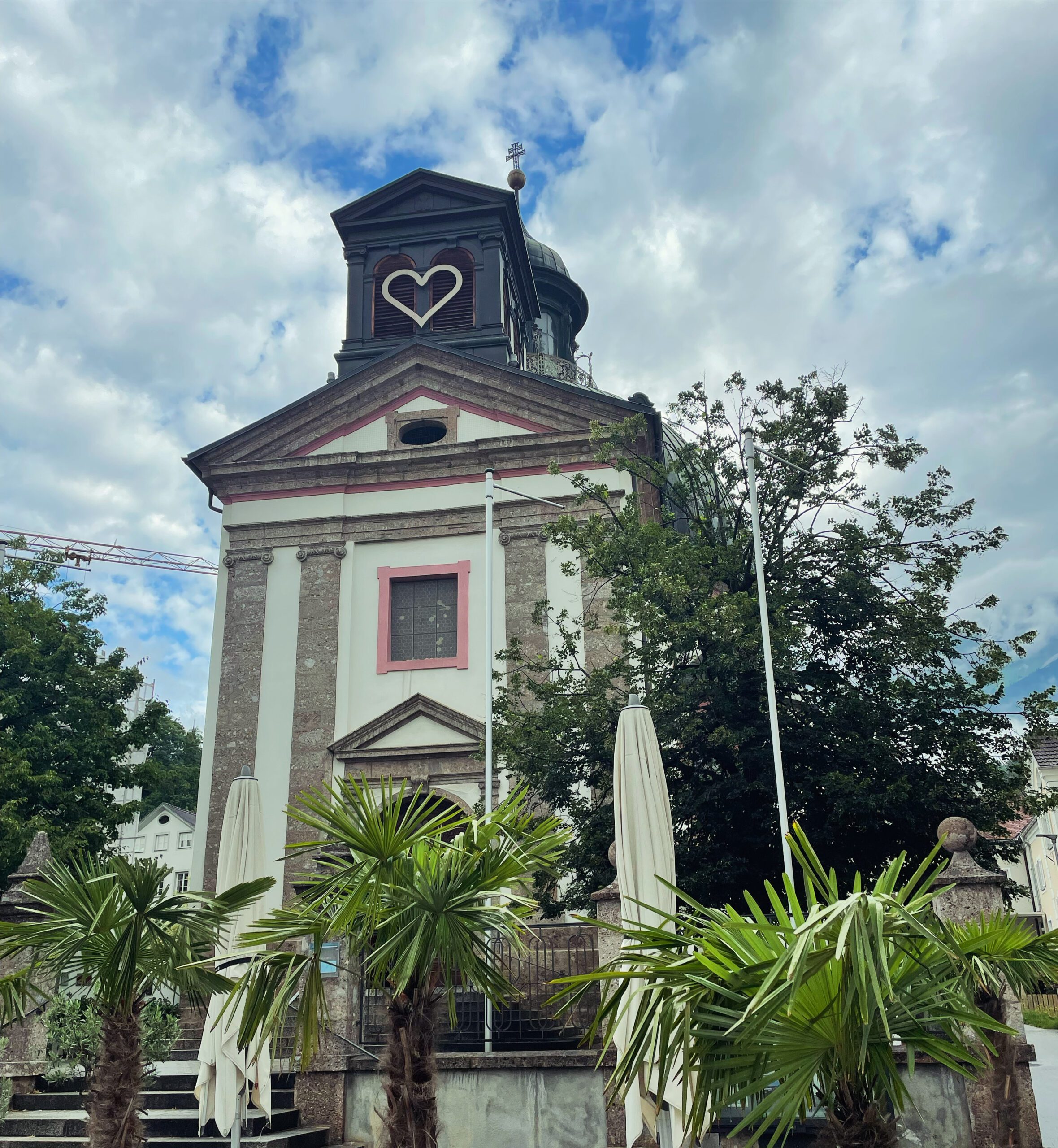
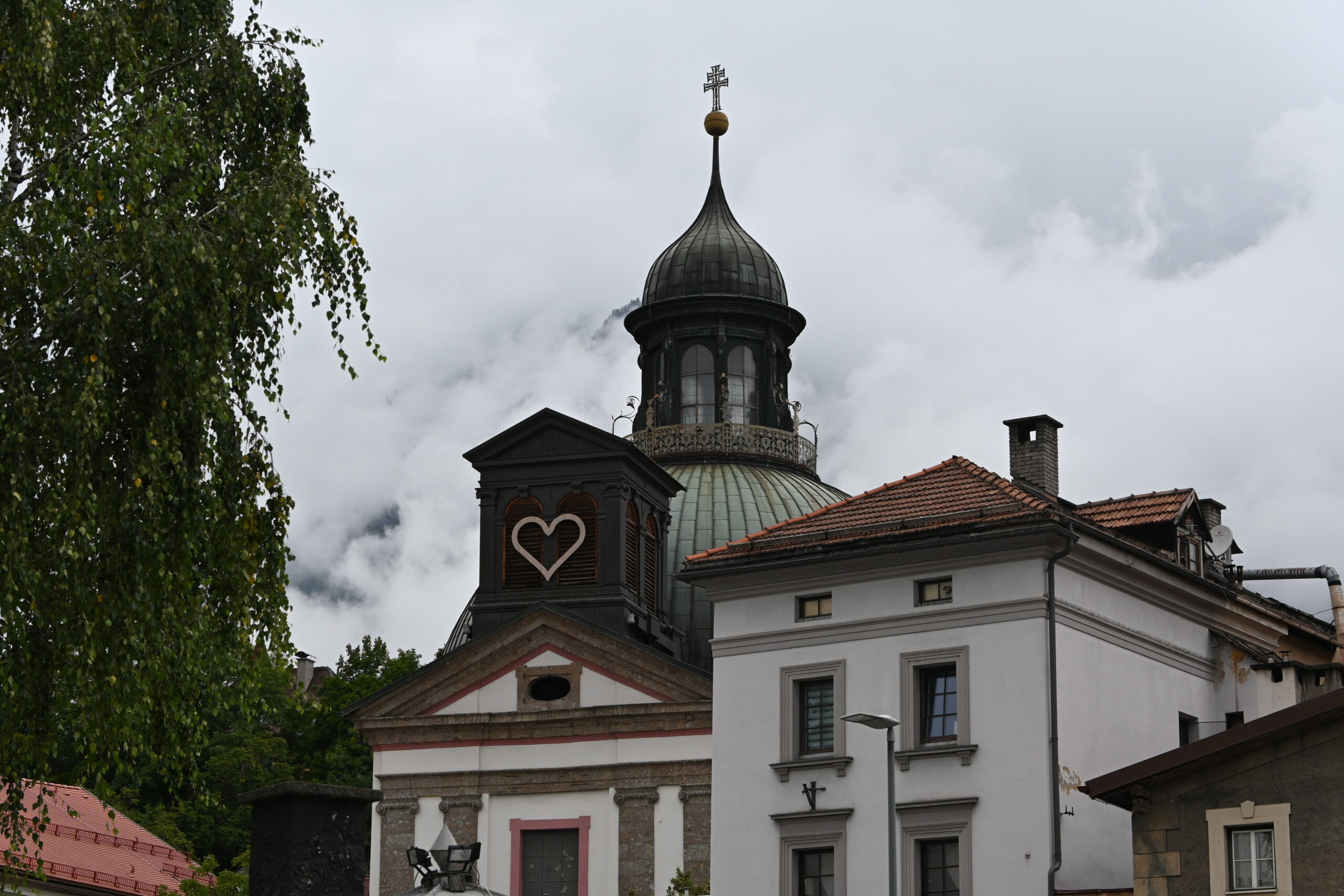
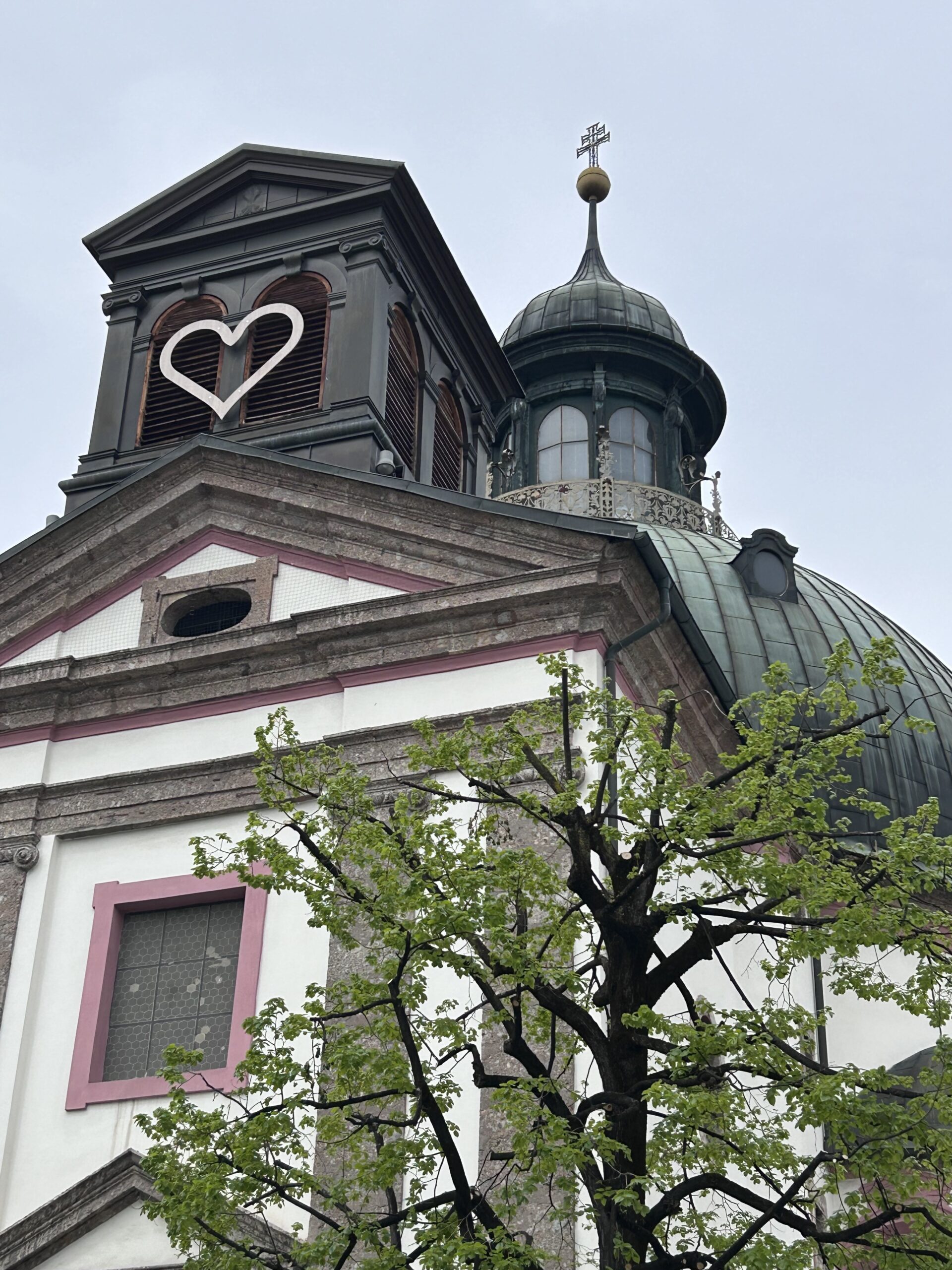
The parish of Mariahilf gives its name to the Innsbruck district west of the Inn Bridge. Together with the Mariahilf Church, the cemetery, the kindergarten, the Kunstkammer, and the Widum (rectory), it forms a complex that vividly illustrates the church’s influence on infrastructure, society, and community life. The origins of the parish date back to the 17th century. After Swedish, French, and Hessian troops had devastated large parts of neighboring Bavaria and the city of Bregenz during the final years of the Thirty Years’ War (1618–1648), the Tyrolean Estates vowed on 1 February 1647 to build a church dedicated to Cranach’s miraculous image Mariahilf—today housed in the Cathedral of St. James—should Tyrol be spared the horrors of war. With the building project, the Estates also sought to demonstrate political self-confidence toward the reigning Archduchess Claudia de’ Medici and her chancellor Biener.
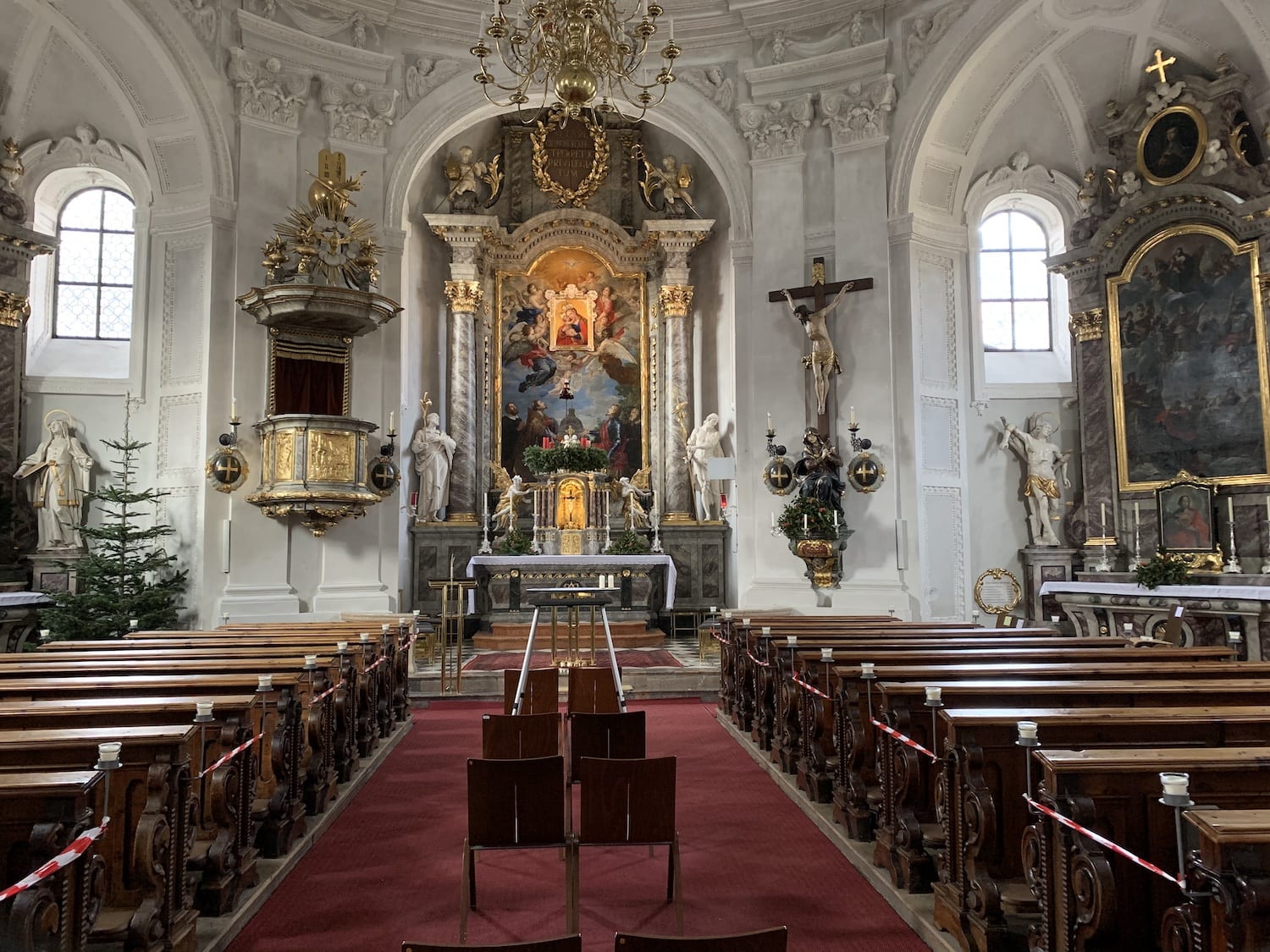
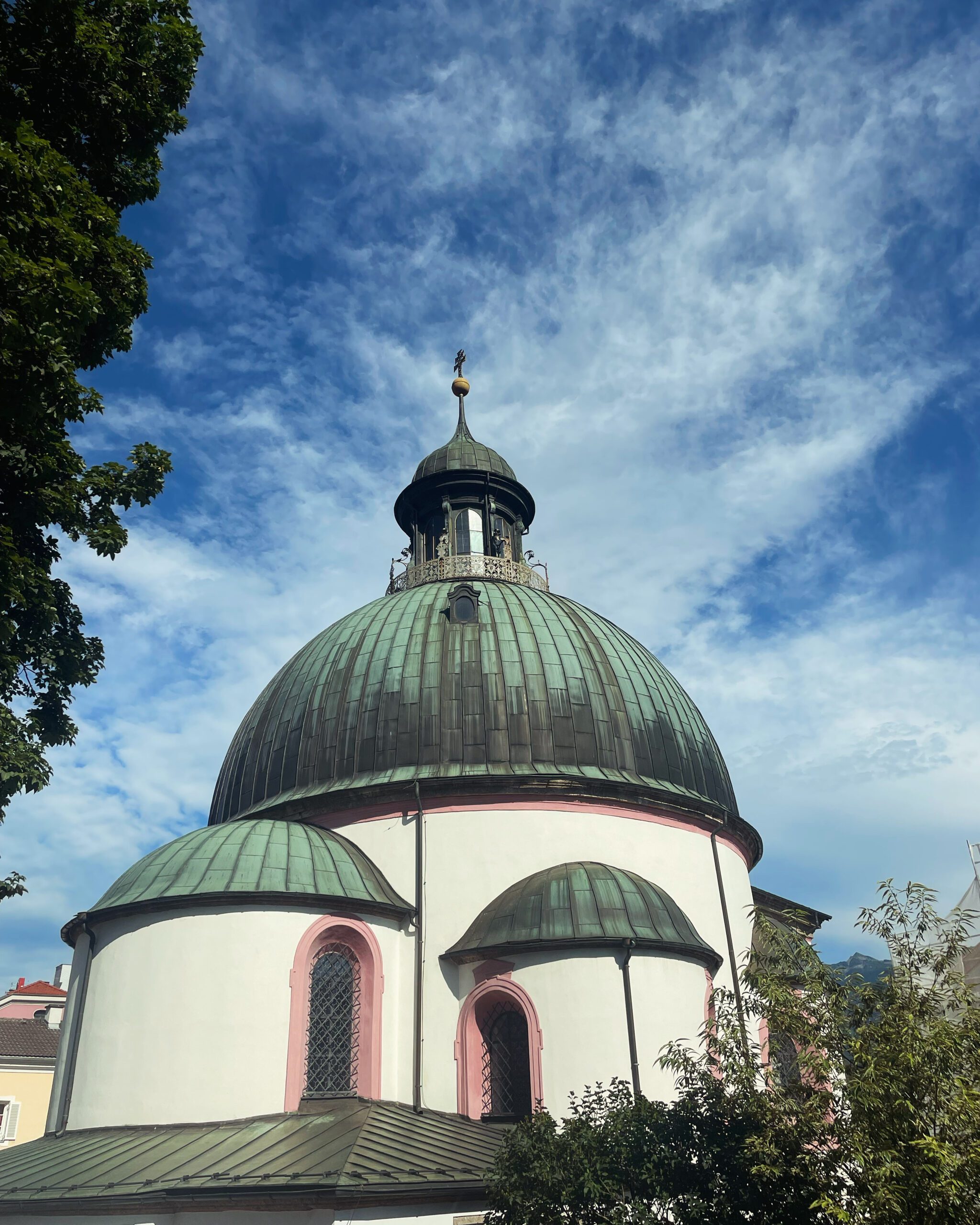
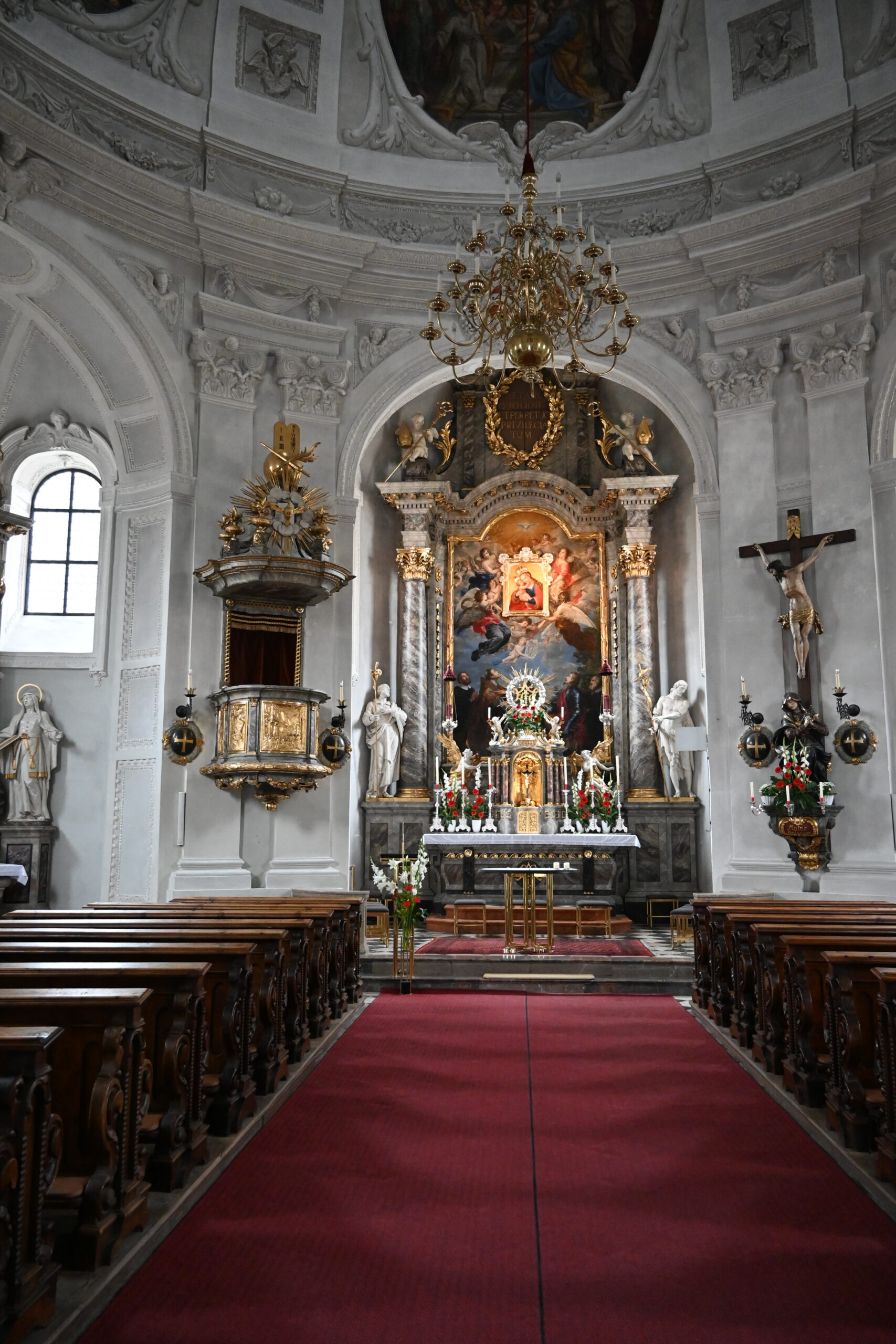
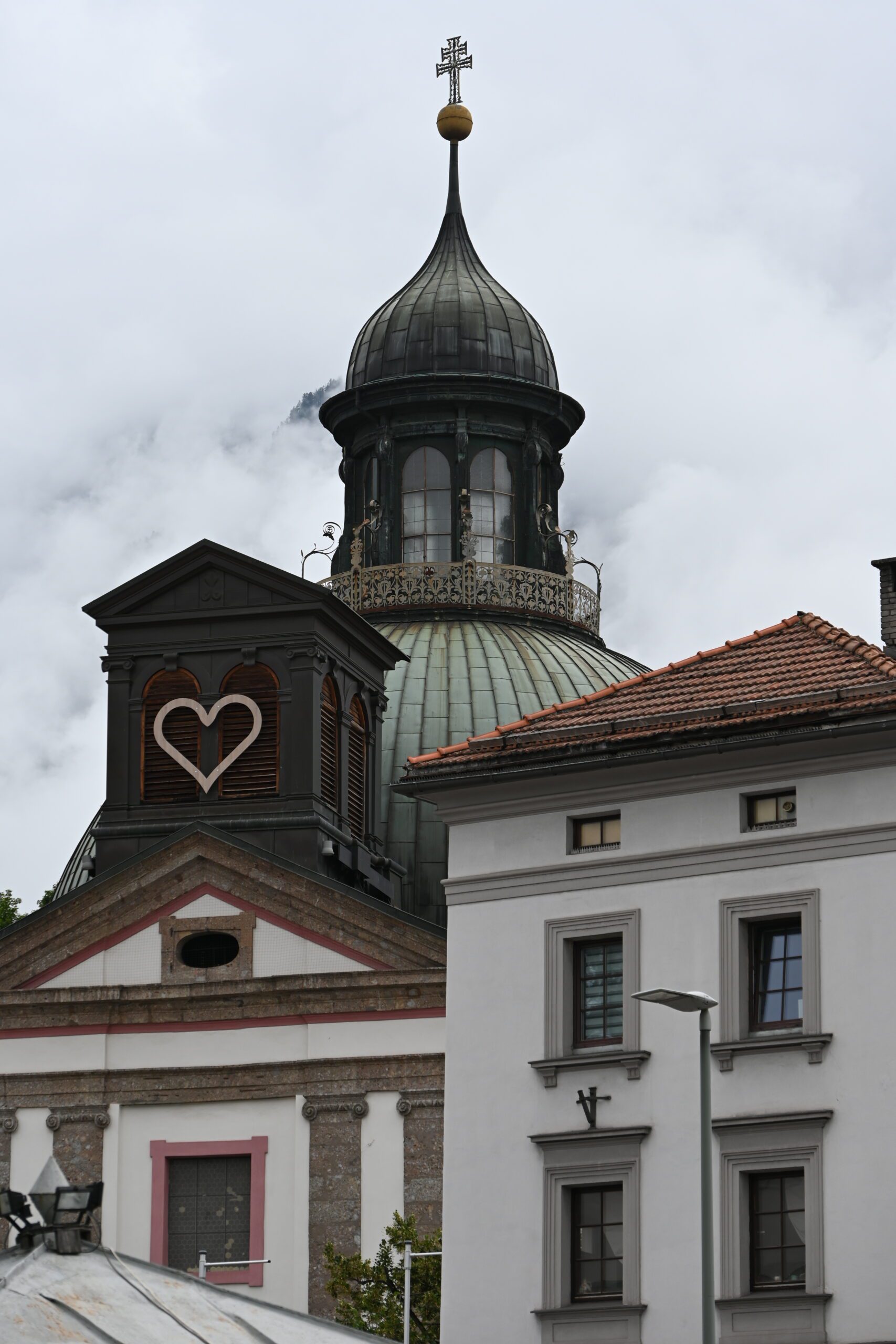
The construction was led by Christoph Gumpp. As early as 1648, the first mass was celebrated on a provisional altar, and one year later the shell of the building was completed. Over the centuries, several generations of Tyrolean artists contributed to shaping the church into its present form. Gumpp, likely inspired by his travels to Italy, drew from domed structures such as the Roman Pantheon. Unlike typical Baroque architecture, which emphasizes a unified interior, Mariahilf follows Renaissance principles: a composition of distinct elements. Five side chapels form the rounded outer structure. Six oval ceiling frescoes depicting scenes from the life of Mary decorate the inner side of the dome, while six additional frescoes present scenes from the Old Testament. As Cranach’s original Mariahilf remained in St. James, Michael Waldmann created a painted copy in 1654. This painting was integrated into a depiction of the church’s origin story. Surrounding it are representations of the four Estates—clergy, nobility, farmers, and burghers—who hand the new church over to Mary’s protection at the high altar. Above the triumphal arch appear the coats of arms of Tyrol, the House of Austria, and the Medici family, to which the late Archduchess Claudia belonged. Perhaps the most important figure in Mariahilf’s history, however, was neither artist nor architect, but Dr. Sigismund Epp (1647–1720), professor of theology, pro‑chancellor, and rector of the University of Innsbruck. He endowed two benefices that allowed the Tyrolean Estates to operate and later expand the church, thereby strengthening their influence in the city. Under Epp, Mariahilf became the parish of the University of Innsbruck. His generosity came with conditions, including the requirements for the benefice holder:
“To enjoy this benefice, a pious and respectable secular priest, a native Tyrolean and capable of speaking the German language, shall be appointed… The benefice holder shall include the founders in his prayers and good works.”
After Epp’s death, the privilege of serving as university church shifted from Mariahilf to the Holy Trinity Church of the Soldiers of Christ. Through the Mariahilf chaplaincy, the Tyrolean Estates could form political opposition not only to the Jesuits and the territorial prince in religious matters but also in key issues such as education and university governance. The independent parish was able to counteract Vienna’s growing centralization under Maria Theresa and Joseph II, whose governments sought to move educational authority away from the church and under state control. In the early 1850s, Mariahilf’s pastor Caspar Weyrer founded a parish school. Decades earlier, an attempt to establish an educational institution independent of St. Nicholas’ trivial school had been rejected. Weyrer, however, obtained capital and property through another benefactress, Elisabeth von Mayrhofer zu Koburg & Anger, enabling him to establish the Mariahilf school independently of governmental oversight. The foundation charter stated:
„Die beiden Häuser, der Garten, der Hof, kurz den ganzen Einfang vermache ich zu einem Schulhaus oder zu einer Kinderwarth-Anstalt… die Kinder (sind) verbunden, alle Wochen einmal in der Versammlung laut einen Vaterunser und ein Avemaria zu beten.“
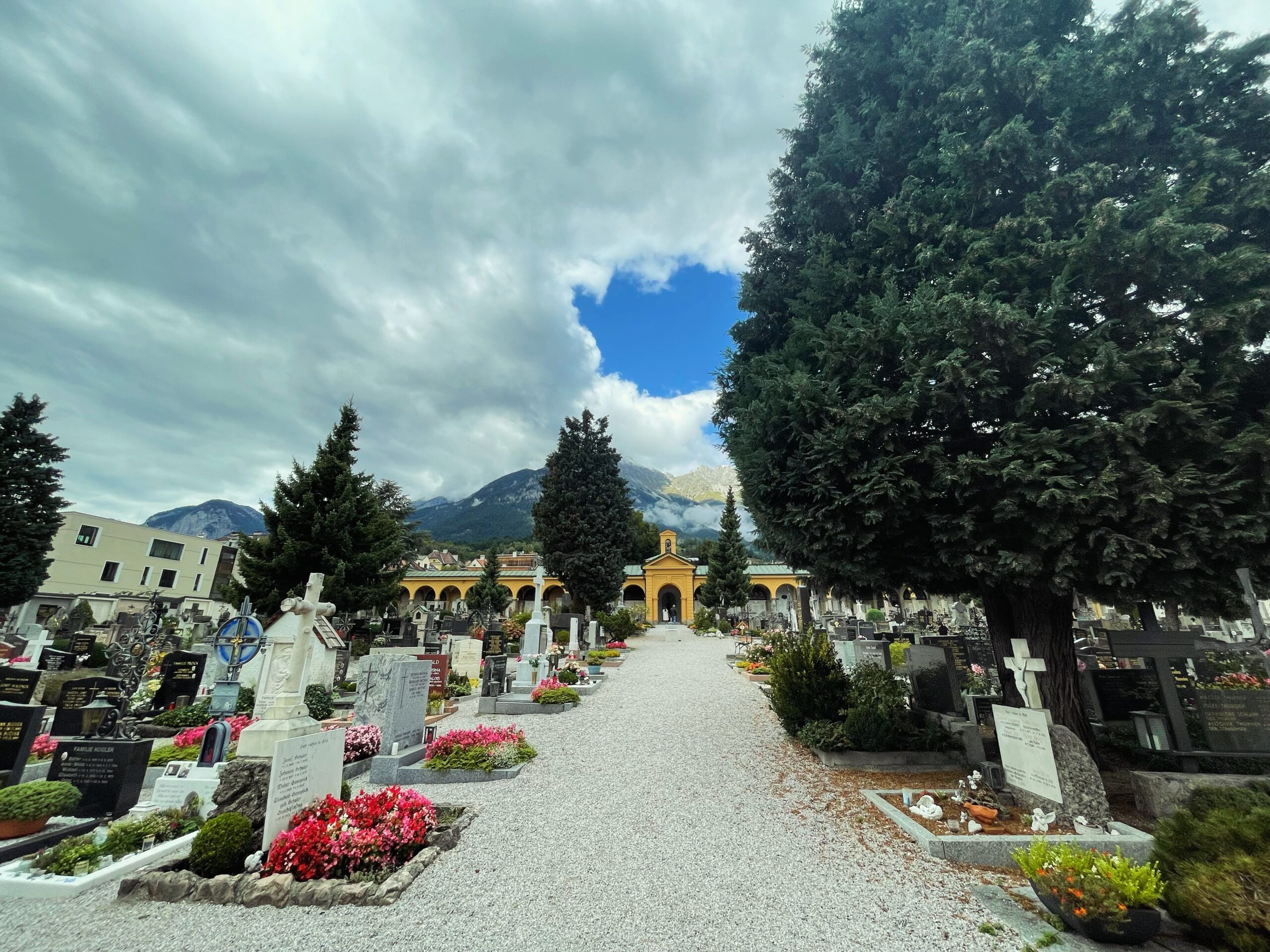
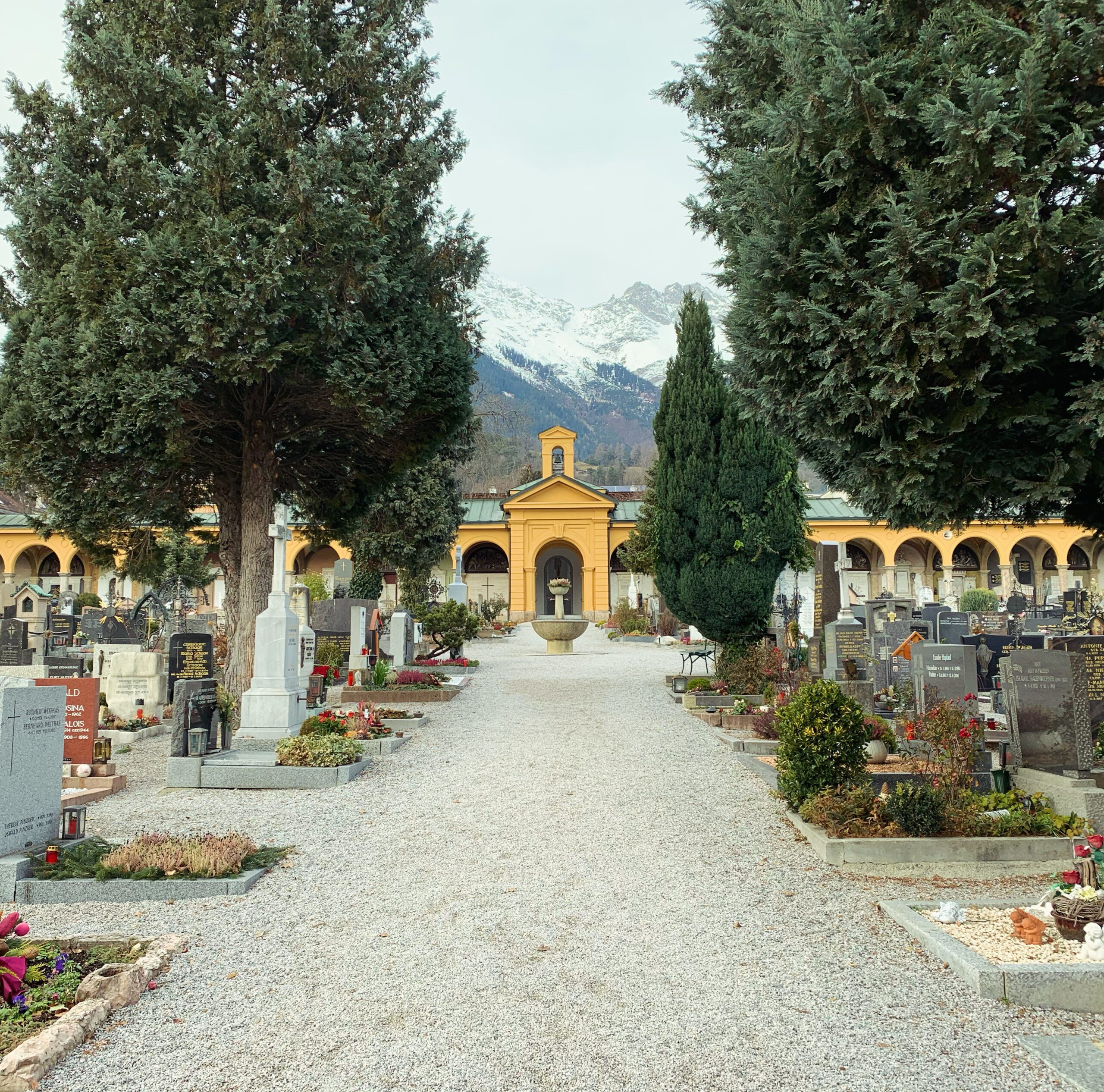
Praying for one’s soul remained popular in 19th‑century Innsbruck. With the enactment of a new school law in 1872, the parish school was forced to close. Weyrer immediately founded a private school to circumvent the law. Neither the liberal‑German city council nor the Ministry in Vienna wished to see a church‑run school in Innsbruck’s educational landscape, and the district school board soon declared the foundation buildings unsuitable for schooling. Yet the matter was not settled. A few years earlier, the Mariahilf cemetery—established in 1786—had already come to the authorities’ attention due to poor soil conditions and related hygiene issues. In 1876, four years after the school’s closure, the parish began planning the relocation of the cemetery. The Tyrolean Estates, who still oversaw Mariahilf, acquired the land where the cemetery remains today. In its picturesque hillside location, with arcades and a Neo‑Renaissance chapel, the Tyrolean State Cemetery is considered the most beautiful in Innsbruck. Moving the cemetery finally made way for the construction of the new school. On the former burial ground, the present‑day Mariahilf primary school opened in 1902. A small portion of the former chapel wall remains visible on its rear side. The old school building was converted into a parish kindergarten.
Despite Mary’s blessing and protection, disasters struck the parish over the centuries. The major Innsbruck earthquake of 22 December 1689 caused significant damage to the newly built church. Later destruction came at human hands: during World War I, the bells cast by the Grassmayr foundry in 1837 and the organ pipes were melted down for weapon production. When the National Socialists seized power in 1938, the Mayrhofer foundation—like many church institutions—was dissolved, and its assets absorbed into the National Socialist People’s Welfare organization. During WWII air raids, the kindergarten and parish hall were destroyed, and the church suffered minor damage. Shortly before the end of the war, a 1,000‑kg bomb landed between the kindergarten and parish hall but failed to explode. Whether the Virgin’s intercession was responsible remains a matter of speculation. Today, the Mariahilf parish remains the dominant institution in the neighborhood that bears its name. Next to the church stands the Epp benefice house, designed by Johann Martin Gumpp as the chaplain’s residence and now home to the Kunstkammer—a collection of exhibits and archives on Mariahilf. On the opposite side, the church is flanked by the Messnerhaus and the kindergarten reopened in 1952. North of the church stands the 19th‑century rectory with its large parish garden. Today, the Mariahilf parish and the Vincentian Conference jointly administer the parish center and kindergarten.
Maria help Innsbruck!
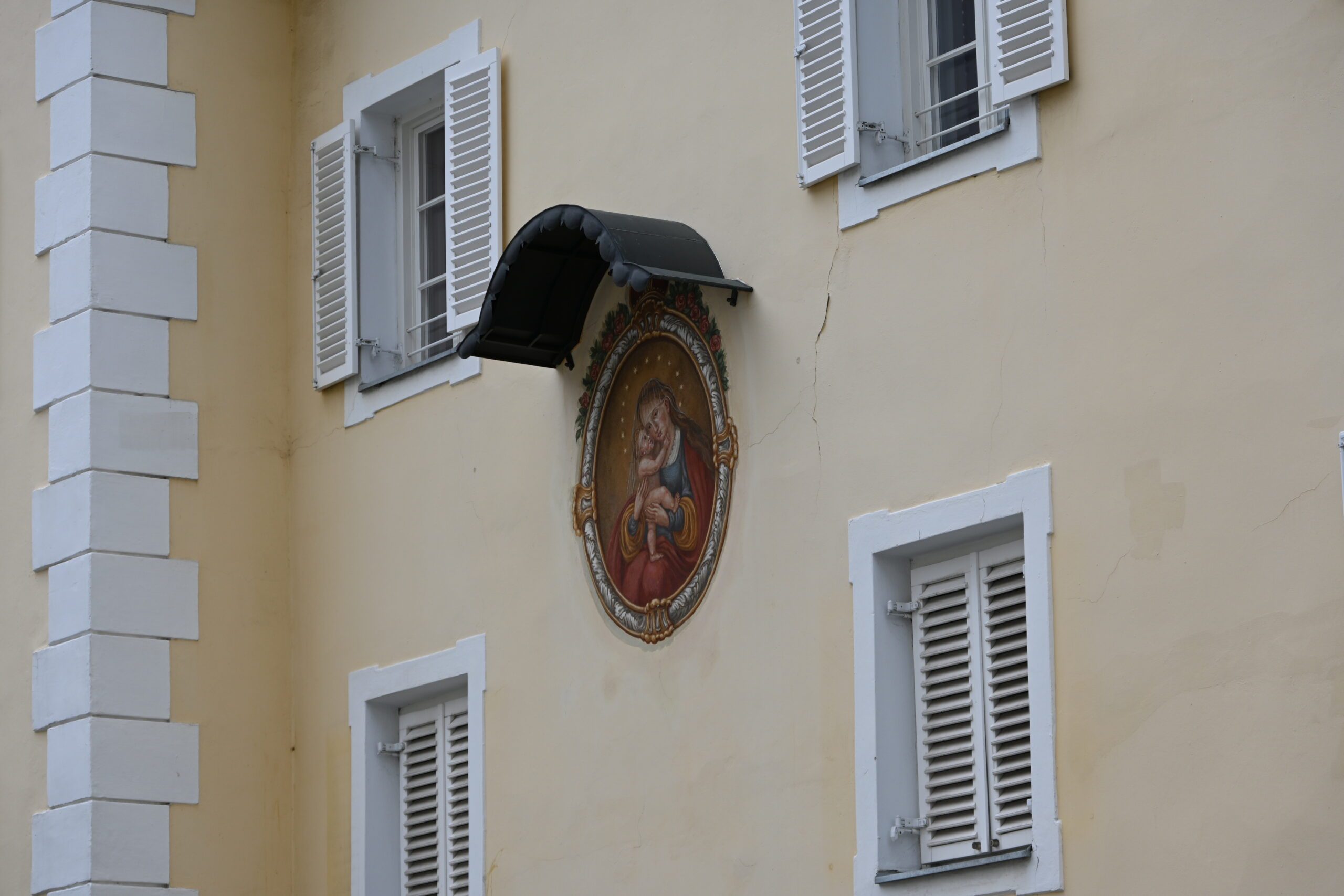
Veneration of saints and popular piety have always walked a narrow line between faith, superstition, and magic. In the Alpine regions, where people were exposed to a largely inexplicable natural environment to a greater extent than in many other areas, these forms of belief developed remarkable and locally distinctive expressions. Saints were invoked for help with a wide range of everyday concerns. Saint Anne was asked to protect the house and hearth, while prayers for a good harvest were addressed to Saint Notburga of Rattenberg, who was particularly popular in Tyrol. As the use of fertilizer and agricultural machinery increased, she later became the patron saint of women wearing traditional costume. Miners entrusted their fate in their dangerous underground work to Saint Barbara and Saint Bernard. The chapel near the manor houses in the Hall Valley (Halltal) close to Innsbruck offers a fascinating insight into a spiritual world that oscillates between the legendary figure of the Bettelwurf spirit and the worship of various local patron saints. The saint who continues to eclipse all others in veneration, however, is Mary. From the blessing of herbs on the Feast of the Assumption to the clockwise-flowing water at the monastery and pilgrimage site of Maria Waldrast at the foot of Mount Serles, and from votive paintings in churches and chapels, she is a constant and beloved presence in popular devotion. Anyone strolling attentively through Innsbruck will repeatedly encounter a particular image on building façades: the Mariahilf devotional image by Lucas Cranach the Elder (c. 1472–1553). Cranach’s Madonna is one of the most popular and frequently copied Marian images in the Alpine region. It represents a reinterpretation of the classical iconography of the Mother of God. Similar to Leonardo da Vinci’s Mona Lisa, which was created around the same time, Mary smiles enigmatically at the viewer. Cranach dispensed with all traditional forms of sacralization such as the crescent moon or halo and portrayed her in contemporary everyday clothing. The reddish-blond hair of both mother and child relocates them from Palestine to Europe. The holy and virginal Mary thus became an ordinary woman with her child, belonging to the upper middle class of the sixteenth century.
The origin, journey, and veneration of the Mariahilf devotional image encapsulate, on a small scale, the history of the Reformation, the Counter-Reformation, and popular piety in the German territories. The odyssey of this modestly sized painting (measuring just 78 × 47 cm) began in what is today Thuringia, at the princely court of the land, one of the cultural centers of Europe at the time. Elector Frederick III of Saxony (1463–1525) was a deeply devout man and possessed one of the most extensive collections of relics of his era. Despite his profound rootedness in popular belief in relics and his strong devotion to Mary, in 1518 he supported Martin Luther not only for religious reasons but also for reasons of power politics. The safe conduct granted by this powerful territorial prince and Luther’s accommodation at Wartburg Castle enabled the reformer to work on the German translation of the Holy Scriptures and on his vision of a new, reformed Church. As was customary at the time, Frederick also maintained an “art director” in his entourage: Lucas Cranach, who had served as court painter in Wittenberg since 1515. Like many artists of his time, Cranach was not only extraordinarily productive but also highly business‑minded. In addition to his artistic work, he ran both a pharmacy and a wine tavern in Wittenberg. Thanks to his wealth and social standing, he served as mayor of the town from 1528 onward. Cranach was renowned for painting quickly and in large quantities. He recognized art as a medium for capturing and disseminating both time and zeitgeist. Much like Albrecht Dürer, he produced widely circulated works of great popular appeal. His portraits of the contemporary elite continue to shape our image of early modern celebrities such as his patron Frederick, Emperor Maximilian I, Martin Luther, and his fellow artist Dürer.
At the latest through his acquaintance with the church critics Philipp Melanchthon and Martin Luther at Wittenberg Castle, Cranach became a follower of the new reformed Christianity, which at that time still lacked an official institutional form. The ambiguities in religious beliefs and practices during the period before the formal split of the Church are reflected in Cranach’s works. Despite Luther’s and Melanchthon’s rejection of the veneration of saints, Marian devotion, and iconographic imagery in churches, Cranach continued to paint according to the tastes of his patrons. Just as fluid as the confessional boundaries of the sixteenth century is the date of origin of the Mariahilf image. Cranach created it sometime between 1510 and 1537, either for the private household altar of Frederick’s sister‑in‑law, Duchess Barbara of Saxony, or for the Church of the Holy Cross in Dresden. Art historians remain divided on the issue to this day. Cranach’s close friendship with Martin Luther suggests that he may have painted the work after his conversion to Lutheranism, and that this secularized depiction of a mother and child reflects a new religious worldview. Nevertheless, it is equally plausible that the pragmatic artist produced the painting earlier, in accordance with the wishes of the patron and the fashion of the time, entirely without ideological intent and before Luther’s arrival in Wittenberg.
After Frederick’s death, Cranach entered the service of his successor, John Frederick I of Saxony. When his patron was taken captive by the Emperor following the Battle of Mühlberg in 1547, Cranach, despite his advanced age, followed him into captivity as far as Augsburg and Innsbruck. After five years in the retinue of this comparatively luxuriously housed hostage, Cranach returned to Wittenberg, where he died at what was, by contemporary standards, a biblical age. The Mariahilf image was probably transferred to the art chamber of the Saxon ruler during the turbulent years of the confessional wars, likely to protect it from destruction during iconoclastic outbreaks. Almost sixty-five years later, the painting, like its creator before it, would make its way to Innsbruck along circuitous paths. When the art‑loving Bishop of Passau from the House of Habsburg visited the Dresden court in 1611, he selected Cranach’s Mariahilf image as a diplomatic gift and brought it to his princely episcopal residence on the Danube. There, the cathedral dean saw the painting and was so taken with it that he commissioned a copy for his household altar. A pilgrimage cult quickly developed around the image. When, seven years later, the Bishop of Passau became Archduke Leopold V of Austria and sovereign of Tyrol, the increasingly popular painting moved with him to the Innsbruck court. His Tuscan wife, Claudia de’ Medici, diligently sustained Marian devotion in the Italian tradition even after his death. Both the Servite church and the Capuchin monastery received altars and images of the Holy Mother of God. Nonetheless, nothing surpassed the popularity of Cranach’s Mariahilf image. During the Thirty Years’ War, the painting was frequently removed from the court chapel and publicly displayed in order to protect the city. At these mass prayers, the desperate population of Innsbruck loudly implored the small image with the cry “Maria, help!”, a formula that had entered popular devotion through the Jesuits. In 1647, at a moment of greatest peril, the Tyrolean Estates vowed to build a church around the image should Mary’s protection spare the land from devastation by Bavarian and Swedish troops. That a reformed depiction of the Virgin Mary, painted by a friend of Martin Luther, was invoked to protect the city from Protestant forces is not without a certain irony.
Although the Church of Mariahilf was indeed built, the original painting was installed in 1650 in the parish church of St. James (St. Jakob) within the secure city walls, while the new church received a copy created by Michael Waldmann. This was not to be the last of its kind. Cranach’s motif and representation of the Mother of God enjoyed extraordinary popularity and can still be found today not only in churches, but also on countless private houses. Through these reproductions, art became a mass phenomenon. The Marian image had migrated from the private possession of a Saxon prince into public space. Centuries before Andy Warhol and Roy Lichtenstein, Cranach and Dürer had become intensely copied artists, and their works became part of everyday life and the visual fabric of the city. While the original Mariahilf image may hang in St. James’s Cathedral, it is the copy—and the parish that grew up around it—that gave an entire district its name.
Leopold V & Claudia de Medici: Glamour and splendour in Innsbruck
While the Thirty Years’ War was ravaging half of Europe, a charismatic princely couple set out to reshape the face of Innsbruck forever in the Baroque manner. The Habsburg who entered the history of the land as Leopold V (1586–1632) assumed sovereign governmental responsibilities in the Upper Austrian regency of Tyrol and the Further Austrian territories after turbulent early years. Unlike many firstborn members of his rank, his career had long appeared uncertain. In his youth he received the classical humanist education customary for young aristocrats, under the guidance of the Jesuits. In Graz and Judenburg he studied philosophy and theology in preparation for a career within the ecclesiastical sphere of power—an established path for younger sons with little prospect of secular thrones. Leopold’s early career within the power structures of the Church epitomised precisely those features of Catholicism rejected by Protestants and Church reformers. At the age of twelve he was elected Bishop of Passau; at thirteen he was appointed coadjutor of the Bishopric of Strasbourg in Lorraine. He never, however, received holy orders; the spiritual duties were carried out by a prince‑bishop appointed for that purpose. A passionate politician, Leopold travelled extensively between his dioceses and supported the imperial side during the conflict between Rudolf II and Matthias—later immortalised by Franz Grillparzer in Bruderzwist im Hause Habsburg. These activities, scarcely befitting a churchman, nonetheless preserved Leopold’s chances of attaining a secular princely title.
That opportunity arose in 1618, when the unmarried Maximilian III died childless. At the behest of his brother, Leopold assumed the role of Habsburg governor and ruler of the Upper and Further Austrian lands and their incorporated peoples and territories. In the early years of his regency he continued to shuttle between his bishoprics in southern and western Germany, threatened by the upheavals of the Thirty Years’ War. Although the ambitious power politician found satisfaction in the excitement of high politics, the status of governor did not suffice. He sought recognition as territorial prince, complete with homage and dynastic inheritance. What he lacked were a suitable bride, time, and money. Costly conflicts had depleted his coffers.
Money arrived with the bride—and with her, time. Claudia de’ Medici (1604–1648), from the wealthy Tuscan merchant‑princely dynasty, was selected to bestow dynastic fortune upon the aspiring territorial prince, now approaching forty. As a child, Claudia had already been promised to the Duke of Urbino, whom she married at seventeen, despite a proposal from Emperor Ferdinand II. Her husband died after only two years of marriage. The ties between the Medici and the Habsburgs remained intact. Since the marriage of Francesco de’ Medici to Johanna of Habsburg, a daughter of Ferdinand I, the two dynasties had been closely interwoven. Leopold and Claudia likewise proved a perfect match of title, power, Baroque piety, and wealth. Leopold’s sister Maria Magdalena, who as a Medici bride had become Grand Duchess of Tuscany, resided in Florence and sent her brother a painted portrait of the young widow, remarking that she was “beautiful in face, body, and virtue.” After a delicate dance of mutual conditions—the bride’s family seeking assurance of the groom’s title, while the Emperor required proof of a suitable marriage before granting the ducal dignity—the moment finally arrived. In 1625 Leopold, now raised to duke and well nourished and mature in years, relinquished his ecclesiastical possessions and titles in order to marry and, together with his nearly twenty‑years‑younger bride, found a new Tyrolean line of the House of Habsburg.
The relationship between the prince and the Italian woman was to characterise Innsbruck. The Medici had made a fortune from the cotton and textile trade, but above all from financial transactions, and had risen to political power. Under the Medici, Florence had become the cultural and financial centre of Europe, comparable to the New York of the 20th century or the Arab Emirates of the 21st century. The Florentine cathedral, which was commissioned by the powerful wool merchants' guild, was the most spectacular building in the world in terms of its design and size. Galileo Galilei was the first mathematician of Duke Cosimo II. In 1570, Cosimo de Medici was appointed the first Grand Duke of Tuscany by the Pope. Thanks to generous loans and donations, the Tuscan moneyed aristocracy became European aristocracy. In the 17th century, the city on the Arno had lost some of its political clout, but in cultural terms Florence was still the benchmark. Leopold did everything in his power to catapult his royal seat into this league.
In February 1622 the wedding celebrations of Emperor Ferdinand II and Eleonore of Mantua had taken place in Innsbruck; for the northern Italian bridal entourage Innsbruck was easier to reach than Vienna. Tyrol was religiously unified and had been spared the initial devastations of the Thirty Years’ War. Whereas the imperial wedding concluded within five days, Leopold and Claudia celebrated for two full weeks. Their official marriage ceremony had taken place in Florence Cathedral without the groom present. The subsequent festivities celebrating the Habsburg–Medici union became one of the most magnificent events in Innsbruck’s history, holding the city in thrall for a fortnight. After a wintry procession descending from the snow‑covered Brenner Pass, Innsbruck welcomed its new princess and her family. Prior to her arrival, the groom and his subjects had prayed for inner purification to seek divine blessing. Like the Emperor before them, the bridal couple entered the city in a grand procession through two specially erected gates. Fifteen hundred marksmen fired volleys from all their weapons. Drummers, pipers, and the bells of the Hofkirche accompanied the procession of 750 participants passing the astonished populace. A broad programme of entertainment—hunts, theatre, dances, music, and exotic spectacles including “bears, Turks, and Moors”—filled guests and townspeople alike with amazement and delight. From a modern perspective, one particularly inglorious attraction was the cat race, in which riders attempted to sever the head of a cat suspended by its legs as they galloped past.
Leopold’s early years of rule were far less glorious for his subjects. His policies were marked by frequent conflicts with the estates of the realm. A hardliner of the Counter‑Reformation, he supported imperial troops. The Lower Engadine, over which Leopold exercised jurisdiction, was a persistent source of unrest. Under the pretext of protecting Catholic subjects from Protestant attacks, Leopold occupied the region. Although he repeatedly suppressed uprisings successfully, the resources required drove both population and estates to the brink of despair. The northern border with Bavaria was likewise unstable and demanded Leopold’s attention as military commander. Duke Bernhard of Saxe‑Weimar had taken Füssen and was positioned at the Ehrenberg Pass on the Tyrolean frontier. Innsbruck was spared direct combat, but its proximity to the fronts nevertheless made it part of the Thirty Years’ War. Financially, Leopold funded these efforts through comprehensive tax reforms to the disadvantage of the middle classes. Wartime inflation, caused by disruptions in trade critical to Innsbruck, worsened living conditions. In 1622 a weather‑related crop failure further aggravated the situation, already strained by debt from earlier obligations. His insistence on enforcing modern Roman law across the territory, at the expense of traditional customary law, also earned him little affection among his subjects.
None of this prevented Leopold and Claudia from maintaining a splendid court in absolutist fashion. Under Leopold’s rule Innsbruck underwent extensive Baroque transformation. Court festivals attracted the European high nobility. Spectacles such as lion fights, featuring exotic animals from the ducal menagerie established by Ferdinand II in the Hofgarten, as well as theatre and concerts, served to entertain court society. The morals and manners of the rugged Alpine population were to be refined. It was a delicate balance between lavish court festivities and prohibitions on carnival celebrations for ordinary citizens. Divine wrath—manifest in plague and war—was to be averted through virtuous conduct. Swearing, shouting, and the carrying of firearms in public streets were prohibited. Pimps, prostitution, adultery, and moral decay were prosecuted rigorously at the pious court. Jews likewise faced harsh conditions under Leopold and Claudia. Long‑standing hostility towards the Hebrew population gave rise to one of the most disturbing traditions of Tyrolean piety. In 1642 Hippolyt Guarinoni, an Italian‑born physician at the Abbey of Hall and founder of the Karlskirche in Volders, composed the legend of the child martyr Anderle of Rinn. Inspired by the alleged ritual murder of Simon of Trent in 1475, Guarinoni wrote the Anderl‑Lied in verse. In Rinn near Innsbruck an antisemitic cult emerged around the remains of Andreas Oxner—supposedly murdered by Jews in 1462, a date revealed to Guarinoni in a dream. This cult was only banned in 1989 by the Bishop of Innsbruck. Innsbruck was not only morally but also physically “cleansed.” Waste, particularly problematic during dry periods when no water flowed through the canals, was regularly removed by princely decree. Livestock were forbidden to roam within the city walls. Memories of the recent plague epidemic remained vivid; foul smells and miasmas were to be eliminated at all cost.
Around the midpoint of the Thirty Years’ War, one of the most powerful women in Tyrolean history came to prominence. After Leopold’s early death, Claudia ruled the country on behalf of her minor son, together with her chancellor Wilhelm Biener (1590–1651), employing a modern, confessionally driven, early absolutist policy and a firm hand. She relied on an efficient administrative apparatus. The young widow surrounded herself with Italians and Italian‑speaking Tyroleans who introduced new ideas while displaying uncompromising severity in the fight against Lutheranism. To prevent fires—after the Lion House and Ferdinand II’s estate Ruhelust had burned down directly in front of the Hofburg in 1636—stables and other wooden buildings within the city walls were demolished. Silkworm breeding in Trentino and early considerations regarding a Tyrolean university flourished under Claudia’s regency. Chancellor Biener centralised parts of the administration, above all aiming to replace the fragmented legal systems of the Tyrolean territories with a uniform code. This required further curtailing the power of the often arbitrary local nobility in favour of the territorial prince. The system was intended to finance not only the expensive court but also territorial defence. It was not only Protestant troops from southern Germany that threatened the Habsburg lands. France—nominally a Catholic power—sought compensation at the expense of the Casa de Austria in Spain, Italy, and the Further Austrian territories, today’s Benelux countries. Innsbruck became one of the centres of the Habsburg war council. Situated at the fringes of the German battlefields and midway between Vienna and Tuscany, the city was an ideal meeting place for Austrians, Spaniards, and Italians alike. The notoriously brutal Swedish forces threatened Tyrol directly but were kept at bay. Fortifications protecting Tyrol were constructed through forced labour by unwanted inhabitants of the land—beggars, Roma, and deserters. Defensive works near Scharnitz on today’s German border were named Porta Claudia after the ruler. When Claudia de’ Medici died in 1648, around the conclusion of the Thirty Years’ War, events unfolded much as they did in England at almost the same time under Cromwell: the estates rose against the central authority. Claudia, who never learned the German vernacular and even after more than twenty years remained unfamiliar with local customs, had never been particularly popular. Nonetheless, her removal was unthinkable. The role of scapegoat passed to her chancellor. Wilhelm Biener, now persona non grata, was imprisoned by her successor Archduke Ferdinand Karl and the estates, and in 1651—like Charles I two years after a show trial—was beheaded.
A trace of Florence and the Medici still shapes Innsbruck today. The family coat of arms, with its red balls and lilies, can still be seen both in the Jesuit Church, where Claudia and Leopold were laid to rest, and in the parish church of Mariahilf. The Old Town Hall is also known as the Claudiana. Remains of the Porta Claudia near Scharnitz likewise survive. Leopold’s name is particularly associated with theatre in Innsbruck. The Leopold Fountain in front of the House of Music commemorates him. Anyone undertaking the ascent of the striking Serles mountain begins the hike at the monastery of Maria Waldrast, which Leopold devotedly founded in 1621—to the wondrous image of Our Beloved Lady at Waldrast—for the Servite Order, and which Claudia subsequently expanded. Chancellor Wilhelm Biener is commemorated by a street name in the Saggen district.
The master builders Gumpp and the baroqueisation of Innsbruck
The works of the Gumpp family still strongly characterise the appearance of Innsbruck today. The baroque parts of the city in particular can be traced back to them. The founder of the dynasty in Tyrol, Christoph Gumpp (1600-1672), was actually a carpenter. However, his talent had chosen him for higher honours. The profession of architect or artist did not yet exist at that time; even Michelangelo and Leonardo da Vinci were considered craftsmen. After working on the Holy Trinity Church, the Swabian-born Gumpp followed in the footsteps of the Italian master builders who had set the tone under Ferdinand II. At the behest of Leopold V, Gumpp travelled to Italy to study theatre buildings and to learn from his contemporary style-setting colleagues his expertise for the planned royal palace. Comedihaus aufzupolieren. Seine offizielle Tätigkeit als Hofbaumeister begann 1633. Neue Zeiten bedurften eines neuen Designs, abseits des architektonisch von der Gotik geprägten Mittelalters und den Schrecken des Dreißigjährigen Krieges. Über die folgenden Jahrzehnte wurde Innsbruck unter der Regentschaft Claudia de Medicis einer kompletten Renovierung unterzogen. Gumpp vererbte seinen Titel an die nächsten beiden Generationen innerhalb der Familie weiter. Die Gumpps traten nicht nur als Baumeister in Erscheinung. Sie waren Tischler, Maler, Kupferstecher und Architekten, was ihnen erlaubte, ähnlich der Bewegung der Tiroler Moderne rund um Franz Baumann und Clemens Holzmeister Anfang des 20. Jahrhunderts, Projekte ganzheitlich umzusetzen. Auch bei der Errichtung der Schanzwerke zur Landesverteidigung während des Dreißigjährigen Krieges waren sie als Planer beteiligt. Christoph Gumpps Meisterstück aber war die Errichtung des Comedihaus im ehemaligen Ballhaus. Die überdimensionierten Maße des damals richtungsweisenden Theaters, das in Europa zu den ersten seiner Art überhaupt gehörte, erlaubte nicht nur die Aufführung von Theaterstücken, sondern auch Wasserspiele mit echten Schiffen und aufwändige Pferdeballettaufführungen. Das Comedihaus war ein Gesamtkunstwerk an und für sich, das in seiner damaligen Bedeutung wohl mit dem Festspielhaus in Bayreuth des 19. Jahrhunderts oder der Elbphilharmonie in Hamburg heute verglichen werden muss.
His descendants Johann Martin Gumpp the Elder, Georg Anton Gumpp and Johann Martin Gumpp the Younger were responsible for many of the buildings that still characterise the townscape today. The Wilten collegiate church, the Mariahilfkirche, the Johanneskirche and the Spitalskirche were all designed by the Gumpps. In addition to designing churches and their work as court architects, they also made a name for themselves as planners of secular buildings. Many of Innsbruck's town houses and city palaces, such as the Taxispalais or the Altes Landhaus in Maria-Theresien-Straße, were designed by them. With the loss of the city's status as a royal seat, the magnificent large-scale commissions declined and with them the fame of the Gumpp family. Their former home is now home to the Munding confectionery in the historic city centre. In the Pradl district, Gumppstraße commemorates the Innsbruck dynasty of master builders.
University City of Innsbruck
1669 is considered the official founding year of one of the most important institutions in Innsbruck's city history. On 15 October, Emperor Leopold I granted the Tyroleans the privilege of „Haller Salzaufschlags“. Diese Steuer auf die begehrte Handelsware aus der hauseigenen Saline machte es möglich, eine Universität zu finanzieren. Die Basis für eine Hochschule war zu diesem Zeitpunkt bereits gelegt. Die Universität ging aus der Lateinschule hervor, die von den Jesuiten etwas mehr als hundert Jahre zuvor unter Ferdinand I. gegründet worden war. Der Schwerpunkt am Gymnasium lag auf der klassischen humanistischen Bildung. Latein und Griechisch waren notwendige Schwerpunkte im Unterricht, um dem intellektuellen und politischen Diskurs folgen zu können. Wissenschaftliche Bücher und viele andere Schriftstücke wurden in der Frühen Neuzeit noch immer auf Latein verfasst. Auch für höhere Posten im öffentlichen Dienst war Latein Voraussetzung. Die Universität brachte neue Ausbildungsmöglichkeiten nach Innsbruck. Die erste Fakultät, die den Lehrbetrieb aufnahm, war die Philosophie. Theologie, Recht und Medizin folgten kurz darauf. Als Papst Innozenz XI. der Universität 1677 seinen Segen gab, war der Betrieb schon voll angelaufen. Professoren und Studenten verschiedenster Nationalität tummelten sich in Innsbruck. Der Jesuitenorden war mit mehreren Lehrstühlen vertreten, andere Professoren wurden von der Diözese Brixen bestellt. Das führte zu Spannungen innerhalb der Universität, vertraten doch die Jesuiten vor allem die Interessen des Landesfürsten und Monarchen, während die Professoren der Diözese die politischen Interessen des Bischofs wahren wollten. Von einer Trennung von Staat, Kirche und Wissenschaft war man in dieser frühen Phase der Aufklärung noch weit entfernt. Dabei ging es um Posten, Macht, Geld und Einfluss, nicht nur innerhalb der Stadt.
A university degree usually took seven years before the graduate was permitted to slip a ring onto his finger as a symbol of his doctoral status. During the first two years, every student had to dedicate himself to philosophy before selecting a specialized field. In addition to humanities coursework, church services, theatrical performances, music-making, and practical pursuits like fencing and horseback riding were integral components of an educated young man's life. The university, however, was far more than an educational institution. In 1665, Innsbruck lost its status as a residence city, relinquishing much of its prestige and splendor. The university's presence offset this downgrade to some extent, ensuring that the aristocracy remained present in the city, at least in the form of students. Students and professors reshaped the city's social fabric. In the first decade following its founding, roughly 50 different men from all corners of the world taught philosophy in Innsbruck to a student body of over 300. These intellectuals were a remarkable group. Internally, they organized themselves into Landsmannschaften—fraternities based on nationality or language group. Every Landsmannschaft with sufficient members had its own distinct attire, badges, and insignia, and maintained its own unique traditions. At public and social occasions such as processions, delegations like the Congregation of the Blessed Virgin, drawn from the Jesuit-influenced university, stood out prominently. Professors made a habit of appearing in velvet gowns, color-coded according to their respective faculties. Carrying a sword, the gladius deambulatoris, was granted to students upon completing their first year at the university. Unlike the strictly and demurely dressed locals of Innsbruck, these young men of privileged backgrounds made colorful, flamboyant appearances reminiscent of medieval dandies. They conversed in a jargon that sounded strange and unintelligible to outsiders, while official matters were conducted entirely in Latin.
The strictly supervised daily life of students in the assembly hall and lecture halls was lightened by booze-filled evening entertainment, excursions into the countryside surrounding Innsbruck, music-making, church processions, and theatrical performances. Time and again, friction arose between ordinary citizens and members of the university. Despite their social standing, students were frequently far from diligent model pupils; rather, they were young men accustomed to a certain lifestyle and status. To keep them under control, a dedicated legal system was required. Students were subject to university law, which was entirely separate from municipal law. The university itself could impose imprisonment, fines, and even banishment from the territory. Only cases involving capital punishment required appealing to the regional government. For instance, students were officially forbidden from drinking to excess. If this occurred in one of Innsbruck's taverns anyway, the young offender received an admonition. Should he be unable or unwilling to settle his bill, the aggrieved innkeeper could not file a formal complaint with the courts, as serving excessive amounts of alcohol to the student body was prohibited. Insults to honor within university circles could lead to duels, much like in the military. Especially when combined with alcohol, riots and disturbances were not uncommon. Thus, in January 1674, "not only were nuisances, rumors, and absurd acts committed at night," but "students of the university were apprehended carrying all kinds of forbidden weapons such as matchlocks, pistols, pocket pistols, stilettos, sabers, and knives..." To enforce the law, the university rectorate maintained its own force. The Scharwache (watchmen) was armed with halberds and tasked with preventing student disturbances as effectively as possible. Six armed men were on duty day and night to maintain order. There was even a dedicated university prison (Carcer) to detain wrongdoers on bread and water. The costs for this were split between the city of Innsbruck and the university.
The university has always served as a political focal point and a reflection of the prevailing zeitgeist. Since the mid-18th century, its primary purpose was to train loyal, Catholic civil servants for the state. The name Leopold-Franzens-Universität traces back to the two emperors, Leopold I and Francis I, under whom it was originally founded and re-established, respectively. On two separate occasions, the university was downgraded to a lyceum or abolished entirely. Emperor Joseph II closed the gates of the Jesuit-influenced educational institution, as did the Bavarian administration during the Napoleonic Wars. Emperor Francis I, who pivoted back to the traditionally Catholic line of the Habsburgs during the Restoration, re-founded the institution in 1826. However, the university remained under close surveillance during Metternich's police state, as authorities feared nationalistic and liberal students who were beginning to form fraternities. Secret state police operated in lecture halls and student circles alike to nip the problematic ideas of young agitators in the bud as early as possible. Industrialization and its accompanying economic, political, and societal demands on education reshaped university life. Reflecting the spirit of the era, the inaugural address by the Dean of the Faculty of Philosophy, Prof. Dr. Joachim Suppan (1794–1864), addressed a practical physics problem aimed at achieving "a more precise knowledge of the so important and useful invention of the steam engine, also for domestic industry, where it has so far found no application." The fact that Suppan was an ordained priest alongside his degrees in philosophy and mathematics highlights the continuing influence of the Church on education during the 19th century. Suppan's closing admonition to the students—urging them "to one day render fruitful services to the fatherland through knowledge and virtue"—underscores how closely bound the university remained to state authority alongside ecclesiastical power. The nationalistic conflicts of the late monarchy were similarly mirrored in the university's history. Academic life in the late 19th century was defined by competing student corps, Burschenschaften, and fraternities. Students and professors grew increasingly radicalized, leading to recurring clashes between different factions and changing alliances. The only issues on which liberals, conservatives, and Pan-German nationalists could consistently agree were antisemitism and a shared hostility toward Italians. The interwar period brought a continuation of these old conflicts. Many students and faculty members had served in the First World War and were accustomed to resolving disputes through force. The apparatus of the Corporate State (Ständestaat) in the 1930s drew its ranks from Catholic fraternities, whereas Pan-German Burschenschaften served as a major pillar for National Socialism. The democratic Republic of Austria and the broader emancipation that accompanied it held little appeal for the traditionally elitist academics on both sides. Young men suddenly no longer had academia to themselves. While women and the sons of working-class artisan families had long been barred from university studies, it now became theoretically possible to advance socially through higher education. The university celebrated its first female Doctor of Law five years after the founding of the Republic. The press noted:
“This coming Saturday, Miss Mitzi Fischer will be awarded the degree of Doctor of Law at the University of Innsbruck. Miss Fischer is a native of Vienna. She also completed her secondary education in Vienna. After her matriculation examination, she pursued the study of law at the University of Innsbruck. The future doctor passed all examinations with distinction and would therefore, according to former custom, have to be promoted sub auspiciis imperatoris. In any case, Miss Fischer is the first woman to earn the doctoral degree in law at the University of Innsbruck.”
With the annexation to the German Reich in 1938, the university was renamed once again. After the war, the Deutsche Alpenuniversität reverted back to Leopold-Franzens-Universität. Surprisingly quiet, much like in 1848, were the students in Innsbruck during the year 1968. While students were the drivers of change in other European cities, Innsbruck remained calm. In Paris, cobblestones flew; in Innsbruck, people settled for boycotts and sit-ins. Although there were individual groups in the late 1960s and 1970s such as the Kommunistische Gruppe Innsbruck, the Committee for Solidarity with Vietnam, the socialist VSStÖ, or the liberal-Catholic Aktion within the ÖH (Austrian Students' Association), no mass movement materialized. The vast majority of students came from the upper class and had completed their Matura at a Catholic-oriented grammar school. Beethoven's old adage that "as long as the Austrian still has brown beer and sausages, he does not revolt" proved true. Only a few students could summon enthusiasm for solidarity with Vietnam, Mao Zedong, or Fidel Castro. Who wanted to risk their own career in a region dominated by the holy trinity of the Tiroler Tageszeitung, Bishop Paulus Rusch, and the regional parliament (Landtag) with an absolute majority held by the ÖVP? Anyone who dared to distribute rebellious flyers or leftist literature anyway had to expect media defamation, a reprimand from the rectorate, or even a visit from state authorities. The professors—who in the 20th century often still exuded the detachment and aloof aura of the Early Modern era or made little secret of their political leanings—were rarely criticized. Rather, criticism was directed at the inadequate equipment of the modest lecture halls for the ever-increasing number of students. The major transformation in universities was not fought for in Austria, but voted for. Under Chancellor Bruno Kreisky, tuition fees were abolished. Education became affordable and conceivable for a larger number of young people. As a result, the number of students at Austrian universities rose from 50,000 to over 73,000 between 1968 and 1974.
Despite all adversities and curiosities over the centuries, the University of Innsbruck has, since its earliest days, generally enjoyed an excellent reputation. In the 20th and 21st centuries, faculty and students repeatedly achieved internationally acclaimed research results. Victor Franz Hess was awarded the Nobel Prize in Physics for his work on cosmic radiation. Quantum physicist Anton Zeilinger was also associated with the University of Innsbruck, though not at the time of his award in 2022. Professors Fritz Pregl, Adolf Windaus, and Hans Fischer likewise received the Nobel Prize in Chemistry, though none of them were active in Innsbruck at the time. The university hospital has likewise delivered outstanding achievements in both research and education, as well as in the daily medical care of the city, and is considered one of Innsbruck’s flagship institutions. The university is of great importance to the city not only intellectually and economically. Around 30,000 students populate and shape life between the Nordkette mountain range and the Patscherkofel.
Glaube, Kirche und Obrigkeit
The abundance of churches, chapels, crucifixes, statues, and paintings in public spaces strikes many visitors to Innsbruck from other countries as unusual. Not only places of worship, but also many private houses are decorated with depictions of Jesus, Mary, saints, and biblical scenes. For centuries, the Christian faith and its institutions shaped everyday life throughout Europe, and Innsbruck—as a residence city of the strictly Catholic Habsburgs and the capital of the self-proclaimed Holy Land of Tyrol—was particularly richly endowed with ecclesiastical buildings. In terms of number and scale relative to the conditions of earlier times, churches appear as gigantic features in the cityscape. In the 16th century, Innsbruck, with its approximately 5,000 inhabitants, possessed several churches whose splendor and size surpassed every other building, including the palaces of the aristocracy. Wilten Abbey was a vast complex in the midst of a small farming village that had developed around it.
The spatial dimensions of these places of worship reflect their importance within the political and social structure. For many inhabitants of Innsbruck, the Church was not only a moral authority but also a secular landowner. The Bishop of Brixen was formally equal in rank to the territorial prince. Peasants worked on the bishop’s estates just as they did on those of a secular ruler. The clergy exercised both taxation and judicial authority over their subjects, and ecclesiastical landowners were often regarded as particularly demanding. At the same time, it was also the clergy in Innsbruck who were largely responsible for social welfare, healthcare, care for the poor and orphans, food distribution, and education. The Church’s influence extended into the material world in a way comparable to how the modern state operates today through tax offices, police, schools, and employment services. What democracy, parliament, and the market economy represent for us today, bishops, the Bible, Christian devotional literature, and parish priests represented for people of earlier centuries: a reality that maintained order.
It would be incorrect to believe that all clergymen were cynical power-hungry figures who exploited their uneducated subjects. The majority of both clergy and nobility were devout and God-fearing, albeit in a manner that is difficult to comprehend from today’s perspective. It was not the case that every superstition was blindly accepted or that people were arbitrarily executed based on anonymous accusations. In the early modern period, violations of religion and morals were tried before secular courts and punished severely. Charges were brought under the term heresy, which encompassed a wide range of offenses. Sodomy—meaning any sexual act not serving reproduction—sorcery, witchcraft, and blasphemy, in short any deviation from the correct faith, could be punished by burning. The act of burning was intended both to purify the condemned and to destroy them and their sinful behavior completely, thereby removing evil from the community. For a long time, the Church regulated everyday social life down to the smallest details. Church bells structured people’s daily schedules. Their sound called people to work or worship, or informed the community of a death through tolling. People were able to distinguish individual bell signals and their meanings. Sundays and holidays structured time. Fasting days regulated diet. Family life, sexuality, and individual behavior were expected to conform to Church-prescribed morality. For many people, salvation in the afterlife was more important than happiness on earth, which was seen as predetermined by the course of time and divine will. Purgatory, the Last Judgment, and the torments of hell were real and served to frighten and discipline even adults.
While parts of Innsbruck’s bourgeoisie were at least gently awakened by the ideas of the Enlightenment after the Napoleonic Wars, the majority of the population remained deeply attached to a blend of conservative Catholicism and superstitious folk piety. Religiosity was not necessarily a question of background and social status, as the social, media, and political debates along the fault line between liberals and conservatives repeatedly demonstrated. Although the freedom of religious practice had been legally enshrined since the December Constitution (Dezemberverfassung) of 1867, state and religion remained closely intertwined. Thanks to the 1855 concordat between the Pope and the Emperor, marriage law and the school system were under the control of the Catholic Church. It was only under pressure from liberals in parliament that these bastions of everyday social life began to crumble, yet particularly in Tyrol, the pastor's word remained sacrosanct. In the First Republic, a conservative backlash occurred. Ignaz Seipel, a Christian Social politician who went down in history as the Iron Prelate (Eiserner Prälat), rose to the highest office of the state in the 1920s. Federal Chancellor Engelbert Dollfuß saw his Corporate State (Ständestaat)—a construct built on a Catholic foundation—as a bulwark against socialism. In 1933, the concordat with the Vatican was renewed. Even after World War II, church and politics in Tyrol formed a powerful double act in the persons of Bishop Rusch and Governor Wallnöfer. In 1957, the government of the Second Republic reconfirmed the agreement, which formally remains valid to this day. A genuine separation of church and state did not begin until the 1970s. Although people leaving the church in recent decades have dented official membership figures and recreational events draw larger crowds than Sunday masses, faith and the church still hold a fixed place in the daily lives of Innsbruck’s residents, even if often unnoticed. The Roman Catholic Church still owns a vast amount of land in and around Innsbruck, even beyond the walls of its monasteries and educational institutions. A number of schools in and around Innsbruck also remain under the influence of conservative forces and the church. And whoever enjoys a public holiday, cracks Easter eggs against one another, or lights a candle on a Christmas tree does not have to be a Christian to act in the name of Jesus—disguised as tradition.
Maria Theresia, Mother of the Nation and Reformer
Maria Theresa ranks among the most important figures in Austrian history. Particularly significant were her domestic reforms, many of which had a tangible impact on the everyday lives of Innsbruck’s inhabitants and are still visible today in the city’s built environment. Together with her most influential advisers—Friedrich Wilhelm von Haugwitz, Joseph von Sonnenfels, and Wenzel Anton Kaunitz—she succeeded in transforming the so‑called Austrian hereditary lands into a modern state. Instead of governing her territories through the local nobility, she relied on a centralized, professional administration. In keeping with Enlightenment thought, her advisers recognized that the welfare of the state depended on the health and level of education of its individual subjects. An early healthcare reform of 1742 obliged the professors of medicine at the University of Innsbruck not only to teach but also to ensure the operation of the municipal hospital in the Neustadt district. A school reform likewise reshaped the educational landscape within the city walls, both spatially and conceptually. Due to a lack of space, the school was relocated from Domplatz to Kiebachgasse, and its educational mission was redefined. Subjects were expected to remain Catholic, but their loyalty was to be directed toward the state. Education was placed under centralized state control in order to develop talents in a targeted manner. The aim was not to raise critical, humanistic intellectuals, but rather to train personnel for the state administrative apparatus. This reform laid the foundation for later social mobility. Through military service and civil administration, non‑nobles were now able to pursue careers and climb the social ladder. Any improvement of the individual was regarded as a gain for the whole. Further measures followed that affected not only the national economy but also the daily lives of most people. The standardization of weights and measures made the tax system more precise and less susceptible to abuse. For farmers, the harmonization of laws meant that their livelihoods were less dependent on local landlords and their arbitrary decisions. The Robot—the unpaid compulsory labor owed by peasants to their landlords—was also abolished under Maria Theresa. A shift in thinking likewise took place in criminal prosecution and the judicial system. In 1747, a small police force was established in Innsbruck to oversee market regulation, trade and guild regulations, control of foreigners, and public morals. Above all, this served to regulate the provision of goods in favor of consumers. Not only poor quality but also price gouging was punished. The strictness of early food inspections is illustrated by a police record from 1748, in which a butcher from Pradl was fined for exceeding the legally fixed meat prices. This denser network of regulations and improved law enforcement went hand in hand with a more humane system of punishment. Although the criminal code Constitutio Criminalis Theresiana did not abolish torture, it did strictly regulate its use. Yet despite Maria Theresa’s self‑presentation as a pious mother of the land and her reputation today as an Enlightenment ruler, the devoutly Catholic sovereign was uncompromising when it came to power and religion. In keeping with Enlightenment thought, she ordered critical investigations into superstitions such as vampirism, which was widespread in the eastern parts of her realm, and initiated the final end of the witch trials. At the same time, however, Protestants were ruthlessly expelled from the country. Many Tyroleans were forced to leave their homeland and resettle in more remote regions of the Habsburg monarchy.
In crown lands such as Tyrol, which had previously enjoyed a high degree of autonomy, Maria Theresa’s reforms were met with little approval. Centralization remains a sensitive issue in Austrian politics to this day. With the exception of a few liberals, people saw themselves more as an independent, autonomous land and less as part of a modern territorial state. The clergy also resented their new subordinate role, which was further intensified under Joseph II. For the local nobility, the reforms meant not only a loss of status and autonomy but also higher taxes and levies. Taxes, duties, and customs revenues that had long provided Innsbruck with reliable income were now collected centrally and only partially returned through fiscal redistribution. To mitigate the social decline of sons from impoverished noble families and prepare them for state service, Maria Theresa founded the Theresianum, which also had a branch in Innsbruck from 1775 onward. As so often, time smoothed over former conflicts, and today Innsbruck’s inhabitants take pride in having hosted one of the most significant rulers in Austrian history. Not only the Triumphal Arch and the Imperial Palace (Hofburg), but also the Turnvereinshaus and the New City School recall the Theresian era, a period in which the state began to intervene ever more deeply in the lives of its citizens from the moment they entered school.
Air raids on Innsbruck
The appearance of a city is subject to constant change. Certain eras left particularly visible changes in Innsbruck's cityscape. The political, economic, and social upheavals from the 15th century onward, as well as in the second half of the 19th century, are also reflected in buildings and monuments. However, the most drastic event with the greatest impact on the cityscape was likely the air raids on the city during World War II, when the "home front" became an actual theater of war. For centuries, its location at the foot of the Brenner Pass had been a blessing for the city; now, it became its undoing. Innsbruck was an important supply station for reinforcements for the Italian front. On the night of December 15–16, 1943, the first Allied air raid struck the ill-prepared city. 269 people fell victim to the bombs, 500 were injured, and more than 1,500 were left homeless. Over 300 buildings, primarily in Wilten and the inner city, were destroyed and damaged. On Monday, December 18, the front page of the Innsbrucker Nachrichten—the predecessor to the Tiroler Tageszeitung—featured all kinds of propagandistic reports about the successful and heroic defensive struggle of the German Wehrmacht on all fronts against the alliance of the "Anglo-Americans" and "the Russian," but made no mention of the bombing raid on Innsbruck.
"Bombing Terror over Innsbruck"
December 16 will remain recorded in the history of Innsbruck as the day on which the air terror of the Anglo-Americans struck the Gau capital with all the severity of this mean and brutal method of warfare, which can no longer be called conduct of war. In several waves, enemy bomber formations approached the city and directed their attacks with numerous high-explosive and incendiary bombs against residential areas. Severe damage to residential buildings, hospitals, and other community facilities was the sad result—exceeding all previous damage—of this criminal assault, which brought severe suffering to numerous families in our city, a heavy burden on their way of life, the bitter fate of the destruction of cherished property, the destruction of hearth and home, and homelessness. Boundless hatred and the burning desire to retaliate against this inhuman atrocity with relentless severity are the sole sentiments moving all minds, alongside dealing with personal and community hardships. We all look upon our soldiers with complete trust and await with confidence the day on which the Führer will give the command to deploy their concentrated power with new weapons against the enemy in the West, who through his terror of murder and arson against the defenseless has once again proven that he differs in no way from the Asiatic beasts in the East—unless it be through greater cowardice. The city's air-raid protection facilities have proven their worth, as has the air-raid discipline of the population. Up to this hour, 26 fallen have been reported, a number that in all likelihood should not increase significantly. Relief measures began immediately and effectively under the leadership of the Party and with the active cooperation of the Wehrmacht.
This imaginatively crafted report barely made it onto page 3. The city's poor preparation for the foreseeable bombardment was likely something they preferred not to display too prominently, given the immense scale of the damage to the city and the tragic personal losses among the population. That the mortal remains of the victims of the December 15, 1943 air raid were laid out in state on what is today's Landhausplatz, directly in front of the newly constructed *Gauhaus*—the symbol of National Socialist power—carries a sad irony of fate. In January 1944, construction began on air-raid shelters and other protective measures. A large portion of the work was carried out by prisoners from the Reichenau concentration camp.
In total, Innsbruck was attacked twenty-two times between 1943 and 1945. In the process, nearly 3,833—almost 50%—of the buildings in the city were damaged, and 504 people died. In the final months of the war, any sense of normalcy had ceased to exist. The population lived in constant fear. Schools were closed as early as the morning hours. A regular daily routine was out of the question. Fortunately, the city was only subject to targeted attacks. German cities like Hamburg or Dresden were completely flattened by Allied firestorms within a matter of hours, leaving tens of thousands dead. Nevertheless, the toll was devastating. Many buildings, such as the Jesuit Church, Wilten Abbey, the Servite Church, and the public indoor pool on Amraserstraße, were hit. The attack on December 16, 1944—one year after the first strike—devastated the Cathedral and the Town Hall. Historical buildings and monuments in Innsbruck received special care and protection. The *Golden Roof* was protected with a specialized structure, as was Maximilian's sarcophagus in the Court Church (*Hofkirche*). The statues of the Court Church, the "*Schwarze Mander*" (Black Men), were relocated to Kundl. The painting of the Virgin of Succor by Lucas Cranach from the Innsbruck Cathedral was transferred to the Ötztal during the war.
Many years after the war, the city was still characterized by the rubble and damage of the air raids; today, very little remains to remind us of these events that were traumatic for so many Innsbruck residents. The air-raid shelter south of Innsbruck along the Brennerstraße and the markings on houses indicating air-raid cellars—with their black squares, white circles, and arrows—can still be seen today. Two of the anti-aircraft gun positions, now merely overgrown masonry ruins, can be visited on the *Lanser Köpfl* above Innsbruck. In Pradl, where along with Wilten most of the buildings were damaged, bronze plaques on the affected houses point to their post-war reconstruction. On the old Innsbruck Town Hall, a wall painting commemorates the direct bomb hit in December 1944.