Farmhouses in Pradl
Pradlerstrasse / Egerdachstrasse
Worth knowing
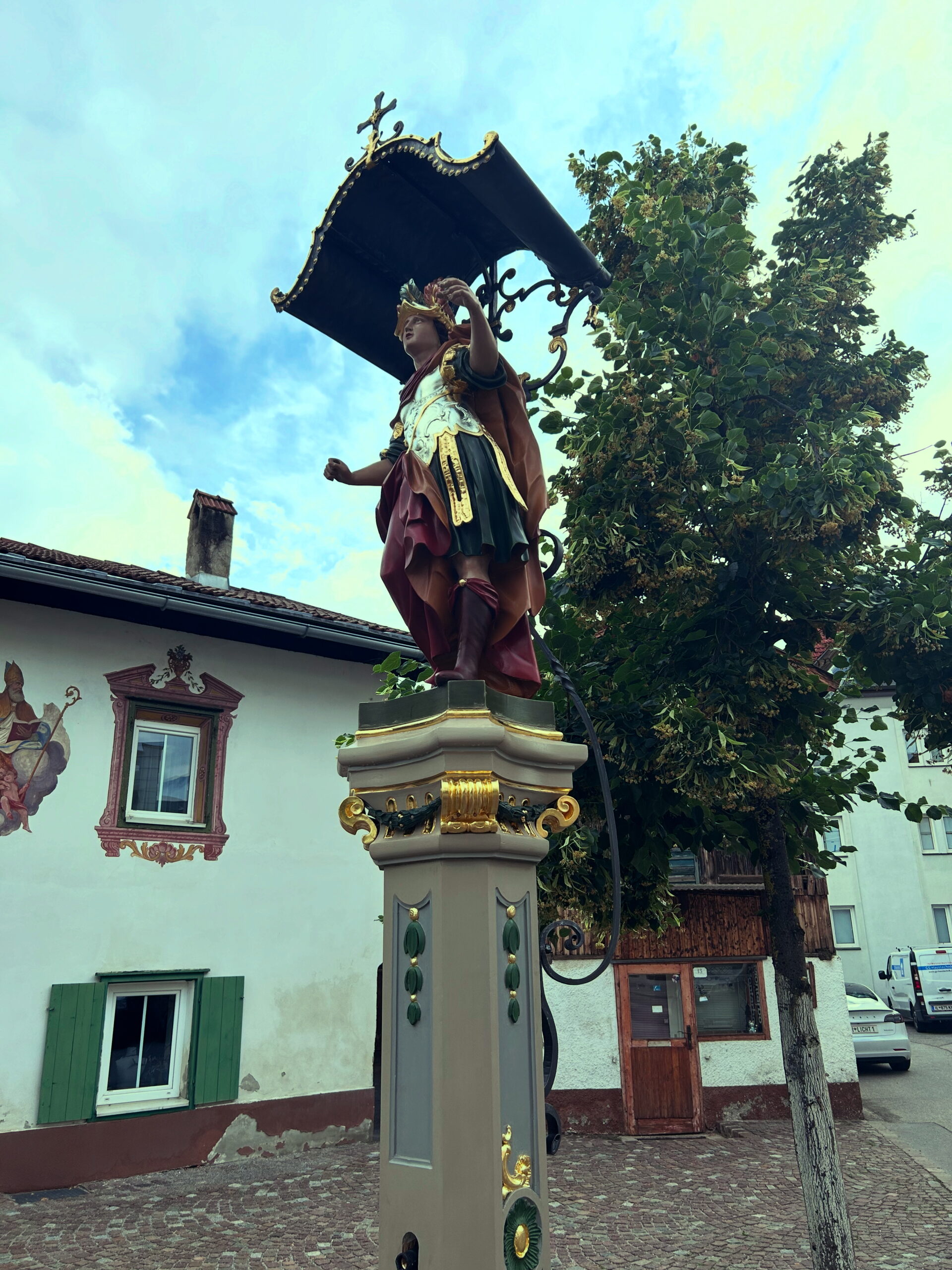
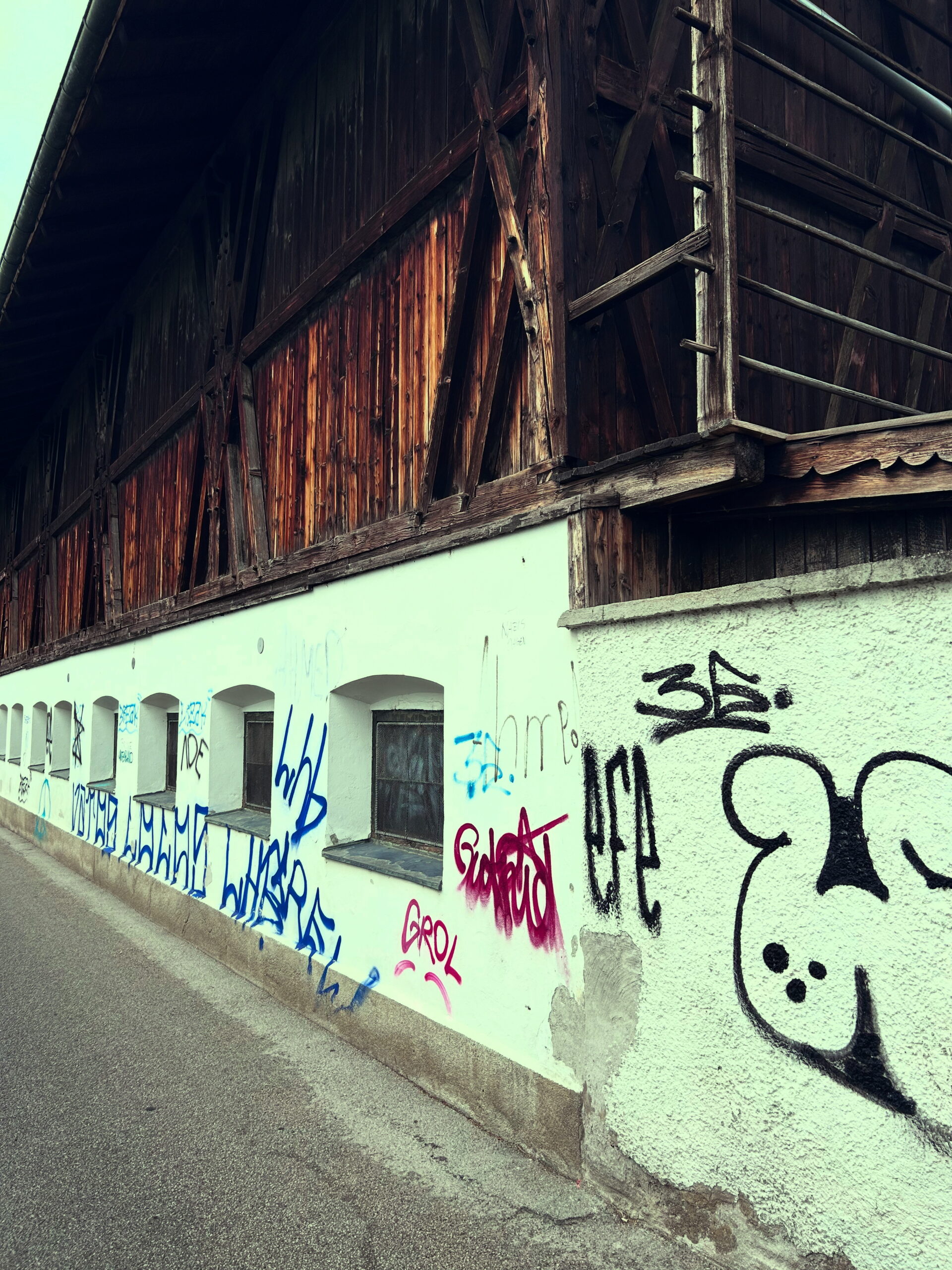
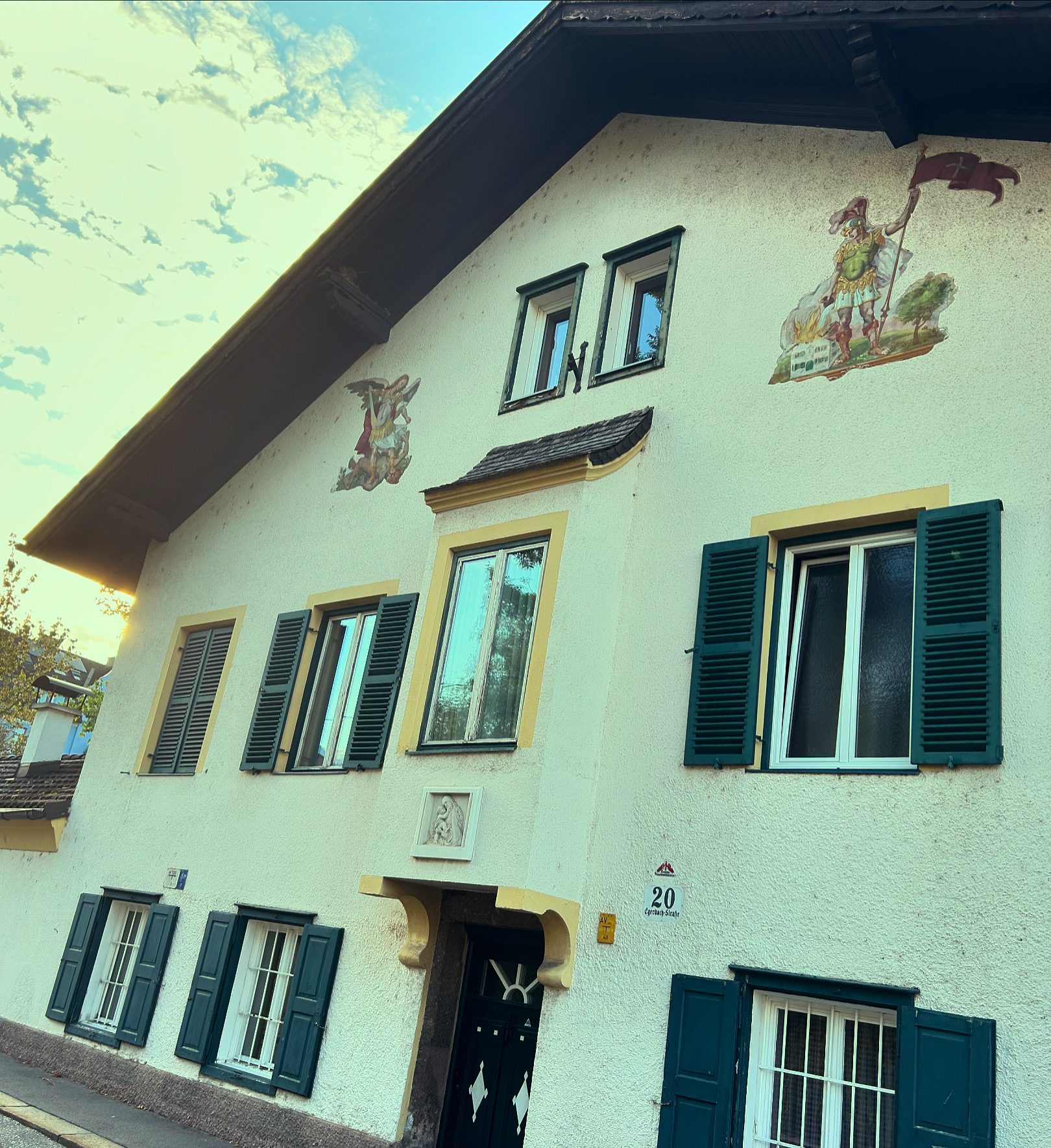
Until the 19th century, Pradl was a small rural settlement between the Sill River and what is now the Pradl parish church, consisting of about 20 farmhouses. The origins of the village can be traced back to an estate owned by the Counts of Andechs, around which a community developed. The oldest farmhouse can be documented as far back as the 13th century. In the 15th century, the farmers benefitted from the social and economic developments taking place in the ducal residence city of Innsbruck and in the silver-mining town of Schwaz. The farmers of Pradl focused early on livestock breeding. City dwellers and noble households, as well as craftsmen and skilled workers, consumed more expensive meat than the average Tyrolean of earlier centuries. The next boost for agricultural business came with industrialization in the 19th century. The small square with the Florianibrunnen – a fountain built in 1865 and expanded in 1913 with a Baroque statue of Saint Florian – remains a popular meeting place in Pradl to this day. The patrons of this village center were the Hörtnagl family. The Hörtnagls are the most successful example of the transformation from livestock farmers to entrepreneurs. The Hörtnagl farmstead at Egerdachstraße 20, featuring a statue of the Virgin of Grace and paintings of Saint Florian and the Archangel Michael, dates back to 1580. In 1862, Andrä Hörtnagl founded a meat trading business. Under his son Hans Hörtnagl (1864–1944), the company grew. The politically engaged and influential family was also heavily involved in important infrastructure projects such as the construction of the slaughterhouse in Saggen. Through skill and hard work they gained wealth, and their land ownership allowed them to exert political influence as well. In the 1930s, Hans Hörtnagl enabled the city to build the Hörtnagl Settlement on one of the family's properties in the western part of the city. To this day, the traditional company Hörtnagl is an established part of Tyrol’s gourmet landscape.
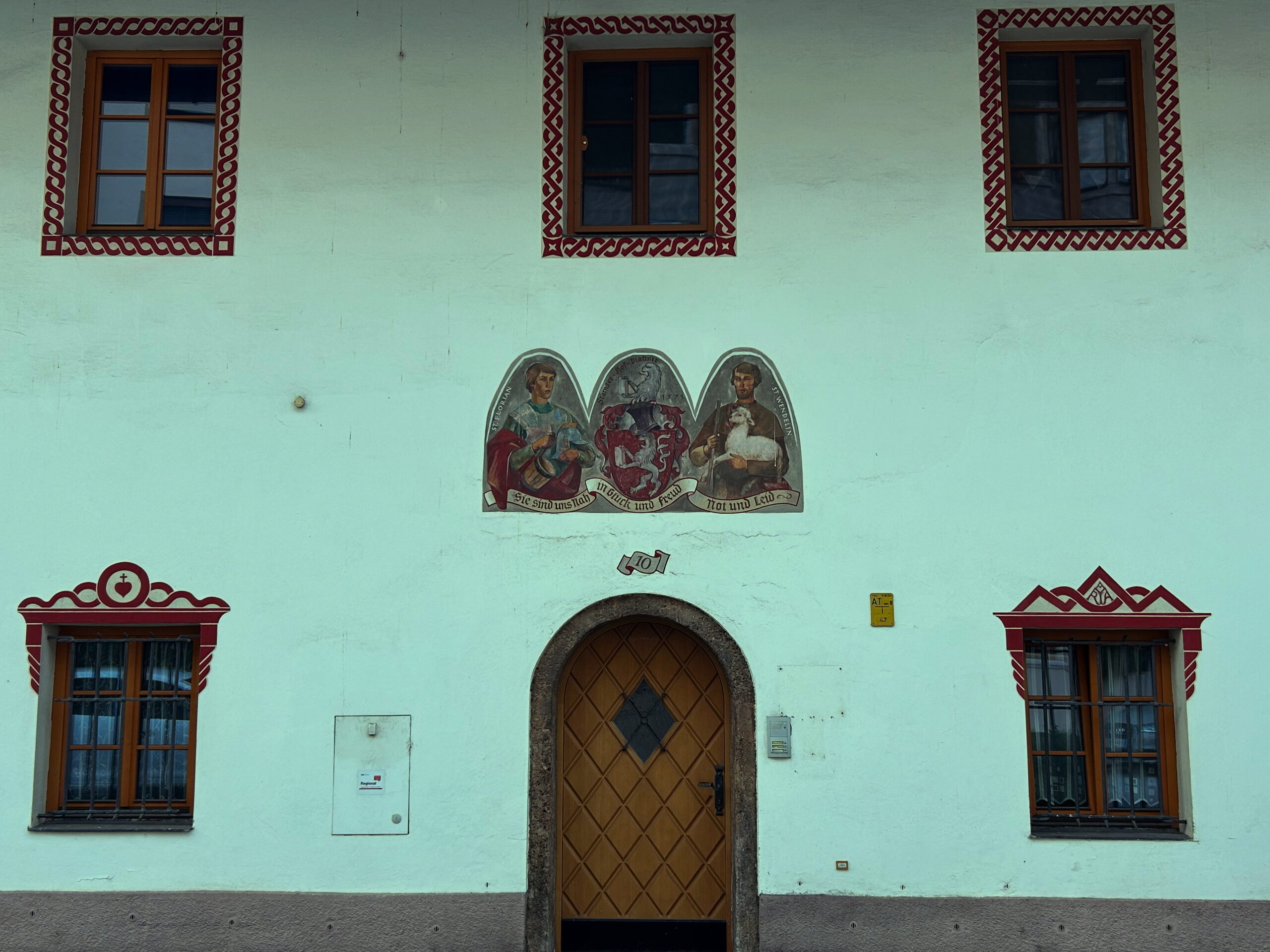
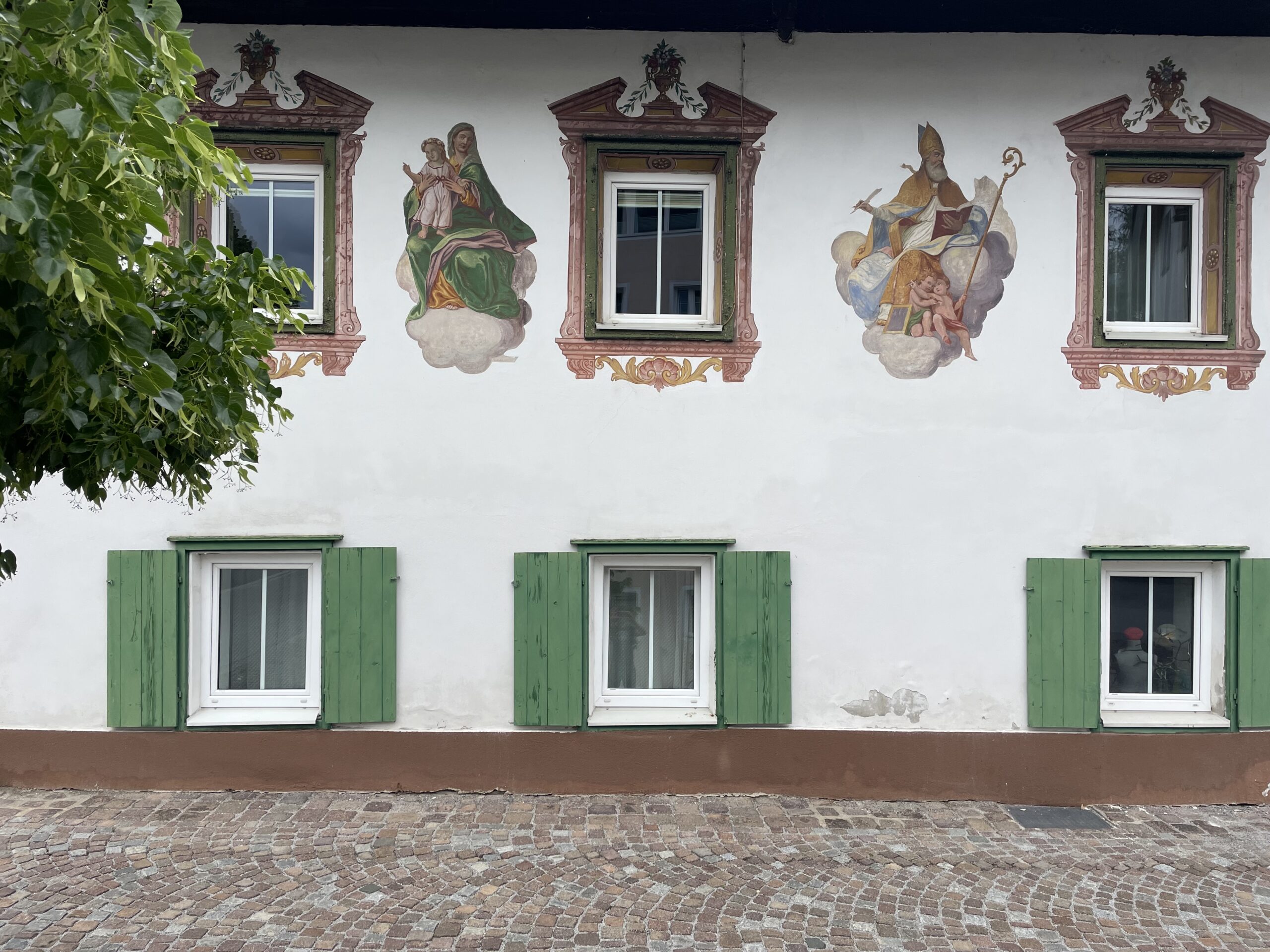
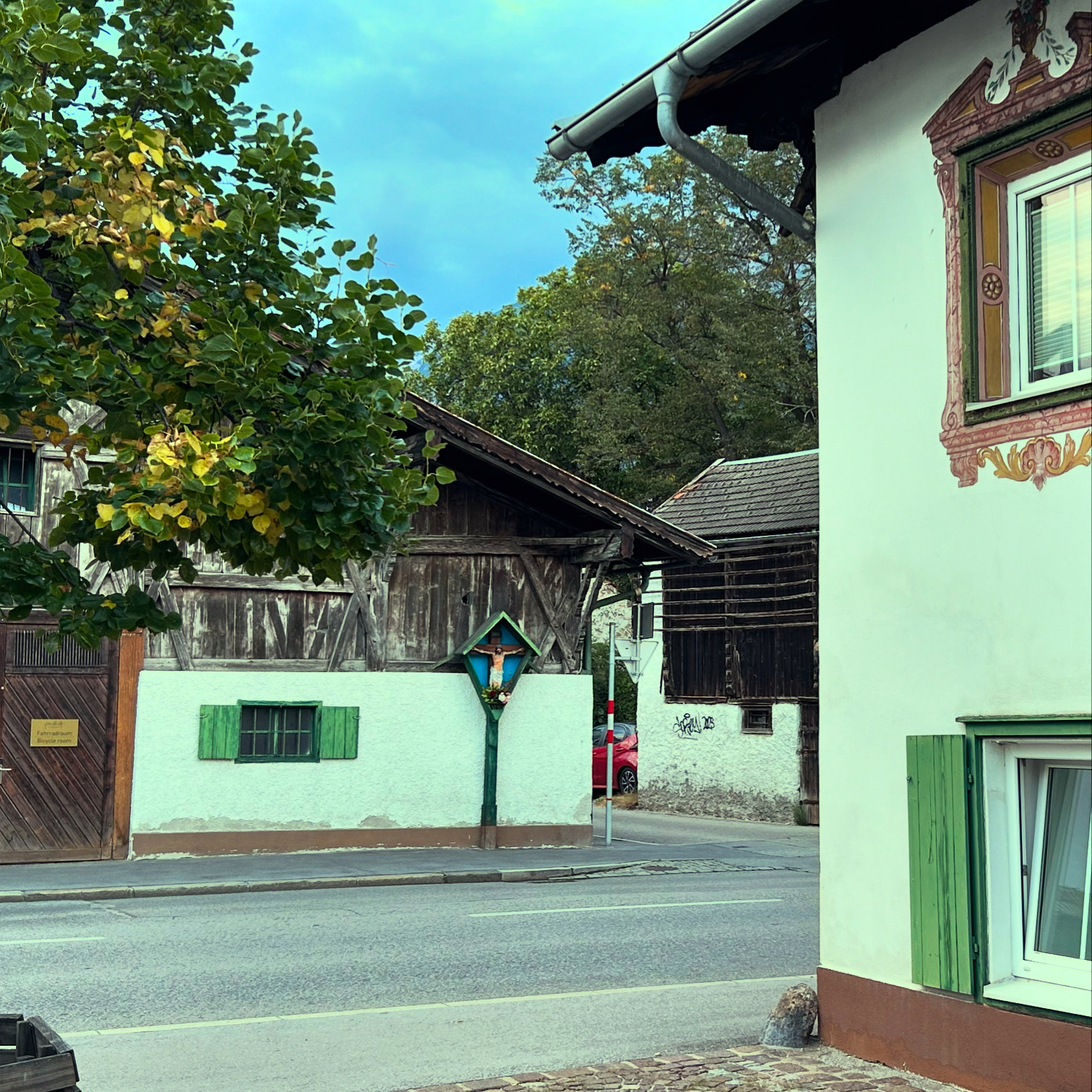
Around the Florianibrunnen, in Egerdachstraße and Pradlerstraße, several other beautiful estates can be found. At Egerdachstraße 10 stands the Stamserhof, owned by the Plattner family, an impressive farmhouse from the 16th century. Baroque depictions of Saints Florian and Wendelin flank the family’s coat of arms and the pious phrase: “They are close to us, in happiness and joy, need and sorrow.” The Lodronischer Hof directly opposite also dates back to the 16th century. From 1870 onward, it housed the Pradl Farmers’ Theatre, which, with plays such as The Last Rottenburger or The Outlaw’s Daughter, as well as productions depicting the Tyrolean Rebellion of 1809, attracted many city dwellers to rural Pradl. The two-story Baroque farmhouse (house number 20) right next to the Florianibrunnen features a mural of the Virgin Mary painted by Rafael Thaler (1870–1947) around 1920.
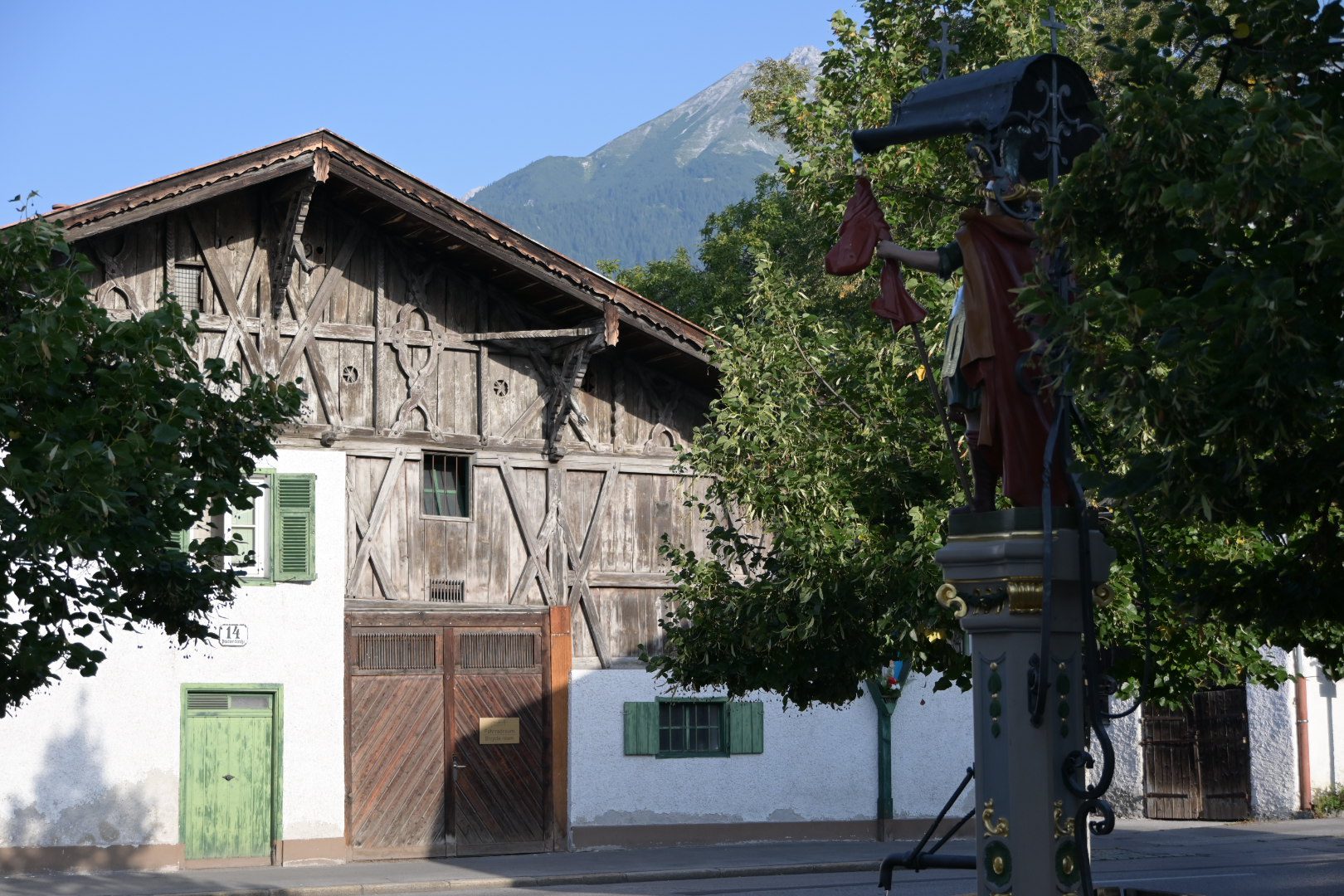
Most of the Pradl farmsteads are no longer used for agriculture. Between Pembaurstraße and the part of Gabelsbergerstraße known as Fackngassl, a few horses can still be seen. As in Amras, farmers in Pradl made good money in past decades by selling land for residential construction. However, the richly decorated Baroque farmsteads remain impressive relics of Pradl’s not-so-distant past as a village.
Tyrol in the hands of farmers
Despite all figures and facts to the contrary, identification with the farming class in Tyrol remains widespread to this day as a nostalgically romanticised self‑image. Free, independent, and indispensable—this is the image of farmers between Landeck and Kufstein. Although fewer than 2 per cent of the population today earn their living from agriculture, farmers manage—through active associations, skilful self‑representation, and political lobbying structures—to achieve a level of representation in society that is disproportionate to their numbers. This was not always the case; in fact, the situation had once been the exact opposite. For centuries, by far the largest proportion of the population worked in agriculture, yet farmers possessed little political influence. The landlords not only owned the land itself but also exercised authority over the agricultural population. Independent action as active participants in the economic system was unthinkable for farmers. Rent was regularly collected in the form of payments in kind. The social order was rigid. The local lesser nobility administered the peasantry within their territories and, in turn, paid their dues to the territorial prince or bishop.
Three types of relationships existed between farmers and landlords. Throughout the Middle Ages, serfdom (Leibgeding) was common. Farmers worked on the lord’s estates as serfs. This dependency could extend so far that decisions regarding marriage, property, mobility, and other aspects of personal life were not freely permitted. In the vast majority of Tyrol, however, this form had already disappeared by the Early Modern period.
The second form, known as temporary tenure (Freistift), involved leasing a farm for a fixed period, usually one year. As a rule, the lease was renewed, since both landlords and farmers—much like employers and employees today—benefited from long‑term continuity. However, tenants had no legal right to remain on the property, and there were no written contracts regulating the arrangement. These orally agreed leases were governed by customary law and tradition. The landlord could reassign farmers within his estates at will or evict them entirely. If a farm was transferred within a family from father to son with the landlord’s consent, a fee—known as an Ehrung—of up to 10 per cent of the farm’s value had to be paid.
The third and most modern form was hereditary tenure (Erbleihe). Although the land technically remained the property of the landlord, eviction was no longer easily possible. Hereditary tenants paid lower rents than temporary tenants. In autumn—either on St Gall’s Day (16 October) or St Martin’s Day (11 November)—farmers holding land in hereditary tenure had to deliver their rent, which gradually shifted from payments in kind to monetary payments. Through land purchases or skilful marriage strategies, farmers were able to enlarge their holdings. Farms were inherited within families. Retired farmers who transferred their property during their lifetime—the so‑called transfer “with the warm hand”—retained the right to live on the farm and were supported through an agreed retirement provision (Ausgedinge).
In the fifteenth century, political rules began to change. Towards the end of the Middle Ages, a form of modern statehood gradually emerged. Territorial princes had long regarded the lesser nobility—with their intermediary role and independent jurisdiction—as an obstacle. Monarchs and the high aristocracy sought to exercise direct authority over their subjects. While the estate‑based social order and hereditary privilege remained formally intact, the role of the lesser nobility changed fundamentally. They shifted from being lords with direct power over their subjects to estate administrators and organisers of territorial defence on behalf of the prince. In order to limit the influence of the lesser nobility, Duke Frederick IV formally recognised hereditary tenure in his Territorial Ordinance of 1404. With the exception of the territories of the prince‑bishops of Trent and Brixen, this form of tenancy gradually replaced temporary tenure throughout Tyrol. Legal disputes between farmers and landlords had to be brought before the territorial prince. Through this political measure, Frederick secured the immediate loyalty of his subjects, gaining direct access to military manpower and tax revenues. Farmers benefited by no longer being entirely subject to the arbitrariness of their landlords. Hereditary tenure transformed farmers into a kind of entrepreneur, enabling them to participate in early capitalism as market actors. Although they remained exposed to natural forces and broader political conditions—such as wars or customs regulations—they now had the opportunity to rise above the subsistence‑level existence of earlier centuries. After delivering the tithe and providing for their households, farmers sold surplus goods at market. Hard‑working and capable farmers could accumulate a certain degree of prosperity. Economic developments from the fifteenth century onwards—particularly Innsbruck’s rise as a residential capital and mining activities in Hall and Schwaz—benefited farmers in the surrounding villages. Officials employed at court and workers in the emerging mining industry formed a middle class with increased purchasing power. Demand for meat rose, which in turn led to a shift towards livestock farming, seen as more profitable than arable agriculture. Broader economic conditions also played a role. Inflation following the discovery of the New World and its silver mines, along with the financial upheavals of the sixteenth century, reduced the real value of monetary rents. Small farmers leasing land under temporary tenure and paying rent in kind suffered from currency devaluation, while large agricultural enterprises benefited from it.
Local inheritance laws also played a major role in determining regional economic success or decline. In North Tyrol’s upper regions and in South Tyrol, partible inheritance (Realteilung) prevailed: farms were divided among all heirs, leading to fragmentation and reduced profitability. In contrast, in the Innsbruck region and the Lower Inn Valley, impartible inheritance (Anerbenteilung) was common. With few exceptions, the eldest child inherited the entire farm in order to preserve its structure. Siblings were usually forced to leave and earn their living as servants, craftsmen, farmhands, or maids. As Söllhäusler—people owning only a small house and perhaps a garden but no significant land—they belonged to the Pöfel, a marginal social group that included innkeepers, itinerant people, prostitutes, servants, and beggars. In cases of illness or destitution, they had limited claims against the heir and could temporarily return to the farm. Depending on the value of the holding, siblings might be entitled to an annuity, though in most cases this was minimal or nonexistent. Even then, farmers were adept at presenting the book value of their property as low as possible.
These developments led to new social structures within farms themselves and to increasing disparities within the farming class. Farmers exercised authority over their servants in all matters, akin to the pater familias of the extended family in ancient Rome. Life on the farms bore little resemblance to the idyllic family life often promoted today as traditional Tyrolean lifestyle. Instead, large, clan‑like family units lived under the strict regime of the farmer, who determined labour routines, food, accommodation, limited leisure, and personal relationships. Clear hierarchies emerged within villages. Hereditary tenants enjoyed higher status than temporary tenants; large farmers were held in higher regard than small ones and often took leading roles in village life. Particularly successful and loyal farmers were granted family coats of arms by the territorial prince and elevated to the rank of farming nobility. In a society where honour and status were valued at least as highly as money itself, the title of a free farmer was far more than a mere symbol. These structures persisted in rural areas well into the nineteenth century, and in more remote regions even into the twentieth century. At the outbreak of the First World War, more than 50 per cent of Tyrol’s population was still employed in agriculture. The fine farmhouses in Hötting, Wilten, Pradl, and Amras—whose façades proudly display family coats of arms and references to hereditary farm status—stand as testimony to the rise of the farming class in the Early Modern period.
Theatres, country stages, cinemas & Kuno
The Tyrolean State Theatre, opposite the Imperial Palace, remains to this day the most striking monument to the city's educated middle-class evening entertainment. Since its existence began, however, this house of high culture has, for the most part, led a rather dreary existence when it comes to audience numbers. From Baroque plays centered on the suffering of Christ in the 16th century to daring productions nearly 500 years later that were often rewarded with little applause by audiences, activity at the State Theatre has always been the passion of a small elite. The majority of Innsbruck’s inhabitants, by contrast, spent their leisure time with more down-to-earth amusements. Travelling performers had already been welcome guests during the Middle Ages, although only under certain conditions. Just as today, public performances in earlier times were subject to strict censorship. What age restrictions for cinema films are today were once limitations placed on performances deemed displeasing to God, extending even to complete bans on theatre and acting under particularly devout provincial rulers. As society became increasingly bourgeois and moral attitudes more enlightened, these rules gradually became less restrictive. This marked the beginning of the institutionalization of theatre. According to its own records, the Pradl Farmers’ Theatre (Pradler Bauerntheater), the oldest folk theatre group in Innsbruck that still exists as an institution today, was founded in 1762. Although its first venue was an open-air stage in the Hötting meadows, and although craftsmen and students as well as farmers were part of the ensemble, this should not diminish either the honour of its name or its origins. While performances at the State Theatre were often staged before half-empty audiences, the amateur actors of the farmers’ theatre enjoyed great popularity with their comedies. Innsbruck residents of all social classes made weekend pilgrimages from the city to performance venues in the surrounding villages or enjoyed the evening entertainment in local inns. Especially popular were the so-called knights’ plays, featuring abducted princesses, heroic rescuers, and clumsy villains. Unlike the serious productions presented in bourgeois theatre, the performers of the farmers’ theatres interacted directly with the audience. Interjections from the spectators were not suppressed but spontaneously incorporated into the play. It could even happen that the audience, not always entirely sober, physically intervened in the action of the performance. In 1870, the Pradl Farmers’ Theatre moved into a hay barn at the Lodron Estate (Lodronischer Hof) on Egerdachstraße that had been converted into a stage. In 1898, the company even toured Vienna. By that time, Innsbruck already possessed a whole range of theatres and venues that entertained audiences with plays and music. In 1892, the Löwenhaus Stage (Löwenhaus-Bühne) opened on Rennweg, on the site where the Tyrolean regional ORF broadcasting centre is located today. The wooden building burned down in the late 1950s, just as state broadcasting was beginning its rise.
From the large number of theatre troupes, one particularly ambitious showman emerged. Ferdinand Exl (1875–1942) broke new ground with part of the Pradl Farmers’ Theatre (Pradler Bauerntheater). For a long time, the accepted wisdom had been: "Anyone who wants to go to a farmers’ theatre will not find what they are looking for in the theatre, and anyone who seeks not merely entertainment but literary inspiration in the theatre does not go to a farmers’ theatre." Exl recognized the trend of the times. Clerks and workers could not afford the exorbitant ticket prices of the State Theatre, nor did they wish to sit through lengthy Wagner operas or plays such as The Sorrows of Young Werther. Nevertheless, audiences did expect a certain level of quality in both content and performance. With the so-called literary folk plays by renowned local authors such as Ludwig Anzengruber, Franz Kranewitter, and Karl Schönherr, Exl succeeded in combining entertainment with artistic quality. Anzengruber summarized this development as follows:
Anzengruber's Tyroleans not only sing Schnaderhüpfel, platteln d'Schuh, swear like Croats and scuffle, but they are also people with a subtle psyche who have their own thoughts about various problems and develop their own philosophy.
The first play staged by Exl, The Priest of Kirchfeld (Der Pfarrer von Kirchfeld) by Ludwig Anzengruber, was performed in 1902 at the Österreichischer Hof in Wilten. In 1903, the Exl Stage (Exl Bühne) moved to the Adambräu brewery in Adamgasse. From 1904 to 1915, audience favourites such as Franz Kranewitter’s plays Michael Gaismair and Andre Hofer were performed at the Löwenhaus near the Court Garden (Hofgarten). In addition to theatrical productions, tourists were offered traditional Tyrolean entertainment, including zither performances and “genuine, lively Tyrolean Schuhplattler dancing.” In 1904, the company embarked on its first international tour, travelling to Switzerland and Germany. Both the press and audiences were enthusiastic about the nationalist-leaning plays, performed by sturdy Tyrolean young men and attractive young women. In 1910, Exl finally abandoned amateur status and, in addition to long-serving members of his own family and the Auer family, increasingly hired townspeople and professional actors. The First World War and the resulting travel restrictions put a stop to further touring activities. The troupe became part of the Innsbruck Municipal Theatre (Innsbrucker Stadttheater), whose audiences, during those difficult years, were also receptive to lighter entertainment. After the most difficult post-war years had passed, the company’s fortunes improved once again. Beginning in 1924, the Exl Stage performed regularly not only at the Municipal Theatre during the winter season but also at Vienna’s Raimund Theatre and the Vienna Comedy House (Wiener Komödienhaus). The political developments of the 1930s greatly benefited the German nationalist spirit that permeated many of the plays Exl brought to the stage. Exl had already joined the National Socialist German Workers’ Party (NSDAP), which was banned in Austria at the time, in 1933. Although Austria’s Christian Social corporative state prohibited the excessively German-nationalist troupe from performing, they received an even more enthusiastic reception during their tours in National Socialist Germany. In 1935, the Exl Stage performed Karl Schönherr’s play Faith and Homeland (Glaube und Heimat) in Berlin. The Berliner Morgenpost of 4 April 1935 described it as: “...art that flows from the depths of German folk culture and returns to the hearts of moved and grateful listeners.” Following Austria’s annexation by Nazi Germany in 1938 (Anschluss), Exl once again enjoyed favourable media attention in his homeland and was celebrated as: “...a counterweight to the completely Judaized, artistically Bolshevized theatre establishment...” In 1942, the founder of the Exl Stage passed away. His wife and son took over the company and, after the war, became part of the Tyrolean State Theatre. During the 1950s, the troupe enjoyed one final successful tour through both West and East Germany before the theatre company was dissolved in 1956.
Times had changed. Cinema killed the theatre star. Motion pictures shown in cinemas began to compete with the stage. Ferdinand Exl had foreseen this development early on. In 1912, his ensemble appeared in the French film Speckbacher, which portrayed the Tyrolean Uprising in a heroic light. The first motion picture had already flickered across a screen in Innsbruck’s Stadtsaal in 1896, only one year after the world’s first public film screenings, before a fascinated audience. Cinema quickly became part of everyday life for many people. In addition to silent films, audiences were shown newsreels that were considered politically desirable, especially during wartime and often served propagandistic purposes. In the following decades, cinemas sprang up like mushrooms. In 1909, a movie theatre opened at Maria-Theresien-Straße 10 and later moved to Maria-Theresien-Straße 37, where it became known as the Zentral. After the war it was transformed into a Nonstop Cinema, where visitors bought a ticket for a continuous programme of newsreels, cartoons, advertisements, and feature films that repeated in an endless cycle. In 1928, the Innsbruck Red Cross opened the Kammer-Lichtspiele cinema in Wilhelm-Greil-Straße in order to finance its new association headquarters. At Maria-Theresien-Straße 17 stood the Triumph, which survived under the name Central until the 1990s. The site now occupied by the youth centre Z6 was once home to the Forum Cinema. In 1933, the Löwenkino opened in Höttinger Gasse. In 1959, it moved as the Metropol into the protected historic Malfatti House opposite the Inn Bridge, where it still exists today. During the final phase of the Second World War, Innsbruck’s largest cinema auditorium opened its doors with the Laurin-Lichtspiele, located in the middle of the South Tyrolean settlement on Gumppstraße. Robert and Walter Kinigadner, two South Tyrolean optants who had already gained experience in the cinema business in Brixen (Bressanone), took over operations of the hall, which could seat 800 viewers. Harmless homeland films alternated with National Socialist propaganda productions. The Exl Stage also used the Laurin, which served as a theatre venue until the 1970s, for theatrical performances. Today, a supermarket occupies the space behind the columns of what was once the building’s grand entrance. Above the checkout area, visitors can still see murals depicting the legend of the mythical dwarf king Laurin and the Germanic hero Dietrich von Bern, executed in the characteristic style of National Socialist art. In 1958, the Leokino opened in the premises of the former Catholic Workers’ Association (Katholischer Arbeiterverein). It remains in operation to this day and is a permanent fixture of Innsbruck’s film scene. At their peak in 1958, Innsbruck’s cinemas recorded an astonishing 3.5 million tickets sold. The most popular films were homeland movies and light-hearted comedies such as Sissi starring Romy Schneider and The White Horse Inn (Im Weißen Rössl) starring Peter Alexander. In the 1970s, cinema also assumed a role in public enlightenment when bare breasts first appeared on the screen. Films such as Schoolgirl Report (Schulmädchen-Report) and Josefine Mutzenbacher brought the sexual revolution a little closer to the people of Tyrol as well.
These moral transgressions came at a time when cinema had already begun to pass the peak of its economic success. The television set in the living room was starting to provide both information and evening entertainment. When the Austrian Broadcasting Corporation (Österreichischer Rundfunk, ORF) began operations in 1955, hardly anyone yet owned a television set capable of receiving its rather limited programming. That was to change quickly. The audience figures achieved during the post-war period have never been surpassed. From the long list of cinemas that once existed, only a trio remains. The Metropol, housed in the historic Malfatti House (Malfattihaus), attracts audiences with blockbuster films, while the Cinematograph and the Leokino cater to a more alternative crowd. Every August, an open-air cinema takes place at the Zeughaus (the former armoury). Of the many folk theatres, the Pradl troupe has survived to this day, albeit under a new name. In 1958, they found a new home at the cultural inn Bierstindl. The amateur troupe Innsbrucker Ritterspiele (Innsbruck Knights’ Plays) continues to enjoy immense popularity and regularly performs to full houses. The play The Villainous Kuno of Drachenfels (Der Schurkische Kuno von Drachenfels) revives the traditions of past centuries every year, complete with the repeated beheading scene and humorous interaction with the audience. The Landhaus Alpenheim in the Saggen district, now better known as Villa Exl, where the Exl family once lived, is a notable example of Tyrolean vernacular architecture. It features murals by Raphael Thaler and is well worth a visit. Ferdinand Exl is also commemorated by a street bearing his name in the Höttinger Au district. The times had changed. Folk theatre, once a central form of popular entertainment, had to compete first with cinema and later with television. Yet despite these transformations, elements of Innsbruck’s theatrical tradition have endured. While the grand touring companies and the multitude of cinemas have largely disappeared, institutions such as the Leokino, the Metropol, and the successors of the Pradl Farmers’ Theatre continue to preserve and reinterpret a cultural heritage that stretches back centuries.
Baroque: art movement and art of living
Anyone traveling through Austria is familiar with the domes and onion-shaped towers of churches in towns and villages. They are the characteristic hallmark of the Baroque architectural style, which reached its peak during the Counter-Reformation and continues to shape the cityscape of Innsbruck to this day. The most prominent churches—such as the Cathedral, St. John’s Church, or the Jesuit Church—are built in the Baroque style. Places of worship were meant to be splendid and magnificent, symbols of the triumph of the true faith. The exuberant, all-encompassing piety of elites and subjects alike was reflected in art and culture: great drama, pathos, suffering, splendor, and glory combined to form the Baroque—a style that left a lasting imprint on the entire Catholic sphere of influence of the Habsburgs and their allies between Spain and Hungary. From the seventeenth century onward, the Gumpp family of master builders and Johann Georg Fischer fundamentally transformed Innsbruck’s cityscape. The Old Provincial Government Building in the Old Town, the New Provincial Government Building on Maria-Theresien-Strasse, countless palazzi, paintings, and sculptures—the Baroque was the defining stylistic force of the House of Habsburg in the seventeenth and eighteenth centuries and became embedded in everyday life. The bourgeoisie did not wish to lag behind the nobility and princes and therefore had their private residences built in the Baroque style as well. Farmhouses were adorned with images of saints, depictions of the Virgin Mary, and representations of the Sacred Heart of Jesus.
Yet the Baroque was more than an architectural style; it was a way of life that emerged in the aftermath of the Thirty Years’ War. The Ottoman threat from the east, culminating in the two sieges of Vienna, dominated the empire’s foreign policy, while the Reformation shaped domestic affairs. Baroque culture became a central element of Catholicism and its political self-representation in public space—a countermodel to the austere and rigorous way of life advocated by Calvin and Luther. Christian holidays were introduced to brighten everyday life. Architecture, music, and painting were rich, full, and exuberant. In theatres such as the Comedihaus in Innsbruck, dramas with religious themes were performed. Ways of the Cross with chapels and representations of the crucified Christ crisscrossed the landscape. Popular piety, expressed through pilgrimages and the veneration of Mary and the saints, became firmly embedded in everyday church life. Multiple crises shaped daily existence. In addition to war and famine, plague epidemics occurred particularly frequently in the seventeenth century. Baroque piety was used as a means of educating subjects, teaching them to interpret these calamities as expressions of God’s dissatisfaction—misfortunes that could be remedied through a devout and virtuous way of life. Although the sale of indulgences was no longer common practice in the Catholic Church after the sixteenth century, vivid notions of heaven and hell persisted. Through a virtuous life—that is, living in accordance with Catholic values and displaying proper conduct as a subject within the divine order—one could come significantly closer to paradise. So-called Christian devotional literature became the most popular reading material following the educational reforms of the eighteenth century and the rising literacy of the population. The suffering of the Crucified for humanity was regarded as a symbol of the hardship endured by subjects on earth within the feudal system. Through votive paintings, people sought assistance in times of hardship or expressed gratitude—most often to the Virgin Mary—for surviving dangers and illnesses. Particularly impressive votive paintings can be admired in the Wilten Basilica. The historian Ernst Hanisch described the Baroque and its influence on the Austrian way of life as follows:
“Austria emerged in its modern form as a crusading imperialism—externally against the Turks and internally against the Reformers. This brought bureaucracy and the military, and externally a multiethnic society. State and Church attempted to control the intimate sphere of citizens’ lives. Everyone had to reform themselves through the confessional; sexuality was restricted, norm-compliant sexuality enforced. People were systematically trained to dissemble.”
Rituals and submissive behavior toward authority left deep traces in everyday culture, distinguishing Catholic countries such as Austria and Italy to this day from Protestant-influenced regions such as Germany, England, or Scandinavia. Austrians’ passion for academic titles has its roots in Baroque hierarchies. The term Baroque prince refers to a particularly patriarchal and patronizing politician who knows how to captivate an audience with grand gestures. While political sobriety is valued in Germany, the style of Austrian politicians remains theatrical—entirely in keeping with the Austrian adage “Schaumamal” (“let’s see”).