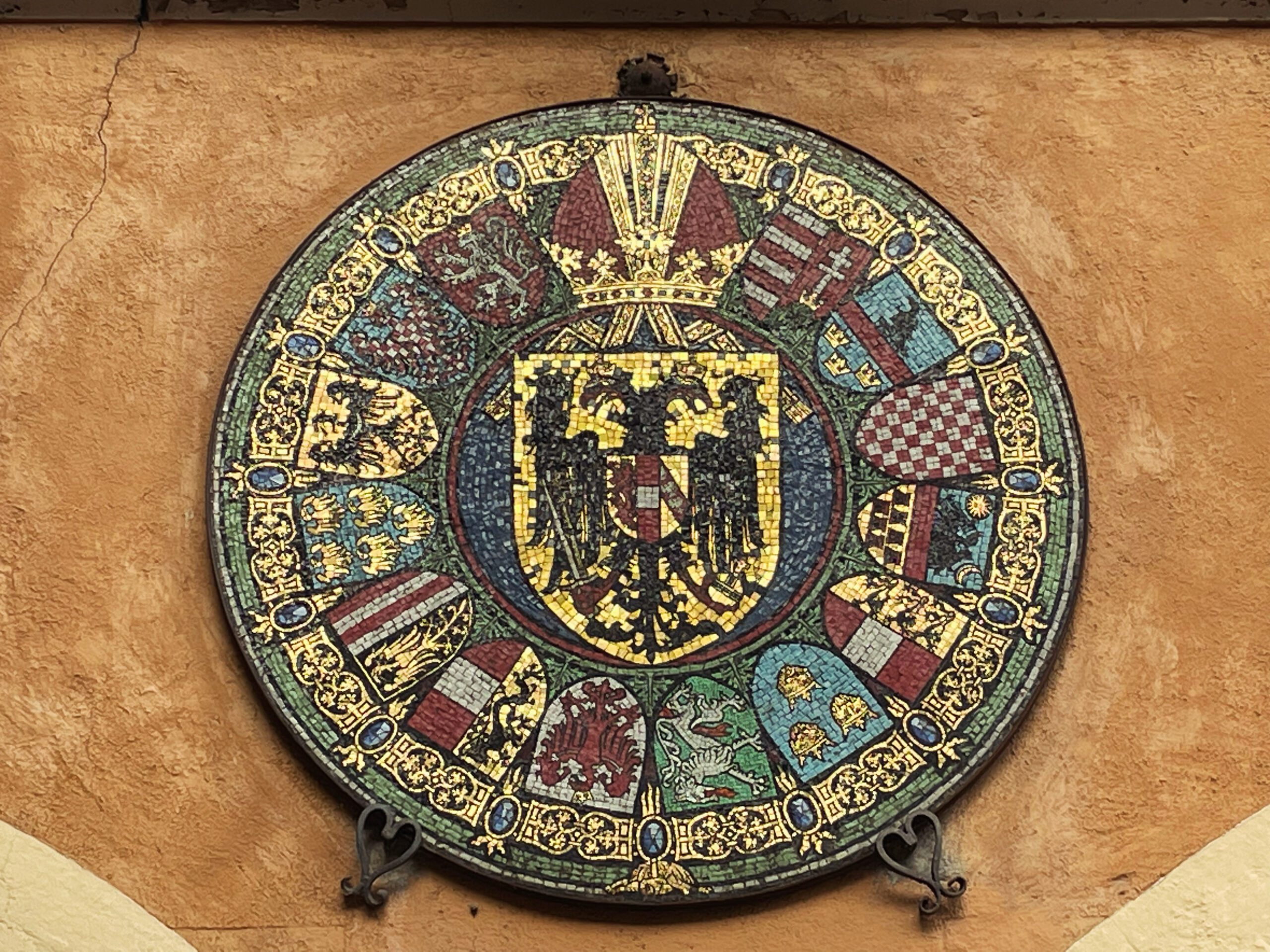
Emblem k.u.k. Monarchie
Wissenswert dazu…
Innsbruck and the House of Habsburg
Innsbrucks Innenstadt wird bis heute von Gebäuden und Denkmälern geprägt, die an die Familie Habsburg erinnern. Unzählige Touristen bewundern die stummen Hinterlassenschaften der Dynastie, die als mindestens ebenso ur-österreichisch gilt wie Schnitzel, Mozartkugeln und Mehlspeisen. Diese Darstellung ist allerdings nicht korrekt, auch wenn die Habsburger die Landesgeschichte über Jahrhunderte mitprägten. Sie waren ein europäisches Herrscherhaus, zu dessen Einflussbereich verschiedenste Territorien gehörten. Am Zenit ihrer Macht waren ihre Mitglieder die Herrscher über ein „Reich, in dem die Sonne nie untergeht“. Durch Kriege und geschickte Heirats- und Machtpolitik saßen sie in verschiedenen Epochen an den Schalthebeln der Macht zwischen Südamerika und der Ukraine. Ob der internationalen Ausrichtung des Hauses Habsburg verwundert es nicht, dass so mancher CEO der Grafschaft Tirol aus dieser Dynastie zumindest am Anfang etwas fremdelte mit der alpinen Provinz und ihren Einwohnern. Einige der Tiroler Landesfürsten hatten weder eine besondere Beziehung zu Tirol noch brachten sie diesem deutschen Land besondere Zuneigung entgegen. Ferdinand I. (1503 – 1564) wurde am spanischen Hof erzogen. Maximilians Enkel Karl V. war in Burgund aufgewachsen. Als er mit 17 Jahren zum ersten Mal spanischen Boden betrat, um das Erbe seiner Mutter Johanna über die Reiche Kastilien und Aragorn anzutreten, sprach er kein Wort spanisch. Als er 1519 zum Deutschen Kaiser gewählt wurde, sprach er kein Wort Deutsch. Es waren auch nicht alle Habsburger glücklich in Innsbruck sein zu „dürfen“. Angeheiratete Prinzen und Prinzessinnen wie Maximilians zweite Frau Bianca Maria Sforza oder Ferdinand II. zweite Frau Anna Caterina Gonzaga strandeten ungefragt nach der Hochzeit in der rauen, deutschsprachigen Bergwelt. Stellt man sich zudem vor, was ein Umzug samt Heirat von Italien nach Tirol zu einem fremden Mann für einen Teenager bedeutet, kann man erahnen, wie schwer das Leben der Prinzessinnen war. Kinder der Aristokratie wurden bis ins 20. Jahrhundert vor allem dazu erzogen, politisch verheiratet zu werden. Widerspruch dagegen gab es keinen. Man mag sich das höfische Leben als prunkvoll vorstellen, Privatsphäre war in all dem Luxus nicht vorgesehen.
Innsbruck repeatedly became a place of destiny for this ruling dynasty. Thanks to its strategically favorable location between Italian cities and German centers such as Augsburg and Regensburg, Innsbruck gained a special status within the empire at the latest after being elevated to a residence city under Emperor Maximilian. Innsbruck experienced its Habsburg heyday when it served as the main residence of the Tyrolean sovereigns. Ferdinand II, Maximilian III, and Leopold V, together with their wives, shaped the city during their reigns. When Sigismund Franz of Habsburg (1630–1665) died childless as the last provincial ruler, Innsbruck also lost its status as a residence city, and Tyrol was governed by a governor. Tyrolean mining had lost much of its importance and no longer required special attention. Shortly thereafter, the Habsburgs lost their possessions in Western Europe, including Spain and Burgundy, which pushed Innsbruck from the center to the periphery of the empire.
Despite this decline in favor and the increasing centralization of government affairs, Tyrol, as a conservative region, generally remained loyal to the dynasty. Even after the period as a residence city, the births of new members of the ruling family were dutifully celebrated with parades and processions; deaths were mourned with memorial masses; and archdukes, kings, and emperors were immortalized in public spaces with statues and paintings. In the nineteenth century, the Jesuit Hartmann Grisar wrote the following about the celebrations marking the birth of Archduke Leopold in 1716:
„But what an imposing sight it was when, as night fell, the Abbot of Wilten held the final religious function in front of St Anne's Column, which had been consecrated by the blood of the country, surrounded by rows of students and the packed crowd; when, by the light of thousands of burning lights and torches, the whole town, together with the studying youth, the hope of the country, implored heaven for a blessing for the Emperor's newborn first son.“
The Habsburgs valued the Nibelung-like loyalty of their alpine subjects. The region’s difficult accessibility made it a perfect refuge in turbulent and crisis-ridden times. Charles V (1500–1558) fled to Innsbruck for a time during a conflict with the Protestant Schmalkaldic League. Ferdinand I (1793–1875) had his family stay in Innsbruck to keep them far from the Ottoman threat in eastern Austria. Shortly before his coronation, Franz Joseph I enjoyed the seclusion of Innsbruck during the turbulent summer of the 1848 revolution together with his brother Maximilian, who was later executed by nationalist insurgents as Emperor of Mexico. A plaque at the Alpine inn Heiligwasser above Igls commemorates the fact that the monarch spent the night there during his ascent of the Patscherkofel. In the Austro-Hungarian Monarchy of the nineteenth century, Innsbruck was the western outpost of a vast empire that extended as far as present-day Ukraine. Franz Joseph I (1830–1916) ruled a multiethnic empire between 1848 and 1916. His neo-absolutist understanding of rule, however, was outdated. Although Austria had had a parliament and a constitution since 1867, the emperor regarded this government as “his.” Ministers were accountable to the emperor, who stood above the government.
In the second half of the nineteenth century, the ailing empire began to crumble increasingly. On October 28, 1918, the Republic of Czechoslovakia was proclaimed; on October 29, Croats, Slovenes, and Serbs withdrew from the monarchy. The last emperor, Charles, abdicated on November 11. On November 12, “German-Austria declared itself a democratic republic in which all power emanates from the people.” The Habsburg chapter had come to an end. Even though only very few Austrians today can imagine a monarchy as a form of government, the view of the ruling family remains ambivalent. Despite all the national, economic, and democratic problems that existed in the multiethnic states that— in various forms and configurations—were subject to the Habsburgs, the successor nation-states in some cases proved far less successful at reconciling minority interests and cultural differences within their territories. Since the EU’s eastward enlargement, the Habsburg Monarchy has not infrequently been portrayed by well-meaning historians as a precursor to the European Union. The list of Habsburg legacies in Innsbruck is long. Together with the Catholic Church, the Habsburgs shaped public space through architecture, art, and culture. The Golden Roof, the Imperial Palace, the Triumphal Arch, Ambras Castle, the Leopold Fountain, and many other structures still bear witness today to the presence of what was arguably the most significant ruling dynasty in European history in Innsbruck.