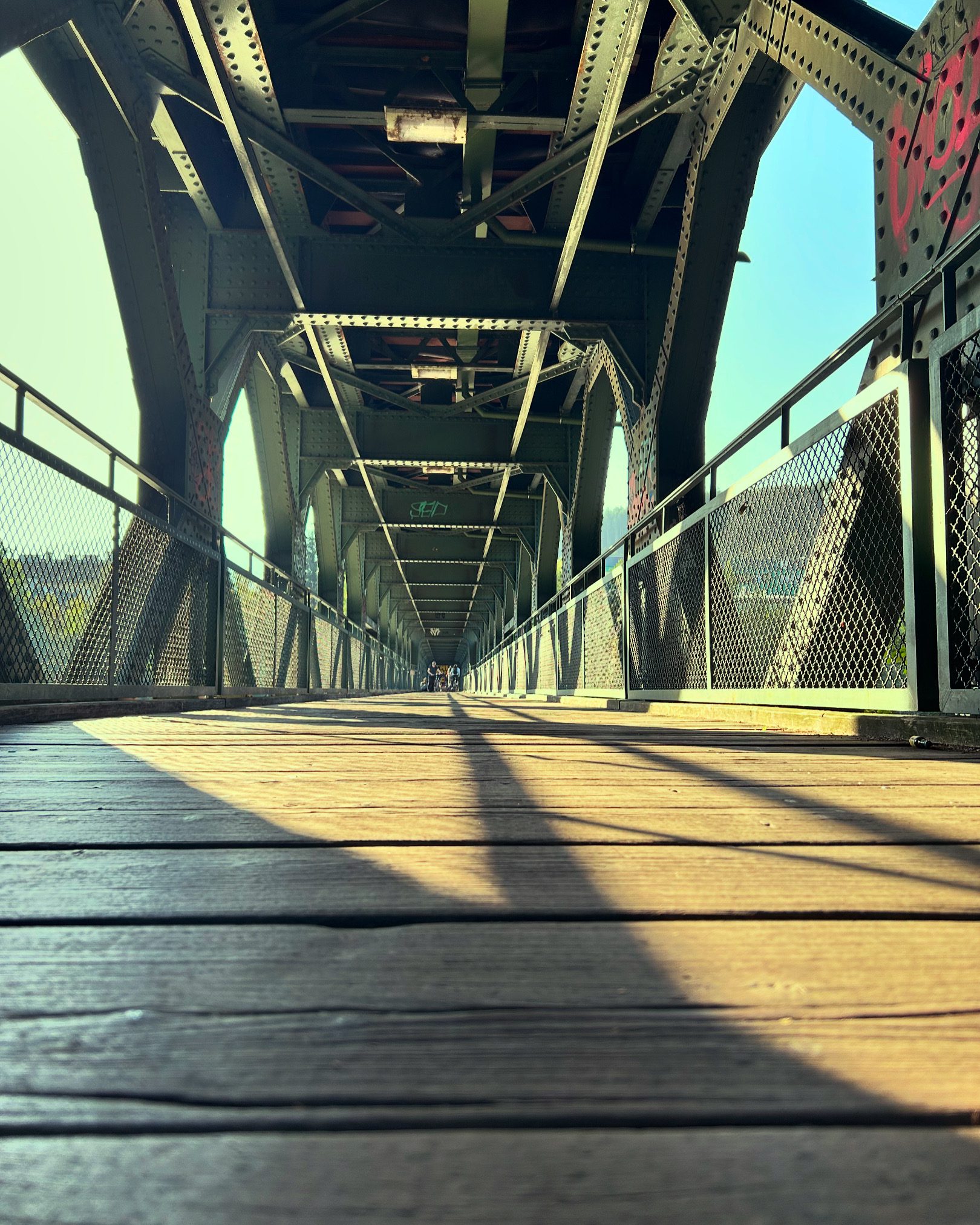
Karwendel Bridge Innsbruck
Die Eisenbahn als Entwicklungshelfer Innsbrucks
In 1830, the world's first railway line was opened between Liverpool and Manchester. Just a few decades later, the Tyrol, which had been somewhat remote from the main trade routes and economically underdeveloped for some time, was also connected to the world with spectacular railway constructions across the Alps. While travelling had previously been expensive, long and arduous journeys in carriages, on horseback or on foot, the ever-expanding railway network meant unprecedented comfort and speed.
It was Innsbruck's mayor Joseph Valentin Maurer (1797 - 1843) who recognised the importance of the railway as an opportunity for the Alpine region. In 1836, he advocated the construction of a railway line in order to make the beautiful but hard-to-reach region accessible to the widest possible, wealthy public. The first practical pioneer of railway transport in Tyrol was Alois von Negrelli (1799 - 1858), who also played a key role in the Suez Canal project of the century. At the end of the 1830s, when the first railway lines of the Danube Monarchy went into operation in the east of the empire, he drew up a "Expert opinion on the railway from Innsbruck via Kufstein to the royal Bavarian border at the Otto Chapel near Kiefersfelden“ vorgelegt. Negrelli hatte in jungen Jahren in der k.k. Baudirektion Innsbruck service, so he knew the city very well. His report already contained sketches and a list of costs. He had suggested the Triumphpforte and the Hofgarten as a site for the main railway station. In a letter, he commented on the railway line through his former home town with these words:
"...I also hear with the deepest sympathy that the railway from Innsbruck to Kufstein is being taken seriously, as the Laage is very suitable for this and the area along the Inn is so rich in natural products and so populated that I cannot doubt its success, nor will I fail to take an active part in it myself and through my business friends when it comes to the purchase of shares. You have no idea of the new life that such an endeavour will awaken in the other side..."
Friedrich List, known as the father of the German railway, put forward the plan for a rail link from the Hanseatic cities of northern Germany via Tyrol to the Italian Adriatic. On the Austrian side, Carl Ritter von Ghega (1802 - 1860) inherited overall responsibility for the railway project within the giant Habsburg empire from Negrelli, who died young. In 1851, Austria and Bavaria signed an agreement to build a railway line to the Tyrolean capital. Construction began in May 1855. It was the largest construction site Innsbruck had ever seen. Not only was the railway station built, but the railway viaducts out of the city to the north-east also had to be constructed.
On 24 November 1858, the railway line between Innsbruck and Kufstein and on to Munich via Rosenheim went into operation. The line was ahead of its time. Unlike the rest of the railway, which was not privatised until 1860, the line opened as a private railway, operated by the previously founded Imperial and Royal Privileged Southern State, Lombard, Venetian and Central Italian Railway Company. This move meant that the costly railway construction could be excluded from Austria's already tight state budget. The first step was taken with this opening towards the eastern parts of the monarchy, especially to Munich. Goods and travellers could now be transported quickly and conveniently from Bavaria to the Alps and back. In South Tyrol, the first trains rolled over the tracks between Verona and Trento in the spring of 1859.
However, the north-south corridor was still unfinished. The first serious considerations regarding the Brenner railway were made in 1847. In 1854, the disputes south of the Brenner Pass and the commercial necessity of connecting the two parts of the country prompted the Permanent Central Fortification Commission on the plan. The loss of Lombardy after the war with France and Sardinia-Piedmont in 1859 delayed the project in northern Italy, which had become politically unstable. From the Imperial and Royal Privileged Southern State, Lombard, Venetian and Central Italian Railway Company 1860 had to Imperial and Royal Privileged Southern Railway Company to start with the detailed planning. In the following year, the mastermind behind this outstanding infrastructural achievement of the time, engineer Carl von Etzel (1812 - 1865), began to survey the site and draw up concrete plans for the layout of the railway. The planner was instructed by the private company's investors to be as economical as possible and to manage without large viaducts and bridges. Contrary to earlier considerations by Carl Ritter von Ghega to cushion the gradient up to the pass at 1370 metres above sea level by starting the line in Hall, Etzel drew up the plan, which included Innsbruck, together with his construction manager Achilles Thommen and chose the Sill Gorge as the best route. This not only saved seven kilometres of track and a lot of money, but also secured Innsbruck's important status as a transport hub. The alpine terrain, mudslides, snowstorms and floods were major challenges during construction. River courses had to be relocated, rocks blasted, earthworks dug and walls built to cope with the alpine route. The worst problems, however, were caused by the war that broke out in Italy in 1866. Patriotic German-speaking workers in particular refused to work with the "enemy". 14,000 Italian-speaking workers had to be dismissed before work could continue. Despite this, the W's highest regular railway line with its 22 tunnels blasted out of the rock was completed in a remarkably short construction time. It is not known how many men lost their lives working on the Brenner railway.
The opening was remarkably unspectacular. Many people were not sure whether they liked the technical innovation or not. Economic sectors such as lorry transport and the post stations along the Brenner line were doomed, as the death of the rafting industry after the opening of the railway line to the lowlands had shown. Even during the construction work, there were protests from farmers who feared for their profits due to the threat of importing agricultural goods. Just as the construction of the railway line had previously been influenced by world politics, a celebration was held. Austria was in national mourning due to the execution of the former Emperor Maximilian of Mexico, the brother of Franz Josef I, before a revolutionary court martial. A grand state ceremony worthy of the project was dispensed with. Instead of a priestly consecration and festive baptism, the Southern railway company 6000 guilders to the poor relief fund. Also in the Innsbrucker Nachrichten there is not a word about the revolution in transport, apart from the announcement of the last express train over the Brenner Pass and the publication of the timetable for the Southern Railway.
(The last express coach). Yesterday evening at half past seven the last express coach to South Tyrol departed from here. The oldest postilion in Innsbruck was driving the horses, his hat was fluttered with mourning, and the carriage was decorated with branches of weeping willows for the last journey. Two marksmen travelling to Matrei were the only passengers to pay their last respects to the express coach. In the last days of 1797, the beautiful, otherwise so lively and now deserted road was conspicuously dead.
Until the opening of the railway line over the Brenner Pass on 24 August 1867, Innsbruck was a terminus station of regional importance. The new, spectacular Brenner railway across the Alps connected the northern and southern parts of the country as well as Germany and Italy. The new Brenner road had already opened the year before. The Alps had lost their divisive character and their terror for transit, at least a little. While an estimated 20,000 people crossed the Brenner in 1865, three years later in the first full year of operation of the railway line there were around ten times as many. In addition, a whole flood of goods found their way across the new north-south axis, boosting trade and consumption.
Das zweite Hindernis, das zur Landeseinheit überwunden werden musste, war der Arlberg. Erste Pläne einer Bahnlinie, die die Region um den Bodensee mit dem Rest der Donaumonarchie verbinden würde, gab es bereits 1847, immer wieder wurde das Projekt aber zurückgestellt. 1871 kam es wegen durch Exportverbote von Lebensmitteln auf Grund des deutsch-französischen Krieges zu einer Hungersnot in Vorarlberg, weil Nahrungsmittel nicht schnell genug vom Osten des Riesenreiches in den äußersten Westen geliefert werden konnten. Die Wirtschaftskrise von 1873 verzögerte den Bau trotzdem erneut. Erst sieben Jahre später fiel der Beschluss im Parlament, die Bahnlinie zu realisieren. Im selben Jahr begannen östlich und westlich des Arlbergmassivs die komplizierten Bauarbeiten. 38 Wildbäche und 54 Lawinengefahrstellen mussten mit 3100 Bauwerken bei prekären Wetterverhältnissen im alpinen Gelände verbaut werden. Die bemerkenswerteste Leistung war der zehn Kilometer lange Tunnel, der zwei Gleise führt. Am 30. Juni 1883 fuhr der letzte Transport der Post mit dem Pferdewagen in feierlichem Trauerflor von Innsbruck nach Landeck. Tags darauf erledigte die Eisenbahn diesen Dienst. Mit der Eröffnung der Eisenbahn von Innsbruck nach Landeck und der endgültigen Fertigstellung der Arlbergbahn bis Bludenz 1884 inklusive dem Tunneldurchschlag durch den Arlberg war Innsbruck endgültig wieder zum Verkehrsknotenpunkt zwischen Deutschland und Italien, Frankreich, der Schweiz und Wien geworden. 1904 wurde die Stubaitalbahn, 1912 die Mittenwaldbahn eröffnet. Beide Projekte plante Josef Riehl (1842 – 1917).
Die Eisenbahn war das am direktesten spürbare Merkmal des Fortschritts für einen großen Teil der Bevölkerung. Die Bahnviadukte, die aus Höttinger Breccie aus dem nahen Steinbruch errichtet wurden, setzten der Stadt im Osten Richtung Pradl ein physisches und sichtbares Ende. Aber nicht nur aus einer rein technischen Perspektive veränderte die Bahn das Land. Sie brachte einen immensen gesellschaftlichen Wandel. Arbeitskräfte, Studenten, Soldaten und Touristen strömten in großer Zahl in die Stadt und brachten neue Lebensentwürfe und Ideen mit. Josef Leitgeb beschrieb den Wandel in seinem Roman Das unversehrte Jahr folgendermaßen:
„Zwar hatte die Eisenbahn schon damals viele landfremde Leute auch nach Wilten gezogen, sie wohnten in den neuen hohen Häusern, die überall aus dem Boden schossen, auf dem seit Jahrhunderten das Korn gewachsen war, aber sie wurden noch als Zugereiste empfunden, ihre tschechischen, slowenischen und ungarischen Namen wollten sich nicht in die Klänge fugen, die man gewohnt war. Sie kleideten sich in das billige Zeug, das man fertig und auf Raten zu kaufen bekam, mieden die Gottesdienste und besuchten dafür Versammlungen, in denen sich die eingesessenen Bürger nicht zurechtgefunden hatten. Bei Licht besehen waren es stille, arbeitsame, sparende Leute, die aus den großen Städten und dem flachen Lande halt andere Lebensformen mitgebracht hatten, und wer sie scheel ansah, konnte kein anderes Recht dafür in Anspruch nehmen, als das er für seine Gemütlichkeit keine Zuschauer brauchte. Doch war die Ablehnung der Zugewanderten durch die Einheimischen damals noch deutlich fühlbar; der Vater hatte einmal eine Predigt gehört, in der der Pfarrer versicherte, alle Menschen konnten der ewigen Seligkeit teilhaft werden, „auch Räuber und Mörder, ja sogar Eisenbahner.“
The Die Bundesbahndirektion der K.u.K. General-Direction der österreichischen Staatsbahnen in Innsbruck war eine von nur drei Direktionen in Cisleithanien. Neue soziale Schichten entstanden durch die Bahn als Arbeitgeber. Es bedurfte Menschen aller Bevölkerungsschichten, um den Bahnbetrieb am Laufen zu halten. Arbeiter und Handwerker konnten bei der Bahn, ähnlich wie in der staatlichen Verwaltung oder dem Militär, sozial aufsteigen. Neue Berufe wie Bahnwärter, Schaffner, Heizer oder Lokführer entstanden. Bei der Bahn zu arbeiten, brachte ein gewisses Prestige mit sich. Nicht nur war man ein Teil der modernsten Branche der Zeit, die Titel und Uniformen machten aus Angestellten und Arbeitern Respektpersonen. Bis 1870 stieg die Einwohnerzahl Innsbrucks vor allem wegen der Wirtschaftsimpulse, die die Bahn brachte von 12.000 auf 17.000 Menschen. Lokale Produzenten profitieren von der Möglichkeit der kostengünstigen und schnellen Warenein- und Ausfuhren. Der Arbeitsmarkt veränderte sich. Vor der Eröffnung der Bahnlinien waren 9 von 10 Tirolern in der Landwirtschaft tätig. Mit der Eröffnung der Brennerbahn sank dieser Wert auf unter 70%. Das neue Verkehrsmittel trug zur gesellschaftlichen Demokratisierung und Verbürgerlichung bei. Nicht nur für wohlhabende Touristen, auch für Untertanen, die nicht der Upper Class angehörten, wurden mit der Bahn Ausflüge in die Umgebung möglich. Neue Lebensmittel veränderten den Speiseplan der Menschen. Erste Kaufhäuser entstanden mit dem Erscheinen von Konsumartikeln, die vorher nicht verfügbar waren. Das Erscheinungsbild der Innsbrucker wandelte sich mit neuer, modischer Kleidung, die für viele zum ersten Mal erschwinglich wurde. Der Bahnhofsvorplatz in Innsbruck wurde zu einem der neuen Zentren der Stadt. Die modernen Hotels waren nun nicht mehr in der Altstadt, sondern hier zu finden. Nicht allen war diese Entwicklung allerdings recht. Die Schifffahrt am Inn, bis dahin ein wichtiger Verkehrsweg, kam beinahe umgehend zum Erliegen. Der ohnehin nach 1848 schwer gerupfte Kleinadel und besonders strenge Kleriker befürchteten den Kollaps der heimischen Landwirtschaft und den endgültigen Sittenverfall durch die Fremden in der Stadt.
The railway was worth its weight in gold for tourism. It was now possible to reach the remote and exotic mountain world of the Tyrolean Alps. Health resorts such as Igls and entire valleys such as the Stubaital, as well as Innsbruck city transport, benefited from the development of the railway. 1904 years later, the Stubai Valley Railway was the first Austrian railway with alternating current to connect the side valley with the capital. On 24 December 1904, 780,000 crowns, the equivalent of around 6 million euros, were subscribed as capital stock for tram line 1. In the summer of the following year, the line connected the new districts of Pradl and Wilten with Saggen and the city centre. Three years later, Line 3 opened the next inner-city public transport connection, which only ran to the remote village in 1942 after Amras was connected to Innsbruck.
The railway was also of great importance to the military. As early as 1866, at the Battle of Königgrätz between Austria and Prussia, it was clear how important troop transport would be in the future. Until 1918, Austria was a huge empire that stretched from Vorarlberg and Tyrol in the south-west to Galicia, an area in what is now Poland, and Ukraine in the east. The Brenner Railway was needed to reinforce the turbulent southern border with its new neighbour, the Kingdom of Italy. Tyrolean soldiers were also deployed in Galicia during the first years of the First World War until Italy declared war on Austria. When the front line was opened up in South Tyrol, the railway was important for moving troops quickly from the east of the empire to the southern front.
Carl von Etzel, who did not live to see the opening of the Brenner railway, is commemorated today by Ing.-Etzel-Straße in Saggen along the railway viaducts. Josef Riehl is commemorated by Dr.-Ing.-Riehl-Straße in Wilten near the Westbahnhof railway station. There is also a street dedicated to Achilles Thommen. As a walker or cyclist, you can cross the Karwendel Bridge in the Höttinger Au one floor below the Karwendel railway and admire the steel framework. You can get a good impression of the golden age of the railway by visiting the ÖBB administration building in Saggen or the listed Westbahnhof railway station in Wilten. In the viaduct arches in Saggen, you can enjoy Innsbruck's nightlife in one of the many pubs covered by history.