Slaughterhouse block
Erzherzog-Eugen-Straße 25 - 38
Worth knowing
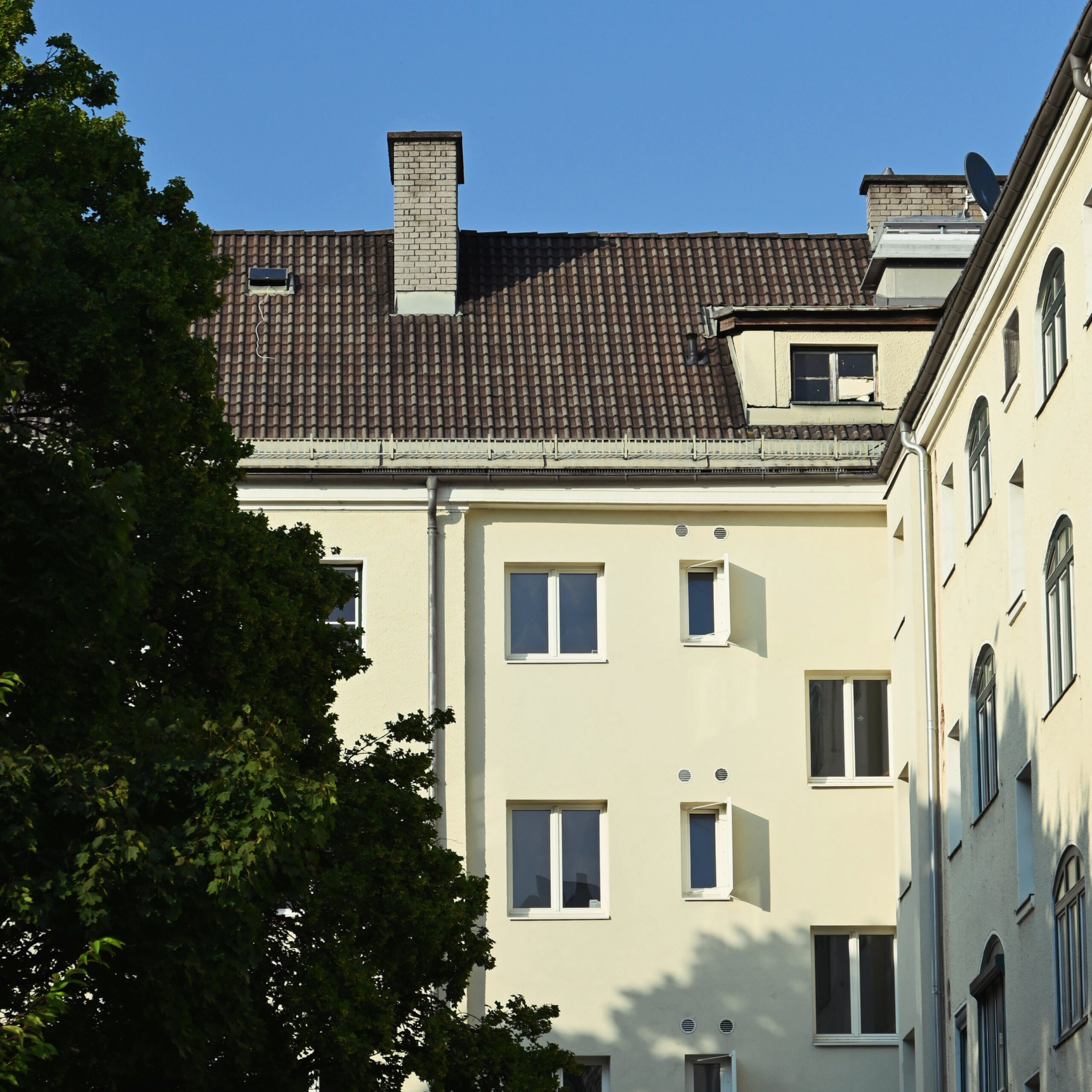
Between Pradl, Saggen, and Dreiheiligen stands a monument of the interwar period that still conveys the charm of the Vienna municipal housing projects shaped by social democracy. Thanks to its protected status as a historic building, the Schlachthofblock has retained the character of the 1920s. The inner courtyard, complete with laundry‑drying frames, is as unchanged as the bad reputation the settlement along the Sill continues to have. Together with the new houses on Amraser Kaufmannstraße—mockingly nicknamed “Stalingrad”—and the Bocksiedlung in Reichenau, the block was one of Innsbruck’s social hot spots and notorious far beyond the city limits. In 1978, Klaus Pirchmoser wrote the following lines about the complex—without any regard for what we now call political correctness:
"Wilful destruction in the stairwell and basement shows the degree of the "filtering down phase" that has been initiated and also points to a necessary social reorganisation."
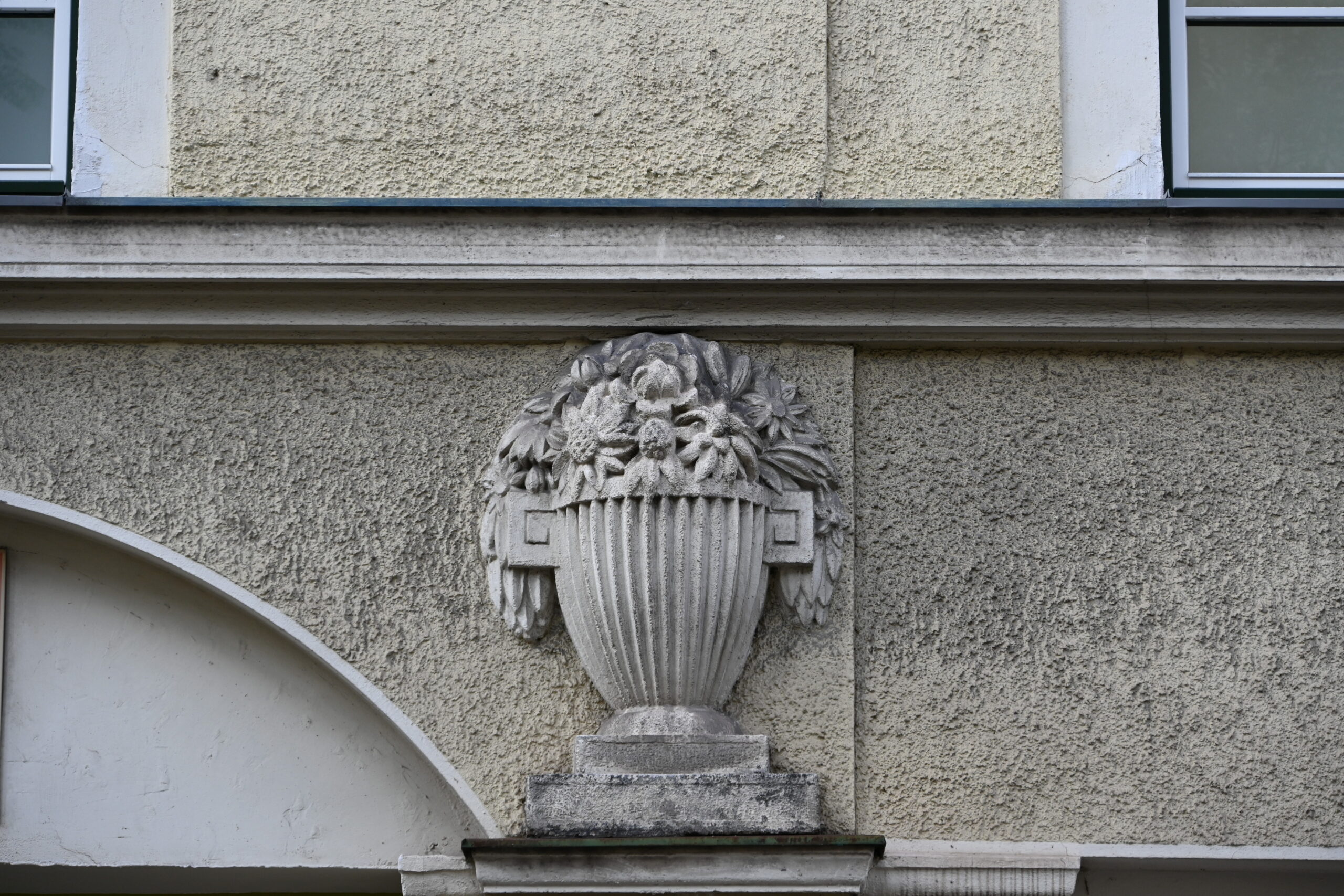
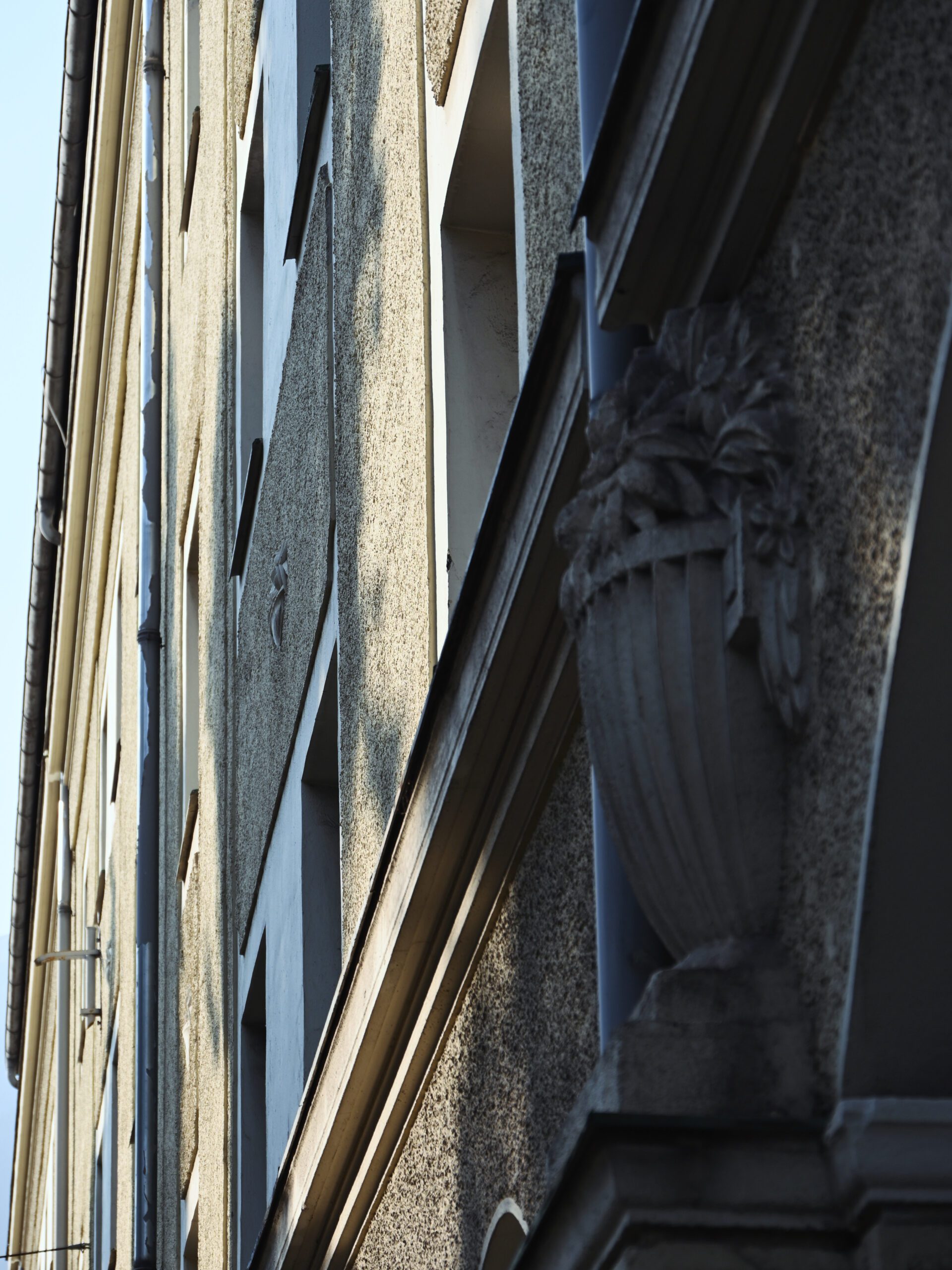
The oldest parts of the building, since demolished during renovations, dated back to before the First World War. In 1911, an official residence with nine apartments for employees of the slaughterhouse was constructed. The following year, municipal housing authorities built another block with 16 apartments. As early as 1920, the first resolutions to expand the settlement were passed in the city council. In Vienna, the Metzleinstaler Hof—the first municipal housing project—had been handed over to tenants that same year to address the post‑war housing crisis. As in the capital, thousands of people in Innsbruck lived in shacks or with relatives, without a home of their own. The Social Democrats, strongly represented in Innsbruck’s city council, demanded that the city follow Vienna’s example in matters of social housing. In 1921, a project for the construction of 18 residential buildings was presented. The following year, Mayor Wilhelm Greil submitted an urgent motion from the municipal housing committee to the council. Reading the press coverage surrounding the project, one cannot help but be reminded of modern-day political debates about large-scale public works, more than a century later. How should the investment be divided among city, province, and federal government? Amid the currency troubles of the young Republic of German-Austria, the projected construction costs skyrocketed from 50 million kronen to 1.5 billion kronen in just one year. The various political factions used the cost estimates to support their respective agendas. One city councillor estimated the interest rate on the loan the city needed at 14%, noting that the interest payments alone would devour future rental income. Another warned that the city might eventually be forced to sell property to foreigners and blamed the stagnation in private construction on tenant protection laws—burdens that, he claimed, would only intensify with the new nonprofit housing project. Proposals ranged from founding a construction joint‑stock company to exempting imported cement from customs duties in order to reduce expenses. Advocates of reforming existing municipal housing structures instead of building new ones also made their voices heard, arguing that the municipal housing authority should restrict single tenants from occupying large units rather than spending taxpayers’ money on new construction. Construction of what would later become known as the Schlachthofblock began in 1922. Theodor Prachensky took over the planning on behalf of the Vaterländische Baugesellschaft. Three years later, the 19 five‑story buildings were completed. Prachensky adhered to the Social Democratic architectural vision of modern urban housing that was taking hold in many European cities. Like Gothic, Baroque, and Neoclassicism in the past, the design of public housing followed international stylistic trends. In addition to 183 units of 55 square meters each, four shops and a kindergarten were built. The block was arranged around a spacious, landscaped courtyard with play equipment for children. Although Prachensky designed the façades with simple surfaces and without the pomp of Historicism, he did not forego ornamentation entirely. The ancient amphora motif, overflowing with flowers, symbolizes prosperity, fertility, and joy—a strong sign of renewal after the crisis years. A similar symbol can be found on the north façade of the old market hall. In the case of the Schlachthofblock, the relief was intended to reflect the newfound pride of the working class and point the way toward a prosperous future. In contrast, the residential complex across the street at Erzherzog‑Eugen‑Straße 42–44, planned by Fritz Grüll for the Vienna Housing Cooperative in 1929, features no ornament at all and instead follows the Bauhaus style with its rounded balconies. The Pembaurblock, built shortly afterward according to Prachensky’s plans, also differs markedly from Innsbruck’s first municipal housing project. More than 100 years later—and after many renovations and alterations—the Schlachthofblock still stands in the 21st century, a silent witness to an era of Austrian and Innsbruck history that remains only sparsely illuminated.
Press article on the abattoir block
Innsbrucker Nachrichten / 11 February 1921
...Now the speaker has presented a generous project for the construction of 18 residential buildings near the municipal abattoir. The construction of a block of houses adjacent to the municipal abattoir is planned to create space for 183 new flats in the form of simple residential buildings. There are plans for 4 flats with 1 room and kitchen/living room, 148 flats with 2 rooms and kitchen/living room and 36 flats with 3 rooms and kitchen/living room, resulting in a total of 581 living spaces. The detailed plans submitted to the municipal council show the appropriate and practical utilisation of the entire complex. The total construction costs for the entire block of 18 residential care houses amount to 49,810,000 K, i.e. almost 50 million crowns. The city, province and state are to each pay one third of the lost construction costs. If the negotiations with the provincial and state governments are cancelled immediately, the construction of 10 houses can begin this year. The municipal council agreed to the planned construction in recognition of the great importance of rapid and energetic realisation.
Innsbrucker Nachrichten / 22 April 1922
...After the opening, the chairman, Mayor Greil, brought an urgent motion to the attention of the municipal council, which the members of the municipal housing welfare committee had tabled in order to pursue the extension of the block of flats at the municipal abattoir, which would result in a total of 163 flats. The construction of the apartment blocks at the abattoir, which had already been decided in 1920, has not yet progressed, but the advanced season as well as the increasing housing shortage make the immediate start of the extension an absolute necessity. The motion calls for the immediate submission of the long-completed construction plans, the invitation to tender for the construction work, the financing of the extension or the sale of dispensable properties in favour of this project and the immediate start of construction.
Allgemeiner Tiroler Anzeiger / 3 February 1937
Gang of young burglars
The Innsbruck criminal investigation department has reportedly arrested two boys aged 15 and 16 who lived in the slaughterhouse block and had been carrying out their robberies from there for more than half a year. They were a real terror to the businessmen of the whole neighbourhood and had the cheek to boast of their crimes to other boys. The following burglaries have been proven so far: Branch of Therese Mölk, Viaduktbogen 5 (large quantities of food, sardines, salami, etc.); grocery store Ischia u. Co., Erzherzog-Eugen-Stratze (vermouth wine and large quantities of sardines): Trafik Plattner, Erzherzog-Eugen-Straße (cigarettes, chocolate and money); Magazin'des Stadtbauamtes im Viadukt bogen (several sacks of coal): Master butcher Tschon, Schlachthofblock (sausages): Rufinatscher general store in Schlachthofblock (large amount of food); two break-ins at the Mölk company (some food, they couldn't take any more because they were scared away both times); display burglary at Hindenburgplatz (several bottles of liqueurs, confectionery and chocolate); display burglary at "Frifa", Wilhelm- Greil-Straße (several handbags, wallets and purses): Display burglary in Maria-Theresien[1]Straße at the Dannhauser company (shirts, pullovers, ties etc.); display burglary at the Hammerle toy shop, Maria-Theresien-Straße (toys): Shoplifting from the Sailer tobacconist's in Pfarrgaffe (they were scared away here); also opportunist thefts from the Stauder and Sterzinger general stores in Pradler Straße (food), Mayer general store in Weyerburggasse (cigarettes), Kritzinger coal store in Defreggerstraße (coal). Some of the stolen items were seized by the police, the food, cigarettes and coal were smuggled or sold by the boys.
Theodor Prachensky: Beamter zwischen Kaiser und Republik
Copilot said: Innsbruck is home to many famous sights, monuments, and spectacular buildings. The Golden Roof and the Bergisel Ski Jump attract tens of thousands of visitors every year. Less imposing, but arguably more important for the city's development during the turbulent first half of the 20th century, were other buildings. From the second half of the 1920s onward, major projects were implemented to alleviate the greatest hardship faced by many Innsbruck residents, who were living in barracks or crowded together with relatives in extremely confined conditions. Entire new districts were created, complete with kindergartens, schools, parks, and recreational facilities. One of the master builders who left a lasting mark on Innsbruck during this period was Theodor Prachensky (1888–1970). The story of his forty-year career in the service of the City of Innsbruck reads like a summary of Austrian history in the early twentieth century. Prachensky worked as both an architect and a civil servant under five different political systems. The Austro-Hungarian Empire was followed by the First Republic, which in turn gave way to the authoritarian Corporate State. In 1938 came the annexation by Nazi Germany, and in 1945, with the end of the war, the Second Republic was proclaimed. Like many artists, architects, and builders of his generation, Prachensky laid the foundations for his career at what is today the Higher Technical College (HTL). In 1908, he graduated from the construction engineering department of the Imperial-Royal State Trade School (k.k. Staatsgewerbeschule) in Innsbruck. Just one year later, he moved to Merano to gain his first experience with large-scale building projects at the renowned architectural firm Musch & Lun. In 1913, he returned to Innsbruck. In the same year, he married Maria, the sister of his friend Franz Baumann, moved into the Prachensky House, which he had designed himself at Bergiselweg 20, and began his employment with the Innsbruck City Administration under Senior Building Councillor Jakob Albert. This decision to enter public service would prove fortunate during the economically difficult years after the war, even though it required him to curb some of his creative ambitions. First, however, he was called to the front. Although Prachensky opposed the war, he volunteered for military service in 1915 as a one-year volunteer with the Tyrolean Imperial Rifles (Tiroler Kaiserjäger). Whether he was motivated by expectations associated with his position as a civil servant or by the widespread patriotic enthusiasm of the time can no longer be determined.
Nach dem Krieg kehrte er ins wirtschaftlich schwer angeschlagene Innsbruck zurück. Seine wegweisenden, wohl auch vom sozialdemokratischen Gedankengut seines Vaters Josef beeinflussten Projekte konnten erst nach den ersten und schwierigsten Nachkriegsjahren begonnen werden. Den Anfang machte der Schlachthausblock im Saggen zwischen 1922 und 1925. Es folgten der Mandelsbergerblock, der Pembaurblock sowie Kindergarten und Hauptschule in der Pembaurstraße, die ebenfalls für die wachsende Arbeiterschaft gedacht waren. Auch das 1931 entworfene Arbeitsamt war eine wichtige Neuerung im Sozialwesen. Seit der Republikgründung 1918 half das Arbeitsamt bei der Vermittlung von Arbeitssuchenden und Arbeitgebern und der Eindämmung der Arbeitslosigkeit.
The next major turning point after the First World War and the economic crisis was the succession of changes in Austria’s political system. Despite Dollfuss’s seizure of power and the banning of the Social Democratic Party in 1933, followed by Austria’s annexation to the German Reich in 1938, Prachensky was able to remain a senior civil servant and continued to influence the appearance of Innsbruck. Together with Jakob Albert, he implemented the residential developments that became known as the South Tyrolean Settlements (Südtiroler Siedlungen) under the National Socialist regime from 1939 onward. Unlike several members of his family, he himself never became a member of the Nazi Party. The Social Democratic influence of his father remained too strong, and this influence is reflected in his architecture. After the Second World War, he remained in office as Senior Building Councillor of the City of Innsbruck for another eight years. In addition to his work as an urban planner and architect, Prachensky was a passionate painter. He died in Innsbruck at the age of eighty-two.
The projects realized by Prachensky are not as spectacular as the mountain stations designed by his brother-in-law Franz Baumann or Lois Welzenbacher’s high-rise building. His surviving structures often appear sober and purely functional, yet reveal their fascination upon closer inspection. Particularly remarkable is the symbolism that Prachensky repeatedly incorporated into his work. Looking at his drawings in the Archive of Architecture at the University of Innsbruck, one quickly recognizes that he was as much an artist as a technician. Many of his designs, such as the Social Democratic People’s House (Sozialdemokratisches Volkshaus) on Salurnerstraße, his Kaiserschützen Memorial, and the Peace and Heroes Church (Friedens- und Heldenkirche), were never built. Innsbruck nevertheless contains many of Prachensky’s buildings that document the history of the interwar period and the changing political and governmental influences under which he himself lived. These include the large residential complexes of the 1920s and 1930s, the War Memorial Chapel (Krieger-Gedächtniskapelle) at Pradl Cemetery, and the old employment office (note: today an annex of the University of Innsbruck, located behind the current AMS employment service building in Wilten). The War Memorial Chapel at Pradl Cemetery, the Kaiserschützen Chapel at Tummelplatz, designed together with Clemens Holzmeister, as well as his unrealized proposals for a Kaiserjäger memorial and the Peace and Heroes Church of Innsbruck, reflect both his own experiences of war and the longing for peace shared by many of his contemporaries. His sons, grandsons, and great-grandchildren carried forward his creative legacy as architects, designers, photographers, and painters in a variety of disciplines. In 2017, parts of the multi-generational body of work created by the Prachensky family of artists were honored in an exhibition at the former Adambräu Brewery.
A republic is born
Hardly any era is more difficult to grasp than the interwar period. The Roaring Twenties, jazz, and automobiles come to mind just as readily as inflation and economic crisis. In major cities like Berlin, young women carrying themselves as flappers with bobbed hair, cigarettes, and short skirts danced lasciviously to the new sounds. In Innsbruck, American drinks were served during Five O'Clock Tea at the bar in the Knights' Hall (Rittersaal) of the Cafe Gasthaus Zur Annasäule, which later became the Alt-Innsbruck. The suits of armor can still be admired in the bay window from Maria-Theresien-Straße. For the most part, however, as part of the young Republic of German-Austria, Innsbruck’s population belonged to the faction of poverty, economic crisis, and political polarization. Right from the start, the proclamation of the republic in front of the parliament in Vienna before more than 100,000 people—who were less enthusiastic than they were curious and unsettled—was anything but smooth, accompanied by riots, shootouts, two deaths, and 40 injuries. No one knew how things were supposed to continue after the end of the monarchy and the loss of a large part of the state territory. The new Austria seemed too small and incapable of surviving. The bureaucratic apparatus of the Austro-Hungarian Empire carried on seamlessly under a new flag and name. In the constitution, the federal states, as successors to the old crown lands, were granted a great deal of leeway in legislation and administration under the framework of federalism. However, enthusiasm for the new state among the population remained limited. Not only was the supply situation miserable after the loss of the vast majority of the former giant Habsburg empire, but people also distrusted the underlying concept of the republic. The monarchy had not been perfect, but very few people could relate to the idea of democracy. Instead of being subjects of the Emperor, people were now citizens, but only citizens of a dwarf state with an oversized capital that was little loved in the federal states, rather than citizens of a great empire. In the former crown lands, which were largely governed by the Christian Social Party, people frequently spoke of the "Viennese hydrocephalus" (Wiener Wasserkopf) that let itself be fed by the yields of the hardworking rural population. Other federal states also toyed with the idea of breaking away from the republic after the plan to join Germany, which was supported by all parties, was banned by the victorious powers of the First World War. The various Tyrolean plans, however, were particularly spectacular. From a neutral alpine state with other federal states, a free state consisting of Tyrol and Bavaria, or extending from Kufstein to Salurn, an annexation to Switzerland, all the way to a Catholic church-state under papal leadership, many options were considered. The most obvious solution was particularly popular. Feeling German was nothing new. So why not also attach oneself politically to the big brother to the north? This desire was highly pronounced, especially among urban elites and students. The annexation plan (Anschlussplan) received 98% approval in a vote in Tyrol, but it never came to fruition. In Innsbruck, the Tyrolean National Assembly (Tiroler Nationalversammlung) and the Tyrolean National Council (Tiroler Nationalrat)—a concentration government with members from all parties—constituted themselves in the autumn of 1918 from the members of the former provincial parliament (Landtag). The National Council had authority over the people's and citizens' militias (Volks- und Bürgerwehren), which had formed at the municipal level to maintain public order, at least on paper. Primarily between Innsbruck and the Brenner Pass, up to 50,000 soldiers were stationed at the railway stations, causing problems while waiting for their transport home.
Instead of becoming a part of Germany, Tyrol was occupied by the hated Wallsche (Italian forces). For nearly two years after the end of the war, Italian troops occupied Innsbruck. Following the complex and lengthy peace negotiations in Paris, it finally became a certainty: on October 10, 1920, the formal annexation of South Tyrol took place. At the Brenner Pass, the barrier gate went down. On the North Tyrolean side, only a few administrative and customs buildings were erected, but in the southern part of the village, large barracks shot out of the ground to secure the new border militarily. Historical Tyrol was split in two. In Innsbruck and many other Tyrolean municipalities, pompous mourning ceremonies were organized annually on this date for years. In 1924, the Innsbruck city council decided to name squares and streets around the main railway station after South Tyrolean cities. Bozner Platz as well as Brixner Straße and Salurner Straße still bear their names today. Many people on both sides of the Brenner felt betrayed. Although they had by no means won the war, they did not see themselves as losers to Italy. Hatred toward Italians reached its peak in the interwar period, even though the occupying forces acted with pronounced mildness. A passage from the 1930s short story collection "The Front Above the Peaks" (Die Front über den Gipfeln) by Karl Springenschmid reflects the general mood:
"The young girl says, 'Becoming Italian would be the worst thing.
Old Tappeiner just nods and grumbles: "I know it myself and we all know it: becoming a whale would be the worst thing."
Trouble was also brewing in domestic politics. The revolution in Russia and the subsequent civil war with millions of fatalities, expropriation, and a complete reversal of the system cast its long shadow all the way to Austria. The prospect of "Soviet conditions" terrified people. Austria was deeply divided. Capital and federal states, city and countryside, citizens, workers, and peasants—in the vacuum of the first postwar years, each group wanted to shape the future according to its own ideas. The cultural struggles of the late monarchy between conservatives, liberals, and socialists continued seamlessly. The rift existed not only on a political level. Morals, family, leisure activities, education, faith, legal understanding—every sphere of life was affected. Who should govern? How should wealth, rights, and duties be distributed? Liberals and the Tyrolean People's Party (Tiroler Volkspartei), which had emerged from the Peasants' League (Bauernbund), the People's Association (Volksverein), and the Catholic Working Class (Katholische Arbeiterschaft), were at least as hostile toward Social Democracy as they were toward the federal capital of Vienna and the Italian occupiers. A communist overthrow was not a real danger, especially in Tyrol, but it was effectively instrumentalized in the media as a threat to bring Social Democracy into disrepute. Although a workers', peasants', and soldiers' council (Arbeiter-, Bauern- und Soldatenrat) modeled on the Soviet system had proclaimed itself in Innsbruck in 1919, its influence remained minimal and it was supported by no political party. From 1920 onward, so-called soldiers' councils were officially formed, but like the rest of politics, they were dominated by the Christian Socials. The conservative peasant and bourgeois camp right of center militarized itself more professionally with the Tyrolean Homeland Guard (Tiroler Heimatwehr) and enjoyed a stronger influx of members than leftist groups, also thanks to church support. From church pulpits and in conservative media, Social Democracy was referred to as the "party of Jews" (Judenpartei) and homeless traitors to the fatherland. People were all too eager to blame them for the lost war and its consequences. The Tiroler Anzeiger summed up the public fears: "Woe to the Christian people if the Jew-Socialists win the elections!".
While the Tyrolean People's Party dominated in rural districts, Social Democracy in Innsbruck under the leadership of Martin Rapoldi always managed to win between 30% and 50% of the vote in elections from 1919 onward, despite the strong headwinds. Under the new municipal code of 1919, which provided for universal suffrage for all adults, the city council comprised 40 members. Out of 24,644 citizens called to the ballot box, an incredible 24,060 exercised their right to vote. A certain degree of emancipation also became noticeable. Right from the first city council with free elections, three women were represented. The fact that the Social Democrats did not secure the mayoral seat was due to the majorities in the city council formed by alliances among the other parties.
High politics, however, was merely the backdrop to the actual misery. Martin Rapoldi got straight to the point in September 1919: "Gentlemen, for the moment the constitutional question is completely secondary to the population, as is whether the province has more rights or fewer rights. More potatoes is the slogan in our province." Time and again, looting and hunger riots broke out in the provincial capital. Those who had money could supply themselves with food on the black market; the rest depended on charity from foreign aid shipments. Long after the war, the province of Tyrol still required outside help to feed its population. Under the headline "Significant Expansion of the American Child Relief Action in Tyrol," the Innsbrucker Nachrichten reported on April 9, 1921: "Taking into account the needs of the province of Tyrol, the American representatives for Austria have most generously increased the daily number of meals to 18,000 portions." Alongside hunger, medical care was a major issue. The epidemic that went down in history as the Spanish Flu also took its toll in Innsbruck in the years after the war. Exact numbers were not recorded; worldwide, the number of fatalities is estimated at 27 to 50 million. In Innsbruck, at the height of the Spanish Flu, around 100 victims are said to have succumbed to the disease daily. Many Innsbruckers had not returned home from the battlefields and were missing as fathers, husbands, and workers. Many of those who did make it back were wounded and scarred by the horrors of war. As late as February 1920, the "Tyrolean Committee of Siberians" (Tiroler Ausschuss der Sibirier) organized a benefit evening at the Gasthof Breinößl "…in favor of the fund for the repatriation of our prisoners of war…". On top of this came unemployment. Civil servants and public sector employees in particular had lost their jobs after the League of Nations tied its loan to harsh austerity measures. Public sector salaries were cut. Strikes occurred repeatedly. Tourism as an economic factor was nonexistent due to the problems in the surrounding countries, which were likewise ravaged by the war. The construction industry, which had been booming before the war, collapsed completely. Innsbruck’s largest company, Huter & Söhne, had over 700 employees in 1913; at the peak of the economic crisis in 1933, only 18 remained. The middle class largely collapsed. The average Innsbrucker was destitute and malnourished. Often, no more than 800 calories per day could be scraped together. In this climate of poverty, the crime rate was higher than ever before. Many people lost their homes. In 1922, 3,000 families in Innsbruck were looking for accommodation despite a municipal emergency housing program that had already been in effect for several years. Apartments were built into every available property. On February 11, 1921, a long list in the Innsbrucker Nachrichten detailing the individual projects under way included this item:
"The municipal hospital has vacated the epidemic barracks in Pradl and placed them at the disposal of the municipality for the creation of emergency housing. The necessary credit of 295 K (Editor's note: Kronen) was approved for the construction of 7 emergency apartments."
In the early years, there was hardly any improvement in people's everyday lives. The central government had little enforcement power in distant federal states like Tyrol. For a time, Innsbruck, like many other Austrian municipalities, even began printing its own money. The amount of money in circulation rose from 12 billion kronen to over 3 trillion kronen between 1920 and 1922. An epochal inflation was the result. Then, politics woke up from its lethargy. Under Chancellor Ignaz Seipel, the Republic managed to secure a League of Nations loan. The krone, a relic of the monarchy, was replaced by the schilling as the official currency of Austria on January 1, 1925. Between 1918 and 1922, the old currency had lost more than 95% of its value against the dollar relative to the pre-war exchange rate. With the currency stabilization following the League of Nations loan, however, not only did banks and citizens recover, but public sector construction orders also picked up again. Innsbruck modernized. What economists call a sham boom (Scheinblüte) occurred. This short-term economic recovery was a bubble, but it brought major residential construction and infrastructure projects to the city of Innsbruck. In Innsbruck, there are no deliberate places of remembrance dedicated to the creation of the First Republic. The heritage-protected residential complexes such as the Schlachthofblock, the Pembaurblock, the Mandelsbergerblock, the Pembaurschule, the municipal indoor swimming pool (Städtisches Hallenbad), the Höhenstraße up to the Hungerburg, and the cable cars onto the Patscherkofel and Nordkette are contemporary witnesses that remain in operation to this day. The city purchased the Achensee lake and, as the main shareholder of TIWAG, built the power plant in Jenbach. In 1930, the Universitätsbrücke bridge connected the clinic in Wilten with the Höttinger Au. On the Sill river, the Pembaurbrücke and the Prinz-Eugen-Brücke were constructed. In Reichenau, the first airfield opened on June 1, 1925, involving Innsbruck in air traffic 65 years after the opening of the railway line. Many interested onlookers gathered on the meadow east of the city to witness the event. A monument to the pilots who fell in the World War was unveiled before the German airline Aero Lloyd took off for Munich in a single-engine Fokker-Grulich F III. In the autumn, the integration of the new airfield into the Strasbourg – Zurich – Innsbruck – Vienna route by the French Compagnie Internationale de Navigation followed. Thanks to the daring efforts of pilot Raoul Stojsawljewic, remote regions and alpine mountain huts could now also be supplied with food from Innsbruck, as a report in the Innsbrucker Nachrichten from June 7, 1926, shows:
"In fine weather yesterday morning, Major Stojsawljewic from German Lufthansa took off with his aircraft and flew toward Kühtai, where he dropped free beer, donated by the 'Löwenbräu' brewery, by parachute from a low altitude. At 10 o'clock, the Patscherkofelhaus was approached and beer from the Zipf brewery was dropped..."
Trotz der kurzzeitigen Höhenflüge war die Erste Republik auch auf lokaler Ebene eine schwere Geburt und sie sollte nicht lange Bestand haben, obwohl viel Positives seinen Anfang nahm. Aus Untertanen wurden Bürger. Was in der Zeit Maria Theresias begann, wurde nun unter neuen Vorzeichen weitergeführt. Der Wechsel vom Untertanen zum Bürger zeichnete sich nicht nur durch ein neues Wahlrecht, sondern vor allem durch die verstärkte Obsorge des Staates aus. Staatliche Regelungen, Schulen, Kindergärten, Arbeitsämter, Krankenhäuser und städtische Wohnanlagen traten an die Stelle des Wohlwollens von Grundherrn, Landesfürsten, wohlhabender Bürger, der Monarchie und der Kirche. Bis heute basiert vieles im österreichischen Staatswesen sowie im Innsbrucker Stadtbild und der Infrastruktur auf dem, was nach dem Zusammenbruch der Monarchie entstanden war. Auch gesellschaftliche Bräuche und alltägliche Lebenseinstellungen veränderten sich in der Republik nach dem Zusammenbruch der Monarchie. Der 1925 eingeführte Weltspartag erinnert alljährlich an die Einführung des Schillings und die Mahnung an Kinder und Erwachsene zum verantwortungsvollen Umgang mit Geld. Die Handschrift der jungen Massenparteien und das neue Verhältnis zwischen Zentralstaat und Bürger sind bei allem Lokalpatriotismus unübersehbar.
The Rapoldis: hydropower and resistance
Martin Rapoldi (1880–1926) and his wife Maria (1884–1975) were among the most remarkable figures in Innsbruck’s municipal politics during the first half of the twentieth century. Martin Rapoldi had come to Innsbruck via Carinthia, Vienna, and Bohemia. During his apprenticeship as a carpenter, he was first exposed to socially critical ideas. Together with other apprentices, he founded a kind of anarchist trade union in Klagenfurt with youthful enthusiasm. In Vienna and Žatec, in what is now the Czech Republic, he became active in the trade union movement and in the Social Democratic Party, which had only recently been officially established. In 1904, he moved to Innsbruck, where the man in his mid-twenties soon distinguished himself as an ambitious organizer and an inspiring public speaker. Thanks to his linguistic talent, he took over the Volkszeitung, the mouthpiece of the Tyrolean Social Democrats, in the years that followed. Despite the initial enthusiasm for entering the war, which also existed within the Social Democratic movement, Rapoldi, who was known as an anti-clerical priest-hater, soon advocated for peace and for the introduction of universal suffrage at the municipal level as well. In the early years of the First Republic, he enjoyed a brief but steep political rise. He was elected to the Tyrolean Parliament and became a member of the first National Council in Vienna. In Innsbruck, he succeeded in making the Social Democrats the strongest party on the municipal council. However, due to the anti-socialist stance of the other factions on the council, he was never able to assume the office of mayor. His particular concerns were housing construction and the municipal energy supply. During Rapoldi’s time on the council, the major projects known as the Schlachthofblock in Dreiheiligen and the Pembaurblock in Pradl, together with a school and kindergarten, were built. He was also instrumental in establishing the Innsbruck Light Works, today’s Innsbrucker Kommunalbetriebe (Innsbruck Municipal Utilities). His greatest achievement was the acquisition of Lake Achensee and the Achensee Railway. As early as 1911, under Mayor Wilhelm Greil, the City of Innsbruck negotiated with the Bavarian monastery of Fiecht to purchase the lake for a hydroelectric power station serving the city’s electricity utility. The war interrupted these plans. In 1919, negotiations between the municipal council and the monastery concerning the purchase of Lake Achensee resumed. The purchase price was ultimately fixed at 1.2 million crowns, plus the monastery’s own electricity requirements. Financing proved difficult in the financially strained postwar period. Until 1924, the federal government granted tax relief for municipalities constructing hydroelectric power plants. At the last moment, TIWAG (Tyrolean Hydroelectric Power Company) was founded, with the City of Innsbruck as the majority shareholder, and the purchase could finally be completed. According to legend, because of the inflation between 1919 and 1924, the value of the purchase price at the time of payment was no longer enough to buy a lake, but only a gentleman’s suit. When the city sold the lake to TIWAG sixty years later, it generated nearly one billion Austrian schillings, enough to pay off the city’s debts. In 1926, the "Red Carpenter" died at the young age of 46 from the consequences of a kidney infection.
The biography of his wife Maria is no less impressive. In her parents’ household in Wörgl, she came into contact with Social Democratic ideas at an early age. Trained as a bookkeeper, she moved to Innsbruck. It was probably through her work for the health insurance fund that she met her future husband, whom she married in 1905. Despite raising two young daughters, Maria was already active in 1912 at the provincial women’s conference of the Social Democrats. After her husband’s death, she remained actively involved in the Social Democratic movement. As an employee of the Volkszeitung, she repeatedly came under the scrutiny of the Fatherland Front during the years of Austrofascism. After the Volkszeitung was banned as part of the regime’s censorship measures, she had to struggle to make a living as an unemployed widow. She opened a stamp shop in Innsbruck’s Old Town. At the same time, she was involved underground in the Red Aid (Rote Hilfe), an organization that supported the families of imprisoned members of the Republican Protection League (Republikanischer Schutzbund). During the National Socialist era, she was imprisoned for a short period. After the war, she emerged from the shadow of her husband Martin, who had died at a young age, and assumed official public responsibilities of her own. From 1946 to 1959, she served as a member of the Innsbruck City Council. She campaigned for social causes such as homes for the elderly, children’s homes, and improvements in food supplies and healthcare during the difficult postwar years. She also served as a member of the Tyrolean Relief Organization (Tiroler Hilfswerk), the City School Board, the Board of Trustees of the Sieberer Orphanage, and the Administrative Committee of the Innsbruck Girls’ Secondary School.
Martin and Maria Rapoldi are buried in a distinguished honorary grave at the Westfriedhof (Western Cemetery), which is well worth visiting. The park in Pradl, opened in 1927, also bears the names of these two memorable municipal politicians. Following Rapoldi’s early death, the Social Democratic Party erected a monument in his honor in Kranebitten. In 1934, however, the monument was destroyed by members of the Tyrolean Home Guard (Tiroler Heimwehr).
Josef Prachensky: Lebensreform und Sozialdemokratie
Industrialisation and the rise of the bourgeoisie in the 19th century transformed society for better and for worse. Urbanisation was increasingly perceived by many people as a burden. Although many workers and employees in Innsbruck had, in absolute terms, more resources at their disposal than ever before, the pressure to participate socially also grew. From the 1890s onwards, several advertising columns (Litfaßsäulen) appeared in Innsbruck, on which artistically designed posters promoted the new variety of products. Department stores and fashion retailers made social differences within an increasingly differentiated society more visible than ever. Anyone who wanted to keep up in the new bourgeois class had to be able to afford membership in this emerging consumer society. At the same time, the strains of industrialisation increased. Traffic on the streets, factory emissions, cramped living conditions in tenement blocks, and the previously unknown haste brought about by the strict structuring of time—which made new illnesses such as neurasthenia socially acceptable—gave rise to counter-movements. Although Innsbruck could not be compared with Paris or London in terms of size or intensity of industrialisation, the social gap was nonetheless enormous for many residents of formerly rural villages such as Pradl and for workers who had migrated from the countryside.
„Light air and sun“ war das Motto der Lebensreform, einer Sammelbewegung alternativer Lebensmodelle, die im späten 19. Jahrhundert in Deutschland im Gleichschritt mit der Entwicklung der Sozialdemokratie ihren Anfang nahm. Beide Ideen waren Reaktionen auf die Lebensbedingungen in den rasant wachsenden Städten. Schon vor der politischen Teilhabe beeinflussten Lebensreform und Sozialdemokratie Gesellschaft, Kunst und Architektur. Man wollte sich von dem, was Max Weber als protestantische Ethik beschrieb, der Industrie, den Stechuhren, ganz allgemein dem rasenden technischen Fortschritt mit allen Auswirkungen auf den Menschen und das Sozialgefüge, abgrenzen. Der Mensch als Individuum, nicht seine Wirtschaftsleistung, sollte wieder im Mittelpunkt stehen. Was dem Arbeiter Karl Marx´ Schriften, waren der gehobenen Bürgerschaft Kunst und Architektur. Der Jugendstil war der künstlerische Ausdruck auf dieses „Back to the origin“ der Jahrhundertwende. Das verspielte Element war das Gegenteil zum stets symmetrischen und aufgeräumten Historismus. Das Winklerhaus ist eines der wenigen im Stadtbild erhaltenen Zeugnisse dieses Zeitgeistes. Seit 1869 erschien die German Quarterly Journal for Public Health Care, which focussed on improving nutrition, hygiene and living space. In 1881 the Austrian Society for Healthcare gegründet. Private Vereine veranstalteten Aufklärungsveranstaltungen zum sauberen und gesunden Leben. Man betrieb politisches Lobbying zur Errichtung von Parks im öffentlichen Raum und der Verbesserung der Infrastruktur wie Bädern, Krankenhäusern, Kanalisation und Wasserleitungen. Assanation und Sozialhygiene waren Schlagwörter einer bürgerlichen Elite, die um ihre Mitmenschen und die Volksgesundheit besorgt war. Anstelle der sozialistischen Revolution sollte der christliche Gedanke der Nächstenliebe die Gesellschaft voranbringen. Wie alle elitären Bewegungen nahm auch die Lebensreform teils absurde und sektenartige Blüten an. Bewegungen wie der Vegetarismus, FKK, Gartenstädte, verschiedene esoterische Strömungen und andere alternative Lebensformen, die sich bis heute in der einen oder anderen Form erhalten konnten, entstanden in dieser Zeit. Auch Orientalismus und Spiritismus feierten in der Upper Class ein fröhliches Dasein.
This often well-intentioned but eccentric lifestyle remained largely inaccessible to workers; however, it formed, in many respects, the ideological core of the realpolitik of a then-young political party. Early Social Democrats confronted the everyday realities of workers and sought practical improvements beyond theoretical doctrine. Their basic demands are strikingly similar to today’s, albeit at a different level. Improving working conditions and housing ranked high on most people’s wish lists. Many tenement blocks were dreary, overcrowded environments lacking infrastructure such as sports facilities or parks. Modern housing estates were to be functional, comfortable, affordable, and integrated with green spaces. These ideas had also taken hold in public institutions. In 1907, Albert Gruber, a professor at the Innsbruck vocational school, wrote:
"I've often heard people say that we don't need plants in Innsbruck, that nature provides us with everything, but that's not true. What could be nicer than when professionals can walk from their place of work to their home through a series of plants. It turns the journey to and from work into a relaxing walk. Incidentally, there are many reasons why planting trees and gardens in urban areas is beneficial. I do not want to emphasise the interaction between people and plants, which is probably well known. In another way, plants improve the air we breathe by reducing dust."
Even before the First World War, changes occurred in everyday political life. Social Democracy had existed as a political party since 1889, but under the Habsburg monarchy its scope for political influence was very limited. Socialism was considered unchristian and viewed with suspicion in the “Holy Land” of Tyrol. Nevertheless, the labour movement was significant as a secularly organised social counterweight and alternative to the Catholic structures that dominated Tyrol. In 1865, the first Tyrolean Workers’ Educational Association was founded in Innsbruck. Workers were to become aware of their position within society in preparation for the impending world revolution. For this, it was essential to possess at least a basic level of education and to be able to read and write. Ten years later, Franz Reisch founded the General Workers’ Association in Innsbruck. Two years after that, the empire-wide “General Workers’, Sick, and Invalids’ Fund” was launched. Despite state repression, considerable gatherings of “radicals” repeatedly took place. From 1893 onwards, the Social Democratic Volkszeitung für Tirol und Vorarlberg was published in Innsbruck as a countervoice to the Catholic press. It was here that a young printer from the eastern part of the Austro-Hungarian monarchy began his career in Innsbruck’s local politics. The Bohemian-born Josef Prachensky (1861–1931) had discovered the labour movement during the printers’ strike in Vienna while on his journeyman travels. It is no longer entirely clear whether he first fell in love with the city or with his future wife. What is known is that he took over the management of the printing house that published the Social Democratic workers’ newspaper. Prachensky played a key role in founding the Social Democratic Party of Tyrol in 1890. In 1899, he was a driving force behind the opening of the First Tyrolean Workers’ Bakery (Erste Tiroler Arbeiter-Bäckerei, ETAB) on what is now Maximilianstraße. This cooperative aimed to produce high-quality bread under good working and hygienic conditions at fair prices. After several relocations, the ETAB settled on Hallerstraße, where it produced fresh baked goods daily until 1999. With his views and business initiatives, Prachensky quickly gained a reputation as an anarchist—a current within the political left that enjoyed a certain popularity around the turn of the century, but was also feared and discredited due to its often violent activism. In addition to the ETAB, Prachensky supported the “Workers’ Consumers’ Association” and founded the alcohol-free beverage hall at Museumstraße 16, a venue that, in keeping with the ideals of the Lebensreform movement and socialism, sought to improve the general health of the working class. Where people had once fasted according to the Christian calendar, abstinence was now to purify body and mind according to the measure of individual reason and personal well-being. Friedrich Engels (1820–1895), co-author of the Communist Manifesto, had already recognised spirits and hard liquor as a social ill of the working class in the first half of the 19th century. The aim of steering people away from alcohol was shared by socialism and, in many respects, by various Christian organisations that preached abstinence. Alcoholics, after all, could neither launch a world revolution nor lead a God-fearing life according to church ideals—whether Catholic, Lutheran, or Calvinist. How little this approach succeeded in Innsbruck during the Belle Époque is illustrated by the rapid renaming of the establishment from Alcohol-Free to Reform, accompanied by the introduction of alcohol sales and Prachensky’s subsequent bankruptcy. One of his particular political concerns was to limit the influence of the Church within the school system, which in the 19th and early 20th centuries remained very strong even in nominally liberal Innsbruck, which was bound to follow national educational regulations. Although the liberal educational reform of 1869 was intended to push the clergy out of schools, their influence remained considerable in practice. Prachensky advocated giving children from working-class families at least a decent education, in order to provide them with a minimum chance of improving their living conditions. His demands around the turn of the century—for better and more uniform teacher salaries, a reduction in the proportion of religious instruction, support for less affluent children, and smaller class sizes—seem strikingly modern today.
The first free elections to the Imperial Council (Reichsrat) of the Austro-Hungarian monarchy for all male citizens in 1907 altered the political and social balance of power and gave Social Democrats new momentum, even though the census-based voting system still applied at the municipal level. The “common people” (Pöbel, colloquially referred to as Pofl) now had political representation. Important legislation—such as limits on working hours and improvements in working conditions—could now be demanded with greater force. The Crown Land of Tyrol, together with Upper Austria, had the longest working hours in the entire Danube Monarchy. Although trade union membership grew in number, Tyrol remained too heavily shaped by rural structures outside small urban centres to exert significant pressure. After the proclamation of the republic in 1918 and the introduction of universal suffrage at the municipal level, Social Democrats won the most votes in Innsbruck for the first time. However, the fulfilment of their demands still had to wait even after the first municipal elections following 1918. Innsbruck was “red,” but decisive authority over major political issues remained with the conservative provincial government. Although Innsbruck did not experience civil war–like conditions as seen in industrial strongholds such as Vienna, Linz, or Steyr, brawls, assassination attempts, and violence were nonetheless frequent. Prachensky—who, as a Social Democrat, had always resisted being labelled a “radical”—was drawn into the entrenched conflicts of the interwar period and founded the Tyrolean branch of the Republican Protection League (Republikanischer Schutzbund, RESCH), the counterpart to the right-wing paramilitary Heimwehr units.
Wilhelm Greil: DER Bürgermeister Innsbrucks
One of the most important figures in Innsbruck's municipal history was Wilhelm Greil (1850–1928). The entrepreneur held the office of mayor from 1896 to 1923, having previously helped shape the city's fortunes as vice mayor. His tenure was not only long, but also took place during a particularly dynamic era. The four decades between the economic crisis of 1873 and the First World War were marked by unprecedented growth and rapid modernization. It was a time of incorporating entire city districts, technical innovations, and new media. Private investments in infrastructure such as railways, energy, and electricity were encouraged by the state and given tax incentives in order to lead the provinces and cities of the struggling Danube Monarchy into modernity. The city's economy was booming. Businesses emerged in the new districts of Pradl and Wilten, attracting a labor force. Tourism also brought fresh capital into the city. Innsbruck's city council was dominated by the liberal and Pan-German nationalist 'Deutsche Volkspartei' (German People's Party), to which Greil also belonged. It was only with the incorporation of Wilten and Pradl in 1904 that the conservatives were able to gain ground, though they could not fully catch up. Social Democracy played almost no role until 1918. Due to an electoral system based on voting rights categorized by wealth classes, only about 10% of Innsbruck's population could step up to the ballot box. Women were fundamentally excluded. Furthermore, relative voting rights applied within the three electoral colleges, which effectively meant: winner takes it all. Appropriately enough, Mayor Greil lived much like a Renaissance prince. He hailed from the upper-class haute bourgeoisie. His father was able to afford establishing the family's home base in the Palais Lodron on Maria-Theresien-Straße. Thanks to this electoral statute, Mayor Greil could rely on 100% support in the city council well into the era of the First Republic, which naturally simplified decision-making and governance considerably. For all the efficiency that Innsbruck's mayors displayed on a superficial level, one should not forget that this was only possible because, as part of an elite composed of entrepreneurs, merchants, and professionals, they ruled through a form of elected dictatorship—without any significant opposition or consideration for other population groups such as workers, artisans, and employees. The Imperial Municipal Act of 1862 granted cities like Innsbruck, and thus its mayors, far-reaching powers. It is hardly surprising that the chain of office presented to Greil on his 60th birthday by his colleagues on the city council bore an astonishing resemblance to the collar orders of the old nobility. However, Greil was also a skillful politician who adeptly navigated the established power structures and media landscape of his time. Article 17 of the Austrian Basic Law of 1867, known as the December Constitution, secured freedom of expression in the press without prior censorship for the first time—excluding, of course, punishable content such as blasphemy or insulting the authorities. Consequently, a variety of newspapers established themselves, such as the conservative Neue Tiroler Stimme, the social democratic Volkszeitung, or the liberal Innsbrucker Nachrichten, shaping a worldview according to their publishers' preferences. Thanks to the reach of the Innsbrucker Nachrichten, Wilhelm Greil was able to effectively project his view of local politics. Despite his at times fierce speeches—modeled on the platform of Georg Ritter von Schönerer (1842–1921), the founding figure of the Pan-German nationalists—he managed to reach arrangements with conservative forces in the region, even if things frequently clashed in the media and elsewhere. Taxes, social policy, education, housing, and the design of public spaces were debated with passion and zeal, often enough with violence as the ultimate argument.
Unter Greils Ägide und dem allgemeinen wirtschaftlichen Aufschwung erweiterte sich Innsbruck im Eiltempo. Der Gemeinderat kaufte ganz im Stil eines Kaufmanns vorausschauend Grund an, um der Stadt Neuerungen zu ermöglichen. Der Politiker Greil konnte sich bei den großen Bauprojekten der Zeit auf die Beamten und Stadtplaner Eduard Klingler, Jakob Albert und Theodor Prachensky stützen. Infrastrukturprojekte wie das neue Rathaus in der Maria-Theresienstraße 1897, die Eröffnung der Mittelgebirgsbahn, die Hungerburgbahn und die Karwendelbahn wurden während seiner Regierungszeit umgesetzt. Weitere gut sichtbare Meilensteine waren die Erneuerung des Marktplatzes und der Bau der Markthalle. Neben den prestigeträchtigen Großprojekten revolutionierte vor allem Unsichtbares in den letzten Jahrzehnten des 19. Jahrhunderts das Leben vieler Innsbrucker. Bereits Greils Vorgänger Bürgermeister Heinrich Falk (1840 – 1917) hatte erheblich zur Modernisierung der Stadt und zur Besiedelung des Saggen beigetragen. Seit 1859 war die Beleuchtung der Stadt mit Gasrohrleitungen stetig vorangeschritten. Mit dem Wachstum der Stadt und der Modernisierung wurden die Senkgruben, die in Hinterhöfen der Häuser als Abort dienten und nach Entleerung an umliegende Landwirte als Dünger verkauft wurden, zu einer Unzumutbarkeit für immer mehr Menschen. 1880 wurde das Ragging, so der Name im Volksmund für die Entleerung der Aborte, in den Verantwortungsbereich der Stadt übertragen. Zwei pneumatische Maschinen sollten den Vorgang zumindest etwas hygienischer gestalten. Zwischen 1887 und 1891 wurde Innsbruck mit einer modernen Hochdruckwasserleitung ausgestattet, über die auch Wohnungen in höher gelegenen Stockwerken mit frischem Wasser versorgt werden konnten. Wer auf sich hielt und es sich leisten konnte, hatte damit erstmals die Gelegenheit eine Spültoilette im Eigenheim zu installieren. Greil setzte diesen Feldzug der Modernisierung mit einer Vielzahl an Infrastrukturprojekten fort. Die Ansammlung an Menschen auf enger werdendem Raum unter teils prekären Hygieneverhältnissen hatte viele Probleme mit sich. Die Randbezirke der Stadt und die umliegenden Dörfer wurden regelmäßig von Typhus heimgesucht. Nach jahrzehntelangen Diskussionen wurde 1903 mit dem Bau einer modernen Schwemmkanalisation begonnen. Ausgehend von der Innenstadt wurden immer mehr Stadtteile an diesen heute alltäglichen Luxus angeschlossen. 1908 waren nur die Koatlackler Mariahilf und St. Nikolaus nicht an das Kanalsystem angeschlossen. Auch der neue Schlachthof im Saggen erhöhte Hygiene und Sauberkeit in der Stadt. Schlecht kontrollierte Hofschlachtungen gehörten mit wenigen Ausnahmen der Vergangenheit an. Das Vieh kam im Zug am Sillspitz an und wurde in der modernen Anlage fachgerecht geschlachtet. Greil überführte das Gaswerk in Pradl und das Elektrizitätswerk in Mühlau in städtischen Besitz. Die Straßenbeleuchtung wurde im 20. Jahrhundert von den Gaslaternen auf elektrisches Licht umgestellt. 1888 übersiedelte das Krankenhaus von der Maria-Theresienstraße an seinen heutigen Standort. Bürgermeister und Gemeinderat konnten sich bei dieser Innsbrucker Renaissance neben der wachsenden Wirtschaftskraft in der Vorkriegszeit auch auf Mäzen aus dem Bürgertum stützen. Waren technische Neuerungen und Infrastruktur Sache der Liberalen, verblieb die Fürsorge der Ärmsten weiterhin bei klerikal gesinnten Kräften, wenn auch nicht mehr bei der Kirche selbst. Freiherr Johann von Sieberer stiftete das Greisenasyl und das Waisenhaus im Saggen. Leonhard Lang stiftete das Gebäude in der Maria-Theresienstraße, in der sich bis heute das Rathaus befindet gegen das Versprechen der Stadt ein Lehrlingsheim zu bauen.
In contrast to the booming pre-war era, Greil’s leadership after 1914 was marked by crisis management. In his final years in office, he guided Innsbruck through the transition from the Habsburg monarchy to the republic—a time characterized above all by hunger, hardship, scarcity of resources, and insecurity. He was 68 years old when Tyrol was divided at the Brenner Pass after the war. During his political career, Greil had often exploited general hostility toward Italians (“Walsche”) in a similarly populist manner to his Christian Social counterpart in Vienna, Karl Lueger, who used antisemitic rhetoric. At the end of his career, he had to witness the Italian occupation of Innsbruck. With the introduction of the republic, the census-based voting system was abolished, marking the beginning of the end of liberal dominance in the municipal council. In 1919, the Social Democrats won elections in Innsbruck for the first time. Only due to council majorities and a coalition of Greater German-liberal and conservative-clerical politicians did Greil remain mayor. He died in 1928 at the age of 78 as an honorary citizen of the city of Innsbruck. Wilhelm-Greil-Straße had already been named after him during his lifetime.