Mentlberg Castle & Pilgrimage Church
Mentlberg 23
Worth knowing
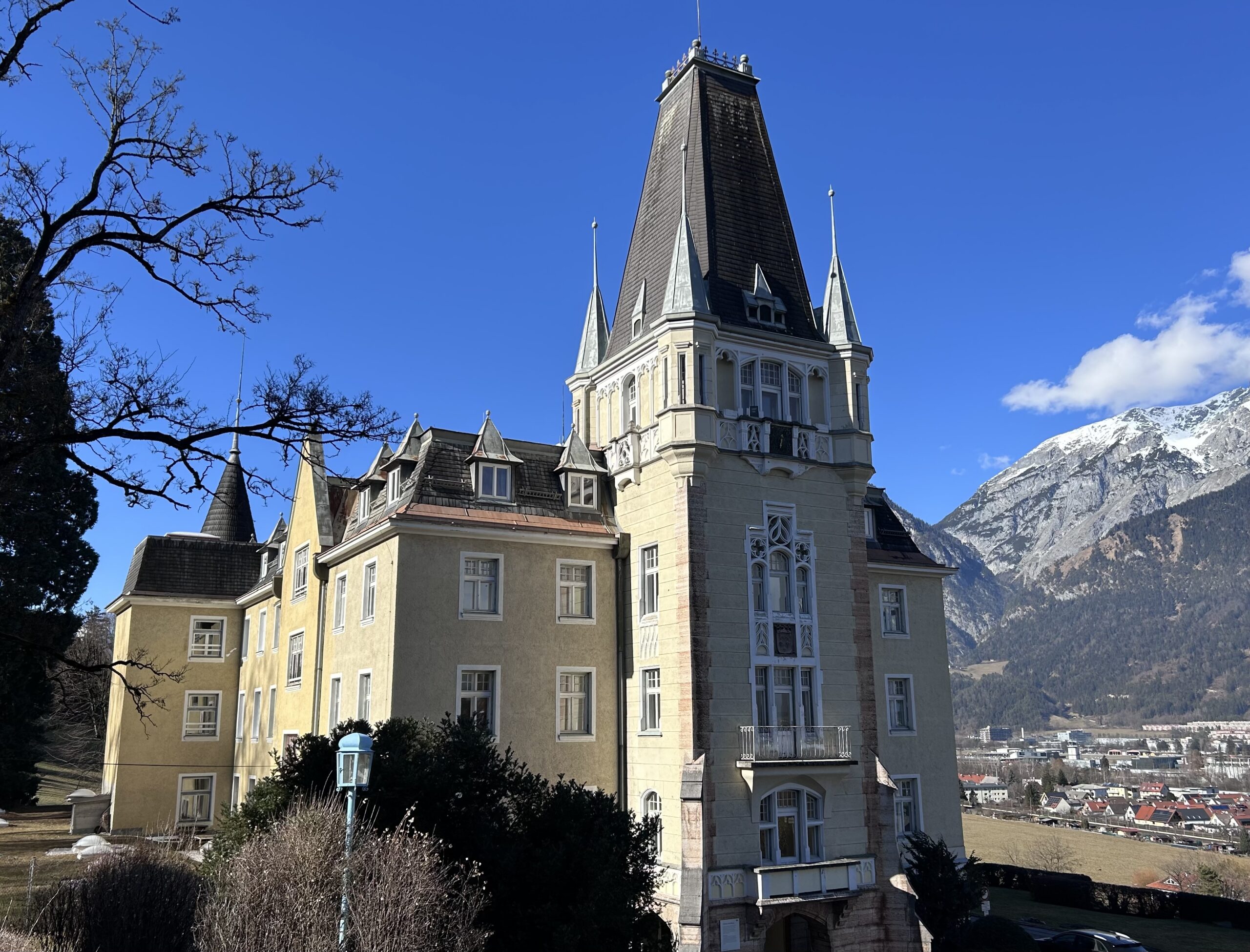
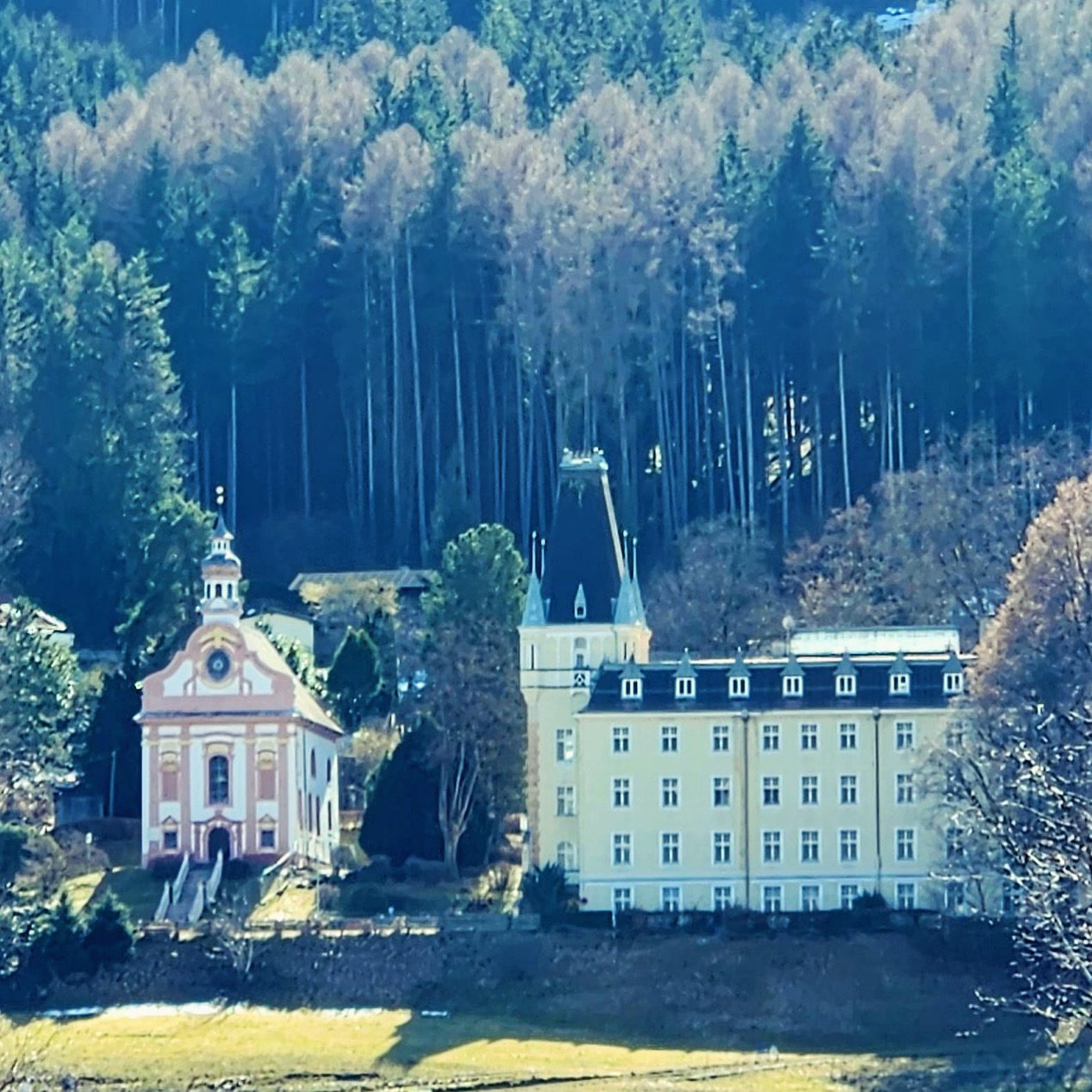
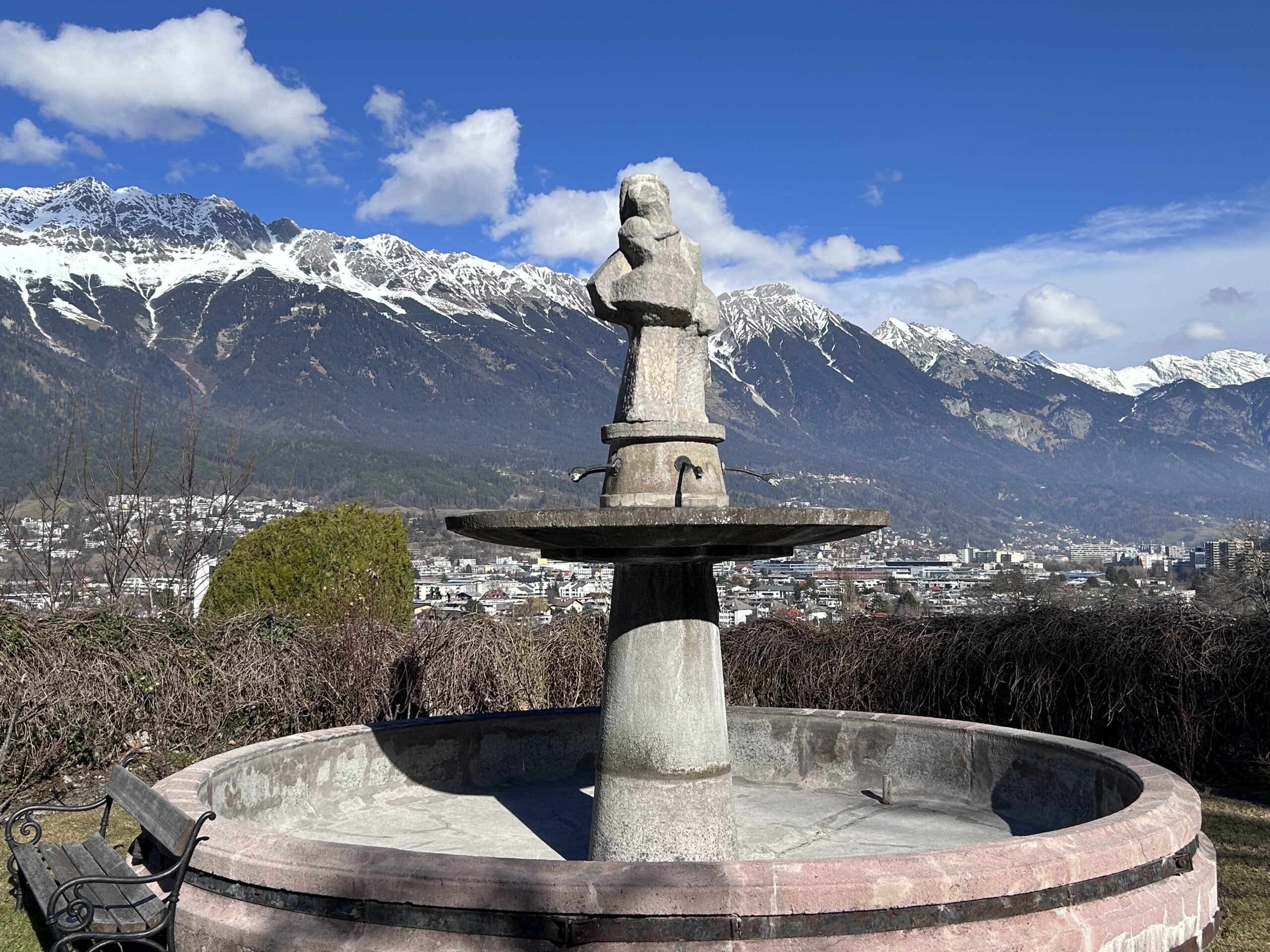
On the south-western outskirts of the city, the Mentlberg Castle and pilgrimage church are two little-noticed gems of Innsbruck's history. The ensemble has probably undergone the most changes of use and ownership of all. Aristocratic residence, place of pilgrimage, hotel, boarding school, barracks, sports centre - nowhere is Innsbruck as versatile as at the foot of the Wiltenberg.
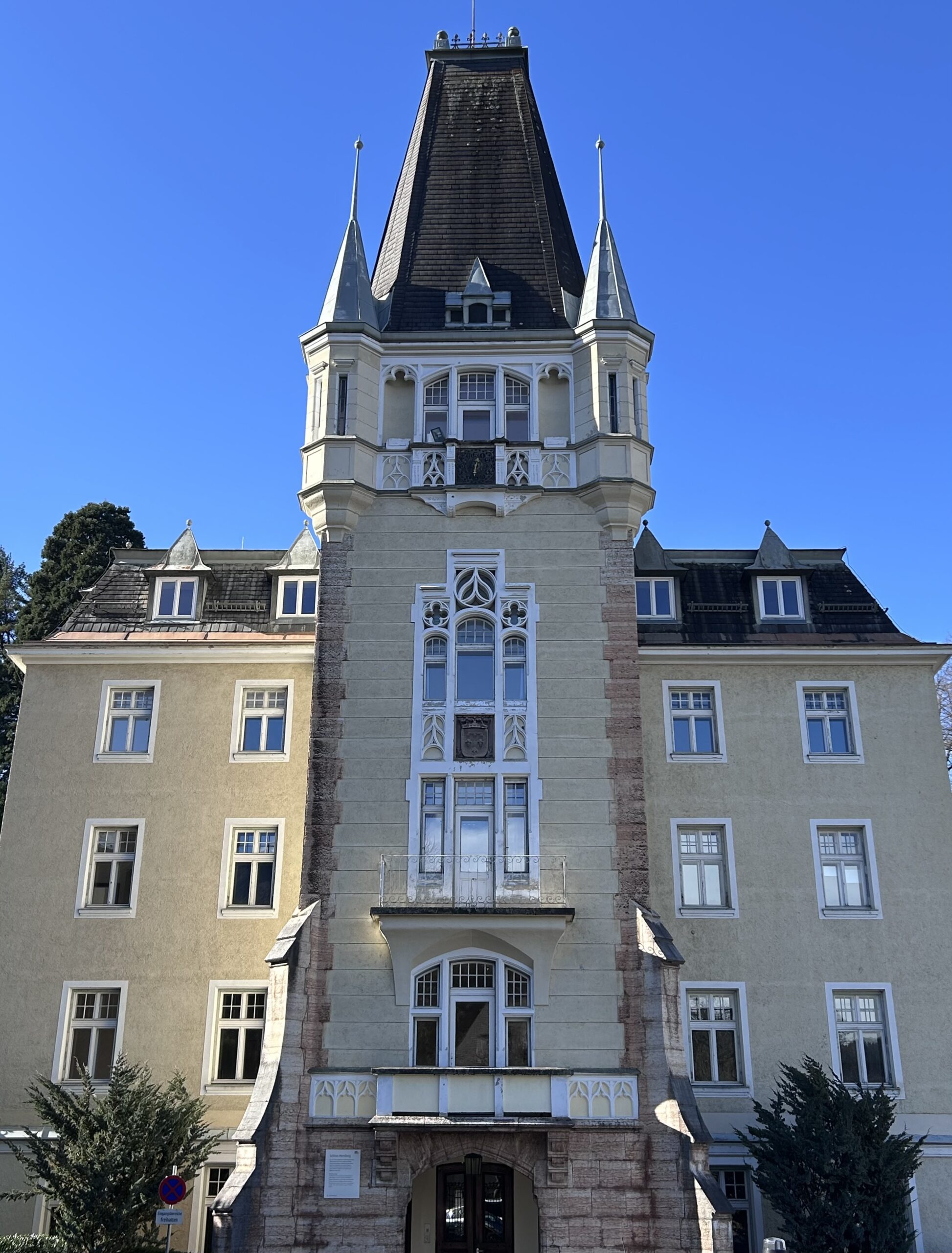
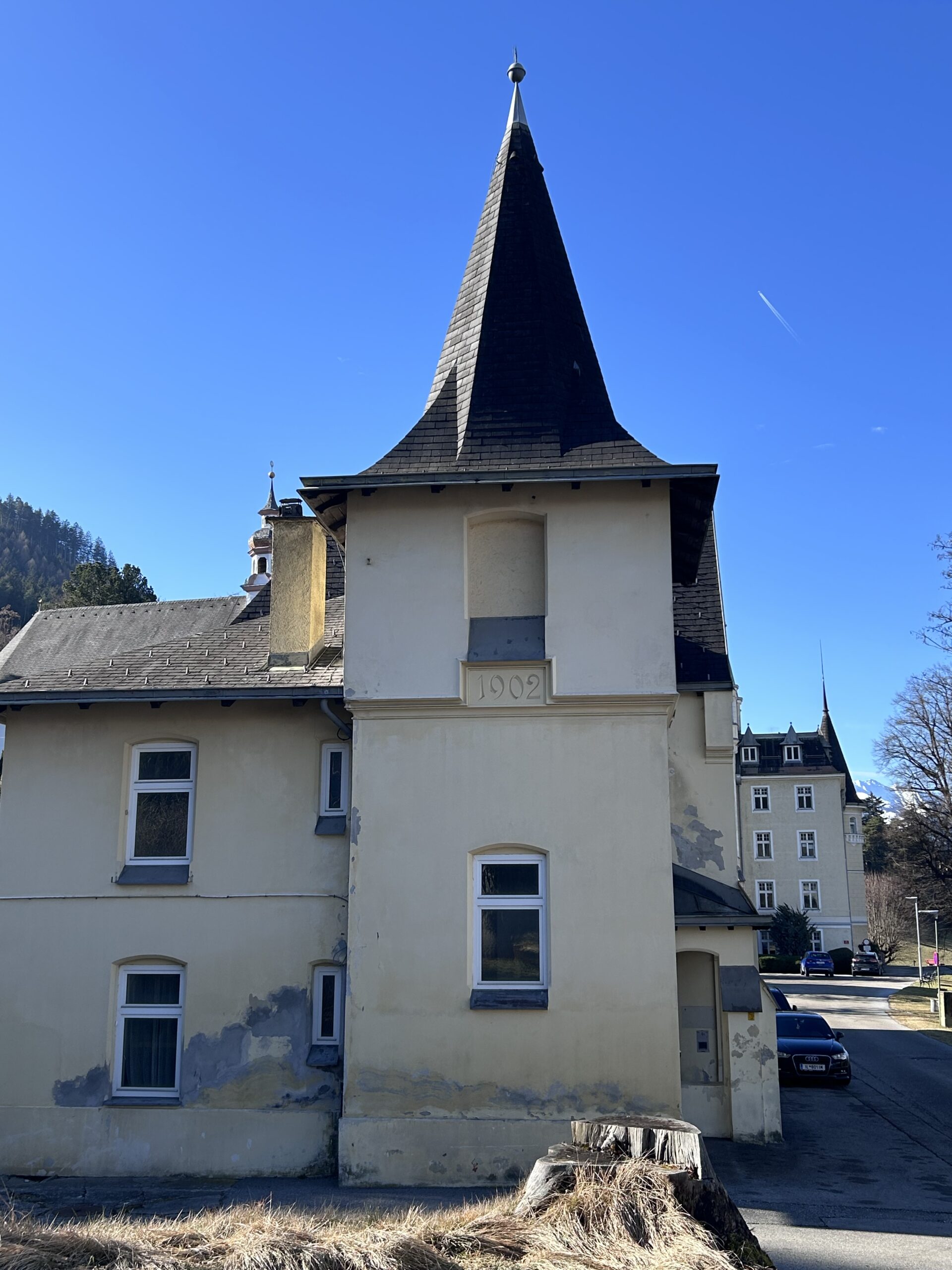
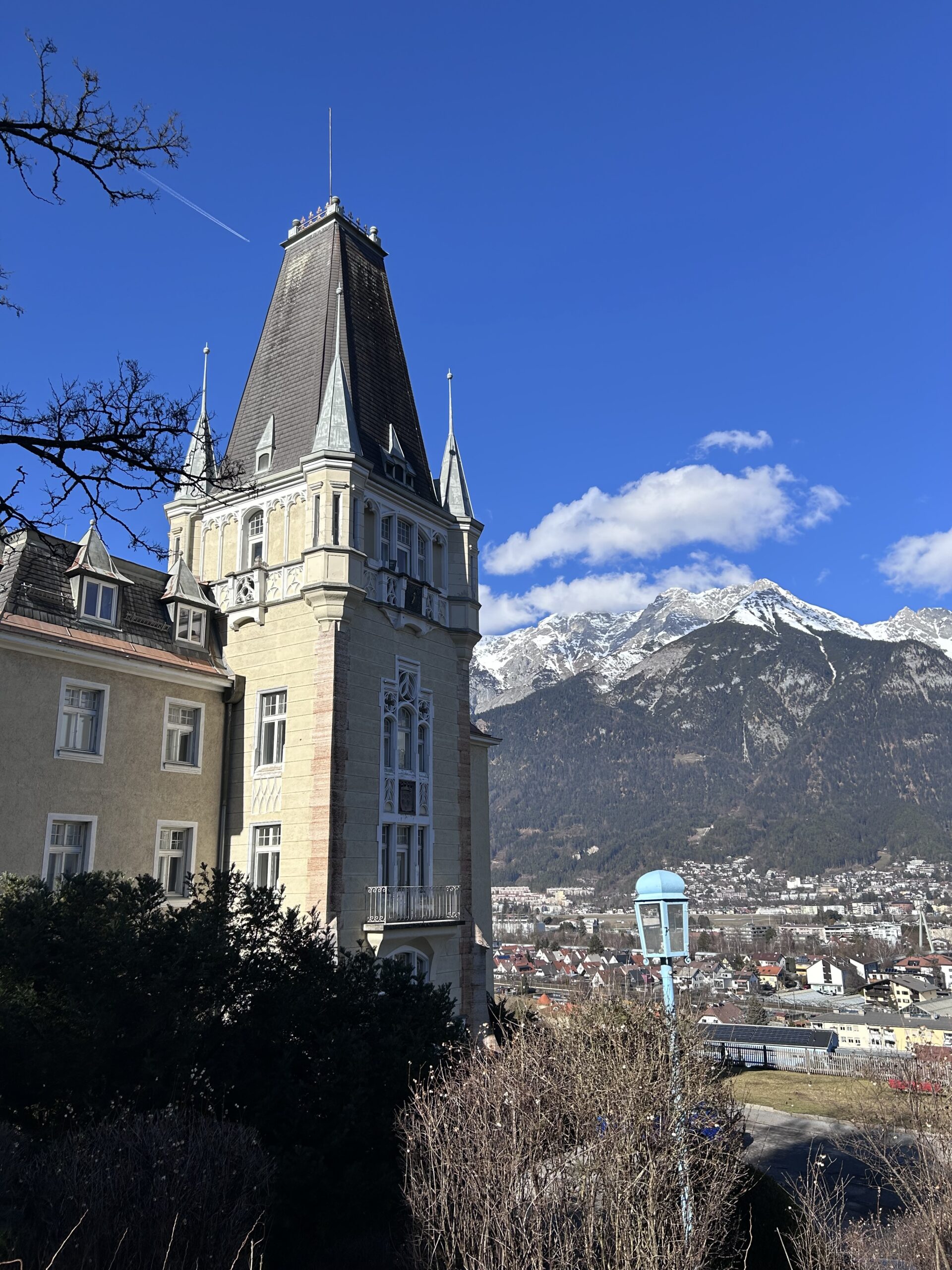
The castle was given its current appearance between 1902 and 1905. The French Prince Ferdinand of Bourbon-Orleans, Duke of Vendome, had acquired the castle 15 years earlier for himself and his wife Sophie, a sister of the Austrian Empress Elisabeth, as a hunting lodge, farm and holiday home. It was probably the location on the edge of the forest, close to the town in the middle of the Alps, that particularly appealed to the couple. Sissi, like her sister more fond of country life than the strict court etiquette of Vienna, was a frequent guest. Fully committed to the French high aristocracy, the prince had his estate remodelled in the spirit of historicism in the form of a Loire chateau in order to have at least a small piece of home in the province of Germany's hereditary enemy. The driveway and boundary wall facing the forest also leave no doubt as to the noble origins of the owners. The neo-Gothic tower at the eastern end with its striking pyramid-shaped roof bears the coat of arms of the French aristocratic house.
The lower part of the estate, where there is a farmstead, meadows and fields, is completely different. Here, the aristocrats showed their love for the Tyrolean country life, which they considered unspoilt. In order to fully satisfy his and his Bavarian wife's rural desires, the duke also acquired the so-called Lower FiggeThe site is now Sieglanger on the banks of the Inn, where he had stables, garages, a park with a greenhouse and a staff annex built.
However, the history of the estate goes back much further. It was first mentioned in 1305 as an estate of Wilten Abbey. The Courtyard on the Gallwiese comprised several hectares of land and the forest rights on the Wiltenberg. Elevated in front of the town, Mentlberg was ideal for a watchtower. Via beacons, so-called Chalk fire the town could be warned of approaching danger. The abbots of Wilten came here on summer holidays to spend the hot season away from monastery politics.
Heinrich Mentlberger, owner of today's Weinhaus Happ, town magistrate and mayor, acquired the estate from Wilten Abbey in 1485. The enterprising contemporary of Maximilian was elevated to the nobility by his sovereign as a member of the Imperial Council, turning Mentlberg from a country estate into the noble baronial estate that gave it its name. Numerous changes of ownership within the aristocracy followed over the next few centuries before Leopold Lindner acquired the estate in 1884. Lindner did not come from the aristocracy, but his ancestors were involved with the Wilten-based company Rosenbacher's Eidam had amassed a considerable fortune as a supplier of farm produce. Like other industrialists of his time, he invested his capital in the growing tourism sector. Lindner saw the potential of the estate in this time of new beginnings and the gold rush of tourism. In Egerdach, which had been benefiting from its spring since 1620, and the Kurhaus in Mühlau, there were already two successful spa and bathing establishments near Innsbruck. A hotel boarding house was created in the count's ambience, which resembled a wellness hotel today. Guests enjoyed treatments such as spruce needle, brine and mineral baths.
The First World War gave the estate a new use. Like Ambras Castle, Mentlberg also became a military hospital. Soldiers were treated in the lung sanatorium. Despite the renovation of the castle at public expense after the war, Duke Ferdinand von Bourbon-Orleans wanted to get rid of his Austrian property. In 1926, the province of Tyrol, an association of Innsbruck innkeepers led by the Hotel Grauer Bär as well as the Alpine Holzindustrie GmbH aus Laibach für das Schloss Mentlberg und den damit zusammenhängenden Besitz. Laibach war erst seit kurzem nicht mehr Teil der Österreichischen Monarchie, sondern ein Teil des Königreichs Jugoslawien, die wirtschaftlichen Verbindungen waren aber aufrecht geblieben. Um 400.000 Schilling erwarb das jugoslawische Unternehmen das Anwesen. Der Plan, das Schloss erneut in ein Hotel zu verwandeln, scheiterte aber nach anfänglicher Euphorie und hohen Investments. Nur zwei Jahre später gingen die insgesamt 70 Hektar Grund um 600.000 Schilling an das Land Tirol. Der Gallwiesenhof on the Mentlberg was to be transformed into a model estate for agricultural training purposes, with the castle serving as accommodation for the students and apprentices of the educational establishment. The bold plan to Lower Figge to build a bathing beach on the Inn never materialised. Instead, the land was used in the 1930s for the construction of the Dollfuß and fishermen's housing estate.
In 1932, the castle was to be used as a home for mothers and babies, but this proposal was rejected by the provincial parliament due to the overly ostentatious ambience. In the financially difficult times after the economic crisis, the provincial government decided to lease the castle as a hotel for 6,000 shillings in order to relieve the provincial budget.
The plan to organise the slalom of the 1933 World Ski Championships on the Mentlberg also failed, not because of finances but because of the snow conditions, at least in that year. The following year, the slopes next to the castle ""...the 40 best-placed downhill skiers in the Pfriemesköpfl - Mutters race... for the prize of honour of Federal Chancellor Dr Dollfuß...“
In the late 1930s and the post-war period, Mentlberg Castle was used for military and administrative purposes. After being used as a barracks by the Austrian army, it was the location of the Reich Labour Service. Under the law, young men and women were obliged to work as Soldiers of labour to take on charitable work. In addition to the educational and disciplinary component of this service as part of propaganda, the Nazi regime also succeeded in drastically reducing the unemployment figures in the areas newly annexed to the Reich in one fell swoop. After the war, the French occupying forces took up residence in the castle for a short time before it once again became a school and apprenticeship centre. After 2015, the building was used as a refugee centre. The province of Tyrol is currently converting Mentlberg into a centre for disaster control in compliance with the preservation order.
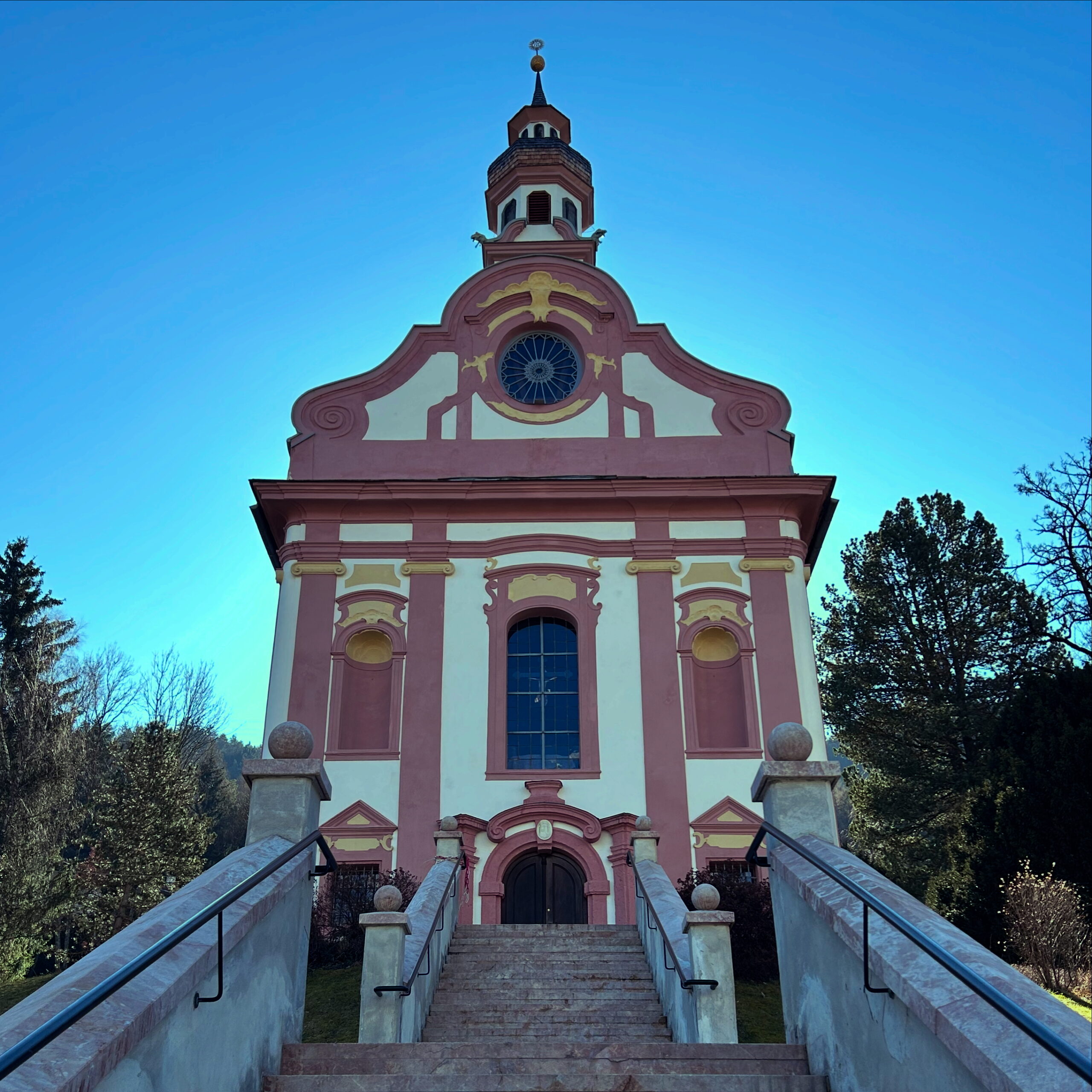
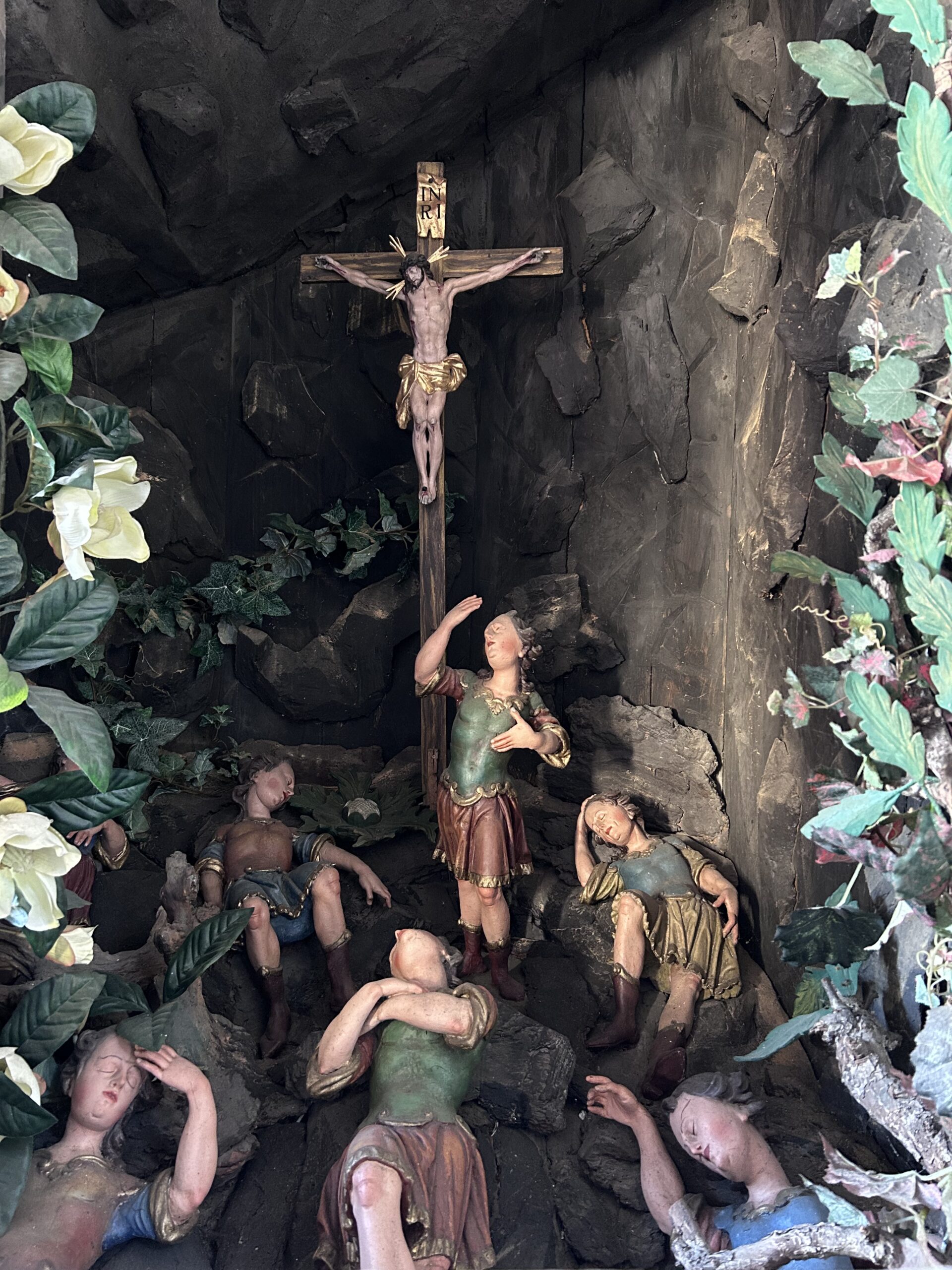
To the east of the castle is the Mentlberg pilgrimage church, a classic product of the Baroque period. An officer in the imperial army brought a statue of the Mother of God with the body of Jesus back to Tyrol from his deployment in the Thirty Years' War (1618 - 1648). Due to economic hardship and war, the 17th century was the heyday of Christian superstition, in which people attributed their personal fate to the intervention of saints. The soldier's father, Ferdinand von Khuepach, zu Ried, was the owner of Mentlberg Castle and decided to erect the wooden figure in the small chapel on his estate. Similar to the Tummelplatz, the "Sorrowful mother on the Gallwiese" miraculous healings here too. Wilten Abbey reacted quickly to promote the pilgrimage. The abbot had seven picture pillars erected along the path from Wilten to Mentlberg and renovated the ageing chapel. The Seven Sleepers, an ancient legend of seven young martyrs from Ephesus, were particularly revered as intercessors in cases of high fever and insomnia. The abbot of Wilten Abbey therefore had a depiction of the grotto in which the seven boys were imprisoned erected in the chapel.
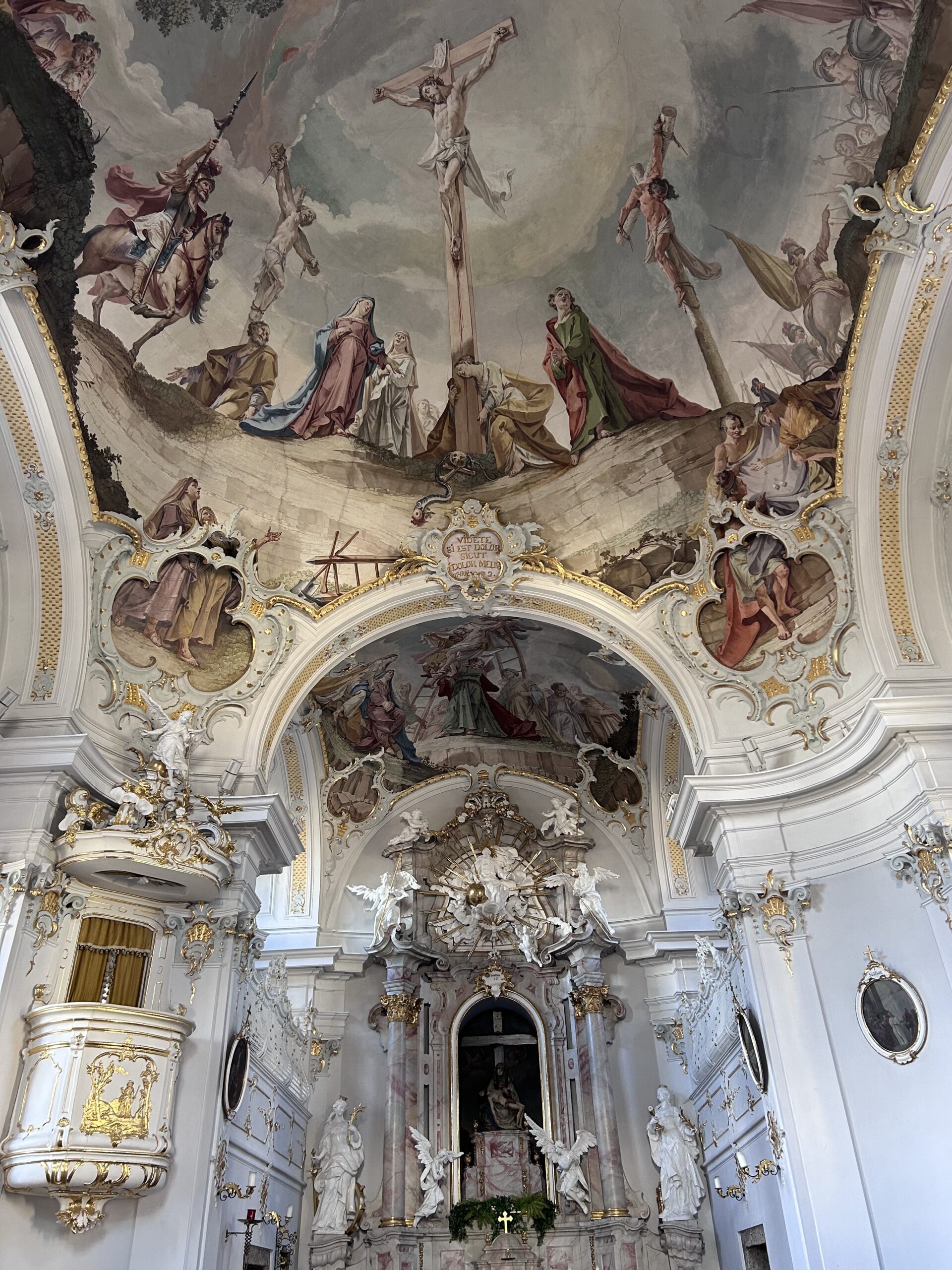
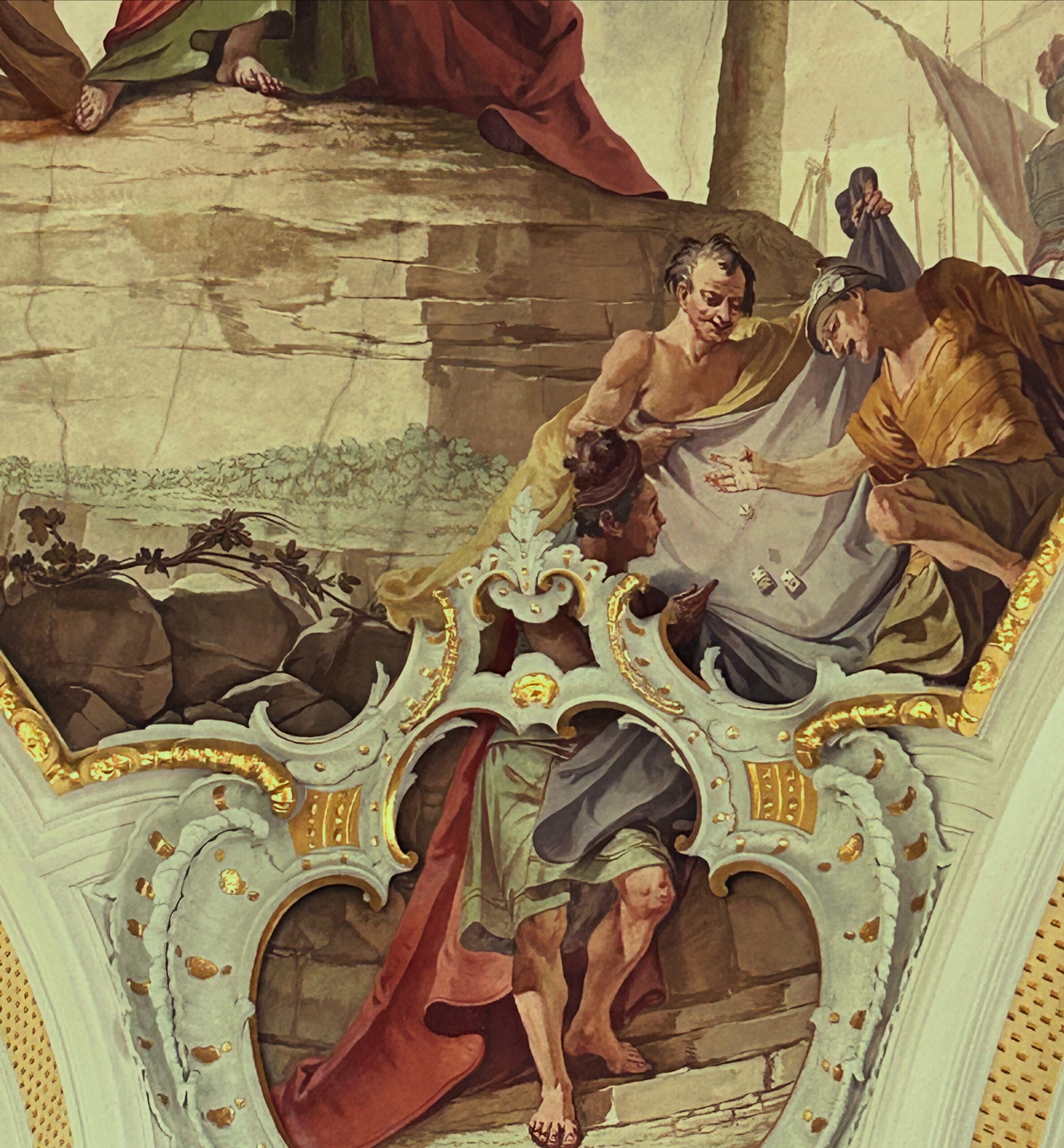
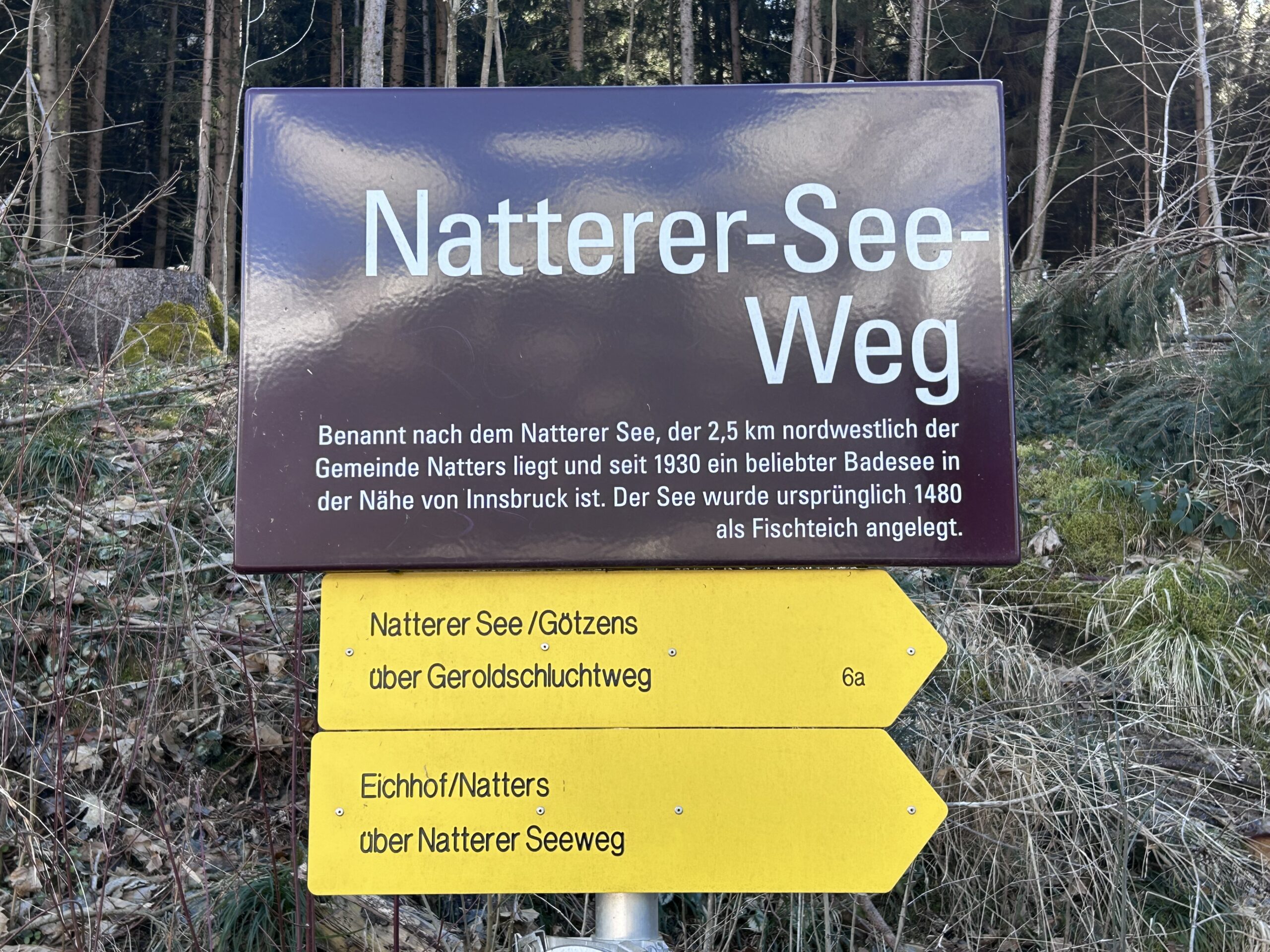
Im 18. Jahrhundert wurde Mentlberg zu einem veritablen Wallfahrtsort. Ob es die Schönheit des Ortes samt der tollen Aussicht auf das Inntal oder der offizielle, sehr barocke Name der Kirche „Our Lady of Sorrows“ war, der die Menschen anzog, kann nicht mehr nachvollzogen werden. 1770 wurde nach Plänen von Konstantin Johann Walter, unter anderem Architekt der Triumphpforte und des Umbaus der Hofburg, die bis heute bestehende Kirche im Rokokostil errichtet. Das Deckengemälde mit der Kreuzigungsszene ist typische für diese Zeit. Die Grotte der Siebenschläfer wurde ebenso in die neue Kirche integriert wie das Altarbild der Gnadenmutter und die Holzplastik. Votivbilder zeugen bis heute von der Wundergläubigkeit der frommen Bürger. Heute ist die Kirche am Mentlberg, ob ihrer angenehmen Größe, der wunderschönen barocken Innenausstattung und des Blicks auf die Stadt Innsbruck bei Hochzeitspaaren äußerst beliebt. Vom Schloss startend lassen sich wunderbare Spaziergänge zum Natterer See, dem Eichhof und weiter ins Mittelgebirge unternehmen.
Tourism: From Alpine summer retreat to Piefke Saga
In the 1990s, an Austrian television series caused a scandal. The Piefke Saga written by the Tyrolean author Felix Mitterer, describes the relationship between the German holidaymaker family Sattmann and their hosts in a fictitious Tyrolean holiday resort in four bizarrely amusing episodes. Despite all the scepticism about tourism in its current, sometimes extreme, excesses, it should not be forgotten that tourism was an important factor in Innsbruck and the surrounding area in the 19th century, driving the region's development in the long term, and not just economically.
The first travellers to Innsbruck were pilgrims and business people. Traders, journeymen on the road, civil servants, soldiers, entourages of aristocratic guests at court, skilled workers from various trades, miners, clerics, pilgrims and scientists were the first tourists to be drawn to the city between Italy and Germany. Travelling was expensive, dangerous and arduous. In addition, a large proportion of the subjects were not allowed to leave their own land without the permission of their landlord or abbot. Those who travelled usually did so on the cobbler's pony. Although Innsbruck's inns and innkeepers were already earning money from travellers in the Middle Ages and early modern times, there was no question of tourism as we understand it today. It began when a few crazy travellers were drawn to the mountain peaks for the first time. In addition to a growing middle class, this also required a new attitude towards the Alps. For a long time, the mountains had been a pure threat to people. It was mainly the British who set out to conquer the world's mountains after the oceans. From the late 18th century, the era of Romanticism, news of the natural beauty of the Alps spread through travelogues. The first foreign-language travel guide to Tyrol, Travells through the Rhaetian Alps by Jean Francois Beaumont was published in 1796.
In addition to the alpine attraction, it was the wild and exotic Natives Tirols, die international für Aufsehen sorgten. Der bärtige Revoluzzer namens Andreas Hofer, der es mit seinem Bauernheer geschafft hatte, Napoleons Armee in die Knie zu zwingen, erzeugte bei den Briten, den notorischen Erzfeinden der Franzosen, ebenso großes Interesse wie bei deutschen Nationalisten nördlich der Alpen, die in ihm einen frühen Protodeutschen sahen. Die Tiroler galten als unbeugsamer Menschenschlag, archetypisch und ungezähmt, ähnlich den Germanen unter Arminius, die das Imperium Romanum herausgefordert hatten. Die Beschreibungen Innsbrucks aus der Feder des Autors Beda Weber (1798 – 1858) und andere Reiseberichte in der boomenden Presselandschaft dieser Zeit trugen dazu bei, ein attraktives Bild Innsbrucks zu prägen.
Nun mussten die wilden Alpen nur noch der Masse an Touristen zugänglich gemacht werden, die zwar gerne den frühen Abenteurern auf ihren Expeditionen nacheifern wollten, deren Risikobereitschaft und Fitness mit den Wünschen nicht schritthalten konnten. Der German Alpine Club eröffnete 1869 eine Sektion Innsbruck, nachdem der 1862 Österreichische Alpenverein was not very successful. Driven by the Greater German idea of many members, the two institutions merged in 1873. Alpine Club is still bourgeois to this day, while its social democratic counterpart is the Naturfreunde. The network of paths grew as a result of its development, as did the number of huts that could accommodate guests. The transit country of Tyrol had countless mule tracks and footpaths that had existed for centuries and served as the basis for alpinism. Small inns, farms and stations along the postal routes served as accommodation. The Tyrolean theologian Franz Senn (1831 - 1884) and the writer Adolf Pichler (1819 - 1900) were instrumental in the surveying of Tyrol and the creation of maps. Contrary to popular belief, the Tyroleans were not born mountaineers, but had to be taught the skills to conquer the mountains. Until then, mountains had been one thing above all: dangerous and arduous in everyday agricultural life. Climbing them had hardly occurred to anyone before. The Alpine clubs also trained mountain guides. From the turn of the century, skiing came into fashion alongside hiking and mountaineering. There were no lifts yet, and to get up the mountains you had to use the skins that are still glued to touring skis today. It was not until the 1920s, following the construction of the cable cars on the Nordkette and Patscherkofel mountains, that a wealthy clientele was able to enjoy the modern luxury of mountain lifts while skiing.
New hotels, cafés, inns, shops and means of transport were needed to meet the needs of guests. Anyone who had running water and a telephone connection at home in London or Paris did not want to make do with an outhouse in the corridor or in front of the house when on holiday. The so-called first and second class inns were suitable for transit traffic, but they were not equipped to receive upscale tourists. Until the 19th century, innkeepers in the city and in the villages around Innsbruck belonged to the upper middle class in terms of income. They were often farmers who ran a pub on the side and sold food. As the example of Andreas Hofer shows, they also had a good reputation and influence within local society. As meeting places for the locals and hubs for postal and goods traffic, they were often well informed about what was happening in the wider world. However, as they were neither members of a guild nor counted among the middle classes, the profession of innkeeper was not one of the most honourable professions. This changed with the professionalisation of the tourism industry. Entrepreneurs such as Robert Nißl, who took over Büchsenhausen Castle in 1865 and converted it into a brewery, invested in the infrastructure. Former aristocratic residences such as Weiherburg Castle became inns and hotels. The revolution in Innsbruck did not take place on the barricades in 1848, but in tourism a few decades later, when resourceful citizens replaced the aristocracy as owners of castles such as Büchsenhausen and Weiherburg.
Opened in 1849, the Österreichischer Hof was long regarded as the top dog of the modern hotel industry, but was officially just a copy of a grand hotel. Only with the Grand Hotel Europa had opened a first-class establishment in Innsbruck in 1869. The heyday of the inns in the old town was over. In 1892, the zeitgeisty Reformhotel Habsburger Hof a second large business. Where the Metropolkino cinema stands today, the Kaiserhof was built as a new building. The Habsburg Court already offered its guests electric light, an absolute sensation. Also on the previously unused area in front of the railway station was the Arlberger Hof settled. What would be seen as a competitive disadvantage today was a selling point at the time. Railway stations were the centres of modern cities. Station squares were not overcrowded transport hubs as they are today, but sophisticated and well-kept places in front of the architecturally sophisticated halls where the trains arrived.
The number of guests increased slowly but steadily. Shortly before the outbreak of the First World War, Innsbruck had 200,000 guests. In June 1896, the Innsbrucker Nachrichten:
„Der Fremdenverkehr in Innsbruck bezifferte sich im Monat Mai auf 5647 Personen. Darunter befanden sich (außer 2763 Reisenden aus Oesterreich-Ungarn) 1974 Reichsdeutsche, 282 Engländer, 65 Italiener, 68 Franzosen, 53 Amerikaner, 51 Russen und 388 Personen aus verschiedenen anderen Ländern.“
In addition to the number of travellers who had an impact on life in the small town of Innsbruck, it was also the internationality of the visitors who gradually gave Innsbruck a new look. In addition to the purely touristic infrastructure, the development of general innovations was also accelerated. The wealthy guests could hardly socialise in pubs with cesspits behind their houses. Of course, a sewerage system would have been on the agenda anyway, but the economic factor of tourism made it possible and accelerated the release of funds for the major projects at the turn of the century. This not only changed the appearance of the town, but also people's everyday and working lives. Resourceful entrepreneurs such as Heinrich Menardi managed to expand the value chain to include paid holiday pleasures in addition to board and lodging. In 1880, he opened the Lohnkutscherei und Autovermietung Heinrich Menardi for excursions in the Alpine surroundings. Initially with carriages, and after the First World War with coaches and cars, wealthy tourists were chauffeured as far as Venice. The company still exists today and is now based in the Menardihaus at Wilhelm-Greil-Strasse 17 opposite Landhausplatz, even though over time the transport and trading industry shifted to the more lucrative property sector. Local trade also benefited from the wealthy clientele from abroad. In 1909, there were already three dedicated Tourist equipment shops next to the fashionable department stores that had just opened a few years earlier.
Innsbruck and the surrounding towns were also known for spa holidays, the predecessor of today's wellness, where well-heeled clients recovered from a wide variety of illnesses in an Alpine environment. The Igler Hof, back then Grandhotel Igler Hof and the Sporthotel Igls, still partly exude the chic of that time. Michael Obexer, the founder of the spa town of Igls and owner of the Grand Hotel, was a tourism pioneer. There were two spas in Egerdach near Amras and in Mühlau. The facilities were not as well-known as the hotspots of the time in Bad Ischl, Marienbad or Baden near Vienna, as can be seen on old photos and postcards, but the treatments with brine, steam, gymnastics and even magnetism were in line with the standards of the time, some of which are still popular with spa and wellness holidaymakers today. Bad Egerdach near Innsbruck had been known as a healing spring since the 17th century. The spring was said to cure gout, skin diseases, anaemia and even the nervous disorder known in the 19th century as neurasthenia, the predecessor of burnout. The institution's chapel still exists today opposite the SOS Children's Village. The bathing establishment in Mühlau has existed since 1768 and was converted into an inn and spa in the style of the time in the course of the 19th century. The former bathing establishment is now a residential building worth seeing in Anton-Rauch-Straße. However, the most spectacular tourist project that Innsbruck ever experienced was probably Hoch Innsbruck, today's Hungerburg. Not only the Hungerburg railway and hotels, but even its own lake was created here after the turn of the century to attract guests.
One of the former owners of the land of the Hungerburg and Innsbruck tourism pioneer, Richard von Attlmayr, was significantly involved in the predecessor of today's tourism association. Since 1881, the Innsbruck Beautification Association to satisfy the increasing needs of guests. The association took care of the construction of hiking and walking trails, the installation of benches and the development of impassable areas such as the Mühlauer Klamm or the Sillschlucht gorge. The striking green benches along many paths are a reminder of the still existing association. 1888 years later, the profiteers of tourism in Innsbruck founded the Commission for the promotion of tourismthe predecessor of today's tourism association. By joining forces in advertising and quality assurance at the accommodation establishments, the individual businesses hoped to further boost tourism.
„Alljährlich mehrt sich die Zahl der überseeischen Pilger, die unser Land und dessen gletscherbekrönte Berge zum Verdrusse unserer freundnachbarlichen Schweizer besuchen und manch klingenden Dollar zurücklassen. Die Engländer fangen an Tirol ebenso interessant zu finden wie die Schweiz, die Zahl der Franzosen und Niederländer, die den Sommer bei uns zubringen, mehrt sich von Jahr zu Jahr.“
Postkarten waren die ersten massentauglichen Influencer der Tourismusgeschichte. Viele Betriebe ließen ihre eigenen Postkarten drucken. Verlage produzierten unzählige Sujets der beliebtesten Sehenswürdigkeiten der Stadt. Es ist interessant zu sehen, was damals als sehenswert galt und auf den Karten abgebildet wurde. Anders als heute waren es vor allem die zeitgenössisch modernen Errungenschaften der Stadt: der Leopoldbrunnen, das Stadtcafé beim Theater, die Kettenbrücke, die Zahnradbahn auf die Hungerburg oder die 1845 eröffnete Stefansbrücke an der Brennerstraße, die als Steinbogen aus Quadern die Sill überquerte, waren die Attraktionen. Auch Andreas Hofer war ein gut funktionierendes Testimonial auf den Postkarten: Der Gasthof Schupfen in dem Andreas Hofer sein Hauptquartier hatte und der Berg Isel mit dem großen Andreas-Hofer-Denkmal waren gerne abgebildete Motive.
1914 gab es in Innsbruck 17 Hotels, die Gäste anlockten. Dazu kamen die Sommer- und Winterfrischler in Igls und dem Stubaital. Der Erste Weltkrieg ließ die erste touristische Welle mit einem Streich versanden. Gerade als sich der Fremdenverkehr Ende der 1920er Jahre langsam wieder erholt hatte, kamen mit der Wirtschaftskrise und Hitlers 1000 Mark blockThe next setback came in 1933, when he tried to put pressure on the Austrian government to end the ban on the NSDAP.
It required the Economic miracle in the 1950s and 1960s to revitalise tourism in Innsbruck after the destruction. Between 1955 and 1972, the number of overnight stays in Tyrol increased fivefold. After the arduous war years and the reconstruction of the European economy, Tyrol and Innsbruck were able to slowly but steadily establish tourism as a stable source of income, even away from the official hotels and guesthouses. Many Innsbruck families moved together in their already cramped flats to supplement their household budgets by renting out beds to guests from abroad. Tourism not only brought in foreign currency, but also enabled the locals to create a new image of themselves both internally and externally. At the same time, the economic upturn made it possible for more and more Innsbruck residents to go on holiday abroad. The beaches of Italy were particularly popular. The wartime enemies of previous decades became guests and hosts.
The Bocksiedlung and Austrofascism
In addition to hunger, political polarisation characterised people's lives in the 1920s and 1930s. Although the collapse of the monarchy had brought about a republic, the two major popular parties, the Social Democrats and the Christian Socials, were as hostile to each other as two scorpions. Both parties set up paramilitary blocs to back up their political agenda with violence on the streets if necessary. The Republican Defence League on the side of the Social Democrats and various Christian-social or even monarchist-orientated Home defenceFor the sake of simplicity, the different groups will be summarised under this collective term, were like civil war parties. Many politicians and functionaries on both sides had fought at the front during the war and were correspondingly militarised. The Tiroler Heimatwehr was able to rely on better infrastructure and a political network in rural Tyrol thanks to the support of the Catholic Church. On 12 November 1928, the tenth anniversary of the founding of the Republic, 18,000 members of the Austrian armed forces marched through the city on the First All-Austrian Homeland March to underline their superiority on the highest holiday of the domestic social democracies. The Styrian troops were quartered in Wilten Abbey, among other places.
From 1930, the NSDAP also became increasingly present in the public sphere. It was able to gain supporters, particularly among students and young, disillusioned workers. By 1932, the party already had 2,500 members in Innsbruck. There were repeated violent clashes between the opposing political groups. The so-called Höttinger Saalschlacht Hötting was not yet part of Innsbruck at that time. The community was mainly inhabited by labourers. In this red National Socialists planned a rally in the Tyrolean bastion at the Gasthof Golden Beara meeting place for the Social Democrats. This provocation ended in a fight that resulted in over 30 people being injured and one death from a stab wound on the National Socialist side. The riots spread throughout the city, with the injured even clashing in the hospital. Only with the help of the gendarmerie and the army was it possible to separate the opponents.
After years of civil war-like conditions, the Christian Socialists under Chancellor Engelbert Dollfuß (1892 - 1934) prevailed in 1933 and eliminated parliament. There was no significant fighting in Innsbruck. On 15 March, the party house of the Social Democratic Labour Party Tyrol im Hotel Sonne The Republican Protection League leader Gustav Kuprian was arrested for high treason and the individual groups disarmed. Dollfuß's goal was to establish the so-called Austrian corporative statea one-party state without opposition, curtailing elementary rights such as freedom of the press and freedom of assembly. In Tyrol in 1933, the Tiroler Wochenzeitung was newly founded to function as a party organ. The entire state apparatus was to be organised along the lines of Mussolini's fascism in Italy under the Vaterländischen Front united: Anti-socialist, authoritarian, conservative in its view of society, anti-democratic, anti-Semitic and militarised. The Innsbruck municipal council was reduced from 40 to 28 members. Instead of free elections, they were appointed by the provincial governor, which meant that only conservative councillors were represented.
Dollfuß was extremely popular in Tyrol, as pictures of the packed square in front of the Hofburg during one of his speeches in 1933 show. His policies were the closest thing to the Habsburg monarchy. His political course was supported by the Catholic Church. This gave him access to infrastructure, press organs and front organisations. Against the hated socialists, the Patriotic Front with their paramilitary units. They did not shy away from repression and acts of violence against life and limb and the facilities of political opponents. Socialists, social democrats, trade unionists and communists were repeatedly arrested. In 1934, members of the Heimwehr destroyed the monument to the Social Democrat Martin Rapoldi in Kranebitten. The press was politically controlled and censored. The articles glorified the idyllic rural life. Families with many children were supported financially. The segregation of the sexes in schools and the reorganisation of the curriculum for girls, combined with pre-military training for boys, was in the interests of a large part of the population. The traditionally orientated cultural policy, with which Austria presented itself as the better Germany under the anti-clerical National Socialist leadership appealed to the conservative part of society. As early as 1931, some Tyrolean mayors had joined forces to have the entry ban for the Habsburgs lifted, so the unspoken long-term goal of reinstalling the monarchy by the Christian Socials enjoyed broad support.
On 25 July 1934, the banned National Socialists attempted a coup in Vienna, in which Dollfuß was killed. There was also an attempted coup in Innsbruck. A policeman was shot dead in Herrengasse when a group of National Socialists attempted to take control of the city. Hitler, who had not ordered the attacks, distanced himself, and the Austrian groups of the banned party were restricted as a result. In Innsbruck, the "Verfügung des Regierungskommissärs der Landeshauptstadt Tirols“ der Platz vor dem Tiroler Landestheater als Dollfußplatz led. Dollfuß had met with the Tyrolean Heimwehr leader Richard Steidle at a rally here two weeks before his death. Steidle himself had been the victim of political violence on several occasions. In 1932, he was attacked on the tram after the Höttinger Saalschlacht, and the following year he was the victim of an assassination attempt in front of his house in Leopoldstraße. After the NSDAP seized power, he was sent to Buchenhausen concentration camp, where he died in 1940.
Dollfuß' successor as Chancellor Kurt Schuschnigg (1897 - 1977) was a Tyrolean by birth and a member of the Innsbruck student fraternity Austria. He ran a law firm in Innsbruck for a long time. In 1930, he founded a paramilitary unit called Ostmärkische Sturmscharenwhich formed the counterweight of the Christian Socials to the radical Heimwehr groups. After the February Uprising in 1934, as Minister of Justice in the Dollfuß cabinet, he was jointly responsible for the execution of several Social Democrats.
However, Austrofascism was unable to turn the tide in the 1930s, especially economically. The economic crisis, which also hit Austria in 1931 and fuelled the radical, populist policies of the NSDAP, hit hard. State investment in major infrastructure projects came to a standstill. The unemployment rate in 1933 was 25%. The restriction of social welfare, which was introduced at the beginning of the First Republick was introduced had dramatic effects. The long-term unemployed were excluded from receiving social benefits as "Discontinued" excluded. Poverty caused the crime rate to rise, and robberies, muggings and thefts became more frequent.
As in previous decades, the housing situation was a particular problem. Despite the city's efforts to create modern living space, many Innsbruck residents still lived in shacks. Bathrooms or one bedroom per person were the exception. Since the great growth of Innsbruck from the 1880s onwards, the housing situation was precarious for many people. The railways, industrialisation, refugees from the German-speaking regions of Italy and the economic crisis had pushed Innsbruck to the brink of the possible. After Vienna, Innsbruck had the second highest number of residents per house. Rents for housing were so high that workers often slept in stages in order to share the costs. Although new blocks of flats and homeless shelters were built, especially in Pradl, such as the workers' hostel in Amthorstraße in 1907, the hostel in Hunoldstraße and the Pembaurblock, this was not enough to deal with the situation. Out of this need and despair, several shanty towns and settlements emerged on the outskirts of the city, founded by the marginalised, the desperate and those left behind who found no place in the system. In the prisoner-of-war camp in the Höttinger Au, people took up residence in the barracks after they had been invalided out. The best known and most notorious to this day was the Bocksiedlung on the site of today's Reichenau. From 1930, several families settled in barracks and caravans between the airport, which was located there at the time, and the barracks of the Reichenau concentration camp. The legend of its origins speaks of Otto and Josefa Rauth as the founders, whose caravan was stranded here. Rauth was not only economically poor, but also morally poor as an avowed communist in Tyrolean terms. His raft, the Noah's Ark, which he wanted to use to reach the Soviet Union via the Inn and Danube, anchored in front of Gasthof Sandwirt.
Gradually, an area emerged on the edge of both the town and society, which was run by the unofficial mayor of the estate, Johann Bock (1900 - 1975), like an independent commune. He regulated the agendas in his sphere of influence in a rough and ready manner.
The Bockala had a terrible reputation among the good citizens of the city. And despite all the historical smoothing and nostalgia, probably not without good reason. As helpful and supportive as the often eccentric residents of the estate could be among themselves, physical violence and petty crime were commonplace. Excessive alcohol consumption was common practice. The streets were unpaved. There was no running water, sewage system or sanitary facilities, nor was there a regular electricity supply. Even the supply of drinking water was precarious for a long time, which brought with it the constant risk of epidemics.
Many, but not all, of the residents were unemployed or criminals. In many cases, it was people who had fallen through the system who settled in the Bocksiedlung. Having the wrong party membership could be enough to prevent you from getting a flat in Innsbruck in the 1930s. Karl Jaworak, who carried out an assassination attempt on Federal Chancellor Prelate Ignaz Seipel in 1924, lived at Reichenau 5a from 1958 after his imprisonment and deportation to a concentration camp during the Nazi regime.
The furnishings of the Bocksiedlung dwellings were just as heterogeneous as the inhabitants. There were caravans and circus wagons, wooden barracks, corrugated iron huts, brick and concrete houses. The Bocksiedlung also had no fixed boundaries. Bockala In Innsbruck, being a citizen was a social status that largely originated in the imagination of the population.
Within the settlement, the houses and carriages built were rented out and sold. With the toleration of the city of Innsbruck, inherited values were created. The residents cultivated self-sufficient gardens and kept livestock, and dogs and cats were also on the menu in meagre times.
The air raids of the Second World War exacerbated the housing situation in Innsbruck and left the Bocksiedlung grow. At its peak, there are said to have been around 50 accommodations. The barracks of the Reichenau concentration camp were also used as sleeping quarters after the last imprisoned National Socialists held there were transferred or released, although the concentration camp was not part of the Bocksiedlung in the narrower sense.
The beginning of the end was the 1964 Olympic Games and a fire in the settlement a year earlier. Malicious tongues claim that this was set to speed up the eviction. In 1967, Mayor Alois Lugger and Johann Bock negotiated the next steps and compensation from the municipality for the eviction, reportedly in an alcohol-fuelled atmosphere. In 1976, the last quarters were evacuated due to hygienic deficiencies.
Many former residents of the Bocksiedlung were relocated to municipal flats in Pradl, the Reichenau and in the O-Village quartered here. The customs of the Bocksiedlung lived on for a number of years, which accounts for the poor reputation of the urban apartment blocks in these neighbourhoods to this day.
A reappraisal of what many historians call the Austrofascism has hardly ever happened in Austria. In the church of St Jakob im Defereggen in East Tyrol or in the parish church of Fritzens, for example, pictures of Dollfuß as the protector of the Catholic Church can still be seen, more or less without comment. In many respects, the legacy of the divided situation of the interwar period extends to the present day. To this day, there are red and black motorists' clubs, sports associations, rescue organisations and alpine associations whose roots go back to this period.
The history of the Bocksiedlung was compiled in many interviews and painstaking detail work by the city archives for the book "Bocksiedlung. A piece of Innsbruck" of the city archive.
Baroque: art movement and art of living
Anyone travelling in Austria will be familiar with the domes and onion domes of churches in villages and towns. This form of church tower originated during the Counter-Reformation and is a typical feature of the Baroque architectural style. They are also predominant in Innsbruck's cityscape. Innsbruck's most famous places of worship, such as the cathedral, St John's Church and the Jesuit Church, are in the Baroque style. Places of worship were meant to be magnificent and splendid, a symbol of the victory of true faith. Religiousness was reflected in art and culture: grand drama, pathos, suffering, splendour and glory combined to create the Baroque style, which had a lasting impact on the entire Catholic-oriented sphere of influence of the Habsburgs and their allies between Spain and Hungary.
The cityscape of Innsbruck changed enormously. The Gumpps and Johann Georg Fischer as master builders as well as Franz Altmutter's paintings have had a lasting impact on Innsbruck to this day. The Old Country House in the historic city centre, the New Country House in Maria-Theresien-Straße, the countless palazzi, paintings, figures - the Baroque was the style-defining element of the House of Habsburg in the 17th and 18th centuries and became an integral part of everyday life. The bourgeoisie did not want to be inferior to the nobles and princes and had their private houses built in the Baroque style. Pictures of saints, depictions of the Mother of God and the heart of Jesus adorned farmhouses.
Baroque was not just an architectural style, it was an attitude to life that began after the end of the Thirty Years' War. The Turkish threat from the east, which culminated in the two sieges of Vienna, determined the foreign policy of the empire, while the Reformation dominated domestic politics. Baroque culture was a central element of Catholicism and its political representation in public, the counter-model to Calvin's and Luther's brittle and austere approach to life. Holidays with a Christian background were introduced to brighten up people's everyday lives. Architecture, music and painting were rich, opulent and lavish. In theatres such as the Comedihaus dramas with a religious background were performed in Innsbruck. Stations of the cross with chapels and depictions of the crucified Jesus dotted the landscape. Popular piety in the form of pilgrimages and the veneration of the Virgin Mary and saints found its way into everyday church life. Multiple crises characterised people's everyday lives. In addition to war and famine, the plague broke out particularly frequently in the 17th century. The Baroque piety was also used to educate the subjects. Even though the sale of indulgences was no longer a common practice in the Catholic Church after the 16th century, there was still a lively concept of heaven and hell. Through a virtuous life, i.e. a life in accordance with Catholic values and good behaviour as a subject towards the divine order, one could come a big step closer to paradise. The so-called Christian edification literature was popular among the population after the school reformation of the 18th century and showed how life should be lived. The suffering of the crucified Christ for humanity was seen as a symbol of the hardship of the subjects on earth within the feudal system. People used votive images to ask for help in difficult times or to thank the Mother of God for dangers and illnesses they had overcome.
The historian Ernst Hanisch described the Baroque and the influence it had on the Austrian way of life as follows:
„Österreich entstand in seiner modernen Form als Kreuzzugsimperialismus gegen die Türken und im Inneren gegen die Reformatoren. Das brachte Bürokratie und Militär, im Äußeren aber Multiethnien. Staat und Kirche probierten den intimen Lebensbereich der Bürger zu kontrollieren. Jeder musste sich durch den Beichtstuhl reformieren, die Sexualität wurde eingeschränkt, die normengerechte Sexualität wurden erzwungen. Menschen wurden systematisch zum Heucheln angeleitet.“
The rituals and submissive behaviour towards the authorities left their mark on everyday culture, which still distinguishes Catholic countries such as Austria and Italy from Protestant regions such as Germany, England or Scandinavia. The Austrians' passion for academic titles has its origins in the Baroque hierarchies. The expression Baroque prince describes a particularly patriarchal and patronising politician who knows how to charm his audience with grand gestures. While political objectivity is valued in Germany, the style of Austrian politicians is theatrical, in keeping with the Austrian bon mot of "Schaumamal".
Sporty Innsbruck
Wer den Beweis benötigt, dass die Innsbrucker stets ein aktives Völkchen waren, könnte das Bild „Winterlandschaft“ des niederländischen Malers Pieter Bruegel (circa 1525 – 1569) aus dem 16. Jahrhundert bemühen. Auf seiner Rückreise von Italien gen Norden hielt der Meister wohl auch in Innsbruck und beobachtete dabei die Bevölkerung beim Eislaufen auf dem zugefrorenen Amraser See. Beda Weber beschrieb in seinem Handbuch für Reisende in Tirol 1851 the leisure habits of the people of Innsbruck, including ice skating on Lake Amras. "The lake not far away (note: Amras), a pool in the mossy area, is used by ice skaters in winter." To this day, sporty clothing in every situation is the most normal thing in the world for Innsbruckers. While in other cities people turn up their noses at functional clothing or hiking and sports shoes in restaurants or offices, at the foot of the Nordkette you don't stand out.
It wasn't always like that. The path from ice-skating peasant to active citizen was a long one. In the Middle Ages and early modern times, leisure and free time for sports such as hunting or riding was primarily a privilege of the nobility. It was not until the changed living conditions of the 19th century that a large proportion of the population, especially in the cities, had something like leisure time for the first time. More and more people no longer worked in agriculture, but as labourers and employees in offices, workshops and factories according to regulated schedules.
The pioneer was the early industrialised England, where workers and employees slowly began to free themselves from the turbo capitalism of early industrialisation. 16-hour days were not only detrimental to workers' health, entrepreneurs also realised that overworking was unprofitable. Healthy and happy workers were better for productivity. Efforts to introduce an 8-hour day had been underway since the 1860s. In 1873, the Austrian book printers pushed through a working day of ten hours. In 1918, Austria switched to a 48-hour week. From 1930, 40 hours per week became the standard working time in industrial companies. People of all classes, no longer just the aristocracy, now had time and energy for hobbies, club life and sporting activities.
In many cases, it was also English tourists who brought sporting trends, disciplines and equipment with them. The financial outlay for the required equipment determined whether the discipline remained the preserve of the middle classes or whether labourers could also afford the pleasure. For example, luge was already widespread around the turn of the century, while bobsleigh and skeleton remained elitist sports. Sport was not just a leisure activity, but a demarcation between the individual social classes. The working classes, bourgeoisie and aristocracy also nurtured their identity through the sports they practised. Aristocrats rode and hunted with the dignity of old, the middle classes showed their individuality, wealth and independence through expensive sports equipment such as modern bicycles, and the working classes chased balls or wrestled in teams of eleven. The separation may no longer be conscious, but you can still see people identifying with „their“ sport today.
In the middle of the 19th century, sportsmen and women joined singers, museum and theatre enthusiasts, scientists and literature fans. The beginning of organised club sport in Innsbruck was marked by the ITV, the Innsbrucker Turnvereinwhich was founded in 1849. Gymnastics was the epitome of sport in German-speaking countries. The idea of competition was not in the foreground. Most clubs had a political background. There were Christian, socialist and Greater German sports clubs. They served as a preliminary organisation for political parties and bodies. More or less all clubs had Aryan clauses in their statutes. Jews therefore founded their own sports clubs. The national movement emerged from the German gymnastics clubs, similar to the student fraternities. The members were supposed to train themselves physically in order to fulfil the national body to serve in the best possible way in the event of war. Sedentary occupations, especially academic ones, became more common, and gymnastics served as a means of compensation. If you see the gymnasts performing their exercises and demonstrations in old pictures, the strictly military character of these events is striking. The Greater German agitator Friedrich Ludwig Jahn (1778 - 1852), commonly known as Gymnastics father Jahnwas not only the nation's gymnast, but also the spiritual father of the Lützow Free Corps which went into action against Napoleon as a kind of all-German volunteer army. One of the most famous bon mots attributed to this passionate anti-Semite is "Hatred of everything foreign is a German's duty". In Saggen, Jahnstraße and a small park with a monument commemorate Friedrich Ludwig Jahn.
Swimming pools were among the first sports facilities. The first bathing establishment welcomed swimmers from 1833 in the Höttinger in the outdoor pool on the Gießen. Further baths at Büchsenhausen Castle or the separate women's and men's baths next to today's Sillpark area soon followed. The outdoor swimming pool was in a particularly beautiful location Beautiful rest above Ambras Castle, which opened in 1929 shortly after the indoor swimming pool in Pradl was built. The population had grown just as much as the desire for swimming as a leisure activity. In 1961, the sports programme at Tivoli was expanded to include the Freischwimmbad Tivoli extended.
1883 gründeten die Radfahrer den Verein Bicycle Club. The first bicycle races in France and Great Britain took place from 1869. The English city of Coventry was also a pioneer in the production of the elegant steel steeds, which cost a fortune. In the same year, the Innsbruck press had already reported on the modern means of personal transport when "some gentlemen ventured onto the road with several velocipedes ordered by the Peterlongo company". In 1876, cycling was briefly banned in Innsbruck as accidents had repeatedly occurred. Cycling was also quickly recognised by the state as a form of exercise that could be used for military purposes. A Reich war ministerial decree on this can be found in the press:
„Es ist beabsichtigt, wie in den Vorjahren, auch heuer bei den Uebungen mit vereinigten Waffen Radfahrer zu verwenden… Die Commanden der Infanterie- und Tiroler Jägerregimenter sowie der Feldjäger-Bataillone haben jene Personen, welche als Radfahrer in Evidenz stehen und heuer zur Waffenübung verpflichtet sind, zum Einrücken mit ihrem Fahrrade aufzufordern.“
The scene continued to develop before the turn of the century under the direction of Anton Schlumpeter from Munich. Schlumpeter covered the entire value chain with a riding school, a bicycle shop and workshop and finally the Veldidena bicycle brand produced in his Wilten factory. The Velocipedists siedelten sich 1896 im Rahmen der „Internationalen Ausstellung für körperliche Erziehung, Gesundheitspflege und Sport" in Saggen near the viaduct arches with a cycling track and grandstand. The Innsbrucker Nachrichten newspaper reported enthusiastically on this innovation, as cycling was the most popular sporting discipline in Europe until the first car races:
„Die Innsbrucker Rennbahn, welche in Verbindung mit der internationalen Ausstellung noch im Laufe der nächsten Wochen eröffnet wird, erhält einen Umfang von 400 Metern bei einer Breite von 6 Metern… Die Velociped-Rennbahn, um deren Errichtung sich der Präsident des Tiroler Radfahrer-Verbandes Herr Staatsbahn-Oberingenieur R. v. Weinong, das Hauptverdienst erworben hat, wird eine der hervorragendsten und besteingerichteten Radfahrbahnen des Continents sein. Am. 29. d. M. (Anm.: Juni 1896) wird auf der Innsbrucker Rennbahn zum erstenmale ein großes internationales Radwettfahren abgehalten, welchem dann in der Zukunft alljährlich regelmäßig Velociped-Preisrennen folgen sollen, was der Förderung des Radfahr-Sports wie auch des Fremdenverkehrs in Innsbruck sicher in bedeutendem Maße nützlich sein wird.“
The cement railway was used for daily training in the warm season. The smoke-filled air as the locomotives passed by was probably not good for the lungs. After initial enthusiasm, Schlumpeter had to step in to save the railway. The enterprising entrepreneur realised that the cyclists were not providing enough activity and, on his own initiative, began to build a kind of predecessor to today's Olympiaworld at the Tivoli with several facilities for sport. In addition to cycling races, boxers could compete in the ring. He also had tennis courts built in Saggen. Despite all his efforts, the facility was demolished again in 1901.
Football was able to establish itself in Innsbruck more sustainably than cycling. The footballers had left the umbrella organisation ITV due to the Aryan law, which forbade matches with teams with Jewish players, and founded several clubs of their own. Verein Fußball Innsbruckwhich would later become the SVI. At this time, there were already national football matches, for example a 1:1 draw between the ITV team and Bayern Munich. The matches were played on a football pitch in front of the Sieberer orphanage. In Wilten, now part of Innsbruck, in 1910 the SK Wilten. The Besele football pitch, which still exists today next to the Westfriedhof cemetery, was equipped with stands to cope with the masses of spectators. 1913 saw the founding of Wacker Innsbruck the most successful Tyrolean football club to date, winning the Austrian championship ten times under different names and also celebrating international success.
In addition to the various summer sports, winter sports also became increasingly popular. Tobogganing was already a popular leisure activity on the hills around Innsbruck in the middle of the 19th century. The first ice rink opened in 1870 as a winter alternative to swimming on the grounds of the open-air swimming pool in the Höttinger Au. Unlike water sports, ice skating was a pleasure that could be enjoyed by men and women together. Instead of meeting up for a Sunday stroll, young couples could meet at the ice rink without their parents present. The ice skating club was founded in 1884 and used the exhibition grounds as an ice rink. With the ice rink in front of the k.u.k. shooting range in Mariahilf, the Lansersee, the Amraser See, the Höttinger Au swimming facility and the Sillkanal in Kohlstatt provided the people of Innsbruck with many opportunities for ice skating. The first ice hockey club, the IEV, was founded as early as 1908.
Skiing, initially a Nordic pastime in the valley, soon spread as a downhill discipline. The Innsbruck Academic Alpine Club was founded in 1893 and two years later organised the first ski race on Tyrolean soil from Sistrans to Ambras Castle. Founded in 1867, the Sports shop Witting in Maria-Theresien-Straße proved its business acumen and was still selling equipment for the well-heeled skiing public before 1900. After St. Anton and Kitzbühel, the first ski centre was founded in 1906. Innsbruck Ski Club. The equipment was simple and for a long time only allowed skiing on relatively flat slopes with a mixture of alpine and Nordic style similar to cross-country skiing. Nevertheless, people dared to whizz down the slopes in Mutters or on the Ferrariwiese. In 1928, two cable cars were installed on the Nordkette and the Patscherkofel, which made skiing significantly more attractive. Skiing achieved its breakthrough as a national sport with the World Ski Championships in Innsbruck in February 1933. On an unmarked course, 10 kilometres and 1500 metres of altitude had to be covered between the Glungezer and Tulfes. The two local heroes Gustav Lantschner and Inge Wersin-Lantschner won several medals in the races, fuelling the hype surrounding alpine winter sports in Innsbruck.
Innsbruck identifiziert sich bis heute sehr stark mit dem Sport. Mit der Fußball-EM 2008, der Radsport-WM 2018 und der Kletter-WM 2018 konnte man an die glorreichen 1930er Jahre mit zwei Skiweltmeisterschaften und die beiden Olympiaden von 1964 und 1976 auch im Spitzensportbereich wieder an die Goldenen Zeiten anknüpfen. Trotzdem ist es weniger der Spitzen- als vielmehr der Breitensport, der dazu beiträgt, aus Innsbruck die selbsternannte Sporthauptstadt Österreichs zu machen. Es gibt kaum einen Innsbrucker, der nicht zumindest den Alpinski anschnallt. Mountainbiken auf den zahlreichen Almen rund um Innsbruck, Skibergsteigen, Sportklettern und Wandern sind überdurchschnittlich populär in der Bevölkerung und fest im Alltag verankert.
Innsbruck and National Socialism
In the 1920s and 30s, the NSDAP also grew and prospered in Tyrol. The first local branch of the NSDAP in Innsbruck was founded in 1923. With "Der Nationalsozialist - Combat Gazette for Tyrol and Vorarlberg“ published its own weekly newspaper. In 1933, the NSDAP also experienced a meteoric rise in Innsbruck with the tailwind from Germany. The general dissatisfaction and disenchantment with politics among the citizens and theatrically staged torchlight processions through the city, including swastika-shaped bonfires on the Nordkette mountain range during the election campaign, helped the party to make huge gains. Over 1800 Innsbruck residents were members of the SA, which had its headquarters at Bürgerstraße 10. While the National Socialists were only able to win 2.8% of the vote in their first municipal council election in 1921, this figure had already risen to 41% by the 1933 elections. Nine mandataries, including the later mayor Egon Denz and the Gauleiter of Tyrol Franz Hofer, were elected to the municipal council. It was not only Hitler's election as Reich Chancellor in Germany, but also campaigns and manifestations in Innsbruck that helped the party, which had been banned in Austria since 1934, to achieve this result. As everywhere else, it was mainly young people in Innsbruck who were enthusiastic about National Socialism. They were attracted by the new, the clearing away of old hierarchies and structures such as the Catholic Church, the upheaval and the unprecedented style. National Socialism was particularly popular among the big German-minded lads of the student fraternities and often also among professors.
When the annexation of Austria to Germany took place in March 1938, civil war-like scenes ensued. Already in the run-up to the invasion, there had been repeated marches and rallies by the National Socialists after the ban on the party had been lifted. Even before Federal Chancellor Schuschnigg gave his last speech to the people before handing over power to the National Socialists with the words "God bless Austria" had closed on 11 March 1938, the National Socialists were already gathering in the city centre to celebrate the invasion of the German troops. The police of the corporative state were partly sympathetic to the riots of the organised manifestations and partly powerless in the face of the goings-on. Although the Landhaus and Maria-Theresien-Straße were cordoned off and secured with machine-gun posts, there was no question of any crackdown by the executive. "One people - one empire - one leader" echoed through the city. The threat of the German military and the deployment of SA troops dispelled the last doubts. More and more of the enthusiastic population joined in. At the Tiroler Landhaus, then still in Maria-Theresienstraße, and at the provisional headquarters of the National Socialists in the Gasthaus Old Innspruggthe swastika flag was hoisted.
On 12 March, the people of Innsbruck gave the German military a frenetic welcome. To ensure hospitality towards the National Socialists, Mayor Egon Denz had each worker paid a week's wages. On 5 April, Adolf Hitler personally visited Innsbruck to be celebrated by the crowd. Archive photos show a euphoric crowd awaiting the Führer, the promise of salvation. Mountain fires in the shape of swastikas were lit on the Nordkette. The referendum on 10 April resulted in a vote of over 99% in favour of Austria's annexation to Germany. After the economic hardship of the interwar period, the economic crisis and the governments under Dollfuß and Schuschnigg, people were tired and wanted change. What kind of change was initially less important than the change itself. "Showing them up there", that was Hitler's promise. The Wehrmacht and industry offered young people a perspective, even those who had little to do with the ideology of National Socialism in and of itself. The fact that there were repeated outbreaks of violence was not unusual for the interwar period in Austria anyway. Unlike today, democracy was not something that anyone could have got used to in the short period between the monarchy in 1918 and the elimination of parliament under Dollfuß in 1933, which was characterised by political extremes. There is no need to abolish something that does not actually exist in the minds of the population.
Tyrol and Vorarlberg were combined into a Reichsgau with Innsbruck as its capital. Even though National Socialism was viewed sceptically by a large part of the population, there was hardly any organised or even armed resistance, as the Catholic resistance OE5 and the left in Tyrol were not strong enough for this. There were isolated instances of unorganised subversive behaviour by the population, especially in the arch-Catholic rural communities around Innsbruck. The power apparatus dominated people's everyday lives too comprehensively. Many jobs and other comforts of life were tied to an at least outwardly loyal attitude to the party. The majority of the population was spared imprisonment, but the fear of it was omnipresent.
The regime under Hofer and Gestapo chief Werner Hilliges also did a great job of suppression. In Tyrol, the church was the biggest obstacle. During National Socialism, the Catholic Church was systematically combated. Catholic schools were converted, youth organisations and associations were banned, monasteries were closed, religious education was abolished and a church tax was introduced. Particularly stubborn priests such as Otto Neururer were sent to concentration camps. Local politicians such as the later Innsbruck mayors Anton Melzer and Franz Greiter also had to flee or were arrested. It would go beyond the scope of this article to summarise the violence and crimes committed against the Jewish population, the clergy, political suspects, civilians and prisoners of war. The Gestapo headquarters were located at Herrengasse 1, where suspects were severely abused and sometimes beaten to death with fists. In 1941, the Reichenau labour camp was set up in Rossau near the Innsbruck building yard. Suspects of all kinds were kept here for forced labour in shabby barracks. Over 130 people died in this camp consisting of 20 barracks due to illness, the poor conditions, labour accidents or executions. Prisoners were also forced to work at the Messerschmitt factory in the village of Kematen, 10 kilometres from Innsbruck. These included political prisoners, Russian prisoners of war and Jews. The forced labour included, among other things, the construction of the South Tyrolean settlements in the final phase or the tunnels to protect against air raids in the south of Innsbruck. In the Innsbruck clinic, disabled people and those deemed unacceptable by the system, such as homosexuals, were forcibly sterilised.
The memorials to the National Socialist era are few and far between. The Tiroler Landhaus with the Liberation Monument and the building of the Old University are the two most striking memorials. The forecourt of the university and a small column at the southern entrance to the hospital were also designed to commemorate what was probably the darkest chapter in Austria's history.
Believe, Church and Power
Die Fülle an Kirchen, Kapellen, Kruzifixen und Wandmalereien im öffentlichen Raum wirkt auf viele Besucher Innsbrucks aus anderen Ländern eigenartig. Nicht nur Gotteshäuser, auch viele Privathäuser sind mit Darstellungen der Heiligen Familie oder biblischen Szenen geschmückt. Der christliche Glaube und seine Institutionen waren in ganz Europa über Jahrhunderte alltagsbestimmend. Innsbruck als Residenzstadt der streng katholischen Habsburger und Hauptstadt des selbsternannten Heiligen Landes Tirol wurde bei der Ausstattung mit kirchlichen Bauwerkern besonders beglückt. Allein die Dimension der Kirchen umgelegt auf die Verhältnisse vergangener Zeiten sind gigantisch. Die Stadt mit ihren knapp 5000 Einwohnern besaß im 16. Jahrhundert mehrere Kirchen, die in Pracht und Größe jedes andere Gebäude überstrahlte, auch die Paläste der Aristokratie. Das Kloster Wilten war ein Riesenkomplex inmitten eines kleinen Bauerndorfes, das sich darum gruppierte. Die räumlichen Ausmaße der Gotteshäuser spiegelt die Bedeutung im politischen und sozialen Gefüge wider.
Die Kirche war für viele Innsbrucker nicht nur moralische Instanz, sondern auch weltlicher Grundherr. Der Bischof von Brixen war formal hierarchisch dem Landesfürsten gleichgestellt. Die Bauern arbeiteten auf den Landgütern des Bischofs wie sie auf den Landgütern eines weltlichen Fürsten für diesen arbeiteten. Damit hatte sie die Steuer- und Rechtshoheit über viele Menschen. Die kirchlichen Grundbesitzer galten dabei nicht als weniger streng, sondern sogar als besonders fordernd gegenüber ihren Untertanen. Gleichzeitig war es auch in Innsbruck der Klerus, der sich in großen Teilen um das Sozialwesen, Krankenpflege, Armen- und Waisenversorgung, Speisungen und Bildung sorgte. Der Einfluss der Kirche reichte in die materielle Welt ähnlich wie es heute der Staat mit Finanzamt, Polizei, Schulwesen und Arbeitsamt tut. Was uns heute Demokratie, Parlament und Marktwirtschaft sind, waren den Menschen vergangener Jahrhunderte Bibel und Pfarrer: Eine Realität, die die Ordnung aufrecht hält. Zu glauben, alle Kirchenmänner wären zynische Machtmenschen gewesen, die ihre ungebildeten Untertanen ausnützten, ist nicht richtig. Der Großteil sowohl des Klerus wie auch der Adeligen war fromm und gottergeben, wenn auch auf eine aus heutiger Sicht nur schwer verständliche Art und Weise. Verletzungen der Religion und Sitten wurden in der späten Neuzeit vor weltlichen Gerichten verhandelt und streng geahndet. Die Anklage bei Verfehlungen lautete Häresie, worunter eine Vielzahl an Vergehen zusammengefasst wurde. Sodomie, also jede sexuelle Handlung, die nicht der Fortpflanzung diente, Zauberei, Hexerei, Gotteslästerung – kurz jede Abwendung vom rechten Gottesglauben, konnte mit Verbrennung geahndet werden. Das Verbrennen sollte die Verurteilten gleichzeitig reinigen und sie samt ihrem sündigen Treiben endgültig vernichten, um das Böse aus der Gemeinschaft zu tilgen. Bis in die Angelegenheiten des täglichen Lebens regelte die Kirche lange Zeit das alltägliche Sozialgefüge der Menschen. Kirchenglocken bestimmten den Zeitplan der Menschen. Ihr Klang rief zur Arbeit, zum Gottesdienst oder informierte als Totengeläut über das Dahinscheiden eines Mitglieds der Gemeinde. Menschen konnten einzelne Glockenklänge und ihre Bedeutung voneinander unterscheiden. Sonn- und Feiertage strukturierten die Zeit. Fastentage regelten den Speiseplan. Familienleben, Sexualität und individuelles Verhalten hatten sich an den von der Kirche vorgegebenen Moral zu orientieren. Das Seelenheil im nächsten Leben war für viele Menschen wichtiger als das Lebensglück auf Erden, war dies doch ohnehin vom determinierten Zeitgeschehen und göttlichen Willen vorherbestimmt. Fegefeuer, letztes Gericht und Höllenqualen waren Realität und verschreckten und disziplinierten auch Erwachsene.
Während das Innsbrucker Bürgertum von den Ideen der Aufklärung nach den Napoleonischen Kriegen zumindest sanft wachgeküsst wurde, blieb der Großteil der Menschen weiterhin der Mischung aus konservativem Katholizismus und abergläubischer Volksfrömmigkeit verbunden. Religiosität war nicht unbedingt eine Frage von Herkunft und Stand, wie die gesellschaftlichen, medialen und politischen Auseinandersetzungen entlang der Bruchlinie zwischen Liberalen und Konservativ immer wieder aufzeigten. Seit der Dezemberverfassung von 1867 war die freie Religionsausübung zwar gesetzlich verankert, Staat und Religion blieben aber eng verknüpft. Die Wahrmund-Affäre, die sich im frühen 20. Jahrhundert ausgehend von der Universität Innsbruck über die gesamte K.u.K. Monarchie ausbreitete, war nur eines von vielen Beispielen für den Einfluss, den die Kirche bis in die 1970er Jahre hin ausübte. Kurz vor dem Ersten Weltkrieg nahm diese politische Krise, die die gesamte Monarchie erfassen sollte in Innsbruck ihren Anfang. Ludwig Wahrmund (1861 – 1932) war Ordinarius für Kirchenrecht an der Juridischen Fakultät der Universität Innsbruck. Wahrmund, vom Tiroler Landeshauptmann eigentlich dafür ausgewählt, um den Katholizismus an der als zu liberal eingestuften Innsbrucker Universität zu stärken, war Anhänger einer aufgeklärten Theologie. Im Gegensatz zu den konservativen Vertretern in Klerus und Politik sahen Reformkatholiken den Papst nur als spirituelles Oberhaupt, nicht aber als weltlich Instanz, an. Studenten sollten nach Wahrmunds Auffassung die Lücke und die Gegensätze zwischen Kirche und moderner Welt verringern, anstatt sie einzuzementieren. Seit 1848 hatten sich die Gräben zwischen liberal-nationalen, sozialistischen, konservativen und reformorientiert-katholischen Interessensgruppen und Parteien vertieft. Eine der heftigsten Bruchlinien verlief durch das Bildungs- und Hochschulwesen entlang der Frage, wie sich das übernatürliche Gebaren und die Ansichten der Kirche, die noch immer maßgeblich die Universitäten besetzten, mit der modernen Wissenschaft vereinbaren ließen. Liberale und katholische Studenten verachteten sich gegenseitig und krachten immer aneinander. Bis 1906 war Wahrmund Teil der Leo-Gesellschaft, die die Förderung der Wissenschaft auf katholischer Basis zum Ziel hatte, bevor er zum Obmann der Innsbrucker Ortsgruppe des Vereins Freie Schule wurde, der für eine komplette Entklerikalisierung des gesamten Bildungswesens eintrat. Vom Reformkatholiken wurde er zu einem Verfechter der kompletten Trennung von Kirche und Staat. Seine Vorlesungen erregten immer wieder die Aufmerksamkeit der Obrigkeit. Angeheizt von den Medien fand der Kulturkampf zwischen liberalen Deutschnationalisten, Konservativen, Christlichsozialen und Sozialdemokraten in der Person Ludwig Wahrmunds eine ideale Projektionsfläche. Was folgte waren Ausschreitungen, Streiks, Schlägereien zwischen Studentenverbindungen verschiedener Couleur und Ausrichtung und gegenseitige Diffamierungen unter Politikern. Die Los-von-Rom Bewegung des Deutschradikalen Georg Ritter von Schönerer (1842 – 1921) krachte auf der Bühne der Universität Innsbruck auf den politischen Katholizismus der Christlichsozialen. Die deutschnationalen Akademiker erhielten Unterstützung von den ebenfalls antiklerikalen Sozialdemokraten sowie von Bürgermeister Greil, auf konservativer Seite sprang die Tiroler Landesregierung ein. Die Wahrmund Affäre schaffte es als Kulturkampfdebatte bis in den Reichsrat. Für Christlichsoziale war es ein „Kampf des freissinnigen Judentums gegen das Christentum“ in dem sich „Zionisten, deutsche Kulturkämpfer, tschechische und ruthenische Radikale“ in einer „internationalen Koalition“ als „freisinniger Ring des jüdischen Radikalismus und des radikalen Slawentums“ präsentierten. Wahrmund hingegen bezeichnete in der allgemein aufgeheizten Stimmung katholische Studenten als „Verräter und Parasiten“. Als Wahrmund 1908 eine seiner Reden, in der er Gott, die christliche Moral und die katholische Heiligenverehrung anzweifelte, in Druck bringen ließ, erhielt er eine Anzeige wegen Gotteslästerung. Nach weiteren teils gewalttätigen Versammlungen sowohl auf konservativer und antiklerikaler Seite, studentischen Ausschreitungen und Streiks musste kurzzeitig sogar der Unibetrieb eingestellt werden. Wahrmund wurde zuerst beurlaubt, später an die deutsche Universität Prag versetzt.
Auch in der Ersten Republik war die Verbindung zwischen Kirche und Staat stark. Der christlichsoziale, als Eiserner Prälat in die Geschichte eingegangen Ignaz Seipel schaffte es in den 1920er Jahren bis ins höchste Amt des Staates. Bundeskanzler Engelbert Dollfuß sah seinen Ständestaat als Konstrukt auf katholischer Basis als Bollwerk gegen den Sozialismus. Auch nach dem Zweiten Weltkrieg waren Kirche und Politik in Person von Bischof Rusch und Kanzler Wallnöfer ein Gespann. Erst dann begann eine ernsthafte Trennung. Glaube und Kirche haben noch immer ihren fixen Platz im Alltag der Innsbrucker, wenn auch oft unbemerkt. Die Kirchenaustritte der letzten Jahrzehnte haben der offiziellen Mitgliederzahl zwar eine Delle versetzt und Freizeitevents werden besser besucht als Sonntagsmessen. Die römisch-katholische Kirche besitzt aber noch immer viel Grund in und rund um Innsbruck, auch außerhalb der Mauern der jeweiligen Klöster und Ausbildungsstätten. Etliche Schulen in und rund um Innsbruck stehen ebenfalls unter dem Einfluss konservativer Kräfte und der Kirche. Und wer immer einen freien Feiertag genießt, ein Osterei ans andere peckt oder eine Kerze am Christbaum anzündet, muss nicht Christ sein, um als Tradition getarnt im Namen Jesu zu handeln.