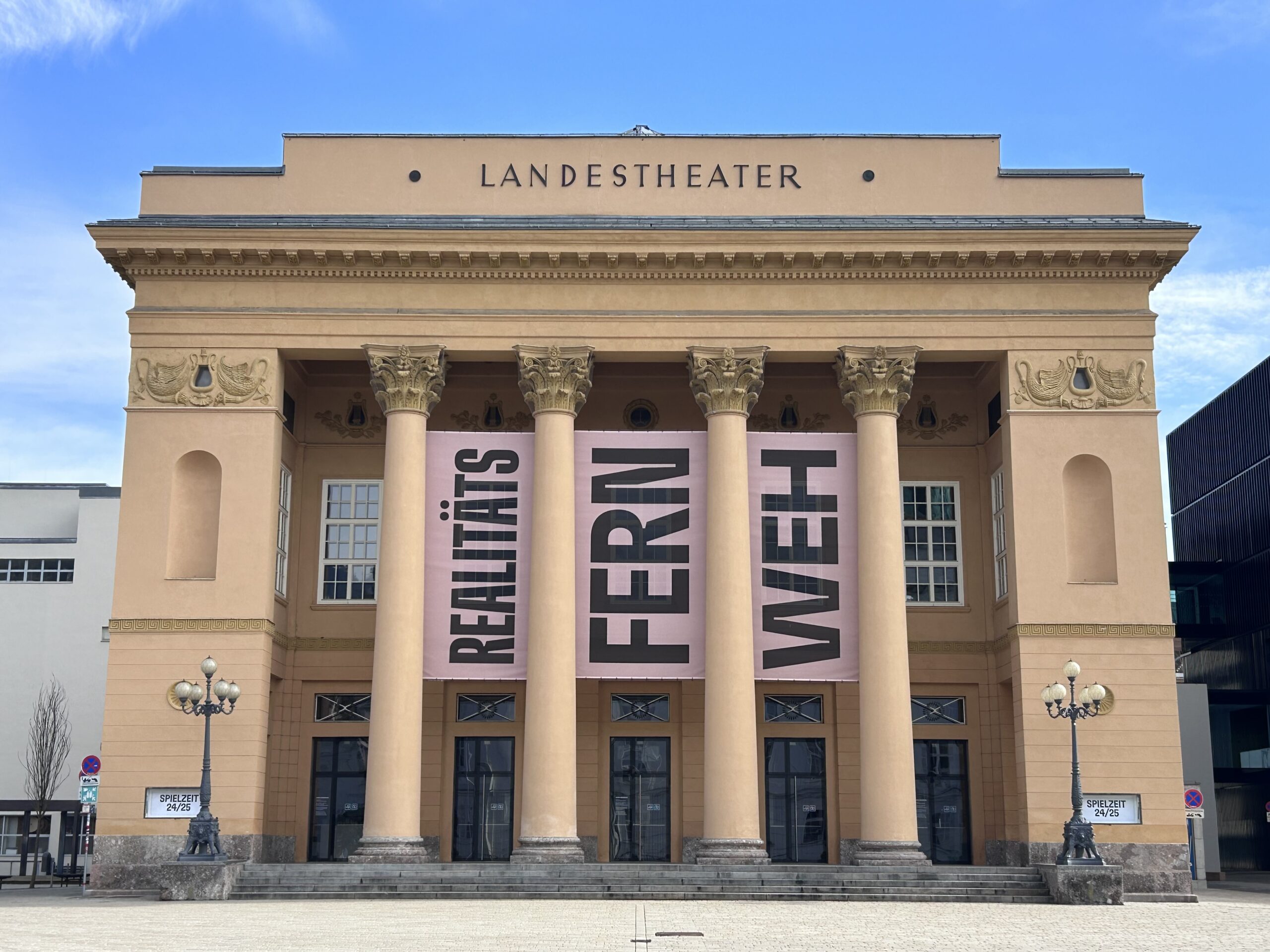
Tiroler Landestheater & Kongresshaus
Rennweg 3
Worth knowing
The area between the Hofburg and the Hofgarten was already used for entertainment during the time of Emperor Maximilian. Competitions and tournaments of all kinds took place at the racecourse. Innsbruck’s Renaissance prince preferred less sporting but more culturally appealing activities. Under Ferdinand II, the first city theatre was built in 1581 according to plans by court architect Alberto Lucchese, called the Comedihaus. The name is misleading. The plays performed under Jesuit direction were usually lengthy dramas in Latin, based on biblical themes or, in true Renaissance spirit, on antiquity. Theatre was intended to prepare the audience for confessional resistance against the looming coarsening brought by Protestantism and to maintain morale in the fight against the Ottoman threat to the Habsburg realm. For Emperor Ferdinand’s wedding in 1622, a play was staged with the memorable title: “Action of Ovinio Gallicono, who once defeated the Scythians after first converting to Christianity and thus winning the hand of Constantine’s daughter.” Those who preferred secular entertainment were not left out: alongside plays, dressage riding and water shows were also possible. Not only classical culture but also the principle of “bread and circuses” enjoyed great popularity during the Renaissance.
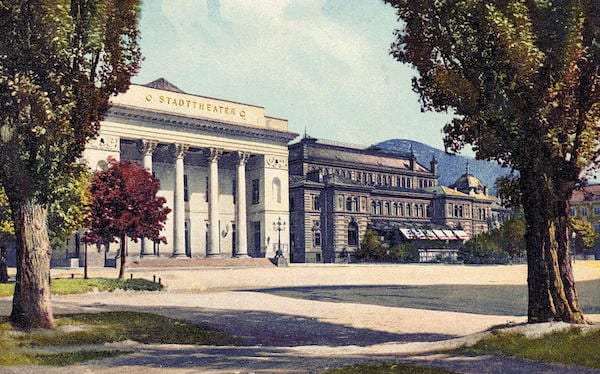
In 1630, Prince Leopold V converted a ball house into a court theatre. He and his wife Claudia de Medici, educated contemporaries of the 17th century, valued art and culture. Their residence city was to be up to date. Until then, theatres were usually travelling institutions moving from town to town, or local universities and grammar schools organised performances. Now, a permanent team was to amuse, educate, and instruct the court as needed. The court theatre was one of the first permanent opera and theatre houses in the Holy Roman Empire. The Jesuits and their pupils still led the productions, but the highlights were the Innsbruck horse ballet and the ladies’ ballet, which the princely couple even exported as cultural showcases to the imperial court in Vienna. The lavish spectacle did not last long, as financial hardship after the Thirty Years’ War was too great. Innsbruck was a small town with about 5,000 inhabitants, most of whom were neither interested in Jesuit baroque performances nor could afford to attend. In 1653, the oversized city theatre moved to the site of today’s Tyrolean State Theatre, opposite the Hofgarten. Christoph Gumpp planned to convert one of the former ball game houses into a smaller but more modern Comedihaus in Venetian style with only 1,000 seats.
Im 18. Jahrhundert ging die Zeit der exklusiv höfischen Theaterkultur zu Ende. Mit der Verbürgerlichung der Gesellschaft nahm das Showbusiness eine öffentliche Rolle ein. In Innsbruck war die Hochkultur und deren Deutung immer von den Macht- und Herrschaftsverhältnissen geprägt. 1765 unter Maria Theresia wurde das „Hoftheater" and under their son Josef, a supporter of the modern nation state, it was renovated into the Nationaltheater. In 1805, under Bavarian foreign rule, it was the "Königlich-Bayrische Hof-Nationaltheater“. During the period of nationalisation following the collapse of the Holy Roman Empire, the Hoftheater zum austrianisierten Nationaltheater. Nach den napoleonischen Kriegen gierten die kunstsinnigen Bürger Innsbrucks nach Unterhaltung, wie sie international üblich war. Dafür musste das alte Nationaltheater modern aus- und umgebaut werden. Das Landestheater in seinem aktuellen Aussehen wurde im 19. Jahrhundert vom italienischen Architekten Giuseppe Segusini (1801 – 1876) geplant. Segusini kam im von Napoleon besetzten Norditalien zur Welt. Seine Ausbildung absolvierte er während der habsburgischen Herrschaft in Venedig an der Accademia di Belle Arti. 1840 legte er einen Plan zum Umbau des Innsbrucker Hoftheaters vor. Der klassizistische Bau entstand vier Jahre später vor einem ähnlichen gesellschaftlichen Hintergrund wie das Ferdinandeum, für dessen Neubau Segusini ebenfalls Pläne vorlegte, aber nicht zum Zug kam. Ein großer Teil der Kosten wurde ganz im Geist der Zeit vom eigens dafür gegründeten Theaterverein der Stadt übernommen. Die Neueröffnung in seinem jetzigen Aussehen erfolgte am 19. April 1846, dem Geburtstag Kaisers Ferdinand I., einem der Stadt Innsbruck besonders gewogenen Monarchen. Die Form des Gebäudes ähnelt einem römischen Triumphbogen. Der wuchtige Eingangsbereich über Treppen wird von mächtigen Säulen gestützt. Heute wirkt das altehrwürdige Landestheater neben dem wuchtigen und modernen House of Music beinahe etwas verloren. Im Nationalsozialismus wurde aus dem Nationaltheater das „Reichsgautheater“, der Platz davor erhielt den Namen Adolf Hitler Square. Nach dem Krieg wurde es zum Tiroler Landestheater.
The former ball house on the opposite side of the street, today’s Congress Centre, served as the court riding school during the years when Tyrol had a sovereign prince. In 1776, in the spirit of rationalisation, it became a customs house. The centralisation under Maria Theresa and Joseph II required new infrastructure to accommodate officials for taxation. The name Dogana, Italian for customs, derives from this use. In the 19th century, the former administrative building hosted fairs and exhibitions, such as the Tyrolean State Exhibition of 1893. During the first air raids on Innsbruck in 1944, the Dogana suffered considerable damage. Unlike destroyed houses and churches, the congress centre was not high on the list of system-relevant buildings. For 25 years, the remains of the Dogana decayed to the foundations before work began on the ruin in the city centre. According to plans by architect Hubert Prachensky, a cubic building in the Brutalist style was constructed between 1970 and 1973, almost simultaneously with the four Mariahilfpark residential blocks. Both inside and outside, the congress centre appears bulky and blocky, softened only by newer building sections. Modern artworks inside include pieces by Rudi Wach, who also created the crucifix on the Inn Bridge. Since 2007, the new valley station of the Hungerburgbahn has been located next to the congress centre. In the spirit of a modern gladiator fight, which could have taken place at the racecourse in Maximilian’s time, the finish area between the theatre and the congress centre hosted the biggest sporting event since the Olympic Games with the 2018 Cycling World Championships.
Ferdinand II: Principe and Renaissance prince
Archduke Ferdinand II of Austria (1529–1595) ranks among the most colourful figures in Tyrolean regional history. His father, Emperor Ferdinand I, ensured that he received an excellent education. Ferdinand grew up at the Spanish court of his uncle, Emperor Charles V. The years of his formal education coincided with the early phase of Jesuit influence at the Habsburg courts. The young statesman was educated by these devout scholars entirely in the spirit of Christian humanism, complemented by instruction in the customs and etiquette of the High Renaissance aristocracy. In his youth, Ferdinand travelled extensively through Italy and Burgundy, where he became acquainted with a refined and luxurious courtly lifestyle that had not yet been established among the German aristocracy. He also spent several formative years in Innsbruck. Ferdinand was what one might today describe as a globetrotter, a member of the educational elite, or a cosmopolitan. He was regarded as intelligent, charming, and artistically inclined. Among contemporaries less enamoured of his eccentricity, however, he was reputed to be immoral and hedonistic. Even during his lifetime, rumours circulated that he hosted extravagant and indecent orgies. This reputation was likely connected to his private life. In a first, “semi‑morganatic” marriage, Ferdinand was wed to the commoner Philippine Welser. After the death of his first wife, Ferdinand married at the age of fifty‑three the deeply religious Anna Caterina Gonzaga, a sixteen‑year‑old princess of Mantua. Mutual affection between the two appears to have been limited, not least because Anna Caterina was Ferdinand’s niece. The Habsburgs were far less squeamish about marriages within the family than about unions between nobles and commoners. From this marriage, too, Ferdinand “only” fathered three daughters.
After the rarely Ferdinand I, Innsbruck once again gained a resident ruler. Ferdinand’s father divided his realm among his sons. Maximilian II, suspected by his parents of heresy and sympathy with Protestant doctrines, inherited Upper and Lower Austria as well as Bohemia and Hungary. Ferdinand’s younger brother Charles ruled Inner Austria—Carinthia, Styria, and Carniola. The middle son received Tyrol, which at the time extended as far as the Engadin, along with the fragmented Habsburg possessions west of the central European core lands. The golden age of silver mining in Tyrol was already fading. The mines of Schwaz were becoming unprofitable due to cheap silver imports from the Americas. The influx of precious metals from the Habsburg territories in New Spain led to inflation. These financial challenges did not deter Ferdinand from commissioning extensive public and private infrastructure projects. Innsbruck benefited enormously—economically and culturally—from once again becoming the seat of an active ruler after years of neglect following Maximilian’s death. Ferdinand’s archducal presence attracted aristocrats and officials back to the city. By the late 1560s, the administrative apparatus had grown once again to around one thousand people, whose spending stimulated local commerce. Bakers, butchers, and inns flourished after leaner years. By the end of the sixteenth century, Innsbruck had an above‑average number of taverns compared to other cities, profiting handsomely from merchants, travellers, and guests. Wine taverns also functioned as storage and trading centres.
The Italian cities of Florence, Venice and Milan were trendsetters in terms of culture, art and architecture. Ferdinand's Tyrolean court was to be in no way inferior to them. Gone were the days when Germans were considered uncivilised in the more beautiful cities south of the Alps, barbaric or even as Pigs were labelled. To this end, he had Innsbruck remodelled in the spirit of the Renaissance. In keeping with the trend of the time, he imitated the Italian aristocratic courts. Court architect Giovanni Lucchese assisted him in this endeavour. Ferdinand spent a considerable part of his life at Ambras Castle near Innsbruck, where he amassed one of the most valuable collections of works of art and armour in the world. Ferdinand transformed the castle above the village of Amras into a modern court. His parties, masked balls and parades were legendary. During the wedding of a nephew, he had 1800 calves and 130 oxen roasted. Wine is said to have flowed from the wells instead of water for 10 days.
The transformation of Innsbruck did not end with Ambras Castle. West of the city, an archway still commemorates Ferdinand’s game reserve, complete with a pleasure pavilion (Lusthaus), also designed by Lucchese. To allow the sovereign access to his weekend residence, a road was laid through the marshy Höttinger floodplains, forming the basis of today’s Kranebitter Allee. The Lusthaus was replaced in 1786 by the structure now known as the Powder Tower (Pulverturm), which today houses parts of the University of Innsbruck’s Faculty of Sport Science. In the city centre, Ferdinand commissioned the princely Comedihaus on today’s Rennweg. To improve Innsbruck’s water supply, the Mühlau Bridge was constructed, allowing water from the Mühlau stream to be channelled into the city. The Jesuits, who had arrived in Innsbruck shortly before Ferdinand’s accession to counter reformers and critics of the Church and to reorganise education, were granted a new church in Silbergasse. Numerous new buildings—including the monasteries of the Jesuits, Franciscans, Capuchins, and Servite nuns—stimulated crafts and construction. These new orders supported Ferdinand’s emphasis on the confessional conformity of his subjects. In the Tyrolean Provincial Ordinance of 1573, Ferdinand not only sought to curb fornication, profanity, and prostitution, but also obliged his subjects to live a God‑fearing—i.e. Catholic—life. The “Prohibition of Sorcery and Superstitious Divination” outlawed any deviation from the true faith under threat of imprisonment, corporal punishment, and confiscation of property. Jews were required to wear a clearly visible yellow ring on the left side of their clothing. At the same time, Ferdinand brought a Jewish financier to Innsbruck to manage the court’s complex finances. Samuel May and his family lived in the city as protected court Jews; Daniel Levi entertained the archduke with dance and harp music, while Elieser Lazarus served as his personal physician.
To live lavishly, tax the population heavily, tolerate Protestant advisers at court while suppressing Protestantism among the populace posed no contradiction for a Renaissance prince. Ferdinand saw himself as Advocatus Ecclesiae, the secular representative of the Church, responsible in an absolutist confessional sense for the salvation of his subjects’ souls. At the age of fifteen, he had already marched into battle with his uncle Charles V during the Schmalkaldic War against the enemies of the Roman Church. Coercive measures, the founding of churches and monasteries—such as those of the Franciscans and Capuchins in Innsbruck—improved pastoral care, and Jesuit theatrical productions like The Beheading of John were among the preferred weapons against Protestantism. Ferdinand’s piety was sincere, yet like most of his contemporaries he was adept at adapting to circumstances. His policies reflected the influence of contemporary Italian avant‑garde thought. Machiavelli’s Il Principe argued that rulers were permitted whatever was necessary for success—and could be deposed if they failed. Ferdinand II sought to embody this early absolutist style of leadership and, with his Provincial Ordinance, introduced a comparatively modern legal framework. For his subjects, however, this meant higher taxes, as well as significant restrictions on common land usage, fishing, and hunting rights. Miners, mining entrepreneurs, and foreign trading companies with their counting houses in Innsbruck further drove up food prices. In summary, while Ferdinand enjoyed exclusive hunting privileges on his estates, his subjects endured hardship caused by rising burdens, inflation, and game damage exacerbated by hunting bans. Owing largely to his architectural legacy, Ferdinand continues to enjoy a favourable reputation today. The eccentric archduke found his final resting place—fittingly according to his own tastes—in the Silver Chapel, beside his first wife, Philippine Welser.
Leopold V & Claudia de Medici: Glamour and splendour in Innsbruck
While the Thirty Years’ War was ravaging half of Europe, a charismatic princely couple set out to reshape the face of Innsbruck forever in the Baroque manner. The Habsburg who entered the history of the land as Leopold V (1586–1632) assumed sovereign governmental responsibilities in the Upper Austrian regency of Tyrol and the Further Austrian territories after turbulent early years. Unlike many firstborn members of his rank, his career had long appeared uncertain. In his youth he received the classical humanist education customary for young aristocrats, under the guidance of the Jesuits. In Graz and Judenburg he studied philosophy and theology in preparation for a career within the ecclesiastical sphere of power—an established path for younger sons with little prospect of secular thrones. Leopold’s early career within the power structures of the Church epitomised precisely those features of Catholicism rejected by Protestants and Church reformers. At the age of twelve he was elected Bishop of Passau; at thirteen he was appointed coadjutor of the Bishopric of Strasbourg in Lorraine. He never, however, received holy orders; the spiritual duties were carried out by a prince‑bishop appointed for that purpose. A passionate politician, Leopold travelled extensively between his dioceses and supported the imperial side during the conflict between Rudolf II and Matthias—later immortalised by Franz Grillparzer in Bruderzwist im Hause Habsburg. These activities, scarcely befitting a churchman, nonetheless preserved Leopold’s chances of attaining a secular princely title.
That opportunity arose in 1618, when the unmarried Maximilian III died childless. At the behest of his brother, Leopold assumed the role of Habsburg governor and ruler of the Upper and Further Austrian lands and their incorporated peoples and territories. In the early years of his regency he continued to shuttle between his bishoprics in southern and western Germany, threatened by the upheavals of the Thirty Years’ War. Although the ambitious power politician found satisfaction in the excitement of high politics, the status of governor did not suffice. He sought recognition as territorial prince, complete with homage and dynastic inheritance. What he lacked were a suitable bride, time, and money. Costly conflicts had depleted his coffers.
Money arrived with the bride—and with her, time. Claudia de’ Medici (1604–1648), from the wealthy Tuscan merchant‑princely dynasty, was selected to bestow dynastic fortune upon the aspiring territorial prince, now approaching forty. As a child, Claudia had already been promised to the Duke of Urbino, whom she married at seventeen, despite a proposal from Emperor Ferdinand II. Her husband died after only two years of marriage. The ties between the Medici and the Habsburgs remained intact. Since the marriage of Francesco de’ Medici to Johanna of Habsburg, a daughter of Ferdinand I, the two dynasties had been closely interwoven. Leopold and Claudia likewise proved a perfect match of title, power, Baroque piety, and wealth. Leopold’s sister Maria Magdalena, who as a Medici bride had become Grand Duchess of Tuscany, resided in Florence and sent her brother a painted portrait of the young widow, remarking that she was “beautiful in face, body, and virtue.” After a delicate dance of mutual conditions—the bride’s family seeking assurance of the groom’s title, while the Emperor required proof of a suitable marriage before granting the ducal dignity—the moment finally arrived. In 1625 Leopold, now raised to duke and well nourished and mature in years, relinquished his ecclesiastical possessions and titles in order to marry and, together with his nearly twenty‑years‑younger bride, found a new Tyrolean line of the House of Habsburg.
The relationship between the prince and the Italian woman was to characterise Innsbruck. The Medici had made a fortune from the cotton and textile trade, but above all from financial transactions, and had risen to political power. Under the Medici, Florence had become the cultural and financial centre of Europe, comparable to the New York of the 20th century or the Arab Emirates of the 21st century. The Florentine cathedral, which was commissioned by the powerful wool merchants' guild, was the most spectacular building in the world in terms of its design and size. Galileo Galilei was the first mathematician of Duke Cosimo II. In 1570, Cosimo de Medici was appointed the first Grand Duke of Tuscany by the Pope. Thanks to generous loans and donations, the Tuscan moneyed aristocracy became European aristocracy. In the 17th century, the city on the Arno had lost some of its political clout, but in cultural terms Florence was still the benchmark. Leopold did everything in his power to catapult his royal seat into this league.
In February 1622 the wedding celebrations of Emperor Ferdinand II and Eleonore of Mantua had taken place in Innsbruck; for the northern Italian bridal entourage Innsbruck was easier to reach than Vienna. Tyrol was religiously unified and had been spared the initial devastations of the Thirty Years’ War. Whereas the imperial wedding concluded within five days, Leopold and Claudia celebrated for two full weeks. Their official marriage ceremony had taken place in Florence Cathedral without the groom present. The subsequent festivities celebrating the Habsburg–Medici union became one of the most magnificent events in Innsbruck’s history, holding the city in thrall for a fortnight. After a wintry procession descending from the snow‑covered Brenner Pass, Innsbruck welcomed its new princess and her family. Prior to her arrival, the groom and his subjects had prayed for inner purification to seek divine blessing. Like the Emperor before them, the bridal couple entered the city in a grand procession through two specially erected gates. Fifteen hundred marksmen fired volleys from all their weapons. Drummers, pipers, and the bells of the Hofkirche accompanied the procession of 750 participants passing the astonished populace. A broad programme of entertainment—hunts, theatre, dances, music, and exotic spectacles including “bears, Turks, and Moors”—filled guests and townspeople alike with amazement and delight. From a modern perspective, one particularly inglorious attraction was the cat race, in which riders attempted to sever the head of a cat suspended by its legs as they galloped past.
Leopold’s early years of rule were far less glorious for his subjects. His policies were marked by frequent conflicts with the estates of the realm. A hardliner of the Counter‑Reformation, he supported imperial troops. The Lower Engadine, over which Leopold exercised jurisdiction, was a persistent source of unrest. Under the pretext of protecting Catholic subjects from Protestant attacks, Leopold occupied the region. Although he repeatedly suppressed uprisings successfully, the resources required drove both population and estates to the brink of despair. The northern border with Bavaria was likewise unstable and demanded Leopold’s attention as military commander. Duke Bernhard of Saxe‑Weimar had taken Füssen and was positioned at the Ehrenberg Pass on the Tyrolean frontier. Innsbruck was spared direct combat, but its proximity to the fronts nevertheless made it part of the Thirty Years’ War. Financially, Leopold funded these efforts through comprehensive tax reforms to the disadvantage of the middle classes. Wartime inflation, caused by disruptions in trade critical to Innsbruck, worsened living conditions. In 1622 a weather‑related crop failure further aggravated the situation, already strained by debt from earlier obligations. His insistence on enforcing modern Roman law across the territory, at the expense of traditional customary law, also earned him little affection among his subjects.
None of this prevented Leopold and Claudia from maintaining a splendid court in absolutist fashion. Under Leopold’s rule Innsbruck underwent extensive Baroque transformation. Court festivals attracted the European high nobility. Spectacles such as lion fights, featuring exotic animals from the ducal menagerie established by Ferdinand II in the Hofgarten, as well as theatre and concerts, served to entertain court society. The morals and manners of the rugged Alpine population were to be refined. It was a delicate balance between lavish court festivities and prohibitions on carnival celebrations for ordinary citizens. Divine wrath—manifest in plague and war—was to be averted through virtuous conduct. Swearing, shouting, and the carrying of firearms in public streets were prohibited. Pimps, prostitution, adultery, and moral decay were prosecuted rigorously at the pious court. Jews likewise faced harsh conditions under Leopold and Claudia. Long‑standing hostility towards the Hebrew population gave rise to one of the most disturbing traditions of Tyrolean piety. In 1642 Hippolyt Guarinoni, an Italian‑born physician at the Abbey of Hall and founder of the Karlskirche in Volders, composed the legend of the child martyr Anderle of Rinn. Inspired by the alleged ritual murder of Simon of Trent in 1475, Guarinoni wrote the Anderl‑Lied in verse. In Rinn near Innsbruck an antisemitic cult emerged around the remains of Andreas Oxner—supposedly murdered by Jews in 1462, a date revealed to Guarinoni in a dream. This cult was only banned in 1989 by the Bishop of Innsbruck. Innsbruck was not only morally but also physically “cleansed.” Waste, particularly problematic during dry periods when no water flowed through the canals, was regularly removed by princely decree. Livestock were forbidden to roam within the city walls. Memories of the recent plague epidemic remained vivid; foul smells and miasmas were to be eliminated at all cost.
Around the midpoint of the Thirty Years’ War, one of the most powerful women in Tyrolean history came to prominence. After Leopold’s early death, Claudia ruled the country on behalf of her minor son, together with her chancellor Wilhelm Biener (1590–1651), employing a modern, confessionally driven, early absolutist policy and a firm hand. She relied on an efficient administrative apparatus. The young widow surrounded herself with Italians and Italian‑speaking Tyroleans who introduced new ideas while displaying uncompromising severity in the fight against Lutheranism. To prevent fires—after the Lion House and Ferdinand II’s estate Ruhelust had burned down directly in front of the Hofburg in 1636—stables and other wooden buildings within the city walls were demolished. Silkworm breeding in Trentino and early considerations regarding a Tyrolean university flourished under Claudia’s regency. Chancellor Biener centralised parts of the administration, above all aiming to replace the fragmented legal systems of the Tyrolean territories with a uniform code. This required further curtailing the power of the often arbitrary local nobility in favour of the territorial prince. The system was intended to finance not only the expensive court but also territorial defence. It was not only Protestant troops from southern Germany that threatened the Habsburg lands. France—nominally a Catholic power—sought compensation at the expense of the Casa de Austria in Spain, Italy, and the Further Austrian territories, today’s Benelux countries. Innsbruck became one of the centres of the Habsburg war council. Situated at the fringes of the German battlefields and midway between Vienna and Tuscany, the city was an ideal meeting place for Austrians, Spaniards, and Italians alike. The notoriously brutal Swedish forces threatened Tyrol directly but were kept at bay. Fortifications protecting Tyrol were constructed through forced labour by unwanted inhabitants of the land—beggars, Roma, and deserters. Defensive works near Scharnitz on today’s German border were named Porta Claudia after the ruler. When Claudia de’ Medici died in 1648, around the conclusion of the Thirty Years’ War, events unfolded much as they did in England at almost the same time under Cromwell: the estates rose against the central authority. Claudia, who never learned the German vernacular and even after more than twenty years remained unfamiliar with local customs, had never been particularly popular. Nonetheless, her removal was unthinkable. The role of scapegoat passed to her chancellor. Wilhelm Biener, now persona non grata, was imprisoned by her successor Archduke Ferdinand Karl and the estates, and in 1651—like Charles I two years after a show trial—was beheaded.
A trace of Florence and the Medici still shapes Innsbruck today. The family coat of arms, with its red balls and lilies, can still be seen both in the Jesuit Church, where Claudia and Leopold were laid to rest, and in the parish church of Mariahilf. The Old Town Hall is also known as the Claudiana. Remains of the Porta Claudia near Scharnitz likewise survive. Leopold’s name is particularly associated with theatre in Innsbruck. The Leopold Fountain in front of the House of Music commemorates him. Anyone undertaking the ascent of the striking Serles mountain begins the hike at the monastery of Maria Waldrast, which Leopold devotedly founded in 1621—to the wondrous image of Our Beloved Lady at Waldrast—for the Servite Order, and which Claudia subsequently expanded. Chancellor Wilhelm Biener is commemorated by a street name in the Saggen district.
Theatres, country stages, cinemas & Kuno
The Tyrolean State Theatre, opposite the Imperial Palace, remains to this day the most striking monument to the city's educated middle-class evening entertainment. Since its existence began, however, this house of high culture has, for the most part, led a rather dreary existence when it comes to audience numbers. From Baroque plays centered on the suffering of Christ in the 16th century to daring productions nearly 500 years later that were often rewarded with little applause by audiences, activity at the State Theatre has always been the passion of a small elite. The majority of Innsbruck’s inhabitants, by contrast, spent their leisure time with more down-to-earth amusements. Travelling performers had already been welcome guests during the Middle Ages, although only under certain conditions. Just as today, public performances in earlier times were subject to strict censorship. What age restrictions for cinema films are today were once limitations placed on performances deemed displeasing to God, extending even to complete bans on theatre and acting under particularly devout provincial rulers. As society became increasingly bourgeois and moral attitudes more enlightened, these rules gradually became less restrictive. This marked the beginning of the institutionalization of theatre. According to its own records, the Pradl Farmers’ Theatre (Pradler Bauerntheater), the oldest folk theatre group in Innsbruck that still exists as an institution today, was founded in 1762. Although its first venue was an open-air stage in the Hötting meadows, and although craftsmen and students as well as farmers were part of the ensemble, this should not diminish either the honour of its name or its origins. While performances at the State Theatre were often staged before half-empty audiences, the amateur actors of the farmers’ theatre enjoyed great popularity with their comedies. Innsbruck residents of all social classes made weekend pilgrimages from the city to performance venues in the surrounding villages or enjoyed the evening entertainment in local inns. Especially popular were the so-called knights’ plays, featuring abducted princesses, heroic rescuers, and clumsy villains. Unlike the serious productions presented in bourgeois theatre, the performers of the farmers’ theatres interacted directly with the audience. Interjections from the spectators were not suppressed but spontaneously incorporated into the play. It could even happen that the audience, not always entirely sober, physically intervened in the action of the performance. In 1870, the Pradl Farmers’ Theatre moved into a hay barn at the Lodron Estate (Lodronischer Hof) on Egerdachstraße that had been converted into a stage. In 1898, the company even toured Vienna. By that time, Innsbruck already possessed a whole range of theatres and venues that entertained audiences with plays and music. In 1892, the Löwenhaus Stage (Löwenhaus-Bühne) opened on Rennweg, on the site where the Tyrolean regional ORF broadcasting centre is located today. The wooden building burned down in the late 1950s, just as state broadcasting was beginning its rise.
From the large number of theatre troupes, one particularly ambitious showman emerged. Ferdinand Exl (1875–1942) broke new ground with part of the Pradl Farmers’ Theatre (Pradler Bauerntheater). For a long time, the accepted wisdom had been: "Anyone who wants to go to a farmers’ theatre will not find what they are looking for in the theatre, and anyone who seeks not merely entertainment but literary inspiration in the theatre does not go to a farmers’ theatre." Exl recognized the trend of the times. Clerks and workers could not afford the exorbitant ticket prices of the State Theatre, nor did they wish to sit through lengthy Wagner operas or plays such as The Sorrows of Young Werther. Nevertheless, audiences did expect a certain level of quality in both content and performance. With the so-called literary folk plays by renowned local authors such as Ludwig Anzengruber, Franz Kranewitter, and Karl Schönherr, Exl succeeded in combining entertainment with artistic quality. Anzengruber summarized this development as follows:
Anzengruber's Tyroleans not only sing Schnaderhüpfel, platteln d'Schuh, swear like Croats and scuffle, but they are also people with a subtle psyche who have their own thoughts about various problems and develop their own philosophy.
The first play staged by Exl, The Priest of Kirchfeld (Der Pfarrer von Kirchfeld) by Ludwig Anzengruber, was performed in 1902 at the Österreichischer Hof in Wilten. In 1903, the Exl Stage (Exl Bühne) moved to the Adambräu brewery in Adamgasse. From 1904 to 1915, audience favourites such as Franz Kranewitter’s plays Michael Gaismair and Andre Hofer were performed at the Löwenhaus near the Court Garden (Hofgarten). In addition to theatrical productions, tourists were offered traditional Tyrolean entertainment, including zither performances and “genuine, lively Tyrolean Schuhplattler dancing.” In 1904, the company embarked on its first international tour, travelling to Switzerland and Germany. Both the press and audiences were enthusiastic about the nationalist-leaning plays, performed by sturdy Tyrolean young men and attractive young women. In 1910, Exl finally abandoned amateur status and, in addition to long-serving members of his own family and the Auer family, increasingly hired townspeople and professional actors. The First World War and the resulting travel restrictions put a stop to further touring activities. The troupe became part of the Innsbruck Municipal Theatre (Innsbrucker Stadttheater), whose audiences, during those difficult years, were also receptive to lighter entertainment. After the most difficult post-war years had passed, the company’s fortunes improved once again. Beginning in 1924, the Exl Stage performed regularly not only at the Municipal Theatre during the winter season but also at Vienna’s Raimund Theatre and the Vienna Comedy House (Wiener Komödienhaus). The political developments of the 1930s greatly benefited the German nationalist spirit that permeated many of the plays Exl brought to the stage. Exl had already joined the National Socialist German Workers’ Party (NSDAP), which was banned in Austria at the time, in 1933. Although Austria’s Christian Social corporative state prohibited the excessively German-nationalist troupe from performing, they received an even more enthusiastic reception during their tours in National Socialist Germany. In 1935, the Exl Stage performed Karl Schönherr’s play Faith and Homeland (Glaube und Heimat) in Berlin. The Berliner Morgenpost of 4 April 1935 described it as: “...art that flows from the depths of German folk culture and returns to the hearts of moved and grateful listeners.” Following Austria’s annexation by Nazi Germany in 1938 (Anschluss), Exl once again enjoyed favourable media attention in his homeland and was celebrated as: “...a counterweight to the completely Judaized, artistically Bolshevized theatre establishment...” In 1942, the founder of the Exl Stage passed away. His wife and son took over the company and, after the war, became part of the Tyrolean State Theatre. During the 1950s, the troupe enjoyed one final successful tour through both West and East Germany before the theatre company was dissolved in 1956.
Times had changed. Cinema killed the theatre star. Motion pictures shown in cinemas began to compete with the stage. Ferdinand Exl had foreseen this development early on. In 1912, his ensemble appeared in the French film Speckbacher, which portrayed the Tyrolean Uprising in a heroic light. The first motion picture had already flickered across a screen in Innsbruck’s Stadtsaal in 1896, only one year after the world’s first public film screenings, before a fascinated audience. Cinema quickly became part of everyday life for many people. In addition to silent films, audiences were shown newsreels that were considered politically desirable, especially during wartime and often served propagandistic purposes. In the following decades, cinemas sprang up like mushrooms. In 1909, a movie theatre opened at Maria-Theresien-Straße 10 and later moved to Maria-Theresien-Straße 37, where it became known as the Zentral. After the war it was transformed into a Nonstop Cinema, where visitors bought a ticket for a continuous programme of newsreels, cartoons, advertisements, and feature films that repeated in an endless cycle. In 1928, the Innsbruck Red Cross opened the Kammer-Lichtspiele cinema in Wilhelm-Greil-Straße in order to finance its new association headquarters. At Maria-Theresien-Straße 17 stood the Triumph, which survived under the name Central until the 1990s. The site now occupied by the youth centre Z6 was once home to the Forum Cinema. In 1933, the Löwenkino opened in Höttinger Gasse. In 1959, it moved as the Metropol into the protected historic Malfatti House opposite the Inn Bridge, where it still exists today. During the final phase of the Second World War, Innsbruck’s largest cinema auditorium opened its doors with the Laurin-Lichtspiele, located in the middle of the South Tyrolean settlement on Gumppstraße. Robert and Walter Kinigadner, two South Tyrolean optants who had already gained experience in the cinema business in Brixen (Bressanone), took over operations of the hall, which could seat 800 viewers. Harmless homeland films alternated with National Socialist propaganda productions. The Exl Stage also used the Laurin, which served as a theatre venue until the 1970s, for theatrical performances. Today, a supermarket occupies the space behind the columns of what was once the building’s grand entrance. Above the checkout area, visitors can still see murals depicting the legend of the mythical dwarf king Laurin and the Germanic hero Dietrich von Bern, executed in the characteristic style of National Socialist art. In 1958, the Leokino opened in the premises of the former Catholic Workers’ Association (Katholischer Arbeiterverein). It remains in operation to this day and is a permanent fixture of Innsbruck’s film scene. At their peak in 1958, Innsbruck’s cinemas recorded an astonishing 3.5 million tickets sold. The most popular films were homeland movies and light-hearted comedies such as Sissi starring Romy Schneider and The White Horse Inn (Im Weißen Rössl) starring Peter Alexander. In the 1970s, cinema also assumed a role in public enlightenment when bare breasts first appeared on the screen. Films such as Schoolgirl Report (Schulmädchen-Report) and Josefine Mutzenbacher brought the sexual revolution a little closer to the people of Tyrol as well.
These moral transgressions came at a time when cinema had already begun to pass the peak of its economic success. The television set in the living room was starting to provide both information and evening entertainment. When the Austrian Broadcasting Corporation (Österreichischer Rundfunk, ORF) began operations in 1955, hardly anyone yet owned a television set capable of receiving its rather limited programming. That was to change quickly. The audience figures achieved during the post-war period have never been surpassed. From the long list of cinemas that once existed, only a trio remains. The Metropol, housed in the historic Malfatti House (Malfattihaus), attracts audiences with blockbuster films, while the Cinematograph and the Leokino cater to a more alternative crowd. Every August, an open-air cinema takes place at the Zeughaus (the former armoury). Of the many folk theatres, the Pradl troupe has survived to this day, albeit under a new name. In 1958, they found a new home at the cultural inn Bierstindl. The amateur troupe Innsbrucker Ritterspiele (Innsbruck Knights’ Plays) continues to enjoy immense popularity and regularly performs to full houses. The play The Villainous Kuno of Drachenfels (Der Schurkische Kuno von Drachenfels) revives the traditions of past centuries every year, complete with the repeated beheading scene and humorous interaction with the audience. The Landhaus Alpenheim in the Saggen district, now better known as Villa Exl, where the Exl family once lived, is a notable example of Tyrolean vernacular architecture. It features murals by Raphael Thaler and is well worth a visit. Ferdinand Exl is also commemorated by a street bearing his name in the Höttinger Au district. The times had changed. Folk theatre, once a central form of popular entertainment, had to compete first with cinema and later with television. Yet despite these transformations, elements of Innsbruck’s theatrical tradition have endured. While the grand touring companies and the multitude of cinemas have largely disappeared, institutions such as the Leokino, the Metropol, and the successors of the Pradl Farmers’ Theatre continue to preserve and reinterpret a cultural heritage that stretches back centuries.
Romance, sunless summers and apology cards
Thanks to the university, its professors and the young people it attracted and produced, Innsbruck also sniffed the morning air of the Enlightenment in the 18th century in the era of Maria Theresa, even if the Jesuit faculty leadership put the brakes on it. 1741 saw the founding of the Societas Academica Litteraria a circle of scholars in the Taxispalais. The masonic lodge was founded in 1777 To the three mountains, four years later, the Tyrolean Society for Arts and Science was founded. The spirit of reason in the time of Maria Theresa and Emperor Joseph also found its way into Innsbruck's elite. Spurred on by the French Revolution, some students even declared their allegiance to the Jacobins. Under Emperor Franz, all these associations were banned and strictly monitored after the declaration of war on France in 1794. Enlightenment ideas were frowned upon by large sections of the population even before the French Revolution. At the latest after the beheading of Marie Antoinette, the Emperor's sister, and the outbreak of war between the French Republic and the monarchies of Europe, they were considered dangerous. Who wanted to be considered a Jacobin when it came to defending their homeland?
After the Napoleonic Wars, Innsbruck was slow to recover, both economically and mentally. Adalbert Stifter (1805 -1868), probably the most famous writer of Austrian Romanticism, described Innsbruck in the 1830s in his travelogue Tyrol and Vorarlberg as follows:
„The inns were bad, the pavements wretched, long gutters overhung the narrow streets, which were bordered on both sides by dull arches... the beautiful banks of the Inn were unpaved, but covered with heaps of rubbish and criss-crossed by cesspools.“
Die kleine Stadt am Rande des Kaiserreiches hatte etwas mehr als 12.000 Einwohner, „ohne die Soldaten, Studenten und Fremden zu rechnen“. University, grammar school, Reading casino, music club, theatre and museum were evidence of a developing, modern urban culture. There was a Deutsches Kaffeehaus, a Restoration in the courtyard garden and several traditional inns such as the White cross, the Österreichischen Hofwhich Grape, das Katzung, das Mouthingeach of which Goldenen Adler, Stern und Hirsch. After 1830, the open sewers were blocked and made more hygienic, roads were repaired and bridges renovated. The overdue straightening and taming of the Inn and Sill rivers, which had begun before the turmoil of war, was also tackled. The biggest innovation for the population came in 1830, when oil lamps lit up the town at night. It was probably just a dim twilight created by the more than 150 lamps mounted on pillars and arm chandeliers, but for contemporaries it was a true revolution.
Die bayerische Besatzung war verschwunden, die Ideen der Denker der Aufklärung und der Französischen Revolution hatten sich aber in einigen Köpfen des städtischen Milieus verfangen. Natürlich waren es keine atheistischen, sozialistischen oder gar umstürzlerischen Gedanken, die sich breit machten. Es ging vor allem um wirtschaftliche, politische und gesellschaftliche Teilhabe des Bürgertums. Das Vereinswesen feierte eine Renaissance. Was heute wenig spektakulär klingt, war zur Regierungszeit Metternichs aufsehenerregend. Zwischen dem Beginn der Napoleonischen Kriege mit dem revolutionären Frankreich 1797 und dem Wiener Kongress waren Vereine allgemein verboten gewesen. Wer auf sich hielt, trat nun einer dieser neuartigen Gesellschaften bei. "Innsbruck has a music society, an agricultural society and a mining and geological society." stand etwa im Reiseführer Beda Webers wie ein Qualitätssiegel für die Stadt zu lesen. Es galt das tugendhafte Miteinander zum Wohl der weniger Begüterten und die Erziehung der Massen mit dem Treiben in den Vereinen zu forcieren. Wissenschaft, Literatur, Theater und Musik, aber auch Initiativen wie der Innsbruck Beautification Association, but also practical institutions such as the voluntary fire brigade established themselves as pillars of a previously unknown civil society. One of the first associations to be formed was the Innsbruck Music Society, from which the Tyrolean State Conservatory emerged. In keeping with the spirit of the times, men and women were not members of the same organisations. Women were mainly involved in charitable organisations such as the Women's association for the promotion of infant care centres and female industrial schools. Female participation in the political discourse was not desired.
In addition to Christian charity, a thirst for recognition and prestige were probably also major incentives for members to get involved in the clubs. People met to see and be seen. Good deeds, demonstrating education and leading a virtuous life were then, as now, the best PR for oneself.
Club life also served as entertainment on long evenings without electric light, television and the internet. Students, civil servants, members of the lower nobility and academics met in the pubs and coffee houses to exchange ideas. This was not only about highly intellectual and abstract matters, but also about profane realpolitik such as the suspension of internal tariffs, which made people's lives unnecessarily expensive. Culturally, the bourgeois educated elite in the Romantic and Biedermeier periods discovered the cultural escape into an intact past for themselves. After decades of political confusion, war and hardship, people wanted a distraction from the recent past, just as they did after 1945. Antiquity and its thinkers celebrated a second renaissance in Innsbruck, as in the rest of Europe. Romantic thinkers of the 18th and early 19th centuries such as Winckelmann, Lessing and Hegel were influential. The Greeks were „Noble simplicity and quiet greatness" attested. Goethe wanted the "Search the land of the Greeks with your soul" and travelled to Italy in search of his longing for the good, pre-Christian times in which the people of the Golden Age cultivated an informal relationship with their gods. Roman Stoic virtues were transported into the modern age as role models and formed the basis for bourgeois frugality and patriotism, which became very fashionable. Philologists combed through the texts of ancient writers and philosophers and conveyed a pleasing "Best of" into the 19th century. Columns, sphinxes, busts and statues with classical proportions adorned palaces, administrative buildings and museums such as the Ferdinandeum. Students and intellectuals such as the Briton Lord Byron were so inspired by the Panhellenism and the idea of nationalism that they risked their lives in the Greek struggle for independence against the Ottoman Empire. After the end of the Holy Roman Empire, Pan-Germanism became the political fashion of the liberal bourgeoisie in Innsbruck.
Kanzler Clemens von Metternichs (1773 – 1859) Polizeistaat hielt diese gesellschaftlichen Regungen lange Zeit unter Kontrolle. Zeitungen, Flugblätter, Schriften mussten sich an die Vorgaben der strengen Zensur anpassen oder im Untergrund verbreitet werden. Autoren wie Hermann von Gilm (1812 – 1864) und Johann Senn (1792 – 1857), an beide erinnern heute Straßen in Innsbruck, verbreiteten in Tirol anonym politisch motivierte Literatur. Der vielleicht bekannteste Public Intellectual des Vormärz war wahrscheinlich Adolf Pichler (1819 – 1900), dem bereits kurz nach seinem Ableben unter gänzlich anderen Vorzeichen in der Stadtpolitik der späten Monarchie ein Denkmal gewidmet wurde und nach dem heute das Bundesrealgymnasium am gleichnamigen Platz gewidmet ist. Bücher und Vereine standen unter Generalverdacht. Der Innsbrucker Musikverein lehrte im Rahmen seiner Ausbildung auch die Deklamation, das Vortragen von Texten, Musik und Reden, die Inhalte wurden von der Obrigkeit streng überwacht. Alle Arten von Vereinen wie die Innsbrucker Liedertafel and student fraternities, even the members of the Ferdinandeum were spied on. The social movements forming in the working-class neighbourhoods were particularly targeted by Metternich's secret police. Despite their demonstrative loyalty to the emperor, the marksmen were also on the list of institutions to be observed. They were considered too rebellious, not only towards foreign powers, but also towards the Viennese central government. The mix of Greater German nationalist ideas and Tyrolean patriotism presented with the pathos of Romanticism seems strangely harmless today, but was neither comfortable nor acceptable to the Metternich state apparatus.
However, political activism was a marginal phenomenon that only occupied a small elite. After the mines and salt works had lost their profitability in the 17th century and transit lost its economic importance due to the new trade routes across the Atlantic, Tyrol had become a poor region. The Napoleonic Wars had raged for over 20 years. The year 1809 went down as Tyrolean heroic age in the historiography of the 19th and early 20th centuries, the consequences of heroism were barely highlighted. Although the Austrian Empire was one of the victorious powers after the Congress of Vienna, its economic situation was miserable. As after the world wars of the 20th century, many men had not returned home during the coalition wars. The university, which drew young aristocrats into the city's economic cycle, was not reopened until 1826. Unlike industrial locations in Bohemia, Moravia, Prussia or England, the hard-to-reach city in the Alps was only just beginning to develop into a modern labour market. Tourism was also still in its infancy and was not a Cash Cow. It is no wonder that hardly any buildings in the Biedermeier style have survived in Innsbruck. And then there was a volcano on the other side of the world that had an undue influence on the fate of the city of Innsbruck. In 1815, Tambora erupted in Indonesia and sent a huge cloud of dust, sulphur and ash around the world. In 1816 Year without summer into history. All over Europe, there were freak weather conditions, floods and failed harvests. The Alps, an already difficult part of the world to farm, were not exempt from this.
The economic upheavals and price increases led to hardship and misery, especially among the poorer sections of the population. In the 19th century, caring for the poor was a task for the communities, usually with the support of wealthy citizens as patrons with the idea of Christian charity. The state, the community, the church and the newly emerging civil society in the form of associations began to look after the welfare of the poorest sections of the population. Charity concerts, collections and appeals for donations were organised. The measures often contained an enlightened component, even if the means to an end seem strange and alien today. In Innsbruck, for example, a begging ordinance came into force that banned dispossessed people from marrying. Almost 1000 citizens were categorised as alms recipients and beggars.
As the need grew and the city coffers became emptier, Innsbruck came up with an innovation that was to last for over 100 years: The New Year's apology card. Even back then, it was customary to visit relatives on the first day of the year to give each other a Happy New Year to make a wish. It was also customary for needy families and beggars to knock on the doors of wealthy citizens to ask for alms at New Year. The introduction of the New Year's relief card killed several birds with one stone. The buyers of the card were able to institutionalise and support their poorer members in a regulated way, similar to the way street newspapers are bought today. Twenty is possible. At the same time, the New Year's apology card served as a way of avoiding the unpopular obligatory visits to relatives. Those who hung the card on their front door also signalled to those in need that no further requests for alms were necessary, as they had already paid their contribution. Last but not least, the noble donors were also favourably mentioned in the media so that everyone could see how much they cared for their less fortunate fellow human beings in the name of charity.
The New Year's apology cards were a complete success. At their premiere at the turn of the year from 1819 to 1820, 600 were sold. Many communities adopted the Innsbruck recipe. In the magazine "The Imperial and Royal Privileged Bothe of and for Tyrol and Vorarlberg", the proceeds for Bruneck, Bozen, Trient, Rovereto, Schwaz, Imst, Bregenz and Innsbruck were published on 12 February. Other institutions such as fire brigades and associations also adopted the well-functioning custom to raise funds for their cause. The construction of the new Höttinger parish church was financed to a large extent from the proceeds of specially issued apology cards in addition to donations. The varied designs ranged from Christian motifs to portraits of well-known personalities, official buildings, new buildings, sights and curiosities. Many of the designs can still be seen in the Innsbruck City Archives.
The master builders Gumpp and the baroqueisation of Innsbruck
The works of the Gumpp family still strongly characterise the appearance of Innsbruck today. The baroque parts of the city in particular can be traced back to them. The founder of the dynasty in Tyrol, Christoph Gumpp (1600-1672), was actually a carpenter. However, his talent had chosen him for higher honours. The profession of architect or artist did not yet exist at that time; even Michelangelo and Leonardo da Vinci were considered craftsmen. After working on the Holy Trinity Church, the Swabian-born Gumpp followed in the footsteps of the Italian master builders who had set the tone under Ferdinand II. At the behest of Leopold V, Gumpp travelled to Italy to study theatre buildings and to learn from his contemporary style-setting colleagues his expertise for the planned royal palace. Comedihaus aufzupolieren. Seine offizielle Tätigkeit als Hofbaumeister begann 1633. Neue Zeiten bedurften eines neuen Designs, abseits des architektonisch von der Gotik geprägten Mittelalters und den Schrecken des Dreißigjährigen Krieges. Über die folgenden Jahrzehnte wurde Innsbruck unter der Regentschaft Claudia de Medicis einer kompletten Renovierung unterzogen. Gumpp vererbte seinen Titel an die nächsten beiden Generationen innerhalb der Familie weiter. Die Gumpps traten nicht nur als Baumeister in Erscheinung. Sie waren Tischler, Maler, Kupferstecher und Architekten, was ihnen erlaubte, ähnlich der Bewegung der Tiroler Moderne rund um Franz Baumann und Clemens Holzmeister Anfang des 20. Jahrhunderts, Projekte ganzheitlich umzusetzen. Auch bei der Errichtung der Schanzwerke zur Landesverteidigung während des Dreißigjährigen Krieges waren sie als Planer beteiligt. Christoph Gumpps Meisterstück aber war die Errichtung des Comedihaus im ehemaligen Ballhaus. Die überdimensionierten Maße des damals richtungsweisenden Theaters, das in Europa zu den ersten seiner Art überhaupt gehörte, erlaubte nicht nur die Aufführung von Theaterstücken, sondern auch Wasserspiele mit echten Schiffen und aufwändige Pferdeballettaufführungen. Das Comedihaus war ein Gesamtkunstwerk an und für sich, das in seiner damaligen Bedeutung wohl mit dem Festspielhaus in Bayreuth des 19. Jahrhunderts oder der Elbphilharmonie in Hamburg heute verglichen werden muss.
His descendants Johann Martin Gumpp the Elder, Georg Anton Gumpp and Johann Martin Gumpp the Younger were responsible for many of the buildings that still characterise the townscape today. The Wilten collegiate church, the Mariahilfkirche, the Johanneskirche and the Spitalskirche were all designed by the Gumpps. In addition to designing churches and their work as court architects, they also made a name for themselves as planners of secular buildings. Many of Innsbruck's town houses and city palaces, such as the Taxispalais or the Altes Landhaus in Maria-Theresien-Straße, were designed by them. With the loss of the city's status as a royal seat, the magnificent large-scale commissions declined and with them the fame of the Gumpp family. Their former home is now home to the Munding confectionery in the historic city centre. In the Pradl district, Gumppstraße commemorates the Innsbruck dynasty of master builders.
Baroque: art movement and art of living
Anyone traveling through Austria is familiar with the domes and onion-shaped towers of churches in towns and villages. They are the characteristic hallmark of the Baroque architectural style, which reached its peak during the Counter-Reformation and continues to shape the cityscape of Innsbruck to this day. The most prominent churches—such as the Cathedral, St. John’s Church, or the Jesuit Church—are built in the Baroque style. Places of worship were meant to be splendid and magnificent, symbols of the triumph of the true faith. The exuberant, all-encompassing piety of elites and subjects alike was reflected in art and culture: great drama, pathos, suffering, splendor, and glory combined to form the Baroque—a style that left a lasting imprint on the entire Catholic sphere of influence of the Habsburgs and their allies between Spain and Hungary. From the seventeenth century onward, the Gumpp family of master builders and Johann Georg Fischer fundamentally transformed Innsbruck’s cityscape. The Old Provincial Government Building in the Old Town, the New Provincial Government Building on Maria-Theresien-Strasse, countless palazzi, paintings, and sculptures—the Baroque was the defining stylistic force of the House of Habsburg in the seventeenth and eighteenth centuries and became embedded in everyday life. The bourgeoisie did not wish to lag behind the nobility and princes and therefore had their private residences built in the Baroque style as well. Farmhouses were adorned with images of saints, depictions of the Virgin Mary, and representations of the Sacred Heart of Jesus.
Yet the Baroque was more than an architectural style; it was a way of life that emerged in the aftermath of the Thirty Years’ War. The Ottoman threat from the east, culminating in the two sieges of Vienna, dominated the empire’s foreign policy, while the Reformation shaped domestic affairs. Baroque culture became a central element of Catholicism and its political self-representation in public space—a countermodel to the austere and rigorous way of life advocated by Calvin and Luther. Christian holidays were introduced to brighten everyday life. Architecture, music, and painting were rich, full, and exuberant. In theatres such as the Comedihaus in Innsbruck, dramas with religious themes were performed. Ways of the Cross with chapels and representations of the crucified Christ crisscrossed the landscape. Popular piety, expressed through pilgrimages and the veneration of Mary and the saints, became firmly embedded in everyday church life. Multiple crises shaped daily existence. In addition to war and famine, plague epidemics occurred particularly frequently in the seventeenth century. Baroque piety was used as a means of educating subjects, teaching them to interpret these calamities as expressions of God’s dissatisfaction—misfortunes that could be remedied through a devout and virtuous way of life. Although the sale of indulgences was no longer common practice in the Catholic Church after the sixteenth century, vivid notions of heaven and hell persisted. Through a virtuous life—that is, living in accordance with Catholic values and displaying proper conduct as a subject within the divine order—one could come significantly closer to paradise. So-called Christian devotional literature became the most popular reading material following the educational reforms of the eighteenth century and the rising literacy of the population. The suffering of the Crucified for humanity was regarded as a symbol of the hardship endured by subjects on earth within the feudal system. Through votive paintings, people sought assistance in times of hardship or expressed gratitude—most often to the Virgin Mary—for surviving dangers and illnesses. Particularly impressive votive paintings can be admired in the Wilten Basilica. The historian Ernst Hanisch described the Baroque and its influence on the Austrian way of life as follows:
“Austria emerged in its modern form as a crusading imperialism—externally against the Turks and internally against the Reformers. This brought bureaucracy and the military, and externally a multiethnic society. State and Church attempted to control the intimate sphere of citizens’ lives. Everyone had to reform themselves through the confessional; sexuality was restricted, norm-compliant sexuality enforced. People were systematically trained to dissemble.”
Rituals and submissive behavior toward authority left deep traces in everyday culture, distinguishing Catholic countries such as Austria and Italy to this day from Protestant-influenced regions such as Germany, England, or Scandinavia. Austrians’ passion for academic titles has its roots in Baroque hierarchies. The term Baroque prince refers to a particularly patriarchal and patronizing politician who knows how to captivate an audience with grand gestures. While political sobriety is valued in Germany, the style of Austrian politicians remains theatrical—entirely in keeping with the Austrian adage “Schaumamal” (“let’s see”).
Innsbruck and National Socialism
In den 1920er und 30er wuchs und gedieh die NSDAP auch in Tirol. Die erste Ortsgruppe Innsbrucks wurde bereits 1923 gegründet. Mit „Der Nationalsozialist - Combat Gazette for Tyrol and Vorarlberg“ erschien ein eigenes Wochenblatt. 1933 erlebte die NSDAP mit dem Rückenwind aus Deutschland auch in Innsbruck einen kometenhaften Aufstieg. Die Modernität der und die Aufstiegsmöglichkeiten, die sie bot, sprach junge, ambitionierte Menschen an. Das Neue, das Aufräumen mit alten Hierarchien und Strukturen wie der katholischen Kirche und der allgemeine Um- und Aufbruch in eine neue Zeit waren mächtige Anziehungsfaktoren. Arbeiter, Angestellte und Unternehmer gleichermaßen sehnten sich nach dem Wirtschaftsaufschwung auch für das schwächelnde Österreich, der in Deutschland die Arbeitslosenzahlen massiv reduziert hatte. Akademiker hingegen sahen sich in der großdeutschen Zukunft dem politischen Ziel ihrer Träume entgegengehen. Die demokratische Republik war konservativen Eliten ein Gräuel. Wer bereits oben war, sehnte sich nach den Zeiten vor dem allgemeinen Wahlrecht zurück, als Sozialdemokraten noch nichts zu melden hatten. Dazu versprach der neue „deutsche Volkskörper“ den vielen auf der Strecke gebliebenen Menschen eine glanzvolle Zukunft in einer egalitären Gemeinschaft ähnlich den Sozialdemokraten. Das Versprechen, die deutschsprachigen Südtiroler Home to the realm zu holen und damit das Unrecht der Brennergrenze auszumerzen wurde von allen gerne gehört. Konnten die Nationalsozialisten bei ihrem ersten Antreten bei der Innsbrucker Gemeinderatswahl 1921 nur 2,8% der Stimmen erringen, waren es bei den Wahlen 1933 bereits 41%. Nicht nur die Wahl Hitlers zum Reichskanzler in Deutschland, auch Kampagnen, Fackelzüge, Spendenaktionen und Events aller Art verhalfen der ab 1934 in Österreich verbotenen Partei zu diesem Ergebnis. Neun Mandatare, darunter der spätere Innsbrucker Bürgermeister Egon Denz und Gauleiter Franz Hofer, zogen in den Gemeinderat ein.
Als der Anschluss Österreichs an Deutschland im März 1938 erfolgte, kam es in Innsbruck zu bürgerkriegsähnlichen Szenen. Über 1800 Innsbrucker waren Mitglied der SA, die ihr Quartier in der Bürgerstraße 10 hatte. Bereits im Vorfeld des Einmarsches war es immer wieder zu Aufmärschen und Kundgebungen der Nationalsozialisten gekommen, nachdem das Verbot der Partei aufgehoben worden war. Noch bevor Bundeskanzler Schuschnigg seine letzte Rede an das Volk vor der Machtübergabe an die Nationalsozialisten mit den Worten „God bless Austria“ am 11. März 1938 geschlossen hatte, rotteten sich bereits die Nationalsozialisten in der Innenstadt zusammen um den Einmarsch der deutschen Truppen vorzufeiern. Die Polizei war dem Aufruhr der organisierten Manifestationen teils gewogen, teils stand sie dem Treiben machtlos gegenüber. Landhaus und Maria-Theresien-Straße wurden zwar abgeriegelt und mit Maschinengewehrständen gesichert, an ein Durchgreifen seitens der Exekutive war aber nicht zu denken. „One people - one empire - one leader“ und das Horst-Wessel-Lied hallten durch die Stadt. Die Bedrohung des deutschen Militärs und der Aufmarsch von SA-Truppen beseitigten die letzten Zweifel. Mehr und mehr schloss sich die begeisterte Bevölkerung an. Am Tiroler Landhaus, damals noch in der Maria-Theresienstraße, sowie im provisorischen Hauptquartier der Nationalsozialisten im Gasthaus Old Innsprugg, wurde die Hakenkreuzfahne gehisst. Der Putsch, samt Festnahme amtsbekannter Unruhestifter und offiziellem Wechsel politischer Amtsträger geschah über Nacht. Am 12. März empfingen Tausende Innsbrucker das deutsche Militär frenetisch. Um die demonstrative Gastfreundschaft gegenüber den Nationalsozialisten sicherzustellen, ließ der neue Bürgermeister Egon Denz jedem Arbeiter einen Wochenlohn auszahlen. Am 5. April besuchte Adolf Hitler persönlich Innsbruck, um sich von einer euphorischen Menschenmenge als heilsversprechender Führer feiern zu lassen. Auf der Nordkette wurden Bergfeuer in Hakenkreuzform entzündet. Die Volksbefragung am 10. April ergab eine Zustimmung von über 99% zum Anschluss Österreichs an Deutschland. Die Menschen waren nach der wirtschaftlichen Not der Zwischenkriegszeit, der Wirtschaftskrise und den Regierungen unter Dollfuß und Schuschnigg müde und wollten Veränderung. Welche Art von Veränderung, war im ersten Moment weniger wichtig als die Veränderung an und für sich. Wehrmacht und Industrie boten jungen Menschen eine Perspektive, auch denen, die mit der Ideologie des Nationalsozialismus an und für sich wenig anfangen konnten. Die Arbeitslosenquote sank nach dem Anschluss tatsächlich rapide von knapp 25 auf unter drei Prozent. Dass es immer wieder zu Gewaltausbrüchen kam, war für die Zwischenkriegszeit in Österreich ohnehin nicht unüblich. Anders als heute war Demokratie nichts, woran sich jemand in der kurzen, von politischen Extremen geprägten Zeit zwischen der Monarchie 1918 bis zur Ausschaltung des Parlaments unter Dollfuß 1933 hätte gewöhnen können. Was faktisch nicht in den Köpfen der Bevölkerung existiert, muss man nicht abschaffen.
Tirol und Vorarlberg wurden in einem Reichsgau zusammengefasst mit Innsbruck als Hauptstadt. Auch wenn der Nationalsozialismus von einem guten Teil der Bevölkerung mit der Zeit immer skeptischer gesehen wurde, gab es kaum organisierten oder gar bewaffneten Widerstand, dazu waren der katholische Widerstand OE5 und die Linke in Tirol nicht stark genug. Unorganisiertes subversives Verhalten der Bevölkerung, vor allem in den Landgemeinden rund um Innsbruck gab es vereinzelt. Zu allumfassend dominierte der Machtapparat den Alltag der Menschen. Viele Arbeitsstellen und sonstige Annehmlichkeiten des Lebens waren an eine zumindest äußerlich parteitreue Gesinnung gebunden. Eine Inhaftierung blieb dem größten Teil der Bevölkerung zwar erspart, die Angst davor war aber allgegenwärtig. Das Regime unter Hofer und Gestapochef Werner Hilliges leistete ganze Arbeit bei der Unterdrückung. Regimegegner Nummer eins war der Klerus, die katholische Kirche wurde deshalb auf allen Ebenen bekämpft. Katholische Schulen wurden umfunktioniert, Jugendorganisationen und Vereine verboten, Klöster geschlossen, der Religionsunterricht abgeschafft und eine Kirchensteuer eingeführt. Besonders hartnäckige Pfarrer wie Otto Neururer wurden in Konzentrationslager gebracht. Auch Lokalpolitiker wie die späteren Innsbrucker Bürgermeister Franz Greiter und Anton Melzer, der im Ersten Weltkrieg für Gott, Kaiser und Vaterland einen Arm verloren hatte, mussten flüchten oder wurden verhaftet. Gewalt und die Verbrechen an der jüdischen Bevölkerung, dem Klerus, politisch Verdächtigen, Zivilpersonen und Kriegsgefangenen auch nur überblicksmäßig zusammenzufassen würde den Rahmen sprengen. In der Klinik Innsbruck wurden Behinderte und vom System als nicht genehm empfundene Menschen wie Homosexuelle zwangssterilisiert. 1941 wurde in der Rossau in der Nähe des Bauhofs Innsbruck das Arbeitslager Reichenau errichtet. Etwa 120 Personen fanden in diesem Barackenlager den Tod durch Krankheit, die schlechten Bedingungen, Arbeitsunfälle oder Hinrichtungen. Die meist jüdischen, russischen oder italienischen Zwangsarbeiter wurden in den Messerschmitt Werken in Kematen und auf den vielen Baustellen wie der Errichtung der South Tyrolean settlements oder der Stollen zum Schutz vor den Luftangriffen im Süden Innsbrucks eingesetzt. Die Erinnerungsorte an die Zeit des Nationalsozialismus sind rar gesät. Das auffälligste Denkmal ist wohl das Tiroler Landhaus mit dem Befreiungsdenkmal. An der Alten Universität in der Herrengasse prangt eine Bronzetafel, die daran erinnert, dass die Gestapo hier einst ihr Hauptquartier hatte, wo Verdächtige unter Folter verhört, schwer misshandelt und teils mit Fäusten zu Tode geprügelt wurden. Der Vorplatz der Universität und eine kleine Säule am südlichen Eingang der Klinik wurden ebenfalls im Gedenken an das wohl dunkelste Kapitel Österreichs Geschichte gestaltet. In der Rossau wurde ein Gedenkort an das Arbeitslager Reichenau errichtet.