Turnusvereinshaus & Waltherpark
Innstraße 2
Worth knowing
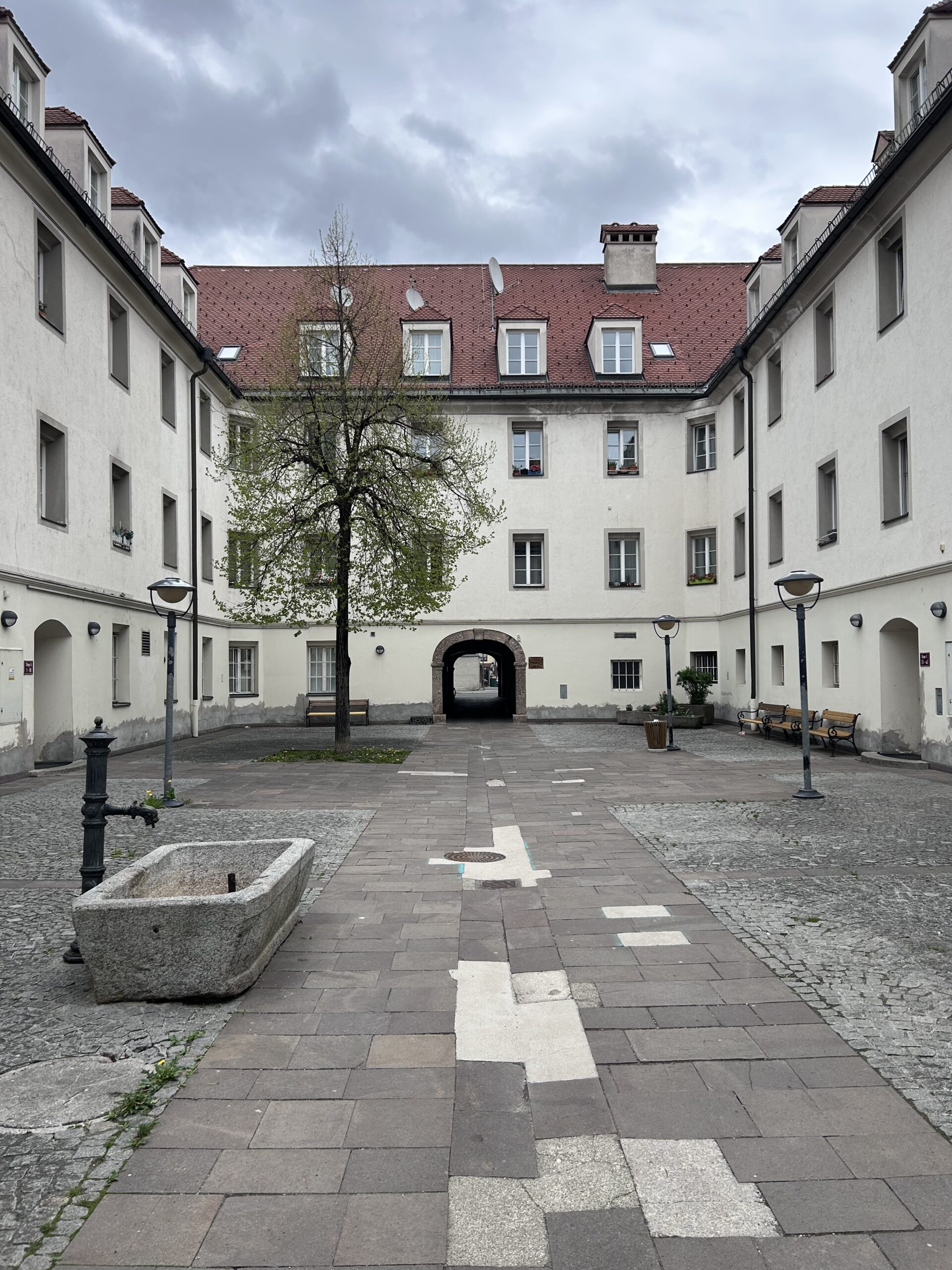
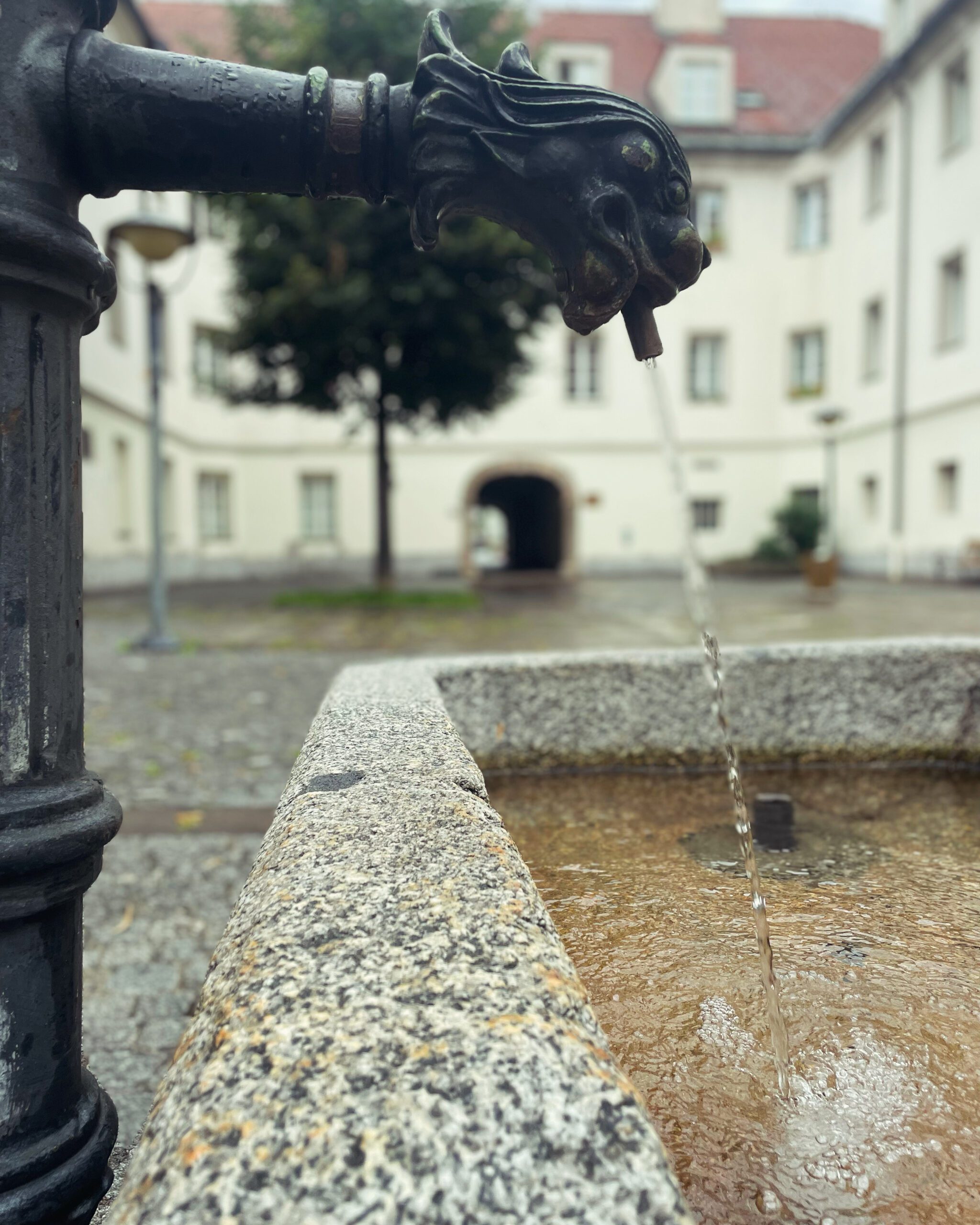
Where apartments and shops stand today, the city’s former correctional institution was once located. The core of the building, in its current appearance, dates back to the 18th century. The long, three‑storey structure stretches along the Innrain. A small turret crowns the barracks‑like building with its arcaded walkway, which now houses shops and restaurants. The inner courtyard—with its notable fountain and barred windows—still recalls the building’s past uses as the Turnusvereinshaus. In the 18th century, not only did the number of citizens grow, but the number of beggars and alms‑seekers also rose sharply. Combined with the emergence of Enlightenment‑era legal thinking, there arose a perceived need “to confine work‑shy and disorderly people and to receive individuals brought in under escort.” The Kräuterturm on the eastern section of the city wall was not a prison but a holding facility. Long-term deprivation of liberty was not common practice; imprisonment served only as a temporary measure until a court hearing where the actual punishment was pronounced. For a long time, plans to establish a penal institution failed due to lack of funding. Only the idea of financing the facility through forced labour made completion possible. In 1725, after nearly fifteen years of construction, the Zuchthaus (house of correction) finally opened its doors. The new institution was not a prison but a workhouse. Inmates were expected to pay for their stay through manual labour. Around 300 people worked under extremely harsh conditions in the linen factory and later in the loden factory. The most common offences were theft, bodily harm, murder, and child murder—a term historically referring to infanticide following birth. The facility also housed beggars, who were expected to sustain themselves through work. While such “disorderly people” had previously been under the care of church‑run institutions such as the Sondersiechenhaus, the Enlightenment’s rationalising worldview reshaped attitudes towards those unable to work. According to Enlightenment ideals, such institutions were intended to benefit both society and the individual by offering correction and reintegration. In 1859, the City of Innsbruck purchased the building and handed it over to the city’s Turnusverein (a rotational quartering association). At the time, it was custom and civic duty for residents to accommodate soldiers passing through the city. With the Italian Wars of Independence, the number of such soldiers increased significantly, as they were transported across the Brenner Pass to the battlefields. Those who could afford it joined the Turnusverein, allowing them to transfer the obligation of housing soldiers to the Turnusvereinshaus. This civic duty ended in 1869. With the opening of the Brenner railway line, Innsbruck ceased to be a necessary stopover. The dramatically shorter travel time transformed military logistics and made institutions like the Turnusvereinshaus obsolete. The building was subsequently repurposed to house the regional gendarmerie command. During World War I, it served as an interim detention facility for Italian prisoners of war. The Turnusvereinshaus had once again become a prison. Most detained soldiers stayed only briefly before being moved to larger camps in eastern Austria, including Mauthausen. Today, Innsbruck’s correctional facility is located on the city’s western outskirts, known colloquially as the Zieglstadl. The nickname derives from a brickworks that had operated on the site for 90 years before the prison was relocated there in 1964. Despite the move to a modern facility, the fundamental nature of incarceration changed only slowly. Considering the many reforms Austria’s penal system has undergone across centuries and political regimes, it is striking how recently the idea of reintegration became part of criminal justice. Even in the 1970s, it was common practice to place inmates in dark cells without light, to isolate them, and to impose regular deprivation of food as an additional punishment.
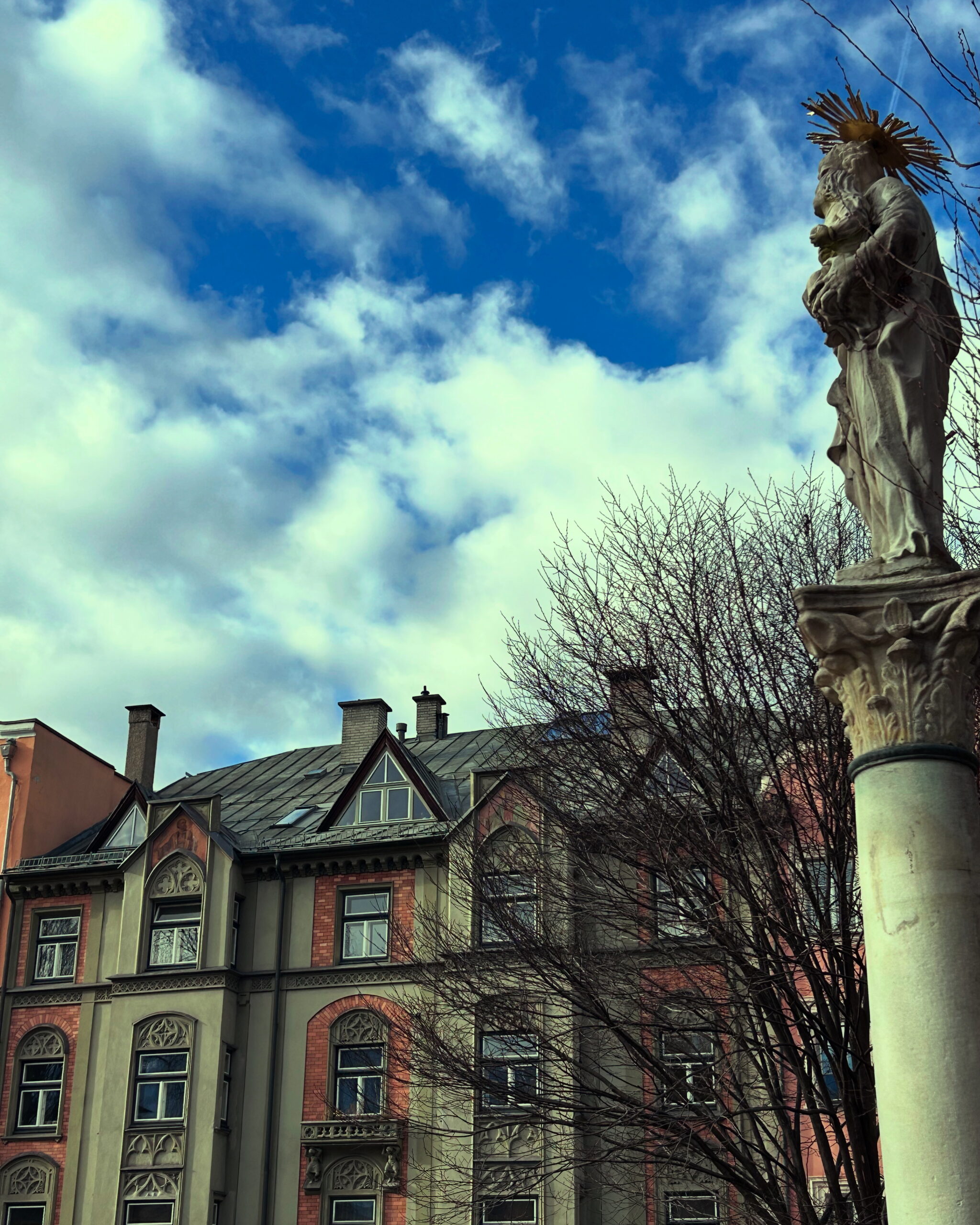
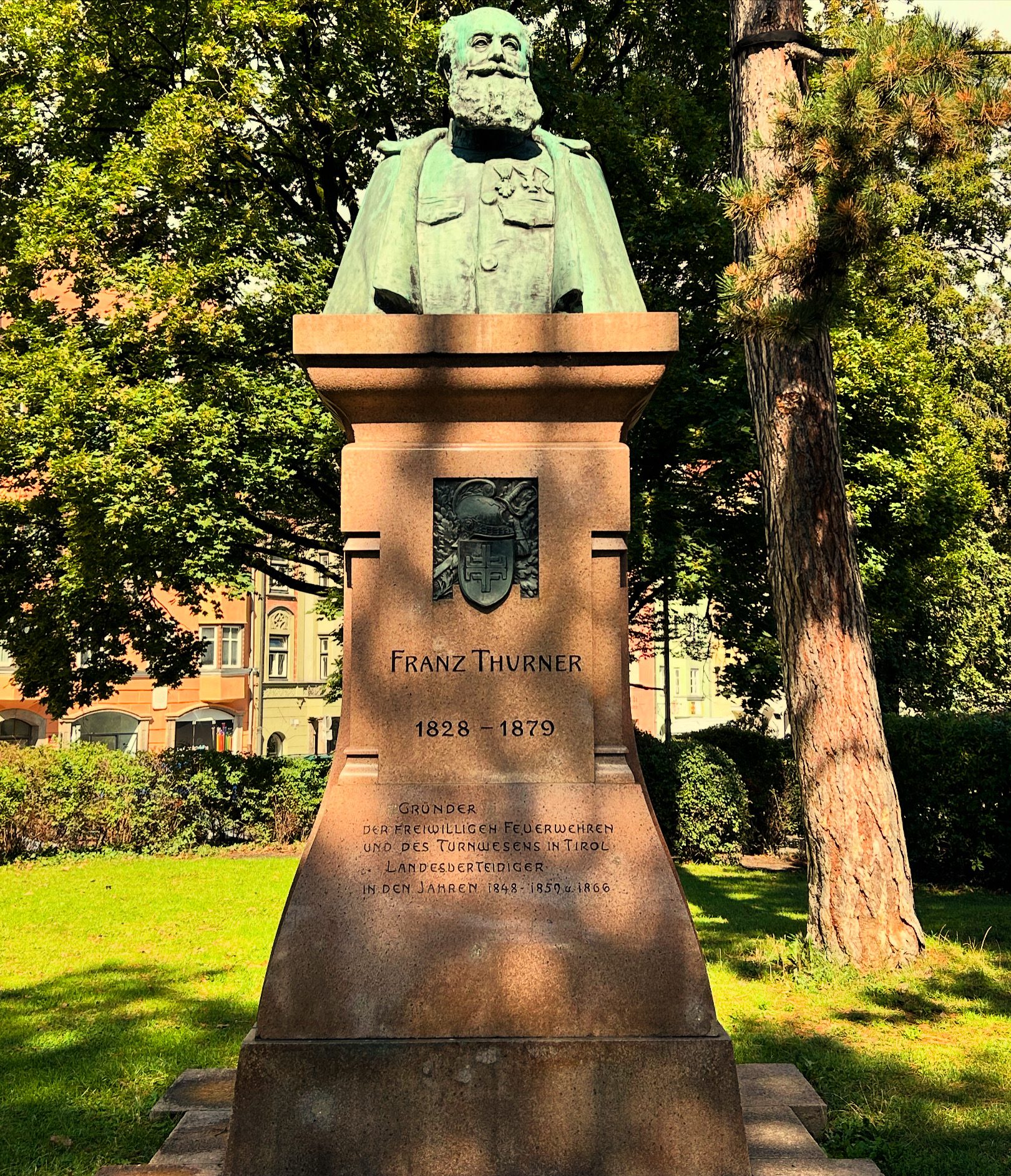
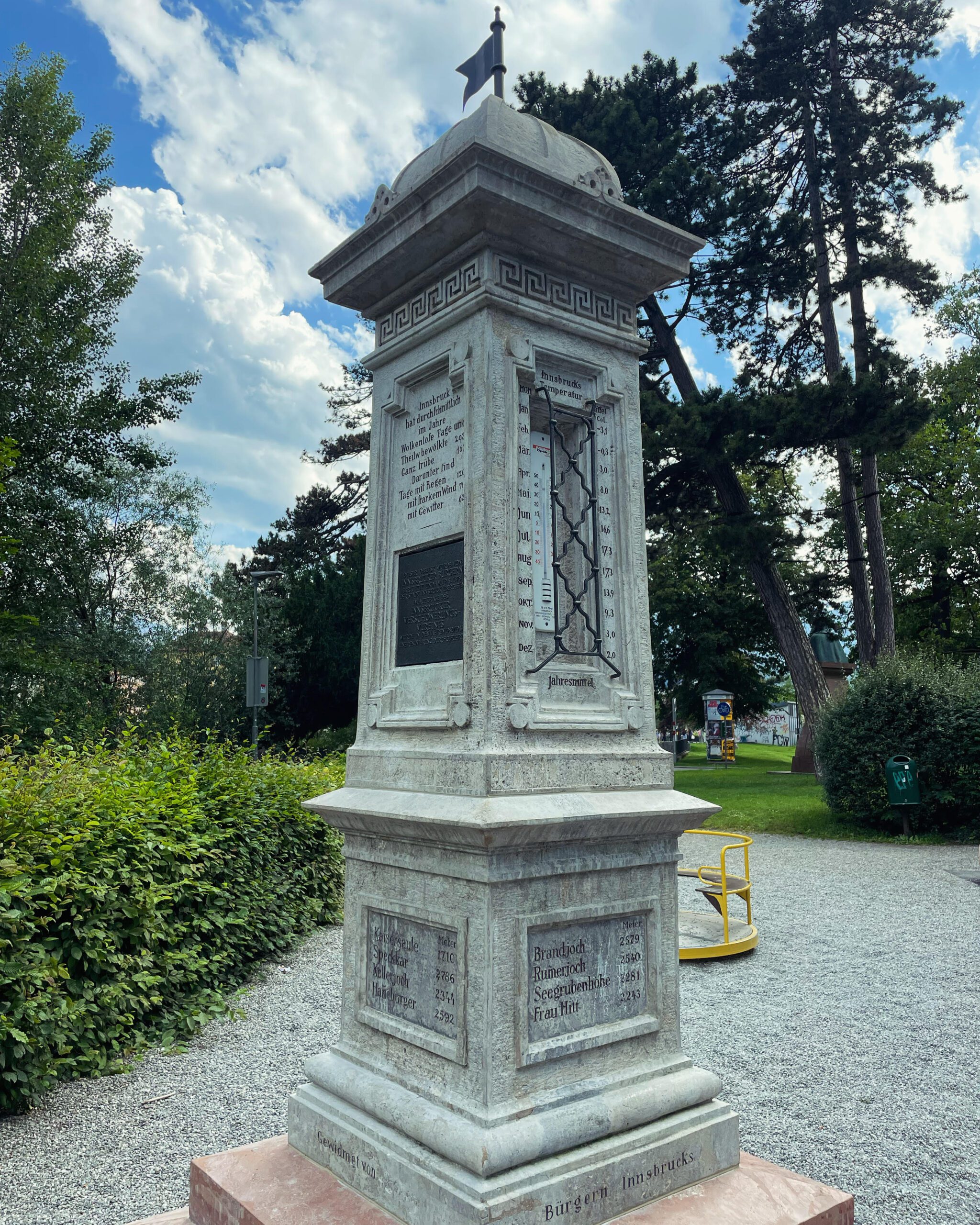
To the east of the former penitentiary lies Waltherpark, a remarkable collection of curiosities featuring sports facilities and green spaces. When the last raftsmen ceased operations in the 1870s and the landing place on the Inn was closed, a small urban oasis, then called Innpark, was created as part of the river engineering works. The so‑called “Dürer View” on the banks of the Inn offers a splendid panoramic vista of the Old Town. It was supposedly here that Albrecht Dürer sat in 1495 when he made the sketches for his famous watercolour of the city of Innsbruck. The actual work was produced later in his workshop in Nuremberg, and the original painting “Innsprugg von Norden” now hangs in the Albertina in Vienna. The oldest monument in the park is the Joachim Fountain, which was moved several times from the Old Town to St. Nikolaus. In 1878, the Geographers’ Column, a decorative obelisk, was erected, offering, in an ingeniously calculated way, information about Innsbruck’s weather and climate. Just a few steps away stands a bust of Franz Thurner, founder of organised gymnastics in Tyrol and of the volunteer fire brigade, who had distinguished himself within the liberal, pan‑German milieu of the city’s elite. The largest monument in the park is the pompous statue of the mythical German minstrel Walther von der Vogelweide, erected in 1877. The medieval bard proved an ideal projection figure for Innsbruck’s German‑national city fathers. Since almost nothing is known for certain about Walther from historical sources apart from his songs, poems and drinking verses in Middle High German, any ideology could be projected onto him. Not only was he regarded, thanks to his extensive body of work, as the greatest German‑language poet of the High Middle Ages and thus as a representative of an early Germanic identity, but his critical stance towards the papacy also made him attractive to the liberal city council. A similar statue was erected twelve years later in Bolzano by a bourgeoisie culturally oriented towards the north, serving as a kind of marker of the city in contrast to the Italian‑speaking Welsch Tyroleans of Trentino. The park received its current name in 1930. This time, the intention was less to emphasise Innsbruck’s Germanic character than to commemorate the lost territorial unity of Tyrol after its division at the Brenner Pass, which the German‑speaking minstrel Walther von der Vogelweide came to symbolise.
Romance, sunless summers and apology cards
Thanks to the university, its professors and the young people it attracted and produced, Innsbruck also sniffed the morning air of the Enlightenment in the 18th century in the era of Maria Theresa, even if the Jesuit faculty leadership put the brakes on it. 1741 saw the founding of the Societas Academica Litteraria a circle of scholars in the Taxispalais. The masonic lodge was founded in 1777 To the three mountains, four years later, the Tyrolean Society for Arts and Science was founded. The spirit of reason in the time of Maria Theresa and Emperor Joseph also found its way into Innsbruck's elite. Spurred on by the French Revolution, some students even declared their allegiance to the Jacobins. Under Emperor Franz, all these associations were banned and strictly monitored after the declaration of war on France in 1794. Enlightenment ideas were frowned upon by large sections of the population even before the French Revolution. At the latest after the beheading of Marie Antoinette, the Emperor's sister, and the outbreak of war between the French Republic and the monarchies of Europe, they were considered dangerous. Who wanted to be considered a Jacobin when it came to defending their homeland?
After the Napoleonic Wars, Innsbruck was slow to recover, both economically and mentally. Adalbert Stifter (1805 -1868), probably the most famous writer of Austrian Romanticism, described Innsbruck in the 1830s in his travelogue Tyrol and Vorarlberg as follows:
„The inns were bad, the pavements wretched, long gutters overhung the narrow streets, which were bordered on both sides by dull arches... the beautiful banks of the Inn were unpaved, but covered with heaps of rubbish and criss-crossed by cesspools.“
Die kleine Stadt am Rande des Kaiserreiches hatte etwas mehr als 12.000 Einwohner, „ohne die Soldaten, Studenten und Fremden zu rechnen“. University, grammar school, Reading casino, music club, theatre and museum were evidence of a developing, modern urban culture. There was a Deutsches Kaffeehaus, a Restoration in the courtyard garden and several traditional inns such as the White cross, the Österreichischen Hofwhich Grape, das Katzung, das Mouthingeach of which Goldenen Adler, Stern und Hirsch. After 1830, the open sewers were blocked and made more hygienic, roads were repaired and bridges renovated. The overdue straightening and taming of the Inn and Sill rivers, which had begun before the turmoil of war, was also tackled. The biggest innovation for the population came in 1830, when oil lamps lit up the town at night. It was probably just a dim twilight created by the more than 150 lamps mounted on pillars and arm chandeliers, but for contemporaries it was a true revolution.
Die bayerische Besatzung war verschwunden, die Ideen der Denker der Aufklärung und der Französischen Revolution hatten sich aber in einigen Köpfen des städtischen Milieus verfangen. Natürlich waren es keine atheistischen, sozialistischen oder gar umstürzlerischen Gedanken, die sich breit machten. Es ging vor allem um wirtschaftliche, politische und gesellschaftliche Teilhabe des Bürgertums. Das Vereinswesen feierte eine Renaissance. Was heute wenig spektakulär klingt, war zur Regierungszeit Metternichs aufsehenerregend. Zwischen dem Beginn der Napoleonischen Kriege mit dem revolutionären Frankreich 1797 und dem Wiener Kongress waren Vereine allgemein verboten gewesen. Wer auf sich hielt, trat nun einer dieser neuartigen Gesellschaften bei. "Innsbruck has a music society, an agricultural society and a mining and geological society." stand etwa im Reiseführer Beda Webers wie ein Qualitätssiegel für die Stadt zu lesen. Es galt das tugendhafte Miteinander zum Wohl der weniger Begüterten und die Erziehung der Massen mit dem Treiben in den Vereinen zu forcieren. Wissenschaft, Literatur, Theater und Musik, aber auch Initiativen wie der Innsbruck Beautification Association, but also practical institutions such as the voluntary fire brigade established themselves as pillars of a previously unknown civil society. One of the first associations to be formed was the Innsbruck Music Society, from which the Tyrolean State Conservatory emerged. In keeping with the spirit of the times, men and women were not members of the same organisations. Women were mainly involved in charitable organisations such as the Women's association for the promotion of infant care centres and female industrial schools. Female participation in the political discourse was not desired.
In addition to Christian charity, a thirst for recognition and prestige were probably also major incentives for members to get involved in the clubs. People met to see and be seen. Good deeds, demonstrating education and leading a virtuous life were then, as now, the best PR for oneself.
Club life also served as entertainment on long evenings without electric light, television and the internet. Students, civil servants, members of the lower nobility and academics met in the pubs and coffee houses to exchange ideas. This was not only about highly intellectual and abstract matters, but also about profane realpolitik such as the suspension of internal tariffs, which made people's lives unnecessarily expensive. Culturally, the bourgeois educated elite in the Romantic and Biedermeier periods discovered the cultural escape into an intact past for themselves. After decades of political confusion, war and hardship, people wanted a distraction from the recent past, just as they did after 1945. Antiquity and its thinkers celebrated a second renaissance in Innsbruck, as in the rest of Europe. Romantic thinkers of the 18th and early 19th centuries such as Winckelmann, Lessing and Hegel were influential. The Greeks were „Noble simplicity and quiet greatness" attested. Goethe wanted the "Search the land of the Greeks with your soul" and travelled to Italy in search of his longing for the good, pre-Christian times in which the people of the Golden Age cultivated an informal relationship with their gods. Roman Stoic virtues were transported into the modern age as role models and formed the basis for bourgeois frugality and patriotism, which became very fashionable. Philologists combed through the texts of ancient writers and philosophers and conveyed a pleasing "Best of" into the 19th century. Columns, sphinxes, busts and statues with classical proportions adorned palaces, administrative buildings and museums such as the Ferdinandeum. Students and intellectuals such as the Briton Lord Byron were so inspired by the Panhellenism and the idea of nationalism that they risked their lives in the Greek struggle for independence against the Ottoman Empire. After the end of the Holy Roman Empire, Pan-Germanism became the political fashion of the liberal bourgeoisie in Innsbruck.
Kanzler Clemens von Metternichs (1773 – 1859) Polizeistaat hielt diese gesellschaftlichen Regungen lange Zeit unter Kontrolle. Zeitungen, Flugblätter, Schriften mussten sich an die Vorgaben der strengen Zensur anpassen oder im Untergrund verbreitet werden. Autoren wie Hermann von Gilm (1812 – 1864) und Johann Senn (1792 – 1857), an beide erinnern heute Straßen in Innsbruck, verbreiteten in Tirol anonym politisch motivierte Literatur. Der vielleicht bekannteste Public Intellectual des Vormärz war wahrscheinlich Adolf Pichler (1819 – 1900), dem bereits kurz nach seinem Ableben unter gänzlich anderen Vorzeichen in der Stadtpolitik der späten Monarchie ein Denkmal gewidmet wurde und nach dem heute das Bundesrealgymnasium am gleichnamigen Platz gewidmet ist. Bücher und Vereine standen unter Generalverdacht. Der Innsbrucker Musikverein lehrte im Rahmen seiner Ausbildung auch die Deklamation, das Vortragen von Texten, Musik und Reden, die Inhalte wurden von der Obrigkeit streng überwacht. Alle Arten von Vereinen wie die Innsbrucker Liedertafel and student fraternities, even the members of the Ferdinandeum were spied on. The social movements forming in the working-class neighbourhoods were particularly targeted by Metternich's secret police. Despite their demonstrative loyalty to the emperor, the marksmen were also on the list of institutions to be observed. They were considered too rebellious, not only towards foreign powers, but also towards the Viennese central government. The mix of Greater German nationalist ideas and Tyrolean patriotism presented with the pathos of Romanticism seems strangely harmless today, but was neither comfortable nor acceptable to the Metternich state apparatus.
However, political activism was a marginal phenomenon that only occupied a small elite. After the mines and salt works had lost their profitability in the 17th century and transit lost its economic importance due to the new trade routes across the Atlantic, Tyrol had become a poor region. The Napoleonic Wars had raged for over 20 years. The year 1809 went down as Tyrolean heroic age in the historiography of the 19th and early 20th centuries, the consequences of heroism were barely highlighted. Although the Austrian Empire was one of the victorious powers after the Congress of Vienna, its economic situation was miserable. As after the world wars of the 20th century, many men had not returned home during the coalition wars. The university, which drew young aristocrats into the city's economic cycle, was not reopened until 1826. Unlike industrial locations in Bohemia, Moravia, Prussia or England, the hard-to-reach city in the Alps was only just beginning to develop into a modern labour market. Tourism was also still in its infancy and was not a Cash Cow. It is no wonder that hardly any buildings in the Biedermeier style have survived in Innsbruck. And then there was a volcano on the other side of the world that had an undue influence on the fate of the city of Innsbruck. In 1815, Tambora erupted in Indonesia and sent a huge cloud of dust, sulphur and ash around the world. In 1816 Year without summer into history. All over Europe, there were freak weather conditions, floods and failed harvests. The Alps, an already difficult part of the world to farm, were not exempt from this.
The economic upheavals and price increases led to hardship and misery, especially among the poorer sections of the population. In the 19th century, caring for the poor was a task for the communities, usually with the support of wealthy citizens as patrons with the idea of Christian charity. The state, the community, the church and the newly emerging civil society in the form of associations began to look after the welfare of the poorest sections of the population. Charity concerts, collections and appeals for donations were organised. The measures often contained an enlightened component, even if the means to an end seem strange and alien today. In Innsbruck, for example, a begging ordinance came into force that banned dispossessed people from marrying. Almost 1000 citizens were categorised as alms recipients and beggars.
As the need grew and the city coffers became emptier, Innsbruck came up with an innovation that was to last for over 100 years: The New Year's apology card. Even back then, it was customary to visit relatives on the first day of the year to give each other a Happy New Year to make a wish. It was also customary for needy families and beggars to knock on the doors of wealthy citizens to ask for alms at New Year. The introduction of the New Year's relief card killed several birds with one stone. The buyers of the card were able to institutionalise and support their poorer members in a regulated way, similar to the way street newspapers are bought today. Twenty is possible. At the same time, the New Year's apology card served as a way of avoiding the unpopular obligatory visits to relatives. Those who hung the card on their front door also signalled to those in need that no further requests for alms were necessary, as they had already paid their contribution. Last but not least, the noble donors were also favourably mentioned in the media so that everyone could see how much they cared for their less fortunate fellow human beings in the name of charity.
The New Year's apology cards were a complete success. At their premiere at the turn of the year from 1819 to 1820, 600 were sold. Many communities adopted the Innsbruck recipe. In the magazine "The Imperial and Royal Privileged Bothe of and for Tyrol and Vorarlberg", the proceeds for Bruneck, Bozen, Trient, Rovereto, Schwaz, Imst, Bregenz and Innsbruck were published on 12 February. Other institutions such as fire brigades and associations also adopted the well-functioning custom to raise funds for their cause. The construction of the new Höttinger parish church was financed to a large extent from the proceeds of specially issued apology cards in addition to donations. The varied designs ranged from Christian motifs to portraits of well-known personalities, official buildings, new buildings, sights and curiosities. Many of the designs can still be seen in the Innsbruck City Archives.
Maria Theresia, Reformatorin und Landesmutter
Maria Theresia zählt zu den bedeutendsten Figuren der österreichischen Geschichte. Obwohl sie oft als Kaiserin tituliert wird, war sie offiziell "nur" unter anderem Erzherzogin von Österreich, Königin von Ungarn und Königin von Böhmen. Bedeutend waren ihre innenpolitischen Reformen. Viele davon betrafen konkret auch den Alltag der Innsbrucker in merklichem Ausmaß. Gemeinsam mit ihren Beratern Friedrich Wilhelm von Haugwitz, Joseph von Sonnenfels und Wenzel Anton Kaunitz schaffte sie es aus den sogenannten Österreichischen Erblanden einen modernen Staat zu basteln. Anstatt der Verwaltung ihrer Territorien durch den ansässigen Adel setzte sie auf eine moderne Verwaltung. Ihre Berater hatten ganz im Stil der Aufklärung erkannt, dass sich das Staatswohl aus der Gesundheit und Bildungsgrad seiner Einzelteile ergab. Eine frühe Krankenreform Maria Theresias aus dem Jahr 1742 verpflichtete die Professoren des Fachbereichs Medizin an der Universität Innsbruck auch den Betrieb des Stadtspitals in der Neustadt sicherzustellen. Eine Schulreform veränderte die Bildungslandschaft innerhalb der Stadtmauern nicht nur thematisch, sondern auch örtlich. Untertanen sollten katholisch sein, ihre Treue aber sollte dem Staat gelten. Schulbildung wurde unter zentrale staatliche Verwaltung gestellt. Es sollten keine kritischen, humanistischen Geistesgrößen, sondern Material für den staatlichen Verwaltungsapparat erzogen werden. Über Militär und Verwaltung konnten nun auch Nichtadlige in höhere staatliche Positionen aufsteigen. Gleichzeitig sollten Reformen im Staatsdienst und in der Wirtschaft nicht nur mehr Möglichkeiten für die Untertanen schaffen, sondern auch die Staatseinnahmen erhöhen. Gewichte und Maßeinheiten wurden nominiert, um das Steuersystem undurchlässiger zu machen. Für Bürger und Bauern hatte die Vereinheitlichung der Gesetze den Vorteil, dass das Leben weniger von Grundherren und deren Launen abhing. Auch der Robot, den Bauern auf den Gütern des Grundherrn kostenfrei zu leisten hatten, wurde unter Maria Theresia abgeschafft. In Strafverfolgung und Justiz fand ein Umdenken statt. 1747 wurde in Innsbruck eine kleine Polizei which was responsible for matters relating to market supervision, trade regulations, tourist control and public decency. The penal code Constitutio Criminalis Theresiana did not abolish torture, but it did regulate its use.
As much as Maria Theresa staged herself as a pious mother of the country and is known today as an Enlightenment figure, the strict Catholic ruler was not squeamish when it came to questions of power and religion. In keeping with the trend of the Enlightenment, she had superstitions such as vampirism, which was widespread in the eastern parts of her empire, critically analysed and initiated the final end to witch trials. At the same time, however, she mercilessly expelled Protestants from the country. Many Tyroleans were forced to leave their homeland and settle in parts of the Habsburg Empire further away from the centre.
In crown lands such as Tyrol, Maria Theresa's reforms met with little favour. With the exception of a few liberals, they saw themselves more as an independent and autonomous province and less as part of a modern territorial state. The clergy also did not like the new, subordinate role, which became even more pronounced under Joseph II. For the local nobility, the reforms not only meant a loss of importance and autonomy, but also higher taxes and duties. Taxes, levies and customs duties, which had always provided the city of Innsbruck with reliable income, were now collected centrally and only partially refunded via financial equalisation. In order to minimise the fall of sons from impoverished aristocratic families and train them for civil service, Maria Theresa founded the Theresianum, das ab 1775 auch in Innsbruck eine Niederlassung hatte. Wie so oft bügelte die Zeit manche Falte aus und Innsbrucker sind mittlerweile stolz darauf, eine der bedeutendsten Herrscherpersönlichkeiten der österreichischen Geschichte beherbergt zu haben. Heute erinnern die Triumphpfote und die Hofburg in Innsbruck an die Theresianische Zeit.
1796 - 1866: Vom Herzen Jesu bis Königgrätz
The period between the French Revolution and the Battle of Königgrätz in 1866 was a period of war. Many of the basic political attitudes, animosities towards other groups and European nationalism of the 19th and 20th centuries, which were also to influence the history of Innsbruck, had their roots in the conflicts of this period. Revolutionary Paris was a long way away and there were neither e-mails nor a nationwide press system to disseminate news. The godlessness of Marie Antoinette's murderers and the hatred of the Church of the new masters of France were successfully spread via leaflets and church pulpits. The monarchies of Europe, led by the Habsburgs, had declared war on the French Republic. Fears were rife that the slogan of the revolution „Liberté, Égalité, Fraternité" could spread across Europe. A young general named Napoleon Bonaparte was with his italienischen Armee advanced across the Alps as part of the coalition wars and met the Austrian troops there. It was not just a war for territory and power, it was a battle of systems. The Grande Armee of the revolutionary French Republic met the troops of the conservative and Catholic Habsburgs.
Tyrolean marksmen were actively involved in the fighting to defend the country's borders against the invading French. The men were used to handling weapons and were considered skilled marksmen. The historian Ludwig Denk put it this way in an essay in 1860:
"...The Tyrolean's main passion is shooting. Early on, the father takes his son hunting. It is not uncommon to see boys running around with loaded rifles, climbing high mountains and shooting birds or squirrels..."
The strength of units such as the Höttinger Schützen, founded in 1796, lay not in open field battles but in guerrilla warfare. They also had a secret weapon on their side against the most advanced and modern army of the time: the Sacred Heart. Since 1719, Jesuit missionaries had been travelling to the furthest side valleys and had successfully established the cult of the Sacred Heart as a unifying element in the fight against pagan customs and Protestantism. Now that they were facing the godless revolutionary French, who had declared war not only on the monarchy but also on the clergy, it was only logical that the Sacred Heart of Jesus would watch over the Tyrolean holy warriors in a protective capacity. In a hopeless situation, the Tyrolean troops renewed their covenant with the Heart of Jesus to ask for protection. Against all odds, the Tyrolean archers were successful in their defence. It was the abbot of Stams Abbey who petitioned the provincial estates to henceforth organise an annual "das Fest des göttlichen Herzens Jesu mit feierlichem Gottesdienst zu begehen, wenn Tirol von der drohenden Feindesgefahr befreit werde." Every year, the Sacred Heart celebrations were discussed and announced with great pomp in the press. In the 19th and early 20th centuries in particular, they were an explosive mixture of popular superstition, Catholicism and national resentment against everything French and Italian. Countless soldiers entrusted their well-being to the heart of Jesus even in the technologised battlefield of the First World War and carried images of this symbol with them in the hail of grenades. Alongside Cranach's Mother of Mercy, the depiction of the Heart of Jesus is probably the most popular Christian motif in Tyrol to this day and is emblazoned on the façades of countless houses.
The Habsburg Tyrol had expanded during the turmoil of war without his involvement, and probably also without that of the Sacred Heart of Jesus. Trentino had become part of the crown land in the last breaths of the Holy Roman Empire before its dissolution in 1803. Innsbruck, on the other hand, had shrunk. The deaths of soldiers and the economic difficulties caused by the war led to a decline in the population from a good 9500 around 1750 to around 8800. After the Napoleonic Wars, things remained quiet on the Tyrolean borders for around 30 years. This changed with the Italian Risorgimento, the national movement led by Sardinia-Piedmont and France. 1848, 1859 and 1866 saw the so-called Italian wars of unification. In the course of the 19th century, at the latest since 1848, there was a veritable national frenzy among young men of the upper classes. Volunteer armies sprang up in all regions of Europe. Students and academics who came together in their fraternities, gymnasts, marksmen, all wanted to prove their new love of the nation on the battlefield and supported the official armies.
As a garrison town, Innsbruck was an important supply centre. After the Congress of Vienna, the Tyrolean Jägerkorps the k.k. Tiroler Kaiserjägerregiment an elite unit that was deployed in these conflicts. Volunteer units such as the Innsbruck academics or the Stubai Riflemen fought in Italy. Thousands fell in the fight against the coalition of the arch-enemy France, the godless Garibaldians and the threat posed by the Kingdom of Italy under the leadership of the Francophile Savoys from Piedmont, which was being formed at Austria's expense. The media fuelled the mood away from the front line. The "Innsbrucker Zeitung" predigte in ihren Artikeln Kaisertreue und großdeutsch-tirolischen Nationalismus, wetterte gegen das Italienertum und Franzosen und pries den Mut Tiroler Soldaten.
"Die starke Besetzung der Höhen am Ausgange des Valsugana bei Primolano und le Tezze gab schon oft den Innsbrucker-Akademikern I. und den Stubaiern Anlaß, freiwillige Ercur:sionen gegen le Tezze, Fonzago und Fastro, als auch auf das rechte Brenta-Ufer und den Höhen gegen die kleinen Lager von den Sette comuni zu machen...Am 19. schon haben die Stubaier einige Feinde niedergestreckt, als sie sich das erste mal hinunterwagten, indem sie sich ihnen entgegenschlichen..."
Probably the most famous battle of the Wars of unification took place in Solferino near Lake Garda in 1859. Horrified by the bloody events, Henry Durant decided to found the Red Cross. The writer Joseph Roth described the events in the first pages of his classic book, which is well worth reading Radetzkymarsch.
"In the battle of Solferino, he (note: Lieutenant Trotta) commanded a platoon as an infantry lieutenant. The battle had been going on for half an hour. Three paces in front of him he saw the white backs of his soldiers. The first row of his platoon was kneeling, the second was standing. Everyone was cheerful and certain of victory. They had eaten copiously and drunk brandy at the expense and in honour of the emperor, who had been in the field since yesterday. Here and there one fell out of line."
The year 1866 was particularly costly for the Austrian Empire, with the loss of Veneto and Lombardy in Italy. At the same time, Prussia took the lead in the German Confederation, the successor organisation to the Holy Roman Empire of the German Nation. For Innsbruck, the withdrawal of the Habsburg Monarchy from the German Confederation meant that it had finally become a city on the western periphery of the empire. The tendency towards so-called Großdeutschen LösungThe German question, i.e. statehood together with the German Empire instead of the independent Austrian Empire, was very pronounced in Innsbruck. The extent to which this German question divided the city became apparent over 30 years later, when the Innsbruck municipal council voted in favour of the Iron Chancellor Bismarck, who was responsible for the fratricidal war between Austria and Germany, wanted to dedicate a street to him. While conservatives loyal to the emperor were horrified by this proposal, the Greater German liberals around Mayor Wilhelm Greil were enthusiastic.
With the Tummelplatz, the Pradl military cemetery and the Kaiserjägermuseum on Mount Isel, the city has several memorials to these bloody conflicts, in which many Innsbruck residents took to the field.
The First World War
It was almost not Gavrilo Princip, but a student from Innsbruck who changed the fate of the world. It was thanks to chance that the 20-year-old Serb was stopped in 1913 because he bragged to a waitress that he was planning to assassinate the heir to the throne. It was only when the world-changing shooting in Sarajevo actually took place that an article about it appeared in the media. After the actual assassination of Franz Ferdinand on 28 June, it was impossible to foresee what impact the First World War that broke out as a result would have on the world and people's everyday lives. However, two days after the assassination of the Habsburg in Sarajevo, the Innsbrucker Nachrichten already prophetic: "We have reached a turning point - perhaps the "turning point" - in the fortunes of this empire".
Enthusiasm for the war in 1914 was also high in Innsbruck. From the "Gott, Kaiser und VaterlandDriven by the "spirit of the times", most people unanimously welcomed the attack on Serbia. Politicians, the clergy and the press joined in the general rejoicing. In addition to the imperial appeal "To my peoples", which appeared in all the media of the empire, the Innsbrucker Nachrichten On 29 July, the day after Austria-Hungary declared war on Serbia, the media published an article about the capture of Belgrade by Prince Eugene in 1717. The tone in the media was celebratory, although not entirely without foreboding of what was to come.
"The Emperor's appeal to his people will be deeply felt. The internal strife has been silenced and the speculations of our enemies about unrest and similar things have been miserably put to shame. Above all, the Germans stand by the Emperor and the Empire in their old and well-tried loyalty: this time, too, they are ready to stand up for dynasty and fatherland with their blood. We are facing difficult days; no one can even guess what fate will bring us, what it will bring to Europe, what it will bring to the world. We can only trust with our old Emperor in our strength and in God and cherish the confidence that, if we find unity and stick together, we must be granted victory, for we did not want war and our cause is that of justice!"
Theologians such as Joseph Seeber (1856 - 1919) and Anton Müllner alias Bruder Willram (1870 - 1919) who, with her sermons and writings such as "Das blutige Jahr" elevated the war to a crusade against France and Italy.
Many Innsbruckers volunteered for the campaign against Serbia, which was thought to be a matter of a few weeks or months. Such a large number of volunteers came from outside the city to join the military commissions that Innsbruck was almost bursting at the seams. Nobody could have guessed how different things would turn out. Even after the first battles in distant Galicia, it was clear that it would not be a matter of months. Kaiserjäger and other Tyrolean troops were literally burnt out. Poor equipment, a lack of supplies and the catastrophic leadership of the high command under Konrad von Hötzendorf led to the deaths of thousands or to captivity, where hunger, abuse and forced labour awaited them.
In 1915, the Kingdom of Italy entered the war on the side of France and England. This meant that the front went right through what was then Tyrol. From the Ortler in the west across northern Lake Garda to the Sextener Dolomiten the battles of the mountain war took place. Innsbruck was not directly affected by the fighting. However, the war could at least be heard as far as the provincial capital, as was reported in the newspaper of 7 July 1915:
„Bald nach Beginn der Feindseligkeiten der Italiener konnte man in der Gegend der Serlesspitze deutlich Kanonendonner wahrnehmen, der von einem der Kampfplätze im Süden Tirols kam, wahrscheinlich von der Vielgereuter Hochebene. In den letzten Tagen ist nun in Innsbruck selbst und im Nordosten der Stadt unzweifelhaft der Schall von Geschützdonner festgestellt worden, einzelne starke Schläge, die dumpf, nicht rollend und tönend über den Brenner herüberklangen. Eine Täuschung ist ausgeschlossen. In Innsbruck selbst ist der Donner der Kanonen schwerer festzustellen, weil hier der Lärm zu groß ist, es wurde aber doch einmal abends ungefähr um 9 Uhr, als einigermaßen Ruhe herrschte, dieser unzweifelhafte von unseren Mörsern herrührender Donner gehört.“
Until the transfer of regular troops from the Eastern Front to the Tyrolean borders, the national defence depended on the Standschützen, a troop made up of men under 21, over 42 or unfit for regular military service. The casualty figures were correspondingly high.
Although the front was relatively far away from Innsbruck, the war also penetrated civilian life. Due to the mass mobilisation of a large part of the working male population, many businesses came to a complete standstill. Shelves in shops remained empty, public transport came to a standstill, craftsmen and labourers were missing everywhere. There was often a shortage of coal and firewood. Hunger and cold became bitter enemies of women, children, the wounded and those unfit for war in the city. This experience of the total involvement of society as a whole was new to the people. Barracks were erected in the Höttinger Au to house prisoners of war. Transports of wounded brought such a large number of horribly injured people that many civilian buildings such as the university library, which was currently under construction, or Ambras Castle were converted into military hospitals. The Pradl military cemetery was established to cope with the large number of fallen soldiers. A predecessor to tram line 3 was set up to transport the wounded from the railway station to the new garrison hospital, today's Conrad barracks in Pradl. The companies that were still able to produce were subordinated to the war economy. However, the longer the war lasted, the fewer there were. By the winter of 1917, Innsbruck's economy had almost completely collapsed.
As the war drew to a close, so did the front. In February 1918, the Italian air force managed to drop three bombs on Innsbruck. In this winter, which was known as Hunger winter When the war went down in European history, the shortages also made themselves felt. In the final years of the war, food was supplied via ration coupons. 500 g of meat, 60 g of butter and 2 kg of potatoes were the basic diet per person - per week, mind you. Archive photos show the long queues of desperate and hungry people outside the food shops. There were repeated protests and strikes. Politicians, trade unionists, workers and war returnees saw their chance for change. Under the motto Peace, bread and the right to vote a wide variety of parties united in resistance to the war. At this time, most people were already aware that the war was lost and what fate awaited Tyrol, as this article from 6 October 1918 shows:
„Aeußere und innere Feinde würfeln heute um das Land Andreas Hofers. Der letzte Wurf ist noch grausamer; schändlicher ist noch nie ein freies Land geschachert worden. Das Blut unserer Väter, Söhne und Brüder ist umsonst geflossen, wenn dieser schändliche Plan Wirklichkeit werden soll. Der letzte Wurf ist noch nicht getan. Darum auf Tiroler, zum Tiroler Volkstag in Brixen am 13. Oktober 1918 (nächsten Sonntag). Deutscher Boden muß deutsch bleiben, Tiroler Boden muß tirolisch bleiben. Tiroler entscheidet selbst über Eure Zukunft!“
On 4 November, Austria-Hungary and the Kingdom of Italy finally agreed an armistice. This gave the Allies the right to occupy areas of the monarchy. The very next day, Bavarian troops entered Innsbruck. Austria's ally Germany was still at war with Italy and was afraid that the front could be moved closer to the German Reich in North Tyrol. Fortunately for Innsbruck and the surrounding area, however, Germany also surrendered a week later on 11 November. This meant that the major battles between regular armies did not take place.
Nevertheless, Innsbruck was in danger. Huge columns of military vehicles, trains full of soldiers and thousands of emaciated soldiers making their way home from the front on foot passed through the city. Those who could, jumped on one of the overcrowded trains or a car to leave the Brenner Pass behind them to get home. In November 1918, more than 270 soldiers lost their lives during these daring manoeuvres or had to be admitted to one of the city's military hospitals. The city not only had to keep its own citizens in check and guarantee rations, but also protect itself from looting. In order to maintain public order, the Tyrolean National Council formed a People's Army on 5 November made up of schoolchildren, students, workers and citizens. On 23 November 1918, Italian troops occupied the city and the surrounding area. Mayor Greil's appeasement to the people of Innsbruck to surrender the city without rioting was successful. 5000 men had to find shelter in the starving and miserable city. Schools were turned into barracks. Although there were isolated riots, hunger riots and looting, there were no armed clashes with the occupying troops or even a Bolshevik revolution as in Munich.
Over 1200 Innsbruck residents lost their lives on the battlefields and in military hospitals, over 600 were wounded. Memorials to the First World War and its victims can be found in Innsbruck, particularly at churches and cemeteries. The Kaiserjägermuseum on Mount Isel displays uniforms, weapons and pictures of the battle. Streets in Innsbruck are dedicated to the two theologians Anton Müllner and Josef Seeber. A street was also named after the commander-in-chief of the Imperial and Royal Army on the Southern Front, Archduke Eugene. There is a memorial to the unsuccessful commander in front of the Hofgarten. The eastern part of the Amras military cemetery commemorates the Italian occupation.
Wilhelm Greil: DER Bürgermeister Innsbrucks
One of the most important figures in the town's history was Wilhelm Greil (1850 - 1923). From 1896 to 1923, the entrepreneur held the office of mayor, having previously helped to shape the city's fortunes as deputy mayor. It was a time of growth, the incorporation of entire neighbourhoods, technical innovations and new media. The four decades between the economic crisis of 1873 and the First World War were characterised by unprecedented economic growth and rapid modernisation. Private investment in infrastructure such as railways, energy and electricity was desired by the state and favoured by tax breaks in order to lead the countries and cities of the ailing Danube monarchy into the modern age. The city's economy boomed. Businesses sprang up in the new districts of Pradl and Wilten, attracting workers. Tourism also brought fresh capital into the city. At the same time, however, the concentration of people in a confined space under sometimes precarious hygiene conditions also brought problems. The outskirts of the city and the neighbouring villages in particular were regularly plagued by typhus.
Innsbruck city politics, in which Greil was active, was characterised by the struggle between liberal and conservative forces. Greil belonged to the "Deutschen Volkspartei", a liberal and national-Great German party. What appears to be a contradiction today, liberal and national, was a politically common and well-functioning pair of ideas in the 19th century. The Pan-Germanism was not a political peculiarity of a radical right-wing minority, but rather a centrist trend, particularly in German-speaking cities in the Reich, which was significant in various forms across almost all parties until after the Second World War. Innsbruckers who were self-respecting did not describe themselves as Austrians, but as Germans. Those who were members of the liberal Innsbrucker Nachrichten of the period around the turn of the century, you will find countless articles in which the common ground between the German Empire and the German-speaking countries was made the topic of the day, while distancing themselves from other ethnic groups within the multinational Habsburg Empire. Greil was a skilful politician who operated within the predetermined power structures of his time. He knew how to skilfully manoeuvre around the traditional powers, the monarchy and the clergy and to come to terms with them.
Taxes, social policy, education, housing and the design of public spaces were discussed with passion and fervour. Due to an electoral system based on voting rights via property classes, only around 10% of the entire population of Innsbruck were able to go to the ballot box. Women were excluded as a matter of principle. Relative suffrage applied within the three electoral bodies, which meant as much as: The winner takes it all. Greil wohne passenderweise ähnlich wie ein Renaissancefürst. Er entstammte der großbürgerlichen Upper Class. Sein Vater konnte es sich leisten, im Palais Lodron in der Maria-Theresienstraße die Homebase der Familie zu gründen. Massenparteien wie die Sozialdemokratie konnten sich bis zur Wahlrechtsreform der Ersten Republik nicht durchsetzen. Konservative hatten es in Innsbruck auf Grund der Bevölkerungszusammensetzung, besonders bis zur Eingemeindung von Wilten und Pradl, ebenfalls schwer. Bürgermeister Greil konnte auf 100% Rückhalt im Gemeinderat bauen, was die Entscheidungsfindung und Lenkung natürlich erheblich vereinfachte. Bei aller Effizienz, die Innsbrucker Bürgermeister bei oberflächlicher Betrachtung an den Tag legten, sollte man nicht vergessen, dass das nur möglich war, weil sie als Teil einer Elite aus Unternehmern, Handelstreibenden und Freiberuflern ohne nennenswerte Opposition und Rücksichtnahme auf andere Bevölkerungsgruppen wie Arbeitern, Handwerkern und Angestellten in einer Art gewählten Diktatur durchregierten. Das Reichsgemeindegesetz von 1862 verlieh Städten wie Innsbruck und damit den Bürgermeistern größere Befugnisse. Es verwundert kaum, dass die Amtskette, die Greil zu seinem 60. Geburtstag von seinen Kollegen im Gemeinderat verliehen bekam, den Ordensketten des alten Adels erstaunlich ähnelte.
Under Greil's aegis and the general economic upturn, fuelled by private investment, Innsbruck expanded at a rapid pace. In true merchant style, the municipal council purchased land with foresight in order to enable the city to innovate. The politician Greil was able to rely on the civil servants and town planners Eduard Klingler, Jakob Albert and Theodor Prachensky for the major building projects of the time. Infrastructure projects such as the new town hall in Maria-Theresienstraße in 1897, the opening of the Mittelgebirgsbahn railway, the Hungerburgbahn and the Karwendelbahn wurden während seiner Regierungszeit umgesetzt. Weitere gut sichtbare Meilensteine waren die Erneuerung des Marktplatzes und der Bau der Markthalle. Neben den prestigeträchtigen Großprojekten entstanden in den letzten Jahrzehnten des 19. Jahrhunderts aber viele unauffällige Revolutionen. Vieles, was in der zweiten Hälfte des 19. Jahrhunderts vorangetrieben wurde, gehört heute zum Alltag. Für die Menschen dieser Zeit waren diese Dinge aber eine echte Sensation und lebensverändernd. Bereits Greils Vorgänger Bürgermeister Heinrich Falk (1840 – 1917) hatte erheblich zur Modernisierung der Stadt und zur Besiedelung des Saggen beigetragen. Seit 1859 war die Beleuchtung der Stadt mit Gasrohrleitungen stetig vorangeschritten. Mit dem Wachstum der Stadt und der Modernisierung wurden die Senkgruben, die in Hinterhöfen der Häuser als Abort dienten und nach Entleerung an umliegende Landwirte als Dünger verkauft wurden, zu einer Unzumutbarkeit für immer mehr Menschen. 1880 wurde das RaggingThe city was responsible for the emptying of the lavatories. Two pneumatic machines were to make the process at least a little more hygienic. Between 1887 and 1891, Innsbruck was equipped with a modern high-pressure water pipeline, which could also be used to supply fresh water to flats on higher floors. For those who could afford it, this was the first opportunity to install a flush toilet in their own home.
Greil continued this campaign of modernisation. After decades of discussions, the construction of a modern alluvial sewerage system began in 1903. Starting in the city centre, more and more districts were connected to this now commonplace luxury. By 1908, only the Koatlackler Mariahilf und St. Nikolaus nicht an das Kanalsystem angeschlossen. Auch der neue Schlachthof im Saggen erhöhte Hygiene und Sauberkeit in der Stadt. Schlecht kontrollierte Hofschlachtungen gehörten mit wenigen Ausnahmen der Vergangenheit an. Das Vieh kam im Zug am Sillspitz an und wurde in der modernen Anlage fachgerecht geschlachtet. Greil überführte auch das Gaswerk in Pradl und das Elektrizitätswerk in Mühlau in städtischen Besitz. Die Straßenbeleuchtung wurde im 20. Jahrhundert von den Gaslaternen auf elektrisches Licht umgestellt. 1888 übersiedelte das Krankenhaus von der Maria-Theresienstraße an seinen heutigen Standort. Bürgermeister und Gemeinderat konnten sich bei dieser Innsbrucker Renaissance neben der wachsenden Wirtschaftskraft in der Vorkriegszeit auch auf Mäzen aus dem Bürgertum stützen. Waren technische Neuerungen und Infrastruktur Sache der Liberalen, verblieb die Fürsorge der Ärmsten weiterhin bei klerikal gesinnten Kräften, wenn auch nicht mehr bei der Kirche selbst. Freiherr Johann von Sieberer stiftete das Greisenasyl und das Waisenhaus im Saggen. Leonhard Lang stiftete das Gebäude in der Maria-Theresienstraße, in der sich bis heute das Rathaus befindet gegen das Versprechen der Stadt ein Lehrlingsheim zu bauen.
Im Gegensatz zur boomenden Vorkriegsära war die Zeit nach 1914 vom Krisenmanagement geprägt. In seinen letzten Amtsjahren begleitete Greil Innsbruck am Übergang von der Habsburgermonarchie zur Republik durch Jahre, die vor allem durch Hunger, Elend, Mittelknappheit und Unsicherheit geprägt waren. Er war 68 Jahre alt, als italienische Truppen nach dem Ersten Weltkrieg die Stadt besetzten und Tirol am Brenner geteilt wurde. Das Ende der Monarchie und des Zensuswahlrechts bedeuteten auch den Niedergang der Liberalen in Innsbruck, auch wenn Greil das in seiner aktiven Karriere nur teilweise miterlebte. 1919 konnten die Sozialdemokraten in Innsbruck zwar zum ersten Mal den Wahlsieg davontragen, dank der Mehrheiten im Gemeinderat blieb Greil aber Bürgermeister. 1928 verstarb er als Ehrenbürger der Stadt Innsbruck im Alter von 78 Jahren. Die Wilhelm-Greil-Straße war noch zu seinen Lebzeiten nach ihm benannt worden.
Big City Life in early Innsbruck
Innsbruck hatte sich von einem römischen Castell während des Mittelalters zu einer Stadt entwickelt. Diese formale Anerkennung Innsbrucks als Stadt durch den Landesfürsten brachte ein gänzlich neues System für die Bürger mit sich. Marktrecht, Baurecht, Zollrecht und eine eigene Gerichtsbarkeit gingen nach und nach auf die Stadt über. Stadtbürger unterlagen nicht mehr ihrem Grundherrn, sondern der städtischen Gerichtsbarkeit, zumindest innerhalb der Stadtmauern. Das geflügelte Wort "Stadtluft macht frei" rührt daher, dass man nach einem Jahr in der Stadt von allen Verbindlichkeiten seines ehemaligen Grundherrn frei war. Bürger konnten anders als unfreie Bauern und Dienstleute frei über ihren Besitz und ihre Lebensführung verfügen. Natürlich hatten sie Rechte und Pflichten zu erfüllen. Bürger lieferten zwar keinen Zehent ab, sondern bezahlten Steuern an die Stadt. Welche Gruppe innerhalb der Stadt welche Steuer zu bezahlen hatte, konnte die Stadtregierung selbst festlegen. Die Stadt wiederum musste diese Steuern nicht direkt abliefern, sondern konnte nach Abzug einer fixen Abgabe an den Landesfürsten frei über ihr Budget verfügen. Zu den Ausgaben neben der Stadtverteidigung gehörte die Kranken- und Armenfürsorge. Notleidende Bürger konnten in der „Boiling kitchen“ Speisen beziehen, so sie das Bürgerrecht hatten. Besondere Beachtung schenkte die Stadtregierung ansteckenden Krankheiten wie der Pest, die in regelmäßigen Abständen die Einwohner marterte.
In return for their rights, every citizen had to take the oath of citizenship. This civic oath included the obligation to pay taxes and perform military service. In addition to defending the town, the citizens were also deployed outside the town. In 1406, a delegation together with mercenaries opposed an Appenzell army in defence of the Upper Inn Valley. From 1511, according to Emperor Maximilian's Landlibell, the town council was also obliged to provide a contingent of conscripts for the defence of the country. In addition to this, there were volunteers who Freifähnlein For example, during the Turkish siege of Vienna in 1529, Innsbruckers were among the city's defenders.
Im 15. Jahrhundert wurde der Platz eng im rasch wachsenden Innsbruck. Das Bürgerrecht wurde zu einem exklusiven Gut. Nur noch freien Untertanen aus ehelicher Geburt war es möglich, das Stadtrecht zu erlangen. Um Bürger zu werden, mussten entweder Hausbesitz oder Fähigkeiten in einem Handwerk nachgewiesen werden, an der die Zünfte der Stadt interessiert waren. Der Streit darum, wer ein „echter“ Innsbrucker ist, und wer nicht, hält sich bis heute. Dass Migration und Austausch mit anderen immer schon die Garantie für Wohlstand waren und Innsbruck zu der lebenswerten Stadt gemacht haben, die sie heute ist, wird dabei oft vergessen.
Due to these restrictions, Innsbruck had a completely different social composition to the neighbouring villages. Craftsmen, merchants, civil servants and servants of the court dominated the cityscape. Merchants were often travelling people, officials and court servants also came to Innsbruck for a short time as part of a prince's entourage and did not have citizenship. It was the craftsmen who exercised a large part of the political power within the citizenry. Unlike peasants, they belonged to the mobile classes in the Middle Ages and early modern period. After their apprenticeship, they went to the Walzbefore they took the master craftsman's examination and either returned home or settled in another city. Craftsmen not only transferred knowledge, they also spread cultural, social and political ideas. The craft guilds sometimes exercised their own jurisdiction alongside the municipal jurisdiction among their members. They were social structures within the city structure that had a great influence on politics. Wages, prices and social life were regulated by the guilds under the supervision of the sovereign. One could speak of an early social partnership, as the guilds also provided social security for their members in the event of illness or occupational disability. Individual trades such as locksmiths, tanners, platers, carpenters, bakers, butchers and blacksmiths each had their own guild, headed by a master craftsman.
From the 14th century, Innsbruck demonstrably had a city council, the so-called Gemainand a mayor who was elected annually by the citizens. These were not secret but public elections, which were held every year around Christmas time. In the Innsbrucker Geschichtsalmanach von 1948 findet man Aufzeichnungen über die Wahl des Jahres 1598.
The Feast of St. Erhard, i.e., January 8th, played a significant role in the lives of the citizens of Innsbruck each year. On this day, they gathered to elect the city officials, namely the mayor, city judge, public orator, and the twelve-member council. A detailed account of the election process between 1598 and 1607 is provided by a protocol preserved in the city archive: "... The ringing of the great bell summoned the council and the citizenry to the town hall, and once the honorable council and the entire community were assembled at the town hall, the honorable council first convened in the council chamber and heard the farewell of the outgoing mayor of the previous year, Augustin Tauscher."
Der Bürgermeister vertrat die Stadt gegenüber den anderen Ständen und dem Landesfürsten, der die Oberherrschaft über die Stadt je nach Epoche mal mehr, mal weniger intensiv ausübte. Jeder Stadtrat hatte eigene, klar zugeteilte Aufgaben zu erfüllen wie die Überwachung des Marktrechts, die Betreuung des Spitals und der Armenfürsorge oder die für Innsbruck besonders wichtige Zollordnung. Der Konsum von Alkohol und das Verweilen in den Gaststätten war zu verschiedenen Zeiten unterschiedlich geregelt. Ärmeren Bevölkerungsschichten war es nicht nur zu teuer, sie durften auch nur zu gewissen Zeiten in die Gasthäuser. So sollte übermäßiger Trunkenheit und dem Anbetteln der Oberschicht vorgebeugt werden. Der Stadtrat kontrollierte die Qualität und Güte der Speisen ähnlich einem frühen Marktamt, waren Städte doch an der Qualität ihrer Betriebe interessiert, um als Wirtschaftsstandort und für Gäste interessant zu sein. Bei all diesen politischen Vorgängen sollte man sich stets in Erinnerung rufen, dass Innsbruck im 16. Jahrhundert etwa 5000 Einwohner hatte, von denen nur ein kleiner Teil das Bürgerrecht besaß. Besitzlose, fahrendes Volk, Erwerbslose, Dienstboten, Diplomaten, Angestellte, Frauen und Studenten waren keine wahlberechtigten Bürger. Zu wählen war ein Privileg der männlichen Oberschicht.
Contrary to popular belief, the Middle Ages were not a lawless time of arbitrariness. At both local and national level, there were codes that regulated very precisely what was permitted and what was forbidden. This could vary greatly depending on the ruler and the prevailing morals and customs. Carrying weapons, swearing, prostitution, making noise, playing music, blasphemy, children playing - anything and anyone could be targeted by the guardians of the law. If you include the rules for trade, customs duties, the exercise of professions by guilds and price fixing for all kinds of goods by the magistrate, pre-modern and early modern coexistence was no less regulated than it is today. The difference was control and enforcement power, which the authorities often lacked.
If someone was caught committing an unlawful or immoral act, there were courts that passed judgement. The medieval court days were held at the "Dingstätte" is held outdoors. The tradition of the Thing goes back to the old Germanic Thingwhere all free men gathered to dispense justice. The city council appointed a judge who was responsible for all offences that were not subject to the blood court. He was assisted by a panel of several jurors. Punishments ranged from fines to pillorying and imprisonment. The city also monitored compliance with religious order. "Heretics" and dissenters were not reprimanded by the church, but by the city government.
The penal system also included less humane methods than are common today, but torture was not used indiscriminately and arbitrarily. However, torture was also regulated as part of the procedure in particularly serious cases. Until the 17th century, suspects and criminals in Innsbruck were Kräuterturm at the south-east corner of the city wall, on what is now Herzog-Otto-Ufer. Both the trial and the serving of the sentence were public trials. The city tower was Fool's cottagea cage in which people were locked up and put on display. On the wooden Schandesel you were dragged through the town for minor offences. The pillory was located in the suburb, today's Maria-Theresien-Straße. There was no police force, but the town magistrate employed servants and town watchmen were posted at the town gates to keep the peace. It was a civic duty to help catch criminals. Vigilante justice was forbidden.
The responsibilities between municipal and manorial justice had been regulated in the Urbarbuch since 1288. The provincial court still had jurisdiction over serious offences. Crimes such as theft, murder and arson were subject to this blood law. The provincial court for all municipalities south of the Inn between Ampass and Götzens was located on the Sonnenburgwhich was located to the south above Innsbruck. In the 14th century, the Sonnenburg district court moved to the upper town square in front of the Innsbruck city tower, later to the town hall and in the early modern period to Götzens. With the centralisation of the law in the 18th century, the court moved to Götzens. Sonnenburg back to Innsbruck and was housed under different names and in different buildings such as the Leuthaus in Wilten, on the Innrain or at the Ettnau residence, known as the Malfatti Castlein the Höttinger Gasse.
From the late 15th century, Innsbruck's executioner was centralised and responsible for several courts and was based in Hall. The execution centres were located in several places over the years. For a long time, there was a gallows on a hill in today's Dreiheiligen district, right next to the main road. The Köpflplatz was located until 1731 at today's corner of Fallbachgasse / Weiherburggasse in Anpruggen. In Hötting stand der Galgen hinter der Kapelle zum Großen Gott. Die heutige Kapelle, die neben dem barocken Kruzifix Keramikfiguren des bekannten Künstlers Max Spielmann (1906 – 1984) trägt, wurde bei Straßenarbeiten in den 1960er Jahren versetzt. Während Spielmanns Denkmal Totentanz an die Gefallenen des Zweiten Weltkriegs erinnert, konnten zum Tode Verurteilte am letzten Weg hier ein letztes Gebet zum Himmel schicken, bevor ihnen der Strick um den Hals gelegt oder der Kopf abgeschlagen wurde, je nach gesellschaftlichem Status und Art des Verbrechens. Es war nicht unüblich, dass der Verurteilte seinem Henker eine Art Trinkgeld zusteckte, damit sich dieser bemühte, möglichst genau zu zielen, um so die Hinrichtung so schmerzlos wie möglich zu gestalten. Viel konnte schiefgehen. Traf das Schwert nicht genau, wurde die Schlinge nicht sorgfältig umgelegt oder riss gar das Seil, erhöhte sich das Leiden des Verurteilten. Für die Obrigkeit und öffentliche Ordnung besonders schädliche Delinquenten wie der „Ketzer“ Jakob Hutter oder die gefassten Anführer der Bauernaufstände von 1525 und 1526 wurden vor dem Goldenen Dachl executed in a manner suitable for the public. "Embarrassing" punishments such as quartering or wheeling, from the Latin word poena were not the order of the day, but could be ordered in special cases. Executions were a demonstration of power by the authorities and were public. It was seen as a way of cleansing society of criminals and was intended to serve as a deterrent. Large crowds gathered to accompany the gallows bird on its final journey. Classes at the university were suspended on execution days to allow students to attend and purify them. The bodies of the executed were often left hanging and buried outside the consecrated area of the cemeteries or given to the university for study purposes. The last public execution in Austrian history took place in 1868. Even then, people were not squeamish, but the killings on the stranglehold, which was the method of choice for executions until the 1950s, were no longer a spectacle in front of an audience.
With the centralisation of law under Maria Theresa and Joseph II in the 18th century and the General Civil Code in the 19th century under Franz I, the law passed from cities and sovereigns to the monarch and their administrative bodies at various levels. Torture was abolished. The Enlightenment had fundamentally changed the concept of law, punishment and rehabilitation. The collection of taxes was also centralised, which resulted in a great loss of importance for the local nobility and an increase in the status of the civil service. With the increasing centralisation under Maria Theresa and Joseph II, taxes and customs duties were also gradually centralised and collected by the Imperial Court Chamber. As a result, Innsbruck, like many municipalities at the time, lost a large amount of revenue, which was only partially offset by equalisation.
Die Eisenbahn als Entwicklungshelfer Innsbrucks
In 1830, the world's first railway line was opened between Liverpool and Manchester. Just a few decades later, the Tyrol, which had been somewhat remote from the main trade routes and economically underdeveloped for some time, was also connected to the world with spectacular railway constructions across the Alps. While travelling had previously been expensive, long and arduous journeys in carriages, on horseback or on foot, the ever-expanding railway network meant unprecedented comfort and speed.
It was Innsbruck's mayor Joseph Valentin Maurer (1797 - 1843) who recognised the importance of the railway as an opportunity for the Alpine region. In 1836, he advocated the construction of a railway line in order to make the beautiful but hard-to-reach region accessible to the widest possible, wealthy public. The first practical pioneer of railway transport in Tyrol was Alois von Negrelli (1799 - 1858), who also played a key role in the Suez Canal project of the century. At the end of the 1830s, when the first railway lines of the Danube Monarchy went into operation in the east of the empire, he drew up a "Expert opinion on the railway from Innsbruck via Kufstein to the royal Bavarian border at the Otto Chapel near Kiefersfelden“ vorgelegt. Negrelli hatte in jungen Jahren in der k.k. Baudirektion Innsbruck service, so he knew the city very well. His report already contained sketches and a list of costs. He had suggested the Triumphpforte and the Hofgarten as a site for the main railway station. In a letter, he commented on the railway line through his former home town with these words:
"...I also hear with the deepest sympathy that the railway from Innsbruck to Kufstein is being taken seriously, as the Laage is very suitable for this and the area along the Inn is so rich in natural products and so populated that I cannot doubt its success, nor will I fail to take an active part in it myself and through my business friends when it comes to the purchase of shares. You have no idea of the new life that such an endeavour will awaken in the other side..."
Friedrich List, known as the father of the German railway, put forward the plan for a rail link from the Hanseatic cities of northern Germany via Tyrol to the Italian Adriatic. On the Austrian side, Carl Ritter von Ghega (1802 - 1860) inherited overall responsibility for the railway project within the giant Habsburg empire from Negrelli, who died young. In 1851, Austria and Bavaria signed an agreement to build a railway line to the Tyrolean capital. Construction began in May 1855. It was the largest construction site Innsbruck had ever seen. Not only was the railway station built, but the railway viaducts out of the city to the north-east also had to be constructed.
On 24 November 1858, the railway line between Innsbruck and Kufstein and on to Munich via Rosenheim went into operation. The line was ahead of its time. Unlike the rest of the railway, which was not privatised until 1860, the line opened as a private railway, operated by the previously founded Imperial and Royal Privileged Southern State, Lombard, Venetian and Central Italian Railway Company. This move meant that the costly railway construction could be excluded from Austria's already tight state budget. The first step was taken with this opening towards the eastern parts of the monarchy, especially to Munich. Goods and travellers could now be transported quickly and conveniently from Bavaria to the Alps and back. In South Tyrol, the first trains rolled over the tracks between Verona and Trento in the spring of 1859.
However, the north-south corridor was still unfinished. The first serious considerations regarding the Brenner railway were made in 1847. In 1854, the disputes south of the Brenner Pass and the commercial necessity of connecting the two parts of the country prompted the Permanent Central Fortification Commission on the plan. The loss of Lombardy after the war with France and Sardinia-Piedmont in 1859 delayed the project in northern Italy, which had become politically unstable. From the Imperial and Royal Privileged Southern State, Lombard, Venetian and Central Italian Railway Company 1860 had to Imperial and Royal Privileged Southern Railway Company to start with the detailed planning. In the following year, the mastermind behind this outstanding infrastructural achievement of the time, engineer Carl von Etzel (1812 - 1865), began to survey the site and draw up concrete plans for the layout of the railway. The planner was instructed by the private company's investors to be as economical as possible and to manage without large viaducts and bridges. Contrary to earlier considerations by Carl Ritter von Ghega to cushion the gradient up to the pass at 1370 metres above sea level by starting the line in Hall, Etzel drew up the plan, which included Innsbruck, together with his construction manager Achilles Thommen and chose the Sill Gorge as the best route. This not only saved seven kilometres of track and a lot of money, but also secured Innsbruck's important status as a transport hub. The alpine terrain, mudslides, snowstorms and floods were major challenges during construction. River courses had to be relocated, rocks blasted, earthworks dug and walls built to cope with the alpine route. The worst problems, however, were caused by the war that broke out in Italy in 1866. Patriotic German-speaking workers in particular refused to work with the "enemy". 14,000 Italian-speaking workers had to be dismissed before work could continue. Despite this, the W's highest regular railway line with its 22 tunnels blasted out of the rock was completed in a remarkably short construction time. It is not known how many men lost their lives working on the Brenner railway.
The opening was remarkably unspectacular. Many people were not sure whether they liked the technical innovation or not. Economic sectors such as lorry transport and the post stations along the Brenner line were doomed, as the death of the rafting industry after the opening of the railway line to the lowlands had shown. Even during the construction work, there were protests from farmers who feared for their profits due to the threat of importing agricultural goods. Just as the construction of the railway line had previously been influenced by world politics, a celebration was held. Austria was in national mourning due to the execution of the former Emperor Maximilian of Mexico, the brother of Franz Josef I, before a revolutionary court martial. A grand state ceremony worthy of the project was dispensed with. Instead of a priestly consecration and festive baptism, the Southern railway company 6000 guilders to the poor relief fund. Also in the Innsbrucker Nachrichten there is not a word about the revolution in transport, apart from the announcement of the last express train over the Brenner Pass and the publication of the timetable for the Southern Railway.
(The last express coach). Yesterday evening at half past seven the last express coach to South Tyrol departed from here. The oldest postilion in Innsbruck was driving the horses, his hat was fluttered with mourning, and the carriage was decorated with branches of weeping willows for the last journey. Two marksmen travelling to Matrei were the only passengers to pay their last respects to the express coach. In the last days of 1797, the beautiful, otherwise so lively and now deserted road was conspicuously dead.
Until the opening of the railway line over the Brenner Pass on 24 August 1867, Innsbruck was a terminus station of regional importance. The new, spectacular Brenner railway across the Alps connected the northern and southern parts of the country as well as Germany and Italy. The new Brenner road had already opened the year before. The Alps had lost their divisive character and their terror for transit, at least a little. While an estimated 20,000 people crossed the Brenner in 1865, three years later in the first full year of operation of the railway line there were around ten times as many. In addition, a whole flood of goods found their way across the new north-south axis, boosting trade and consumption.
Das zweite Hindernis, das zur Landeseinheit überwunden werden musste, war der Arlberg. Erste Pläne einer Bahnlinie, die die Region um den Bodensee mit dem Rest der Donaumonarchie verbinden würde, gab es bereits 1847, immer wieder wurde das Projekt aber zurückgestellt. 1871 kam es wegen durch Exportverbote von Lebensmitteln auf Grund des deutsch-französischen Krieges zu einer Hungersnot in Vorarlberg, weil Nahrungsmittel nicht schnell genug vom Osten des Riesenreiches in den äußersten Westen geliefert werden konnten. Die Wirtschaftskrise von 1873 verzögerte den Bau trotzdem erneut. Erst sieben Jahre später fiel der Beschluss im Parlament, die Bahnlinie zu realisieren. Im selben Jahr begannen östlich und westlich des Arlbergmassivs die komplizierten Bauarbeiten. 38 Wildbäche und 54 Lawinengefahrstellen mussten mit 3100 Bauwerken bei prekären Wetterverhältnissen im alpinen Gelände verbaut werden. Die bemerkenswerteste Leistung war der zehn Kilometer lange Tunnel, der zwei Gleise führt. Am 30. Juni 1883 fuhr der letzte Transport der Post mit dem Pferdewagen in feierlichem Trauerflor von Innsbruck nach Landeck. Tags darauf erledigte die Eisenbahn diesen Dienst. Mit der Eröffnung der Eisenbahn von Innsbruck nach Landeck und der endgültigen Fertigstellung der Arlbergbahn bis Bludenz 1884 inklusive dem Tunneldurchschlag durch den Arlberg war Innsbruck endgültig wieder zum Verkehrsknotenpunkt zwischen Deutschland und Italien, Frankreich, der Schweiz und Wien geworden. 1904 wurde die Stubaitalbahn, 1912 die Mittenwaldbahn eröffnet. Beide Projekte plante Josef Riehl (1842 – 1917).
Die Eisenbahn war das am direktesten spürbare Merkmal des Fortschritts für einen großen Teil der Bevölkerung. Die Bahnviadukte, die aus Höttinger Breccie aus dem nahen Steinbruch errichtet wurden, setzten der Stadt im Osten Richtung Pradl ein physisches und sichtbares Ende. Aber nicht nur aus einer rein technischen Perspektive veränderte die Bahn das Land. Sie brachte einen immensen gesellschaftlichen Wandel. Arbeitskräfte, Studenten, Soldaten und Touristen strömten in großer Zahl in die Stadt und brachten neue Lebensentwürfe und Ideen mit. Josef Leitgeb beschrieb den Wandel in seinem Roman Das unversehrte Jahr folgendermaßen:
„Zwar hatte die Eisenbahn schon damals viele landfremde Leute auch nach Wilten gezogen, sie wohnten in den neuen hohen Häusern, die überall aus dem Boden schossen, auf dem seit Jahrhunderten das Korn gewachsen war, aber sie wurden noch als Zugereiste empfunden, ihre tschechischen, slowenischen und ungarischen Namen wollten sich nicht in die Klänge fugen, die man gewohnt war. Sie kleideten sich in das billige Zeug, das man fertig und auf Raten zu kaufen bekam, mieden die Gottesdienste und besuchten dafür Versammlungen, in denen sich die eingesessenen Bürger nicht zurechtgefunden hatten. Bei Licht besehen waren es stille, arbeitsame, sparende Leute, die aus den großen Städten und dem flachen Lande halt andere Lebensformen mitgebracht hatten, und wer sie scheel ansah, konnte kein anderes Recht dafür in Anspruch nehmen, als das er für seine Gemütlichkeit keine Zuschauer brauchte. Doch war die Ablehnung der Zugewanderten durch die Einheimischen damals noch deutlich fühlbar; der Vater hatte einmal eine Predigt gehört, in der der Pfarrer versicherte, alle Menschen konnten der ewigen Seligkeit teilhaft werden, „auch Räuber und Mörder, ja sogar Eisenbahner.“
The Die Bundesbahndirektion der K.u.K. General-Direction der österreichischen Staatsbahnen in Innsbruck war eine von nur drei Direktionen in Cisleithanien. Neue soziale Schichten entstanden durch die Bahn als Arbeitgeber. Es bedurfte Menschen aller Bevölkerungsschichten, um den Bahnbetrieb am Laufen zu halten. Arbeiter und Handwerker konnten bei der Bahn, ähnlich wie in der staatlichen Verwaltung oder dem Militär, sozial aufsteigen. Neue Berufe wie Bahnwärter, Schaffner, Heizer oder Lokführer entstanden. Bei der Bahn zu arbeiten, brachte ein gewisses Prestige mit sich. Nicht nur war man ein Teil der modernsten Branche der Zeit, die Titel und Uniformen machten aus Angestellten und Arbeitern Respektpersonen. Bis 1870 stieg die Einwohnerzahl Innsbrucks vor allem wegen der Wirtschaftsimpulse, die die Bahn brachte von 12.000 auf 17.000 Menschen. Lokale Produzenten profitieren von der Möglichkeit der kostengünstigen und schnellen Warenein- und Ausfuhren. Der Arbeitsmarkt veränderte sich. Vor der Eröffnung der Bahnlinien waren 9 von 10 Tirolern in der Landwirtschaft tätig. Mit der Eröffnung der Brennerbahn sank dieser Wert auf unter 70%. Das neue Verkehrsmittel trug zur gesellschaftlichen Demokratisierung und Verbürgerlichung bei. Nicht nur für wohlhabende Touristen, auch für Untertanen, die nicht der Upper Class angehörten, wurden mit der Bahn Ausflüge in die Umgebung möglich. Neue Lebensmittel veränderten den Speiseplan der Menschen. Erste Kaufhäuser entstanden mit dem Erscheinen von Konsumartikeln, die vorher nicht verfügbar waren. Das Erscheinungsbild der Innsbrucker wandelte sich mit neuer, modischer Kleidung, die für viele zum ersten Mal erschwinglich wurde. Der Bahnhofsvorplatz in Innsbruck wurde zu einem der neuen Zentren der Stadt. Die modernen Hotels waren nun nicht mehr in der Altstadt, sondern hier zu finden. Nicht allen war diese Entwicklung allerdings recht. Die Schifffahrt am Inn, bis dahin ein wichtiger Verkehrsweg, kam beinahe umgehend zum Erliegen. Der ohnehin nach 1848 schwer gerupfte Kleinadel und besonders strenge Kleriker befürchteten den Kollaps der heimischen Landwirtschaft und den endgültigen Sittenverfall durch die Fremden in der Stadt.
The railway was worth its weight in gold for tourism. It was now possible to reach the remote and exotic mountain world of the Tyrolean Alps. Health resorts such as Igls and entire valleys such as the Stubaital, as well as Innsbruck city transport, benefited from the development of the railway. 1904 years later, the Stubai Valley Railway was the first Austrian railway with alternating current to connect the side valley with the capital. On 24 December 1904, 780,000 crowns, the equivalent of around 6 million euros, were subscribed as capital stock for tram line 1. In the summer of the following year, the line connected the new districts of Pradl and Wilten with Saggen and the city centre. Three years later, Line 3 opened the next inner-city public transport connection, which only ran to the remote village in 1942 after Amras was connected to Innsbruck.
The railway was also of great importance to the military. As early as 1866, at the Battle of Königgrätz between Austria and Prussia, it was clear how important troop transport would be in the future. Until 1918, Austria was a huge empire that stretched from Vorarlberg and Tyrol in the south-west to Galicia, an area in what is now Poland, and Ukraine in the east. The Brenner Railway was needed to reinforce the turbulent southern border with its new neighbour, the Kingdom of Italy. Tyrolean soldiers were also deployed in Galicia during the first years of the First World War until Italy declared war on Austria. When the front line was opened up in South Tyrol, the railway was important for moving troops quickly from the east of the empire to the southern front.
Carl von Etzel, who did not live to see the opening of the Brenner railway, is commemorated today by Ing.-Etzel-Straße in Saggen along the railway viaducts. Josef Riehl is commemorated by Dr.-Ing.-Riehl-Straße in Wilten near the Westbahnhof railway station. There is also a street dedicated to Achilles Thommen. As a walker or cyclist, you can cross the Karwendel Bridge in the Höttinger Au one floor below the Karwendel railway and admire the steel framework. You can get a good impression of the golden age of the railway by visiting the ÖBB administration building in Saggen or the listed Westbahnhof railway station in Wilten. In the viaduct arches in Saggen, you can enjoy Innsbruck's nightlife in one of the many pubs covered by history.