Quaternionenadler
Herzog-Friedrich-Straße 35
Worth knowing
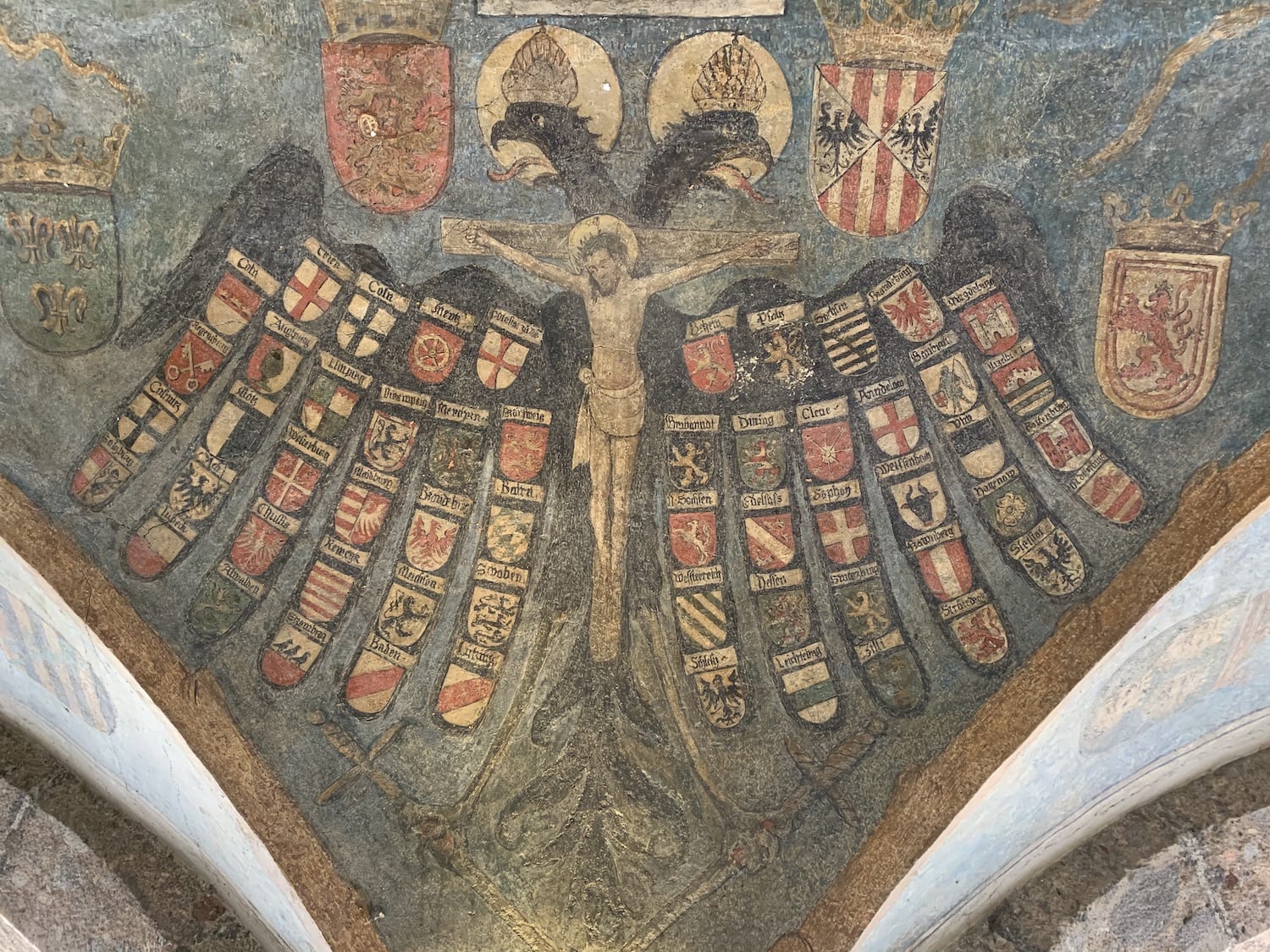
Under one of the arcades near the entrance to the Old Town lies the Quaternion Eagle, a remarkable symbol of Habsburg power during Maximilian’s era. The Quaternion Eagle, also called the Blood-Ban Eagle, represented the political hierarchy of the Middle Ages and the Early Modern period. It united the most important institutions of feudal legislation. The double-headed eagle symbolized the monarchy. Beneath its wings, the coats of arms of the individual states of the Holy Roman Empire find protection. In the top row are the coats of arms of the prince-electors who elected the emperor. The four secular electors—Bohemia, Palatinate, Saxony, Brandenburg—and the three ecclesiastical electors—Trier, Cologne, Mainz—were, perhaps for symmetry, complemented by the coat of arms of the Podestà of Rome. The unifying element is the crucified Christ, who brings together the lands and the empire. In the feudal system, the Church was considered the representative of this Maiestas Domini on earth. The four shields above the eagle symbolize the royal houses of France, England, Sicily, and Scotland, which, alongside the Habsburgs, were regarded as anointed and thus equal kings.
The painting of the Quaternion Eagle was created in 1496 on the house of the then city judge Walter Zeller, today known as the Kohlegger House. Maximilian granted Zeller—considered particularly capable and honorable—the High Jurisdiction, the right to impose the death penalty for capital crimes, a privilege normally reserved for the territorial prince. Granting this blood jurisdiction to a city judge remained unique in Innsbruck’s history. Out of pride and gratitude to the emperor, and to emphasize his loyal affiliation with the ruling house, Zeller also had the fire steels of the Order of the Golden Fleece and the coats of arms of the Habsburg hereditary lands incorporated into the Quaternion Eagle. With this powerful artistic manifestation of the Holy Roman Empire, Zeller sought to underscore the legal validity of his position. Not preserved was the decorative inscription added by Zeller’s son, Walter the Younger, as a pious addition on the outside of the building: “Nisi dominus custodiet civitatem, frustra vigilat, cui custodit eam.” (Note: Unless the Lord guards the city, the watchman keeps vigil in vain.) That the Gothic painting under the arcades is still visible today is thanks to chance. In the 17th century, the artwork, like many others, was carelessly painted over. It only reappeared during renovation work in the 1930s.
Holy Roman Empire
The state of Austria is a relatively young invention, as is citizenship. For more than 1,000 years, Innsbruck was part of the Holy Roman Empire. The people of Innsbruck were subjects of the Emperor—and subjects of the Tyrolean territorial prince—and of their feudal lord. If they possessed civic rights, they were also citizens of Innsbruck. And very likely they were Christians as well. What they were not, at least until 1806, was Austrian. But what exactly was this Holy Roman Empire? And who was the Emperor? And was he really more powerful than a king? The French philosopher Voltaire is said to have mocked it in 1761 with the words: “The Holy Roman Empire was neither holy, nor Roman, nor an empire.” He was probably not entirely wrong. In reality, it was an association of individual territories, shaped by conflicts and disputes over power—both among the princes of the Empire themselves and between the princes and the Emperor. It had no capital. The center of the Empire was wherever the Emperor happened to be, as he frequently changed his residences. Emperor Maximilian I. made Innsbruck one of his residences, which acted like a turbo boost for the city’s development. Nationality and a sense of belonging played a much smaller role in political affiliation until the 19th century than they do today. The bond that held much together was Christianity. Institutions such as the Imperial Chamber Court or the Imperial Diet were introduced only in the late Middle Ages and the Early Modern period to facilitate administration and to settle disputes among the territorial princes. The Golden Bull, which among other things regulated the election of the Emperor, was a very simple form of an early constitution. Three ecclesiastical and four secular prince-electors chose their head. The princes had seat and vote in the Imperial Diet, and the Emperor depended on them. To assert himself, he required a strong dynastic power base. The Habsburgs were able to draw on Tyrol for this, among other territories. Tyrol repeatedly became a bone of contention between the Habsburgs and the Dukes of Bavaria, even though both belonged to the Holy Roman Empire. Innsbruck was several times administered by Bavarian princely dynasties.
The hierarchy within the feudal system was strictly ordered, from the Emperor down to the peasant. Emperors and kings received power and legitimacy directly from God. The feudal system was divinely ordained. Peasants—more than 90 percent of the medieval population—worked in agriculture to sustain the clergy, who prayed for salvation, and the aristocracy, who fought for the defenseless and protected the clergy. It was a three-part relationship: one side provided order and prayers for the salvation of humankind, another provided protection of life and limb, and the third contributed obedience, loyalty, and labor. This concept of loyalty may seem alien to modern citizens, as today’s obligations—taxes, compliance with laws, elections, or compulsory service—are more abstract and far less personal. Yet well into the 20th century, the feudal system was built precisely on this principle. Loyalty was not based on a birthright comparable to modern citizenship. The “Austrian” military commander Prince Eugene may have been of French origin, yet he fought in the army of Leopold I., Emperor of the Holy Roman Empire, against France. He was a subject of the Archduke of Austria, with residences in Vienna and Hungary. While today one must be a native-born U.S. citizen to become President of the United States, rulers in earlier times were likewise not bound to an inherited nationality. Emperor Charles V. was born in what is now Ghent in Belgium, grew up at the Burgundian court, became King of Spain, inherited the Archduchy of Austria, and was later elected Emperor. To be “Germanic” did not mean to be German; it usually referred to the everyday language a person spoke.
The “Roman” element in the German imperial title was a centuries-old concept. When Charlemagne was crowned Roman-German Emperor in Rome in the year 800, he assumed the legacy of the Roman emperors with divine legitimacy through papal anointing—and at the same time became the secular protector of the Pope. In return, the Emperor was the earthly protector of the Holy Father. The Holy Roman Empire under the mantle of the Emperor ceased to exist in 1806 during the Napoleonic Wars. From this point onward, Central Europe slowly began to transform into a collection of nation-states modeled on France and England. The idea of the Roman Empire was rooted in the adventurous ancient notion that ancient Rome had to continue to exist. For devout Christians, according to the doctrine of the Four World Empires, it was of immense importance that the Empire endured. This doctrine was based on the Book of Daniel in the Old Testament. According to the story, the Babylonian king Nebuchadnezzar dreamed of four successive world empires. With the end of the fourth empire, the prophet foretold, the world would also come to an end. Around the year 400, the Church Father Jerome interpreted these four empires as Babylon, Persia, Greece, and the Roman Empire. In medieval belief, the end of Roman rule would therefore also mean the end of the world—and so Rome must not fall. Through the so-called translatio imperii, the transfer of the legal claim of the ancient Roman Empire to the Roman-German emperors after Charlemagne, Rome’s continuity was formally preserved, and the world was allowed to endure. Thanks to the Emperor, humanity still exists today.
Innsbruck and the House of Habsburg
Innsbrucks Innenstadt wird bis heute von Gebäuden und Denkmälern geprägt, die an die Familie Habsburg erinnern. Unzählige Touristen bewundern die stummen Hinterlassenschaften der Dynastie, die als mindestens ebenso ur-österreichisch gilt wie Schnitzel, Mozartkugeln und Mehlspeisen. Diese Darstellung ist allerdings nicht korrekt, auch wenn die Habsburger die Landesgeschichte über Jahrhunderte mitprägten. Sie waren ein europäisches Herrscherhaus, zu dessen Einflussbereich verschiedenste Territorien gehörten. Am Zenit ihrer Macht waren ihre Mitglieder die Herrscher über ein „Reich, in dem die Sonne nie untergeht“. Durch Kriege und geschickte Heirats- und Machtpolitik saßen sie in verschiedenen Epochen an den Schalthebeln der Macht zwischen Südamerika und der Ukraine. Ob der internationalen Ausrichtung des Hauses Habsburg verwundert es nicht, dass so mancher CEO der Grafschaft Tirol aus dieser Dynastie zumindest am Anfang etwas fremdelte mit der alpinen Provinz und ihren Einwohnern. Einige der Tiroler Landesfürsten hatten weder eine besondere Beziehung zu Tirol noch brachten sie diesem deutschen Land besondere Zuneigung entgegen. Ferdinand I. (1503 – 1564) wurde am spanischen Hof erzogen. Maximilians Enkel Karl V. war in Burgund aufgewachsen. Als er mit 17 Jahren zum ersten Mal spanischen Boden betrat, um das Erbe seiner Mutter Johanna über die Reiche Kastilien und Aragorn anzutreten, sprach er kein Wort spanisch. Als er 1519 zum Deutschen Kaiser gewählt wurde, sprach er kein Wort Deutsch. Es waren auch nicht alle Habsburger glücklich in Innsbruck sein zu „dürfen“. Angeheiratete Prinzen und Prinzessinnen wie Maximilians zweite Frau Bianca Maria Sforza oder Ferdinand II. zweite Frau Anna Caterina Gonzaga strandeten ungefragt nach der Hochzeit in der rauen, deutschsprachigen Bergwelt. Stellt man sich zudem vor, was ein Umzug samt Heirat von Italien nach Tirol zu einem fremden Mann für einen Teenager bedeutet, kann man erahnen, wie schwer das Leben der Prinzessinnen war. Kinder der Aristokratie wurden bis ins 20. Jahrhundert vor allem dazu erzogen, politisch verheiratet zu werden. Widerspruch dagegen gab es keinen. Man mag sich das höfische Leben als prunkvoll vorstellen, Privatsphäre war in all dem Luxus nicht vorgesehen.
Innsbruck repeatedly became a place of destiny for this ruling dynasty. Thanks to its strategically favorable location between Italian cities and German centers such as Augsburg and Regensburg, Innsbruck gained a special status within the empire at the latest after being elevated to a residence city under Emperor Maximilian. Innsbruck experienced its Habsburg heyday when it served as the main residence of the Tyrolean sovereigns. Ferdinand II, Maximilian III, and Leopold V, together with their wives, shaped the city during their reigns. When Sigismund Franz of Habsburg (1630–1665) died childless as the last provincial ruler, Innsbruck also lost its status as a residence city, and Tyrol was governed by a governor. Tyrolean mining had lost much of its importance and no longer required special attention. Shortly thereafter, the Habsburgs lost their possessions in Western Europe, including Spain and Burgundy, which pushed Innsbruck from the center to the periphery of the empire.
Despite this decline in favor and the increasing centralization of government affairs, Tyrol, as a conservative region, generally remained loyal to the dynasty. Even after the period as a residence city, the births of new members of the ruling family were dutifully celebrated with parades and processions; deaths were mourned with memorial masses; and archdukes, kings, and emperors were immortalized in public spaces with statues and paintings. In the nineteenth century, the Jesuit Hartmann Grisar wrote the following about the celebrations marking the birth of Archduke Leopold in 1716:
„But what an imposing sight it was when, as night fell, the Abbot of Wilten held the final religious function in front of St Anne's Column, which had been consecrated by the blood of the country, surrounded by rows of students and the packed crowd; when, by the light of thousands of burning lights and torches, the whole town, together with the studying youth, the hope of the country, implored heaven for a blessing for the Emperor's newborn first son.“
The Habsburgs valued the Nibelung-like loyalty of their alpine subjects. The region’s difficult accessibility made it a perfect refuge in turbulent and crisis-ridden times. Charles V (1500–1558) fled to Innsbruck for a time during a conflict with the Protestant Schmalkaldic League. Ferdinand I (1793–1875) had his family stay in Innsbruck to keep them far from the Ottoman threat in eastern Austria. Shortly before his coronation, Franz Joseph I enjoyed the seclusion of Innsbruck during the turbulent summer of the 1848 revolution together with his brother Maximilian, who was later executed by nationalist insurgents as Emperor of Mexico. A plaque at the Alpine inn Heiligwasser above Igls commemorates the fact that the monarch spent the night there during his ascent of the Patscherkofel. In the Austro-Hungarian Monarchy of the nineteenth century, Innsbruck was the western outpost of a vast empire that extended as far as present-day Ukraine. Franz Joseph I (1830–1916) ruled a multiethnic empire between 1848 and 1916. His neo-absolutist understanding of rule, however, was outdated. Although Austria had had a parliament and a constitution since 1867, the emperor regarded this government as “his.” Ministers were accountable to the emperor, who stood above the government.
In the second half of the nineteenth century, the ailing empire began to crumble increasingly. On October 28, 1918, the Republic of Czechoslovakia was proclaimed; on October 29, Croats, Slovenes, and Serbs withdrew from the monarchy. The last emperor, Charles, abdicated on November 11. On November 12, “German-Austria declared itself a democratic republic in which all power emanates from the people.” The Habsburg chapter had come to an end. Even though only very few Austrians today can imagine a monarchy as a form of government, the view of the ruling family remains ambivalent. Despite all the national, economic, and democratic problems that existed in the multiethnic states that— in various forms and configurations—were subject to the Habsburgs, the successor nation-states in some cases proved far less successful at reconciling minority interests and cultural differences within their territories. Since the EU’s eastward enlargement, the Habsburg Monarchy has not infrequently been portrayed by well-meaning historians as a precursor to the European Union. The list of Habsburg legacies in Innsbruck is long. Together with the Catholic Church, the Habsburgs shaped public space through architecture, art, and culture. The Golden Roof, the Imperial Palace, the Triumphal Arch, Ambras Castle, the Leopold Fountain, and many other structures still bear witness today to the presence of what was arguably the most significant ruling dynasty in European history in Innsbruck.
Big City Life in early Innsbruck
During the Middle Ages, Innsbruck officially developed into a city. Formal recognition by the territorial prince in 1239 brought with it an entirely new system for its citizens. Market rights, building rights, customs rights, and an independent jurisdiction were gradually transferred to the city. Urban citizens were no longer subject to their feudal lord, but to the city’s jurisdiction—at least within the city walls. The well-known saying “city air makes one free” derives from the fact that after one year of residence in the city, a person was released from all obligations to their former lord. Unlike unfree peasants and servants, citizens could freely dispose of their property and determine their way of life. Naturally, they also had rights and obligations. Citizens did not pay tithes, but instead paid taxes to the city. Which group within the city was required to pay which taxes could be determined by the city government itself. The city, in turn, did not have to pass these taxes on directly, but could freely dispose of its budget after paying a fixed levy to the territorial prince. In addition to city defense, expenditures included care for the sick and the poor. Needy citizens could obtain meals from the “boiling kitchen” (Siedeküche), provided they held civic rights. The city government paid particular attention to contagious diseases such as the plague, which periodically tormented the population. In return for their rights, every citizen had to swear the civic oath. This oath included the obligation to pay taxes and perform military service. In addition to defending the city, citizens were also deployed beyond its walls. In 1406, a contingent together with mercenaries confronted an Appenzell army to defend the Upper Inn Valley. From 1511 onward, according to Emperor Maximilian’s Landlibell, the city council was also obliged to provide a contingent of conscripts for territorial defense. In addition, there were volunteers who could enlist for military service in the city’s Freifähnlein; for example, Innsbruck citizens were among the defenders of Vienna during the Ottoman siege of 1529.
In the 15th century, space became scarce in the rapidly growing city of Innsbruck. Citizenship became an exclusive commodity. Only free subjects born of legitimate birth were able to obtain city rights. To become a citizen, one had to prove either house ownership or skills in a craft in which the city's guilds were interested. The debate over who is a "true" Innsbrucker and who is not persists to this day. That migration and exchange with others have always been the guarantee for prosperity—and made Innsbruck into the livable city it is today—is often forgotten in the process. Because of these restrictions, Innsbruck had a completely different social structure than the surrounding villages. Craftsmen, merchants, civil servants, and domestic servants defined the cityscape. Traveling traders, officials, and court retainers also came to Innsbruck for short periods in the entourage of a prince and held no citizenship rights. The craftsmen exerted the greatest political power at the municipal level. Unlike peasants, they belonged to the socially mobile classes of the Middle Ages and the Early Modern Period. After completing their apprenticeship, they went on the Walz (journeyman years) before undergoing the master's examination, subsequently either returning home or settling in another city. Craftsmen were responsible not only for the transfer of technical knowledge, but also for spreading cultural, social, and political ideas. The individual trades—such as blacksmiths, coppersmiths, goldsmiths, furriers, bagmakers, cloth shearers, shoemakers, locksmiths, tanners, armorers, carpenters, bakers, and butchers—each had their own guild headed by a master. These craft guilds sometimes exercised their own jurisdiction over their members alongside the municipal court system. Wages, prices, and social life were regulated by the guilds under the supervision of the sovereign. One could speak of an early form of social partnership, as the guilds also provided security for their members in the event of illness or disability.
From the 14th century onward, Innsbruck demonstrably possessed a city council—the so-called Gemain—and a mayor. The elections, held annually after the turn of the year, were not secret, but public. Innsbruck had a population of around 5,000, of whom only a small fraction held citizenship rights. Propertyless individuals, itinerant folk, the unemployed, domestic servants, diplomats, employees, women, and later students were not eligible to vote. Casting a vote was an exclusive privilege of the male upper class. In the Innsbrucker Geschichtsalmanach of 1948, one can find records regarding the election of the year 1598.
The Feast of St. Erhard, i.e., January 8th, played a significant role in the lives of the citizens of Innsbruck each year. On this day, they gathered to elect the city officials, namely the mayor, city judge, public orator, and the twelve-member council. A detailed account of the election process between 1598 and 1607 is provided by a protocol preserved in the city archive: "... The ringing of the great bell summoned the council and the citizenry to the town hall, and once the honorable council and the entire community were assembled at the town hall, the honorable council first convened in the council chamber and heard the farewell of the outgoing mayor of the previous year, Augustin Tauscher."
The mayor represented the city to the other estates and the sovereign, who exercised supreme authority over the town with varying degrees of intensity depending on the era. Each city councilor was assigned specific, clearly defined tasks, such as overseeing market rights and the quality of offered goods, managing the hospital and poor relief, or administering the customs regulations, which were particularly vital for Innsbruck. The city council was also tasked with maintaining discipline, social order, and prevailing moral standards. The consumption of alcohol and staying in taverns were regulated differently at various times. For poorer social classes, going to inns was not only too expensive, but they were also restricted to visiting them only during specific hours. This was intended to prevent excessive drunkenness and begging directed at the upper class. Much like an early market authority, the city council monitored the quality and standard of food, as cities were keen on maintaining the reputation of their businesses to remain attractive as economic hubs and for visiting guests.
Contrary to popular belief, the Middle Ages were not a lawless era of arbitrariness. At both municipal and territorial levels, there were codes that very precisely regulated what was permitted and what was forbidden. Depending on the ruler and prevailing moral standards, these could vary significantly. Carrying weapons, swearing, prostitution, making noise, playing music, blasphemy, children playing—anything and anyone could end up in the crosshairs of law enforcement. Considering the regulations for trade, customs, professional practice by guilds, and price-fixing for all sorts of goods by the magistrate, pre- and early modern cohabitation was no less regulated than it is today. The difference lay in monitoring and enforcement power, which the authorities often lacked. If someone was caught in an unlawful or immoral act, judicial bodies existed to hand down sentences. Medieval court days were held outdoors at the "Dingstätte." The tradition of the Ding dates back to the ancient Germanic Thing, where all free men gathered to administer justice. The city council appointed a judge responsible for all offenses not subject to blood justice (Blutgericht). He was assisted by a panel of several jurors. Penalties ranged from fines to the pillory and imprisonment. The city also monitored adherence to religious order. There was no police force, but the city judge employed bailiffs, and city guards were stationed at the gates to maintain order. It was a civic duty to assist in capturing criminals; vigilantism was strictly prohibited. Law enforcement included methods far less humane than those common today, though torture was not applied randomly or arbitrarily. Torture as part of formal procedure in particularly severe cases was also regulated. Up until the 17th century, suspects and criminals in Innsbruck were detained and interrogated in the Kräuterturm (Herb Tower) at the southeastern corner of the city wall, along present-day Herzog-Otto-Ufer. Both trials and sentence executions were public affairs. Minor offenses brought mild yet humiliating punishments: in front of the City Tower stood the Narrenhäusel (fools' house), a cage in which offenders were locked up and put on display for several hours or days. On the wooden Schandesel (donkey of shame), one was paraded through the city. The pillory stood in the suburb—today's Maria-Theresien-Straße. The jurisdictional boundaries between municipal and territorial justice had been regulated in the land register (Urbarbuch) since 1288. "Heretics" and dissidents were sentenced not by the Church, but by the city government. Only severe crimes remained under the jurisdiction of the territorial court (Landesgericht). Offenses such as theft, murder, or arson fell under this high justice (Blutrecht). The territorial court for all communities south of the Inn between Ampass and Götzens was based at the Sonnenburg, situated on the hill south above Innsbruck. In the 14th century, the Sonnenburg court relocated to the Upper Town Square in front of the Innsbruck City Tower, later to the Town Hall, and in the early modern period to Götzens. With the centralization of law in the 18th century, the Sonnenburg court returned to Innsbruck, taking shelter under various names and in different buildings—such as the Leuthaus in Wilten, on the Innrain, or at the Ansitz Ettnau (known as the Malfatti-Schlössl) in Höttinger Gasse.
From the late 15th century onward, Innsbruck’s executioner was centralized and responsible for several courts, residing in Hall. Execution sites changed over time. A gallows long stood on a hill in today’s Dreiheiligen district directly by the main road. The Köpflplatz was located until 1731 at today’s corner of Fallbachgasse and Weiherburggasse in Anpruggen. In Hötting, the gallows stood behind the Chapel of the Great God. The present chapel, which alongside a Baroque crucifix features ceramic figures by the renowned artist Max Spielmann (1906–1984), was relocated during roadworks in the 1960s. While Spielmann’s Dance of Death memorial commemorates those killed in the Second World War, those sentenced to death once sent a final prayer heavenward here before the noose was placed around their necks or their heads were severed—depending on social status and the nature of the crime. It was not uncommon for the condemned to give their executioner a kind of gratuity so that he would aim as precisely as possible to make the execution as painless as possible. Much could go wrong: if the sword missed its mark, the noose was improperly placed, or the rope broke, the suffering of the condemned increased. For authorities and public order, particularly dangerous offenders such as the “heretic” Jakob Hutter or the captured leaders of the Peasants’ Revolts of 1525 and 1526 were publicly executed in front of the Golden Roof. “Aggravated” punishments such as quartering or breaking on the wheel—derived from the Latin poena—were not routine but could be ordered in special cases. Executions were public demonstrations of authority and served as a form of purification of society and as a deterrent. Large crowds gathered to accompany the condemned on their final journey. On execution days, university lectures were suspended to allow students to attend and be morally instructed. The bodies of those executed were often left hanging and buried outside consecrated cemetery grounds or handed over to the university for study purposes. The last public execution in Austrian history took place in 1868. Although executions thereafter were still far from gentle, killings by strangulation at the gallows—used until the 1950s—were no longer public spectacles.
With the centralisation of law under Maria Theresa and Joseph II in the 18th century and the General Civil Code in the 19th century under Franz I, the law passed from cities and sovereigns to the monarch and their administrative bodies at various levels. Torture was abolished. The Enlightenment had fundamentally changed the concept of law, punishment and rehabilitation. The collection of taxes was also centralised, which resulted in a great loss of importance for the local nobility and an increase in the status of the civil service. With the increasing centralisation under Maria Theresa and Joseph II, taxes and customs duties were also gradually centralised and collected by the Imperial Court Chamber. As a result, Innsbruck, like many municipalities at the time, lost a large amount of revenue, which was only partially offset by equalisation.