Gasthof Goldener Adler
Herzog-Friedrich-Straße 6
Worth knowing
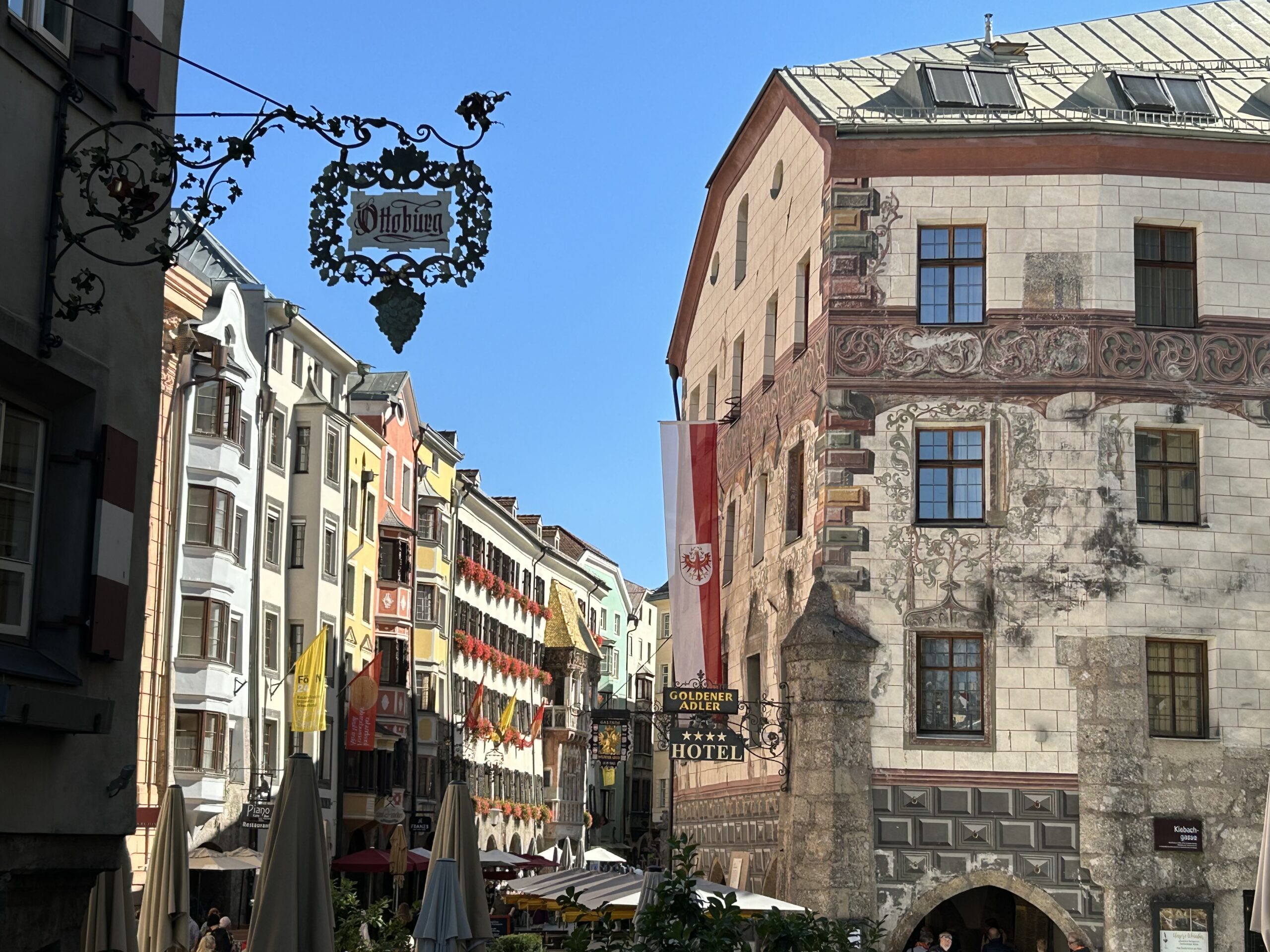
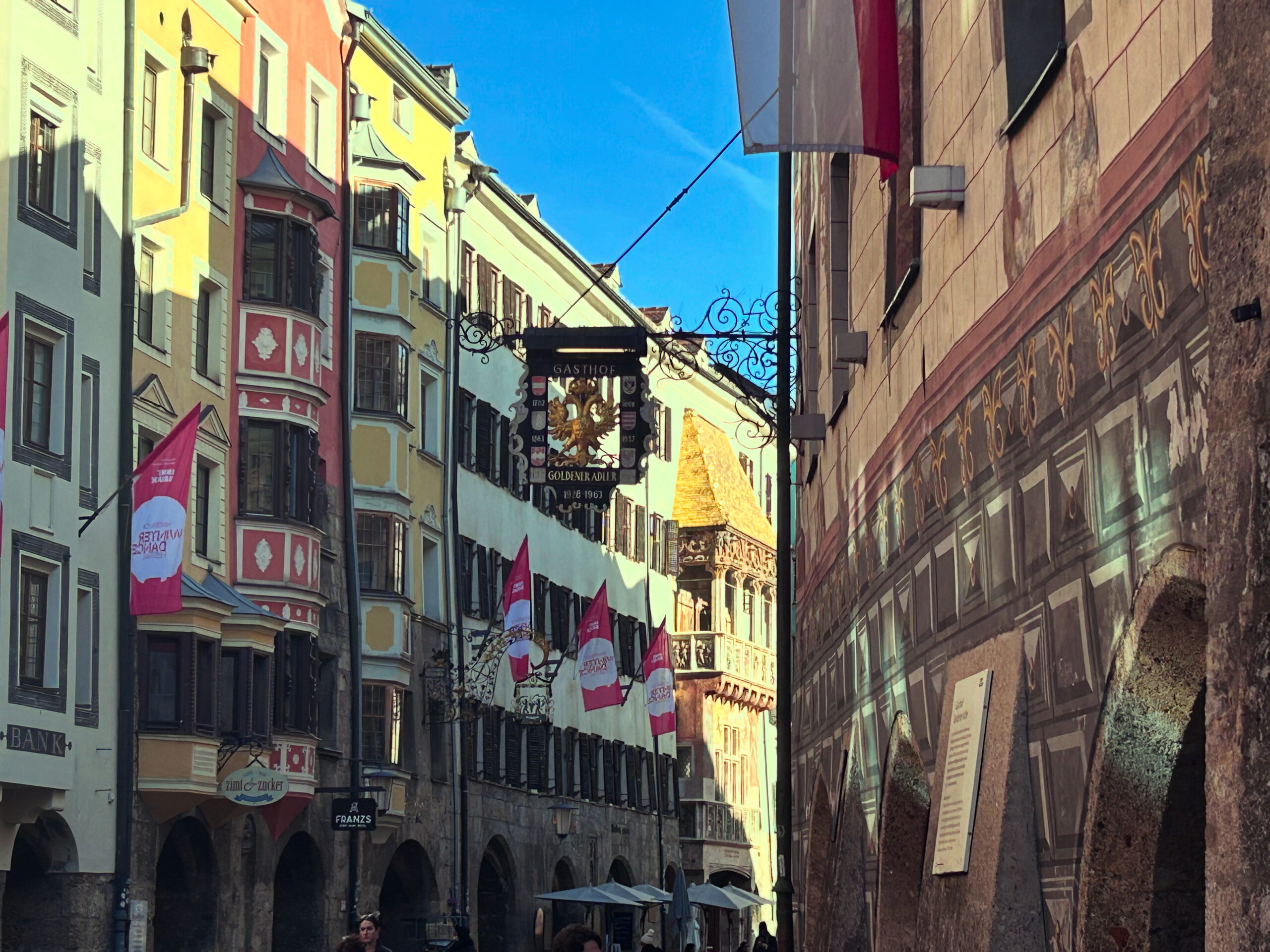
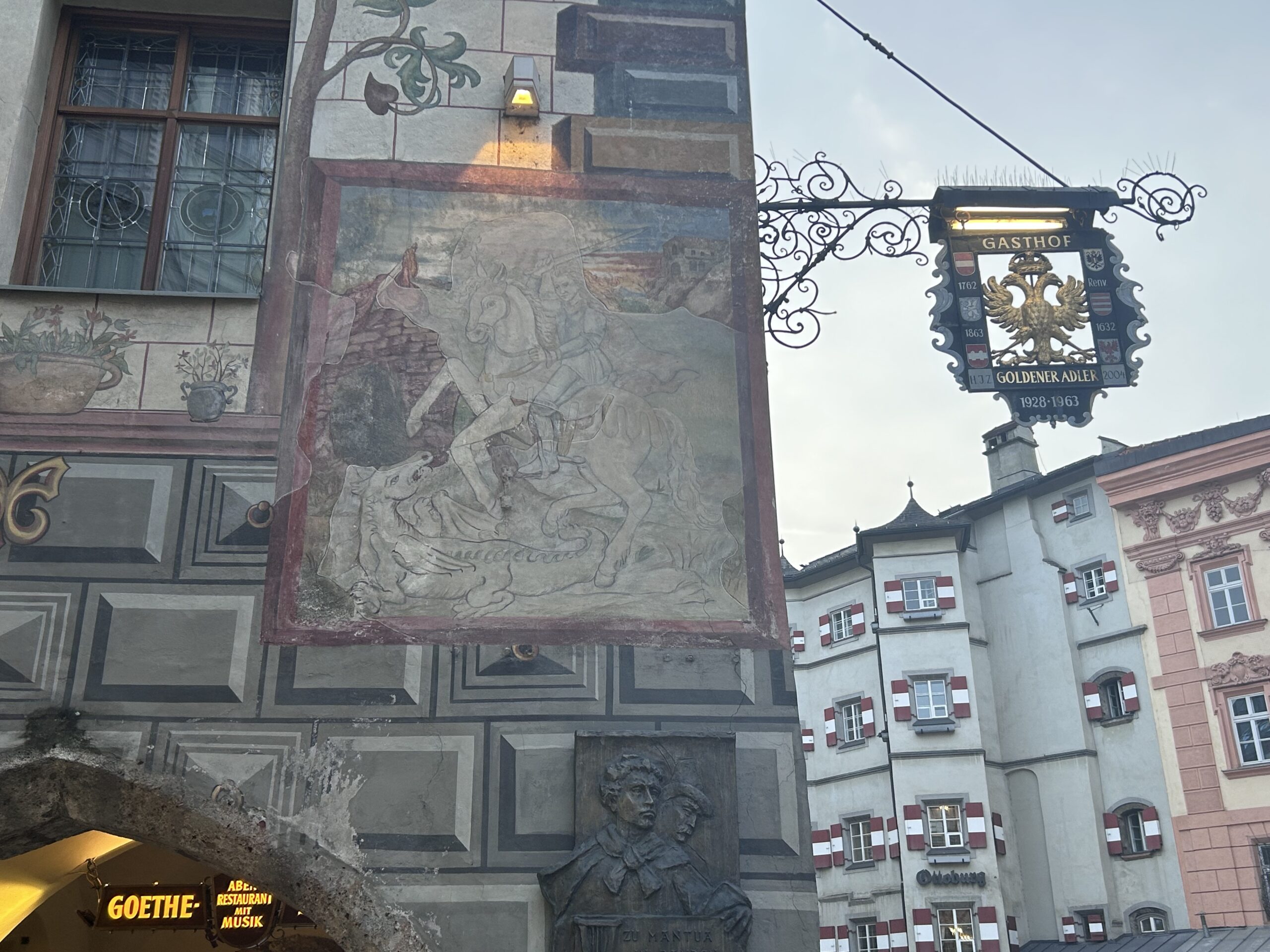
For centuries, Innsbruck’s inns were not only social meeting points but also vital infrastructure for the city as a trading and residential hub. One of these inns was the Goldener Adler in Innsbruck, today an institution. Thanks to its proximity to the Ballhaus, it was the ideal lodging for passing merchants. The Goldener Adler was first mentioned in a document in 1573. However, since Emperor Maximilian’s entourage is said to have stayed there, it can be assumed that the inn welcomed guests much earlier. A sign at the Goldener Adler gives 1390 as its founding date. Today a respected tavern, the Goldener Adler—like all other inns—was for a long time a place where travelers, merchants, and other itinerant folk stayed. Accommodated in simple quarters and served cheap meals, they turned inns into hubs of information exchange. Travel was dangerous, and knowledge about foreign lands, political conditions, trustworthy business partners, roads, tolls, and the economic situation in various regions was worth its weight in gold in an era without internet, telephone, television, or newspapers. Strangers from all over the world maintained their own ways of interacting with each other and with society. An inn probably resembled a truck stop more than the hotels we know today. Many citizens engaged in respectable Christian professions viewed the guests with suspicion, and inns were considered places of dubious reputation. This only began to change gradually with Innsbruck’s rise in the 15th century. As the clientele changed, so did the reputation of the inns. Anyone who came to Innsbruck and cared about status stayed at the Goldener Adler. Celebrities of all kinds lodged here, as the plaque at the entrance attests. It was not uncommon for minor aristocrats and guests of the court to sleep in one of the inns when the official chambers were fully booked. Innsbruck’s innkeepers profited not only from transit but also from the city’s status as a residence and the entourage of noble visitors—though bills from the Hofburg were usually paid late and only after reminders. The Pofl—people without citizenship or sufficient property—were not allowed to enter the taverns.
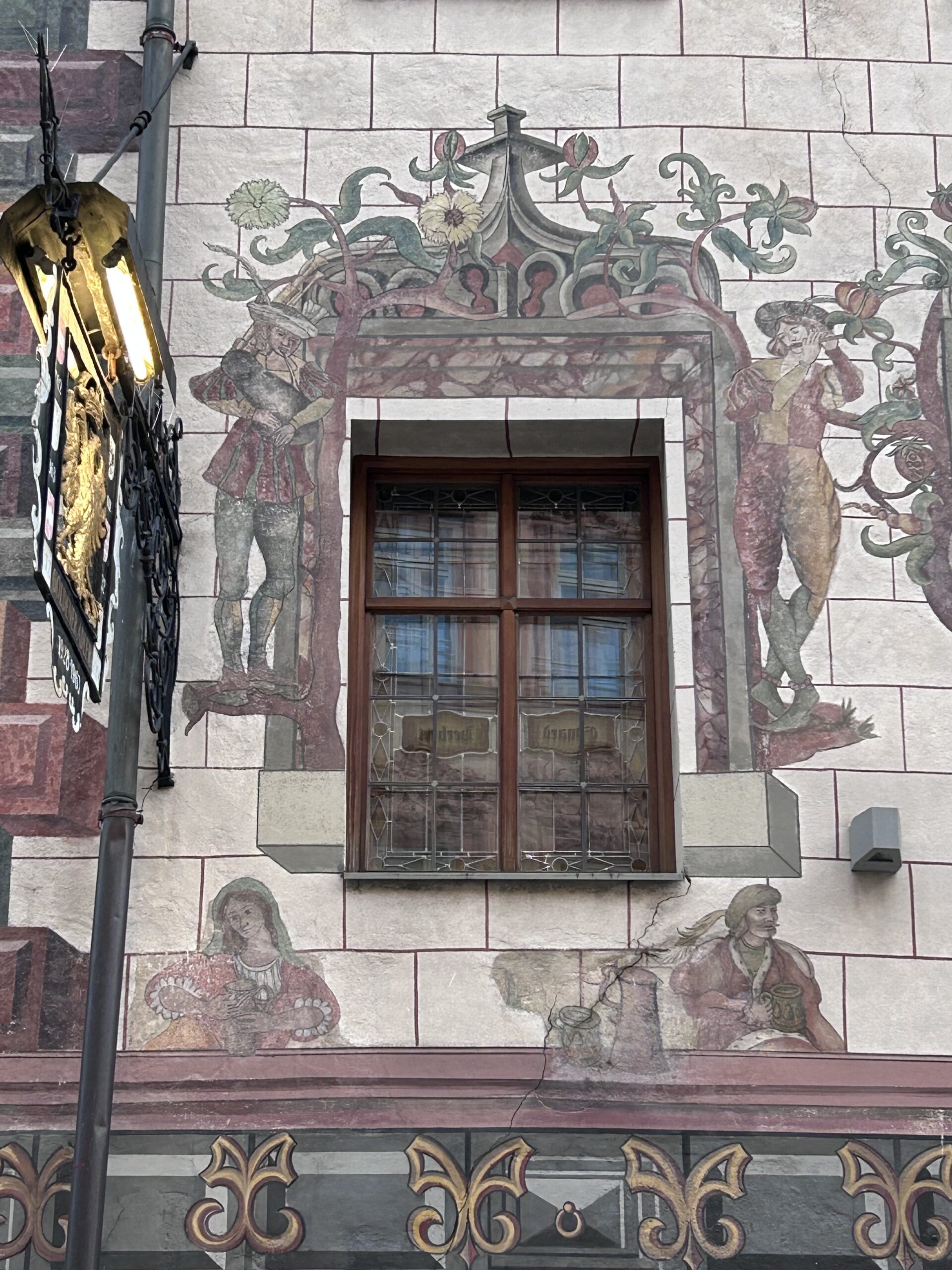
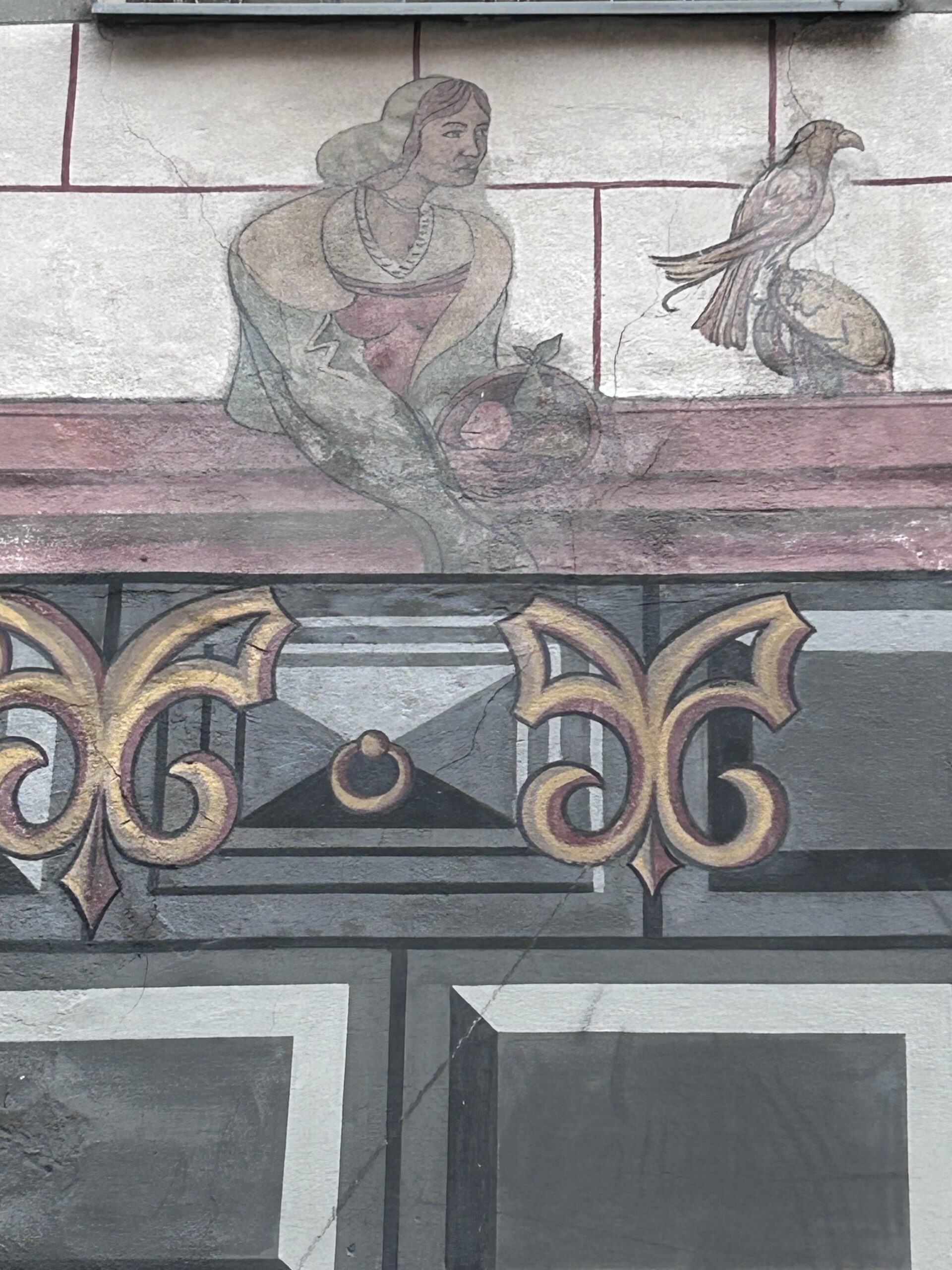
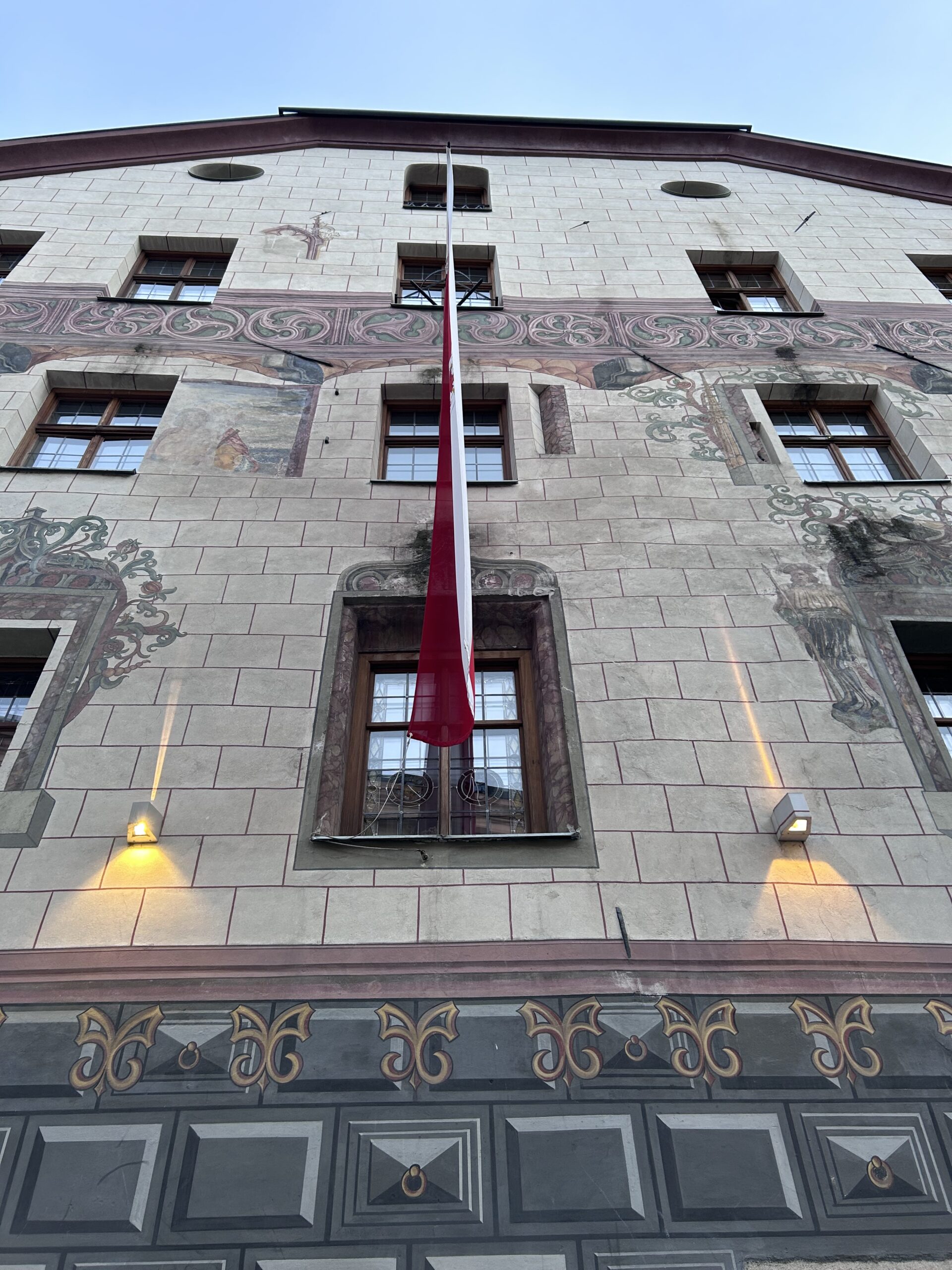
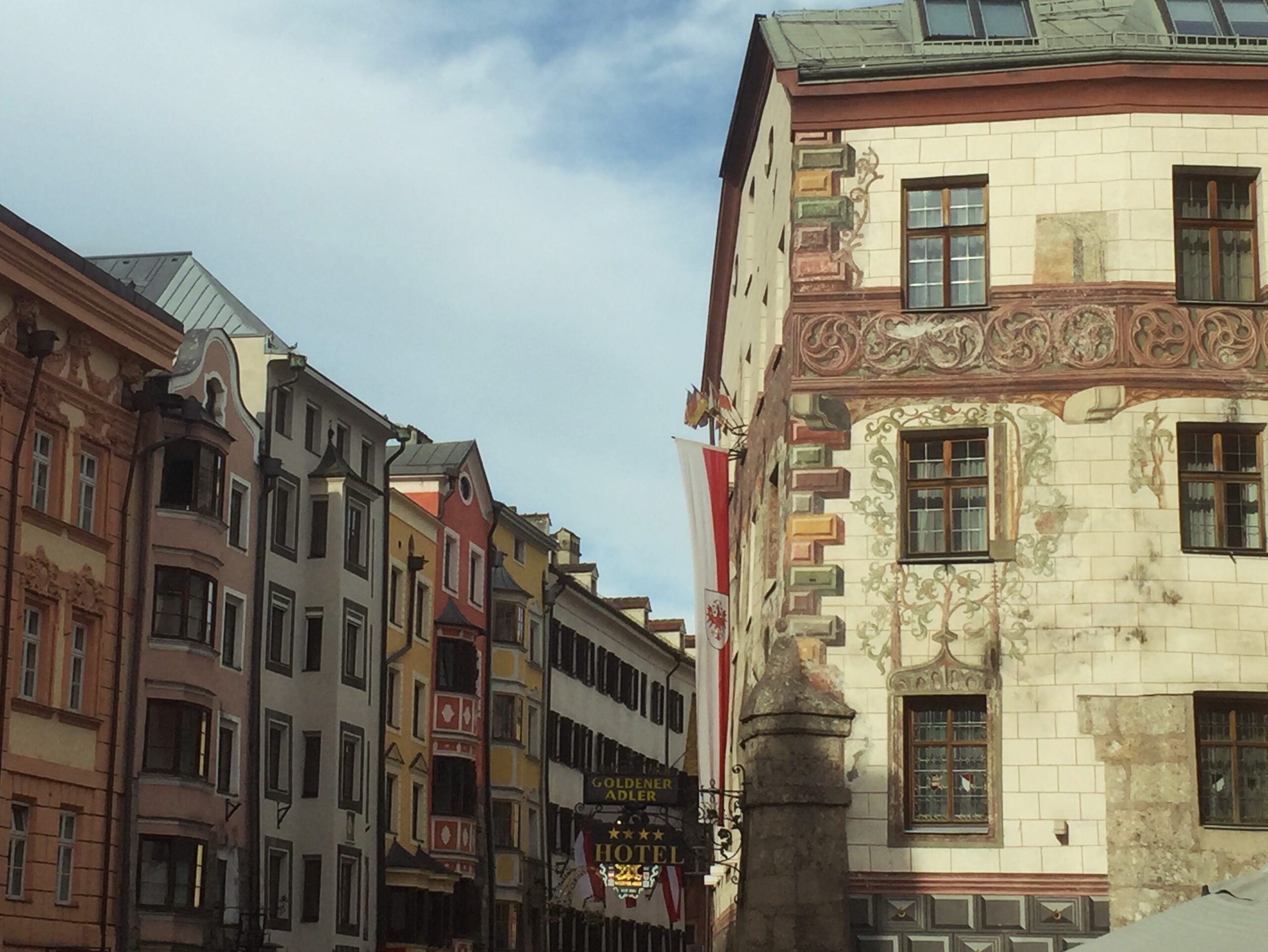
The inn gained almost state-level significance during the Tyrolean uprising. From the balcony of the Goldener Adler, Andreas Hofer is said to have addressed the Innsbruck population after taking the city in 1809. A plaque under the arcades at the restaurant entrance commemorates this moment and displays the modestly ambitious text. To this day, the tradition and history of the establishment are celebrated through the naming of its rooms. Guests can dine in the Goethe Stüberl and then retire to the Archduke Eugen Room. Each room is dedicated to a prominent guest of the past, with their biography and connection to the inn lovingly recounted. The exterior of the building also reflects its significance and tradition. From the Inn Bridge, one can see the magnificent Gothic building dominating the entrance to the Old Town. Older pictures and postcards show the Goldener Adler without ornamentation; the frescoes were only rediscovered during renovations after World War II. The coat of arms with the double-headed eagle is also worth seeing. Today, the Goldener Adler is one of the most beautiful restaurants in the city, equally popular with locals and tourists. Not exactly cheap, the inn offers hearty cuisine in the pleasant atmosphere of its cozy parlors or outdoors with a view of the Ottoburg.
Tourism: From Alpine summer retreat to Piefke Saga
In the 1990s, an Austrian television series caused a scandal. Die Piefke Saga, written by the Tyrolean author Felix Mitterer, portrayed in four darkly humorous and revealing episodes the relationship between the German tourist family Sattmann and their hosts in a fictional Tyrolean holiday resort. Despite all justified criticism of modern tourism and its sometimes extreme excesses, one should not forget that tourism in the nineteenth century was an important driving force for the development of Innsbruck and its surroundings—not only economically. The first travellers to visit Innsbruck were pilgrims and “business people” of the early modern period. Merchants, journeymen on their travels, officials, soldiers, entourages of visiting nobility, skilled labourers, miners, clergy, pilgrims, and scholars were the earliest “tourists” attracted to the city between Italy and the German lands. Travel was expensive, dangerous, and arduous. Moreover, many subjects were not permitted to leave their place of origin without the consent of their feudal lord or abbot. Those who travelled usually did so on foot. Although Innsbruck’s inns and taverns profited from travellers as early as the Middle Ages and the early modern period, tourism in the modern sense did not yet exist. This began only when a few eccentrics were first drawn to mountain peaks. For this to happen, not only was a growing middle class required, but also a new perception of the Alps. For a long time, mountains had been regarded purely as a threat. It was primarily the British who, having explored the world’s oceans, now sought to conquer its mountain ranges as well. From the late eighteenth century onward, during the Romantic period, travel accounts began to spread the idea of the natural beauty of the Alps. The first foreign-language travel guide to Tyrol, Travels through the Rhaetian Alps by Jean François Beaumont, appeared in 1796. In addition to the alpine scenery, it was also the “wild and exotic natives” of Tyrol that fascinated international audiences. The bearded rebel Andreas Hofer, who had managed to challenge Napoleon’s army with a peasant force, attracted as much attention in Britain—the traditional enemy of France—as among German nationalists north of the Alps, who saw in him a kind of proto-German figure. Tyroleans were perceived as a stubborn, archetypal, and untamed people, comparable to the Germanic tribes under Arminius who had once resisted the Roman Empire. Descriptions of Innsbruck by authors such as Beda Weber (1798–1858), along with other travel accounts in the rapidly expanding press landscape, helped shape an attractive image of the city.
The next step was to make the wild Alpine environment accessible to a growing number of tourists who wished to emulate early adventurers, even if their willingness to take risks and their physical fitness fell short. In 1869, the German Alpine Club established a section in Innsbruck, following the relatively unsuccessful founding of the Austrian Alpine Club in 1862. Driven by the Greater German idea shared by many members, the two associations merged in 1873. To this day, the Alpine Club retains a largely bourgeois character, while its social-democratic counterpart is the organisation Naturfreunde. The network of hiking trails expanded, as did the number of mountain huts capable of hosting guests. As a transit region, Tyrol already possessed numerous mule tracks and footpaths that had existed for centuries and now formed the basis for alpine tourism. Small inns, farms, and stations along postal routes served as accommodation. Key figures such as the Tyrolean theologian Franz Senn (1831–1884) and Adolf Pichler (1819–1900) were instrumental in surveying Tyrol and creating maps. Contrary to popular belief, the Tyroleans were not born mountaineers but had to learn how to master the alpine environment; previously, mountains had been viewed mainly as dangerous obstacles in agricultural life. The Alpine clubs also trained mountain guides. Around the turn of the century, skiing began to gain popularity alongside hiking and mountaineering. Ski lifts did not yet exist; to climb mountains, skins were attached to skis—a practice still used in ski touring today. Only from the 1920s onward, with the construction of cable cars to the Nordkette and Patscherkofel, did a wealthier clientele begin to enjoy the modern luxury of mechanised mountain access.
This development required new hotels, cafés, inns, shops, and modes of transport to meet the needs of visitors. Guests accustomed to running water and telephones in cities like London or Paris were not willing to accept basic conditions such as outdoor toilets. Inns of the first and second class were suitable for transit travellers but not equipped for more discerning tourists. Until the nineteenth century, innkeepers in Innsbruck and the surrounding villages belonged to the upper middle class in terms of income, but their profession was not considered particularly prestigious. Many were farmers who supplemented their income by serving food and drink. As local meeting points and hubs in postal and goods networks, inns were centres of information, yet innkeeping did not carry the status of a guild profession or bourgeois occupation. This changed with the professionalisation of tourism. Entrepreneurs such as Robert Nißl, who acquired Büchsenhausen Castle in 1865 and transformed it into a brewery, or Johann Gruber of the inn Zum Riesen Haymon, invested in tourism infrastructure. Former aristocratic estates such as Weiherburg were converted into inns and hotels. In Innsbruck, the true transformation did not occur on the barricades of 1848 but later, within the tourism sector, as ambitious citizens replaced aristocrats as owners of estates.
The Österreichischer Hof, opened in 1849, dominated early modern hospitality but was not yet a true grand hotel. That distinction only came with the opening of the Grand Hotel Europa in 1869. In 1892, the Habsburger Hof followed, offering modern comforts such as electric lighting—a sensation at the time. Hotels like the Kaiserhof and Arlberger Hof were located near the railway station, which at the time represented the centre of modern urban life rather than the congested traffic hubs of today.
Visitor numbers grew steadily. Shortly before the First World War, Innsbruck recorded around 200,000 guests annually. A report from June 1896 noted:
“Tourism in Innsbruck in the month of May amounted to 5,647 persons, including 2,763 from Austria-Hungary, 1,974 from the German Empire, 282 English, 65 Italians, 68 French, 53 Americans, 51 Russians, and 388 from various other countries.”
In addition to the sheer number of travellers influencing life in the small town of Innsbruck, it was also the international character of its visitors that gradually gave the city a new face. Beyond purely tourist infrastructure, general modern developments were also accelerated. Wealthy guests could hardly be expected to frequent inns with cesspits behind the building. While a sewage system would inevitably have been built sooner or later, the economic importance of tourism enabled and accelerated the allocation of funds for the major infrastructure projects of the turn of the century. This transformation affected not only the city’s appearance but also the everyday lives and working conditions of its inhabitants. Enterprising individuals such as Heinrich Menardi succeeded in expanding the value chain by offering paid leisure activities in addition to accommodation and food. In 1880, he founded the carriage hire and later automobile rental service Heinrich Menardi for excursions into the Alpine surroundings. Initially using horse-drawn carriages, and after the First World War buses and cars, affluent tourists were transported as far as Venice. The company still exists today and is now headquartered in the Menardi building at Wilhelm‑Greil‑Straße 17, opposite Landhausplatz, although it has since shifted from transport and trade to the more lucrative real estate sector. Local retail also benefited from the affluent international clientele. By 1909, there were already three dedicated tourist equipment shops in the city, alongside the fashionable department stores that had opened just a few years earlier.
Innsbruck and its surrounding areas also became known for spa tourism—the precursor of today’s wellness industry—where wealthy guests recovered from a wide range of ailments in an alpine environment. Spa facilities existed in Egerdach near Amras, in Mentlberg, and in Mühlau. Establishments such as the Igler Hof (then the Grand Hotel Igler Hof) and the Sporthotel Igls still retain some of the charm of that era. Michael Obexer, founder of the spa resort in Igls and owner of the grand hotel, was a pioneer of tourism. Although these facilities never achieved the international fame of major spa destinations such as Bad Ischl, Marienbad, or Baden near Vienna—as evidenced by historical photographs and postcards—the treatments offered, including brine baths, steam therapies, gymnastics, and even “magnetism,” corresponded to what was considered state of the art at the time and still partially resonates in today’s wellness practices. Perhaps the most spectacular tourism project Innsbruck ever experienced was “Hoch‑Innsbruck,” today known as the Hungerburg. Not only the funicular railway and hotels were built there; even an artificial lake was created after the turn of the century to attract visitors.
One of the former landowners in the Hungerburg area and a pioneer of Innsbruck tourism, Richard von Attlmayr, played a key role in the predecessor organisation of today’s tourism association. Since 1881, the Innsbruck Beautification Association had been concerned with meeting the growing needs of visitors. The association developed walking and hiking paths, installed benches, and opened up hard-to-access areas such as the Mühlauer Gorge and the Sill Gorge. The distinctive green benches along many paths still serve as a reminder of this organisation, which continues to exist today. Seven years later, in 1888, those benefiting from tourism in Innsbruck founded the Commission for the Promotion of Tourism, the predecessor of today’s tourism board. Through joint efforts in marketing and quality assurance among accommodation providers, businesses hoped to further stimulate tourism.
“Each year the number of overseas pilgrims visiting our country and its glacier-crowned mountains increases, much to the annoyance of our friendly Swiss neighbours, and many a fine dollar is left behind. The English are beginning to find Tyrol just as interesting as Switzerland, and the number of French and Dutch visitors spending the summer here grows year by year.”
Postcards became the first mass-market “influencers” in the history of tourism. Many businesses produced their own postcards, and publishers created countless images of the city’s most popular sights. It is striking what was considered worth seeing at the time. Unlike today, it was primarily the modern achievements of the city that were depicted: the Leopold Fountain, the city café near the theatre, the chain bridge, the cog railway to the Hungerburg, or the Stefansbrücke (opened in 1845), a stone arch bridge crossing the Sill. Andreas Hofer also served as an effective testimonial on postcards: the Schupfen inn, where he had established his headquarters, and the Bergisel with the large Andreas Hofer monument were popular motifs.
In 1914, Innsbruck had 17 hotels attracting visitors, supplemented by summer and winter holidaymakers in Igls and the Stubai Valley. The First World War abruptly brought this first wave of tourism to an end. Just as tourism began to recover in the late 1920s, the global economic crisis and Hitler’s 1,000-mark travel restriction in 1933—introduced to pressure the Austrian government into lifting the ban on the Nazi Party—dealt further blows.
It took the economic boom of the 1950s and 1960s to revive tourism in Innsbruck after the destruction. Between 1955 and 1972, overnight stays in Tyrol increased fivefold. Following the hardships of the war years and the reconstruction of Europe’s economy, tourism became a stable source of income for Tyrol and Innsbruck, extending even beyond official hotels and guesthouses. Many Innsbruck families crowded more tightly into their already small apartments in order to rent out beds to foreign guests and supplement their income. Tourism not only brought foreign currency but also enabled locals to develop a new sense of identity, both internally and externally. At the same time, increasing prosperity allowed more Innsbruck residents to travel abroad themselves. The beaches of Italy became particularly popular destinations. Former wartime enemies thus became guests and hosts to one another.
Big City Life in early Innsbruck
During the Middle Ages, Innsbruck officially developed into a city. Formal recognition by the territorial prince in 1239 brought with it an entirely new system for its citizens. Market rights, building rights, customs rights, and an independent jurisdiction were gradually transferred to the city. Urban citizens were no longer subject to their feudal lord, but to the city’s jurisdiction—at least within the city walls. The well-known saying “city air makes one free” derives from the fact that after one year of residence in the city, a person was released from all obligations to their former lord. Unlike unfree peasants and servants, citizens could freely dispose of their property and determine their way of life. Naturally, they also had rights and obligations. Citizens did not pay tithes, but instead paid taxes to the city. Which group within the city was required to pay which taxes could be determined by the city government itself. The city, in turn, did not have to pass these taxes on directly, but could freely dispose of its budget after paying a fixed levy to the territorial prince. In addition to city defense, expenditures included care for the sick and the poor. Needy citizens could obtain meals from the “boiling kitchen” (Siedeküche), provided they held civic rights. The city government paid particular attention to contagious diseases such as the plague, which periodically tormented the population. In return for their rights, every citizen had to swear the civic oath. This oath included the obligation to pay taxes and perform military service. In addition to defending the city, citizens were also deployed beyond its walls. In 1406, a contingent together with mercenaries confronted an Appenzell army to defend the Upper Inn Valley. From 1511 onward, according to Emperor Maximilian’s Landlibell, the city council was also obliged to provide a contingent of conscripts for territorial defense. In addition, there were volunteers who could enlist for military service in the city’s Freifähnlein; for example, Innsbruck citizens were among the defenders of Vienna during the Ottoman siege of 1529.
In the 15th century, space became scarce in the rapidly growing city of Innsbruck. Citizenship became an exclusive commodity. Only free subjects born of legitimate birth were able to obtain city rights. To become a citizen, one had to prove either house ownership or skills in a craft in which the city's guilds were interested. The debate over who is a "true" Innsbrucker and who is not persists to this day. That migration and exchange with others have always been the guarantee for prosperity—and made Innsbruck into the livable city it is today—is often forgotten in the process. Because of these restrictions, Innsbruck had a completely different social structure than the surrounding villages. Craftsmen, merchants, civil servants, and domestic servants defined the cityscape. Traveling traders, officials, and court retainers also came to Innsbruck for short periods in the entourage of a prince and held no citizenship rights. The craftsmen exerted the greatest political power at the municipal level. Unlike peasants, they belonged to the socially mobile classes of the Middle Ages and the Early Modern Period. After completing their apprenticeship, they went on the Walz (journeyman years) before undergoing the master's examination, subsequently either returning home or settling in another city. Craftsmen were responsible not only for the transfer of technical knowledge, but also for spreading cultural, social, and political ideas. The individual trades—such as blacksmiths, coppersmiths, goldsmiths, furriers, bagmakers, cloth shearers, shoemakers, locksmiths, tanners, armorers, carpenters, bakers, and butchers—each had their own guild headed by a master. These craft guilds sometimes exercised their own jurisdiction over their members alongside the municipal court system. Wages, prices, and social life were regulated by the guilds under the supervision of the sovereign. One could speak of an early form of social partnership, as the guilds also provided security for their members in the event of illness or disability.
From the 14th century onward, Innsbruck demonstrably possessed a city council—the so-called Gemain—and a mayor. The elections, held annually after the turn of the year, were not secret, but public. Innsbruck had a population of around 5,000, of whom only a small fraction held citizenship rights. Propertyless individuals, itinerant folk, the unemployed, domestic servants, diplomats, employees, women, and later students were not eligible to vote. Casting a vote was an exclusive privilege of the male upper class. In the Innsbrucker Geschichtsalmanach of 1948, one can find records regarding the election of the year 1598.
The Feast of St. Erhard, i.e., January 8th, played a significant role in the lives of the citizens of Innsbruck each year. On this day, they gathered to elect the city officials, namely the mayor, city judge, public orator, and the twelve-member council. A detailed account of the election process between 1598 and 1607 is provided by a protocol preserved in the city archive: "... The ringing of the great bell summoned the council and the citizenry to the town hall, and once the honorable council and the entire community were assembled at the town hall, the honorable council first convened in the council chamber and heard the farewell of the outgoing mayor of the previous year, Augustin Tauscher."
The mayor represented the city to the other estates and the sovereign, who exercised supreme authority over the town with varying degrees of intensity depending on the era. Each city councilor was assigned specific, clearly defined tasks, such as overseeing market rights and the quality of offered goods, managing the hospital and poor relief, or administering the customs regulations, which were particularly vital for Innsbruck. The city council was also tasked with maintaining discipline, social order, and prevailing moral standards. The consumption of alcohol and staying in taverns were regulated differently at various times. For poorer social classes, going to inns was not only too expensive, but they were also restricted to visiting them only during specific hours. This was intended to prevent excessive drunkenness and begging directed at the upper class. Much like an early market authority, the city council monitored the quality and standard of food, as cities were keen on maintaining the reputation of their businesses to remain attractive as economic hubs and for visiting guests.
Contrary to popular belief, the Middle Ages were not a lawless era of arbitrariness. At both municipal and territorial levels, there were codes that very precisely regulated what was permitted and what was forbidden. Depending on the ruler and prevailing moral standards, these could vary significantly. Carrying weapons, swearing, prostitution, making noise, playing music, blasphemy, children playing—anything and anyone could end up in the crosshairs of law enforcement. Considering the regulations for trade, customs, professional practice by guilds, and price-fixing for all sorts of goods by the magistrate, pre- and early modern cohabitation was no less regulated than it is today. The difference lay in monitoring and enforcement power, which the authorities often lacked. If someone was caught in an unlawful or immoral act, judicial bodies existed to hand down sentences. Medieval court days were held outdoors at the "Dingstätte." The tradition of the Ding dates back to the ancient Germanic Thing, where all free men gathered to administer justice. The city council appointed a judge responsible for all offenses not subject to blood justice (Blutgericht). He was assisted by a panel of several jurors. Penalties ranged from fines to the pillory and imprisonment. The city also monitored adherence to religious order. There was no police force, but the city judge employed bailiffs, and city guards were stationed at the gates to maintain order. It was a civic duty to assist in capturing criminals; vigilantism was strictly prohibited. Law enforcement included methods far less humane than those common today, though torture was not applied randomly or arbitrarily. Torture as part of formal procedure in particularly severe cases was also regulated. Up until the 17th century, suspects and criminals in Innsbruck were detained and interrogated in the Kräuterturm (Herb Tower) at the southeastern corner of the city wall, along present-day Herzog-Otto-Ufer. Both trials and sentence executions were public affairs. Minor offenses brought mild yet humiliating punishments: in front of the City Tower stood the Narrenhäusel (fools' house), a cage in which offenders were locked up and put on display for several hours or days. On the wooden Schandesel (donkey of shame), one was paraded through the city. The pillory stood in the suburb—today's Maria-Theresien-Straße. The jurisdictional boundaries between municipal and territorial justice had been regulated in the land register (Urbarbuch) since 1288. "Heretics" and dissidents were sentenced not by the Church, but by the city government. Only severe crimes remained under the jurisdiction of the territorial court (Landesgericht). Offenses such as theft, murder, or arson fell under this high justice (Blutrecht). The territorial court for all communities south of the Inn between Ampass and Götzens was based at the Sonnenburg, situated on the hill south above Innsbruck. In the 14th century, the Sonnenburg court relocated to the Upper Town Square in front of the Innsbruck City Tower, later to the Town Hall, and in the early modern period to Götzens. With the centralization of law in the 18th century, the Sonnenburg court returned to Innsbruck, taking shelter under various names and in different buildings—such as the Leuthaus in Wilten, on the Innrain, or at the Ansitz Ettnau (known as the Malfatti-Schlössl) in Höttinger Gasse.
From the late 15th century onward, Innsbruck’s executioner was centralized and responsible for several courts, residing in Hall. Execution sites changed over time. A gallows long stood on a hill in today’s Dreiheiligen district directly by the main road. The Köpflplatz was located until 1731 at today’s corner of Fallbachgasse and Weiherburggasse in Anpruggen. In Hötting, the gallows stood behind the Chapel of the Great God. The present chapel, which alongside a Baroque crucifix features ceramic figures by the renowned artist Max Spielmann (1906–1984), was relocated during roadworks in the 1960s. While Spielmann’s Dance of Death memorial commemorates those killed in the Second World War, those sentenced to death once sent a final prayer heavenward here before the noose was placed around their necks or their heads were severed—depending on social status and the nature of the crime. It was not uncommon for the condemned to give their executioner a kind of gratuity so that he would aim as precisely as possible to make the execution as painless as possible. Much could go wrong: if the sword missed its mark, the noose was improperly placed, or the rope broke, the suffering of the condemned increased. For authorities and public order, particularly dangerous offenders such as the “heretic” Jakob Hutter or the captured leaders of the Peasants’ Revolts of 1525 and 1526 were publicly executed in front of the Golden Roof. “Aggravated” punishments such as quartering or breaking on the wheel—derived from the Latin poena—were not routine but could be ordered in special cases. Executions were public demonstrations of authority and served as a form of purification of society and as a deterrent. Large crowds gathered to accompany the condemned on their final journey. On execution days, university lectures were suspended to allow students to attend and be morally instructed. The bodies of those executed were often left hanging and buried outside consecrated cemetery grounds or handed over to the university for study purposes. The last public execution in Austrian history took place in 1868. Although executions thereafter were still far from gentle, killings by strangulation at the gallows—used until the 1950s—were no longer public spectacles.
With the centralisation of law under Maria Theresa and Joseph II in the 18th century and the General Civil Code in the 19th century under Franz I, the law passed from cities and sovereigns to the monarch and their administrative bodies at various levels. Torture was abolished. The Enlightenment had fundamentally changed the concept of law, punishment and rehabilitation. The collection of taxes was also centralised, which resulted in a great loss of importance for the local nobility and an increase in the status of the civil service. With the increasing centralisation under Maria Theresa and Joseph II, taxes and customs duties were also gradually centralised and collected by the Imperial Court Chamber. As a result, Innsbruck, like many municipalities at the time, lost a large amount of revenue, which was only partially offset by equalisation.
Andreas Hofer and the Tyrolean uprising of 1809
The period of the Napoleonic Wars provided Tyrol with a national epic and, in Andreas Hofer, a hero whose legacy continues to resonate to this day. Anyone searching for a Tyrolean national founding narrative—voilà! However, if one sets aside the carefully constructed legend of the Tyrolean uprising against foreign rule, the years before and after 1809 emerge as a darker chapter in Innsbruck’s urban history, marked by economic hardship, wartime devastation, and widespread looting. During the Napoleonic Wars, the Kingdom of Bavaria was allied with France and, through several conflicts between 1796 and 1805, succeeded in taking Tyrol from the Habsburgs. Innsbruck was no longer the capital of a crown land, but merely one of many district capitals within the administrative unit of the Innkreis. Revenues from tolls and customs duties, as well as income from Hall salt production, were redirected northwards. The British continental blockade against Napoleon caused the collapse of long‑established and prosperity‑generating sectors of the Innsbruck economy, particularly long‑distance trade and transport. Innsbruck’s citizens were required to quarter Bavarian soldiers in their homes. The abolition of the Tyrolean provincial government, the gubernium, and the Tyrolean parliament meant not only a loss of status, but also a loss of jobs and financial resources. While the city suffered financially under war and the new regime, the upheaval also opened up new socio‑political opportunities. War, as the saying goes, is the father of all things, and many citizens did not entirely oppose the fresh winds of change. Inspired by the spirit of the Enlightenment, reason, and the French Revolution, the new rulers set about dismantling traditional structures. Measures such as street‑cleaning regulations and compulsory smallpox vaccination aimed to improve hygiene and public health. At the beginning of the nineteenth century, a considerable number of people still died from diseases caused by poor sanitation and contaminated drinking water. A modern tax system was introduced, and the powers of the nobility were further curtailed in line with the emerging administrative state. The Bavarian authorities reinstated the right to form associations, which had been banned in 1797. The reduction of the Church’s influence over education was also welcomed by the liberal-minded population of Innsbruck. A telling example of these reforms was the appointment of the Benedictine monk Martin Goller—later co‑founder of the Innsbruck Music Society—to promote musical and cultural education in the city. However, Catholic processions and religious festivals fell victim to the Enlightenment-inspired agenda of the new rulers. In 1808, the Bavarian king introduced the Municipal Edict across his territories, obliging subjects to maintain public buildings, fountains, roads, bridges, and other infrastructure.
These reforms were unpopular with large segments of the Tyrolean population. For Tyrolean farmers, who had long been largely exempt from compulsory labour, the new obligations represented an additional burden and an affront to their sense of status. The immediate trigger for the uprising was the conscription of young men into the Bavarian-Napoleonic army, despite the fact that Tyroleans, according to the Landlibell issued by Emperor Maximilian, were only obliged to defend their own borders. On 10 April 1809, a disturbance during a conscription in Axams near Innsbruck escalated into a full uprising. Under the banner of “God, Emperor, and Fatherland,” Tyrolean militia units assembled to drive the Bavarian troops and administrators out of Innsbruck. The riflemen were led by Andreas Hofer (1767–1810), an innkeeper as well as a wine and horse trader from the Passeier Valley near Merano. He was supported not only by fellow Tyroleans such as Father Haspinger, Peter Mayr, and Josef Speckbacher, but also—behind the scenes—by Archduke Johann of Habsburg. Upon entering Innsbruck, the insurgents did not limit themselves to official targets. As in the Peasants’ War of 1525, their zeal was driven not only by adrenaline but also by alcohol. The unruly mob proved more damaging to the city than Bavarian rule had been since 1805. Particularly severe riots were directed against bourgeois women and the small Jewish population—carried out by the very “liberators.”
n July 1809, following the Peace of Znaim concluded with the Habsburgs—still regarded by many Tyroleans today as Vienna’s betrayal of Tyrol—Bavarian and French forces regained control of Innsbruck. What followed entered the history books as the Tyrolean Uprising under Andreas Hofer, who had by then assumed supreme command of the Tyrolean militia. In total, the insurgents achieved victory three times on the battlefield, most famously in the Third Battle of Bergisel in August 1809. “Innsbruck sees and hears what it has never seen or heard before: a battle involving 40,000 combatants…” For a brief period, Andreas Hofer effectively ruled Tyrol in the absence of regular administrative structures, even in civilian matters. The city’s dire financial situation, however, did not improve. Instead of Bavarian and French soldiers, Innsbruck citizens now had to house and feed their own compatriots from the peasant regiments and pay levies to the new provincial government. The liberal and affluent urban elites were particularly unhappy with the new rulers. The decrees issued by Hofer in his role as provincial commander resembled a theocratic order more than nineteenth‑century legislation. Women were required to appear in public only modestly veiled, dances were banned, and “immodest” monuments—such as the nymphs at the Leopold Fountain—were removed from public space. Educational responsibilities were to be returned to the clergy. Liberals and intellectuals were arrested, while the recitation of the rosary became compulsory. In the autumn of 1809, the fourth and final Battle of Bergisel ended in a decisive defeat at the hands of overwhelming French forces. The government in Vienna had used the Tyrolean insurgents primarily as a tactical buffer in the war against Napoleon. Even earlier, the emperor had already been forced to cede Tyrol again in the Treaty of Schönbrunn. Between 1810 and 1814, Innsbruck once more came under Bavarian administration. The population, too, was only moderately motivated to continue fighting. Wilten suffered severe damage from the fighting, shrinking from over 1,000 inhabitants to fewer than 700. By this time, Hofer himself was a man broken by exhaustion and alcohol. He was captured and executed in Mantua on 20 January 1810. To make matters worse, Tyrol was divided. The Adige Valley and Trentino became part of the Kingdom of Italy established by Napoleon, while the Puster Valley was annexed to the French‑controlled Illyrian Provinces.
The “fight for freedom” continues to symbolise the Tyrolean self‑image to this day. For a long time, Andreas Hofer was regarded as an undisputed hero and the prototype of the resilient, patriotic, and steadfast Tyrolean—the underdog who resisted foreign domination and unholy customs. In reality, Hofer was likely a charismatic leader, but politically inept, conservative‑clerical, and simple‑minded. His tactical principle at the Third Battle of Mount Isel—“Grad nit aufferlassen tiat sie” (“You just must not let them come up”)—captures his character quite well. In conservative Tyrolean circles such as the marksmen (Schützen), Hofer continues to be venerated in an uncritical and quasi‑cultic manner. The Tyrolean marksmen tradition is a living form of heritage that has modernised in some respects, yet in many darker corners remains reactionary in orientation. To this day, marksmen from Wilten, Amras, Pradl, and Hötting march in harmony alongside clergy, traditional costume associations, and brass bands in church processions, firing rifles into the air to drive all evil away from Tyrol and the Catholic Church. Throughout the city, numerous monuments commemorate the year 1809. During the second half of the nineteenth century, the fighters were increasingly heroised as a German bulwark against foreign peoples. Mount Isel was made available to the city for the veneration of the freedom fighters by Wilten Abbey, the Catholic authority in Innsbruck. Streets in the Wilten district—incorporated into Innsbruck in 1904 during a period dominated by a Greater German liberal city council and long administered by the Abbey—were named after Andreas Hofer and his comrades Josef Speckbacher, Peter Mayr, Father Haspinger, and Kajetan Sweth. The short Rote Gassl (Red Alley) in the historic centre of Wilten commemorates the Tyrolean marksmen who—supposedly clad in red uniforms, probably erroneously attributed to them—are said to have paid mass homage at this spot to the victorious commander Hofer after the second Battle of Mount Isel. To this day, Andreas Hofer is frequently invoked in Tyrol in support of a wide range of initiatives and agendas. Especially during the nationalism of the nineteenth century, repeated reference was made to the idealised hero Andreas Hofer. Through paintings, pamphlets, and theatrical performances he was elevated to iconic status. Even today, one can still see the likeness of the senior marksman when Tyroleans protest against unpopular measures of the federal government, EU transit regulations, or—somewhat incongruously—when FC Wacker Innsbruck faces away teams. The slogan in such cases is: “Men, it’s time!” The legend of the battle‑hardened Tyrolean farmer—working the fields by day and training in the evening at the shooting range as a sharpshooter and defender of the homeland—is repeatedly revived to reinforce an image of “authentic” Tyrolean identity. The commemorations marking the anniversary of Andreas Hofer’s death on 20 February continue to draw large crowds from all parts of Tyrol to Innsbruck. Only in recent decades has a more critical reassessment emerged of this staunchly conservative marksman captain, likely overwhelmed by his role as Tyrol’s provincial commander, who—encouraged by elements of the Habsburg dynasty and the Catholic Church—sought not only to repel French and Bavarian forces but also to keep the liberal ideas of the Enlightenment firmly out of Tyrol.