Andechsburg
Innrain 1
Worth knowing
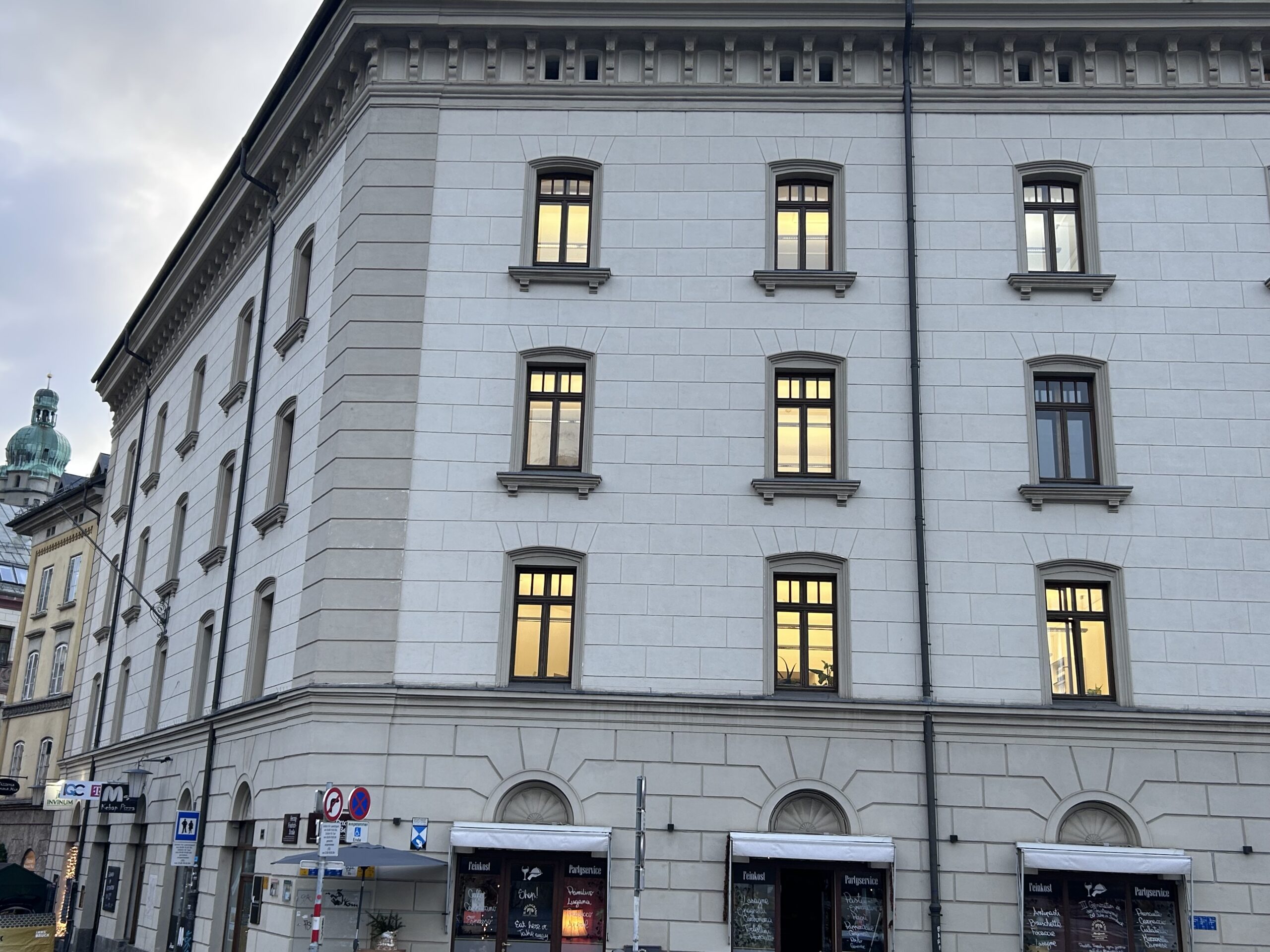
With the introduction of general conscription under Maria Theresa in Austria, the military infrastructure adapted to a standing army. Innsbruck became a garrison town in 1745. Thirty years later, the city walls were dismantled, and the Castrum Inpruka was converted into a state barracks. The new form of warfare with artillery instead of siege towers rendered the old fortifications, designed for medieval sieges, useless. The civic duty of defense was now taken over by professional soldiers. From 1778, parts of the Tyrolean Land and Field Regiment were stationed in Innsbruck, which became the Tyrolean Kaiserjäger after the Napoleonic Wars in 1816. At the same time, the Tyrolean riflemen (Schützen) continued to exist, trained at shooting ranges throughout the country as a kind of standing militia since the late Middle Ages. In February and March 1848, many cities in northern Italy saw uprisings against the Habsburgs, which went down in history as the First Italian War of Independence. The fighting in northern Italy demanded modernization of the Tyrolean military. Border security could no longer rely on volunteer armies and privately raised companies like Adolf Pichler’s Academic Legion. In 1851, reconstruction began to create the modern Inn Barracks. Changes in the military system also altered the cityscape. Although the military presence did not restore the splendor of the times when the city was an imperial residence, it boosted the population and importance of Innsbruck. With soldiers arriving from all over the multiethnic Austro-Hungarian monarchy, an international flair entered Innsbruck. These mostly young men enlivened the city with their presence and their pay, even though barracks life offered little freedom. Unlike the students of the University of Innsbruck, the soldiers did not come from the upper class but sought social advancement through military service. The barracks remained until 1978, when the Tyrolean government took over the building as an administrative office. Wall remnants in the inner courtyard still recall the medieval castle. In the local pubs, you can still enjoy the atmosphere of the old Andechs Castle.
With the introduction of general conscription under Maria Theresa in Austria, the military infrastructure adapted to a standing army. Innsbruck became a garrison town in 1745. Thirty years later, the city walls were dismantled, and the Castrum Inpruka was converted into a state barracks. The new form of warfare with artillery instead of siege towers rendered the old fortifications, designed for medieval sieges, useless. The civic duty of defense was now taken over by professional soldiers. From 1778, parts of the Tyrolean Land and Field Regiment were stationed in Innsbruck, which became the Tyrolean Kaiserjäger after the Napoleonic Wars in 1816. At the same time, the Tyrolean riflemen (Schützen) continued to exist, trained at shooting ranges throughout the country as a kind of standing militia since the late Middle Ages. In February and March 1848, many cities in northern Italy saw uprisings against the Habsburgs, which went down in history as the First Italian War of Independence. The fighting in northern Italy demanded modernization of the Tyrolean military. Border security could no longer rely on volunteer armies and privately raised companies like Adolf Pichler’s Academic Legion. In 1851, reconstruction began to create the modern Inn Barracks. Changes in the military system also altered the cityscape. Although the military presence did not restore the splendor of the times when the city was an imperial residence, it boosted the population and importance of Innsbruck. With soldiers arriving from all over the multiethnic Austro-Hungarian monarchy, an international flair entered Innsbruck. These mostly young men enlivened the city with their presence and their pay, even though barracks life offered little freedom. Unlike the students of the University of Innsbruck, the soldiers did not come from the upper class but sought social advancement through military service. The barracks remained until 1978, when the Tyrolean government took over the building as an administrative office. Wall remnants in the inner courtyard still recall the medieval castle. In the local pubs, you can still enjoy the atmosphere of the old Andechs Castle.
The Counts of Andechs and the foundation of Innsbruck
The 12th century brought economic, scientific, and social growth to Europe and is regarded as a kind of early medieval Renaissance. Through the indirect route of the Crusades, intensified exchange took place with the cultures of the Near East, which were more highly developed in many respects. Via southern Spain and Italy, Arab scholars brought translations of Greek thinkers such as Aristotle to Europe. Roman law was rediscovered at the first universities south of the Alps. New agricultural knowledge, technical innovations, and a favourable climate—which was to last until the mid‑14th century—enabled the emergence of towns and larger settlements. One of these settlements lay between the Roman road over the Brenner Pass, the River Inn, and the Nordkette mountain range. Politically and economically, the importance of the Inn Valley was largely limited to transit. The two relatively low and therefore easily passable Alpine crossings—the Reschen Pass and the Brenner Pass—between the German lands and the possessions of the German kings in Italy converged in the wide valley basin. A dispute over control of this part of the Holy Roman Empire gave rise to the political constellation that would shape Tyrol and Innsbruck well into the modern era. In 1024, Conrad II of the Salian dynasty was elected king. He found himself in competition with the Bavarian dukes of the House of Wittelsbach, under whose control the coveted Alpine passes lay at the time. In order to wrest the territory away from his Bavarian rivals and place it under the control of the Reich Church loyal to him, Conrad II granted the territory of Tyrol as a fief in 1027 to the bishops of Brixen and Trento. The bishops, in turn, required so‑called Vögte (advocates) to administer these lands and exercise jurisdiction. These advocates of the Bishop of Brixen were the Counts of Andechs. Although today the Andechs family stands in the shadow of the Welfs, Hohenstaufen, Wittelsbachs, and Habsburgs, they were a powerful dynasty in the High Middle Ages. They originated from the region around Lake Ammersee in Bavaria and owned estates in Upper Bavaria between the Lech and Isar rivers as well as east of Munich. Through skilful marriage policies, they acquired the titles of Dukes of Merania—a region on the Dalmatian coast—and Margraves of Istria, thereby rising in rank within the Holy Roman Empire. To secure both administration and eventual salvation, they founded Dießen Abbey and the monastery on the Holy Mountain of Andechs above Lake Ammersee in the 12th century. In 1165, Otto V of Andechs ascended to the episcopal seat of Brixen and granted the advocacy over this prince‑bishopric to his brother. In this way, the Andechs family gained control over the administration of the central Inn Valley, the Wipp Valley, the Puster Valley, and the Eisack Valley.
But this was far from the end of the dynastic entanglements and political complications that stood in the way of Innsbruck’s founding. Today, the city stretches across both sides of the River Inn. In the 12th century, however, this area was under the influence of two different landlords. Much of the Inn Valley was densely forested, and the banks of the broad river consisted of marshy terrain. South of the Inn, manorial authority was exercised by Wilten Abbey, while the land north of the river was administered by the Counts of Andechs. Whereas the southern part of the later city around the abbey had been used for agriculture for centuries, the floodplain around the unregulated river remained largely unsettled before the High Middle Ages. The region was not one of the hotspots of Europe’s cultural landscape. Most people worked in agriculture under their landlord’s control. They lived in poor huts made of clay and wood. Medical care was almost non‑existent, child mortality was high, and few people lived beyond the age of fifty.
As every good property developer is keen to point out even today, location already mattered greatly when it came to the potential of a new construction project. Around the year 1133, the Counts of Andechs founded the market settlement of Anbruggen in what is now St. Nikolaus, taking advantage of the site’s excellent transport connections, and linked the northern and southern banks of the Inn with a bridge. What had been agriculturally unusable land at the foot of the Nordkette was transformed into a trading hub by this transport link. The small wooden bridge facilitated the movement of goods across the Eastern Alps between Italian and German trading cities. The Brenner route, long considered too steep for large trading convoys, became more attractive thanks to one of the innovations of the medieval Renaissance: new harness systems made it possible for wagons to negotiate steep inclines. The shorter Via Raetia replaced the Via Claudia Augusta over the Reschen Pass as the main Alpine transit route. The farsighted Andechs market benefited from this development. Toll revenues generated by trade between German and Italian cities allowed the settlement to prosper. Soon blacksmiths, innkeepers, wagon operators, tailors, carpenters, rope makers, wheelwrights, and tanners settled there. Horses, merchants, and their retinues had to be fed and accommodated, wagons repaired. Larger enterprises employed workers and servants. What had once been a remote, swampy wasteland became a service centre. The transformation from a purely agrarian area into a town could begin. Anbruggen grew rapidly, but space between the Nordkette and the Inn was limited. In 1180, Berchtold V of Andechs acquired a parcel of land on the southern side of the Inn from Wilten Abbey to expand his trading post. The abbot was unwilling to relinquish his foothold entirely, as the new settlement was flourishing thanks to toll revenues. The deed mentions three houses within the new settlement that were reserved for Wilten Abbey. As part of the construction of the city walls, the Counts of Andechs built Andechs Castle and moved their ancestral seat from Merano to Innsbruck. At some point between 1187 and 1204, the citizens of Innsbruck were granted town privileges. The year 1239 is often cited as the official founding date, when the last count of the Andechs dynasty, Otto VIII, formally confirmed the town charter in a document. At this time, Innsbruck was already the minting site of the Andechs family and would likely have become the capital of their principality. However, events took a different turn. In 1246, the Bavarian Wittelsbachs—the Andechs’ greatest rivals in southern Germany—destroyed their ancestral castle on Lake Ammersee. Otto, the last count of the House of Andechs‑Merania, died in 1248 without heirs. Twelve years earlier, he had married Elisabeth, the daughter of Count Albert VIII of Tyrol. This noble family, whose ancestral seat lay in Merano, thus inherited the fiefs and parts of the Andechs possessions, including the city on the Inn—along with the longstanding enmity with the Bavarian Wittelsbachs.
1796 - 1866: Vom Herzen Jesu bis Königgrätz
The period between the French Revolution and the Battle of Königgrätz in 1866 was a highly warlike era. Many of the later political attitudes, animosities toward other groups, and the European nationalism of the nineteenth and twentieth centuries—which would also shape the history of Innsbruck—had their roots in the conflicts of this time. The monarchies of Europe, led by the Catholic Habsburgs, declared war on the French Republic. Although revolutionary Paris was far away and no comprehensive press system existed for the dissemination of news, the alleged godlessness of the murderers of Marie Antoinette was effectively spread through pamphlets and sermons from church pulpits. Fear arose that the revolutionary slogan “Liberté, Égalité, Fraternité,” along with its principles, might spread throughout Europe. During the Coalition Wars, a young general named Napoleon Bonaparte advanced across the Alps in 1796 with his Italian army and encountered Austrian troops. This was not merely a war over territory and power—it was a clash of systems. The Grande Armée of revolutionary France confronted the forces of the conservative and Catholic Habsburgs. Tyrolean riflemen (Schützen) actively participated in the fighting, defending the province’s borders against the advancing French. The men were accustomed to handling weapons and were considered skilled marksmen. The historian Ludwig Denk described this in a publication from 1860:
"...The Tyrolean's main passion is shooting. Early on, the father takes his son hunting. It is not uncommon to see boys running around with loaded rifles, climbing high mountains and shooting birds or squirrels..."
The strength of units such as the Hötting Rifle Company, established in 1796, lay not in open field battles but in guerrilla warfare. Moreover, they believed they had a secret weapon against the most advanced army of the time: the Sacred Heart of Jesus. Since 1719, Jesuit missionaries had spread devotion to the Sacred Heart even in the most remote valleys, successfully establishing it as a unifying force in the struggle against pagan customs and Protestantism. Faced with the godless revolutionary French, it seemed only natural that the Sacred Heart would once again—after 1703—watch protectively over the Tyrolean warriors of God. In desperate circumstances, the Tyrolean troops renewed their covenant. Against all odds, the riflemen succeeded in their defensive efforts. The abbot of Stams Abbey petitioned the provincial estates that, henceforth, “the Feast of the Divine Heart of Jesus should be celebrated annually with a solemn church service, if Tyrol were freed from the threat of enemy danger.”
Victory in this battle did not change the outcome of the war against Napoleon’s overwhelming forces, nor did it alter the territorial expansion of Tyrol—while Innsbruck’s population declined. During the turmoil of war, the Habsburg territory had expanded without notable military success—and likely without the help of the Sacred Heart. The archiepiscopal territory of Trentino became part of the crown lands through a territorial settlement known as the Reichsdeputationshauptschluss in the final phase of the Holy Roman Empire before its dissolution in 1803. Innsbruck, however, shrank. Fallen soldiers and war-related economic hardship led to a decline in the population from over 9,500 around 1750 to approximately 8,800 in the early decades of the nineteenth century. While this may seem modest in absolute numbers, the consequences were severe: stagnation in urban life. Young men were missing—as labourers, husbands, and fathers. This wartime recession remains largely underrepresented in the city’s historiography. Perhaps the near absence of Biedermeier architecture in Innsbruck can be seen as a subtle reminder of these difficult years.
After the Napoleonic Wars and the reorganisation of Europe at the Congress of Vienna, Tyrol’s borders remained largely peaceful for around thirty years. This changed with the Italian Risorgimento, the national movement led by Sardinia‑Piedmont and France. In 1848, 1859, and 1866, the so‑called Italian Wars of Unification took place. Over the course of the nineteenth century—at the latest since 1848—a fervent nationalist enthusiasm spread among young men of the upper classes across Europe. Volunteer armies sprang up everywhere. Students and academics formed associations; gymnasts and riflemen alike sought to prove their newfound national identity on the battlefield, supporting official armies against their respective enemies. During this time, Innsbruck served as an important logistical hub as a garrison town. Following the Congress of Vienna, the Tyrolean Jäger Corps became the Imperial and Royal Tyrolean Kaiserjäger Regiment, an elite unit deployed in these conflicts. Volunteer formations such as the Innsbruck Academics and the Stubai Riflemen also fought in Italy. Thousands fell in battle against a coalition consisting of the traditional enemy France, the particularly “godless” Redshirts under Giuseppe Garibaldi, and the emerging Kingdom of Italy, formed at Austria’s expense under the leadership of the Francophile House of Savoy from Piedmont. The media further inflamed sentiment behind the front lines. The Innsbrucker Zeitung preached loyalty to the emperor and a Greater German‑Tyrolean nationalism, railed against Italians and the French, and celebrated the bravery of Tyrolean soldiers. One report stated:
“The strong occupation of the heights at the exit of the Valsugana near Primolano and Le Tezze has often given the Innsbruck Academics I and the Stubai riflemen cause to undertake voluntary excursions against Le Tezze, Fonzago, and Fastro, as well as to the right bank of the Brenta and the heights opposite the small camps of the Sette Comuni… On the 19th, the Stubai riflemen had already struck down several enemies when they ventured down for the first time, creeping up on them…”
Probably the most famous battle of the Wars of unification fand in Solferino 1859 in der Nähe des Gardasees statt. Entsetzt vom blutigen Geschehen entschloss sich Henry Durant das Rote Kreuz zu gründen. Der Schriftsteller Joseph Roth beschrieb das Geschehen auf den ersten Seiten seines Romans Radetzkymarsch.
"In the battle of Solferino, he (note: Lieutenant Trotta) commanded a platoon as an infantry lieutenant. The battle had been going on for half an hour. Three paces in front of him he saw the white backs of his soldiers. The first row of his platoon was kneeling, the second was standing. Everyone was cheerful and certain of victory. They had eaten copiously and drunk brandy at the expense and in honour of the emperor, who had been in the field since yesterday. Here and there one fell out of line."
The year 1866 proved particularly catastrophic for the Austrian Empire. In Italy, Venetia and Lombardy were lost. In the north, the Habsburg army suffered a devastating defeat at the Battle of Königgrätz. After this short “brother’s war,” Prussia took over leadership of the German Confederation from the Habsburgs. Austria’s reorientation toward the east meant that Innsbruck definitively became a city on the western periphery of the empire. This shift was accompanied by a resurgence of nationalist ideas, particularly among Innsbruck’s liberal upper bourgeoisie. Support for the “Greater German solution”—a united state with the German Empire rather than the Austro‑Hungarian Monarchy—was especially strong. The extent to which this German Question divided the city became apparent more than thirty years later, when the Innsbruck city council proposed naming a street after Otto von Bismarck. While conservative loyalists reacted with outrage, the liberal Greater German faction around Mayor Wilhelm Greil welcomed the idea. After the Second World War, the defeat at Königgrätz supported Austria’s narrative of being the first victim of National Socialism, as it had already been excluded from a unified German state in 1866.
To this day, the conflicts at Tyrol’s southern borders continue to shape tradition and the cityscape. The Sacred Heart celebrations were long marked by great pomp and, especially in the nineteenth and early twentieth centuries, developed into a volatile mixture of superstition, Catholicism, and ethnic nationalism directed against French and Italian influences. Countless soldiers continued to entrust their fate to the Sacred Heart even amidst the shellfire of the First World War. Alongside Cranach’s Madonna of Mercy, the flaming Sacred Heart remains one of the most popular Christian motifs in Tyrol and adorns the façades of countless buildings. With sites such as the Tummelplatz, the Pradl Military Cemetery, and the Kaiserjäger Museum on Bergisel, Innsbruck preserves several places of remembrance for these bloody conflicts, in which many of its residents marched off to war and never returned.
Maria Theresia, Mother of the Nation and Reformer
Maria Theresa ranks among the most important figures in Austrian history. Particularly significant were her domestic reforms, many of which had a tangible impact on the everyday lives of Innsbruck’s inhabitants and are still visible today in the city’s built environment. Together with her most influential advisers—Friedrich Wilhelm von Haugwitz, Joseph von Sonnenfels, and Wenzel Anton Kaunitz—she succeeded in transforming the so‑called Austrian hereditary lands into a modern state. Instead of governing her territories through the local nobility, she relied on a centralized, professional administration. In keeping with Enlightenment thought, her advisers recognized that the welfare of the state depended on the health and level of education of its individual subjects. An early healthcare reform of 1742 obliged the professors of medicine at the University of Innsbruck not only to teach but also to ensure the operation of the municipal hospital in the Neustadt district. A school reform likewise reshaped the educational landscape within the city walls, both spatially and conceptually. Due to a lack of space, the school was relocated from Domplatz to Kiebachgasse, and its educational mission was redefined. Subjects were expected to remain Catholic, but their loyalty was to be directed toward the state. Education was placed under centralized state control in order to develop talents in a targeted manner. The aim was not to raise critical, humanistic intellectuals, but rather to train personnel for the state administrative apparatus. This reform laid the foundation for later social mobility. Through military service and civil administration, non‑nobles were now able to pursue careers and climb the social ladder. Any improvement of the individual was regarded as a gain for the whole. Further measures followed that affected not only the national economy but also the daily lives of most people. The standardization of weights and measures made the tax system more precise and less susceptible to abuse. For farmers, the harmonization of laws meant that their livelihoods were less dependent on local landlords and their arbitrary decisions. The Robot—the unpaid compulsory labor owed by peasants to their landlords—was also abolished under Maria Theresa. A shift in thinking likewise took place in criminal prosecution and the judicial system. In 1747, a small police force was established in Innsbruck to oversee market regulation, trade and guild regulations, control of foreigners, and public morals. Above all, this served to regulate the provision of goods in favor of consumers. Not only poor quality but also price gouging was punished. The strictness of early food inspections is illustrated by a police record from 1748, in which a butcher from Pradl was fined for exceeding the legally fixed meat prices. This denser network of regulations and improved law enforcement went hand in hand with a more humane system of punishment. Although the criminal code Constitutio Criminalis Theresiana did not abolish torture, it did strictly regulate its use. Yet despite Maria Theresa’s self‑presentation as a pious mother of the land and her reputation today as an Enlightenment ruler, the devoutly Catholic sovereign was uncompromising when it came to power and religion. In keeping with Enlightenment thought, she ordered critical investigations into superstitions such as vampirism, which was widespread in the eastern parts of her realm, and initiated the final end of the witch trials. At the same time, however, Protestants were ruthlessly expelled from the country. Many Tyroleans were forced to leave their homeland and resettle in more remote regions of the Habsburg monarchy.
In crown lands such as Tyrol, which had previously enjoyed a high degree of autonomy, Maria Theresa’s reforms were met with little approval. Centralization remains a sensitive issue in Austrian politics to this day. With the exception of a few liberals, people saw themselves more as an independent, autonomous land and less as part of a modern territorial state. The clergy also resented their new subordinate role, which was further intensified under Joseph II. For the local nobility, the reforms meant not only a loss of status and autonomy but also higher taxes and levies. Taxes, duties, and customs revenues that had long provided Innsbruck with reliable income were now collected centrally and only partially returned through fiscal redistribution. To mitigate the social decline of sons from impoverished noble families and prepare them for state service, Maria Theresa founded the Theresianum, which also had a branch in Innsbruck from 1775 onward. As so often, time smoothed over former conflicts, and today Innsbruck’s inhabitants take pride in having hosted one of the most significant rulers in Austrian history. Not only the Triumphal Arch and the Imperial Palace (Hofburg), but also the Turnvereinshaus and the New City School recall the Theresian era, a period in which the state began to intervene ever more deeply in the lives of its citizens from the moment they entered school.
Adolf Pichler: vom Vormärz zum Mainstream
The 19th century transformed Innsbruck in many ways. Politics, administration, society, as well as distributions of power and wealth, underwent profound changes between the first half—still heavily marked by the war years up to 1815—and the second half, which entered European history as the bourgeois era. New professional and social spheres emerged. Through diligence, skill, intellect, and good fortune, the state school and education system allowed individuals to rise further than ever before. Liberal thinkers, who had been suspected of radicalism under Metternich's system and whose writings were frequently censored, were gradually able to express themselves somewhat more freely after 1848. The 1860s brought formal parliamentarism, new municipal statutes, the Compromise with Hungary within the new Austro-Hungarian (k.u.k.) Monarchy, and Austria's exit from the German Confederation. Nationalism, once considered the domain of an avant-garde of a few liberals and "radicals" in the German states, became mainstream politics. The life of Adolf Pichler can be read as representative of these developments. At the age of 12, the son of a customs official moved from Erl near Kufstein to Innsbruck to launch his academic career at the gymnasium. Under the wing of the Jesuits—whom he would later view with little enthusiasm—he began his academic path in the spirit of classical humanism. During this time, Pichler primarily immersed himself in ancient writers and their philosophies. Still a teenager, he founded the association *"Eiche und Buche"* (*Oak and Beech*) with youthful zeal and published a weekly literary journal. During his studies of philosophy, law, and medicine in Innsbruck and Vienna, he read the works of contemporary thinkers—some of whom were subject to censorship—such as Feuerbach, Hegel, and Fichte. He drew from the secret library, affectionately dubbed the *"Giftbude"* (*poison booth*), of Johann Schuler, the editor of the *Tiroler Bote*. He came to know the liberal German champions Anastasius Grün and Heinrich Heine. They advocated for a united German nation in place of the fragmented small states of the German Confederation. Combined with the influence of the eccentric English literary figure Lord Byron and the medieval minnesinger Walther von der Vogelweide, Pichler developed a worldview that would ultimately prevail among Innsbruck's liberal class toward the end of the 19th century: Tyrol was to be part of the German cultural nation. His literary circle, *Die Nibelungen*, founded in 1841, served not only for exchanging books, but also as a precursor to student fraternities, which were banned in Metternich's police state. Four years later, Pichler came firmly into the crosshairs of the secret state police. Together with other "radicals"—most notably Hermann von Gilm—he published the poetry collection *Frühlingslieder aus Tirol* (*Spring Songs from Tyrol*), which fell victim to censorship. Through this collection of harmlessly sentimental poems (from a modern perspective), Pichler had become a sort of intellectual father figure and founder of the *Jungtiroler* (*Young Tyroleans*), without making a remarkably substantial content contribution himself. The young man not only became part of the subversive, Pan-German liberal Tyrolean literary scene, but also corresponded with foreign authors and intellectuals through letters and newspaper articles. His circle of colleagues and friends ranged from Tyroleans Adolf Flir, Johann Senn, and Beda Weber to Grillparzer, Stifter, and Alexander von Humboldt.
In 1848, shortly after completing his medical studies in Vienna, Pichler took part in the fighting along Tyrol’s borders during the Italian wars of independence. He raised his own unit, the Academic Legion. Although students and professors fought alongside Habsburg troops in the defense of the borders, the authorities regarded Pichler’s activities with suspicion. His association with subversive circles and his politically engaged articles, poems, and plays hindered his academic career in the monarchy after the upheavals of 1848. Rejected by the university, he accepted a position teaching at a Gymnasium in Innsbruck, while continuing his work as a literary historian. Pichler devoted himself to documenting the history of Tyrolean literature and encouraged his students to collect plays and traditions from their respective home regions. In the spirit of 1848, he became an eager archivist of Tyrolean traditions, attempting to weave the past and inherited customs into a cohesive, nationally oriented—and distinctly Germanic—narrative. His own literary works, often imbued with national pathos, achieved only limited success. Apart from Rodrigo, a historical drama staged at the Innsbruck City Theatre, his plays failed to reach a wider audience. Set during the fall of the Visigothic kingdom in eighth-century Spain, the play serves as an allegory for Austria’s political situation after its withdrawal from the German Confederation. Rodrigo disappears from history following defeat in a decisive battle at the Guadalete River—a clear parallel to Königgrätz.
Wohl ein wenig desillusioniert nach der in Tirol wenig revolutionären Märzrevolution und dem Ausscheiden Österreichs aus dem deutschen Bund 1866, wandte sich der vom offen Aufsässigen zum stillen Widerspenstigen mutierten Intellektuellen der Geologie zu. Auf langen Wanderungen durch die Alpen sammelte er Erkenntnisse über die geliebte Heimat und konnte so zumindest ein wenig in die Fußstapfen Alexanders von Humboldt treten. 1867 wurde er zum Universitätsprofessor für Geologie in Innsbruck berufen und konnte so seine akademische Karriere im Alter von knapp 50 Jahren doch noch krönen, ohne selbst je ein naturwissenschaftliches Studium absolviert zu haben. Den Posten als Rektor lehnte der unangepasste Pichler ab, zu hoch wäre wohl der Preis dafür gewesen. Liest man heute die Artikel und Gedichte Pichlers, fühlt man sich in Ausdruck und Thematik rund um Deutschtum, Wahrheit, Kampfeslust und Heldenverehrung stark an die Diktion der völkischen Presse der frühen Nationalsozialisten erinnert. Als Intellektueller, Kritiker und Kommentator des Zeitgeschehens beeinflusste Pichler den Zeitgeist der Innsbrucker Politik merklich. Viel ist in seinen Schriften die Rede von deutschen Helden, Walhalla, Wotan, Aufopferung und Erlösung. Bis an sein Lebensende verfasste er Gedichte, Theaterstücke und schmalzige Hymnen wie seinen späten Dietrich von Bern aus dem Jahr 1898.
Do you know Dietrich of Bern, Once held in chains? In anger he breathes fire— until iron melts like wax. Follow the example of your hero— never endure a foreign yoke— never accept as master the slave who once crawled before you.
His primary outlet was the sharply satirical and anti-clerical journal Der Scherer, published between 1899 and 1906. Its logo depicted a smiling elderly Tyrolean presenting a dead mole—symbolizing the clergy, often portrayed as a pest—to the viewer. Pichler also contributed to major newspapers and journals such as Die Presse, Wiener Zeitung, Augsburger Allgemeine, Gartenlaube, Odin, and Germania, consistently writing against both clerical authority and political power. While resolutely nationalist, he rejected the popular forms of antisemitism common at the time, as well as imperialism in all its forms—British, French, or German. He advocated the principle that all peoples and nations should govern themselves, and that culture and tradition deserved respect.
By the time the once “radical” public intellectual died in 1900, he had become a respected figure. His views had remained largely unchanged, but they had moved from the margins into the mainstream and were no longer censored—indeed, they were particularly valued in Innsbruck’s municipal politics under Mayor Wilhelm Greil. Liberal newspapers published effusive tributes. Karl Habermann, editor of Der Scherer, burned a pastoral letter by the Prince-Bishop of Brixen during a torchlight procession in Pichler’s honour—an act that led to legal proceedings. A special issue of Der Scherer, filled with poems and tributes by fellow writers and admirers, included a final farewell written by Pichler himself, in which he compared his pen to the sword of King Arthur. An obituary honoured the “old man” with the words:
“Tyrol, once a black clerical land, has through Pichler become a new centre of intellectual uprising, from which thousands of compatriots across all German regions draw the torch to ignite the sacred flame in their own homes.”
Other publications such as Odin—a militant organ of the pan-German movement—and the Ostdeutsche Rundschau also celebrated the Tyrolean hero. Writers like Franz Kranewitter (1860–1938), Rudolf Greinz (1866–1942), Heinrich von Schullern (1865–1955), and Arthur von Wallpach (1866–1946) carried forward Pichler’s intellectual legacy as part of the Jung-Tirol movement—first in Der Scherer and later in Der Föhn. They were united by shared experiences: Austria’s withdrawal from the German Confederation, the declining power of the Habsburg monarchy, and the loss of southern Tyrolean territories. Their blend of liberalism—partly anti-clerical, partly infused with martial imagery—combined with a strong emphasis on homeland and Tyrolean identity, remained popular both after the First World War and during the National Socialist period. Works such as Kranewitter’s Andreas Hofer and Wallpach’s poetry collections with titles like Tyrolean Blood or We Break Through Death! allowed various political movements to appropriate their messages. Just one year after Pichler’s death, a committee was formed to erect a monument in his honour, chaired by Mayor Greil. Since 1930, Adolf-Pichler-Platz—where his bronze statue stands—has borne his name. Streets in Amras and Pradl commemorate his successors Greinz, Schullern, Kranewitter, and Renk. A memorial plaque adorns Pichler’s former residence in Müllerstraße, decorated with a Tyrolean eagle, laurel wreath, and oak leaves, bearing the inscription: “To the German poet Adolf Pichler – from the Land of Tyrol.”