Cafe Central
Gilmstrasse 5
Worth knowing
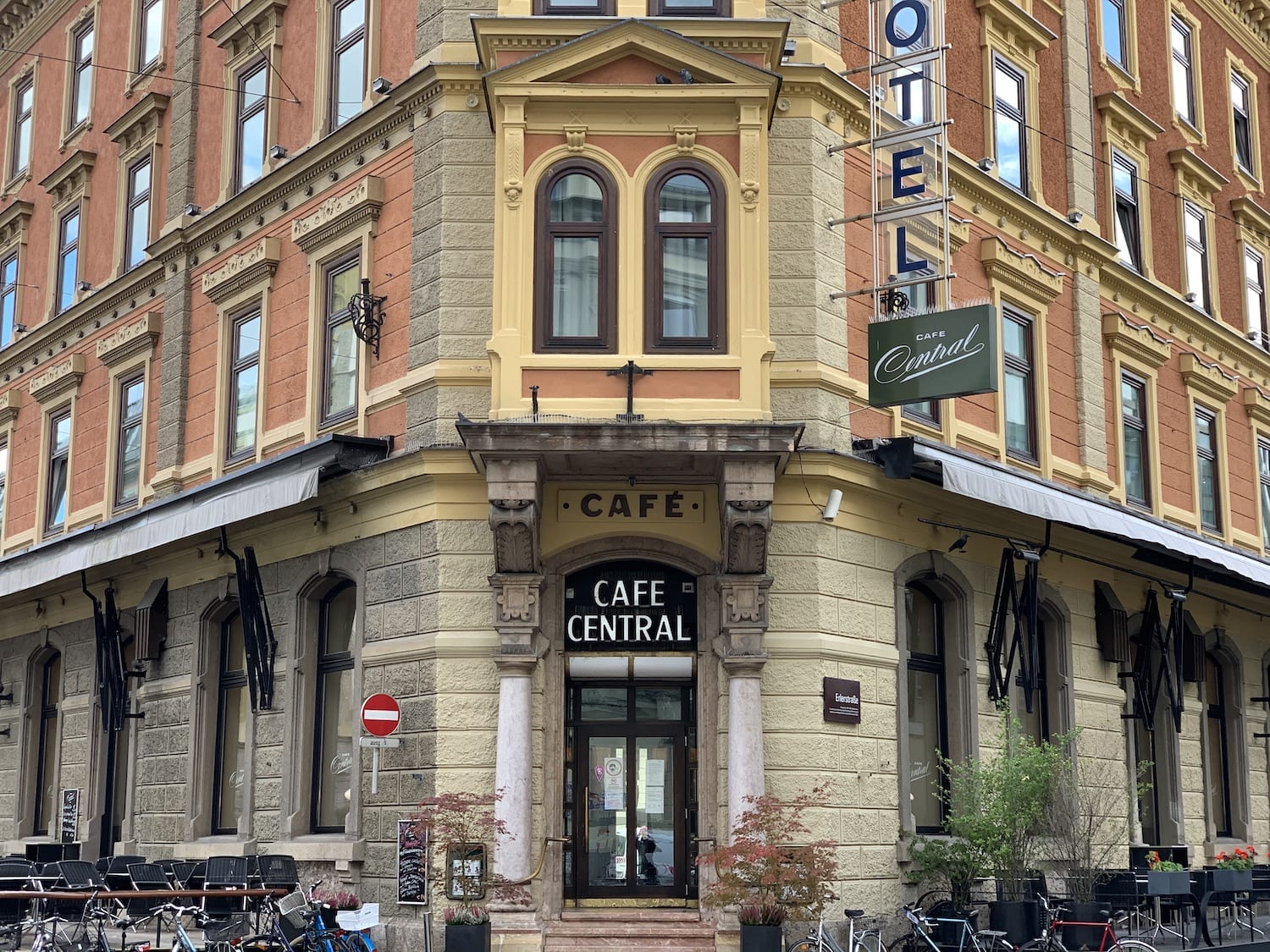
The first coffeehouse at the site of today’s Central opened on September 14, 1876, as “Café Grabhofer.” Although the year 1848 did not bring a bloody revolution to Tyrol, it did lead to social changes in everyday life. Coffeehouse culture was one of them. Anyone who considered themselves important met here to indulge in the muse of bourgeois existence, to discuss, or quietly read one of the many newspapers available during this politically heated time. Just like today, there was a bank directly opposite the café back then. Financial services and a modern coffeehouse formed, perhaps unintentionally, a perfect symbiosis for the upper middle-class clientele. The booming economy of the years following the 1873 economic crisis met a commodity that, thanks to late 19th-century colonialism, became increasingly affordable for more citizens. With his coffeehouse in a new style, proprietor Johann Grabhofer embraced the right trend at the right time and place. During the Belle Époque before World War I, the Central was one of many lively centers of city life. Students, soldiers, industrialists, citizens, and travelers gathered here to discuss, read, and celebrate in a pleasant atmosphere. After the founder’s death, his daughter and her husband managed the establishment. When she also passed away in 1891, Leopold Eck acquired the coffeehouse and renamed it Café Central. Just a year later, the unused upper floors of the same building became the Hotel Central. Five years later, Eck sold the building to the then-tenant of the café, Franz Kosak, who for the first time also served beer.
World War I and the Italian occupation period thoroughly reshuffled Innsbruck’s gastronomic fortunes. In 1919, during the post-war years, Josef Falkner first turned the coffeehouse into a depot for wines from his vineyard in Tramin, later into an office building for part of the Commerzbank, before reopening it as a guest establishment in 1928. Alongside the café and hotel, the enterprising restaurateur also opened the Falknerkeller wine tavern in the basement, modeled after South Tyrolean style. This became one of Innsbruck’s first establishments deserving the name “nightclub.” The hotel’s basement quickly gained a dubious reputation, as reported in the Allgemeiner Tiroler Anzeiger on June 8, 1928:
On 17 March, an exciting shooting took place in the well-known Innsbruck wine bar "Falknerkeller". In a fit of jealousy, 37-year-old railway employee Johann Raggl from Arzl near Imst had fired his revolver at his former lover Marie Amonn, who worked as a waitress in the pub. The shots missed their target only because a friend intervened.
After World War II, the Central became the “Comptoir Français” under French occupation and was used as a French restaurant. The Falknerkeller advertised its culinary offerings and unusually long opening hours with an original slogan in the Innsbrucker Nachrichten:
Falknerkeller's Easter wine must be as good as ever.
Please ask old folks how it was in pre-war years…
We close at midnight daily, please honor us with your visit.
At the end of the French occupation, the hotel, café, and cellar returned to Falkner. Breaking with tradition, Falkner abandoned the typical Tyrolean parlor style in favor of a more creative concept. The “Pirate Castle,” modeled after a harbor tavern, brought variety to Innsbruck’s post-war nightlife. The day before its opening in the new design, this ad appeared in the Innsbrucker Nachrichten: “A ship with Innsbruck pirates lands on July 1 on the previously unknown treasure island in the Falknerkeller! Come aboard! Josef Falkner / Isolde Sterzinger.” After Falkner’s death, the Sparkasse acquired the Central in 1967. The mix of nightclub and coffeehouse attracted mainly young people and students. In 1980, the Falknerkeller became Club Central. Seven years later, it was sold to the construction company Fröschl, which renovated the historic building while preserving its special charm. However, the era of nightlife on Gilmstraße was drawing to a close. Today, you can enjoy coffee, cake, and Austrian specialties at the Central in a pleasant atmosphere. The neo-baroque interior has survived the various renovations well, and the furnishings still recall the good old days when Viennese coffeehouse culture decided to settle in Tyrol and elevate the provincial town of Innsbruck to the standards of the Austro-Hungarian monarchy.
Colonial goods, coffee and enlightenment
Legend has it that when the Turks laid siege to Vienna in 1683, they brought two things to Austria that have left a lasting mark on breakfast culture to this day: the crescent-shaped Kipferl and coffee. How the exotic beverage actually made its way from distant growing regions into the German-speaking world can no longer be conclusively reconstructed; it was almost certainly not through sacks of coffee beans allegedly abandoned on the battlefield outside Vienna. This urban legend can more plausibly be traced back to the late seventeenth century, when the coffee bean began to establish itself in Europe as a luxury commodity consumed by political and economic elites. This was the era of the great trading companies, the first stock exchanges, and the philosophers, legal scholars, and economists of the early Enlightenment—a period in which lucrative overseas trade brought coffee and the economic sectors that developed around it into Europe’s cities. As part of the Habsburg Empire and an important trading town, Innsbruck was involved in this imperial business from an early date. Long-distance trade was an integral part of the local economy. Thanks to the Inn Bridge and its favourable geographic position, the city had been integrated into European trade networks since the twelfth century. A substantial portion of Innsbruck’s wealthy elite—who also exercised political influence through the city council—emerged from the mercantile class.
At the beginning of the eighteenth century, coffee appeared for the first time in Innsbruck’s municipal legislation, a strong indication that it had crossed the threshold into public significance within urban life. In 1713, the city council decreed that coffee might be purchased exclusively in pharmacies. Much like Red Bull in the 1990s, the exotic drink was initially viewed with suspicion. As demand grew in the Enlightenment climate of Emperor Joseph II’s reign and coffee gradually gained wider social acceptance, these restrictions were relaxed. Coffee nevertheless remained an exclusive and expensive indulgence of eccentric elites rather than an everyday beverage. Spice merchants—shops specialising in spices and foodstuffs—began to sell coffee. The Innsbruck coffee brand Nosko, which still exists today, claims to be the city’s oldest roastery, tracing its origins to the spice shop founded in 1751 by Josef Ulrich Müller at Seilergasse 18. Unterberger & Comp. Kolonialwaren, the second coffee roastery still operating in Innsbruck today, likewise began as a spice merchant’s business. Jakob Fischnaller took over a shop in the Old Town that had existed since 1660 and began selling coffee there in 1768. Restaurateurs followed this slowly emerging trend. With the arrival of the first licensed coffee servers at the end of the 1750s, the triumphal advance of the coffee bean began. These early establishments bore little resemblance to the Viennese coffeehouse culture known worldwide today. In 1793, Café Katzung opened its doors to the affluent bourgeoisie, who began to appropriate public space with billiard tables and newspaper stands. Fifty years later, there were already eight coffeehouses in the small city of Innsbruck. Unlike traditional inns, coffeehouses symbolised a new, urban, and enlightened lifestyle and marked a clear distinction between city and countryside. For a long time, wine and beer had been the everyday drinks of the masses. In the Middle Ages, water from wells—especially in larger cities—was often considered unsafe, while light wine and nourishing, calorie-rich beer were more reliable alternatives. Alcohol, however, dulled the senses. Under Maria Theresa, peasants were granted local distilling rights. The strong, often cheaply produced spirits distilled from fallen fruit were popular among the rural population and among workers and employees in cities alike—and problematic at the same time. Anyone concerned with social standing avoided them. Coffee, by contrast, promoted alertness and productivity and supported the new virtues of diligence and industriousness. In cities such as Innsbruck, the compliant subject was gradually replaced by the critical, newspaper‑reading citizen. Consuming the expensive colonial commodity allowed one to present oneself as a connoisseur, capable of distinguishing genuine bean coffee from the cheap brews adulterated with various fillers—and able to afford it—thereby setting oneself apart from the lower classes. When Napoleon banned the import of coffee in the territories under his control in 1810 in an attempt to weaken the British economy, which depended heavily on overseas trade, this sparked fierce protests throughout Europe. Fig and chicory coffee, used as substitutes—as would later again be the case during the World Wars—met with little enthusiasm among the bourgeois population.
The colonial goods trade, which linked the exploitative business models of African coffee plantations, American tobacco plantations and South American fruit plantations with the Alps, reached a high point in Innsbruck, as in the entire German-speaking region, from the end of the 19th century, when the European powers' race for Africa entered the home straight. In 1900, there were around 40 colonial goods traders in Innsbruck. These were mostly speciality shops and general merchants who sold various, usually expensive goods from all over the world. Above all, luxury goods such as rum, tobacco, cocoa, tea and coffee or exotic fruits such as bananas were sold as colonial goods to the wealthy Innsbruck bourgeoisie. From this time onwards, the Viennese coffee house culture with all its peculiarities finally became the standard for the bourgeois culture of the Austro-Hungarian Empire. Monarchy. No matter where you were between Innsbruck in the west and Czernowitz in the east of the vast empire, you could be sure of finding a railway station, an appropriate hotel and a coffee house with German-speaking staff and a similar menu and furnishings. Coffee houses, unlike traditional inns, were places where not only the aristocracy and new elites, but also men and women, albeit often in separate areas as in the Cafe Munding, could spend time.
Neither coffeehouse culture nor colonial goods shops disappeared from everyday life with the rupture of the First World War and the end of the monarchy. In the 1930s, around sixty such businesses were still operating in Innsbruck. Supermarkets with extensive assortments as we know them today did not yet exist; shopping was still done at market stalls or in small shops. Only after the Second World War did the term Kolonialwaren disappear from the city’s trade registers, replaced by the designations coffee roastery and fruit importer. What remains, however, is not only Viennese coffeehouse culture. Innsbruck is still home to several of the oldest cafés of their kind, including Katzung, Munding, and Central. Since 1884, the firm Ischia has distributed exotic fruits in the city and remains a prominent feature of the urban landscape to this day with its distinctive logo on the company building next to the new city library. A brass plaque at Herzog‑Friedrich‑Strasse 26 and a large version of the logo depicting a trading ship on the main thoroughfare Egger‑Lienz‑Strasse near the Westbahnhof attest to the presence of the Unterberger brand. More contentious is the logo of Praxmarer Kaffee, which shows a kneeling “Moor” offering a cup on a façade in Amraserstrasse. While the traditional coffee company no longer exists, the firm Praxmarer Obst—trading in exotic fruits—continues to operate under the same name.
The year 1848 and its consequences
The year 1848 occupies a mythical place in European history. Innsbruck was not one of the hotspots like Paris, Vienna, Budapest, Milan or Berlin, but even in the “Holy Land” of Tyrol the revolutionary year left its mark. In contrast to the rural surroundings, an enlightened educated bourgeoisie had developed in Innsbruck. Enlightened people no longer wanted to be subjects of a monarch or territorial prince, but citizens with rights and duties in relation to a modern state. Students and members of the liberal professions demanded political participation, freedom of the press and civil rights. Workers demanded better wages and working conditions. Particularly radical liberals and nationalists even questioned the absolute authority of the Church. In March 1848 this socially and politically highly explosive mixture erupted in uprisings and street fighting in many cities. In Innsbruck, some students and professors celebrated the newly granted freedom of the press with a torchlight procession. On the whole, however, the revolution proceeded quietly in the rather leisurely Tyrol. To speak of a spontaneous outburst of emotion or even a revolution would already be an exaggeration: the date of the procession was postponed from 20 to 21 March because of bad weather. There were hardly any anti-Habsburg riots or violent incidents; a stray stone thrown into a Jesuit window was one of the highlights of the Alpine version of the Revolution of 1848. The students even supported the city magistrate in maintaining public order, thereby demonstrating their gratitude to the monarch for the newly granted freedoms and their loyalty.
The initial enthusiasm for change among the bourgeois elites was soon replaced in Innsbruck by a surge of German-national patriotism. On April 6, 1848, the governor of Tyrol led a ceremonial procession in which the German flag was displayed. A German tricolour was also hoisted on the city tower. While students, workers, liberal-national citizens, republicans, supporters of a constitutional monarchy, and Catholic conservatives could not agree on social issues such as press freedom, they shared a common hostility toward the Italian independence movement, which had spread across northern Italy from Piedmont and Milan. Innsbruck students and riflemen, with the support of the imperial army leadership, marched into the Trentino to suppress unrest and uprisings at an early stage. Notable members of this corps included the already elderly Father Haspinger, who had fought alongside Andreas Hofer in 1809, and Adolf Pichler. Johann Nepomuk Mahl-Schedl, a wealthy owner of Büchsenhausen Castle, even equipped his own company and marched over the Brenner Pass to secure the border. However, the war did not remain confined to the southern borders. Innsbruck itself, as the political and economic center of the multinational crown land of Tyrol and home to many Italian speakers, became an arena of the conflict between nationalities. Combined with ample alcohol consumption, anti-Italian sentiment posed a greater threat to public order than the demand for civil liberties. A dispute between a German-speaking craftsman and an Italian-speaking Ladin escalated to such an extent that it nearly triggered a pogrom against the numerous businesses and inns of Italian-speaking Tyroleans.
The relative calm of Innsbruck suited the imperial court in Vienna, which was under pressure. As unrest in the capital continued after March, Emperor Ferdinand fled to Tyrol in May. According to contemporary press reports, he was enthusiastically welcomed by the population.
"“What is the name of the land to which such an honour falls, what is the people that enjoys such trust in these fateful times? Does the peace and security here rest solely on legend from ancient times, or is there also in the present a foundation on which one can build, which the wind cannot blow away and the storm cannot shake? This Alpine land is called Tyrol, do you like it? Yes, the Tyrolean people alone prove, in the midst of a shaken Europe, reverence and loyalty, courage and strength for their hereditary ruling house, while all around rebellion, contradiction, defiance and demands, often even revolt and upheaval rage; Tyrol alone stands firmly without wavering in custom and obedience, in religion, truth and law, while elsewhere insolence and falsehood, madness and passions prevail …”"
In June, a young Franz Joseph—still not yet emperor—also stopped at the Hofburg on his return from the battlefields of northern Italy instead of traveling directly to Vienna. Innsbruck once again became a royal residence, albeit only for one summer. While blood was shed in Vienna, Milan, and Budapest, the imperial family enjoyed rural Tyrolean life. Ferdinand, Franz Karl, his wife Sophie, and Franz Joseph received guests from foreign courts and were driven by carriage to excursion destinations such as Weiherburg, Stefansbrücke, Kranebitten, and even up to Heiligwasser, and went on hikes. This calm did not last long. Ferdinand, considered no longer fit to rule, handed over power under gentle pressure to Franz Joseph I. In July 1848, the first parliamentary session was held in Vienna, and a constitution came into force. However, the monarchy’s willingness to reform soon waned. The new parliament—the Reichsrat—could not pass binding laws, the emperor never attended it, and he did not understand why a monarchy ordained by God needed such a council.
The subtly initiated liberalization nevertheless ran its course in the cities. Innsbruck was granted the status of a city with its own independent charter (Statutarstadt). In 1850, the "Provisorische Gemeindegesetz für die Landeshauptstadt Innsbruck" ("Provisional Municipal Code for the State Capital of Innsbruck") came into force:
"The municipality is to provide for the sanitation police; it takes care of the paving and maintenance of streets, alleys, and paths, with the exception of those whose maintenance is the responsibility of the Imperial Treasury, as well as for street lighting, the maintenance and cleaning of the main drainage canals, and the maintenance of municipal bridges, fountains, aqueducts, and other facilities, as well as public bathing establishments. It administers the health, fire, market, building, and traffic police, oversees land boundaries, measures, and weights; it is charged with the provision of food supplies, and takes police precautions to avert threats to personal safety and property posed by flooding or other natural disasters."
Innsbruck's municipal law provided for citizenship rights that, while tied to property ownership or tax payments, legally guaranteed certain rights to members of the community. Right of domicile (Heimatrecht) could be acquired through birth, marriage, or extraordinary conferral, granting voting rights at the municipal level to at least adult males. If one fell into financial hardship, one was entitled to basic welfare provided by the city. Within the city government, the Greater German-liberal faction prevailed thanks to the census-based majority voting system, with merchants, tradesmen, industrialists, and innkeepers setting the tone. On June 2, 1848, the first edition of the liberal and Greater German-leaning Innsbrucker Zeitung was published—from which the above article on the emperor's arrival in Innsbruck is taken. Conservatives, on the other hand, read the Volksblatt für Tirol und Vorarlberg. Moderate readers who favored a constitutional monarchy preferred to consume the Bothe für Tirol und Vorarlberg. However, freedom of the press was short-lived. The previously abolished censorship was partially reinstated. Newspaper publishers were subjected to various forms of harassment by the authorities, and newspapers were strictly forbidden from printing content critical of the state government, the monarchy, or the Church.
"Anyone who, by means of printed matter, incites, instigates or attempts to incite others to take action which would bring about the violent separation of a part from the unified state... of the Austrian Empire... or the general Austrian Imperial Diet or the provincial assemblies of the individual crown lands.... Imperial Diet or the Diet of the individual Crown Lands... violently disrupts... shall be punished with severe imprisonment of two to ten years."
After Innsbruck had officially replaced Meran as the provincial capital in 1849 and had thus finally become the political centre of Tyrol, parties began to form. With the establishment of the Catholic-conservative faction and the liberals, a pair of opposing ideas emerged that would shape politics not only until the First World War. Associations of all kinds as political organisations in advance of parties, and newspapers, formed the lines along which society split in all questions of life from the cradle to the grave. From 1868 onwards, the liberal, greater German-oriented party provided the mayor of the city of Innsbruck. The influence of the Church declined in Innsbruck in contrast to the surrounding municipalities. Individualism, capitalism, nationalism and consumption stepped into the breach. New worlds of work, department stores, theatres, cafés and dance halls did not displace religion entirely even in the city, but the weighting shifted as a result of the civil freedoms won in 1848.
The probably most important legal change of 1848 was the land relief patent. In Innsbruck the clergy, especially Wilten Abbey, owned a large part of the agricultural land. The Church and the nobility were exempt from taxes. In 1848/49 feudal lordship and the relationship of subjection were abolished in Austria. Ground rents, tithes and compulsory labour were thus removed. The landowners received one third of the value of their land from the state within the framework of the reform, one third was regarded as tax relief, and one third of the compensation had to be borne by the peasants themselves. They could pay this amount in instalments over twenty years. The after-effects can still be felt today. The descendants of the peasants who were successful at the time enjoy, through inherited land ownership resulting from the 1848 reforms, the fruits of prosperity and also political influence through land sales for housing, leases and compensation payments by public authorities for infrastructure projects. The landowning nobility of the past had to come to terms with the humiliation of taking up bourgeois occupations. The transition from privilege by birth to privileged status within society through financial means, networks and education often succeeded. Many Innsbruck dynasties of academics have their origins in the decades after 1848.
Life also changed for the broader population. The previously unknown phenomenon of leisure time emerged and, together with disposable income available to a greater number of people, fostered hobbies. Civil organisations and associations—from reading circles to choral societies, fire brigades and sports clubs—were founded. The revolutionary year also manifested itself in the cityscape. Parks such as the English Garden at Ambras Castle or the Hofgarten were no longer reserved exclusively for the aristocracy but served citizens as local recreational areas. In St. Nikolaus the Waltherpark was created as a small oasis of calm. One floor above, the first swimming and bathing facility in Tyrol opened at Büchsenhausen Castle; soon afterwards another bath followed in Dreiheiligen. Excursion inns around Innsbruck flourished. Alongside high-end restaurants and hotels, a scene of taverns emerged in which workers and employees could also afford pleasant evenings with theatre, music and dancing.
The Red Bishop and Innsbruck's moral decay
In the 1950s, Innsbruck began to recover from the crisis and war years of the first half of the 20th century. On May 15, 1955, Chancellor Leopold Figl officially declared a political turning point with his famous words, "*Austria is free*," and the signing of the Austrian State Treaty. During the years that went down in history as the *Wirtschaftswunder* (economic miracle), moderate prosperity established itself in many households. Between 1953 and 1962, an annual economic growth rate of over 6% allowed an increasing portion of the population to dream of exotic luxuries like refrigerators, a private bathroom, or even a vacation in the South. This era brought not only material but also social change. People's desires became more elaborate with rising prosperity and the lifestyle promoted in advertising and media. The phenomenon of a new youth culture began to take root amidst the somber postwar society of small-town Austria. Previously unknown terms like *teenager* and *latchkey kid* (*Schlüsselkind*) entered everyday vocabulary in the 1950s. In 1956, the magazine *BRAVO* launched. For the first time, a media outlet catered directly to the interests of young people. Marilyn Monroe was featured on the first cover, under the headline: "*Did Marilyn's curves get married too?*" The biggest stars of those early years were James Dean and Peter Kraus, before the Beatles took over in the 1960s. After the *Summer of Love*, the advice column "Dr. Sommer" began educating youth on love and sex. The church's all-powerful authority over the moral conduct of adolescents began to crumble, albeit slowly—the first photo love story featuring nudity did not follow until 1982. Up until the 1970s, opportunities for young people in Innsbruck were largely limited to traditional inns (*Wirtshausstuben*), the marksmanship club (*Schützenverein*), and brass bands (*Blasmusik*). Only gradually did bars, discos, nightclubs, pubs, and event venues begin to open. Events like the *5 Uhr Tanztee* (5 o'clock tea dance) at the Sporthotel Igls attracted young singles looking to socialize. *Café Central* became the "second home of long-haired youths," as the *Tiroler Tageszeitung* horrifiedly observed in 1972. Establishments such as the *Falknerkeller* on Gilmstraße, the *Uptown Jazzsalon* in Hötting, the Jazzclub in Hofgasse, the *Clima Club* in Saggen, the *Scotch Club* on Angerzellgasse, and the *Tangente* on Bruneckerstraße had nothing in common with the traditional tavern. The performances by The Rolling Stones and Deep Purple at the Olympiahalle in 1973 marked the temporary peak of Innsbruck's cultural awakening. While this did not turn Innsbruck into London or San Francisco, locals had at least caught a breath of rock 'n' roll. By contrast, what remains anchored in cultural memory as the 1968 revolution barely took place in the "*Heiliges Land*" (Holy Land of Tyrol). Neither workers nor students took to the barricades in large numbers. Though a few radical student groups eventually emerged to protest social injustice, the Vietnam War, and traditional gender roles, there was no comparison to the unrest seen in Prague, Paris, or the distant USA. The historian Fritz Keller famously described Austria's '68 movement as a mere "*Mailüfterl*" (gentle May breeze). Nevertheless, society was undergoing a quiet transformation. A look at the annual music charts offers a clue: While the top 10 in 1964 was still dominated by *Kaplan Alfred Flury* and *Freddy* with "Lass die kleinen Dinge" and "Gib mir dein Wort," alongside the Beatles with their German version of "Komm, gib mir deine Hand," musical tastes were shifting. Although Peter Alexander and Mireille Mathieu could still be found on the charts, from 1967 onward, international acts with foreign-language tracks—such as *The Rolling Stones, Tom Jones, The Monkees, Scott McKenzie, Adriano Celentano*, and *Simon & Garfunkel*—dominated the top spots with increasingly socially critical lyrics.
This change sparked a backlash. The spearhead of the conservative counter-revolution was the Bishop of Innsbruck, Paulus Rusch. Cigarettes, alcohol, overly revealing fashion, trips abroad, working women, nightclubs, premarital sex, the 40-hour workweek, Sunday sports events, dance nights, mixed-gender education and leisure—all of this was deeply abhorrent to the strict clergyman and devoted follower of the Sacred Heart of Jesus cult. Peter Paul Rusch was born in Munich in 1903 and grew up in Vorarlberg as the youngest of three children in an upper-middle-class household. Both of his parents and his older sister died of tuberculosis before he reached adulthood. Forced to fend for himself at the young age of 17 during the lean post-war years, inflation wiped out his father's inheritance—which was meant to finance his university studies—in no time. Rusch worked for six years at the Bank für Tirol und Vorarlberg to fund his theology degree. In 1927, he entered the Collegium Canisianum, and six years later, he was ordained as a priest of the Jesuit order. His meteoric career led the intelligent young man to serve as a chaplain in Lech am Arlberg and Hohenems. He then returned to Innsbruck as head of the partial seminary. In 1938, he became Titular Bishop of Lycopolis and Apostolic Administrator for Tyrol and Vorarlberg—two imaginative titles intended to replace the authority of the bishop in North Tyrol. As the youngest de facto bishop in Europe, he had to endure the harrassment of the National Socialist rulers against the Church. Although his critical stance on National Socialism was well known, Rusch himself was never imprisoned; the authorities feared turning the popular young bishop into a martyr. After the war, the socially and politically active bishop was at the forefront of the reconstruction effort. With hands-on dedication, he sought to strengthen the influence of the Church. His father had worked his way up from carpenter to architect, passing down a passion for construction. Added to this was Rusch's own experience in banking: thanks to his background in the private sector, he recognized the opportunities for the Church to step in and distinguish itself as a helper in times of need. Under Rusch's leadership, the Katholische Jugend (Catholic Youth) volunteered without pay to construct the Heiligjahrsiedlung (Holy Year Settlement) in Höttinger Au. The diocese purchased the plot of land from the Ursuline Order, and interest-free loans were advanced to the settlers by the Church. His pragmatic, hands-on approach to the housing shortage earned him the nickname the "Red Bishop." In these modest houses with self-sufficiency gardens—built according to the vision of the dogmatic and frugal "worker's bishop"—41 families, with preference given to those with many children, found a new home. Alleviating the housing shortage was meant to keep the greatest threats of the Cold War away from his congregation. Both the state-mandated atheism of communism and the consumer-driven capitalism spilling over from the US into Western Europe were anathema to him. In 1953, Rusch published his book "Junger Arbeiter, wohin?" ("Young Worker, Whither Bound?"). What sounded like revolutionary, left-wing literature was actually an exposition of Christian Social Teaching, which condemned both capitalism and socialism. Families were expected to live modestly, managing in Christian harmony on the moderate income of a single breadwinning father. Employers, employees, and laborers were to form a peaceful unit—cooperation instead of class struggle, laying the groundwork for today's social partnership. Everyone had their place in a Christian sense: a sort of modern feudal system, which had already been envisioned for implementation under Dollfuss's Austrofascist Corporate State (Ständestaat). He shared his political views with State Governor Eduard Wallnöfer and Mayor Alois Lugger, who together with the bishop formed the "Holy Trinity" of conservative Tyrol during the economic miracle era. To this, Rusch added a latent Catholic antisemitism that remained widespread in Tyrol even after 1945, enduring as a supposed tradition through aberrations like the veneration of Anderle von Rinn.
Besondere Anliegen waren dem streitbaren Jesuiten Erziehung und Bildung. Die gesellschaftliche Formung quer durch alle Klassen durch die Soldaten Christi konnte in Innsbruck auf eine lange Tradition zurückblicken. Der Jesuitenpater und vormalige Gefängnisseelsorger Alois Mathiowitz (1853 – 1922) gründete 1909 in Pradl den Peter-Mayr-Bund. His approach was to put young people on the right path through leisure activities and sport and adults from working-class backgrounds through lectures and popular education. The workers' youth centre in Reichenauerstraße, which was built under his aegis, still serves as a youth centre and kindergarten today. Rusch also had experience with young people. In 1936, he was elected regional field master of the scouts in Vorarlberg. Despite a speech impediment, he was a charismatic guy and extremely popular with his young colleagues and teenagers. In his opinion, only a sound education under the wing of the church according to the Christian model could save the salvation of young people. In order to give young people a perspective and steer them in an orderly direction with a home and family, the Youth building society savings strengthened. In the parishes, kindergartens, youth centres and educational institutions such as the House of encounter am Rennweg errichtet, um von Anfang an die Erziehung in kirchlicher Hand zu haben. Der allergrößte Teil des sozialen Lebens der Stadtjugend spielte sich nicht in verruchten Spelunken ab. Den meisten Jugendlichen fehlte schlicht und ergreifend das Geld, um regelmäßig in Lokalen zu verkehren. Viele fanden ihren Platz in den halbwegs geordneten Bahnen der katholischen Jugendorganisationen.
Hier ist die Übersetzung des letzten Teils: Rusch failed to foresee that the clergy itself was changing with the times. Alongside the conservative bishop, a generation of liberal clerics was emerging and immersing themselves in youth work. In the 1960s and 70s, two church youth movements wielded immense influence in Innsbruck. Responsible for this were Sigmund Kripp and Meinrad Schumacher, who won over teenagers and young adults through new pedagogical approaches and a more open handling of sensitive topics like sexuality and substances. In Innsbruck, the Marianische Kongregation (Marian Congregation)—known to this day as the MK—had been shaping the minds of the elite according to the principles of the Jesuit Order since 1578. This youth organization catered to high school students (Gymnasiasten). The MK was strictly hierarchical, designed to teach young "Soldiers of Christ" obedience from the outset. In 1959, Father Sigmund Kripp took over the leadership of the organization. Under his direction—and supported by financial contributions from the Church, the state, parents, and substantial volunteer labor—the youth built projects such as the Mittergrathütte along with its own material ropeway in Kühtai, as well as the legendary youth center Kennedyhaus on Sillgasse. Federal Chancellor Klaus and members of the US Embassy attended the cornerstone laying of this youth center—which would become the largest of its kind in Europe with nearly 1,500 members—as the building was dedicated to the first Catholic, recently assassinated President of the United States. Innsbruck's second church youth organization was Z6. City youth chaplain Father Meinrad Schumacher took care of all those young people who had no place in the MK or the Katholische Hochschülerschaft (Catholic Students' Association) through the Aktion 4-5-6. Working-class children and apprentices met in various youth centers in Pradl or Reichenau until a new center opened in 1971 at its namesake Zollerstraße 6, also built by the members themselves. Josef Windischer took over as director. Z6 had much more in common with what Denis Hopper and Peter Fonda displayed on movie screens riding their motorcycles in Easy Rider. Things were rougher here than in the MK. Rocker gangs, petty criminals, and drug addicts also spent their free time at Z6. While Schumacher ran his program with the "well-behaved" youth upstairs, Windischer populated the basement with the "outsiders" to support these lost sheep as best as possible. By the late 1960s, both the MK and Z6 decided to open their doors to non-members. Girls' and boys' groups were partially merged, and non-members were admitted. Although the two youth centers targeted different demographics, their overall concept was identical: theological knowledge and Christian morality were imparted in a playful, age-appropriate environment. Sections dedicated to chess, soccer, hockey, basketball, music, movies, and a party cellar addressed young people's desires for play, sports, and destigmatizing their first sexual experiences. The youth centers offered a space where adolescents of both genders could mingle. However, the MK in particular remained an institution that had little to do with the wild lifestyle of the 1968 movement as commonly portrayed in films. For instance, dance classes were not held during Advent, Carnival, or on Saturdays, and they remained forbidden fruit for anyone under 17. Nonetheless, the youth centers went too far for Bishop Rusch. The critical articles in the MK magazine Wir diskutieren ("We Discuss")—which reached a circulation of over 2,000 copies—increasingly met with his displeasure. Solidarity with Vietnam was one thing, but criticism of the Schützen (traditional Tyrolean marksmanship guilds) and the Austrian Armed Forces (Bundesheer) could not be tolerated. After years of disputes between the bishop and the youth center, the showdown arrived in 1973. When Father Kripp published his book Abschied von morgen ("Farewell to Tomorrow"), detailing his pedagogical concept and work in the MK, closed-door proceedings were launched against the head of the youth center within the diocese and the Jesuit Order. Despite massive protests from parents and members, Kripp was removed from his post. Neither inner-church intervention by the prominent theologian Karl Rahner, nor a petition initiated by artist Paul Flora, nor regional and national outrage in the press could save the overly liberal priest from the wrath of Rusch—who even secured the papal blessing from Rome for Kripp's dismissal. In July 1974, Z6 also came to a temporary end. Articles about the birth control pill and the Z6 newspaper's criticism of the Catholic Church were too much for the strict bishop. Rusch simply had the locks to the youth center changed—a method he had previously used against the Katholische Hochschülerschaft when it drifted too close to a left-wing activist group. On August 1, 1974, the Tiroler Tageszeitung noted in an article on the matter:
"In recent weeks, there had been profound disputes between the educators and the bishop over fundamental issues. According to the bishop, the views expressed in "Z 6" were "no longer in line with church teaching". For example, the leadership of the centre granted young people absolute freedom of conscience without simultaneously recognising objective norms and also permitted sexual relations before marriage."
It was his adherence to conservative values and his stubbornness that damaged Rusch's reputation during the last 20 years of his life. When he was consecrated as the first bishop of the newly founded Diocese of Innsbruck in 1964, times were changing. The progressive clergyman with practical life experience of the past was overtaken by the modern lifestyle of a new generation and the demands of an establishing consumer society. The bishop's constant criticism of his flock's lifestyle and his stubborn refusal to abandon his overly conservative values—paired with occasionally bizarre statements—transformed the young, hands-on bishop of the reconstruction era into a reason for many Tyroleans to leave the Catholic Church. His concept of repentance and penance produced surreal results. For instance, while he demanded admissions of guilt and atonement for transgressions during the Nazi era, he simultaneously criticized the denazification laws as too far-reaching and severe. Responding to changing sexual norms and the abortion law reforms under Chancellor Kreisky, he claimed that girls and young women who engaged in premature sexual relations were up to twelve times more likely to suffer from cancers of the reproductive organs. Rusch referred to Hamburg as a "den of sin" (Sündenbabel) and suggested that the simple minds of the Tyrolean population were ill-equipped to handle phenomena like tourism and nightlife, which lured them into immoral behavior. He feared that technology and progress would make people far too independent of God. He was adamantly opposed to the new trend of dual-income households: individuals were expected to be content with a modest "spiritual single-family home" complete with a vegetable garden rather than striving for more, while women were expected to dedicate themselves strictly to their traditional role as housewives and mothers.
In 1973, after 35 years at the head of the church community of Tyrol and Innsbruck, Bishop Rusch was named an honorary citizen of the City of Innsbruck. He resigned from his office in 1981. In 1986, Innsbruck's first bishop was laid to rest in St. James' Cathedral (Dom St. Jakob). The Bischof-Paulus-Studentenheim (Bishop Paulus Student Residence), located near the Petrus Canisius Church built under his leadership in Höttinger Au, serves as a reminder of his legacy. Following its closure in 1974, the Z6 youth center relocated to Andreas-Hofer-Straße 11 before finding its current home on Dreiheiligenstraße, right in the heart of the early modern working-class district opposite the Plague Church (Pestkirche). After his involvement in social projects in Brazil, Jussuf Windischer remained in Innsbruck. The father of four continued to work with marginalized social groups, served as a lecturer at the Social Academy, worked as a prison chaplain, and headed the Caritas Integration House in Innsbruck. The MK also continues to exist today, even though the Kennedyhaus—which was renamed Sigmund-Kripp-Haus by its members immediately following Kripp's departure—no longer exists. In 2005, Kripp was named an honorary citizen of the City of Innsbruck by his former sodalis and later vice mayor—just like Bishop Rusch before him.