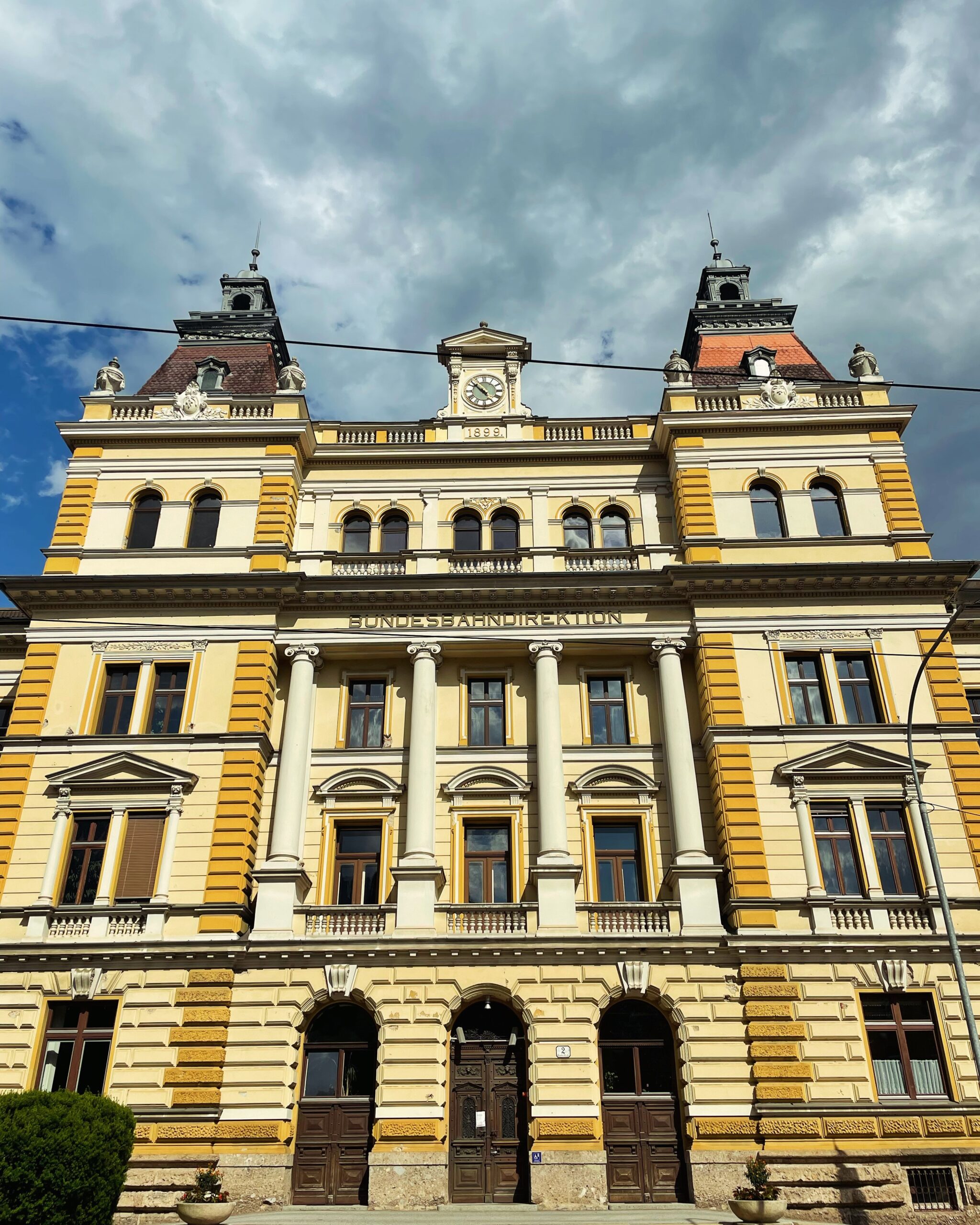
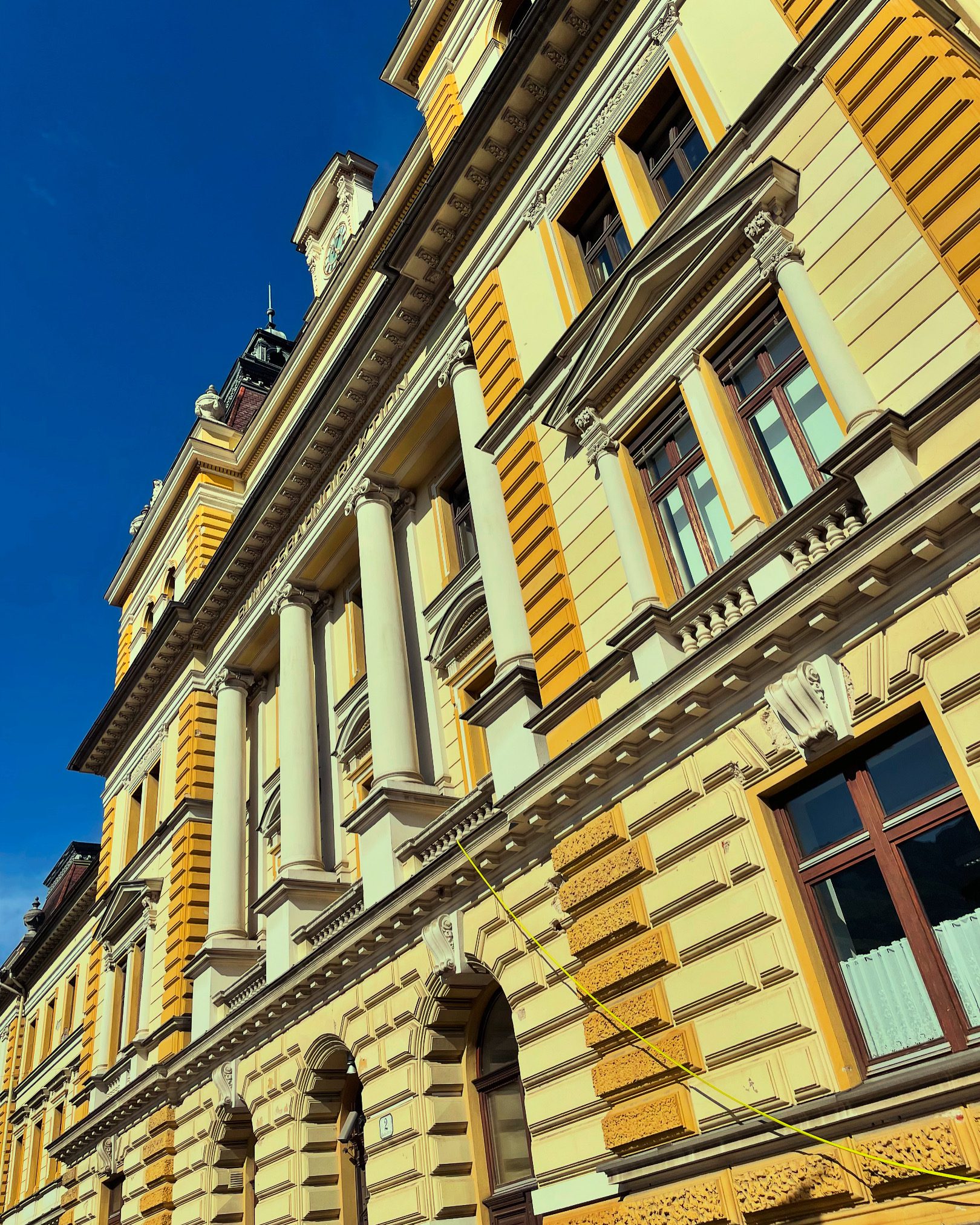
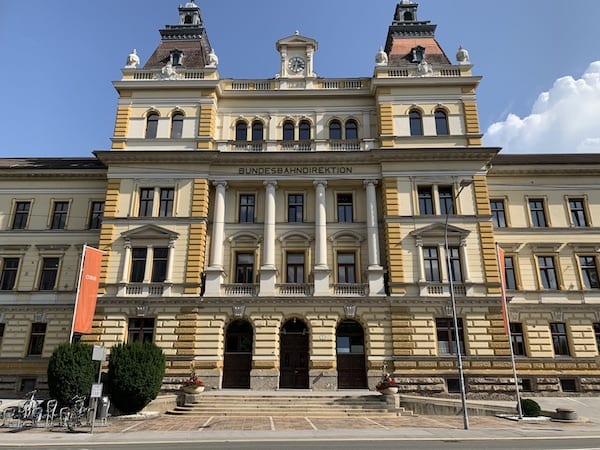
ÖBB Administrative Building
Claudiastrasse 2
Worth knowing
The railway was perhaps the most important technological innovation of the 19th century. It connected Innsbruck with the rest of the vast multi‑ethnic Habsburg Empire. More than merely a means of transportation, the railway also served as an intellectual and emotional bond. It offered citizens, no matter where within the empire they found themselves, a sense of familiar recognition. Railway stations resembled one another throughout the monarchy—from Innsbruck in the far west to Lemberg in today’s Ukraine—much like airports do around the world today. Thanks to their characteristic architecture and furnishings, stations conveyed the feeling of being under the protection of the Emperor and his officials. Alongside cafés, theaters, administrative offices, and churches, they helped bring the culture of the Austro‑Hungarian monarchy into even its farthest corners. In 1898, Innsbruck received its own local administrative office. Not only was the city the capital of the Crown Land of Tyrol, but ever since the opening of the trans‑Alpine railway lines in all directions, it had become an important transport hub. The increasingly dense timetables demanded ever more staff. Because there was no available space near the train station, the Saggen district was chosen as the new location. The ÖBB administrative building reflects the significance of the railway during this era; it was no coincidence that it was constructed as a palace‑like complex in Innsbruck’s most elegant and modern neighborhood. Symmetrical forms, towers, and columns shape the building in the historicist style typical of the Belle Époque. The Hötting breccia used for the lower base—sourced from the quarry on the Hungerburg—conveys stability and security. Particularly splendid is the conference hall with its double‑headed eagle, stucco ceiling, large chandeliers, and the somewhat old‑fashioned long table that is still in use today. The building at Bienerstraße 8, also part of the ÖBB complex, served an ignominious purpose for one year: from March 1938 to May 1939, it housed the headquarters of the Gestapo before the secret police relocated to their new quarters on Herrengasse. National Socialism, however, was responsible not only for the misuse of this building—railway infrastructure suffered disproportionately under the war. The elegant stations that had emerged from the 19th century until 1914, along with the neighborhoods surrounding them, often fell victim to Allied air raids during World War II. Today, railway districts in Austria are often no longer among the most attractive parts of their cities, and many stations are modern constructions. Yet parts of Innsbruck’s historic railway world have survived: the ÖBB administrative building, sections of the old station building on Südtirolerplatz, and the small Westbahnhof in Wilten all retain the turn‑of‑the‑century aesthetics that still evoke the charm of the early railway age and the Danube Monarchy.
Die Eisenbahn als Entwicklungshelfer Innsbrucks
In 1830, the world’s first public railway line for passenger traffic, operated by a steam locomotive, was put into service between Liverpool and Manchester. Shortly thereafter, this new means of transport rapidly spread across the entire continent. Until then, travel had been expensive, long, and arduous—undertaken by carriage, on horseback, or on foot—something that hardly anyone did at all, and certainly not with pleasure. Innsbruck’s mayor, Joseph Valentin Maurer (1797–1843), recognized the importance of the railway as an opportunity for the Alpine region at an early stage. In 1836, he advocated the construction of a railway line in order to make the beautiful but hard-to-reach region accessible to as broad and affluent a public as possible and to re-establish Innsbruck as a European transport hub during economically difficult times for the city. The first practical pioneer of railway transport in Tyrol was Alois von Negrelli (1799–1858). At the end of the 1830s, when the first railway lines of the Danube Monarchy were being put into operation in the eastern parts of the empire, he presented an “Expert Report on the Route of a Railway from Innsbruck via Kufstein to the Royal Bavarian Border at the Otto Chapel near Kiefersfelden.” Negrelli, later one of the many intellectual fathers of the Suez Canal, had served in his youth in the Imperial and Royal Building Directorate in Innsbruck and knew the city well. His report already contained sketches and a cost estimate. As a location for the main railway station, he had proposed the area around the Triumphal Arch and the Hofgarten. In a letter, he expressed himself about the railway line through his former home city as follows:
"...I also hear with the deepest sympathy that the railway from Innsbruck to Kufstein is being taken seriously, as the Laage is very suitable for this and the area along the Inn is so rich in natural products and so populated that I cannot doubt its success, nor will I fail to take an active part in it myself and through my business friends when it comes to the purchase of shares. You have no idea of the new life that such an endeavour will awaken in the other side..."
Hier ist die Übersetzung des gesamten Abschnitts: Friedrich List (1789–1846), known as the father of the German railway, put forward the plan for a rail link from the North German Hanseatic cities through Tyrol to the Italian Adriatic. The intellectual liberal economist and advocate of the largest possible customs union in Central Europe saw the expansion of the railway network as the key to economic prosperity. On the Austrian side, Carl Ritter von Ghega (1802–1860) inherited overall responsibility for the railway project within the sprawling Habsburg Empire from the early-deceased Negrelli. List would not live to see his dream of a sensibly connected Central European economic area realized; in 1846, driven to despair by the conservative political situation in the German states, he shot himself on Tyrolean soil in Kufstein. Five years later, Austria and Bavaria expressed their intent in a treaty to build a railway line to the Tyrolean state capital. In May 1855, construction began on what was until then the largest building site Innsbruck had ever seen. The station area took shape between Museumstraße, Pradl, and Wilten, and the station forecourt subsequently became one of the city's new focal points. Modern hotels were no longer located in the Old Town, but right here. To the east, the tracks led out of the city along newly constructed viaducts. On November 24, 1858, after just three years of construction, the railway line between Innsbruck and Kufstein—and onward via Rosenheim to Munich—went into operation. The line was ahead of its time: unlike the rest of the railway system, which was only privatized in 1860, it opened right from the start as a private railway, operated by the previously founded k.k. privilegierte südliche Staats-, Lombardisch-, Venetianisch- und Zentral-italienische Eisenbahngesellschaft (Imperial Royal Privileged Southern State, Lombard, Venetian, and Central Italian Railway Company). With this strategic move, the costly construction of the railway could be kept off the books of Austria’s chronically cash-strapped state budget. With this opening toward the eastern parts of the monarchy and, above all, toward Munich, the first step toward modernizing Tyrol had been taken. Goods and passengers could now be transported quickly and comfortably from Bavaria to the Alps and back. In South Tyrol, the first trains began rolling along the tracks between Verona and Trento in the spring of 1859. For the time being, the north-south corridor remained incomplete. The first serious considerations regarding the Brenner Railway were made in 1847. Conflicts south of the Brenner Pass and the commercial necessity of connecting the two parts of the province prompted the Permanente Central-Befestigungs-Commission (Permanent Central Fortification Commission) to step in by 1854. However, the loss of Lombardy following the war with France and Sardinia-Piedmont in 1859 delayed the project in a now politically unstable Northern Italy. In 1860, the k.k. privilegierte südliche Staats-, Lombardisch-, Venetianisch- und Zentral-italienische Eisenbahngesellschaft had to be reorganized into the k.k. privilegierte Südbahngesellschaft (Imperial Royal Privileged Southern Railway Company) to begin detailed planning. The following year, the mastermind behind this outstanding infrastructural achievement of the era, Engineer Carl von Etzel (1812–1865), began surveying the terrain and drafting concrete plans for laying the tracks. The planner was instructed by the private company’s investors to keep costs as low as possible and avoid large viaducts and bridges. Contrary to earlier considerations by Ghega—who had suggested starting the route in Hall to soften the incline up to the pass at 1,370 meters above sea level—Etzel developed a plan that included Innsbruck. Together with his site manager Achilles Thommen, he selected the Sill Gorge (Sillschlucht) as the best route. This not only saved seven kilometers of track length and a significant amount of money, but also secured Innsbruck's crucial status as a transport hub. The alpine terrain, mudslides, snowstorms, and floods posed immense challenges for the construction crews. River courses had to be diverted, rock faces blasted, earthworks excavated, and walls constructed to master the environment. However, the severe outbreak of war in Italy in 1866 caused the greatest disruptions. Particularly patriotic German-speaking workers refused to work alongside the "enemy." As a result, 14,000 Italian-speaking laborers had to be dismissed before work could resume. Nevertheless, what was then the world's highest standard-gauge railway line, featuring 22 tunnels blasted out of the solid rock, was completed in a remarkably short construction period. How many men lost their health and lives while working on the Brenner Railway remains unknown.
Die Eröffnung ging bemerkenswert unspektakulär über die Bühne. Viele Menschen waren sich nicht sicher ob der technischen Neuerung. Wirtschaftszweige wie das Rodfuhrwesen und die Poststationen entlang der neuen Brennerstraße, die nach 20 Jahren Bauzeit erst 1850 vollendet worden war, swaren dem Untergang geweiht, wie das Sterben der Flößerei nach der Eröffnung der Bahnlinie ins Unterland gezeigt hatte. Schon während der Bauarbeiten war es zu Protesten der Bauern, die ob des drohenden Imports landwirtschaftlicher Güter um ihren Gewinn fürchteten, gekommen. Auf eine dem Ereignis würdige Feier wurde, wie bereits zuvor beim Bau der Bahnstrecke verzichtet. Wegen der Hinrichtung des ehemaligen Kaisers Maximilians von Mexiko, dem Bruder Franz Josef I., vor einem revolutionären Kriegsgericht, war Österreich in Staatstrauer. Anstelle einer priesterlichen Weihe und festlicher Taufe spendete die Southern railway company 6000 guilders to the poor relief fund. Also in the Innsbrucker Nachrichten there is not a word about the revolution in transport, apart from the announcement of the last express train over the Brenner Pass and the publication of the timetable for the Southern Railway.
(The last express coach). Yesterday evening at half past seven the last express coach to South Tyrol departed from here. The oldest postilion in Innsbruck was driving the horses, his hat was fluttered with mourning, and the carriage was decorated with branches of weeping willows for the last journey. Two marksmen travelling to Matrei were the only passengers to pay their last respects to the express coach. In the last days of 1797, the beautiful, otherwise so lively and now deserted road was conspicuously dead.
Until the opening of the railway line over the Brenner Pass on 24 August 1867, Innsbruck was a terminus station of regional importance. The new, spectacular Brenner railway across the Alps connected the northern and southern parts of the country as well as Germany and Italy. The new Brenner road had already opened the year before. The Alps had lost their divisive character and their terror for transit, at least a little. While an estimated 20,000 people crossed the Brenner in 1865, three years later in the first full year of operation of the railway line there were around ten times as many. In addition, a whole flood of goods found their way across the new north-south axis, boosting trade and consumption.
The second alpine obstacle that had to be overcome for territorial unity was the Arlberg. Initial plans for a railway line connecting the Lake Constance region with the rest of the Danube Monarchy existed as early as 1847, but the project was repeatedly postponed. In 1871, export bans on food due to the Franco‑Prussian War led to famine in Vorarlberg, because supplies could not be transported quickly enough from the eastern parts of the vast empire to the far west. The economic crisis of 1873 delayed construction yet again. Only seven years later did parliament decide to realize the railway line. In the same year, complex construction work began east and west of the Arlberg massif. A total of 38 mountain streams and 54 avalanche-prone zones had to be secured with 3,100 structures under precarious alpine weather conditions. The most remarkable achievement was the ten-kilometer-long tunnel carrying two tracks. On June 30, 1883, the last transport of mail by horse-drawn carriage departed from Innsbruck to Landeck in a ceremonially mournful setting. The very next day, the railway took over this service. With the opening of the railway from Innsbruck to Landeck and the final completion of the Arlberg Railway to Bludenz in 1884—including the breakthrough of the Arlberg tunnel—Innsbruck was once again definitively established as a transport hub between Germany and Italy, France, Switzerland, and Vienna. In 1904 the Stubai Valley Railway, and in 1912 the Mittenwald Railway, were opened. Both projects were planned by Josef Riehl (1842–1917).
For a large part of the population, the railway was the most directly perceptible sign of progress. The railway viaducts, built from Hötting breccia quarried nearby, formed a physical and visible boundary to the east of the city toward Pradl. However, the railway did not change the region only from a technical perspective—it brought immense social transformation. Workers, students, soldiers, and tourists streamed into the city in large numbers, bringing new ways of life and ideas with them. Josef Leitgeb described this transformation in his novel The Untouched Year as follows:
“Even then, the railway had already brought many newcomers to Wilten. They lived in the new tall buildings that were springing up everywhere on land where grain had grown for centuries. Yet they were still perceived as outsiders; their Czech, Slovenian, and Hungarian names did not fit into the familiar sounds. They wore cheap ready-made clothing bought on installment, avoided church services, and instead attended meetings where the established citizens felt out of place. Seen clearly, they were quiet, hardworking, thrifty people who had simply brought different ways of life from the large cities and the lowlands. Anyone who looked at them askance could claim no other justification than that they did not want spectators for their own comfort. Nevertheless, the rejection of newcomers by the locals was still clearly palpable at the time; the father once heard a sermon in which the priest assured that all people could attain eternal salvation—‘even robbers and murderers, yes, even railwaymen.’”
The Federal Railway Directorate of the Imperial and Royal General Directorate of the Austrian State Railways in Innsbruck was one of only three directorates in Cisleithania. New social classes emerged as a result of the railway as an employer. People from all strata of society were needed to keep railway operations running. Workers and craftsmen could experience social advancement within the railway, similar to opportunities in state administration or the military. New professions such as track keeper, conductor, stoker, or locomotive driver emerged. Working for the railway carried a certain prestige. Not only was one part of the most modern industry of the time; titles and uniforms turned employees and workers into figures of respect. By 1870, Innsbruck’s population had grown from 12,000 to 17,000, largely due to the economic impulses generated by the railway. Local producers benefited from the ability to import and export goods quickly and at low cost. The labor market changed. Before the railway lines were opened, nine out of ten Tyroleans worked in agriculture; after the opening of the Brenner Railway, this figure dropped to below 70%. The new mode of transport contributed to social democratization and the rise of a bourgeois society. Not only wealthy tourists but also ordinary subjects—those who did not belong to the upper class—could now take excursions into the surrounding area. New foods altered people’s diets. The first department stores appeared with the arrival of consumer goods that had previously been unavailable. The appearance of Innsbruck’s inhabitants changed with new, fashionable clothing that became affordable for many for the first time. Not everyone welcomed this development. Shipping on the Inn River, previously an important transport route, almost immediately came to a standstill. The already weakened lower nobility and particularly strict clergy feared the collapse of local agriculture and a final moral decline due to the presence of strangers in the city.
The railway was worth its weight in gold for tourism. It was now possible to reach the remote and exotic mountain world of the Tyrolean Alps. Health resorts such as Igls and entire valleys such as the Stubaital, as well as Innsbruck city transport, benefited from the development of the railway. 1904 years later, the Stubai Valley Railway was the first Austrian railway with alternating current to connect the side valley with the capital. On 24 December 1904, 780,000 crowns, the equivalent of around 6 million euros, were subscribed as capital stock for tram line 1. In the summer of the following year, the line connected the new districts of Pradl and Wilten with Saggen and the city centre. Three years later, Line 3 opened the next inner-city public transport connection, which only ran to the remote village in 1942 after Amras was connected to Innsbruck.
The railway was also of great importance to the military. As early as 1866, at the Battle of Königgrätz between Austria and Prussia, it was clear how important troop transport would be in the future. Until 1918, Austria was a huge empire that stretched from Vorarlberg and Tyrol in the south-west to Galicia, an area in what is now Poland, and Ukraine in the east. The Brenner Railway was needed to reinforce the turbulent southern border with its new neighbour, the Kingdom of Italy. Tyrolean soldiers were also deployed in Galicia during the first years of the First World War until Italy declared war on Austria. When the front line was opened up in South Tyrol, the railway was important for moving troops quickly from the east of the empire to the southern front.
Carl von Etzel, who did not live to see the opening of the Brenner railway, is commemorated today by Ing.-Etzel-Straße in Saggen along the railway viaducts. Josef Riehl is commemorated by Dr.-Ing.-Riehl-Straße in Wilten near the Westbahnhof railway station. There is also a street dedicated to Achilles Thommen. As a walker or cyclist, you can cross the Karwendel Bridge in the Höttinger Au one floor below the Karwendel railway and admire the steel framework. You can get a good impression of the golden age of the railway by visiting the ÖBB administration building in Saggen or the listed Westbahnhof railway station in Wilten. In the viaduct arches in Saggen, you can enjoy Innsbruck's nightlife in one of the many pubs covered by history.
Tourism: From Alpine summer retreat to Piefke Saga
In the 1990s, an Austrian television series caused a scandal. Die Piefke Saga, written by the Tyrolean author Felix Mitterer, portrayed in four darkly humorous and revealing episodes the relationship between the German tourist family Sattmann and their hosts in a fictional Tyrolean holiday resort. Despite all justified criticism of modern tourism and its sometimes extreme excesses, one should not forget that tourism in the nineteenth century was an important driving force for the development of Innsbruck and its surroundings—not only economically. The first travellers to visit Innsbruck were pilgrims and “business people” of the early modern period. Merchants, journeymen on their travels, officials, soldiers, entourages of visiting nobility, skilled labourers, miners, clergy, pilgrims, and scholars were the earliest “tourists” attracted to the city between Italy and the German lands. Travel was expensive, dangerous, and arduous. Moreover, many subjects were not permitted to leave their place of origin without the consent of their feudal lord or abbot. Those who travelled usually did so on foot. Although Innsbruck’s inns and taverns profited from travellers as early as the Middle Ages and the early modern period, tourism in the modern sense did not yet exist. This began only when a few eccentrics were first drawn to mountain peaks. For this to happen, not only was a growing middle class required, but also a new perception of the Alps. For a long time, mountains had been regarded purely as a threat. It was primarily the British who, having explored the world’s oceans, now sought to conquer its mountain ranges as well. From the late eighteenth century onward, during the Romantic period, travel accounts began to spread the idea of the natural beauty of the Alps. The first foreign-language travel guide to Tyrol, Travels through the Rhaetian Alps by Jean François Beaumont, appeared in 1796. In addition to the alpine scenery, it was also the “wild and exotic natives” of Tyrol that fascinated international audiences. The bearded rebel Andreas Hofer, who had managed to challenge Napoleon’s army with a peasant force, attracted as much attention in Britain—the traditional enemy of France—as among German nationalists north of the Alps, who saw in him a kind of proto-German figure. Tyroleans were perceived as a stubborn, archetypal, and untamed people, comparable to the Germanic tribes under Arminius who had once resisted the Roman Empire. Descriptions of Innsbruck by authors such as Beda Weber (1798–1858), along with other travel accounts in the rapidly expanding press landscape, helped shape an attractive image of the city.
The next step was to make the wild Alpine environment accessible to a growing number of tourists who wished to emulate early adventurers, even if their willingness to take risks and their physical fitness fell short. In 1869, the German Alpine Club established a section in Innsbruck, following the relatively unsuccessful founding of the Austrian Alpine Club in 1862. Driven by the Greater German idea shared by many members, the two associations merged in 1873. To this day, the Alpine Club retains a largely bourgeois character, while its social-democratic counterpart is the organisation Naturfreunde. The network of hiking trails expanded, as did the number of mountain huts capable of hosting guests. As a transit region, Tyrol already possessed numerous mule tracks and footpaths that had existed for centuries and now formed the basis for alpine tourism. Small inns, farms, and stations along postal routes served as accommodation. Key figures such as the Tyrolean theologian Franz Senn (1831–1884) and Adolf Pichler (1819–1900) were instrumental in surveying Tyrol and creating maps. Contrary to popular belief, the Tyroleans were not born mountaineers but had to learn how to master the alpine environment; previously, mountains had been viewed mainly as dangerous obstacles in agricultural life. The Alpine clubs also trained mountain guides. Around the turn of the century, skiing began to gain popularity alongside hiking and mountaineering. Ski lifts did not yet exist; to climb mountains, skins were attached to skis—a practice still used in ski touring today. Only from the 1920s onward, with the construction of cable cars to the Nordkette and Patscherkofel, did a wealthier clientele begin to enjoy the modern luxury of mechanised mountain access.
This development required new hotels, cafés, inns, shops, and modes of transport to meet the needs of visitors. Guests accustomed to running water and telephones in cities like London or Paris were not willing to accept basic conditions such as outdoor toilets. Inns of the first and second class were suitable for transit travellers but not equipped for more discerning tourists. Until the nineteenth century, innkeepers in Innsbruck and the surrounding villages belonged to the upper middle class in terms of income, but their profession was not considered particularly prestigious. Many were farmers who supplemented their income by serving food and drink. As local meeting points and hubs in postal and goods networks, inns were centres of information, yet innkeeping did not carry the status of a guild profession or bourgeois occupation. This changed with the professionalisation of tourism. Entrepreneurs such as Robert Nißl, who acquired Büchsenhausen Castle in 1865 and transformed it into a brewery, or Johann Gruber of the inn Zum Riesen Haymon, invested in tourism infrastructure. Former aristocratic estates such as Weiherburg were converted into inns and hotels. In Innsbruck, the true transformation did not occur on the barricades of 1848 but later, within the tourism sector, as ambitious citizens replaced aristocrats as owners of estates.
The Österreichischer Hof, opened in 1849, dominated early modern hospitality but was not yet a true grand hotel. That distinction only came with the opening of the Grand Hotel Europa in 1869. In 1892, the Habsburger Hof followed, offering modern comforts such as electric lighting—a sensation at the time. Hotels like the Kaiserhof and Arlberger Hof were located near the railway station, which at the time represented the centre of modern urban life rather than the congested traffic hubs of today.
Visitor numbers grew steadily. Shortly before the First World War, Innsbruck recorded around 200,000 guests annually. A report from June 1896 noted:
“Tourism in Innsbruck in the month of May amounted to 5,647 persons, including 2,763 from Austria-Hungary, 1,974 from the German Empire, 282 English, 65 Italians, 68 French, 53 Americans, 51 Russians, and 388 from various other countries.”
In addition to the sheer number of travellers influencing life in the small town of Innsbruck, it was also the international character of its visitors that gradually gave the city a new face. Beyond purely tourist infrastructure, general modern developments were also accelerated. Wealthy guests could hardly be expected to frequent inns with cesspits behind the building. While a sewage system would inevitably have been built sooner or later, the economic importance of tourism enabled and accelerated the allocation of funds for the major infrastructure projects of the turn of the century. This transformation affected not only the city’s appearance but also the everyday lives and working conditions of its inhabitants. Enterprising individuals such as Heinrich Menardi succeeded in expanding the value chain by offering paid leisure activities in addition to accommodation and food. In 1880, he founded the carriage hire and later automobile rental service Heinrich Menardi for excursions into the Alpine surroundings. Initially using horse-drawn carriages, and after the First World War buses and cars, affluent tourists were transported as far as Venice. The company still exists today and is now headquartered in the Menardi building at Wilhelm‑Greil‑Straße 17, opposite Landhausplatz, although it has since shifted from transport and trade to the more lucrative real estate sector. Local retail also benefited from the affluent international clientele. By 1909, there were already three dedicated tourist equipment shops in the city, alongside the fashionable department stores that had opened just a few years earlier.
Innsbruck and its surrounding areas also became known for spa tourism—the precursor of today’s wellness industry—where wealthy guests recovered from a wide range of ailments in an alpine environment. Spa facilities existed in Egerdach near Amras, in Mentlberg, and in Mühlau. Establishments such as the Igler Hof (then the Grand Hotel Igler Hof) and the Sporthotel Igls still retain some of the charm of that era. Michael Obexer, founder of the spa resort in Igls and owner of the grand hotel, was a pioneer of tourism. Although these facilities never achieved the international fame of major spa destinations such as Bad Ischl, Marienbad, or Baden near Vienna—as evidenced by historical photographs and postcards—the treatments offered, including brine baths, steam therapies, gymnastics, and even “magnetism,” corresponded to what was considered state of the art at the time and still partially resonates in today’s wellness practices. Perhaps the most spectacular tourism project Innsbruck ever experienced was “Hoch‑Innsbruck,” today known as the Hungerburg. Not only the funicular railway and hotels were built there; even an artificial lake was created after the turn of the century to attract visitors.
One of the former landowners in the Hungerburg area and a pioneer of Innsbruck tourism, Richard von Attlmayr, played a key role in the predecessor organisation of today’s tourism association. Since 1881, the Innsbruck Beautification Association had been concerned with meeting the growing needs of visitors. The association developed walking and hiking paths, installed benches, and opened up hard-to-access areas such as the Mühlauer Gorge and the Sill Gorge. The distinctive green benches along many paths still serve as a reminder of this organisation, which continues to exist today. Seven years later, in 1888, those benefiting from tourism in Innsbruck founded the Commission for the Promotion of Tourism, the predecessor of today’s tourism board. Through joint efforts in marketing and quality assurance among accommodation providers, businesses hoped to further stimulate tourism.
“Each year the number of overseas pilgrims visiting our country and its glacier-crowned mountains increases, much to the annoyance of our friendly Swiss neighbours, and many a fine dollar is left behind. The English are beginning to find Tyrol just as interesting as Switzerland, and the number of French and Dutch visitors spending the summer here grows year by year.”
Postcards became the first mass-market “influencers” in the history of tourism. Many businesses produced their own postcards, and publishers created countless images of the city’s most popular sights. It is striking what was considered worth seeing at the time. Unlike today, it was primarily the modern achievements of the city that were depicted: the Leopold Fountain, the city café near the theatre, the chain bridge, the cog railway to the Hungerburg, or the Stefansbrücke (opened in 1845), a stone arch bridge crossing the Sill. Andreas Hofer also served as an effective testimonial on postcards: the Schupfen inn, where he had established his headquarters, and the Bergisel with the large Andreas Hofer monument were popular motifs.
In 1914, Innsbruck had 17 hotels attracting visitors, supplemented by summer and winter holidaymakers in Igls and the Stubai Valley. The First World War abruptly brought this first wave of tourism to an end. Just as tourism began to recover in the late 1920s, the global economic crisis and Hitler’s 1,000-mark travel restriction in 1933—introduced to pressure the Austrian government into lifting the ban on the Nazi Party—dealt further blows.
It took the economic boom of the 1950s and 1960s to revive tourism in Innsbruck after the destruction. Between 1955 and 1972, overnight stays in Tyrol increased fivefold. Following the hardships of the war years and the reconstruction of Europe’s economy, tourism became a stable source of income for Tyrol and Innsbruck, extending even beyond official hotels and guesthouses. Many Innsbruck families crowded more tightly into their already small apartments in order to rent out beds to foreign guests and supplement their income. Tourism not only brought foreign currency but also enabled locals to develop a new sense of identity, both internally and externally. At the same time, increasing prosperity allowed more Innsbruck residents to travel abroad themselves. The beaches of Italy became particularly popular destinations. Former wartime enemies thus became guests and hosts to one another.
Wilhelm Greil: DER Bürgermeister Innsbrucks
One of the most important figures in Innsbruck's municipal history was Wilhelm Greil (1850–1928). The entrepreneur held the office of mayor from 1896 to 1923, having previously helped shape the city's fortunes as vice mayor. His tenure was not only long, but also took place during a particularly dynamic era. The four decades between the economic crisis of 1873 and the First World War were marked by unprecedented growth and rapid modernization. It was a time of incorporating entire city districts, technical innovations, and new media. Private investments in infrastructure such as railways, energy, and electricity were encouraged by the state and given tax incentives in order to lead the provinces and cities of the struggling Danube Monarchy into modernity. The city's economy was booming. Businesses emerged in the new districts of Pradl and Wilten, attracting a labor force. Tourism also brought fresh capital into the city. Innsbruck's city council was dominated by the liberal and Pan-German nationalist 'Deutsche Volkspartei' (German People's Party), to which Greil also belonged. It was only with the incorporation of Wilten and Pradl in 1904 that the conservatives were able to gain ground, though they could not fully catch up. Social Democracy played almost no role until 1918. Due to an electoral system based on voting rights categorized by wealth classes, only about 10% of Innsbruck's population could step up to the ballot box. Women were fundamentally excluded. Furthermore, relative voting rights applied within the three electoral colleges, which effectively meant: winner takes it all. Appropriately enough, Mayor Greil lived much like a Renaissance prince. He hailed from the upper-class haute bourgeoisie. His father was able to afford establishing the family's home base in the Palais Lodron on Maria-Theresien-Straße. Thanks to this electoral statute, Mayor Greil could rely on 100% support in the city council well into the era of the First Republic, which naturally simplified decision-making and governance considerably. For all the efficiency that Innsbruck's mayors displayed on a superficial level, one should not forget that this was only possible because, as part of an elite composed of entrepreneurs, merchants, and professionals, they ruled through a form of elected dictatorship—without any significant opposition or consideration for other population groups such as workers, artisans, and employees. The Imperial Municipal Act of 1862 granted cities like Innsbruck, and thus its mayors, far-reaching powers. It is hardly surprising that the chain of office presented to Greil on his 60th birthday by his colleagues on the city council bore an astonishing resemblance to the collar orders of the old nobility. However, Greil was also a skillful politician who adeptly navigated the established power structures and media landscape of his time. Article 17 of the Austrian Basic Law of 1867, known as the December Constitution, secured freedom of expression in the press without prior censorship for the first time—excluding, of course, punishable content such as blasphemy or insulting the authorities. Consequently, a variety of newspapers established themselves, such as the conservative Neue Tiroler Stimme, the social democratic Volkszeitung, or the liberal Innsbrucker Nachrichten, shaping a worldview according to their publishers' preferences. Thanks to the reach of the Innsbrucker Nachrichten, Wilhelm Greil was able to effectively project his view of local politics. Despite his at times fierce speeches—modeled on the platform of Georg Ritter von Schönerer (1842–1921), the founding figure of the Pan-German nationalists—he managed to reach arrangements with conservative forces in the region, even if things frequently clashed in the media and elsewhere. Taxes, social policy, education, housing, and the design of public spaces were debated with passion and zeal, often enough with violence as the ultimate argument.
Unter Greils Ägide und dem allgemeinen wirtschaftlichen Aufschwung erweiterte sich Innsbruck im Eiltempo. Der Gemeinderat kaufte ganz im Stil eines Kaufmanns vorausschauend Grund an, um der Stadt Neuerungen zu ermöglichen. Der Politiker Greil konnte sich bei den großen Bauprojekten der Zeit auf die Beamten und Stadtplaner Eduard Klingler, Jakob Albert und Theodor Prachensky stützen. Infrastrukturprojekte wie das neue Rathaus in der Maria-Theresienstraße 1897, die Eröffnung der Mittelgebirgsbahn, die Hungerburgbahn und die Karwendelbahn wurden während seiner Regierungszeit umgesetzt. Weitere gut sichtbare Meilensteine waren die Erneuerung des Marktplatzes und der Bau der Markthalle. Neben den prestigeträchtigen Großprojekten revolutionierte vor allem Unsichtbares in den letzten Jahrzehnten des 19. Jahrhunderts das Leben vieler Innsbrucker. Bereits Greils Vorgänger Bürgermeister Heinrich Falk (1840 – 1917) hatte erheblich zur Modernisierung der Stadt und zur Besiedelung des Saggen beigetragen. Seit 1859 war die Beleuchtung der Stadt mit Gasrohrleitungen stetig vorangeschritten. Mit dem Wachstum der Stadt und der Modernisierung wurden die Senkgruben, die in Hinterhöfen der Häuser als Abort dienten und nach Entleerung an umliegende Landwirte als Dünger verkauft wurden, zu einer Unzumutbarkeit für immer mehr Menschen. 1880 wurde das Ragging, so der Name im Volksmund für die Entleerung der Aborte, in den Verantwortungsbereich der Stadt übertragen. Zwei pneumatische Maschinen sollten den Vorgang zumindest etwas hygienischer gestalten. Zwischen 1887 und 1891 wurde Innsbruck mit einer modernen Hochdruckwasserleitung ausgestattet, über die auch Wohnungen in höher gelegenen Stockwerken mit frischem Wasser versorgt werden konnten. Wer auf sich hielt und es sich leisten konnte, hatte damit erstmals die Gelegenheit eine Spültoilette im Eigenheim zu installieren. Greil setzte diesen Feldzug der Modernisierung mit einer Vielzahl an Infrastrukturprojekten fort. Die Ansammlung an Menschen auf enger werdendem Raum unter teils prekären Hygieneverhältnissen hatte viele Probleme mit sich. Die Randbezirke der Stadt und die umliegenden Dörfer wurden regelmäßig von Typhus heimgesucht. Nach jahrzehntelangen Diskussionen wurde 1903 mit dem Bau einer modernen Schwemmkanalisation begonnen. Ausgehend von der Innenstadt wurden immer mehr Stadtteile an diesen heute alltäglichen Luxus angeschlossen. 1908 waren nur die Koatlackler Mariahilf und St. Nikolaus nicht an das Kanalsystem angeschlossen. Auch der neue Schlachthof im Saggen erhöhte Hygiene und Sauberkeit in der Stadt. Schlecht kontrollierte Hofschlachtungen gehörten mit wenigen Ausnahmen der Vergangenheit an. Das Vieh kam im Zug am Sillspitz an und wurde in der modernen Anlage fachgerecht geschlachtet. Greil überführte das Gaswerk in Pradl und das Elektrizitätswerk in Mühlau in städtischen Besitz. Die Straßenbeleuchtung wurde im 20. Jahrhundert von den Gaslaternen auf elektrisches Licht umgestellt. 1888 übersiedelte das Krankenhaus von der Maria-Theresienstraße an seinen heutigen Standort. Bürgermeister und Gemeinderat konnten sich bei dieser Innsbrucker Renaissance neben der wachsenden Wirtschaftskraft in der Vorkriegszeit auch auf Mäzen aus dem Bürgertum stützen. Waren technische Neuerungen und Infrastruktur Sache der Liberalen, verblieb die Fürsorge der Ärmsten weiterhin bei klerikal gesinnten Kräften, wenn auch nicht mehr bei der Kirche selbst. Freiherr Johann von Sieberer stiftete das Greisenasyl und das Waisenhaus im Saggen. Leonhard Lang stiftete das Gebäude in der Maria-Theresienstraße, in der sich bis heute das Rathaus befindet gegen das Versprechen der Stadt ein Lehrlingsheim zu bauen.
In contrast to the booming pre-war era, Greil’s leadership after 1914 was marked by crisis management. In his final years in office, he guided Innsbruck through the transition from the Habsburg monarchy to the republic—a time characterized above all by hunger, hardship, scarcity of resources, and insecurity. He was 68 years old when Tyrol was divided at the Brenner Pass after the war. During his political career, Greil had often exploited general hostility toward Italians (“Walsche”) in a similarly populist manner to his Christian Social counterpart in Vienna, Karl Lueger, who used antisemitic rhetoric. At the end of his career, he had to witness the Italian occupation of Innsbruck. With the introduction of the republic, the census-based voting system was abolished, marking the beginning of the end of liberal dominance in the municipal council. In 1919, the Social Democrats won elections in Innsbruck for the first time. Only due to council majorities and a coalition of Greater German-liberal and conservative-clerical politicians did Greil remain mayor. He died in 1928 at the age of 78 as an honorary citizen of the city of Innsbruck. Wilhelm-Greil-Straße had already been named after him during his lifetime.
Klingler, Huter, Retter & Co: master builders of expansion
The final decades of the 19th century became known in Austrian history as the Gründerzeit (Founders’ Era). After the economic crisis of 1873, the financial situation recovered and an unprecedented construction boom began. Innsbruck also established a modern banking system. Financial institutions such as the Savings Bank founded in 1821 and the Creditanstalt, whose building erected in 1910 still towers over Maria-Theresien-Straße like a small palace, made it possible to obtain loans, without which entrepreneurship and commerce as we know them today would not have been possible. In some cases, these financial institutions even acted as developers themselves. Between 1880 and 1900, Innsbruck’s population grew from 20,000 to 26,000 inhabitants, while Wilten, incorporated into the city in 1904, even tripled its population from 4,000 to 12,000. The number of buildings increased from 600 to more than 900. Most of them, unlike previous buildings, were multi-story apartment houses. Infrastructure was also modernized. Gas, running water, and electricity became part of everyday life for an increasing number of people. These buildings represented the new society. Entrepreneurs, professionals, employees, and workers had different needs than the legally dependent subjects of previous centuries. The urban lifestyle demanded apartments with several rooms and open spaces for recreation after working hours. Apartment buildings made a modern lifestyle possible even for people who did not own property. Unlike the rural regions of Tyrol, where farming families lived together with servants in farmhouses as part of an extended kinship community, life in the city was already quite close to our present-day understanding of family life. Although the upper middle class had not yet surpassed the nobility, it had reduced the gap considerably and, through its new position on the municipal council, was able not only to commission private building projects but also to decide on public construction projects. The old city hospital in the center of town was replaced by a modern hospital in the west; Sieberer’s orphanage and retirement home were established in Saggen, and a new urban center emerged around the railway station.
The forty years preceding the First World War were a gold rush era for the construction industry. The architecture of the buildings reflected the worldview of their owners. Master builders often assumed several roles and frequently replaced architects altogether. Most clients had very clear ideas about what they wanted. They were not seeking breathtaking new creations but rather copies of or adaptations based on existing buildings. In keeping with the spirit of the age, Innsbruck’s master builders designed structures according to the wishes of their financially powerful clients in the styles of Historicism, Classicism, and the Tyrolean Heimatstil. The style chosen for a home was often not merely an aesthetic decision but also an ideological statement by the owner. Liberals generally preferred Classicism, while conservatives were drawn to the Tyrolean Heimatstil. Whereas the Heimatstil presented itself in a Neo-Baroque form with abundant paintings, clear forms, statues, and columns were characteristic elements of Classical-inspired architecture. In what was sometimes a rather wild mixture of styles, people realized their ideas of classical Greece and ancient Rome. Not only railway stations and public buildings but also large apartment buildings, entire streets, churches, and even cemeteries were built along former country roads in this design. Academics—and those wishing to appear as such—demonstrated their fascination with antiquity through neoclassical façades. Catholic traditionalists commissioned murals depicting saints and scenes from Tyrolean history on their Heimatstil houses. While Neoclassicism predominates in Saggen and Wilten, the district of Pradl is largely characterized by conservative Heimatstil architecture. For a long time, many architectural experts looked down upon the tastes of social climbers and the newly rich. Heinrich Hammer wrote in his standard work Art History of the City of Innsbruck:
"Of course, this first rapid expansion of the city took place in an era that was unfruitful in terms of architectural art, in which architecture, instead of developing an independent, contemporary style, repeated the architectural styles of the past one after the other."
The era of grand villas, which imitated the aristocratic residences of former times with a bourgeois touch, came to an end after several exuberant decades simply because space became scarce. Further development of the city with detached houses was no longer possible. Even today, the area around Falkstraße, Gänsbachstraße, and Bienerstraße is known as Villensaggen, while the areas further east are referred to as Blocksaggen. Wilten and Pradl, however, never experienced this kind of development. Nevertheless, in their gold-rush enthusiasm, developers sealed ever more land with construction. In 1907, Albert Gruber delivered a warning speech about this growth, cautioning against unchecked urban expansion and land speculation.
"It is the most difficult and responsible task facing our city fathers. Up until the 1980s (note: 1880), let's say in view of our circumstances, a certain slow pace was maintained in urban expansion. Since the last 10 years, however, it can be said that cityscapes have been expanding at a tremendous pace. Old houses are being torn down and new ones erected in their place. Of course, if this demolition and construction is carried out haphazardly, without any thought, only for the benefit of the individual, then disasters, so-called architectural crimes, usually occur. In order to prevent such haphazard building, which does not benefit the general public, every city must ensure that individuals cannot do as they please: the city must set a limit to unrestricted speculation in the area of urban expansion. This includes above all land speculation."
A handful of master builders, together with the Innsbruck Building Authority, guided this development. If Wilhelm Greil can be called the mayor of Innsbruck’s expansion, then the Vienna-born Eduard Klingler (1861–1916) certainly deserves the title of its architect. As a public official and master builder, Klingler left a profound mark on Innsbruck’s cityscape. He began working for the Province of Tyrol in 1883. In 1889 he joined the municipal building authority, which he headed from 1902 onward. Among the projects attributed to Klingler as head of the building authority are the Commercial Academy, the Leitgeb School, Pradl Cemetery, the Dermatological Clinic within the hospital complex, the Municipal Kindergarten on Michael-Gaismair-Straße, the Train Barracks (today a residential building), the Market Hall, and the Tyrolean State Conservatory. One particularly noteworthy Heimatstil building designed by him is the Ulrich House on Bergisel, which today serves as the headquarters of the Old Kaiserjäger Club.
The most important construction company in Innsbruck was Johann Huter & Sons. Johann Huter took over his father’s brickworks. In 1856 he acquired the company’s first property, the Huter Grounds, on Innrain. Three years later the first business headquarters was established on Meranerstraße. The company’s official founding came in 1860 when it was registered together with his sons Josef and Peter. Like many of its competitors, Huter & Sons saw itself as a full-service provider. The company included its own brickworks, cement factory, carpentry shop, metal workshop, design office, and construction firm. By the outbreak of the First World War, it employed more than 700 people. In 1906/07, the Huter family built their residential and business headquarters at Kaiser-Josef-Straße 15 in the typical style of the late pre-war years. This stately house combines the Tyrolean Heimatstil, surrounded by gardens and nature, with Neo-Gothic and Neo-Romanesque elements. Well-known buildings erected by Huter & Sons in Innsbruck include the Monastery of Perpetual Adoration, St. Nicholas Parish Church, the first building of the new hospital complex, and several buildings on Claudiaplatz.
The second major player was Josef Retter (1872–1954). Born in Lower Austria with Tyrolean roots, he completed an apprenticeship as a mason before attending the Imperial-Royal State Trade School in Vienna and the master craftsman school of its construction department. After gaining professional experience throughout the Habsburg Monarchy—in Vienna, Croatia, and Bolzano—he was able, thanks to his wife’s dowry, to establish his own construction company in Innsbruck at the age of 29. Like Huter’s company, his enterprise also included a sawmill, a sand and gravel works, and a stonemasonry workshop. In 1904 he built his residential and office building. The dark Neo-Gothic Retter House at Schöpfstraße 23a, with its distinctive bay window supported by columns and a turret, is decorated with a remarkable mosaic representing an allegory of architecture. The relief on the gable depicts the union of art and craftsmanship, symbolizing Retter’s career path. Retter’s buildings particularly shaped Wilten and Saggen. Through projects such as the new Academic Gymnasium, the castle-like Commercial Academy building, the Protestant Christ Church in Saggen, the Zelger House on Anichstraße, Sonnenburg in Wilten, and the Neo-Gothic Mentlberg Castle in Sieglanger, he created many of the most important buildings of this era in Innsbruck.
Late in life but with a similarly practice-orientated background that was typical of 19th century master builders, Anton Fritz started his construction company in 1888. He grew up remotely in Graun in the Vinschgau Valley. After working as a foreman, plasterer and bricklayer, he decided to attend the trade school in Innsbruck at the age of 36. Talent and luck brought him his breakthrough as a planner with the country-style villa at Karmelitergasse 12. In its heyday, his construction company employed 150 people. In 1912, shortly before the outbreak of the First World War and the resulting slump in the construction industry, he handed over his company to his son Adalbert. Anton Fritz's legacy includes his own home at Müllerstraße 4, the Mader house in Glasmalereistraße and houses on Claudiaplatz and Sonnenburgplatz.
With Carl Kohnle, Carl Albert, Karl Lubomirski, and Simon Tommasi, Innsbruck possessed several other master builders who left their mark on the cityscape through typical buildings of the late 19th century. Together, they shaped Innsbruck’s new streets in the prevailing architectural spirit of the final thirty years of the Habsburg Monarchy. Residential houses, railway stations, government buildings, and churches throughout the vast empire stretching from Ukraine to Tyrol looked remarkably similar. New movements such as Art Nouveau gained acceptance only slowly. In Innsbruck, it was the Munich architect Josef Bachmann who introduced a new accent to bourgeois design with the redesign of the façade of the Winkler House. With the outbreak of the First World War, construction activity largely ceased. After the war, the era of neoclassical Historicism and the Heimatstil was definitively over. Times had become harsher, and the requirements for housing had changed. In the period of severe housing shortages in the young Republic of German-Austria, affordable housing and modern sanitary facilities became more important than representative façades and grand rooms. The increasingly professional education of master builders and architects at the Imperial-Royal State Trade School also contributed to a new understanding of construction, replacing the often self-taught veterans of the gold-rush era of Classicism. A stroll through Saggen and parts of Wilten and Pradl still transports visitors back to the Gründerzeit. Claudiaplatz and Sonnenburgplatz are among the most impressive examples. The construction company Huter & Sons still exists today. The company is now located in Sieglanger on Josef-Franz-Huter-Straße, named after its founder. Although the residential building on Kaiser-Josef-Straße no longer bears the company’s name, it remains, in all its opulence, a remarkable relic of the period that permanently transformed Innsbruck’s appearance. In addition to his residence on Schöpfstraße, the district of Wilten contains a second building associated with the Retter family. Opposite the university on Innrain stands Villa Retter. Josef Retter’s eldest daughter, Maria Josefa, who herself had been educated according to the principles of the reform educator Maria Montessori, opened Innsbruck’s first Haus des Kindes (“House of the Child”) in 1932. Above the entrance, a portrait depicts the benefactor Josef Retter. The south façade is adorned with a mosaic in the characteristic style of the 1930s, referring to the building’s original purpose. A smiling blond girl embraces her mother, who is holding a book, and her father, who carries a hammer. The family crypt at Westfriedhof Cemetery is another notable legacy of the Retter family.
Innsbruck - city of bureaucrats and civil servants
Innsbrucker brüsten sich stolz der vielen Titulierungen ihrer Heimatstadt. Für jeden Geschmack ist etwas dabei: Hauptstadt der Alpen, Universitätsstadt, Österreichs Sportstadt oder Heimat des weltbesten Krankenhauses. Wirft man einen Blick auf die Liste der größten Arbeitgeber der Region oder in die Geschichte, ist Innsbruck vor allem eins: Beamtenstadt. Universität und Landeskrankenhaus sind zwar die größten einzelnen Arbeitgeber, rechnet man aber die öffentlichen Bediensteten aller Ebenen, Stadt, Land und Bund zusammen und nimmt die ausgelagerten Unternehmen im Besitz der öffentlichen Hand wie die ÖBB, TIWAG oder die Innsbrucker Kommunalbetriebe hinzu sowie Lehrer und Polizei, sind die Beamten klar in der Überzahl. Diese Titel hat auch die längste Tradition. Spätestens seit der Übersiedlung der landesfürstlichen Residenz unter Friedrich IV. machte die Beamtenschaft nicht nur einen beträchtlichen quantitativen Teil der Bürgerschaft aus, sie bestimmt die Geschicke der Stadt in einflussreicher, wenn auch unauffälliger Manier. Bis heute sind es Beamten, die den Laden am Laufen halten. Sie setzen Gesetze durch, kümmern sich um die Planung und Instandhaltung von Infrastruktur, machen eifrig Aufzeichnungen über die Bevölkerung, um Steuern ein- und Soldaten auszuheben. Die erste Welle der Bürokratie kam wohl bereits mit dem Roman Empire. Den Römern folgten im frühen Mittelalter die Brüder des Stiftes Wilten. Die schreibkundigen Männer verwalteten nicht nur die herzoglichen und eigenen Besitztümer durch ihre Urbare und hoben die Abgaben bei den bäuerlichen Untertanen ein, sondern legten Taufmatrikel, Heiratsverzeichnisse und Sterbebücher an. Die Feudalherrschaft erforderte zwar einen Panoramablick über das, was sich innerhalb ihres Herrschaftsbereichs abspielte, vor allem in der Stadt war das Leben aber eher von den Beschränkungen der Zünfte als von denen der Obrigkeit bestimmt. Ein Magistrat war nur oberflächlich vorhanden. Es gab Gesetze, aber keine Polizei, Steuern aber kein Finanzamt. Städtische Infrastruktur war praktisch nicht vorhanden, schließlich gab es weder fließend Wasser, elektrischen Strom, Kanalisation, städtische Kindergarten, ein Arbeitsamt oder eine Krankenkasse. Die zur Stadt erhobene Gemeinde Innsbruck wurde lange von einem Stadtrichter, ab dem 14. Jahrhundert von einem Bürgermeister mit Gemeinderat regiert. Es handelte sich dabei nicht um hauptberufliche Beamte, sondern Mitglieder der städtischen Elite. Nur wenige Menschen wie Zöllner, Kornmesser, Schreiber oder Turmwächter standen bei der Stadt unter Lohn und Brot.
In the 15th century, professional life and society became more differentiated, armies grew larger, and tax burdens increased. Traditional customary law was replaced by modern Roman law, which was more difficult for laypeople to understand. As the city grew, so did the bureaucratic apparatus. Between the early 15th century and the reign of Leopold V, Innsbruck had developed from a trading and transport settlement into a civil servants’ city. Of the approximately 5,500 inhabitants, more than half belonged to the court, the municipal administration, the university, or the clergy. Court life, administration, customs, taxation, long-distance trade, and finance required literate personnel. Administration had become the city’s most important economic sector, ahead of crafts, transport, and hospitality. Civil servants distinguished themselves socially. If at all, citizens usually encountered these foreign people only in unpleasant situations. The reins were tightened particularly firmly under Maximilian I. Laws decided centrally were implemented locally by the Imperial Circles. Salaried officials penetrated the lives of individuals in a way unknown in the Middle Ages. To make matters worse, these officials often came from abroad. Italians and Burgundians in particular were sought-after key personnel, but they remained alien to the local population. Not only did they often not speak German; they could read and write, were employees rather than subject peasants. They had more money, dressed differently, followed different customs, and ate different foods. Unlike the territorial prince, they did not invoke God, but rules written by humans and inspired by antiquity and reason. Depending on the fashions, customs, and moral concepts of the time, laws changed. Just as nature conservation or speed limits on motorways are repeatedly debated today despite their obvious sense, prohibitions against spitting, disposing of chamber pots, wooden buildings, and keeping livestock within the city walls were criticized at the time—even though they drastically improved hygiene and safety.
While it had long been customary for citizens to take certain liberties in the absence of the ruler—whether in logging, construction, hunting, or fishing—the bureaucracy was always present. Whereas the territorial prince was seen as a benevolent father of his subjects, and bishops and abbots, though strict landlords, could at least offer salvation in return, the new administrative authority appeared anonymous, aloof, faceless, foreign, and distant. The basis for negotiation that a subject once had in direct contact with his lord was buried by merciless law—at least if one could not pay bribes or did not know someone in a higher position. When the unconditional faith in an increasingly corrupt clergy began to crumble and Ferdinand I appointed the Spaniard Salamanca as the country’s supreme financial administrator, the simmering dissatisfaction erupted into open rebellion in 1525. The subjects did not demand the deposition of the prince, but a change in the rule of the clergy and the foreign bureaucracy. Even in the 17th century, it was the head of Wilhelm Biener, the highest-ranking official in the country, that rolled—not that of the sovereign.
Bureaucracy, the rule of the administration, also had advantages for the subjects. It established fixed rules where arbitrariness often prevailed. The law, harmonised across different territories, was more predictable. And with a bit of luck and talent, it was possible to climb the social ladder by serving the public authorities, even without belonging to the nobility. Michael Gaismair, one of the leaders of the 1525 rebellion, was the son of a mining entrepreneur and had been in the service of the provincial governor before his career as a revolutionary.
The next modernization of administration took place in the 18th century. Under the enlightened absolutist monarchs Maria Theresa and Joseph II, a new wind blew down to the municipal level. Innsbruck received a police force for the first time. The city administration was modernized in 1784. Instead of the old town council with its community assembly, a mayor now governed, supported by a council and above all by civil servants. This magistrate consisted of salaried experts who were still largely members of the lower nobility, but who now had to qualify for office through examinations. Bureaucracy gained more power at the operational political level. While the office of mayor was limited in time, civil servants enjoyed lifelong, non-terminable positions. This tenure and a renewed surge of new laws—often contradicting tradition—reinforced the image of civil servants as aloof and distant from citizens. When the element of foreign rule was added with the Bavarian occupation of Tyrol—modeled on French administration—another uprising broke out in 1809. The mass conscription of young men for military service, regulation of religious life, and compulsory vaccination, enforced by Bavarian officials, was too much for the Tyrolean psyche.
After 1809, bureaucracy expanded into ever more areas of life as part of industrialization and new technologies. Not only the state through taxation and the military, but also universities, schools, construction, railways, the postal system, and institutions such as the Chamber of Trade and Commerce required administrative staff. The city grew in population and businesses alike. New infrastructure—gas, sewer systems, and electricity—and new ideas about hygiene, food inspection, health, and education demanded new employees in the municipal administration. The old town hall in the Old Town became too small, and an extension proved impossible. In 1897, the civil servants moved into the new town hall on Maria-Theresien-Straße. The move was made possible by the generous donation of the industrialist and hotelier Leonhard Lang. He had converted the former Palais Künigl into the Hotel d’Autriche before the mayor and his entourage moved in.
When the monarchy collapsed in 1918, the transition was not seamless, but thanks to the structures in place, it was unimaginably smooth. However, it was no longer the emperor who carried the burden of the state, but a host of civil servants and guardians of order who provided water, electricity and a functioning railway network. With Eduard Klingler and Theodor Prachensky, two heads of building authorities in the first half of the 20th century left their mark on Innsbruck's cityscape, which is still clearly visible today. With agendas such as public housing, the labour office, education, urban infrastructure, road construction, public transport, registration and weddings, the Republic took over more or less all the tasks of daily life from the monarchy and the church. So for anyone who is annoyed by excessive officialdom and agonisingly slow bureaucracy on their next visit to the New Town Hall, it is worth remembering that the welfare state in the person of its civil servants manages the social welfare and public infrastructure of thousands of people from the cradle to the grave, mostly unnoticed.