Collegium Canisianum
Tschurtschenthalerstrasse 7
Worth knowing
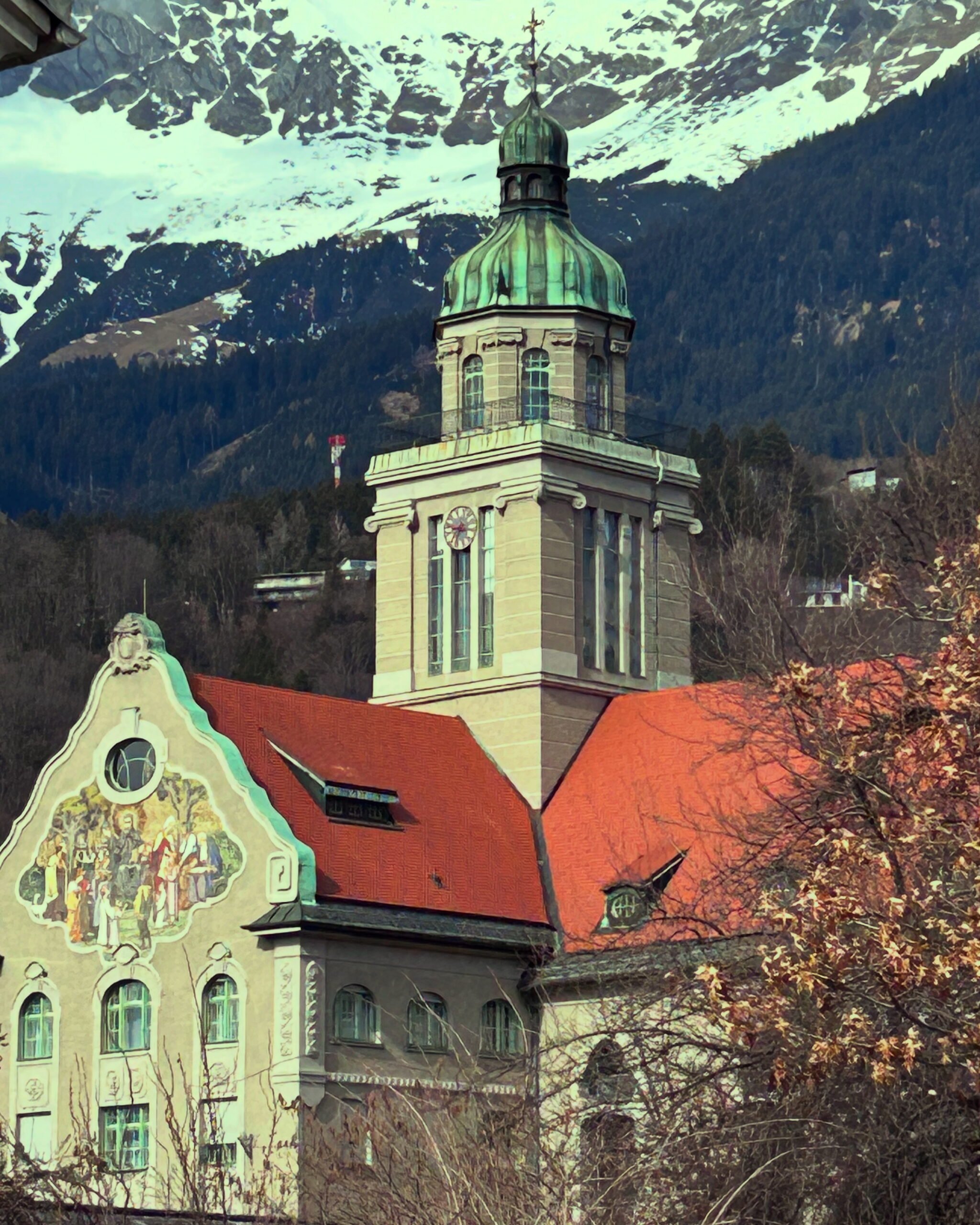
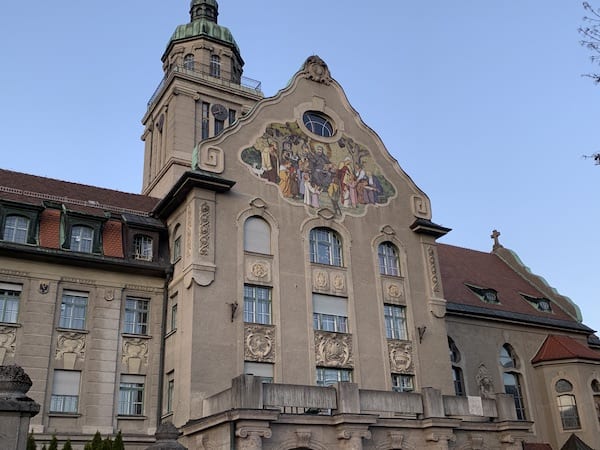
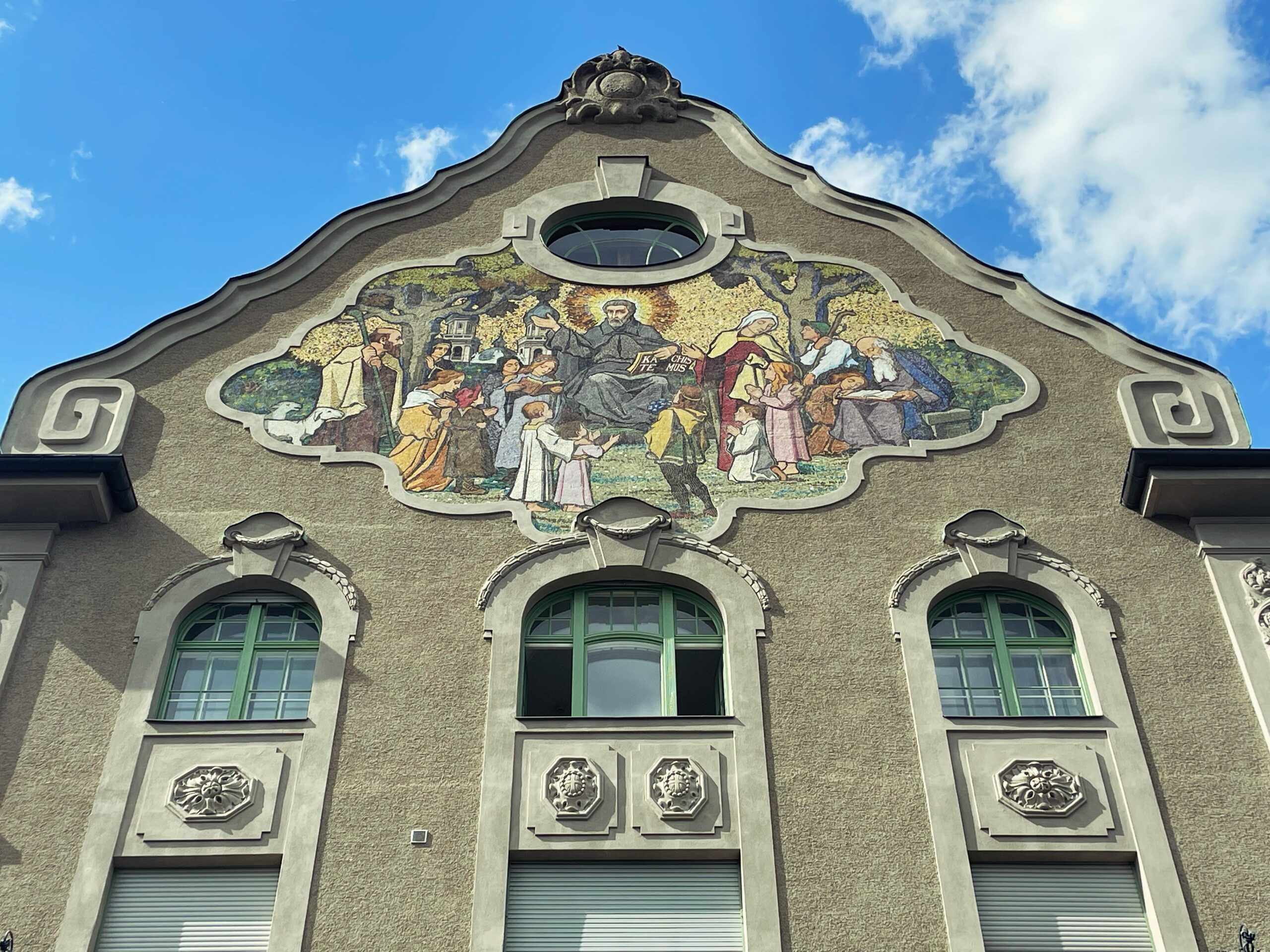
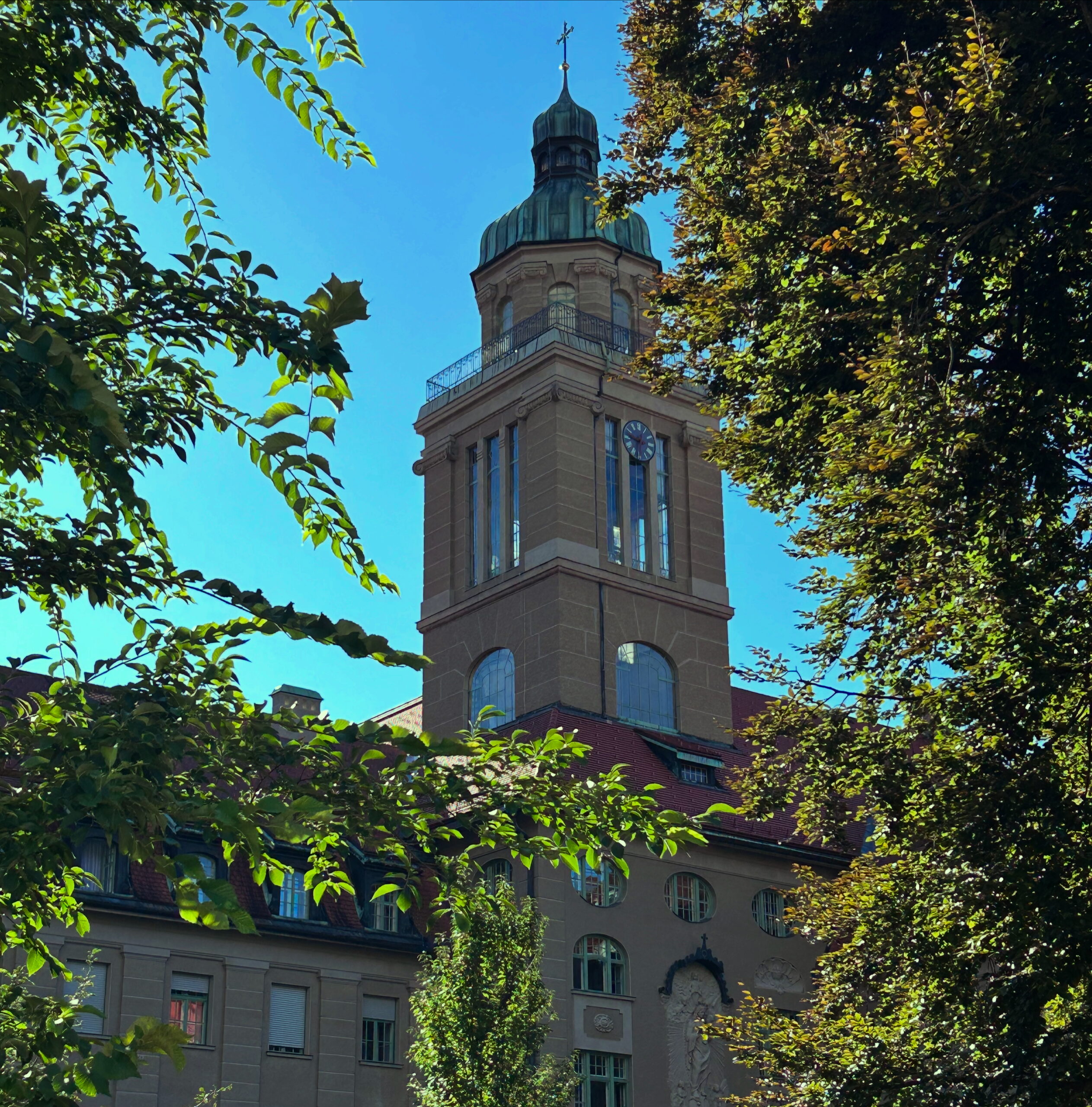
The colossal building of the Jesuit student residence, including its chapel, occupies a dignified place in the villa district of Saggen. Anyone looking down from Villa Blanka, slightly above Innsbruck, toward Saggen will first see the Canisianum, which—resembling a palace with its more than 20 window axes across the width—dominates the entire street. The entrance, featuring an Ionic columned portico and a tower with a lantern rising above it, forms a harmonious ensemble. The main windows are adorned with stone coats of arms of the House of Habsburg, the city of Innsbruck, and the province of Tyrol. The large mosaic on the façade depicts Petrus Canisius in the pose of a popular educator and interpreter of the world. A smaller mosaic, also shimmering in gold, shows the archangel Michael holding a sword to the head of a subjugated Satan. Both works were created by the Tyrolean Institute for Stained Glass and Mosaic.
The Collegium Canisianum is, alongside the Jesuit Church and the theological faculty, the second still-existing and prominently visible building in the cityscape that bears witness to the Jesuit influence on Innsbruck’s educational landscape. Its origins are rather surprising, as one would not expect such a grandiose building of a religious order to be dated to the final years of the monarchy. The institution began with the settlement of the Jesuits in Innsbruck. In 1587, the Nikolaihaus in today’s Universitätsstraße was opened as a boarding school for impoverished students of the Latin school. The students were supported at the expense of the archducal court or wealthy citizens. In return, they were required to pray rosaries and litanies for the salvation of their noble patron’s soul. After the founding of the University of Innsbruck in 1669, it served as a residence hall for students of the theological faculty. Under the enlightened Emperor Joseph II, who was not well disposed toward the Jesuits, the order lost its role as patron of the educational system; only under Franz Joseph I were the Jesuits restored to their traditional status. Soon, however, the Nikolaihaus in today’s Sillgasse became too small due to the large influx of students. In the general construction boom of the pre-war years, work began on the new residence in Saggen—despite the fact that the liberal circles of the city were anything but enthusiastic about yet another religious building in the urban landscape. As with the Convent of Perpetual Adoration, the clergy prevailed; Austria was still firmly in Catholic-Habsburg hands. In 1911, the Collegium Canisianum opened its doors to 276 seminarians from around the world. No member of the Habsburgs attended the opening, but one could read the “imperial thanks” for the project in the Innsbrucker Nachrichten on October 28:
“The imperial-royal governor for Tyrol and Vorarlberg has, by supreme order, conveyed the highest thanks to those involved for the expressions of loyalty telegraphed on the occasion of the consecration of the newly built house Collegium Canisianum, the theological seminary in Innsbruck.”
Like many other church institutions, the Canisianum and the theological faculty were forced to close after the Anschluss of Austria in 1938 under the fury of the National Socialists. The Jesuits went into exile in Sion, Switzerland, but returned again after the war in 1945. The chapel in the basement was redesigned in the 1970s in the contemporary, modern, and very austere style of the time. Similar to the parish church in Höttinger Au, which is also dedicated to Petrus Canisius, this devotional space is intended to reflect a reorientation of the clergy. Since 2013, the Canisianum has served as a student residence.
Petrus Canisius and the Jesuits
Franciscans, Premonstratensians, Carmelites, Servites, Capuchins, Ursulines. Anyone visiting Innsbruck strolls past numerous monasteries—usually without realizing it. Yet the most politically and socially influential order in the city’s history since the sixteenth century was the Jesuits. These “Soldiers of Christ” were founded in 1540 by the Spanish nobleman Ignatius of Loyola (1491–1556). Loyola was a morally rigorous reformer and an influential church politician with access to the highest circles of power of his time. His aim was to reform the Church—not, like Luther, without the Pope as its supreme authority. Nor did he consider dissolving monastic property. Renewal of faith from the top down, rather than the destruction of the existing order, was the guiding principle of the Societas Jesu. The order rapidly gained influence. Its military-inspired organization and structure, the combination of humanist learning with Catholic tradition, its affinity for science and education paired with a form of popular piety imbued with mysticism—all this made the Jesuits attractive to many people who were disillusioned by the moral decay of the late medieval clergy. In these respects, the Jesuits were very much attuned to an era shaped by new political, social, and economic structures. Like the Protestant reformers, they skilfully exploited the new medium of print to disseminate their writings. They represented the confessional continuation of a societal transformation characterized by the growing power of the state, new media, and double-entry bookkeeping. In this environment, spiritual guidance was in high demand. Politically, the Holy Roman Empire in the mid-sixteenth century was steeped in crisis. Italy had been severely affected by the wars between France and the Habsburgs. Major trading houses such as the Fuggers and the Welsers amassed ever greater influence. The German territories were still reeling from the Peasants’ Wars. Inflation posed a serious threat, and the many technological innovations around 1500 inspired fear among broad segments of the population. How, then, could the wrath of God—provoked by the failings of the Renaissance popes—and the looming end of the world be averted, if not through moral reform and a life lived according to the teachings of Christ?
A zealous patron of the Jesuits in Tyrol was the territorial prince and later Emperor Ferdinand I. Like Ignatius of Loyola, he had grown up in Spain. He struggled with German customs, the Reformation movement—unknown in Spain—and even the German language itself. The Tyrolean population, for its part, regarded their sovereign with suspicion, easily mistaking his foreign courtly entourage for an occupying power. A unifying element between these two worlds was the Roman Church, and in particular the modern Jesuit order. Probably the most important Jesuit theologian was Petrus Canisius (1521–1597). Born Peter Kanis into an upper-middle-class household in the Netherlands—his father was mayor of Nijmegen—he was exposed to high politics from an early age and learned courtly manners before studying in Cologne. Canisius became the first member of the order active within the Holy Roman Empire. Intelligent and highly educated, he rose swiftly through the ranks. Ferdinand appointed him to Vienna, where he was tasked with restoring order both as episcopal administrator and at the university. Alongside teaching and research, one of his main duties was to identify and interrogate university members suspected of Protestant sympathies. Canisius also spent several years in Innsbruck. Initially, the Jesuits were supposed to move into the newly completed Court Church (Hofkirche) and assume responsibility for the choral prayers at the tomb of Maximilian I. Canisius, as the highest-ranking representative of the order north of the Alps, politely but firmly declined. In 1563, however, the Emperor succeeded in luring him to the Alps after all. The scholar was needed as an adviser during a dispute with the Pope at the Council of Trent. For Ferdinand, Canisius composed a prayer manual intended to guide the ruler along the right spiritual path. The presence of Petrus Canisius made Innsbruck one of the theological centres of the German‑speaking world in the sixteenth century. In October 1571, he informed the parish of Wilten of the victory of the papal‑imperial fleet over the Ottomans at Lepanto. From the pulpit, Canisius proclaimed the triumph of Christian forces over the looming pagan threat in the greatest naval battle in history, adopting a tone reminiscent of a Catholic news broadcaster. His role as preacher and scholar in the city would be comparable to Albert Einstein holding a teaching post at a university in the 1930s. Canisius himself was deeply impressed by the piety of the Alpine population.
"Tyrol deserves our special attention, because it is even more Catholic than any other region of Germany and has not yet allowed itself to be ensnared by the heretics like the other countries. Even if many places have already been corrupted [...]. Innsbruck is ... the heart and life of the whole country."
Beyond courtly circles, the court preacher also cut a fine figure. While many Innsbruck residents eyed other foreign preachers and advisers at court with suspicion, Canisius was a man of the people. On behalf of his spiritual—and even more so his secular—masters, he travelled across Europe. Like Martin Luther, he “listened to the people’s speech.” Canisius is said to have travelled more than 100,000 kilometres between the Netherlands, Rome, and Poland, usually staying in modest inns. He understood how vital it was to win over the rural population. While his fellow Jesuits evangelised in distant India, he fought Protestantism in the German lands. He recognized that sermons in Latin were ill‑suited to immunise peasants, farmhands, and maids against the threat posed to the Roman Church by Luther’s Protestantism.
The strongest and most enduring pillar in the struggle against the Reformers was education. Canisius regarded many bishops and politicians as corrupt, morally depraved, and sinful. Instead of eliminating them, however, they were to reform themselves under the protective wings of the Soldiers of Christ. By founding new colleges, the Jesuits sought to improve the education of civil servants, the nobility, and the clergy, and to raise moral standards rooted in Christian principles. To this end, they established colleges throughout the Empire. In Protestant regions, German schools, academies, and grammar schools were founded with the aim of enabling as many subjects as possible to read the Bible for themselves in pursuit of piety and salvation. The Jesuits, by contrast, concentrated on educating elites and thus attained lasting influence within the power centres of Catholic states. With his Catechism, Petrus Canisius created a foundational German‑language compendium for the Catholic struggle against the Reformation. Translated into all major European languages, it long served as a guiding text of the Catholic Church. Between 1555 and 1558, three versions of varying complexity were produced for different audiences. Resourceful publishers even created an illustrated catechism for the illiterate. Well into the nineteenth century—and in some regions even beyond the Second World War—the Kanisi, as it was affectionately known, remained the most influential religious‑philosophical work in Tyrol and the foundation of religious instruction in schools. Canisius also made use of the new medium of the pamphlet to reach as wide an audience as possible. Together with those of Luther, his writings were probably the most widely read of the sixteenth century. In Innsbruck, the Jesuits founded the Latin School from which the university later emerged. This new educational institution had a profound impact on urban development, training the intelligentsia that enabled Innsbruck’s rise as an administrative and economic centre. In addition to university chairs, the Jesuits also oversaw the Theresianum. From 1775 to 1848, noble pupils and students housed in the Franciscan monastery were instructed in courtly etiquette and virtuous conduct in preparation for their careers. The Theresian Knightly Academy provided instruction in diplomatic skills such as foreign languages and dance, as well as military disciplines like fencing. Under Joseph II, Jesuit activities were temporarily interrupted. He stripped ecclesiastical orders of power and property, including the Jesuits—an order he personally disliked and which was also banned by the Pope for being too powerful. In 1781, the University of Innsbruck was downgraded to a lyceum. The vacated Jesuit College was used to establish the city’s first botanical garden, which was expanded further after the Theresianum was dissolved in 1808 during Bavarian administration. The Jesuits were recalled to Innsbruck in 1838. In 1910, the garden was relocated to Hötting as part of new school construction.
Through a dense network of influential positions and control over the education system, the order expanded rapidly. Especially during the Counter‑Reformation, the Jesuits succeeded in forging a close alliance with the Habsburg dynasty. The influence of Jesuit education is evident in the governance of many Habsburg rulers. Jesuits such as Bartholomäus Viller and Wilhelm Lamormaini wielded considerable political influence as confessors and advisers in the Early Modern period. It is no coincidence that Jesuits continue to feature as adversaries of Freemasons in countless conspiracy theories and novels, often cast as the modern equivalent of a James Bond villain. At the same time, the Jesuits were remarkably open to research, knowledge accumulation, and education, striving to understand the world as part of Christian creation. To Catholics, this made them a fashionable counterpoint both to traditional, ossified orders and to Protestantism. Faith and empiricism merged into a kind of pre‑modern science seeking to explain nature and physics. The collection of Ferdinand II at Ambras Castle testifies to this spirit of inquiry, as do the alchemical experiments of Emperor Matthias (1557–1619), which now appear rather absurd.
Despite their rational leanings, the Jesuits also re‑introduced mysticism into everyday church life. Passion plays, Holy Sepulchres, processions, and feast days wrapped strict doctrinal principles in spectacle and performance. Work hard – play hard was the motto. Festivities during processions often escalated into exuberant celebrations, not unlike today’s tent festivals, occasionally erupting into brawls and even violent riots. Bread and wine were celebrated in the style of Roman panem et circenses. On behalf of Ferdinand I, Petrus Canisius authored a book promoting a miracle in Seefeld—On the Highly Celebrated Miraculous Sign that Occurred with the Most Holy Sacrament of the Altar at Seefeld in the Princely County of Tyrol in the Year 1384—to stimulate pilgrimage to the site.
The Jesuit order, fully committed to popular belief, was also highly motivated when it came to persecuting witches and people of other faiths. Peter Canisius was one of the masterminds behind the early modern witch hunts:
"Witches are being punished everywhere, and they are multiplying strangely.... They envy children the grace of baptism and deprive them of it. There are large numbers of child murderers among them... Never before in Germany have you seen people so devoted and dedicated to the devil..."
Canisius also attracted attention as an exorcist, particularly in cases involving noblewomen allegedly afflicted by the “virus” of Protestantism. He exploited the public fascination with witches and demoniacs to promote the power and authority of the Catholic Church. At the same time, the Jesuits were highly active in missionary efforts in the then newly discovered New World of the Americas as well as in Asia. Saint Francis Xavier, one of Ignatius of Loyola’s earliest companions, died during a missionary journey in China. An altar dedicated to this Soldier of Christ can be found in a side chapel of the Jesuit Church in Innsbruck.
To this day, the Jesuits continue to exert an educational influence over Innsbruck. When the city was elevated to an independent diocese in 1964 under the Jesuit Paulus Rusch, Petrus Canisius was chosen as its patron saint. Karl‑Rahner‑Platz today is home not only to the Jesuit Church but also to the Faculty of Theology of the University of Innsbruck. In the Saggen district, the Collegium Canisianum remains under Jesuit administration. The principle of broad‑based societal influence aimed at mass audiences has endured on many levels. The Marian Congregation, known in Innsbruck as the MK, was once one of the largest youth centres in Europe and, in a modern sense, stands in the tradition of the Jesuit approach to the gentle introduction into faith and the education of youth within the Church.
Innsbruck and National Socialism
In den 1920er und 30er wuchs und gedieh die NSDAP auch in Tirol. Die erste Ortsgruppe Innsbrucks wurde bereits 1923 gegründet. Mit „Der Nationalsozialist - Combat Gazette for Tyrol and Vorarlberg“ erschien ein eigenes Wochenblatt. 1933 erlebte die NSDAP mit dem Rückenwind aus Deutschland auch in Innsbruck einen kometenhaften Aufstieg. Die Modernität der und die Aufstiegsmöglichkeiten, die sie bot, sprach junge, ambitionierte Menschen an. Das Neue, das Aufräumen mit alten Hierarchien und Strukturen wie der katholischen Kirche und der allgemeine Um- und Aufbruch in eine neue Zeit waren mächtige Anziehungsfaktoren. Arbeiter, Angestellte und Unternehmer gleichermaßen sehnten sich nach dem Wirtschaftsaufschwung auch für das schwächelnde Österreich, der in Deutschland die Arbeitslosenzahlen massiv reduziert hatte. Akademiker hingegen sahen sich in der großdeutschen Zukunft dem politischen Ziel ihrer Träume entgegengehen. Die demokratische Republik war konservativen Eliten ein Gräuel. Wer bereits oben war, sehnte sich nach den Zeiten vor dem allgemeinen Wahlrecht zurück, als Sozialdemokraten noch nichts zu melden hatten. Dazu versprach der neue „deutsche Volkskörper“ den vielen auf der Strecke gebliebenen Menschen eine glanzvolle Zukunft in einer egalitären Gemeinschaft ähnlich den Sozialdemokraten. Das Versprechen, die deutschsprachigen Südtiroler Home to the realm zu holen und damit das Unrecht der Brennergrenze auszumerzen wurde von allen gerne gehört. Konnten die Nationalsozialisten bei ihrem ersten Antreten bei der Innsbrucker Gemeinderatswahl 1921 nur 2,8% der Stimmen erringen, waren es bei den Wahlen 1933 bereits 41%. Nicht nur die Wahl Hitlers zum Reichskanzler in Deutschland, auch Kampagnen, Fackelzüge, Spendenaktionen und Events aller Art verhalfen der ab 1934 in Österreich verbotenen Partei zu diesem Ergebnis. Neun Mandatare, darunter der spätere Innsbrucker Bürgermeister Egon Denz und Gauleiter Franz Hofer, zogen in den Gemeinderat ein.
Als der Anschluss Österreichs an Deutschland im März 1938 erfolgte, kam es in Innsbruck zu bürgerkriegsähnlichen Szenen. Über 1800 Innsbrucker waren Mitglied der SA, die ihr Quartier in der Bürgerstraße 10 hatte. Bereits im Vorfeld des Einmarsches war es immer wieder zu Aufmärschen und Kundgebungen der Nationalsozialisten gekommen, nachdem das Verbot der Partei aufgehoben worden war. Noch bevor Bundeskanzler Schuschnigg seine letzte Rede an das Volk vor der Machtübergabe an die Nationalsozialisten mit den Worten „God bless Austria“ am 11. März 1938 geschlossen hatte, rotteten sich bereits die Nationalsozialisten in der Innenstadt zusammen um den Einmarsch der deutschen Truppen vorzufeiern. Die Polizei war dem Aufruhr der organisierten Manifestationen teils gewogen, teils stand sie dem Treiben machtlos gegenüber. Landhaus und Maria-Theresien-Straße wurden zwar abgeriegelt und mit Maschinengewehrständen gesichert, an ein Durchgreifen seitens der Exekutive war aber nicht zu denken. „One people - one empire - one leader“ und das Horst-Wessel-Lied hallten durch die Stadt. Die Bedrohung des deutschen Militärs und der Aufmarsch von SA-Truppen beseitigten die letzten Zweifel. Mehr und mehr schloss sich die begeisterte Bevölkerung an. Am Tiroler Landhaus, damals noch in der Maria-Theresienstraße, sowie im provisorischen Hauptquartier der Nationalsozialisten im Gasthaus Old Innsprugg, wurde die Hakenkreuzfahne gehisst. Der Putsch, samt Festnahme amtsbekannter Unruhestifter und offiziellem Wechsel politischer Amtsträger geschah über Nacht. Am 12. März empfingen Tausende Innsbrucker das deutsche Militär frenetisch. Um die demonstrative Gastfreundschaft gegenüber den Nationalsozialisten sicherzustellen, ließ der neue Bürgermeister Egon Denz jedem Arbeiter einen Wochenlohn auszahlen. Am 5. April besuchte Adolf Hitler persönlich Innsbruck, um sich von einer euphorischen Menschenmenge als heilsversprechender Führer feiern zu lassen. Auf der Nordkette wurden Bergfeuer in Hakenkreuzform entzündet. Die Volksbefragung am 10. April ergab eine Zustimmung von über 99% zum Anschluss Österreichs an Deutschland. Die Menschen waren nach der wirtschaftlichen Not der Zwischenkriegszeit, der Wirtschaftskrise und den Regierungen unter Dollfuß und Schuschnigg müde und wollten Veränderung. Welche Art von Veränderung, war im ersten Moment weniger wichtig als die Veränderung an und für sich. Wehrmacht und Industrie boten jungen Menschen eine Perspektive, auch denen, die mit der Ideologie des Nationalsozialismus an und für sich wenig anfangen konnten. Die Arbeitslosenquote sank nach dem Anschluss tatsächlich rapide von knapp 25 auf unter drei Prozent. Dass es immer wieder zu Gewaltausbrüchen kam, war für die Zwischenkriegszeit in Österreich ohnehin nicht unüblich. Anders als heute war Demokratie nichts, woran sich jemand in der kurzen, von politischen Extremen geprägten Zeit zwischen der Monarchie 1918 bis zur Ausschaltung des Parlaments unter Dollfuß 1933 hätte gewöhnen können. Was faktisch nicht in den Köpfen der Bevölkerung existiert, muss man nicht abschaffen.
Tirol und Vorarlberg wurden in einem Reichsgau zusammengefasst mit Innsbruck als Hauptstadt. Auch wenn der Nationalsozialismus von einem guten Teil der Bevölkerung mit der Zeit immer skeptischer gesehen wurde, gab es kaum organisierten oder gar bewaffneten Widerstand, dazu waren der katholische Widerstand OE5 und die Linke in Tirol nicht stark genug. Unorganisiertes subversives Verhalten der Bevölkerung, vor allem in den Landgemeinden rund um Innsbruck gab es vereinzelt. Zu allumfassend dominierte der Machtapparat den Alltag der Menschen. Viele Arbeitsstellen und sonstige Annehmlichkeiten des Lebens waren an eine zumindest äußerlich parteitreue Gesinnung gebunden. Eine Inhaftierung blieb dem größten Teil der Bevölkerung zwar erspart, die Angst davor war aber allgegenwärtig. Das Regime unter Hofer und Gestapochef Werner Hilliges leistete ganze Arbeit bei der Unterdrückung. Regimegegner Nummer eins war der Klerus, die katholische Kirche wurde deshalb auf allen Ebenen bekämpft. Katholische Schulen wurden umfunktioniert, Jugendorganisationen und Vereine verboten, Klöster geschlossen, der Religionsunterricht abgeschafft und eine Kirchensteuer eingeführt. Besonders hartnäckige Pfarrer wie Otto Neururer wurden in Konzentrationslager gebracht. Auch Lokalpolitiker wie die späteren Innsbrucker Bürgermeister Franz Greiter und Anton Melzer, der im Ersten Weltkrieg für Gott, Kaiser und Vaterland einen Arm verloren hatte, mussten flüchten oder wurden verhaftet. Gewalt und die Verbrechen an der jüdischen Bevölkerung, dem Klerus, politisch Verdächtigen, Zivilpersonen und Kriegsgefangenen auch nur überblicksmäßig zusammenzufassen würde den Rahmen sprengen. In der Klinik Innsbruck wurden Behinderte und vom System als nicht genehm empfundene Menschen wie Homosexuelle zwangssterilisiert. 1941 wurde in der Rossau in der Nähe des Bauhofs Innsbruck das Arbeitslager Reichenau errichtet. Etwa 120 Personen fanden in diesem Barackenlager den Tod durch Krankheit, die schlechten Bedingungen, Arbeitsunfälle oder Hinrichtungen. Die meist jüdischen, russischen oder italienischen Zwangsarbeiter wurden in den Messerschmitt Werken in Kematen und auf den vielen Baustellen wie der Errichtung der South Tyrolean settlements oder der Stollen zum Schutz vor den Luftangriffen im Süden Innsbrucks eingesetzt. Die Erinnerungsorte an die Zeit des Nationalsozialismus sind rar gesät. Das auffälligste Denkmal ist wohl das Tiroler Landhaus mit dem Befreiungsdenkmal. An der Alten Universität in der Herrengasse prangt eine Bronzetafel, die daran erinnert, dass die Gestapo hier einst ihr Hauptquartier hatte, wo Verdächtige unter Folter verhört, schwer misshandelt und teils mit Fäusten zu Tode geprügelt wurden. Der Vorplatz der Universität und eine kleine Säule am südlichen Eingang der Klinik wurden ebenfalls im Gedenken an das wohl dunkelste Kapitel Österreichs Geschichte gestaltet. In der Rossau wurde ein Gedenkort an das Arbeitslager Reichenau errichtet.
Glaube, Kirche und Obrigkeit
The abundance of churches, chapels, crucifixes, statues, and paintings in public spaces strikes many visitors to Innsbruck from other countries as unusual. Not only places of worship, but also many private houses are decorated with depictions of Jesus, Mary, saints, and biblical scenes. For centuries, the Christian faith and its institutions shaped everyday life throughout Europe, and Innsbruck—as a residence city of the strictly Catholic Habsburgs and the capital of the self-proclaimed Holy Land of Tyrol—was particularly richly endowed with ecclesiastical buildings. In terms of number and scale relative to the conditions of earlier times, churches appear as gigantic features in the cityscape. In the 16th century, Innsbruck, with its approximately 5,000 inhabitants, possessed several churches whose splendor and size surpassed every other building, including the palaces of the aristocracy. Wilten Abbey was a vast complex in the midst of a small farming village that had developed around it.
The spatial dimensions of these places of worship reflect their importance within the political and social structure. For many inhabitants of Innsbruck, the Church was not only a moral authority but also a secular landowner. The Bishop of Brixen was formally equal in rank to the territorial prince. Peasants worked on the bishop’s estates just as they did on those of a secular ruler. The clergy exercised both taxation and judicial authority over their subjects, and ecclesiastical landowners were often regarded as particularly demanding. At the same time, it was also the clergy in Innsbruck who were largely responsible for social welfare, healthcare, care for the poor and orphans, food distribution, and education. The Church’s influence extended into the material world in a way comparable to how the modern state operates today through tax offices, police, schools, and employment services. What democracy, parliament, and the market economy represent for us today, bishops, the Bible, Christian devotional literature, and parish priests represented for people of earlier centuries: a reality that maintained order.
It would be incorrect to believe that all clergymen were cynical power-hungry figures who exploited their uneducated subjects. The majority of both clergy and nobility were devout and God-fearing, albeit in a manner that is difficult to comprehend from today’s perspective. It was not the case that every superstition was blindly accepted or that people were arbitrarily executed based on anonymous accusations. In the early modern period, violations of religion and morals were tried before secular courts and punished severely. Charges were brought under the term heresy, which encompassed a wide range of offenses. Sodomy—meaning any sexual act not serving reproduction—sorcery, witchcraft, and blasphemy, in short any deviation from the correct faith, could be punished by burning. The act of burning was intended both to purify the condemned and to destroy them and their sinful behavior completely, thereby removing evil from the community. For a long time, the Church regulated everyday social life down to the smallest details. Church bells structured people’s daily schedules. Their sound called people to work or worship, or informed the community of a death through tolling. People were able to distinguish individual bell signals and their meanings. Sundays and holidays structured time. Fasting days regulated diet. Family life, sexuality, and individual behavior were expected to conform to Church-prescribed morality. For many people, salvation in the afterlife was more important than happiness on earth, which was seen as predetermined by the course of time and divine will. Purgatory, the Last Judgment, and the torments of hell were real and served to frighten and discipline even adults.
While parts of Innsbruck’s bourgeoisie were at least gently awakened by the ideas of the Enlightenment after the Napoleonic Wars, the majority of the population remained deeply attached to a blend of conservative Catholicism and superstitious folk piety. Religiosity was not necessarily a question of background and social status, as the social, media, and political debates along the fault line between liberals and conservatives repeatedly demonstrated. Although the freedom of religious practice had been legally enshrined since the December Constitution (Dezemberverfassung) of 1867, state and religion remained closely intertwined. Thanks to the 1855 concordat between the Pope and the Emperor, marriage law and the school system were under the control of the Catholic Church. It was only under pressure from liberals in parliament that these bastions of everyday social life began to crumble, yet particularly in Tyrol, the pastor's word remained sacrosanct. In the First Republic, a conservative backlash occurred. Ignaz Seipel, a Christian Social politician who went down in history as the Iron Prelate (Eiserner Prälat), rose to the highest office of the state in the 1920s. Federal Chancellor Engelbert Dollfuß saw his Corporate State (Ständestaat)—a construct built on a Catholic foundation—as a bulwark against socialism. In 1933, the concordat with the Vatican was renewed. Even after World War II, church and politics in Tyrol formed a powerful double act in the persons of Bishop Rusch and Governor Wallnöfer. In 1957, the government of the Second Republic reconfirmed the agreement, which formally remains valid to this day. A genuine separation of church and state did not begin until the 1970s. Although people leaving the church in recent decades have dented official membership figures and recreational events draw larger crowds than Sunday masses, faith and the church still hold a fixed place in the daily lives of Innsbruck’s residents, even if often unnoticed. The Roman Catholic Church still owns a vast amount of land in and around Innsbruck, even beyond the walls of its monasteries and educational institutions. A number of schools in and around Innsbruck also remain under the influence of conservative forces and the church. And whoever enjoys a public holiday, cracks Easter eggs against one another, or lights a candle on a Christmas tree does not have to be a Christian to act in the name of Jesus—disguised as tradition.
The success story of the Innsbruck glass painters
The United States of America were regarded in the pre-war period as the land of unlimited opportunity, where dishwashers could become millionaires. Yet such success stories are not exclusive to the New World. In the not yet fully regulated society of the Danube Monarchy, capable and diligent individuals from farming backgrounds, the working class, or artisanal trades—often without formal education, certification, or state approval—could achieve remarkable upward mobility. The three founders of the Tyrolean Stained Glass and Mosaic Institute, Josef von Stadl, Georg Mader, and Albert Neuhauser, are exemplary of such a success story from Innsbruck’s urban history. While most Innsbruck industrial and craft enterprises focused on supplying the local market with solid, well‑established goods and consumer products, stained glass production stood out as one of the few innovative and export‑oriented industries of its time.
Each of the founders’ personal histories, their differing skills and life paths, is noteworthy. Josef von Stadl (1828–1893) grew up on his parents’ farm and inn in Steinach am Brenner. From an early age, he had to help in the family business. This heavy labour resulted in an inflammation of the periosteum in his arm at the age of nine, making physical work impossible thereafter. Instead, the artistically talented boy attended the model secondary school in Innsbruck, today’s BORG. In 1848, he joined the Tyrolean sharpshooters of his hometown, though he was not deployed at the front. He later gained practical experience as a locksmith and turner. In 1853, he contributed to rebuilding the church in Steinach after a fire. His skills were soon recognised, and he steadily rose from labourer to master builder. Georg Mader (1824–1881), also from Steinach, began working as a farmhand at a young age. Through the patronage of his brother, a clergyman, the devout youth was able to train as a painter, though he initially had to abandon his passion to assist in the family mill. After completing his journeyman travels, he decided to devote himself fully to painting. In Munich, he refined his skills with the firms Kaulbach and Schraudolph. After working on the cathedral in Speyer, he returned to Tyrol, where he supported himself mainly through commissions for ecclesiastical art. Albert Neuhauser (1832–1901) trained in his father’s glazing and sheet‑metal workshop. However, he too had to abandon his intended career path early due to health issues—lung problems that appeared when he was just ten years old. Instead of continuing in the successful family business, he travelled to Venice. The island of Murano had been home for centuries to the finest glassmaking workshops. Fascinated by this craft, he defied his father’s wishes and attended a stained glass workshop in Munich. The products of the recently established Bavarian factory, however, did not meet his quality standards. Back in his father’s apartment in Herzog‑Friedrich‑Strasse, he began experimenting with glass—much like the “garage innovators” who, a century later, would lay the foundations for the personal computer.
Neuhauser’s experiments and tinkering aroused the curiosity of his friend von Stadl, who in turn introduced him to the artistically inclined Mader. In 1861, the three decided to combine their expertise in a formal business venture—what today might be called a startup. Neuhauser took responsibility for technical and commercial aspects as well as product development, von Stadl handled decorative design and contacts with builders, and Mader focused on figurative design, particularly for ecclesiastical commissions. Their first workshop, staffed by two painters and a kiln operator, was located on the third floor of the Gasthof zur Rose in the Old Town. Raw materials had to be imported from England, as domestic glass did not meet Neuhauser’s standards, and imports were subject to a 25% tariff. Together with a chemistry teacher, Neuhauser eventually succeeded—after a trip to Birmingham and extensive experimentation—in producing glass of the desired quality himself.
In 1867, Josef von Stadl married the painter Maria Pfefferer, the daughter of a physician. The former farmer’s son from the Wipptal had not only risen into the upper bourgeoisie; his wife’s dowry also gave him financial independence. In 1869, supported financially by Neuhauser’s father, the partners decided to expand their successful enterprise. The dynamism and lack of regulation characteristic of the Gründerzeit boom is illustrated by the example of the glassworks established in the fields of Wilten, which went into operation in 1872. Production began just 110 days after construction—officially never approved by the municipal authorities of Wilten—had commenced. Due to health reasons, Neuhauser withdrew from the company as early as 1874, and although the founders handed over management of their flourishing business relatively soon, they remained shareholders. At the same time, each continued to work successfully on independent projects within their respective fields.
Von Stadl, in particular, left a lasting imprint on Innsbruck. At the height of its success, the stained glass workshop employed over 70 people. In 1878, according to von Stadl’s plans, housing was built for employees, workers, artists, and craftsmen associated with the company. This “Glassworks Settlement” included the buildings at Müllerstraße 39–57, Schöpfstraße 18–24, and Speckbacherstraße 14–16, which still exist today. Their architecture differs markedly from the surrounding Gründerzeit buildings: von Stadl used less ornamentation but placed emphasis on small front gardens. Workers and employees were meant to feel in no way inferior to the residents of the cottage‑style villas in Saggen. While it was not uncommon for large companies to build their own housing—Siemensstadt in Berlin being a well-known example—this development reflects a particular corporate self‑image and forward-looking vision: the company saw itself not only as an employer but also as a provider of housing and social support. Another major project by von Stadl in Innsbruck was the Provincial Maternity Clinic in Wilten. After completing the Vinzentinum in 1878, he was named an honorary citizen and diocesan architect of Brixen. Pope Leo XIII awarded him the Order of St. Gregory for his services. The St. Nikolaus Church—whose windows had been produced by the Tyrolean Glass Painting Institute—became his final resting place.
Georg Mader continued to work as a painter on sacred buildings. He became a member of the Vienna Academy of Art as early as 1868. When he suffered a stroke in 1881, he was taken to Badgastein for rehabilitation. The spa town in Salzburg was a meeting place for the European aristocracy and upper middle classes at the time. In the midst of high society, the former journeyman miller died a wealthy man.
The restless and creative Neuhauser returned to Venice after resigning as director and went on to establish Austria’s first mosaic institute. The merger of the two companies in 1900 expanded the range of artistic possibilities. For his achievements, he was awarded the Order of Franz Joseph. In Wilten, Neuhauserstraße was named in his honour. Franz-Josephs-Orden. In Wilten wurde die Neuhauserstraße nach ihm benannt.