Militärfriedhof Amras / Pradler Friedhof
Amraserstraße / Kaufmannstraße / Wiesengasse
Worth knowing
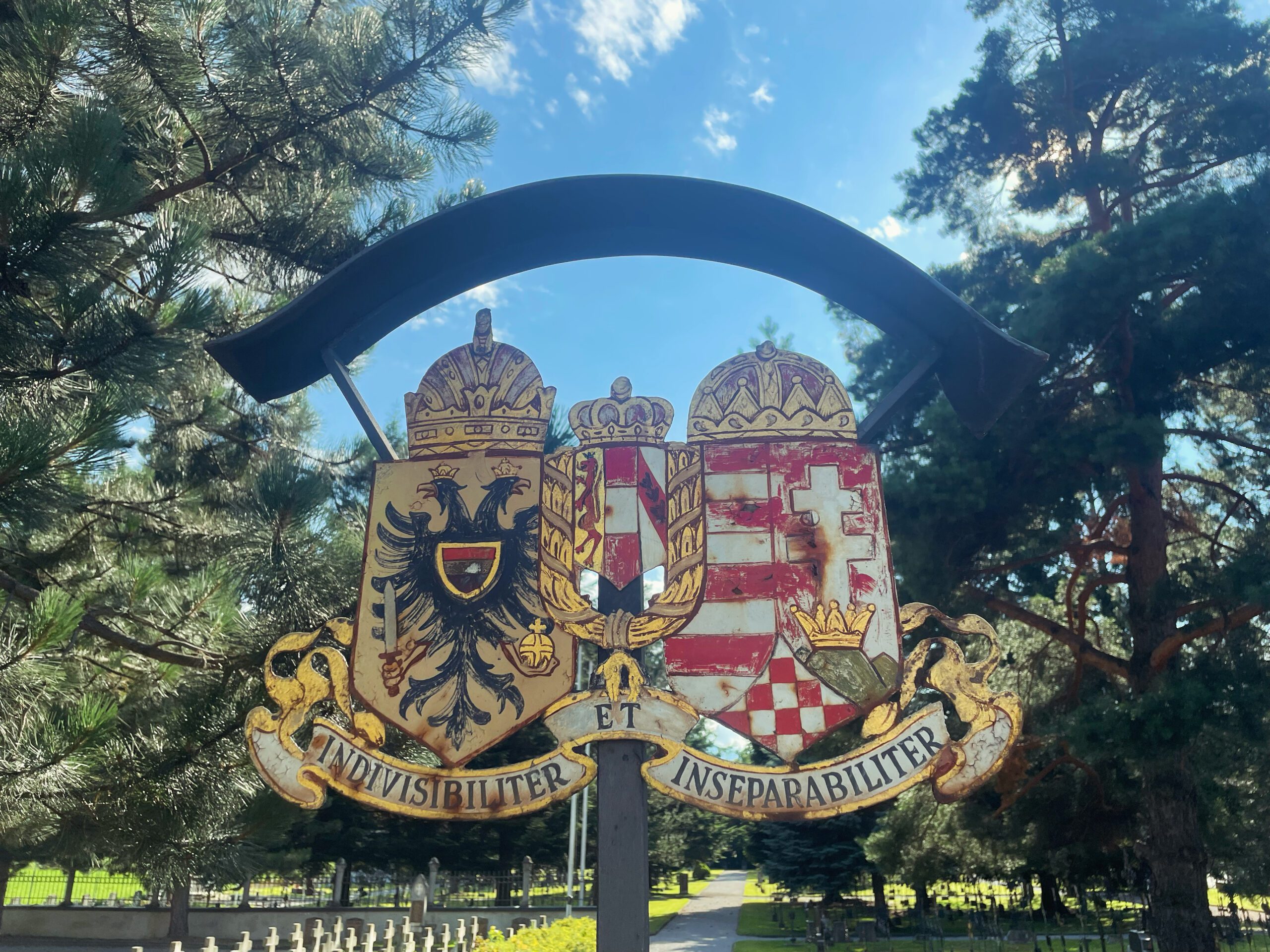
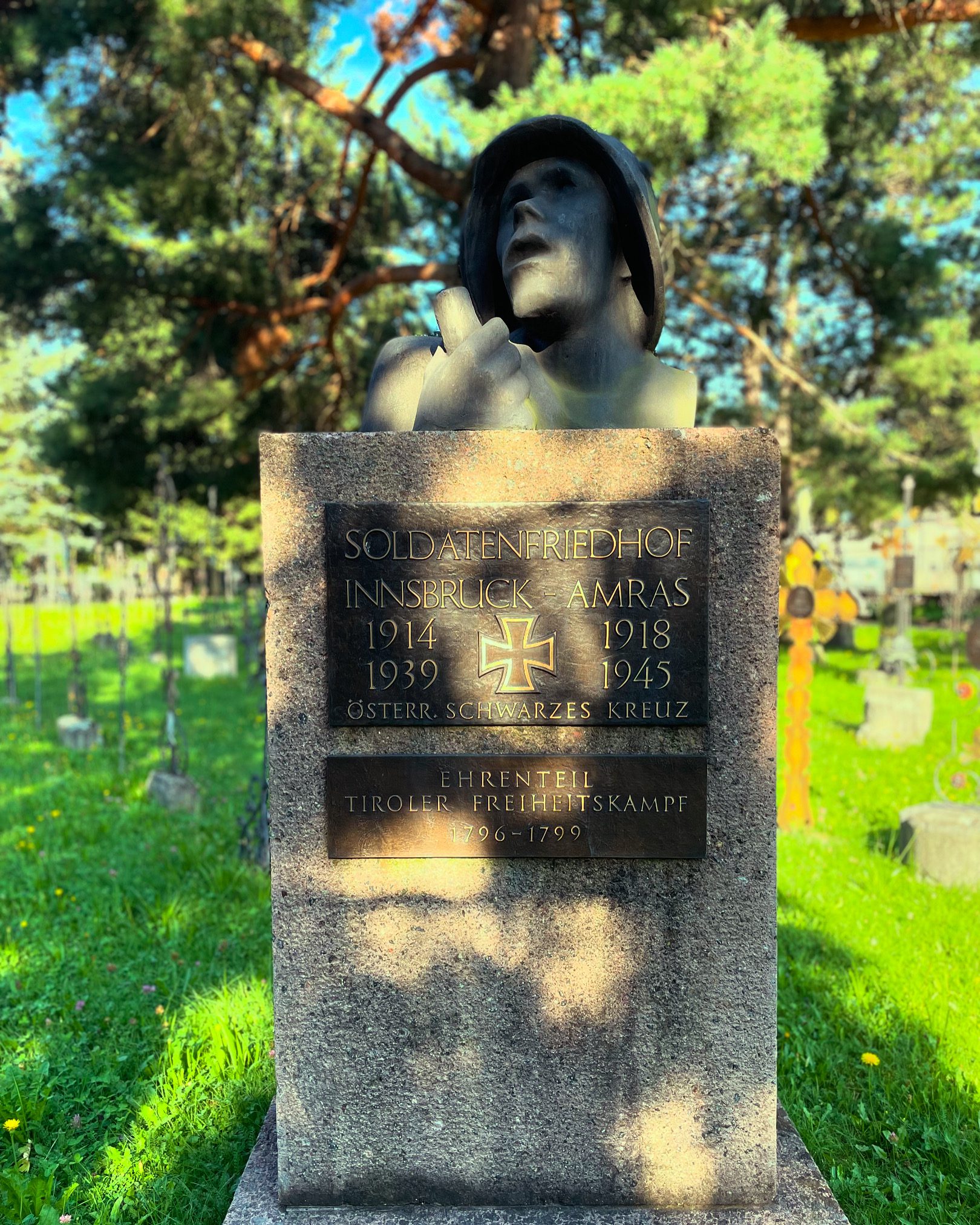
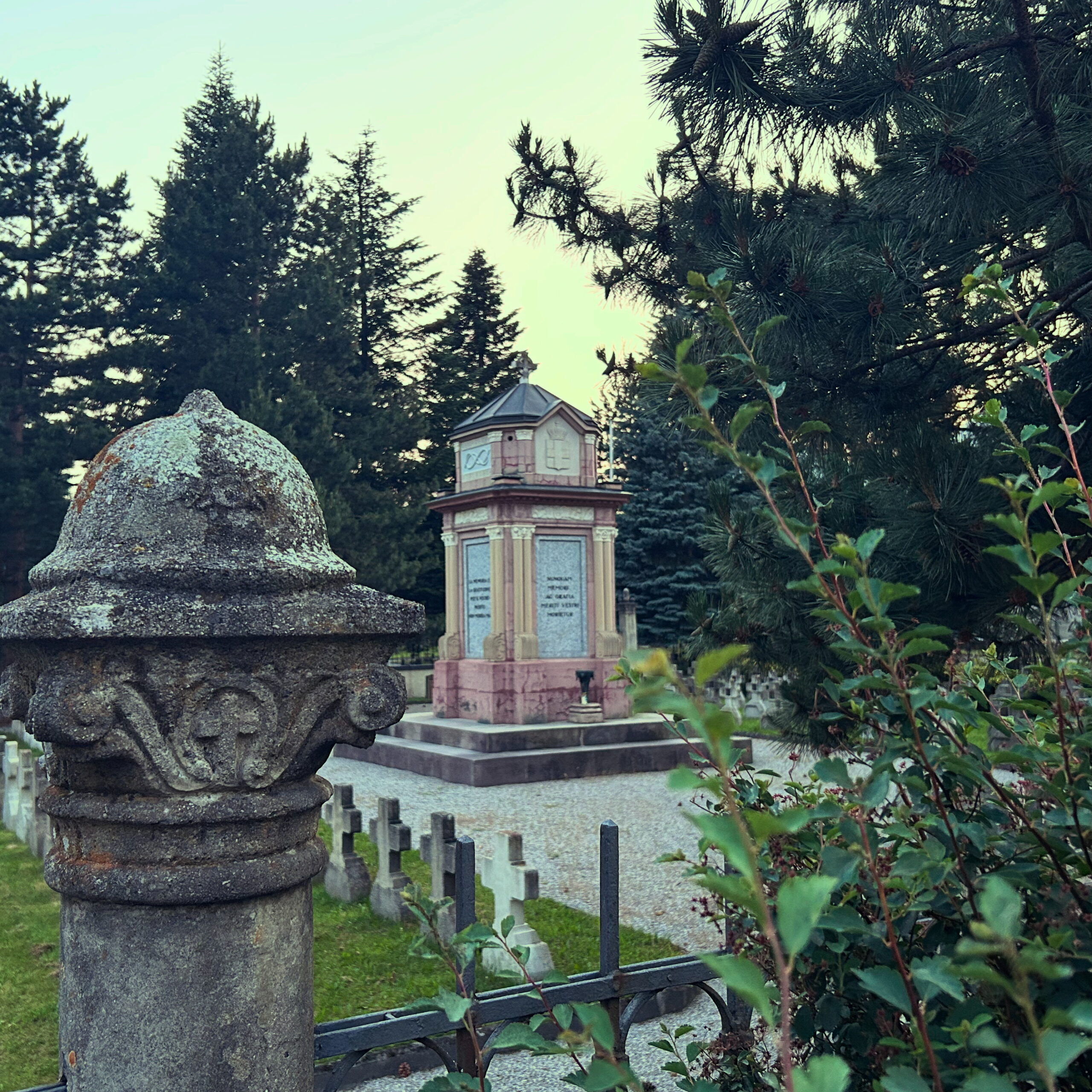
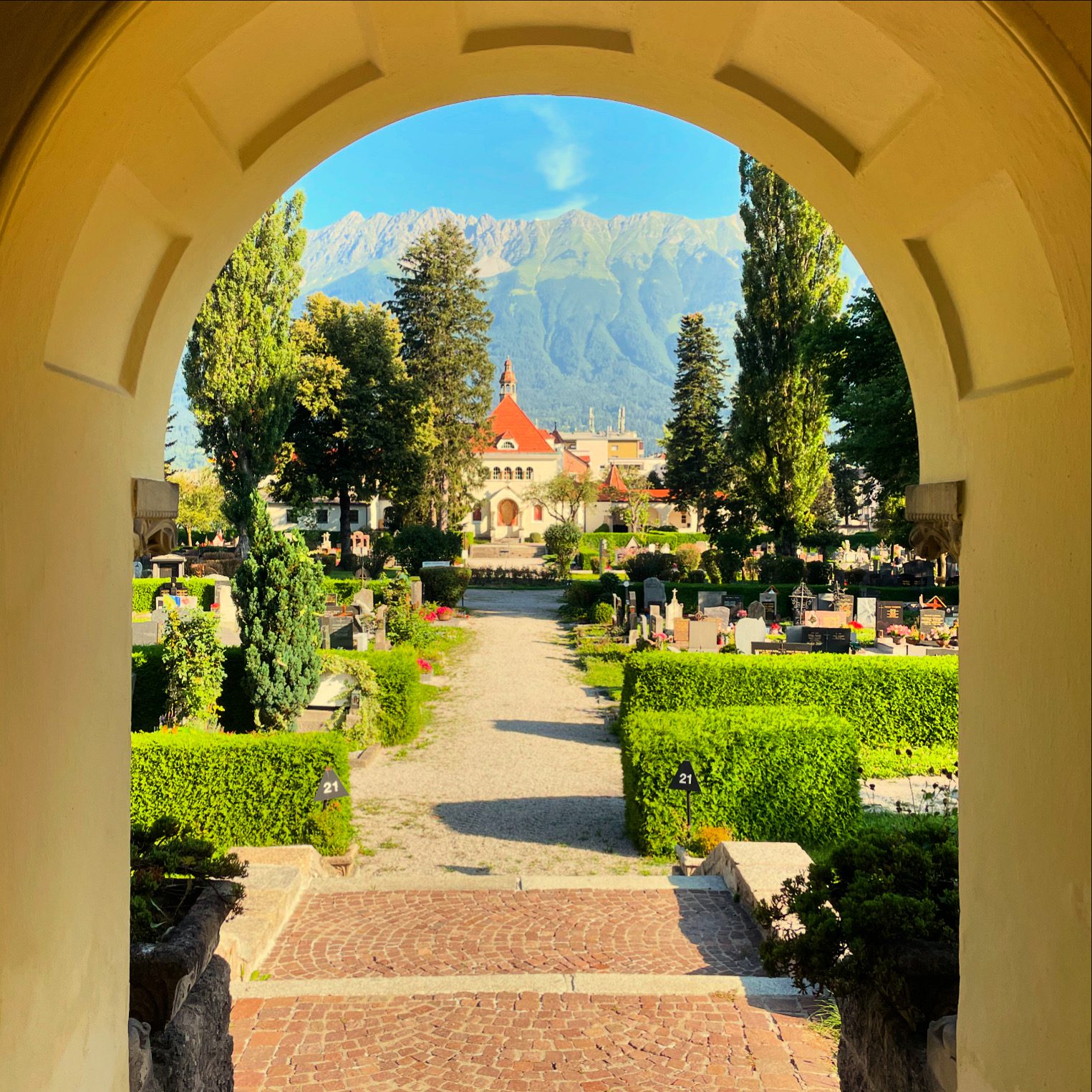
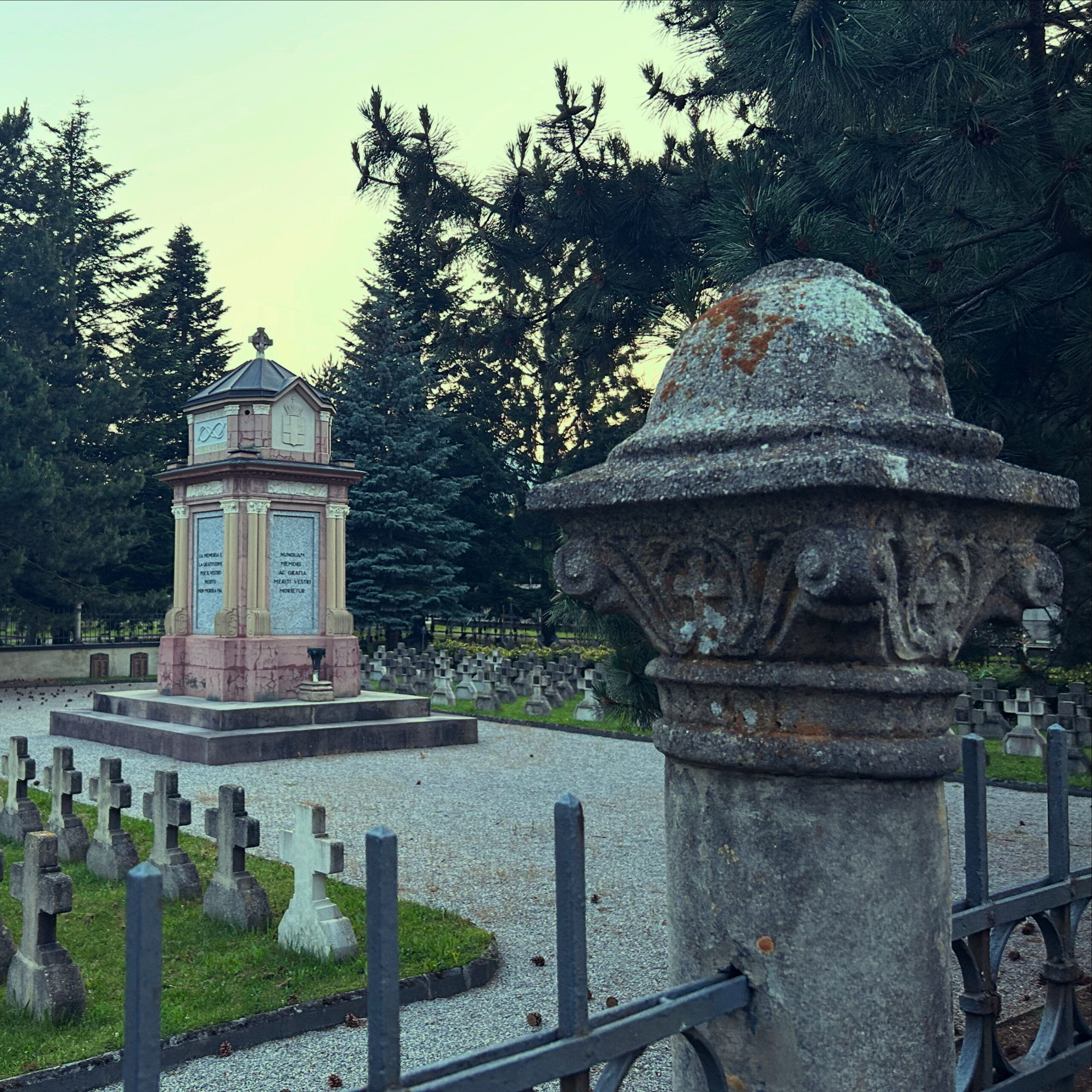
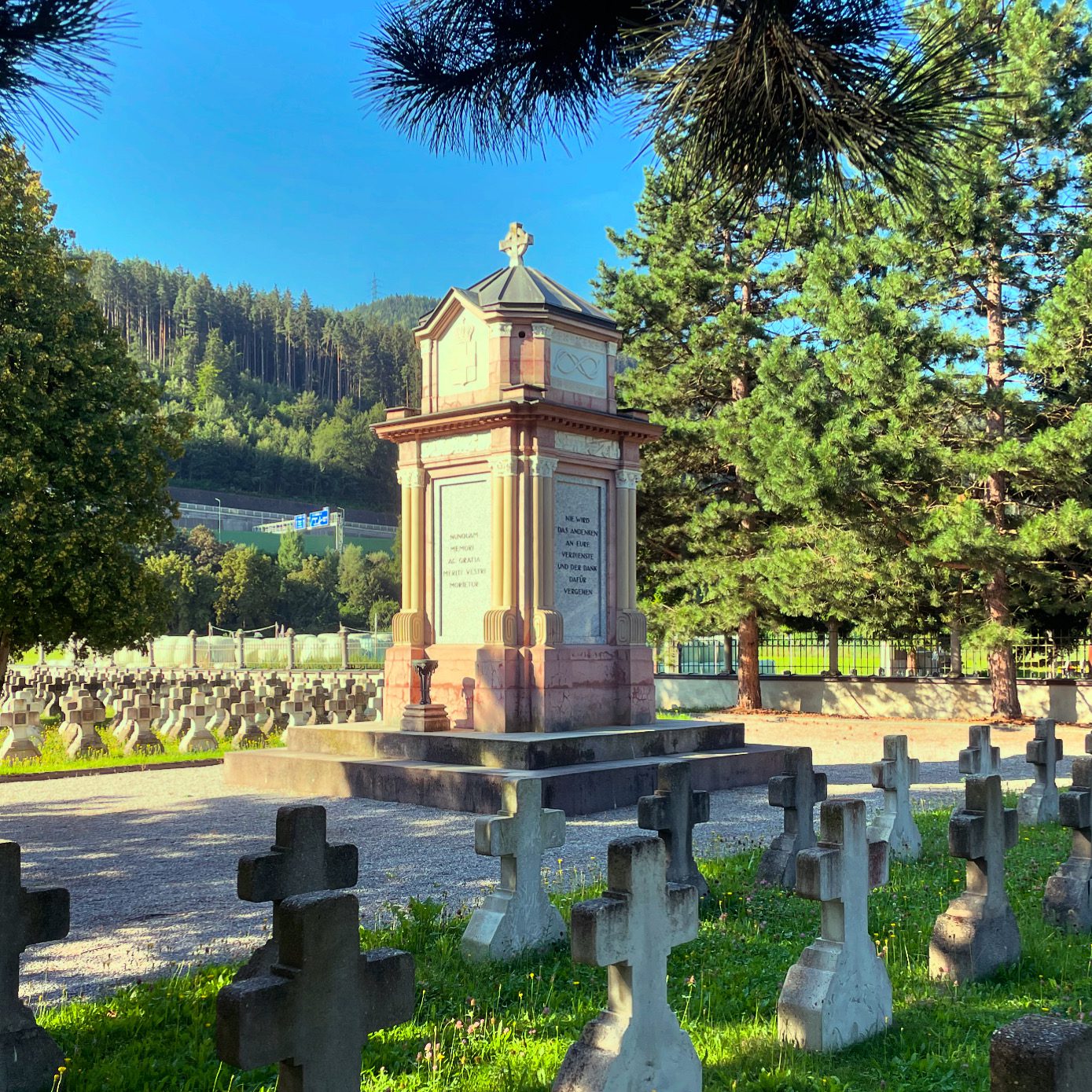
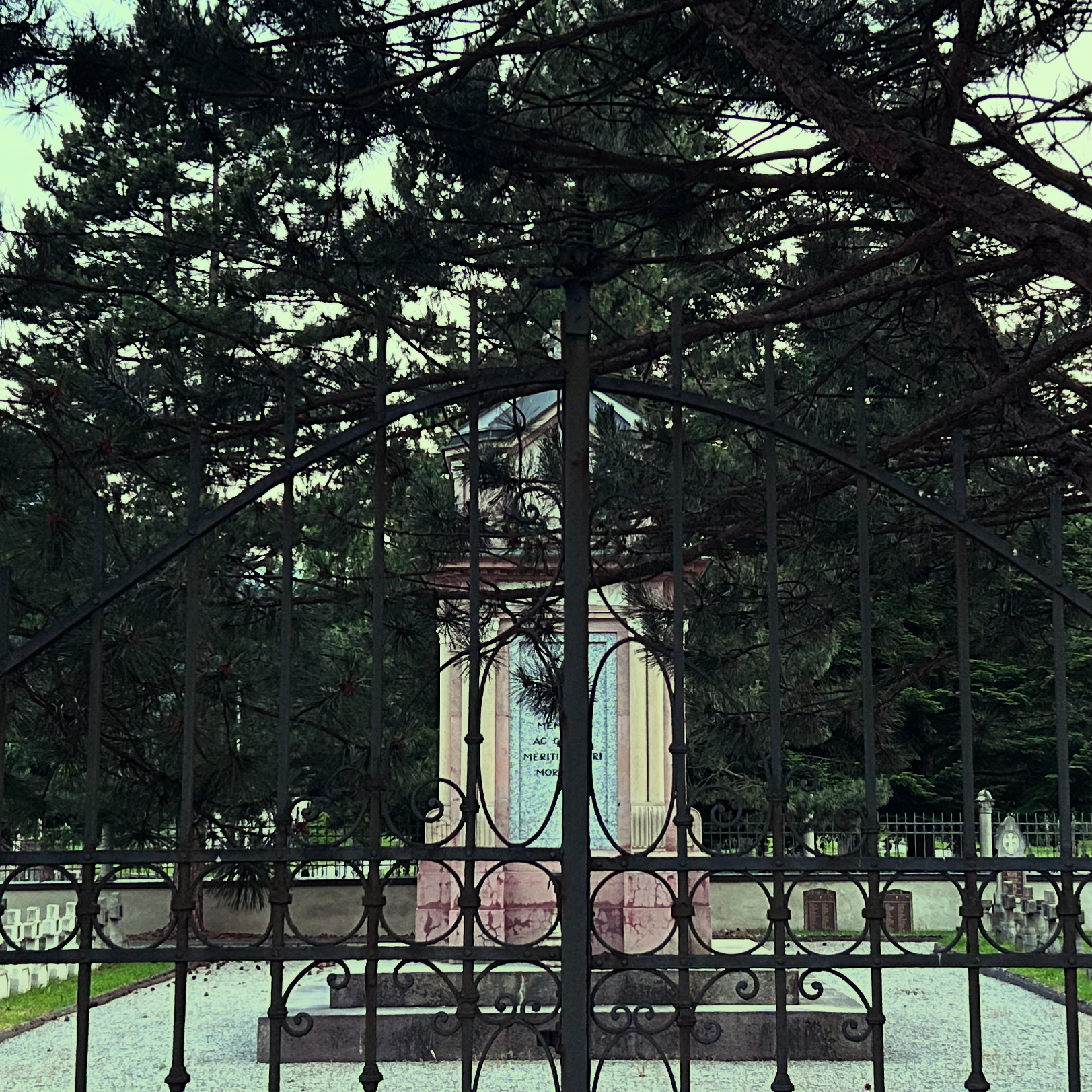
The Soldiers’ Cemetery in Amras is a little‑known memorial site that reflects important chapters of European history within the cityscape of Innsbruck. The cemetery was established in 1917 during the First World War. The number of casualties far exceeded the capacity of the Old Military Cemetery. The village of Amras, located outside Innsbruck, was ideal for burying the realities of war away from the public eye. Its location was also practical, as the Conrad Barracks with a military hospital had been situated just a few minutes’ walk south of the new burial grounds since 1911. A total of 5,680 soldiers and war victims from many nations are buried here, most of whom died in the Innsbruck military hospital. Particularly interesting are the different sections of the military cemetery. The eastern entrance is adorned with a wrought‑iron emblem of the k.u.k. (Austro‑Hungarian) monarchy featuring the coats of arms of Hungary and Austria, the two parts of the Dual Monarchy—even though the motto Indivisibiliter et Inseparabiliter (“indivisible and inseparable”) has not been accurate since the end of the war. Beyond the entrance, the Italian section of the cemetery welcomes visitors with a large stone monument created by Italian sculptor Natale Tommasi. In Italian, German, and Latin, it commemorates the 618 Italians, 178 Austrians, and 2 French soldiers who fell between 1914 and 1918, as well as the 20 Italian victims of the Second World War who are buried here. The crown and Savoy knot on the monument symbolize the rule of the Italian royal house. For centuries, it had been the Habsburgs who left their mark on large parts of Italy; now the tables had turned. Tommasi’s biography is one of many that were disrupted by the political turmoil of the First World War and the collapse of the multinational Austro‑Hungarian Monarchy—just as many works of post‑war literature and visual art testify. In the 19th century, he worked as a restorer and architect in various parts of the Habsburg Empire such as Trieste and Pula. In Innsbruck, he designed the façade of the Ferdinandeum. In 1898 he moved his residence to Innsbruck, where he also planned the main post office in Maximilianstraße. He was honored for his work both by the Pope and with the Austrian Franz Joseph Order. As a Trentino native, he had been a subject of the Habsburg Monarchy during the war; after the division of the region at the Brenner Pass, he became Italian—and thus overnight a foreigner in his adopted city of Innsbruck.
Adjacent to the Italian section lies the Tyrolean part of the cemetery. In addition to soldiers of the First World War, honorary graves from the Napoleonic Wars of 1796–97 and 1799 can also be found here. Most of the wrought‑iron crosses were mass‑produced at the time, but today they appear like small works of art. It is fascinating to see how many nations’ men fought in the defensive war against Napoleon on behalf of the Austrian Monarchy. Unknown soldiers also found their final resting place here. Many graves have traveled a long way: when the local soldiers’ cemetery in Stams, 40 km west of Innsbruck, had to make way for the new motorway in 1983, the burial sites were relocated to Innsbruck. The following year, 175 years after the Tyrolean Uprising of 1809, the altar commemorating war victims was inaugurated.
In the rear part of the cemetery stands the male Pietà, the “Memorial of the Nameless Buried,” created by sculptor Eduard Föderl (1909–1974), a controversial artwork. During the period of Austrofascism, this stone composition was designed to commemorate the fallen of the First World War. It symbolizes heroic suffering and self‑sacrifice in war by placing the soldier’s heroic death for the fatherland on the same level as the crucifixion of Jesus. It was intended as a gift from the city of Vienna to Budapest. Both Austria and Hungary were then oriented toward Mussolini’s Fascist Italy, where many similarly designed war memorials still stand in public spaces today. The handover to the Hungarian government failed in 1938 due to the National Socialist takeover. In 1953, the monument was brought to Innsbruck after no appropriate location could be found—or wanted—in Soviet‑occupied Vienna. Around the year 2000, the Pietà was moved to the municipal works yard and restored. In 2023, the statue—controversial due to its symbolism glorifying death for the fatherland—was reinstalled at the Soldiers’ Cemetery.
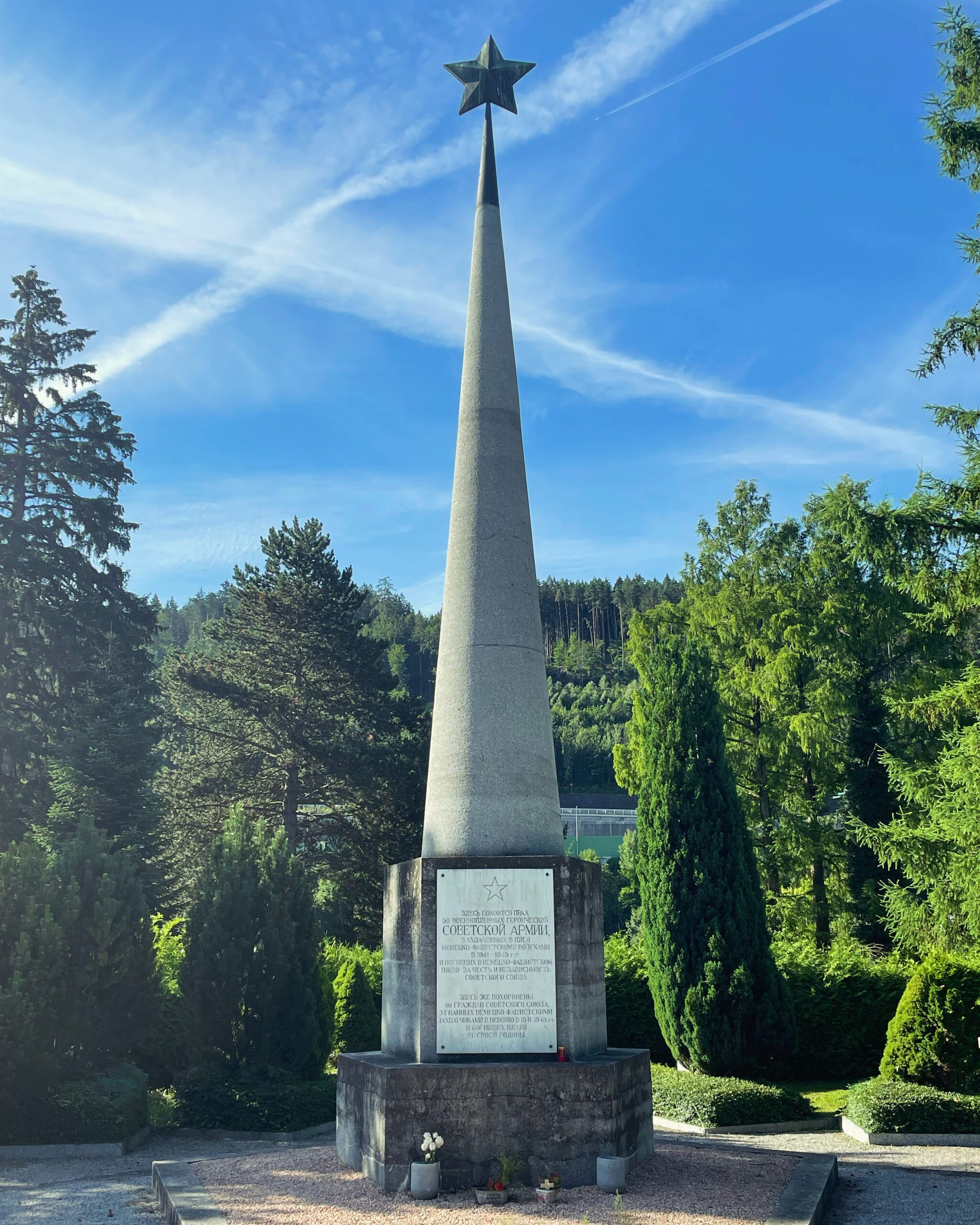
In the western part of the grounds lie the Muslim and Soviet military cemeteries. The graves of Bosnian‑Herzegovinian soldiers who fought for the Austro‑Hungarian Monarchy in the First World War are marked by small, east‑facing stone cones topped with a fez. The Russian part of the cemetery was established in 1949. It commemorates the Soviet prisoners of war who lost their lives in the KZ Reichenau labor camp. At its center stands an obelisk adorned with a star. The maintenance of Soviet war memorials was established after the Second World War as an obligation of the Republic of Austria—one of the conditions for Austrian independence demanded by the Soviet Union—and remains in effect today.
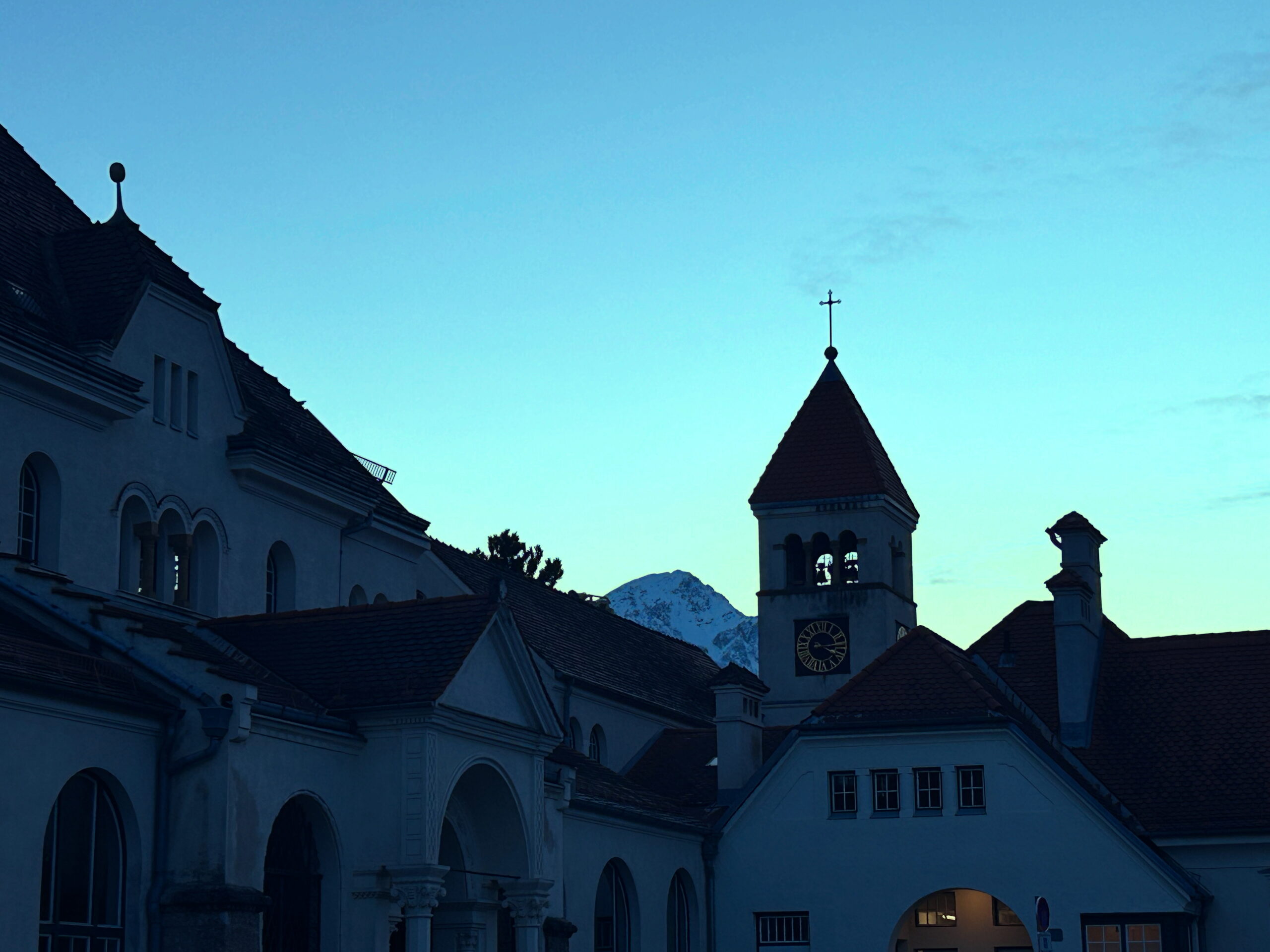
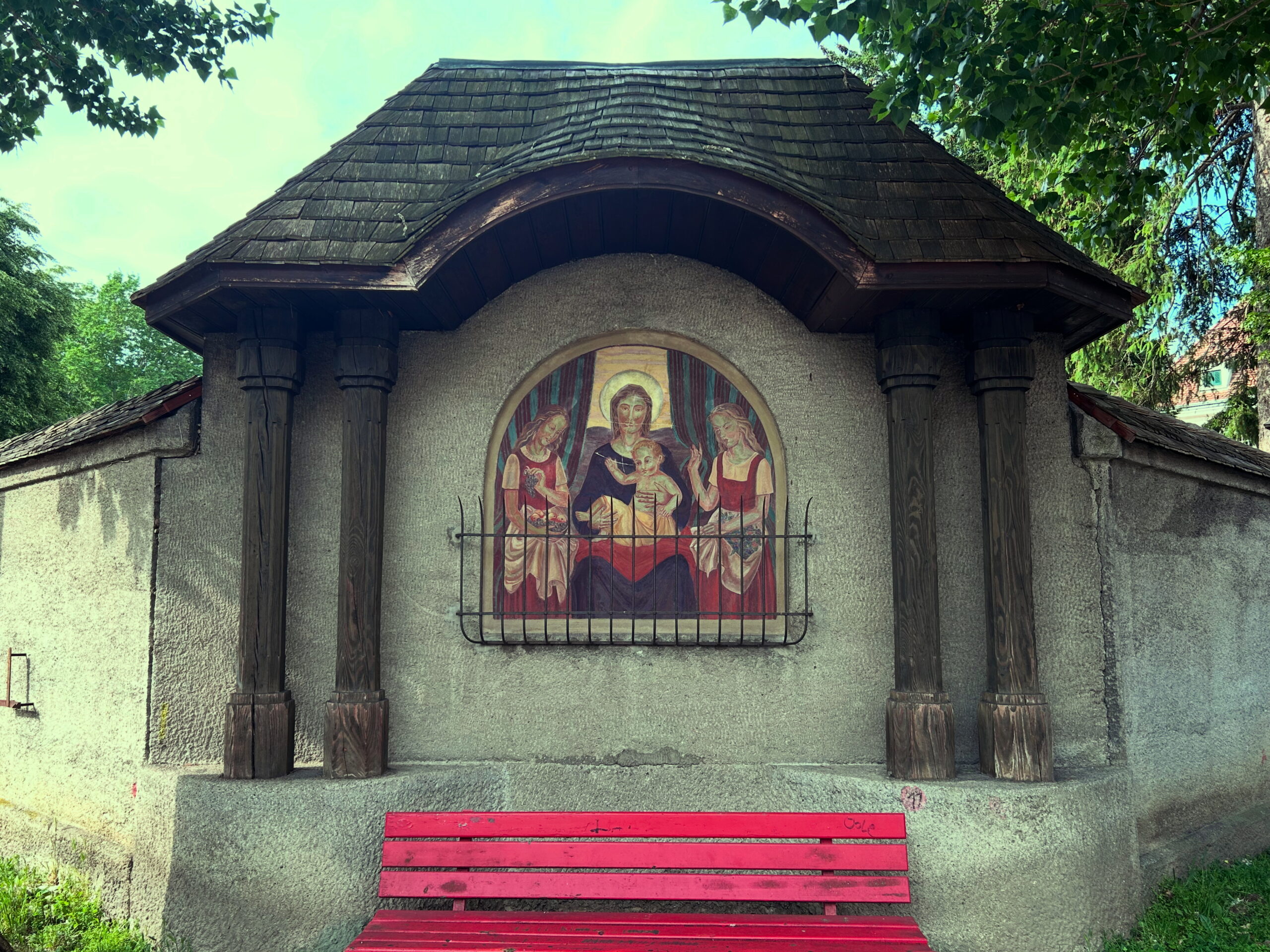
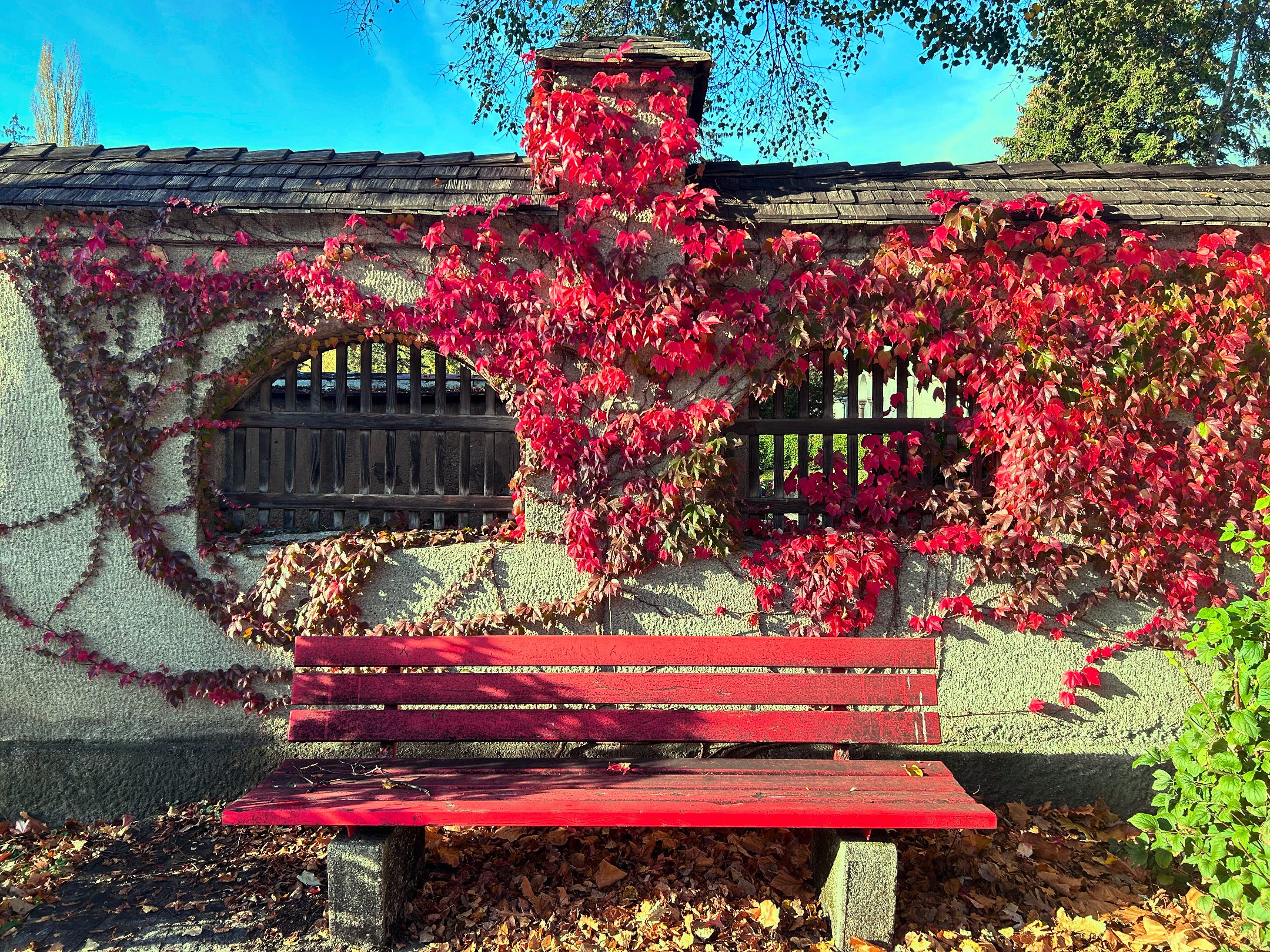
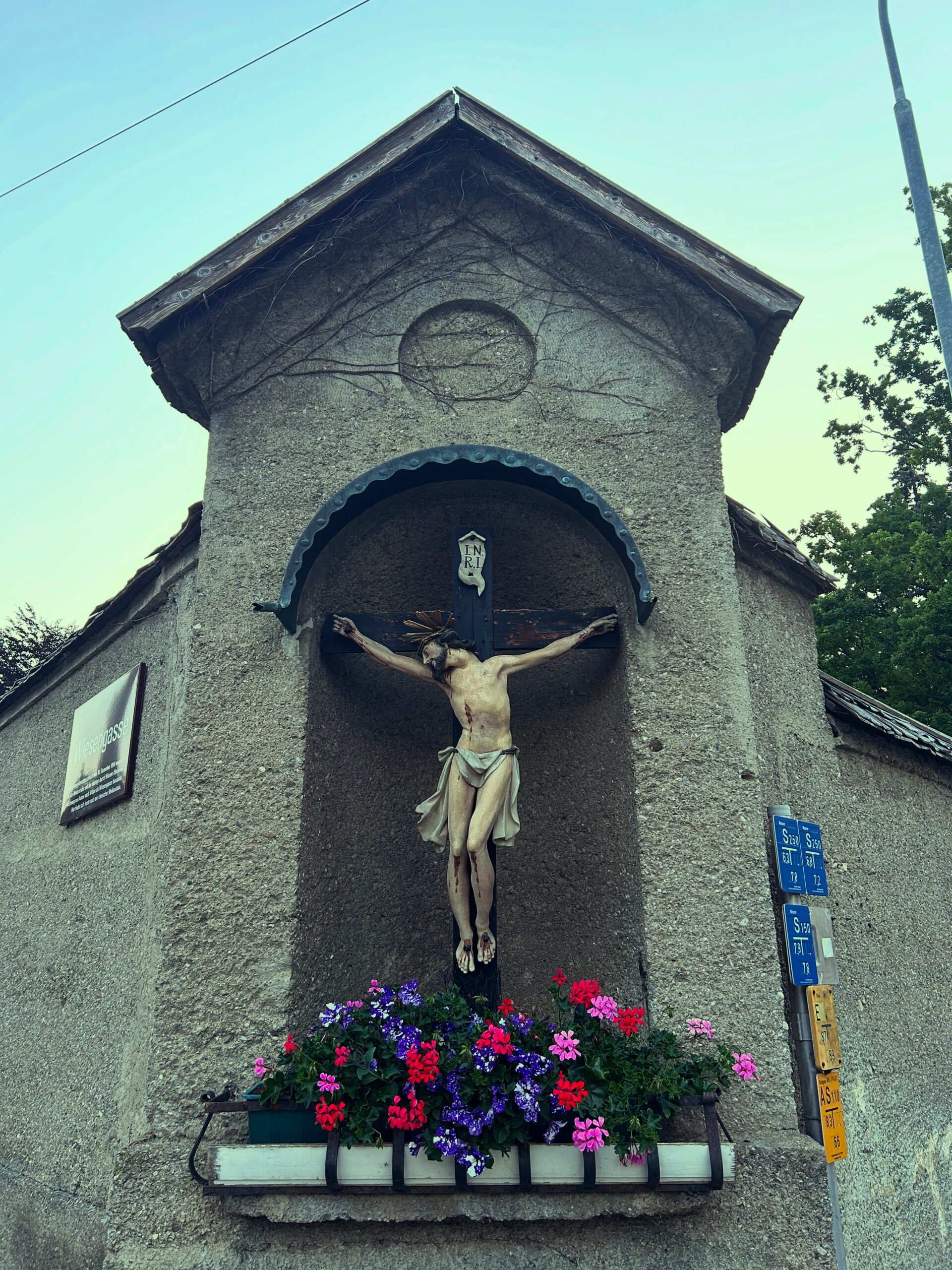
North of the Soldiers’ Cemetery lies the Pradl Cemetery, the city’s largest. The grounds were designed in 1912 by Eduard Klingler in the style of the late monarchy. The enclosing wall with its artworks was one of the last Neo‑Gothic projects before the end of Historicism, though it already shows influences of modernism. The entire cemetery is surrounded by a wall with small towers, and its eastern corners provide benches for rest. At the southeastern corner, a crucifix watches over the faithful. The northeastern bench is overlooked by a modern icon of the Mother of God with her son, flanked by two girls holding grapes. This Madonna of the Grapes is the patron saint of wine carriers and vintners; the grapes symbolize the spilled blood of her son. In the Gospel of John, after his blood flowed from the cross into the chalice of the Last Supper, Jesus was described as the “true vine.” This depiction was especially popular in Gothic art of the late Middle Ages and early modern period. The consecration and mortuary hall rises like a castle among the surrounding apartment buildings. The building appears as if taken from a Charles Dickens novel set in Victorian England. The entrance area was designed entirely in the classical style of the period. Inside one finds a depiction of Jesus being taken down from the cross. The peaceful character of the mural differs greatly from the otherwise common Baroque representations in Innsbruck, which emphasize Christ’s suffering on the cross.
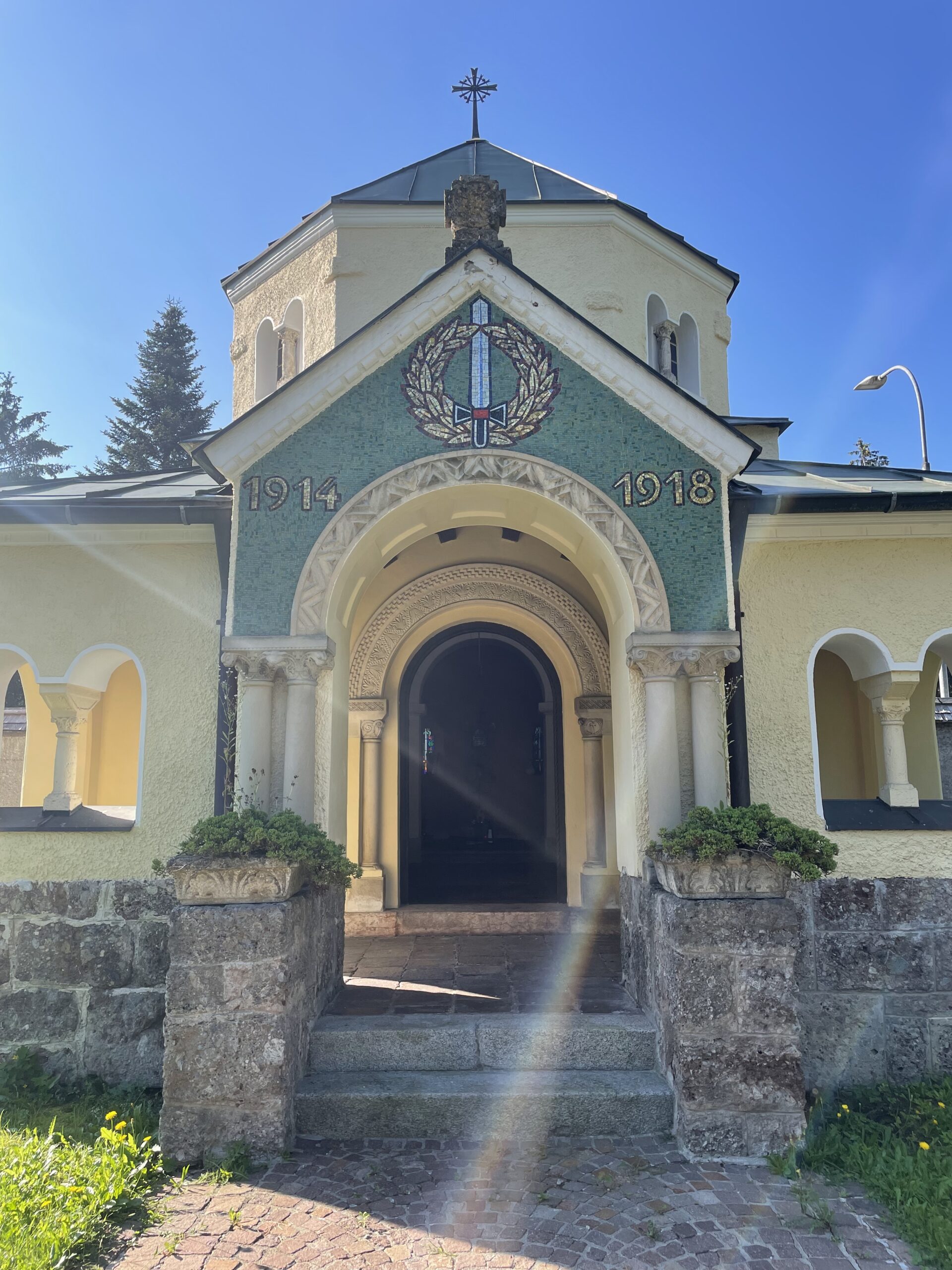
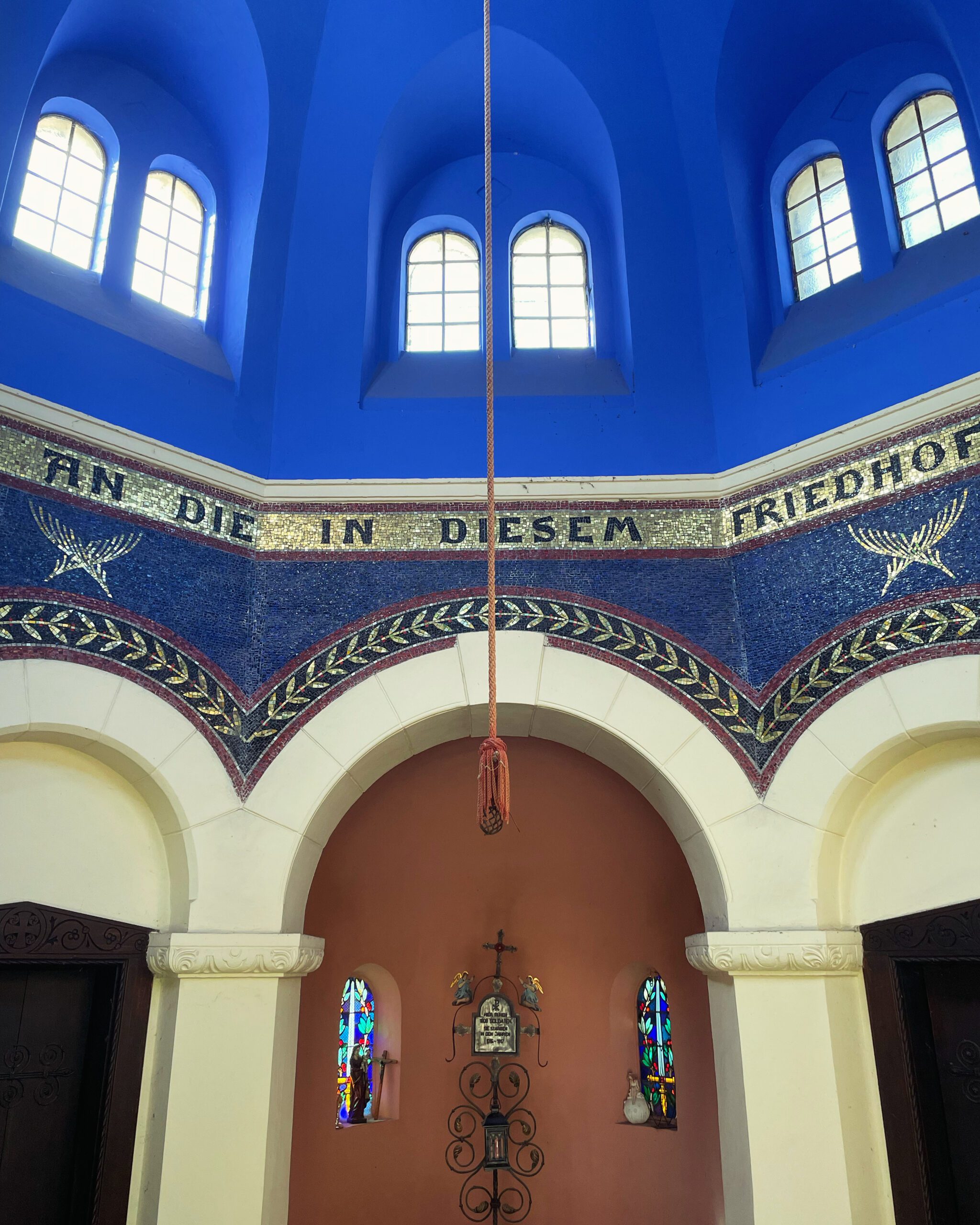
On the south side, integrated into the cemetery wall, the crypt chapel commemorates the fallen soldiers until 1917 who found their final resting place here. It was designed by Theodor Prachensky. The interior of the chapel is a small work of art. A dark blue mosaic with gold lettering bears the inscription: Dedicated to the memory of the victims of the world war buried in this cemetery. The walls contain name lists, arranged by their year of death. The names of Serbian, Romanian, and Montenegrin soldiers—those who were not part of the Austro‑Hungarian army—were listed separately on individual plaques. The plaque on the outer southern wall facing Wiesengasse is decorated with an oak‑leaf wreath, a symbol of pan‑German nationalism. Its inscription reads:
“Never forget that the freedom of your homeland is not a gift from heaven alone, but has again and again had to be defended with the heavy blood‑sacrifices of your fathers, grandfathers, and ancestors against the wicked grasp of foreign powers.”
South of the Soldiers’ Cemetery, at the far edge of the grounds, lies the Innsbruck crematorium with its urn garden. When the Enlightenment swept across the European elites in the 18th and 19th centuries like a second Renaissance, more and more people questioned earth burial. Choosing cremation based on ancient models became fashionable. It was not only considered reasonable, space‑saving, and hygienic, but also carried a touch of modernity. Particularly in Innsbruck’s liberal circles—constantly embroiled in disputes with the conservative powers governing the rest of Tyrol—the desire grew for the possibility of taking one’s final journey as a heap of ashes. Social democrats also supported cremation, though before the First World War they had no influence in the municipal council or the state parliament. The Catholic Church, however, opposed this unchristian, pagan form of burial for a long time. Although an urn garden was established at the Wilten West Cemetery in 1927, a crematorium could not be implemented due to the protests of a large part of the population. In Innsbruck, it would take until the 21st century before it became possible to consign one’s mortal remains to the flames. It was not until 2013 that the crematorium—built as a modest and unobtrusive functional structure—was opened by a consortium of Innsbruck funeral companies.
Theodor Prachensky: Beamter zwischen Kaiser und Republik
Copilot said: Innsbruck is home to many famous sights, monuments, and spectacular buildings. The Golden Roof and the Bergisel Ski Jump attract tens of thousands of visitors every year. Less imposing, but arguably more important for the city's development during the turbulent first half of the 20th century, were other buildings. From the second half of the 1920s onward, major projects were implemented to alleviate the greatest hardship faced by many Innsbruck residents, who were living in barracks or crowded together with relatives in extremely confined conditions. Entire new districts were created, complete with kindergartens, schools, parks, and recreational facilities. One of the master builders who left a lasting mark on Innsbruck during this period was Theodor Prachensky (1888–1970). The story of his forty-year career in the service of the City of Innsbruck reads like a summary of Austrian history in the early twentieth century. Prachensky worked as both an architect and a civil servant under five different political systems. The Austro-Hungarian Empire was followed by the First Republic, which in turn gave way to the authoritarian Corporate State. In 1938 came the annexation by Nazi Germany, and in 1945, with the end of the war, the Second Republic was proclaimed. Like many artists, architects, and builders of his generation, Prachensky laid the foundations for his career at what is today the Higher Technical College (HTL). In 1908, he graduated from the construction engineering department of the Imperial-Royal State Trade School (k.k. Staatsgewerbeschule) in Innsbruck. Just one year later, he moved to Merano to gain his first experience with large-scale building projects at the renowned architectural firm Musch & Lun. In 1913, he returned to Innsbruck. In the same year, he married Maria, the sister of his friend Franz Baumann, moved into the Prachensky House, which he had designed himself at Bergiselweg 20, and began his employment with the Innsbruck City Administration under Senior Building Councillor Jakob Albert. This decision to enter public service would prove fortunate during the economically difficult years after the war, even though it required him to curb some of his creative ambitions. First, however, he was called to the front. Although Prachensky opposed the war, he volunteered for military service in 1915 as a one-year volunteer with the Tyrolean Imperial Rifles (Tiroler Kaiserjäger). Whether he was motivated by expectations associated with his position as a civil servant or by the widespread patriotic enthusiasm of the time can no longer be determined.
Nach dem Krieg kehrte er ins wirtschaftlich schwer angeschlagene Innsbruck zurück. Seine wegweisenden, wohl auch vom sozialdemokratischen Gedankengut seines Vaters Josef beeinflussten Projekte konnten erst nach den ersten und schwierigsten Nachkriegsjahren begonnen werden. Den Anfang machte der Schlachthausblock im Saggen zwischen 1922 und 1925. Es folgten der Mandelsbergerblock, der Pembaurblock sowie Kindergarten und Hauptschule in der Pembaurstraße, die ebenfalls für die wachsende Arbeiterschaft gedacht waren. Auch das 1931 entworfene Arbeitsamt war eine wichtige Neuerung im Sozialwesen. Seit der Republikgründung 1918 half das Arbeitsamt bei der Vermittlung von Arbeitssuchenden und Arbeitgebern und der Eindämmung der Arbeitslosigkeit.
The next major turning point after the First World War and the economic crisis was the succession of changes in Austria’s political system. Despite Dollfuss’s seizure of power and the banning of the Social Democratic Party in 1933, followed by Austria’s annexation to the German Reich in 1938, Prachensky was able to remain a senior civil servant and continued to influence the appearance of Innsbruck. Together with Jakob Albert, he implemented the residential developments that became known as the South Tyrolean Settlements (Südtiroler Siedlungen) under the National Socialist regime from 1939 onward. Unlike several members of his family, he himself never became a member of the Nazi Party. The Social Democratic influence of his father remained too strong, and this influence is reflected in his architecture. After the Second World War, he remained in office as Senior Building Councillor of the City of Innsbruck for another eight years. In addition to his work as an urban planner and architect, Prachensky was a passionate painter. He died in Innsbruck at the age of eighty-two.
The projects realized by Prachensky are not as spectacular as the mountain stations designed by his brother-in-law Franz Baumann or Lois Welzenbacher’s high-rise building. His surviving structures often appear sober and purely functional, yet reveal their fascination upon closer inspection. Particularly remarkable is the symbolism that Prachensky repeatedly incorporated into his work. Looking at his drawings in the Archive of Architecture at the University of Innsbruck, one quickly recognizes that he was as much an artist as a technician. Many of his designs, such as the Social Democratic People’s House (Sozialdemokratisches Volkshaus) on Salurnerstraße, his Kaiserschützen Memorial, and the Peace and Heroes Church (Friedens- und Heldenkirche), were never built. Innsbruck nevertheless contains many of Prachensky’s buildings that document the history of the interwar period and the changing political and governmental influences under which he himself lived. These include the large residential complexes of the 1920s and 1930s, the War Memorial Chapel (Krieger-Gedächtniskapelle) at Pradl Cemetery, and the old employment office (note: today an annex of the University of Innsbruck, located behind the current AMS employment service building in Wilten). The War Memorial Chapel at Pradl Cemetery, the Kaiserschützen Chapel at Tummelplatz, designed together with Clemens Holzmeister, as well as his unrealized proposals for a Kaiserjäger memorial and the Peace and Heroes Church of Innsbruck, reflect both his own experiences of war and the longing for peace shared by many of his contemporaries. His sons, grandsons, and great-grandchildren carried forward his creative legacy as architects, designers, photographers, and painters in a variety of disciplines. In 2017, parts of the multi-generational body of work created by the Prachensky family of artists were honored in an exhibition at the former Adambräu Brewery.
Klingler, Huter, Retter & Co: master builders of expansion
The final decades of the 19th century became known in Austrian history as the Gründerzeit (Founders’ Era). After the economic crisis of 1873, the financial situation recovered and an unprecedented construction boom began. Innsbruck also established a modern banking system. Financial institutions such as the Savings Bank founded in 1821 and the Creditanstalt, whose building erected in 1910 still towers over Maria-Theresien-Straße like a small palace, made it possible to obtain loans, without which entrepreneurship and commerce as we know them today would not have been possible. In some cases, these financial institutions even acted as developers themselves. Between 1880 and 1900, Innsbruck’s population grew from 20,000 to 26,000 inhabitants, while Wilten, incorporated into the city in 1904, even tripled its population from 4,000 to 12,000. The number of buildings increased from 600 to more than 900. Most of them, unlike previous buildings, were multi-story apartment houses. Infrastructure was also modernized. Gas, running water, and electricity became part of everyday life for an increasing number of people. These buildings represented the new society. Entrepreneurs, professionals, employees, and workers had different needs than the legally dependent subjects of previous centuries. The urban lifestyle demanded apartments with several rooms and open spaces for recreation after working hours. Apartment buildings made a modern lifestyle possible even for people who did not own property. Unlike the rural regions of Tyrol, where farming families lived together with servants in farmhouses as part of an extended kinship community, life in the city was already quite close to our present-day understanding of family life. Although the upper middle class had not yet surpassed the nobility, it had reduced the gap considerably and, through its new position on the municipal council, was able not only to commission private building projects but also to decide on public construction projects. The old city hospital in the center of town was replaced by a modern hospital in the west; Sieberer’s orphanage and retirement home were established in Saggen, and a new urban center emerged around the railway station.
The forty years preceding the First World War were a gold rush era for the construction industry. The architecture of the buildings reflected the worldview of their owners. Master builders often assumed several roles and frequently replaced architects altogether. Most clients had very clear ideas about what they wanted. They were not seeking breathtaking new creations but rather copies of or adaptations based on existing buildings. In keeping with the spirit of the age, Innsbruck’s master builders designed structures according to the wishes of their financially powerful clients in the styles of Historicism, Classicism, and the Tyrolean Heimatstil. The style chosen for a home was often not merely an aesthetic decision but also an ideological statement by the owner. Liberals generally preferred Classicism, while conservatives were drawn to the Tyrolean Heimatstil. Whereas the Heimatstil presented itself in a Neo-Baroque form with abundant paintings, clear forms, statues, and columns were characteristic elements of Classical-inspired architecture. In what was sometimes a rather wild mixture of styles, people realized their ideas of classical Greece and ancient Rome. Not only railway stations and public buildings but also large apartment buildings, entire streets, churches, and even cemeteries were built along former country roads in this design. Academics—and those wishing to appear as such—demonstrated their fascination with antiquity through neoclassical façades. Catholic traditionalists commissioned murals depicting saints and scenes from Tyrolean history on their Heimatstil houses. While Neoclassicism predominates in Saggen and Wilten, the district of Pradl is largely characterized by conservative Heimatstil architecture. For a long time, many architectural experts looked down upon the tastes of social climbers and the newly rich. Heinrich Hammer wrote in his standard work Art History of the City of Innsbruck:
"Of course, this first rapid expansion of the city took place in an era that was unfruitful in terms of architectural art, in which architecture, instead of developing an independent, contemporary style, repeated the architectural styles of the past one after the other."
The era of grand villas, which imitated the aristocratic residences of former times with a bourgeois touch, came to an end after several exuberant decades simply because space became scarce. Further development of the city with detached houses was no longer possible. Even today, the area around Falkstraße, Gänsbachstraße, and Bienerstraße is known as Villensaggen, while the areas further east are referred to as Blocksaggen. Wilten and Pradl, however, never experienced this kind of development. Nevertheless, in their gold-rush enthusiasm, developers sealed ever more land with construction. In 1907, Albert Gruber delivered a warning speech about this growth, cautioning against unchecked urban expansion and land speculation.
"It is the most difficult and responsible task facing our city fathers. Up until the 1980s (note: 1880), let's say in view of our circumstances, a certain slow pace was maintained in urban expansion. Since the last 10 years, however, it can be said that cityscapes have been expanding at a tremendous pace. Old houses are being torn down and new ones erected in their place. Of course, if this demolition and construction is carried out haphazardly, without any thought, only for the benefit of the individual, then disasters, so-called architectural crimes, usually occur. In order to prevent such haphazard building, which does not benefit the general public, every city must ensure that individuals cannot do as they please: the city must set a limit to unrestricted speculation in the area of urban expansion. This includes above all land speculation."
A handful of master builders, together with the Innsbruck Building Authority, guided this development. If Wilhelm Greil can be called the mayor of Innsbruck’s expansion, then the Vienna-born Eduard Klingler (1861–1916) certainly deserves the title of its architect. As a public official and master builder, Klingler left a profound mark on Innsbruck’s cityscape. He began working for the Province of Tyrol in 1883. In 1889 he joined the municipal building authority, which he headed from 1902 onward. Among the projects attributed to Klingler as head of the building authority are the Commercial Academy, the Leitgeb School, Pradl Cemetery, the Dermatological Clinic within the hospital complex, the Municipal Kindergarten on Michael-Gaismair-Straße, the Train Barracks (today a residential building), the Market Hall, and the Tyrolean State Conservatory. One particularly noteworthy Heimatstil building designed by him is the Ulrich House on Bergisel, which today serves as the headquarters of the Old Kaiserjäger Club.
The most important construction company in Innsbruck was Johann Huter & Sons. Johann Huter took over his father’s brickworks. In 1856 he acquired the company’s first property, the Huter Grounds, on Innrain. Three years later the first business headquarters was established on Meranerstraße. The company’s official founding came in 1860 when it was registered together with his sons Josef and Peter. Like many of its competitors, Huter & Sons saw itself as a full-service provider. The company included its own brickworks, cement factory, carpentry shop, metal workshop, design office, and construction firm. By the outbreak of the First World War, it employed more than 700 people. In 1906/07, the Huter family built their residential and business headquarters at Kaiser-Josef-Straße 15 in the typical style of the late pre-war years. This stately house combines the Tyrolean Heimatstil, surrounded by gardens and nature, with Neo-Gothic and Neo-Romanesque elements. Well-known buildings erected by Huter & Sons in Innsbruck include the Monastery of Perpetual Adoration, St. Nicholas Parish Church, the first building of the new hospital complex, and several buildings on Claudiaplatz.
The second major player was Josef Retter (1872–1954). Born in Lower Austria with Tyrolean roots, he completed an apprenticeship as a mason before attending the Imperial-Royal State Trade School in Vienna and the master craftsman school of its construction department. After gaining professional experience throughout the Habsburg Monarchy—in Vienna, Croatia, and Bolzano—he was able, thanks to his wife’s dowry, to establish his own construction company in Innsbruck at the age of 29. Like Huter’s company, his enterprise also included a sawmill, a sand and gravel works, and a stonemasonry workshop. In 1904 he built his residential and office building. The dark Neo-Gothic Retter House at Schöpfstraße 23a, with its distinctive bay window supported by columns and a turret, is decorated with a remarkable mosaic representing an allegory of architecture. The relief on the gable depicts the union of art and craftsmanship, symbolizing Retter’s career path. Retter’s buildings particularly shaped Wilten and Saggen. Through projects such as the new Academic Gymnasium, the castle-like Commercial Academy building, the Protestant Christ Church in Saggen, the Zelger House on Anichstraße, Sonnenburg in Wilten, and the Neo-Gothic Mentlberg Castle in Sieglanger, he created many of the most important buildings of this era in Innsbruck.
Late in life but with a similarly practice-orientated background that was typical of 19th century master builders, Anton Fritz started his construction company in 1888. He grew up remotely in Graun in the Vinschgau Valley. After working as a foreman, plasterer and bricklayer, he decided to attend the trade school in Innsbruck at the age of 36. Talent and luck brought him his breakthrough as a planner with the country-style villa at Karmelitergasse 12. In its heyday, his construction company employed 150 people. In 1912, shortly before the outbreak of the First World War and the resulting slump in the construction industry, he handed over his company to his son Adalbert. Anton Fritz's legacy includes his own home at Müllerstraße 4, the Mader house in Glasmalereistraße and houses on Claudiaplatz and Sonnenburgplatz.
With Carl Kohnle, Carl Albert, Karl Lubomirski, and Simon Tommasi, Innsbruck possessed several other master builders who left their mark on the cityscape through typical buildings of the late 19th century. Together, they shaped Innsbruck’s new streets in the prevailing architectural spirit of the final thirty years of the Habsburg Monarchy. Residential houses, railway stations, government buildings, and churches throughout the vast empire stretching from Ukraine to Tyrol looked remarkably similar. New movements such as Art Nouveau gained acceptance only slowly. In Innsbruck, it was the Munich architect Josef Bachmann who introduced a new accent to bourgeois design with the redesign of the façade of the Winkler House. With the outbreak of the First World War, construction activity largely ceased. After the war, the era of neoclassical Historicism and the Heimatstil was definitively over. Times had become harsher, and the requirements for housing had changed. In the period of severe housing shortages in the young Republic of German-Austria, affordable housing and modern sanitary facilities became more important than representative façades and grand rooms. The increasingly professional education of master builders and architects at the Imperial-Royal State Trade School also contributed to a new understanding of construction, replacing the often self-taught veterans of the gold-rush era of Classicism. A stroll through Saggen and parts of Wilten and Pradl still transports visitors back to the Gründerzeit. Claudiaplatz and Sonnenburgplatz are among the most impressive examples. The construction company Huter & Sons still exists today. The company is now located in Sieglanger on Josef-Franz-Huter-Straße, named after its founder. Although the residential building on Kaiser-Josef-Straße no longer bears the company’s name, it remains, in all its opulence, a remarkable relic of the period that permanently transformed Innsbruck’s appearance. In addition to his residence on Schöpfstraße, the district of Wilten contains a second building associated with the Retter family. Opposite the university on Innrain stands Villa Retter. Josef Retter’s eldest daughter, Maria Josefa, who herself had been educated according to the principles of the reform educator Maria Montessori, opened Innsbruck’s first Haus des Kindes (“House of the Child”) in 1932. Above the entrance, a portrait depicts the benefactor Josef Retter. The south façade is adorned with a mosaic in the characteristic style of the 1930s, referring to the building’s original purpose. A smiling blond girl embraces her mother, who is holding a book, and her father, who carries a hammer. The family crypt at Westfriedhof Cemetery is another notable legacy of the Retter family.
The Bocksiedlung and Austrofascism
Political violence, alongside hunger and a severe housing shortage, shaped Austria throughout the 1920s and 1930s. The two major mass parties of the young republic, the Social Democrats and the Christian Socials, regarded each other with hostility. Both parties established paramilitary organizations to enforce their political agendas on the streets if necessary. The Republikanischer Schutzbund on the Social Democratic side and various Christian Social or even monarchist-oriented Heimwehr groups, which for simplicity may be grouped under this collective term, watched one another like opposing sides in a civil war. Many politicians and functionaries on both sides had fought on the front during the war and had become deeply militarized as a result. The Tyrolean Heimwehr enjoyed superior infrastructure and political connections due to the support of the Catholic Church. On November 12, 1928, the tenth anniversary of the founding of the Republic, 18,000 Heimwehr members marched through the city in the first nationwide Heimwehr rally, demonstrating their strength on what was the most important holiday for Austrian Social Democrats. From 1930 onward, the Nazi Party (NSDAP) also became increasingly visible in public life. It found supporters particularly among students and disillusioned young workers. By 1932, the party already had 2,500 members in Innsbruck. Violent clashes between the hostile political factions occurred repeatedly. The most notorious of these became known as the Hötting Hall Battle (Höttinger Saalschlacht) of May 27, 1932. At that time, Hötting was still independent and not yet part of Innsbruck. The community was inhabited mainly by workers. In this “red” stronghold of Tyrol, National Socialists planned a rally at the Goldener Bär Inn, a traditional meeting place of Social Democrats. This provocation escalated into a fight that left more than thirty people injured and one National Socialist dead. The violence spread across the entire city; even in the hospital, the injured continued fighting each other. Only the intervention of the gendarmerie and the army succeeded in separating the opposing sides.
After these years that resembled a civil war, the Christian Social Party prevailed in 1933 under Chancellor Engelbert Dollfuß (1892–1934). His goal was the establishment of the so-called Austrian Corporate State (Österreichischer Ständestaat), today better known under the term Austrofascism. The entire state apparatus was to be unified under the Fatherland Front (Vaterländische Front), modeled on Mussolini’s fascism in Italy: anti-socialist, authoritarian, socially conservative, anti-democratic, antisemitic, and militarized. Quite a few people welcomed the replacement of parliament and the multi-party system by a strong leader who promised peace and order. In Innsbruck, unlike in many Austrian cities where this political upheaval was at times accompanied by bloodshed, no significant fighting occurred. On 15 March, the headquarters of the Tyrolean Social Democratic Workers' Party (Sozialdemokratische Arbeiterpartei Tirol) in the Hotel Sonne was cleared out. The leader of the Republican Protection League (Republikanischer Schutzbund), Gustav Kuprian, was arrested on charges of high treason, and the individual units of the Schutzbund were disarmed. The Tiroler Wochenzeitung was established as the party newspaper. Innsbruck’s municipal council was reduced from forty to twenty-eight members. Instead of being elected through free elections, council members were appointed by the provincial governor. The Social Democrats, who had previously held strong representation, were removed from the city government. Dollfuß was extraordinarily popular in Tyrol, as photographs of the crowded square in front of the Hofburg during one of his speeches in 1933 demonstrate. His policies came closer than any other contemporary system to the traditions of the Habsburg Monarchy. As early as 1931, several Tyrolean mayors had joined forces in an effort to lift the ban on the Habsburg family entering Austria. This policy was supported by the Catholic Church and was even incorporated into the Constitution of 1934: “In the name of God, the Almighty, from whom all law proceeds, the Austrian people receive this Constitution for their Christian, German federal state founded on a corporative basis.” The close relationship with the Church provided the government with access to infrastructure, media organizations, and affiliated institutions. The Fatherland Front, together with its paramilitary units, took harsh action against the despised Socialists. It did not hesitate to employ repression and violence against both individuals and institutions associated with the political opposition. Suspected and actual Socialists, Social Democrats, trade unionists, and Communists were repeatedly arrested. The press was politically controlled and censored, while newspaper articles glorified the idyllic nature of rural life. Large families received financial support. Schools were segregated by gender, and the curricula differed accordingly: domestic work for girls and pre-military training for boys. Cultural policy deliberately distinguished itself from that of the National Socialist and anti-clerical neighbor to the north. Theatre and music were intended to present Austria as the “better and more civilized” German state.
tion Austrofascism, however, brought peace and order only briefly, if at all. On 25 July 1934, a coup attempt by the banned National Socialists took place in Vienna, during which Chancellor Engelbert Dollfuß was killed. Hitler, who had not ordered the attacks, initially distanced himself publicly from the events, helping to suppress the planned overthrow before it could gain momentum. An attempted coup also occurred in Innsbruck. During an effort by a group of National Socialists to seize control of the city, a police officer was shot and killed in Herrengasse. In memory of the murdered Federal Chancellor, who was subsequently elevated to the status of a martyr, the square in front of the theatre, where he had met with Richard Steidl only two weeks earlier, was renamed Dollfuß Square (Dollfußplatz) by “order of the Government Commissioner of the Provincial Capital of Tyrol.” Dollfuß’s successor as head of state was Kurt Schuschnigg (1897–1977), a native Tyrolean. The war veteran, who came from the lower nobility of the former Austro-Hungarian Empire, was a member of the Innsbruck student fraternity Austria. In 1930, Schuschnigg, then a lawyer and member of parliament, founded the Ostmärkische Sturmschar, a Catholic and antisemitic paramilitary organization intended to serve as a counterweight to the more radical Heimwehr groups. As Minister of Education and Minister of Justice, Schuschnigg played a key role in the rightward shift of society under the Corporate State. Among other measures, he reintroduced the death penalty. For the people of Innsbruck, however, little changed under the new Chancellor in terms of everyday hardship. Economically, the Corporate State was unable to reverse the situation during the 1930s. Government investment in major infrastructure projects came to a halt following the economic crisis of 1931. By 1933, the unemployment rate had reached 25 percent. The reduction of social welfare measures that had been introduced at the beginning of the First Republic had dramatic consequences. Long-term unemployed individuals were excluded from receiving social benefits as so-called “Ausgesteuerte” (persons whose entitlement to benefits had expired). Poverty led to rising crime rates, and assaults, robberies, and thefts became commonplace. As in previous decades, housing remained a particularly serious problem. Despite the city's efforts to provide modern housing, many Innsbruck residents still lived in dilapidated dwellings. Private bathrooms or even a separate bedroom for each person were rare exceptions. Since Innsbruck’s rapid growth beginning in the 1880s, housing conditions had remained precarious for a large part of the population. The railway, industrialization, refugees from the German-speaking regions of Italy, and the economic crisis had pushed the city to the limits of its capacity. After Vienna, Innsbruck had the second-highest number of residents per house in Austria. Housing rents were so high that workers often slept in shifts in order to share the costs. Although new apartment blocks and homeless shelters had been built, especially in Pradl, including the Workers’ Residence (Wohnheim für Arbeiter) on Amthorstraße in 1907 and the Hostel (Herberge) on Hunoldstraße, these measures were insufficient to bring the situation under control.
In this climate of social dictatorship and economic hardship, several shantytowns and barrack settlements emerged on the outskirts of the city. They were founded by the excluded, the desperate, and those left behind who could find no place within the system. The former prisoner-of-war camp in Höttinger Au, west of the city, served as emergency accommodation for homeless people. The most famous and notorious inner-city enclave, remembered to this day, was the Bocksiedlung ("Bock Settlement") in the area of present-day Reichenau. Beginning around 1930, several families settled there between the airport then located on the site and the concentration camp that would later be built in Reichenau. According to local legend, Otto and Josefa Rauth were the founders of the settlement after their caravan became stranded there. In the Innsbruck of the Corporate State, having the wrong party affiliation was enough to make affordable housing unattainable. As an openly declared Communist, Rauth possessed what was arguably the most disadvantageous party membership of all. His raft, the Ark Noah (Arche Noah), with which he planned to travel via the Inn and Danube rivers to the Soviet Union, remained moored on the riverbank in front of the Sandwirt Inn (Gasthof Sandwirt) and never actually set sail. Gradually, a settlement developed that existed both physically on the edge of the city and socially on the margins of society. It was run like an independent commune by its unofficial mayor, Johann Bock (1900–1975). He managed everyday life within his sphere of influence in a rough but warm-hearted manner. The air raids of the Second World War further worsened Innsbruck's housing situation and caused the Bocksiedlung to grow. At its peak, it is said to have contained around fifty dwellings. Even the barracks of the Reichenau concentration camp were used as sleeping quarters after the last National Socialists held there had been transferred or released. The Bockala, as the inhabitants were known, had a terrible reputation among the respectable citizens of the rest of the city, and despite later attempts to romanticize or soften its history, that reputation was probably not entirely undeserved. Many, though not all, residents were unemployed or involved in criminal activities. Often, however, they were simply people who had fallen through the cracks of society and found refuge in the Bocksiedlung. As helpful and supportive as the often eccentric residents could be toward one another, physical violence and petty crime were part of everyday life. Excessive alcohol consumption was commonplace. There were no paved roads, no sewage system, no sanitary facilities, and no regular electricity supply. Even access to drinking water remained precarious for a long time, creating a constant risk of disease outbreaks. The dwellings themselves were as diverse as their inhabitants. They included caravans, circus wagons, wooden barracks, corrugated metal huts, brick houses, and concrete buildings. Within the Bocksiedlung, houses and wagons were rented out and sold. With the tacit tolerance of the City of Innsbruck, property rights acquired through long-term occupation even emerged under Johann Bock's leadership. The residents cultivated self-sufficiency gardens and kept livestock. In difficult times, even dogs and cats occasionally appeared on the menu. There were no fixed boundaries to the settlement; in Innsbruck, being a Bockala was as much a social status as it was a place of residence.
The beginning of the end for the Bocksiedlung (“Bock Settlement”) came with the 1964 Olympic Games and a fire that had occurred in the settlement the year before. An urban legend claims that the fire was deliberately set by the municipal authorities in order to accelerate the clearance of the neighborhood and make way for the construction of the Olympic Village (Olympisches Dorf). In 1967, Mayor Alois Lugger and Johann Bock negotiated the future of the settlement and compensation payments from the municipality for its evacuation. According to local accounts, these discussions took place in a rather alcohol-laden atmosphere. Nevertheless, it would take several more years before the settlement effectively came to an end. It was not until 1976 that the last remaining dwellings were forcibly vacated due to unsanitary conditions. Many of the Bockala were relocated to municipal apartments in Pradl, Reichenau, and the newly constructed Olympic Village (O-Dorf). The customs and lifestyle associated with the Bocksiedlung continued there under a new address for several years, contributing in large part to the negative reputation that these neighborhoods still carry today. Less firmly embedded in the collective memory of many Innsbruck residents than the legends of the Bocksiedlung is the interwar period. Yet this era often remains a much greater part of everyday culture than we realize. In churches such as St. Jakob in Defereggen in East Tyrol or the parish church of Fritzens, images depicting Dollfuß as the protector of the Catholic Church can still be seen, more or less without comment. Even today, there are “red” and “black” motorists’ clubs, sports associations, rescue organizations, and Alpine clubs whose roots can be traced back to this period. The history of the Bocksiedlung has been painstakingly reconstructed by the Innsbruck City Archive through numerous interviews and extensive archival research, and was published in a highly readable form in the book: Bocksiedlung. Ein Stück Innsbruck (Bocksiedlung: A Piece of Innsbruck) published by the Innsbruck City Archive. The book provides a valuable account of both the settlement itself and the social realities of Innsbruck in the twentieth century.
The First World War
An Innsbruck student nearly changed the course of world history instead of Gavrilo Princip. In 1913, the young man boasted to a waitress about his plans to shoot the heir to the throne, but he was arrested before he could carry them out. Only when the world-changing shots were actually fired in Sarajevo a year later did an article appear in the Innsbrucker Nachrichten on June 30 about the events. The consequences that the First World War, which subsequently broke out, would have for the world and for people's everyday lives could not yet be foreseen after the assassination of Franz Ferdinand on June 28. Two days after the murder of the Habsburg heir in Sarajevo, readers in Innsbruck were already reading prophetic words in their newspaper: “We have arrived at a turning point – perhaps the turning point – in the destiny of this empire.” In Innsbruck, too, enthusiasm for war was widespread in 1914. Driven by the slogan of the time, “God, Emperor, and Fatherland,” the vast majority of people unanimously welcomed the attack on Serbia. Politicians, the clergy, and the press fuelled the general jubilation. Particularly “deserving” in promoting the war were the two theologians Joseph Seeber (1856–1919) and Anton Müllner, known as Brother Willram (1870–1919), who, through their sermons and writings such as The Bloody Year, elevated the war into a crusade against France and Italy. In addition to the imperial proclamation To My Peoples, which appeared throughout the media of the Empire, the Innsbrucker Nachrichten published an article on July 29, the day after Austria-Hungary declared war on Serbia, about Prince Eugene's capture of Belgrade in 1717. The tone in the media was celebratory, although not entirely without dark forebodings of what was to come.
"The Emperor's appeal to his people will be deeply felt. The internal strife has been silenced and the speculations of our enemies about unrest and similar things have been miserably put to shame. Above all, the Germans stand by the Emperor and the Empire in their old and well-tried loyalty: this time, too, they are ready to stand up for dynasty and fatherland with their blood. We are facing difficult days; no one can even guess what fate will bring us, what it will bring to Europe, what it will bring to the world. We can only trust with our old Emperor in our strength and in God and cherish the confidence that, if we find unity and stick together, we must be granted victory, for we did not want war and our cause is that of justice!"
Many Innsbruck residents volunteered for the campaign against Serbia, which was believed to be a matter of only a few weeks or months. So many volunteers poured into Innsbruck from outside the city to report to the recruitment commissions that the city was almost bursting at the seams. No one could imagine how differently things would turn out. After the first battles in distant Galicia, it became clear that this would not be over within a few months. The Imperial Riflemen (Kaiserjäger) and other Tyrolean troops were effectively sacrificed. Poor equipment, inadequate supplies, and the catastrophic leadership of the High Command under Conrad von Hötzendorf led thousands either to their deaths or into captivity, where hunger, abuse, and forced labour awaited them. In 1915, Italy entered the war on the side of France and Britain. Under the infamous secret Treaty of London, the young kingdom had been promised generous territorial gains in return for supporting the Entente against Germany and Austria. On May 23, the former ally declared war on the Habsburg Empire. Until regular troops could be transferred from the Eastern Front, regional defence depended on the Standschützen, a force consisting of men under 21, over 42, or those deemed unfit for regular military service. Correspondingly, casualties were high. Fighting in the mountain war stretched from the Ortler in the west across the northern shore of Lake Garda to the Sexten Dolomites. Innsbruck itself was not directly affected by military operations. At the very least, however, the sounds of war could be heard in the provincial capital, as reported in the newspaper of July 7, 1915:
“Soon after the Italians commenced hostilities, cannon fire could clearly be heard in the region of the Serles peak, coming from one of the battlefields in southern Tyrol, probably the Vielgereut plateau. In recent days, the sound of artillery fire has also undoubtedly been detected in Innsbruck itself and in the northeastern parts of the city — individual powerful blasts, dull rather than rolling and resonant, echoing across the Brenner Pass. There can be no mistake. In Innsbruck itself, the thunder of the guns is more difficult to detect because of the noise of the city, but on one occasion, around 9 p.m., when there was some degree of quiet, this unmistakable thunder, originating from our mortars, was clearly heard.”
Although the front was far away, the war increasingly penetrated civilian life. This total involvement of society in warfare was a new phenomenon. The mass mobilization of a large proportion of the working male population brought many businesses to a complete standstill. Shop shelves remained empty, public transport services ceased, and craftsmen and labourers were called up for military service. Companies still able to operate were subordinated to the wartime economy. By the “Hunger Winter” of 1917, Innsbruck’s economy had almost completely collapsed. Food, coal, and firewood were in short supply, and hunger and cold became bitter enemies of women, children, the wounded, and those unfit for military service. During the final years of the war, provisions were distributed through ration cards. The basic weekly allowance per person amounted to 500 grams of meat, 60 grams of butter, and 2 kilograms of potatoes. Archive photographs show long queues of desperate and hungry people outside food shops. Protests and strikes repeatedly broke out. Politicians, trade unionists, workers, and returning soldiers saw an opportunity for change. Under the slogan “Peace, Bread, and Suffrage,” parties of many different political backgrounds united in opposition to the war. The cityscape also changed. Barracks were erected in Höttinger Au to house prisoners of war. Wounded soldiers arrived in such large numbers that civilian buildings, including the university library then under construction and Ambras Castle, were converted into military hospitals. A predecessor of today’s Tram Line 3 was established to transport the wounded from the railway station to the new garrison hospital, today’s Conrad Barracks in Pradl. To cope with the large number of fallen soldiers, the Pradl Military Cemetery was created.
As the war neared its end, the front also drew closer. In February 1918, the Italian air force succeeded in dropping three bombs on Innsbruck. The Neue Freie Presse reported for the first time on the secret Treaty of London, heightening Tyrolean anxiety over the threatened loss of territory south of the Brenner Pass. By then, most people already knew the war was lost and sensed the fate that awaited Tyrol, as this article of October 6, 1918, demonstrates:
“External and internal enemies are gambling today with the land of Andreas Hofer. The latest throw of the dice is even more cruel; never before has a free land been bartered away so disgracefully. The blood of our fathers, sons, and brothers has been shed in vain if this shameful plan becomes reality. The final throw has not yet been made. Therefore, Tyroleans, attend the Tyrolean People’s Assembly in Brixen on October 13, 1918 (next Sunday). German soil must remain German; Tyrolean soil must remain Tyrolean. Tyroleans, decide your own future!”
On November 4, Austria-Hungary and the Kingdom of Italy finally agreed to an armistice. Part of the agreement granted Italy the right to occupy territory of the monarchy. Alarm bells immediately rang among Austria-Hungary’s allies in the German Empire. On the very next day, Bavarian troops entered Innsbruck. Germany was still at war with Italy and feared that the front might shift into North Tyrol, bringing it closer to German territory. Fortunately for Innsbruck and the surrounding region, Germany also capitulated one week later on November 11. As a result, major military engagements between regular armies were avoided.
Nevertheless, Innsbruck remained in danger. Massive convoys of military vehicles, trains packed with soldiers, and thousands of exhausted troops making their way home on foot passed through the city. Anyone who could jumped onto overcrowded trains or military vehicles to leave the front behind and return home. In November 1918 alone, more than 270 soldiers lost their lives during these reckless attempts or had to be admitted to one of the city’s hospitals. The city not only had to maintain order among its own citizens and ensure food supplies but also protect itself against looting. To preserve public order, the Tyrolean National Council established a citizens’ militia on November 5 composed of pupils, students, workers, and ordinary citizens. On November 23, 1918, Italian troops occupied the city and its surroundings. More than 80,000 Italian soldiers were stationed in Tyrol, around 5,000 of whom required accommodation in the starving and destitute city. Schools were turned into barracks. Mayor Greil’s conciliatory appeal to surrender the city peacefully succeeded. There were isolated disturbances, food riots, and incidents of looting, but there were no armed clashes with the occupation troops and no Bolshevik revolution such as the one that occurred in Munich.
The consequences of the First World War for Innsbruck’s population were devastating. More than 1,200 people lost their lives on battlefields or in military hospitals, while approximately 600 were wounded. Memorials to the First World War and its victims can be found throughout Innsbruck, particularly at churches and cemeteries. The Kaiserjäger Museum on Bergisel displays uniforms, weapons, and photographs from the war. The theologians Anton Müllner and Josef Seeber have streets named after them in Innsbruck. A street was also named after Archduke Eugene, commander-in-chief of the Austro-Hungarian Army on the Southern Front. A monument to the unsuccessful military leader stands in front of the Hofgarten. The eastern section of the Amras Military Cemetery commemorates the Italian occupation.
Innsbruck and National Socialism
In den 1920er und 30er wuchs und gedieh die NSDAP auch in Tirol. Die erste Ortsgruppe Innsbrucks wurde bereits 1923 gegründet. Mit „Der Nationalsozialist - Combat Gazette for Tyrol and Vorarlberg“ erschien ein eigenes Wochenblatt. 1933 erlebte die NSDAP mit dem Rückenwind aus Deutschland auch in Innsbruck einen kometenhaften Aufstieg. Die Modernität der und die Aufstiegsmöglichkeiten, die sie bot, sprach junge, ambitionierte Menschen an. Das Neue, das Aufräumen mit alten Hierarchien und Strukturen wie der katholischen Kirche und der allgemeine Um- und Aufbruch in eine neue Zeit waren mächtige Anziehungsfaktoren. Arbeiter, Angestellte und Unternehmer gleichermaßen sehnten sich nach dem Wirtschaftsaufschwung auch für das schwächelnde Österreich, der in Deutschland die Arbeitslosenzahlen massiv reduziert hatte. Akademiker hingegen sahen sich in der großdeutschen Zukunft dem politischen Ziel ihrer Träume entgegengehen. Die demokratische Republik war konservativen Eliten ein Gräuel. Wer bereits oben war, sehnte sich nach den Zeiten vor dem allgemeinen Wahlrecht zurück, als Sozialdemokraten noch nichts zu melden hatten. Dazu versprach der neue „deutsche Volkskörper“ den vielen auf der Strecke gebliebenen Menschen eine glanzvolle Zukunft in einer egalitären Gemeinschaft ähnlich den Sozialdemokraten. Das Versprechen, die deutschsprachigen Südtiroler Home to the realm zu holen und damit das Unrecht der Brennergrenze auszumerzen wurde von allen gerne gehört. Konnten die Nationalsozialisten bei ihrem ersten Antreten bei der Innsbrucker Gemeinderatswahl 1921 nur 2,8% der Stimmen erringen, waren es bei den Wahlen 1933 bereits 41%. Nicht nur die Wahl Hitlers zum Reichskanzler in Deutschland, auch Kampagnen, Fackelzüge, Spendenaktionen und Events aller Art verhalfen der ab 1934 in Österreich verbotenen Partei zu diesem Ergebnis. Neun Mandatare, darunter der spätere Innsbrucker Bürgermeister Egon Denz und Gauleiter Franz Hofer, zogen in den Gemeinderat ein.
Als der Anschluss Österreichs an Deutschland im März 1938 erfolgte, kam es in Innsbruck zu bürgerkriegsähnlichen Szenen. Über 1800 Innsbrucker waren Mitglied der SA, die ihr Quartier in der Bürgerstraße 10 hatte. Bereits im Vorfeld des Einmarsches war es immer wieder zu Aufmärschen und Kundgebungen der Nationalsozialisten gekommen, nachdem das Verbot der Partei aufgehoben worden war. Noch bevor Bundeskanzler Schuschnigg seine letzte Rede an das Volk vor der Machtübergabe an die Nationalsozialisten mit den Worten „God bless Austria“ am 11. März 1938 geschlossen hatte, rotteten sich bereits die Nationalsozialisten in der Innenstadt zusammen um den Einmarsch der deutschen Truppen vorzufeiern. Die Polizei war dem Aufruhr der organisierten Manifestationen teils gewogen, teils stand sie dem Treiben machtlos gegenüber. Landhaus und Maria-Theresien-Straße wurden zwar abgeriegelt und mit Maschinengewehrständen gesichert, an ein Durchgreifen seitens der Exekutive war aber nicht zu denken. „One people - one empire - one leader“ und das Horst-Wessel-Lied hallten durch die Stadt. Die Bedrohung des deutschen Militärs und der Aufmarsch von SA-Truppen beseitigten die letzten Zweifel. Mehr und mehr schloss sich die begeisterte Bevölkerung an. Am Tiroler Landhaus, damals noch in der Maria-Theresienstraße, sowie im provisorischen Hauptquartier der Nationalsozialisten im Gasthaus Old Innsprugg, wurde die Hakenkreuzfahne gehisst. Der Putsch, samt Festnahme amtsbekannter Unruhestifter und offiziellem Wechsel politischer Amtsträger geschah über Nacht. Am 12. März empfingen Tausende Innsbrucker das deutsche Militär frenetisch. Um die demonstrative Gastfreundschaft gegenüber den Nationalsozialisten sicherzustellen, ließ der neue Bürgermeister Egon Denz jedem Arbeiter einen Wochenlohn auszahlen. Am 5. April besuchte Adolf Hitler persönlich Innsbruck, um sich von einer euphorischen Menschenmenge als heilsversprechender Führer feiern zu lassen. Auf der Nordkette wurden Bergfeuer in Hakenkreuzform entzündet. Die Volksbefragung am 10. April ergab eine Zustimmung von über 99% zum Anschluss Österreichs an Deutschland. Die Menschen waren nach der wirtschaftlichen Not der Zwischenkriegszeit, der Wirtschaftskrise und den Regierungen unter Dollfuß und Schuschnigg müde und wollten Veränderung. Welche Art von Veränderung, war im ersten Moment weniger wichtig als die Veränderung an und für sich. Wehrmacht und Industrie boten jungen Menschen eine Perspektive, auch denen, die mit der Ideologie des Nationalsozialismus an und für sich wenig anfangen konnten. Die Arbeitslosenquote sank nach dem Anschluss tatsächlich rapide von knapp 25 auf unter drei Prozent. Dass es immer wieder zu Gewaltausbrüchen kam, war für die Zwischenkriegszeit in Österreich ohnehin nicht unüblich. Anders als heute war Demokratie nichts, woran sich jemand in der kurzen, von politischen Extremen geprägten Zeit zwischen der Monarchie 1918 bis zur Ausschaltung des Parlaments unter Dollfuß 1933 hätte gewöhnen können. Was faktisch nicht in den Köpfen der Bevölkerung existiert, muss man nicht abschaffen.
Tirol und Vorarlberg wurden in einem Reichsgau zusammengefasst mit Innsbruck als Hauptstadt. Auch wenn der Nationalsozialismus von einem guten Teil der Bevölkerung mit der Zeit immer skeptischer gesehen wurde, gab es kaum organisierten oder gar bewaffneten Widerstand, dazu waren der katholische Widerstand OE5 und die Linke in Tirol nicht stark genug. Unorganisiertes subversives Verhalten der Bevölkerung, vor allem in den Landgemeinden rund um Innsbruck gab es vereinzelt. Zu allumfassend dominierte der Machtapparat den Alltag der Menschen. Viele Arbeitsstellen und sonstige Annehmlichkeiten des Lebens waren an eine zumindest äußerlich parteitreue Gesinnung gebunden. Eine Inhaftierung blieb dem größten Teil der Bevölkerung zwar erspart, die Angst davor war aber allgegenwärtig. Das Regime unter Hofer und Gestapochef Werner Hilliges leistete ganze Arbeit bei der Unterdrückung. Regimegegner Nummer eins war der Klerus, die katholische Kirche wurde deshalb auf allen Ebenen bekämpft. Katholische Schulen wurden umfunktioniert, Jugendorganisationen und Vereine verboten, Klöster geschlossen, der Religionsunterricht abgeschafft und eine Kirchensteuer eingeführt. Besonders hartnäckige Pfarrer wie Otto Neururer wurden in Konzentrationslager gebracht. Auch Lokalpolitiker wie die späteren Innsbrucker Bürgermeister Franz Greiter und Anton Melzer, der im Ersten Weltkrieg für Gott, Kaiser und Vaterland einen Arm verloren hatte, mussten flüchten oder wurden verhaftet. Gewalt und die Verbrechen an der jüdischen Bevölkerung, dem Klerus, politisch Verdächtigen, Zivilpersonen und Kriegsgefangenen auch nur überblicksmäßig zusammenzufassen würde den Rahmen sprengen. In der Klinik Innsbruck wurden Behinderte und vom System als nicht genehm empfundene Menschen wie Homosexuelle zwangssterilisiert. 1941 wurde in der Rossau in der Nähe des Bauhofs Innsbruck das Arbeitslager Reichenau errichtet. Etwa 120 Personen fanden in diesem Barackenlager den Tod durch Krankheit, die schlechten Bedingungen, Arbeitsunfälle oder Hinrichtungen. Die meist jüdischen, russischen oder italienischen Zwangsarbeiter wurden in den Messerschmitt Werken in Kematen und auf den vielen Baustellen wie der Errichtung der South Tyrolean settlements oder der Stollen zum Schutz vor den Luftangriffen im Süden Innsbrucks eingesetzt. Die Erinnerungsorte an die Zeit des Nationalsozialismus sind rar gesät. Das auffälligste Denkmal ist wohl das Tiroler Landhaus mit dem Befreiungsdenkmal. An der Alten Universität in der Herrengasse prangt eine Bronzetafel, die daran erinnert, dass die Gestapo hier einst ihr Hauptquartier hatte, wo Verdächtige unter Folter verhört, schwer misshandelt und teils mit Fäusten zu Tode geprügelt wurden. Der Vorplatz der Universität und eine kleine Säule am südlichen Eingang der Klinik wurden ebenfalls im Gedenken an das wohl dunkelste Kapitel Österreichs Geschichte gestaltet. In der Rossau wurde ein Gedenkort an das Arbeitslager Reichenau errichtet.