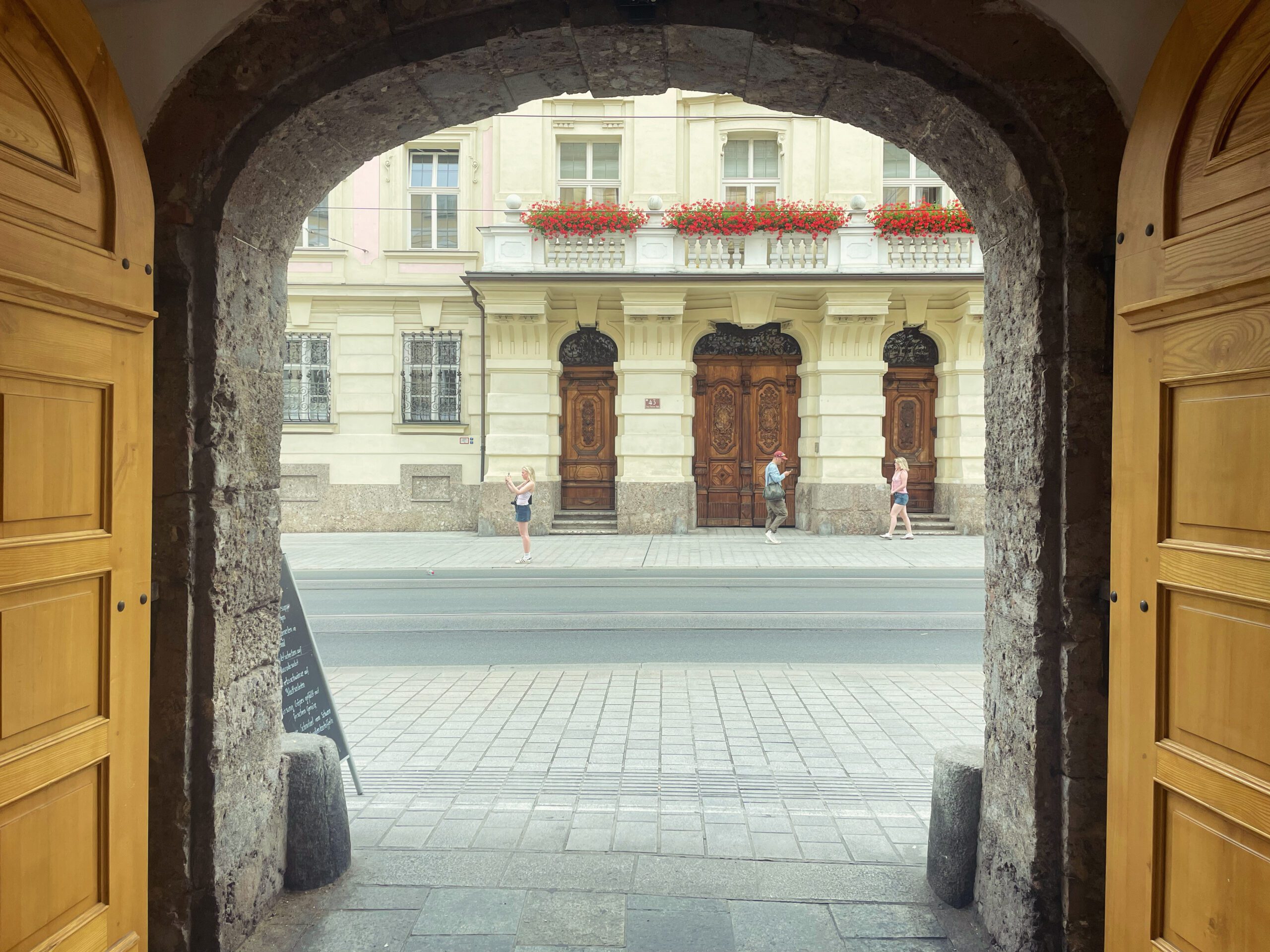
Tyrolean Parliament / Palais Trapp
Also interesting...
Sporty Innsbruck
Anyone seeking proof that the people of Innsbruck have always been an active bunch might turn to the painting Winter Landscape by the Dutch artist Pieter Bruegel (c. 1525–1569) from the sixteenth century. On his return journey north from Italy, the master likely stopped in Innsbruck and observed the local population ice skating on the frozen Lake Ambras. In his Handbook for Travellers in Tyrol (1851), Beda Weber described the leisure habits of Innsbruck’s inhabitants, including ice skating at Lake Ambras: “The lake nearby (note: Amras), a pool in the marshy area, is used by skaters in winter.” To this day, wearing sports clothing in almost any situation is perfectly normal for Innsbruck residents. While in other cities functional clothing or hiking and sports shoes might draw raised eyebrows in restaurants or offices, at the foot of the Nordkette such attire hardly stands out. This was not always the case, however. The path from the ice-skating peasant to the active citizen was a long one. In the Middle Ages and early modern period, leisure and free time for activities such as hunting or riding were largely privileges of the aristocracy. Only with the changing living conditions of the nineteenth century did a significant portion of the population—especially in urban areas—experience something resembling leisure for the first time. Increasingly, people no longer worked in agriculture but as workers and employees in offices, workshops, and factories according to regulated schedules. Industrialised England played a pioneering role, where workers and employees gradually began freeing themselves from the excessive demands of early industrial capitalism. Sixteen‑hour workdays were not only detrimental to workers’ health; employers also realised that overwork reduced productivity. Since the 1860s, efforts had been made to introduce an eight-hour working day. In 1873, Austrian printers established a ten-hour working day, and in 1918 Austria adopted a 48-hour workweek. By 1930, a 40-hour week had become standard in industrial enterprises. People from all social classes—not just the aristocracy—now had the time and energy for hobbies, club life, and sport. English tourists, in particular, introduced new sports, disciplines, and equipment. The cost of equipment largely determined whether a sport remained reserved for the bourgeoisie or was accessible to workers. Sledding, for example, became widespread around the turn of the century, while bobsleigh and skeleton remained elite sports. Sport was not only a leisure activity but also a marker of social distinction: the working class, bourgeoisie, and aristocracy all shaped their identities through the sports they practised. Nobles maintained traditions such as riding and hunting; the bourgeoisie displayed individuality and wealth through expensive equipment like bicycles; and the working class played football or engaged in wrestling and physical contests.
By the mid-nineteenth century, athletes, like singers, museum and theatre enthusiasts, scientists, and lovers of literature, began to come together in associations. Gymnasts were the pioneers of organized club sport in Innsbruck. Gymnastics was considered the quintessential form of sport in the German-speaking world. Competition was not the primary focus; rather, members were expected to train their bodies in order to serve the national body effectively in times of war. As sedentary professions—especially academic ones—became more common, gymnastics was seen as a form of balance. Looking at historical images of gymnasts practicing and performing their exercises, one cannot fail to notice the distinctly military character of these events. Friedrich Ludwig Jahn (1778–1852), commonly known as “Turnvater Jahn,” was not only a leading advocate of physical exercise but also the intellectual founder of the Lützow Free Corps, which fought against Napoleon as a kind of all-German volunteer army. One of the best-known mottos attributed to him is: “Hatred of all foreign things is the German’s duty.” In Saggen, Jahnstraße and a small park with a monument still commemorate Friedrich Ludwig Jahn. The German gymnastics clubs, much like student fraternities, played a significant role in the emergence of the national movement. It therefore took some time before the first official gymnastics club could be established. Gymnasts, who were regarded as particularly liberal and aligned with the Greater German idea, were viewed with suspicion by the Habsburg authorities under Metternich. The founding of gymnastics clubs was banned throughout the German-speaking world. Only one year after the social upheavals of 1848 was the Innsbruck Gymnastics Club (ITV) officially founded. After a conservative backlash in 1850, during which gymnastics clubs were once again banned, the development of the Austrian Imperial Council in the 1860s spurred the formation of political parties. Sports clubs benefited from this as their precursor organisations. In 1863, the ITV was founded for the second time and continues to exist to this day. Soon, Christian, socialist, and Greater German associations emerged, with people gathering in different clubs depending on their ideological and social affiliations.
Among the earliest sports facilities were swimming baths. The first bathing establishment welcomed swimmers from 1833 onward in Hötting, at the open-air pool by the Gießen stream. Additional facilities soon followed near Büchsenhausen Castle, as well as a complex next to what is now the Sillpark site, which was divided into separate areas for women and men. Particularly beautifully situated was the Schönruh outdoor pool above Ambras Castle, which opened in 1929 shortly after the indoor swimming pool in Pradl had been built. The population had grown significantly, and so too had people’s enthusiasm for swimming as a leisure activity. In 1961, the range of sports facilities at Tivoli was expanded with the addition of the Tivoli outdoor pool. In 1883, cyclists founded the Bicycle Club. The first cycling races had been held in France and Great Britain from 1869 onward. The English city of Coventry was also a pioneer in the production of the elegant “steel steeds,” which were extremely expensive. In the same year, the Innsbruck press reported on these modern means of individual transport, when “several gentlemen ventured onto the streets with multiple velocipedes ordered from the firm Peterlongo.” In 1876, cycling was temporarily banned in Innsbruck due to repeated accidents. Cycling was also quickly recognised by the authorities as a form of physical training that could be used for military purposes. A decree from the Imperial Ministry of War was reported in the press:
“It is intended, as in previous years, to also employ cyclists in this year’s exercises involving combined arms… The commands of the infantry and Tyrolean rifle regiments, as well as the field rifle battalions, are to call upon those individuals who are registered as cyclists and are obliged to participate in military exercises this year to report for duty with their bicycles.”
Unter der Regie des Münchners Anton Schlumpeter entwickelte sich die Szene vor der Jahrhundertwende weiter. Schlumpeter deckte mit einer Fahrschule, einem Geschäft für Fahrräder samt Werkstatt und schließlich mit den in seiner Wiltener Fabrik produzierten Fahrradmarke Veldidena die Wertschöpfungskette komplett ab. Die Velocipedisten siedelten sich 1896 im Rahmen der „Internationalen Ausstellung für körperliche Erziehung, Gesundheitspflege und Sport“ im Saggen nahe der Viaduktbögen mit einer Radrennbahn samt Tribüne an. Die Innsbrucker Nachrichten berichteten begeistert von dieser Neuerung, war doch der Radsport bis zu den ersten Autorennen europaweit die beliebteste Sportdisziplin:
“The Innsbruck cycling track, which is to be opened in the coming weeks in connection with the international exhibition, will have a length of 400 metres and a width of 6 metres… The velocipede racing track, the construction of which is chiefly due to the efforts of the President of the Tyrolean Cyclists’ Association, State Railway Chief Engineer R. von Weinong, will be one of the most outstanding and best-equipped cycling tracks on the continent. On the 29th of this month (June 1896), a major international cycling competition will be held on the Innsbruck track for the first time, and in the future, regular annual velocipede prize races are to follow, which will undoubtedly be of considerable benefit to both the promotion of cycling as a sport and tourism in Innsbruck.”
The cement railway was used for daily training in the warm season. The smoke-filled air as the locomotives passed by was probably not good for the lungs. After initial enthusiasm, Schlumpeter had to step in to save the railway. The enterprising entrepreneur realised that the cyclists were not providing enough activity and, on his own initiative, began to build a kind of predecessor to today's Olympiaworld at the Tivoli with several facilities for sport. In addition to cycling races, boxers could compete in the ring. He also had tennis courts built in Saggen. Despite all his efforts, the facility was demolished again in 1901.
Football proved more sustainable than cycling in establishing itself in Innsbruck. For a long time, it was regarded as an English sport and therefore as “un-German.” Unlike gymnastics, it was considered too focused on commerce and professionalisation, and it was seen as offering too little military, educational, or societal value. It was only with the International Exhibition of 1896 in Saggen that football began to gain a certain level of acceptance. There were already interregional matches, for example a 1–1 draw between the team of the Innsbruck Gymnastics Club and Bayern Munich. In order to compete against other teams, the footballers were required to leave their parent organisation, the ITV. The “Aryan clause” embedded there not only prohibited the admission of Jewish players, but also banned matches against teams that included Jewish players. In 1903, the club Fußball Innsbruck was founded, which would later develop into SVI. Matches were played on a football field in front of the Sieberer orphanage. In Wilten, by then part of Innsbruck, SK Wilten was established in 1910. The football ground Besele, which still exists today next to the West Cemetery, was equipped with grandstands to accommodate growing numbers of spectators. In 1913, Wacker Innsbruck was officially founded, the club that remains the most successful football team in Tyrol to this day. For a long time, successful football remained largely confined to Vienna. While the Austrian “Wunderteam” gained international recognition in the 1930s and even won the precursor to today’s European Championship, football in Tyrol was played at a more modest level. It was only after the Second World War that national and international successes began to emerge. Ten Austrian championship titles and reaching the semi-finals of the European Cup testify to the deep-rooted enthusiasm for football among the people of Innsbruck.
In addition to the various summer sports, winter sports also became increasingly popular. Sledding had already become a popular leisure activity by the mid-nineteenth century on the hills surrounding Innsbruck. The first ice rink opened in 1870 as a winter alternative to swimming, on the grounds of the outdoor pool in Höttinger Au. Unlike water sports, ice skating was an activity that could be enjoyed jointly by men and women. Instead of meeting during Sunday strolls, young couples could arrange to meet at the ice rink without parental supervision. In 1884, the Ice Skating Club was founded and used the exhibition grounds as its rink. With facilities such as the ice rink in front of the Imperial and Royal shooting range in Mariahilf, Lake Lans, Lake Ambras, the swimming complex in Höttinger Au, and the Sill Canal in Kohlstatt, Innsbruck offered numerous opportunities for ice skating. As early as 1908, the first ice hockey club was established with the IEV. Skiing, initially a Nordic-style pastime practiced in the valleys, soon spread as a downhill discipline as well. The Academic Alpine Club Innsbruck was founded in 1893 and organised the first ski race on Tyrolean soil two years later, running from Sistrans to Ambras Castle. The sports shop Witting, established in 1867 on Maria-Theresien-Straße, demonstrated strong business acumen by selling ski equipment to a well-to-do clientele even before 1900. Following St. Anton and Kitzbühel, the first Innsbruck ski club was founded in 1906. Equipment remained simple for a long time, allowing skiing primarily on relatively gentle slopes, combining alpine and Nordic techniques similar to cross-country skiing. Nevertheless, skiers ventured to descend slopes in places such as Mutters or the Ferrari meadow. From 1928 onward, two cable cars led up to both the Nordkette and the Patscherkofel, making skiing significantly more attractive. Skiing achieved its breakthrough as a national sport with the World Ski Championships held in Innsbruck in February 1933. On an unmarked course, participants had to cover 10 kilometres and 1,500 metres of elevation between the Glungezer and Tulfes. The two local athletes Gustav Lantschner and Inge Wersin‑Lantschner won multiple medals in these competitions, further fuelling the growing enthusiasm for alpine winter sports in Innsbruck.
Competitions in various sports—above all cycling, boxing, athletics, and football—had become mass phenomena by the interwar period at the latest. In 1924, Joseph Roth (1894–1939) wrote his praise poem dedicated to sport:
The zeitgeist stretches the biceps and fulfils,
with knockout and belly kick the century,
if there is someone who wonders about it,
never read the newspaper Sport im Bild.
After the Second World War, sport finally became a mass phenomenon. While footballers were no longer able to build on the successes of the pre-war period, it was above all skiers who contributed to the slowly emerging sense of national identity among Austrians. Innsbruck remains strongly identified with sport to this day. With events such as the UEFA European Championship in 2008, the UCI Road World Championships in 2018, and the Climbing World Championships in 2018, the city has been able to reconnect—also at the elite level—with the “golden years” of the 1930s, which saw two World Ski Championships, as well as with the Olympic Games of 1964 and 1976. However, it is less elite sport than grassroots participation that contributes to Innsbruck’s reputation as the self-proclaimed “sports capital of Austria.” There are hardly any residents who do not at least strap on alpine skis from time to time. Mountain biking on the numerous alpine pastures around Innsbruck, ski touring, sport climbing, and hiking are exceptionally popular among the local population and are deeply embedded in everyday life.
Tivoli
Sillufer / Pradl
Mentlberg Castle & Pilgrimage Church
Mentlberg 23
Mountain Isel
Mountain Isel 1
Städtisches Hallenbad
Amraserstraße 3
Panoramagebäude
Rennweg 39
Hungerburgbahn & Nordkettenbahn
Congress Centre / Rennweg 39