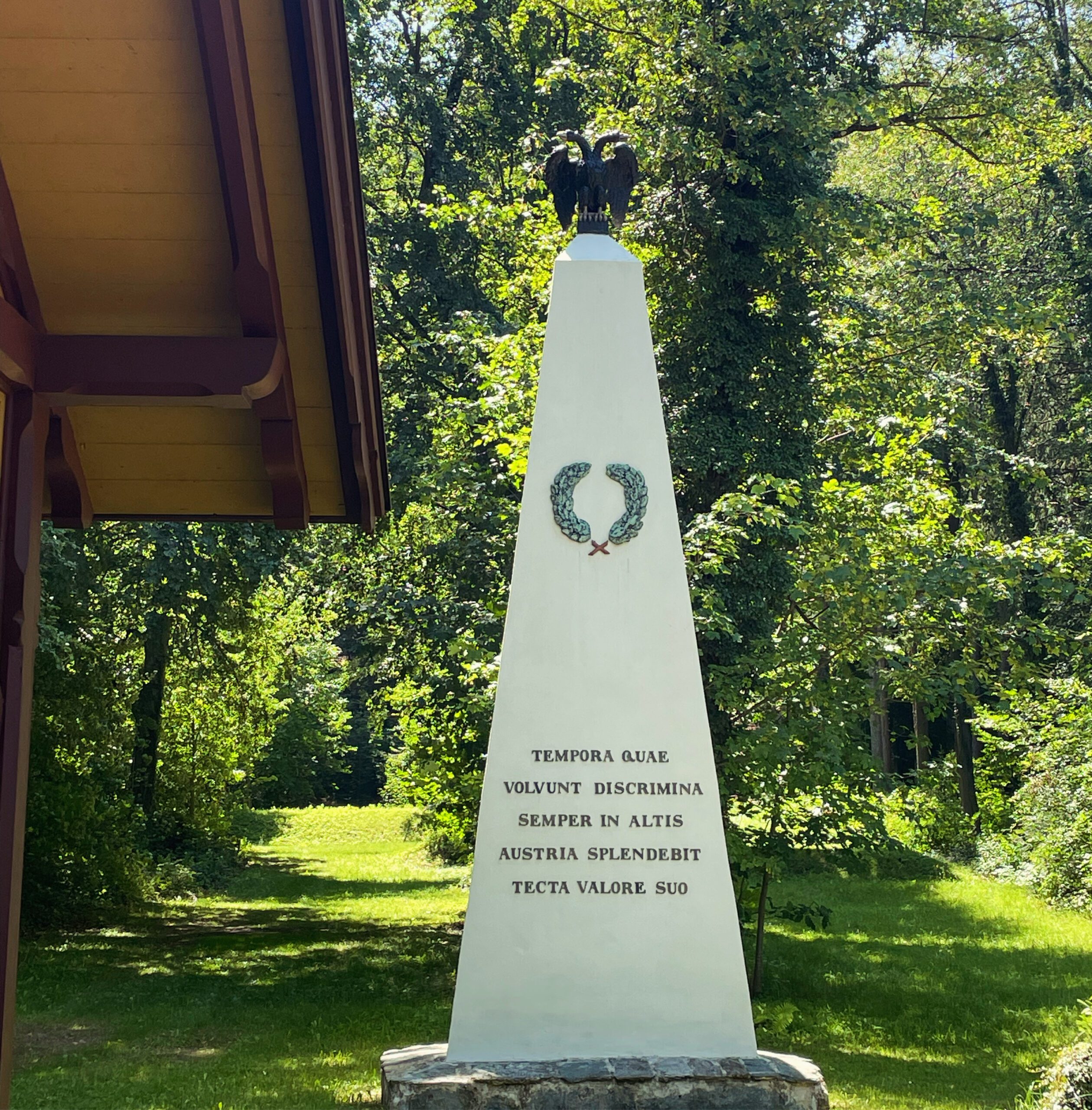
Schießstand Berg Isel
Wissenswert dazu…
Andreas Hofer and the Tyrolean uprising of 1809
The period of the Napoleonic Wars provided Tyrol with a national epic and, in Andreas Hofer, a hero whose legacy continues to resonate to this day. Anyone searching for a Tyrolean national founding narrative—voilà! However, if one sets aside the carefully constructed legend of the Tyrolean uprising against foreign rule, the years before and after 1809 emerge as a darker chapter in Innsbruck’s urban history, marked by economic hardship, wartime devastation, and widespread looting. During the Napoleonic Wars, the Kingdom of Bavaria was allied with France and, through several conflicts between 1796 and 1805, succeeded in taking Tyrol from the Habsburgs. Innsbruck was no longer the capital of a crown land, but merely one of many district capitals within the administrative unit of the Innkreis. Revenues from tolls and customs duties, as well as income from Hall salt production, were redirected northwards. The British continental blockade against Napoleon caused the collapse of long‑established and prosperity‑generating sectors of the Innsbruck economy, particularly long‑distance trade and transport. Innsbruck’s citizens were required to quarter Bavarian soldiers in their homes. The abolition of the Tyrolean provincial government, the gubernium, and the Tyrolean parliament meant not only a loss of status, but also a loss of jobs and financial resources. While the city suffered financially under war and the new regime, the upheaval also opened up new socio‑political opportunities. War, as the saying goes, is the father of all things, and many citizens did not entirely oppose the fresh winds of change. Inspired by the spirit of the Enlightenment, reason, and the French Revolution, the new rulers set about dismantling traditional structures. Measures such as street‑cleaning regulations and compulsory smallpox vaccination aimed to improve hygiene and public health. At the beginning of the nineteenth century, a considerable number of people still died from diseases caused by poor sanitation and contaminated drinking water. A modern tax system was introduced, and the powers of the nobility were further curtailed in line with the emerging administrative state. The Bavarian authorities reinstated the right to form associations, which had been banned in 1797. The reduction of the Church’s influence over education was also welcomed by the liberal-minded population of Innsbruck. A telling example of these reforms was the appointment of the Benedictine monk Martin Goller—later co‑founder of the Innsbruck Music Society—to promote musical and cultural education in the city. However, Catholic processions and religious festivals fell victim to the Enlightenment-inspired agenda of the new rulers. In 1808, the Bavarian king introduced the Municipal Edict across his territories, obliging subjects to maintain public buildings, fountains, roads, bridges, and other infrastructure.
These reforms were unpopular with large segments of the Tyrolean population. For Tyrolean farmers, who had long been largely exempt from compulsory labour, the new obligations represented an additional burden and an affront to their sense of status. The immediate trigger for the uprising was the conscription of young men into the Bavarian-Napoleonic army, despite the fact that Tyroleans, according to the Landlibell issued by Emperor Maximilian, were only obliged to defend their own borders. On 10 April 1809, a disturbance during a conscription in Axams near Innsbruck escalated into a full uprising. Under the banner of “God, Emperor, and Fatherland,” Tyrolean militia units assembled to drive the Bavarian troops and administrators out of Innsbruck. The riflemen were led by Andreas Hofer (1767–1810), an innkeeper as well as a wine and horse trader from the Passeier Valley near Merano. He was supported not only by fellow Tyroleans such as Father Haspinger, Peter Mayr, and Josef Speckbacher, but also—behind the scenes—by Archduke Johann of Habsburg. Upon entering Innsbruck, the insurgents did not limit themselves to official targets. As in the Peasants’ War of 1525, their zeal was driven not only by adrenaline but also by alcohol. The unruly mob proved more damaging to the city than Bavarian rule had been since 1805. Particularly severe riots were directed against bourgeois women and the small Jewish population—carried out by the very “liberators.”
n July 1809, following the Peace of Znaim concluded with the Habsburgs—still regarded by many Tyroleans today as Vienna’s betrayal of Tyrol—Bavarian and French forces regained control of Innsbruck. What followed entered the history books as the Tyrolean Uprising under Andreas Hofer, who had by then assumed supreme command of the Tyrolean militia. In total, the insurgents achieved victory three times on the battlefield, most famously in the Third Battle of Bergisel in August 1809. “Innsbruck sees and hears what it has never seen or heard before: a battle involving 40,000 combatants…” For a brief period, Andreas Hofer effectively ruled Tyrol in the absence of regular administrative structures, even in civilian matters. The city’s dire financial situation, however, did not improve. Instead of Bavarian and French soldiers, Innsbruck citizens now had to house and feed their own compatriots from the peasant regiments and pay levies to the new provincial government. The liberal and affluent urban elites were particularly unhappy with the new rulers. The decrees issued by Hofer in his role as provincial commander resembled a theocratic order more than nineteenth‑century legislation. Women were required to appear in public only modestly veiled, dances were banned, and “immodest” monuments—such as the nymphs at the Leopold Fountain—were removed from public space. Educational responsibilities were to be returned to the clergy. Liberals and intellectuals were arrested, while the recitation of the rosary became compulsory. In the autumn of 1809, the fourth and final Battle of Bergisel ended in a decisive defeat at the hands of overwhelming French forces. The government in Vienna had used the Tyrolean insurgents primarily as a tactical buffer in the war against Napoleon. Even earlier, the emperor had already been forced to cede Tyrol again in the Treaty of Schönbrunn. Between 1810 and 1814, Innsbruck once more came under Bavarian administration. The population, too, was only moderately motivated to continue fighting. Wilten suffered severe damage from the fighting, shrinking from over 1,000 inhabitants to fewer than 700. By this time, Hofer himself was a man broken by exhaustion and alcohol. He was captured and executed in Mantua on 20 January 1810. To make matters worse, Tyrol was divided. The Adige Valley and Trentino became part of the Kingdom of Italy established by Napoleon, while the Puster Valley was annexed to the French‑controlled Illyrian Provinces.
The “fight for freedom” continues to symbolise the Tyrolean self‑image to this day. For a long time, Andreas Hofer was regarded as an undisputed hero and the prototype of the resilient, patriotic, and steadfast Tyrolean—the underdog who resisted foreign domination and unholy customs. In reality, Hofer was likely a charismatic leader, but politically inept, conservative‑clerical, and simple‑minded. His tactical principle at the Third Battle of Mount Isel—“Grad nit aufferlassen tiat sie” (“You just must not let them come up”)—captures his character quite well. In conservative Tyrolean circles such as the marksmen (Schützen), Hofer continues to be venerated in an uncritical and quasi‑cultic manner. The Tyrolean marksmen tradition is a living form of heritage that has modernised in some respects, yet in many darker corners remains reactionary in orientation. To this day, marksmen from Wilten, Amras, Pradl, and Hötting march in harmony alongside clergy, traditional costume associations, and brass bands in church processions, firing rifles into the air to drive all evil away from Tyrol and the Catholic Church. Throughout the city, numerous monuments commemorate the year 1809. During the second half of the nineteenth century, the fighters were increasingly heroised as a German bulwark against foreign peoples. Mount Isel was made available to the city for the veneration of the freedom fighters by Wilten Abbey, the Catholic authority in Innsbruck. Streets in the Wilten district—incorporated into Innsbruck in 1904 during a period dominated by a Greater German liberal city council and long administered by the Abbey—were named after Andreas Hofer and his comrades Josef Speckbacher, Peter Mayr, Father Haspinger, and Kajetan Sweth. The short Rote Gassl (Red Alley) in the historic centre of Wilten commemorates the Tyrolean marksmen who—supposedly clad in red uniforms, probably erroneously attributed to them—are said to have paid mass homage at this spot to the victorious commander Hofer after the second Battle of Mount Isel. To this day, Andreas Hofer is frequently invoked in Tyrol in support of a wide range of initiatives and agendas. Especially during the nationalism of the nineteenth century, repeated reference was made to the idealised hero Andreas Hofer. Through paintings, pamphlets, and theatrical performances he was elevated to iconic status. Even today, one can still see the likeness of the senior marksman when Tyroleans protest against unpopular measures of the federal government, EU transit regulations, or—somewhat incongruously—when FC Wacker Innsbruck faces away teams. The slogan in such cases is: “Men, it’s time!” The legend of the battle‑hardened Tyrolean farmer—working the fields by day and training in the evening at the shooting range as a sharpshooter and defender of the homeland—is repeatedly revived to reinforce an image of “authentic” Tyrolean identity. The commemorations marking the anniversary of Andreas Hofer’s death on 20 February continue to draw large crowds from all parts of Tyrol to Innsbruck. Only in recent decades has a more critical reassessment emerged of this staunchly conservative marksman captain, likely overwhelmed by his role as Tyrol’s provincial commander, who—encouraged by elements of the Habsburg dynasty and the Catholic Church—sought not only to repel French and Bavarian forces but also to keep the liberal ideas of the Enlightenment firmly out of Tyrol.