Landhausplatz & Tiroler Landhaus
Eduard Wallnöfer Square
Worth knowing
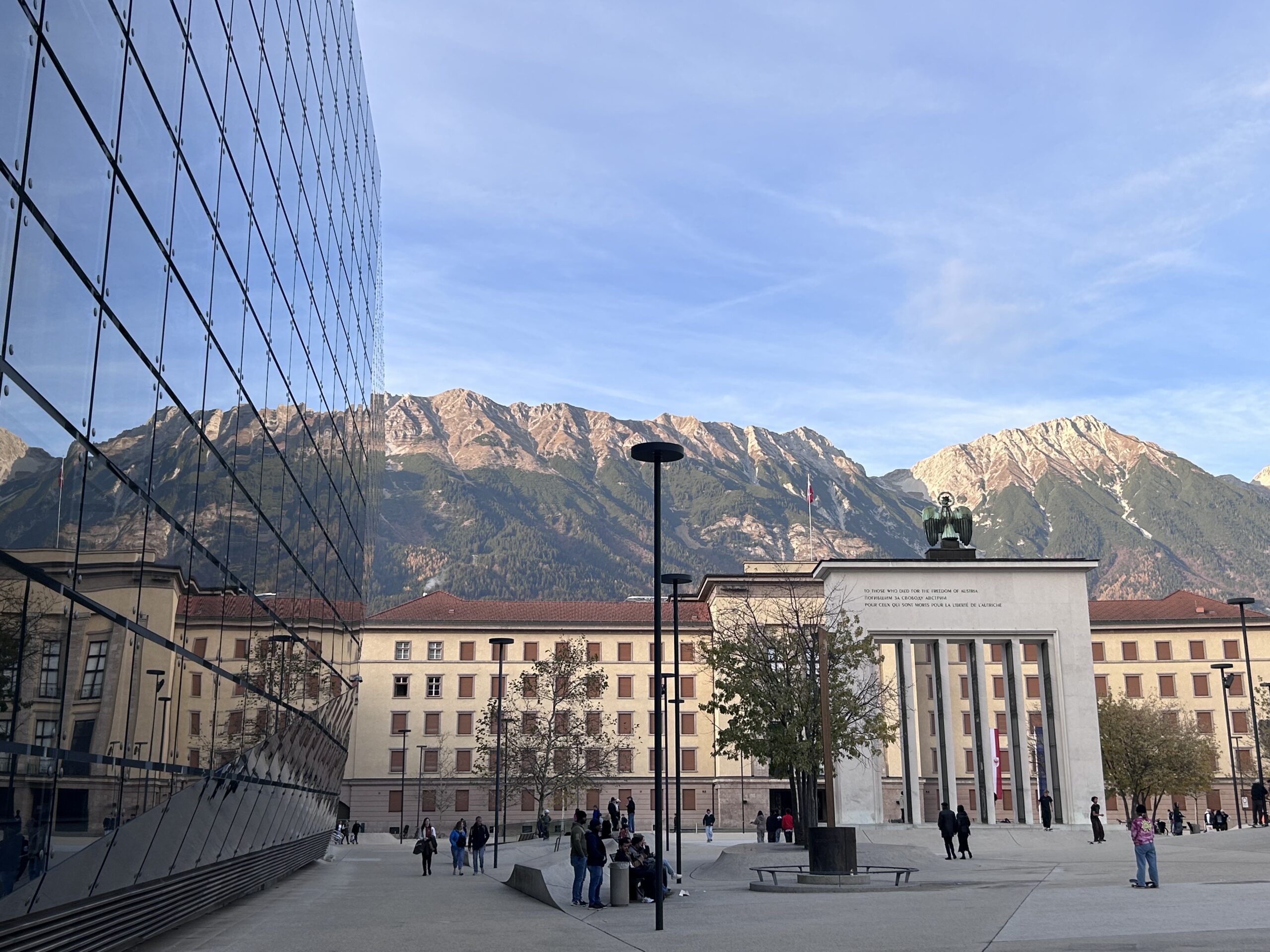
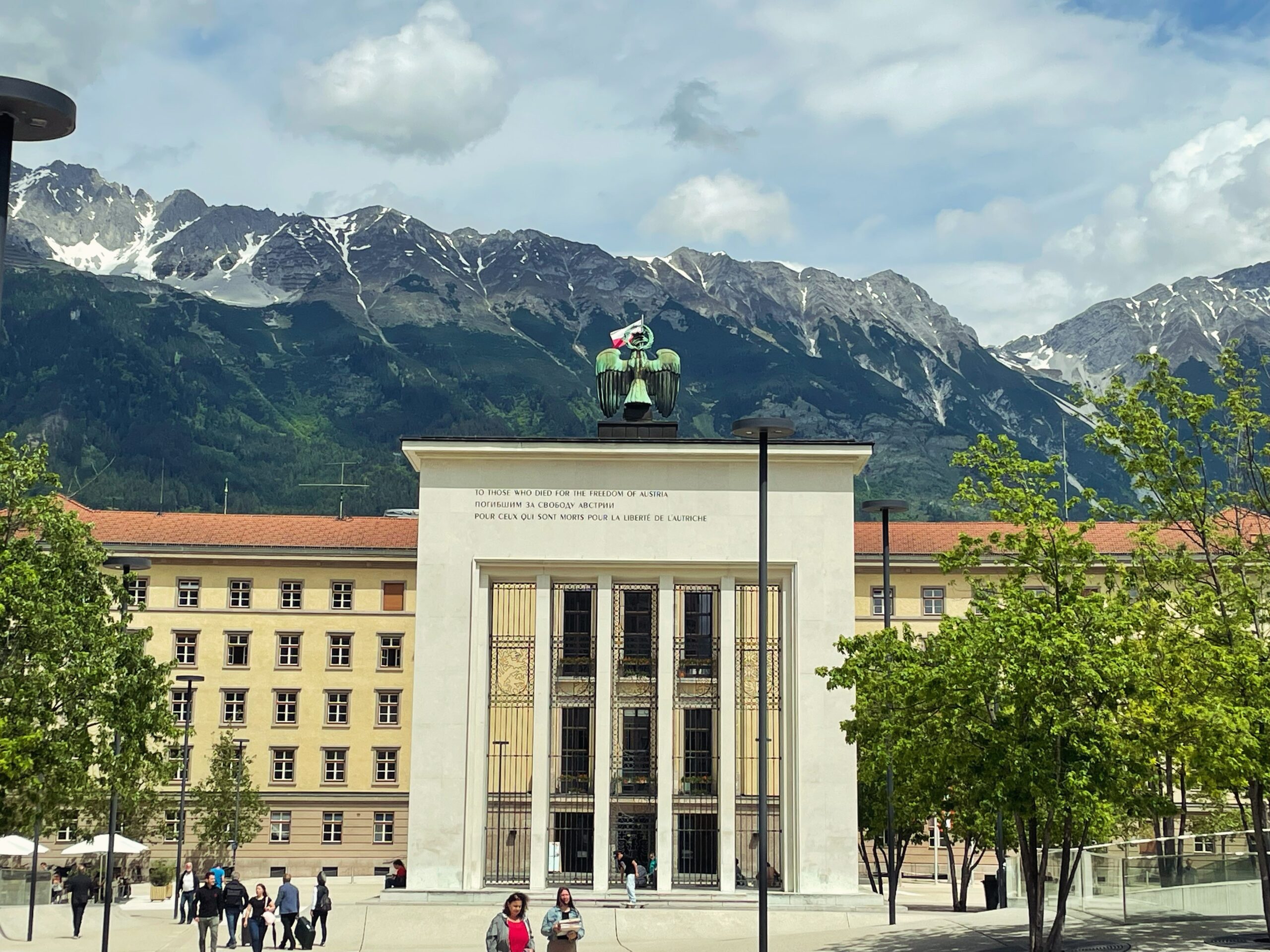
The Tyrolean Landhaus and Eduard-Wallnöfer-Platz, along with the associated “French Monument,” are considered by many Innsbruck residents to be the city’s greatest architectural blunder. It wasn’t always seen that way. The probably ugliest chapter of European history laid the foundation for the unpleasant appearance of this inner-city square. Anyone comparing photos of Landhausplatz before and after 1938 would hardly recognize it. Few places in Innsbruck have changed so drastically. Photos from before the Nazi building frenzy show lots of greenery, tall trees, and individual buildings such as Heinrich Menardi’s carriage rental and car hire. On the north side of the square, the courtyard of the Fugger-Taxis Palace extended to Wilhelm-Greil-Straße. The Fuggerhaus housed the secondary school and the business academy. When construction of the Reich Governor’s Office under Gauleiter Franz Hofer began in 1938, school buildings and the southeastern part of the palace were demolished, and the square was completely redesigned and leveled. The new building adjoined the Old Landhaus to symbolize a transition between old and new centers of power. The buildings between today’s Landhaus and Bismarckplatz, where Lois Welzenbacher’s futuristic high-rise towered above everything, were to make way for a large area for political parades. The open space was intended to be adorned with monuments and columns commemorating Tyroleans who had fallen for National Socialism. The Gauhaus and the square were to become a symbol of the new ideology—a kind of church for faith in the Führer and the liberation of the German people. In reality, only the northern part of Landhausplatz with the Gauhaus was redesigned during the war years. The poorly managed construction phase, personally overseen by Hofer, was plagued by delays and problems due to the war and the simultaneous building of housing blocks for South Tyrolean resettlers. What remains of the grandiose plans is a drab functional building that even Berlin was not entirely happy with at the time. The tender for the new government building was won by architects Walter and Ewald Guth. The façade, seen from the front, was intended to resemble an eagle about to take flight. As with many buildings of the Nazi regime, the Gauhaus combined neoclassicism and modernism. The columns at the entrance stylistically counter the smooth surfaces and symmetrical forms.
No interrogations or mistreatment took place in the Reich Governor’s Office; that was the responsibility of the Gestapo headquarters in Innsbruck, located on Herrengasse. In what is now the Tyrolean Landhaus, crimes were planned and laws and orders from Berlin were implemented. Some rooms in the Landhaus still bear symbols of the Nazi era. How to deal with these silent witnesses of National Socialism remains the subject of lively debate. Gauleiter Franz Hofer’s office long served as the meeting room of the Tyrolean provincial government.
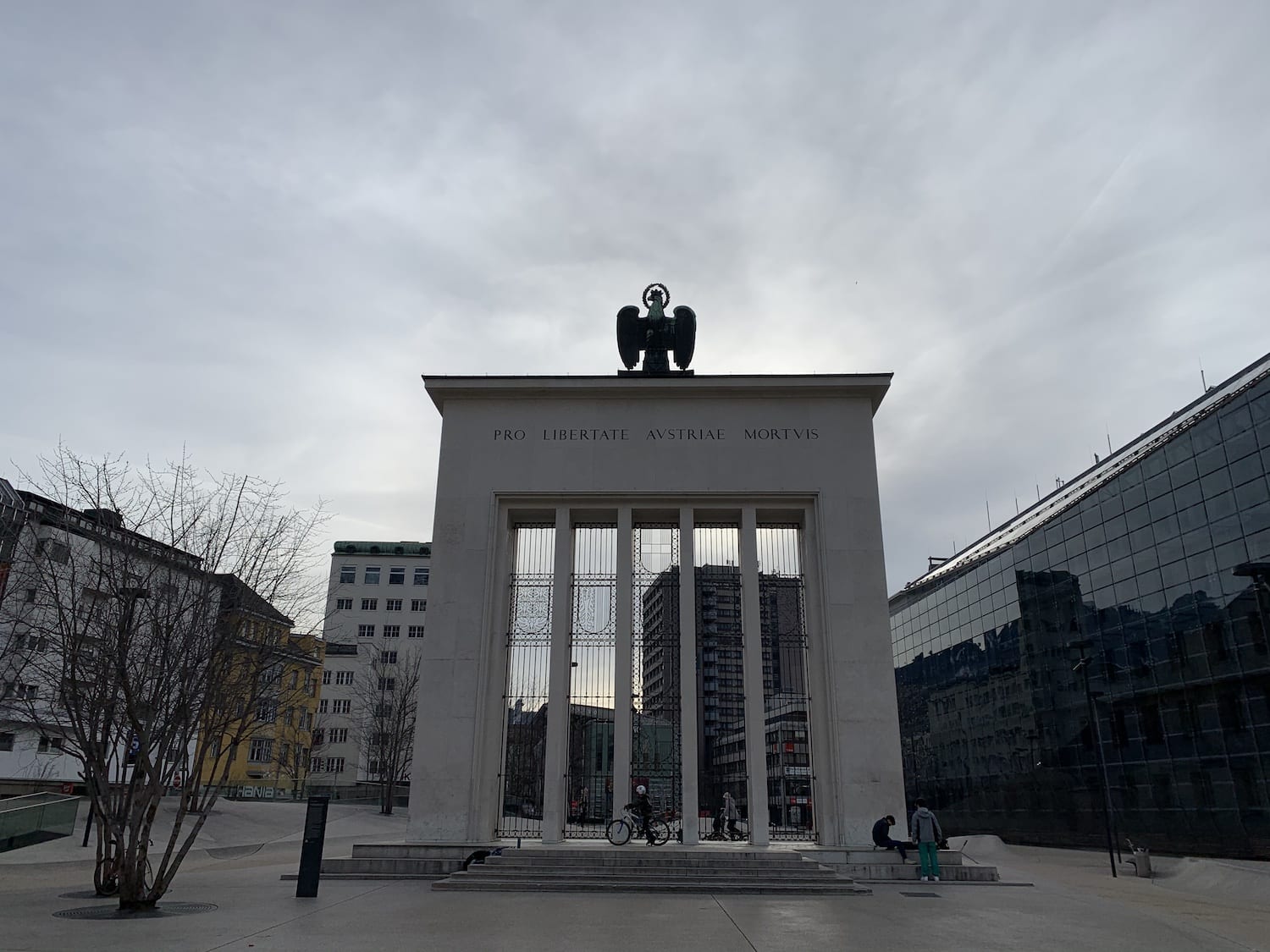
The southern part of Landhausplatz was only designed after 1945. Buildings such as Ansitz Haidenburg had been destroyed during air raids, leaving the square open for new development. Eduard-Wallnöfer-Platz is dominated by the Liberation Monument, commissioned by the French occupation in 1946 to give the ideologically burdened site a new visual orientation. Whereas in 1938 a monument was planned for those who fell for National Socialism, just seven years later the aim was to commemorate resistance fighters as well as fallen soldiers. The monument was intended as a modern version of the nearby Triumphal Arch. With the inscription “Freedom of Austria’s Dead” (Pro Libertate Austriae Mortuis), the structure honors those who died for Austria’s liberation on both sides. Commander-in-Chief General Emile Bethouart refrained from using the French language, thus graciously downplaying the Allies’ role in Austria’s liberation in favor of the Austrian resistance. The population found it hard to accept a liberation monument imposed by the occupying power, especially amid the housing shortage that persisted after the air raids. To avoid fueling public resentment in the early postwar years, the French also refrained from holding a formal inauguration. Although the grille displays the coats of arms of Austria’s new federal states, the monument bears undeniable similarities to various fascist memorials—not least because of its neoclassical style and the enthroned eagle with laurel wreath designed by Emmerich Kerle. The construction of the “French Monument,” as Innsbruck residents called it, was largely carried out by prisoners of war provided to the contractor Mayreder, Kraus & Co. In addition to labor shortages, the required raw materials posed problems in the austere postwar period.
For decades, the entire square led a dreary existence without seating. For a long time, Landhausplatz served as a parking lot amid increasing inner-city traffic. Gradually, it shed its postwar gloom. A discreet memorial at the southern end of Landhausplatz commemorates the Jewish victims of the Kristallnacht pogrom of 1938. The menorah was consecrated in June 1997 by Chief Rabbi Chaim Eisenberg of the Jewish Community for Tyrol and Vorarlberg.
Today, anyone crossing Landhausplatz finds what seems like a well-designed, lively inner-city fun park for skaters and BMX riders. Its current appearance dates from 2011, after the LAAC architectural firm won a 2008 competition to redesign the square. In the first years after its opening, cycling and skating on the austere Landhausplatz with its inviting concrete waves were strictly prohibited, following heated disputes between the provincial government and skateboarders that had already flared up in the 1990s. Young people, however, were undeterred and stubbornly claimed the square in front of the Tyrolean provincial government for themselves. Recently, this colorful youth activity has been brought to an inglorious end by restrictive measures.
Risen from the ruins
Following the end of the war, US troops controlled Tyrol for two months starting in May 1945, before administration of the occupied territory was handed over to France. While the end of the war meant the air raids were over and the danger of a destructive final battle in the streets of Innsbruck was averted, hardship and anxiety persisted. During the first three postwar years, hunger was the greatest enemy. Fiorello La Guardia, head of UNRRA (*United Nations Relief and Rehabilitation Administration*)—which supplied war-devastated areas with basic necessities—counted Austria "...among those nations of the world closest to starvation." May 1945 was less a "month of bliss" and more freezing cold, with snow reaching all the way into the valleys. The winter of 1946/47 went down in Tyrolean climate history as particularly cold and long, followed by a summer that was exceptionally hot and dry. Crop failures reached up to 50%. The supply situation was catastrophic, especially in the city. Obtaining daily food became a life-threatening, everyday worry for the people of Innsbruck. In addition to its own citizens, thousands of Displaced Persons, liberated forced laborers, and occupation soldiers had to be fed. Milk, bread, eggs, sugar, flour, fat—there was a shortage of everything. The Tyrolean state government and the French occupation forces could not cover the required per capita kilocalorie intake. To improve the logistics for incoming supplies, the French laid the foundation for the new airport on the *Ulfiswiese* in Höttinger Au as early as 1946, which replaced the airbase in Reichenau (opened 20 years earlier) after two years of construction. Contemporary witnesses remember with horror the flown-in food cans and their far-from-tasty contents, such as whale meat, that were allocated to them. Food supply was managed through ration cards. Adults had to present confirmation from the employment office to receive these cards. Rations varied depending on the worker category: heavy laborers, pregnant women, and nursing mothers received food worth 2,700 calories. Craftsmen with light jobs, civil servants, and freelancers received 1,850 kilocalories, while office workers received 1,450 calories. Housewives and other "ordinary consumers" (*Normalverbraucher*) received 1,200 calories. Foreign relief organizations ran charitable initiatives such as soup kitchens and school feeding programs. The American welfare organization CARE (*Cooperative for American Remittances to Europe*) sent CARE packages. Many children were sent to foster households in Switzerland during the summer to regain their strength and put a few extra pounds on their bones. However, these measures were not enough for everyone. Housewives and other "ordinary consumers" in particular suffered under the low allocations. Despite the risk of being arrested, many Innsbruck residents set out for the surrounding villages to forage for food (*hamstern*). Those with money paid astronomical prices to the farmers; those without had to beg for food. In extreme cases, women whose husbands had fallen in battle, were prisoners of war, or were missing saw no other way out than prostitution. Women who became pregnant as a result faced severe verbal abuse targeted at both themselves and their offspring. Decriminalized abortion in Austria was still 30 years away. For the most part, politicians were powerless in the face of this. Satisfying all interests was impossible even in normal times. Many decisions made between the parliament in Vienna, the Tyrolean state parliament (*Landtag*), and Innsbruck City Hall were incomprehensible to the public. Office buildings and commercial enterprises were given free rein by the Innsbruck municipal electric company, while private households faced repeated restrictions on power access starting in October 1945. This disadvantage of households compared to the economy also applied to the coal supply. While children suffered from malnutrition, some enterprising farmers legally distilled profitable schnapps from fruit. The old divides between city and countryside grew larger and more bitter. Innsbruck residents accused the surrounding rural population of deliberately withholding food for the black market. Raids, thefts, and illegal logging occurred. Transports at the train station were guarded by armed units. Appropriating food from a warehouse was both illegal and an everyday reality. Hungry children and teenagers roamed the city, seizing any opportunity to get food or fuel. The first Governor of Tyrol, Karl Gruber—who had himself been part of the illegal resistance during the war—understood the situation of people rebelling against the system, but could do nothing to change it. Innsbruck Mayor Anton Melzer's hands were tied as well. It was not only difficult to reconcile the needs of all interest groups; time and again, cases of corruption and favors for relatives and acquaintances surfaced among the civil service. Gruber's successor in the governor's chair, Alfons Weißgatterer, had to weather several minor uprisings when public anger boiled over and stones were thrown at the *Landhaus* (state parliament building). The state government's response came via the *Tiroler Tageszeitung*.
„Are the broken windows that clattered from the country house into the street yesterday suitable arguments to prove our will to rebuild? Shouldn't we remember that economic difficulties have never been resolved by demonstrations and rallies in any country?“
The newspaper had been founded in 1945 under the administration of the US armed forces to promote democratization and denazification. Its first editor-in-chief, Anton Klotz (1889–1961), had worked for the conservative *Allgemeiner Tiroler Anzeiger* before being sent to the Buchenwald concentration camp by the National Socialists. After just one year, the daily newspaper was transferred to *Schlüssel GmbH* under the leadership of ÖVP politician Joseph Moser. In the first few months after the war, a paper shortage made it the only available newspaper in the region. The second paper, the *Tiroler Nachrichten*, which began publication in late 1945, was under the direct administration of the ÖVP. Thanks to high circulation and almost direct control over the content, the Tyrolean state government was able to shape public sentiment. However, this dominance over public opinion did nothing to change reality, such as the precarious housing situation. An estimated 30,000 Innsbruck residents were homeless, living in cramped conditions with relatives, or residing in temporary barracks settlements. These included the former labor camp in Reichenau, the settlement colloquially known as the "*Ausländerlager*" (foreigners' camp) for displaced persons from formerly German areas of Europe, and the *Bocksiedlung*. Maria-Theresien-Straße, Museumstraße, the railway station district, Wilten, and Pradlerstraße would likely be much more visually appealing today had officials not been forced to quickly plug the gaps in the cityscape to create housing as fast as possible for the many homeless residents and returning soldiers. Aesthetics, however, was a luxury that no one could afford in this situation. Tens of thousands of citizens pitched in to clear the rubble and debris left behind on the streets by air raids. The exhausted population urgently needed new living space to escape the unhealthy living conditions, in which large extended families were sometimes squeezed into single-room apartments.
"The emergency situation jeopardises the comfort of the home. It eats away at the roots of joie de vivre. No one suffers more than the woman whose happiness is to see a contented, cosy family circle around her. What a strain on mental strength is required by the daily gruelling struggle for a little shopping, the hardship of queuing, the disappointment of rejections and refusals and the look of discouragement on the faces of loved ones tormented by deprivation."
What could be read in the *Tiroler Tageszeitung* was only part of the harsh everyday reality. Just as after the First World War, when the Spanish Flu claimed many victims, 1945 also saw a surge in dangerous infections. Vaccines against tuberculosis could not be delivered during the first winter, and hospital beds were in short supply.
Even though the situation eased after 1947, living conditions in Tyrol remained precarious. It took years before noticeable improvements occurred. Food rationing was finally discontinued on July 1, 1953. In the same year, Mayor Greiter was able to announce that all buildings destroyed during the air raids had been fully restored. This was also thanks to the occupying forces. The French troops under Émile Béthouart behaved very leniently and cooperatively toward their former enemy, treating the Tyrolean culture and population with friendliness and an open mind. Although people were initially hostile toward the occupying power—yet another war had been lost—the skepticism of Innsbruck's residents faded over time. Thanks to the soldiers of the *4th Moroccan Mountain Division*, many Tyroleans saw Black people for the very first time. The soldiers were especially popular among children because of the chocolates and sweets they handed out. Many locals also found employment within the French administration. The French Monument on Landhausplatz commemorates the era of the French occupation. On the *Émile-Béthouart-Steg*—the footbridge connecting St. Nikolaus and the inner city across the Inn River—a commemorative plaque encapsulates the relationship between the occupying forces and the local population:
"Came as a victor
Remained as a protector.
Returned home as a friend."
In addition to material hardship, a collective war trauma shaped society. The adults of the 1950s were products of interwar upbringing and National Socialism. Men who had fought at the front could only speak of their horrifying experiences as losers of the war within certain circles, while women usually had no platform at all to process their fears and anxieties. Domestic violence and alcoholism were widespread. Teachers, police officers, politicians, and civil servants had frequently been part of the National Socialist follower base—a demographic that did not simply vanish with the end of the war, but was merely met with a wall of silence in public life. Although a large number of proceedings against National Socialists took place at the Innsbruck People's Court under the direction of the Allied powers, the number of convictions failed to reflect the true extent of what had occurred. The vast majority of the accused went free. Particularly implicated representatives of the system were imprisoned for a time or lost their public service positions, but after serving their sentences, they were able to return to their old lives relatively unmolested—at least professionally. People not only wanted to draw a line under the past decades; the perpetrators of yesterday were needed to keep the society of today running. At the latest with the growing tensions between the superpowers and the USSR, former Nazis were viewed as the lesser evil compared to socialists and communists. The problem with this strategy of suppression was that no one took responsibility for what had happened, even though enthusiasm and support for National Socialism had been widespread, especially at the beginning. There was hardly a family without at least one member who had an inglorious history between 1933 and 1945. Shame over what had transpired since 1938 and during those years in Austrian politics blended with the fear of being treated as war culprits by the occupying powers—the USA, Great Britain, France, and the USSR—much like in 1918. An atmosphere emerged in which no one—neither the generation that took part nor the one that followed—spoke about what had taken place. This attitude long prevented any critical examination of the events since 1933. The myth of Austria as the "first victim" of National Socialism—which only slowly began to crumble with the Waldheim affair in the 1980s—was born. Police officers, teachers, judges—they were all left in their positions despite their political stance. Society needed them to keep functioning. A prime example of this generously spread blanket of forgetting, with strong ties to Innsbruck, is the biography of the physician Burghard Breitner (1884–1956). Breitner grew up in a wealthy upper-middle-class household. The Villa Breitner at Mattsee housed a museum dedicated to the German nationalist poet Josef Viktor Scheffel, who was revered by Breitner's father. After passing his school-leaving exams (Matura), Breitner decided against a career in literature in favor of studying medicine. He subsequently completed his military service and launched his medical career. In 1912/13, he served as a military doctor in the Balkan War. In 1914, he was deployed to the Eastern Front, where he was taken prisoner by Russian forces. As a physician, he selflessly cared for his comrades in the prisoner-of-war camp. It was not until 1920 that he returned to Austria from the POW camp, celebrated as a hero and the "Angel of Siberia." In 1932, his career at the University of Innsbruck began. By 1938, Breitner faced the problem that he could not provide the "Greater Aryan Certificate" (Großer Ariernachweis) due to the Jewish background of his paternal grandmother. However, thanks to his good relationship with the rector of the University of Innsbruck and key National Socialists, he was ultimately able to continue working at the university clinic. During the Nazi regime, Breitner—as head of the Innsbruck Clinic—was responsible for forced sterilizations and "voluntary castrations," even if he likely did not perform any of the surgeries personally. After the war, the "Angel of Siberia" managed, with some effort, to maneuver his way through the denazification process. In 1951, he was nominated as a candidate for the federal presidential election by the VdU (Federation of Independents), a political collecting basin for staunch National Socialists. In 1952, Breitner became Rector of the University of Innsbruck. Following his death, the City of Innsbruck dedicated an honorary grave to him at the Westfriedhof (Western Cemetery). In the Reichenau district, a street is dedicated to him in the immediate vicinity of the site of the former concentration camp.
Art in architecture: the post-war period in Innsbruck
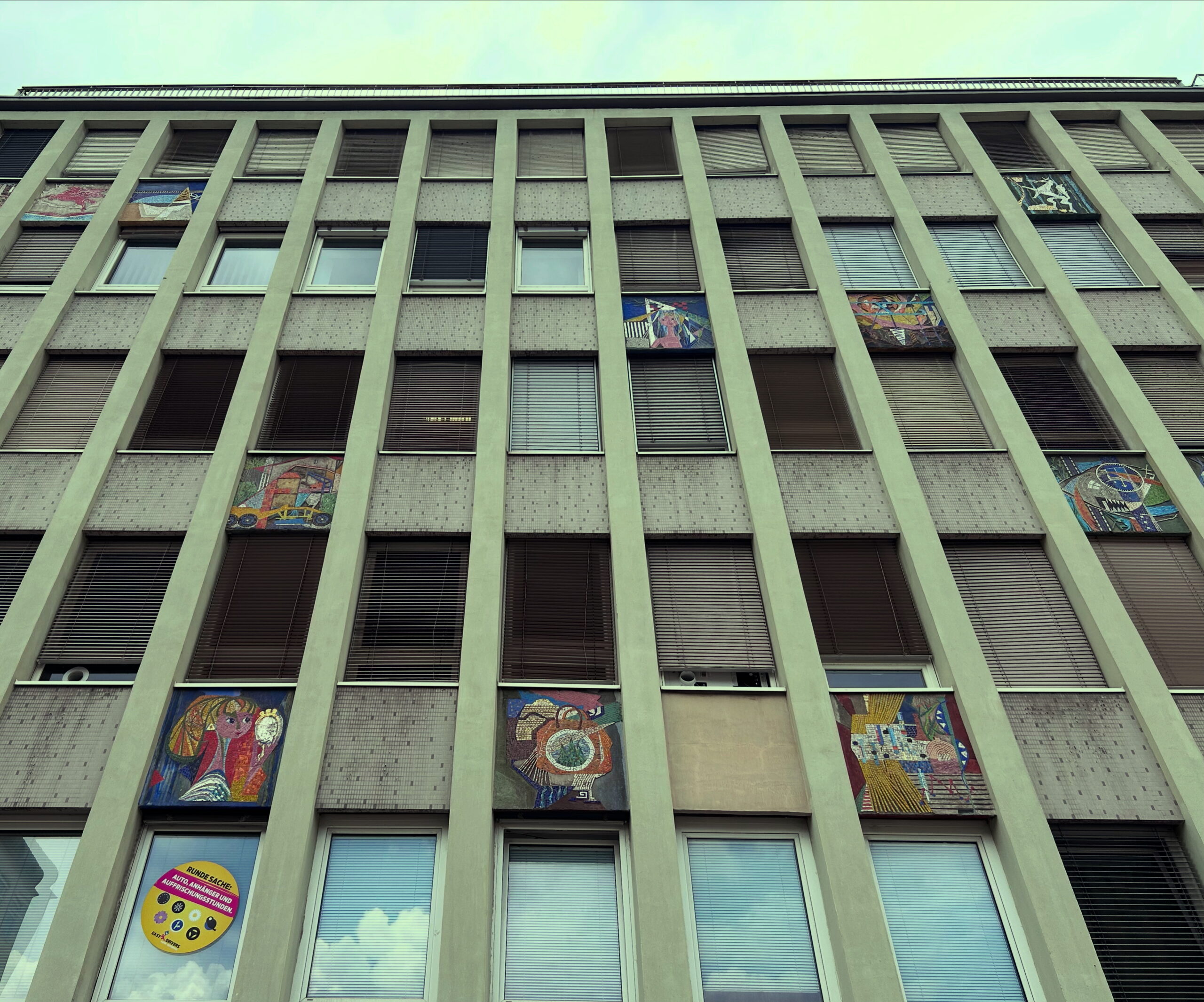
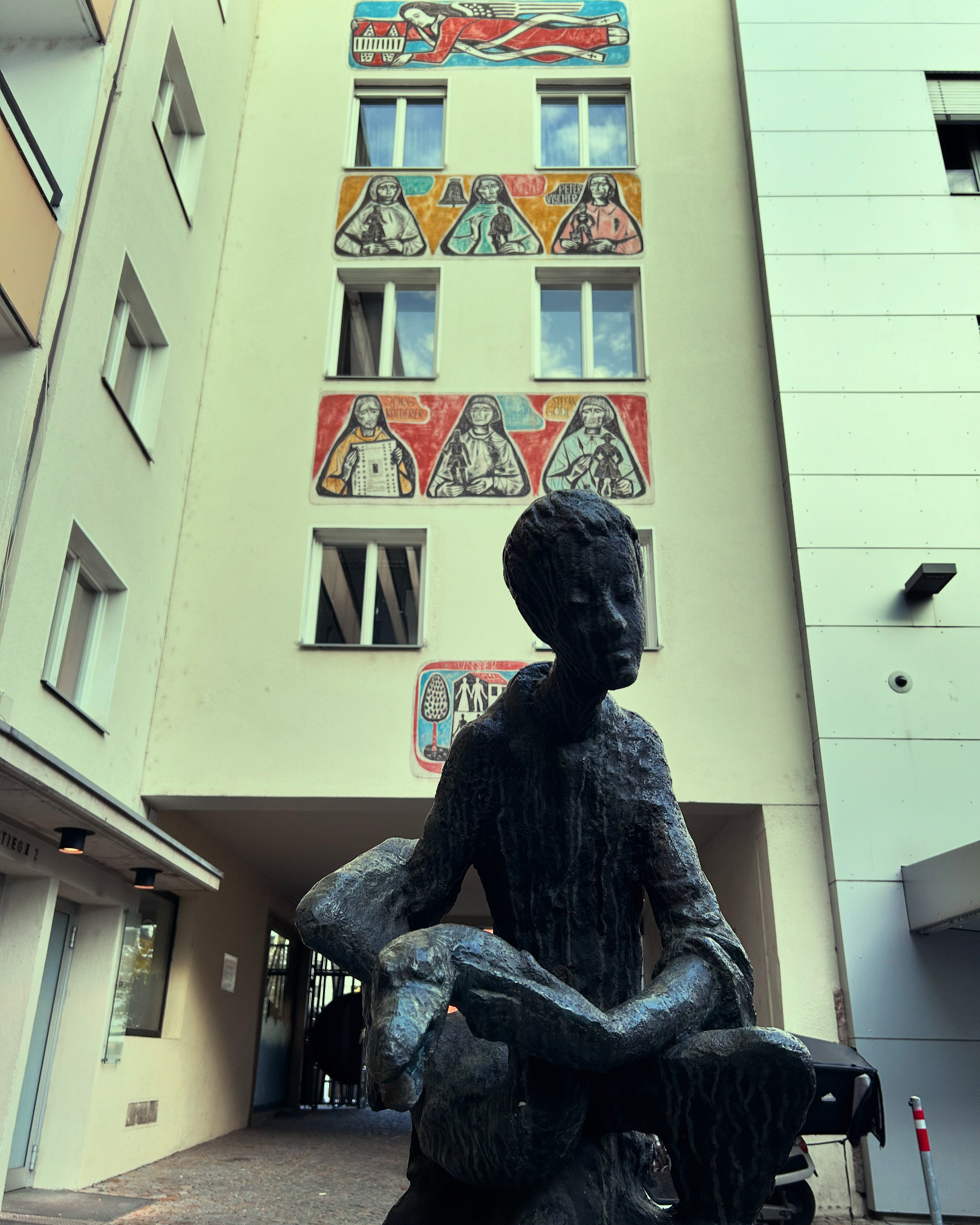
Just as after the First World War, the housing shortage was one of the most pressing issues after 1945. Innsbruck had been severely affected by air raids, and funds for new construction were scarce. When the first residential complexes were built in the 1950s, frugality was the order of the day. While many of the buildings erected from the 1950s onward are architecturally unremarkable, they house quite interesting works of art. Starting in 1949, Austria introduced the "Kunst am Bau" (Percent for Art) initiative. For state-funded construction projects, 2% of the total expenditure was to be allocated to artistic design. Implementing building legislation—and thus managing these budgets—was the responsibility of the federal states, then as now. In the frugal postwar years, even successful and practical artists like Oswald Haller (1908–1981), who made his living from commercial art and tourism posters, had fallen on hard times. Public procurement was meant to offer them financial support. This concept had first emerged in the Weimar Republic in 1919 and was continued by the National Socialists from 1934 onward. Austria readopted Kunst am Bau after the war to shape public spaces as part of the reconstruction effort. The public sector, replacing the aristocracy and the bourgeoisie as the property developers of past centuries, was under intense financial pressure. Nevertheless, residential projects—though primarily focused on functionality—were not meant to look entirely plain. The Tyrolean artists entrusted with creating these artworks were chosen through open competitions. The most renowned among them was Max Weiler, perhaps the most prominent artist in postwar Tyrol, who was responsible for the frescoes in the Theresienkirche on the Hungerburg in Innsbruck, among other works. Other prominent names include Helmut Rehm (1911–1991), Walter Honeder (1906–2006), Fritz Berger (1916–2002), and Emmerich Kerle (1916–2010). Many of these artists were shaped not only by the Bundesgewerbeschule Innsbruck (today's HTL) and the Academy of Fine Arts Vienna, but also by their collective experience during National Socialism and the war. Fritz Berger had lost his right arm and an eye, forcing him to learn to work with his left hand. Emmerich Kerle served as a war painter in Finland. In Vienna, he was taught by Josef Müllner, an artist who made his mark on art history with busts of Adolf Hitler, Siegfried from the Nibelungen saga, and the still-controversial Karl Lueger Monument in Vienna. Like a large portion of the Tyrolean population, these artists—along with politicians and civil servants—longed for peace and quiet after the harsh and painful war years, wanting to let bygones be bygones regarding the events of recent decades. The works created under Kunst am Bau reflect this attitude toward a new self-image and moral code. It was the first time that abstract, non-representational art entered Innsbruck's public space, albeit only within an uncritical framework. Fairytales, legends, and religious symbols were popular motifs immortalized in sgraffito, mosaics, murals, and statues. One could speak of a sort of second wave of Biedermeier art, symbolizing the petty-bourgeois lifestyle of the postwar population. The art was also intended to create a new awareness and image of what was considered "typically Austrian." As late as 1955, every second Austrian still considered themselves German. The diverse motifs depict leisure activities, clothing styles, and the concepts of social order and norms of the postwar era. Women were frequently portrayed in traditional costume (Tracht and Dirndl), men in Lederhosen. Conservative ideals of gender roles were processed through this art: hardworking fathers, dutiful wives tending to home and hearth, and children eagerly studying in school remained the ideal well into the 1970s. Anyone walking attentively through the city will find many of these artworks still visible on buildings in Pradl and Wilten today. The contrast between plain architecture and contemporary art from a postwar era—often suppressed, yet long romanticized and glorified in films and stories—is well worth seeing. Particularly fine examples can be found on the facades along Pacherstraße, Hunoldstraße, Ing.-Thommenstraße, Innrain, the Landesberufsschule Mandelsbergerstraße, or in the courtyard between Landhausplatz and Maria-Theresien-Straße.
Operation Greenup - Innsbrooklyn's rebirth
Following minor skirmishes in the Außerfern region and at the Porta Claudia in Scharnitz near Seefeld, the US Army's *Cactus Division* reached Zirl on May 3, 1945, standing at the gates of the Gau capital of Innsbruck. A few resistance fighters from the O5 group—centered around Fritz Molden and Karl Gruber, who later became Governor of Tyrol—had occupied barracks and official facilities in Innsbruck after the Gau leadership, Gestapo, and SS had fled. Nevertheless, the American troops did not know what to expect in Innsbruck, as Adolf Hitler had declared Tyrol part of the "Alpine Fortress" (*Alpenfestung*)—a retreat that was to be defended to the last man. Had Innsbruck become a battleground, as was the case in many other cities, it would have resulted in the destruction of the city. That it did not come to this and that Innsbruck was surrendered without a fight is thanks to a handful of brave women and men who paved the way for a peaceful surrender as part of the US espionage mission *Operation Greenup*. The main figures of this movie-worthy coup were Friedrich "*Fred*" Mayer (1921–2016), Hans Wijnberg (1922–2011), Franz Weber (1920–2001), and Anna Niederkircher (1895–1968). Mayer and Wijnberg, fleeing National Socialism in Europe with their Jewish families, had ended up in New York. They volunteered for military service and, thanks to their European background and language skills, joined the OSS, the US military intelligence agency. Weber had ended up in a prisoner-of-war camp in southern Italy as a Wehrmacht deserter. A devout Catholic, he wanted to help overthrow the Nazi regime in his Tyrolean homeland after his wartime experiences, where he was also recruited by the OSS. Together, operating out of Innsbruck, they were tasked with spying on the supply line over the Brenner Pass as well as key military infrastructure and industry, such as the Messerschmitt works in Kematen.
On February 26, the three men and their equipment parachuted out of a plane over the snow-covered Ötztal Alps. Traveling by sled and public transport, they made their way deep in enemy territory to Oberperfuss, Franz Weber's hometown. They found support in the village, which was Catholic and critical of the regime. Weber's sisters Eva, Margarete, and Luise, his neighbor Maria Hörtnagl, and especially his fiancée Anni Niederkircher and her mother Anna, the landlady of the *Gasthof zur Krone*, played invaluable roles in providing supplies, cover, and shelter. Franz Weber acted as the group's local guide. Fred Mayer blended in with the population in Oberperfuss, Innsbruck, and Kematen under various identities. His exploits—sneaking into the officers' mess disguised as a Wehrmacht soldier or into the Messerschmitt works as a French forced laborer—seem like something straight out of a spy movie. He established contacts with other resistance groups and gathered intelligence. Weber's sisters in Innsbruck housed him and provided him with everything imaginable, such as forged documents or a stolen Wehrmacht uniform. Anni Niederkircher served as the liaison between Oberperfuss and Innsbruck. As the radio operator, Hans Wijnberg maintained communications with the US forces' base in Bari. Everyone involved knew that if their risky operation were uncovered, they would be sentenced to death. In April, just a few days before the end of the war, this worst-case scenario occurred. Robert Moser, the radio dealer and resistance member who had employed Fred Mayer in his shop as cover, was exposed. At the Gestapo headquarters in Innsbruck's Herrengasse, he was interrogated, tortured, and ultimately whipped and beaten to death. On April 20, Fred Mayer was also arrested. Yet despite beatings and torture, he held firm—and did even more: After revealing himself as a member of US Military Intelligence, he managed in negotiations with *Gauleiter* Hofer to arrange for Innsbruck to be surrendered without a fight as an open city. In exchange for Mayer's assurance that he would be treated as a prisoner of war, Hofer issued an order to the population in a radio broadcast on May 2 to refrain from any combat actions. On May 3 at 2:00 PM, Fred Mayer—still bearing the scars of his treatment by the Gestapo—reached the US troops near Zirl with this news. A few hours later, the ceasefire came into effect. The vehicles and soldiers were able to enter the city without any further bloodshed or destruction.
For a long time, the memory of *Operation Greenup* and the heroic actions of all involved under extreme danger was overshadowed by the narrative of self-liberation by the brave Tyrolean population. It was not until 2010 that Fred Mayer, who had received the *Purple Heart*—one of the US military's highest decorations for valor—was finally honored by the State of Tyrol at almost 90 years of age. Hans Wijnberg was awarded a Medal of Merit by the City of Innsbruck ten years after his death. Franz Weber, who served as a member of both the State Parliament and the National Council after the war, received the *Decoration of Honor of the State of Tyrol* and the *Decoration of Honor for Services to the Republic of Austria*. A hard-to-find bronze plaque at the former Gestapo headquarters in Herrengasse commemorates Robert Moser, who was tortured to death. A small information board can be found at Anichstraße 19, the building where Mayer stayed during his time in Innsbruck. It was only with the publication of Peter Pirker's gripping book "*Codename Brooklyn*," which received widespread international attention, that what is perhaps the most impressive episode in Innsbruck's history became known to a broader audience. Yet Innsbruck may owe a lasting legacy to Wijnberg's radio transmissions: His codename for the city was *Brooklyn*, named after the New York borough where he and Mayer had lived for a long time. Following the end of National Socialism, Innsbruck was reborn as *Innsbrooklyn*.
Franz Hofer: The Gauleiter of Tyrol
With National Socialism, many political positions and posts in the public service were reassigned. The cult of the Führer and the ideology of the National Socialist Party were structurally cemented at all levels. Innsbruck's mayor Franz Fischer was replaced by Egon Denz upon the takeover of power. Edmund Christoph likewise replaced Governor (Landeshauptmann) Josef Schumacher (1894–1971) overnight, before Franz Hofer (1902–1975) took his place as Gauleiter in May 1938, becoming Reich Governor (Reichsstatthalter) from 1940. The young, ambitious careerist stands as a representative for many who made careers under National Socialism. Hofer was born in Bad Hofgastein in the province of Salzburg. His father, himself a staunch German nationalist, came to Innsbruck in 1909 to take over the Gasthof Breinößl. Hofer completed his schooling in Innsbruck before running a radio shop. As early as 1931, he became a member of the NSDAP in Austria. After a short time, he rose to Gauleiter—a title that initially brought him more trouble than credit. Following the ban on the party in Austria, Hofer was imprisoned, but was freed by members of the SA. Shot while fleeing to Italy, he subsequently traveled to the Altreich (Old Reich), where he became a German citizen and launched a rapid career within the party. After the annexation (Anschluss) of Austria, the loyal Hofer was appointed Gauleiter of Tyrol and Vorarlberg by Hitler's decree on May 24, 1938, and two years later as Reich Governor of Tyrol-Vorarlberg. His plans were as ambitious as his title, as Tyrol provided fertile ground for National Socialism. Relative to population size, no other district in the Ostmark had more party members than this one. By 1939, Hofer was already close to his goal of establishing the first completely 'Jew-free' Gau. A year later, only one Jew remained registered in Tyrol. Furthermore, Hofer enriched himself lavishly on a personal level with Aryanized property. In this way, he acquired the Villa Schindler—formerly belonging to the operator of the Café Schindler at Rennweg 10—as well as the Lachhof in Kleinvolderberg near Innsbruck, where he established a type of command center outside the city. The anti-Catholic Hofer also took severe action against church organizations; the Wilten Boys' Choir (Wiltener Sängerknaben) was as much a thorn in his side as the ubiquitous depictions of Mary in Innsbruck. Socialist and communist organizations played no role in Tyrolean society, posing less of a threat than stubborn Catholics. All religious orders were closed, and Catholic youth groups and associations were integrated into the National Socialist system. Between 1938 and 1945, 119 out of 570 priests were taken into custody at least once; eleven were executed or did not survive the conditions of their imprisonment. When Italy came under complete German control in 1943, Hofer took his next career step. He was appointed Supreme Commissioner of the Operational Zone of the Alpine Foothills (Operationszone Alpenvorland), which comprised Tyrol-Vorarlberg and the Northern Italian provinces. It was also Franz Hofer who conceived the idea for the so-called 'Alpine Fortress' (Alpenfestung), the final bastion of the German people against the enemy. On April 12, 1945, less than a month before the end of the war, he presented this proposal in person to Adolf Hitler, who subsequently appointed him Reich Defense Commissioner of the Alpine Fortress.
When all hope was lost and the final dreams of an Alpine resistance stronghold collapsed, Hofer proved to be remarkably adaptable to changing circumstances. Following negotiations with the advancing Allied forces, Innsbruck was surrendered without resistance as an open city on 3 May 1945, thereby sparing it from the devastating battles that marked the final days of the war in many other places. Only a few days earlier, however, Hofer had still presented himself, at least outwardly, as a committed National Socialist. This is evident from a radio address he delivered on 30 April 1945:
"However, should the enemy, despite heroic fighting, be at the gates of Innsbruck, a defence of the Gau capital under the given circumstances would by no means save the worst, but rather destroy the last.... But we want to claw our way into our mountains all the more tenaciously..."
Hofer was arrested a few days later. In October 1948, he managed to escape from the internment camp at Dachau and flee to Germany, where he went into hiding in Mülheim an der Ruhr under a false name. It has never been conclusively proven, but it is entirely possible that American and British intelligence services assisted their former adversary in escaping. Such assistance may have been motivated by a desire to protect their own methods and networks that had been used against National Socialism in Tyrol and were now being deployed against the Soviet Union. Had Hofer stood trial, these activities might well have become public knowledge. In 1949, a court in Munich sentenced him in absentia to ten years in prison. In July 1953, this judgment was upheld in Munich, although the sentence was reduced to three years. Since the time he had already spent in custody was credited toward the sentence, Hofer remained a free man. In Austria, meanwhile, a court sentenced him to death in 1949. However, this sentence was never enforced, and no criminal prosecution followed. Among Hofer’s supporters were Johannes Baptist Geisler, Bishop of Brixen, and Alfons Weißgatterer, Governor of Tyrol. In legal proceedings held in Innsbruck in 1950, his assets were confiscated by the Republic of Austria. From 1954 onward, Hofer lived openly under his real name in Germany. He managed the company Ruhr Armatur GmbH, a supplier of sanitary equipment. Although legal proceedings were initiated concerning his involvement in Aktion T4 in Tyrol, the Nazi programme of the “destruction of life unworthy of life,” the case was ultimately dismissed in 1963. In a sense, Tyrol remained loyal to its former Gauleiter even after his emigration and until his death. Hofer had always been an admirer of Tyrolean traditions. As Gauleiter, he promoted folk music, traditional costumes, and the Tyrolean riflemen’s associations (Schützen). While these organizations were officially dissolved in 1938, under Hofer they were reorganized into the Standschützenverband. The conductor of the Wilten-Innsbruck Town Band, Sepp Tanzer, whom Hofer appointed head of the Department of Folk Music within the Reich Music Chamber, composed the Standschützen March in his honour. When Hofer was buried in Mühlhausen thirty years after the end of the war, a delegation of Tyrolean riflemen attended the funeral to pay their final respects. The Tyrolean Government Building (Tiroler Landhaus), which remains the seat of the Tyrol provincial government to this day, was constructed during Hofer’s rule and stands as a lasting architectural reminder of the Gauleiter of Tyrol.
Innsbruck and National Socialism
In den 1920er und 30er wuchs und gedieh die NSDAP auch in Tirol. Die erste Ortsgruppe Innsbrucks wurde bereits 1923 gegründet. Mit „Der Nationalsozialist - Combat Gazette for Tyrol and Vorarlberg“ erschien ein eigenes Wochenblatt. 1933 erlebte die NSDAP mit dem Rückenwind aus Deutschland auch in Innsbruck einen kometenhaften Aufstieg. Die Modernität der und die Aufstiegsmöglichkeiten, die sie bot, sprach junge, ambitionierte Menschen an. Das Neue, das Aufräumen mit alten Hierarchien und Strukturen wie der katholischen Kirche und der allgemeine Um- und Aufbruch in eine neue Zeit waren mächtige Anziehungsfaktoren. Arbeiter, Angestellte und Unternehmer gleichermaßen sehnten sich nach dem Wirtschaftsaufschwung auch für das schwächelnde Österreich, der in Deutschland die Arbeitslosenzahlen massiv reduziert hatte. Akademiker hingegen sahen sich in der großdeutschen Zukunft dem politischen Ziel ihrer Träume entgegengehen. Die demokratische Republik war konservativen Eliten ein Gräuel. Wer bereits oben war, sehnte sich nach den Zeiten vor dem allgemeinen Wahlrecht zurück, als Sozialdemokraten noch nichts zu melden hatten. Dazu versprach der neue „deutsche Volkskörper“ den vielen auf der Strecke gebliebenen Menschen eine glanzvolle Zukunft in einer egalitären Gemeinschaft ähnlich den Sozialdemokraten. Das Versprechen, die deutschsprachigen Südtiroler Home to the realm zu holen und damit das Unrecht der Brennergrenze auszumerzen wurde von allen gerne gehört. Konnten die Nationalsozialisten bei ihrem ersten Antreten bei der Innsbrucker Gemeinderatswahl 1921 nur 2,8% der Stimmen erringen, waren es bei den Wahlen 1933 bereits 41%. Nicht nur die Wahl Hitlers zum Reichskanzler in Deutschland, auch Kampagnen, Fackelzüge, Spendenaktionen und Events aller Art verhalfen der ab 1934 in Österreich verbotenen Partei zu diesem Ergebnis. Neun Mandatare, darunter der spätere Innsbrucker Bürgermeister Egon Denz und Gauleiter Franz Hofer, zogen in den Gemeinderat ein.
Als der Anschluss Österreichs an Deutschland im März 1938 erfolgte, kam es in Innsbruck zu bürgerkriegsähnlichen Szenen. Über 1800 Innsbrucker waren Mitglied der SA, die ihr Quartier in der Bürgerstraße 10 hatte. Bereits im Vorfeld des Einmarsches war es immer wieder zu Aufmärschen und Kundgebungen der Nationalsozialisten gekommen, nachdem das Verbot der Partei aufgehoben worden war. Noch bevor Bundeskanzler Schuschnigg seine letzte Rede an das Volk vor der Machtübergabe an die Nationalsozialisten mit den Worten „God bless Austria“ am 11. März 1938 geschlossen hatte, rotteten sich bereits die Nationalsozialisten in der Innenstadt zusammen um den Einmarsch der deutschen Truppen vorzufeiern. Die Polizei war dem Aufruhr der organisierten Manifestationen teils gewogen, teils stand sie dem Treiben machtlos gegenüber. Landhaus und Maria-Theresien-Straße wurden zwar abgeriegelt und mit Maschinengewehrständen gesichert, an ein Durchgreifen seitens der Exekutive war aber nicht zu denken. „One people - one empire - one leader“ und das Horst-Wessel-Lied hallten durch die Stadt. Die Bedrohung des deutschen Militärs und der Aufmarsch von SA-Truppen beseitigten die letzten Zweifel. Mehr und mehr schloss sich die begeisterte Bevölkerung an. Am Tiroler Landhaus, damals noch in der Maria-Theresienstraße, sowie im provisorischen Hauptquartier der Nationalsozialisten im Gasthaus Old Innsprugg, wurde die Hakenkreuzfahne gehisst. Der Putsch, samt Festnahme amtsbekannter Unruhestifter und offiziellem Wechsel politischer Amtsträger geschah über Nacht. Am 12. März empfingen Tausende Innsbrucker das deutsche Militär frenetisch. Um die demonstrative Gastfreundschaft gegenüber den Nationalsozialisten sicherzustellen, ließ der neue Bürgermeister Egon Denz jedem Arbeiter einen Wochenlohn auszahlen. Am 5. April besuchte Adolf Hitler persönlich Innsbruck, um sich von einer euphorischen Menschenmenge als heilsversprechender Führer feiern zu lassen. Auf der Nordkette wurden Bergfeuer in Hakenkreuzform entzündet. Die Volksbefragung am 10. April ergab eine Zustimmung von über 99% zum Anschluss Österreichs an Deutschland. Die Menschen waren nach der wirtschaftlichen Not der Zwischenkriegszeit, der Wirtschaftskrise und den Regierungen unter Dollfuß und Schuschnigg müde und wollten Veränderung. Welche Art von Veränderung, war im ersten Moment weniger wichtig als die Veränderung an und für sich. Wehrmacht und Industrie boten jungen Menschen eine Perspektive, auch denen, die mit der Ideologie des Nationalsozialismus an und für sich wenig anfangen konnten. Die Arbeitslosenquote sank nach dem Anschluss tatsächlich rapide von knapp 25 auf unter drei Prozent. Dass es immer wieder zu Gewaltausbrüchen kam, war für die Zwischenkriegszeit in Österreich ohnehin nicht unüblich. Anders als heute war Demokratie nichts, woran sich jemand in der kurzen, von politischen Extremen geprägten Zeit zwischen der Monarchie 1918 bis zur Ausschaltung des Parlaments unter Dollfuß 1933 hätte gewöhnen können. Was faktisch nicht in den Köpfen der Bevölkerung existiert, muss man nicht abschaffen.
Tirol und Vorarlberg wurden in einem Reichsgau zusammengefasst mit Innsbruck als Hauptstadt. Auch wenn der Nationalsozialismus von einem guten Teil der Bevölkerung mit der Zeit immer skeptischer gesehen wurde, gab es kaum organisierten oder gar bewaffneten Widerstand, dazu waren der katholische Widerstand OE5 und die Linke in Tirol nicht stark genug. Unorganisiertes subversives Verhalten der Bevölkerung, vor allem in den Landgemeinden rund um Innsbruck gab es vereinzelt. Zu allumfassend dominierte der Machtapparat den Alltag der Menschen. Viele Arbeitsstellen und sonstige Annehmlichkeiten des Lebens waren an eine zumindest äußerlich parteitreue Gesinnung gebunden. Eine Inhaftierung blieb dem größten Teil der Bevölkerung zwar erspart, die Angst davor war aber allgegenwärtig. Das Regime unter Hofer und Gestapochef Werner Hilliges leistete ganze Arbeit bei der Unterdrückung. Regimegegner Nummer eins war der Klerus, die katholische Kirche wurde deshalb auf allen Ebenen bekämpft. Katholische Schulen wurden umfunktioniert, Jugendorganisationen und Vereine verboten, Klöster geschlossen, der Religionsunterricht abgeschafft und eine Kirchensteuer eingeführt. Besonders hartnäckige Pfarrer wie Otto Neururer wurden in Konzentrationslager gebracht. Auch Lokalpolitiker wie die späteren Innsbrucker Bürgermeister Franz Greiter und Anton Melzer, der im Ersten Weltkrieg für Gott, Kaiser und Vaterland einen Arm verloren hatte, mussten flüchten oder wurden verhaftet. Gewalt und die Verbrechen an der jüdischen Bevölkerung, dem Klerus, politisch Verdächtigen, Zivilpersonen und Kriegsgefangenen auch nur überblicksmäßig zusammenzufassen würde den Rahmen sprengen. In der Klinik Innsbruck wurden Behinderte und vom System als nicht genehm empfundene Menschen wie Homosexuelle zwangssterilisiert. 1941 wurde in der Rossau in der Nähe des Bauhofs Innsbruck das Arbeitslager Reichenau errichtet. Etwa 120 Personen fanden in diesem Barackenlager den Tod durch Krankheit, die schlechten Bedingungen, Arbeitsunfälle oder Hinrichtungen. Die meist jüdischen, russischen oder italienischen Zwangsarbeiter wurden in den Messerschmitt Werken in Kematen und auf den vielen Baustellen wie der Errichtung der South Tyrolean settlements oder der Stollen zum Schutz vor den Luftangriffen im Süden Innsbrucks eingesetzt. Die Erinnerungsorte an die Zeit des Nationalsozialismus sind rar gesät. Das auffälligste Denkmal ist wohl das Tiroler Landhaus mit dem Befreiungsdenkmal. An der Alten Universität in der Herrengasse prangt eine Bronzetafel, die daran erinnert, dass die Gestapo hier einst ihr Hauptquartier hatte, wo Verdächtige unter Folter verhört, schwer misshandelt und teils mit Fäusten zu Tode geprügelt wurden. Der Vorplatz der Universität und eine kleine Säule am südlichen Eingang der Klinik wurden ebenfalls im Gedenken an das wohl dunkelste Kapitel Österreichs Geschichte gestaltet. In der Rossau wurde ein Gedenkort an das Arbeitslager Reichenau errichtet.
Air raids on Innsbruck
The appearance of a city is subject to constant change. Certain eras left particularly visible changes in Innsbruck's cityscape. The political, economic, and social upheavals from the 15th century onward, as well as in the second half of the 19th century, are also reflected in buildings and monuments. However, the most drastic event with the greatest impact on the cityscape was likely the air raids on the city during World War II, when the "home front" became an actual theater of war. For centuries, its location at the foot of the Brenner Pass had been a blessing for the city; now, it became its undoing. Innsbruck was an important supply station for reinforcements for the Italian front. On the night of December 15–16, 1943, the first Allied air raid struck the ill-prepared city. 269 people fell victim to the bombs, 500 were injured, and more than 1,500 were left homeless. Over 300 buildings, primarily in Wilten and the inner city, were destroyed and damaged. On Monday, December 18, the front page of the Innsbrucker Nachrichten—the predecessor to the Tiroler Tageszeitung—featured all kinds of propagandistic reports about the successful and heroic defensive struggle of the German Wehrmacht on all fronts against the alliance of the "Anglo-Americans" and "the Russian," but made no mention of the bombing raid on Innsbruck.
"Bombing Terror over Innsbruck"
December 16 will remain recorded in the history of Innsbruck as the day on which the air terror of the Anglo-Americans struck the Gau capital with all the severity of this mean and brutal method of warfare, which can no longer be called conduct of war. In several waves, enemy bomber formations approached the city and directed their attacks with numerous high-explosive and incendiary bombs against residential areas. Severe damage to residential buildings, hospitals, and other community facilities was the sad result—exceeding all previous damage—of this criminal assault, which brought severe suffering to numerous families in our city, a heavy burden on their way of life, the bitter fate of the destruction of cherished property, the destruction of hearth and home, and homelessness. Boundless hatred and the burning desire to retaliate against this inhuman atrocity with relentless severity are the sole sentiments moving all minds, alongside dealing with personal and community hardships. We all look upon our soldiers with complete trust and await with confidence the day on which the Führer will give the command to deploy their concentrated power with new weapons against the enemy in the West, who through his terror of murder and arson against the defenseless has once again proven that he differs in no way from the Asiatic beasts in the East—unless it be through greater cowardice. The city's air-raid protection facilities have proven their worth, as has the air-raid discipline of the population. Up to this hour, 26 fallen have been reported, a number that in all likelihood should not increase significantly. Relief measures began immediately and effectively under the leadership of the Party and with the active cooperation of the Wehrmacht.
This imaginatively crafted report barely made it onto page 3. The city's poor preparation for the foreseeable bombardment was likely something they preferred not to display too prominently, given the immense scale of the damage to the city and the tragic personal losses among the population. That the mortal remains of the victims of the December 15, 1943 air raid were laid out in state on what is today's Landhausplatz, directly in front of the newly constructed *Gauhaus*—the symbol of National Socialist power—carries a sad irony of fate. In January 1944, construction began on air-raid shelters and other protective measures. A large portion of the work was carried out by prisoners from the Reichenau concentration camp.
In total, Innsbruck was attacked twenty-two times between 1943 and 1945. In the process, nearly 3,833—almost 50%—of the buildings in the city were damaged, and 504 people died. In the final months of the war, any sense of normalcy had ceased to exist. The population lived in constant fear. Schools were closed as early as the morning hours. A regular daily routine was out of the question. Fortunately, the city was only subject to targeted attacks. German cities like Hamburg or Dresden were completely flattened by Allied firestorms within a matter of hours, leaving tens of thousands dead. Nevertheless, the toll was devastating. Many buildings, such as the Jesuit Church, Wilten Abbey, the Servite Church, and the public indoor pool on Amraserstraße, were hit. The attack on December 16, 1944—one year after the first strike—devastated the Cathedral and the Town Hall. Historical buildings and monuments in Innsbruck received special care and protection. The *Golden Roof* was protected with a specialized structure, as was Maximilian's sarcophagus in the Court Church (*Hofkirche*). The statues of the Court Church, the "*Schwarze Mander*" (Black Men), were relocated to Kundl. The painting of the Virgin of Succor by Lucas Cranach from the Innsbruck Cathedral was transferred to the Ötztal during the war.
Many years after the war, the city was still characterized by the rubble and damage of the air raids; today, very little remains to remind us of these events that were traumatic for so many Innsbruck residents. The air-raid shelter south of Innsbruck along the Brennerstraße and the markings on houses indicating air-raid cellars—with their black squares, white circles, and arrows—can still be seen today. Two of the anti-aircraft gun positions, now merely overgrown masonry ruins, can be visited on the *Lanser Köpfl* above Innsbruck. In Pradl, where along with Wilten most of the buildings were damaged, bronze plaques on the affected houses point to their post-war reconstruction. On the old Innsbruck Town Hall, a wall painting commemorates the direct bomb hit in December 1944.
Innsbruck - city of bureaucrats and civil servants
Innsbrucker brüsten sich stolz der vielen Titulierungen ihrer Heimatstadt. Für jeden Geschmack ist etwas dabei: Hauptstadt der Alpen, Universitätsstadt, Österreichs Sportstadt oder Heimat des weltbesten Krankenhauses. Wirft man einen Blick auf die Liste der größten Arbeitgeber der Region oder in die Geschichte, ist Innsbruck vor allem eins: Beamtenstadt. Universität und Landeskrankenhaus sind zwar die größten einzelnen Arbeitgeber, rechnet man aber die öffentlichen Bediensteten aller Ebenen, Stadt, Land und Bund zusammen und nimmt die ausgelagerten Unternehmen im Besitz der öffentlichen Hand wie die ÖBB, TIWAG oder die Innsbrucker Kommunalbetriebe hinzu sowie Lehrer und Polizei, sind die Beamten klar in der Überzahl. Diese Titel hat auch die längste Tradition. Spätestens seit der Übersiedlung der landesfürstlichen Residenz unter Friedrich IV. machte die Beamtenschaft nicht nur einen beträchtlichen quantitativen Teil der Bürgerschaft aus, sie bestimmt die Geschicke der Stadt in einflussreicher, wenn auch unauffälliger Manier. Bis heute sind es Beamten, die den Laden am Laufen halten. Sie setzen Gesetze durch, kümmern sich um die Planung und Instandhaltung von Infrastruktur, machen eifrig Aufzeichnungen über die Bevölkerung, um Steuern ein- und Soldaten auszuheben. Die erste Welle der Bürokratie kam wohl bereits mit dem Roman Empire. Den Römern folgten im frühen Mittelalter die Brüder des Stiftes Wilten. Die schreibkundigen Männer verwalteten nicht nur die herzoglichen und eigenen Besitztümer durch ihre Urbare und hoben die Abgaben bei den bäuerlichen Untertanen ein, sondern legten Taufmatrikel, Heiratsverzeichnisse und Sterbebücher an. Die Feudalherrschaft erforderte zwar einen Panoramablick über das, was sich innerhalb ihres Herrschaftsbereichs abspielte, vor allem in der Stadt war das Leben aber eher von den Beschränkungen der Zünfte als von denen der Obrigkeit bestimmt. Ein Magistrat war nur oberflächlich vorhanden. Es gab Gesetze, aber keine Polizei, Steuern aber kein Finanzamt. Städtische Infrastruktur war praktisch nicht vorhanden, schließlich gab es weder fließend Wasser, elektrischen Strom, Kanalisation, städtische Kindergarten, ein Arbeitsamt oder eine Krankenkasse. Die zur Stadt erhobene Gemeinde Innsbruck wurde lange von einem Stadtrichter, ab dem 14. Jahrhundert von einem Bürgermeister mit Gemeinderat regiert. Es handelte sich dabei nicht um hauptberufliche Beamte, sondern Mitglieder der städtischen Elite. Nur wenige Menschen wie Zöllner, Kornmesser, Schreiber oder Turmwächter standen bei der Stadt unter Lohn und Brot.
In the 15th century, professional life and society became more differentiated, armies grew larger, and tax burdens increased. Traditional customary law was replaced by modern Roman law, which was more difficult for laypeople to understand. As the city grew, so did the bureaucratic apparatus. Between the early 15th century and the reign of Leopold V, Innsbruck had developed from a trading and transport settlement into a civil servants’ city. Of the approximately 5,500 inhabitants, more than half belonged to the court, the municipal administration, the university, or the clergy. Court life, administration, customs, taxation, long-distance trade, and finance required literate personnel. Administration had become the city’s most important economic sector, ahead of crafts, transport, and hospitality. Civil servants distinguished themselves socially. If at all, citizens usually encountered these foreign people only in unpleasant situations. The reins were tightened particularly firmly under Maximilian I. Laws decided centrally were implemented locally by the Imperial Circles. Salaried officials penetrated the lives of individuals in a way unknown in the Middle Ages. To make matters worse, these officials often came from abroad. Italians and Burgundians in particular were sought-after key personnel, but they remained alien to the local population. Not only did they often not speak German; they could read and write, were employees rather than subject peasants. They had more money, dressed differently, followed different customs, and ate different foods. Unlike the territorial prince, they did not invoke God, but rules written by humans and inspired by antiquity and reason. Depending on the fashions, customs, and moral concepts of the time, laws changed. Just as nature conservation or speed limits on motorways are repeatedly debated today despite their obvious sense, prohibitions against spitting, disposing of chamber pots, wooden buildings, and keeping livestock within the city walls were criticized at the time—even though they drastically improved hygiene and safety.
While it had long been customary for citizens to take certain liberties in the absence of the ruler—whether in logging, construction, hunting, or fishing—the bureaucracy was always present. Whereas the territorial prince was seen as a benevolent father of his subjects, and bishops and abbots, though strict landlords, could at least offer salvation in return, the new administrative authority appeared anonymous, aloof, faceless, foreign, and distant. The basis for negotiation that a subject once had in direct contact with his lord was buried by merciless law—at least if one could not pay bribes or did not know someone in a higher position. When the unconditional faith in an increasingly corrupt clergy began to crumble and Ferdinand I appointed the Spaniard Salamanca as the country’s supreme financial administrator, the simmering dissatisfaction erupted into open rebellion in 1525. The subjects did not demand the deposition of the prince, but a change in the rule of the clergy and the foreign bureaucracy. Even in the 17th century, it was the head of Wilhelm Biener, the highest-ranking official in the country, that rolled—not that of the sovereign.
Bureaucracy, the rule of the administration, also had advantages for the subjects. It established fixed rules where arbitrariness often prevailed. The law, harmonised across different territories, was more predictable. And with a bit of luck and talent, it was possible to climb the social ladder by serving the public authorities, even without belonging to the nobility. Michael Gaismair, one of the leaders of the 1525 rebellion, was the son of a mining entrepreneur and had been in the service of the provincial governor before his career as a revolutionary.
The next modernization of administration took place in the 18th century. Under the enlightened absolutist monarchs Maria Theresa and Joseph II, a new wind blew down to the municipal level. Innsbruck received a police force for the first time. The city administration was modernized in 1784. Instead of the old town council with its community assembly, a mayor now governed, supported by a council and above all by civil servants. This magistrate consisted of salaried experts who were still largely members of the lower nobility, but who now had to qualify for office through examinations. Bureaucracy gained more power at the operational political level. While the office of mayor was limited in time, civil servants enjoyed lifelong, non-terminable positions. This tenure and a renewed surge of new laws—often contradicting tradition—reinforced the image of civil servants as aloof and distant from citizens. When the element of foreign rule was added with the Bavarian occupation of Tyrol—modeled on French administration—another uprising broke out in 1809. The mass conscription of young men for military service, regulation of religious life, and compulsory vaccination, enforced by Bavarian officials, was too much for the Tyrolean psyche.
After 1809, bureaucracy expanded into ever more areas of life as part of industrialization and new technologies. Not only the state through taxation and the military, but also universities, schools, construction, railways, the postal system, and institutions such as the Chamber of Trade and Commerce required administrative staff. The city grew in population and businesses alike. New infrastructure—gas, sewer systems, and electricity—and new ideas about hygiene, food inspection, health, and education demanded new employees in the municipal administration. The old town hall in the Old Town became too small, and an extension proved impossible. In 1897, the civil servants moved into the new town hall on Maria-Theresien-Straße. The move was made possible by the generous donation of the industrialist and hotelier Leonhard Lang. He had converted the former Palais Künigl into the Hotel d’Autriche before the mayor and his entourage moved in.
When the monarchy collapsed in 1918, the transition was not seamless, but thanks to the structures in place, it was unimaginably smooth. However, it was no longer the emperor who carried the burden of the state, but a host of civil servants and guardians of order who provided water, electricity and a functioning railway network. With Eduard Klingler and Theodor Prachensky, two heads of building authorities in the first half of the 20th century left their mark on Innsbruck's cityscape, which is still clearly visible today. With agendas such as public housing, the labour office, education, urban infrastructure, road construction, public transport, registration and weddings, the Republic took over more or less all the tasks of daily life from the monarchy and the church. So for anyone who is annoyed by excessive officialdom and agonisingly slow bureaucracy on their next visit to the New Town Hall, it is worth remembering that the welfare state in the person of its civil servants manages the social welfare and public infrastructure of thousands of people from the cradle to the grave, mostly unnoticed.
The Tyrolean nation, "democracy" and the heart of Jesus
Many Tyroleans still like to see themselves as a nation of their own. With “Tirol isch lei oans,” “Zu Mantua in Banden,” and “Dem Land Tirol die Treue,” the federal state has no fewer than three more or less official anthems. This pronounced local patriotism, as in other Austrian provinces, has historical roots. Tyrolean freedom and independence are frequently invoked almost as local sacred relics to substantiate this self-image. People also like to speak of the first democracy on mainland Europe—an assertion that is clearly an exaggeration when one considers the feudal, hierarchy-driven history of the region well into the twentieth century. Nevertheless, a certain distinctiveness in Tyrol’s historical development cannot be denied, even if this involved less the participation of broad sections of the population than the curtailment of the sovereign’s power by local elites. Tyrolean princes were already minting coins bearing their likenesses at an early stage, yet their relationship with the clergy, the estates, and the population was subject to constant fluctuation. The first act of what might be called proto-democratic Tyrolean historiography was what the Innsbruck historian Otto Stolz (1881–1957) enthusiastically celebrated in the 1950s—drawing on English history—as a Magna Charta Libertatum. Following the marriage of the Bavarian Ludwig of Wittelsbach to the Tyrolean sovereign Margaret of Tyrol-Gorizia, the Bavarian Wittelsbach dynasty briefly ruled Tyrol. In order to win over the Tyrolean population, Ludwig decided in the fourteenth century to offer the estates a concession. In the Great Charter of Freedom of 1342, he promised the Tyroleans that no laws would be enacted and no taxes raised without prior consultation with the estates. However, this was by no means a democratic constitution in the modern, twenty-first-century sense, as the estates consisted primarily of the landed nobility, who naturally represented their own interests. Although one version of the document mentioned the inclusion of peasants as an estate in the regional assembly, this version was never officially implemented.
The second act followed with Habsburg involvement. As cities and the bourgeoisie gained greater political weight in the fifteenth century due to their economic importance, a counterbalance to the nobility emerged within the estates. At the Landtag of 1423 under Frederick IV, eighteen members of the nobility met for the first time with eighteen representatives of towns and the peasantry. Over time, a fixed composition developed in the regional assemblies of the fifteenth and sixteenth centuries. Represented were the bishops of Brixen and Trient, the abbots of Tyrolean monasteries, the nobility, delegates from the towns, and representatives of the peasantry. The Landeshauptmann presided over the assembly. Naturally, the resolutions and wishes of the Landtag were not binding on the prince; nevertheless, it was surely reassuring for a ruler to know that representatives of the population stood behind him or supported difficult decisions.
Another important document for the region was the Tyrolean Landlibell. In 1511, Maximilian stipulated, among other things, that Tyrolean soldiers were to be deployed only for the defense of their own land. The reason for Maximilian’s apparent generosity lay less in affection for the Tyroleans than in the necessity of keeping the Tyrolean mines operational instead of sacrificing valuable workers and the peasantry that supported them on Europe’s battlefields. What is often overlooked is that the Landlibell also imposed significant restrictions on the population and increased financial burdens. In addition to regulating troop contingents, it defined special taxes. The nobility and clergy were required to use the income from their estates as the tax base, which often amounted to a rough estimate. Towns, by contrast, were taxed according to the number of hearths in their houses—a figure that could be recorded quite accurately. The highly sought-after mining workers were exempt from these taxes and were only conscripted for military service in cases of extreme emergency. This special regulation of territorial defense laid down in the Landlibell was one of the causes of the uprising of 1809, when young Tyroleans were conscripted during mobilization under universal military service. To this day, the Napoleonic Wars—during which the Catholic crown land was threatened by the “godless French” and the revolutionary social order—continue to shape Tyrolean self-perception. During this defensive struggle, a bond formed between Catholicism and Tyrol. Before a decisive battle against Napoleon’s armies in June 1796, the Tyrolean riflemen entrusted their fate to the Sacred Heart of Jesus and entered into a personal covenant with God to protect the Holy Land of Tyrol. Another identity-forming legend from 1796 centers on a young woman from the village of Spinges. Katharina Lanz, who entered regional history as the “Virgin of Spinges,” is said to have motivated the nearly defeated Tyrolean troops through her commanding presence in battle, ultimately enabling them to overcome the French superiority. Depending on the account, she is said to have wielded a pitchfork, a flail, or a scythe—much like the French maiden Joan of Arc—striking fear into Napoleon’s troops. Legends and traditions surrounding the riflemen and the notion of being an independent, God-chosen nation accidentally attached to the Republic of Austria stem from these narratives. The government in Vienna under Maria Theresa viewed this identity with skepticism. Distinct identities of individual crown lands did not align with enlightened concepts of a modern state. In the nineteenth century, too, efforts were made to strengthen identification with the monarchy and foster a new national consciousness. Subjects were meant to feel allegiance not to Tyrol, but to the House of Habsburg. The press, visits by the ruling family, monuments such as the Rudolf Fountain, and the opening of Bergisel with Hofer portrayed as a loyal Tyrolean were intended to help transform the population into faithful imperial subjects. Over the centuries, Innsbruck’s inhabitants saw themselves as Tyroleans, Germans, Catholics, and subjects of the emperor—but hardly anyone identified as Austrian before 1945. Only after the Second World War did a sense of belonging to Austria slowly begin to develop in Tyrol as well.
The end of the monarchy further strengthened Tyrolean national sentiment. When the Habsburg Empire collapsed after the First World War, the crown land of Tyrol also fell apart. What had been known as South Tyrol until 1918—the Italian-speaking region between Riva on Lake Garda and Salurn in the Adige Valley—became Trentino with its capital in Trento. Liberals and conservatives, otherwise divided on almost every issue, were united in their hostility toward the unwanted division of the province and the founding of the Republic of German-Austria. Even today, many Tyroleans take particular pride in their local identity and readily distinguish themselves from residents of other federal states. For many Tyroleans, the Brenner Pass still represents an unjust border more than a century later, even though political cross-border cooperation takes place at the EU level within the framework of a “Europe of the Regions.” The legend of the Holy Land, the independent Tyrolean nation, and the first mainland democracy persists to this day. The saying “bisch a Tiroler bisch a Mensch, bisch koana, bisch a Oasch” (“If you’re a Tyrolean, you’re a human being; if you’re not, you’re an arse”) succinctly captures Tyrolean nationalism. The fact that the historical crown land of Tyrol was a multiethnic construct—including Italians, Ladins, Cimbrians, and Rhaeto-Romans—is often deliberately ignored in right-wing circles. Laws from the federal capital Vienna or even from Brussels are viewed with unreflective skepticism. Nationalists on both sides of the Brenner still draw on figures such as the Virgin of Spinges, the Sacred Heart of Jesus, and Andreas Hofer to present their causes in a way that resonates with the public.
Reichskristallnacht in Innsbruck
The history of Jewish life in Innsbruck is, objectively speaking, unspectacular. The first Jewish settlers arrived in the city during the Middle Ages. At the beginning of the 16th century, the Jewish cemetery on the Judenbühel in St. Nikolaus was mentioned for the first time. In 1880, only 109 Jewish residents were registered in Innsbruck. In the days leading up to the First World War, during which Jewish soldiers regularly served as subjects of the Habsburg Monarchy, Innsbruck counted 500 Jewish citizens. This did not change the traditionally deeply rooted antisemitism that had always burned brightly in the "Holy Land" of Tyrol. Long before the rise of the National Socialists, political factions built their platforms on antisemitism. During the 1889 election campaign, the Partei Christlicher Mittelstand (Christian Middle Class Party) warned voters via flyers about "harmful Jews." In churches, antisemitic sermons and the ritual murder legend in Tyrolean disguise—the story of Anderle von Rinn—were commonplace. The popular Tyrolean theologian Josef Seeber even authored an epic, antisemitic ballad with his version of the Wandering Jew.
What was new about the National Socialist pogroms in 1938 was the open, institutionally ordered violence. Like many other German and Austrian cities, Innsbruck was a crime scene during the events that unfolded in November 1938, forming one of the saddest chapters of recent history known as *Reichskristallnacht* or the November Pogroms. The Nazi regime used the assassination of a German ambassador in Paris by a Polish-Jewish student as a pretext for the organized pogroms. Initiated by the party leadership around Adolf Hitler, orders were passed down to local chapters in cities across the German Reich to accelerate the "de-Jewification" of Germany and "Aryanization"—the expropriation of the Jewish population. Considering the ratio of its small Jewish population to the number of victims, Innsbruck was one of the most brutally acting cities in the German Reich during the November Pogroms. On November 9, a celebration was held at the municipal theater to commemorate the National Socialist coup attempt of 1923 in Munich. The audience was primed for the swearing-in of SS members at *Adolf-Hitler-Platz* in front of the theater with performances by the Hitler Youth and Richard Wagner’s *Lohengrin*. After midnight, Gauleiter Hofer and high-ranking members of the SS gathered to review the details of the upcoming "spontaneous uprising of the German people against the Jews." Apartments and shops belonging to Jews were destroyed. Jewish citizens were abused and beaten. Richard Berger, Wilhelm Bauer, and Richard Graubart were killed. Mayor Egon Denz (1899–1979) prohibited the fire brigade from extinguish... More or less the entire Jewish population was forcibly relocated to Vienna in the days following the *Reichspogromnacht*. The murder of Richard Graubart is well documented. He ran a shoe store on Museumstraße. With his family, he occupied a villa on Gänsbacherstraße in the Saggen district. Led by SS-Hauptsturmführer Hans Aichinger, his murderers—some of whom he knew personally—broke into the family’s apartment. Graubart was stabbed to death; the doctor who arrived an hour later could only declare him dead. The villa, along with the rest of the Graubart family’s property, had already been allocated to an NSDAP functionary prior to the crime. In the November 10 edition of the *Neueste Zeitung*, one could read:
"Synagogue in Innsbruck is destroyed... Similar to all cities in Germany, such protests also took place in Innsbruck.... With their anger, the crowd demonstrated their outrage at the cruel bloodshed and called for action against Jews.... To avoid further unrest, many Jews were arrested... Incidentally, the city of Innsbruck and our Gau are looking forward to being freed from the Jewish burden fairly soon, as a process of Aryanisation is being set in motion en masse."
When the riots were brought to trial before the People's Court at Innsbruck Provincial Court after the war, none of the defendants were convicted of murder. Rudolf Schwarz and Robert Huttig, two of the men who had murdered Richard Graubart, were sentenced to 11 and 10 years' imprisonment respectively in 1947, but were pardoned and released from prison in 1951. The trial against Mayor Egon Denz at the Innsbruck People's Court was discontinued in 1947. After his death in 1979, he was given a grave of honour at Innsbruck's West Cemetery. It was not until 1981 that the city of Innsbruck erected a memorial plaque at the site of the synagogue destroyed in 1938. In 1993, the new synagogue was opened on the same site in Sillgasse in the presence of Innsbruck's Bishop Reinhold Stecher (1921 - 2013). The small Jewish community of Tyrol and Vorarlberg received a special gift for the inauguration. In November 1938, the neighbours at the time had removed and kept the key to the destroyed door of the old synagogue, which was returned on this day.