Adolf Pichler: vom Vormärz zum Mainstream
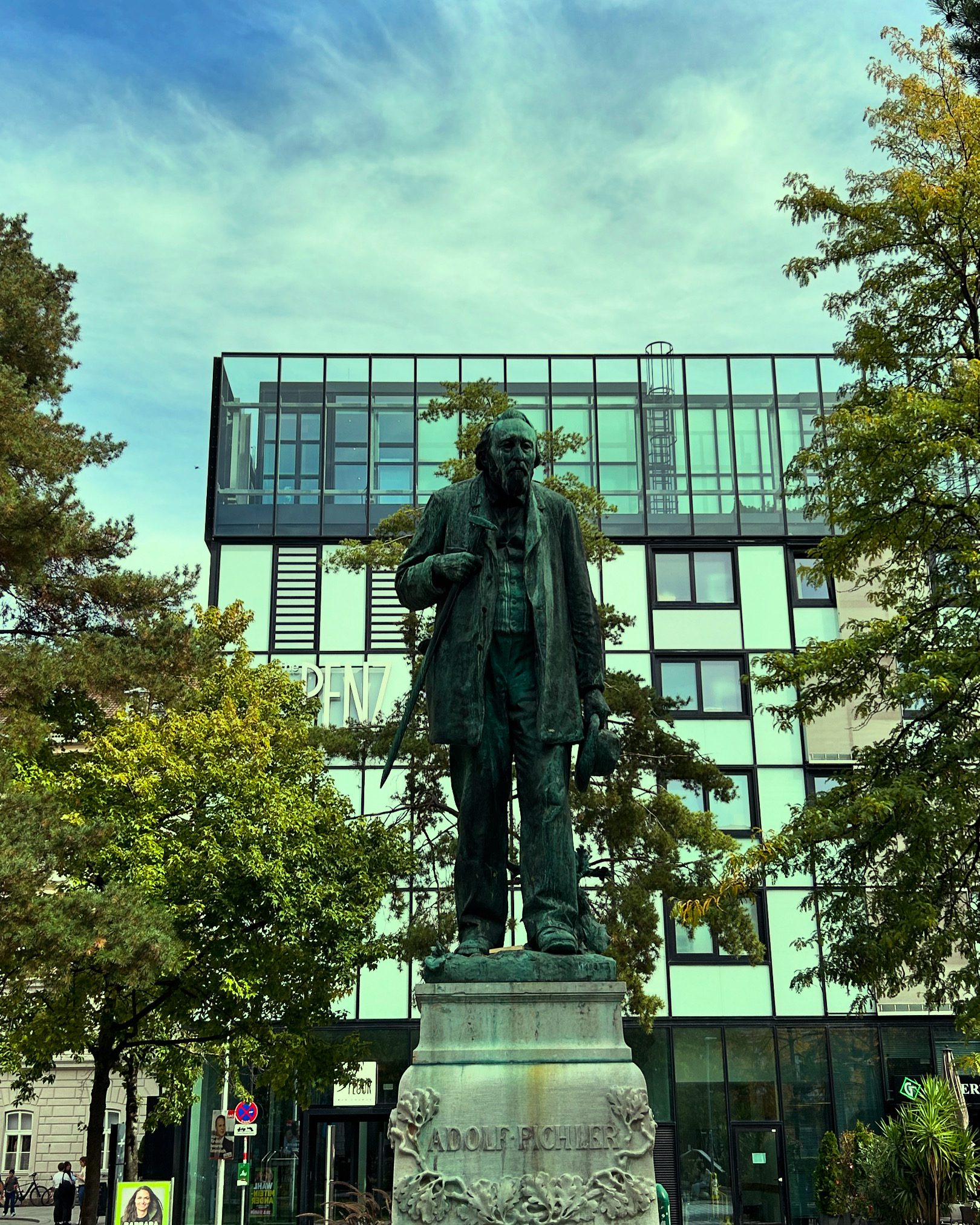
Adolf Pichler: vom Vormärz zum Mainstream
The 19th century transformed Innsbruck in many ways. Politics, administration, society, as well as distributions of power and wealth, underwent profound changes between the first half—still heavily marked by the war years up to 1815—and the second half, which entered European history as the bourgeois era. New professional and social spheres emerged. Through diligence, skill, intellect, and good fortune, the state school and education system allowed individuals to rise further than ever before. Liberal thinkers, who had been suspected of radicalism under Metternich's system and whose writings were frequently censored, were gradually able to express themselves somewhat more freely after 1848. The 1860s brought formal parliamentarism, new municipal statutes, the Compromise with Hungary within the new Austro-Hungarian (k.u.k.) Monarchy, and Austria's exit from the German Confederation. Nationalism, once considered the domain of an avant-garde of a few liberals and "radicals" in the German states, became mainstream politics. The life of Adolf Pichler can be read as representative of these developments. At the age of 12, the son of a customs official moved from Erl near Kufstein to Innsbruck to launch his academic career at the gymnasium. Under the wing of the Jesuits—whom he would later view with little enthusiasm—he began his academic path in the spirit of classical humanism. During this time, Pichler primarily immersed himself in ancient writers and their philosophies. Still a teenager, he founded the association *"Eiche und Buche"* (*Oak and Beech*) with youthful zeal and published a weekly literary journal. During his studies of philosophy, law, and medicine in Innsbruck and Vienna, he read the works of contemporary thinkers—some of whom were subject to censorship—such as Feuerbach, Hegel, and Fichte. He drew from the secret library, affectionately dubbed the *"Giftbude"* (*poison booth*), of Johann Schuler, the editor of the *Tiroler Bote*. He came to know the liberal German champions Anastasius Grün and Heinrich Heine. They advocated for a united German nation in place of the fragmented small states of the German Confederation. Combined with the influence of the eccentric English literary figure Lord Byron and the medieval minnesinger Walther von der Vogelweide, Pichler developed a worldview that would ultimately prevail among Innsbruck's liberal class toward the end of the 19th century: Tyrol was to be part of the German cultural nation. His literary circle, *Die Nibelungen*, founded in 1841, served not only for exchanging books, but also as a precursor to student fraternities, which were banned in Metternich's police state. Four years later, Pichler came firmly into the crosshairs of the secret state police. Together with other "radicals"—most notably Hermann von Gilm—he published the poetry collection *Frühlingslieder aus Tirol* (*Spring Songs from Tyrol*), which fell victim to censorship. Through this collection of harmlessly sentimental poems (from a modern perspective), Pichler had become a sort of intellectual father figure and founder of the *Jungtiroler* (*Young Tyroleans*), without making a remarkably substantial content contribution himself. The young man not only became part of the subversive, Pan-German liberal Tyrolean literary scene, but also corresponded with foreign authors and intellectuals through letters and newspaper articles. His circle of colleagues and friends ranged from Tyroleans Adolf Flir, Johann Senn, and Beda Weber to Grillparzer, Stifter, and Alexander von Humboldt.
In 1848, shortly after completing his medical studies in Vienna, Pichler took part in the fighting along Tyrol’s borders during the Italian wars of independence. He raised his own unit, the Academic Legion. Although students and professors fought alongside Habsburg troops in the defense of the borders, the authorities regarded Pichler’s activities with suspicion. His association with subversive circles and his politically engaged articles, poems, and plays hindered his academic career in the monarchy after the upheavals of 1848. Rejected by the university, he accepted a position teaching at a Gymnasium in Innsbruck, while continuing his work as a literary historian. Pichler devoted himself to documenting the history of Tyrolean literature and encouraged his students to collect plays and traditions from their respective home regions. In the spirit of 1848, he became an eager archivist of Tyrolean traditions, attempting to weave the past and inherited customs into a cohesive, nationally oriented—and distinctly Germanic—narrative. His own literary works, often imbued with national pathos, achieved only limited success. Apart from Rodrigo, a historical drama staged at the Innsbruck City Theatre, his plays failed to reach a wider audience. Set during the fall of the Visigothic kingdom in eighth-century Spain, the play serves as an allegory for Austria’s political situation after its withdrawal from the German Confederation. Rodrigo disappears from history following defeat in a decisive battle at the Guadalete River—a clear parallel to Königgrätz.
Wohl ein wenig desillusioniert nach der in Tirol wenig revolutionären Märzrevolution und dem Ausscheiden Österreichs aus dem deutschen Bund 1866, wandte sich der vom offen Aufsässigen zum stillen Widerspenstigen mutierten Intellektuellen der Geologie zu. Auf langen Wanderungen durch die Alpen sammelte er Erkenntnisse über die geliebte Heimat und konnte so zumindest ein wenig in die Fußstapfen Alexanders von Humboldt treten. 1867 wurde er zum Universitätsprofessor für Geologie in Innsbruck berufen und konnte so seine akademische Karriere im Alter von knapp 50 Jahren doch noch krönen, ohne selbst je ein naturwissenschaftliches Studium absolviert zu haben. Den Posten als Rektor lehnte der unangepasste Pichler ab, zu hoch wäre wohl der Preis dafür gewesen. Liest man heute die Artikel und Gedichte Pichlers, fühlt man sich in Ausdruck und Thematik rund um Deutschtum, Wahrheit, Kampfeslust und Heldenverehrung stark an die Diktion der völkischen Presse der frühen Nationalsozialisten erinnert. Als Intellektueller, Kritiker und Kommentator des Zeitgeschehens beeinflusste Pichler den Zeitgeist der Innsbrucker Politik merklich. Viel ist in seinen Schriften die Rede von deutschen Helden, Walhalla, Wotan, Aufopferung und Erlösung. Bis an sein Lebensende verfasste er Gedichte, Theaterstücke und schmalzige Hymnen wie seinen späten Dietrich von Bern aus dem Jahr 1898.
Do you know Dietrich of Bern, Once held in chains? In anger he breathes fire— until iron melts like wax. Follow the example of your hero— never endure a foreign yoke— never accept as master the slave who once crawled before you.
His primary outlet was the sharply satirical and anti-clerical journal Der Scherer, published between 1899 and 1906. Its logo depicted a smiling elderly Tyrolean presenting a dead mole—symbolizing the clergy, often portrayed as a pest—to the viewer. Pichler also contributed to major newspapers and journals such as Die Presse, Wiener Zeitung, Augsburger Allgemeine, Gartenlaube, Odin, and Germania, consistently writing against both clerical authority and political power. While resolutely nationalist, he rejected the popular forms of antisemitism common at the time, as well as imperialism in all its forms—British, French, or German. He advocated the principle that all peoples and nations should govern themselves, and that culture and tradition deserved respect.
By the time the once “radical” public intellectual died in 1900, he had become a respected figure. His views had remained largely unchanged, but they had moved from the margins into the mainstream and were no longer censored—indeed, they were particularly valued in Innsbruck’s municipal politics under Mayor Wilhelm Greil. Liberal newspapers published effusive tributes. Karl Habermann, editor of Der Scherer, burned a pastoral letter by the Prince-Bishop of Brixen during a torchlight procession in Pichler’s honour—an act that led to legal proceedings. A special issue of Der Scherer, filled with poems and tributes by fellow writers and admirers, included a final farewell written by Pichler himself, in which he compared his pen to the sword of King Arthur. An obituary honoured the “old man” with the words:
“Tyrol, once a black clerical land, has through Pichler become a new centre of intellectual uprising, from which thousands of compatriots across all German regions draw the torch to ignite the sacred flame in their own homes.”
Other publications such as Odin—a militant organ of the pan-German movement—and the Ostdeutsche Rundschau also celebrated the Tyrolean hero. Writers like Franz Kranewitter (1860–1938), Rudolf Greinz (1866–1942), Heinrich von Schullern (1865–1955), and Arthur von Wallpach (1866–1946) carried forward Pichler’s intellectual legacy as part of the Jung-Tirol movement—first in Der Scherer and later in Der Föhn. They were united by shared experiences: Austria’s withdrawal from the German Confederation, the declining power of the Habsburg monarchy, and the loss of southern Tyrolean territories. Their blend of liberalism—partly anti-clerical, partly infused with martial imagery—combined with a strong emphasis on homeland and Tyrolean identity, remained popular both after the First World War and during the National Socialist period. Works such as Kranewitter’s Andreas Hofer and Wallpach’s poetry collections with titles like Tyrolean Blood or We Break Through Death! allowed various political movements to appropriate their messages. Just one year after Pichler’s death, a committee was formed to erect a monument in his honour, chaired by Mayor Greil. Since 1930, Adolf-Pichler-Platz—where his bronze statue stands—has borne his name. Streets in Amras and Pradl commemorate his successors Greinz, Schullern, Kranewitter, and Renk. A memorial plaque adorns Pichler’s former residence in Müllerstraße, decorated with a Tyrolean eagle, laurel wreath, and oak leaves, bearing the inscription: “To the German poet Adolf Pichler – from the Land of Tyrol.”
Sights to see...
Adolf-Pichler-Platz
Adolf-Pichler-Platz
Andechsburg
Innrain 1