Adolf-Pichler-Platz
Adolf-Pichler-Platz
Worth knowing
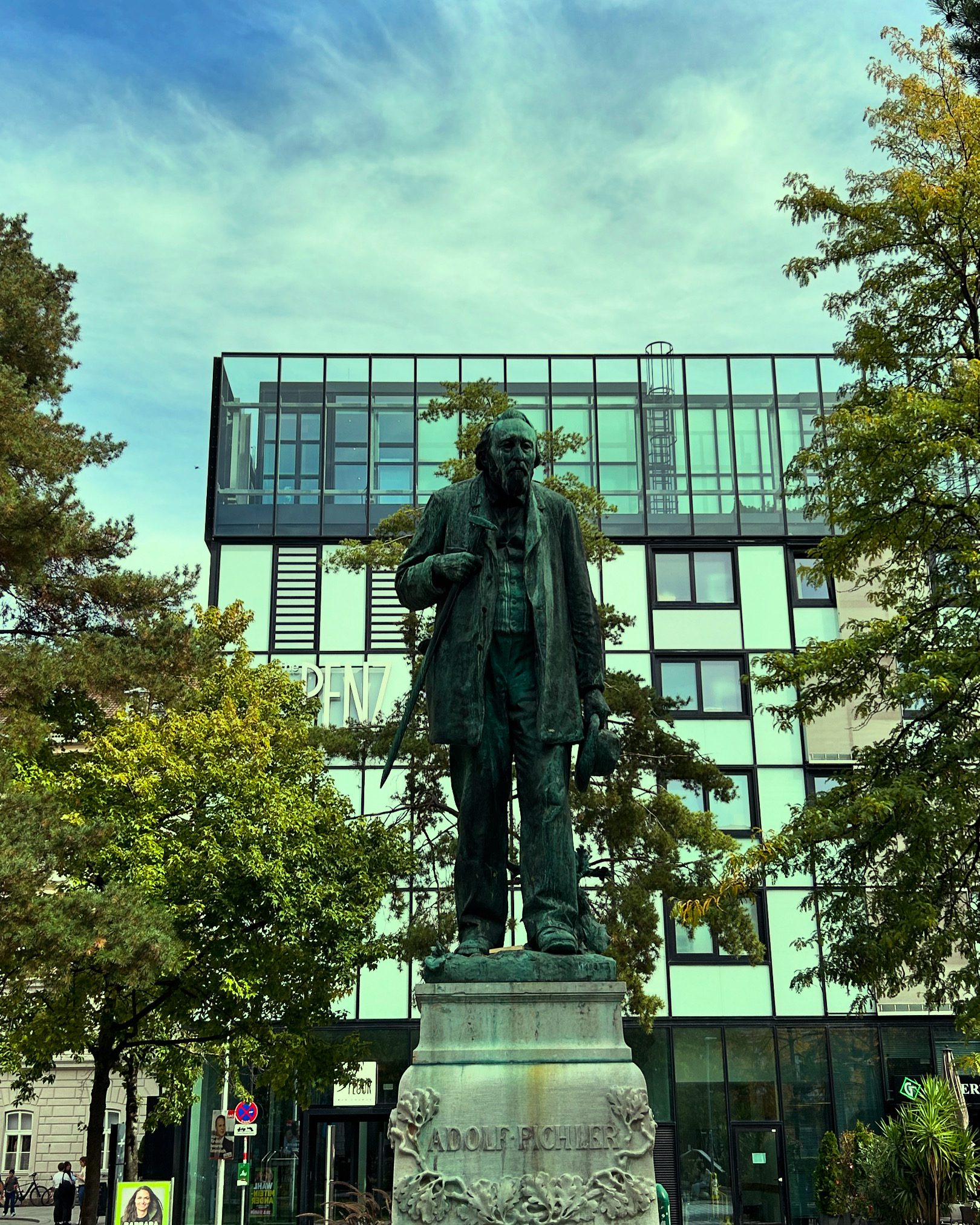
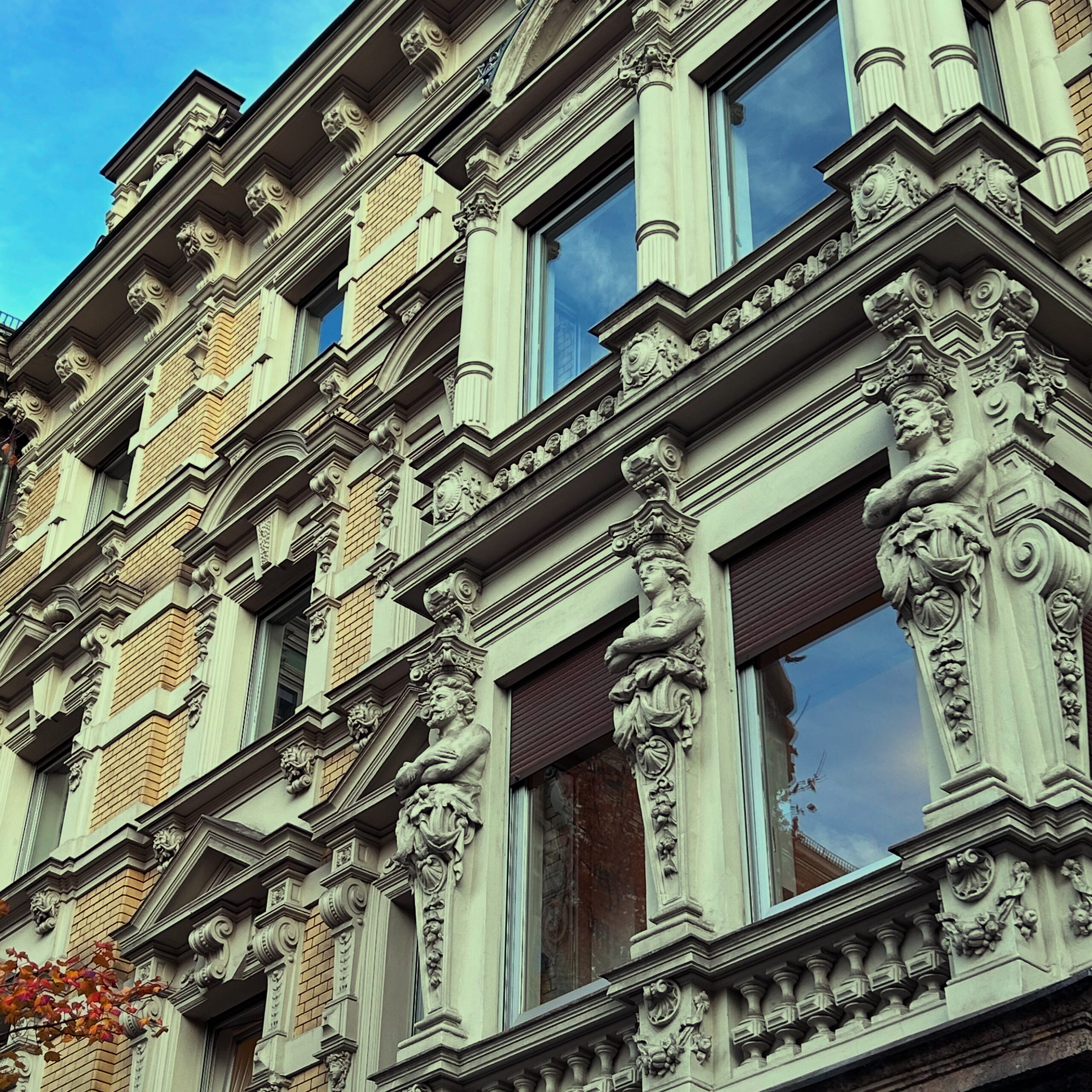
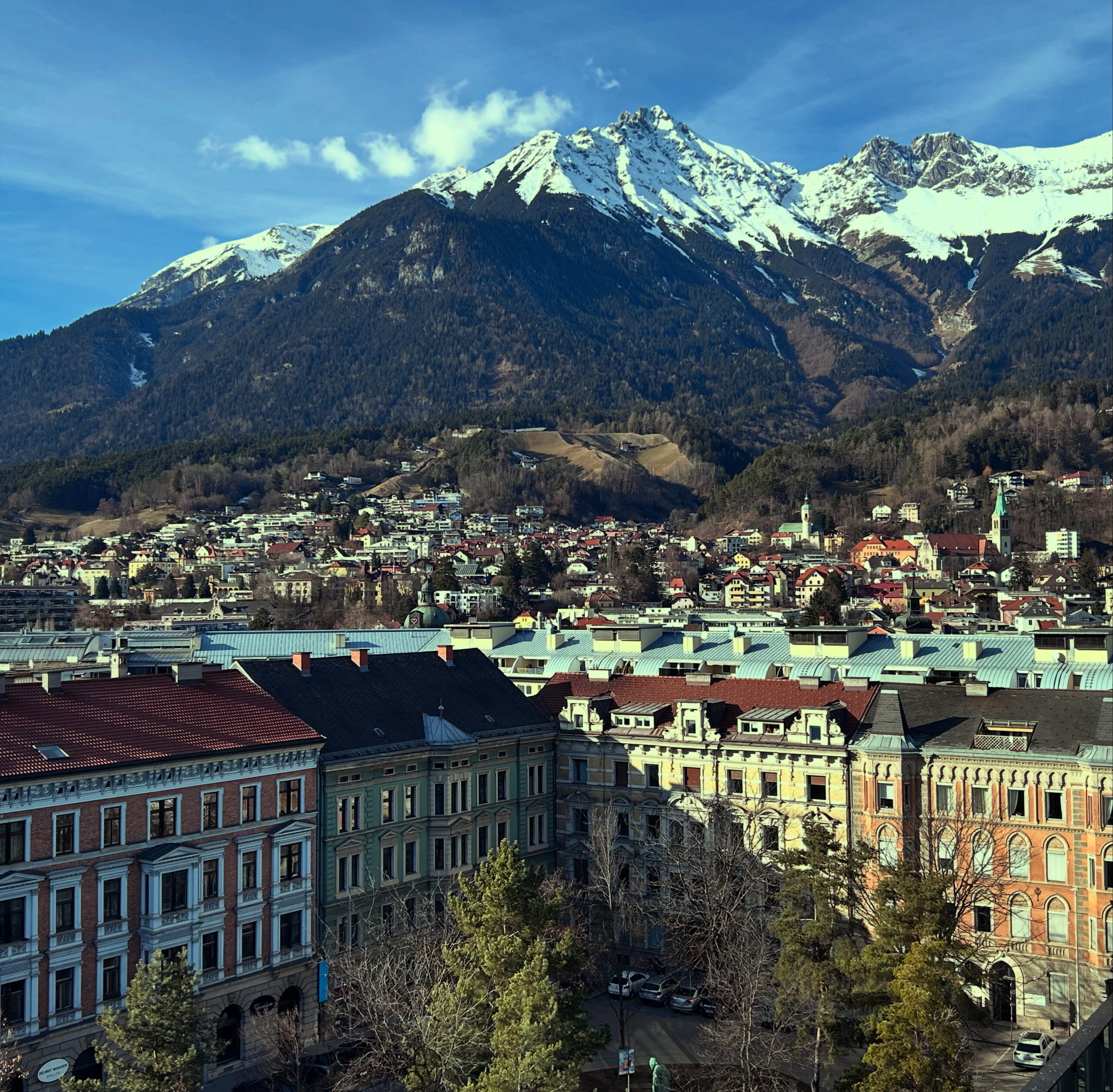
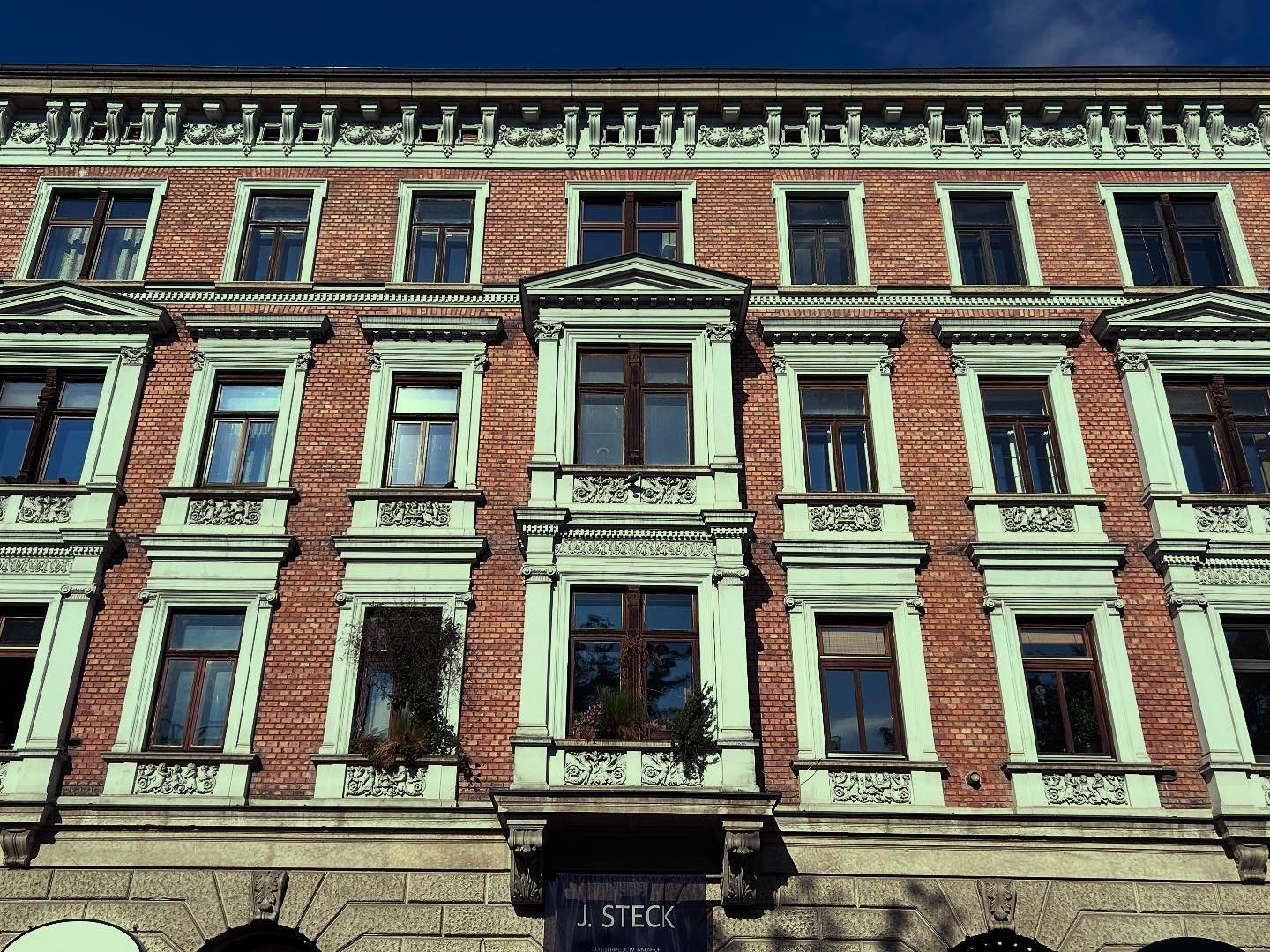
Adolf-Pichler-Platz today is a vibrant mix of buildings from different eras and styles. To the north and west, late 19th-century townhouses frame the small park with its trees, playground equipment, and the Adolf Pichler monument. On the east side, the modern Rathausgalerien with their glass façades adjoin the Federal Secondary School. A narrow cycle lane runs alongside the hopelessly congested street and the perpetually full parking spaces. It is hard to imagine that until the 1860s, a cemetery stood here in the heart of the city. Since the 14th century, the open space outside the city walls, behind the former city hospital and its chapel, had been used as a burial ground complete with arcades and cloisters. Only with the opening of the West Cemetery were the often lavish honorary graves gradually relocated, along with their monuments and memorials, from the Neustadt to the Wiltener fields. When the city hospital moved westward to the outskirts 20 years later, the Innsbruck market expanded onto the vacant land, giving the square the name Neuer Markt (“New Market”). In 1878, the market stalls had to make way for the construction of the elegant row of houses at the northern end of the square. Spurred by economic growth, some of the city’s finest historicist buildings arose here during one of the earliest waves of urban expansion. At the corner of Stainerstraße stands a beautiful residential and commercial building in delicate pink. The adjoining building boasts a neo-Romanesque façade, above whose entrance portal sits the lion typical of this architectural style. Particularly noteworthy is the house built in the rare brick style for Innsbruck. Its bay window is adorned with classical statues, columns, and exuberant ornamentation, while capitals crown the windows. In 1890, the Federal Secondary School moved from today’s Boznerplatz into the vacated premises of the former hospital. Founded nearly 40 years earlier, it represented a science- and mathematics-oriented counterpart to the Jesuit Academic Gymnasium, which focused on the humanities. Instead of classical languages, practical subjects geared toward the modern professional world now took centre stage.
The Adolf Pichler monument in the centre of the square was created under Mayor Wilhelm Greil. The square had long borne the name Karl-Ludwig-Platz, after the Habsburg Archduke and governor in Innsbruck from 1855 to 1861. Just a year after Adolf Pichler’s death (1819–1900), a committee was formed in the typical late-monarchic fashion to commemorate this esteemed “German” citizen in public space. By then, the town hall had moved from the Old Town to Maria-Theresien-Straße. For the municipal council, Adolf Pichler offered the perfect canvas to project the spirit of the age onto the square behind the new town hall. The Innsbruck intellectual embodied the idealised 19th century for the councillors: a self-made man from the bourgeois middle class with liberal and German-national convictions, standing in contrast to the Habsburg Karl Ludwig. The design of the monument was entrusted to Edmund Klotz, a Tyrolean sculptor living in Vienna, who had already created the Greil family tomb at the West Cemetery 20 years earlier. He depicted Pichler in the then-typical hiker and mountaineer outfit, complete with hat, walking stick, and geologist’s hammer as crown and insignia. The monument was inaugurated with pomp and music in 1909. The renaming to Adolf-Pichler-Platz was only decided by the municipal council in 1930.
The upheavals of the decades following the monument’s unveiling did not spare the square. During World War I, the Federal Secondary School premises, like many schools and public institutions, were converted into a military hospital. A bombing raid in December 1944 damaged several buildings. The square, like Tivoli and Rapoldipark, was used by residents as a vegetable garden for self-sufficiency. After the 1960s, traffic conquered the link between the Old Town, Innrain, and Anichstraße. Only with the redesign and new playground in 1994 did Adolf-Pichler-Platz regain its appeal. A few years later came the most comprehensive renovation. The drab façade of the town hall on the west side and its courtyard, used as a car park and rebuilt in the late 1940s after wartime destruction, were extended with a modern section. French architect Dominique Perrault won a competition with his idea of blending municipal offices with shops and restaurants to create a public space. The glass roof of the Rathauspassage is by Daniel Buren, while the tower’s glass façade was designed by Peter Kogler. Construction between 2000 and 2002 progressed slowly, as remnants of the site’s past as a cemetery repeatedly came to light. The new town hall, complete with shopping centre and adjoining hotel, transformed the square entirely. Around the turn of the millennium, the Rathausgalerien—alongside the new Bergisel ski jump and the planned Nordkettenbahn—became another milestone on Innsbruck’s path to its self-proclaimed status as a “world city” through modern architecture. Since the 2000s, glass façades face the Gründerzeit houses. Today, visitors can relax in the park on the former cemetery under Adolf Pichler’s stern gaze or spend the evening in one of the bars. Wilhelm Greil, patron of the monument committee and himself a merchant and moderniser, would likely have approved of this development.
Adolf Pichler: vom Vormärz zum Mainstream
Das 19. Jahrhundert veränderte Innsbruck in vielerlei Hinsicht. Politik, Verwaltung, Gesellschaft, Macht- und Vermögensverhältnisse änderten sich zwischen der ersten Hälfte, die noch stark von den Kriegsjahren bis 1815 geprägt waren, und der zweiten Hälfte, die als bürgerliches Zeitalter in die Geschichte Europas einging. Neue Berufs- und Lebenswelten entstanden. Mit Fleiß, Geschick, Klugheit und Glück konnte man es dank dem staatlichen Schul- und Bildungswesen weiter bringen als je zuvor. Liberale Vordenker, die im System Metternichs unter dem Verdacht der Radikalität standen und deren Schriften oft genug der Zensur anheimfielen, konnten sich nach 1848 nach und nach zumindest etwas freier äußern. Die 1860er Jahre brachten einen formalen Parlamentarismus, neue Gemeindestatuten, den Ausgleich mit Ungarn innerhalb der neuen k.u.k. Monarchie und das Ausscheiden Österreichs aus dem Deutschen Bund. Der ehemals in den deutschen Staaten als Avantgarde einiger Liberaler und „Radikaler“ geltende Nationalismus wurde zur Politik der Mitte.
In Innsbruck kann das Leben Adolf Pichlers stellvertretend für diese Entwicklungen gelesen werden. Mit 12 Jahren kam der Sohn eines Zollbeamten von Erl bei Kufstein nach Innsbruck, um am Gymnasium seine akademische Karriere zu starten. Unter den Fittichen der Jesuiten, denen er später mit wenig Begeisterung begegnen sollte, startete er im Geiste des klassischen Humanismus seine akademische Karriere. Pichler lernte in dieser Zeit vor allem die antiken Schriftsteller und ihre Philosophien kennen. Bereits als Teenager gründete er mit jugendlichem Eifer den Verein „Eiche und Buche“ und gab eine literarische Wochenschrift heraus. Während seinen Philosophie-, Jus- und Medizinstudien in Innsbruck und Wien lernte las er die Werke damals moderner, teils aber unter Zensur stehender Denker wie Feuerbach, Hegel und Fichte. Er bediente sich aus der geheimen Bibliothek, liebevoll Giftbude tituliert, von Johann Schuler, dem Redakteur des Tiroler Boten. Er lernte die liberalen deutschen Vorkämpfer Anastasius Grün und Heinrich Heine kennen. Sie vertraten den Gedanken einer geeinten deutschen Nation anstelle der Kleinstaatlichkeit des Deutschen Bundes. Unter der Beimengung des englischen Literaturexzentrikers Lord Byron und des mittelalterlichen Minnesängers Walther von der Vogelweide entstand sein Blick auf die Welt, der sich innerhalb der liberalen Schicht Innsbrucks gegen Ende des 19. Jahrhunderts durchsetzen sollte. Tirol sollte ein Teil der deutschen Kulturnation sein. 1845 geriet Pichler endgültig ins Visier der geheimen Staatspolizei Metternichs. Gemeinsam mit anderen „Radikalen“, allen voran Hermann von Gilm, gab er den Lyrikband Frühlingslieder aus Tirol heraus, der trotz aller Harmlosigkeit nicht erschienen durfte. Pichler war durch die Sammlung der Gedichte als eine Art geistiger Vater zum Gründer der Jungtiroler geworden, ohne selbst inhaltlich bemerkenswert beizutragen. Der junge Mann wurde nicht nur ein Teil der subversiven, national-liberalen Tiroler Literaturszene, sondern tauschte sich in Briefen und Zeitungsartikeln auch mit ausländischen Autoren und Intellektuellen aus. Sein Kollegen- und Freundeskreis reichte von den Tirolern Adolf Flir, Johann Senn und Beda Weber über Grillparzer und Stifter bis hin zu Alexander von Humboldt.
1848, Pichler hatte gerade sein Medizinstudium in Wien abgeschlossen, beteiligte er sich an den Kämpfen an den Tiroler Landesgrenzen in den Italienischen Unabhängigkeitskriegen. Pichler stellte ein eigenes Corps, die Akademische Legion auf. Obwohl die Studenten und Professoren gemeinsam mit den habsburgischen Truppen den Grenzschutz wahrnahmen, beäugte die Obrigkeit das Treiben Pichlers und seiner Truppe argwöhnisch. Der Umgang mit subversiven Elementen und seine politisch motivierten Artikel, Gedichte und Stücke verhinderten in der Donaumonarchie nach den Wirren von 1848 die akademische Karriere Pichlers. An der Universität abgelehnt musste er sich mit einem Posten am Gymnasium in Innsbruck zufriedengeben. Nebenbei verfolgte er seinen Weg als Literaturhistoriker weiter. Er schrieb über die Geschichte der Tiroler Literatur, ließ sich von seinen Schülern Theaterstücke aus deren jeweiliger Heimatregionen zusammentragen, um diese Tirolensien zu sammeln. Pichler war im Geiste von 1848 ein eifriger Archivar Tiroler Traditionen und Überlieferungen, um die Vergangenheit und Althergebrachtes zu einem nationalen, germanisch gefärbten Narrativ zu bündeln. Seine eigenen, von nationalem Pathos triefenden literarischen Gehversuche bestehend waren nur von überschaubarem Erfolg gekrönt. Pichlers Dramen schafften es mit Ausnahme des Stückes Rodrigo, ein im Innsbrucker Stadttheater aufgeführter Historienschinken nicht an die breite Öffentlichkeit. Die Handlung spielt zur Zeit des Untergangs des Westgotenreichs in Spanien im 8. Jahrhundert und ist eine Anspielung auf die politische Situation in Österreich der Zeit nach dem Ausscheiden der Monarchie aus dem Deutschen Bund. Rodrigo verschwindet der nach einer Niederlage in der Entscheidungsschlacht am spanischen Rio Guadalete, dem Äquivalent zu Königgrätz, aus der Geschichte.
Wohl ein wenig desillusioniert nach der in Österreich wenig revolutionären Märzrevolution und dem Ausscheiden Österreichs aus dem deutschen Bund 1866, wandte sich der vom offen Aufsässigen zum still Widerspenstigen gewandelte Intellektuelle der Geologie zu. Auf langen Wanderungen durch die Alpen sammelte er Erkenntnisse über die geliebte Heimat und konnte so zumindest ein wenig in die Fußstapfen Alexanders von Humboldt treten. 1867 wurde er zum Universitätsprofessor für Geologie in Innsbruck berufen und konnte so seine akademische Karriere im Alter von knapp 50 Jahren doch noch krönen, ohne selbst je ein naturwissenschaftliches Studium absolviert zu haben. Den Posten als Rektor lehnte der unangepasste Pichler ab, zu hoch wäre wohl der Preis dafür gewesen. Liest man heute die Artikel und Gedichte Pichlers, fühlt man sich in Ausdruck und Thematik rund um Deutschtum, Wahrheit, Kampfeslust und Heldenverehrung stark an die Diktion der völkischen Presse der frühen Nationalsozialisten erinnert. Als Intellektueller, Kritiker und Kommentator des Zeitgeschehens beeinflusste Pichler den Zeitgeist der Innsbrucker Politik merklich. Viel ist in seinen Schriften die Rede von den Nibelungen, Walhalla, Wotan, Aufopferung und Erlösung. Bis an sein Lebensende verfasste er Gedichte, Theaterstücke und schmalzige Hymnen wie seinen späten Dietrich von Bern aus dem Jahr 1898.
Kennt den Dietrich Ihr den Berner?
Den man einst in Fesseln schloss –
Flammen atmet er im Zorne –
dass wie Wachs das Eisen floss,
folgt dem Beispiel Eures Helden –
duldet nie ein fremdes Joch –
duldet nie als Herrn den Sklaven –
der am Boden vor Euch kroch.
Sein Hausblatt war der zwischen 1899 und 1906 erscheinenden, bissige politische, antiklerikale Scherer. Das Logo des selbsternannten Satireblattes war ein lächelnder älterer Tiroler, der dem Betrachter einen toten Maulwurf, dem Symbol für den oft als Schädling bezeichneten Klerus entgegenstreckt. Auch in überregionalen Magazinen und Zeitungen wie Presse, Wiener Zeitung, Augsburger Allgemeine, Gartenlaube, Odin und Germania schrieb der stramm deutschnationale Pichler gegen Klerus und Obrigkeit an. Der volkstümlich schwelende Antisemitismus hingegen war ihm fremd und zuwider. Anders als später den Faschisten und Nationalsozialisten sprach sich Pichler auch gegen jegliche Form des Imperialismus aus, sei es britischer, französischer oder deutscher. Alle Völker und Nationen sollten sich selbst verwalten, Kultur und Traditionen sollten geachtet werden.
Als der ehemals als „Radikaler“ angesehene Public Intellectual 1900 seine Augen für immer schloss, war aus ihm ein geachteter Bürger geworden. Seine politischen Ansichten waren dieselben geblieben, entsprachen mittlerweile aber dem Mainstream und wurden nicht mehr zensuriert, sondern ganz besonders im Innsbrucker Gemeinderat unter Wilhelm Greil hochgeschätzt. Die liberale Presse überschlug sich in Lobeshymnen und Wehklagen. Karl Habermann, Herausgeber des Scherer, verbrannte bei einem Fackelzug zu Ehren des hochverehrten Adolf Pichlers einen gegen seine Zeitung gerichteten offenen Brief des Fürstbischofs von Brixen, wofür er sich vor Gericht verantworten musste im Hirtenbriefproceß verantworten musste. In einer eigenen Heftnummer voll mit Gedichten und Artikel literarischer Weggefährten und Bewunderer konnte man im Scherer einen letzten, von Pichler selbst verfassten Abschied, in dem er seine Schreibfeder mit dem Schwerte König Arthurs verglich, lesen. In einem Nachruf ehrte man den „Alten“ mit den Worten:
„Tirol, das schwarze Pfaffenland, es ward durch Pichler zum neuen Flammenherde geistiger Empörung, von dem sich tausende von Volksgenossen in allen deutschen Gauen die Brandfackel holen, um auch in ihrem Heim die heilige Flamme zu entzünden.“
Auch in anderen einschlägigen Magazinen wie Odin – ein Kampfblatt für die alldeutsche Bewegung auf unbedingt völkischem Standpunkte and the Ostdeutschen Rundschau, dem „nationalen Kampfblatt der Deutschen in Österreich“ ließ man den Tiroler Heros hochleben. Schriftsteller wie Franz Kranewitter (1860 – 1938), Rudolf Greinz (1866 - 1942), Heinrich von Schullern (1865 – 1955) und Arthur von Wallpach (1866 – 1946) trugen die literarische Flamme Pichlers als Jung-Tirol weiter, zuerst im Scherer und später in Der Föhn. Sie alle einte die Erfahrung des Ausscheidens Österreichs aus dem Deutschen Bund, der Machtverlust der K.u.K. Monarchie sowie der Verlust der südlichen Landesteile des historischen Tirols. Ihre Form des teils antiklerikalen, teils kriegsverherrlichenden Liberalismus bei gleichzeitiger Lobpreisung der Heimatverbundenheit und des Tiroler Volksgeistes erfreuten sich sowohl nach dem ersten Weltkrieg wie auch während des Nationalsozialismus großer Beliebtheit. Stücke wie der Andreas Hofer Kranewitters und die Gedichtbände Wallpachs mit klingenden Namen wie Tiroler Blut or Wir brechen durch den Tod! – Gedichte aus dem Felde ermöglichten es fast jeder politischen Richtung ihr Programm darin auf die eine oder andere Weise wiederzufinden. Bereits ein Jahr nach Adolf Pichlers Tod wurde ein Komitee ins Leben gerufen, um ihm ein Denkmal zu errichten. Den Vorstand übernahm Bürgermeister Greil, der seinen Spiritus Rector nur zu gerne im öffentlichen Raum platzieren ließ. Seit 1930 ist der Adolf-Pichler-Platz, auf dem die Bronzestatue steht, nach ihm benannt. Auch seinen nachfolgenden Jung-Tirolern Greinz, Schullern, Kranewitter und Renk wurden in Amras und Pradl Straßen gewidmet. Pichlers Wohnhaus in der Müllerstraße schmückt eine Erinnerungstafel mit Tiroler Adler, Lorbeerkranz und Eichellaub: „DEM DEUTSCHEN DICHTER ADOLF PICHLER – DAS LAND TIROL“.
Klingler, Huter, Retter & Co: master builders of expansion
he buildings of the late monarchy still characterise the cityscape of Innsbruck today. The last decades of the 19th century were characterised as Wilhelminian style in the history of Austria. After an economic crisis in 1873, the city began to expand in a revival. From 1880 to 1900, Innsbruck's population grew from 20,000 to 26,000. Wilten, which was incorporated in 1904, tripled in size from 4,000 to 12,000. Between 1850 and 1900, the number of buildings within the city grew from 600 to over 900, most of which were multi-storey apartment blocks, unlike the small buildings of the early modern period. The infrastructure also changed in the course of technical innovations. Gas, water and electricity became part of everyday life for more and more people. The old city hospital gave way to the new hospital. The orphanage and Sieberer's old people's asylum were built in Saggen.
The buildings constructed in the new neighbourhoods were a reflection of this new society. Entrepreneurs, freelancers, employees and workers with political voting rights developed different needs than subjects without this right. From the 1870s, a modern banking system emerged in Innsbruck. Credit institutions such as the Sparkasse, founded in 1821, or the Kreditanstalt, whose building erected in 1910 still stands like a small palace in Maria-Theresien-Straße, not only made it possible to take out loans, but also acted as builders themselves. The apartment blocks that were built also enabled non-homeowners to lead a modern life. Unlike in rural areas of Tyrol, where farming families and their farmhands and maids lived in farmhouses as part of a clan, life in the city came close to the family life we know today. The living space had to correspond to this. The lifestyle of city dwellers demanded multi-room flats and open spaces for relaxation after work. The wealthy middle classes, consisting of entrepreneurs and freelancers, had not yet overtaken the aristocracy, but they had narrowed the gap. They were the ones who not only commissioned private building projects, but also decided on public buildings through their position on the local council.
The 40 years before the First World War were a kind of gold-rush period for construction companies, craftsmen, master builders and architects. The buildings reflected the world view of their clients. Master builders combined several roles and often replaced the architect. Most clients had very clear ideas about what they wanted. They were not to be breathtaking new creations, but copies and references to existing buildings. In keeping with the spirit of the times, the Innsbruck master builders designed the buildings in the styles of historicism and classicism as well as the Tyrolean Heimatstil in accordance with the wishes of the financially strong clients. The choice of style used to build a home was often not only a visual but also an ideological statement by the client. Liberals usually favoured classicism, while conservatives were in favour of the Tyrolean Heimatstil. While the Heimatstil was neo-baroque and featured many paintings, clear forms, statues and columns were style-defining elements in the construction of new classicist buildings. The ideas that people had of classical Greece and ancient Rome were realised in a sometimes wild mix of styles. Not only railway stations and public buildings, but also large apartment blocks and entire streets, even churches and cemeteries were built in this design along the old corridors. The upper middle classes showed their penchant for antiquity with neoclassical façades. Catholic traditionalists had images of saints and depictions of Tyrol's regional history painted on the walls of their Heimatstil houses. While neoclassicism dominates in Saggen and Wilten, most of the buildings in Pradl are in the conservative Heimatstil style.
For a long time, many building experts turned up their noses at the buildings of the upstarts and nouveau riche. Heinrich Hammer wrote in his standard work "Art history of the city of Innsbruck":
"Of course, this first rapid expansion of the city took place in an era that was unfruitful in terms of architectural art, in which architecture, instead of developing an independent, contemporary style, repeated the architectural styles of the past one after the other."
The era of large villas, which imitated the aristocratic residences of days gone by with a bourgeois touch, came to an end after a few wild decades due to a lack of space. Further development of the urban area with individual houses was no longer possible, the space had become too narrow. The area of Falkstrasse / Gänsbachstrasse / Bienerstrasse is still regarded as a neighbourhood today. Villensaggenthe areas to the east as Blocksaggen. In Wilten and Pradl, this type of development did not even occur. Nevertheless, master builders sealed more and more ground in the gold rush. Albert Gruber gave a cautionary speech on this growth in 1907, in which he warned against uncontrolled growth in urban planning and land speculation.
"It is the most difficult and responsible task facing our city fathers. Up until the 1980s (note: 1880), let's say in view of our circumstances, a certain slow pace was maintained in urban expansion. Since the last 10 years, however, it can be said that cityscapes have been expanding at a tremendous pace. Old houses are being torn down and new ones erected in their place. Of course, if this demolition and construction is carried out haphazardly, without any thought, only for the benefit of the individual, then disasters, so-called architectural crimes, usually occur. In order to prevent such haphazard building, which does not benefit the general public, every city must ensure that individuals cannot do as they please: the city must set a limit to unrestricted speculation in the area of urban expansion. This includes above all land speculation."
A handful of master builders and the Innsbruck building authority accompanied this development in Innsbruck. If Wilhelm Greil is described as the mayor of the expansion, the Viennese-born Eduard Klingler (1861 - 1916) probably deserves the title of its architect. Klingler played a key role in shaping Innsbruck's cityscape in his role as a civil servant and master builder. He began working for the state of Tyrol in 1883. In 1889, he joined the municipal building department, which he headed from 1902. In Innsbruck, the commercial academy, the Leitgebule school, the Pradl cemetery, the dermatological clinic in the hospital area, the municipal kindergarten in Michael-Gaismair-Straße, the Trainkaserne (note: today a residential building), the market hall and the Tyrolean State Conservatory are all attributable to Klingler as head of the building department. The Ulrichhaus on Mount Isel, which is now home to the Alt-Kaiserjäger-Club, is a building worth seeing in the Heimatstil style based on his design.
The most important building office in Innsbruck was Johann Huter & Sons. Johann Huter took over his father's brickworks. In 1856, he acquired the first company premises, the Hutergründeon the Innrain. Three years later, the first prestigious headquarters were built in Meranerstraße. The company registration together with his sons Josef and Peter in 1860 marked the official start of the company that still exists today. Huter & Söhne like many of its competitors, saw itself as a complete service provider. The company had its own brickworks, a cement factory, a joinery and a locksmith's shop as well as a planning office and the actual construction company. In 1906/07, the Huters built their own company headquarters at Kaiser-Josef-Straße 15 in the typical style of the last pre-war years. The stately house combines the Tyrolean Heimatstil surrounded by gardens and nature with neo-Gothic and neo-Romanesque elements. Famous from Huter & Söhne buildings erected in Innsbruck include the Monastery of Perpetual Adoration, the parish church of St Nicholas, the first building of the new clinic and several buildings on Claudiaplatz. Shortly before the outbreak of the First World War, the construction company employed more than 700 people.
The second major player was Josef Retter (1872 - 1954). Born in Lower Austria with Tyrolean roots, he completed an apprenticeship as a bricklayer before joining the k.k. State Trade School in Vienna and attended the foreman's school in the building trade department. After gaining professional experience in Vienna, Croatia and Bolzano throughout the Danube Monarchy, he was able to open his own construction company in Innsbruck at the age of 29 thanks to his wife's dowry. Like Huter, his company also included a sawmill, a sand and gravel works and a workshop for stonemasonry work. In 1904, he opened his residential and office building at Schöpfstraße 23a, which is still used today as a Rescuer's house is well known. The dark, neo-Gothic building with its striking bay window with columns and a turret is adorned with a remarkable mosaic depicting an allegory of architecture. The gable relief shows the combination of art and craftsmanship, a symbol of Retter's career. His company was particularly influential in Wilten and Saggen. With the new Academic Grammar School, the castle-like school building for the Commercial Academy, the Evangelical Church of Christ in Saggen, the Zelgerhaus in Anichstraße, the Sonnenburg in Wilten and the neo-Gothic Mentlberg Castle on Sieglanger, he realised many of the most important buildings of this era in Innsbruck.
Late in life but with a similarly practice-orientated background that was typical of 19th century master builders, Anton Fritz started his construction company in 1888. He grew up remotely in Graun in the Vinschgau Valley. After working as a foreman, plasterer and bricklayer, he decided to attend the trade school in Innsbruck at the age of 36. Talent and luck brought him his breakthrough as a planner with the country-style villa at Karmelitergasse 12. In its heyday, his construction company employed 150 people. In 1912, shortly before the outbreak of the First World War and the resulting slump in the construction industry, he handed over his company to his son Adalbert. Anton Fritz's legacy includes his own home at Müllerstraße 4, the Mader house in Glasmalereistraße and houses on Claudiaplatz and Sonnenburgplatz.
With Carl Kohnle, Carl Albert, Karl Lubomirski and Simon Tommasi, Innsbruck had other master builders who immortalised themselves in the cityscape with buildings typical of the late 19th century. They all made Innsbruck's new streets shine in the prevailing architectural zeitgeist of the last 30 years of the Danube Monarchy. Residential buildings, railway stations, official buildings and churches in the vast empire between the Ukraine and Tyrol looked similar across the board. New trends such as Art Nouveau emerged only hesitantly. In Innsbruck, it was the Munich architect Josef Bachmann who set a new accent in civic design with the redesign of the façade of the Winklerhaus. Building activity came to a halt at the beginning of the First World War. After the war, the era of neoclassical historicism and Heimatstil was finally history. Times were more austere and the requirements for residential buildings had changed. More important than a representative façade and large, stately rooms became affordable living space and modern facilities with sanitary installations during the housing shortage of the sparse, young Republic of German-Austria. The more professional training of master builders and architects at the k.k. Staatsgewerbeschule also contributed to a new understanding of the building trade than the often self-taught veterans of the gold-digger era of classicism had. Walks in Saggen and parts of Wilten and Pradl still take you back to the days of the Wilhelminian style. Claudiaplatz and Sonnenburgplatz are among the most impressive examples. The construction company Huter and Sons still exists today. The company is now located in Sieglanger in Josef-Franz-Huter-Straße, named after the company founder. Although the residential building in Kaiser-Josef-Straße no longer bears the company's logo, its opulence is still a relic of the era that changed Innsbruck's appearance forever. In addition to his home in Schöpfstraße, Wilten is home to a second building belonging to the Retter family. On the Innrain opposite the university is the Villa Retter. Josef Retter's eldest daughter Maria Josefa, who herself was educated by the reform pedagogue Maria Montessori, opened the first „House of the child“ of Innsbruck. Above the entrance is a portrait of the patron Josef Retter, while the south façade is adorned with a mosaic in the typical style of the 1930s, hinting at the building's original purpose. A smiling, blonde girl embraces her mother, who is holding a book, and her father, who is carrying a hammer. The small burial chapel at the Westfriedhof cemetery, which serves as the Retters' family burial place, is also a legacy of this important family for Innsbruck that is well worth seeing.
Wilhelm Greil: DER Bürgermeister Innsbrucks
One of the most important figures in the town's history was Wilhelm Greil (1850 - 1923). From 1896 to 1923, the entrepreneur held the office of mayor, having previously helped to shape the city's fortunes as deputy mayor. It was a time of growth, the incorporation of entire neighbourhoods, technical innovations and new media. The four decades between the economic crisis of 1873 and the First World War were characterised by unprecedented economic growth and rapid modernisation. Private investment in infrastructure such as railways, energy and electricity was desired by the state and favoured by tax breaks in order to lead the countries and cities of the ailing Danube monarchy into the modern age. The city's economy boomed. Businesses sprang up in the new districts of Pradl and Wilten, attracting workers. Tourism also brought fresh capital into the city. At the same time, however, the concentration of people in a confined space under sometimes precarious hygiene conditions also brought problems. The outskirts of the city and the neighbouring villages in particular were regularly plagued by typhus.
Innsbruck city politics, in which Greil was active, was characterised by the struggle between liberal and conservative forces. Greil belonged to the "Deutschen Volkspartei", a liberal and national-Great German party. What appears to be a contradiction today, liberal and national, was a politically common and well-functioning pair of ideas in the 19th century. The Pan-Germanism was not a political peculiarity of a radical right-wing minority, but rather a centrist trend, particularly in German-speaking cities in the Reich, which was significant in various forms across almost all parties until after the Second World War. Innsbruckers who were self-respecting did not describe themselves as Austrians, but as Germans. Those who were members of the liberal Innsbrucker Nachrichten of the period around the turn of the century, you will find countless articles in which the common ground between the German Empire and the German-speaking countries was made the topic of the day, while distancing themselves from other ethnic groups within the multinational Habsburg Empire. Greil was a skilful politician who operated within the predetermined power structures of his time. He knew how to skilfully manoeuvre around the traditional powers, the monarchy and the clergy and to come to terms with them.
Taxes, social policy, education, housing and the design of public spaces were discussed with passion and fervour. Due to an electoral system based on voting rights via property classes, only around 10% of the entire population of Innsbruck were able to go to the ballot box. Women were excluded as a matter of principle. Relative suffrage applied within the three electoral bodies, which meant as much as: The winner takes it all. Greil wohne passenderweise ähnlich wie ein Renaissancefürst. Er entstammte der großbürgerlichen Upper Class. Sein Vater konnte es sich leisten, im Palais Lodron in der Maria-Theresienstraße die Homebase der Familie zu gründen. Massenparteien wie die Sozialdemokratie konnten sich bis zur Wahlrechtsreform der Ersten Republik nicht durchsetzen. Konservative hatten es in Innsbruck auf Grund der Bevölkerungszusammensetzung, besonders bis zur Eingemeindung von Wilten und Pradl, ebenfalls schwer. Bürgermeister Greil konnte auf 100% Rückhalt im Gemeinderat bauen, was die Entscheidungsfindung und Lenkung natürlich erheblich vereinfachte. Bei aller Effizienz, die Innsbrucker Bürgermeister bei oberflächlicher Betrachtung an den Tag legten, sollte man nicht vergessen, dass das nur möglich war, weil sie als Teil einer Elite aus Unternehmern, Handelstreibenden und Freiberuflern ohne nennenswerte Opposition und Rücksichtnahme auf andere Bevölkerungsgruppen wie Arbeitern, Handwerkern und Angestellten in einer Art gewählten Diktatur durchregierten. Das Reichsgemeindegesetz von 1862 verlieh Städten wie Innsbruck und damit den Bürgermeistern größere Befugnisse. Es verwundert kaum, dass die Amtskette, die Greil zu seinem 60. Geburtstag von seinen Kollegen im Gemeinderat verliehen bekam, den Ordensketten des alten Adels erstaunlich ähnelte.
Under Greil's aegis and the general economic upturn, fuelled by private investment, Innsbruck expanded at a rapid pace. In true merchant style, the municipal council purchased land with foresight in order to enable the city to innovate. The politician Greil was able to rely on the civil servants and town planners Eduard Klingler, Jakob Albert and Theodor Prachensky for the major building projects of the time. Infrastructure projects such as the new town hall in Maria-Theresienstraße in 1897, the opening of the Mittelgebirgsbahn railway, the Hungerburgbahn and the Karwendelbahn wurden während seiner Regierungszeit umgesetzt. Weitere gut sichtbare Meilensteine waren die Erneuerung des Marktplatzes und der Bau der Markthalle. Neben den prestigeträchtigen Großprojekten entstanden in den letzten Jahrzehnten des 19. Jahrhunderts aber viele unauffällige Revolutionen. Vieles, was in der zweiten Hälfte des 19. Jahrhunderts vorangetrieben wurde, gehört heute zum Alltag. Für die Menschen dieser Zeit waren diese Dinge aber eine echte Sensation und lebensverändernd. Bereits Greils Vorgänger Bürgermeister Heinrich Falk (1840 – 1917) hatte erheblich zur Modernisierung der Stadt und zur Besiedelung des Saggen beigetragen. Seit 1859 war die Beleuchtung der Stadt mit Gasrohrleitungen stetig vorangeschritten. Mit dem Wachstum der Stadt und der Modernisierung wurden die Senkgruben, die in Hinterhöfen der Häuser als Abort dienten und nach Entleerung an umliegende Landwirte als Dünger verkauft wurden, zu einer Unzumutbarkeit für immer mehr Menschen. 1880 wurde das RaggingThe city was responsible for the emptying of the lavatories. Two pneumatic machines were to make the process at least a little more hygienic. Between 1887 and 1891, Innsbruck was equipped with a modern high-pressure water pipeline, which could also be used to supply fresh water to flats on higher floors. For those who could afford it, this was the first opportunity to install a flush toilet in their own home.
Greil continued this campaign of modernisation. After decades of discussions, the construction of a modern alluvial sewerage system began in 1903. Starting in the city centre, more and more districts were connected to this now commonplace luxury. By 1908, only the Koatlackler Mariahilf und St. Nikolaus nicht an das Kanalsystem angeschlossen. Auch der neue Schlachthof im Saggen erhöhte Hygiene und Sauberkeit in der Stadt. Schlecht kontrollierte Hofschlachtungen gehörten mit wenigen Ausnahmen der Vergangenheit an. Das Vieh kam im Zug am Sillspitz an und wurde in der modernen Anlage fachgerecht geschlachtet. Greil überführte auch das Gaswerk in Pradl und das Elektrizitätswerk in Mühlau in städtischen Besitz. Die Straßenbeleuchtung wurde im 20. Jahrhundert von den Gaslaternen auf elektrisches Licht umgestellt. 1888 übersiedelte das Krankenhaus von der Maria-Theresienstraße an seinen heutigen Standort. Bürgermeister und Gemeinderat konnten sich bei dieser Innsbrucker Renaissance neben der wachsenden Wirtschaftskraft in der Vorkriegszeit auch auf Mäzen aus dem Bürgertum stützen. Waren technische Neuerungen und Infrastruktur Sache der Liberalen, verblieb die Fürsorge der Ärmsten weiterhin bei klerikal gesinnten Kräften, wenn auch nicht mehr bei der Kirche selbst. Freiherr Johann von Sieberer stiftete das Greisenasyl und das Waisenhaus im Saggen. Leonhard Lang stiftete das Gebäude in der Maria-Theresienstraße, in der sich bis heute das Rathaus befindet gegen das Versprechen der Stadt ein Lehrlingsheim zu bauen.
Im Gegensatz zur boomenden Vorkriegsära war die Zeit nach 1914 vom Krisenmanagement geprägt. In seinen letzten Amtsjahren begleitete Greil Innsbruck am Übergang von der Habsburgermonarchie zur Republik durch Jahre, die vor allem durch Hunger, Elend, Mittelknappheit und Unsicherheit geprägt waren. Er war 68 Jahre alt, als italienische Truppen nach dem Ersten Weltkrieg die Stadt besetzten und Tirol am Brenner geteilt wurde. Das Ende der Monarchie und des Zensuswahlrechts bedeuteten auch den Niedergang der Liberalen in Innsbruck, auch wenn Greil das in seiner aktiven Karriere nur teilweise miterlebte. 1919 konnten die Sozialdemokraten in Innsbruck zwar zum ersten Mal den Wahlsieg davontragen, dank der Mehrheiten im Gemeinderat blieb Greil aber Bürgermeister. 1928 verstarb er als Ehrenbürger der Stadt Innsbruck im Alter von 78 Jahren. Die Wilhelm-Greil-Straße war noch zu seinen Lebzeiten nach ihm benannt worden.
The First World War
It was almost not Gavrilo Princip, but a student from Innsbruck who changed the fate of the world. It was thanks to chance that the 20-year-old Serb was stopped in 1913 because he bragged to a waitress that he was planning to assassinate the heir to the throne. It was only when the world-changing shooting in Sarajevo actually took place that an article about it appeared in the media. After the actual assassination of Franz Ferdinand on 28 June, it was impossible to foresee what impact the First World War that broke out as a result would have on the world and people's everyday lives. However, two days after the assassination of the Habsburg in Sarajevo, the Innsbrucker Nachrichten already prophetic: "We have reached a turning point - perhaps the "turning point" - in the fortunes of this empire".
Enthusiasm for the war in 1914 was also high in Innsbruck. From the "Gott, Kaiser und VaterlandDriven by the "spirit of the times", most people unanimously welcomed the attack on Serbia. Politicians, the clergy and the press joined in the general rejoicing. In addition to the imperial appeal "To my peoples", which appeared in all the media of the empire, the Innsbrucker Nachrichten On 29 July, the day after Austria-Hungary declared war on Serbia, the media published an article about the capture of Belgrade by Prince Eugene in 1717. The tone in the media was celebratory, although not entirely without foreboding of what was to come.
"The Emperor's appeal to his people will be deeply felt. The internal strife has been silenced and the speculations of our enemies about unrest and similar things have been miserably put to shame. Above all, the Germans stand by the Emperor and the Empire in their old and well-tried loyalty: this time, too, they are ready to stand up for dynasty and fatherland with their blood. We are facing difficult days; no one can even guess what fate will bring us, what it will bring to Europe, what it will bring to the world. We can only trust with our old Emperor in our strength and in God and cherish the confidence that, if we find unity and stick together, we must be granted victory, for we did not want war and our cause is that of justice!"
Theologians such as Joseph Seeber (1856 - 1919) and Anton Müllner alias Bruder Willram (1870 - 1919) who, with her sermons and writings such as "Das blutige Jahr" elevated the war to a crusade against France and Italy.
Many Innsbruckers volunteered for the campaign against Serbia, which was thought to be a matter of a few weeks or months. Such a large number of volunteers came from outside the city to join the military commissions that Innsbruck was almost bursting at the seams. Nobody could have guessed how different things would turn out. Even after the first battles in distant Galicia, it was clear that it would not be a matter of months. Kaiserjäger and other Tyrolean troops were literally burnt out. Poor equipment, a lack of supplies and the catastrophic leadership of the high command under Konrad von Hötzendorf led to the deaths of thousands or to captivity, where hunger, abuse and forced labour awaited them.
In 1915, the Kingdom of Italy entered the war on the side of France and England. This meant that the front went right through what was then Tyrol. From the Ortler in the west across northern Lake Garda to the Sextener Dolomiten the battles of the mountain war took place. Innsbruck was not directly affected by the fighting. However, the war could at least be heard as far as the provincial capital, as was reported in the newspaper of 7 July 1915:
„Bald nach Beginn der Feindseligkeiten der Italiener konnte man in der Gegend der Serlesspitze deutlich Kanonendonner wahrnehmen, der von einem der Kampfplätze im Süden Tirols kam, wahrscheinlich von der Vielgereuter Hochebene. In den letzten Tagen ist nun in Innsbruck selbst und im Nordosten der Stadt unzweifelhaft der Schall von Geschützdonner festgestellt worden, einzelne starke Schläge, die dumpf, nicht rollend und tönend über den Brenner herüberklangen. Eine Täuschung ist ausgeschlossen. In Innsbruck selbst ist der Donner der Kanonen schwerer festzustellen, weil hier der Lärm zu groß ist, es wurde aber doch einmal abends ungefähr um 9 Uhr, als einigermaßen Ruhe herrschte, dieser unzweifelhafte von unseren Mörsern herrührender Donner gehört.“
Until the transfer of regular troops from the Eastern Front to the Tyrolean borders, the national defence depended on the Standschützen, a troop made up of men under 21, over 42 or unfit for regular military service. The casualty figures were correspondingly high.
Although the front was relatively far away from Innsbruck, the war also penetrated civilian life. Due to the mass mobilisation of a large part of the working male population, many businesses came to a complete standstill. Shelves in shops remained empty, public transport came to a standstill, craftsmen and labourers were missing everywhere. There was often a shortage of coal and firewood. Hunger and cold became bitter enemies of women, children, the wounded and those unfit for war in the city. This experience of the total involvement of society as a whole was new to the people. Barracks were erected in the Höttinger Au to house prisoners of war. Transports of wounded brought such a large number of horribly injured people that many civilian buildings such as the university library, which was currently under construction, or Ambras Castle were converted into military hospitals. The Pradl military cemetery was established to cope with the large number of fallen soldiers. A predecessor to tram line 3 was set up to transport the wounded from the railway station to the new garrison hospital, today's Conrad barracks in Pradl. The companies that were still able to produce were subordinated to the war economy. However, the longer the war lasted, the fewer there were. By the winter of 1917, Innsbruck's economy had almost completely collapsed.
As the war drew to a close, so did the front. In February 1918, the Italian air force managed to drop three bombs on Innsbruck. In this winter, which was known as Hunger winter When the war went down in European history, the shortages also made themselves felt. In the final years of the war, food was supplied via ration coupons. 500 g of meat, 60 g of butter and 2 kg of potatoes were the basic diet per person - per week, mind you. Archive photos show the long queues of desperate and hungry people outside the food shops. There were repeated protests and strikes. Politicians, trade unionists, workers and war returnees saw their chance for change. Under the motto Peace, bread and the right to vote a wide variety of parties united in resistance to the war. At this time, most people were already aware that the war was lost and what fate awaited Tyrol, as this article from 6 October 1918 shows:
„Aeußere und innere Feinde würfeln heute um das Land Andreas Hofers. Der letzte Wurf ist noch grausamer; schändlicher ist noch nie ein freies Land geschachert worden. Das Blut unserer Väter, Söhne und Brüder ist umsonst geflossen, wenn dieser schändliche Plan Wirklichkeit werden soll. Der letzte Wurf ist noch nicht getan. Darum auf Tiroler, zum Tiroler Volkstag in Brixen am 13. Oktober 1918 (nächsten Sonntag). Deutscher Boden muß deutsch bleiben, Tiroler Boden muß tirolisch bleiben. Tiroler entscheidet selbst über Eure Zukunft!“
On 4 November, Austria-Hungary and the Kingdom of Italy finally agreed an armistice. This gave the Allies the right to occupy areas of the monarchy. The very next day, Bavarian troops entered Innsbruck. Austria's ally Germany was still at war with Italy and was afraid that the front could be moved closer to the German Reich in North Tyrol. Fortunately for Innsbruck and the surrounding area, however, Germany also surrendered a week later on 11 November. This meant that the major battles between regular armies did not take place.
Nevertheless, Innsbruck was in danger. Huge columns of military vehicles, trains full of soldiers and thousands of emaciated soldiers making their way home from the front on foot passed through the city. Those who could, jumped on one of the overcrowded trains or a car to leave the Brenner Pass behind them to get home. In November 1918, more than 270 soldiers lost their lives during these daring manoeuvres or had to be admitted to one of the city's military hospitals. The city not only had to keep its own citizens in check and guarantee rations, but also protect itself from looting. In order to maintain public order, the Tyrolean National Council formed a People's Army on 5 November made up of schoolchildren, students, workers and citizens. On 23 November 1918, Italian troops occupied the city and the surrounding area. Mayor Greil's appeasement to the people of Innsbruck to surrender the city without rioting was successful. 5000 men had to find shelter in the starving and miserable city. Schools were turned into barracks. Although there were isolated riots, hunger riots and looting, there were no armed clashes with the occupying troops or even a Bolshevik revolution as in Munich.
Over 1200 Innsbruck residents lost their lives on the battlefields and in military hospitals, over 600 were wounded. Memorials to the First World War and its victims can be found in Innsbruck, particularly at churches and cemeteries. The Kaiserjägermuseum on Mount Isel displays uniforms, weapons and pictures of the battle. Streets in Innsbruck are dedicated to the two theologians Anton Müllner and Josef Seeber. A street was also named after the commander-in-chief of the Imperial and Royal Army on the Southern Front, Archduke Eugene. There is a memorial to the unsuccessful commander in front of the Hofgarten. The eastern part of the Amras military cemetery commemorates the Italian occupation.
Risen from the ruins
Nach Kriegsende kontrollierten US-Truppen für zwei Monate Tirol. Anschließend übernahm die Siegermacht Frankreich die Verwaltung. Den Tirolern blieb die sowjetische Besatzung, die über Ostösterreich hereinbrach, erspart. Besonders in den ersten drei Nachkriegsjahren war der Hunger der größte Feind der Menschen. Der Mai 1945 brachte nicht nur das Kriegsende, sondern auch Schnee. Der Winter 1946/47 ging als besonders kalt und lang in die Tiroler Klimageschichte ein, der Sommer als besonders heiß und trocken. Es kam zu Ernteausfällen von bis zu 50%. Die Versorgungslage war vor allem in der Stadt in der unmittelbaren Nachkriegszeit katastrophal. Die tägliche Nahrungsmittelbeschaffung wurde zur lebensgefährlichen Sorge im Alltag der Innsbrucker. Neben den eigenen Bürgern mussten auch tausende von Displaced PersonsThe Tyrolean government had to feed a large number of people, freed forced labourers and occupying soldiers. To accomplish this task, the Tyrolean provincial government had to rely on outside help. The chairman of the UNRRA (Note: United Nations Relief and Rehabilitation Administration), which supplied war zones with essentials, Fiorello La Guardia counted Austria "to those peoples of the world who are closest to starvation." Milk, bread, eggs, sugar, flour, fat - there was too little of everything. The French occupation was unable to meet the demand for the required kilocalories per capita, as the local population and the emergency services often lacked supplies. Until 1946, they even took goods from the Tyrolean economy.
Die Lebensmittelversorgung erfolgte schon wenige Wochen nach Kriegsende über Lebensmittelkarten. Erwachsene mussten eine Bestätigung des Arbeitsamtes vorlegen, um an diese Karten zu kommen. Die Rationen unterschieden sich je nach Kategorie der Arbeiter. Schwerstarbeiter, Schwangere und stillende Mütter erhielten Lebensmittel im „Wert“ von 2700 Kalorien. Handwerker mit leichten Berufen, Beamte und Freiberufler erhielten 1850 Kilokalorien, Angestellte 1450 Kalorien. Hausfrauen und andere „Normalverbraucher“ konnten nur 1200 Kalorien beziehen. Zusätzlich gab es Initiativen wie Volksküchen oder Ausspeisungen für Schulkinder, die von ausländischen Hilfsorganisationen übernommen wurden. Aus Amerika kamen Carepakete von der Wohlfahrtsorganisation Cooperative for American Remittances to Europe. Many children were sent to foster homes in Switzerland in the summer to regain their strength and put a few extra kilos on their ribs.
However, all these measures were not enough for everyone. Housewives and other "normal consumers" in particular suffered from the low allocations. Despite the risk of being arrested, many Innsbruck residents travelled to the surrounding villages to hoard. Those who had money paid sometimes utopian prices to the farmers. Those who had none had to beg for food. In extreme cases, women whose husbands had been killed, captured or were missing saw no other way out than to prostitute themselves. These women, especially the unfortunate ones who became pregnant, had to endure the worst abuse for themselves and their offspring. Austria was still 30 years away from legalised abortion.
Politicians were largely powerless in the face of this. Even in normal times, it was impossible to pacify all interests. Many decisions between the parliament in Vienna, the Tyrolean provincial parliament and Innsbruck town hall were incomprehensible to the people. While children had to do without fruit and vitamins, some farmers legally distilled profitable schnapps. Official buildings and commercial enterprises were given free rein by the Innsbruck electricity company, while private households were restricted access to electricity at several times of the day from October 1945. The same disadvantage for households compared to businesses applied to the supply of coal. The old rifts between town and country grew wider and more hateful. Innsbruckers accused the surrounding population of deliberately withholding food for the black market. There were robberies, thefts and woodcutting. Transports at the railway station were guarded by armed units. Obtaining food from a camp was both illegal and commonplace. Children and young people roamed the city hungry and took every opportunity to get something to eat or fuel. The first Tyrolean governor Gruber, himself an illegal member of the resistance during the war, understood the situation of the people who rebelled against the system, but was unable to do anything about it. The mayor of Innsbruck, Anton Melzer, also had his hands tied. Not only was it difficult to reconcile the needs of all interest groups, there were repeated cases of corruption and favours to relatives and acquaintances among the civil servants. Gruber's successor in the provincial governor's chair, Alfons Weißgatterer, had to survive several small riots when popular anger was vented and stones were thrown in the direction of the Landhaus. Tiroler Tageszeitung. The paper was founded in 1945 under the administration of the US armed forces for the purposes of democratisation and denazification, but was transferred the following year to Schlüssel GmbH under the management of ÖVP politician Joseph Moser. Thanks to the high circulation and its almost direct influence on the content, the Tyrolean provincial government was able to steer the public mood:
„Are the broken windows that clattered from the country house into the street yesterday suitable arguments to prove our will to rebuild? Shouldn't we remember that economic difficulties have never been resolved by demonstrations and rallies in any country?“
The housing situation was at least as bad. An estimated 30,000 Innsbruck residents were homeless, living in cramped conditions with relatives or in shanty towns such as the former labour camp in Reichenau, the shanty town for displaced persons from the former German territories of Europe, popularly known as the "Ausländerlager", or the "Ausländerlager". Bocksiedlung. Weniges erinnert noch an den desaströsen Zustand, in dem sich Innsbruck nach den Luftangriffen der letzten Kriegsjahre in den ersten Nachkriegsjahren befand. Zehntausende Bürger halfen mit, Schutt und Trümmer von den Straßen zu schaffen. Die Maria-Theresien-Straße, die Museumstraße, das Bahnhofsviertel, Wilten oder die Pradlerstraße wären wohl um einiges ansehnlicher, hätte man nicht die Löcher im Straßenbild schnell stopfen müssen, um so schnell als möglich Wohnraum für die vielen Obdachlosen und Rückkehrer zu schaffen. Ästhetik aber war ein Luxus, den man sich in dieser Situation nicht leisten konnte. Die ausgezehrte Bevölkerung benötigte neuen Wohnraum, um den gesundheitsschädlichen Lebensbedingungen, in denen Großfamilien teils in Einraumwohnungen einquartiert waren, zu entfliehen.
"The emergency situation jeopardises the comfort of the home. It eats away at the roots of joie de vivre. No one suffers more than the woman whose happiness is to see a contented, cosy family circle around her. What a strain on mental strength is required by the daily gruelling struggle for a little shopping, the hardship of queuing, the disappointment of rejections and refusals and the look of discouragement on the faces of loved ones tormented by deprivation."
What is in the Tiroler Tageszeitung was only part of the harsh reality of everyday life. As after the First World War, when the Spanish flu claimed many victims, there was also an increase in dangerous infections in 1945. Vaccines against tuberculosis could not be delivered in the first winter. Hospital beds were also in short supply. Even though the situation eased after 1947, living conditions in Tyrol remained precarious. It took years before there were any noticeable improvements. Food rationing was discontinued on 1 July 1953. In the same year, Mayor Greiter was able to announce that all the buildings destroyed during the air raids had been repaired.
This was also thanks to the occupying forces. The French troops under Emile Bethouart behaved very mildly and co-operatively towards the former enemy and were friendly and open-minded towards the Tyrolean culture and population. Initially hostile towards the occupying power - yet another war had been lost - the scepticism of the people of Innsbruck gradually gave way. The soldiers were particularly popular with the children because of the chocolates and sweets they handed out. Many people were given jobs within the French administration. Thanks to the uniformed soldiers, many a Tyrolean saw of the 4th Moroccan Mountain Division, die bis September 1945 den Großteil der Soldaten stellten, zum ersten Mal dunkelhäutige Menschen. Die Besatzer stellten, soweit dies in ihren Möglichkeiten lag, auch die Versorgung sicher. Zeitzeugen erinnern sich mit Grauen an die Konservendosen, die sie als Hauptnahrungsmittel erhielten. Um die Logistik zu erleichtern legten die Franzosen bereits 1946 den Grundstein für den neuen Flughafen auf der Ulfiswiese in der Höttinger Au, der den 20 Jahre zuvor eröffneten in der Reichenau nach zwei Jahren Bauzeit ersetzte. Das Franzosendenkmal am Landhausplatz erinnert an die französische Besatzungszeit. Am Emile Bethouart footbridgeThe memorial plaque on the river Inn, which connects St. Nikolaus and the city centre, is a good expression of the relationship between the occupation and the population:
"Arrived as a winner.
Remained as a protector.
Returned home as a friend."
In addition to material hardship, society was characterised by the collective trauma of war. The adults of the 1950s were products of the education of the interwar period and National Socialism. Men who had fought at the front could only talk about their horrific experiences in certain circles as war losers; women usually had no forum at all to process their fears and worries. Domestic violence and alcoholism were widespread. Teachers, police officers, politicians and civil servants often came from National Socialist supporters, who did not simply disappear with the end of the war, but were merely hushed up in public. On Innsbruck People's Court Although there were a large number of trials against National Socialists under the direction of the victorious powers, the number of convictions did not reflect the extent of what had happened. The majority of those accused went free. Particularly incriminated representatives of the system were sent to prison for some time, but were able to resume their old lives relatively undisturbed after serving their sentences, at least professionally. It was not just a question of drawing a line under the past decades; yesterday's perpetrators were needed to keep today's society running.
The problem with this strategy of suppression was that no one took responsibility for what had happened, even if there was great enthusiasm and support for National Socialism, especially at the beginning. There was hardly a family that did not have at least one member with a less than glorious history between 1933 and 1945. Shame about what had happened since 1938 and in Austria's politics over the years was mixed with the fear of being treated as a war culprit by the occupying powers of the USA, Great Britain, France and the USSR in a similar way to 1918. A climate arose in which no one, neither those involved nor the following generation, spoke about what had happened. For a long time, this attitude prevented people from coming to terms with what had happened since 1933. The myth of Austria as the first victim of National Socialism, which only began to slowly crumble with the Waldheim affair in the 1980s, was born. Police officers, teachers, judges - they were all left in their jobs despite their political views. Society needed them to keep going.
An example of the generously spread cloak of oblivion with a strong connection to Innsbruck is the life of the doctor Burghard Breitner (1884-1956). Breitner grew up in a well-to-do middle-class household. The Villa Breitner at Mattsee was home to a museum about the German nationalist poet Josef Viktor Scheffel, who was honoured by his father. After graduating from high school, Breitner decided against a career in literature in favour of studying medicine. He then decided to do his military service and began his career as a doctor. In 1912/13 he served as a military doctor in the Balkan War. In 1914, he was sent to the Eastern Front, where he was taken prisoner of war by the Russians. As a doctor, he sacrificially cared for his comrades in the prison camp. It was not until 1920 that he was recognised as a hero and "Angel of Siberia" returned to Austria from the prison camp. In 1932, he began his career at the University of Innsbruck. In 1938, Breitner was faced with the problem that, due to his paternal grandmother's Jewish background, he had to take the "Great Aryan proof" could not provide. However, thanks to his good relationship with the Rector of Innsbruck University and important National Socialists, he was ultimately able to continue working at the university hospital. During the Nazi regime, Breitner was responsible for forced sterilisations and "Voluntary emasculation", even though he probably did not personally carry out any of the operations. After the war, the "Angel of Siberia" managed to wriggle through the denazification process with some difficulty. In 1951, he was nominated as a candidate for the VDUa political rallying point for staunch National Socialists, as a candidate for the federal presidential election. Breitner became Rector of the University of Innsbruck in 1952. After his death, the city of Innsbruck dedicated a grave of honour to him at Innsbruck West Cemetery. In Reichenau, a street is dedicated to him in the immediate vicinity of the site of the former concentration camp.