Andechsburg
Innrain 1
Worth knowing
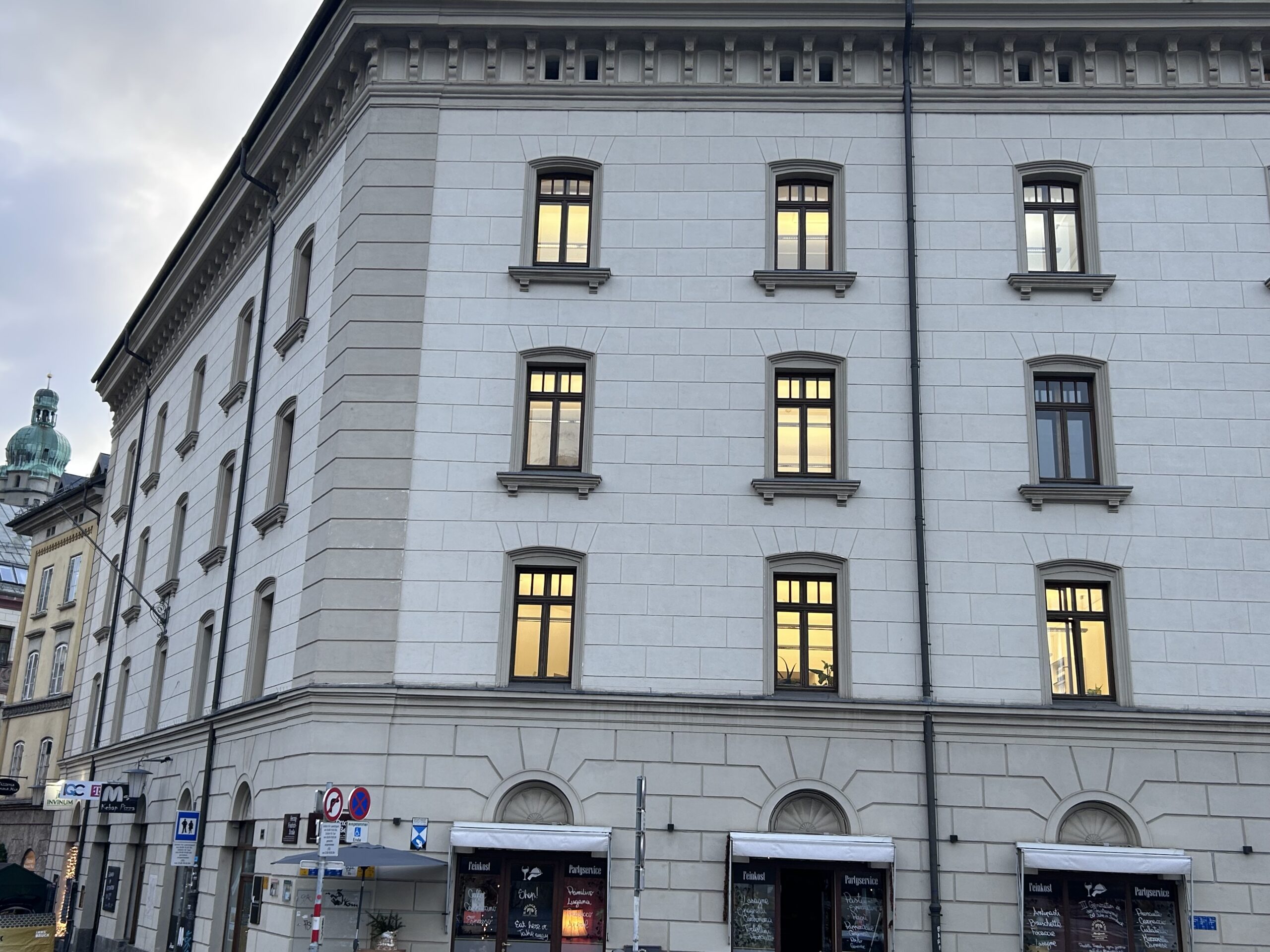
With the introduction of general conscription under Maria Theresa in Austria, the military infrastructure adapted to a standing army. Innsbruck became a garrison town in 1745. Thirty years later, the city walls were dismantled, and the Castrum Inpruka was converted into a state barracks. The new form of warfare with artillery instead of siege towers rendered the old fortifications, designed for medieval sieges, useless. The civic duty of defense was now taken over by professional soldiers. From 1778, parts of the Tyrolean Land and Field Regiment were stationed in Innsbruck, which became the Tyrolean Kaiserjäger after the Napoleonic Wars in 1816. At the same time, the Tyrolean riflemen (Schützen) continued to exist, trained at shooting ranges throughout the country as a kind of standing militia since the late Middle Ages. In February and March 1848, many cities in northern Italy saw uprisings against the Habsburgs, which went down in history as the First Italian War of Independence. The fighting in northern Italy demanded modernization of the Tyrolean military. Border security could no longer rely on volunteer armies and privately raised companies like Adolf Pichler’s Academic Legion. In 1851, reconstruction began to create the modern Inn Barracks. Changes in the military system also altered the cityscape. Although the military presence did not restore the splendor of the times when the city was an imperial residence, it boosted the population and importance of Innsbruck. With soldiers arriving from all over the multiethnic Austro-Hungarian monarchy, an international flair entered Innsbruck. These mostly young men enlivened the city with their presence and their pay, even though barracks life offered little freedom. Unlike the students of the University of Innsbruck, the soldiers did not come from the upper class but sought social advancement through military service. The barracks remained until 1978, when the Tyrolean government took over the building as an administrative office. Wall remnants in the inner courtyard still recall the medieval castle. In the local pubs, you can still enjoy the atmosphere of the old Andechs Castle.
With the introduction of general conscription under Maria Theresa in Austria, the military infrastructure adapted to a standing army. Innsbruck became a garrison town in 1745. Thirty years later, the city walls were dismantled, and the Castrum Inpruka was converted into a state barracks. The new form of warfare with artillery instead of siege towers rendered the old fortifications, designed for medieval sieges, useless. The civic duty of defense was now taken over by professional soldiers. From 1778, parts of the Tyrolean Land and Field Regiment were stationed in Innsbruck, which became the Tyrolean Kaiserjäger after the Napoleonic Wars in 1816. At the same time, the Tyrolean riflemen (Schützen) continued to exist, trained at shooting ranges throughout the country as a kind of standing militia since the late Middle Ages. In February and March 1848, many cities in northern Italy saw uprisings against the Habsburgs, which went down in history as the First Italian War of Independence. The fighting in northern Italy demanded modernization of the Tyrolean military. Border security could no longer rely on volunteer armies and privately raised companies like Adolf Pichler’s Academic Legion. In 1851, reconstruction began to create the modern Inn Barracks. Changes in the military system also altered the cityscape. Although the military presence did not restore the splendor of the times when the city was an imperial residence, it boosted the population and importance of Innsbruck. With soldiers arriving from all over the multiethnic Austro-Hungarian monarchy, an international flair entered Innsbruck. These mostly young men enlivened the city with their presence and their pay, even though barracks life offered little freedom. Unlike the students of the University of Innsbruck, the soldiers did not come from the upper class but sought social advancement through military service. The barracks remained until 1978, when the Tyrolean government took over the building as an administrative office. Wall remnants in the inner courtyard still recall the medieval castle. In the local pubs, you can still enjoy the atmosphere of the old Andechs Castle.
The Counts of Andechs and the foundation of Innsbruck
The 12th century brought an economic, scientific and social boom to Europe and is regarded as a kind of early medieval renaissance. Via the Crusades, there was an increased exchange with the cultures of the Middle East, which were more developed in many respects. Arab scholars brought translations of Greek thinkers such as Aristotle to Europe via southern Spain and Italy. Roman law was rediscovered at the first universities south of the Alps. New agricultural knowledge and a favourable climate, which was to last until the middle of the 14th century, made it possible for towns and larger settlements to emerge. One of these settlements was located to the north of Wilten Abbey between the River Inn and the Nordkette mountain range.
Politically and economically, the importance of the Inn Valley and the area north of it was mainly limited to transit. Tyrol had two low Alpine crossings, the Reschen Pass and the Brenner Pass, which were important for the imperial connection between the German lands in the north and the lands in Italy. In 1024, the Salian Conrad II, a rival of the Bavarian dukes from the House of Wittelsbach, was elected king. In order to bring these two Alpine crossings away from his Bavarian rivals and under the control of the Imperial Church, which was loyal to him, Conrad II granted the territory of Tyrol as a fief to the bishops of Brixen and Trento in 1027. The bishops in turn needed so-called bailiffs to administer these lands and administer justice.
These bailiffs of the Bishop of Brixen were the Counts of Andechs. The Andechs family may be overshadowed today by the Guelphs, Hohenstaufen, Wittelsbach and Habsburg dynasties, but they were an influential family in the High Middle Ages. They came from the area around Lake Ammer in Bavaria and owned estates in Upper Bavaria between the Lech and Isar rivers and east of Munich. Through skilful marriage politics, they had acquired the titles of Dukes of Merania, a region on the Dalmatian coast, and Margraves of Istria. They thus rose in rank within the Heiligen Römischen Reiches on. In the 12th century, they founded the Dießen monastery and the monastery on the holy mountain of Andechs above Lake Ammersee to ensure both administration and later salvation. In 1165, Otto V of Andechs came to the bishop's see in Brixen and gave the bailiwick over this high monastery to his brother. From then on, they administered the central part of the Inn Valley, the Wipp Valley, the Puster Valley and the Eisack Valley.
Today, Innsbruck stretches along both sides of the Inn. In the 12th century, this area was under the influence of two lords of the manor. South of the Inn, Wilten Abbey exercised lordship. The area north of the river was under the administration of the Andechs. While the southern urban area around the monastery had been used for agriculture for centuries, the alluvial area of the unregulated watercourse could not be cultivated before the High Middle Ages and was sparsely populated. The Inn Valley was densely forested and the banks of the wide Inn were swampy. Most of the people worked in agriculture, which was run by their landlord. They lived in poor huts made of mud and wood. There was hardly any medical care outside the towns, infant mortality was high and hardly anyone lived past the age of 50. Around the year 1133, the Andechs founded the market in what is now St Nicholas' Square Anbruggen and connected the northern and southern banks of the Inn via a bridge. The construction of the bridge turned the unusable agricultural land at the foot of the Nordkette mountain range into a trading centre. It greatly facilitated the movement of goods in the Eastern Alps. The Brenner route had become more interesting thanks to one of the innovations of the medieval Renaissance: new harnesses made it possible to negotiate the steep climbs with carts. The shorter Via Raetia had the Via Claudia Augusta over the Reschen Pass as the main transport route across the Alps. The customs revenue generated from trade between the German and Italian towns allowed the settlement to prosper. Blacksmiths, innkeepers, carriage operators, tailors, carpenters, rope makers, wagon makers and tanners settled in the small market. Horses, traders and carters had to be looked after and accommodated, and carts had to be repaired. The larger of these businesses employed clerks and farm labourers. The transformation from pure agriculture to a town began.
Anbruggen grew rapidly, but the space between the Nordkette and the Inn was limited. In 1180, Berchtold V of Andechs acquired a piece of land on the south side of the Inn from Wilten Monastery. This was the definitive starting signal for the genesis of Innsbruck. The abbot did not want to take his foot out of the door completely, as the new settlement developed splendidly thanks to the customs revenue. The document mentions three houses that were reserved for Wilten Abbey within the new settlement. In the course of building the town wall, the Counts of Andechs had the Andechs Castle and moved their ancestral seat from Merano to Innsbruck. Sometime between 1187 and 1204, the citizens of Innsbruck were granted city rights. The official date of foundation is often taken as 1239, when the last count of the Andechs dynasty, Otto VIII, formally confirmed the city charter in a document. Innsbruck was already the mint of the Andechs at this time and would probably have become the capital of their principality. But things turned out differently. In 1246, the Bavarian Wittelsbach dynasty, the Andechs' biggest rivals in southern Germany, destroyed their ancestral castle on Lake Ammersee. Otto, the last count of the House of Andechs-Merania, died without descendants in 1248. 12 years earlier, he had married Elisabeth, the daughter of Count Albert VIII of Tyrol. This noble family with its ancestral castle in Merano thus took over the fiefs and parts of the possessions, including the town on the Inn, as well as the arch-enemy with the Bavarian Wittelsbachs.
1796 - 1866: Vom Herzen Jesu bis Königgrätz
The period between the French Revolution and the Battle of Königgrätz in 1866 was a period of war. Many of the basic political attitudes, animosities towards other groups and European nationalism of the 19th and 20th centuries, which were also to influence the history of Innsbruck, had their roots in the conflicts of this period. Revolutionary Paris was a long way away and there were neither e-mails nor a nationwide press system to disseminate news. The godlessness of Marie Antoinette's murderers and the hatred of the Church of the new masters of France were successfully spread via leaflets and church pulpits. The monarchies of Europe, led by the Habsburgs, had declared war on the French Republic. Fears were rife that the slogan of the revolution „Liberté, Égalité, Fraternité" could spread across Europe. A young general named Napoleon Bonaparte was with his italienischen Armee advanced across the Alps as part of the coalition wars and met the Austrian troops there. It was not just a war for territory and power, it was a battle of systems. The Grande Armee of the revolutionary French Republic met the troops of the conservative and Catholic Habsburgs.
Tyrolean marksmen were actively involved in the fighting to defend the country's borders against the invading French. The men were used to handling weapons and were considered skilled marksmen. The historian Ludwig Denk put it this way in an essay in 1860:
"...The Tyrolean's main passion is shooting. Early on, the father takes his son hunting. It is not uncommon to see boys running around with loaded rifles, climbing high mountains and shooting birds or squirrels..."
The strength of units such as the Höttinger Schützen, founded in 1796, lay not in open field battles but in guerrilla warfare. They also had a secret weapon on their side against the most advanced and modern army of the time: the Sacred Heart. Since 1719, Jesuit missionaries had been travelling to the furthest side valleys and had successfully established the cult of the Sacred Heart as a unifying element in the fight against pagan customs and Protestantism. Now that they were facing the godless revolutionary French, who had declared war not only on the monarchy but also on the clergy, it was only logical that the Sacred Heart of Jesus would watch over the Tyrolean holy warriors in a protective capacity. In a hopeless situation, the Tyrolean troops renewed their covenant with the Heart of Jesus to ask for protection. Against all odds, the Tyrolean archers were successful in their defence. It was the abbot of Stams Abbey who petitioned the provincial estates to henceforth organise an annual "das Fest des göttlichen Herzens Jesu mit feierlichem Gottesdienst zu begehen, wenn Tirol von der drohenden Feindesgefahr befreit werde." Every year, the Sacred Heart celebrations were discussed and announced with great pomp in the press. In the 19th and early 20th centuries in particular, they were an explosive mixture of popular superstition, Catholicism and national resentment against everything French and Italian. Countless soldiers entrusted their well-being to the heart of Jesus even in the technologised battlefield of the First World War and carried images of this symbol with them in the hail of grenades. Alongside Cranach's Mother of Mercy, the depiction of the Heart of Jesus is probably the most popular Christian motif in Tyrol to this day and is emblazoned on the façades of countless houses.
The Habsburg Tyrol had expanded during the turmoil of war without his involvement, and probably also without that of the Sacred Heart of Jesus. Trentino had become part of the crown land in the last breaths of the Holy Roman Empire before its dissolution in 1803. Innsbruck, on the other hand, had shrunk. The deaths of soldiers and the economic difficulties caused by the war led to a decline in the population from a good 9500 around 1750 to around 8800. After the Napoleonic Wars, things remained quiet on the Tyrolean borders for around 30 years. This changed with the Italian Risorgimento, the national movement led by Sardinia-Piedmont and France. 1848, 1859 and 1866 saw the so-called Italian wars of unification. In the course of the 19th century, at the latest since 1848, there was a veritable national frenzy among young men of the upper classes. Volunteer armies sprang up in all regions of Europe. Students and academics who came together in their fraternities, gymnasts, marksmen, all wanted to prove their new love of the nation on the battlefield and supported the official armies.
As a garrison town, Innsbruck was an important supply centre. After the Congress of Vienna, the Tyrolean Jägerkorps the k.k. Tiroler Kaiserjägerregiment an elite unit that was deployed in these conflicts. Volunteer units such as the Innsbruck academics or the Stubai Riflemen fought in Italy. Thousands fell in the fight against the coalition of the arch-enemy France, the godless Garibaldians and the threat posed by the Kingdom of Italy under the leadership of the Francophile Savoys from Piedmont, which was being formed at Austria's expense. The media fuelled the mood away from the front line. The "Innsbrucker Zeitung" predigte in ihren Artikeln Kaisertreue und großdeutsch-tirolischen Nationalismus, wetterte gegen das Italienertum und Franzosen und pries den Mut Tiroler Soldaten.
"Die starke Besetzung der Höhen am Ausgange des Valsugana bei Primolano und le Tezze gab schon oft den Innsbrucker-Akademikern I. und den Stubaiern Anlaß, freiwillige Ercur:sionen gegen le Tezze, Fonzago und Fastro, als auch auf das rechte Brenta-Ufer und den Höhen gegen die kleinen Lager von den Sette comuni zu machen...Am 19. schon haben die Stubaier einige Feinde niedergestreckt, als sie sich das erste mal hinunterwagten, indem sie sich ihnen entgegenschlichen..."
Probably the most famous battle of the Wars of unification took place in Solferino near Lake Garda in 1859. Horrified by the bloody events, Henry Durant decided to found the Red Cross. The writer Joseph Roth described the events in the first pages of his classic book, which is well worth reading Radetzkymarsch.
"In the battle of Solferino, he (note: Lieutenant Trotta) commanded a platoon as an infantry lieutenant. The battle had been going on for half an hour. Three paces in front of him he saw the white backs of his soldiers. The first row of his platoon was kneeling, the second was standing. Everyone was cheerful and certain of victory. They had eaten copiously and drunk brandy at the expense and in honour of the emperor, who had been in the field since yesterday. Here and there one fell out of line."
The year 1866 was particularly costly for the Austrian Empire, with the loss of Veneto and Lombardy in Italy. At the same time, Prussia took the lead in the German Confederation, the successor organisation to the Holy Roman Empire of the German Nation. For Innsbruck, the withdrawal of the Habsburg Monarchy from the German Confederation meant that it had finally become a city on the western periphery of the empire. The tendency towards so-called Großdeutschen LösungThe German question, i.e. statehood together with the German Empire instead of the independent Austrian Empire, was very pronounced in Innsbruck. The extent to which this German question divided the city became apparent over 30 years later, when the Innsbruck municipal council voted in favour of the Iron Chancellor Bismarck, who was responsible for the fratricidal war between Austria and Germany, wanted to dedicate a street to him. While conservatives loyal to the emperor were horrified by this proposal, the Greater German liberals around Mayor Wilhelm Greil were enthusiastic.
With the Tummelplatz, the Pradl military cemetery and the Kaiserjägermuseum on Mount Isel, the city has several memorials to these bloody conflicts, in which many Innsbruck residents took to the field.
Maria Theresia, Reformatorin und Landesmutter
Maria Theresia zählt zu den bedeutendsten Figuren der österreichischen Geschichte. Obwohl sie oft als Kaiserin tituliert wird, war sie offiziell "nur" unter anderem Erzherzogin von Österreich, Königin von Ungarn und Königin von Böhmen. Bedeutend waren ihre innenpolitischen Reformen. Viele davon betrafen konkret auch den Alltag der Innsbrucker in merklichem Ausmaß. Gemeinsam mit ihren Beratern Friedrich Wilhelm von Haugwitz, Joseph von Sonnenfels und Wenzel Anton Kaunitz schaffte sie es aus den sogenannten Österreichischen Erblanden einen modernen Staat zu basteln. Anstatt der Verwaltung ihrer Territorien durch den ansässigen Adel setzte sie auf eine moderne Verwaltung. Ihre Berater hatten ganz im Stil der Aufklärung erkannt, dass sich das Staatswohl aus der Gesundheit und Bildungsgrad seiner Einzelteile ergab. Eine frühe Krankenreform Maria Theresias aus dem Jahr 1742 verpflichtete die Professoren des Fachbereichs Medizin an der Universität Innsbruck auch den Betrieb des Stadtspitals in der Neustadt sicherzustellen. Eine Schulreform veränderte die Bildungslandschaft innerhalb der Stadtmauern nicht nur thematisch, sondern auch örtlich. Untertanen sollten katholisch sein, ihre Treue aber sollte dem Staat gelten. Schulbildung wurde unter zentrale staatliche Verwaltung gestellt. Es sollten keine kritischen, humanistischen Geistesgrößen, sondern Material für den staatlichen Verwaltungsapparat erzogen werden. Über Militär und Verwaltung konnten nun auch Nichtadlige in höhere staatliche Positionen aufsteigen. Gleichzeitig sollten Reformen im Staatsdienst und in der Wirtschaft nicht nur mehr Möglichkeiten für die Untertanen schaffen, sondern auch die Staatseinnahmen erhöhen. Gewichte und Maßeinheiten wurden nominiert, um das Steuersystem undurchlässiger zu machen. Für Bürger und Bauern hatte die Vereinheitlichung der Gesetze den Vorteil, dass das Leben weniger von Grundherren und deren Launen abhing. Auch der Robot, den Bauern auf den Gütern des Grundherrn kostenfrei zu leisten hatten, wurde unter Maria Theresia abgeschafft. In Strafverfolgung und Justiz fand ein Umdenken statt. 1747 wurde in Innsbruck eine kleine Polizei which was responsible for matters relating to market supervision, trade regulations, tourist control and public decency. The penal code Constitutio Criminalis Theresiana did not abolish torture, but it did regulate its use.
As much as Maria Theresa staged herself as a pious mother of the country and is known today as an Enlightenment figure, the strict Catholic ruler was not squeamish when it came to questions of power and religion. In keeping with the trend of the Enlightenment, she had superstitions such as vampirism, which was widespread in the eastern parts of her empire, critically analysed and initiated the final end to witch trials. At the same time, however, she mercilessly expelled Protestants from the country. Many Tyroleans were forced to leave their homeland and settle in parts of the Habsburg Empire further away from the centre.
In crown lands such as Tyrol, Maria Theresa's reforms met with little favour. With the exception of a few liberals, they saw themselves more as an independent and autonomous province and less as part of a modern territorial state. The clergy also did not like the new, subordinate role, which became even more pronounced under Joseph II. For the local nobility, the reforms not only meant a loss of importance and autonomy, but also higher taxes and duties. Taxes, levies and customs duties, which had always provided the city of Innsbruck with reliable income, were now collected centrally and only partially refunded via financial equalisation. In order to minimise the fall of sons from impoverished aristocratic families and train them for civil service, Maria Theresa founded the Theresianum, das ab 1775 auch in Innsbruck eine Niederlassung hatte. Wie so oft bügelte die Zeit manche Falte aus und Innsbrucker sind mittlerweile stolz darauf, eine der bedeutendsten Herrscherpersönlichkeiten der österreichischen Geschichte beherbergt zu haben. Heute erinnern die Triumphpfote und die Hofburg in Innsbruck an die Theresianische Zeit.
Adolf Pichler: vom Vormärz zum Mainstream
Das 19. Jahrhundert veränderte Innsbruck in vielerlei Hinsicht. Politik, Verwaltung, Gesellschaft, Macht- und Vermögensverhältnisse änderten sich zwischen der ersten Hälfte, die noch stark von den Kriegsjahren bis 1815 geprägt waren, und der zweiten Hälfte, die als bürgerliches Zeitalter in die Geschichte Europas einging. Neue Berufs- und Lebenswelten entstanden. Mit Fleiß, Geschick, Klugheit und Glück konnte man es dank dem staatlichen Schul- und Bildungswesen weiter bringen als je zuvor. Liberale Vordenker, die im System Metternichs unter dem Verdacht der Radikalität standen und deren Schriften oft genug der Zensur anheimfielen, konnten sich nach 1848 nach und nach zumindest etwas freier äußern. Die 1860er Jahre brachten einen formalen Parlamentarismus, neue Gemeindestatuten, den Ausgleich mit Ungarn innerhalb der neuen k.u.k. Monarchie und das Ausscheiden Österreichs aus dem Deutschen Bund. Der ehemals in den deutschen Staaten als Avantgarde einiger Liberaler und „Radikaler“ geltende Nationalismus wurde zur Politik der Mitte.
In Innsbruck kann das Leben Adolf Pichlers stellvertretend für diese Entwicklungen gelesen werden. Mit 12 Jahren kam der Sohn eines Zollbeamten von Erl bei Kufstein nach Innsbruck, um am Gymnasium seine akademische Karriere zu starten. Unter den Fittichen der Jesuiten, denen er später mit wenig Begeisterung begegnen sollte, startete er im Geiste des klassischen Humanismus seine akademische Karriere. Pichler lernte in dieser Zeit vor allem die antiken Schriftsteller und ihre Philosophien kennen. Bereits als Teenager gründete er mit jugendlichem Eifer den Verein „Eiche und Buche“ und gab eine literarische Wochenschrift heraus. Während seinen Philosophie-, Jus- und Medizinstudien in Innsbruck und Wien lernte las er die Werke damals moderner, teils aber unter Zensur stehender Denker wie Feuerbach, Hegel und Fichte. Er bediente sich aus der geheimen Bibliothek, liebevoll Giftbude tituliert, von Johann Schuler, dem Redakteur des Tiroler Boten. Er lernte die liberalen deutschen Vorkämpfer Anastasius Grün und Heinrich Heine kennen. Sie vertraten den Gedanken einer geeinten deutschen Nation anstelle der Kleinstaatlichkeit des Deutschen Bundes. Unter der Beimengung des englischen Literaturexzentrikers Lord Byron und des mittelalterlichen Minnesängers Walther von der Vogelweide entstand sein Blick auf die Welt, der sich innerhalb der liberalen Schicht Innsbrucks gegen Ende des 19. Jahrhunderts durchsetzen sollte. Tirol sollte ein Teil der deutschen Kulturnation sein. 1845 geriet Pichler endgültig ins Visier der geheimen Staatspolizei Metternichs. Gemeinsam mit anderen „Radikalen“, allen voran Hermann von Gilm, gab er den Lyrikband Frühlingslieder aus Tirol heraus, der trotz aller Harmlosigkeit nicht erschienen durfte. Pichler war durch die Sammlung der Gedichte als eine Art geistiger Vater zum Gründer der Jungtiroler geworden, ohne selbst inhaltlich bemerkenswert beizutragen. Der junge Mann wurde nicht nur ein Teil der subversiven, national-liberalen Tiroler Literaturszene, sondern tauschte sich in Briefen und Zeitungsartikeln auch mit ausländischen Autoren und Intellektuellen aus. Sein Kollegen- und Freundeskreis reichte von den Tirolern Adolf Flir, Johann Senn und Beda Weber über Grillparzer und Stifter bis hin zu Alexander von Humboldt.
1848, Pichler hatte gerade sein Medizinstudium in Wien abgeschlossen, beteiligte er sich an den Kämpfen an den Tiroler Landesgrenzen in den Italienischen Unabhängigkeitskriegen. Pichler stellte ein eigenes Corps, die Akademische Legion auf. Obwohl die Studenten und Professoren gemeinsam mit den habsburgischen Truppen den Grenzschutz wahrnahmen, beäugte die Obrigkeit das Treiben Pichlers und seiner Truppe argwöhnisch. Der Umgang mit subversiven Elementen und seine politisch motivierten Artikel, Gedichte und Stücke verhinderten in der Donaumonarchie nach den Wirren von 1848 die akademische Karriere Pichlers. An der Universität abgelehnt musste er sich mit einem Posten am Gymnasium in Innsbruck zufriedengeben. Nebenbei verfolgte er seinen Weg als Literaturhistoriker weiter. Er schrieb über die Geschichte der Tiroler Literatur, ließ sich von seinen Schülern Theaterstücke aus deren jeweiliger Heimatregionen zusammentragen, um diese Tirolensien zu sammeln. Pichler war im Geiste von 1848 ein eifriger Archivar Tiroler Traditionen und Überlieferungen, um die Vergangenheit und Althergebrachtes zu einem nationalen, germanisch gefärbten Narrativ zu bündeln. Seine eigenen, von nationalem Pathos triefenden literarischen Gehversuche bestehend waren nur von überschaubarem Erfolg gekrönt. Pichlers Dramen schafften es mit Ausnahme des Stückes Rodrigo, ein im Innsbrucker Stadttheater aufgeführter Historienschinken nicht an die breite Öffentlichkeit. Die Handlung spielt zur Zeit des Untergangs des Westgotenreichs in Spanien im 8. Jahrhundert und ist eine Anspielung auf die politische Situation in Österreich der Zeit nach dem Ausscheiden der Monarchie aus dem Deutschen Bund. Rodrigo verschwindet der nach einer Niederlage in der Entscheidungsschlacht am spanischen Rio Guadalete, dem Äquivalent zu Königgrätz, aus der Geschichte.
Wohl ein wenig desillusioniert nach der in Österreich wenig revolutionären Märzrevolution und dem Ausscheiden Österreichs aus dem deutschen Bund 1866, wandte sich der vom offen Aufsässigen zum still Widerspenstigen gewandelte Intellektuelle der Geologie zu. Auf langen Wanderungen durch die Alpen sammelte er Erkenntnisse über die geliebte Heimat und konnte so zumindest ein wenig in die Fußstapfen Alexanders von Humboldt treten. 1867 wurde er zum Universitätsprofessor für Geologie in Innsbruck berufen und konnte so seine akademische Karriere im Alter von knapp 50 Jahren doch noch krönen, ohne selbst je ein naturwissenschaftliches Studium absolviert zu haben. Den Posten als Rektor lehnte der unangepasste Pichler ab, zu hoch wäre wohl der Preis dafür gewesen. Liest man heute die Artikel und Gedichte Pichlers, fühlt man sich in Ausdruck und Thematik rund um Deutschtum, Wahrheit, Kampfeslust und Heldenverehrung stark an die Diktion der völkischen Presse der frühen Nationalsozialisten erinnert. Als Intellektueller, Kritiker und Kommentator des Zeitgeschehens beeinflusste Pichler den Zeitgeist der Innsbrucker Politik merklich. Viel ist in seinen Schriften die Rede von den Nibelungen, Walhalla, Wotan, Aufopferung und Erlösung. Bis an sein Lebensende verfasste er Gedichte, Theaterstücke und schmalzige Hymnen wie seinen späten Dietrich von Bern aus dem Jahr 1898.
Kennt den Dietrich Ihr den Berner?
Den man einst in Fesseln schloss –
Flammen atmet er im Zorne –
dass wie Wachs das Eisen floss,
folgt dem Beispiel Eures Helden –
duldet nie ein fremdes Joch –
duldet nie als Herrn den Sklaven –
der am Boden vor Euch kroch.
Sein Hausblatt war der zwischen 1899 und 1906 erscheinenden, bissige politische, antiklerikale Scherer. Das Logo des selbsternannten Satireblattes war ein lächelnder älterer Tiroler, der dem Betrachter einen toten Maulwurf, dem Symbol für den oft als Schädling bezeichneten Klerus entgegenstreckt. Auch in überregionalen Magazinen und Zeitungen wie Presse, Wiener Zeitung, Augsburger Allgemeine, Gartenlaube, Odin und Germania schrieb der stramm deutschnationale Pichler gegen Klerus und Obrigkeit an. Der volkstümlich schwelende Antisemitismus hingegen war ihm fremd und zuwider. Anders als später den Faschisten und Nationalsozialisten sprach sich Pichler auch gegen jegliche Form des Imperialismus aus, sei es britischer, französischer oder deutscher. Alle Völker und Nationen sollten sich selbst verwalten, Kultur und Traditionen sollten geachtet werden.
Als der ehemals als „Radikaler“ angesehene Public Intellectual 1900 seine Augen für immer schloss, war aus ihm ein geachteter Bürger geworden. Seine politischen Ansichten waren dieselben geblieben, entsprachen mittlerweile aber dem Mainstream und wurden nicht mehr zensuriert, sondern ganz besonders im Innsbrucker Gemeinderat unter Wilhelm Greil hochgeschätzt. Die liberale Presse überschlug sich in Lobeshymnen und Wehklagen. Karl Habermann, Herausgeber des Scherer, verbrannte bei einem Fackelzug zu Ehren des hochverehrten Adolf Pichlers einen gegen seine Zeitung gerichteten offenen Brief des Fürstbischofs von Brixen, wofür er sich vor Gericht verantworten musste im Hirtenbriefproceß verantworten musste. In einer eigenen Heftnummer voll mit Gedichten und Artikel literarischer Weggefährten und Bewunderer konnte man im Scherer einen letzten, von Pichler selbst verfassten Abschied, in dem er seine Schreibfeder mit dem Schwerte König Arthurs verglich, lesen. In einem Nachruf ehrte man den „Alten“ mit den Worten:
„Tirol, das schwarze Pfaffenland, es ward durch Pichler zum neuen Flammenherde geistiger Empörung, von dem sich tausende von Volksgenossen in allen deutschen Gauen die Brandfackel holen, um auch in ihrem Heim die heilige Flamme zu entzünden.“
Auch in anderen einschlägigen Magazinen wie Odin – ein Kampfblatt für die alldeutsche Bewegung auf unbedingt völkischem Standpunkte and the Ostdeutschen Rundschau, dem „nationalen Kampfblatt der Deutschen in Österreich“ ließ man den Tiroler Heros hochleben. Schriftsteller wie Franz Kranewitter (1860 – 1938), Rudolf Greinz (1866 - 1942), Heinrich von Schullern (1865 – 1955) und Arthur von Wallpach (1866 – 1946) trugen die literarische Flamme Pichlers als Jung-Tirol weiter, zuerst im Scherer und später in Der Föhn. Sie alle einte die Erfahrung des Ausscheidens Österreichs aus dem Deutschen Bund, der Machtverlust der K.u.K. Monarchie sowie der Verlust der südlichen Landesteile des historischen Tirols. Ihre Form des teils antiklerikalen, teils kriegsverherrlichenden Liberalismus bei gleichzeitiger Lobpreisung der Heimatverbundenheit und des Tiroler Volksgeistes erfreuten sich sowohl nach dem ersten Weltkrieg wie auch während des Nationalsozialismus großer Beliebtheit. Stücke wie der Andreas Hofer Kranewitters und die Gedichtbände Wallpachs mit klingenden Namen wie Tiroler Blut or Wir brechen durch den Tod! – Gedichte aus dem Felde ermöglichten es fast jeder politischen Richtung ihr Programm darin auf die eine oder andere Weise wiederzufinden. Bereits ein Jahr nach Adolf Pichlers Tod wurde ein Komitee ins Leben gerufen, um ihm ein Denkmal zu errichten. Den Vorstand übernahm Bürgermeister Greil, der seinen Spiritus Rector nur zu gerne im öffentlichen Raum platzieren ließ. Seit 1930 ist der Adolf-Pichler-Platz, auf dem die Bronzestatue steht, nach ihm benannt. Auch seinen nachfolgenden Jung-Tirolern Greinz, Schullern, Kranewitter und Renk wurden in Amras und Pradl Straßen gewidmet. Pichlers Wohnhaus in der Müllerstraße schmückt eine Erinnerungstafel mit Tiroler Adler, Lorbeerkranz und Eichellaub: „DEM DEUTSCHEN DICHTER ADOLF PICHLER – DAS LAND TIROL“.