Cafe Munding
Kiebachgasse 16 / Mundingplatz
Worth knowing
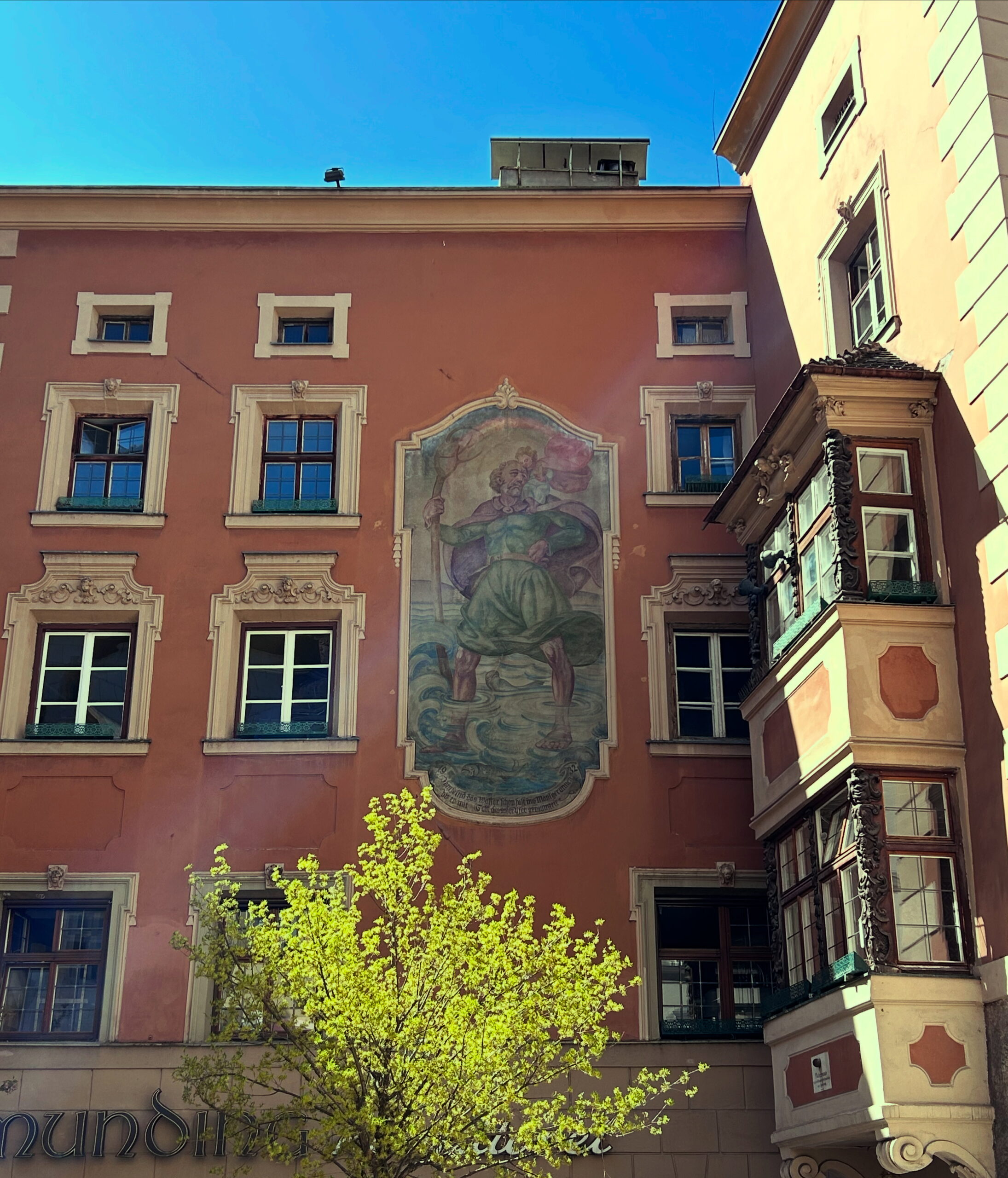
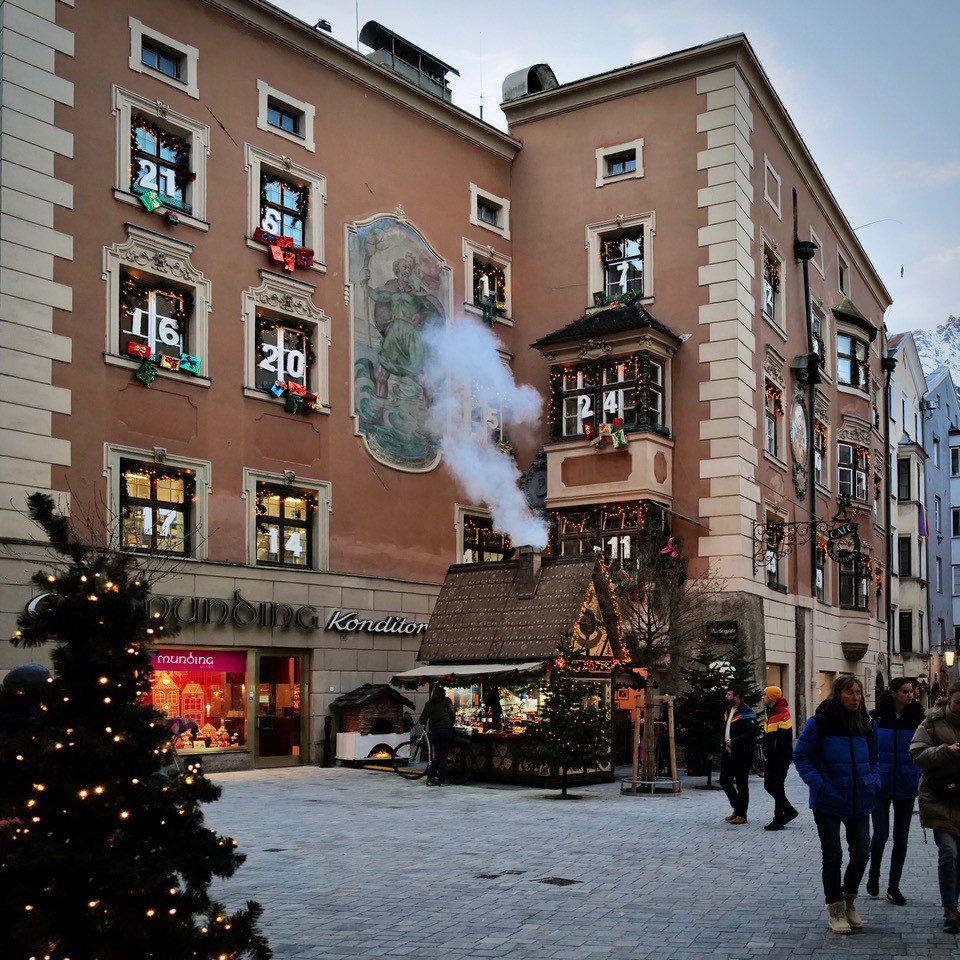
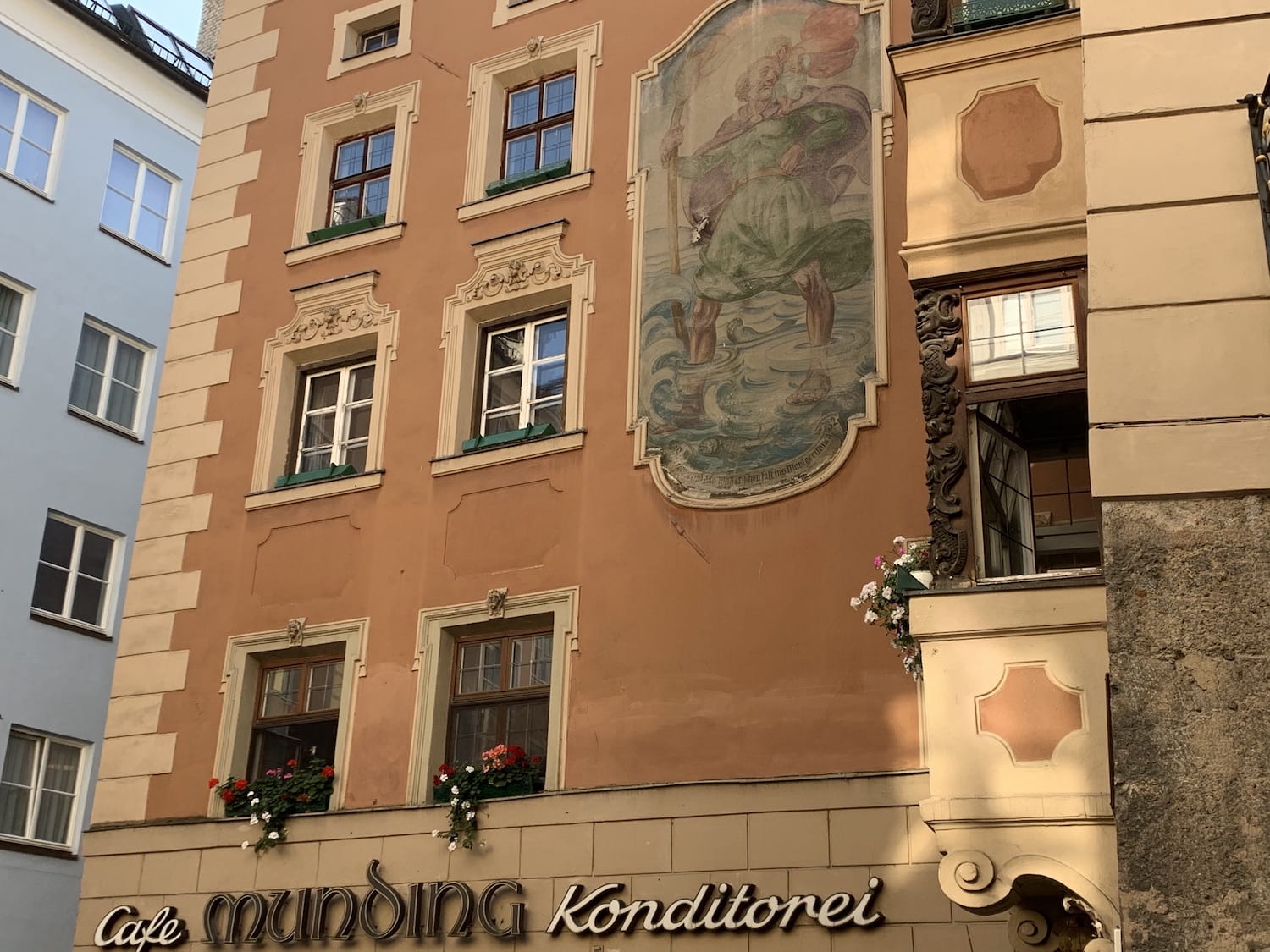
The striking building next to the Kolbenturm was once the home of one of Innsbruck’s most influential dynasties. The master builders of the Gumpp clan shaped the cityscape for generations with their baroque buildings. Innsbruck is full of the Gumpps’ legacy, but they would hardly recognise their own residence today. Although the core of the Gumpp House still dates back to the 17th century, its façade underwent a complete remake in 1911. Anton Kirchmayr designed the Munding in a wild mix of styles, combining Tyrolean Heimatstil, Art Nouveau, and Historicism. Unfortunately, these remarkable wall paintings did not survive. In 1936, the building was renovated in the style of Tyrolean Modernism, a movement that turned away from the typical Alpine charm with its extensive wooden panelling. Today, a large image of Saint Christopher, along with a poem in Tyrolean dialect, adorns the façade.
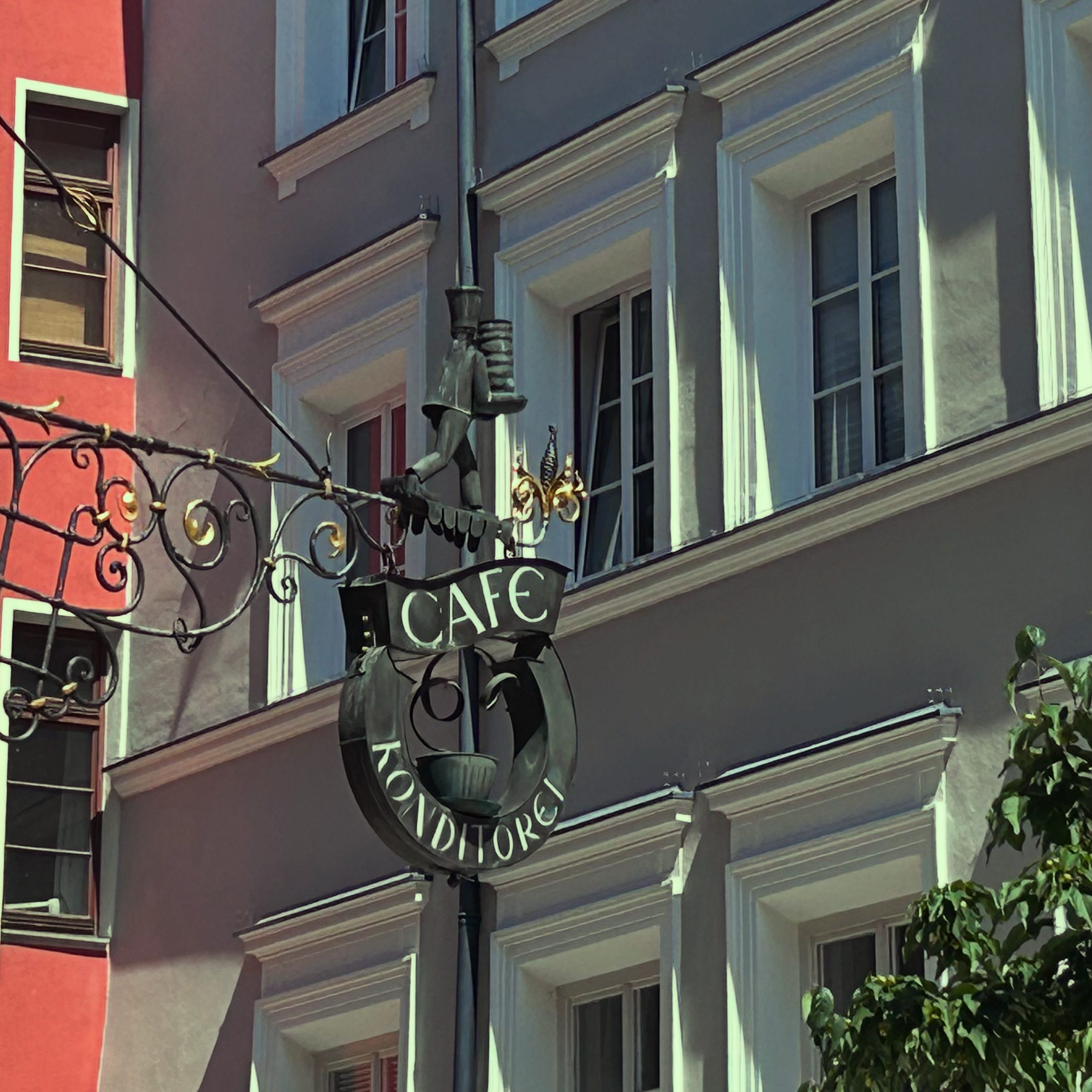
Since 1803, the Munding family has operated a confectionery in the Gumpp House. The café’s founder, Johann Nepomuk Munding, arrived during his journeyman travels from what is now the German side of Lake Constance—then part of the Habsburg Empire—via Graubünden to Tyrol. In Innsbruck, he began working in the city kitchen. With his savings, he opened what is now the oldest café in the city, despite the turbulent wartime conditions that gripped Europe. The Napoleonic campaigns also reached Innsbruck. Several sieges, plundering, and constantly shifting power dynamics marked the first ten years. Anyone who examines the house wall closely will discover a cannonball, a relic from the turbulent years of Bavarian occupation and the Tyrolean uprising of 1809. Alongside Café Katzung and Café Central, Munding was one of the meeting points for the growing bourgeoisie in Innsbruck during the Belle Époque. With its Ladies’ Café and Tea Salon, Munding also offered women a social forum — something quite unusual until the second half of the 20th century. While Katzung is now modern in style and Central exudes the charm and elegance of a Viennese coffee house, time seems to have stood still at Munding. Visitors can not only enjoy excellent cakes and coffee specialities but also admire the largely preserved furnishings and décor from that era. Windows, ceilings, and many pieces of furniture and lamps remain in the style of the 1930s.
Colonial goods, coffee and enlightenment
Legend has it that when the Turks besieged Vienna in 1683, they brought two things to Austria that have had a lasting influence on breakfast to this day: The crescent-shaped croissant and coffee. How it actually happened that the exotic drink made its way from the growing regions overseas to the German-speaking world is probably no longer clear, but it was probably not sacks full of coffee beans left behind on the battlefield outside Vienna. This urban legend can probably be traced back to the late 17th century, when the coffee bean began to establish itself as a luxury food for the political and economic elite in Europe. It was the era of the great trading companies, the first stock exchanges and the philosophers, legal scholars and economists of the early Enlightenment, in which the lucrative overseas trade brought the coffee bean and the economic sectors that developed from it to the cities of Europe. As part of the Habsburg Empire and a trading city, Innsbruck had been part of imperial business since the 16th century. Long-distance trade was an integral part of the economy. Thanks to the Inn Bridge and its favourable position, the city had been integrated into European networks since the 12th century. The city's wealthy elite, who also had political influence through the city council, were largely drawn from the merchant class.
At the beginning of the 18th century, coffee appeared in Innsbruck's legislation for the first time, which is a strong indication that it was crossing the threshold of importance within the city. In 1713, the city council decided to authorise the purchase of coffee exclusively in pharmacies. Similar to Red Bull In the 1990s, the exotic drink was suspected of being disreputable. As demand increased in the climate of enlightenment during the time of Emperor Joseph II and the luxury drink became more and more popular in society, the regulations were relaxed. However, coffee was still not an everyday drink, but an exclusive and expensive pleasure for eccentric elites. Speciality shops, spice and food shops began to sell coffee. The still existing Innsbruck coffee brand Nosko claims the title of the city's oldest roastery as the successor to Josef Ulrich Müller's Spezerei in Seilergasse 18, which opened in 1751. Also Unterberger&Comp colonial goods, Innsbruck's second coffee roastery, which still exists today, began as a speciality shop. Jakob Fischnaller took over a shop that had been located in the historic city centre since 1660, where he sold coffee from 1768.
The bean's triumphal march began with the first coffee cafés at the end of the 1750s. The first establishments still had little to do with the Viennese coffee house culture that is known worldwide today. In 1793, the Cafe Katzung opened its doors to the wealthy bourgeoisie, who began to conquer the public space for themselves with billiard tables and newspaper stands. 50 years later, there were already 8 coffee houses in little Innsbruck. Unlike traditional inns, they symbolised a new, urban and enlightened lifestyle, a distinguishing feature between the city and the surrounding area. For a long time, wine and beer had been the everyday drinks of the masses. Even if wine was not particularly strong in the Middle Ages, it did dull the senses. Spirits were popular among the working class, and home-distilled schnapps was both popular and problematic in the countryside. Those who took care of themselves stayed away from it. Coffee, on the other hand, made people alert and productive and favoured the new virtues of industriousness and hard work. In cities like Innsbruck, the willing subject was increasingly replaced by the critical, newspaper-reading citizen. By savouring the expensive colonial goods, connoisseurs who knew how to distinguish the cheap brew, mixed with all kinds of fillers, from real coffee beans and could afford it, were able to distinguish themselves from the lower classes. Pofl stand out. When Napoleon banned the import of coffee in the territories under his control in 1810 in order to weaken the British economy, which was based on long-distance trade, there were fierce protests throughout Europe. Fig and chicory coffee as a substitute product was not particularly popular with the general public, as would later be the case during the world wars.
The colonial goods trade, which linked the exploitative business models of African coffee plantations, American tobacco plantations and South American fruit plantations with the Alps, reached a high point in Innsbruck, as in the entire German-speaking region, from the end of the 19th century, when the European powers' race for Africa entered the home straight. In 1900, there were around 40 colonial goods traders in Innsbruck. These were mostly speciality shops and general merchants who sold various, usually expensive goods from all over the world. Above all, luxury goods such as rum, tobacco, cocoa, tea and coffee or exotic fruits such as bananas were sold as colonial goods to the wealthy Innsbruck bourgeoisie. From this time onwards, the Viennese coffee house culture with all its peculiarities finally became the standard for the bourgeois culture of the Austro-Hungarian Empire. Monarchy. No matter where you were between Innsbruck in the west and Czernowitz in the east of the vast empire, you could be sure of finding a railway station, an appropriate hotel and a coffee house with German-speaking staff and a similar menu and furnishings. Coffee houses, unlike traditional inns, were places where not only the aristocracy and new elites, but also men and women, albeit often in separate areas as in the Cafe Munding, could spend time.
Neither coffee house culture nor colonial goods shops disappeared from everyday life in the Republic of Austria with the caesura of the First World War and the end of the monarchy. In the 1930s, around 60 of these shops were located in Innsbruck. There were still no supermarkets with the large product ranges of today, and purchases were still made at market stalls or in small shops. The „Purchasing Association of Specie and Colonial Goods Wholesalers North Tyrol Ges.m.b.H“. It was only after the Second World War that the term "Kolonialwaren" disappeared from the city's trade directories and was replaced by the terms "Kaffeerösterei" and "Fruchtimport". Not only the Viennese coffee house culture has come to stay. Katzung, Munding and Central are still some of the oldest of their kind in Innsbruck. The Ischia company has been selling exotic fruits in the city since 1884 and is still prominently represented in the cityscape today with its striking logo on the company building next to the new city library. A brass sign at Herzog-Friedrich-Straße 26 and a large version of the logo with the merchant ship on the main traffic artery Egger-Lienz-Straße near Westbahnhof bear witness to the presence of the Unterberger brand. The logo of Praxmarer Kaffee, which shows a kneeling Moor with an offered cup on a façade in Amraserstraße, is much more conflict-laden. The traditional company itself no longer exists, but there is still a trade in tropical fruit with the same name, Praxmarer Obst.
The master builders Gumpp and the baroqueisation of Innsbruck
The works of the Gumpp family still strongly characterise the appearance of Innsbruck today. The baroque parts of the city in particular can be traced back to them. The founder of the dynasty in Tyrol, Christoph Gumpp (1600-1672), was actually a carpenter. However, his talent had chosen him for higher honours. The profession of architect or artist did not yet exist at that time; even Michelangelo and Leonardo da Vinci were considered craftsmen. After working on the Holy Trinity Church, the Swabian-born Gumpp followed in the footsteps of the Italian master builders who had set the tone under Ferdinand II. At the behest of Leopold V, Gumpp travelled to Italy to study theatre buildings and to learn from his contemporary style-setting colleagues his expertise for the planned royal palace. Comedihaus polish up.
His official work as court architect began in 1633. New times called for a new design, away from the Gothic-influenced architecture of the Middle Ages and the horrors of the Thirty Years' War. Over the following decades, Innsbruck underwent a complete renovation under the regency of Claudia de Medici. Gumpp passed on his title to the next two generations within the family. The Gumpps were not only active as master builders. They were also carpenters, painters, engravers and architects, which allowed them to create a wide range of works similar to the Tiroler Moderne around Franz Baumann and Clemens Holzmeister at the beginning of the 20th century to realise projects holistically. They were also involved as planners in the construction of the fortifications for national defence during the Thirty Years' War.
Christoph Gumpp's masterpiece, however, was the construction of the Comedihaus in the former ballroom. The oversized dimensions of the then trend-setting theatre, which was one of the first of its kind in Europe, not only allowed plays to be performed, but also water games with real ships and elaborate horse ballet performances. The Comedihaus was a total work of art in and of itself, which in its significance at the time can be compared to the festival theatre in Bayreuth in the 19th century or the Elbphilharmonie today.
His descendants Johann Martin Gumpp the Elder, Georg Anton Gumpp and Johann Martin Gumpp the Younger were responsible for many of the buildings that still characterise the townscape today. The Wilten collegiate church, the Mariahilfkirche, the Johanneskirche and the Spitalskirche were all designed by the Gumpps. In addition to designing churches and their work as court architects, they also made a name for themselves as planners of secular buildings. Many of Innsbruck's town houses and city palaces, such as the Taxispalais or the Altes Landhaus in Maria-Theresien-Straße, were designed by them. With the loss of the city's status as a royal seat, the magnificent large-scale commissions declined and with them the fame of the Gumpp family. Their former home is now home to the Munding confectionery in the historic city centre. In the Pradl district, Gumppstraße commemorates the Innsbruck dynasty of master builders.
The year 1848 and its consequences
The year 1848 occupies a mythical place in European history. Although the hotspots were not to be found in secluded Tyrol, but in the major metropolises such as Paris, Vienna, Budapest, Milan and Berlin, even in the Holy Land however, the revolutionary year left its mark. In contrast to the rural surroundings, an enlightened educated middle class had developed in Innsbruck. Enlightened people no longer wanted to be subjects of a monarch or sovereign, but citizens with rights and duties towards the state. Students and freelancers demanded political participation, freedom of the press and civil rights. Workers demanded better wages and working conditions. Radical liberals and nationalists in particular even questioned the omnipotence of the church.
In March 1848, this socially and politically highly explosive mixture erupted in riots in many European cities. In Innsbruck, students and professors celebrated the newly enacted freedom of the press with a torchlight procession. On the whole, however, the revolution proceeded calmly in the leisurely Tyrol. It would be foolhardy to speak of a spontaneous outburst of emotion; the date of the procession was postponed from 20 to 21 March due to bad weather. There were hardly any anti-Habsburg riots or attacks; a stray stone thrown into a Jesuit window was one of the highlights of the Alpine version of the 1848 revolution. The students even helped the city magistrate to monitor public order in order to show their gratitude to the monarch for the newly granted freedoms and their loyalty.
The initial enthusiasm for bourgeois revolution was quickly replaced by German nationalist, patriotic fervour in Innsbruck. On 6 April 1848, the German flag was waved by the governor of Tyrol during a ceremonial procession. A German flag was also raised on the city tower. Tricolour was hoisted. While students, workers, liberal-nationalist-minded citizens, republicans, supporters of a constitutional monarchy and Catholic conservatives disagreed on social issues such as freedom of the press, they shared a dislike of the Italian independence movement that had spread from Piedmont and Milan to northern Italy. Innsbruck students and marksmen marched to Trentino with the support of the k.k. The Innsbruck students and riflemen moved into Trentino to nip the unrest and uprisings in the bud. Well-known members of this corps were Father Haspinger, who had already fought with Andreas Hofer in 1809, and Adolf Pichler. Johann Nepomuk Mahl-Schedl, wealthy owner of Büchsenhausen Castle, even equipped his own company with which he marched across the Brenner Pass to secure the border.
The city of Innsbruck, as the political and economic centre of the multinational crown land of Tyrol and home to many Italian speakers, also became the arena of this nationality conflict. Combined with copious amounts of alcohol, anti-Italian sentiment in Innsbruck posed more of a threat to public order than civil liberties. A quarrel between a German-speaking craftsman and an Italian-speaking Ladin got so heated that it almost led to a pogrom against the numerous businesses and restaurants owned by Italian-speaking Tyroleans.
The relative tranquillity of Innsbruck suited the imperial house, which was under pressure. When things did not stop boiling in Vienna even after March, Emperor Ferdinand fled to Tyrol in May. According to press reports from this time, he was received enthusiastically by the population.
"Wie heißt das Land, dem solche Ehre zu Theil wird, wer ist das Volk, das ein solches Vertrauen genießt in dieser verhängnißvollen Zeit? Stützt sich die Ruhe und Sicherheit hier bloß auf die Sage aus alter Zeit, oder liegt auch in der Gegenwart ein Grund, auf dem man bauen kann, den der Wind nicht weg bläst, und der Sturm nicht erschüttert? Dieses Alipenland heißt Tirol, gefällts dir wohl? Ja, das tirolische Volk allein bewährt in der Mitte des aufgewühlten Europa die Ehrfurcht und Treue, den Muth und die Kraft für sein angestammtes Regentenhaus, während ringsum Auflehnung, Widerspruch. Trotz und Forderung, häufig sogar Aufruhr und Umsturz toben; Tirol allein hält fest ohne Wanken an Sitte und Gehorsam, auf Religion, Wahrheit und Recht, während anderwärts die Frechheit und Lüge, der Wahnsinn und die Leidenschaften herrschen anstatt folgen wollen. Und während im großen Kaiserreiche sich die Bande überall lockern, oder gar zu lösen drohen; wo die Willkühr, von den Begierden getrieben, Gesetze umstürzt, offenen Aufruhr predigt, täglich mit neuen Forderungen losgeht; eigenmächtig ephemere- wie das Wetter wechselnde Einrichtungen schafft; während Wien, die alte sonst so friedliche Kaiserstadt, sich von der erhitzten Phantasie der Jugend lenken und gängeln läßt, und die Räthe des Reichs auf eine schmähliche Weise behandelt, nach Laune beliebig, und mit jakobinischer Anmaßung, über alle Provinzen verfügend, absetzt und anstellt, ja sogar ohne Ehrfurcht, den Kaiaer mit Sturm-Petitionen verfolgt; während jetzt von allen Seiten her Deputationen mit Ergebenheits-Addressen mit Bittgesuchen und Loyalitätsversicherungen dem Kaiser nach Innsbruck folgen, steht Tirol ganz ruhig, gleich einer stillen Insel, mitten im brausenden Meeressturme, und des kleinen Völkchens treue Brust bildet, wie seine Berge und Felsen, eine feste Mauer in Gesetz und Ordnung, für den Kaiser und das Vaterland."
In June, a young Franz Josef, not yet emperor at the time, also stayed at the Hofburg on his way back from the battlefields of northern Italy instead of travelling directly to Vienna. Innsbruck was once again the royal seat, if only for one summer. While blood was flowing in Vienna, Milan and Budapest, the imperial family enjoyed life in the Tyrolean countryside. Ferdinand, Franz Karl, his wife Sophie and Franz Josef received guests from foreign royal courts and were chauffeured in four-in-hand carriages to the region's excursion destinations such as Weiherburg Castle, Stefansbrücke Bridge, Kranebitten and high up to Heiligwasser. A little later, however, the cosy atmosphere came to an end. Under gentle pressure, Ferdinand, who was no longer considered fit for office, passed the torch of regency to Franz Josef I. In July 1848, the first parliamentary session was held in the Court Riding School in Vienna. The first constitution was enacted. However, the monarchy's desire for reform quickly waned. The new parliament was an imperial council, it could not pass any binding laws, the emperor never attended it during his lifetime and did not understand why the Danube Monarchy, as a divinely appointed monarchy, needed this council.
Nevertheless, the liberalisation that had been gently set in motion took its course in the cities. Innsbruck was given the status of a town with its own statute. Innsbruck's municipal law provided for a right of citizenship that was linked to ownership or the payment of taxes, but legally guaranteed certain rights to members of the community. Birthright citizenship could be acquired by birth, marriage or extraordinary conferment and at least gave male adults the right to vote at municipal level. If you got into financial difficulties, you had the right to basic support from the town.
Thanks to the census-based majority voting system, the Greater German liberal faction prevailed within the city government, in which merchants, tradesmen, industrialists and innkeepers set the tone. On 2 June 1848, the first edition of the liberal and Greater German-minded Innsbrucker Zeitungfrom which the above article on the emperor's arrival in Innsbruck is taken. Conservatives, on the other hand, read the Volksblatt for Tyrol and Vorarlberg. Moderate readers who favoured a constitutional monarchy preferred to consume the Bothen for Tyrol and Vorarlberg. However, the freedom of the press soon came to an end. The previously abolished censorship was reintroduced in parts. Newspaper publishers had to undergo some harassment by the authorities. Newspapers were not allowed to write against the state government, monarchy or church.
"Anyone who, by means of printed matter, incites, instigates or attempts to incite others to take action which would bring about the violent separation of a part from the unified state... of the Austrian Empire... or the general Austrian Imperial Diet or the provincial assemblies of the individual crown lands.... Imperial Diet or the Diet of the individual Crown Lands... violently disrupts... shall be punished with severe imprisonment of two to ten years."
After Innsbruck officially replaced Meran as the provincial capital in 1849 and thus finally became the political centre of Tyrol, political parties were formed. From 1868, the liberal and Greater German orientated party provided the mayor of the city of Innsbruck. The influence of the church declined in Innsbruck in contrast to the surrounding communities. Individualism, capitalism, nationalism and consumerism stepped into the breach. New worlds of work, department stores, theatres, cafés and dance halls did not supplant religion in the city either, but the emphasis changed as a result of the civil liberties won in 1848.
Perhaps the most important change to the law was the Basic relief patent. In Innsbruck, the clergy, above all Wilten Abbey, held a large proportion of the peasant land. The church and nobility were not subject to taxation. In 1848/49, manorial rule and servitude were abolished in Austria. Land rents, tithes and roboters were thus abolished. The landlords received one third of the value of their land from the state as part of the land relief, one third was regarded as tax relief and the farmers had to pay one third of the relief themselves. They could pay off this amount in instalments over a period of twenty years.
The after-effects can still be felt today. The descendants of the then successful farmers enjoy the fruits of prosperity through inherited land ownership, which can be traced back to the land relief of 1848, as well as political influence through land sales for housing construction, leases and public sector redemptions for infrastructure projects. The land-owning nobles of the past had to resign themselves to the ignominy of pursuing middle-class labour. The transition from birthright to privileged status within society was often successful thanks to financial means, networks and education. Many of Innsbruck's academic dynasties began in the decades after 1848.
Das bis dato unbekannte Phänomen der Freizeit kam, wenn auch für den größten Teil nur spärlich, auf und begünstigte gemeinsam mit frei verfügbarem Einkommen einer größeren Anzahl an Menschen Hobbies. Zivile Organisationen und Vereine, vom Lesezirkel über Sängerbünde, Feuerwehren und Sportvereine, gründeten sich. Auch im Stadtbild manifestierte sich das Revolutionsjahr. Parks wie der Englische Garten beim Schloss Ambras oder der Hofgarten waren nicht mehr exklusiv der Aristokratie vorbehalten, sondern dienten den Bürgern als Naherholungsgebiete vom beengten Dasein. In St. Nikolaus entstand der Waltherpark als kleine Ruheoase. Einen Stock höher eröffnete im Schloss Büchsenhausen Tirols erste Schwimm- und Badeanstalt, wenig später folgte ein weiteres Bad in Dreiheiligen. Ausflugsgasthöfe rund um Innsbruck florierten. Neben den gehobenen Restaurants und Hotels entstand eine Szene aus Gastwirtschaften, in denen sich auch Arbeiter und Angestellte gemütliche Abende bei Theater, Musik und Tanz leisten konnten.
Andreas Hofer and the Tyrolean uprising of 1809
The Napoleonic Wars gave the province of Tyrol a national epic and, in Andreas Hofer, a hero whose splendour still shines today. However, if one subtracts the carefully constructed legend of the Tyrolean uprising against foreign rule, the period before and after 1809 was a dark chapter in Innsbruck's history, characterised by economic hardship, the devastation of war and several instances of looting. The Kingdom of Bavaria was allied with France during the Napoleonic Wars and was able to take over the province of Tyrol from the Habsburgs in several battles between 1796 and 1805. Innsbruck was no longer the capital of a crown land, but just one of many district capitals of the administrative unit Innkreis. Revenues from tolls and customs duties as well as from Hall salt left the country for the north. The British colonial blockade against Napoleon meant that Innsbruck's long-distance trade and transport industry, which had always flourished and brought prosperity, collapsed. Innsbruck's citizens had to accommodate Bavarian soldiers in their homes. The abolition of the Tyrolean provincial government, the gubernium and the Tyrolean parliament meant not only the loss of status, but also of jobs and financial resources. Inspired by the spirit of the Enlightenment, reason and the French Revolution, the new rulers set about overturning the traditional order. While the city suffered financially as a result of the war, as is always the case, the upheaval opened up new socio-political opportunities. War is the father of all things, The breath of fresh air was not inconvenient for many citizens. Modern laws such as the Alley cleaning order or compulsory smallpox immunisation were intended to promote cleanliness and health in the city. At the beginning of the 19th century, a considerable number of people were still dying from diseases caused by a lack of hygiene and contaminated drinking water. A new tax system was introduced and the powers of the nobility were further reduced. The Bavarian administration allowed associations, which had been banned in 1797, again. Liberal Innsbruckers also liked the fact that the church was pushed out of the education system. The Benedictine priest and later co-founder of the Innsbruck Music Society, Martin Goller, was appointed to Innsbruck to promote musical education.
Diese Reformen behagten einem großen Teil der Tiroler Bevölkerung nicht. Katholische Prozessionen und religiöse Feste fielen dem aufklärerischen Programm der neuen Landesherren zum Opfer. 1808 wurde vom bayerischen König für seinen gesamten Herrschaftsbereich das Gemeindeedikt eingeführt. Die Untertanen wurden darin verpflichtet öffentliche Gebäude, Brunnen, Wege, Brücken und andere Infrastruktur in Stand zu halten. Für die Tiroler Bauern, die seit Jahrhunderten von Fronarbeit größtenteils befreit waren, bedeutete das eine zusätzliche Belastung und war ein Affront gegen ihren Standesstozl. Der Funke, der das Pulverfass zur Explosion brachte, war die Aushebung junger Männer zum Dienst in der bayrisch-napoleonischen Armee, obwohl Tiroler seit dem LandlibellThe law of Emperor Maximilian stipulated that soldiers could only be called up for the defence of their own borders. On 10 April, there was a riot during a conscription in Axams near Innsbruck, which ultimately led to an uprising. For God, Emperor and Fatherland Tyrolean defence units came together to drive the small army and the Bavarian administrative officials out of Innsbruck. The riflemen were led by Andreas Hofer (1767 - 1810), an innkeeper, wine and horse trader from the South Tyrolean Passeier Valley near Meran. He was supported not only by other Tyroleans such as Father Haspinger, Peter Mayr and Josef Speckbacher, but also by the Habsburg Archduke Johann in the background.
Once in Innsbruck, the marksmen not only plundered official facilities. As with the peasants' revolt under Michael Gaismair, their heroism was fuelled not only by adrenaline but also by alcohol. The wild mob was probably more damaging to the city than the Bavarian administrators had been since 1805, and the "liberators" rioted violently, particularly against middle-class ladies and the small Jewish population of Innsbruck.
In July 1809, Bavaria and the French took control of Innsbruck following the agreement with the Habsburgs. Peace of Znojmo, which many still regard as a Viennese betrayal of the province of Tyrol. What followed was what is known as Tyrolean survey under Andreas Hofer, who had meanwhile assumed supreme command of the Tyrolean defence forces, was to go down in the history books. The Tyrolean insurgents were able to carry victory from the battlefield a total of three times. The 3rd battle in August 1809 on Mount Isel is particularly well known. "Innsbruck sees and hears what it has never heard or seen before: a battle of 40,000 combatants...“ For a short time, Andreas Hofer was Tyrol's commander-in-chief in the absence of regular facts, also for civil affairs. Innsbruck's financial plight did not change. Instead of the Bavarian and French soldiers, the townspeople now had to house and feed their compatriots from the peasant regiment and pay taxes to the new provincial government. The city's liberal and wealthy elites in particular were not happy with the new city rulers. The decrees issued by him as provincial commander were more reminiscent of a theocracy than a 19th century body of laws. Women were only allowed to go out on the streets wearing chaste veils, dance events were banned and revealing monuments such as the one on the Leopoldsbrunnen nymphs on display were banned from public spaces. Educational agendas were to return to the clergy. Liberals and intellectuals were arrested, but the Praying the rosary zum Gebot. Am Ende gab es im Herbst 1809 in der vierten und letzten Schlacht am Berg Isel eine empfindliche Niederlage gegen die französische Übermacht. Die Regierung in Wien hatte die Tiroler Aufständischen vor allem als taktischen Prellbock im Krieg gegen Napoleon benutzt. Bereits zuvor hatte der Kaiser das Land Tirol offiziell im Friedensvertrag von Schönbrunn wieder abtreten müssen. Innsbruck war zwischen 1810 und 1814 wieder unter bayrischer Verwaltung. Auch die Bevölkerung war nur noch mäßig motiviert, Krieg zu führen. Wilten wurde von den Kampfhandlungen stark in Mitleidenschaft gezogen. Das Dorf schrumpfte von über 1000 Einwohnern auf knapp 700. Hofer selbst war zu dieser Zeit bereits ein von der Belastung dem Alkohol gezeichneter Mann. Er wurde gefangengenommen und am 20. Januar 1810 in Mantua hingerichtet. Zu allem Überfluss wurde das Land geteilt. Das Etschtal und das Trentino wurden Teil des von Napoleon aus dem Boden gestampften Königreich Italien, das Pustertal wurde den französisch kontrollierten Illyrian provinces connected.
Der „Fight for freedom" symbolises the Tyrolean self-image to this day. For a long time, Andreas Hofer, the innkeeper from the South Tyrolean Passeier Valley, was regarded as an undisputed hero and the prototype of the Tyrolean who was brave, loyal to his fatherland and steadfast. The underdog who fought back against foreign superiority and unholy customs. In fact, Hofer was probably a charismatic leader, but politically untalented and conservative-clerical, simple-minded. His tactics at the 3rd Battle of Mount Isel "Do not abandon them“ (Ann.: Ihr dürft sie nur nicht heraufkommen lassen) fasst sein Wesen wohl ganz gut zusammen. In konservativen Kreisen Tirols wie den Schützen wird Hofer unkritisch und kultisch verehrt. Das Tiroler Schützenwesen ist gelebtes Brauchtum, das sich zwar modernisiert hat, in vielen dunklen Winkeln aber noch reaktionär ausgerichtet ist. Wiltener, Amraser, Pradler und Höttinger Schützen marschieren immer noch einträchtig neben Klerus, Trachtenvereinen und Marschmusikkapellen bei kirchlichen Prozessionen und schießen in die Luft, um alles Übel von Tirol und der katholischen Kirche fernzuhalten. Über die Stadt verteilt erinnern viele Denkmäler an das Jahr 1809. Die zweite Hälfte des 19. Jahrhunderts erfuhr eine Heroisierung der Kämpfer, die als deutsches Bollwerk gegen fremde Völkerschaften charakterisiert wurden. Der Berg Isel wurde der Stadt für die Verehrung der Freiheitskämpfer vom Stift Wilten, der katholischen Instanz Innsbrucks, zur Verfügung gestellt. Andreas Hofer und seinen Mitstreitern Josef Speckbacher, Peter Mayer, Pater Haspinger und Kajetan Sweth wurden im Stadtteil Wilten, das in der Zeit des großdeutsch-liberal dominierten Gemeinderats 1904 zu Innsbruck kam und lange unter der Verwaltung des Stiftes gestanden hatte, Straßennamen gewidmet. Das kurze Rote Gassl im alten Kern von Wilten erinnert an die Tiroler Schützen, die, in ihnen wohl fälschlich nachgesagten roten Uniformen, dem siegreichen Feldherrn Hofer nach dem Sieg in der zweiten Berg Isel Schlacht an dieser Stelle in Massen gehuldigt haben sollen. In Tirol wird Andreas Hofer bis heute gerne für alle möglichen Initiativen und Pläne vor den Karren gespannt. Vor allem im Nationalismus des 19. Jahrhunderts berief man sich immer wieder auf den verklärten Helden Andreas Hofer. Hofer wurde über Gemälde, Flugblätter und Schauspiele zur Ikone stilisiert. Aber auch heute noch kann man das Konterfei des Oberschützen sehen, wenn sich Tiroler gegen unliebsame Maßnahmen der Bundesregierung, den Transitbestimmungen der EU oder der FC Wacker gegen auswärtige Fußballvereine zur Wehr setzen. Das Motto lautet dann „Man, it's time!“. Die Legende vom wehrfähigen Tiroler Bauern, der unter Tags das Feld bestellt und sich abends am Schießstand zum Scharfschützen und Verteidiger der Heimat ausbilden lässt, wird immer wieder gerne aus der Schublade geholt zur Stärkung der „echten“ Tiroler Identität. Die Feiern zum Todestag Andreas Hofers am 20. Februar locken bis heute regelmäßig Menschenmassen aus allen Landesteilen Tirols in die Stadt. Erst in den letzten Jahrzehnten setzte eine kritische Betrachtung des erzkonservativen und mit seiner Aufgabe als Tiroler Landeskommandanten wohl überforderten Schützenhauptmanns ein, der angestachelt von Teilen der Habsburger und der katholischen Kirche nicht nur Franzosen und Bayern, sondern auch das liberale Gedankengut der Aufklärung vehement aus Tirol fernhalten wollte.