Claudiaplatz
Claudiaplatz
Worth knowing
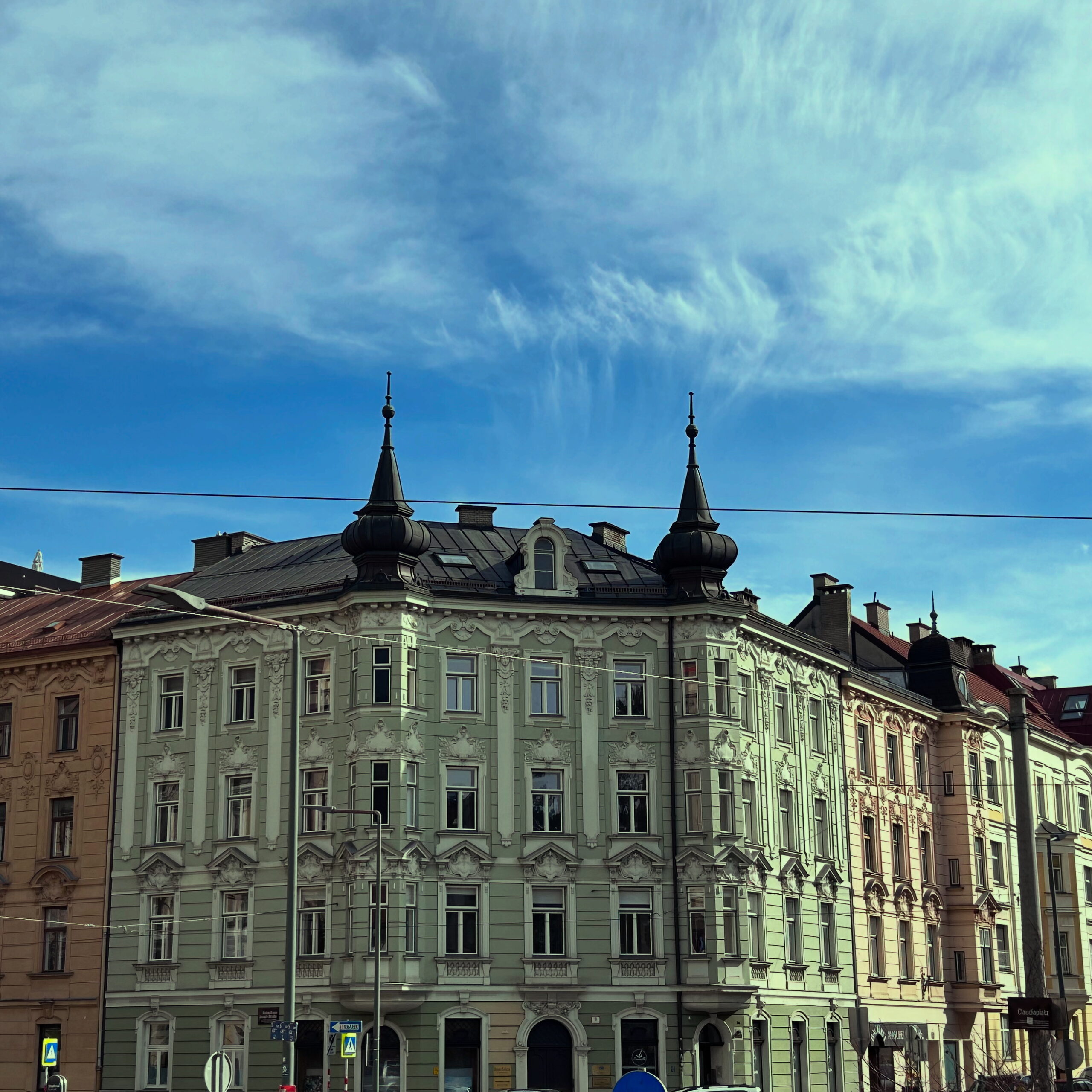
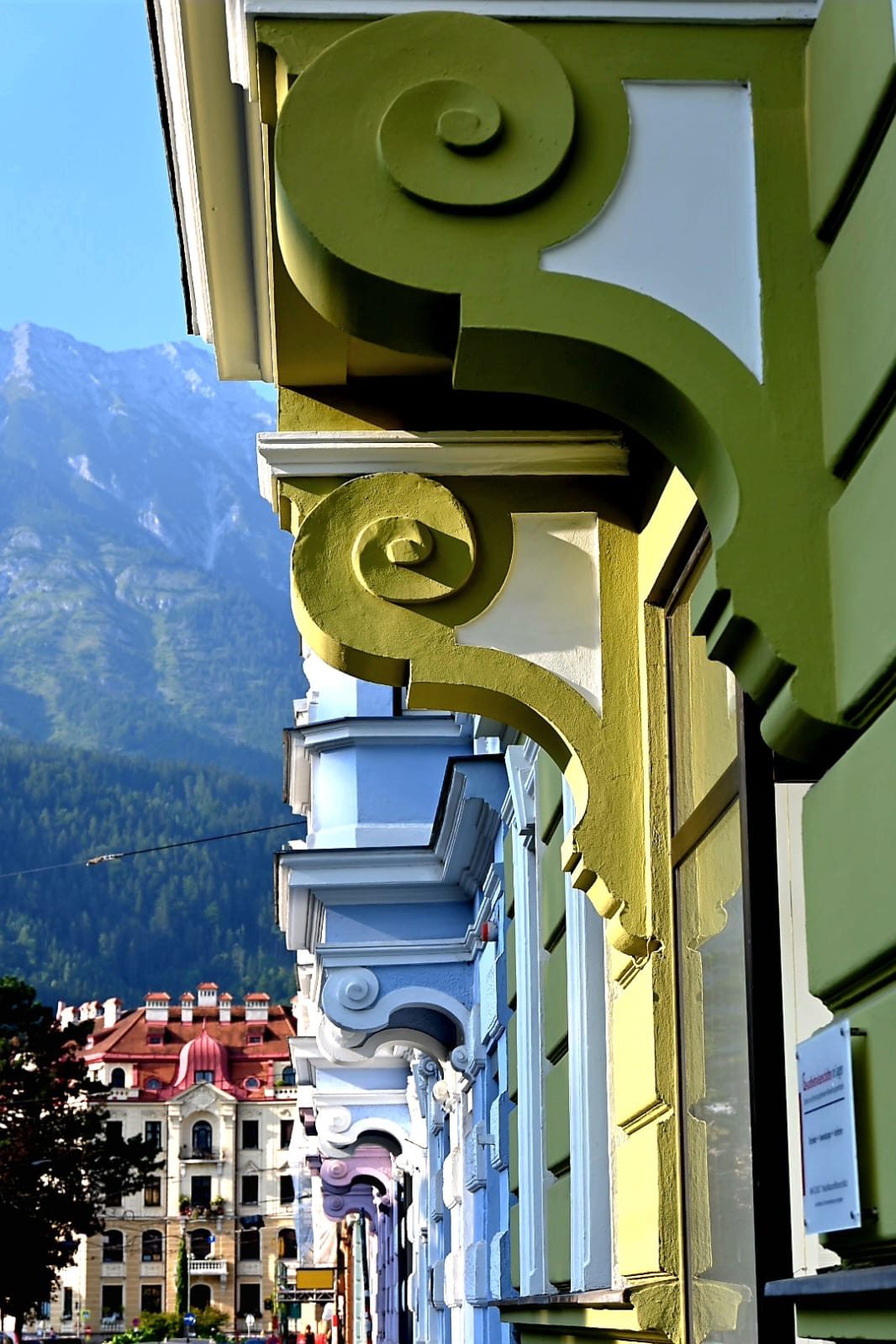
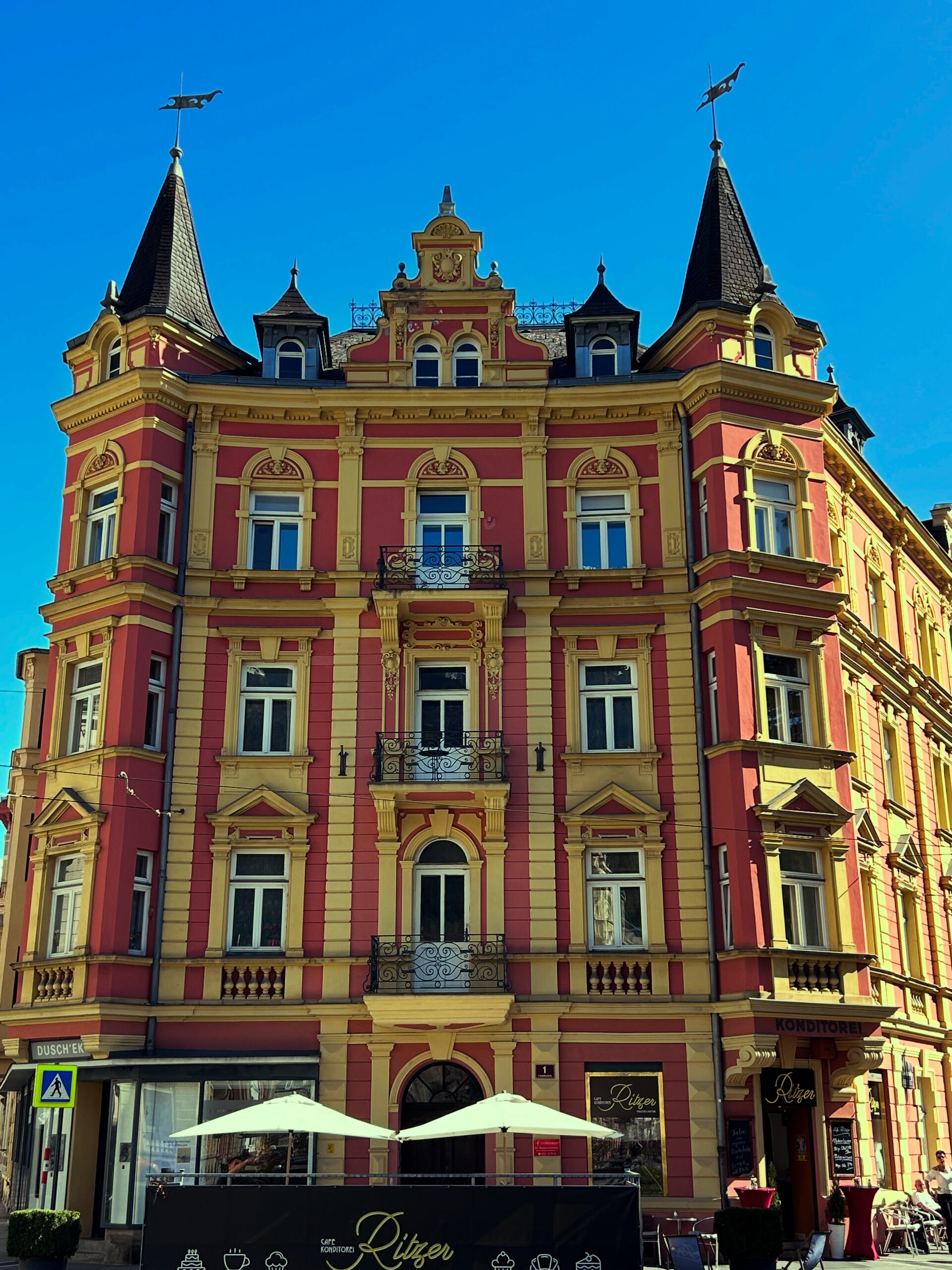
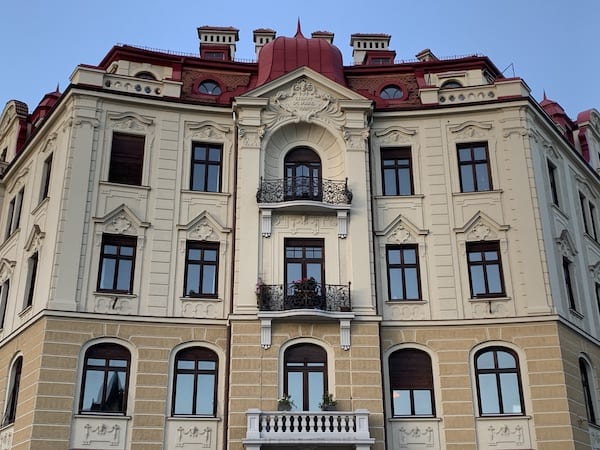
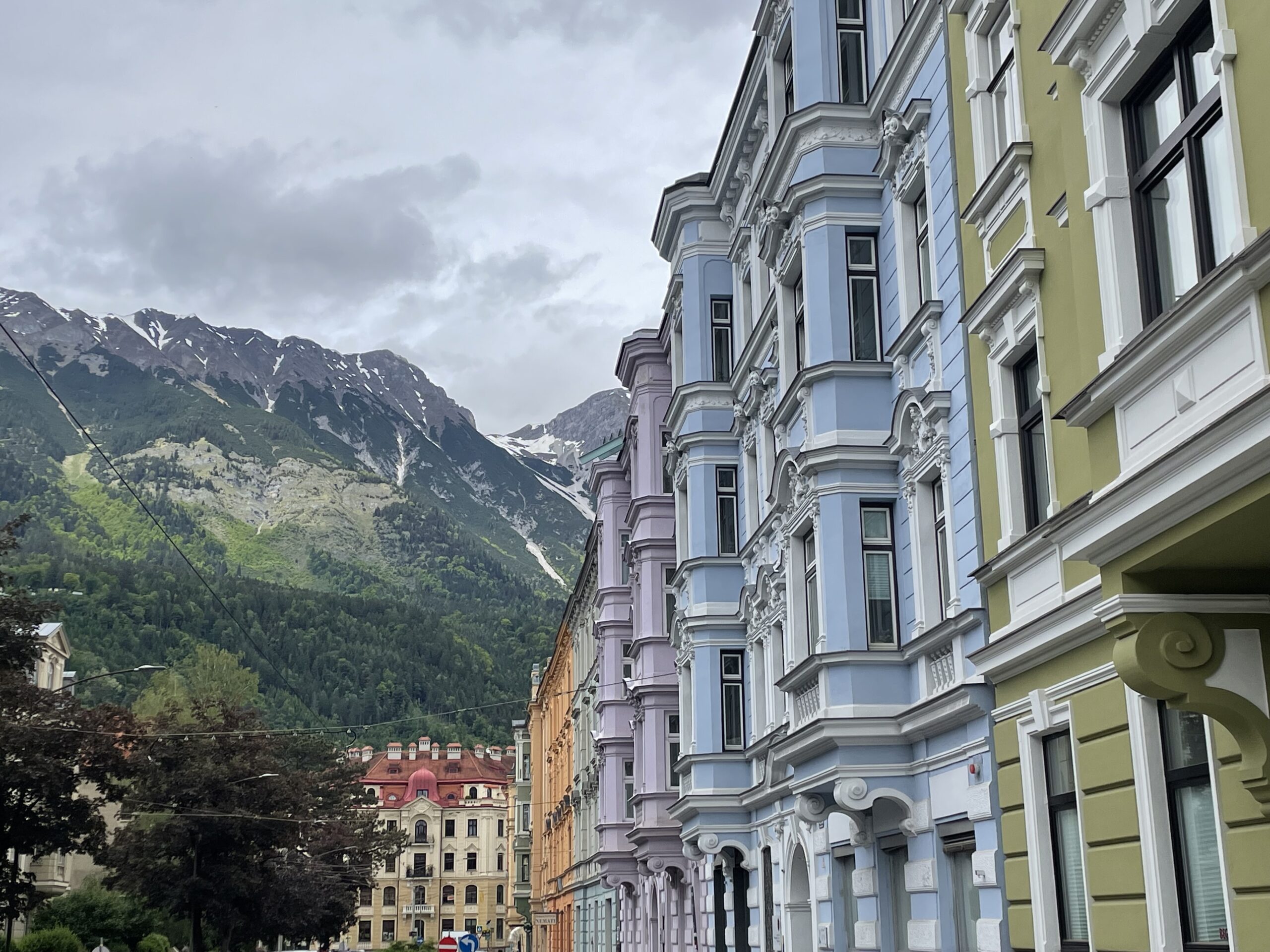
Around 1900, a new, globalized world emerged. Telegraphy and the telephone had enabled the rapid spread of news for 50 years, creating a sense of “simultaneity” between what happened and how it was reported in the media. Innsbruck’s first telephone device likely went into operation in 1877, and the city’s first telephone exchange followed 16 years later. Another 14 years would pass before the first long-distance call to the capital, Vienna, could be made. Entertainment, on the other hand, worked in the opposite direction. Cinema and the gramophone allowed, for the first time, a larger audience to store events and consume them “non-simultaneously.” In transportation, bicycles began to conquer streets that were increasingly illuminated even at night. Electric sewing machines and irons made housework easier for affluent ladies and their staff thanks to the expanding power grid. Zweig, Klimt, Kokoschka, Schiele, Mahler, Wagner, Schönberg, and Freud still shape a nostalgic image of Vienna and Austria abroad today. Innsbruck was not Vienna, and the Fin de Siècle was not celebrated in Tirol as it was in Paris, yet the bourgeoisie of the Alpine region was influenced by Europe. While nations drifted further apart politically, high culture and architecture in many European cities grew closer. The new bourgeois elites in Buenos Aires, Istanbul, Madrid, London, New York, and Vienna had embraced Historicism. Innsbruck was no exception. A touch of this era’s flair can still be sensed around Claudiaplatz. The central roundabout, named after Claudia de Medici, remains something like the heart of the Saggen district. It separates the “Villensaggen” in the northwest from the “Blocksaggen,” with its apartment buildings, in the east of the district. Not only architecturally but also socially, Claudiaplatz has always formed a kind of boundary. While freelancers and white-collar workers mostly settled in the residential blocks of the Blocksaggen, the villas housed an elite of minor nobility, entrepreneurs, and wholesalers. The development of Claudiaplatz reflects the capitalization of Innsbruck’s real estate market during the late monarchy. Developers and entrepreneurs with capital were already investing their money in “concrete gold.” Claudiaplatz 1, 2, and 3 as well as Elisabethstraße 11 were financed from 1898 onwards by Reinhold Boos. Originally from the Rhineland, Boos founded a roofing company in Innsbruck before establishing a name and wealth as a real estate dealer. He had these stately residential buildings constructed with up to seven apartments for a wealthy clientele. Unlike the villas, these properties were intended as rental objects. The magnificent houses have trapezoidal floor plans and are attractively decorated with bay windows and lavish ornamentation. Even the staircases, built during the Gründerzeit, were small works of art and meant to prepare visitors for the apartments and their ambience. Five streets lead into the Claudiaplatz roundabout. To the west, Elisabethstraße leads into the villa district, while Kaiser-Franz-Josef-Straße—with its charming green median strip—is lined with larger but equally notable residential buildings. Particularly remarkable is the house at Conradstraße 6, located just a few meters from Claudiaplatz. Quarry owner Josef Leutsch had this Art Nouveau building designed by architect Josef Mayr. Opposite, Claudiastraße flows into the square, marking the beginning of the Blocksaggen. The colorful houses in this row are a popular photo motif from within the roundabout. This area attracted those who had enough money for a luxury apartment, but not enough for a villa. The social environment in this part of Innsbruck, consisting of academics and freelancers, has been preserved to some degree to this day.
Klingler, Huter, Retter & Co: master builders of expansion
The final decades of the 19th century became known in Austrian history as the Gründerzeit (Founders’ Era). After the economic crisis of 1873, the financial situation recovered and an unprecedented construction boom began. Innsbruck also established a modern banking system. Financial institutions such as the Savings Bank founded in 1821 and the Creditanstalt, whose building erected in 1910 still towers over Maria-Theresien-Straße like a small palace, made it possible to obtain loans, without which entrepreneurship and commerce as we know them today would not have been possible. In some cases, these financial institutions even acted as developers themselves. Between 1880 and 1900, Innsbruck’s population grew from 20,000 to 26,000 inhabitants, while Wilten, incorporated into the city in 1904, even tripled its population from 4,000 to 12,000. The number of buildings increased from 600 to more than 900. Most of them, unlike previous buildings, were multi-story apartment houses. Infrastructure was also modernized. Gas, running water, and electricity became part of everyday life for an increasing number of people. These buildings represented the new society. Entrepreneurs, professionals, employees, and workers had different needs than the legally dependent subjects of previous centuries. The urban lifestyle demanded apartments with several rooms and open spaces for recreation after working hours. Apartment buildings made a modern lifestyle possible even for people who did not own property. Unlike the rural regions of Tyrol, where farming families lived together with servants in farmhouses as part of an extended kinship community, life in the city was already quite close to our present-day understanding of family life. Although the upper middle class had not yet surpassed the nobility, it had reduced the gap considerably and, through its new position on the municipal council, was able not only to commission private building projects but also to decide on public construction projects. The old city hospital in the center of town was replaced by a modern hospital in the west; Sieberer’s orphanage and retirement home were established in Saggen, and a new urban center emerged around the railway station.
The forty years preceding the First World War were a gold rush era for the construction industry. The architecture of the buildings reflected the worldview of their owners. Master builders often assumed several roles and frequently replaced architects altogether. Most clients had very clear ideas about what they wanted. They were not seeking breathtaking new creations but rather copies of or adaptations based on existing buildings. In keeping with the spirit of the age, Innsbruck’s master builders designed structures according to the wishes of their financially powerful clients in the styles of Historicism, Classicism, and the Tyrolean Heimatstil. The style chosen for a home was often not merely an aesthetic decision but also an ideological statement by the owner. Liberals generally preferred Classicism, while conservatives were drawn to the Tyrolean Heimatstil. Whereas the Heimatstil presented itself in a Neo-Baroque form with abundant paintings, clear forms, statues, and columns were characteristic elements of Classical-inspired architecture. In what was sometimes a rather wild mixture of styles, people realized their ideas of classical Greece and ancient Rome. Not only railway stations and public buildings but also large apartment buildings, entire streets, churches, and even cemeteries were built along former country roads in this design. Academics—and those wishing to appear as such—demonstrated their fascination with antiquity through neoclassical façades. Catholic traditionalists commissioned murals depicting saints and scenes from Tyrolean history on their Heimatstil houses. While Neoclassicism predominates in Saggen and Wilten, the district of Pradl is largely characterized by conservative Heimatstil architecture. For a long time, many architectural experts looked down upon the tastes of social climbers and the newly rich. Heinrich Hammer wrote in his standard work Art History of the City of Innsbruck:
"Of course, this first rapid expansion of the city took place in an era that was unfruitful in terms of architectural art, in which architecture, instead of developing an independent, contemporary style, repeated the architectural styles of the past one after the other."
The era of grand villas, which imitated the aristocratic residences of former times with a bourgeois touch, came to an end after several exuberant decades simply because space became scarce. Further development of the city with detached houses was no longer possible. Even today, the area around Falkstraße, Gänsbachstraße, and Bienerstraße is known as Villensaggen, while the areas further east are referred to as Blocksaggen. Wilten and Pradl, however, never experienced this kind of development. Nevertheless, in their gold-rush enthusiasm, developers sealed ever more land with construction. In 1907, Albert Gruber delivered a warning speech about this growth, cautioning against unchecked urban expansion and land speculation.
"It is the most difficult and responsible task facing our city fathers. Up until the 1980s (note: 1880), let's say in view of our circumstances, a certain slow pace was maintained in urban expansion. Since the last 10 years, however, it can be said that cityscapes have been expanding at a tremendous pace. Old houses are being torn down and new ones erected in their place. Of course, if this demolition and construction is carried out haphazardly, without any thought, only for the benefit of the individual, then disasters, so-called architectural crimes, usually occur. In order to prevent such haphazard building, which does not benefit the general public, every city must ensure that individuals cannot do as they please: the city must set a limit to unrestricted speculation in the area of urban expansion. This includes above all land speculation."
A handful of master builders, together with the Innsbruck Building Authority, guided this development. If Wilhelm Greil can be called the mayor of Innsbruck’s expansion, then the Vienna-born Eduard Klingler (1861–1916) certainly deserves the title of its architect. As a public official and master builder, Klingler left a profound mark on Innsbruck’s cityscape. He began working for the Province of Tyrol in 1883. In 1889 he joined the municipal building authority, which he headed from 1902 onward. Among the projects attributed to Klingler as head of the building authority are the Commercial Academy, the Leitgeb School, Pradl Cemetery, the Dermatological Clinic within the hospital complex, the Municipal Kindergarten on Michael-Gaismair-Straße, the Train Barracks (today a residential building), the Market Hall, and the Tyrolean State Conservatory. One particularly noteworthy Heimatstil building designed by him is the Ulrich House on Bergisel, which today serves as the headquarters of the Old Kaiserjäger Club.
The most important construction company in Innsbruck was Johann Huter & Sons. Johann Huter took over his father’s brickworks. In 1856 he acquired the company’s first property, the Huter Grounds, on Innrain. Three years later the first business headquarters was established on Meranerstraße. The company’s official founding came in 1860 when it was registered together with his sons Josef and Peter. Like many of its competitors, Huter & Sons saw itself as a full-service provider. The company included its own brickworks, cement factory, carpentry shop, metal workshop, design office, and construction firm. By the outbreak of the First World War, it employed more than 700 people. In 1906/07, the Huter family built their residential and business headquarters at Kaiser-Josef-Straße 15 in the typical style of the late pre-war years. This stately house combines the Tyrolean Heimatstil, surrounded by gardens and nature, with Neo-Gothic and Neo-Romanesque elements. Well-known buildings erected by Huter & Sons in Innsbruck include the Monastery of Perpetual Adoration, St. Nicholas Parish Church, the first building of the new hospital complex, and several buildings on Claudiaplatz.
The second major player was Josef Retter (1872–1954). Born in Lower Austria with Tyrolean roots, he completed an apprenticeship as a mason before attending the Imperial-Royal State Trade School in Vienna and the master craftsman school of its construction department. After gaining professional experience throughout the Habsburg Monarchy—in Vienna, Croatia, and Bolzano—he was able, thanks to his wife’s dowry, to establish his own construction company in Innsbruck at the age of 29. Like Huter’s company, his enterprise also included a sawmill, a sand and gravel works, and a stonemasonry workshop. In 1904 he built his residential and office building. The dark Neo-Gothic Retter House at Schöpfstraße 23a, with its distinctive bay window supported by columns and a turret, is decorated with a remarkable mosaic representing an allegory of architecture. The relief on the gable depicts the union of art and craftsmanship, symbolizing Retter’s career path. Retter’s buildings particularly shaped Wilten and Saggen. Through projects such as the new Academic Gymnasium, the castle-like Commercial Academy building, the Protestant Christ Church in Saggen, the Zelger House on Anichstraße, Sonnenburg in Wilten, and the Neo-Gothic Mentlberg Castle in Sieglanger, he created many of the most important buildings of this era in Innsbruck.
Late in life but with a similarly practice-orientated background that was typical of 19th century master builders, Anton Fritz started his construction company in 1888. He grew up remotely in Graun in the Vinschgau Valley. After working as a foreman, plasterer and bricklayer, he decided to attend the trade school in Innsbruck at the age of 36. Talent and luck brought him his breakthrough as a planner with the country-style villa at Karmelitergasse 12. In its heyday, his construction company employed 150 people. In 1912, shortly before the outbreak of the First World War and the resulting slump in the construction industry, he handed over his company to his son Adalbert. Anton Fritz's legacy includes his own home at Müllerstraße 4, the Mader house in Glasmalereistraße and houses on Claudiaplatz and Sonnenburgplatz.
With Carl Kohnle, Carl Albert, Karl Lubomirski, and Simon Tommasi, Innsbruck possessed several other master builders who left their mark on the cityscape through typical buildings of the late 19th century. Together, they shaped Innsbruck’s new streets in the prevailing architectural spirit of the final thirty years of the Habsburg Monarchy. Residential houses, railway stations, government buildings, and churches throughout the vast empire stretching from Ukraine to Tyrol looked remarkably similar. New movements such as Art Nouveau gained acceptance only slowly. In Innsbruck, it was the Munich architect Josef Bachmann who introduced a new accent to bourgeois design with the redesign of the façade of the Winkler House. With the outbreak of the First World War, construction activity largely ceased. After the war, the era of neoclassical Historicism and the Heimatstil was definitively over. Times had become harsher, and the requirements for housing had changed. In the period of severe housing shortages in the young Republic of German-Austria, affordable housing and modern sanitary facilities became more important than representative façades and grand rooms. The increasingly professional education of master builders and architects at the Imperial-Royal State Trade School also contributed to a new understanding of construction, replacing the often self-taught veterans of the gold-rush era of Classicism. A stroll through Saggen and parts of Wilten and Pradl still transports visitors back to the Gründerzeit. Claudiaplatz and Sonnenburgplatz are among the most impressive examples. The construction company Huter & Sons still exists today. The company is now located in Sieglanger on Josef-Franz-Huter-Straße, named after its founder. Although the residential building on Kaiser-Josef-Straße no longer bears the company’s name, it remains, in all its opulence, a remarkable relic of the period that permanently transformed Innsbruck’s appearance. In addition to his residence on Schöpfstraße, the district of Wilten contains a second building associated with the Retter family. Opposite the university on Innrain stands Villa Retter. Josef Retter’s eldest daughter, Maria Josefa, who herself had been educated according to the principles of the reform educator Maria Montessori, opened Innsbruck’s first Haus des Kindes (“House of the Child”) in 1932. Above the entrance, a portrait depicts the benefactor Josef Retter. The south façade is adorned with a mosaic in the characteristic style of the 1930s, referring to the building’s original purpose. A smiling blond girl embraces her mother, who is holding a book, and her father, who carries a hammer. The family crypt at Westfriedhof Cemetery is another notable legacy of the Retter family.
The year 1848 and its consequences
The year 1848 occupies a mythical place in European history. Innsbruck was not one of the hotspots like Paris, Vienna, Budapest, Milan or Berlin, but even in the “Holy Land” of Tyrol the revolutionary year left its mark. In contrast to the rural surroundings, an enlightened educated bourgeoisie had developed in Innsbruck. Enlightened people no longer wanted to be subjects of a monarch or territorial prince, but citizens with rights and duties in relation to a modern state. Students and members of the liberal professions demanded political participation, freedom of the press and civil rights. Workers demanded better wages and working conditions. Particularly radical liberals and nationalists even questioned the absolute authority of the Church. In March 1848 this socially and politically highly explosive mixture erupted in uprisings and street fighting in many cities. In Innsbruck, some students and professors celebrated the newly granted freedom of the press with a torchlight procession. On the whole, however, the revolution proceeded quietly in the rather leisurely Tyrol. To speak of a spontaneous outburst of emotion or even a revolution would already be an exaggeration: the date of the procession was postponed from 20 to 21 March because of bad weather. There were hardly any anti-Habsburg riots or violent incidents; a stray stone thrown into a Jesuit window was one of the highlights of the Alpine version of the Revolution of 1848. The students even supported the city magistrate in maintaining public order, thereby demonstrating their gratitude to the monarch for the newly granted freedoms and their loyalty.
The initial enthusiasm for change among the bourgeois elites was soon replaced in Innsbruck by a surge of German-national patriotism. On April 6, 1848, the governor of Tyrol led a ceremonial procession in which the German flag was displayed. A German tricolour was also hoisted on the city tower. While students, workers, liberal-national citizens, republicans, supporters of a constitutional monarchy, and Catholic conservatives could not agree on social issues such as press freedom, they shared a common hostility toward the Italian independence movement, which had spread across northern Italy from Piedmont and Milan. Innsbruck students and riflemen, with the support of the imperial army leadership, marched into the Trentino to suppress unrest and uprisings at an early stage. Notable members of this corps included the already elderly Father Haspinger, who had fought alongside Andreas Hofer in 1809, and Adolf Pichler. Johann Nepomuk Mahl-Schedl, a wealthy owner of Büchsenhausen Castle, even equipped his own company and marched over the Brenner Pass to secure the border. However, the war did not remain confined to the southern borders. Innsbruck itself, as the political and economic center of the multinational crown land of Tyrol and home to many Italian speakers, became an arena of the conflict between nationalities. Combined with ample alcohol consumption, anti-Italian sentiment posed a greater threat to public order than the demand for civil liberties. A dispute between a German-speaking craftsman and an Italian-speaking Ladin escalated to such an extent that it nearly triggered a pogrom against the numerous businesses and inns of Italian-speaking Tyroleans.
The relative calm of Innsbruck suited the imperial court in Vienna, which was under pressure. As unrest in the capital continued after March, Emperor Ferdinand fled to Tyrol in May. According to contemporary press reports, he was enthusiastically welcomed by the population.
"“What is the name of the land to which such an honour falls, what is the people that enjoys such trust in these fateful times? Does the peace and security here rest solely on legend from ancient times, or is there also in the present a foundation on which one can build, which the wind cannot blow away and the storm cannot shake? This Alpine land is called Tyrol, do you like it? Yes, the Tyrolean people alone prove, in the midst of a shaken Europe, reverence and loyalty, courage and strength for their hereditary ruling house, while all around rebellion, contradiction, defiance and demands, often even revolt and upheaval rage; Tyrol alone stands firmly without wavering in custom and obedience, in religion, truth and law, while elsewhere insolence and falsehood, madness and passions prevail …”"
In June, a young Franz Joseph—still not yet emperor—also stopped at the Hofburg on his return from the battlefields of northern Italy instead of traveling directly to Vienna. Innsbruck once again became a royal residence, albeit only for one summer. While blood was shed in Vienna, Milan, and Budapest, the imperial family enjoyed rural Tyrolean life. Ferdinand, Franz Karl, his wife Sophie, and Franz Joseph received guests from foreign courts and were driven by carriage to excursion destinations such as Weiherburg, Stefansbrücke, Kranebitten, and even up to Heiligwasser, and went on hikes. This calm did not last long. Ferdinand, considered no longer fit to rule, handed over power under gentle pressure to Franz Joseph I. In July 1848, the first parliamentary session was held in Vienna, and a constitution came into force. However, the monarchy’s willingness to reform soon waned. The new parliament—the Reichsrat—could not pass binding laws, the emperor never attended it, and he did not understand why a monarchy ordained by God needed such a council.
The subtly initiated liberalization nevertheless ran its course in the cities. Innsbruck was granted the status of a city with its own independent charter (Statutarstadt). In 1850, the "Provisorische Gemeindegesetz für die Landeshauptstadt Innsbruck" ("Provisional Municipal Code for the State Capital of Innsbruck") came into force:
"The municipality is to provide for the sanitation police; it takes care of the paving and maintenance of streets, alleys, and paths, with the exception of those whose maintenance is the responsibility of the Imperial Treasury, as well as for street lighting, the maintenance and cleaning of the main drainage canals, and the maintenance of municipal bridges, fountains, aqueducts, and other facilities, as well as public bathing establishments. It administers the health, fire, market, building, and traffic police, oversees land boundaries, measures, and weights; it is charged with the provision of food supplies, and takes police precautions to avert threats to personal safety and property posed by flooding or other natural disasters."
Innsbruck's municipal law provided for citizenship rights that, while tied to property ownership or tax payments, legally guaranteed certain rights to members of the community. Right of domicile (Heimatrecht) could be acquired through birth, marriage, or extraordinary conferral, granting voting rights at the municipal level to at least adult males. If one fell into financial hardship, one was entitled to basic welfare provided by the city. Within the city government, the Greater German-liberal faction prevailed thanks to the census-based majority voting system, with merchants, tradesmen, industrialists, and innkeepers setting the tone. On June 2, 1848, the first edition of the liberal and Greater German-leaning Innsbrucker Zeitung was published—from which the above article on the emperor's arrival in Innsbruck is taken. Conservatives, on the other hand, read the Volksblatt für Tirol und Vorarlberg. Moderate readers who favored a constitutional monarchy preferred to consume the Bothe für Tirol und Vorarlberg. However, freedom of the press was short-lived. The previously abolished censorship was partially reinstated. Newspaper publishers were subjected to various forms of harassment by the authorities, and newspapers were strictly forbidden from printing content critical of the state government, the monarchy, or the Church.
"Anyone who, by means of printed matter, incites, instigates or attempts to incite others to take action which would bring about the violent separation of a part from the unified state... of the Austrian Empire... or the general Austrian Imperial Diet or the provincial assemblies of the individual crown lands.... Imperial Diet or the Diet of the individual Crown Lands... violently disrupts... shall be punished with severe imprisonment of two to ten years."
After Innsbruck had officially replaced Meran as the provincial capital in 1849 and had thus finally become the political centre of Tyrol, parties began to form. With the establishment of the Catholic-conservative faction and the liberals, a pair of opposing ideas emerged that would shape politics not only until the First World War. Associations of all kinds as political organisations in advance of parties, and newspapers, formed the lines along which society split in all questions of life from the cradle to the grave. From 1868 onwards, the liberal, greater German-oriented party provided the mayor of the city of Innsbruck. The influence of the Church declined in Innsbruck in contrast to the surrounding municipalities. Individualism, capitalism, nationalism and consumption stepped into the breach. New worlds of work, department stores, theatres, cafés and dance halls did not displace religion entirely even in the city, but the weighting shifted as a result of the civil freedoms won in 1848.
The probably most important legal change of 1848 was the land relief patent. In Innsbruck the clergy, especially Wilten Abbey, owned a large part of the agricultural land. The Church and the nobility were exempt from taxes. In 1848/49 feudal lordship and the relationship of subjection were abolished in Austria. Ground rents, tithes and compulsory labour were thus removed. The landowners received one third of the value of their land from the state within the framework of the reform, one third was regarded as tax relief, and one third of the compensation had to be borne by the peasants themselves. They could pay this amount in instalments over twenty years. The after-effects can still be felt today. The descendants of the peasants who were successful at the time enjoy, through inherited land ownership resulting from the 1848 reforms, the fruits of prosperity and also political influence through land sales for housing, leases and compensation payments by public authorities for infrastructure projects. The landowning nobility of the past had to come to terms with the humiliation of taking up bourgeois occupations. The transition from privilege by birth to privileged status within society through financial means, networks and education often succeeded. Many Innsbruck dynasties of academics have their origins in the decades after 1848.
Life also changed for the broader population. The previously unknown phenomenon of leisure time emerged and, together with disposable income available to a greater number of people, fostered hobbies. Civil organisations and associations—from reading circles to choral societies, fire brigades and sports clubs—were founded. The revolutionary year also manifested itself in the cityscape. Parks such as the English Garden at Ambras Castle or the Hofgarten were no longer reserved exclusively for the aristocracy but served citizens as local recreational areas. In St. Nikolaus the Waltherpark was created as a small oasis of calm. One floor above, the first swimming and bathing facility in Tyrol opened at Büchsenhausen Castle; soon afterwards another bath followed in Dreiheiligen. Excursion inns around Innsbruck flourished. Alongside high-end restaurants and hotels, a scene of taverns emerged in which workers and employees could also afford pleasant evenings with theatre, music and dancing.
Crown Prince Rudolf & the mores of the upper class
The smart and liberal Crown Prince Rudolf (1858–1889) was considered the favorite of the peoples of the Habsburg Empire. In many respects, his life can be read as exemplary for the period between 1848 and the outbreak of the First World War—a time when technical ideas developed at a breakneck pace, newspapers distributed the political ideas of various factions in unprecedented circulation, and yet Catholicism, superstition, and spiritism were commonplace. The vast majority of Innsbruck's citizens did not possess the material means or status of a Habsburg, but the fashions and trends under which they lived were the same. The bourgeoisie aspired to the same ideals as the Crown Prince, just as Rudolf always saw himself as part of this bourgeoisie. He was regarded as a well-read, educated humanist and, completely in tune with the spirit of the times, was interested in a wide spectrum of topics. In his role as a member of the ruling house of a multinational empire, he spoke French, Hungarian, Czech, and Croatian in addition to Greek and Latin. As a private individual, he dedicated himself to science and traveling through the lands of the monarchy. Rudolf initiated the publication of the Kronprinzenwerk (The Crown Prince's Work), a scientific encyclopedia; Volume 13, which covered the crown land of Tyrol, was published in 1893. He also authored liberal articles in the Neues Wiener Tagblatt under a pseudonym. Among other things, he wished to push forward land reforms by heavily taxing large landowners, and he wanted to grant more rights to the individual nationalities within the Habsburg Empire. He was extremely unpopular, particularly in conservative, rural Tyrol and among the military. Conversely, among the liberal-minded citizens of Innsbruck, he was seen as the hope for a renewal of the monarchy in the sense of a modern, federal state. Although the Rudolfsbrunnen (Rudolf's Fountain) on Boznerplatz in Innsbruck does not actually commemorate the Crown Prince, he was present at its inauguration. As a champion of rationalism and the Enlightenment, Rudolf despised the widespread belief in supernatural beings and spirits, even as new churches sprouted like mushrooms all around him and the upper class indulged in seances and spiritist superstition. The popular piety of the late monarchy led to major projects such as the parish churches of St. Nikolaus and Hötting.
Despite, or perhaps because of his aristocratic background, Rudolf's private life was turbulent, but not atypical of the time, in which parents and teachers were less approachable educators and more distant figures of respect. Children were brought up strictly. Neither teachers nor parents shied away from corporal punishment, even if there were limits, laws and rules for the use of domestic violence. Militarism and a focus on future gainful employment prevented the kind of childhood and youth we know today. Young men from the upper classes lived out their soldierly daydreams as armed and uniformed members of student fraternities. It is no wonder that the enthusiasm for war, God, Emperor and Fatherland was great in the birth cohorts of the last decades of the 19th century. Rudolf's early years, when he had to undergo a military education under General Gondrecourt at the request of Emperor Franz Josef, were also less than luxurious. It was only after his mother Elisabeth intervened that harassment such as water cures, drill in the rain and snow and being woken up with pistol shots were removed from the six-year-old crown prince's daily programme.
Like many of his contemporaries, Rudolf found himself as a member of the upper class trapped in an unhappy, arranged marriage. The 19th century was not the age of love matches, even if the Romantic and Biedermeier eras are often fondly glorified as such. Marriages among farming folk were frequently concluded based on financial considerations. Aristocrats and members of the high bourgeoisie married out of class snobbery and with the goal of preserving the dynasty. In upper-class circles, wives were often mere ornaments to their husbands and heads of the household. Only after the—often older—husband had passed away could widows enjoy their lives outside of this role. For a long time, servants, housemaids, farmhands, and maids were forbidden from marrying. The danger that those without assets would be unable to feed their children, thereby becoming a burden on the public, was deemed too great by the municipalities. This double standard held by the aristocracy and bourgeoisie toward the common folk (Pofl) meant that illegal abortions, full orphanages, and children growing up with relatives in the countryside instead of with their parents were a part of everyday reality. Throughout his life, Rudolf was also not averse to the fair sex outside of marriage. In the final months of his life, he maintained an affair with Mary Vetsera, a girl of only 17 from the wealthy Hungarian nobility who was considered exceptionally beautiful. Many of his subjects acted just as Rudolf did. Granted, hardly anyone could boast of claiming a Hungarian aristocrat as a mistress. Yet, even in Innsbruck's high society, it was common practice to listen to the priest’s sermon from the pulpit on Sundays while simultaneously maintaining an extramarital relationship or visiting a brothel.
Rudolf's life ended tragically. On January 30, 1889, deeply depressed and ravaged by alcohol, morphine, and gonorrhea, Rudolf met with Vetsera, having spent the previous night with his long-term mistress, the prostitute Maria "Mizzi" Kaspar. Under circumstances that have never been fully cleared up, he first killed the young woman and then himself with a shot to the head. The suicide was never recognized by the Habsburg family. Zita (1892–1989), the widow of the last Emperor Karl, was still speaking of an assassination plot as late as the 1980s. The debate surrounding the burial of the heir to the throne and his mistress exposed the double standards of society. Suicide was considered a grave sin and technically precluded a Christian burial. Vetsera was buried discreetly in a small grave by the cemetery wall at the cemetery in Heiligenkreuz near Mayerling, whereas Rudolf, following imperial intervention with the Pope, received a state funeral and was laid to his final rest in the Imperial Crypt (Kapuzinergruft) in Vienna.
Leopold V & Claudia de Medici: Glamour and splendour in Innsbruck
While the Thirty Years’ War was ravaging half of Europe, a charismatic princely couple set out to reshape the face of Innsbruck forever in the Baroque manner. The Habsburg who entered the history of the land as Leopold V (1586–1632) assumed sovereign governmental responsibilities in the Upper Austrian regency of Tyrol and the Further Austrian territories after turbulent early years. Unlike many firstborn members of his rank, his career had long appeared uncertain. In his youth he received the classical humanist education customary for young aristocrats, under the guidance of the Jesuits. In Graz and Judenburg he studied philosophy and theology in preparation for a career within the ecclesiastical sphere of power—an established path for younger sons with little prospect of secular thrones. Leopold’s early career within the power structures of the Church epitomised precisely those features of Catholicism rejected by Protestants and Church reformers. At the age of twelve he was elected Bishop of Passau; at thirteen he was appointed coadjutor of the Bishopric of Strasbourg in Lorraine. He never, however, received holy orders; the spiritual duties were carried out by a prince‑bishop appointed for that purpose. A passionate politician, Leopold travelled extensively between his dioceses and supported the imperial side during the conflict between Rudolf II and Matthias—later immortalised by Franz Grillparzer in Bruderzwist im Hause Habsburg. These activities, scarcely befitting a churchman, nonetheless preserved Leopold’s chances of attaining a secular princely title.
That opportunity arose in 1618, when the unmarried Maximilian III died childless. At the behest of his brother, Leopold assumed the role of Habsburg governor and ruler of the Upper and Further Austrian lands and their incorporated peoples and territories. In the early years of his regency he continued to shuttle between his bishoprics in southern and western Germany, threatened by the upheavals of the Thirty Years’ War. Although the ambitious power politician found satisfaction in the excitement of high politics, the status of governor did not suffice. He sought recognition as territorial prince, complete with homage and dynastic inheritance. What he lacked were a suitable bride, time, and money. Costly conflicts had depleted his coffers.
Money arrived with the bride—and with her, time. Claudia de’ Medici (1604–1648), from the wealthy Tuscan merchant‑princely dynasty, was selected to bestow dynastic fortune upon the aspiring territorial prince, now approaching forty. As a child, Claudia had already been promised to the Duke of Urbino, whom she married at seventeen, despite a proposal from Emperor Ferdinand II. Her husband died after only two years of marriage. The ties between the Medici and the Habsburgs remained intact. Since the marriage of Francesco de’ Medici to Johanna of Habsburg, a daughter of Ferdinand I, the two dynasties had been closely interwoven. Leopold and Claudia likewise proved a perfect match of title, power, Baroque piety, and wealth. Leopold’s sister Maria Magdalena, who as a Medici bride had become Grand Duchess of Tuscany, resided in Florence and sent her brother a painted portrait of the young widow, remarking that she was “beautiful in face, body, and virtue.” After a delicate dance of mutual conditions—the bride’s family seeking assurance of the groom’s title, while the Emperor required proof of a suitable marriage before granting the ducal dignity—the moment finally arrived. In 1625 Leopold, now raised to duke and well nourished and mature in years, relinquished his ecclesiastical possessions and titles in order to marry and, together with his nearly twenty‑years‑younger bride, found a new Tyrolean line of the House of Habsburg.
The relationship between the prince and the Italian woman was to characterise Innsbruck. The Medici had made a fortune from the cotton and textile trade, but above all from financial transactions, and had risen to political power. Under the Medici, Florence had become the cultural and financial centre of Europe, comparable to the New York of the 20th century or the Arab Emirates of the 21st century. The Florentine cathedral, which was commissioned by the powerful wool merchants' guild, was the most spectacular building in the world in terms of its design and size. Galileo Galilei was the first mathematician of Duke Cosimo II. In 1570, Cosimo de Medici was appointed the first Grand Duke of Tuscany by the Pope. Thanks to generous loans and donations, the Tuscan moneyed aristocracy became European aristocracy. In the 17th century, the city on the Arno had lost some of its political clout, but in cultural terms Florence was still the benchmark. Leopold did everything in his power to catapult his royal seat into this league.
In February 1622 the wedding celebrations of Emperor Ferdinand II and Eleonore of Mantua had taken place in Innsbruck; for the northern Italian bridal entourage Innsbruck was easier to reach than Vienna. Tyrol was religiously unified and had been spared the initial devastations of the Thirty Years’ War. Whereas the imperial wedding concluded within five days, Leopold and Claudia celebrated for two full weeks. Their official marriage ceremony had taken place in Florence Cathedral without the groom present. The subsequent festivities celebrating the Habsburg–Medici union became one of the most magnificent events in Innsbruck’s history, holding the city in thrall for a fortnight. After a wintry procession descending from the snow‑covered Brenner Pass, Innsbruck welcomed its new princess and her family. Prior to her arrival, the groom and his subjects had prayed for inner purification to seek divine blessing. Like the Emperor before them, the bridal couple entered the city in a grand procession through two specially erected gates. Fifteen hundred marksmen fired volleys from all their weapons. Drummers, pipers, and the bells of the Hofkirche accompanied the procession of 750 participants passing the astonished populace. A broad programme of entertainment—hunts, theatre, dances, music, and exotic spectacles including “bears, Turks, and Moors”—filled guests and townspeople alike with amazement and delight. From a modern perspective, one particularly inglorious attraction was the cat race, in which riders attempted to sever the head of a cat suspended by its legs as they galloped past.
Leopold’s early years of rule were far less glorious for his subjects. His policies were marked by frequent conflicts with the estates of the realm. A hardliner of the Counter‑Reformation, he supported imperial troops. The Lower Engadine, over which Leopold exercised jurisdiction, was a persistent source of unrest. Under the pretext of protecting Catholic subjects from Protestant attacks, Leopold occupied the region. Although he repeatedly suppressed uprisings successfully, the resources required drove both population and estates to the brink of despair. The northern border with Bavaria was likewise unstable and demanded Leopold’s attention as military commander. Duke Bernhard of Saxe‑Weimar had taken Füssen and was positioned at the Ehrenberg Pass on the Tyrolean frontier. Innsbruck was spared direct combat, but its proximity to the fronts nevertheless made it part of the Thirty Years’ War. Financially, Leopold funded these efforts through comprehensive tax reforms to the disadvantage of the middle classes. Wartime inflation, caused by disruptions in trade critical to Innsbruck, worsened living conditions. In 1622 a weather‑related crop failure further aggravated the situation, already strained by debt from earlier obligations. His insistence on enforcing modern Roman law across the territory, at the expense of traditional customary law, also earned him little affection among his subjects.
None of this prevented Leopold and Claudia from maintaining a splendid court in absolutist fashion. Under Leopold’s rule Innsbruck underwent extensive Baroque transformation. Court festivals attracted the European high nobility. Spectacles such as lion fights, featuring exotic animals from the ducal menagerie established by Ferdinand II in the Hofgarten, as well as theatre and concerts, served to entertain court society. The morals and manners of the rugged Alpine population were to be refined. It was a delicate balance between lavish court festivities and prohibitions on carnival celebrations for ordinary citizens. Divine wrath—manifest in plague and war—was to be averted through virtuous conduct. Swearing, shouting, and the carrying of firearms in public streets were prohibited. Pimps, prostitution, adultery, and moral decay were prosecuted rigorously at the pious court. Jews likewise faced harsh conditions under Leopold and Claudia. Long‑standing hostility towards the Hebrew population gave rise to one of the most disturbing traditions of Tyrolean piety. In 1642 Hippolyt Guarinoni, an Italian‑born physician at the Abbey of Hall and founder of the Karlskirche in Volders, composed the legend of the child martyr Anderle of Rinn. Inspired by the alleged ritual murder of Simon of Trent in 1475, Guarinoni wrote the Anderl‑Lied in verse. In Rinn near Innsbruck an antisemitic cult emerged around the remains of Andreas Oxner—supposedly murdered by Jews in 1462, a date revealed to Guarinoni in a dream. This cult was only banned in 1989 by the Bishop of Innsbruck. Innsbruck was not only morally but also physically “cleansed.” Waste, particularly problematic during dry periods when no water flowed through the canals, was regularly removed by princely decree. Livestock were forbidden to roam within the city walls. Memories of the recent plague epidemic remained vivid; foul smells and miasmas were to be eliminated at all cost.
Around the midpoint of the Thirty Years’ War, one of the most powerful women in Tyrolean history came to prominence. After Leopold’s early death, Claudia ruled the country on behalf of her minor son, together with her chancellor Wilhelm Biener (1590–1651), employing a modern, confessionally driven, early absolutist policy and a firm hand. She relied on an efficient administrative apparatus. The young widow surrounded herself with Italians and Italian‑speaking Tyroleans who introduced new ideas while displaying uncompromising severity in the fight against Lutheranism. To prevent fires—after the Lion House and Ferdinand II’s estate Ruhelust had burned down directly in front of the Hofburg in 1636—stables and other wooden buildings within the city walls were demolished. Silkworm breeding in Trentino and early considerations regarding a Tyrolean university flourished under Claudia’s regency. Chancellor Biener centralised parts of the administration, above all aiming to replace the fragmented legal systems of the Tyrolean territories with a uniform code. This required further curtailing the power of the often arbitrary local nobility in favour of the territorial prince. The system was intended to finance not only the expensive court but also territorial defence. It was not only Protestant troops from southern Germany that threatened the Habsburg lands. France—nominally a Catholic power—sought compensation at the expense of the Casa de Austria in Spain, Italy, and the Further Austrian territories, today’s Benelux countries. Innsbruck became one of the centres of the Habsburg war council. Situated at the fringes of the German battlefields and midway between Vienna and Tuscany, the city was an ideal meeting place for Austrians, Spaniards, and Italians alike. The notoriously brutal Swedish forces threatened Tyrol directly but were kept at bay. Fortifications protecting Tyrol were constructed through forced labour by unwanted inhabitants of the land—beggars, Roma, and deserters. Defensive works near Scharnitz on today’s German border were named Porta Claudia after the ruler. When Claudia de’ Medici died in 1648, around the conclusion of the Thirty Years’ War, events unfolded much as they did in England at almost the same time under Cromwell: the estates rose against the central authority. Claudia, who never learned the German vernacular and even after more than twenty years remained unfamiliar with local customs, had never been particularly popular. Nonetheless, her removal was unthinkable. The role of scapegoat passed to her chancellor. Wilhelm Biener, now persona non grata, was imprisoned by her successor Archduke Ferdinand Karl and the estates, and in 1651—like Charles I two years after a show trial—was beheaded.
A trace of Florence and the Medici still shapes Innsbruck today. The family coat of arms, with its red balls and lilies, can still be seen both in the Jesuit Church, where Claudia and Leopold were laid to rest, and in the parish church of Mariahilf. The Old Town Hall is also known as the Claudiana. Remains of the Porta Claudia near Scharnitz likewise survive. Leopold’s name is particularly associated with theatre in Innsbruck. The Leopold Fountain in front of the House of Music commemorates him. Anyone undertaking the ascent of the striking Serles mountain begins the hike at the monastery of Maria Waldrast, which Leopold devotedly founded in 1621—to the wondrous image of Our Beloved Lady at Waldrast—for the Servite Order, and which Claudia subsequently expanded. Chancellor Wilhelm Biener is commemorated by a street name in the Saggen district.