The “Boarischer Rummel” and the War of the Spanish Succession
Der Boarische Rummel und der Spanische Erbfolgekrieg
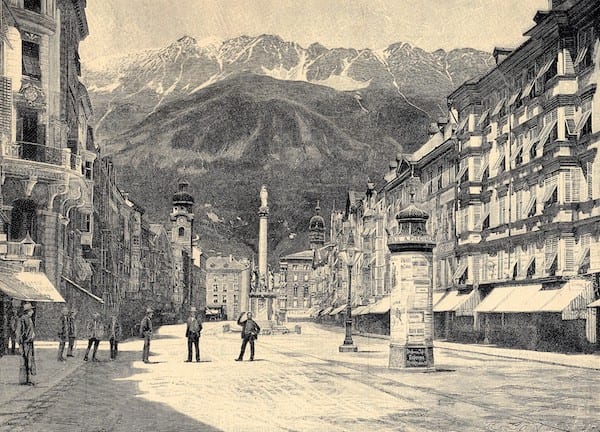
When Charles II of Spain, the last Habsburg ruler of the Spanish line, died without an heir in 1700, the War of the Spanish Succession broke out among the world powers. The Habsburgs, the French, and Bavaria each attempted to secure the throne for their own candidate. In shifting alliances around the globe, large armies confronted one another in the coalition wars. Through frequently changing coalitions, not only European powers but also the Dutch Republic, Great Britain—and even Sweden and Russia—became involved across Europe, Asia, and the Americas. But what did all this have to do with Innsbruck? As so often, it was a matter of Habsburg power politics. In 1665, Sigismund Franz, the last territorial prince of the Tyrolean line, had died. From then on, Tyrol was governed by governors. In 1703, the Electorate of Bavaria, allied with France, laid claim to the County of Tyrol. To militarily underpin this alleged claim, Bavarian forces marched with 12,000 men via Kufstein into the Inn Valley. They quickly captured the area around Innsbruck in order to unite there with the troops of their French ally advancing toward Tyrol from Italy. Troops from South Tyrol and the Upper Inn Valley—largely recruited from the marksmen’s associations—successfully resisted the foreign powers. From Innsbruck, forces moved into the Lower Inn Valley to oppose the enemy troops. Four hundred students and secondary‑school pupils volunteered for service and were assembled under arms and placed under the supreme command of Baron von Cles in front of the Church of Our Lady of Succour (Mariahilfkirche). As good Catholics, the Tyroleans pledged their loyalty to the Sacred Heart of Jesus and prayed for divine assistance. Together with the signal fires lit on the mountains to enable communication between the troops, this practice has been preserved to this day as a traditional custom and is still commemorated annually in June as the mountain fires (Bergfeuer). At the Battle of the Pontlatz Bridge near Landeck, Tyrolean forces celebrated an initial military success that proved decisive. Although numerically inferior, the Tyrolean marksmen were a match for the large armies—trained and equipped for pitched battles—in guerrilla warfare conducted in difficult terrain. They skillfully exploited their superior local knowledge and their abilities as sharpshooters. Only later did regular Habsburg troops advance from South Tyrol. Thus, on 26 July, St Anne’s Day, Bavarian rule was expelled from Innsbruck. The Habsburg retaliation was to be draconian. The Boarischer Rummel (“Bavarian turmoil”) was far more than the harmless skirmish the name might suggest. In 1704, Bavaria suffered defeat against the Habsburgs at the Battle of Höchstädt. Austrian troops subsequently occupied Munich. Now the situation was reversed: the Bavarians rose up against the Habsburgs. Among the events that followed was the notorious Sendlinger Murder Christmas, during which Habsburg troops massacred around 1,000 soldiers who had in fact already surrendered. The complex relationship between Habsburgs, Tyroleans, Innsbruck residents, and Bavarians was a lasting phenomenon. This episode not only highlighted the exceptional sanctity attributed to the land of Tyrol, but also revealed how differently political views were held by the urban and rural populations of the region. A considerable part of Innsbruck’s citizenry even welcomed Elector Max Emanuel of Bavaria with a measure of goodwill. Most Tyroleans, by contrast, not without justification, accused official Austria of neglecting the defense of the region. In a wave of anger and hatred directed at all those who had not resisted the Bavarians and French, violence was also unleashed against institutions such as Wilten Abbey, where Bavarian troops had been quartered during the occupation.