Deutschordenshaus
Hofgasse 3
Worth knowing
Ferdinand I governed Tyrol from afar and was rarely present, but his officials made decisions that were significant for the entire European court. Tyrol was not only part of the Habsburg Empire, ruled by Ferdinand’s brother Charles V, but also an important hub for the business world of the Fugger financial magnates. Through their wealth and ties to the ruling family, they largely influenced Europe’s destiny. The Teutonic Order was not just a knightly order and a relic of the Crusades. At first glance, it may seem somewhat outdated in the Early Modern period, as warfare had long moved away from knightly armies and warrior orders. However, through skillful politics and connections to European high aristocracy, the Order ensured its survival even in an era when swords had long been replaced by gunpowder.
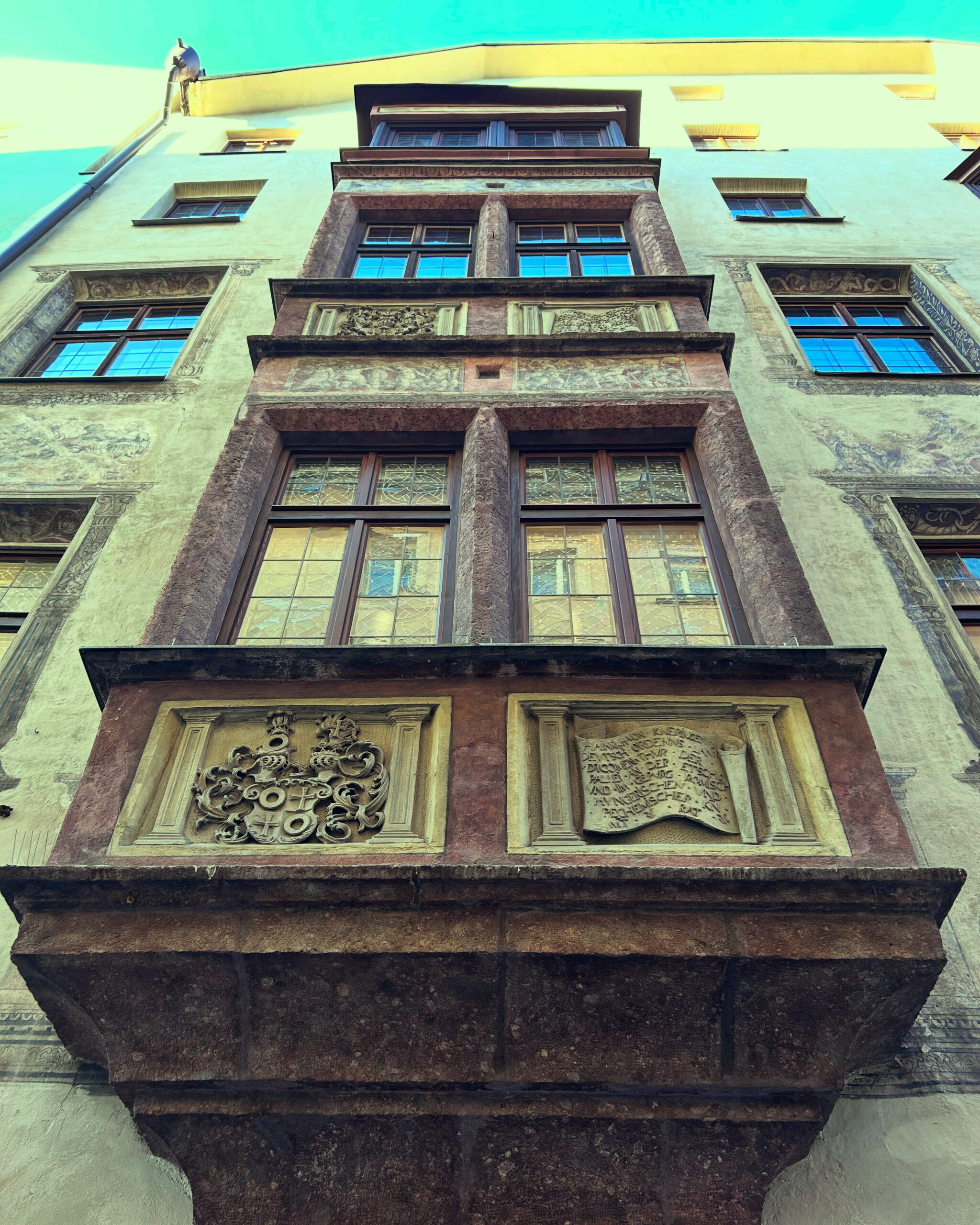
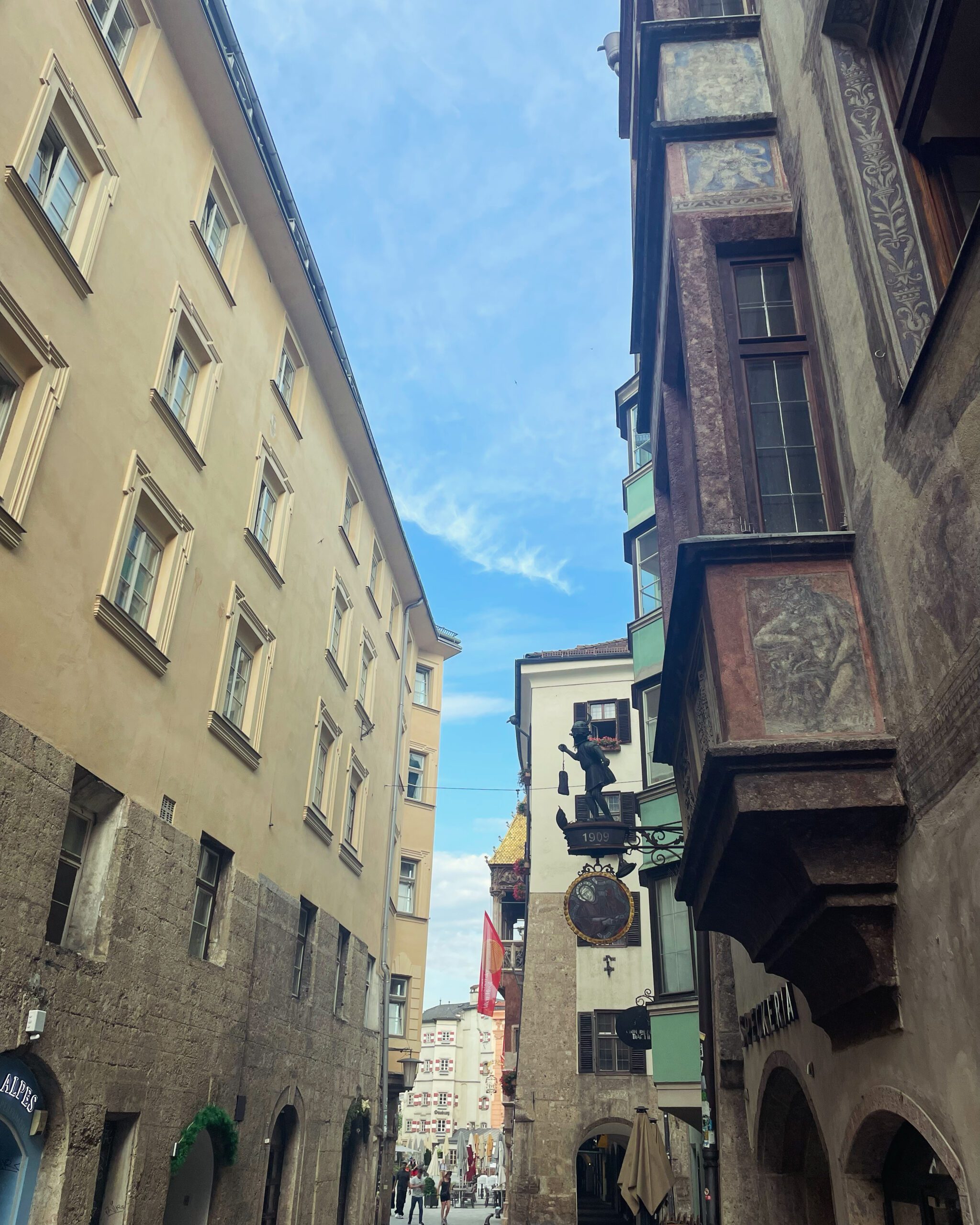
By 1539, the Order sold the building again, and ownership changed hands frequently thereafter. In the 18th century, the building was expanded to five stories and today serves as an ordinary residential house. In 1872, part of the house fell victim to flames during one of the frequent city fires. The facade of the once magnificent building was altered beyond recognition by these unfortunate circumstances, though the structural framework fortunately remained intact. It also suffered damage during air raids in World War II. Ironically, we owe it to the bomb damage that the building now shines again in its old Gothic splendor. During renovations in 1954, the original wall paintings were rediscovered and restored in 2001. Particularly beautiful are the elaborately decorated bay windows featuring depictions of Saint Christopher and Saint George. The lower section of the bay window displays the coat of arms. The Teutonic Order was as devout as it was militant, and Saint George, as the patron saint of the fighting class of the Middle Ages, suited these simultaneously pious and combative brothers perfectly.
The Teutonic Order & Maximilian III.
Maximilian the German master (1558 - 1618) officially took up his post as Gubernator of Tyrol and Vorderösterreich in 1602. Unlike his predecessors, he was the administrator of the land and not its owner. This was reflected in his demeanour. He was a pious and deeply religious man who had to reconcile Christian charity with the political office of regent in a peculiar way. He regularly withdrew for long periods into the seclusion of his study in the Capuchin monastery, founded in 1594, in order to live there in the most modest and austere conditions. He did not organise any lavish parties. He cut Ferdinand's bloated court almost in half. Under Maximilian, strict customs were introduced in Innsbruck. According to legend, children were forbidden to play in the streets. As a fervent representative of the Counter-Reformation, the enforcement of the Catholic faith was of particular concern to him. Unlike his predecessors, he wanted to achieve this through moral rigour rather than ostentatious building projects. He limited himself to completing churches that had already been started, such as the Servite Church or the Jesuit Church, instead of burdening the Tyrolean treasury with new projects. The Innsbruck district of St Nicholas was given its own parish priest, who watched over the salvation of the less well-off but all the more hard-working subjects. Maximilian did not organise lavish concerts in theatres, but together with the widow of his predecessor, Anna Katharina Gonzaga, promoted church singing. Nativity scenes and Easter graves began to establish themselves as an expression of popular faith. Whether it was his example as a pious sovereign, his moderate and prudent religious policy or counter-reformatory suppression, Protestant ideas died a quiet death in the Holy Land of Tyrol under Maximilian's reign, while they continued to simmer in many German principalities.
However, his piety did not exclude scientific interest and the practical measures derived from it for the good of the city. The 17th century was a time when open-minded aristocrats turned to alchemists to replenish the state coffers and had horoscopes cast by scientists such as Johannes Keppler, while they violently campaigned against the "heresy" of the Protestants. The Jesuit, physicist and astronomer Christoph Scheiner, one of the discoverers of sunspots alongside Galileo Galilei, spent three years at Maximilian's court in Innsbruck and researched the function of the human eye at the Inn. Maximilian had him set up a telescope and carried out astronomical research together with Scheiner. Educational institutions also benefited from him. During his reign, the Jesuits expanded their educational mission to include the study of theology and dialectics, which was the first step towards a university.
However, the beginning of the Enlightenment was not just a matter for the princely study room, but was also reflected in the everyday life of the citizens of Innsbruck. The city's fire-fighting system and the hygiene of the Ritschenwhich served as a sewerage system and water source within the city walls, were improved under Maximilian according to the latest knowledge of the time. The second measure in particular was intended to protect the city from a repeat of the great catastrophe under Maximilian's aegis. During his reign, he had to deal with the outbreak of a plague epidemic. The Dreiheiligenkirche church in Kohlstatt, the working-class neighbourhood of the early modern period near the Zeughaus, was built under his patronage to ensure heavenly patronage as well as protection through better hygiene.
The year of Maximilian's death in 1618 marked the beginning of the Thirty Years' War in Europe. As boring as his pious and peaceful reign without ostentation and drama may seem today, the years of peace were probably a blessing for his contemporaries. The moralising Habsburg took the thankless middle seat between the eccentrics Ferdinand II and Leopold V and could hardly leave his mark on the city's memory. Alongside the Dreiheiligenkirche, his final resting place is his most conspicuous legacy. Maximilian's tomb in Innsbruck Cathedral is one of the most remarkable tombs of the Baroque period.
It also tells the interesting story of the Teutonic Order. Maximilian was not only Gubernator of Tyrol and Vorderösterreich, but also Archduke of Austria, Administrator of Prussia and Grand Master of the Teutonic Order. Another Grand Master of the Teutonic Order from the House of Habsburg with a connection to Innsbruck is also buried next to him. Archduke Eugene was the supreme commander of the Austro-Hungarian army on the Italian front during the First World War. The German Orders vividly illustrates the theological mindset and the connection between pious faith and secular power in the early modern period. In the period up to 1500, devout piety and the fear of God were often combined with the exercise of secular power. The order was founded as an order of knights in Jerusalem around 1120 as part of the Crusades. Church and chivalry united to enable pilgrims to visit the holy cities, especially the Church of the Holy Sepulchre, without danger. After the expulsion from Palestine, the knights of the Teutonic Order became involved on the side of Christian Magyars in Transylvania in what is now Romania against pagan tribes. In the 13th century, the Order under Hermann von Salza was able to gain a lot of land in the Baltic region in the fight against the pagan Prussians and conquer the Teutonic Order state establish. This brotherhood acted as a kind of state that, like religious fundamentalists today, invoked God and wanted to establish his order on earth. It was ideals such as Christian charity and the protection of the poor and helpless that also characterised the Teutonic Order at its core. This made it an ideal fit for the Habsburg dynasty. After the decline of the Order in north-east Europe in the 15th century, the Order retained its possessions and power through skilful liaison with the nobility and the military, particularly in the Habsburg Empire.
Türing dynasty of master builders: Innsbruck becomes a cosmopolitan city
With Innsbruck’s rise to the status of a residence city, a true building boom began. Anyone who wished to wield influence needed to have a residence in the city, in order to be as close as possible to the centre of power. In the period before newspapers, a regular postal system, fax, and email, politics was conducted primarily through direct personal contact. One family was particularly closely associated with this development and played a decisive role in transforming the settlement at the Inn Bridge into a stone-built city in a contemporary Gothic style. In the fifteenth century, Sigismund the Rich in Coin brought Niklas Türing (1427–1496) to Innsbruck. Türing first appears in the historical record in 1488. The Türings were a family of stonemasons and master builders from Memmingen in what is now Swabia, a region that at the time belonged as part of Further Austria to the Habsburg Monarchy. Innsbruck had already been the seat of the provincial government for several decades, but architectural grandeur north of the Alps had yet to take hold. The city consisted largely of wooden houses and was scarcely representative. Over the course of the late Middle Ages, Gothic and, somewhat later, Renaissance art had enveloped Europe in a new architectural idiom, founded on a new understanding of architecture and aesthetics. Buildings such as Notre Dame or York Minster set a trend that would shape much of Europe until the onset of the Baroque. Pointed towers, ribbed vaults, bay windows, and playful carvings depicting scenes of courtly life are among the typical features that give this heterogeneous style its distinctive character. For craftsmen and builders, golden times dawned—times that would gather even greater momentum under Maximilian.
During this transitional period between the Middle Ages and the Early Modern era, the Türings left a lasting mark on Gothic Innsbruck. Their work can be traced particularly well in the Old Town. Many of the town houses, such as the Trautson House, still preserve Gothic ground plans, inner courtyards, and carved elements today. Thanks to their training, the Türings combined an eye for the overall structure with attention to detail in their building projects. They were renowned for their exceptionally fine stonework, which made it possible to create elaborate portals, arcades, staircases, and vaults. They produced ornamental reliefs with patterns typical of Renaissance art; grotesques, vases, and animal motifs were characteristic forms of embellishment for bay windows and plain walls. The symmetrical arrangement of individual elements is another hallmark of the period. A substantial part of the Golden Roof (Goldenes Dachl) is attributable to Niklas Türing. He also created the statue of the castle giant Haidl, an exceptionally tall member of Sigismund’s bodyguard, which can still be seen today in the City Tower. Emperor Maximilian held him in such high esteem that he permitted him to immortalise both the Türing family coat of arms and that of his wife—a fountain and a fish—in the vaulting of the Golden Roof. His son Gregor likewise left his mark, among other works, with the Trautson House in Herzog-Friedrich-Strasse and the House of the Castle Giant in Domgasse. Thanks to careers that advanced in step with the city’s development, the Türings gained not only fame and honour but also considerable wealth. A record from 1497 reports that Niklas Türing served the provincial ruler as a “salaried court mason.” When he died—either in 1517 or 1518, the precise year is unknown—his gravestone titled him “Chief Master Builder to His Roman Imperial Majesty.” Together with his son Gregor, he was listed as a master stonemason. The building boom also enabled the Türings to acquire citizenship in Innsbruck. By 1506 at the latest, they owned a house in the workers’ and artisans’ quarter of Anbruggen. In 1509 they were able to purchase the building that today houses the Gasthof zum Lamm in Mariahilfstrasse, and they later acquired additional property at what is now Schlossergasse 21.
The last member of the Türing family to exert a formative influence on Innsbruck’s building scene was Niklas Türing the Younger, who, together with Andrea Crivelli, began the planning work on the Hofkirche. During the sixteenth and seventeenth centuries, the influence of Gothic architecture—particularly in what is now Austria—began to wane. In the course of the Counter-Reformation, churches in particular were increasingly rebuilt or newly constructed in the Baroque style. Today, Türingstrasse in eastern Innsbruck commemorates this early modern dynasty of master builders.