Lutheran Church of Jesus Christ
Richard-Wagner-Strasse 2
Worth knowing
Tyrol has always understood itself as a Holy Land in a strictly Catholic sense. This did not change after 1848. Despite Emperor Franz Joseph I’s Protestant Patent of 1861, which allowed Protestants to practice their faith, Protestant services in Innsbruck could only be held in private. Unlike the surrounding communities, the city of Innsbruck did have a number of Protestants. In 1879, the city’s Protestant community purchased the school building in Kiebachgasse, as it at least offered a chapel. The Catholic press was shocked. On November 8, the newspaper Neue Tiroler Stimme published an article about the opening:
“Among the peculiarities of the land of Tyrol, unity of faith holds first place. It is the treasure that most distinguishes us from other countries. It has cost the land the hardest struggles in both old and modern times; it is the dearest legacy of our ancestors. All the deeper is our sorrow at the thought that this unity of faith has now been solemnly buried. It is now a fact that a Protestant congregation exists in Innsbruck, that it has acquired a Catholic chapel, and that it celebrates Protestant worship publicly therein.”
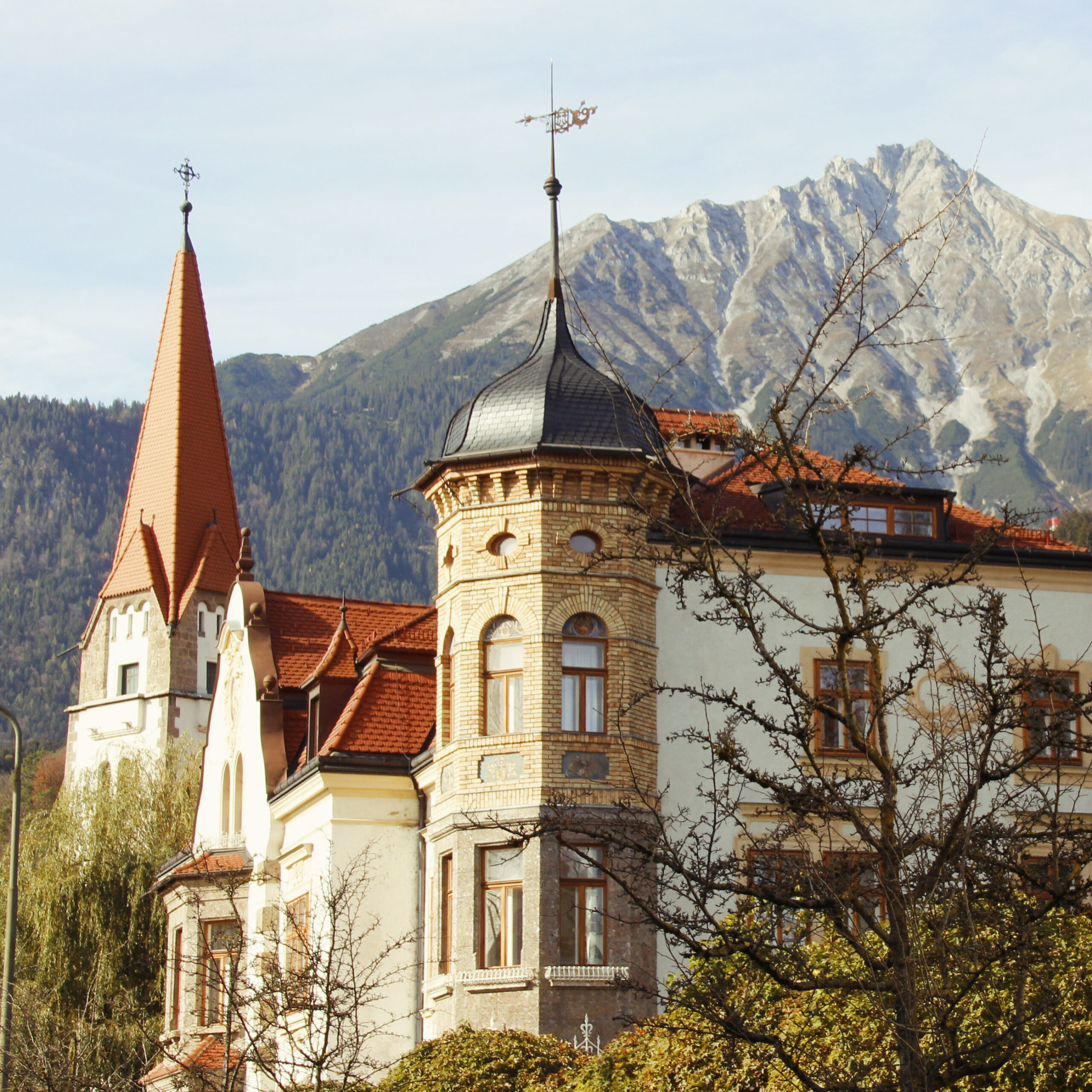
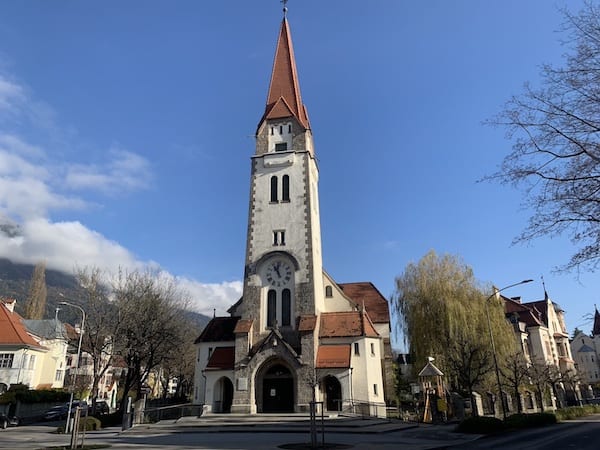
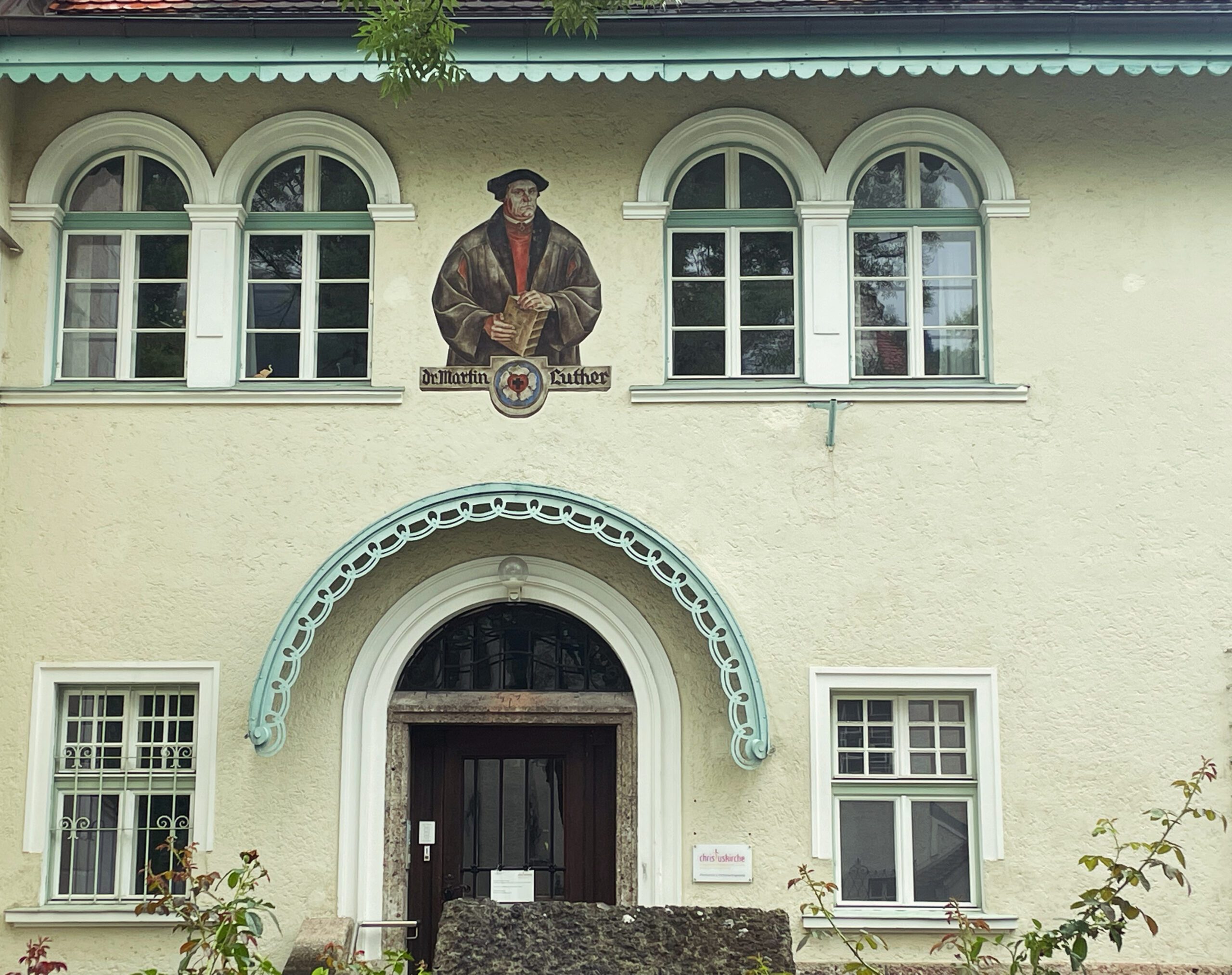
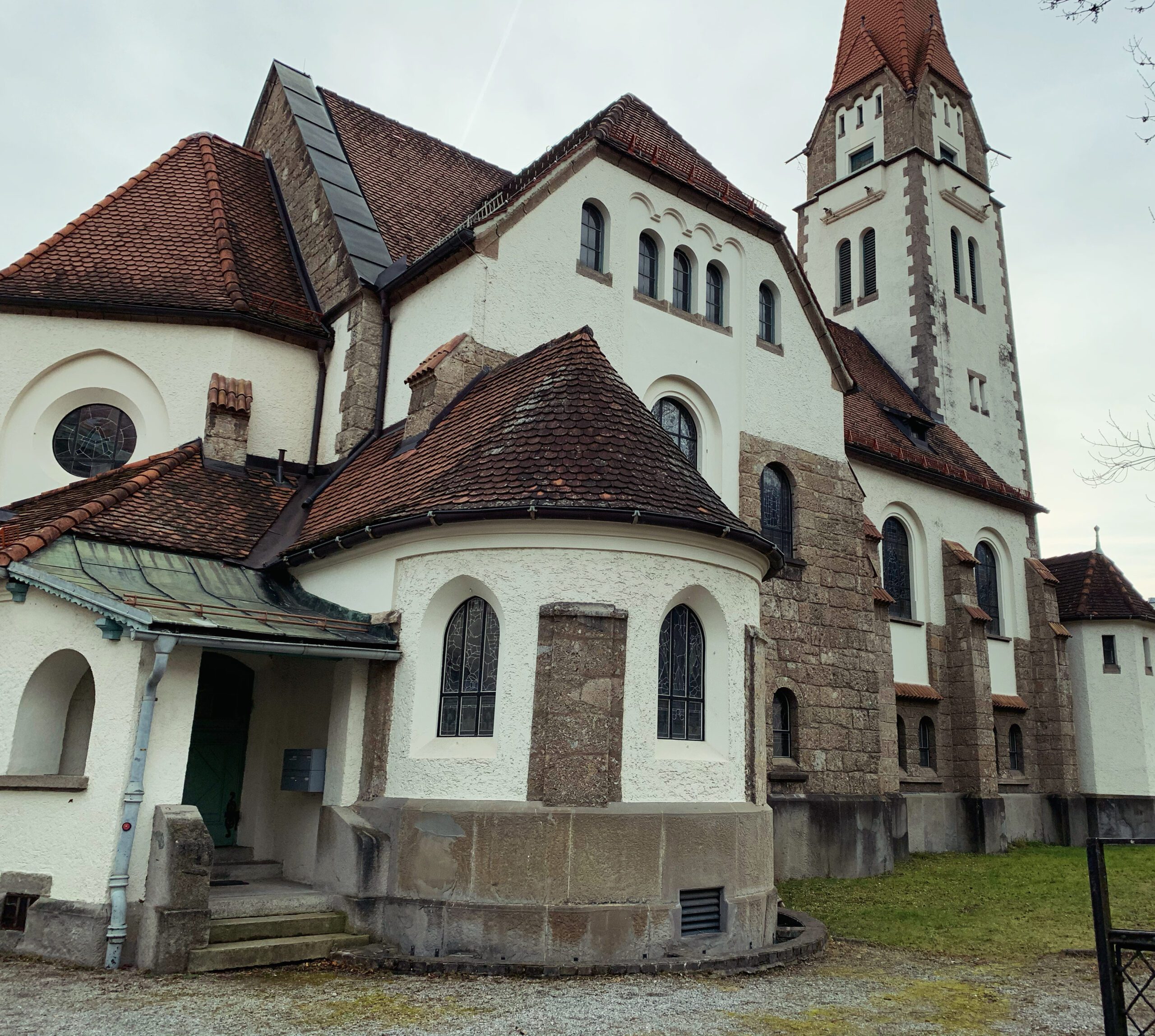
Public outrage, however, could not halt the liberalization of religious life. Through immigration from outside the region, the Protestant community grew and soon outgrew the small, provisional place of worship in the Old Town. Thanks to donations from private individuals, plans for building a church of their own could be made. The city of Innsbruck provided a building site in Saggen. In 1906, the church opened its doors to the Protestant congregation. Architecturally, the building’s exterior does not differ sharply from other Catholic churches of the late monarchy. It includes both neo-Gothic and neo-Romanesque elements. The pointed church tower forms a beautiful contrast to the barrel vault and round arches. Like many other structures—such as the Triumphal Arch—the Christuskirche was built using Höttinger Breccia from the old quarry below the Hungerburg. The fresco on the adjoining rectory was created by Ernst Nepo, who also painted the fresco of Saint Theresia in the entrance area of the Theresienkirche on the Hungerburg. The major difference to Baroque churches lies in the interior, where—classically Protestant—splendor and ornamentation are used very sparingly and modestly. The windows are particularly noteworthy. These small works of art with critical themes were crafted by the Tyrolean Institute for Glass Painting and Mosaics in Innsbruck. Instead of cherubs and saints, the stained-glass windows depict the Reformation figures Zwingli, Luther, and Melanchthon. The portrayal of the Swedish king Gustavus Adolphus, the Habsburgs’ adversary in the Thirty Years’ War, can certainly be read as a contemporary critique of Catholic rulers. Likewise, the depiction of the expulsion of the Zillertal Inclinants, who were forced to emigrate from the Zillertal to Prussia in 1837, did not cast the Austrian ruling house in a favorable light.
The Reformation in Tyrol
The Reformation may appear today primarily as a matter of personal belief. Thanks to the liberal legislation we enjoy in this respect, everyone is free to choose their own confession. If, however, religion is viewed as an essential component of everyday life and personal identity in past centuries, it becomes clear that it was far more than merely an expression of spirituality. The Reformation, which erupted with particular violence between the fifteenth and seventeenth centuries, represented a comprehensive social rupture comparable to the years 1848 or 1968. The accompanying social and political transformation did not come to a halt at the borders of the Holy Land of Tyrol.
It is a chicken-and-egg question whether the Reformation changed the image of humankind or whether a changing perception of existence transformed Christianity. Around 1500, new discoveries and modes of thought began to usher in the end of the Middle Ages. Artists, scholars, and clerics across Europe started to question hierarchies, order, and systems of legitimacy. With the theological reformers of the fifteenth and sixteenth centuries, the feudal system—placing Church and nobility above the people and bourgeoisie—began to crumble. The Bohemian cleric Jan Hus was among the first on the European mainland to question the pope’s omnipotence in the fifteenth century and was burned at the stake for it at the Council of Constance. In France and Switzerland it was Jean Calvin (1509–1564), in the Holy Roman Empire Martin Luther (1483–1546) and Thomas Müntzer (1489–1525), who challenged the Roman Church in the sixteenth century. Reform-minded clergymen and pamphlets spread the new doctrines. In Tyrol, the mining towns of Hall and Schwaz were the main centers of the Reformation in the early sixteenth century. Many miners came from Saxony and brought their own ideas about faith and Church with them. The old liturgy, with sermons delivered in incomprehensible Latin, did not align with these expectations. Preachers such as Dr. Jacob Strauß addressed the population with Lutheran ideas, which also included criticism of the clergy and the system of rule. The religious crisis thus led to problems in the secular sphere beyond the walls of the churches as well. Faith and worldly matters were not separate domains. If miners were dissatisfied with pastoral care, they went on strike. Public order was endangered—not only because miners were permitted to carry weapons, but also because they were well connected among themselves. A general strike could trigger an economic crisis. Fugger capital and Habsburg political power were eager to prevent this and therefore granted the miners special rights. Not only miners, but also progressive segments of the bourgeoisie and the nobility took an interest in the new ways of living one’s faith, which was an important part of lifestyle. The new doctrines became a symbol of a new sense of self and of the social significance that craftsmen, skilled workers, and entrepreneurs in this emerging industry claimed in opposition to the old feudal system.
Ferdinand I and his successors were able to successfully push back the Reformation in Tyrol. Although the religious mandates with their numerous prohibitions were one of the reasons for the peasant wars, in the long term and with many coercive measures, the princely strategy bore fruit. Power politics may have been one reason, but in fact the ruling Habsburgs were pious people who, at least to a large extent, favoured Catholicism out of conviction. Ferdinand II described his motives with the words:
“…through the inspiration of God and the prompting of His Holy Spirit. All [done] to the glory of the Most High, out of a true and fervent zeal devoted to the holy, Catholic, and alone salvific religion.”
It was primarily priests of the Jesuit order who were to bring apostate parishes and citizens back into the fold of the Catholic Church. They began with reform measures such as better training for the clergy. Concubinage and post haggling were to be abolished. Priests and bishops were to concern themselves less with worldly matters and more with the salvation of their flocks. However, as this measure could not be implemented overnight - capable priests first had to be found and educated - coercive measures were introduced. The possession of Protestant books and pamphlets was punishable by law. The lower the status of the citizen, the more severe the punishment. Nobles, counsellors and key workers were often able to practise their Protestant faith discreetly. Under Ferdinand II, underlings had to confess at Easter. The priest drew up a list with the names of those who fulfilled their duty. Anyone who did not appear in the confessional despite repeated reminders could be expelled from the country.
In the seventeenth century, so-called religious reform commissions were established in Austria. If these “missionaries” discovered Protestant-leaning priests or subjects in possession of forbidden literature, they were arrested and expelled from the country, and not infrequently their houses and all possessions were set ablaze. Protestant officials were barred from practicing their professions and were forced either to convert or to emigrate. Particularly obstinate subjects were publicly chained. Maximilian III instituted a special religious surveillance agency that primarily monitored craftsmen and merchants. To prove their Catholic loyalty, they were required to regularly submit proof of confession. Under Maria Theresa in the eighteenth century, Tyrolean Protestants were forcibly resettled to distant parts of the Habsburg Empire. These relocations posed problems not only for the affected individuals. Labor and population numbers were key indicators of development in modern states, leading to what we would today call a brain drain: competencies and military strength were lost in the name of the Lord. In 1781, Enlightenment-minded Emperor Joseph II issued the Edict of Tolerance, partly for this reason, permitting the construction of Protestant churches—albeit under strict conditions. These prayer houses were not allowed to have towers or other architectural features; even windows facing the street were prohibited. In Tyrol, resistance arose against the Edict of Tolerance, as people feared for moral order and sought to avoid foreign religions, discord, and unrest of any kind. Converts were denied marriage and burial in Catholic cemeteries.
To this day, Tyrol regards itself as the self-proclaimed “Holy Land,” with “holy” referring explicitly to the Catholic faith. In 1837, Protestants were expelled from the Zillertal. The descendants of the so-called Zillertal “Inklinanten,” who emigrated under official pressure, still live in Germany today. Although tolerance gradually gained a foothold in the empire and its lands, the close bond between authority and the Catholic Church persisted well into the twentieth century in many areas of life, such as education. When it became known during the constitutional debates of 1848 that free exercise of religion was planned for the entire monarchy, public outrage in Tyrol was enormous. After media campaigns opposing this liberalization of faith, more than 120,000 signatures were collected. In 1861, Emperor Franz Joseph issued the Protestant Patent, which granted the Evangelical Church rights largely equivalent to those of the Catholic Church. The Tyroleans, however, remained steadfast. With the exception of two liberals, all members of the regional parliament voted to maintain confessional unity. The argument stated that there were no adherents of other faiths in Tyrol anyway, and therefore no tolerance toward non-Catholics was necessary. It was not until 1876 that an official Protestant parish was established in Innsbruck.
The year 1848 and its consequences
The year 1848 occupies a mythical place in European history. Innsbruck was not one of the hotspots like Paris, Vienna, Budapest, Milan or Berlin, but even in the “Holy Land” of Tyrol the revolutionary year left its mark. In contrast to the rural surroundings, an enlightened educated bourgeoisie had developed in Innsbruck. Enlightened people no longer wanted to be subjects of a monarch or territorial prince, but citizens with rights and duties in relation to a modern state. Students and members of the liberal professions demanded political participation, freedom of the press and civil rights. Workers demanded better wages and working conditions. Particularly radical liberals and nationalists even questioned the absolute authority of the Church. In March 1848 this socially and politically highly explosive mixture erupted in uprisings and street fighting in many cities. In Innsbruck, some students and professors celebrated the newly granted freedom of the press with a torchlight procession. On the whole, however, the revolution proceeded quietly in the rather leisurely Tyrol. To speak of a spontaneous outburst of emotion or even a revolution would already be an exaggeration: the date of the procession was postponed from 20 to 21 March because of bad weather. There were hardly any anti-Habsburg riots or violent incidents; a stray stone thrown into a Jesuit window was one of the highlights of the Alpine version of the Revolution of 1848. The students even supported the city magistrate in maintaining public order, thereby demonstrating their gratitude to the monarch for the newly granted freedoms and their loyalty.
The initial enthusiasm for change among the bourgeois elites was soon replaced in Innsbruck by a surge of German-national patriotism. On April 6, 1848, the governor of Tyrol led a ceremonial procession in which the German flag was displayed. A German tricolour was also hoisted on the city tower. While students, workers, liberal-national citizens, republicans, supporters of a constitutional monarchy, and Catholic conservatives could not agree on social issues such as press freedom, they shared a common hostility toward the Italian independence movement, which had spread across northern Italy from Piedmont and Milan. Innsbruck students and riflemen, with the support of the imperial army leadership, marched into the Trentino to suppress unrest and uprisings at an early stage. Notable members of this corps included the already elderly Father Haspinger, who had fought alongside Andreas Hofer in 1809, and Adolf Pichler. Johann Nepomuk Mahl-Schedl, a wealthy owner of Büchsenhausen Castle, even equipped his own company and marched over the Brenner Pass to secure the border. However, the war did not remain confined to the southern borders. Innsbruck itself, as the political and economic center of the multinational crown land of Tyrol and home to many Italian speakers, became an arena of the conflict between nationalities. Combined with ample alcohol consumption, anti-Italian sentiment posed a greater threat to public order than the demand for civil liberties. A dispute between a German-speaking craftsman and an Italian-speaking Ladin escalated to such an extent that it nearly triggered a pogrom against the numerous businesses and inns of Italian-speaking Tyroleans.
The relative calm of Innsbruck suited the imperial court in Vienna, which was under pressure. As unrest in the capital continued after March, Emperor Ferdinand fled to Tyrol in May. According to contemporary press reports, he was enthusiastically welcomed by the population.
"“What is the name of the land to which such an honour falls, what is the people that enjoys such trust in these fateful times? Does the peace and security here rest solely on legend from ancient times, or is there also in the present a foundation on which one can build, which the wind cannot blow away and the storm cannot shake? This Alpine land is called Tyrol, do you like it? Yes, the Tyrolean people alone prove, in the midst of a shaken Europe, reverence and loyalty, courage and strength for their hereditary ruling house, while all around rebellion, contradiction, defiance and demands, often even revolt and upheaval rage; Tyrol alone stands firmly without wavering in custom and obedience, in religion, truth and law, while elsewhere insolence and falsehood, madness and passions prevail …”"
In June, a young Franz Joseph—still not yet emperor—also stopped at the Hofburg on his return from the battlefields of northern Italy instead of traveling directly to Vienna. Innsbruck once again became a royal residence, albeit only for one summer. While blood was shed in Vienna, Milan, and Budapest, the imperial family enjoyed rural Tyrolean life. Ferdinand, Franz Karl, his wife Sophie, and Franz Joseph received guests from foreign courts and were driven by carriage to excursion destinations such as Weiherburg, Stefansbrücke, Kranebitten, and even up to Heiligwasser, and went on hikes. This calm did not last long. Ferdinand, considered no longer fit to rule, handed over power under gentle pressure to Franz Joseph I. In July 1848, the first parliamentary session was held in Vienna, and a constitution came into force. However, the monarchy’s willingness to reform soon waned. The new parliament—the Reichsrat—could not pass binding laws, the emperor never attended it, and he did not understand why a monarchy ordained by God needed such a council.
The subtly initiated liberalization nevertheless ran its course in the cities. Innsbruck was granted the status of a city with its own independent charter (Statutarstadt). In 1850, the "Provisorische Gemeindegesetz für die Landeshauptstadt Innsbruck" ("Provisional Municipal Code for the State Capital of Innsbruck") came into force:
"The municipality is to provide for the sanitation police; it takes care of the paving and maintenance of streets, alleys, and paths, with the exception of those whose maintenance is the responsibility of the Imperial Treasury, as well as for street lighting, the maintenance and cleaning of the main drainage canals, and the maintenance of municipal bridges, fountains, aqueducts, and other facilities, as well as public bathing establishments. It administers the health, fire, market, building, and traffic police, oversees land boundaries, measures, and weights; it is charged with the provision of food supplies, and takes police precautions to avert threats to personal safety and property posed by flooding or other natural disasters."
Innsbruck's municipal law provided for citizenship rights that, while tied to property ownership or tax payments, legally guaranteed certain rights to members of the community. Right of domicile (Heimatrecht) could be acquired through birth, marriage, or extraordinary conferral, granting voting rights at the municipal level to at least adult males. If one fell into financial hardship, one was entitled to basic welfare provided by the city. Within the city government, the Greater German-liberal faction prevailed thanks to the census-based majority voting system, with merchants, tradesmen, industrialists, and innkeepers setting the tone. On June 2, 1848, the first edition of the liberal and Greater German-leaning Innsbrucker Zeitung was published—from which the above article on the emperor's arrival in Innsbruck is taken. Conservatives, on the other hand, read the Volksblatt für Tirol und Vorarlberg. Moderate readers who favored a constitutional monarchy preferred to consume the Bothe für Tirol und Vorarlberg. However, freedom of the press was short-lived. The previously abolished censorship was partially reinstated. Newspaper publishers were subjected to various forms of harassment by the authorities, and newspapers were strictly forbidden from printing content critical of the state government, the monarchy, or the Church.
"Anyone who, by means of printed matter, incites, instigates or attempts to incite others to take action which would bring about the violent separation of a part from the unified state... of the Austrian Empire... or the general Austrian Imperial Diet or the provincial assemblies of the individual crown lands.... Imperial Diet or the Diet of the individual Crown Lands... violently disrupts... shall be punished with severe imprisonment of two to ten years."
After Innsbruck had officially replaced Meran as the provincial capital in 1849 and had thus finally become the political centre of Tyrol, parties began to form. With the establishment of the Catholic-conservative faction and the liberals, a pair of opposing ideas emerged that would shape politics not only until the First World War. Associations of all kinds as political organisations in advance of parties, and newspapers, formed the lines along which society split in all questions of life from the cradle to the grave. From 1868 onwards, the liberal, greater German-oriented party provided the mayor of the city of Innsbruck. The influence of the Church declined in Innsbruck in contrast to the surrounding municipalities. Individualism, capitalism, nationalism and consumption stepped into the breach. New worlds of work, department stores, theatres, cafés and dance halls did not displace religion entirely even in the city, but the weighting shifted as a result of the civil freedoms won in 1848.
The probably most important legal change of 1848 was the land relief patent. In Innsbruck the clergy, especially Wilten Abbey, owned a large part of the agricultural land. The Church and the nobility were exempt from taxes. In 1848/49 feudal lordship and the relationship of subjection were abolished in Austria. Ground rents, tithes and compulsory labour were thus removed. The landowners received one third of the value of their land from the state within the framework of the reform, one third was regarded as tax relief, and one third of the compensation had to be borne by the peasants themselves. They could pay this amount in instalments over twenty years. The after-effects can still be felt today. The descendants of the peasants who were successful at the time enjoy, through inherited land ownership resulting from the 1848 reforms, the fruits of prosperity and also political influence through land sales for housing, leases and compensation payments by public authorities for infrastructure projects. The landowning nobility of the past had to come to terms with the humiliation of taking up bourgeois occupations. The transition from privilege by birth to privileged status within society through financial means, networks and education often succeeded. Many Innsbruck dynasties of academics have their origins in the decades after 1848.
Life also changed for the broader population. The previously unknown phenomenon of leisure time emerged and, together with disposable income available to a greater number of people, fostered hobbies. Civil organisations and associations—from reading circles to choral societies, fire brigades and sports clubs—were founded. The revolutionary year also manifested itself in the cityscape. Parks such as the English Garden at Ambras Castle or the Hofgarten were no longer reserved exclusively for the aristocracy but served citizens as local recreational areas. In St. Nikolaus the Waltherpark was created as a small oasis of calm. One floor above, the first swimming and bathing facility in Tyrol opened at Büchsenhausen Castle; soon afterwards another bath followed in Dreiheiligen. Excursion inns around Innsbruck flourished. Alongside high-end restaurants and hotels, a scene of taverns emerged in which workers and employees could also afford pleasant evenings with theatre, music and dancing.
Glaube, Kirche und Obrigkeit
The abundance of churches, chapels, crucifixes, statues, and paintings in public spaces strikes many visitors to Innsbruck from other countries as unusual. Not only places of worship, but also many private houses are decorated with depictions of Jesus, Mary, saints, and biblical scenes. For centuries, the Christian faith and its institutions shaped everyday life throughout Europe, and Innsbruck—as a residence city of the strictly Catholic Habsburgs and the capital of the self-proclaimed Holy Land of Tyrol—was particularly richly endowed with ecclesiastical buildings. In terms of number and scale relative to the conditions of earlier times, churches appear as gigantic features in the cityscape. In the 16th century, Innsbruck, with its approximately 5,000 inhabitants, possessed several churches whose splendor and size surpassed every other building, including the palaces of the aristocracy. Wilten Abbey was a vast complex in the midst of a small farming village that had developed around it.
The spatial dimensions of these places of worship reflect their importance within the political and social structure. For many inhabitants of Innsbruck, the Church was not only a moral authority but also a secular landowner. The Bishop of Brixen was formally equal in rank to the territorial prince. Peasants worked on the bishop’s estates just as they did on those of a secular ruler. The clergy exercised both taxation and judicial authority over their subjects, and ecclesiastical landowners were often regarded as particularly demanding. At the same time, it was also the clergy in Innsbruck who were largely responsible for social welfare, healthcare, care for the poor and orphans, food distribution, and education. The Church’s influence extended into the material world in a way comparable to how the modern state operates today through tax offices, police, schools, and employment services. What democracy, parliament, and the market economy represent for us today, bishops, the Bible, Christian devotional literature, and parish priests represented for people of earlier centuries: a reality that maintained order.
It would be incorrect to believe that all clergymen were cynical power-hungry figures who exploited their uneducated subjects. The majority of both clergy and nobility were devout and God-fearing, albeit in a manner that is difficult to comprehend from today’s perspective. It was not the case that every superstition was blindly accepted or that people were arbitrarily executed based on anonymous accusations. In the early modern period, violations of religion and morals were tried before secular courts and punished severely. Charges were brought under the term heresy, which encompassed a wide range of offenses. Sodomy—meaning any sexual act not serving reproduction—sorcery, witchcraft, and blasphemy, in short any deviation from the correct faith, could be punished by burning. The act of burning was intended both to purify the condemned and to destroy them and their sinful behavior completely, thereby removing evil from the community. For a long time, the Church regulated everyday social life down to the smallest details. Church bells structured people’s daily schedules. Their sound called people to work or worship, or informed the community of a death through tolling. People were able to distinguish individual bell signals and their meanings. Sundays and holidays structured time. Fasting days regulated diet. Family life, sexuality, and individual behavior were expected to conform to Church-prescribed morality. For many people, salvation in the afterlife was more important than happiness on earth, which was seen as predetermined by the course of time and divine will. Purgatory, the Last Judgment, and the torments of hell were real and served to frighten and discipline even adults.
While parts of Innsbruck’s bourgeoisie were at least gently awakened by the ideas of the Enlightenment after the Napoleonic Wars, the majority of the population remained deeply attached to a blend of conservative Catholicism and superstitious folk piety. Religiosity was not necessarily a question of background and social status, as the social, media, and political debates along the fault line between liberals and conservatives repeatedly demonstrated. Although the freedom of religious practice had been legally enshrined since the December Constitution (Dezemberverfassung) of 1867, state and religion remained closely intertwined. Thanks to the 1855 concordat between the Pope and the Emperor, marriage law and the school system were under the control of the Catholic Church. It was only under pressure from liberals in parliament that these bastions of everyday social life began to crumble, yet particularly in Tyrol, the pastor's word remained sacrosanct. In the First Republic, a conservative backlash occurred. Ignaz Seipel, a Christian Social politician who went down in history as the Iron Prelate (Eiserner Prälat), rose to the highest office of the state in the 1920s. Federal Chancellor Engelbert Dollfuß saw his Corporate State (Ständestaat)—a construct built on a Catholic foundation—as a bulwark against socialism. In 1933, the concordat with the Vatican was renewed. Even after World War II, church and politics in Tyrol formed a powerful double act in the persons of Bishop Rusch and Governor Wallnöfer. In 1957, the government of the Second Republic reconfirmed the agreement, which formally remains valid to this day. A genuine separation of church and state did not begin until the 1970s. Although people leaving the church in recent decades have dented official membership figures and recreational events draw larger crowds than Sunday masses, faith and the church still hold a fixed place in the daily lives of Innsbruck’s residents, even if often unnoticed. The Roman Catholic Church still owns a vast amount of land in and around Innsbruck, even beyond the walls of its monasteries and educational institutions. A number of schools in and around Innsbruck also remain under the influence of conservative forces and the church. And whoever enjoys a public holiday, cracks Easter eggs against one another, or lights a candle on a Christmas tree does not have to be a Christian to act in the name of Jesus—disguised as tradition.
The success story of the Innsbruck glass painters
The United States of America were regarded in the pre-war period as the land of unlimited opportunity, where dishwashers could become millionaires. Yet such success stories are not exclusive to the New World. In the not yet fully regulated society of the Danube Monarchy, capable and diligent individuals from farming backgrounds, the working class, or artisanal trades—often without formal education, certification, or state approval—could achieve remarkable upward mobility. The three founders of the Tyrolean Stained Glass and Mosaic Institute, Josef von Stadl, Georg Mader, and Albert Neuhauser, are exemplary of such a success story from Innsbruck’s urban history. While most Innsbruck industrial and craft enterprises focused on supplying the local market with solid, well‑established goods and consumer products, stained glass production stood out as one of the few innovative and export‑oriented industries of its time.
Each of the founders’ personal histories, their differing skills and life paths, is noteworthy. Josef von Stadl (1828–1893) grew up on his parents’ farm and inn in Steinach am Brenner. From an early age, he had to help in the family business. This heavy labour resulted in an inflammation of the periosteum in his arm at the age of nine, making physical work impossible thereafter. Instead, the artistically talented boy attended the model secondary school in Innsbruck, today’s BORG. In 1848, he joined the Tyrolean sharpshooters of his hometown, though he was not deployed at the front. He later gained practical experience as a locksmith and turner. In 1853, he contributed to rebuilding the church in Steinach after a fire. His skills were soon recognised, and he steadily rose from labourer to master builder. Georg Mader (1824–1881), also from Steinach, began working as a farmhand at a young age. Through the patronage of his brother, a clergyman, the devout youth was able to train as a painter, though he initially had to abandon his passion to assist in the family mill. After completing his journeyman travels, he decided to devote himself fully to painting. In Munich, he refined his skills with the firms Kaulbach and Schraudolph. After working on the cathedral in Speyer, he returned to Tyrol, where he supported himself mainly through commissions for ecclesiastical art. Albert Neuhauser (1832–1901) trained in his father’s glazing and sheet‑metal workshop. However, he too had to abandon his intended career path early due to health issues—lung problems that appeared when he was just ten years old. Instead of continuing in the successful family business, he travelled to Venice. The island of Murano had been home for centuries to the finest glassmaking workshops. Fascinated by this craft, he defied his father’s wishes and attended a stained glass workshop in Munich. The products of the recently established Bavarian factory, however, did not meet his quality standards. Back in his father’s apartment in Herzog‑Friedrich‑Strasse, he began experimenting with glass—much like the “garage innovators” who, a century later, would lay the foundations for the personal computer.
Neuhauser’s experiments and tinkering aroused the curiosity of his friend von Stadl, who in turn introduced him to the artistically inclined Mader. In 1861, the three decided to combine their expertise in a formal business venture—what today might be called a startup. Neuhauser took responsibility for technical and commercial aspects as well as product development, von Stadl handled decorative design and contacts with builders, and Mader focused on figurative design, particularly for ecclesiastical commissions. Their first workshop, staffed by two painters and a kiln operator, was located on the third floor of the Gasthof zur Rose in the Old Town. Raw materials had to be imported from England, as domestic glass did not meet Neuhauser’s standards, and imports were subject to a 25% tariff. Together with a chemistry teacher, Neuhauser eventually succeeded—after a trip to Birmingham and extensive experimentation—in producing glass of the desired quality himself.
In 1867, Josef von Stadl married the painter Maria Pfefferer, the daughter of a physician. The former farmer’s son from the Wipptal had not only risen into the upper bourgeoisie; his wife’s dowry also gave him financial independence. In 1869, supported financially by Neuhauser’s father, the partners decided to expand their successful enterprise. The dynamism and lack of regulation characteristic of the Gründerzeit boom is illustrated by the example of the glassworks established in the fields of Wilten, which went into operation in 1872. Production began just 110 days after construction—officially never approved by the municipal authorities of Wilten—had commenced. Due to health reasons, Neuhauser withdrew from the company as early as 1874, and although the founders handed over management of their flourishing business relatively soon, they remained shareholders. At the same time, each continued to work successfully on independent projects within their respective fields.
Von Stadl, in particular, left a lasting imprint on Innsbruck. At the height of its success, the stained glass workshop employed over 70 people. In 1878, according to von Stadl’s plans, housing was built for employees, workers, artists, and craftsmen associated with the company. This “Glassworks Settlement” included the buildings at Müllerstraße 39–57, Schöpfstraße 18–24, and Speckbacherstraße 14–16, which still exist today. Their architecture differs markedly from the surrounding Gründerzeit buildings: von Stadl used less ornamentation but placed emphasis on small front gardens. Workers and employees were meant to feel in no way inferior to the residents of the cottage‑style villas in Saggen. While it was not uncommon for large companies to build their own housing—Siemensstadt in Berlin being a well-known example—this development reflects a particular corporate self‑image and forward-looking vision: the company saw itself not only as an employer but also as a provider of housing and social support. Another major project by von Stadl in Innsbruck was the Provincial Maternity Clinic in Wilten. After completing the Vinzentinum in 1878, he was named an honorary citizen and diocesan architect of Brixen. Pope Leo XIII awarded him the Order of St. Gregory for his services. The St. Nikolaus Church—whose windows had been produced by the Tyrolean Glass Painting Institute—became his final resting place.
Georg Mader continued to work as a painter on sacred buildings. He became a member of the Vienna Academy of Art as early as 1868. When he suffered a stroke in 1881, he was taken to Badgastein for rehabilitation. The spa town in Salzburg was a meeting place for the European aristocracy and upper middle classes at the time. In the midst of high society, the former journeyman miller died a wealthy man.
The restless and creative Neuhauser returned to Venice after resigning as director and went on to establish Austria’s first mosaic institute. The merger of the two companies in 1900 expanded the range of artistic possibilities. For his achievements, he was awarded the Order of Franz Joseph. In Wilten, Neuhauserstraße was named in his honour. Franz-Josephs-Orden. In Wilten wurde die Neuhauserstraße nach ihm benannt.