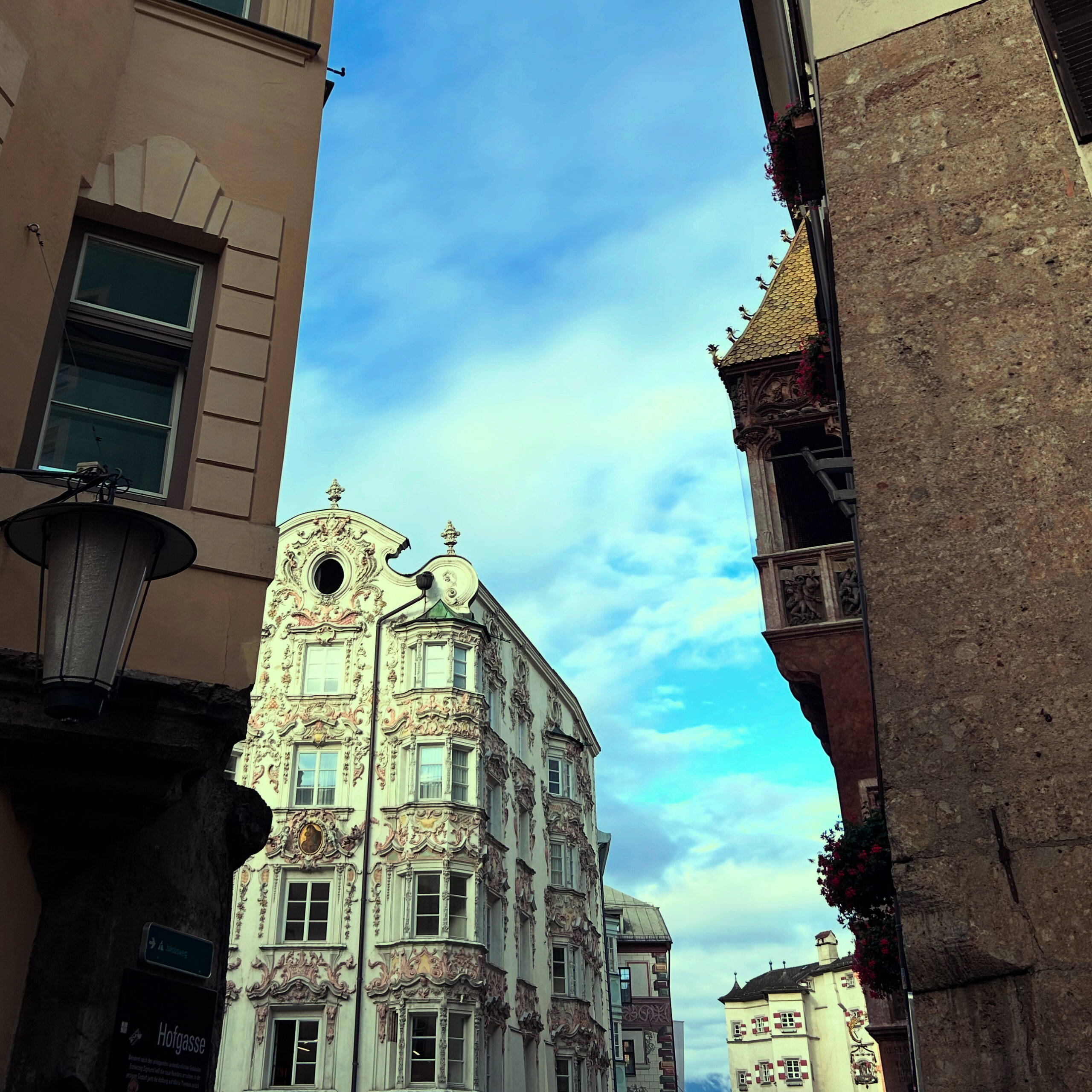
Helblinghaus
Herzog-Friedrich-Straße 10
Worth knowing
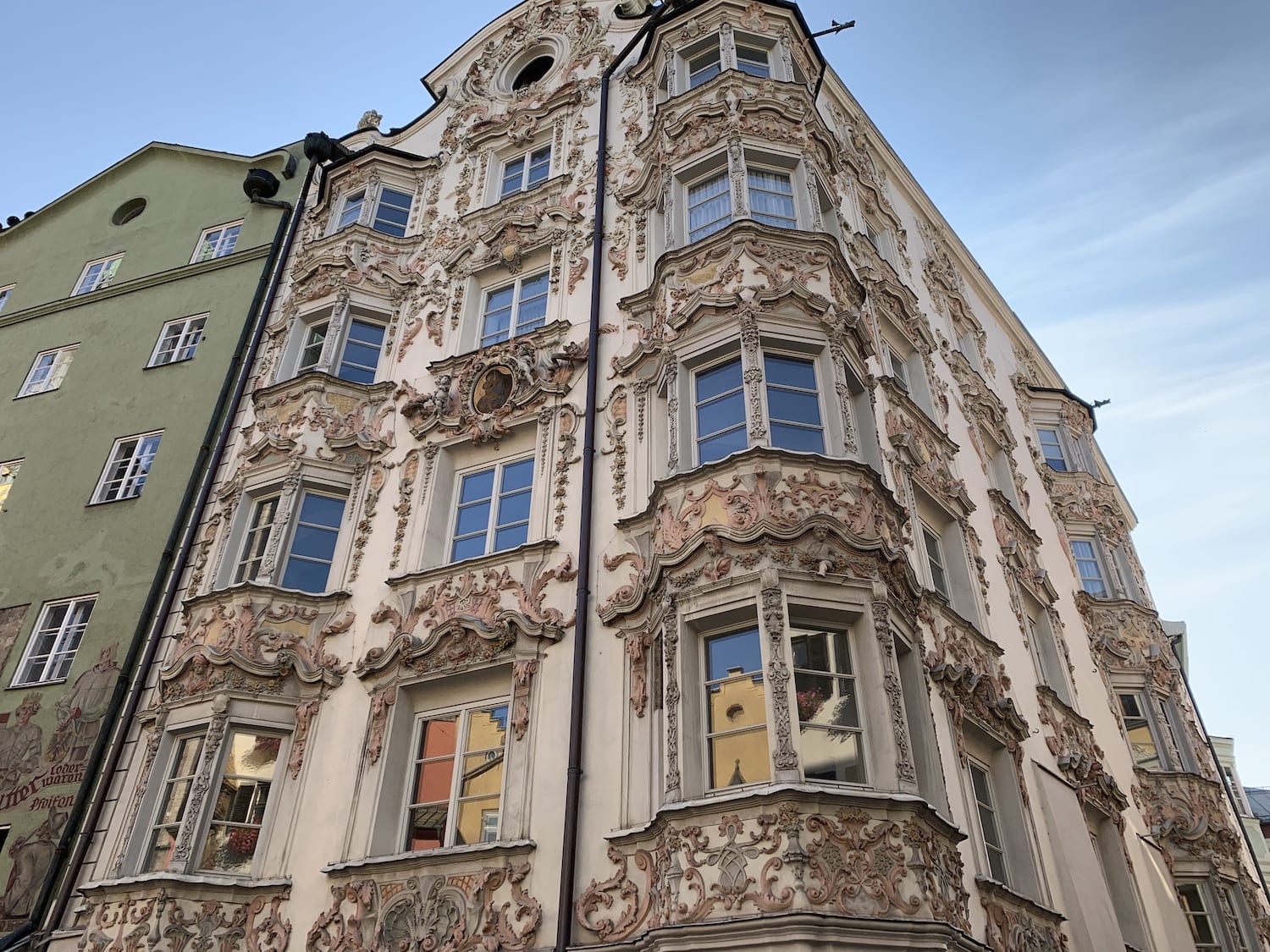
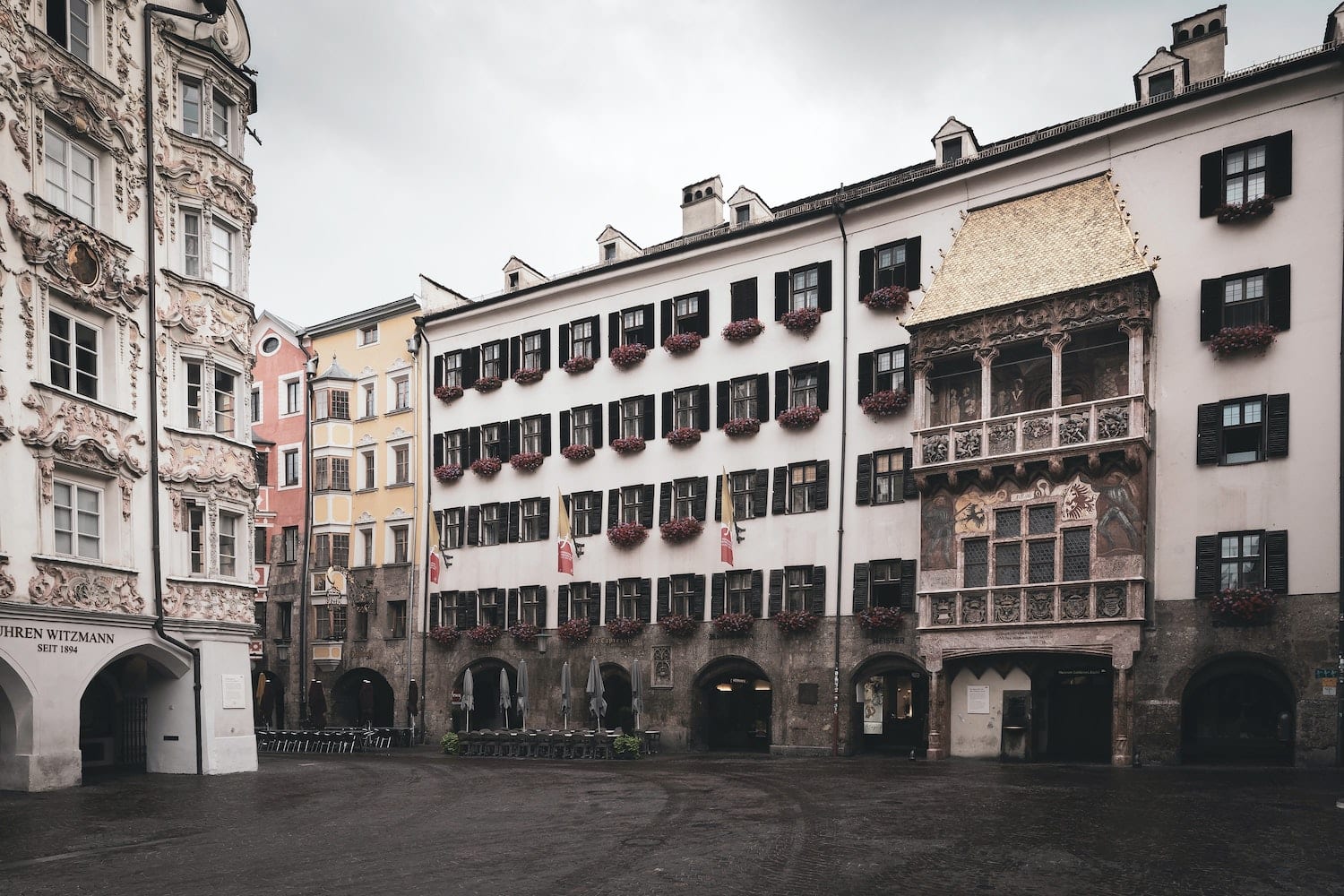
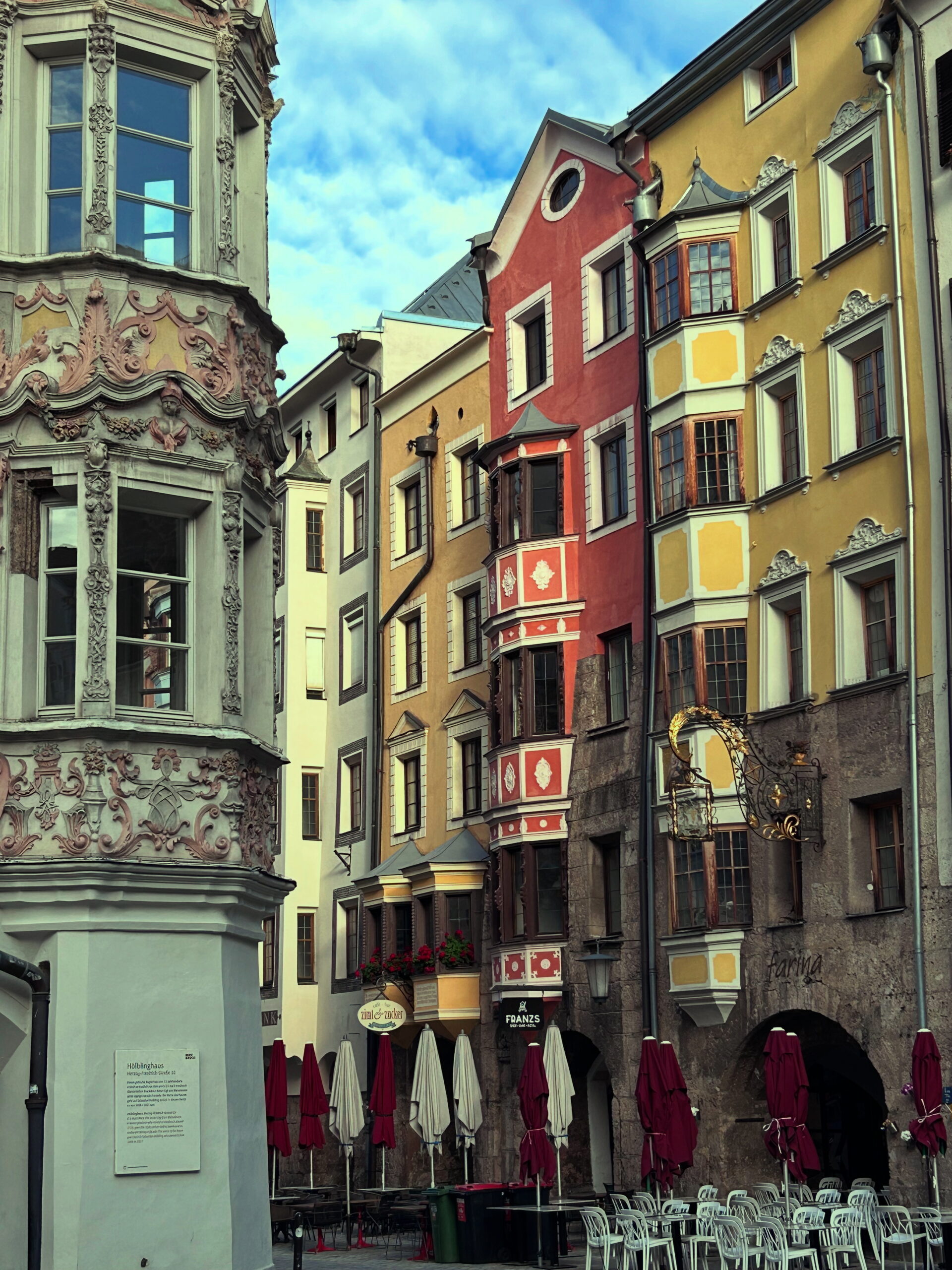
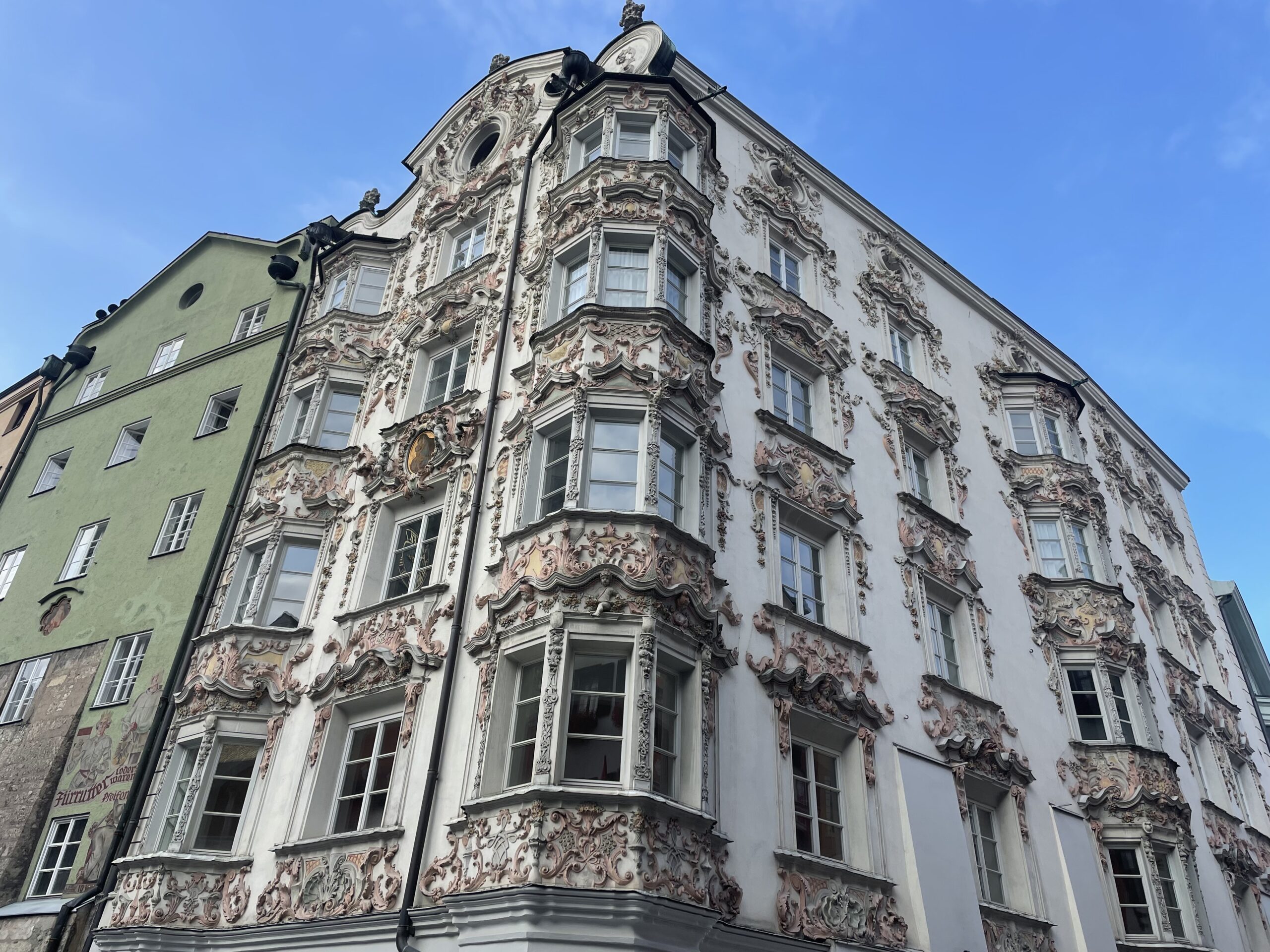
The Helblinghaus is often described as the most beautiful building in Innsbruck. Purists, however, would call the only Baroque building among the Gothic houses misplaced and even kitschy. While tastes differ, one can objectively state that the richly stuccoed townhouse is a real eye-catcher. In 1730, Anton Gigl planned the conversion of a Gothic residential house into a building in the typical early 18th-century style for owner Johann Fischer. The Rococo façade features natural motifs, putti, masks, and other decorative elements. On the gable, in keeping with the spirit of the time, is a copy of Lucas Cranach’s devotional image Mariahilf. Less conspicuous but equally interesting is the very early depiction of a bare-breasted female figure. The 18th century in Tyrol was not an era when women’s bodies were commonly shown in their natural form in public. In other respects, too, the Helblinghaus was ahead of its time. The building got its name from its owner Sebastian Helbling, who, in the early 19th century, was one of the first in Innsbruck to serve the new trendy drink—coffee. At the beginning of the 20th century, the house hosted a Catholic Casino. This was not a gambling establishment but rather the meeting place of Innsbruck’s Casino Movement, a conservative political faction founded during the revolutionary year of 1848. Over the decades, the movement split into several branches, including one in the Habsburg Empire, which had not been part of the German Confederation since 1867. The Innsbruck branch consisted of academics and clerics close to the Church. The association opposed the liberal German People’s Party, which dominated the city council until World War I, and the Social Democrats. While they agreed that the German population was superior to other nationalities in the multinational Danube Monarchy, they found little else in common. Unlike the liberals, who envisioned modern, secular nation-states, the Casino Movement wanted to maintain the status quo in political and social life. Many of its members were Jesuits or had been educated under the order’s guidance. Keeping schools and education under the Church’s control was naturally a major concern for them. In the late days of the monarchy, the movement opposed universal suffrage, which the Social Democrats sought to introduce. Gender equality was equally anathema to them. Whether the depiction of the bare-breasted lady hastened the conservatives’ move to another base is not recorded. Today, the Helblinghaus houses shops and offices.
Maria help Innsbruck!
Veneration of saints and popular piety have always walked a narrow line between faith, superstition, and magic. In the Alpine regions, where people were exposed to a largely inexplicable natural environment to a greater extent than in many other areas, these forms of belief developed remarkable and locally distinctive expressions. Saints were invoked for help with a wide range of everyday concerns. Saint Anne was asked to protect the house and hearth, while prayers for a good harvest were addressed to Saint Notburga of Rattenberg, who was particularly popular in Tyrol. As the use of fertilizer and agricultural machinery increased, she later became the patron saint of women wearing traditional costume. Miners entrusted their fate in their dangerous underground work to Saint Barbara and Saint Bernard. The chapel near the manor houses in the Hall Valley (Halltal) close to Innsbruck offers a fascinating insight into a spiritual world that oscillates between the legendary figure of the Bettelwurf spirit and the worship of various local patron saints. The saint who continues to eclipse all others in veneration, however, is Mary. From the blessing of herbs on the Feast of the Assumption to the clockwise-flowing water at the monastery and pilgrimage site of Maria Waldrast at the foot of Mount Serles, and from votive paintings in churches and chapels, she is a constant and beloved presence in popular devotion. Anyone strolling attentively through Innsbruck will repeatedly encounter a particular image on building façades: the Mariahilf devotional image by Lucas Cranach the Elder (c. 1472–1553). Cranach’s Madonna is one of the most popular and frequently copied Marian images in the Alpine region. It represents a reinterpretation of the classical iconography of the Mother of God. Similar to Leonardo da Vinci’s Mona Lisa, which was created around the same time, Mary smiles enigmatically at the viewer. Cranach dispensed with all traditional forms of sacralization such as the crescent moon or halo and portrayed her in contemporary everyday clothing. The reddish-blond hair of both mother and child relocates them from Palestine to Europe. The holy and virginal Mary thus became an ordinary woman with her child, belonging to the upper middle class of the sixteenth century.
The origin, journey, and veneration of the Mariahilf devotional image encapsulate, on a small scale, the history of the Reformation, the Counter-Reformation, and popular piety in the German territories. The odyssey of this modestly sized painting (measuring just 78 × 47 cm) began in what is today Thuringia, at the princely court of the land, one of the cultural centers of Europe at the time. Elector Frederick III of Saxony (1463–1525) was a deeply devout man and possessed one of the most extensive collections of relics of his era. Despite his profound rootedness in popular belief in relics and his strong devotion to Mary, in 1518 he supported Martin Luther not only for religious reasons but also for reasons of power politics. The safe conduct granted by this powerful territorial prince and Luther’s accommodation at Wartburg Castle enabled the reformer to work on the German translation of the Holy Scriptures and on his vision of a new, reformed Church. As was customary at the time, Frederick also maintained an “art director” in his entourage: Lucas Cranach, who had served as court painter in Wittenberg since 1515. Like many artists of his time, Cranach was not only extraordinarily productive but also highly business‑minded. In addition to his artistic work, he ran both a pharmacy and a wine tavern in Wittenberg. Thanks to his wealth and social standing, he served as mayor of the town from 1528 onward. Cranach was renowned for painting quickly and in large quantities. He recognized art as a medium for capturing and disseminating both time and zeitgeist. Much like Albrecht Dürer, he produced widely circulated works of great popular appeal. His portraits of the contemporary elite continue to shape our image of early modern celebrities such as his patron Frederick, Emperor Maximilian I, Martin Luther, and his fellow artist Dürer.
At the latest through his acquaintance with the church critics Philipp Melanchthon and Martin Luther at Wittenberg Castle, Cranach became a follower of the new reformed Christianity, which at that time still lacked an official institutional form. The ambiguities in religious beliefs and practices during the period before the formal split of the Church are reflected in Cranach’s works. Despite Luther’s and Melanchthon’s rejection of the veneration of saints, Marian devotion, and iconographic imagery in churches, Cranach continued to paint according to the tastes of his patrons. Just as fluid as the confessional boundaries of the sixteenth century is the date of origin of the Mariahilf image. Cranach created it sometime between 1510 and 1537, either for the private household altar of Frederick’s sister‑in‑law, Duchess Barbara of Saxony, or for the Church of the Holy Cross in Dresden. Art historians remain divided on the issue to this day. Cranach’s close friendship with Martin Luther suggests that he may have painted the work after his conversion to Lutheranism, and that this secularized depiction of a mother and child reflects a new religious worldview. Nevertheless, it is equally plausible that the pragmatic artist produced the painting earlier, in accordance with the wishes of the patron and the fashion of the time, entirely without ideological intent and before Luther’s arrival in Wittenberg.
After Frederick’s death, Cranach entered the service of his successor, John Frederick I of Saxony. When his patron was taken captive by the Emperor following the Battle of Mühlberg in 1547, Cranach, despite his advanced age, followed him into captivity as far as Augsburg and Innsbruck. After five years in the retinue of this comparatively luxuriously housed hostage, Cranach returned to Wittenberg, where he died at what was, by contemporary standards, a biblical age. The Mariahilf image was probably transferred to the art chamber of the Saxon ruler during the turbulent years of the confessional wars, likely to protect it from destruction during iconoclastic outbreaks. Almost sixty-five years later, the painting, like its creator before it, would make its way to Innsbruck along circuitous paths. When the art‑loving Bishop of Passau from the House of Habsburg visited the Dresden court in 1611, he selected Cranach’s Mariahilf image as a diplomatic gift and brought it to his princely episcopal residence on the Danube. There, the cathedral dean saw the painting and was so taken with it that he commissioned a copy for his household altar. A pilgrimage cult quickly developed around the image. When, seven years later, the Bishop of Passau became Archduke Leopold V of Austria and sovereign of Tyrol, the increasingly popular painting moved with him to the Innsbruck court. His Tuscan wife, Claudia de’ Medici, diligently sustained Marian devotion in the Italian tradition even after his death. Both the Servite church and the Capuchin monastery received altars and images of the Holy Mother of God. Nonetheless, nothing surpassed the popularity of Cranach’s Mariahilf image. During the Thirty Years’ War, the painting was frequently removed from the court chapel and publicly displayed in order to protect the city. At these mass prayers, the desperate population of Innsbruck loudly implored the small image with the cry “Maria, help!”, a formula that had entered popular devotion through the Jesuits. In 1647, at a moment of greatest peril, the Tyrolean Estates vowed to build a church around the image should Mary’s protection spare the land from devastation by Bavarian and Swedish troops. That a reformed depiction of the Virgin Mary, painted by a friend of Martin Luther, was invoked to protect the city from Protestant forces is not without a certain irony.
Although the Church of Mariahilf was indeed built, the original painting was installed in 1650 in the parish church of St. James (St. Jakob) within the secure city walls, while the new church received a copy created by Michael Waldmann. This was not to be the last of its kind. Cranach’s motif and representation of the Mother of God enjoyed extraordinary popularity and can still be found today not only in churches, but also on countless private houses. Through these reproductions, art became a mass phenomenon. The Marian image had migrated from the private possession of a Saxon prince into public space. Centuries before Andy Warhol and Roy Lichtenstein, Cranach and Dürer had become intensely copied artists, and their works became part of everyday life and the visual fabric of the city. While the original Mariahilf image may hang in St. James’s Cathedral, it is the copy—and the parish that grew up around it—that gave an entire district its name.
Baroque: art movement and art of living
Anyone traveling through Austria is familiar with the domes and onion-shaped towers of churches in towns and villages. They are the characteristic hallmark of the Baroque architectural style, which reached its peak during the Counter-Reformation and continues to shape the cityscape of Innsbruck to this day. The most prominent churches—such as the Cathedral, St. John’s Church, or the Jesuit Church—are built in the Baroque style. Places of worship were meant to be splendid and magnificent, symbols of the triumph of the true faith. The exuberant, all-encompassing piety of elites and subjects alike was reflected in art and culture: great drama, pathos, suffering, splendor, and glory combined to form the Baroque—a style that left a lasting imprint on the entire Catholic sphere of influence of the Habsburgs and their allies between Spain and Hungary. From the seventeenth century onward, the Gumpp family of master builders and Johann Georg Fischer fundamentally transformed Innsbruck’s cityscape. The Old Provincial Government Building in the Old Town, the New Provincial Government Building on Maria-Theresien-Strasse, countless palazzi, paintings, and sculptures—the Baroque was the defining stylistic force of the House of Habsburg in the seventeenth and eighteenth centuries and became embedded in everyday life. The bourgeoisie did not wish to lag behind the nobility and princes and therefore had their private residences built in the Baroque style as well. Farmhouses were adorned with images of saints, depictions of the Virgin Mary, and representations of the Sacred Heart of Jesus.
Yet the Baroque was more than an architectural style; it was a way of life that emerged in the aftermath of the Thirty Years’ War. The Ottoman threat from the east, culminating in the two sieges of Vienna, dominated the empire’s foreign policy, while the Reformation shaped domestic affairs. Baroque culture became a central element of Catholicism and its political self-representation in public space—a countermodel to the austere and rigorous way of life advocated by Calvin and Luther. Christian holidays were introduced to brighten everyday life. Architecture, music, and painting were rich, full, and exuberant. In theatres such as the Comedihaus in Innsbruck, dramas with religious themes were performed. Ways of the Cross with chapels and representations of the crucified Christ crisscrossed the landscape. Popular piety, expressed through pilgrimages and the veneration of Mary and the saints, became firmly embedded in everyday church life. Multiple crises shaped daily existence. In addition to war and famine, plague epidemics occurred particularly frequently in the seventeenth century. Baroque piety was used as a means of educating subjects, teaching them to interpret these calamities as expressions of God’s dissatisfaction—misfortunes that could be remedied through a devout and virtuous way of life. Although the sale of indulgences was no longer common practice in the Catholic Church after the sixteenth century, vivid notions of heaven and hell persisted. Through a virtuous life—that is, living in accordance with Catholic values and displaying proper conduct as a subject within the divine order—one could come significantly closer to paradise. So-called Christian devotional literature became the most popular reading material following the educational reforms of the eighteenth century and the rising literacy of the population. The suffering of the Crucified for humanity was regarded as a symbol of the hardship endured by subjects on earth within the feudal system. Through votive paintings, people sought assistance in times of hardship or expressed gratitude—most often to the Virgin Mary—for surviving dangers and illnesses. Particularly impressive votive paintings can be admired in the Wilten Basilica. The historian Ernst Hanisch described the Baroque and its influence on the Austrian way of life as follows:
“Austria emerged in its modern form as a crusading imperialism—externally against the Turks and internally against the Reformers. This brought bureaucracy and the military, and externally a multiethnic society. State and Church attempted to control the intimate sphere of citizens’ lives. Everyone had to reform themselves through the confessional; sexuality was restricted, norm-compliant sexuality enforced. People were systematically trained to dissemble.”
Rituals and submissive behavior toward authority left deep traces in everyday culture, distinguishing Catholic countries such as Austria and Italy to this day from Protestant-influenced regions such as Germany, England, or Scandinavia. Austrians’ passion for academic titles has its roots in Baroque hierarchies. The term Baroque prince refers to a particularly patriarchal and patronizing politician who knows how to captivate an audience with grand gestures. While political sobriety is valued in Germany, the style of Austrian politicians remains theatrical—entirely in keeping with the Austrian adage “Schaumamal” (“let’s see”).
Wilhelm Greil: DER Bürgermeister Innsbrucks
One of the most important figures in Innsbruck's municipal history was Wilhelm Greil (1850–1928). The entrepreneur held the office of mayor from 1896 to 1923, having previously helped shape the city's fortunes as vice mayor. His tenure was not only long, but also took place during a particularly dynamic era. The four decades between the economic crisis of 1873 and the First World War were marked by unprecedented growth and rapid modernization. It was a time of incorporating entire city districts, technical innovations, and new media. Private investments in infrastructure such as railways, energy, and electricity were encouraged by the state and given tax incentives in order to lead the provinces and cities of the struggling Danube Monarchy into modernity. The city's economy was booming. Businesses emerged in the new districts of Pradl and Wilten, attracting a labor force. Tourism also brought fresh capital into the city. Innsbruck's city council was dominated by the liberal and Pan-German nationalist 'Deutsche Volkspartei' (German People's Party), to which Greil also belonged. It was only with the incorporation of Wilten and Pradl in 1904 that the conservatives were able to gain ground, though they could not fully catch up. Social Democracy played almost no role until 1918. Due to an electoral system based on voting rights categorized by wealth classes, only about 10% of Innsbruck's population could step up to the ballot box. Women were fundamentally excluded. Furthermore, relative voting rights applied within the three electoral colleges, which effectively meant: winner takes it all. Appropriately enough, Mayor Greil lived much like a Renaissance prince. He hailed from the upper-class haute bourgeoisie. His father was able to afford establishing the family's home base in the Palais Lodron on Maria-Theresien-Straße. Thanks to this electoral statute, Mayor Greil could rely on 100% support in the city council well into the era of the First Republic, which naturally simplified decision-making and governance considerably. For all the efficiency that Innsbruck's mayors displayed on a superficial level, one should not forget that this was only possible because, as part of an elite composed of entrepreneurs, merchants, and professionals, they ruled through a form of elected dictatorship—without any significant opposition or consideration for other population groups such as workers, artisans, and employees. The Imperial Municipal Act of 1862 granted cities like Innsbruck, and thus its mayors, far-reaching powers. It is hardly surprising that the chain of office presented to Greil on his 60th birthday by his colleagues on the city council bore an astonishing resemblance to the collar orders of the old nobility. However, Greil was also a skillful politician who adeptly navigated the established power structures and media landscape of his time. Article 17 of the Austrian Basic Law of 1867, known as the December Constitution, secured freedom of expression in the press without prior censorship for the first time—excluding, of course, punishable content such as blasphemy or insulting the authorities. Consequently, a variety of newspapers established themselves, such as the conservative Neue Tiroler Stimme, the social democratic Volkszeitung, or the liberal Innsbrucker Nachrichten, shaping a worldview according to their publishers' preferences. Thanks to the reach of the Innsbrucker Nachrichten, Wilhelm Greil was able to effectively project his view of local politics. Despite his at times fierce speeches—modeled on the platform of Georg Ritter von Schönerer (1842–1921), the founding figure of the Pan-German nationalists—he managed to reach arrangements with conservative forces in the region, even if things frequently clashed in the media and elsewhere. Taxes, social policy, education, housing, and the design of public spaces were debated with passion and zeal, often enough with violence as the ultimate argument.
Unter Greils Ägide und dem allgemeinen wirtschaftlichen Aufschwung erweiterte sich Innsbruck im Eiltempo. Der Gemeinderat kaufte ganz im Stil eines Kaufmanns vorausschauend Grund an, um der Stadt Neuerungen zu ermöglichen. Der Politiker Greil konnte sich bei den großen Bauprojekten der Zeit auf die Beamten und Stadtplaner Eduard Klingler, Jakob Albert und Theodor Prachensky stützen. Infrastrukturprojekte wie das neue Rathaus in der Maria-Theresienstraße 1897, die Eröffnung der Mittelgebirgsbahn, die Hungerburgbahn und die Karwendelbahn wurden während seiner Regierungszeit umgesetzt. Weitere gut sichtbare Meilensteine waren die Erneuerung des Marktplatzes und der Bau der Markthalle. Neben den prestigeträchtigen Großprojekten revolutionierte vor allem Unsichtbares in den letzten Jahrzehnten des 19. Jahrhunderts das Leben vieler Innsbrucker. Bereits Greils Vorgänger Bürgermeister Heinrich Falk (1840 – 1917) hatte erheblich zur Modernisierung der Stadt und zur Besiedelung des Saggen beigetragen. Seit 1859 war die Beleuchtung der Stadt mit Gasrohrleitungen stetig vorangeschritten. Mit dem Wachstum der Stadt und der Modernisierung wurden die Senkgruben, die in Hinterhöfen der Häuser als Abort dienten und nach Entleerung an umliegende Landwirte als Dünger verkauft wurden, zu einer Unzumutbarkeit für immer mehr Menschen. 1880 wurde das Ragging, so der Name im Volksmund für die Entleerung der Aborte, in den Verantwortungsbereich der Stadt übertragen. Zwei pneumatische Maschinen sollten den Vorgang zumindest etwas hygienischer gestalten. Zwischen 1887 und 1891 wurde Innsbruck mit einer modernen Hochdruckwasserleitung ausgestattet, über die auch Wohnungen in höher gelegenen Stockwerken mit frischem Wasser versorgt werden konnten. Wer auf sich hielt und es sich leisten konnte, hatte damit erstmals die Gelegenheit eine Spültoilette im Eigenheim zu installieren. Greil setzte diesen Feldzug der Modernisierung mit einer Vielzahl an Infrastrukturprojekten fort. Die Ansammlung an Menschen auf enger werdendem Raum unter teils prekären Hygieneverhältnissen hatte viele Probleme mit sich. Die Randbezirke der Stadt und die umliegenden Dörfer wurden regelmäßig von Typhus heimgesucht. Nach jahrzehntelangen Diskussionen wurde 1903 mit dem Bau einer modernen Schwemmkanalisation begonnen. Ausgehend von der Innenstadt wurden immer mehr Stadtteile an diesen heute alltäglichen Luxus angeschlossen. 1908 waren nur die Koatlackler Mariahilf und St. Nikolaus nicht an das Kanalsystem angeschlossen. Auch der neue Schlachthof im Saggen erhöhte Hygiene und Sauberkeit in der Stadt. Schlecht kontrollierte Hofschlachtungen gehörten mit wenigen Ausnahmen der Vergangenheit an. Das Vieh kam im Zug am Sillspitz an und wurde in der modernen Anlage fachgerecht geschlachtet. Greil überführte das Gaswerk in Pradl und das Elektrizitätswerk in Mühlau in städtischen Besitz. Die Straßenbeleuchtung wurde im 20. Jahrhundert von den Gaslaternen auf elektrisches Licht umgestellt. 1888 übersiedelte das Krankenhaus von der Maria-Theresienstraße an seinen heutigen Standort. Bürgermeister und Gemeinderat konnten sich bei dieser Innsbrucker Renaissance neben der wachsenden Wirtschaftskraft in der Vorkriegszeit auch auf Mäzen aus dem Bürgertum stützen. Waren technische Neuerungen und Infrastruktur Sache der Liberalen, verblieb die Fürsorge der Ärmsten weiterhin bei klerikal gesinnten Kräften, wenn auch nicht mehr bei der Kirche selbst. Freiherr Johann von Sieberer stiftete das Greisenasyl und das Waisenhaus im Saggen. Leonhard Lang stiftete das Gebäude in der Maria-Theresienstraße, in der sich bis heute das Rathaus befindet gegen das Versprechen der Stadt ein Lehrlingsheim zu bauen.
In contrast to the booming pre-war era, Greil’s leadership after 1914 was marked by crisis management. In his final years in office, he guided Innsbruck through the transition from the Habsburg monarchy to the republic—a time characterized above all by hunger, hardship, scarcity of resources, and insecurity. He was 68 years old when Tyrol was divided at the Brenner Pass after the war. During his political career, Greil had often exploited general hostility toward Italians (“Walsche”) in a similarly populist manner to his Christian Social counterpart in Vienna, Karl Lueger, who used antisemitic rhetoric. At the end of his career, he had to witness the Italian occupation of Innsbruck. With the introduction of the republic, the census-based voting system was abolished, marking the beginning of the end of liberal dominance in the municipal council. In 1919, the Social Democrats won elections in Innsbruck for the first time. Only due to council majorities and a coalition of Greater German-liberal and conservative-clerical politicians did Greil remain mayor. He died in 1928 at the age of 78 as an honorary citizen of the city of Innsbruck. Wilhelm-Greil-Straße had already been named after him during his lifetime.