Court dwarf & castle giant
Hofgasse 12
Worth knowing
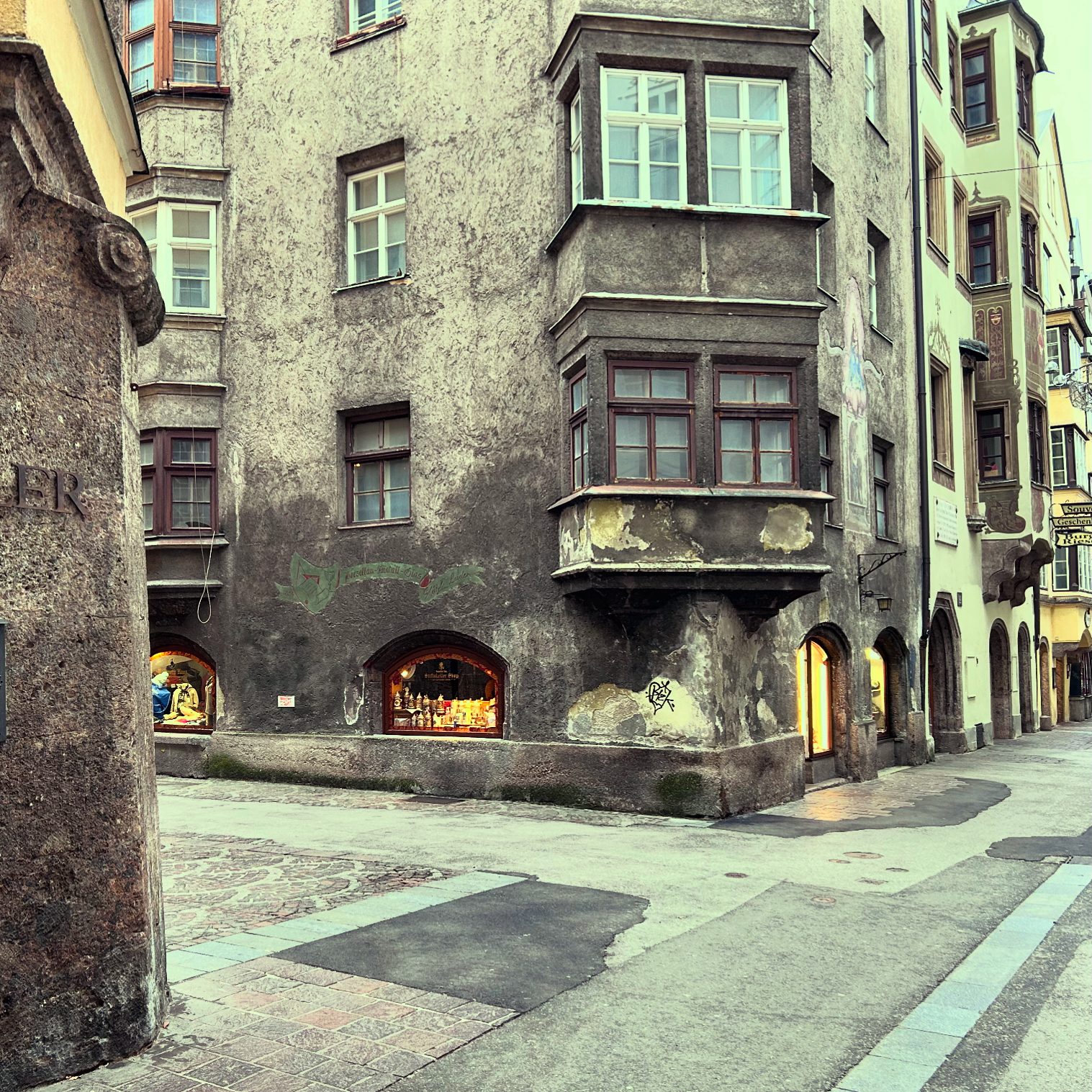
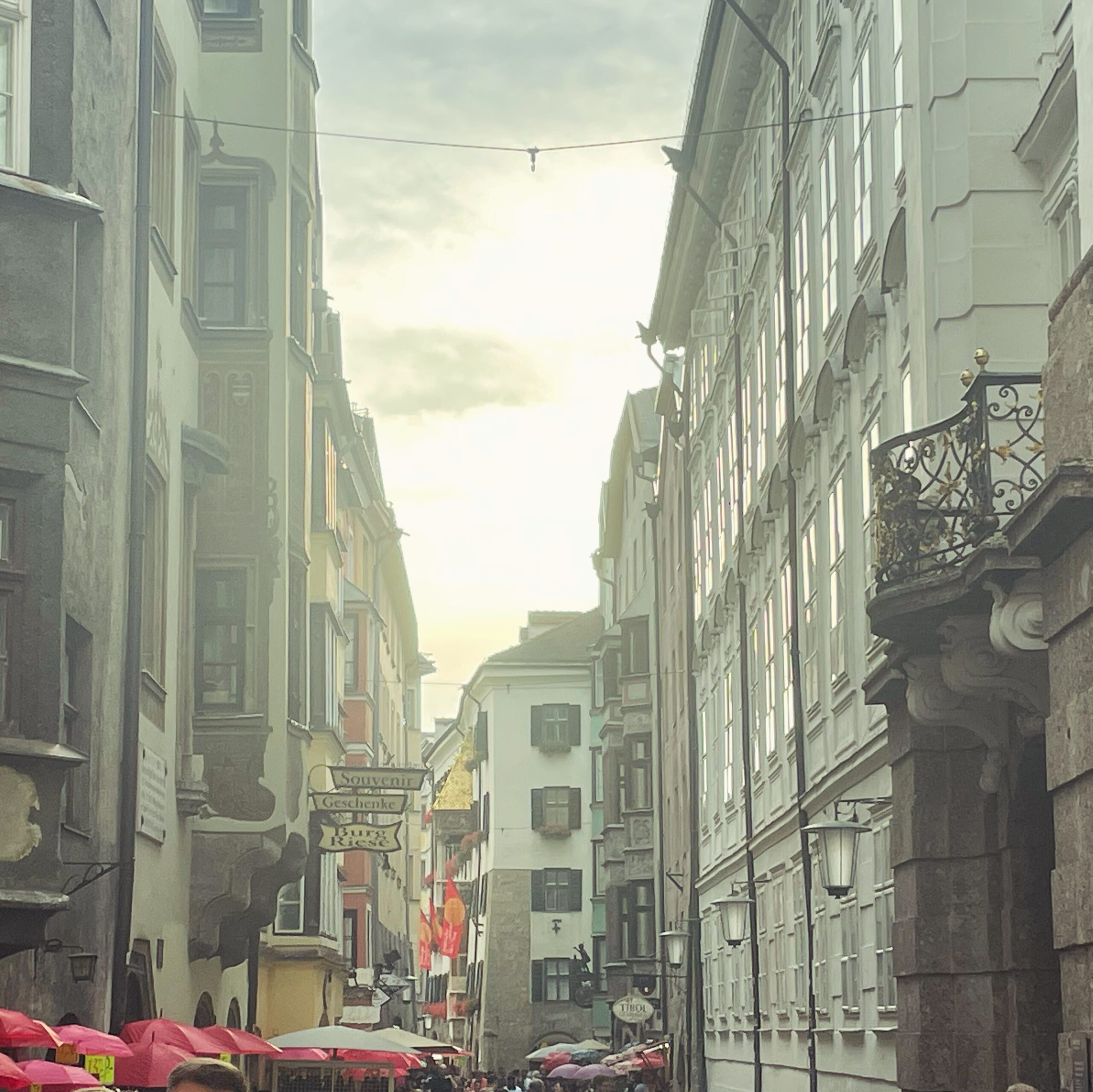
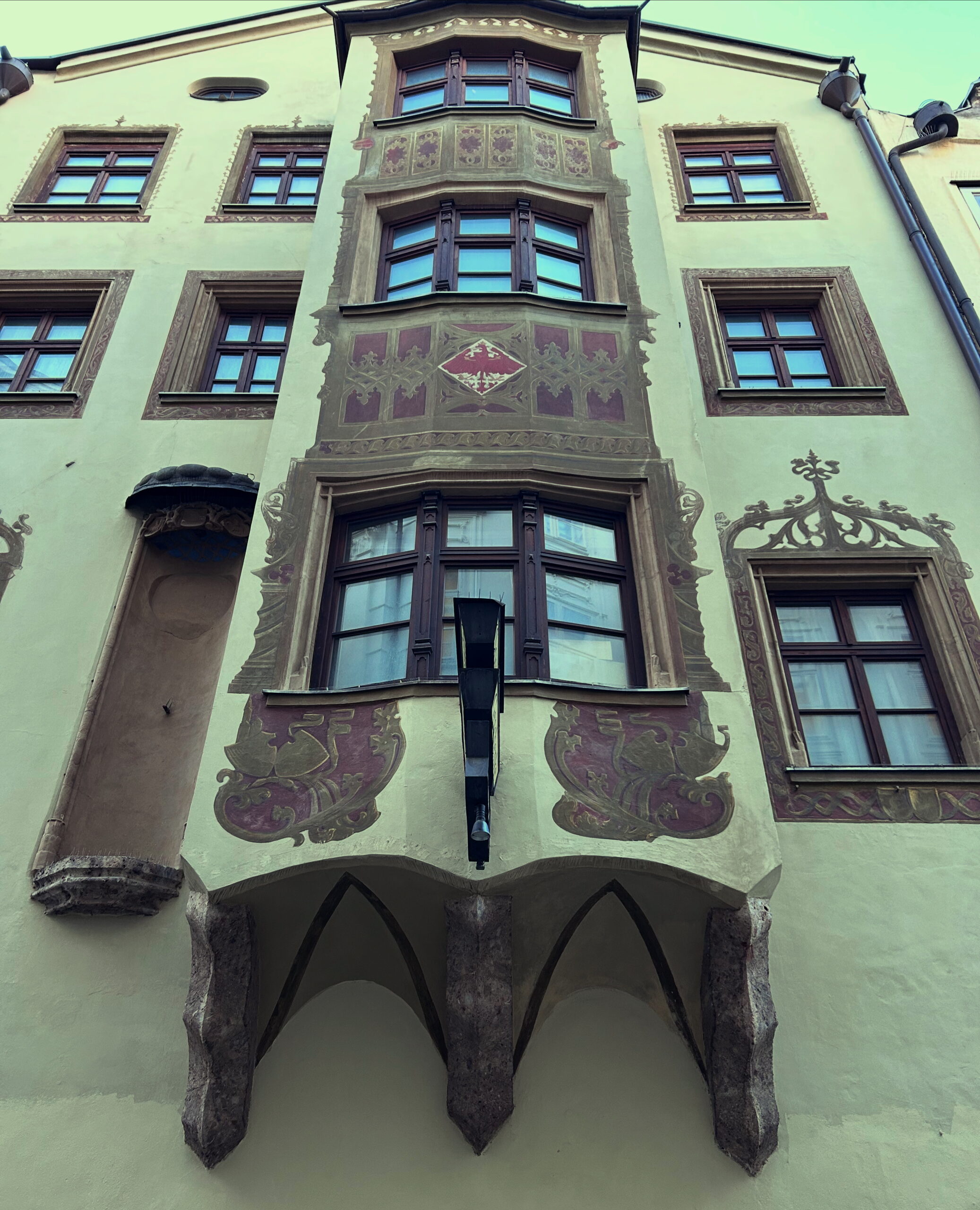
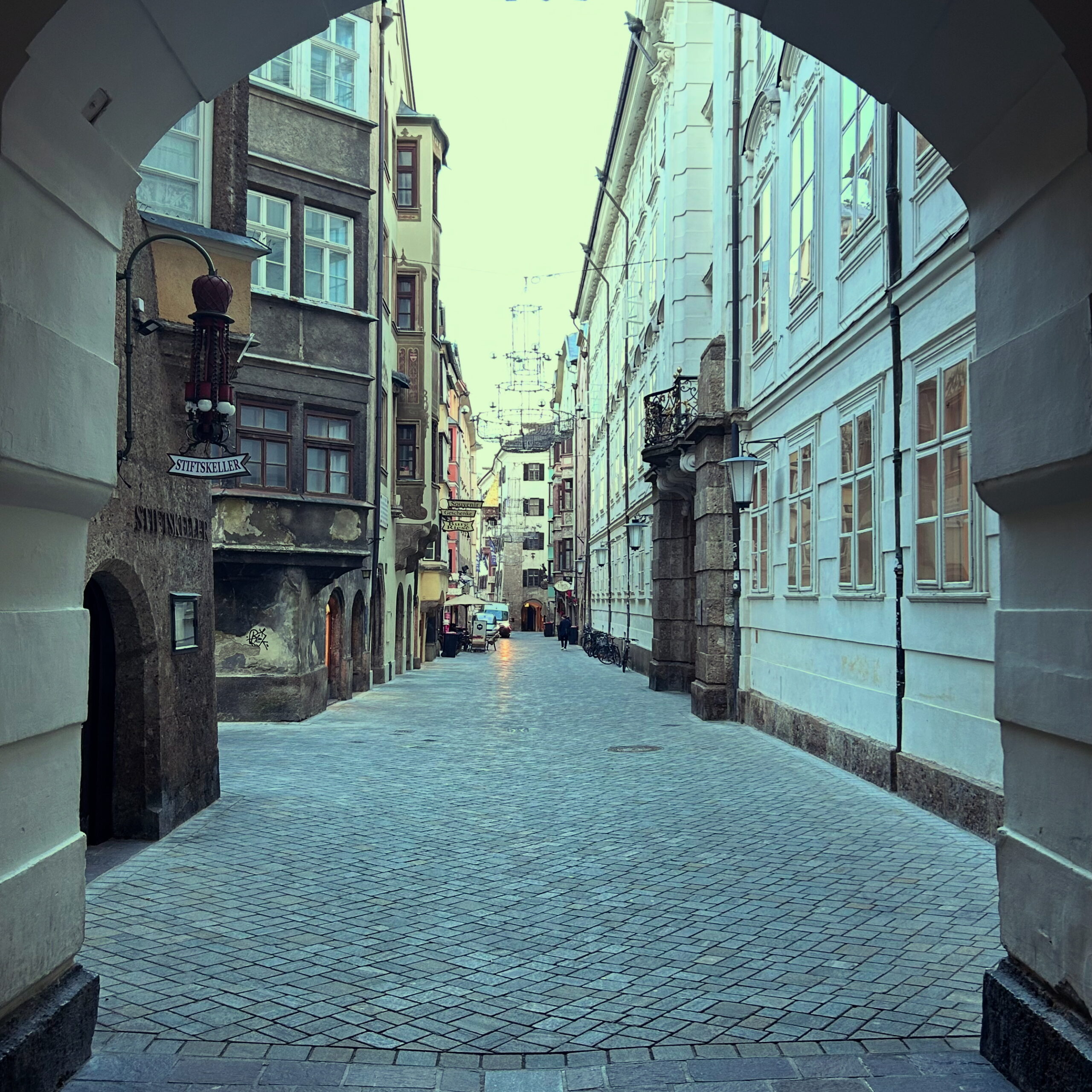
At the corner of Hofgasse and Stiftgasse stands a dark Gothic building whose contrast to the bright white Hofburg opposite could not be greater. The Gothic exterior of the four-story house dates back to 1530 and is attributed to the craftsmanship of the Türing builders. A massive round-arched portal forms the entrance on Stiftgasse. The stately entrance door with the “whispering arch” on Hofgasse is a true Innsbruck curiosity: if someone whispers on one side of the arch, the person on the other side can hear even the faintest word by placing their ear against the arch. The imaginative figures on the wooden entrance door were created by Tyrolean sculptor Rudolf Millonig for the former inn “Zum Burgriesen,” inspired by the Gothic heritage. Those lucky enough to enter can admire the 17th-century staircase and the cross vaults inside.
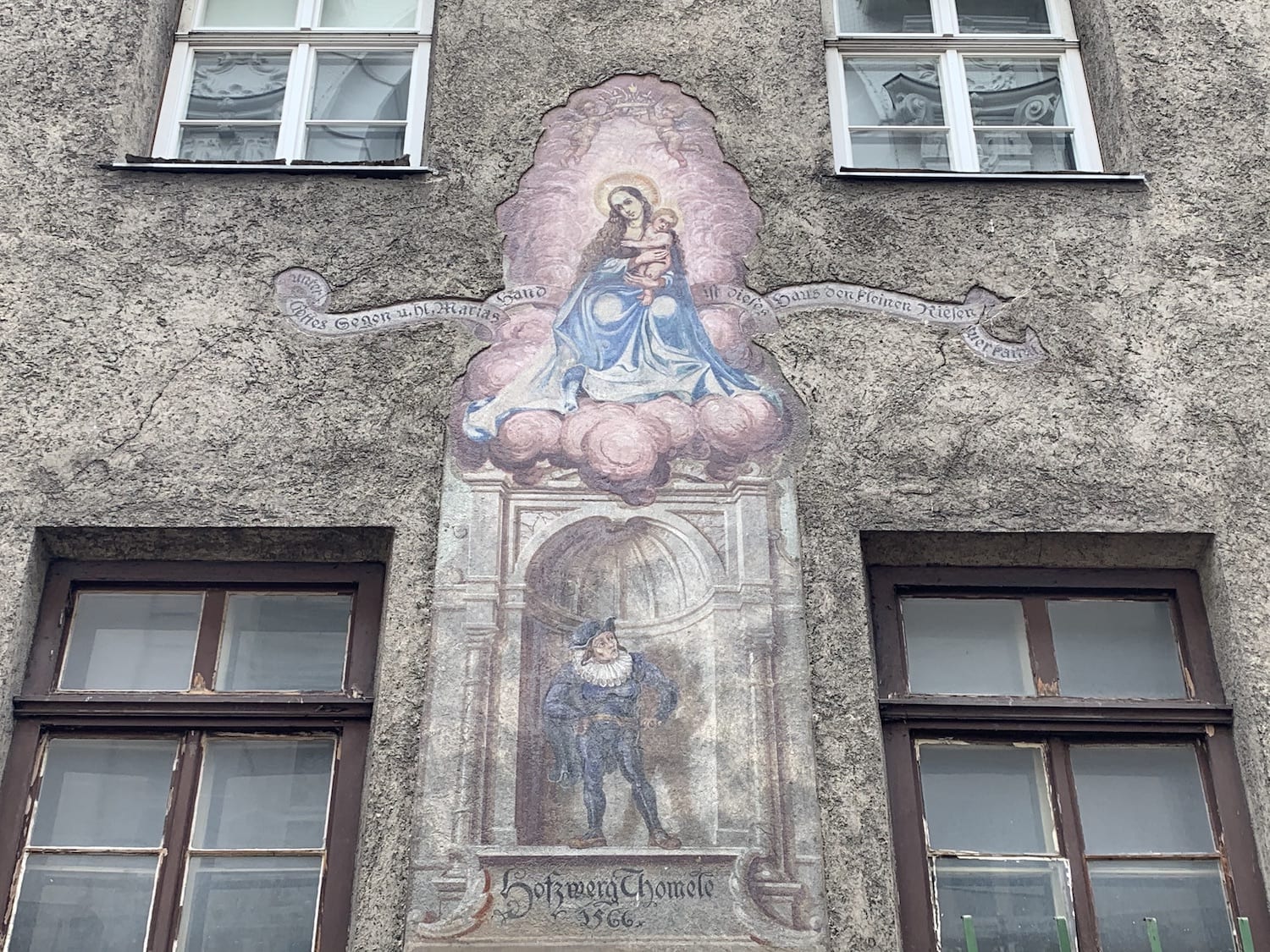
The paintings on the façade along Hofgasse give the house its name: Kleines Riesenhaus or Burgriesenhaus (“Little Giant’s House” or “Castle Giant’s House”). They commemorate two extraordinary Innsbruck figures: the court dwarf Thomele and the castle giant Haidl. A poem beneath an image of the Virgin Mary praises these prominent residents:
“Under God’s blessing and Holy Mary’s hand, this house is dedicated to the little giants.”
Thomele served at the court of Ferdinand II, entertaining the prince and his entourage. Court dwarfs and giants had become a tradition since the Middle Ages, originating from the Duchy of Burgundy, which became part of the Habsburg Empire under Maximilian. Burgundy, with its wealthy trading cities Ghent and Bruges, was not only financially but also culturally Europe’s avant-garde alongside the Italian metropolises. European princes of the 15th century emulated the culture of the Burgundian court. Maximilian’s first wife, Mary of Burgundy, brought much of this flair to the Habsburg court and its ceremonial life. It is no wonder that the cosmopolitan Ferdinand did not want to do without court dwarfs. Court dwarfs and jesters were even allowed to criticize rulers at the time. Still, Thomele was hardly enviable—though dwarfs were highly sought-after entertainers, kicks, blows, and slaps were common if performances displeased the rulers. At the other end of the size scale stood the princely bodyguard. Castle giant Nikolaus Haidl was not just a curiosity but also part of the guard, serving as a kind of bodyguard for Archduke Sigismund “the Rich in Coin.” He was definitely no mythical figure—his gigantic skeletal remains were discovered in 1866 during construction work in the crypt of Innsbruck Cathedral. On the first floor of the city tower is a stone figure that was removed from the façade niche of the Burgriesenhaus.
A plaque on the northern façade commemorates a famous visitor: Prince Eugene (1663–1736), one of the greatest military commanders in Habsburg history, stayed here during his travels. Like many figures in Innsbruck’s history, he was a kind of European mélange. François-Eugène de Savoie-Carignan was originally a French subject of King Louis XIV and a member of the French high nobility. Legend has it that his slight build caused his rejection from the French army, though it is more likely that his family had fallen into royal disgrace, prompting Eugene to enter military service with the Habsburgs—the long-standing rivals of the French monarchy. Between 1683 and 1718, he fought in all major European conflicts. He is best remembered for saving Vienna from Ottoman conquest. Born a Frenchman, he became a member of the Emperor’s Privy Council and President of the Court War Council. Between 1716 and 1724, he served as governor of the Austrian Netherlands. With his private fortune, he became one of the most important private builders between Budapest and Vienna. As an educated collector with an interest in science and art, Prince Eugene corresponded with leading intellectuals of his time, such as Leibniz, Montesquieu, and Voltaire. Paintings portrayed him as a baroque star; songs celebrated him as the savior of Christian Europe from the Turkish threat. At the height of his power, after the emperors he served, he was probably the most influential man in Europe. His body rests in St. Stephen’s Cathedral in Vienna, while his heart lies separately in the Basilica di Superga in Turin, the burial church of the House of Savoy, his family. His indirect descendants from this French noble lineage would later fight against Austria in the Italian Wars of Independence between 1848 and 1866 to achieve Italian unity. Like Andreas Hofer in Tyrol, Prince Eugene is often exploited for nationalist and populist purposes—something he likely would not have approved of. Rather, he and court dwarf Thomele should remind us of the diverse foreign influences that give the city its unique charm. In Innsbruck, both the Burgriesenhaus and Prinz-Eugen-Straße in Saggen commemorate Austria’s most successful military leader.
Siegmund der Münzreiche
On Friedl mit der leeren Tasche followed Siegmund der Münzreiche as Prince of Tyrol. Siegmund of Tyrol (1427 - 1496) had the worst possible start to his reign. When his father Frederick died, Siegmund was only 12 years old. He was therefore taken over by his uncle Frederick III, the Emperor of the Holy Roman Empire and father of Maximilian I, into involuntary custody and guardianship. You could say that Siegmund began his career as a hostage of the emperor, his own cousin. Tyrol was now a rich county and the emperor was reluctant to relinquish direct control over it. It was only when the Tyrolean estates protested against this paternalism that Siegmund was able to take office. The Tyrolean Diet had taken over the reins of government in the absence of a sovereign prince, thereby demonstrating its political clout. At the age of 18, Siegmund moved to Innsbruck to take over the official duties. Four years later, he married Eleanor of Scotland (1433 - 1480), the visually unattractive 16-year-old daughter of King James of the House of Stewart. The marriage was to remain childless.
Under Prince Siegmund, there were many innovations on the one hand and a bloated and expensive court on the other. In Innsbruck and the surrounding area, urban life attracted new crafts. In 1453, the princely silver smelter opened in today's Universitätsstraße. In 1484, Siegmund had the mint moved from Meran in South Tyrol to Hall, which earned him the nickname Siegmund der Münzreiche brought in. Two years later, a princely mill was built on the Sill Canal, which was to form the basis for the early industrialisation that developed in the following years. He issued the Schwaz mountain regulations, which was to become the model for all Habsburg mines. Mining officials were given more rights within their sphere of influence, similar to the universities. There were special regulations for miners within society, as they were a highly sought-after labour force. One can speak of an early social and labour law agreement. The miners worked hard, but earned relatively well. The same applied to the mint and the Hall salt works. A wealthy middle class began to emerge.
During his opulent reign, Innsbruck had become a centre of attraction for craftsmen, goldsmiths and artists. The immigrants often came from the aristocracy and did not want to give up their lifestyle in Innsbruck. A special form of metal industry established itself in Mühlau. Plattner created armour and harnesses for noblemen who wanted to present themselves in a manner befitting their status, both on military campaigns and at tournaments. Siegmund was their best customer. He bought a number of tournament armours for himself and as appreciative gifts for aristocrats of foreign courts and guests of honour. The workshops on the Mühlaubach became the leading workshops of their kind in the world. It was not until the 17th century that the richly decorated armour went out of fashion. The city tower near the Old Town Hall as an expression of the city's prosperity and the first parts of the Hofburg were built under Siegmund. A glass painter settled in Innsbruck. The court library grew in step with Siegmund and Eleonore's humanistically scholarly guests. Both were considered art-loving and interested in literature. Before the invention of printing, books were an expensive hobby. Travellers and showmen were also welcome at court to entertain local and international guests.
Siegmund's opulent lifestyle not only cost him a lot of money, but also his political reputation and, at the end of his career, probably also the princely throne. His second marriage was to Katharina of Saxony (1468 - 1524), a lady from a highly aristocratic electoral family. It was probably also thanks to the influence and court behaviour of Siegmund and his two wives that the expenses of the Coin rich auf lange Sicht die Einnahmen aus Steuern, Salinen und den Bergwerken überstiegen. Bei der landesfürstlichen Hochzeit 1484 umfasste allein der Zug der Braut 54 Wagen. Die Gäste mussten in Innsbruck einquartiert und verköstigt werden. Auch mit der 40 Jahre jüngeren Frau war dem mittlerweile senilen Siegmund männlicher Erbe vergönnt, was besonders bitter für ihn gewesen sein muss, betrachtet man die ihm nachgesagten 30 außerehelich gezeugten Kinder. Gleichzeitig wurden die Zeiten rauer für die, die mit dem neuen Lebensrhythmus der Stadt nicht mithalten konnten. Man kann von circa 2000 Stadtbürgern zu dieser Zeit ausgehen. Der Hofstaat Sigmunds bestand aus 500 Personen, der Hofstaat seiner Frau war dabei nicht miteingerechnet. Diese „Fremden“ erregten in Innsbruck Aufsehen. Die Kluft zwischen den sozialen Schichten wuchs und auch die Landstände waren ob des angeschlagenen Staatshaushaltes besorgt. Sein Hof war am Ende seiner Regierungszeit übermäßig aufgebläht und teuer. Ein verlorener Krieg mit den Schweizer Eidgenossen verpflichtete ihn zu Zahlungen, auch ein Krieg mit Venedig endete schlecht. Siegmund musste habsburgische Besitzungen im Elsass und dem heutigen Breisgau an Karl the bold von Burgund, den zukünftigen Schwiegervater Maximilians I. verpfänden. Die österreichischen Vorlande verkaufte er zu einem Spottpreis an das Herzogtum Bayern, die Tiroler Silberbergwerke verpfändete er an Jakob Fugger. Die bayerischen Wittelsbacher wollten über einen Erbvertrag mit dem altersbedingt geistig umnachteten Sigmund auch Tirol wieder unter ihre Kontrolle bringen. Erst kaiserlicher Druck und das eilige Einschreiten der Tiroler Landstände und Maximilians ermöglichten den Verbleib des Landes beim Haus Habsburg. 1490 übernahm er das Amt des Landesfürsten, obwohl Siegmund noch am Leben war. Damit waren die gesamten Erblande des Hauses Habsburg wieder in einer Hand. Siegmund war nicht der erfolgreichste Landesherr Tirols, genießt dank seiner im Stadtbild gut sichtbaren Verdienste rund um Innsbrucks kulturellen Aufstieg aber noch immer Ansehen in der Volksseele.
Ferdinand II: Principe and Renaissance prince
Archduke Ferdinand II of Austria (1529 - 1595) is one of the most colourful figures in Tyrolean history. His father, Emperor Ferdinand I, gave him an excellent education. He grew up at the Spanish court of his uncle Emperor Charles V. The years in which Ferdinand received his schooling were the early years of Jesuit influence at the Habsburg courts. The young statesman was brought up entirely in the spirit of pious humanism. This was complemented by the customs of the Renaissance aristocracy. At a young age, he travelled through Italy and Burgundy and had become acquainted with a lifestyle at the wealthy courts there that had not yet established itself among the German aristocracy. Ferdinand was what today would be described as a globetrotter, a member of the educated elite or a cosmopolitan. He was considered intelligent, charming and artistic. Among his less eccentric contemporaries, Ferdinand enjoyed a reputation as an immoral and hedonistic libertine. Even during his lifetime, he was rumoured to have organised debauched and immoral orgies.
Ferdinand's father divided his kingdom between his sons. Maximilian II, who was rightly suspected of heresy and adherence to Protestant doctrines by his parents, inherited Upper and Lower Austria as well as Bohemia and Hungary. Ferdinand's younger brother Charles ruled in Inner Austria, i.e. Carinthia, Styria and Carniola. The middle child received Tyrol, which at that time extended as far as the Engadine, and the fragmented Habsburg Forelands in the west of the central European possessions. Ferdinand took over the Tyrol as sovereign in turbulent times. He had already spent several years in Innsbruck in his youth. The mines in Schwaz began to become unprofitable due to the cheap silver from America. The flood of silver from the Habsburg possessions in New Spain on the other side of the Atlantic led to inflation.
However, these financial problems did not stop Ferdinand from commissioning personal and public infrastructure. Innsbruck benefited enormously, both economically and culturally, from the fact that after years without a sovereign prince, it was now once again the centre of a ruler. Ferdinand's archducal presence attracted the aristocracy and civil servants back to Innsbruck after the decades of neglect following Maximilian's death. By the late 1560s, the administration had grown back to 1000 people, who fuelled the local economy with their money. Bakers, butchers and inns flourished again after a few barren years. At the end of the 16th century, Innsbruck had an above-average number of innkeepers compared to other towns, who earned an above-average amount of money from merchants, guests and travellers passing through. Wine houses were not only inns, but also storage and trading centres.
The Italian cities of Florence, Venice and Milan were trendsetters in terms of culture, art and architecture. Ferdinand's Tyrolean court was to be in no way inferior to them. Gone were the days when Germans were considered uncivilised in the more beautiful cities south of the Alps, barbaric or even as Pigs were labelled. To this end, he had Innsbruck remodelled in the spirit of the Renaissance. In keeping with the trend of the time, he imitated the Italian aristocratic courts. Court architect Giovanni Lucchese assisted him in this endeavour. Ferdinand spent a considerable part of his life at Ambras Castle near Innsbruck, where he amassed one of the most valuable collections of works of art and armour in the world. Ferdinand transformed the castle above the village of Amras into a modern court. His parties, masked balls and parades were legendary. During the wedding of a nephew, he had 1800 calves and 130 oxen roasted. Wine is said to have flowed from the wells instead of water for 10 days.
But Ambras Castle was not the end of Innsbruck's transformation. To the west of the city, an archway still reminds us of the Tiergartena hunting ground for Ferdinand, including a summer house also designed by Lucchese. In order for the prince to reach his weekend residence, a road was laid in the marshy Höttinger Au, which formed the basis for today's Kranebitter Allee. The Lusthaus was replaced in 1786 by what is now known as the Pulverturm The new building, which houses part of the sports science faculty of the University of Innsbruck, replaced the well-known building. The princely sport of hunting was followed in the former Lusthauswhich was the Powder Tower. In the city centre, he had the princely Comedihaus on today's Rennweg. In order to improve Innsbruck's drinking water supply, the Mühlauerbrücke bridge was built under Ferdinand to lay a water pipeline from the Mühlaubach stream into the city centre. The Jesuits, who had arrived in Innsbruck shortly before Ferdinand took office to make life difficult for troublesome reformers and church critics and to reorganise the education system, were given a new church in Silbergasse. Numerous new buildings such as the Jesuit, Franciscan, Capuchin and Servite monasteries boosted trade and the construction industry.
The new religious orders supported Ferdinand's focus on the confessional orientation of his flock. In his Tyrolean provincial ordinance issued in 1573, he not only put a stop to fornication, swearing and prostitution, but also obliged his subjects to lead a God-fearing, i.e. Catholic, lifestyle. The „Prohibition of sorcery and disbelieving warfare" prohibited any deviation from the true faith on pain of imprisonment, corporal punishment and expropriation. Jews had to wear a clearly visible ring of yellow fabric on the left side of their chest at all times. At the same time, Ferdinand brought a Jewish financier to Innsbruck to handle the money transactions for the elaborate farm management. Samuel May and his family lived in the city as princely patronage Jews. Daniel Levi delighted Ferdinand with dancing and harp playing at the theatre and Elieser Lazarus looked after his health as court physician.
Fleecing the population, living in splendour, tolerating Protestantism among his important advisors and at the same time fighting Protestantism among the people was no contradiction for the trained Renaissance prince. Already at the age of 15, he marched under his uncle Charles V in the Schmalkaldic War into battle against the enemies of the Roman Church. As a sovereign, he saw himself as Advocatus Ecclesiae (note: representative of the church) in a confessional absolutist sense, who was responsible for the salvation of his subjects. Coercive measures, the foundation of churches and monasteries such as the Franciscans and the Capuchins in Innsbruck, improved pastoral care and the staging of Jesuit theatre plays such as "The beheading of John" were the weapons of choice against Protestantism. Ferdinand's piety was not artificial, but like most of his contemporaries, he managed to adapt flexibly to the situation.
Ferdinand's politics were suitably influenced by the Italian avant-garde of the time. Machiavelli wrote his work "Il Principe", which stated that rulers were allowed to do whatever was necessary for their success, even if they were incapable of being deposed. Ferdinand II attempted to do justice to this early absolutist style of leadership and issued his Tyrolean Provincial Code A modern set of legal rules by the standards of the time. For his subjects, this meant higher taxes on their earnings as well as extensive restrictions on mountain pastures, fishing and hunting rights. The miners, mining entrepreneurs and foreign trading companies with their offices in Innsbruck also drove up food prices. It could be summarised that Ferdinand enjoyed the exclusive pleasure of hunting on his estates, while his subjects lived at subsistence level due to increasing burdens, prices and game damage.
His relationship life was eccentric for a member of the high aristocracy. Ferdinand's first "semi-wild marriage" was to the commoner Philippine Welser. After his wife #1 died, Ferdinand married the devout Anna Caterina Gonzaga, a 16-year-old Princess of Mantua, at the age of 53. However, it seems that the two did not feel much affection for each other, especially as Anna Caterina was a niece of Ferdinand. The Habsburgs were less squeamish about marriages between relatives than they were about the marriage of a nobleman to a commoner. However, he was also "only" able to father three daughters with her. Ferdinand's final resting place was in the Silver Chapel with his first wife Philippine Welser.
Türing dynasty of master builders: Innsbruck becomes a cosmopolitan city
Siegmund der Münzreiche was the one who brought Niklas Türing (1427 - 1496) to Innsbruck in the 15th century. He made his first documented appearance in 1488. The Türings were a family of stonemasons and master builders from what is now Swabia, which at the time was part of the Habsburg Monarchy as part of Vorderösterreich. Innsbruck had been the royal seat of the Tyrolean princes for several decades, but the architectural splendour had not yet arrived north of the Alps. The city was a collection of wooden houses and not very prestigious. Golden times were dawning for craftsmen and master builders, which were to gather even more momentum under Maximilian. There was a real building boom. Aristocrats wanted to have a residence in the city in order to be as close as possible to the centre of power. In the days before the press, a functioning postal system, fax and e-mail, politics was mainly played out through direct contact.
The Türings made a career in step with the city. It is reported from 1497 that Niklas Türing was in the service of the sovereign as a "paid court mason". When he died in 1517 or 1518, it is not known for certain, he was listed on his gravestone as "Roman imperial majesty's chief foreman" is the title. Together with his son Gregor, he was listed as a master stonemason. This enabled the Türings to acquire citizenship in Innsbruck. By 1506 at the latest, they had a house in the workers' and craftsmen's neighbourhood Anbruggen. In 1509, they were able to acquire the house of today's Gasthof zum Lamm in Mariahilfstraße. Further property was added at what is now Schlossergasse 21.
In the course of the late Middle Ages, the early Gothic period and later the Renaissance gave Europe a new architectural guise with a new understanding of architecture and aesthetics. Buildings such as Notre Dame or the Minster of York set the trend that would characterise the whole of Europe until the onset of the Baroque period. Pointed towers, ribbed vaults, bay windows and playful carvings depicting everyday courtly life are some of the typical features that make the heterogeneous style recognisable. The work of the Türings can be traced particularly well in the old town centre. Many of the town houses, such as the Trautsonhaus still have Gothic ground plans, inner courtyards and carvings.
The Türings left their mark on Gothic Innsbruck in the transitional period between the Middle Ages and early modern times. Thanks to their training, they combined an eye for the big picture and details in their building projects. They were known for their particularly fine stonework, which resulted in ornate portals, arcades, staircases and vaults. They produced relief jewellery with patterns in the typical style of Renaissance art. Grotesques, vases and depictions of animals were typical ways of decorating bay windows and smooth walls. The symmetrical arrangement of the individual elements is also a characteristic of the period.
Niklas Türing is the Goldene Dachl to a large extent. He also created the statue of the Burgriesen Haidla particularly tall member of Siegmund's bodyguard, which can be seen today in the city tower. Emperor Maximilian held him in such high esteem that he allowed him to display the family coat of arms of the Türings and his wife, a fountain and a fish, in the vault of the Goldenen Dachls to immortalise him. His son Gregor immortalised himself with the Trautsonhaus in der Herzog-Friedrich-Straße und am Burgriesenhaus in the Domgasse. The last of the Türings to have an influence on the Innsbruck building scene was Niklas Türing the Younger, who began planning the Hofkirche together with Andrea Crivelli. In the 16th and 17th centuries, the influence of the Gothic style began to wane, especially in what is now Austria. Churches in particular were increasingly remodelled and rebuilt in the Baroque style as part of the Counter-Reformation. Today, Türingstraße in the east of Innsbruck is a reminder of the early modern dynasty of master builders.