Court dwarf & castle giant
Hofgasse 12
Worth knowing
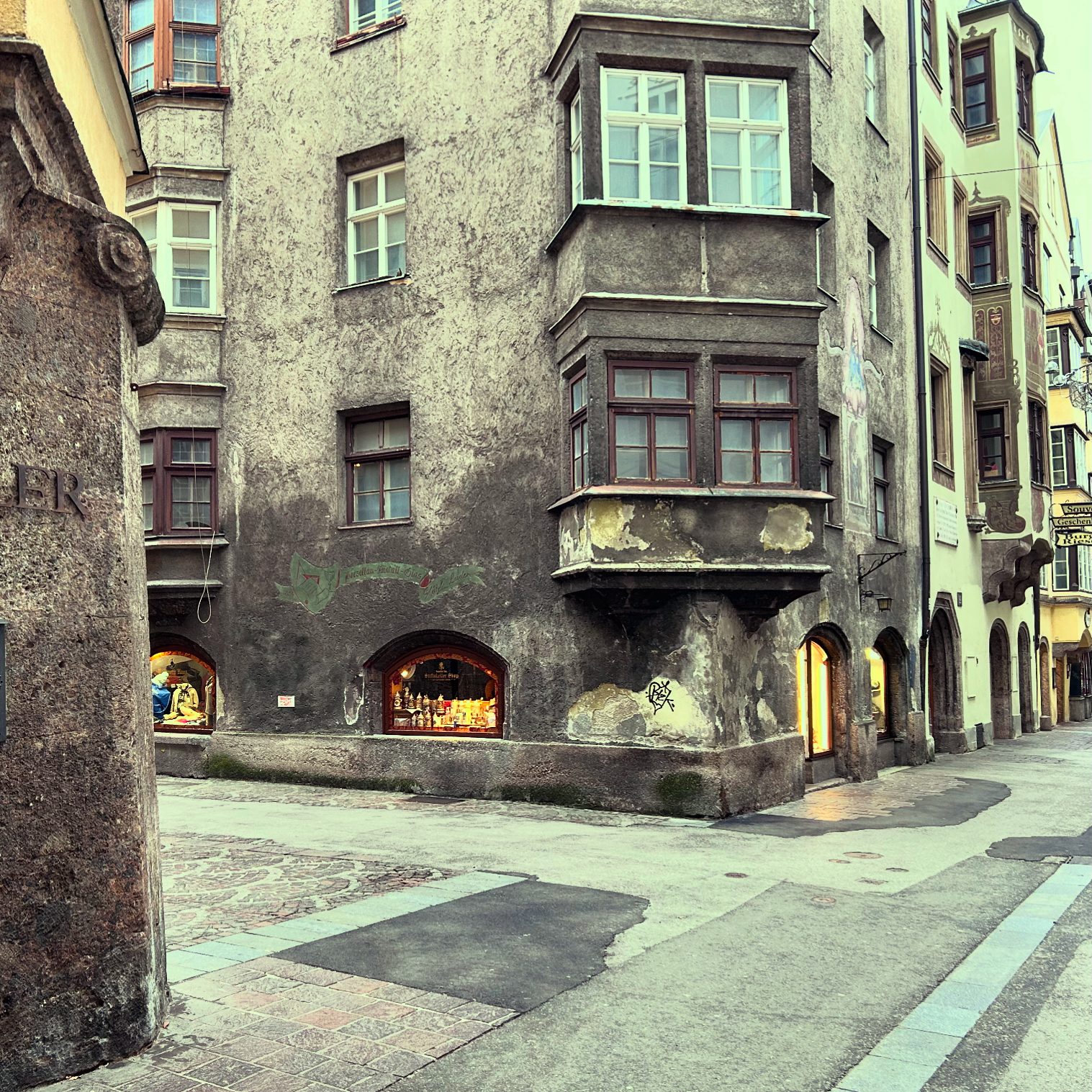
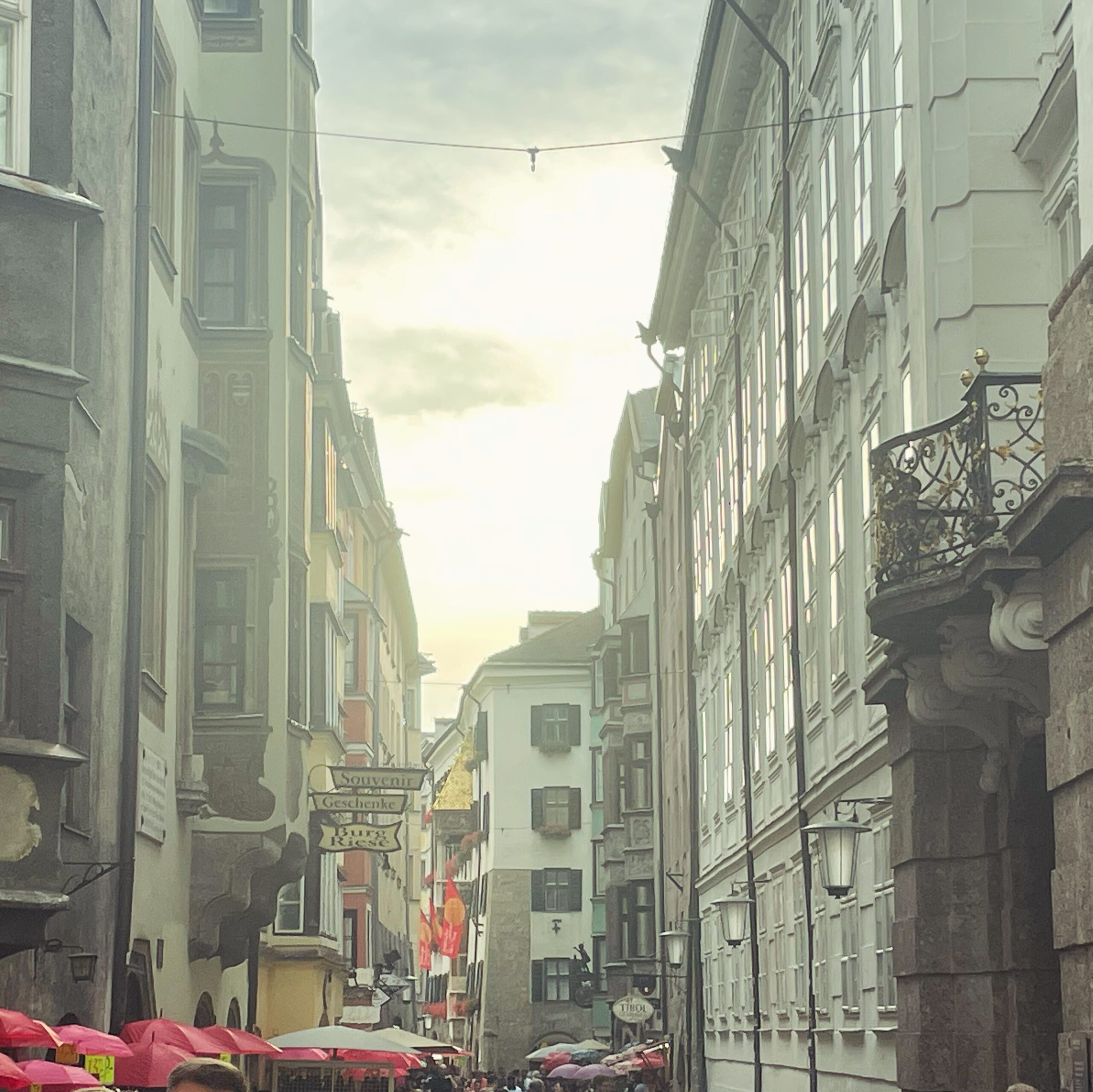
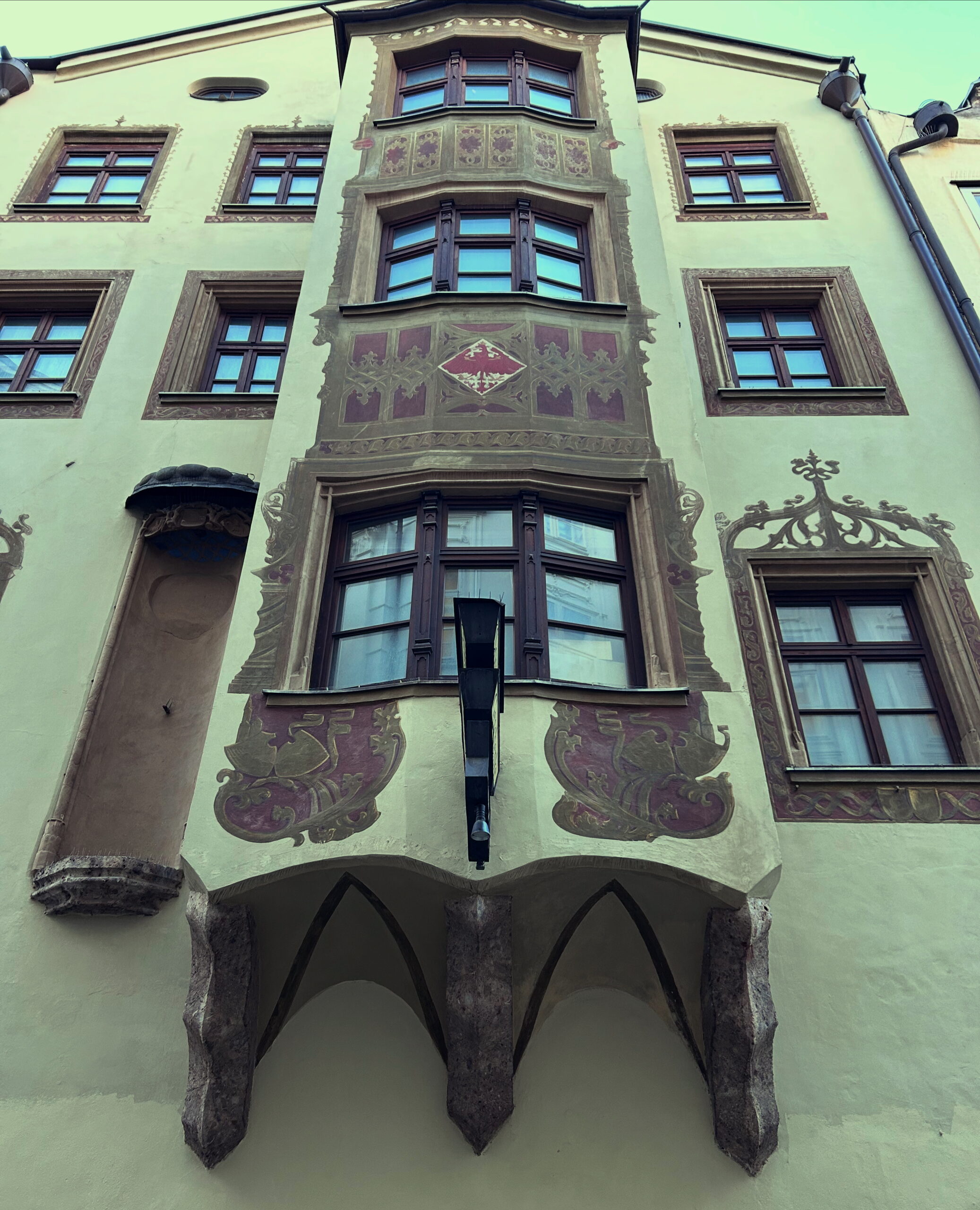
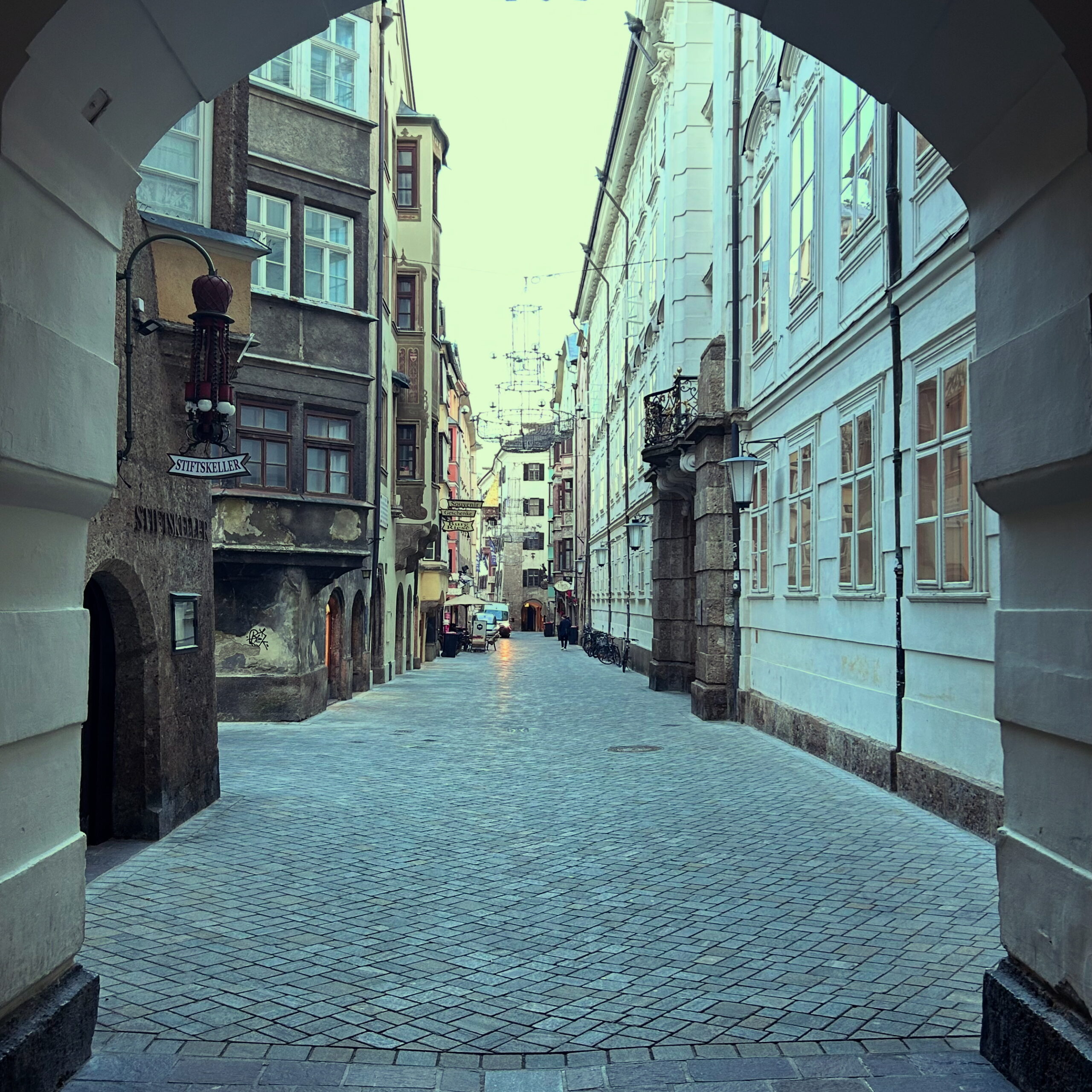
At the corner of Hofgasse and Stiftgasse stands a dark Gothic building whose contrast to the bright white Hofburg opposite could not be greater. The Gothic exterior of the four-story house dates back to 1530 and is attributed to the craftsmanship of the Türing builders. A massive round-arched portal forms the entrance on Stiftgasse. The stately entrance door with the “whispering arch” on Hofgasse is a true Innsbruck curiosity: if someone whispers on one side of the arch, the person on the other side can hear even the faintest word by placing their ear against the arch. The imaginative figures on the wooden entrance door were created by Tyrolean sculptor Rudolf Millonig for the former inn “Zum Burgriesen,” inspired by the Gothic heritage. Those lucky enough to enter can admire the 17th-century staircase and the cross vaults inside.
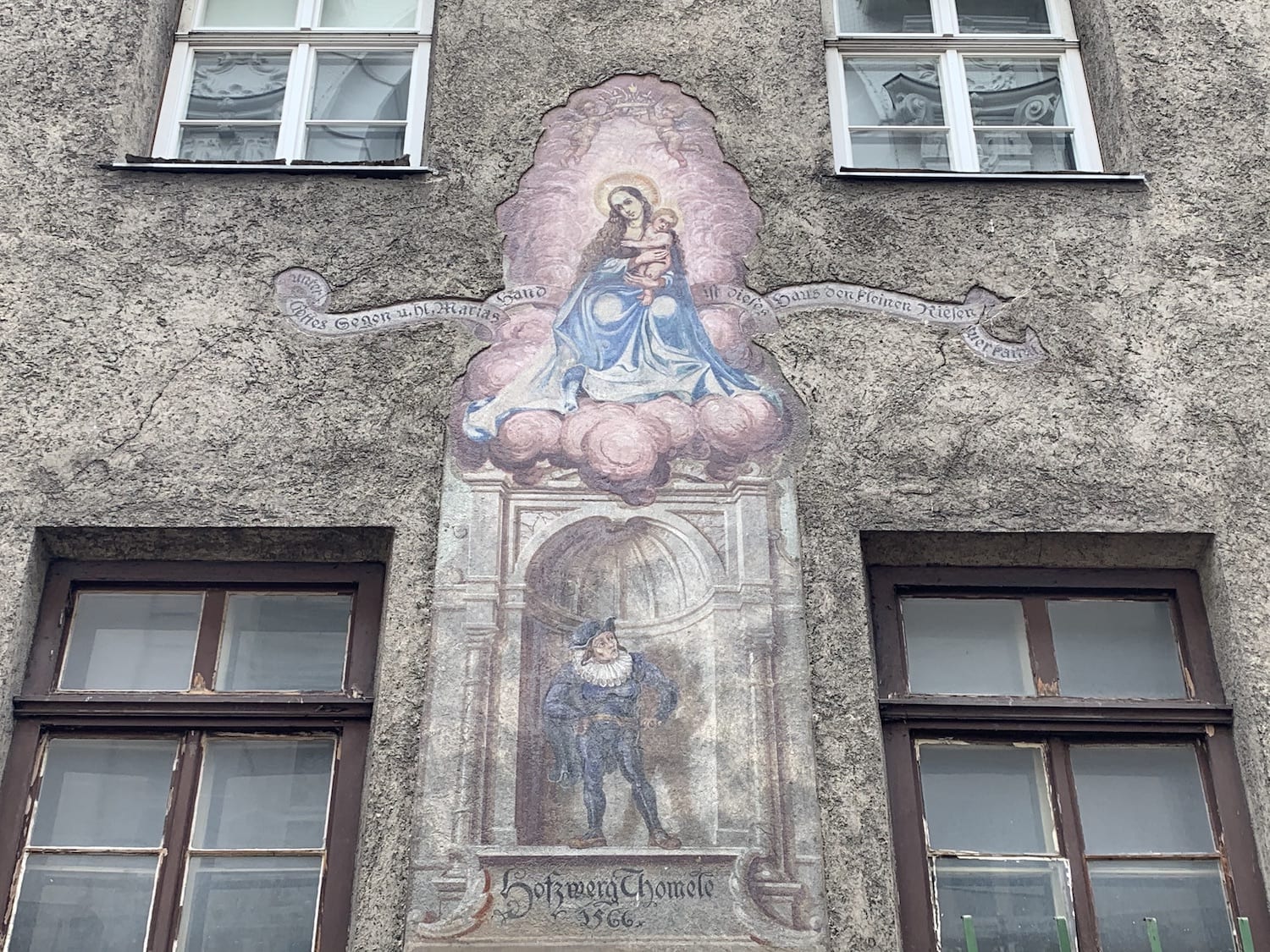
The paintings on the façade along Hofgasse give the house its name: Kleines Riesenhaus or Burgriesenhaus (“Little Giant’s House” or “Castle Giant’s House”). They commemorate two extraordinary Innsbruck figures: the court dwarf Thomele and the castle giant Haidl. A poem beneath an image of the Virgin Mary praises these prominent residents:
“Under God’s blessing and Holy Mary’s hand, this house is dedicated to the little giants.”
Thomele served at the court of Ferdinand II, entertaining the prince and his entourage. Court dwarfs and giants had become a tradition since the Middle Ages, originating from the Duchy of Burgundy, which became part of the Habsburg Empire under Maximilian. Burgundy, with its wealthy trading cities Ghent and Bruges, was not only financially but also culturally Europe’s avant-garde alongside the Italian metropolises. European princes of the 15th century emulated the culture of the Burgundian court. Maximilian’s first wife, Mary of Burgundy, brought much of this flair to the Habsburg court and its ceremonial life. It is no wonder that the cosmopolitan Ferdinand did not want to do without court dwarfs. Court dwarfs and jesters were even allowed to criticize rulers at the time. Still, Thomele was hardly enviable—though dwarfs were highly sought-after entertainers, kicks, blows, and slaps were common if performances displeased the rulers. At the other end of the size scale stood the princely bodyguard. Castle giant Nikolaus Haidl was not just a curiosity but also part of the guard, serving as a kind of bodyguard for Archduke Sigismund “the Rich in Coin.” He was definitely no mythical figure—his gigantic skeletal remains were discovered in 1866 during construction work in the crypt of Innsbruck Cathedral. On the first floor of the city tower is a stone figure that was removed from the façade niche of the Burgriesenhaus.
A plaque on the northern façade commemorates a famous visitor: Prince Eugene (1663–1736), one of the greatest military commanders in Habsburg history, stayed here during his travels. Like many figures in Innsbruck’s history, he was a kind of European mélange. François-Eugène de Savoie-Carignan was originally a French subject of King Louis XIV and a member of the French high nobility. Legend has it that his slight build caused his rejection from the French army, though it is more likely that his family had fallen into royal disgrace, prompting Eugene to enter military service with the Habsburgs—the long-standing rivals of the French monarchy. Between 1683 and 1718, he fought in all major European conflicts. He is best remembered for saving Vienna from Ottoman conquest. Born a Frenchman, he became a member of the Emperor’s Privy Council and President of the Court War Council. Between 1716 and 1724, he served as governor of the Austrian Netherlands. With his private fortune, he became one of the most important private builders between Budapest and Vienna. As an educated collector with an interest in science and art, Prince Eugene corresponded with leading intellectuals of his time, such as Leibniz, Montesquieu, and Voltaire. Paintings portrayed him as a baroque star; songs celebrated him as the savior of Christian Europe from the Turkish threat. At the height of his power, after the emperors he served, he was probably the most influential man in Europe. His body rests in St. Stephen’s Cathedral in Vienna, while his heart lies separately in the Basilica di Superga in Turin, the burial church of the House of Savoy, his family. His indirect descendants from this French noble lineage would later fight against Austria in the Italian Wars of Independence between 1848 and 1866 to achieve Italian unity. Like Andreas Hofer in Tyrol, Prince Eugene is often exploited for nationalist and populist purposes—something he likely would not have approved of. Rather, he and court dwarf Thomele should remind us of the diverse foreign influences that give the city its unique charm. In Innsbruck, both the Burgriesenhaus and Prinz-Eugen-Straße in Saggen commemorate Austria’s most successful military leader.
Siegmund der Münzreiche
Auf den Landesfürsten Friedl mit der leeren Tasche folgte sein Sohn Siegmund der Münzreiche (1427 – 1496). Der Start des jungen Mannes an der Spitze des Landes war holprig. Als sein Vater starb, war Siegmund erst 12 Jahre alt. Deshalb nahm ihn sein Onkel Friedrich III., der Kaiser of the Holy Roman Empire und Vater Maximilians I., in unfreiwillige Obhut und Vormundschaft. Man könnte sagen, Siegmund startete seine Karriere als Geisel des Kaisers, seines eigenen Vetters. Tirol war mittlerweile eine reiche Grafschaft, die direkte Kontrolle darüber wollte der Kaiser nur ungern aufgeben. Der Tiroler Landtag hatte zwischenzeitlich die Regierungsgeschäfte in Ermangelung eines Landesfürsten übernommen und damit politisches Gewicht bewiesen. Erst als die Landstände gegen diese Bevormundung protestierten, konnte Siegmund sein Amt antreten. Mit 18 Jahren zog er in Innsbruck ein, um seine Karriere als CEO Tirols zu starten. Unter seiner Ägide kam es zu vielen Innovationen auf der einen Seite, zu einem aufgeblähten und teuren Hofstaat auf der anderen. In Innsbruck und Umgebung zog das städtische Leben neues Handwerk an. 1453 eröffnete in der heutigen Universitätsstraße die Landesfürstliche Silberschmelze. 1484 ließ Siegmund die Münzprägeanstalt von Meran in Südtirol nach Hall verlegen, was ihm den Beinamen Siegmund der Münzreiche brought in. Two years later, a princely mill was built on the Sill Canal, which was to form the basis for the early industrialisation that developed in the following years. He issued the Schwaz mountain regulations, die zum Vorbild für alle Bergwerke der Habsburger werden sollte. Den Bergbeamten wurden, ähnlich den Universitäten, mehr Rechte innerhalb ihres Wirkungsbereiches gegeben. Für die Bergarbeiter gab es Sonderregelungen innerhalb der Gesellschaft, waren sie doch heiß begehrte Arbeitskräfte. Man kann von einer frühen sozial- und arbeitsrechtlichen Vereinbarung sprechen. Die Bergleute arbeiteten hart, verdienten aber verhältnismäßig gut. Dasselbe galt für die Prägeanstalt und die Haller Salinen. Eine frühe Form bürgerlicher Mittelschicht begann sich durch diese Möglichkeiten am Arbeitsmarkt herauszubilden.
During his opulent reign, Innsbruck had become a centre of attraction for craftsmen, goldsmiths and artists. The immigrants often came from the aristocracy and did not want to give up their lifestyle in Innsbruck. A special form of metal industry established itself in Mühlau. Plattner schufen Rüstungen und Harnische für Adelige, die sich sowohl auf Kriegszügen wie auch auf Turnieren standesgemäß präsentieren wollten. Siegmund war ihr bester Kunde. Er kaufte etliche Turnierharnische für sich selbst und als anerkennende Geschenke für Aristokraten ausländischer Höfe und Ehrengäste. Die Werkstätten am Mühlaubach wurden zu den führenden Betrieben ihrer Art weltweit. Erst im 17. Jahrhundert kamen die reich verzierten Rüstungen aus der Mode. Der Stadtturm beim Alten Rathaus als Ausdruck des städtischen Wohlstands und erste Teile der Hofburg wurden unter Siegmund erbaut. Ein Glasmaler siedete sich in Innsbruck an. Dieses Mäzenatentum war wohl auch ein wenig Kompensation für Siegmunds Eheleben. Er hatte in seinen ersten Jahren als Landesfürst Eleonore von Schottland (1433 – 1480), die optisch wenig attraktive 16 Jahre alte Tochter Königs Jakob aus dem Hause Stewart, geheiratet. Die Ehe sollte ohne Kinder bleiben, dafür aber kulturell umso fruchtbarer sein. Die Hofbibliothek wuchs im Gleichschritt mit Siegmunds und Eleonores humanistisch gelehrten Gästen. Beide galten als kunstsinnig und literarisch interessiert. Bücher waren in der Zeit vor der Erfindung des Buchdrucks ein teures Hobby. Auch fahrendes Volk und Schausteller waren am Hof gerne gesehen, um die einheimischen und internationalen Gäste zu unterhalten.
During his opulent reign, Innsbruck became a magnet for craftsmen, goldsmiths, and artists. Many of the immigrants came from aristocratic backgrounds and did not wish to abandon their lifestyle upon settling in Innsbruck. In Mühlau, a special form of metalworking industry took hold. Armorers produced suits of armor for nobles who wanted to present themselves appropriately on military campaigns as well as at tournaments. Sigismund was their best customer. He purchased numerous tournament armors for himself and as tokens of appreciation for aristocrats from foreign courts and distinguished guests. The workshops along the Mühlau stream became the leading enterprises of their kind worldwide. Only in the seventeenth century did the richly decorated armors fall out of fashion. The city tower next to the Old Town Hall, as an expression of urban prosperity, and the first parts of the Hofburg were built under Sigismund’s rule. A glass painter settled in Innsbruck. This patronage was perhaps also a form of compensation for Sigismund’s married life. In his early years as territorial prince, he married Eleanor of Scotland (1433–1480), the sixteen-year-old, physically rather unattractive daughter of King James of the House of Stewart. The marriage would remain childless, but culturally it proved all the more fruitful. The court library grew in step with the humanistically educated guests welcomed by Sigismund and Eleanor. Both were considered artistically inclined and interested in literature. Books were an expensive hobby in the era before the invention of printing. Traveling performers and entertainers were also welcome at court, helping to amuse domestic and international guests. Sigismund’s opulent lifestyle cost him not only a great deal of money but also political reputation—and ultimately, probably, his princely throne. In his second marriage, he wed Catherine of Saxony (1468–1524), a lady from a high-ranking princely electoral house. It was likely due to the influence and courtly expenditures of Sigismund and his two wives that the Coin-Rich’s expenses eventually exceeded income from taxes, salt works, and mines. At the princely wedding in 1484, the bride’s procession alone consisted of fifty-four wagons. Guests had to be housed and fed in Innsbruck. Even with a wife forty years his junior, the now senile Sigismund was not granted a male heir—an especially bitter fact considering the thirty illegitimate children attributed to him. At the same time, conditions grew harsher for those unable to keep pace with the city’s new rhythm of life. At that time, Innsbruck had approximately 2,000 citizens. Sigismund’s court comprised 500 people, not including his wife’s household. These “outsiders” attracted considerable attention in Innsbruck. The gap between social classes widened, and the estates grew concerned about the strained state finances. By the end of his reign, Sigismund’s court had become excessively bloated and costly. A lost war against the Swiss Confederates obligated him to make payments, and a conflict with Venice also ended unfavorably. Sigismund was forced to mortgage Habsburg possessions in Alsace and the present-day Breisgau to Charles the Bold of Burgundy, the future father-in-law of Maximilian I. He sold the Austrian Forelands to the Duchy of Bavaria at a bargain price and pledged the Tyrolean silver mines to Jakob Fugger. The Bavarian Wittelsbachs sought to regain control of Tyrol through an inheritance treaty with the age-related mentally diminished Sigismund. Only imperial pressure and the swift intervention of the Tyrolean Estates and Maximilian made it possible for the country to remain in the hands of the House of Habsburg. In 1490, Maximilian assumed the office of territorial prince, even though Sigismund was still alive. This reunited all Habsburg hereditary lands under one ruler. Sigismund was not the most successful ruler Tyrol ever had, but thanks to his clearly visible contributions to Innsbruck’s cultural rise, he continues to enjoy a measure of respect in popular memory.
Ferdinand II: Principe and Renaissance prince
Archduke Ferdinand II of Austria (1529–1595) ranks among the most colourful figures in Tyrolean regional history. His father, Emperor Ferdinand I, ensured that he received an excellent education. Ferdinand grew up at the Spanish court of his uncle, Emperor Charles V. The years of his formal education coincided with the early phase of Jesuit influence at the Habsburg courts. The young statesman was educated by these devout scholars entirely in the spirit of Christian humanism, complemented by instruction in the customs and etiquette of the High Renaissance aristocracy. In his youth, Ferdinand travelled extensively through Italy and Burgundy, where he became acquainted with a refined and luxurious courtly lifestyle that had not yet been established among the German aristocracy. He also spent several formative years in Innsbruck. Ferdinand was what one might today describe as a globetrotter, a member of the educational elite, or a cosmopolitan. He was regarded as intelligent, charming, and artistically inclined. Among contemporaries less enamoured of his eccentricity, however, he was reputed to be immoral and hedonistic. Even during his lifetime, rumours circulated that he hosted extravagant and indecent orgies. This reputation was likely connected to his private life. In a first, “semi‑morganatic” marriage, Ferdinand was wed to the commoner Philippine Welser. After the death of his first wife, Ferdinand married at the age of fifty‑three the deeply religious Anna Caterina Gonzaga, a sixteen‑year‑old princess of Mantua. Mutual affection between the two appears to have been limited, not least because Anna Caterina was Ferdinand’s niece. The Habsburgs were far less squeamish about marriages within the family than about unions between nobles and commoners. From this marriage, too, Ferdinand “only” fathered three daughters.
After the rarely Ferdinand I, Innsbruck once again gained a resident ruler. Ferdinand’s father divided his realm among his sons. Maximilian II, suspected by his parents of heresy and sympathy with Protestant doctrines, inherited Upper and Lower Austria as well as Bohemia and Hungary. Ferdinand’s younger brother Charles ruled Inner Austria—Carinthia, Styria, and Carniola. The middle son received Tyrol, which at the time extended as far as the Engadin, along with the fragmented Habsburg possessions west of the central European core lands. The golden age of silver mining in Tyrol was already fading. The mines of Schwaz were becoming unprofitable due to cheap silver imports from the Americas. The influx of precious metals from the Habsburg territories in New Spain led to inflation. These financial challenges did not deter Ferdinand from commissioning extensive public and private infrastructure projects. Innsbruck benefited enormously—economically and culturally—from once again becoming the seat of an active ruler after years of neglect following Maximilian’s death. Ferdinand’s archducal presence attracted aristocrats and officials back to the city. By the late 1560s, the administrative apparatus had grown once again to around one thousand people, whose spending stimulated local commerce. Bakers, butchers, and inns flourished after leaner years. By the end of the sixteenth century, Innsbruck had an above‑average number of taverns compared to other cities, profiting handsomely from merchants, travellers, and guests. Wine taverns also functioned as storage and trading centres.
The Italian cities of Florence, Venice and Milan were trendsetters in terms of culture, art and architecture. Ferdinand's Tyrolean court was to be in no way inferior to them. Gone were the days when Germans were considered uncivilised in the more beautiful cities south of the Alps, barbaric or even as Pigs were labelled. To this end, he had Innsbruck remodelled in the spirit of the Renaissance. In keeping with the trend of the time, he imitated the Italian aristocratic courts. Court architect Giovanni Lucchese assisted him in this endeavour. Ferdinand spent a considerable part of his life at Ambras Castle near Innsbruck, where he amassed one of the most valuable collections of works of art and armour in the world. Ferdinand transformed the castle above the village of Amras into a modern court. His parties, masked balls and parades were legendary. During the wedding of a nephew, he had 1800 calves and 130 oxen roasted. Wine is said to have flowed from the wells instead of water for 10 days.
The transformation of Innsbruck did not end with Ambras Castle. West of the city, an archway still commemorates Ferdinand’s game reserve, complete with a pleasure pavilion (Lusthaus), also designed by Lucchese. To allow the sovereign access to his weekend residence, a road was laid through the marshy Höttinger floodplains, forming the basis of today’s Kranebitter Allee. The Lusthaus was replaced in 1786 by the structure now known as the Powder Tower (Pulverturm), which today houses parts of the University of Innsbruck’s Faculty of Sport Science. In the city centre, Ferdinand commissioned the princely Comedihaus on today’s Rennweg. To improve Innsbruck’s water supply, the Mühlau Bridge was constructed, allowing water from the Mühlau stream to be channelled into the city. The Jesuits, who had arrived in Innsbruck shortly before Ferdinand’s accession to counter reformers and critics of the Church and to reorganise education, were granted a new church in Silbergasse. Numerous new buildings—including the monasteries of the Jesuits, Franciscans, Capuchins, and Servite nuns—stimulated crafts and construction. These new orders supported Ferdinand’s emphasis on the confessional conformity of his subjects. In the Tyrolean Provincial Ordinance of 1573, Ferdinand not only sought to curb fornication, profanity, and prostitution, but also obliged his subjects to live a God‑fearing—i.e. Catholic—life. The “Prohibition of Sorcery and Superstitious Divination” outlawed any deviation from the true faith under threat of imprisonment, corporal punishment, and confiscation of property. Jews were required to wear a clearly visible yellow ring on the left side of their clothing. At the same time, Ferdinand brought a Jewish financier to Innsbruck to manage the court’s complex finances. Samuel May and his family lived in the city as protected court Jews; Daniel Levi entertained the archduke with dance and harp music, while Elieser Lazarus served as his personal physician.
To live lavishly, tax the population heavily, tolerate Protestant advisers at court while suppressing Protestantism among the populace posed no contradiction for a Renaissance prince. Ferdinand saw himself as Advocatus Ecclesiae, the secular representative of the Church, responsible in an absolutist confessional sense for the salvation of his subjects’ souls. At the age of fifteen, he had already marched into battle with his uncle Charles V during the Schmalkaldic War against the enemies of the Roman Church. Coercive measures, the founding of churches and monasteries—such as those of the Franciscans and Capuchins in Innsbruck—improved pastoral care, and Jesuit theatrical productions like The Beheading of John were among the preferred weapons against Protestantism. Ferdinand’s piety was sincere, yet like most of his contemporaries he was adept at adapting to circumstances. His policies reflected the influence of contemporary Italian avant‑garde thought. Machiavelli’s Il Principe argued that rulers were permitted whatever was necessary for success—and could be deposed if they failed. Ferdinand II sought to embody this early absolutist style of leadership and, with his Provincial Ordinance, introduced a comparatively modern legal framework. For his subjects, however, this meant higher taxes, as well as significant restrictions on common land usage, fishing, and hunting rights. Miners, mining entrepreneurs, and foreign trading companies with their counting houses in Innsbruck further drove up food prices. In summary, while Ferdinand enjoyed exclusive hunting privileges on his estates, his subjects endured hardship caused by rising burdens, inflation, and game damage exacerbated by hunting bans. Owing largely to his architectural legacy, Ferdinand continues to enjoy a favourable reputation today. The eccentric archduke found his final resting place—fittingly according to his own tastes—in the Silver Chapel, beside his first wife, Philippine Welser.
Türing dynasty of master builders: Innsbruck becomes a cosmopolitan city
With Innsbruck’s rise to the status of a residence city, a true building boom began. Anyone who wished to wield influence needed to have a residence in the city, in order to be as close as possible to the centre of power. In the period before newspapers, a regular postal system, fax, and email, politics was conducted primarily through direct personal contact. One family was particularly closely associated with this development and played a decisive role in transforming the settlement at the Inn Bridge into a stone-built city in a contemporary Gothic style. In the fifteenth century, Sigismund the Rich in Coin brought Niklas Türing (1427–1496) to Innsbruck. Türing first appears in the historical record in 1488. The Türings were a family of stonemasons and master builders from Memmingen in what is now Swabia, a region that at the time belonged as part of Further Austria to the Habsburg Monarchy. Innsbruck had already been the seat of the provincial government for several decades, but architectural grandeur north of the Alps had yet to take hold. The city consisted largely of wooden houses and was scarcely representative. Over the course of the late Middle Ages, Gothic and, somewhat later, Renaissance art had enveloped Europe in a new architectural idiom, founded on a new understanding of architecture and aesthetics. Buildings such as Notre Dame or York Minster set a trend that would shape much of Europe until the onset of the Baroque. Pointed towers, ribbed vaults, bay windows, and playful carvings depicting scenes of courtly life are among the typical features that give this heterogeneous style its distinctive character. For craftsmen and builders, golden times dawned—times that would gather even greater momentum under Maximilian.
During this transitional period between the Middle Ages and the Early Modern era, the Türings left a lasting mark on Gothic Innsbruck. Their work can be traced particularly well in the Old Town. Many of the town houses, such as the Trautson House, still preserve Gothic ground plans, inner courtyards, and carved elements today. Thanks to their training, the Türings combined an eye for the overall structure with attention to detail in their building projects. They were renowned for their exceptionally fine stonework, which made it possible to create elaborate portals, arcades, staircases, and vaults. They produced ornamental reliefs with patterns typical of Renaissance art; grotesques, vases, and animal motifs were characteristic forms of embellishment for bay windows and plain walls. The symmetrical arrangement of individual elements is another hallmark of the period. A substantial part of the Golden Roof (Goldenes Dachl) is attributable to Niklas Türing. He also created the statue of the castle giant Haidl, an exceptionally tall member of Sigismund’s bodyguard, which can still be seen today in the City Tower. Emperor Maximilian held him in such high esteem that he permitted him to immortalise both the Türing family coat of arms and that of his wife—a fountain and a fish—in the vaulting of the Golden Roof. His son Gregor likewise left his mark, among other works, with the Trautson House in Herzog-Friedrich-Strasse and the House of the Castle Giant in Domgasse. Thanks to careers that advanced in step with the city’s development, the Türings gained not only fame and honour but also considerable wealth. A record from 1497 reports that Niklas Türing served the provincial ruler as a “salaried court mason.” When he died—either in 1517 or 1518, the precise year is unknown—his gravestone titled him “Chief Master Builder to His Roman Imperial Majesty.” Together with his son Gregor, he was listed as a master stonemason. The building boom also enabled the Türings to acquire citizenship in Innsbruck. By 1506 at the latest, they owned a house in the workers’ and artisans’ quarter of Anbruggen. In 1509 they were able to purchase the building that today houses the Gasthof zum Lamm in Mariahilfstrasse, and they later acquired additional property at what is now Schlossergasse 21.
The last member of the Türing family to exert a formative influence on Innsbruck’s building scene was Niklas Türing the Younger, who, together with Andrea Crivelli, began the planning work on the Hofkirche. During the sixteenth and seventeenth centuries, the influence of Gothic architecture—particularly in what is now Austria—began to wane. In the course of the Counter-Reformation, churches in particular were increasingly rebuilt or newly constructed in the Baroque style. Today, Türingstrasse in eastern Innsbruck commemorates this early modern dynasty of master builders.