Jesuitenkirche & Palais Pfeifersberg
Karl-Rahner-Platz / Sillgasse 6
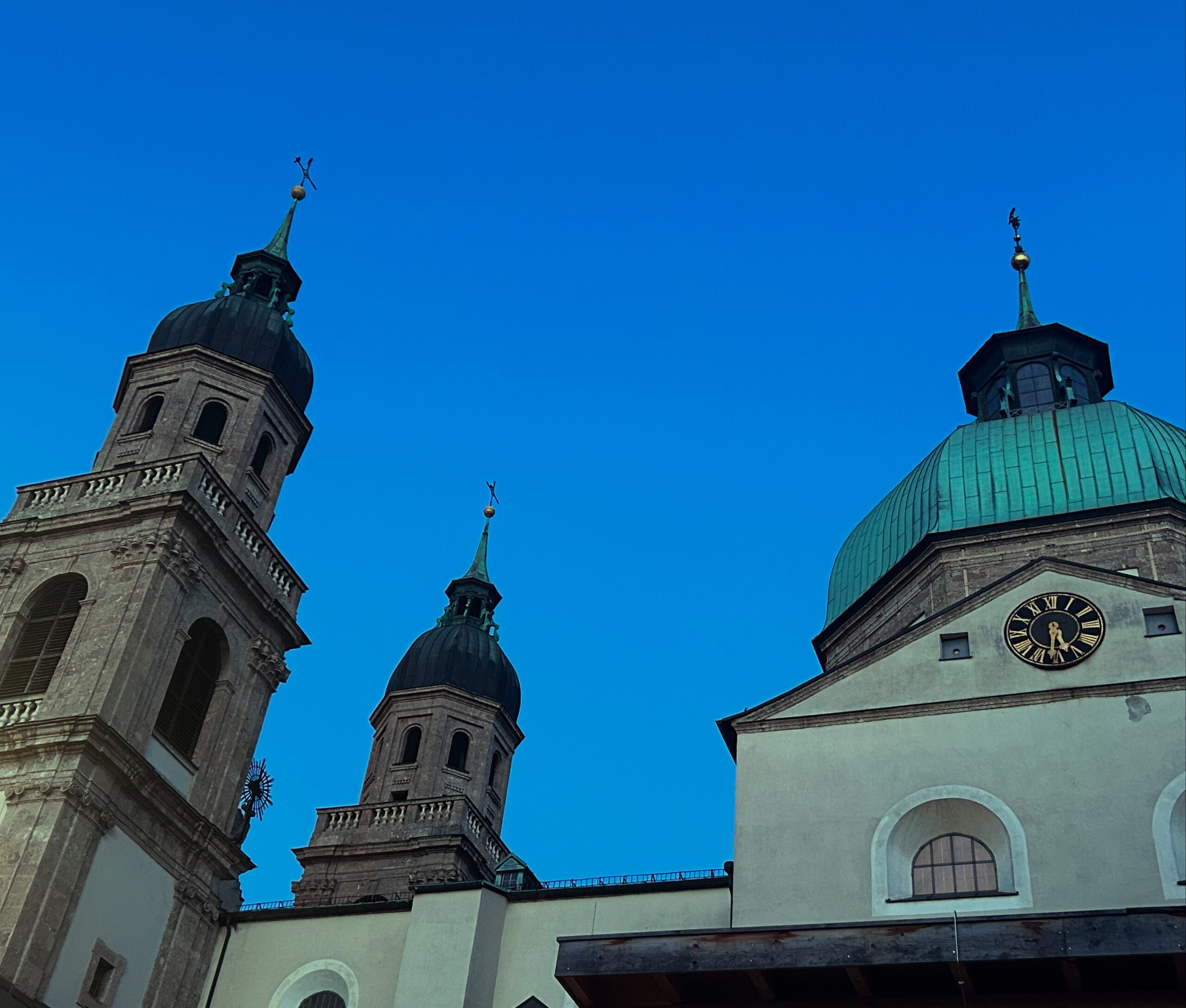
Worth knowing
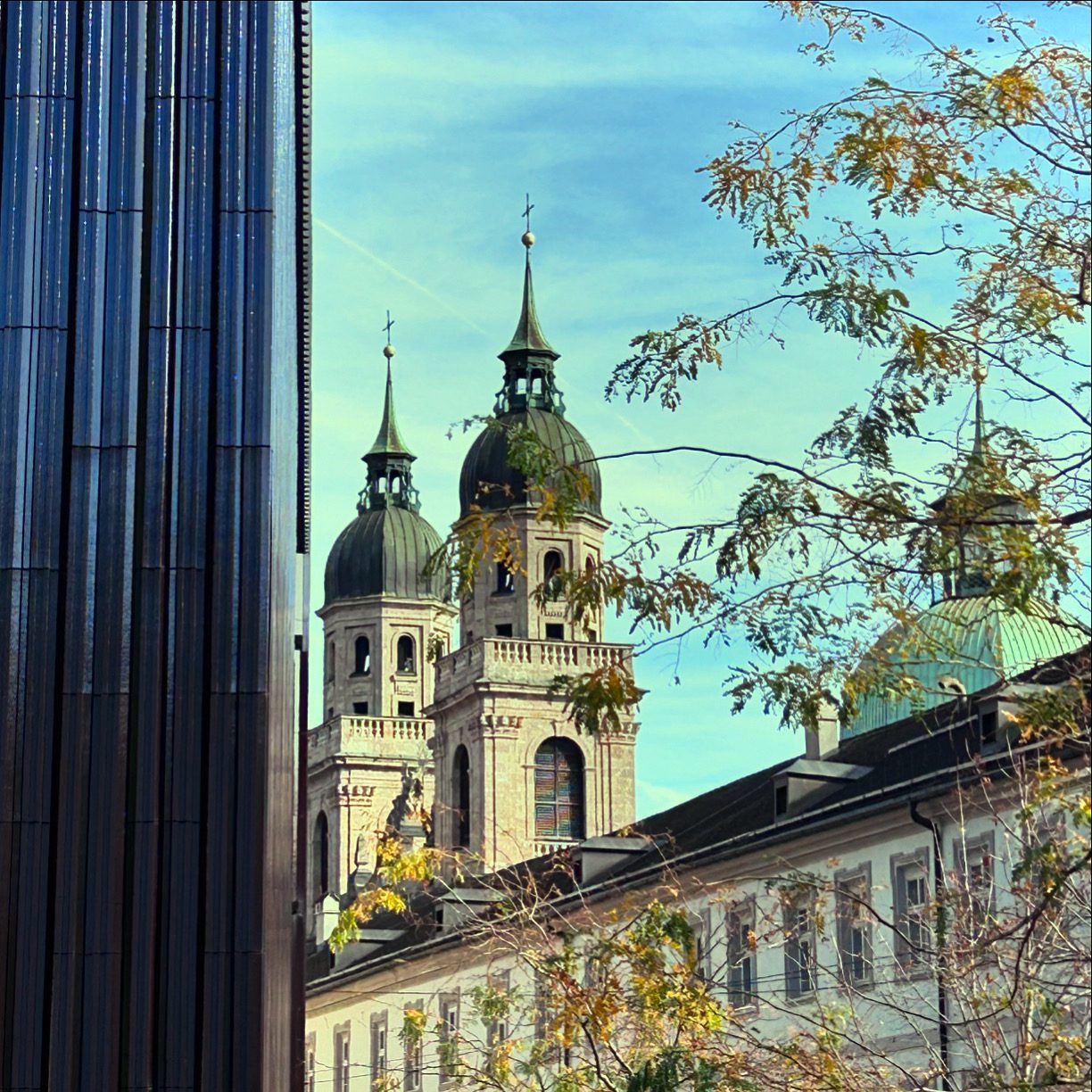
A large area between Sillgasse, Angerzellgasse, and Universitätsstraße is occupied by the building complex consisting of the Faculty of Theology, the Academic Gymnasium, the Palais Pfeifersberg, and the Trinity Church. These buildings still belong to the Jesuits. This order, through its influence at the Habsburg court, shaped society and politics for centuries and was crucial for Innsbruck’s development as a university city. In 1562, the Jesuits moved into the Salvator Chapel to begin teaching at the college. The chapel was part of the Hof- und Kaiserspital founded by Maximilian in 1499 for the poorest segments of the population who could not find space in the city hospital in Neustadt. At Universitätsstraße 4, the year of the college’s founding is still carved in stone within the Austrian coat of arms. Just a few years later, Ferdinand II expanded the small chapel to provide the Jesuits with a more fitting headquarters. His successor, Maximilian III, had the school building constructed. Where eager gymnasium students once came daily under the care of Jesuit fathers for intellectual and spiritual education, today stands the entrance to the university’s theology library. Above the portal, the coats of arms of Tyrol and the double-headed eagle of the Habsburg monarchy are carved in stone beneath the Jesuit emblem, symbolizing the bond between authority and order.
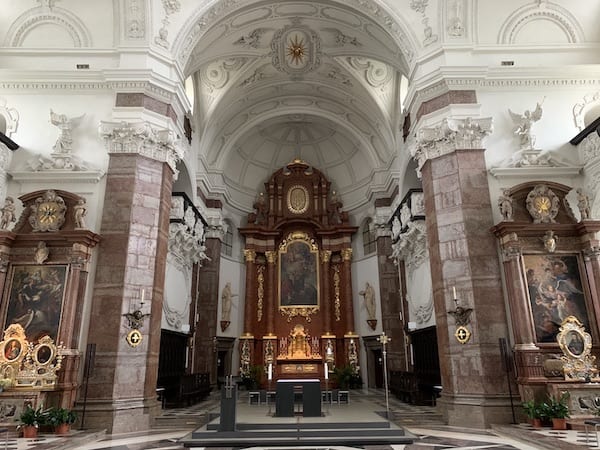
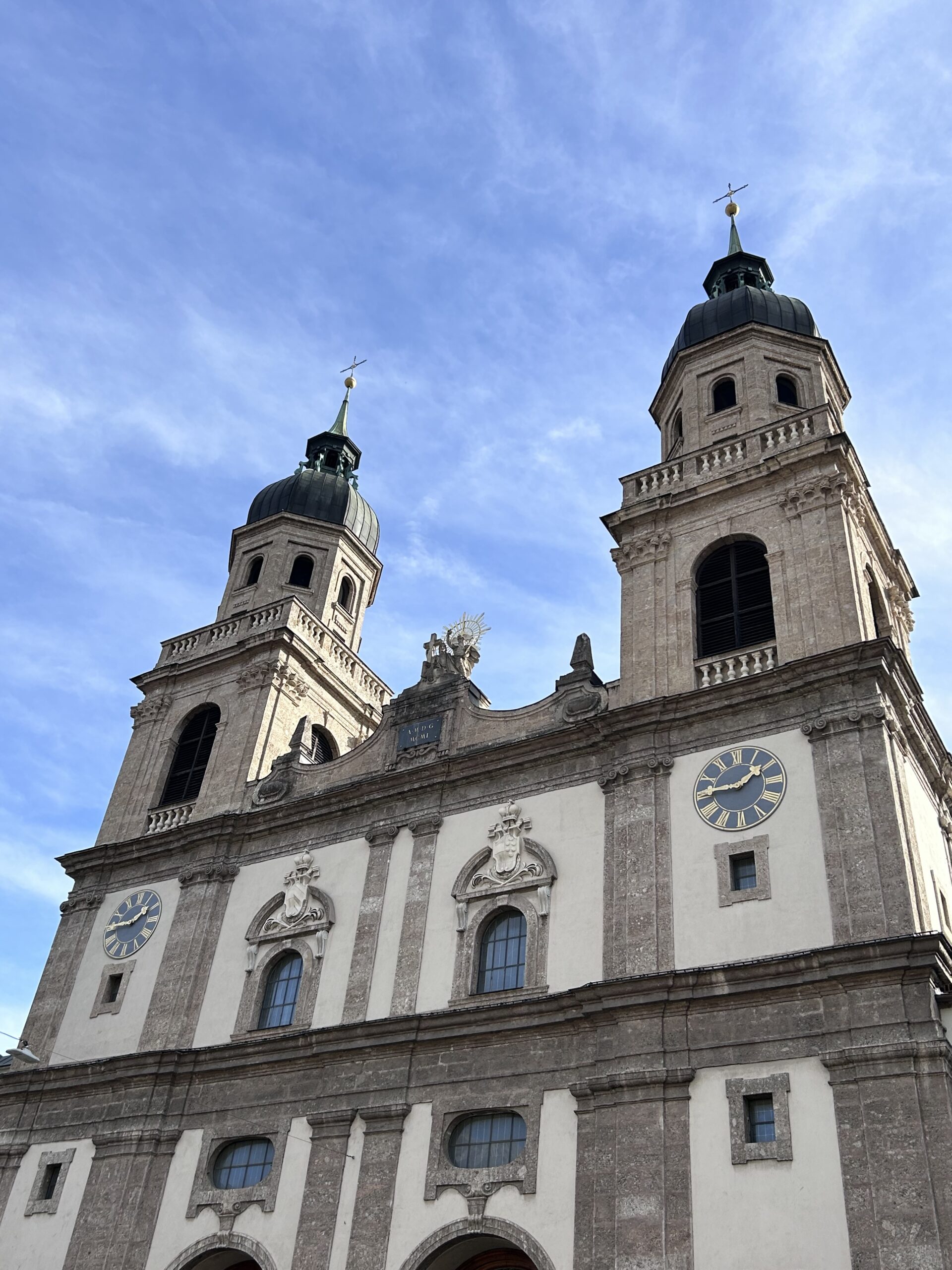
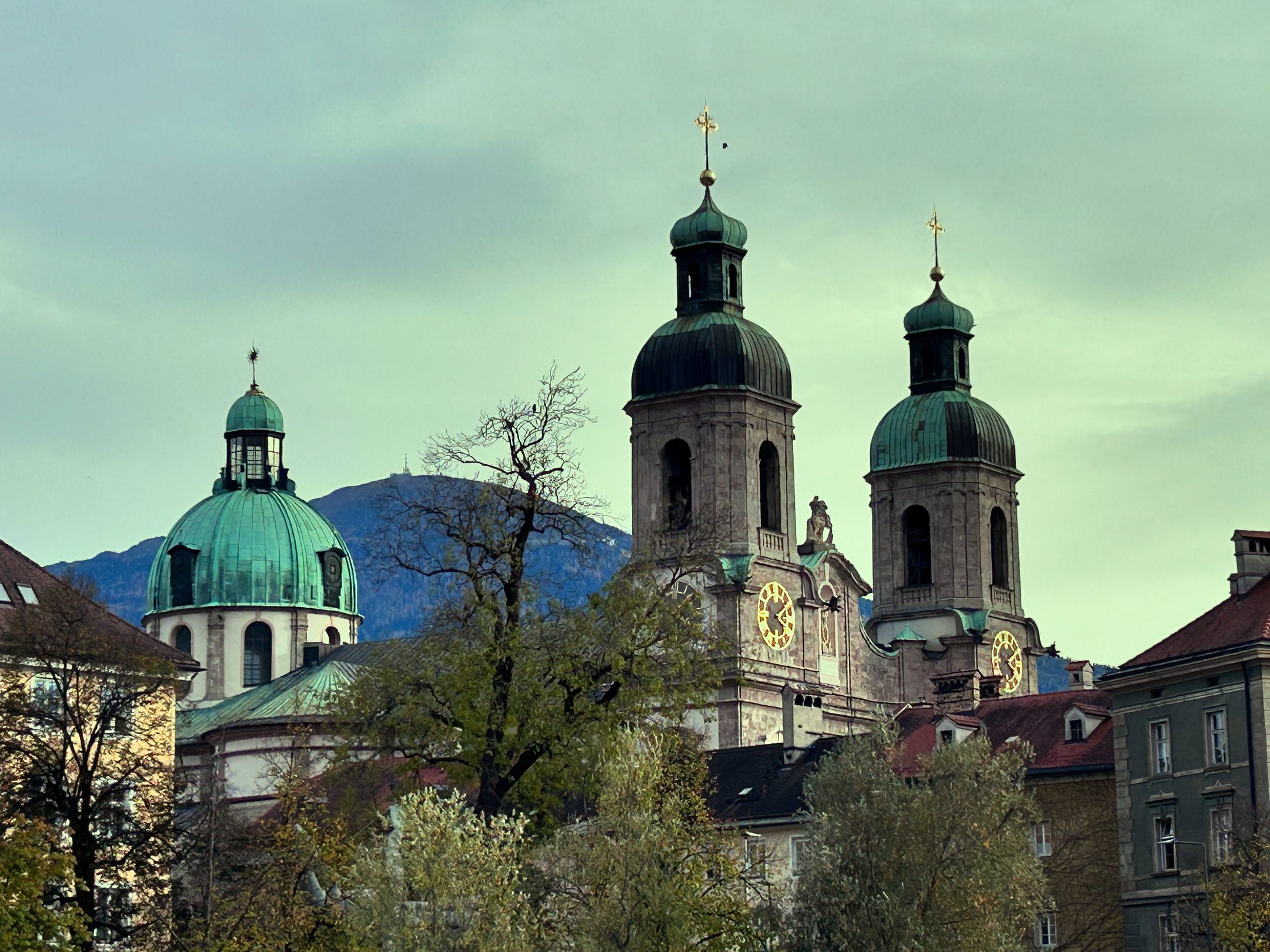
A few months after Maximilian’s death, construction began on the actual Jesuit church at its current location. Laying the foundation stone was one of the first official acts of the new governor and later ruler Leopold V during his first Landtag in Innsbruck. But the new church was ill-fated: after only a few years, it collapsed. Between 1627 and 1633, it was rebuilt with twin towers and a dome despite financial hardship caused by the Thirty Years’ War. Special emphasis was placed on architectural similarity to the Jesuits’ mother church, Il Gesù in Rome. Empty coffers, however, allowed only wooden towers and a sparse interior. The interior was lavishly expanded in the Baroque style in the 18th century. In 1901, a private citizen, Johann von Sieberer, replaced the wooden towers with stone ones.
The underground crypt, freely accessible, is particularly worth seeing. Here lie the tombs of Leopold V and his wife Claudia de Medici. The two rulers, along with their children, are interred in an elaborate monument designed by Christoph Gumpp. The pompous Castrum Doloris—the mourning structure used during Claudia de Medici’s funeral according to Florentine tradition—has unfortunately not survived. The Medici coat of arms on the right entrance portal recalls the origins of the princess. The influential theologian Karl Rahner, after whom the square in front of the church is named, also found his final resting place here.
For a long time, the Jesuit church was the center of spiritual university life, inseparable from academic life. From 1720 onward, university services were held exclusively in the Jesuit church. This privilege repeatedly caused disputes between the diocese and the Jesuits. Students and professors had to swear the Tridentine Profession of Faith before the university chancellor, the bishop’s representative. In this profession, established by Pope Pius after the Council of Trent in 1564, students affirmed their adherence to the Catholic faith. On December 8, all university members had to annually profess belief in the Immaculate Conception of Mary. The refusal of this oath by a handful of Freemasons among the professors at the end of the 18th century caused a major scandal and marked part of the Jesuit-free period in Austrian history. During the brief and mild Enlightenment phase in Innsbruck, the “soldiers of Christ” faced unpleasant times. Under Joseph II, the Jesuits were banned in the Habsburg Empire for a short time, and the Pope suppressed the overly powerful order. This shook Innsbruck’s educational structure considerably. Jesuit property, including the college and university, was broken up. The college fell to the University of Innsbruck, and the Jesuit-run gymnasium had to give up rooms for the library. In 1868, teachers and students moved into the Franciscan monastery next to the Court Church. However, the old building was unsuitable for modern teaching requirements: poor air, little light, sanitary deficiencies, and infrastructural shortcomings did not meet the rising expectations of the bourgeois upper class. Nevertheless, it was not until 1910 that the gymnasium moved into a new building at its current location.
During the conservative restoration under Franz I and Clemens von Metternich, the Jesuits acquired the Palais Pfeifersberg on today’s Sillgasse. The former manor house had been given its present Baroque appearance in 1723 based on plans by Georg Anton Gumpp. Between the Palais and the church lies the Jesuit college with the Ignatius Chapel and the Nikolaihaus. The modern façade above the Baroque portal of the long building was added in 1914. Part of this wing serves as a student residence for theology students. The Jesuit youth center, MK, is located at Sillgasse 8. This entire complex in such an exclusive location in the heart of the city demonstrates both the wealth and the influence that the Church still quietly holds in Austria today.
Petrus Canisius and the Jesuits
Franciscans, Premonstratensians, Carmelites, Servites, Capuchins, Ursulines. Anyone visiting Innsbruck strolls past numerous monasteries—usually without realizing it. Yet the most politically and socially influential order in the city’s history since the sixteenth century was the Jesuits. These “Soldiers of Christ” were founded in 1540 by the Spanish nobleman Ignatius of Loyola (1491–1556). Loyola was a morally rigorous reformer and an influential church politician with access to the highest circles of power of his time. His aim was to reform the Church—not, like Luther, without the Pope as its supreme authority. Nor did he consider dissolving monastic property. Renewal of faith from the top down, rather than the destruction of the existing order, was the guiding principle of the Societas Jesu. The order rapidly gained influence. Its military-inspired organization and structure, the combination of humanist learning with Catholic tradition, its affinity for science and education paired with a form of popular piety imbued with mysticism—all this made the Jesuits attractive to many people who were disillusioned by the moral decay of the late medieval clergy. In these respects, the Jesuits were very much attuned to an era shaped by new political, social, and economic structures. Like the Protestant reformers, they skilfully exploited the new medium of print to disseminate their writings. They represented the confessional continuation of a societal transformation characterized by the growing power of the state, new media, and double-entry bookkeeping. In this environment, spiritual guidance was in high demand. Politically, the Holy Roman Empire in the mid-sixteenth century was steeped in crisis. Italy had been severely affected by the wars between France and the Habsburgs. Major trading houses such as the Fuggers and the Welsers amassed ever greater influence. The German territories were still reeling from the Peasants’ Wars. Inflation posed a serious threat, and the many technological innovations around 1500 inspired fear among broad segments of the population. How, then, could the wrath of God—provoked by the failings of the Renaissance popes—and the looming end of the world be averted, if not through moral reform and a life lived according to the teachings of Christ?
A zealous patron of the Jesuits in Tyrol was the territorial prince and later Emperor Ferdinand I. Like Ignatius of Loyola, he had grown up in Spain. He struggled with German customs, the Reformation movement—unknown in Spain—and even the German language itself. The Tyrolean population, for its part, regarded their sovereign with suspicion, easily mistaking his foreign courtly entourage for an occupying power. A unifying element between these two worlds was the Roman Church, and in particular the modern Jesuit order. Probably the most important Jesuit theologian was Petrus Canisius (1521–1597). Born Peter Kanis into an upper-middle-class household in the Netherlands—his father was mayor of Nijmegen—he was exposed to high politics from an early age and learned courtly manners before studying in Cologne. Canisius became the first member of the order active within the Holy Roman Empire. Intelligent and highly educated, he rose swiftly through the ranks. Ferdinand appointed him to Vienna, where he was tasked with restoring order both as episcopal administrator and at the university. Alongside teaching and research, one of his main duties was to identify and interrogate university members suspected of Protestant sympathies. Canisius also spent several years in Innsbruck. Initially, the Jesuits were supposed to move into the newly completed Court Church (Hofkirche) and assume responsibility for the choral prayers at the tomb of Maximilian I. Canisius, as the highest-ranking representative of the order north of the Alps, politely but firmly declined. In 1563, however, the Emperor succeeded in luring him to the Alps after all. The scholar was needed as an adviser during a dispute with the Pope at the Council of Trent. For Ferdinand, Canisius composed a prayer manual intended to guide the ruler along the right spiritual path. The presence of Petrus Canisius made Innsbruck one of the theological centres of the German‑speaking world in the sixteenth century. In October 1571, he informed the parish of Wilten of the victory of the papal‑imperial fleet over the Ottomans at Lepanto. From the pulpit, Canisius proclaimed the triumph of Christian forces over the looming pagan threat in the greatest naval battle in history, adopting a tone reminiscent of a Catholic news broadcaster. His role as preacher and scholar in the city would be comparable to Albert Einstein holding a teaching post at a university in the 1930s. Canisius himself was deeply impressed by the piety of the Alpine population.
"Tyrol deserves our special attention, because it is even more Catholic than any other region of Germany and has not yet allowed itself to be ensnared by the heretics like the other countries. Even if many places have already been corrupted [...]. Innsbruck is ... the heart and life of the whole country."
Beyond courtly circles, the court preacher also cut a fine figure. While many Innsbruck residents eyed other foreign preachers and advisers at court with suspicion, Canisius was a man of the people. On behalf of his spiritual—and even more so his secular—masters, he travelled across Europe. Like Martin Luther, he “listened to the people’s speech.” Canisius is said to have travelled more than 100,000 kilometres between the Netherlands, Rome, and Poland, usually staying in modest inns. He understood how vital it was to win over the rural population. While his fellow Jesuits evangelised in distant India, he fought Protestantism in the German lands. He recognized that sermons in Latin were ill‑suited to immunise peasants, farmhands, and maids against the threat posed to the Roman Church by Luther’s Protestantism.
The strongest and most enduring pillar in the struggle against the Reformers was education. Canisius regarded many bishops and politicians as corrupt, morally depraved, and sinful. Instead of eliminating them, however, they were to reform themselves under the protective wings of the Soldiers of Christ. By founding new colleges, the Jesuits sought to improve the education of civil servants, the nobility, and the clergy, and to raise moral standards rooted in Christian principles. To this end, they established colleges throughout the Empire. In Protestant regions, German schools, academies, and grammar schools were founded with the aim of enabling as many subjects as possible to read the Bible for themselves in pursuit of piety and salvation. The Jesuits, by contrast, concentrated on educating elites and thus attained lasting influence within the power centres of Catholic states. With his Catechism, Petrus Canisius created a foundational German‑language compendium for the Catholic struggle against the Reformation. Translated into all major European languages, it long served as a guiding text of the Catholic Church. Between 1555 and 1558, three versions of varying complexity were produced for different audiences. Resourceful publishers even created an illustrated catechism for the illiterate. Well into the nineteenth century—and in some regions even beyond the Second World War—the Kanisi, as it was affectionately known, remained the most influential religious‑philosophical work in Tyrol and the foundation of religious instruction in schools. Canisius also made use of the new medium of the pamphlet to reach as wide an audience as possible. Together with those of Luther, his writings were probably the most widely read of the sixteenth century. In Innsbruck, the Jesuits founded the Latin School from which the university later emerged. This new educational institution had a profound impact on urban development, training the intelligentsia that enabled Innsbruck’s rise as an administrative and economic centre. In addition to university chairs, the Jesuits also oversaw the Theresianum. From 1775 to 1848, noble pupils and students housed in the Franciscan monastery were instructed in courtly etiquette and virtuous conduct in preparation for their careers. The Theresian Knightly Academy provided instruction in diplomatic skills such as foreign languages and dance, as well as military disciplines like fencing. Under Joseph II, Jesuit activities were temporarily interrupted. He stripped ecclesiastical orders of power and property, including the Jesuits—an order he personally disliked and which was also banned by the Pope for being too powerful. In 1781, the University of Innsbruck was downgraded to a lyceum. The vacated Jesuit College was used to establish the city’s first botanical garden, which was expanded further after the Theresianum was dissolved in 1808 during Bavarian administration. The Jesuits were recalled to Innsbruck in 1838. In 1910, the garden was relocated to Hötting as part of new school construction.
Through a dense network of influential positions and control over the education system, the order expanded rapidly. Especially during the Counter‑Reformation, the Jesuits succeeded in forging a close alliance with the Habsburg dynasty. The influence of Jesuit education is evident in the governance of many Habsburg rulers. Jesuits such as Bartholomäus Viller and Wilhelm Lamormaini wielded considerable political influence as confessors and advisers in the Early Modern period. It is no coincidence that Jesuits continue to feature as adversaries of Freemasons in countless conspiracy theories and novels, often cast as the modern equivalent of a James Bond villain. At the same time, the Jesuits were remarkably open to research, knowledge accumulation, and education, striving to understand the world as part of Christian creation. To Catholics, this made them a fashionable counterpoint both to traditional, ossified orders and to Protestantism. Faith and empiricism merged into a kind of pre‑modern science seeking to explain nature and physics. The collection of Ferdinand II at Ambras Castle testifies to this spirit of inquiry, as do the alchemical experiments of Emperor Matthias (1557–1619), which now appear rather absurd.
Despite their rational leanings, the Jesuits also re‑introduced mysticism into everyday church life. Passion plays, Holy Sepulchres, processions, and feast days wrapped strict doctrinal principles in spectacle and performance. Work hard – play hard was the motto. Festivities during processions often escalated into exuberant celebrations, not unlike today’s tent festivals, occasionally erupting into brawls and even violent riots. Bread and wine were celebrated in the style of Roman panem et circenses. On behalf of Ferdinand I, Petrus Canisius authored a book promoting a miracle in Seefeld—On the Highly Celebrated Miraculous Sign that Occurred with the Most Holy Sacrament of the Altar at Seefeld in the Princely County of Tyrol in the Year 1384—to stimulate pilgrimage to the site.
The Jesuit order, fully committed to popular belief, was also highly motivated when it came to persecuting witches and people of other faiths. Peter Canisius was one of the masterminds behind the early modern witch hunts:
"Witches are being punished everywhere, and they are multiplying strangely.... They envy children the grace of baptism and deprive them of it. There are large numbers of child murderers among them... Never before in Germany have you seen people so devoted and dedicated to the devil..."
Canisius also attracted attention as an exorcist, particularly in cases involving noblewomen allegedly afflicted by the “virus” of Protestantism. He exploited the public fascination with witches and demoniacs to promote the power and authority of the Catholic Church. At the same time, the Jesuits were highly active in missionary efforts in the then newly discovered New World of the Americas as well as in Asia. Saint Francis Xavier, one of Ignatius of Loyola’s earliest companions, died during a missionary journey in China. An altar dedicated to this Soldier of Christ can be found in a side chapel of the Jesuit Church in Innsbruck.
To this day, the Jesuits continue to exert an educational influence over Innsbruck. When the city was elevated to an independent diocese in 1964 under the Jesuit Paulus Rusch, Petrus Canisius was chosen as its patron saint. Karl‑Rahner‑Platz today is home not only to the Jesuit Church but also to the Faculty of Theology of the University of Innsbruck. In the Saggen district, the Collegium Canisianum remains under Jesuit administration. The principle of broad‑based societal influence aimed at mass audiences has endured on many levels. The Marian Congregation, known in Innsbruck as the MK, was once one of the largest youth centres in Europe and, in a modern sense, stands in the tradition of the Jesuit approach to the gentle introduction into faith and the education of youth within the Church.
The Red Bishop and Innsbruck's moral decay
In the 1950s, Innsbruck began to recover from the crisis and war years of the first half of the 20th century. On May 15, 1955, Chancellor Leopold Figl officially declared a political turning point with his famous words, "*Austria is free*," and the signing of the Austrian State Treaty. During the years that went down in history as the *Wirtschaftswunder* (economic miracle), moderate prosperity established itself in many households. Between 1953 and 1962, an annual economic growth rate of over 6% allowed an increasing portion of the population to dream of exotic luxuries like refrigerators, a private bathroom, or even a vacation in the South. This era brought not only material but also social change. People's desires became more elaborate with rising prosperity and the lifestyle promoted in advertising and media. The phenomenon of a new youth culture began to take root amidst the somber postwar society of small-town Austria. Previously unknown terms like *teenager* and *latchkey kid* (*Schlüsselkind*) entered everyday vocabulary in the 1950s. In 1956, the magazine *BRAVO* launched. For the first time, a media outlet catered directly to the interests of young people. Marilyn Monroe was featured on the first cover, under the headline: "*Did Marilyn's curves get married too?*" The biggest stars of those early years were James Dean and Peter Kraus, before the Beatles took over in the 1960s. After the *Summer of Love*, the advice column "Dr. Sommer" began educating youth on love and sex. The church's all-powerful authority over the moral conduct of adolescents began to crumble, albeit slowly—the first photo love story featuring nudity did not follow until 1982. Up until the 1970s, opportunities for young people in Innsbruck were largely limited to traditional inns (*Wirtshausstuben*), the marksmanship club (*Schützenverein*), and brass bands (*Blasmusik*). Only gradually did bars, discos, nightclubs, pubs, and event venues begin to open. Events like the *5 Uhr Tanztee* (5 o'clock tea dance) at the Sporthotel Igls attracted young singles looking to socialize. *Café Central* became the "second home of long-haired youths," as the *Tiroler Tageszeitung* horrifiedly observed in 1972. Establishments such as the *Falknerkeller* on Gilmstraße, the *Uptown Jazzsalon* in Hötting, the Jazzclub in Hofgasse, the *Clima Club* in Saggen, the *Scotch Club* on Angerzellgasse, and the *Tangente* on Bruneckerstraße had nothing in common with the traditional tavern. The performances by The Rolling Stones and Deep Purple at the Olympiahalle in 1973 marked the temporary peak of Innsbruck's cultural awakening. While this did not turn Innsbruck into London or San Francisco, locals had at least caught a breath of rock 'n' roll. By contrast, what remains anchored in cultural memory as the 1968 revolution barely took place in the "*Heiliges Land*" (Holy Land of Tyrol). Neither workers nor students took to the barricades in large numbers. Though a few radical student groups eventually emerged to protest social injustice, the Vietnam War, and traditional gender roles, there was no comparison to the unrest seen in Prague, Paris, or the distant USA. The historian Fritz Keller famously described Austria's '68 movement as a mere "*Mailüfterl*" (gentle May breeze). Nevertheless, society was undergoing a quiet transformation. A look at the annual music charts offers a clue: While the top 10 in 1964 was still dominated by *Kaplan Alfred Flury* and *Freddy* with "Lass die kleinen Dinge" and "Gib mir dein Wort," alongside the Beatles with their German version of "Komm, gib mir deine Hand," musical tastes were shifting. Although Peter Alexander and Mireille Mathieu could still be found on the charts, from 1967 onward, international acts with foreign-language tracks—such as *The Rolling Stones, Tom Jones, The Monkees, Scott McKenzie, Adriano Celentano*, and *Simon & Garfunkel*—dominated the top spots with increasingly socially critical lyrics.
This change sparked a backlash. The spearhead of the conservative counter-revolution was the Bishop of Innsbruck, Paulus Rusch. Cigarettes, alcohol, overly revealing fashion, trips abroad, working women, nightclubs, premarital sex, the 40-hour workweek, Sunday sports events, dance nights, mixed-gender education and leisure—all of this was deeply abhorrent to the strict clergyman and devoted follower of the Sacred Heart of Jesus cult. Peter Paul Rusch was born in Munich in 1903 and grew up in Vorarlberg as the youngest of three children in an upper-middle-class household. Both of his parents and his older sister died of tuberculosis before he reached adulthood. Forced to fend for himself at the young age of 17 during the lean post-war years, inflation wiped out his father's inheritance—which was meant to finance his university studies—in no time. Rusch worked for six years at the Bank für Tirol und Vorarlberg to fund his theology degree. In 1927, he entered the Collegium Canisianum, and six years later, he was ordained as a priest of the Jesuit order. His meteoric career led the intelligent young man to serve as a chaplain in Lech am Arlberg and Hohenems. He then returned to Innsbruck as head of the partial seminary. In 1938, he became Titular Bishop of Lycopolis and Apostolic Administrator for Tyrol and Vorarlberg—two imaginative titles intended to replace the authority of the bishop in North Tyrol. As the youngest de facto bishop in Europe, he had to endure the harrassment of the National Socialist rulers against the Church. Although his critical stance on National Socialism was well known, Rusch himself was never imprisoned; the authorities feared turning the popular young bishop into a martyr. After the war, the socially and politically active bishop was at the forefront of the reconstruction effort. With hands-on dedication, he sought to strengthen the influence of the Church. His father had worked his way up from carpenter to architect, passing down a passion for construction. Added to this was Rusch's own experience in banking: thanks to his background in the private sector, he recognized the opportunities for the Church to step in and distinguish itself as a helper in times of need. Under Rusch's leadership, the Katholische Jugend (Catholic Youth) volunteered without pay to construct the Heiligjahrsiedlung (Holy Year Settlement) in Höttinger Au. The diocese purchased the plot of land from the Ursuline Order, and interest-free loans were advanced to the settlers by the Church. His pragmatic, hands-on approach to the housing shortage earned him the nickname the "Red Bishop." In these modest houses with self-sufficiency gardens—built according to the vision of the dogmatic and frugal "worker's bishop"—41 families, with preference given to those with many children, found a new home. Alleviating the housing shortage was meant to keep the greatest threats of the Cold War away from his congregation. Both the state-mandated atheism of communism and the consumer-driven capitalism spilling over from the US into Western Europe were anathema to him. In 1953, Rusch published his book "Junger Arbeiter, wohin?" ("Young Worker, Whither Bound?"). What sounded like revolutionary, left-wing literature was actually an exposition of Christian Social Teaching, which condemned both capitalism and socialism. Families were expected to live modestly, managing in Christian harmony on the moderate income of a single breadwinning father. Employers, employees, and laborers were to form a peaceful unit—cooperation instead of class struggle, laying the groundwork for today's social partnership. Everyone had their place in a Christian sense: a sort of modern feudal system, which had already been envisioned for implementation under Dollfuss's Austrofascist Corporate State (Ständestaat). He shared his political views with State Governor Eduard Wallnöfer and Mayor Alois Lugger, who together with the bishop formed the "Holy Trinity" of conservative Tyrol during the economic miracle era. To this, Rusch added a latent Catholic antisemitism that remained widespread in Tyrol even after 1945, enduring as a supposed tradition through aberrations like the veneration of Anderle von Rinn.
Besondere Anliegen waren dem streitbaren Jesuiten Erziehung und Bildung. Die gesellschaftliche Formung quer durch alle Klassen durch die Soldaten Christi konnte in Innsbruck auf eine lange Tradition zurückblicken. Der Jesuitenpater und vormalige Gefängnisseelsorger Alois Mathiowitz (1853 – 1922) gründete 1909 in Pradl den Peter-Mayr-Bund. His approach was to put young people on the right path through leisure activities and sport and adults from working-class backgrounds through lectures and popular education. The workers' youth centre in Reichenauerstraße, which was built under his aegis, still serves as a youth centre and kindergarten today. Rusch also had experience with young people. In 1936, he was elected regional field master of the scouts in Vorarlberg. Despite a speech impediment, he was a charismatic guy and extremely popular with his young colleagues and teenagers. In his opinion, only a sound education under the wing of the church according to the Christian model could save the salvation of young people. In order to give young people a perspective and steer them in an orderly direction with a home and family, the Youth building society savings strengthened. In the parishes, kindergartens, youth centres and educational institutions such as the House of encounter am Rennweg errichtet, um von Anfang an die Erziehung in kirchlicher Hand zu haben. Der allergrößte Teil des sozialen Lebens der Stadtjugend spielte sich nicht in verruchten Spelunken ab. Den meisten Jugendlichen fehlte schlicht und ergreifend das Geld, um regelmäßig in Lokalen zu verkehren. Viele fanden ihren Platz in den halbwegs geordneten Bahnen der katholischen Jugendorganisationen.
Hier ist die Übersetzung des letzten Teils: Rusch failed to foresee that the clergy itself was changing with the times. Alongside the conservative bishop, a generation of liberal clerics was emerging and immersing themselves in youth work. In the 1960s and 70s, two church youth movements wielded immense influence in Innsbruck. Responsible for this were Sigmund Kripp and Meinrad Schumacher, who won over teenagers and young adults through new pedagogical approaches and a more open handling of sensitive topics like sexuality and substances. In Innsbruck, the Marianische Kongregation (Marian Congregation)—known to this day as the MK—had been shaping the minds of the elite according to the principles of the Jesuit Order since 1578. This youth organization catered to high school students (Gymnasiasten). The MK was strictly hierarchical, designed to teach young "Soldiers of Christ" obedience from the outset. In 1959, Father Sigmund Kripp took over the leadership of the organization. Under his direction—and supported by financial contributions from the Church, the state, parents, and substantial volunteer labor—the youth built projects such as the Mittergrathütte along with its own material ropeway in Kühtai, as well as the legendary youth center Kennedyhaus on Sillgasse. Federal Chancellor Klaus and members of the US Embassy attended the cornerstone laying of this youth center—which would become the largest of its kind in Europe with nearly 1,500 members—as the building was dedicated to the first Catholic, recently assassinated President of the United States. Innsbruck's second church youth organization was Z6. City youth chaplain Father Meinrad Schumacher took care of all those young people who had no place in the MK or the Katholische Hochschülerschaft (Catholic Students' Association) through the Aktion 4-5-6. Working-class children and apprentices met in various youth centers in Pradl or Reichenau until a new center opened in 1971 at its namesake Zollerstraße 6, also built by the members themselves. Josef Windischer took over as director. Z6 had much more in common with what Denis Hopper and Peter Fonda displayed on movie screens riding their motorcycles in Easy Rider. Things were rougher here than in the MK. Rocker gangs, petty criminals, and drug addicts also spent their free time at Z6. While Schumacher ran his program with the "well-behaved" youth upstairs, Windischer populated the basement with the "outsiders" to support these lost sheep as best as possible. By the late 1960s, both the MK and Z6 decided to open their doors to non-members. Girls' and boys' groups were partially merged, and non-members were admitted. Although the two youth centers targeted different demographics, their overall concept was identical: theological knowledge and Christian morality were imparted in a playful, age-appropriate environment. Sections dedicated to chess, soccer, hockey, basketball, music, movies, and a party cellar addressed young people's desires for play, sports, and destigmatizing their first sexual experiences. The youth centers offered a space where adolescents of both genders could mingle. However, the MK in particular remained an institution that had little to do with the wild lifestyle of the 1968 movement as commonly portrayed in films. For instance, dance classes were not held during Advent, Carnival, or on Saturdays, and they remained forbidden fruit for anyone under 17. Nonetheless, the youth centers went too far for Bishop Rusch. The critical articles in the MK magazine Wir diskutieren ("We Discuss")—which reached a circulation of over 2,000 copies—increasingly met with his displeasure. Solidarity with Vietnam was one thing, but criticism of the Schützen (traditional Tyrolean marksmanship guilds) and the Austrian Armed Forces (Bundesheer) could not be tolerated. After years of disputes between the bishop and the youth center, the showdown arrived in 1973. When Father Kripp published his book Abschied von morgen ("Farewell to Tomorrow"), detailing his pedagogical concept and work in the MK, closed-door proceedings were launched against the head of the youth center within the diocese and the Jesuit Order. Despite massive protests from parents and members, Kripp was removed from his post. Neither inner-church intervention by the prominent theologian Karl Rahner, nor a petition initiated by artist Paul Flora, nor regional and national outrage in the press could save the overly liberal priest from the wrath of Rusch—who even secured the papal blessing from Rome for Kripp's dismissal. In July 1974, Z6 also came to a temporary end. Articles about the birth control pill and the Z6 newspaper's criticism of the Catholic Church were too much for the strict bishop. Rusch simply had the locks to the youth center changed—a method he had previously used against the Katholische Hochschülerschaft when it drifted too close to a left-wing activist group. On August 1, 1974, the Tiroler Tageszeitung noted in an article on the matter:
"In recent weeks, there had been profound disputes between the educators and the bishop over fundamental issues. According to the bishop, the views expressed in "Z 6" were "no longer in line with church teaching". For example, the leadership of the centre granted young people absolute freedom of conscience without simultaneously recognising objective norms and also permitted sexual relations before marriage."
It was his adherence to conservative values and his stubbornness that damaged Rusch's reputation during the last 20 years of his life. When he was consecrated as the first bishop of the newly founded Diocese of Innsbruck in 1964, times were changing. The progressive clergyman with practical life experience of the past was overtaken by the modern lifestyle of a new generation and the demands of an establishing consumer society. The bishop's constant criticism of his flock's lifestyle and his stubborn refusal to abandon his overly conservative values—paired with occasionally bizarre statements—transformed the young, hands-on bishop of the reconstruction era into a reason for many Tyroleans to leave the Catholic Church. His concept of repentance and penance produced surreal results. For instance, while he demanded admissions of guilt and atonement for transgressions during the Nazi era, he simultaneously criticized the denazification laws as too far-reaching and severe. Responding to changing sexual norms and the abortion law reforms under Chancellor Kreisky, he claimed that girls and young women who engaged in premature sexual relations were up to twelve times more likely to suffer from cancers of the reproductive organs. Rusch referred to Hamburg as a "den of sin" (Sündenbabel) and suggested that the simple minds of the Tyrolean population were ill-equipped to handle phenomena like tourism and nightlife, which lured them into immoral behavior. He feared that technology and progress would make people far too independent of God. He was adamantly opposed to the new trend of dual-income households: individuals were expected to be content with a modest "spiritual single-family home" complete with a vegetable garden rather than striving for more, while women were expected to dedicate themselves strictly to their traditional role as housewives and mothers.
In 1973, after 35 years at the head of the church community of Tyrol and Innsbruck, Bishop Rusch was named an honorary citizen of the City of Innsbruck. He resigned from his office in 1981. In 1986, Innsbruck's first bishop was laid to rest in St. James' Cathedral (Dom St. Jakob). The Bischof-Paulus-Studentenheim (Bishop Paulus Student Residence), located near the Petrus Canisius Church built under his leadership in Höttinger Au, serves as a reminder of his legacy. Following its closure in 1974, the Z6 youth center relocated to Andreas-Hofer-Straße 11 before finding its current home on Dreiheiligenstraße, right in the heart of the early modern working-class district opposite the Plague Church (Pestkirche). After his involvement in social projects in Brazil, Jussuf Windischer remained in Innsbruck. The father of four continued to work with marginalized social groups, served as a lecturer at the Social Academy, worked as a prison chaplain, and headed the Caritas Integration House in Innsbruck. The MK also continues to exist today, even though the Kennedyhaus—which was renamed Sigmund-Kripp-Haus by its members immediately following Kripp's departure—no longer exists. In 2005, Kripp was named an honorary citizen of the City of Innsbruck by his former sodalis and later vice mayor—just like Bishop Rusch before him.
University City of Innsbruck
1669 is considered the official founding year of one of the most important institutions in Innsbruck's city history. On 15 October, Emperor Leopold I granted the Tyroleans the privilege of „Haller Salzaufschlags“. Diese Steuer auf die begehrte Handelsware aus der hauseigenen Saline machte es möglich, eine Universität zu finanzieren. Die Basis für eine Hochschule war zu diesem Zeitpunkt bereits gelegt. Die Universität ging aus der Lateinschule hervor, die von den Jesuiten etwas mehr als hundert Jahre zuvor unter Ferdinand I. gegründet worden war. Der Schwerpunkt am Gymnasium lag auf der klassischen humanistischen Bildung. Latein und Griechisch waren notwendige Schwerpunkte im Unterricht, um dem intellektuellen und politischen Diskurs folgen zu können. Wissenschaftliche Bücher und viele andere Schriftstücke wurden in der Frühen Neuzeit noch immer auf Latein verfasst. Auch für höhere Posten im öffentlichen Dienst war Latein Voraussetzung. Die Universität brachte neue Ausbildungsmöglichkeiten nach Innsbruck. Die erste Fakultät, die den Lehrbetrieb aufnahm, war die Philosophie. Theologie, Recht und Medizin folgten kurz darauf. Als Papst Innozenz XI. der Universität 1677 seinen Segen gab, war der Betrieb schon voll angelaufen. Professoren und Studenten verschiedenster Nationalität tummelten sich in Innsbruck. Der Jesuitenorden war mit mehreren Lehrstühlen vertreten, andere Professoren wurden von der Diözese Brixen bestellt. Das führte zu Spannungen innerhalb der Universität, vertraten doch die Jesuiten vor allem die Interessen des Landesfürsten und Monarchen, während die Professoren der Diözese die politischen Interessen des Bischofs wahren wollten. Von einer Trennung von Staat, Kirche und Wissenschaft war man in dieser frühen Phase der Aufklärung noch weit entfernt. Dabei ging es um Posten, Macht, Geld und Einfluss, nicht nur innerhalb der Stadt.
A university degree usually took seven years before the graduate was permitted to slip a ring onto his finger as a symbol of his doctoral status. During the first two years, every student had to dedicate himself to philosophy before selecting a specialized field. In addition to humanities coursework, church services, theatrical performances, music-making, and practical pursuits like fencing and horseback riding were integral components of an educated young man's life. The university, however, was far more than an educational institution. In 1665, Innsbruck lost its status as a residence city, relinquishing much of its prestige and splendor. The university's presence offset this downgrade to some extent, ensuring that the aristocracy remained present in the city, at least in the form of students. Students and professors reshaped the city's social fabric. In the first decade following its founding, roughly 50 different men from all corners of the world taught philosophy in Innsbruck to a student body of over 300. These intellectuals were a remarkable group. Internally, they organized themselves into Landsmannschaften—fraternities based on nationality or language group. Every Landsmannschaft with sufficient members had its own distinct attire, badges, and insignia, and maintained its own unique traditions. At public and social occasions such as processions, delegations like the Congregation of the Blessed Virgin, drawn from the Jesuit-influenced university, stood out prominently. Professors made a habit of appearing in velvet gowns, color-coded according to their respective faculties. Carrying a sword, the gladius deambulatoris, was granted to students upon completing their first year at the university. Unlike the strictly and demurely dressed locals of Innsbruck, these young men of privileged backgrounds made colorful, flamboyant appearances reminiscent of medieval dandies. They conversed in a jargon that sounded strange and unintelligible to outsiders, while official matters were conducted entirely in Latin.
The strictly supervised daily life of students in the assembly hall and lecture halls was lightened by booze-filled evening entertainment, excursions into the countryside surrounding Innsbruck, music-making, church processions, and theatrical performances. Time and again, friction arose between ordinary citizens and members of the university. Despite their social standing, students were frequently far from diligent model pupils; rather, they were young men accustomed to a certain lifestyle and status. To keep them under control, a dedicated legal system was required. Students were subject to university law, which was entirely separate from municipal law. The university itself could impose imprisonment, fines, and even banishment from the territory. Only cases involving capital punishment required appealing to the regional government. For instance, students were officially forbidden from drinking to excess. If this occurred in one of Innsbruck's taverns anyway, the young offender received an admonition. Should he be unable or unwilling to settle his bill, the aggrieved innkeeper could not file a formal complaint with the courts, as serving excessive amounts of alcohol to the student body was prohibited. Insults to honor within university circles could lead to duels, much like in the military. Especially when combined with alcohol, riots and disturbances were not uncommon. Thus, in January 1674, "not only were nuisances, rumors, and absurd acts committed at night," but "students of the university were apprehended carrying all kinds of forbidden weapons such as matchlocks, pistols, pocket pistols, stilettos, sabers, and knives..." To enforce the law, the university rectorate maintained its own force. The Scharwache (watchmen) was armed with halberds and tasked with preventing student disturbances as effectively as possible. Six armed men were on duty day and night to maintain order. There was even a dedicated university prison (Carcer) to detain wrongdoers on bread and water. The costs for this were split between the city of Innsbruck and the university.
The university has always served as a political focal point and a reflection of the prevailing zeitgeist. Since the mid-18th century, its primary purpose was to train loyal, Catholic civil servants for the state. The name Leopold-Franzens-Universität traces back to the two emperors, Leopold I and Francis I, under whom it was originally founded and re-established, respectively. On two separate occasions, the university was downgraded to a lyceum or abolished entirely. Emperor Joseph II closed the gates of the Jesuit-influenced educational institution, as did the Bavarian administration during the Napoleonic Wars. Emperor Francis I, who pivoted back to the traditionally Catholic line of the Habsburgs during the Restoration, re-founded the institution in 1826. However, the university remained under close surveillance during Metternich's police state, as authorities feared nationalistic and liberal students who were beginning to form fraternities. Secret state police operated in lecture halls and student circles alike to nip the problematic ideas of young agitators in the bud as early as possible. Industrialization and its accompanying economic, political, and societal demands on education reshaped university life. Reflecting the spirit of the era, the inaugural address by the Dean of the Faculty of Philosophy, Prof. Dr. Joachim Suppan (1794–1864), addressed a practical physics problem aimed at achieving "a more precise knowledge of the so important and useful invention of the steam engine, also for domestic industry, where it has so far found no application." The fact that Suppan was an ordained priest alongside his degrees in philosophy and mathematics highlights the continuing influence of the Church on education during the 19th century. Suppan's closing admonition to the students—urging them "to one day render fruitful services to the fatherland through knowledge and virtue"—underscores how closely bound the university remained to state authority alongside ecclesiastical power. The nationalistic conflicts of the late monarchy were similarly mirrored in the university's history. Academic life in the late 19th century was defined by competing student corps, Burschenschaften, and fraternities. Students and professors grew increasingly radicalized, leading to recurring clashes between different factions and changing alliances. The only issues on which liberals, conservatives, and Pan-German nationalists could consistently agree were antisemitism and a shared hostility toward Italians. The interwar period brought a continuation of these old conflicts. Many students and faculty members had served in the First World War and were accustomed to resolving disputes through force. The apparatus of the Corporate State (Ständestaat) in the 1930s drew its ranks from Catholic fraternities, whereas Pan-German Burschenschaften served as a major pillar for National Socialism. The democratic Republic of Austria and the broader emancipation that accompanied it held little appeal for the traditionally elitist academics on both sides. Young men suddenly no longer had academia to themselves. While women and the sons of working-class artisan families had long been barred from university studies, it now became theoretically possible to advance socially through higher education. The university celebrated its first female Doctor of Law five years after the founding of the Republic. The press noted:
“This coming Saturday, Miss Mitzi Fischer will be awarded the degree of Doctor of Law at the University of Innsbruck. Miss Fischer is a native of Vienna. She also completed her secondary education in Vienna. After her matriculation examination, she pursued the study of law at the University of Innsbruck. The future doctor passed all examinations with distinction and would therefore, according to former custom, have to be promoted sub auspiciis imperatoris. In any case, Miss Fischer is the first woman to earn the doctoral degree in law at the University of Innsbruck.”
With the annexation to the German Reich in 1938, the university was renamed once again. After the war, the Deutsche Alpenuniversität reverted back to Leopold-Franzens-Universität. Surprisingly quiet, much like in 1848, were the students in Innsbruck during the year 1968. While students were the drivers of change in other European cities, Innsbruck remained calm. In Paris, cobblestones flew; in Innsbruck, people settled for boycotts and sit-ins. Although there were individual groups in the late 1960s and 1970s such as the Kommunistische Gruppe Innsbruck, the Committee for Solidarity with Vietnam, the socialist VSStÖ, or the liberal-Catholic Aktion within the ÖH (Austrian Students' Association), no mass movement materialized. The vast majority of students came from the upper class and had completed their Matura at a Catholic-oriented grammar school. Beethoven's old adage that "as long as the Austrian still has brown beer and sausages, he does not revolt" proved true. Only a few students could summon enthusiasm for solidarity with Vietnam, Mao Zedong, or Fidel Castro. Who wanted to risk their own career in a region dominated by the holy trinity of the Tiroler Tageszeitung, Bishop Paulus Rusch, and the regional parliament (Landtag) with an absolute majority held by the ÖVP? Anyone who dared to distribute rebellious flyers or leftist literature anyway had to expect media defamation, a reprimand from the rectorate, or even a visit from state authorities. The professors—who in the 20th century often still exuded the detachment and aloof aura of the Early Modern era or made little secret of their political leanings—were rarely criticized. Rather, criticism was directed at the inadequate equipment of the modest lecture halls for the ever-increasing number of students. The major transformation in universities was not fought for in Austria, but voted for. Under Chancellor Bruno Kreisky, tuition fees were abolished. Education became affordable and conceivable for a larger number of young people. As a result, the number of students at Austrian universities rose from 50,000 to over 73,000 between 1968 and 1974.
Despite all adversities and curiosities over the centuries, the University of Innsbruck has, since its earliest days, generally enjoyed an excellent reputation. In the 20th and 21st centuries, faculty and students repeatedly achieved internationally acclaimed research results. Victor Franz Hess was awarded the Nobel Prize in Physics for his work on cosmic radiation. Quantum physicist Anton Zeilinger was also associated with the University of Innsbruck, though not at the time of his award in 2022. Professors Fritz Pregl, Adolf Windaus, and Hans Fischer likewise received the Nobel Prize in Chemistry, though none of them were active in Innsbruck at the time. The university hospital has likewise delivered outstanding achievements in both research and education, as well as in the daily medical care of the city, and is considered one of Innsbruck’s flagship institutions. The university is of great importance to the city not only intellectually and economically. Around 30,000 students populate and shape life between the Nordkette mountain range and the Patscherkofel.
Johann von Sieberer: Innsbruck's good spirit
Whereas in the Middle Ages and early modern times it was primarily the church and the aristocracy that were responsible for the development of infrastructure and buildings in public spaces, in the 18th and 19th centuries members of the wealthy middle classes set out to shape the cityscape with their projects. The political upheavals of 1848 and 1867 had reshuffled the cards. The petty nobility and clergy had lost their wealth, power and social influence. They were replaced by the upper middle classes, which in Innsbruck consisted of wealthy merchants, restaurateurs, hoteliers and industrialists. Men such as the brewer, castle and pub owner Robert Nißl, Alois Epp, Leonhard Lang and Josef Kiebach donated parts of their fortunes and became involved in organisations to keep the infrastructure and social life going. Their ascents bear witness to the fact that in the second half of the 19th century, it was possible to rise through the ranks through skill, hard work and a little luck like never before. Lang had risen from the son of a blacksmith from Mühlau to become a paper manufacturer and trader through skilful management. The industrialist, after whom Langstrasse in Pradl is named, had founded the Hotel Österreichischer Hof purchased. In addition to his foundation, he was also involved in the Folk Art Museum, the Ferdinandeum and enabled the city of Innsbruck to build the New Town Hall in Maria-Theresienstraße. Kiebach (1828 - 1875) was the son of a master locksmith. Kiebach inherited from both his father and his uncle and, after his death, bequeathed a large part of his fortune to run the poor relief fund in the difficult years following the economic crisis of 1873. The best-known member of this new class of successful entrepreneurs in Innsbruck, who is still most visible in the Innsbruck cityscape today, was Baron Johann von Sieberer.
Johann Sieberer was born in Going near Kitzbühel in 1830 as an illegitimate child. The Bishop of Salzburg liked to spend his days off in the Tyrolean mountains. The school system in the Tyrolean lowlands was also administered by the diocese of Salzburg at the time. During a visit to the local primary school, he noticed a particularly keen boy. In 1840, at the behest of the bishop, Sieberer was appointed to the Borromeo in Salzburg as a choirboy. The Archbishop of Salzburg recognised his outstanding talent early on and allowed the boy to attend the Franciscan grammar school in Hall in Tyrol. After leaving school, he studied law in Vienna before entering the service of the family of the Bishop of Salzburg, the Princes of Schwarzenberg. This family was one of the most influential in the Austrian aristocracy. Archduke Albrecht, in whose service Sieberer was, was the founder of the Viennese art collection Albertina. Sieberer worked in the administration of the family's industrial plants and got to know many members of the aristocracy and moneyed gentry of the K&K monarchy while travelling through the monarchy. When, through Albrecht's mediation, he worked from 1860 for the Insurance company Österreichischer Phönix he was able to turn these contacts into money. He amassed a large fortune by selling high policies to members of the Habsburg family and other aristocrats. He acquired his private villa in Meidling near Vienna and invested his money in apartment blocks in the capital.
Johann von Sieberer is best known for his generous foundations in Innsbruck. With the social changes of the 19th century, the traditional extended family began to lose its role as the first port of call in times of need in urban areas. Although the state had increasingly taken over welfare from the church since Maria Theresa and outsourced it to the local authorities, there was often a lack of funds. Sieberer, a devout Catholic in Innsbruck, filled this gap as a kind of patriotic patron in the spirit of Christian charity.
From 1885 until his death in 1914, Sieberer was a benefactor to the Tyrolean capital. The orphanage and a fund to run it, as well as the Franz Joseph Jubilee Travellers' Asylum, can be traced back to the philanthropist Sieberer's donations. He also contributed to the remodelling of the Jesuit church. Unfortunately, only archive photos show the magnificent Unification fountainwhich was erected in 1906 on the then still ostentatious station square in the style of historicism and had to make way for the new transport concept in 1940.
The orphanage and the Kaiser-Franz-Josef-Greisenasyl were infrastructure that could not be financed by the city due to the tight financial situation. Sieberer felt he belonged to what Max Weber called the Protestant work ethic, but imitated the conservative aristocratic circles in which he had been socialised. The individual, virtuous citizen was to serve as an example to the collective. His two building projects were statements and expressions of a new bourgeois self-image. It is interesting to note that Sieberer, unlike monarchs and princes of the past, did not allow himself to be staged by name on his projects.
In 1909, Sieberer was made an honorary citizen of Innsbruck by Mayor Wilhelm Greil, and in 1910 he was made a baron by the Emperor. In Innsbruck, Siebererstraße in the Saggen district commemorates this great Innsbrucker. A memorial in honour of Sieberer was planned during his lifetime. The First World War and the political and financial problems that followed prevented its erection.
Leopold V & Claudia de Medici: Glamour and splendour in Innsbruck
While the Thirty Years’ War was ravaging half of Europe, a charismatic princely couple set out to reshape the face of Innsbruck forever in the Baroque manner. The Habsburg who entered the history of the land as Leopold V (1586–1632) assumed sovereign governmental responsibilities in the Upper Austrian regency of Tyrol and the Further Austrian territories after turbulent early years. Unlike many firstborn members of his rank, his career had long appeared uncertain. In his youth he received the classical humanist education customary for young aristocrats, under the guidance of the Jesuits. In Graz and Judenburg he studied philosophy and theology in preparation for a career within the ecclesiastical sphere of power—an established path for younger sons with little prospect of secular thrones. Leopold’s early career within the power structures of the Church epitomised precisely those features of Catholicism rejected by Protestants and Church reformers. At the age of twelve he was elected Bishop of Passau; at thirteen he was appointed coadjutor of the Bishopric of Strasbourg in Lorraine. He never, however, received holy orders; the spiritual duties were carried out by a prince‑bishop appointed for that purpose. A passionate politician, Leopold travelled extensively between his dioceses and supported the imperial side during the conflict between Rudolf II and Matthias—later immortalised by Franz Grillparzer in Bruderzwist im Hause Habsburg. These activities, scarcely befitting a churchman, nonetheless preserved Leopold’s chances of attaining a secular princely title.
That opportunity arose in 1618, when the unmarried Maximilian III died childless. At the behest of his brother, Leopold assumed the role of Habsburg governor and ruler of the Upper and Further Austrian lands and their incorporated peoples and territories. In the early years of his regency he continued to shuttle between his bishoprics in southern and western Germany, threatened by the upheavals of the Thirty Years’ War. Although the ambitious power politician found satisfaction in the excitement of high politics, the status of governor did not suffice. He sought recognition as territorial prince, complete with homage and dynastic inheritance. What he lacked were a suitable bride, time, and money. Costly conflicts had depleted his coffers.
Money arrived with the bride—and with her, time. Claudia de’ Medici (1604–1648), from the wealthy Tuscan merchant‑princely dynasty, was selected to bestow dynastic fortune upon the aspiring territorial prince, now approaching forty. As a child, Claudia had already been promised to the Duke of Urbino, whom she married at seventeen, despite a proposal from Emperor Ferdinand II. Her husband died after only two years of marriage. The ties between the Medici and the Habsburgs remained intact. Since the marriage of Francesco de’ Medici to Johanna of Habsburg, a daughter of Ferdinand I, the two dynasties had been closely interwoven. Leopold and Claudia likewise proved a perfect match of title, power, Baroque piety, and wealth. Leopold’s sister Maria Magdalena, who as a Medici bride had become Grand Duchess of Tuscany, resided in Florence and sent her brother a painted portrait of the young widow, remarking that she was “beautiful in face, body, and virtue.” After a delicate dance of mutual conditions—the bride’s family seeking assurance of the groom’s title, while the Emperor required proof of a suitable marriage before granting the ducal dignity—the moment finally arrived. In 1625 Leopold, now raised to duke and well nourished and mature in years, relinquished his ecclesiastical possessions and titles in order to marry and, together with his nearly twenty‑years‑younger bride, found a new Tyrolean line of the House of Habsburg.
The relationship between the prince and the Italian woman was to characterise Innsbruck. The Medici had made a fortune from the cotton and textile trade, but above all from financial transactions, and had risen to political power. Under the Medici, Florence had become the cultural and financial centre of Europe, comparable to the New York of the 20th century or the Arab Emirates of the 21st century. The Florentine cathedral, which was commissioned by the powerful wool merchants' guild, was the most spectacular building in the world in terms of its design and size. Galileo Galilei was the first mathematician of Duke Cosimo II. In 1570, Cosimo de Medici was appointed the first Grand Duke of Tuscany by the Pope. Thanks to generous loans and donations, the Tuscan moneyed aristocracy became European aristocracy. In the 17th century, the city on the Arno had lost some of its political clout, but in cultural terms Florence was still the benchmark. Leopold did everything in his power to catapult his royal seat into this league.
In February 1622 the wedding celebrations of Emperor Ferdinand II and Eleonore of Mantua had taken place in Innsbruck; for the northern Italian bridal entourage Innsbruck was easier to reach than Vienna. Tyrol was religiously unified and had been spared the initial devastations of the Thirty Years’ War. Whereas the imperial wedding concluded within five days, Leopold and Claudia celebrated for two full weeks. Their official marriage ceremony had taken place in Florence Cathedral without the groom present. The subsequent festivities celebrating the Habsburg–Medici union became one of the most magnificent events in Innsbruck’s history, holding the city in thrall for a fortnight. After a wintry procession descending from the snow‑covered Brenner Pass, Innsbruck welcomed its new princess and her family. Prior to her arrival, the groom and his subjects had prayed for inner purification to seek divine blessing. Like the Emperor before them, the bridal couple entered the city in a grand procession through two specially erected gates. Fifteen hundred marksmen fired volleys from all their weapons. Drummers, pipers, and the bells of the Hofkirche accompanied the procession of 750 participants passing the astonished populace. A broad programme of entertainment—hunts, theatre, dances, music, and exotic spectacles including “bears, Turks, and Moors”—filled guests and townspeople alike with amazement and delight. From a modern perspective, one particularly inglorious attraction was the cat race, in which riders attempted to sever the head of a cat suspended by its legs as they galloped past.
Leopold’s early years of rule were far less glorious for his subjects. His policies were marked by frequent conflicts with the estates of the realm. A hardliner of the Counter‑Reformation, he supported imperial troops. The Lower Engadine, over which Leopold exercised jurisdiction, was a persistent source of unrest. Under the pretext of protecting Catholic subjects from Protestant attacks, Leopold occupied the region. Although he repeatedly suppressed uprisings successfully, the resources required drove both population and estates to the brink of despair. The northern border with Bavaria was likewise unstable and demanded Leopold’s attention as military commander. Duke Bernhard of Saxe‑Weimar had taken Füssen and was positioned at the Ehrenberg Pass on the Tyrolean frontier. Innsbruck was spared direct combat, but its proximity to the fronts nevertheless made it part of the Thirty Years’ War. Financially, Leopold funded these efforts through comprehensive tax reforms to the disadvantage of the middle classes. Wartime inflation, caused by disruptions in trade critical to Innsbruck, worsened living conditions. In 1622 a weather‑related crop failure further aggravated the situation, already strained by debt from earlier obligations. His insistence on enforcing modern Roman law across the territory, at the expense of traditional customary law, also earned him little affection among his subjects.
None of this prevented Leopold and Claudia from maintaining a splendid court in absolutist fashion. Under Leopold’s rule Innsbruck underwent extensive Baroque transformation. Court festivals attracted the European high nobility. Spectacles such as lion fights, featuring exotic animals from the ducal menagerie established by Ferdinand II in the Hofgarten, as well as theatre and concerts, served to entertain court society. The morals and manners of the rugged Alpine population were to be refined. It was a delicate balance between lavish court festivities and prohibitions on carnival celebrations for ordinary citizens. Divine wrath—manifest in plague and war—was to be averted through virtuous conduct. Swearing, shouting, and the carrying of firearms in public streets were prohibited. Pimps, prostitution, adultery, and moral decay were prosecuted rigorously at the pious court. Jews likewise faced harsh conditions under Leopold and Claudia. Long‑standing hostility towards the Hebrew population gave rise to one of the most disturbing traditions of Tyrolean piety. In 1642 Hippolyt Guarinoni, an Italian‑born physician at the Abbey of Hall and founder of the Karlskirche in Volders, composed the legend of the child martyr Anderle of Rinn. Inspired by the alleged ritual murder of Simon of Trent in 1475, Guarinoni wrote the Anderl‑Lied in verse. In Rinn near Innsbruck an antisemitic cult emerged around the remains of Andreas Oxner—supposedly murdered by Jews in 1462, a date revealed to Guarinoni in a dream. This cult was only banned in 1989 by the Bishop of Innsbruck. Innsbruck was not only morally but also physically “cleansed.” Waste, particularly problematic during dry periods when no water flowed through the canals, was regularly removed by princely decree. Livestock were forbidden to roam within the city walls. Memories of the recent plague epidemic remained vivid; foul smells and miasmas were to be eliminated at all cost.
Around the midpoint of the Thirty Years’ War, one of the most powerful women in Tyrolean history came to prominence. After Leopold’s early death, Claudia ruled the country on behalf of her minor son, together with her chancellor Wilhelm Biener (1590–1651), employing a modern, confessionally driven, early absolutist policy and a firm hand. She relied on an efficient administrative apparatus. The young widow surrounded herself with Italians and Italian‑speaking Tyroleans who introduced new ideas while displaying uncompromising severity in the fight against Lutheranism. To prevent fires—after the Lion House and Ferdinand II’s estate Ruhelust had burned down directly in front of the Hofburg in 1636—stables and other wooden buildings within the city walls were demolished. Silkworm breeding in Trentino and early considerations regarding a Tyrolean university flourished under Claudia’s regency. Chancellor Biener centralised parts of the administration, above all aiming to replace the fragmented legal systems of the Tyrolean territories with a uniform code. This required further curtailing the power of the often arbitrary local nobility in favour of the territorial prince. The system was intended to finance not only the expensive court but also territorial defence. It was not only Protestant troops from southern Germany that threatened the Habsburg lands. France—nominally a Catholic power—sought compensation at the expense of the Casa de Austria in Spain, Italy, and the Further Austrian territories, today’s Benelux countries. Innsbruck became one of the centres of the Habsburg war council. Situated at the fringes of the German battlefields and midway between Vienna and Tuscany, the city was an ideal meeting place for Austrians, Spaniards, and Italians alike. The notoriously brutal Swedish forces threatened Tyrol directly but were kept at bay. Fortifications protecting Tyrol were constructed through forced labour by unwanted inhabitants of the land—beggars, Roma, and deserters. Defensive works near Scharnitz on today’s German border were named Porta Claudia after the ruler. When Claudia de’ Medici died in 1648, around the conclusion of the Thirty Years’ War, events unfolded much as they did in England at almost the same time under Cromwell: the estates rose against the central authority. Claudia, who never learned the German vernacular and even after more than twenty years remained unfamiliar with local customs, had never been particularly popular. Nonetheless, her removal was unthinkable. The role of scapegoat passed to her chancellor. Wilhelm Biener, now persona non grata, was imprisoned by her successor Archduke Ferdinand Karl and the estates, and in 1651—like Charles I two years after a show trial—was beheaded.
A trace of Florence and the Medici still shapes Innsbruck today. The family coat of arms, with its red balls and lilies, can still be seen both in the Jesuit Church, where Claudia and Leopold were laid to rest, and in the parish church of Mariahilf. The Old Town Hall is also known as the Claudiana. Remains of the Porta Claudia near Scharnitz likewise survive. Leopold’s name is particularly associated with theatre in Innsbruck. The Leopold Fountain in front of the House of Music commemorates him. Anyone undertaking the ascent of the striking Serles mountain begins the hike at the monastery of Maria Waldrast, which Leopold devotedly founded in 1621—to the wondrous image of Our Beloved Lady at Waldrast—for the Servite Order, and which Claudia subsequently expanded. Chancellor Wilhelm Biener is commemorated by a street name in the Saggen district.
Ferdinand II: Principe and Renaissance prince
Archduke Ferdinand II of Austria (1529–1595) ranks among the most colourful figures in Tyrolean regional history. His father, Emperor Ferdinand I, ensured that he received an excellent education. Ferdinand grew up at the Spanish court of his uncle, Emperor Charles V. The years of his formal education coincided with the early phase of Jesuit influence at the Habsburg courts. The young statesman was educated by these devout scholars entirely in the spirit of Christian humanism, complemented by instruction in the customs and etiquette of the High Renaissance aristocracy. In his youth, Ferdinand travelled extensively through Italy and Burgundy, where he became acquainted with a refined and luxurious courtly lifestyle that had not yet been established among the German aristocracy. He also spent several formative years in Innsbruck. Ferdinand was what one might today describe as a globetrotter, a member of the educational elite, or a cosmopolitan. He was regarded as intelligent, charming, and artistically inclined. Among contemporaries less enamoured of his eccentricity, however, he was reputed to be immoral and hedonistic. Even during his lifetime, rumours circulated that he hosted extravagant and indecent orgies. This reputation was likely connected to his private life. In a first, “semi‑morganatic” marriage, Ferdinand was wed to the commoner Philippine Welser. After the death of his first wife, Ferdinand married at the age of fifty‑three the deeply religious Anna Caterina Gonzaga, a sixteen‑year‑old princess of Mantua. Mutual affection between the two appears to have been limited, not least because Anna Caterina was Ferdinand’s niece. The Habsburgs were far less squeamish about marriages within the family than about unions between nobles and commoners. From this marriage, too, Ferdinand “only” fathered three daughters.
After the rarely Ferdinand I, Innsbruck once again gained a resident ruler. Ferdinand’s father divided his realm among his sons. Maximilian II, suspected by his parents of heresy and sympathy with Protestant doctrines, inherited Upper and Lower Austria as well as Bohemia and Hungary. Ferdinand’s younger brother Charles ruled Inner Austria—Carinthia, Styria, and Carniola. The middle son received Tyrol, which at the time extended as far as the Engadin, along with the fragmented Habsburg possessions west of the central European core lands. The golden age of silver mining in Tyrol was already fading. The mines of Schwaz were becoming unprofitable due to cheap silver imports from the Americas. The influx of precious metals from the Habsburg territories in New Spain led to inflation. These financial challenges did not deter Ferdinand from commissioning extensive public and private infrastructure projects. Innsbruck benefited enormously—economically and culturally—from once again becoming the seat of an active ruler after years of neglect following Maximilian’s death. Ferdinand’s archducal presence attracted aristocrats and officials back to the city. By the late 1560s, the administrative apparatus had grown once again to around one thousand people, whose spending stimulated local commerce. Bakers, butchers, and inns flourished after leaner years. By the end of the sixteenth century, Innsbruck had an above‑average number of taverns compared to other cities, profiting handsomely from merchants, travellers, and guests. Wine taverns also functioned as storage and trading centres.
The Italian cities of Florence, Venice and Milan were trendsetters in terms of culture, art and architecture. Ferdinand's Tyrolean court was to be in no way inferior to them. Gone were the days when Germans were considered uncivilised in the more beautiful cities south of the Alps, barbaric or even as Pigs were labelled. To this end, he had Innsbruck remodelled in the spirit of the Renaissance. In keeping with the trend of the time, he imitated the Italian aristocratic courts. Court architect Giovanni Lucchese assisted him in this endeavour. Ferdinand spent a considerable part of his life at Ambras Castle near Innsbruck, where he amassed one of the most valuable collections of works of art and armour in the world. Ferdinand transformed the castle above the village of Amras into a modern court. His parties, masked balls and parades were legendary. During the wedding of a nephew, he had 1800 calves and 130 oxen roasted. Wine is said to have flowed from the wells instead of water for 10 days.
The transformation of Innsbruck did not end with Ambras Castle. West of the city, an archway still commemorates Ferdinand’s game reserve, complete with a pleasure pavilion (Lusthaus), also designed by Lucchese. To allow the sovereign access to his weekend residence, a road was laid through the marshy Höttinger floodplains, forming the basis of today’s Kranebitter Allee. The Lusthaus was replaced in 1786 by the structure now known as the Powder Tower (Pulverturm), which today houses parts of the University of Innsbruck’s Faculty of Sport Science. In the city centre, Ferdinand commissioned the princely Comedihaus on today’s Rennweg. To improve Innsbruck’s water supply, the Mühlau Bridge was constructed, allowing water from the Mühlau stream to be channelled into the city. The Jesuits, who had arrived in Innsbruck shortly before Ferdinand’s accession to counter reformers and critics of the Church and to reorganise education, were granted a new church in Silbergasse. Numerous new buildings—including the monasteries of the Jesuits, Franciscans, Capuchins, and Servite nuns—stimulated crafts and construction. These new orders supported Ferdinand’s emphasis on the confessional conformity of his subjects. In the Tyrolean Provincial Ordinance of 1573, Ferdinand not only sought to curb fornication, profanity, and prostitution, but also obliged his subjects to live a God‑fearing—i.e. Catholic—life. The “Prohibition of Sorcery and Superstitious Divination” outlawed any deviation from the true faith under threat of imprisonment, corporal punishment, and confiscation of property. Jews were required to wear a clearly visible yellow ring on the left side of their clothing. At the same time, Ferdinand brought a Jewish financier to Innsbruck to manage the court’s complex finances. Samuel May and his family lived in the city as protected court Jews; Daniel Levi entertained the archduke with dance and harp music, while Elieser Lazarus served as his personal physician.
To live lavishly, tax the population heavily, tolerate Protestant advisers at court while suppressing Protestantism among the populace posed no contradiction for a Renaissance prince. Ferdinand saw himself as Advocatus Ecclesiae, the secular representative of the Church, responsible in an absolutist confessional sense for the salvation of his subjects’ souls. At the age of fifteen, he had already marched into battle with his uncle Charles V during the Schmalkaldic War against the enemies of the Roman Church. Coercive measures, the founding of churches and monasteries—such as those of the Franciscans and Capuchins in Innsbruck—improved pastoral care, and Jesuit theatrical productions like The Beheading of John were among the preferred weapons against Protestantism. Ferdinand’s piety was sincere, yet like most of his contemporaries he was adept at adapting to circumstances. His policies reflected the influence of contemporary Italian avant‑garde thought. Machiavelli’s Il Principe argued that rulers were permitted whatever was necessary for success—and could be deposed if they failed. Ferdinand II sought to embody this early absolutist style of leadership and, with his Provincial Ordinance, introduced a comparatively modern legal framework. For his subjects, however, this meant higher taxes, as well as significant restrictions on common land usage, fishing, and hunting rights. Miners, mining entrepreneurs, and foreign trading companies with their counting houses in Innsbruck further drove up food prices. In summary, while Ferdinand enjoyed exclusive hunting privileges on his estates, his subjects endured hardship caused by rising burdens, inflation, and game damage exacerbated by hunting bans. Owing largely to his architectural legacy, Ferdinand continues to enjoy a favourable reputation today. The eccentric archduke found his final resting place—fittingly according to his own tastes—in the Silver Chapel, beside his first wife, Philippine Welser.
Glaube, Kirche und Obrigkeit
The abundance of churches, chapels, crucifixes, statues, and paintings in public spaces strikes many visitors to Innsbruck from other countries as unusual. Not only places of worship, but also many private houses are decorated with depictions of Jesus, Mary, saints, and biblical scenes. For centuries, the Christian faith and its institutions shaped everyday life throughout Europe, and Innsbruck—as a residence city of the strictly Catholic Habsburgs and the capital of the self-proclaimed Holy Land of Tyrol—was particularly richly endowed with ecclesiastical buildings. In terms of number and scale relative to the conditions of earlier times, churches appear as gigantic features in the cityscape. In the 16th century, Innsbruck, with its approximately 5,000 inhabitants, possessed several churches whose splendor and size surpassed every other building, including the palaces of the aristocracy. Wilten Abbey was a vast complex in the midst of a small farming village that had developed around it.
The spatial dimensions of these places of worship reflect their importance within the political and social structure. For many inhabitants of Innsbruck, the Church was not only a moral authority but also a secular landowner. The Bishop of Brixen was formally equal in rank to the territorial prince. Peasants worked on the bishop’s estates just as they did on those of a secular ruler. The clergy exercised both taxation and judicial authority over their subjects, and ecclesiastical landowners were often regarded as particularly demanding. At the same time, it was also the clergy in Innsbruck who were largely responsible for social welfare, healthcare, care for the poor and orphans, food distribution, and education. The Church’s influence extended into the material world in a way comparable to how the modern state operates today through tax offices, police, schools, and employment services. What democracy, parliament, and the market economy represent for us today, bishops, the Bible, Christian devotional literature, and parish priests represented for people of earlier centuries: a reality that maintained order.
It would be incorrect to believe that all clergymen were cynical power-hungry figures who exploited their uneducated subjects. The majority of both clergy and nobility were devout and God-fearing, albeit in a manner that is difficult to comprehend from today’s perspective. It was not the case that every superstition was blindly accepted or that people were arbitrarily executed based on anonymous accusations. In the early modern period, violations of religion and morals were tried before secular courts and punished severely. Charges were brought under the term heresy, which encompassed a wide range of offenses. Sodomy—meaning any sexual act not serving reproduction—sorcery, witchcraft, and blasphemy, in short any deviation from the correct faith, could be punished by burning. The act of burning was intended both to purify the condemned and to destroy them and their sinful behavior completely, thereby removing evil from the community. For a long time, the Church regulated everyday social life down to the smallest details. Church bells structured people’s daily schedules. Their sound called people to work or worship, or informed the community of a death through tolling. People were able to distinguish individual bell signals and their meanings. Sundays and holidays structured time. Fasting days regulated diet. Family life, sexuality, and individual behavior were expected to conform to Church-prescribed morality. For many people, salvation in the afterlife was more important than happiness on earth, which was seen as predetermined by the course of time and divine will. Purgatory, the Last Judgment, and the torments of hell were real and served to frighten and discipline even adults.
While parts of Innsbruck’s bourgeoisie were at least gently awakened by the ideas of the Enlightenment after the Napoleonic Wars, the majority of the population remained deeply attached to a blend of conservative Catholicism and superstitious folk piety. Religiosity was not necessarily a question of background and social status, as the social, media, and political debates along the fault line between liberals and conservatives repeatedly demonstrated. Although the freedom of religious practice had been legally enshrined since the December Constitution (Dezemberverfassung) of 1867, state and religion remained closely intertwined. Thanks to the 1855 concordat between the Pope and the Emperor, marriage law and the school system were under the control of the Catholic Church. It was only under pressure from liberals in parliament that these bastions of everyday social life began to crumble, yet particularly in Tyrol, the pastor's word remained sacrosanct. In the First Republic, a conservative backlash occurred. Ignaz Seipel, a Christian Social politician who went down in history as the Iron Prelate (Eiserner Prälat), rose to the highest office of the state in the 1920s. Federal Chancellor Engelbert Dollfuß saw his Corporate State (Ständestaat)—a construct built on a Catholic foundation—as a bulwark against socialism. In 1933, the concordat with the Vatican was renewed. Even after World War II, church and politics in Tyrol formed a powerful double act in the persons of Bishop Rusch and Governor Wallnöfer. In 1957, the government of the Second Republic reconfirmed the agreement, which formally remains valid to this day. A genuine separation of church and state did not begin until the 1970s. Although people leaving the church in recent decades have dented official membership figures and recreational events draw larger crowds than Sunday masses, faith and the church still hold a fixed place in the daily lives of Innsbruck’s residents, even if often unnoticed. The Roman Catholic Church still owns a vast amount of land in and around Innsbruck, even beyond the walls of its monasteries and educational institutions. A number of schools in and around Innsbruck also remain under the influence of conservative forces and the church. And whoever enjoys a public holiday, cracks Easter eggs against one another, or lights a candle on a Christmas tree does not have to be a Christian to act in the name of Jesus—disguised as tradition.
Baroque: art movement and art of living
Anyone traveling through Austria is familiar with the domes and onion-shaped towers of churches in towns and villages. They are the characteristic hallmark of the Baroque architectural style, which reached its peak during the Counter-Reformation and continues to shape the cityscape of Innsbruck to this day. The most prominent churches—such as the Cathedral, St. John’s Church, or the Jesuit Church—are built in the Baroque style. Places of worship were meant to be splendid and magnificent, symbols of the triumph of the true faith. The exuberant, all-encompassing piety of elites and subjects alike was reflected in art and culture: great drama, pathos, suffering, splendor, and glory combined to form the Baroque—a style that left a lasting imprint on the entire Catholic sphere of influence of the Habsburgs and their allies between Spain and Hungary. From the seventeenth century onward, the Gumpp family of master builders and Johann Georg Fischer fundamentally transformed Innsbruck’s cityscape. The Old Provincial Government Building in the Old Town, the New Provincial Government Building on Maria-Theresien-Strasse, countless palazzi, paintings, and sculptures—the Baroque was the defining stylistic force of the House of Habsburg in the seventeenth and eighteenth centuries and became embedded in everyday life. The bourgeoisie did not wish to lag behind the nobility and princes and therefore had their private residences built in the Baroque style as well. Farmhouses were adorned with images of saints, depictions of the Virgin Mary, and representations of the Sacred Heart of Jesus.
Yet the Baroque was more than an architectural style; it was a way of life that emerged in the aftermath of the Thirty Years’ War. The Ottoman threat from the east, culminating in the two sieges of Vienna, dominated the empire’s foreign policy, while the Reformation shaped domestic affairs. Baroque culture became a central element of Catholicism and its political self-representation in public space—a countermodel to the austere and rigorous way of life advocated by Calvin and Luther. Christian holidays were introduced to brighten everyday life. Architecture, music, and painting were rich, full, and exuberant. In theatres such as the Comedihaus in Innsbruck, dramas with religious themes were performed. Ways of the Cross with chapels and representations of the crucified Christ crisscrossed the landscape. Popular piety, expressed through pilgrimages and the veneration of Mary and the saints, became firmly embedded in everyday church life. Multiple crises shaped daily existence. In addition to war and famine, plague epidemics occurred particularly frequently in the seventeenth century. Baroque piety was used as a means of educating subjects, teaching them to interpret these calamities as expressions of God’s dissatisfaction—misfortunes that could be remedied through a devout and virtuous way of life. Although the sale of indulgences was no longer common practice in the Catholic Church after the sixteenth century, vivid notions of heaven and hell persisted. Through a virtuous life—that is, living in accordance with Catholic values and displaying proper conduct as a subject within the divine order—one could come significantly closer to paradise. So-called Christian devotional literature became the most popular reading material following the educational reforms of the eighteenth century and the rising literacy of the population. The suffering of the Crucified for humanity was regarded as a symbol of the hardship endured by subjects on earth within the feudal system. Through votive paintings, people sought assistance in times of hardship or expressed gratitude—most often to the Virgin Mary—for surviving dangers and illnesses. Particularly impressive votive paintings can be admired in the Wilten Basilica. The historian Ernst Hanisch described the Baroque and its influence on the Austrian way of life as follows:
“Austria emerged in its modern form as a crusading imperialism—externally against the Turks and internally against the Reformers. This brought bureaucracy and the military, and externally a multiethnic society. State and Church attempted to control the intimate sphere of citizens’ lives. Everyone had to reform themselves through the confessional; sexuality was restricted, norm-compliant sexuality enforced. People were systematically trained to dissemble.”
Rituals and submissive behavior toward authority left deep traces in everyday culture, distinguishing Catholic countries such as Austria and Italy to this day from Protestant-influenced regions such as Germany, England, or Scandinavia. Austrians’ passion for academic titles has its roots in Baroque hierarchies. The term Baroque prince refers to a particularly patriarchal and patronizing politician who knows how to captivate an audience with grand gestures. While political sobriety is valued in Germany, the style of Austrian politicians remains theatrical—entirely in keeping with the Austrian adage “Schaumamal” (“let’s see”).