Kaiser-Franz-Josef-Greisenasyl
Ingenieur-Etzel-Straße 59
Worth knowing
"“As the mayor reported in one of the most recent municipal council meetings, Mr. von Sieberer is considering the plan to build a large, beautiful almshouse here… The building is to be erected on a currently undeveloped plot behind Claudiaplatz, next to the Southern Railway viaduct, and will consist of two separate wings—one for women and one for men. A chapel is planned to be constructed between the two wings.”."
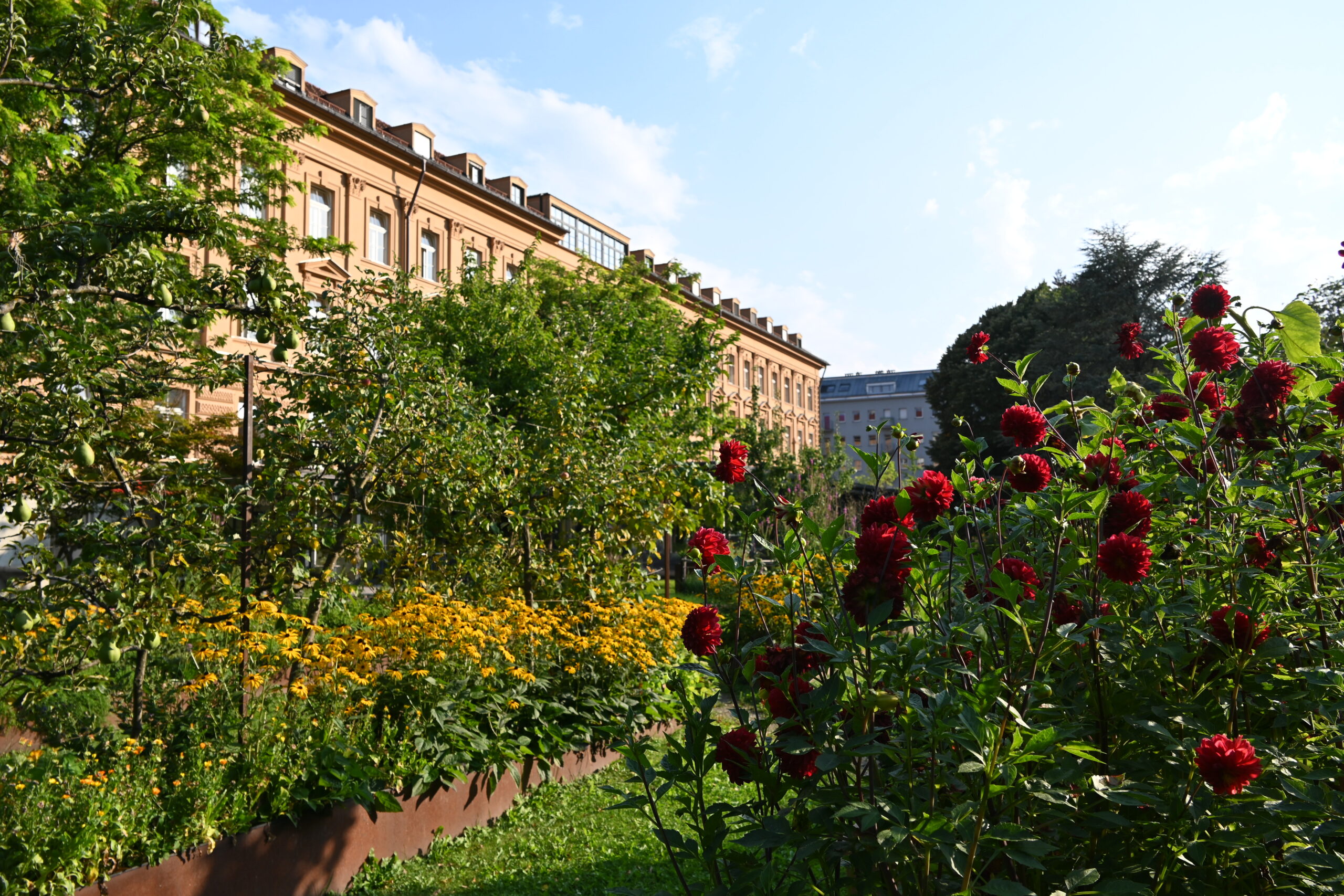
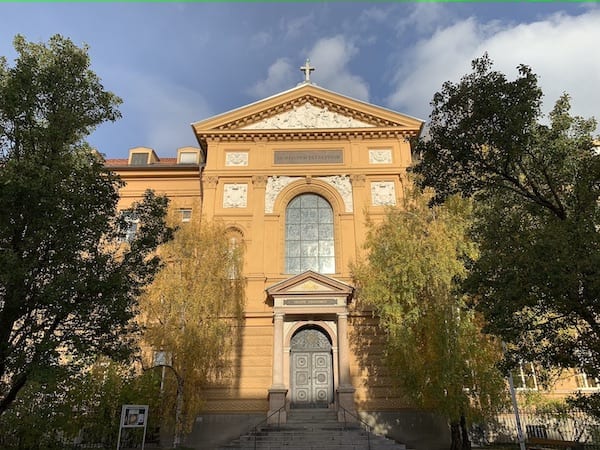
This could be read on 1 June 1907 in the press regarding the plans to establish a modern residential facility. What may seem unremarkable today was a groundbreaking innovation in the late monarchy. In 1908, Johann von Sieberer endowed the Innsbruck Asylum for the Elderly in honor of the 60th anniversary of Emperor Franz Joseph I’s reign. On 29 August 1909, the 100th anniversary of the Bergisel battle, the building was inaugurated by Franz Joseph I himself in the presence of the Bishop of Brixen. Alongside the ÖBB administrative building and the orphanage, the asylum for the elderly is the third impressive secular building in the Saggen district. Far from being a purely functional structure, the neoclassical retirement home stands out. A bell tower marks the building’s chapel. Statues of Saints Peter and Paul as well as Christ symbolize goodwill toward all people. The magnificent façade, 86 meters in length, has been preserved to this day. It not only faintly resembles a palace—it was intentionally designed this way to provide aging individuals with an architecturally dignified environment. Not only the exterior but also the interior was state of the art. The modern kitchen was equipped to prepare meals for up to 300 people.
Die Institution Sieberers schloss eine wichtige Lücke im Sozialwesen. Eine staatlich geregelte Pensionsversicherung wie wir sie heute kennen, gab es vor der Gründung der Republik Österreich nach 1918 nicht. Ältere Menschen, die nicht mehr arbeiten konnten, wurden zu Hause von Verwandten oder Angestellten versorgt. Bei Bauern wurde dies mit dem sogenannten Ausgedinge im Rahmen der Übergabe des Hofes geregelt. Wer nicht zu einer dieser privilegierten Schichten gehörte, fiel schnell durch den Rost. Arbeiter, Handwerksgesellen, Tagelöhner, Knechte und niederes Personal mussten betteln oder waren auf die Armen- und Altenpflege von Gönnern oder der Kirche angewiesen. Seit dem 16. Jahrhundert war die Versorgung in Tirol Sache der Gemeinde, der ein Untertan angehörte. In Notzeiten waren die Gemeinden damit aber oft überfordert. Auch die Kirche konnte sich nicht dauerhaft und zuverlässig diesem Problem annehmen. Durch den durch die Industrialisierung und Urbanisierung bedingten Zuzug nach Innsbruck und dem Verkauf zweier Armenhäuser in St. Nikolaus, war die Situation in Innsbruck um 1900 besonders angespannt. Johann von Sieberer, zu dieser Zeit bereits selbst in fortgeschrittenem Alter, kam zum Entschluss, der Stadt Innsbruck mit Planung des Projekts und der Finanzierung eines großen Teils davon, bei der Errichtung eines Greisenasyls zu unterstützen. Die Stadt unter Bürgermeister Wilhelm Greil musste sich dafür verpflichten einen Baugrund, die Übernahme der Erschließung von Kanalisation und Elektrifizierung und den Kosten für Rechtliches, Architekten und der Bauleitung zu übernehmen. Das Armenamt der Stadt sollte das Altersheim betreiben. Die Betreuung wurde den Barmherzigen Schwestern vom Heiligen Vinzenz und Paul überlassen. Die Idee Sieberers war es, älteren Ehepaaren die Möglichkeit zu geben ihren Lebensabend gemeinsam zu verbringen. Die Zimmer waren für damalige Verhältnisse mit Eisenbetten, Nachtkästchen, Kleiderschrank und Spucknapf gut ausgestattet. Der schmucklose Raum sollte die Pflege der Unterkünfte und die Freihaltung von Ungeziefer und Schädlingen erleichtern. Schwer sozialisierbare Bewohner wie Alkoholkranke wurden angenommen, jedoch separat untergebracht. Das Altersheim besteht bis zum heutigen Tag, auch wenn es natürlich mehrmals modernisiert wurde. An den Erbauer erinnert der moderate Schriftzug an der Ostseite des Gebäudes "Gespendet von einem Patrioten".
Johann von Sieberer: Innsbruck's good spirit
Whereas in the Middle Ages and early modern times it was primarily the church and the aristocracy that were responsible for the development of infrastructure and buildings in public spaces, in the 18th and 19th centuries members of the wealthy middle classes set out to shape the cityscape with their projects. The political upheavals of 1848 and 1867 had reshuffled the cards. The petty nobility and clergy had lost their wealth, power and social influence. They were replaced by the upper middle classes, which in Innsbruck consisted of wealthy merchants, restaurateurs, hoteliers and industrialists. Men such as the brewer, castle and pub owner Robert Nißl, Alois Epp, Leonhard Lang and Josef Kiebach donated parts of their fortunes and became involved in organisations to keep the infrastructure and social life going. Their ascents bear witness to the fact that in the second half of the 19th century, it was possible to rise through the ranks through skill, hard work and a little luck like never before. Lang had risen from the son of a blacksmith from Mühlau to become a paper manufacturer and trader through skilful management. The industrialist, after whom Langstrasse in Pradl is named, had founded the Hotel Österreichischer Hof purchased. In addition to his foundation, he was also involved in the Folk Art Museum, the Ferdinandeum and enabled the city of Innsbruck to build the New Town Hall in Maria-Theresienstraße. Kiebach (1828 - 1875) was the son of a master locksmith. Kiebach inherited from both his father and his uncle and, after his death, bequeathed a large part of his fortune to run the poor relief fund in the difficult years following the economic crisis of 1873. The best-known member of this new class of successful entrepreneurs in Innsbruck, who is still most visible in the Innsbruck cityscape today, was Baron Johann von Sieberer.
Johann Sieberer was born in Going near Kitzbühel in 1830 as an illegitimate child. The Bishop of Salzburg liked to spend his days off in the Tyrolean mountains. The school system in the Tyrolean lowlands was also administered by the diocese of Salzburg at the time. During a visit to the local primary school, he noticed a particularly keen boy. In 1840, at the behest of the bishop, Sieberer was appointed to the Borromeo in Salzburg as a choirboy. The Archbishop of Salzburg recognised his outstanding talent early on and allowed the boy to attend the Franciscan grammar school in Hall in Tyrol. After leaving school, he studied law in Vienna before entering the service of the family of the Bishop of Salzburg, the Princes of Schwarzenberg. This family was one of the most influential in the Austrian aristocracy. Archduke Albrecht, in whose service Sieberer was, was the founder of the Viennese art collection Albertina. Sieberer worked in the administration of the family's industrial plants and got to know many members of the aristocracy and moneyed gentry of the K&K monarchy while travelling through the monarchy. When, through Albrecht's mediation, he worked from 1860 for the Insurance company Österreichischer Phönix he was able to turn these contacts into money. He amassed a large fortune by selling high policies to members of the Habsburg family and other aristocrats. He acquired his private villa in Meidling near Vienna and invested his money in apartment blocks in the capital.
Johann von Sieberer is best known for his generous foundations in Innsbruck. With the social changes of the 19th century, the traditional extended family began to lose its role as the first port of call in times of need in urban areas. Although the state had increasingly taken over welfare from the church since Maria Theresa and outsourced it to the local authorities, there was often a lack of funds. Sieberer, a devout Catholic in Innsbruck, filled this gap as a kind of patriotic patron in the spirit of Christian charity.
From 1885 until his death in 1914, Sieberer was a benefactor to the Tyrolean capital. The orphanage and a fund to run it, as well as the Franz Joseph Jubilee Travellers' Asylum, can be traced back to the philanthropist Sieberer's donations. He also contributed to the remodelling of the Jesuit church. Unfortunately, only archive photos show the magnificent Unification fountainwhich was erected in 1906 on the then still ostentatious station square in the style of historicism and had to make way for the new transport concept in 1940.
The orphanage and the Kaiser-Franz-Josef-Greisenasyl were infrastructure that could not be financed by the city due to the tight financial situation. Sieberer felt he belonged to what Max Weber called the Protestant work ethic, but imitated the conservative aristocratic circles in which he had been socialised. The individual, virtuous citizen was to serve as an example to the collective. His two building projects were statements and expressions of a new bourgeois self-image. It is interesting to note that Sieberer, unlike monarchs and princes of the past, did not allow himself to be staged by name on his projects.
In 1909, Sieberer was made an honorary citizen of Innsbruck by Mayor Wilhelm Greil, and in 1910 he was made a baron by the Emperor. In Innsbruck, Siebererstraße in the Saggen district commemorates this great Innsbrucker. A memorial in honour of Sieberer was planned during his lifetime. The First World War and the political and financial problems that followed prevented its erection.
Wilhelm Greil: DER Bürgermeister Innsbrucks
One of the most important figures in Innsbruck's municipal history was Wilhelm Greil (1850–1928). The entrepreneur held the office of mayor from 1896 to 1923, having previously helped shape the city's fortunes as vice mayor. His tenure was not only long, but also took place during a particularly dynamic era. The four decades between the economic crisis of 1873 and the First World War were marked by unprecedented growth and rapid modernization. It was a time of incorporating entire city districts, technical innovations, and new media. Private investments in infrastructure such as railways, energy, and electricity were encouraged by the state and given tax incentives in order to lead the provinces and cities of the struggling Danube Monarchy into modernity. The city's economy was booming. Businesses emerged in the new districts of Pradl and Wilten, attracting a labor force. Tourism also brought fresh capital into the city. Innsbruck's city council was dominated by the liberal and Pan-German nationalist 'Deutsche Volkspartei' (German People's Party), to which Greil also belonged. It was only with the incorporation of Wilten and Pradl in 1904 that the conservatives were able to gain ground, though they could not fully catch up. Social Democracy played almost no role until 1918. Due to an electoral system based on voting rights categorized by wealth classes, only about 10% of Innsbruck's population could step up to the ballot box. Women were fundamentally excluded. Furthermore, relative voting rights applied within the three electoral colleges, which effectively meant: winner takes it all. Appropriately enough, Mayor Greil lived much like a Renaissance prince. He hailed from the upper-class haute bourgeoisie. His father was able to afford establishing the family's home base in the Palais Lodron on Maria-Theresien-Straße. Thanks to this electoral statute, Mayor Greil could rely on 100% support in the city council well into the era of the First Republic, which naturally simplified decision-making and governance considerably. For all the efficiency that Innsbruck's mayors displayed on a superficial level, one should not forget that this was only possible because, as part of an elite composed of entrepreneurs, merchants, and professionals, they ruled through a form of elected dictatorship—without any significant opposition or consideration for other population groups such as workers, artisans, and employees. The Imperial Municipal Act of 1862 granted cities like Innsbruck, and thus its mayors, far-reaching powers. It is hardly surprising that the chain of office presented to Greil on his 60th birthday by his colleagues on the city council bore an astonishing resemblance to the collar orders of the old nobility. However, Greil was also a skillful politician who adeptly navigated the established power structures and media landscape of his time. Article 17 of the Austrian Basic Law of 1867, known as the December Constitution, secured freedom of expression in the press without prior censorship for the first time—excluding, of course, punishable content such as blasphemy or insulting the authorities. Consequently, a variety of newspapers established themselves, such as the conservative Neue Tiroler Stimme, the social democratic Volkszeitung, or the liberal Innsbrucker Nachrichten, shaping a worldview according to their publishers' preferences. Thanks to the reach of the Innsbrucker Nachrichten, Wilhelm Greil was able to effectively project his view of local politics. Despite his at times fierce speeches—modeled on the platform of Georg Ritter von Schönerer (1842–1921), the founding figure of the Pan-German nationalists—he managed to reach arrangements with conservative forces in the region, even if things frequently clashed in the media and elsewhere. Taxes, social policy, education, housing, and the design of public spaces were debated with passion and zeal, often enough with violence as the ultimate argument.
Unter Greils Ägide und dem allgemeinen wirtschaftlichen Aufschwung erweiterte sich Innsbruck im Eiltempo. Der Gemeinderat kaufte ganz im Stil eines Kaufmanns vorausschauend Grund an, um der Stadt Neuerungen zu ermöglichen. Der Politiker Greil konnte sich bei den großen Bauprojekten der Zeit auf die Beamten und Stadtplaner Eduard Klingler, Jakob Albert und Theodor Prachensky stützen. Infrastrukturprojekte wie das neue Rathaus in der Maria-Theresienstraße 1897, die Eröffnung der Mittelgebirgsbahn, die Hungerburgbahn und die Karwendelbahn wurden während seiner Regierungszeit umgesetzt. Weitere gut sichtbare Meilensteine waren die Erneuerung des Marktplatzes und der Bau der Markthalle. Neben den prestigeträchtigen Großprojekten revolutionierte vor allem Unsichtbares in den letzten Jahrzehnten des 19. Jahrhunderts das Leben vieler Innsbrucker. Bereits Greils Vorgänger Bürgermeister Heinrich Falk (1840 – 1917) hatte erheblich zur Modernisierung der Stadt und zur Besiedelung des Saggen beigetragen. Seit 1859 war die Beleuchtung der Stadt mit Gasrohrleitungen stetig vorangeschritten. Mit dem Wachstum der Stadt und der Modernisierung wurden die Senkgruben, die in Hinterhöfen der Häuser als Abort dienten und nach Entleerung an umliegende Landwirte als Dünger verkauft wurden, zu einer Unzumutbarkeit für immer mehr Menschen. 1880 wurde das Ragging, so der Name im Volksmund für die Entleerung der Aborte, in den Verantwortungsbereich der Stadt übertragen. Zwei pneumatische Maschinen sollten den Vorgang zumindest etwas hygienischer gestalten. Zwischen 1887 und 1891 wurde Innsbruck mit einer modernen Hochdruckwasserleitung ausgestattet, über die auch Wohnungen in höher gelegenen Stockwerken mit frischem Wasser versorgt werden konnten. Wer auf sich hielt und es sich leisten konnte, hatte damit erstmals die Gelegenheit eine Spültoilette im Eigenheim zu installieren. Greil setzte diesen Feldzug der Modernisierung mit einer Vielzahl an Infrastrukturprojekten fort. Die Ansammlung an Menschen auf enger werdendem Raum unter teils prekären Hygieneverhältnissen hatte viele Probleme mit sich. Die Randbezirke der Stadt und die umliegenden Dörfer wurden regelmäßig von Typhus heimgesucht. Nach jahrzehntelangen Diskussionen wurde 1903 mit dem Bau einer modernen Schwemmkanalisation begonnen. Ausgehend von der Innenstadt wurden immer mehr Stadtteile an diesen heute alltäglichen Luxus angeschlossen. 1908 waren nur die Koatlackler Mariahilf und St. Nikolaus nicht an das Kanalsystem angeschlossen. Auch der neue Schlachthof im Saggen erhöhte Hygiene und Sauberkeit in der Stadt. Schlecht kontrollierte Hofschlachtungen gehörten mit wenigen Ausnahmen der Vergangenheit an. Das Vieh kam im Zug am Sillspitz an und wurde in der modernen Anlage fachgerecht geschlachtet. Greil überführte das Gaswerk in Pradl und das Elektrizitätswerk in Mühlau in städtischen Besitz. Die Straßenbeleuchtung wurde im 20. Jahrhundert von den Gaslaternen auf elektrisches Licht umgestellt. 1888 übersiedelte das Krankenhaus von der Maria-Theresienstraße an seinen heutigen Standort. Bürgermeister und Gemeinderat konnten sich bei dieser Innsbrucker Renaissance neben der wachsenden Wirtschaftskraft in der Vorkriegszeit auch auf Mäzen aus dem Bürgertum stützen. Waren technische Neuerungen und Infrastruktur Sache der Liberalen, verblieb die Fürsorge der Ärmsten weiterhin bei klerikal gesinnten Kräften, wenn auch nicht mehr bei der Kirche selbst. Freiherr Johann von Sieberer stiftete das Greisenasyl und das Waisenhaus im Saggen. Leonhard Lang stiftete das Gebäude in der Maria-Theresienstraße, in der sich bis heute das Rathaus befindet gegen das Versprechen der Stadt ein Lehrlingsheim zu bauen.
In contrast to the booming pre-war era, Greil’s leadership after 1914 was marked by crisis management. In his final years in office, he guided Innsbruck through the transition from the Habsburg monarchy to the republic—a time characterized above all by hunger, hardship, scarcity of resources, and insecurity. He was 68 years old when Tyrol was divided at the Brenner Pass after the war. During his political career, Greil had often exploited general hostility toward Italians (“Walsche”) in a similarly populist manner to his Christian Social counterpart in Vienna, Karl Lueger, who used antisemitic rhetoric. At the end of his career, he had to witness the Italian occupation of Innsbruck. With the introduction of the republic, the census-based voting system was abolished, marking the beginning of the end of liberal dominance in the municipal council. In 1919, the Social Democrats won elections in Innsbruck for the first time. Only due to council majorities and a coalition of Greater German-liberal and conservative-clerical politicians did Greil remain mayor. He died in 1928 at the age of 78 as an honorary citizen of the city of Innsbruck. Wilhelm-Greil-Straße had already been named after him during his lifetime.
Klingler, Huter, Retter & Co: master builders of expansion
The final decades of the 19th century became known in Austrian history as the Gründerzeit (Founders’ Era). After the economic crisis of 1873, the financial situation recovered and an unprecedented construction boom began. Innsbruck also established a modern banking system. Financial institutions such as the Savings Bank founded in 1821 and the Creditanstalt, whose building erected in 1910 still towers over Maria-Theresien-Straße like a small palace, made it possible to obtain loans, without which entrepreneurship and commerce as we know them today would not have been possible. In some cases, these financial institutions even acted as developers themselves. Between 1880 and 1900, Innsbruck’s population grew from 20,000 to 26,000 inhabitants, while Wilten, incorporated into the city in 1904, even tripled its population from 4,000 to 12,000. The number of buildings increased from 600 to more than 900. Most of them, unlike previous buildings, were multi-story apartment houses. Infrastructure was also modernized. Gas, running water, and electricity became part of everyday life for an increasing number of people. These buildings represented the new society. Entrepreneurs, professionals, employees, and workers had different needs than the legally dependent subjects of previous centuries. The urban lifestyle demanded apartments with several rooms and open spaces for recreation after working hours. Apartment buildings made a modern lifestyle possible even for people who did not own property. Unlike the rural regions of Tyrol, where farming families lived together with servants in farmhouses as part of an extended kinship community, life in the city was already quite close to our present-day understanding of family life. Although the upper middle class had not yet surpassed the nobility, it had reduced the gap considerably and, through its new position on the municipal council, was able not only to commission private building projects but also to decide on public construction projects. The old city hospital in the center of town was replaced by a modern hospital in the west; Sieberer’s orphanage and retirement home were established in Saggen, and a new urban center emerged around the railway station.
The forty years preceding the First World War were a gold rush era for the construction industry. The architecture of the buildings reflected the worldview of their owners. Master builders often assumed several roles and frequently replaced architects altogether. Most clients had very clear ideas about what they wanted. They were not seeking breathtaking new creations but rather copies of or adaptations based on existing buildings. In keeping with the spirit of the age, Innsbruck’s master builders designed structures according to the wishes of their financially powerful clients in the styles of Historicism, Classicism, and the Tyrolean Heimatstil. The style chosen for a home was often not merely an aesthetic decision but also an ideological statement by the owner. Liberals generally preferred Classicism, while conservatives were drawn to the Tyrolean Heimatstil. Whereas the Heimatstil presented itself in a Neo-Baroque form with abundant paintings, clear forms, statues, and columns were characteristic elements of Classical-inspired architecture. In what was sometimes a rather wild mixture of styles, people realized their ideas of classical Greece and ancient Rome. Not only railway stations and public buildings but also large apartment buildings, entire streets, churches, and even cemeteries were built along former country roads in this design. Academics—and those wishing to appear as such—demonstrated their fascination with antiquity through neoclassical façades. Catholic traditionalists commissioned murals depicting saints and scenes from Tyrolean history on their Heimatstil houses. While Neoclassicism predominates in Saggen and Wilten, the district of Pradl is largely characterized by conservative Heimatstil architecture. For a long time, many architectural experts looked down upon the tastes of social climbers and the newly rich. Heinrich Hammer wrote in his standard work Art History of the City of Innsbruck:
"Of course, this first rapid expansion of the city took place in an era that was unfruitful in terms of architectural art, in which architecture, instead of developing an independent, contemporary style, repeated the architectural styles of the past one after the other."
The era of grand villas, which imitated the aristocratic residences of former times with a bourgeois touch, came to an end after several exuberant decades simply because space became scarce. Further development of the city with detached houses was no longer possible. Even today, the area around Falkstraße, Gänsbachstraße, and Bienerstraße is known as Villensaggen, while the areas further east are referred to as Blocksaggen. Wilten and Pradl, however, never experienced this kind of development. Nevertheless, in their gold-rush enthusiasm, developers sealed ever more land with construction. In 1907, Albert Gruber delivered a warning speech about this growth, cautioning against unchecked urban expansion and land speculation.
"It is the most difficult and responsible task facing our city fathers. Up until the 1980s (note: 1880), let's say in view of our circumstances, a certain slow pace was maintained in urban expansion. Since the last 10 years, however, it can be said that cityscapes have been expanding at a tremendous pace. Old houses are being torn down and new ones erected in their place. Of course, if this demolition and construction is carried out haphazardly, without any thought, only for the benefit of the individual, then disasters, so-called architectural crimes, usually occur. In order to prevent such haphazard building, which does not benefit the general public, every city must ensure that individuals cannot do as they please: the city must set a limit to unrestricted speculation in the area of urban expansion. This includes above all land speculation."
A handful of master builders, together with the Innsbruck Building Authority, guided this development. If Wilhelm Greil can be called the mayor of Innsbruck’s expansion, then the Vienna-born Eduard Klingler (1861–1916) certainly deserves the title of its architect. As a public official and master builder, Klingler left a profound mark on Innsbruck’s cityscape. He began working for the Province of Tyrol in 1883. In 1889 he joined the municipal building authority, which he headed from 1902 onward. Among the projects attributed to Klingler as head of the building authority are the Commercial Academy, the Leitgeb School, Pradl Cemetery, the Dermatological Clinic within the hospital complex, the Municipal Kindergarten on Michael-Gaismair-Straße, the Train Barracks (today a residential building), the Market Hall, and the Tyrolean State Conservatory. One particularly noteworthy Heimatstil building designed by him is the Ulrich House on Bergisel, which today serves as the headquarters of the Old Kaiserjäger Club.
The most important construction company in Innsbruck was Johann Huter & Sons. Johann Huter took over his father’s brickworks. In 1856 he acquired the company’s first property, the Huter Grounds, on Innrain. Three years later the first business headquarters was established on Meranerstraße. The company’s official founding came in 1860 when it was registered together with his sons Josef and Peter. Like many of its competitors, Huter & Sons saw itself as a full-service provider. The company included its own brickworks, cement factory, carpentry shop, metal workshop, design office, and construction firm. By the outbreak of the First World War, it employed more than 700 people. In 1906/07, the Huter family built their residential and business headquarters at Kaiser-Josef-Straße 15 in the typical style of the late pre-war years. This stately house combines the Tyrolean Heimatstil, surrounded by gardens and nature, with Neo-Gothic and Neo-Romanesque elements. Well-known buildings erected by Huter & Sons in Innsbruck include the Monastery of Perpetual Adoration, St. Nicholas Parish Church, the first building of the new hospital complex, and several buildings on Claudiaplatz.
The second major player was Josef Retter (1872–1954). Born in Lower Austria with Tyrolean roots, he completed an apprenticeship as a mason before attending the Imperial-Royal State Trade School in Vienna and the master craftsman school of its construction department. After gaining professional experience throughout the Habsburg Monarchy—in Vienna, Croatia, and Bolzano—he was able, thanks to his wife’s dowry, to establish his own construction company in Innsbruck at the age of 29. Like Huter’s company, his enterprise also included a sawmill, a sand and gravel works, and a stonemasonry workshop. In 1904 he built his residential and office building. The dark Neo-Gothic Retter House at Schöpfstraße 23a, with its distinctive bay window supported by columns and a turret, is decorated with a remarkable mosaic representing an allegory of architecture. The relief on the gable depicts the union of art and craftsmanship, symbolizing Retter’s career path. Retter’s buildings particularly shaped Wilten and Saggen. Through projects such as the new Academic Gymnasium, the castle-like Commercial Academy building, the Protestant Christ Church in Saggen, the Zelger House on Anichstraße, Sonnenburg in Wilten, and the Neo-Gothic Mentlberg Castle in Sieglanger, he created many of the most important buildings of this era in Innsbruck.
Late in life but with a similarly practice-orientated background that was typical of 19th century master builders, Anton Fritz started his construction company in 1888. He grew up remotely in Graun in the Vinschgau Valley. After working as a foreman, plasterer and bricklayer, he decided to attend the trade school in Innsbruck at the age of 36. Talent and luck brought him his breakthrough as a planner with the country-style villa at Karmelitergasse 12. In its heyday, his construction company employed 150 people. In 1912, shortly before the outbreak of the First World War and the resulting slump in the construction industry, he handed over his company to his son Adalbert. Anton Fritz's legacy includes his own home at Müllerstraße 4, the Mader house in Glasmalereistraße and houses on Claudiaplatz and Sonnenburgplatz.
With Carl Kohnle, Carl Albert, Karl Lubomirski, and Simon Tommasi, Innsbruck possessed several other master builders who left their mark on the cityscape through typical buildings of the late 19th century. Together, they shaped Innsbruck’s new streets in the prevailing architectural spirit of the final thirty years of the Habsburg Monarchy. Residential houses, railway stations, government buildings, and churches throughout the vast empire stretching from Ukraine to Tyrol looked remarkably similar. New movements such as Art Nouveau gained acceptance only slowly. In Innsbruck, it was the Munich architect Josef Bachmann who introduced a new accent to bourgeois design with the redesign of the façade of the Winkler House. With the outbreak of the First World War, construction activity largely ceased. After the war, the era of neoclassical Historicism and the Heimatstil was definitively over. Times had become harsher, and the requirements for housing had changed. In the period of severe housing shortages in the young Republic of German-Austria, affordable housing and modern sanitary facilities became more important than representative façades and grand rooms. The increasingly professional education of master builders and architects at the Imperial-Royal State Trade School also contributed to a new understanding of construction, replacing the often self-taught veterans of the gold-rush era of Classicism. A stroll through Saggen and parts of Wilten and Pradl still transports visitors back to the Gründerzeit. Claudiaplatz and Sonnenburgplatz are among the most impressive examples. The construction company Huter & Sons still exists today. The company is now located in Sieglanger on Josef-Franz-Huter-Straße, named after its founder. Although the residential building on Kaiser-Josef-Straße no longer bears the company’s name, it remains, in all its opulence, a remarkable relic of the period that permanently transformed Innsbruck’s appearance. In addition to his residence on Schöpfstraße, the district of Wilten contains a second building associated with the Retter family. Opposite the university on Innrain stands Villa Retter. Josef Retter’s eldest daughter, Maria Josefa, who herself had been educated according to the principles of the reform educator Maria Montessori, opened Innsbruck’s first Haus des Kindes (“House of the Child”) in 1932. Above the entrance, a portrait depicts the benefactor Josef Retter. The south façade is adorned with a mosaic in the characteristic style of the 1930s, referring to the building’s original purpose. A smiling blond girl embraces her mother, who is holding a book, and her father, who carries a hammer. The family crypt at Westfriedhof Cemetery is another notable legacy of the Retter family.