New Schoolhouse
Kiebachgasse 10
Worth knowing
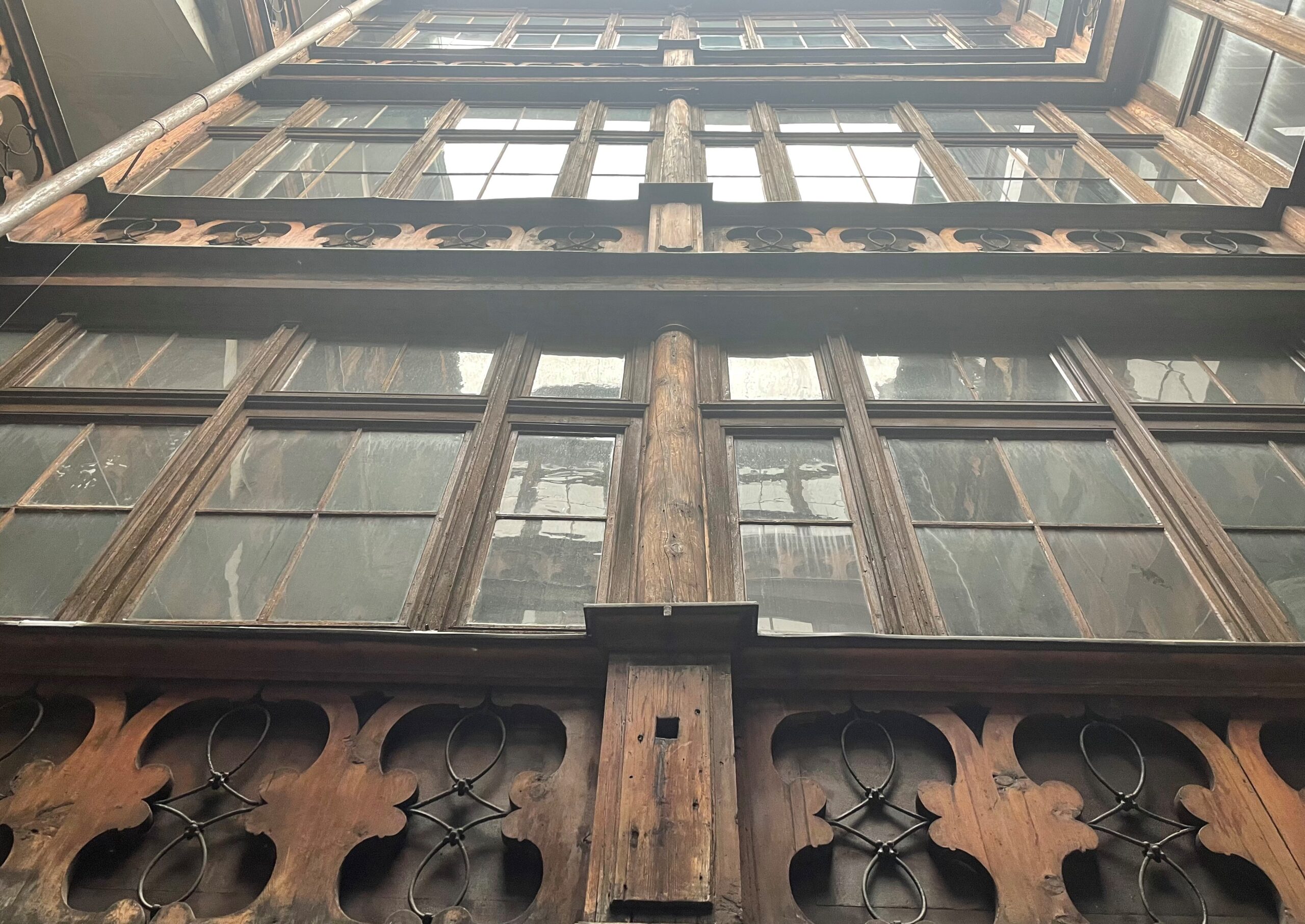
The building of the New City School in Kiebachgasse may look inconspicuous from the outside, but anyone who manages to glimpse the inner courtyard will be rewarded with a Gothic gem from the 16th century. The elaborate wood carvings of the staircase and façade give a good impression of the craftsmanship of the Early Modern period. Looking upward is almost dizzying. The fountain that has survived the centuries is also interesting. Curious visitors can ask for access at the locksmith’s shop in the neighboring building. With a bit of luck, you can enter.
The house tells the story of one of the greatest social changes in Austrian history. In 1774, Maria Theresa’s “General School Ordinance for German Normal, Main, and Trivial Schools in All Imperial-Royal Hereditary Lands” came into force. The enlightened ruler was keen to ensure that children’s education was no longer left to the uncontrolled influence of communities and the Church, as had been the case for centuries. The previous system had led to what we would now call an education crisis: poorly trained workers unable to reach their full potential. From then on, all children—including girls—up to the age of 12 had to, or rather were allowed to, attend school, at least in theory. Nationwide, even after the law change, only one in three children went to school, with a significant urban-rural divide. In villages like Pradl, Amras, and Wilten, which were not yet part of Innsbruck, farmers preferred their children to work in the fields rather than attend school. The school fees required in the early years of the new system were another hurdle for many families. In the city, however, the hunger for education and financial means had been greater even before the law change. As early as 1768, Innsbruck’s teachers and pupils had moved from the old school at Domplatz to the new City School in today’s Kiebachgasse due to lack of space. The new school system was divided into Normal, Main, and Trivial Schools. Trivial schools were mainly found in villages and poorer districts of Innsbruck. Although the Trivial schools in neighborhoods like St. Nikolaus and Kohlstatt could not compare to the New City School in terms of teaching quality, attendance rates were at least higher than in rural areas.
In many ways, the then-modern school differed from today’s system, yet there are similarities. Children were often grouped in classes regardless of age. Religion, German, and arithmetic were part of the curriculum, as was the subject “Instructions for Righteousness and Economy.” The still-familiar subject of general studies conveyed knowledge in disciplines such as geography and natural sciences—of course strictly within the Catholic doctrine of the time. The greatest change from the previously Church-dominated teaching was the stronger focus on numbers. The new curriculum placed special emphasis on mathematical basics, for good reason: whether craftsman, civil servant, or artilleryman in the growing army, without math skills one was lost. Since 1500, mathematics had gained importance over classical humanistic subjects like rhetoric, philosophy, and languages. Economy and technology favored mathematicians over philosophers, even though university disciplines were not yet as strictly separated as they are today. Another reason for the reform and stronger state influence was the sense of statehood necessary for a modern territorial state. From an early age, children were to be raised Catholic but also loyal to the state. Not only pupils but also teachers were standardized. A handbook written at court was intended to unify teaching methods throughout Maria Theresa’s empire and guarantee a certain level of standardization. The then Innsbruck school director Philipp Jakob Tangl (1733–1780) was appointed as an advisor to Maria Theresa’s court in Vienna. Despite the enlightened nature of the curriculum, corporal punishment for disobedience and misconduct remained part of everyday life—and would continue for centuries.
Until 1868, Innsbruck’s children were taught in the New City School. A new Imperial Elementary School Act that year extended compulsory schooling to age 14 and converted Trivial schools into elementary and civic schools. The bourgeois revolution of the second half of the 19th century thus surpassed the Enlightenment under Maria Theresa. Not only was the compulsory school age raised, but new school types such as the scientific secondary school (Realgymnasium), the trade school, and the business academy emerged. The building in Kiebachgasse had become too small for the now larger number of pupils. A new tenant was quickly found in the Protestant Church, as the school also had a small chapel that could be used. When the Protestant community moved to Saggen in 1905, a locksmith rented the building in the heart of the Old Town. What would be unthinkable in today’s museum-tourism context was everyday life well into the 20th century: industrial and craft businesses located right among residential buildings.
The Reformation in Tyrol
The Reformation may appear today primarily as a matter of personal belief. Thanks to the liberal legislation we enjoy in this respect, everyone is free to choose their own confession. If, however, religion is viewed as an essential component of everyday life and personal identity in past centuries, it becomes clear that it was far more than merely an expression of spirituality. The Reformation, which erupted with particular violence between the fifteenth and seventeenth centuries, represented a comprehensive social rupture comparable to the years 1848 or 1968. The accompanying social and political transformation did not come to a halt at the borders of the Holy Land of Tyrol.
It is a chicken-and-egg question whether the Reformation changed the image of humankind or whether a changing perception of existence transformed Christianity. Around 1500, new discoveries and modes of thought began to usher in the end of the Middle Ages. Artists, scholars, and clerics across Europe started to question hierarchies, order, and systems of legitimacy. With the theological reformers of the fifteenth and sixteenth centuries, the feudal system—placing Church and nobility above the people and bourgeoisie—began to crumble. The Bohemian cleric Jan Hus was among the first on the European mainland to question the pope’s omnipotence in the fifteenth century and was burned at the stake for it at the Council of Constance. In France and Switzerland it was Jean Calvin (1509–1564), in the Holy Roman Empire Martin Luther (1483–1546) and Thomas Müntzer (1489–1525), who challenged the Roman Church in the sixteenth century. Reform-minded clergymen and pamphlets spread the new doctrines. In Tyrol, the mining towns of Hall and Schwaz were the main centers of the Reformation in the early sixteenth century. Many miners came from Saxony and brought their own ideas about faith and Church with them. The old liturgy, with sermons delivered in incomprehensible Latin, did not align with these expectations. Preachers such as Dr. Jacob Strauß addressed the population with Lutheran ideas, which also included criticism of the clergy and the system of rule. The religious crisis thus led to problems in the secular sphere beyond the walls of the churches as well. Faith and worldly matters were not separate domains. If miners were dissatisfied with pastoral care, they went on strike. Public order was endangered—not only because miners were permitted to carry weapons, but also because they were well connected among themselves. A general strike could trigger an economic crisis. Fugger capital and Habsburg political power were eager to prevent this and therefore granted the miners special rights. Not only miners, but also progressive segments of the bourgeoisie and the nobility took an interest in the new ways of living one’s faith, which was an important part of lifestyle. The new doctrines became a symbol of a new sense of self and of the social significance that craftsmen, skilled workers, and entrepreneurs in this emerging industry claimed in opposition to the old feudal system.
Ferdinand I and his successors were able to successfully push back the Reformation in Tyrol. Although the religious mandates with their numerous prohibitions were one of the reasons for the peasant wars, in the long term and with many coercive measures, the princely strategy bore fruit. Power politics may have been one reason, but in fact the ruling Habsburgs were pious people who, at least to a large extent, favoured Catholicism out of conviction. Ferdinand II described his motives with the words:
“…through the inspiration of God and the prompting of His Holy Spirit. All [done] to the glory of the Most High, out of a true and fervent zeal devoted to the holy, Catholic, and alone salvific religion.”
It was primarily priests of the Jesuit order who were to bring apostate parishes and citizens back into the fold of the Catholic Church. They began with reform measures such as better training for the clergy. Concubinage and post haggling were to be abolished. Priests and bishops were to concern themselves less with worldly matters and more with the salvation of their flocks. However, as this measure could not be implemented overnight - capable priests first had to be found and educated - coercive measures were introduced. The possession of Protestant books and pamphlets was punishable by law. The lower the status of the citizen, the more severe the punishment. Nobles, counsellors and key workers were often able to practise their Protestant faith discreetly. Under Ferdinand II, underlings had to confess at Easter. The priest drew up a list with the names of those who fulfilled their duty. Anyone who did not appear in the confessional despite repeated reminders could be expelled from the country.
In the seventeenth century, so-called religious reform commissions were established in Austria. If these “missionaries” discovered Protestant-leaning priests or subjects in possession of forbidden literature, they were arrested and expelled from the country, and not infrequently their houses and all possessions were set ablaze. Protestant officials were barred from practicing their professions and were forced either to convert or to emigrate. Particularly obstinate subjects were publicly chained. Maximilian III instituted a special religious surveillance agency that primarily monitored craftsmen and merchants. To prove their Catholic loyalty, they were required to regularly submit proof of confession. Under Maria Theresa in the eighteenth century, Tyrolean Protestants were forcibly resettled to distant parts of the Habsburg Empire. These relocations posed problems not only for the affected individuals. Labor and population numbers were key indicators of development in modern states, leading to what we would today call a brain drain: competencies and military strength were lost in the name of the Lord. In 1781, Enlightenment-minded Emperor Joseph II issued the Edict of Tolerance, partly for this reason, permitting the construction of Protestant churches—albeit under strict conditions. These prayer houses were not allowed to have towers or other architectural features; even windows facing the street were prohibited. In Tyrol, resistance arose against the Edict of Tolerance, as people feared for moral order and sought to avoid foreign religions, discord, and unrest of any kind. Converts were denied marriage and burial in Catholic cemeteries.
To this day, Tyrol regards itself as the self-proclaimed “Holy Land,” with “holy” referring explicitly to the Catholic faith. In 1837, Protestants were expelled from the Zillertal. The descendants of the so-called Zillertal “Inklinanten,” who emigrated under official pressure, still live in Germany today. Although tolerance gradually gained a foothold in the empire and its lands, the close bond between authority and the Catholic Church persisted well into the twentieth century in many areas of life, such as education. When it became known during the constitutional debates of 1848 that free exercise of religion was planned for the entire monarchy, public outrage in Tyrol was enormous. After media campaigns opposing this liberalization of faith, more than 120,000 signatures were collected. In 1861, Emperor Franz Joseph issued the Protestant Patent, which granted the Evangelical Church rights largely equivalent to those of the Catholic Church. The Tyroleans, however, remained steadfast. With the exception of two liberals, all members of the regional parliament voted to maintain confessional unity. The argument stated that there were no adherents of other faiths in Tyrol anyway, and therefore no tolerance toward non-Catholics was necessary. It was not until 1876 that an official Protestant parish was established in Innsbruck.
Maria Theresia, Mother of the Nation and Reformer
Maria Theresa ranks among the most important figures in Austrian history. Particularly significant were her domestic reforms, many of which had a tangible impact on the everyday lives of Innsbruck’s inhabitants and are still visible today in the city’s built environment. Together with her most influential advisers—Friedrich Wilhelm von Haugwitz, Joseph von Sonnenfels, and Wenzel Anton Kaunitz—she succeeded in transforming the so‑called Austrian hereditary lands into a modern state. Instead of governing her territories through the local nobility, she relied on a centralized, professional administration. In keeping with Enlightenment thought, her advisers recognized that the welfare of the state depended on the health and level of education of its individual subjects. An early healthcare reform of 1742 obliged the professors of medicine at the University of Innsbruck not only to teach but also to ensure the operation of the municipal hospital in the Neustadt district. A school reform likewise reshaped the educational landscape within the city walls, both spatially and conceptually. Due to a lack of space, the school was relocated from Domplatz to Kiebachgasse, and its educational mission was redefined. Subjects were expected to remain Catholic, but their loyalty was to be directed toward the state. Education was placed under centralized state control in order to develop talents in a targeted manner. The aim was not to raise critical, humanistic intellectuals, but rather to train personnel for the state administrative apparatus. This reform laid the foundation for later social mobility. Through military service and civil administration, non‑nobles were now able to pursue careers and climb the social ladder. Any improvement of the individual was regarded as a gain for the whole. Further measures followed that affected not only the national economy but also the daily lives of most people. The standardization of weights and measures made the tax system more precise and less susceptible to abuse. For farmers, the harmonization of laws meant that their livelihoods were less dependent on local landlords and their arbitrary decisions. The Robot—the unpaid compulsory labor owed by peasants to their landlords—was also abolished under Maria Theresa. A shift in thinking likewise took place in criminal prosecution and the judicial system. In 1747, a small police force was established in Innsbruck to oversee market regulation, trade and guild regulations, control of foreigners, and public morals. Above all, this served to regulate the provision of goods in favor of consumers. Not only poor quality but also price gouging was punished. The strictness of early food inspections is illustrated by a police record from 1748, in which a butcher from Pradl was fined for exceeding the legally fixed meat prices. This denser network of regulations and improved law enforcement went hand in hand with a more humane system of punishment. Although the criminal code Constitutio Criminalis Theresiana did not abolish torture, it did strictly regulate its use. Yet despite Maria Theresa’s self‑presentation as a pious mother of the land and her reputation today as an Enlightenment ruler, the devoutly Catholic sovereign was uncompromising when it came to power and religion. In keeping with Enlightenment thought, she ordered critical investigations into superstitions such as vampirism, which was widespread in the eastern parts of her realm, and initiated the final end of the witch trials. At the same time, however, Protestants were ruthlessly expelled from the country. Many Tyroleans were forced to leave their homeland and resettle in more remote regions of the Habsburg monarchy.
In crown lands such as Tyrol, which had previously enjoyed a high degree of autonomy, Maria Theresa’s reforms were met with little approval. Centralization remains a sensitive issue in Austrian politics to this day. With the exception of a few liberals, people saw themselves more as an independent, autonomous land and less as part of a modern territorial state. The clergy also resented their new subordinate role, which was further intensified under Joseph II. For the local nobility, the reforms meant not only a loss of status and autonomy but also higher taxes and levies. Taxes, duties, and customs revenues that had long provided Innsbruck with reliable income were now collected centrally and only partially returned through fiscal redistribution. To mitigate the social decline of sons from impoverished noble families and prepare them for state service, Maria Theresa founded the Theresianum, which also had a branch in Innsbruck from 1775 onward. As so often, time smoothed over former conflicts, and today Innsbruck’s inhabitants take pride in having hosted one of the most significant rulers in Austrian history. Not only the Triumphal Arch and the Imperial Palace (Hofburg), but also the Turnvereinshaus and the New City School recall the Theresian era, a period in which the state began to intervene ever more deeply in the lives of its citizens from the moment they entered school.