Palais Fugger-Taxis & Altes Landhaus
Maria-Theresienstrasse 45 / 43
Worth knowing
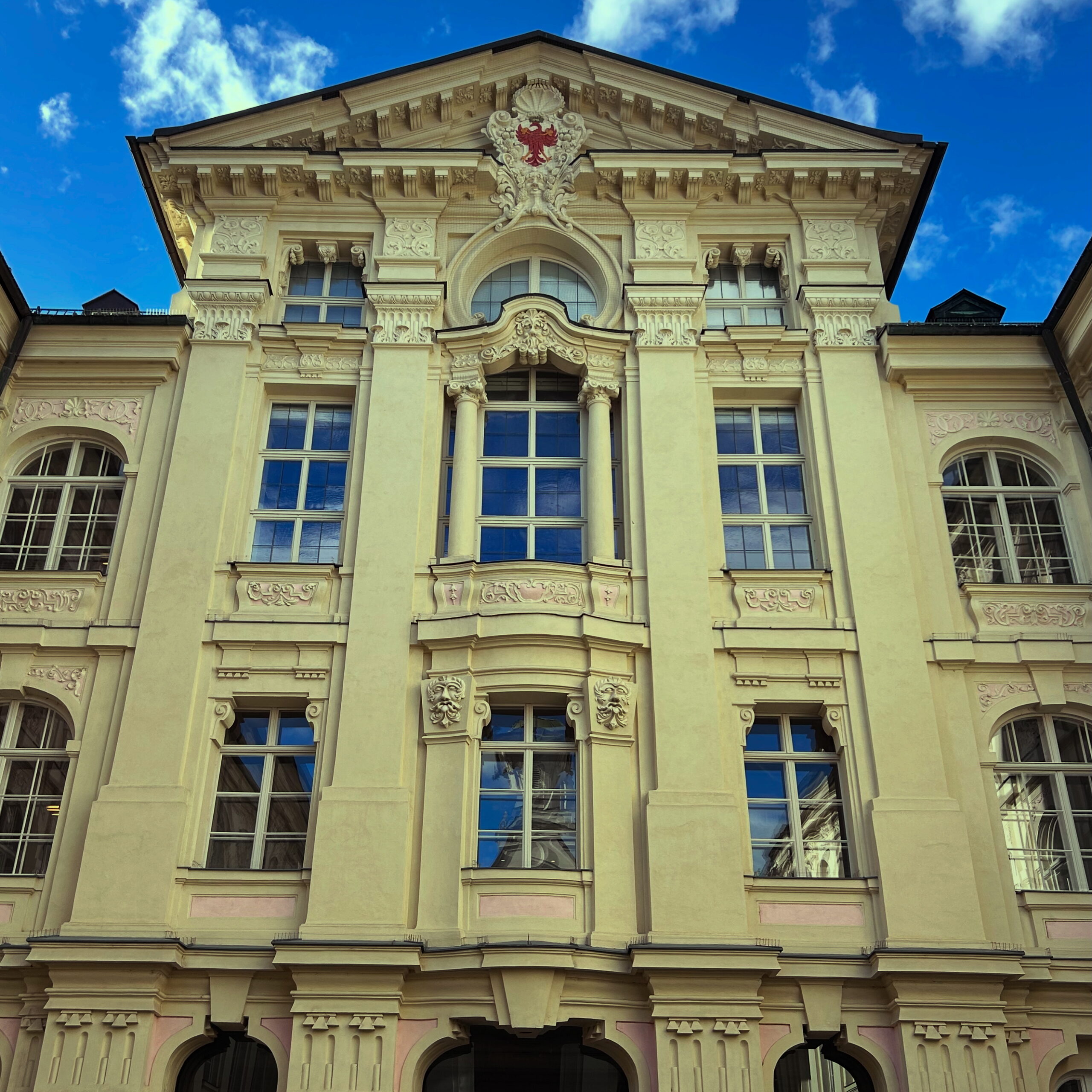
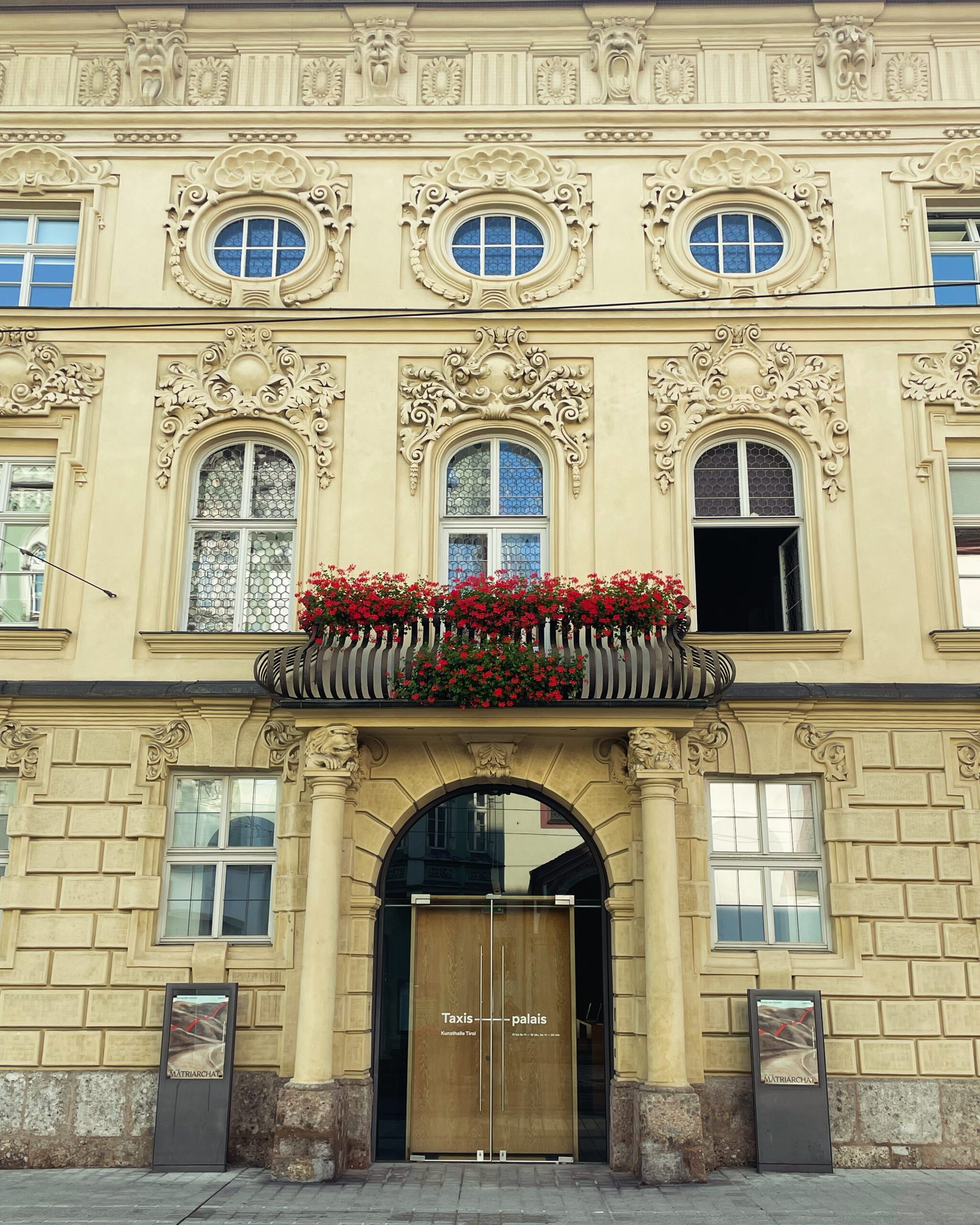
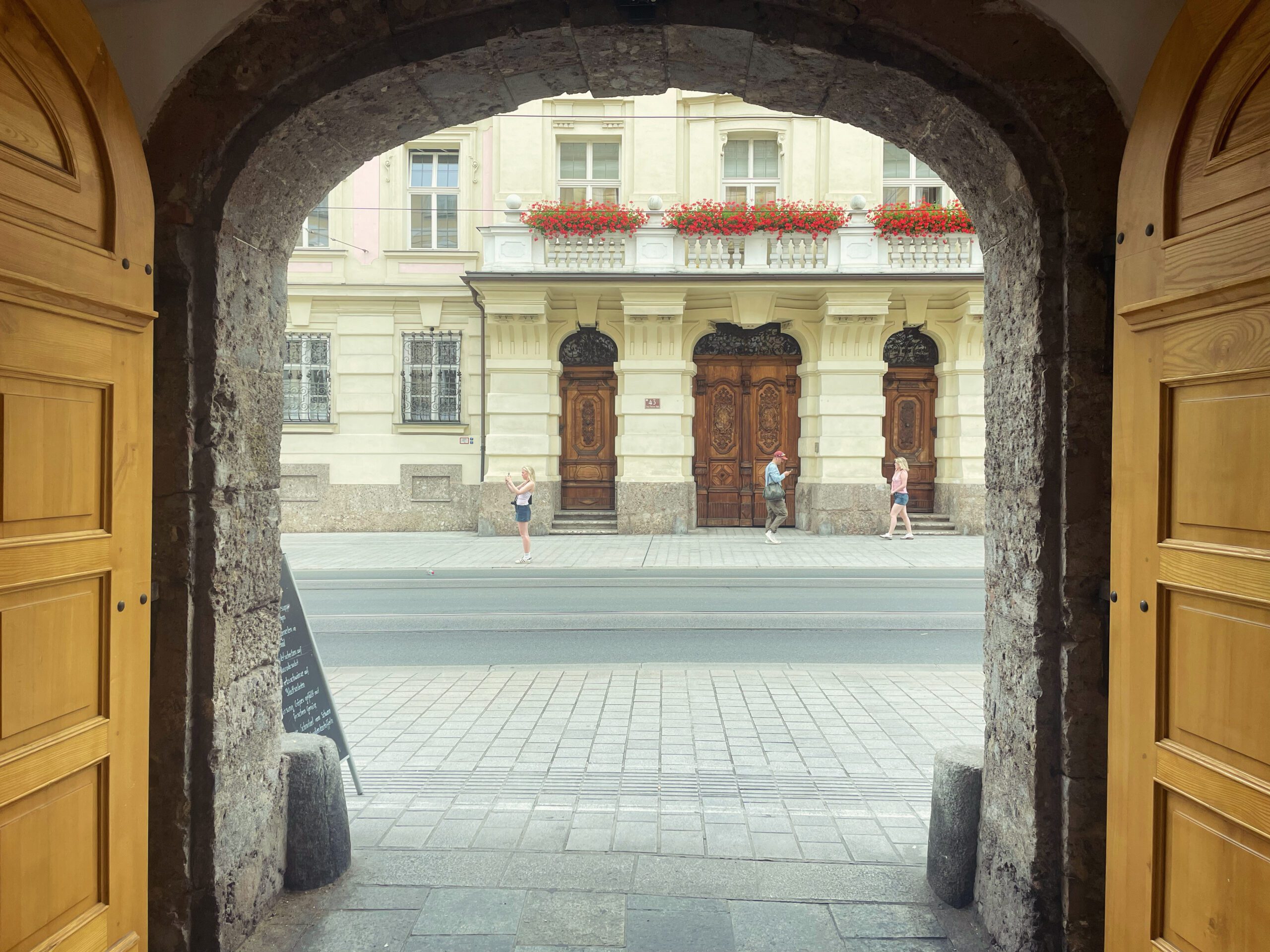
In the southern part of Maria-Theresien-Straße, two buildings stand side by side that symbolically represent the power structures and interplay between Tyrolean economy and politics in the early modern period: the Old Government Building (Altes Landhaus) and the Fugger-Taxis Palace (Palais Fugger Taxis). The names Fugger and Taxis stand for early globalization, capitalism, and a transformation in the world of communication and media. With the Fuggers and the Thurn und Taxis, the palace housed members of two of the most influential families conducting business in Innsbruck. By today’s standards, one would have to invoke names like Warren Buffett and Mark Zuckerberg to make an adequate comparison. The Fugger-Taxis Palace bears witness both to the changes the world underwent from 1500 onward and to Innsbruck’s growing importance as a Habsburg residence city.
Many influential aristocrats built their palaces in the Neustadt during the 16th and 17th centuries to be as close as possible to the court of the Tyrolean sovereign. Although Innsbruck had lost some prestige since the days of Maximilian, it was still one of the most important cities of the Holy Roman Empire. After a fire, Imperial Privy Councillor Count Hans Otto Fugger commissioned a palace that would outshine all other city palaces. Who else could afford such a feat than a member of the Augsburg Fugger merchant dynasty, one of the richest families in early modern Europe? Johann Martin Gumpp the Elder was engaged to design the building, taking inspiration from the Genoese city palaces fashionable at the time. The palace, opened in 1679, suffered severe damage during the great earthquake only ten years later, like most buildings in Innsbruck. Through marriage, the building passed to the von Welsberg family, who rented it out in the following years. In 1784, Joseph Sebastian von Thurn und Taxis purchased the Fugger Palace to use it as a residence and postal station. The Thurn und Taxis dynasty was one of the most important noble families of its time. Through the introduction of the postal system, they achieved fame, honor, and wealth in the empire. In 1905, the Fugger-Taxis Palace became the property of the Tyrolean government to house additional offices for the Landhaus, which had already occupied the neighboring building for 250 years.
Das Alte Landhaus in seiner heutigen Form entstand erst nach dem Palais der beiden Unternehmerfamilien. Die Tiroler Landesregierung war in der Umstrukturierung nach dem Tod des letzten Habsburgers 1665 und dem Verlust des Status als Residenzstadt zu einem Neustart gezwungen. Fortan sollte nicht mehr ein Landesfürst, sondern ein Gubernator das Land Tirol regieren. Diese Statthalter entstammten zwar auch dem Hochadel, waren aber nicht mehr Besitzer, sondern Verwalter des Landes im Namen der Herrscherfamilie Habsburg. Das Staatsverständnis begann sich zu ändern und mit ihm die Anforderungen an die Infrastruktur. Da die Claudiana in the old town was too small for the new government offices, it was decided that the Harnischhaus in the Neustadt, a plater's workshop from the time of Maximilian, als Räumlichkeiten für die Landesregierung zu erstehen. Die kunstvollen Rüstungen waren in den Jahren nach dem Dreißigjährigen Krieg in Zeiten von Söldnerheeren, Feuerwaffen und Artillerie aus der Mode gekommen. Das Plattnerhandwerk erlitt das traurige wirtschaftliche Schicksal der Schallplatte in den 1990ern oder der Festnetztelefone im 21. Jahrhundert. Nach einem Brand 1620 und dem Erdbeben von 1689 war das Gebäude in desolatem Zustand. Jahrzehntelang fehlten aber Geld und politischer Wille, um einen Neubau zu finanzieren. In den Zeiten des französischen Sonnenkönigs Ludwig XIV. und seines absolutistischen, zentralistischen Regierungsansatzes, der in ganz Europa in Mode kam, hatten es auch Vertreter der Länder im Habsburgerreich schwer. Erst in der Zeit nach den Kriegen des späten 17. Jahrhunderts und frühen 18. Jahrhunderts unter Karl VI., dem Vater Maria Theresias, kam das föderale Prinzip in der Politik wieder stärker zur Geltung.
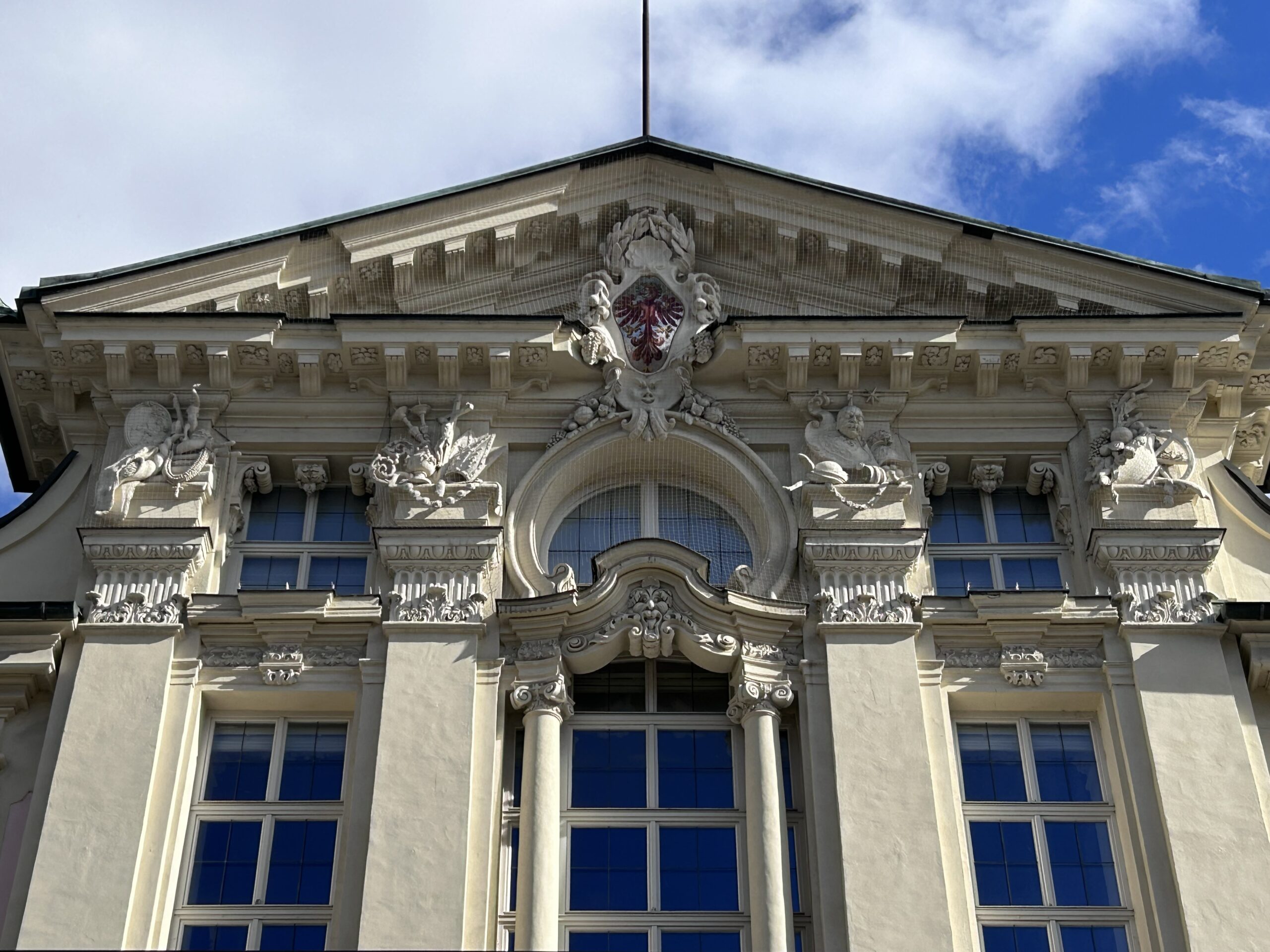
Between 1725 and 1734, the new home of the Tyrolean provincial estates and provincial officials was built according to Georg Anton Gumpp's plans. The building had to combine the functions of offices, meeting rooms and representation to the outside world. The baroque façade with its large windows reflects the fashion of the 18th century. The four estates are emblematically represented by crops, armour, a crucifix and a civic chain, which converge under the red eagle, the heraldic animal of Tyrol, on the gable The interior is even more extravagant than the façade. A richly decorated staircase with golden ornaments and statues welcomes the visitor. The ceiling is adorned with the Tyrolean eagle, which holds its protective wings over the historic land of Tyrol and the towns between Trento and Kufstein. Apollo, god of the muses and arts, and his sister Artemis, goddess of the hunt, were sculpted in wood by Nikolaus Moll during the first construction phase. The statues of Athena, the goddess of wisdom, and Ares, the god of war, were added in 1899 in the spirit of historicism. The assembly hall was no less splendidly decorated and is more reminiscent of a sacred building than a parliament. Based on an idea by Martin Stickler, the art-loving Abbot of Wilten, who also supervised the entire project, the six baroque paintings with biblical scenes depicting the individual regions of Tyrol were created. Red marble on the walls and the four man-sized statues of the two Tyrolean governors Charles of Lorraine and Charles III Philip of the Palatinate-Neuburg as well as Emperor Leopold I and Archduke Leopold V dominate the room, which is still used today for provincial assemblies. Four small putti with wine, a knight's helmet, a bishop's mitre and a Roman lictor's bundle symbolise the estates of the peasantry, the nobility, the clergy and the bourgeoisie.
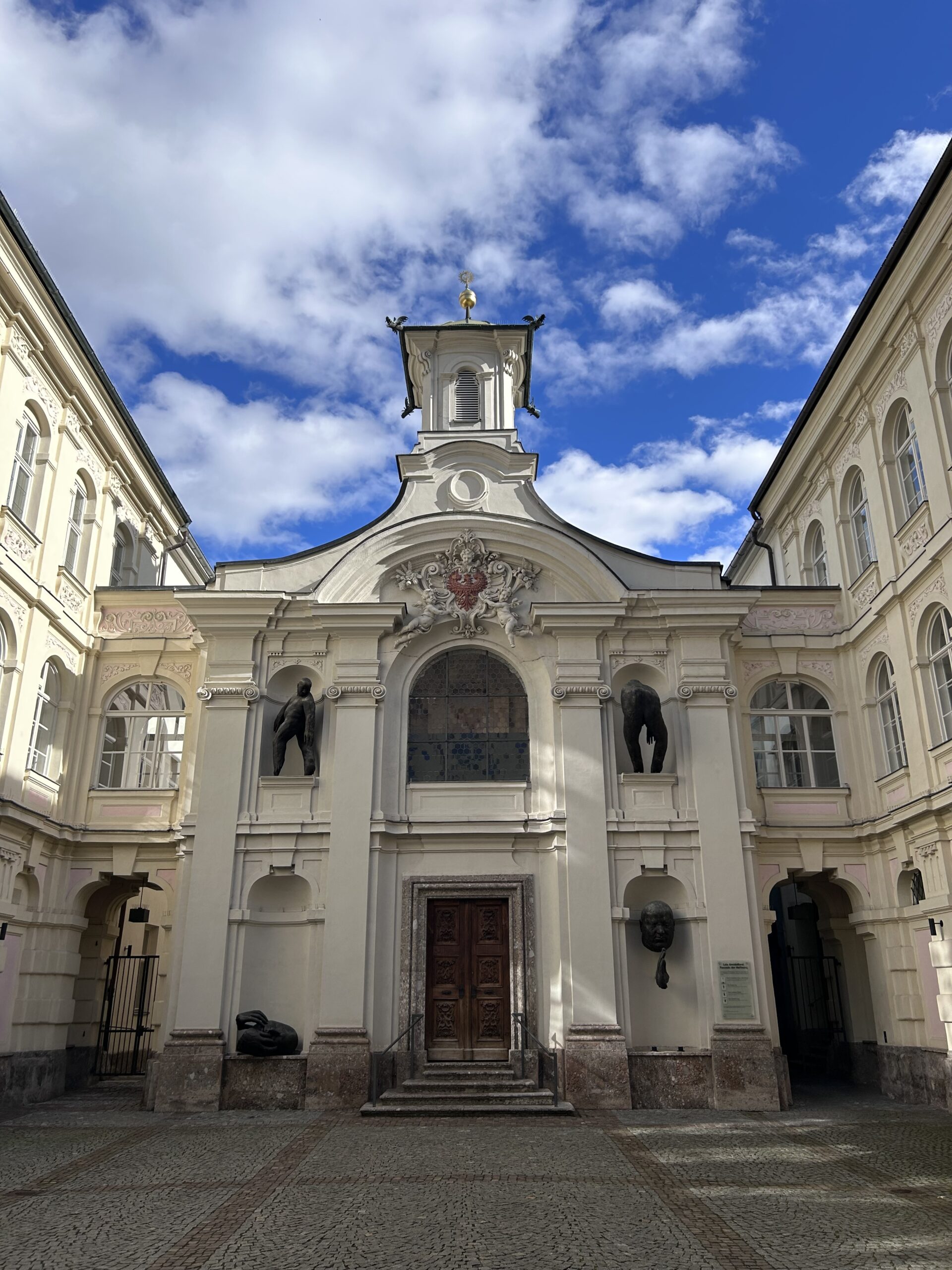
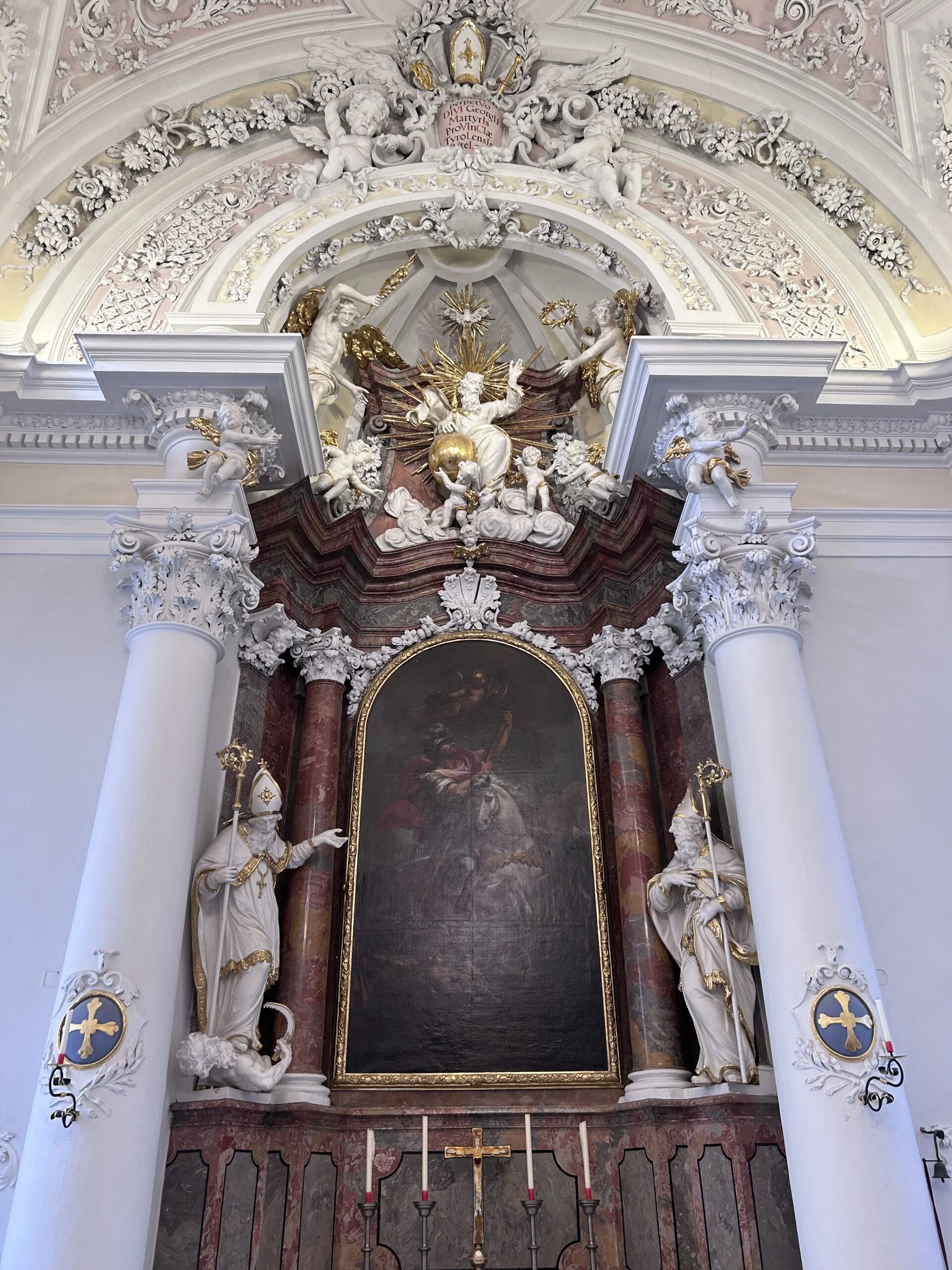
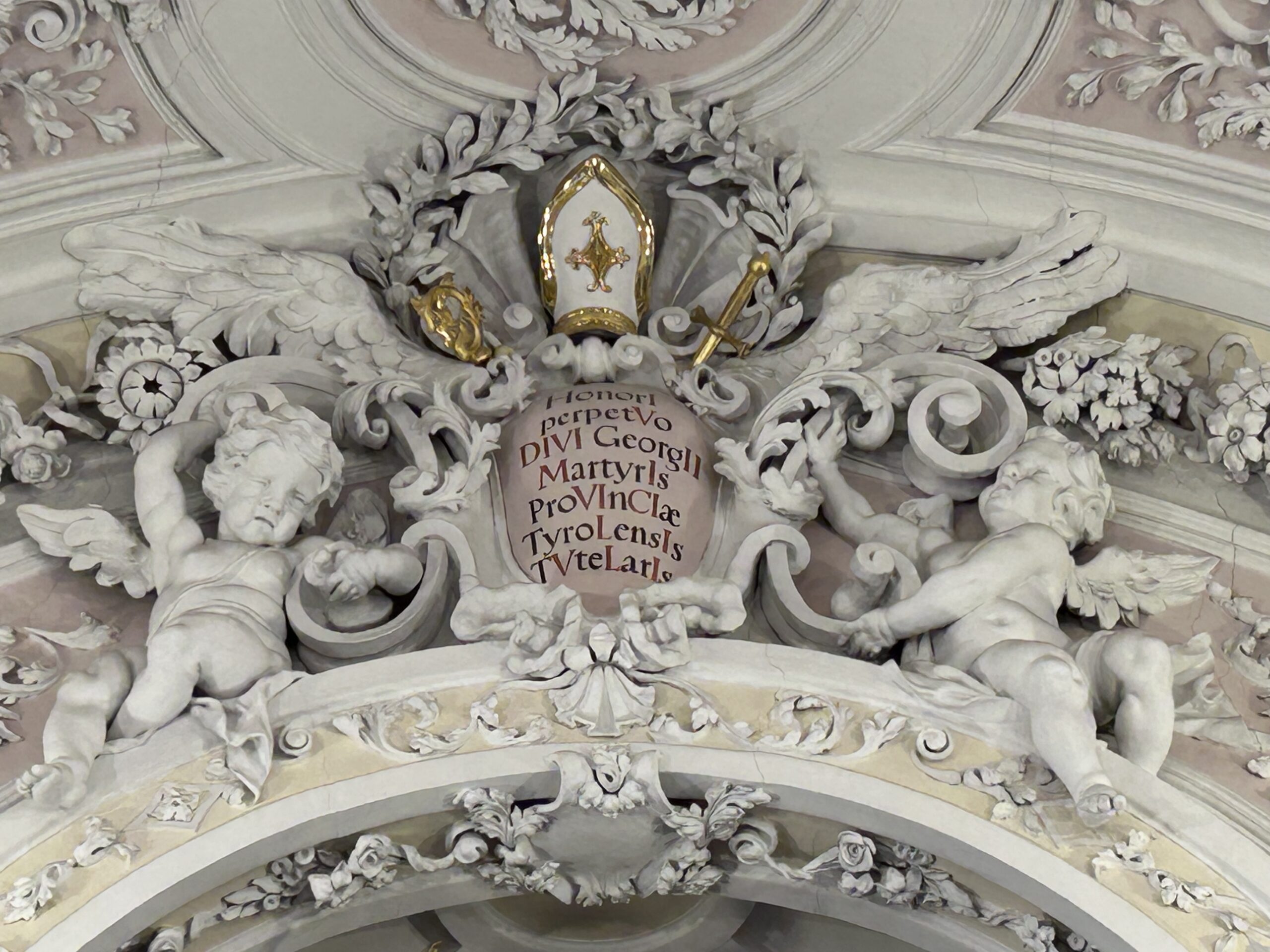
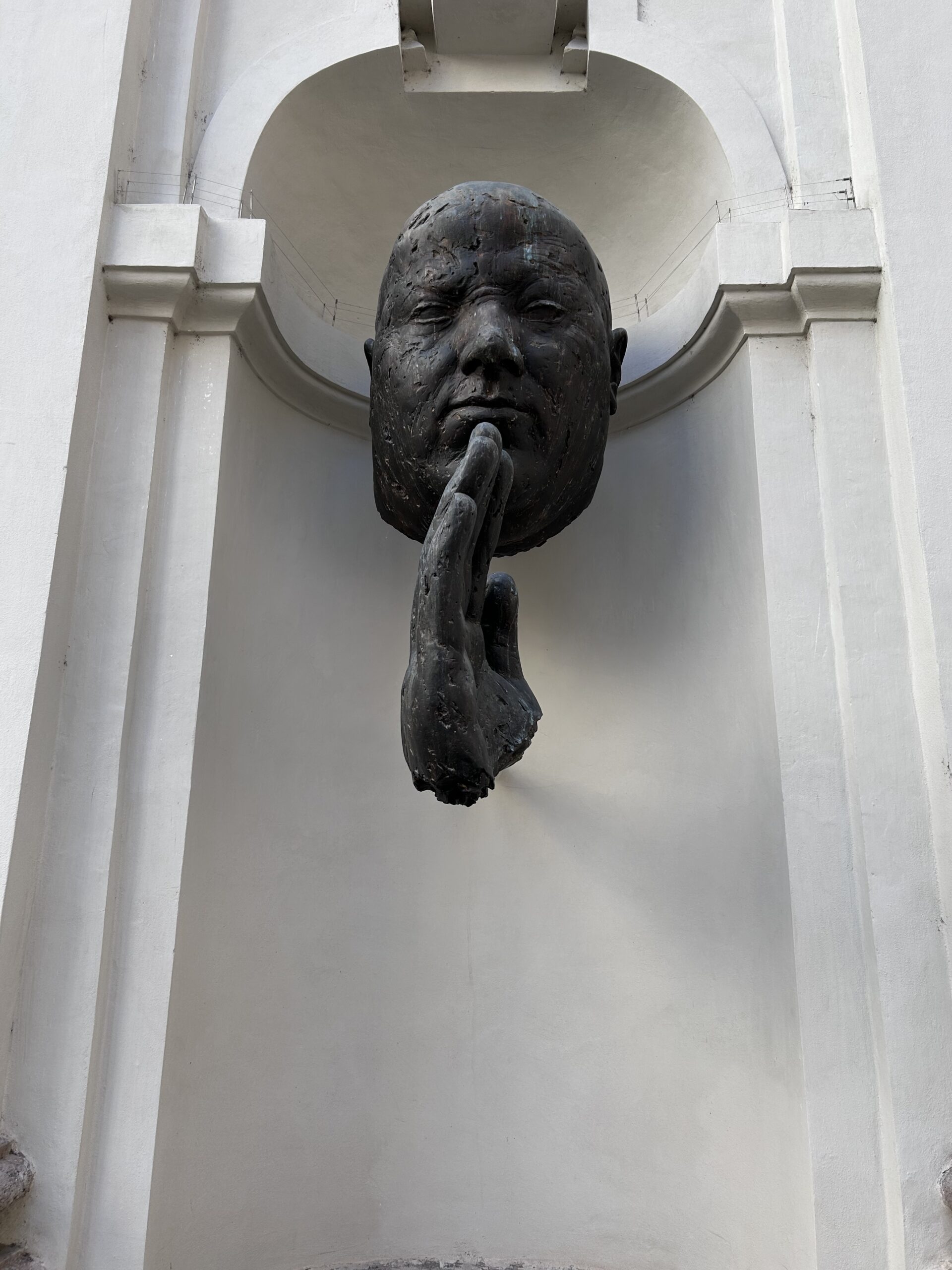
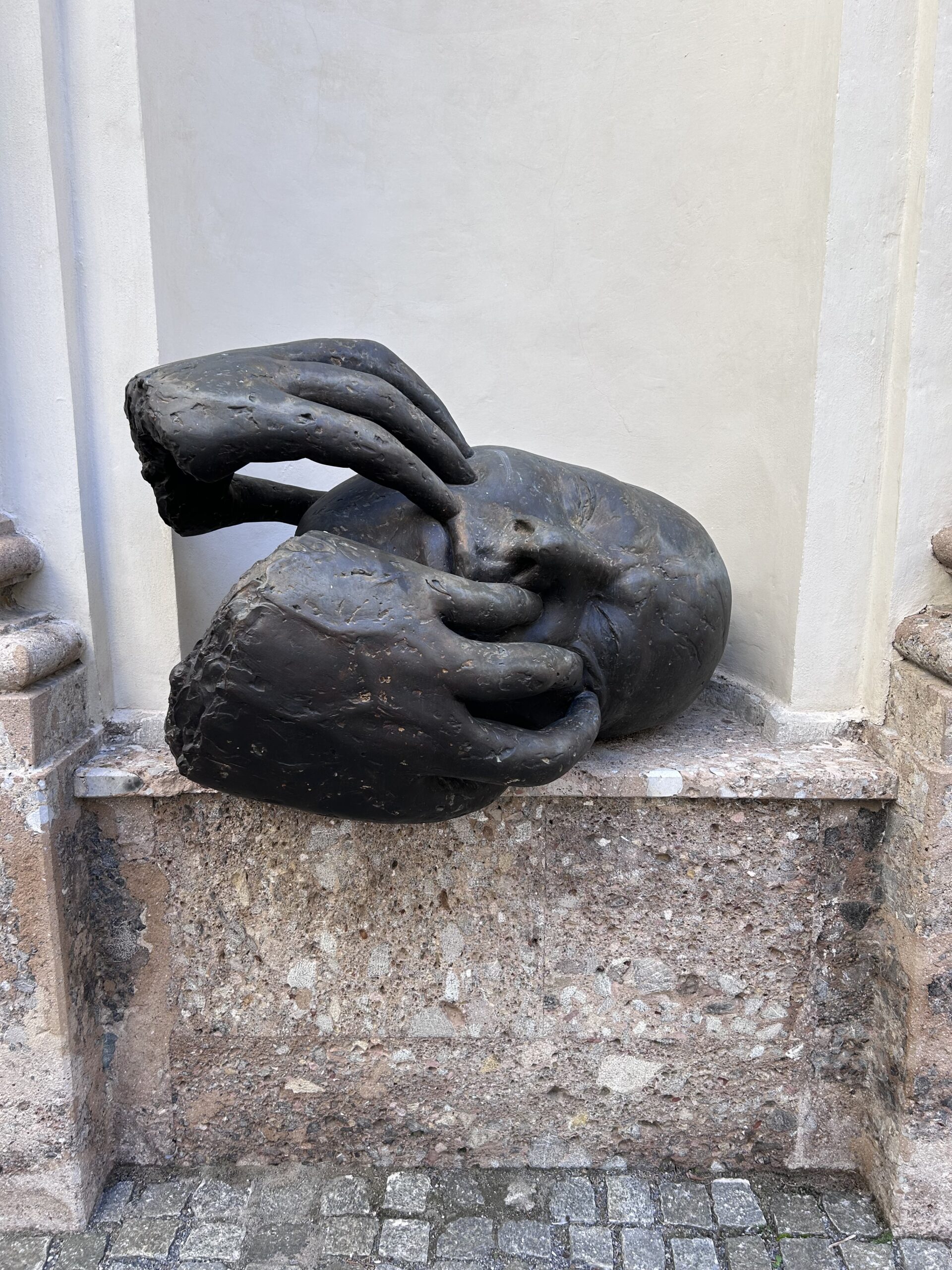
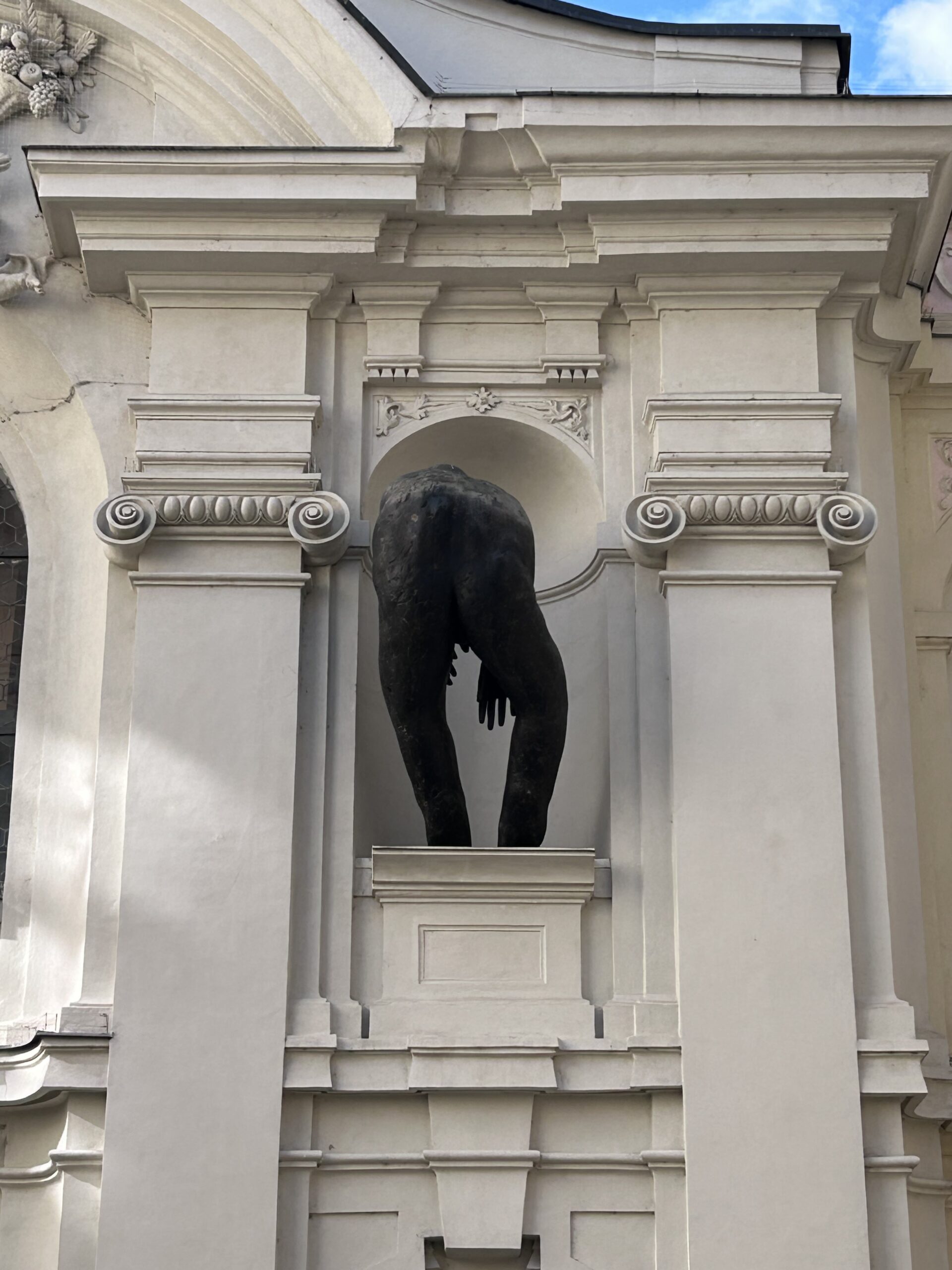
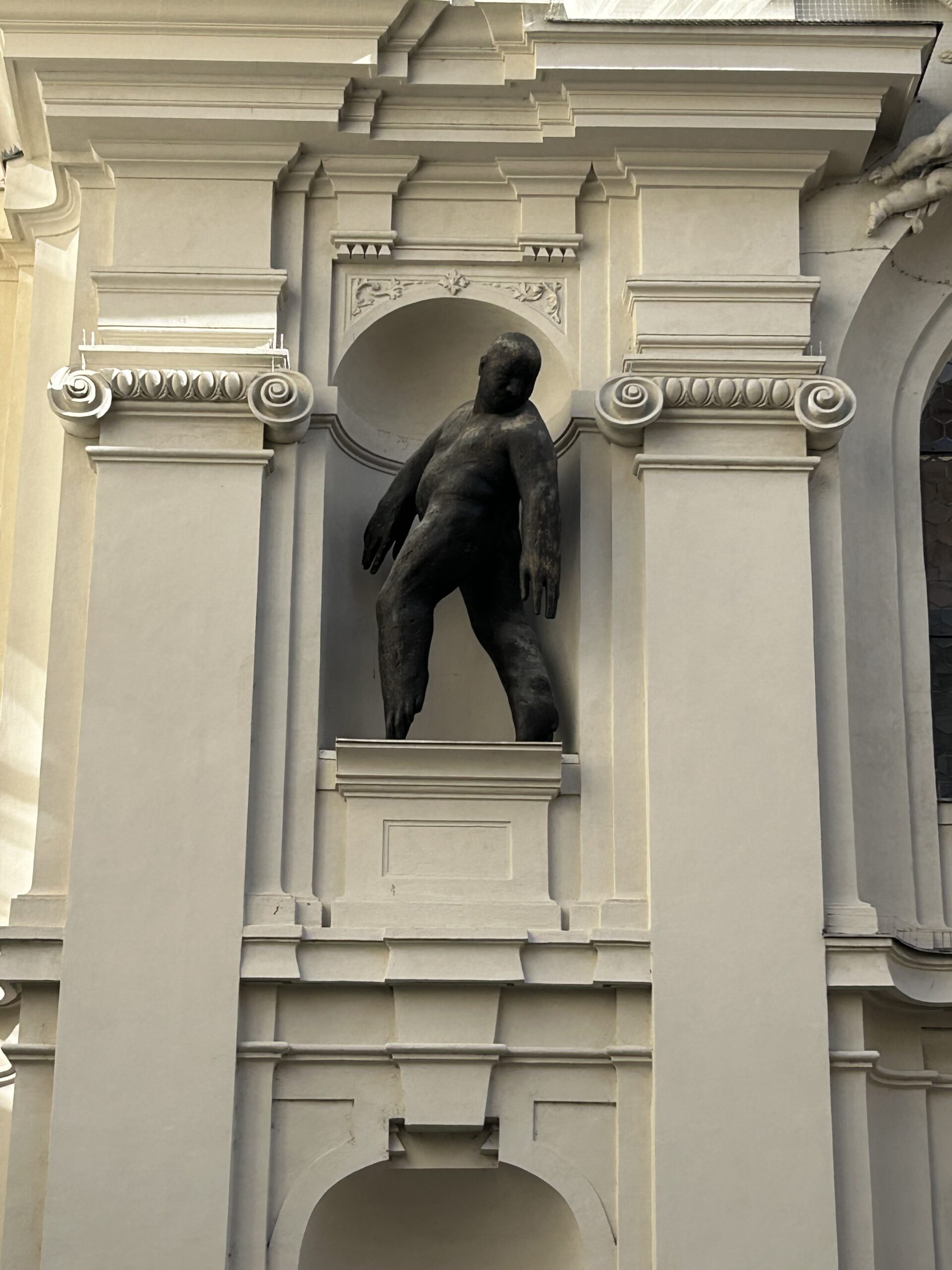
In the courtyard of the Landhaus is the Landhaus Chapel of St. George, the patron saint of Tyrol, which was also redesigned in baroque style in 1728. Above the altar, the saint is honored with the words “Honori perpetuo DIVI Georgii Martyris Provinciae Tyrolensis Tutelatis” (To the eternal honor of Saint George, patron saint of the Tyrol region). The Tyrolean eagle is carried by putti. Striking on the baroque façade are the modern statues in the niches. In 2009, Ladin sculptor Lois Anvidalfarei created four scenes from the life of Saint George for the 200th anniversary of the Battle of Bergisel to symbolize the struggle between good and evil. Evil is represented not by a dragon, as in the legend of Saint George, but by a human figure. Considering Tyrolean history—especially that of the New Government Building around the corner—it is quite fitting to recall human ambivalence in a political context.
Thurn und Taxis and the invention of the post office
The twentieth and twenty-first centuries are commonly regarded as the Information Age. The internet has revolutionized almost every aspect of life. Yet the major transformations that took place around 1500 were also closely linked to new ways of disseminating information. The production and distribution of news, information, and ideas were fundamentally transformed by two innovations. With the invention of the printing press, the reproduction of information became far easier. At roughly the same time, a more efficient postal system began to develop within the Holy Roman Empire. The history of the Taxis family, which established and operated this postal service, exemplifies the opportunities for advancement offered by the early modern period around 1500. Their story is closely connected to the Habsburgs and to the city of Innsbruck, which under Emperor Maximilian was, for a brief period, not only a residence city but the central hub of European postal communication.
The Taxis were a Lombard family of the lower nobility. As early as the thirteenth century, Omodeo de Tasso had established a courier service linking the major cities of northern Italy. During the Middle Ages, however, no reasonably functioning, cross-border postal system existed comparable to that of ancient Rome. The expanding empire under Maximilian—stretching from the Netherlands via Augsburg and Regensburg to Vienna—required communication to be as efficient as possible. To achieve this, Maximilian engaged the Compania de Tassis, which established a permanent relay-based postal route for the Emperor, complete with infrastructure and personnel. The brothers Janetto, Francesco, and Giovanni Battista de Tassis—known in German as Franz and Johann Baptist von Taxis—were appointed Imperial Postmasters by Maximilian I. The Emperor sought to harness their expertise in order to bind his vast realm together through information networks.
At intervals of 20 to 40 kilometers, stations known as posts were established, where messengers and horses could be changed in order to shorten delivery times. Innsbruck became the first modern postal center of the early modern Habsburg Empire. Its location at the foot of the Brenner Pass was now decisive not only for trade but also for the exchange of information. The first postal route, established in 1489, ran from Innsbruck to Mechelen. Soon, the route linking the Netherlands and Italy became known as the “German Route.” With the postal system came additional administrative functions to Innsbruck. The city became a collection point for court mail, which was forwarded from there to the Emperor’s current location. The court chancery assembled the archives of correspondence and chamber administration records in Innsbruck. The news exchanged between correspondents—so-called Zeitungen—gave rise to a new profession: the novellants, who gathered and wrote up current information.
A few years after Maximilian’s death, the Taxis courier service was opened to the private market, albeit still under strict supervision. The Habsburgs were notoriously late payers, and costs had to be covered. This development also offered advantages to the authorities. The growing number of users of the postal system enabled broader surveillance. The Counter-Reformation and the military made systematic use of the post for their purposes. At individual postal stations, so-called “Black Chambers” existed, where suspicious letters were opened. Postmasters also functioned as a kind of intelligence service. Gradually, passenger transport was added to the routes as a way of maximizing revenue. As the Habsburg Empire expanded, so too did the Taxis relay system. In 1505, Philip I of Spain granted the family responsibility for postal services on the Iberian Peninsula as well. Following the Italian conquests under Charles V, the Habsburgs also controlled large parts of northern Italy. From Spain to Hungary, from Milan to Brussels, an expansive information network emerged.
Durch die Kontrolle der europäischen Kommunikation kamen die Taxis zu Macht, Einfluss und Reichtum. Seit 1650 nannte sich das Geschlecht Thurn und Taxis. Vom alten italienischen Tasso, zu Deutsch Dachs, war nichts mehr übriggeblieben. Erst mit der Zentralisierung und dem neuen Staatsverständnis der Aufklärung des 17. Jahrhunderts begann ihr Stern zu sinken. 1769 wurde das Postregal der Familie Taxis für Vorderösterreich aufgehoben. Die Umwälzungen der Napoleonischen Kriege brachten weitere Änderungen mit sich. Als das Heilige Römische Reich When the Thurn und Taxis were dissolved in 1806, they were only able to claim the postal service for themselves in a few German principalities. The service was increasingly monopolised. Post offices became symbols of the penetration of state power in the public sphere. In 1908, the new main post office was built in Maximilianstraße in Innsbruck according to the plans of Natale Tommasi. As with railway stations, the architecture of the building was no different from other large post offices within the Habsburg Empire. Those who conducted their postal business as subjects of Emperor Franz Joseph I were to be able to do so in the same look and feel throughout the entire monarchy between Trento and Lviv.
After the First World War, the Thurn und Taxis family lost its aristocratic privileges. Many of their castles, properties, and palazzi across Europe, however, remain in family ownership to this day. Until 1969, the Old Post Office stood opposite the main post office in Innsbruck; for a time, it was also owned by the Thurn und Taxis family. Since the turn of the millennium, the fate of postal services has mirrored that of the Taxis family itself: shipping and courier services are increasingly transferred to private hands. The state-monopolized postal system of the twentieth century may have been only a brief interlude. Unlike the Taxis family, however, DHL, UPS, and others must content themselves with plain profit and are not elevated to the nobility. The Fugger–Taxis Palace in Innsbruck, by contrast, still serves as a reminder of the Emperor’s postmasters.
Jakob Fugger: the richest man in history
There were hardly any uncrowned individuals who exerted a greater influence on European history well into the twentieth century than Jakob Fugger (1459–1525). Fugger came from a merchant family in Augsburg. His birth was recorded in the city’s tax register with the linguistically amusing entry “Fucker advenit,” which—when read today—transcends modern language boundaries. That the little “Fucker” would one day build an unprecedented, globally operating financial empire out of the family business was by no means foreseeable. Following long-standing family tradition, Jakob and his brothers initially traded cotton with the wealthy cities of northern Italy. In the region between Florence, Venice, and Milan, an early form of financial capitalism had emerged. From there, banking began its triumphant advance across Europe in the late Middle Ages. This system soon crossed the Alps; Innsbruck, too, had branches of Italian financial institutions from the High Middle Ages onward. Merchants who did not wish to carry vast amounts of cash required so‑called bills of exchange to conduct their transactions. In the major trading cities, commercial offices modeled on Italian examples were established. In Venice—the center of long-distance trade in the eastern Mediterranean—Jakob Fugger learned the art of double-entry bookkeeping and the subtleties of advanced Italian economic management. He quickly realized that far more profit could be made through financial transactions and lending than through cotton trading.
The financial-political system prevailing at the time, combined with new demands on power politics, formed the framework within which early capitalism could grow. During the Middle Ages, Europe’s monarchs and aristocrats financed their courts and wars through the tithe, a levy paid by peasants within the feudal system. Modern warfare, driven by the introduction of firearms, became increasingly expensive in the fifteenth century, and the tithe was more and more often insufficient to finance armies. Generous contributions from investors in the growing private economy were required, providing funds in exchange for collateral and interest. For centuries it had been sufficient to know that God’s blessing was on one’s side; at the transition to the modern era, the realization emerged that having a powerful house bank was also no disadvantage. The Fugger trading and financial network expanded rapidly in this fertile climate. For their textile business, branch offices were established in Venice, Bolzano, Milan, Nuremberg, Frankfurt, Bruges, and Antwerp. These branches were multifunctional hybrids comprising sales outlets, bank branches, horse stations, warehouses, postal and news offices, and diplomatic representations. Capital and politics did not remain separate for long. Jakob Fugger’s connection with the House of Habsburg—and with Tyrol in particular—began to intensify in 1487. The Tyrolean ruler Archduke Sigismund suffered defeat in a military conflict with the Republic of Venice. To repay his debts to the Mediterranean power, amounting to 100,000 guilders, he borrowed money from the Fuggers. In return, he issued promissory notes secured by pledging the silver mine at Schwaz to his creditors. Prior to the exploitation of the American silver mines, Schwaz was the largest silver mine in the world. The Fuggers sold the Schwaz silver to the mint at Hall, which they themselves also operated, and then lent these newly minted coins back to Duke Sigismund. A cycle of a very special kind was born. This did not mark the end of the Fuggers’ political influence on world affairs; rather, it was only the starting signal. When the Tyrolean estates deposed Sigismund in 1490 because of his disastrous financial management, Maximilian I succeeded him as ruler of Tyrol. Not only did Maximilian’s lifespan coincide with that of Jakob Fugger, but the destinies of the two men were closely intertwined. The history of Tyrol itself was shaped by the most significant financial magnate of his age. Fugger was astute enough to place his trust in the new ruler. The word “credit,” derived from the Latin credere—to believe—finds clear expression in this decision. Fugger believed that a powerful Maximilian was his most valuable asset. In 1493, Fugger financed Maximilian’s election as Emperor of the Holy Roman Empire, thereby securing his influence and elevation to the nobility. Fugger was also the sponsor of the Viennese double marriage—Maximilian’s masterpiece of dynastic marriage policy—through which Hungary became part of the Habsburg realm. When Maximilian died in 1519, Fugger repeated this strategy, using his financial power to ensure the election of Maximilian’s grandson Charles V as emperor. A loan of 540,000 guilders was extended by the Fuggers to the Habsburgs to cover campaign and bribery expenses. In return, Charles V granted Fugger rights to mines in Spain and South America, where enslaved people worked under inhumane conditions to keep this cycle of exploitation and corruption in motion.
Between 1487 and 1525 alone, the Fuggers granted the Habsburgs an estimated two million guilders in loans. One guilder was equivalent to sixty crowns, while a day laborer earned approximately six crowns per day. With this sum, nearly 55,000 people could have been employed daily for an entire year. A significant portion of these debts was repaid through usage rights to Tyrolean assets and increased taxation. It is estimated that at the time of Jakob Fugger’s death, his financial empire handled around 50 percent of Tyrol’s state budget and controlled 10 percent of the assets of the Holy Roman Empire. His officials managed mines in Tyrol, Bohemia, Slovakia, and Spain, financed trading expeditions throughout the entire known world of the time, and funded numerous wars across Europe. To some historians, Jakob Fugger is considered the richest man in world history. The exact extent of his wealth is difficult to translate into modern terms; when the Frankfurter Allgemeine Zeitung attempted such a calculation in 2016, it arrived at a figure of 300 billion US dollars. Like Maximilian I, Jakob Fugger was both a power-driven individual and an educated, devout Catholic. Corruption, exploitation, the financing of wars, and—out of piety and fear of purgatory—the founding of the Fuggerei, the world’s first social housing complex in Augsburg, were not mutually exclusive in his worldview. In Innsbruck, the Palais Fugger‑Taxis as well as a small alley between Maria‑Theresien‑Strasse and Landhausplatz still commemorate the Fugger family.
Innsbruck - city of bureaucrats and civil servants
Innsbrucker brüsten sich stolz der vielen Titulierungen ihrer Heimatstadt. Für jeden Geschmack ist etwas dabei: Hauptstadt der Alpen, Universitätsstadt, Österreichs Sportstadt oder Heimat des weltbesten Krankenhauses. Wirft man einen Blick auf die Liste der größten Arbeitgeber der Region oder in die Geschichte, ist Innsbruck vor allem eins: Beamtenstadt. Universität und Landeskrankenhaus sind zwar die größten einzelnen Arbeitgeber, rechnet man aber die öffentlichen Bediensteten aller Ebenen, Stadt, Land und Bund zusammen und nimmt die ausgelagerten Unternehmen im Besitz der öffentlichen Hand wie die ÖBB, TIWAG oder die Innsbrucker Kommunalbetriebe hinzu sowie Lehrer und Polizei, sind die Beamten klar in der Überzahl. Diese Titel hat auch die längste Tradition. Spätestens seit der Übersiedlung der landesfürstlichen Residenz unter Friedrich IV. machte die Beamtenschaft nicht nur einen beträchtlichen quantitativen Teil der Bürgerschaft aus, sie bestimmt die Geschicke der Stadt in einflussreicher, wenn auch unauffälliger Manier. Bis heute sind es Beamten, die den Laden am Laufen halten. Sie setzen Gesetze durch, kümmern sich um die Planung und Instandhaltung von Infrastruktur, machen eifrig Aufzeichnungen über die Bevölkerung, um Steuern ein- und Soldaten auszuheben. Die erste Welle der Bürokratie kam wohl bereits mit dem Roman Empire. Den Römern folgten im frühen Mittelalter die Brüder des Stiftes Wilten. Die schreibkundigen Männer verwalteten nicht nur die herzoglichen und eigenen Besitztümer durch ihre Urbare und hoben die Abgaben bei den bäuerlichen Untertanen ein, sondern legten Taufmatrikel, Heiratsverzeichnisse und Sterbebücher an. Die Feudalherrschaft erforderte zwar einen Panoramablick über das, was sich innerhalb ihres Herrschaftsbereichs abspielte, vor allem in der Stadt war das Leben aber eher von den Beschränkungen der Zünfte als von denen der Obrigkeit bestimmt. Ein Magistrat war nur oberflächlich vorhanden. Es gab Gesetze, aber keine Polizei, Steuern aber kein Finanzamt. Städtische Infrastruktur war praktisch nicht vorhanden, schließlich gab es weder fließend Wasser, elektrischen Strom, Kanalisation, städtische Kindergarten, ein Arbeitsamt oder eine Krankenkasse. Die zur Stadt erhobene Gemeinde Innsbruck wurde lange von einem Stadtrichter, ab dem 14. Jahrhundert von einem Bürgermeister mit Gemeinderat regiert. Es handelte sich dabei nicht um hauptberufliche Beamte, sondern Mitglieder der städtischen Elite. Nur wenige Menschen wie Zöllner, Kornmesser, Schreiber oder Turmwächter standen bei der Stadt unter Lohn und Brot.
In the 15th century, professional life and society became more differentiated, armies grew larger, and tax burdens increased. Traditional customary law was replaced by modern Roman law, which was more difficult for laypeople to understand. As the city grew, so did the bureaucratic apparatus. Between the early 15th century and the reign of Leopold V, Innsbruck had developed from a trading and transport settlement into a civil servants’ city. Of the approximately 5,500 inhabitants, more than half belonged to the court, the municipal administration, the university, or the clergy. Court life, administration, customs, taxation, long-distance trade, and finance required literate personnel. Administration had become the city’s most important economic sector, ahead of crafts, transport, and hospitality. Civil servants distinguished themselves socially. If at all, citizens usually encountered these foreign people only in unpleasant situations. The reins were tightened particularly firmly under Maximilian I. Laws decided centrally were implemented locally by the Imperial Circles. Salaried officials penetrated the lives of individuals in a way unknown in the Middle Ages. To make matters worse, these officials often came from abroad. Italians and Burgundians in particular were sought-after key personnel, but they remained alien to the local population. Not only did they often not speak German; they could read and write, were employees rather than subject peasants. They had more money, dressed differently, followed different customs, and ate different foods. Unlike the territorial prince, they did not invoke God, but rules written by humans and inspired by antiquity and reason. Depending on the fashions, customs, and moral concepts of the time, laws changed. Just as nature conservation or speed limits on motorways are repeatedly debated today despite their obvious sense, prohibitions against spitting, disposing of chamber pots, wooden buildings, and keeping livestock within the city walls were criticized at the time—even though they drastically improved hygiene and safety.
While it had long been customary for citizens to take certain liberties in the absence of the ruler—whether in logging, construction, hunting, or fishing—the bureaucracy was always present. Whereas the territorial prince was seen as a benevolent father of his subjects, and bishops and abbots, though strict landlords, could at least offer salvation in return, the new administrative authority appeared anonymous, aloof, faceless, foreign, and distant. The basis for negotiation that a subject once had in direct contact with his lord was buried by merciless law—at least if one could not pay bribes or did not know someone in a higher position. When the unconditional faith in an increasingly corrupt clergy began to crumble and Ferdinand I appointed the Spaniard Salamanca as the country’s supreme financial administrator, the simmering dissatisfaction erupted into open rebellion in 1525. The subjects did not demand the deposition of the prince, but a change in the rule of the clergy and the foreign bureaucracy. Even in the 17th century, it was the head of Wilhelm Biener, the highest-ranking official in the country, that rolled—not that of the sovereign.
Bureaucracy, the rule of the administration, also had advantages for the subjects. It established fixed rules where arbitrariness often prevailed. The law, harmonised across different territories, was more predictable. And with a bit of luck and talent, it was possible to climb the social ladder by serving the public authorities, even without belonging to the nobility. Michael Gaismair, one of the leaders of the 1525 rebellion, was the son of a mining entrepreneur and had been in the service of the provincial governor before his career as a revolutionary.
The next modernization of administration took place in the 18th century. Under the enlightened absolutist monarchs Maria Theresa and Joseph II, a new wind blew down to the municipal level. Innsbruck received a police force for the first time. The city administration was modernized in 1784. Instead of the old town council with its community assembly, a mayor now governed, supported by a council and above all by civil servants. This magistrate consisted of salaried experts who were still largely members of the lower nobility, but who now had to qualify for office through examinations. Bureaucracy gained more power at the operational political level. While the office of mayor was limited in time, civil servants enjoyed lifelong, non-terminable positions. This tenure and a renewed surge of new laws—often contradicting tradition—reinforced the image of civil servants as aloof and distant from citizens. When the element of foreign rule was added with the Bavarian occupation of Tyrol—modeled on French administration—another uprising broke out in 1809. The mass conscription of young men for military service, regulation of religious life, and compulsory vaccination, enforced by Bavarian officials, was too much for the Tyrolean psyche.
After 1809, bureaucracy expanded into ever more areas of life as part of industrialization and new technologies. Not only the state through taxation and the military, but also universities, schools, construction, railways, the postal system, and institutions such as the Chamber of Trade and Commerce required administrative staff. The city grew in population and businesses alike. New infrastructure—gas, sewer systems, and electricity—and new ideas about hygiene, food inspection, health, and education demanded new employees in the municipal administration. The old town hall in the Old Town became too small, and an extension proved impossible. In 1897, the civil servants moved into the new town hall on Maria-Theresien-Straße. The move was made possible by the generous donation of the industrialist and hotelier Leonhard Lang. He had converted the former Palais Künigl into the Hotel d’Autriche before the mayor and his entourage moved in.
When the monarchy collapsed in 1918, the transition was not seamless, but thanks to the structures in place, it was unimaginably smooth. However, it was no longer the emperor who carried the burden of the state, but a host of civil servants and guardians of order who provided water, electricity and a functioning railway network. With Eduard Klingler and Theodor Prachensky, two heads of building authorities in the first half of the 20th century left their mark on Innsbruck's cityscape, which is still clearly visible today. With agendas such as public housing, the labour office, education, urban infrastructure, road construction, public transport, registration and weddings, the Republic took over more or less all the tasks of daily life from the monarchy and the church. So for anyone who is annoyed by excessive officialdom and agonisingly slow bureaucracy on their next visit to the New Town Hall, it is worth remembering that the welfare state in the person of its civil servants manages the social welfare and public infrastructure of thousands of people from the cradle to the grave, mostly unnoticed.
The master builders Gumpp and the baroqueisation of Innsbruck
The works of the Gumpp family still strongly characterise the appearance of Innsbruck today. The baroque parts of the city in particular can be traced back to them. The founder of the dynasty in Tyrol, Christoph Gumpp (1600-1672), was actually a carpenter. However, his talent had chosen him for higher honours. The profession of architect or artist did not yet exist at that time; even Michelangelo and Leonardo da Vinci were considered craftsmen. After working on the Holy Trinity Church, the Swabian-born Gumpp followed in the footsteps of the Italian master builders who had set the tone under Ferdinand II. At the behest of Leopold V, Gumpp travelled to Italy to study theatre buildings and to learn from his contemporary style-setting colleagues his expertise for the planned royal palace. Comedihaus aufzupolieren. Seine offizielle Tätigkeit als Hofbaumeister begann 1633. Neue Zeiten bedurften eines neuen Designs, abseits des architektonisch von der Gotik geprägten Mittelalters und den Schrecken des Dreißigjährigen Krieges. Über die folgenden Jahrzehnte wurde Innsbruck unter der Regentschaft Claudia de Medicis einer kompletten Renovierung unterzogen. Gumpp vererbte seinen Titel an die nächsten beiden Generationen innerhalb der Familie weiter. Die Gumpps traten nicht nur als Baumeister in Erscheinung. Sie waren Tischler, Maler, Kupferstecher und Architekten, was ihnen erlaubte, ähnlich der Bewegung der Tiroler Moderne rund um Franz Baumann und Clemens Holzmeister Anfang des 20. Jahrhunderts, Projekte ganzheitlich umzusetzen. Auch bei der Errichtung der Schanzwerke zur Landesverteidigung während des Dreißigjährigen Krieges waren sie als Planer beteiligt. Christoph Gumpps Meisterstück aber war die Errichtung des Comedihaus im ehemaligen Ballhaus. Die überdimensionierten Maße des damals richtungsweisenden Theaters, das in Europa zu den ersten seiner Art überhaupt gehörte, erlaubte nicht nur die Aufführung von Theaterstücken, sondern auch Wasserspiele mit echten Schiffen und aufwändige Pferdeballettaufführungen. Das Comedihaus war ein Gesamtkunstwerk an und für sich, das in seiner damaligen Bedeutung wohl mit dem Festspielhaus in Bayreuth des 19. Jahrhunderts oder der Elbphilharmonie in Hamburg heute verglichen werden muss.
His descendants Johann Martin Gumpp the Elder, Georg Anton Gumpp and Johann Martin Gumpp the Younger were responsible for many of the buildings that still characterise the townscape today. The Wilten collegiate church, the Mariahilfkirche, the Johanneskirche and the Spitalskirche were all designed by the Gumpps. In addition to designing churches and their work as court architects, they also made a name for themselves as planners of secular buildings. Many of Innsbruck's town houses and city palaces, such as the Taxispalais or the Altes Landhaus in Maria-Theresien-Straße, were designed by them. With the loss of the city's status as a royal seat, the magnificent large-scale commissions declined and with them the fame of the Gumpp family. Their former home is now home to the Munding confectionery in the historic city centre. In the Pradl district, Gumppstraße commemorates the Innsbruck dynasty of master builders.
Baroque: art movement and art of living
Anyone traveling through Austria is familiar with the domes and onion-shaped towers of churches in towns and villages. They are the characteristic hallmark of the Baroque architectural style, which reached its peak during the Counter-Reformation and continues to shape the cityscape of Innsbruck to this day. The most prominent churches—such as the Cathedral, St. John’s Church, or the Jesuit Church—are built in the Baroque style. Places of worship were meant to be splendid and magnificent, symbols of the triumph of the true faith. The exuberant, all-encompassing piety of elites and subjects alike was reflected in art and culture: great drama, pathos, suffering, splendor, and glory combined to form the Baroque—a style that left a lasting imprint on the entire Catholic sphere of influence of the Habsburgs and their allies between Spain and Hungary. From the seventeenth century onward, the Gumpp family of master builders and Johann Georg Fischer fundamentally transformed Innsbruck’s cityscape. The Old Provincial Government Building in the Old Town, the New Provincial Government Building on Maria-Theresien-Strasse, countless palazzi, paintings, and sculptures—the Baroque was the defining stylistic force of the House of Habsburg in the seventeenth and eighteenth centuries and became embedded in everyday life. The bourgeoisie did not wish to lag behind the nobility and princes and therefore had their private residences built in the Baroque style as well. Farmhouses were adorned with images of saints, depictions of the Virgin Mary, and representations of the Sacred Heart of Jesus.
Yet the Baroque was more than an architectural style; it was a way of life that emerged in the aftermath of the Thirty Years’ War. The Ottoman threat from the east, culminating in the two sieges of Vienna, dominated the empire’s foreign policy, while the Reformation shaped domestic affairs. Baroque culture became a central element of Catholicism and its political self-representation in public space—a countermodel to the austere and rigorous way of life advocated by Calvin and Luther. Christian holidays were introduced to brighten everyday life. Architecture, music, and painting were rich, full, and exuberant. In theatres such as the Comedihaus in Innsbruck, dramas with religious themes were performed. Ways of the Cross with chapels and representations of the crucified Christ crisscrossed the landscape. Popular piety, expressed through pilgrimages and the veneration of Mary and the saints, became firmly embedded in everyday church life. Multiple crises shaped daily existence. In addition to war and famine, plague epidemics occurred particularly frequently in the seventeenth century. Baroque piety was used as a means of educating subjects, teaching them to interpret these calamities as expressions of God’s dissatisfaction—misfortunes that could be remedied through a devout and virtuous way of life. Although the sale of indulgences was no longer common practice in the Catholic Church after the sixteenth century, vivid notions of heaven and hell persisted. Through a virtuous life—that is, living in accordance with Catholic values and displaying proper conduct as a subject within the divine order—one could come significantly closer to paradise. So-called Christian devotional literature became the most popular reading material following the educational reforms of the eighteenth century and the rising literacy of the population. The suffering of the Crucified for humanity was regarded as a symbol of the hardship endured by subjects on earth within the feudal system. Through votive paintings, people sought assistance in times of hardship or expressed gratitude—most often to the Virgin Mary—for surviving dangers and illnesses. Particularly impressive votive paintings can be admired in the Wilten Basilica. The historian Ernst Hanisch described the Baroque and its influence on the Austrian way of life as follows:
“Austria emerged in its modern form as a crusading imperialism—externally against the Turks and internally against the Reformers. This brought bureaucracy and the military, and externally a multiethnic society. State and Church attempted to control the intimate sphere of citizens’ lives. Everyone had to reform themselves through the confessional; sexuality was restricted, norm-compliant sexuality enforced. People were systematically trained to dissemble.”
Rituals and submissive behavior toward authority left deep traces in everyday culture, distinguishing Catholic countries such as Austria and Italy to this day from Protestant-influenced regions such as Germany, England, or Scandinavia. Austrians’ passion for academic titles has its roots in Baroque hierarchies. The term Baroque prince refers to a particularly patriarchal and patronizing politician who knows how to captivate an audience with grand gestures. While political sobriety is valued in Germany, the style of Austrian politicians remains theatrical—entirely in keeping with the Austrian adage “Schaumamal” (“let’s see”).