Pradlerstraße
Pradlerstraße
Worth knowing
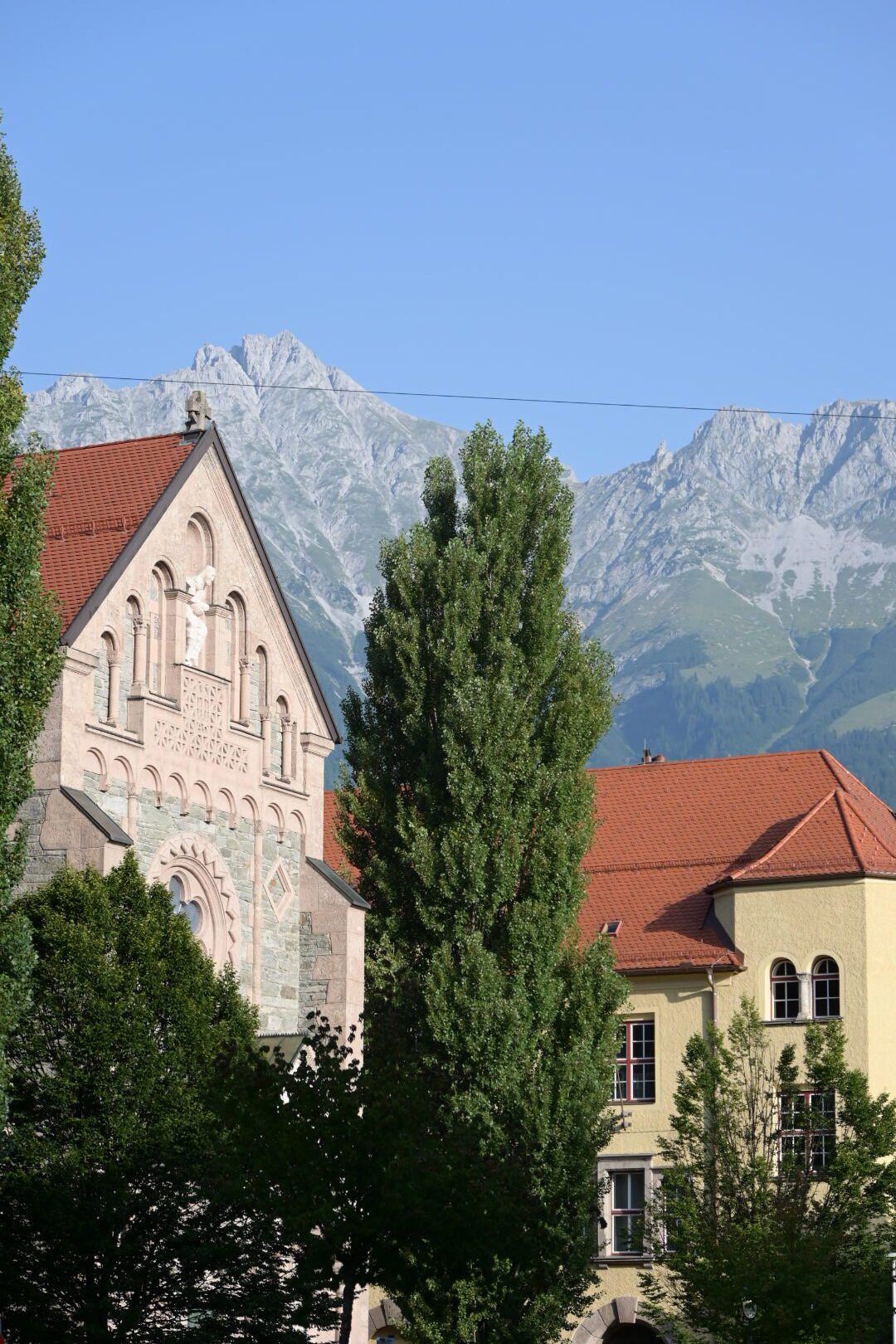
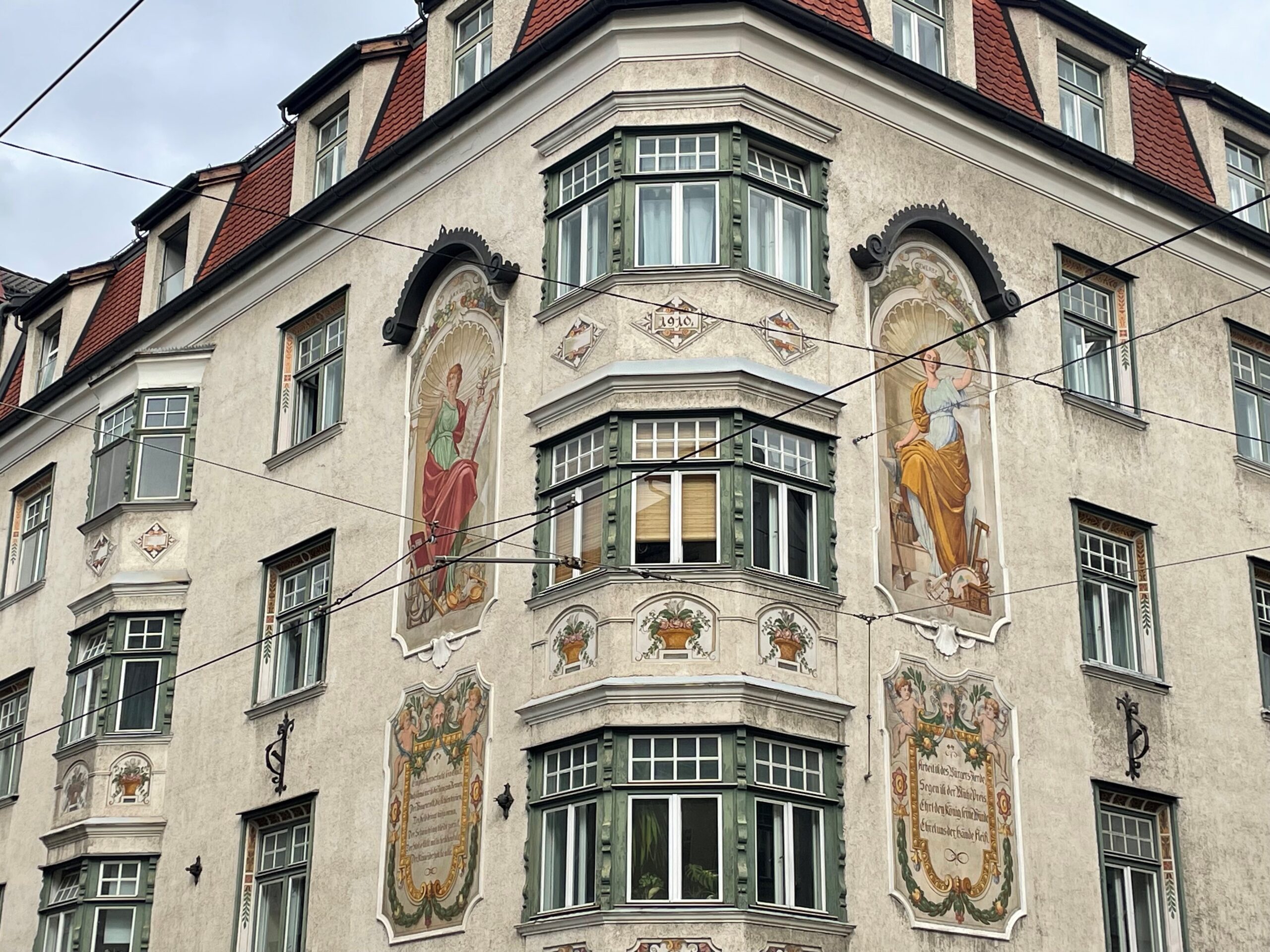
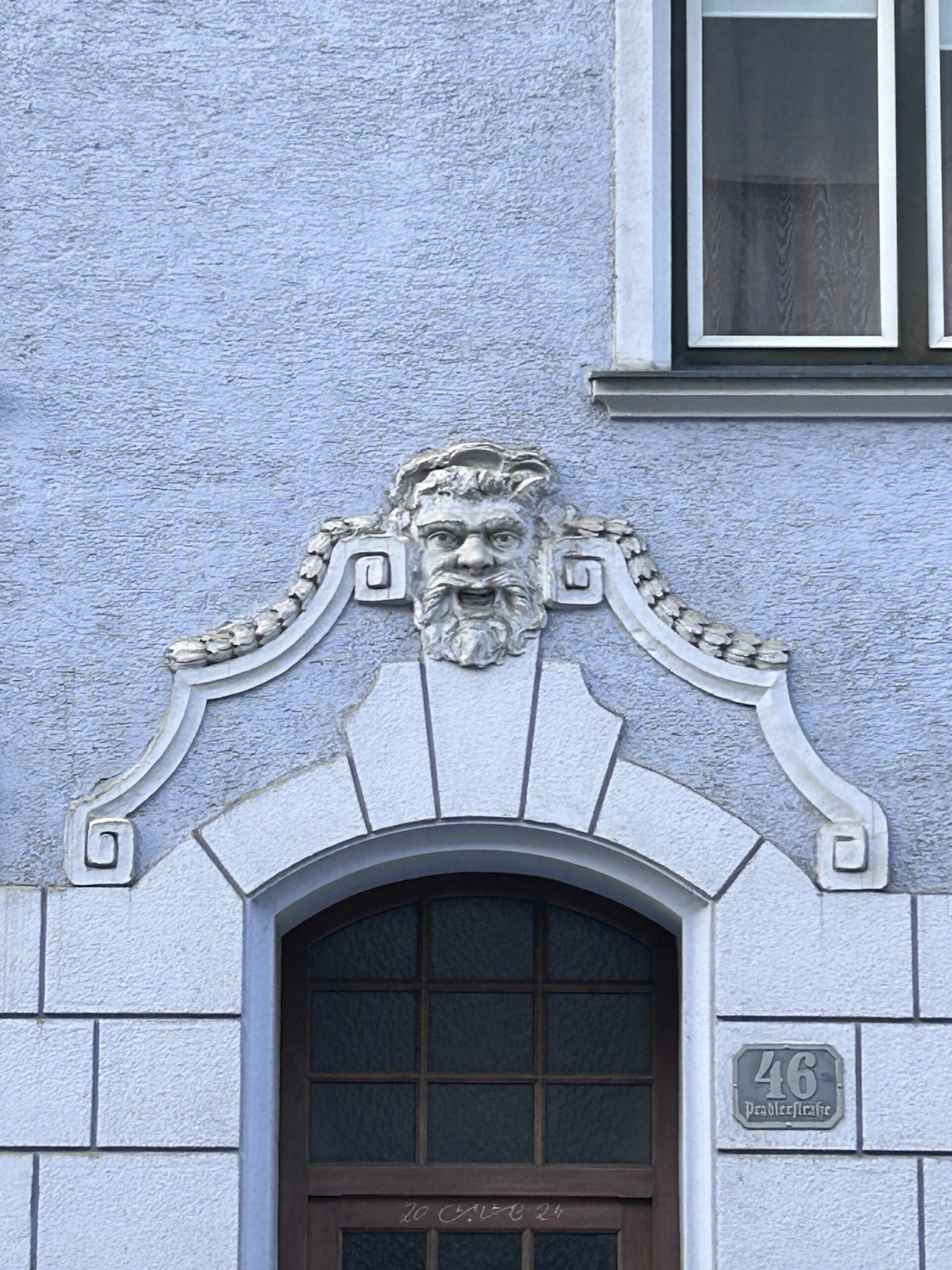
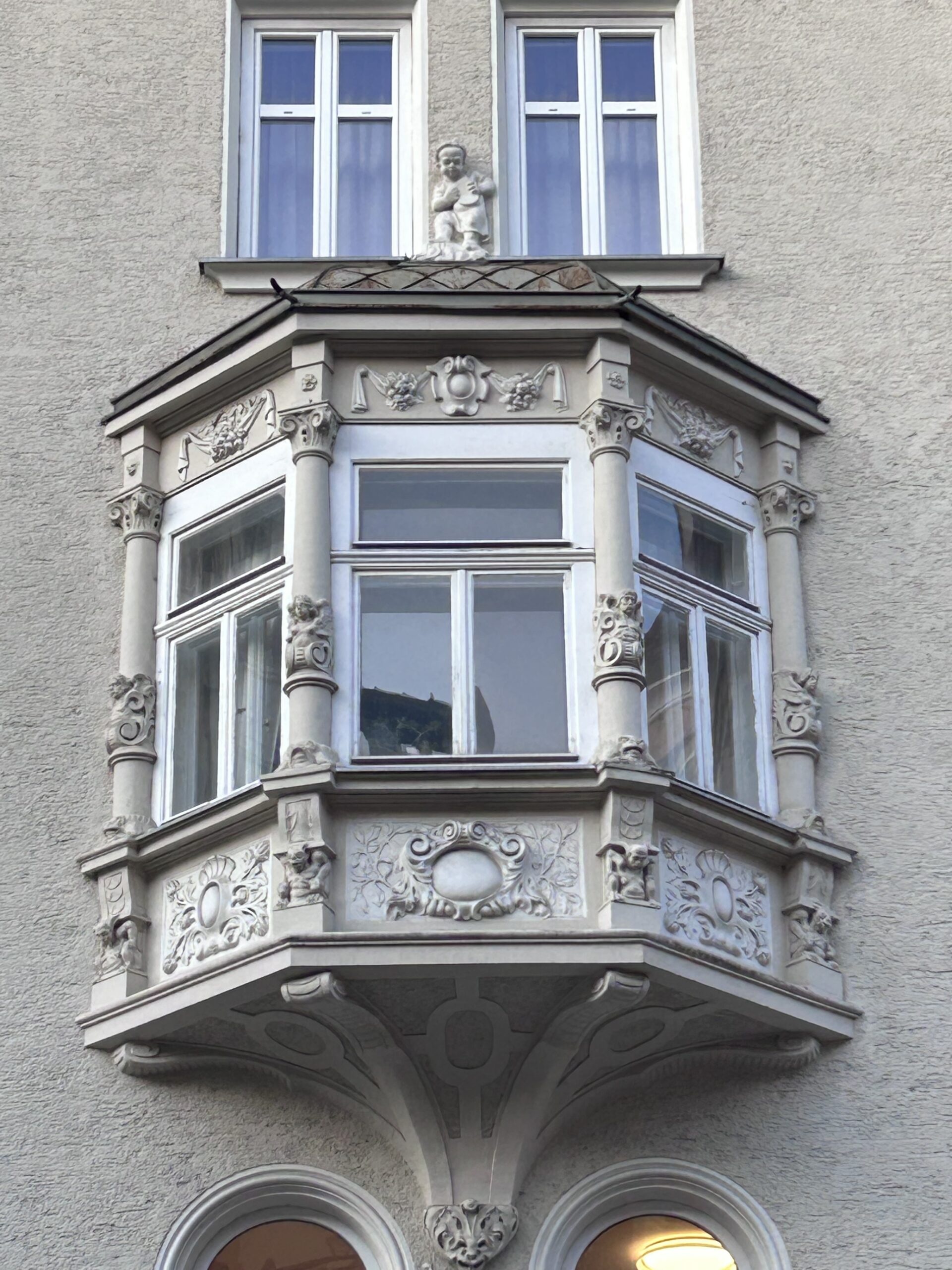
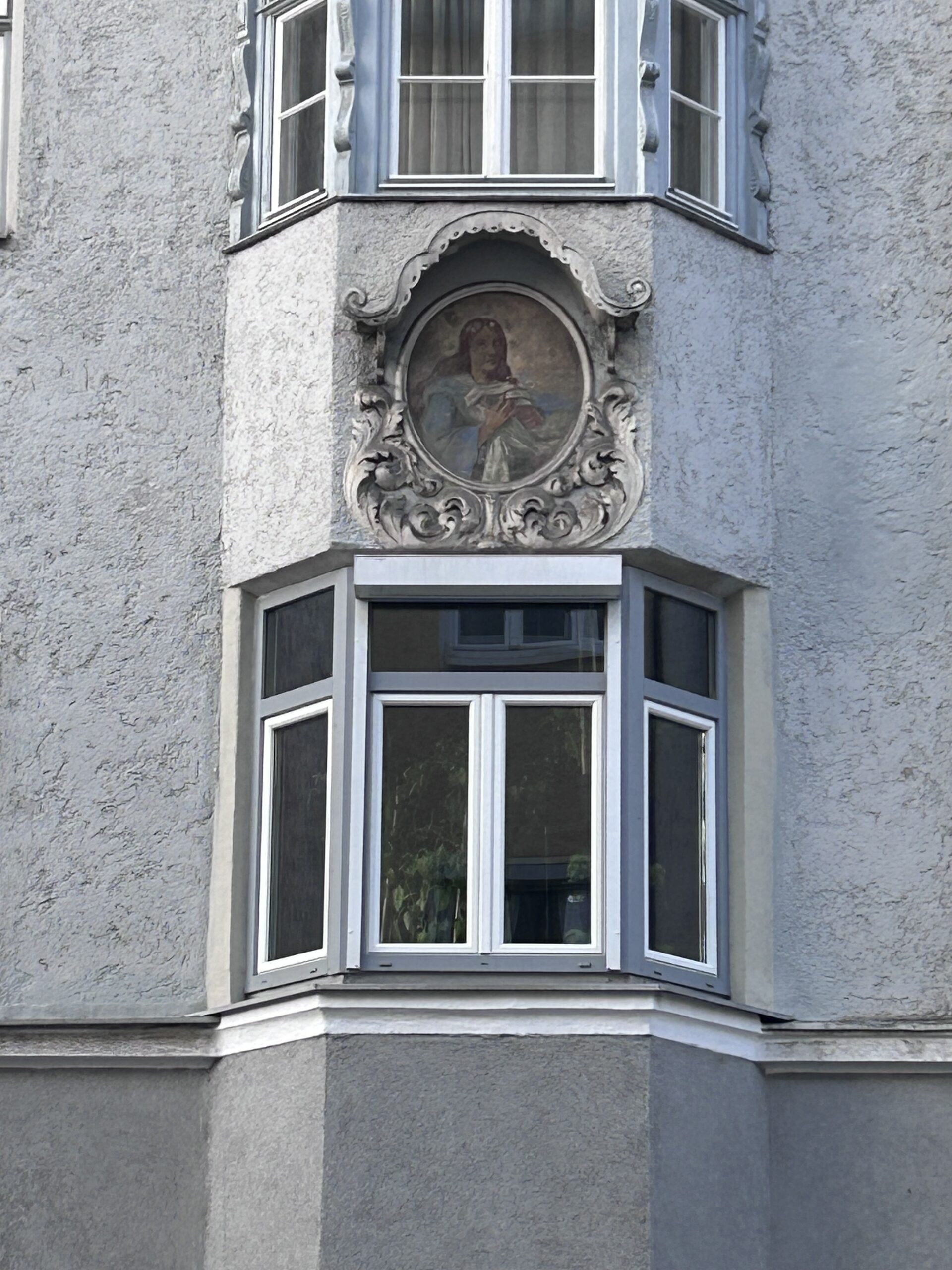
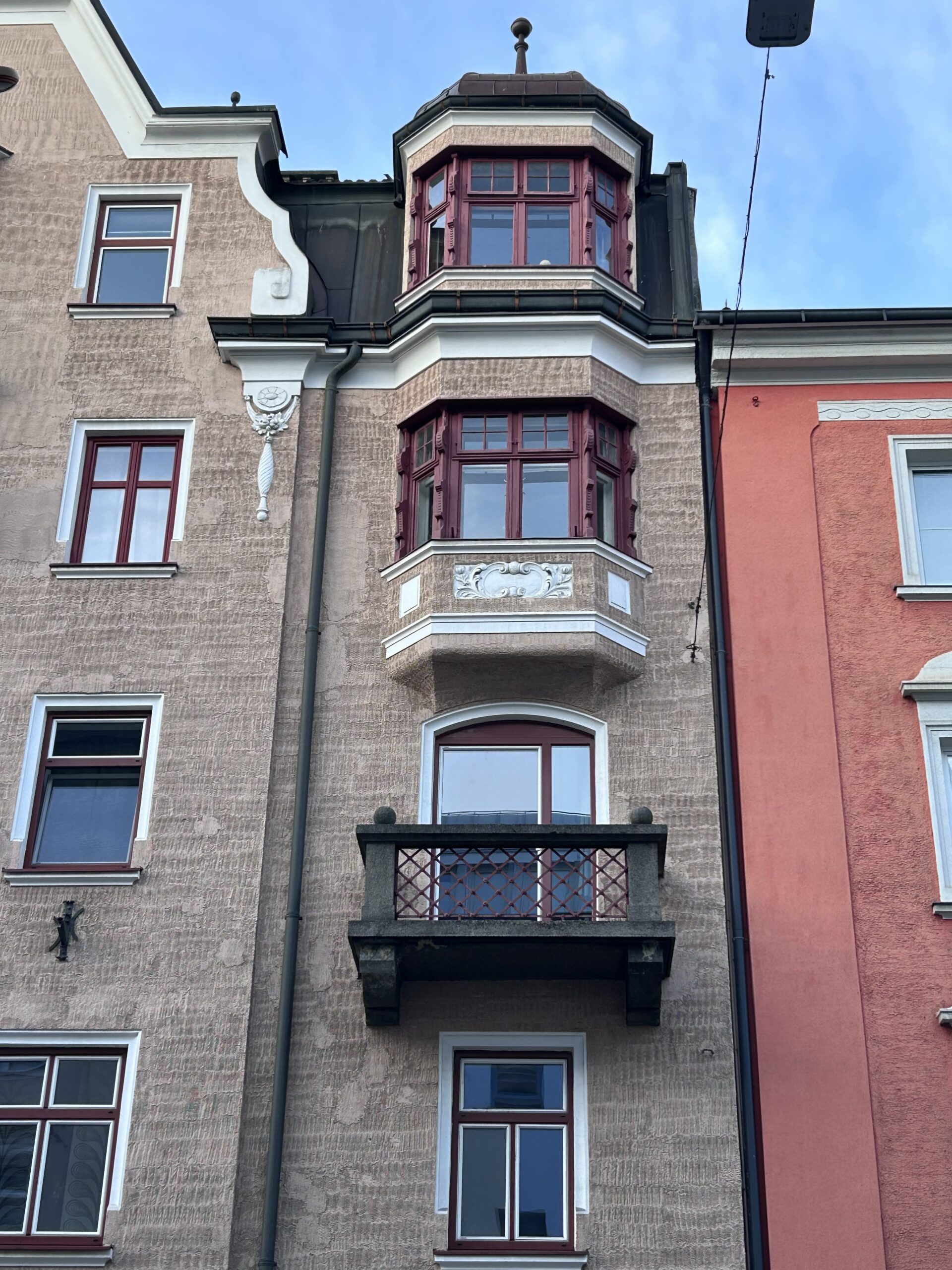
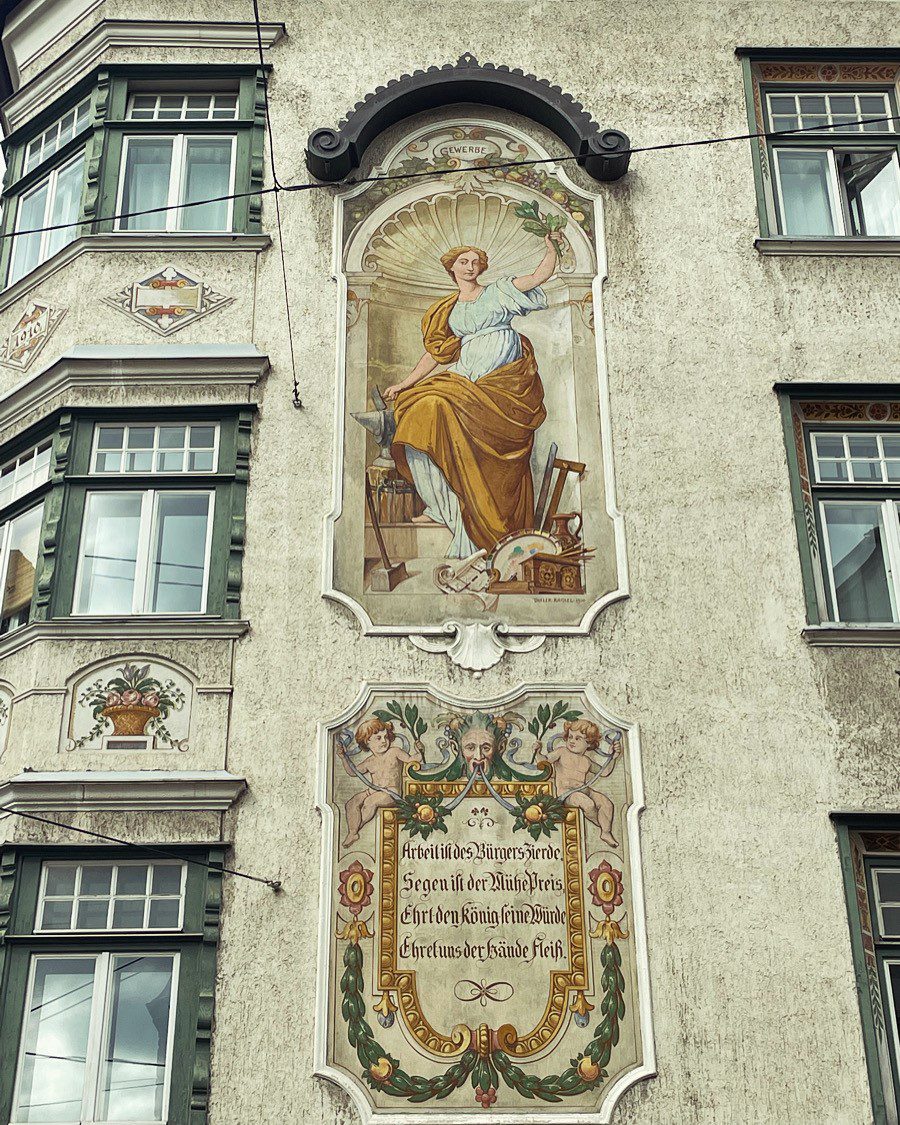
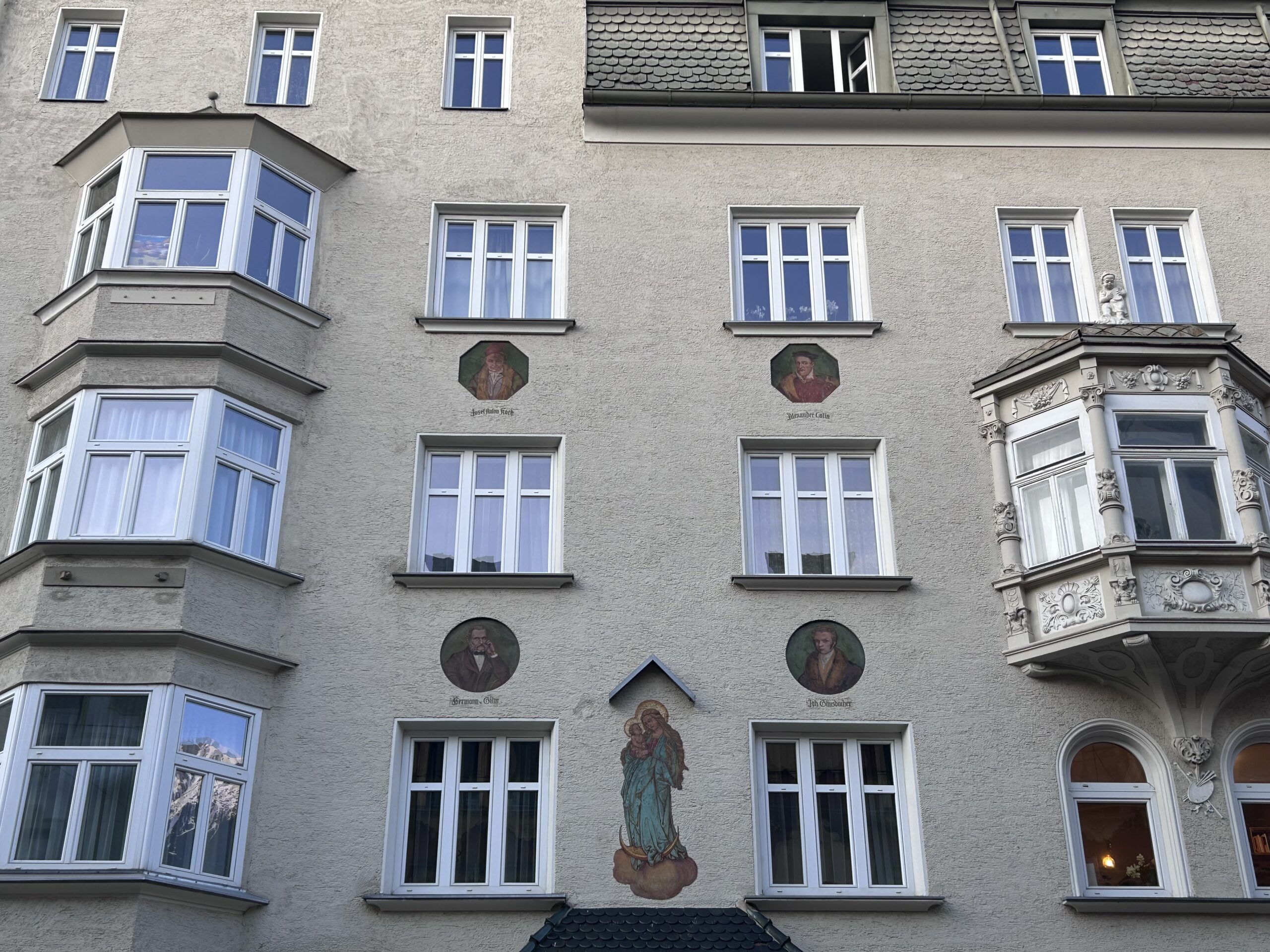
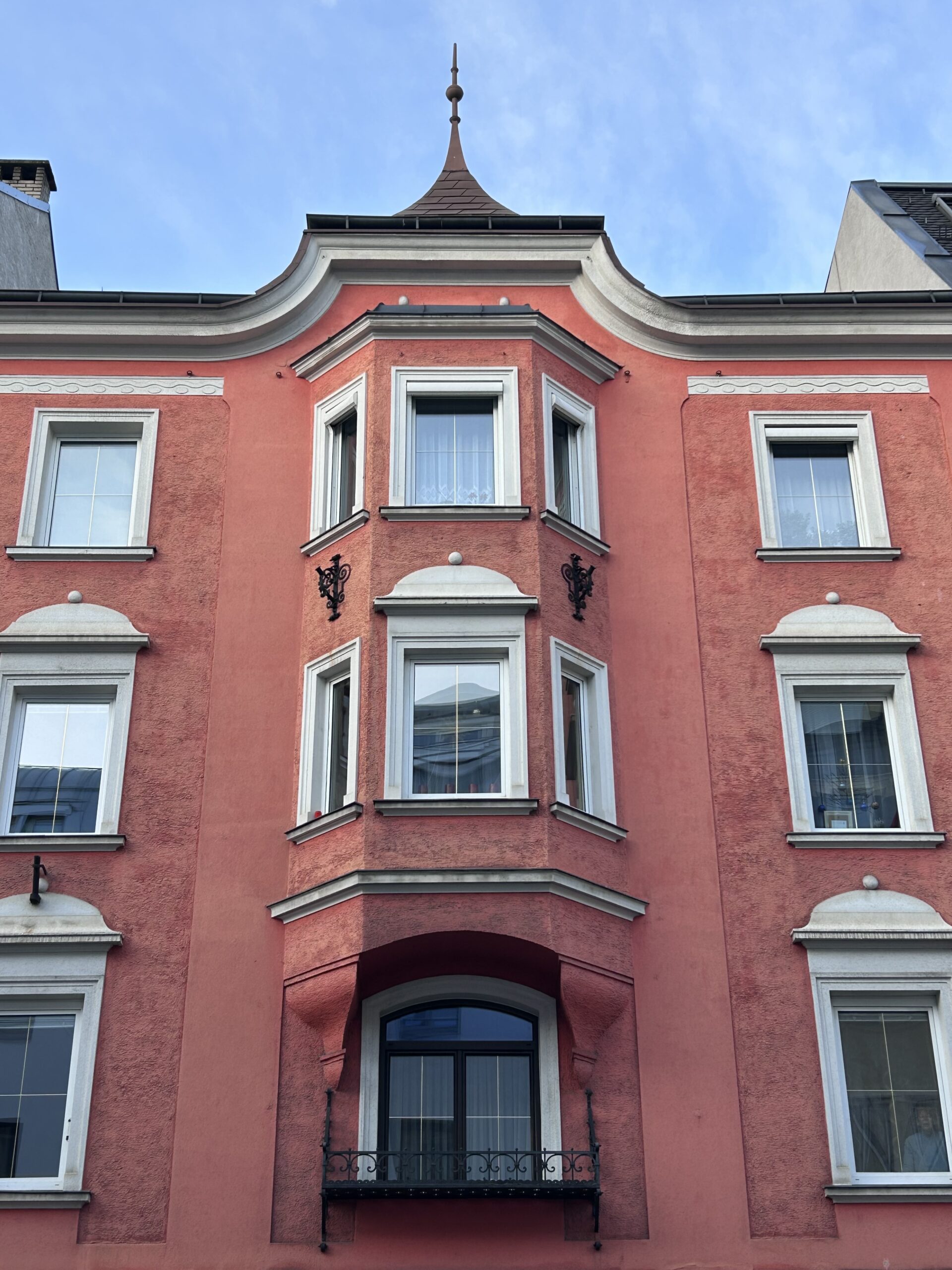
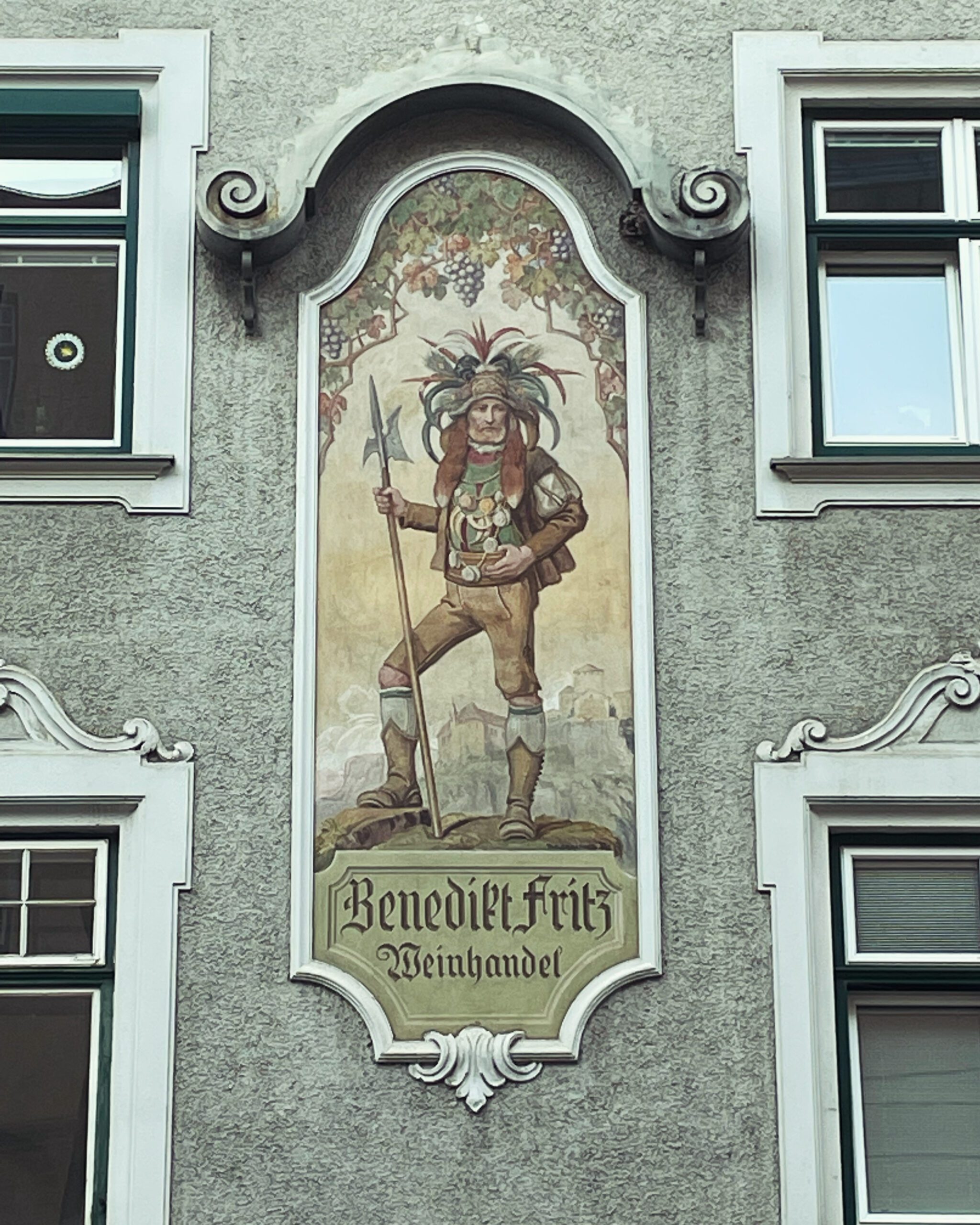
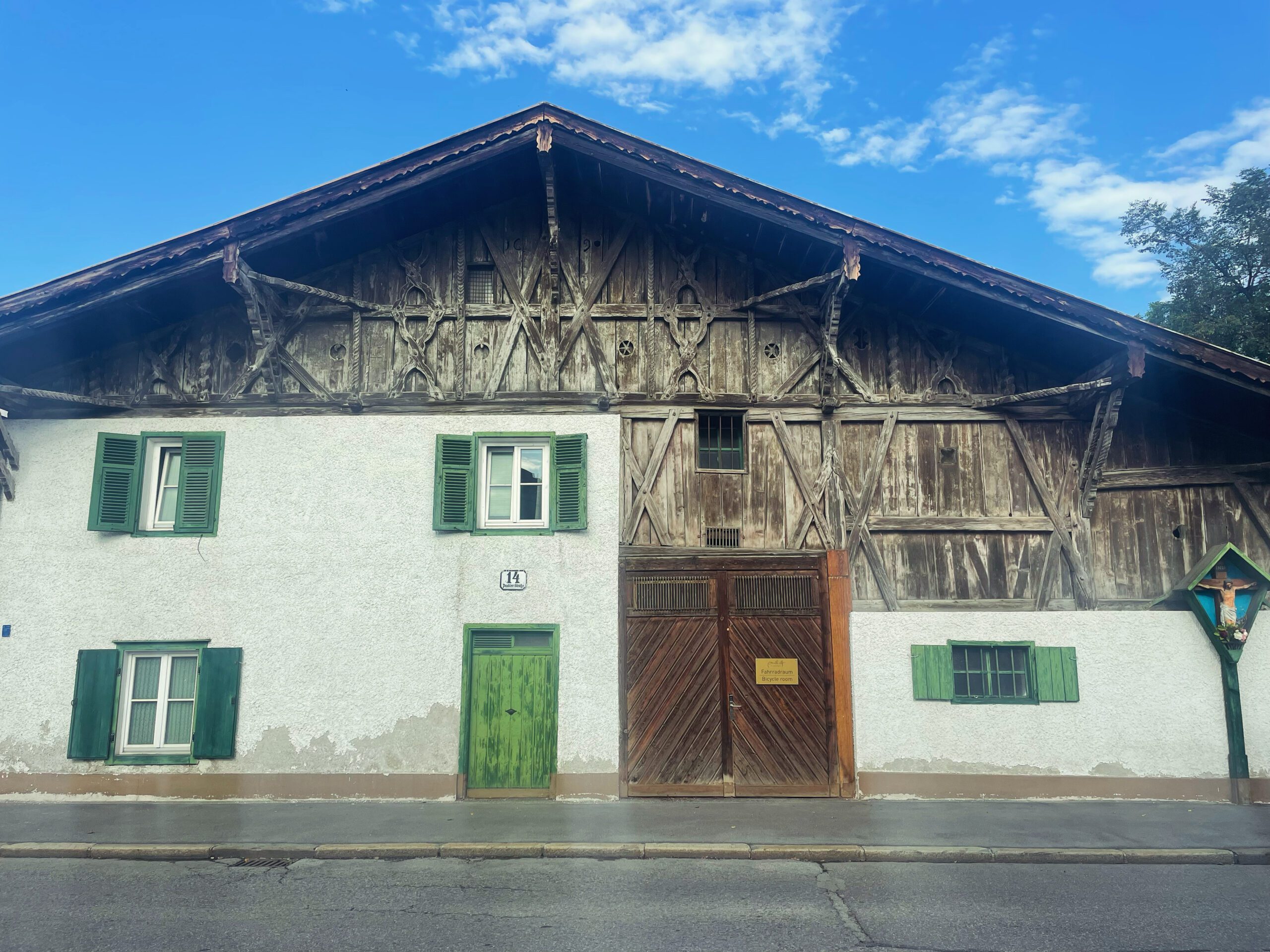
Already in the early modern period, a bridge crossed the Sill, connecting Pradl and Innsbruck. This was the starting point of the “Fürstenweg,” fortified by Ferdinand II, which led all the way to Ambras Castle. The northern part of this early north–south route is today’s Pradlerstraße. A look at the development of this small area tells the story of Innsbruck’s evolution between the 16th and 20th centuries. Throughout the Middle Ages and the early modern period, Pradl was one of many small, rurally shaped villages in the outskirts of the city. In the 19th century, like the other peripheral districts, Pradl became an industrial boomtown. As the city expanded, the old farmhouses were gradually encircled by modern residential buildings and housing estates. Even before Pradl was incorporated into Innsbruck in 1904, major employers such as the Rhomberg silk-spinning factory and the gasworks had settled there. Bakeries, butchers, small shops and inns opened. Unlike Wilten, which had always shown a certain degree of industrialization along the Sill canal, Pradl remained exclusively agricultural until the 19th century. New houses and apartments for employees and workers were needed. Between the intersections Amthorstraße/Pradlerstraße and Gumppstraße/Pradlerstraße, as well as in Gabelsbergerstraße, several of these residential and rental houses still exist today. The sudden change led to tensions between long-established residents and the newcomers. Children from working-class families—often with both parents employed—were considered “Rattler” by the farming families, who were reluctant to let their own children play with them. Pradlerstraße itself, however, was a well-to-do residential area, as some of its beautiful buildings still impressively demonstrate. House No. 32 was the home and workshop of Rafael Thaler (1870–1947), a restorer and artist responsible for many façade paintings and frescoes in the Heimatstil in and around Innsbruck. He decorated his home with his own works. Thaler was a successful and extremely productive painter both in the late monarchy and in the interwar period. His often kitschy works—frequently found on churches and buildings in the Tyrolean Heimatstil—depicted religious motifs, landscapes, cherubs, animals, Tyrolean legendary figures, and allegories from antiquity in a neo-Baroque style. Those who walk through the city with open eyes will spot many of Thaler’s works. In addition to frescoes on house façades, he also accepted commissions for portraits, postcards, and New Year’s greeting cards. House No. 36 is adorned with a depiction of the wine dealer Benedikt Fritz. House No. 38 is a wonderful example of the Heimatstil characteristic of Innsbruck’s architecture at the time. The mural on this corner building, also by Rafael Thaler, shows two female figures representing trade and craftsmanship. The motto beneath them expresses the new, yet still conservative, bourgeois self-image of the owners:
“Work is the citizen’s adornment,
...blessing is the price of labour
pay tribute to the king´s honor,
pay tribute to our hand´s diligence
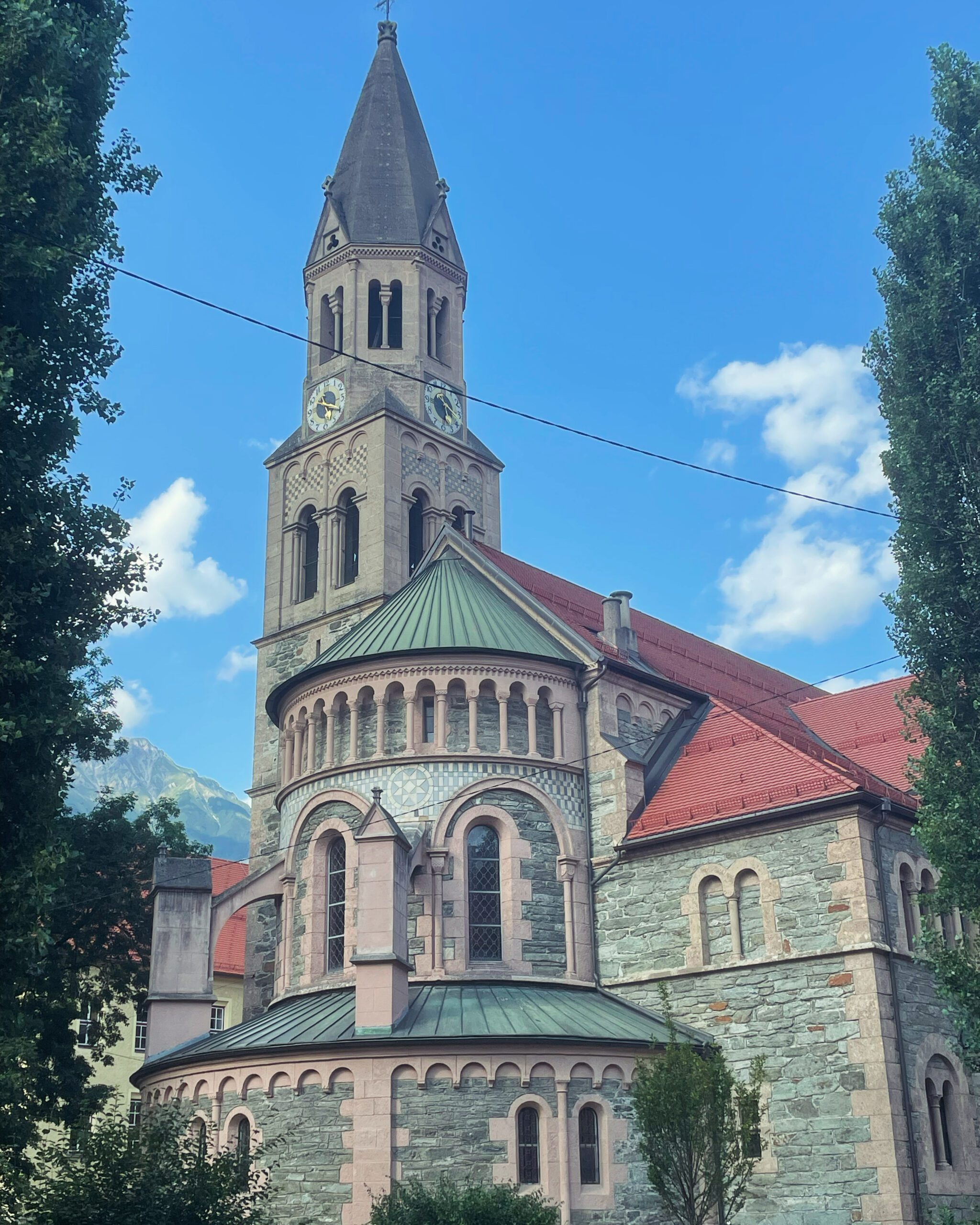
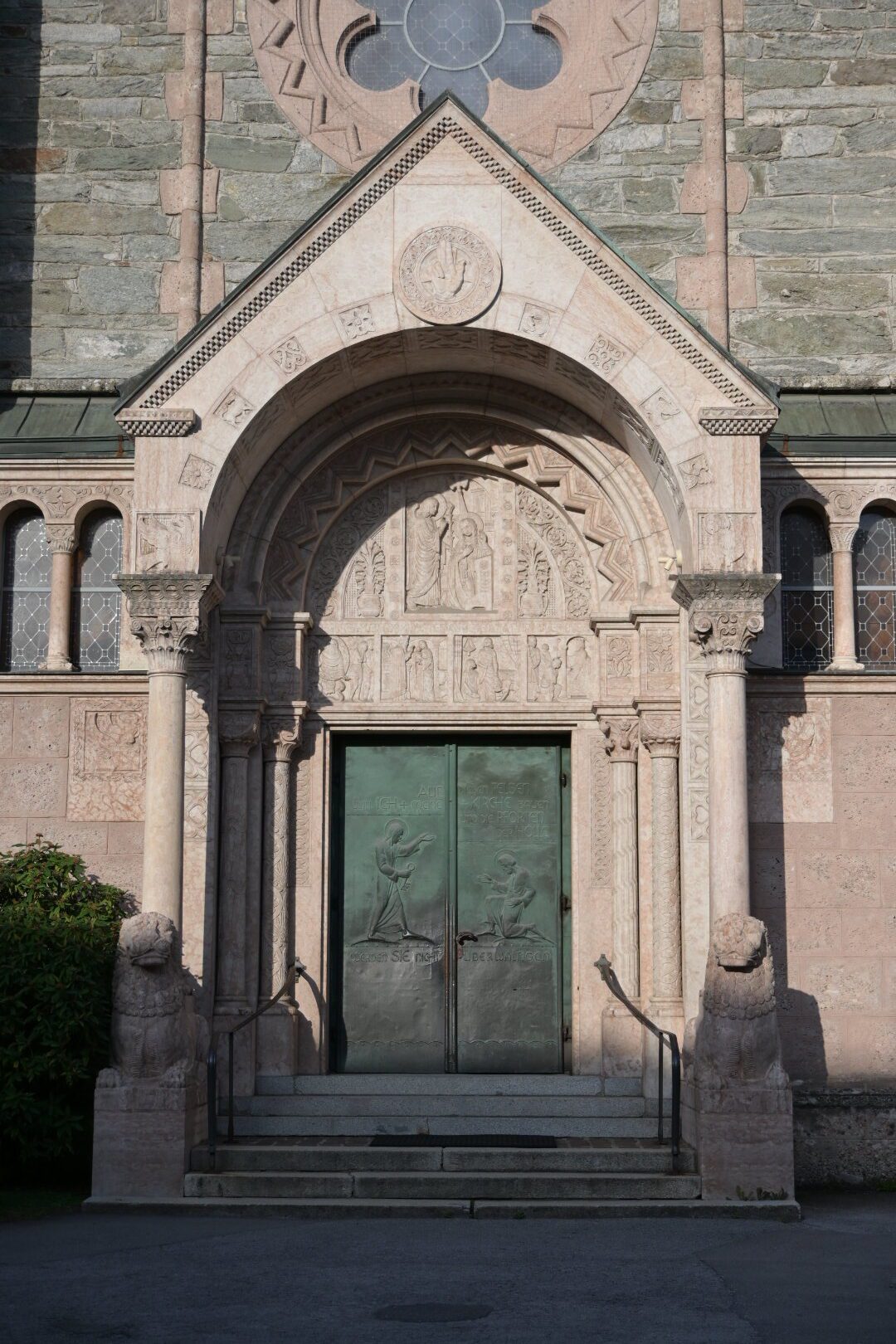
With the growing population came the need for workplaces, shops, and housing—but also for education and pastoral care. Between the farmhouses in the north and the residential buildings in the south of Pradlerstraße, a new neighborhood center emerged around the landmarks of the Pradl expansion: the Leitgeb School and the new parish church. Where today’s Leitgebhalle stands, a chapel had existed since the late 17th century, containing a copy of Lucas Cranach’s miraculous image Mariahilf. In the 19th century, this small house of worship could no longer meet the needs of the many new residents. Between 1905 and 1908, the new church was built—one of the last constructed in Innsbruck during the late monarchy. Particularly impressive is the lion portal made of red marble. The appearance and posture of the lions strongly resemble medieval churches south of the Alps in the Romanesque style, such as San Zeno Maggiore in Verona. After bomb damage during World War II, the double doors were rebuilt in their current form. The copy of Mariahilf inside the church was transferred from the earlier chapel.
The Leitgeb School across the street already points toward a more modern architectural style. It was named after the Innsbruck writer Josef Leitgeb (1897–1952), whose stories and poems offer insight into everyday life of his time. The building, constructed between 1907 and 1908 according to plans by Eduard Klingler, was designed entirely in the Tyrolean Heimatstil, reflecting the urban planner’s taste. After being hit during an air raid in World War II, it required extensive renovation. The building’s original elegance can still be sensed in its basic form. The somewhat rigid, sober cube appears almost classicistic upon closer inspection of its details.
Among the old farmhouses in the south, the elegant Gründerzeit buildings and the turn-of-the-century tenements, many less appealing residential buildings are mixed in—structures built during the post-war years. Due to their proximity to the railway station, many buildings along Pradlerstraße fell victim to air raids. The bronze plaques reading:
“This house was destroyed during the war years 1939/45 and rebuilt with funds from the Federal Ministry of Trade and Reconstruction under Federal Chancellor Ing. Julius Raab”
bear witness to these destructions and the subsequent reconstruction. Since the 1990s, Pradlerstraße has suffered the typical fate of many inner-city European neighborhoods. The large poplar trees on both sides of the street—present since the Bavarian occupation—were sacrificed to car traffic during the road-widening measures of the car-centered 1960s. Long-established businesses are no longer passed on; new shops often fail due to competition from the nearby shopping centers DEZ and Sillpark.
Innsbruck's industrial revolutions
Innsbruck has always seen itself primarily as a city of trade, tourism, and academia. In reality, however, manufacturing and productive industries have played a significant role in its history. As early as the fifteenth century, a proto‑industrial form of production began to emerge from traditional crafts. Metalworking flourished in the booming residential city, driven by the construction boom and the demand for weapons and armour. A combination of factors made this possible: the city’s favourable transport connections, the availability of water power, Innsbruck’s political rise, the craftsmanship of its artisans, and access to capital under Maximilian all contributed to the development of necessary infrastructure. Bell founders and armaments manufacturers such as the Löffler family established workshops in Hötting, Mühlau, and Dreiheiligen that ranked among the leading enterprises of their time in Europe. Along the Sill Canal, mills and workshops harnessed water power as an energy source. Powder mills and silver smelting works were located in Silbergasse, today’s Universitätsstraße. In what is now Adamgasse, close to the city, a munitions factory once stood, which exploded in 1636.
The wealth generated by metalworking stimulated other sectors of the economy. By the early seventeenth century, around 270 businesses were operating in Innsbruck, providing employment for masters, journeymen, and apprentices. Although most of the population was still engaged in administration, trade and craft industries—and the money they generated—began to attract a new social stratum. This led to a redistribution within the city. Citizens and businesses gradually displaced officials and members of the aristocracy from the Neustadt. Many of the Baroque palazzi that now line Maria‑Theresien‑Straße were built during this period, while districts such as Dreiheiligen and St. Nikolaus developed into industrial and working‑class quarters. In addition to metalworking in the Silbergasse area, tanners, carpenters, wagon makers, builders, stonemasons, and other crafts associated with early industrialisation settled here.
Industrial development reshaped not only the social structure through the influx of new workers and their families, but also the physical appearance of Innsbruck. Workers, unlike peasants, were not subjects bound to a feudal lord, even if they remained subordinate to the strict authority of their employers. Entrepreneurs were not of noble birth, yet often possessed greater financial resources than the aristocracy. Traditional hierarchies still existed but began to show signs of strain. The new bourgeoisie introduced new fashions and dressed differently. Capital from outside flowed into the city. Housing and churches were built for the incoming population. The working‑class districts outside the city walls were viewed with suspicion by long‑time residents, not least because overcrowded conditions were believed to foster outbreaks of plague. Large workshops altered both the smell and soundscape of the city. Industrial sites were noisy, and smoke from furnaces polluted the air. Innsbruck had evolved from a small settlement at the Inn Bridge into a proto‑industrial town.
Growth was interrupted for several decades at the end of the eighteenth century by the Napoleonic Wars. Compared to other parts of Europe, the second wave of industrialisation arrived relatively late in Innsbruck. One reason was the delayed development of a functioning banking system. For devout Catholics, bankers were still regarded as “usurers and moneylenders,” and financial dealings were considered morally questionable. Without access to credit, however, large enterprises could not be established. Although the Tyrolean provincial government had founded the Banko as early as 1715 and a private bank operated in Herzog‑Friedrich‑Straße, it was only with the establishment of a branch of the savings bank that people no longer had to keep their money hidden at home. From around 1850 onwards, credit became available, enabling the creation of larger local enterprises. Traditional crafts—both urban guild-based workshops and seasonal rural production—came under pressure from modern industrial manufacturing. Modern factories emerged in St. Nikolaus, Wilten, Mühlau, and Pradl along the Mühlbach and Sill Canal. Many innovative entrepreneurs came from outside Innsbruck. In what is now Innstraße 23, Peter Walde, who had moved from Lusatia to Innsbruck, founded a business in 1777 producing goods derived from fats, such as tallow candles and soap. Eight generations later, Walde remains one of Austria’s oldest family businesses, and its historic headquarters—with its Gothic vaulted ceilings—still sells soaps and candles today. Franz Josef Adam, originally from the Vinschgau, established what became the city’s largest brewery in a former aristocratic residence. In 1838, the spinning machine arrived in Pradl via the Dornbirn firm Herrburger & Rhomberg, bringing textile production into the region. The company had acquired land along the Sill floodplain, where water power provided ideal conditions for operating heavy machinery. Alongside wool, cotton was now also processed.
As 400 years earlier, the Second Industrial Revolution fundamentally transformed both the city and the daily lives of its inhabitants. Districts such as Mühlau, Pradl, and Wilten expanded rapidly. Factories were often located directly within residential areas. Around 1900, more than twenty enterprises were still using the Sill Canal. The Haidmühle in Salurnerstraße operated from 1315 to 1907. A textile factory in Dreiheiligenstraße was also powered by the canal. Noise and emissions from machinery placed heavy burdens on residents, as described in a newspaper article from 1912:
“The installation of an explosion engine in the Hibler fig‑coffee factory near the main railway station has caused outrage among the residents of the surrounding district. The noise produced by this machine throughout most of the day is extremely disturbing and diminishes the value of nearby dwellings. The once highly sought-after garden rooms in hotels on Bahnhofplatz are now scarcely rentable. Even worse than the noise, however, is the smoke and stench produced by the new machine…”
Aristocrats who had relied too long on inherited wealth were increasingly forced to sell their estates to the rising bourgeoisie. For example, Palais Sarnthein—originally built in 1689—was later used by a weapons manufacturer and merchant, Johann Peterlongo. Some members of the aristocracy adapted successfully, investing their resources in industrial ventures. The growing demand for labour was met by former farmhands and landless peasants. While wealthy entrepreneurs built villas in Wilten, Pradl, and Saggen, and middle-class employees occupied urban housing, workers were often accommodated in dormitories or mass housing. Twelve-hour shifts in cramped, noisy, and polluted conditions placed heavy demands on labourers. Child labour was not restricted until the 1840s, and women earned only a fraction of men’s wages. Workers were often dependent on company-owned housing and lacked legal protections. Social security systems did not yet exist; those unable to work depended on charitable support from their home communities. It should be noted that these harsh conditions were not entirely new but evolved from rural life, where inequality, child labour, and precarious work had been common.
However, industrialisation did not only affect everyday material life. Innsbruck experienced the kind of gentrification that can be observed today in trendy urban neighbourhoods such as Prenzlauer Berg in Berlin. The change from the rural life of the village to the city involved more than just a change of location. In one of his texts, the Innsbruck writer Josef Leitgeb tells us how people experienced the urbanisation of what was once a rural area:
“…a great many strangers, poorly dressed, crowded into growing housing blocks, filling the streets morning, noon, and evening as they went to and from work… faces pale and prematurely aged, lacking individuality in posture, speech, and clothing—no longer individuals, but a uniform, endlessly repeatable urban working class… The railway station and the gasworks seemed to be the core of this new and profoundly alien landscape.”
After 1848, many Innsbruck residents experienced a process of “bourgeoisification.” Stories of upward mobility through diligence, talent, and opportunity became more common. Notable examples still in existence include the Tyrolean glass painting workshop, the Hörtnagl food business, and the Walde soap factory. Successful entrepreneurs came to occupy roles once held by the landed nobility, forming вместе with academics a new influential social class. Even workers experienced a degree of bourgeois emancipation. Unlike peasants bound to feudal lords, they now received wages instead of subsistence and gained some autonomy over their private lives. Together with the many academics, they formed a new social class that increasingly gained political influence. As early as 1851, Beda Weber remarked approvingly: “Their social circles are unforced; one already senses something distinctly metropolitan, something not easily found elsewhere in Tyrol.”
The workers also became bourgeois. While the landlord in the countryside was still master of the private lives of his farmhands and maidservants and was able to determine their lifestyle up to and including sexuality via the release for marriage, the labourers were now at least somewhat freer individually. They were poorly paid, but at least they now received their own wages instead of board and lodging and were able to organise their private affairs for themselves without the landlord's guardianship.
However, the downside of this newly gained autonomy became particularly apparent in the early decades of industrialisation. There was little state infrastructure for healthcare or family support. Health insurance, pensions, retirement homes, and childcare facilities did not yet exist; previously, these functions had largely been fulfilled within extended rural families. In working-class districts, unsupervised children were a common sight during the day—especially the youngest, who were not yet subject to compulsory schooling. In response, a women’s association was founded in 1834 following an appeal by the Tyrolean provincial governor. It established childcare institutions in working-class districts such as St. Nikolaus, Dreiheiligen, and Angerzell (today’s Museumstraße). Their aim was not only to keep children off the streets and provide them with food and clothing, but also to instill manners, modest behaviour, and moral discipline. Under strict supervision, caretakers ensured “cleanliness, order, and obedience,” thereby providing at least a basic level of care. The former childcare institution in Paul‑Hofhaimer‑Gasse behind the Ferdinandeum still exists today. The neoclassical building now houses a Caritas integration kindergarten and a daycare center for employees of the State of Tyrol.
Innsbruck never became a traditional industrial working‑class city. Even so, a significant labour movement—such as that found in Vienna—never truly developed in Tyrol. While there were Social Democrats and a small number of Communists, the working class remained too small to exert substantial political influence. May Day marches, for example, are attended by many primarily for inexpensive food and free beer rather than political engagement. More broadly, there are few memorial sites dedicated to industrialisation and the achievements of the working class. Only in places such as St.-Nikolaus-Gasse or in some tenement buildings in Wilten and Pradl have structures survived that offer a glimpse into the everyday life of Innsbruck’s workers.
Klingler, Huter, Retter & Co: master builders of expansion
The final decades of the 19th century became known in Austrian history as the Gründerzeit (Founders’ Era). After the economic crisis of 1873, the financial situation recovered and an unprecedented construction boom began. Innsbruck also established a modern banking system. Financial institutions such as the Savings Bank founded in 1821 and the Creditanstalt, whose building erected in 1910 still towers over Maria-Theresien-Straße like a small palace, made it possible to obtain loans, without which entrepreneurship and commerce as we know them today would not have been possible. In some cases, these financial institutions even acted as developers themselves. Between 1880 and 1900, Innsbruck’s population grew from 20,000 to 26,000 inhabitants, while Wilten, incorporated into the city in 1904, even tripled its population from 4,000 to 12,000. The number of buildings increased from 600 to more than 900. Most of them, unlike previous buildings, were multi-story apartment houses. Infrastructure was also modernized. Gas, running water, and electricity became part of everyday life for an increasing number of people. These buildings represented the new society. Entrepreneurs, professionals, employees, and workers had different needs than the legally dependent subjects of previous centuries. The urban lifestyle demanded apartments with several rooms and open spaces for recreation after working hours. Apartment buildings made a modern lifestyle possible even for people who did not own property. Unlike the rural regions of Tyrol, where farming families lived together with servants in farmhouses as part of an extended kinship community, life in the city was already quite close to our present-day understanding of family life. Although the upper middle class had not yet surpassed the nobility, it had reduced the gap considerably and, through its new position on the municipal council, was able not only to commission private building projects but also to decide on public construction projects. The old city hospital in the center of town was replaced by a modern hospital in the west; Sieberer’s orphanage and retirement home were established in Saggen, and a new urban center emerged around the railway station.
The forty years preceding the First World War were a gold rush era for the construction industry. The architecture of the buildings reflected the worldview of their owners. Master builders often assumed several roles and frequently replaced architects altogether. Most clients had very clear ideas about what they wanted. They were not seeking breathtaking new creations but rather copies of or adaptations based on existing buildings. In keeping with the spirit of the age, Innsbruck’s master builders designed structures according to the wishes of their financially powerful clients in the styles of Historicism, Classicism, and the Tyrolean Heimatstil. The style chosen for a home was often not merely an aesthetic decision but also an ideological statement by the owner. Liberals generally preferred Classicism, while conservatives were drawn to the Tyrolean Heimatstil. Whereas the Heimatstil presented itself in a Neo-Baroque form with abundant paintings, clear forms, statues, and columns were characteristic elements of Classical-inspired architecture. In what was sometimes a rather wild mixture of styles, people realized their ideas of classical Greece and ancient Rome. Not only railway stations and public buildings but also large apartment buildings, entire streets, churches, and even cemeteries were built along former country roads in this design. Academics—and those wishing to appear as such—demonstrated their fascination with antiquity through neoclassical façades. Catholic traditionalists commissioned murals depicting saints and scenes from Tyrolean history on their Heimatstil houses. While Neoclassicism predominates in Saggen and Wilten, the district of Pradl is largely characterized by conservative Heimatstil architecture. For a long time, many architectural experts looked down upon the tastes of social climbers and the newly rich. Heinrich Hammer wrote in his standard work Art History of the City of Innsbruck:
"Of course, this first rapid expansion of the city took place in an era that was unfruitful in terms of architectural art, in which architecture, instead of developing an independent, contemporary style, repeated the architectural styles of the past one after the other."
The era of grand villas, which imitated the aristocratic residences of former times with a bourgeois touch, came to an end after several exuberant decades simply because space became scarce. Further development of the city with detached houses was no longer possible. Even today, the area around Falkstraße, Gänsbachstraße, and Bienerstraße is known as Villensaggen, while the areas further east are referred to as Blocksaggen. Wilten and Pradl, however, never experienced this kind of development. Nevertheless, in their gold-rush enthusiasm, developers sealed ever more land with construction. In 1907, Albert Gruber delivered a warning speech about this growth, cautioning against unchecked urban expansion and land speculation.
"It is the most difficult and responsible task facing our city fathers. Up until the 1980s (note: 1880), let's say in view of our circumstances, a certain slow pace was maintained in urban expansion. Since the last 10 years, however, it can be said that cityscapes have been expanding at a tremendous pace. Old houses are being torn down and new ones erected in their place. Of course, if this demolition and construction is carried out haphazardly, without any thought, only for the benefit of the individual, then disasters, so-called architectural crimes, usually occur. In order to prevent such haphazard building, which does not benefit the general public, every city must ensure that individuals cannot do as they please: the city must set a limit to unrestricted speculation in the area of urban expansion. This includes above all land speculation."
A handful of master builders, together with the Innsbruck Building Authority, guided this development. If Wilhelm Greil can be called the mayor of Innsbruck’s expansion, then the Vienna-born Eduard Klingler (1861–1916) certainly deserves the title of its architect. As a public official and master builder, Klingler left a profound mark on Innsbruck’s cityscape. He began working for the Province of Tyrol in 1883. In 1889 he joined the municipal building authority, which he headed from 1902 onward. Among the projects attributed to Klingler as head of the building authority are the Commercial Academy, the Leitgeb School, Pradl Cemetery, the Dermatological Clinic within the hospital complex, the Municipal Kindergarten on Michael-Gaismair-Straße, the Train Barracks (today a residential building), the Market Hall, and the Tyrolean State Conservatory. One particularly noteworthy Heimatstil building designed by him is the Ulrich House on Bergisel, which today serves as the headquarters of the Old Kaiserjäger Club.
The most important construction company in Innsbruck was Johann Huter & Sons. Johann Huter took over his father’s brickworks. In 1856 he acquired the company’s first property, the Huter Grounds, on Innrain. Three years later the first business headquarters was established on Meranerstraße. The company’s official founding came in 1860 when it was registered together with his sons Josef and Peter. Like many of its competitors, Huter & Sons saw itself as a full-service provider. The company included its own brickworks, cement factory, carpentry shop, metal workshop, design office, and construction firm. By the outbreak of the First World War, it employed more than 700 people. In 1906/07, the Huter family built their residential and business headquarters at Kaiser-Josef-Straße 15 in the typical style of the late pre-war years. This stately house combines the Tyrolean Heimatstil, surrounded by gardens and nature, with Neo-Gothic and Neo-Romanesque elements. Well-known buildings erected by Huter & Sons in Innsbruck include the Monastery of Perpetual Adoration, St. Nicholas Parish Church, the first building of the new hospital complex, and several buildings on Claudiaplatz.
The second major player was Josef Retter (1872–1954). Born in Lower Austria with Tyrolean roots, he completed an apprenticeship as a mason before attending the Imperial-Royal State Trade School in Vienna and the master craftsman school of its construction department. After gaining professional experience throughout the Habsburg Monarchy—in Vienna, Croatia, and Bolzano—he was able, thanks to his wife’s dowry, to establish his own construction company in Innsbruck at the age of 29. Like Huter’s company, his enterprise also included a sawmill, a sand and gravel works, and a stonemasonry workshop. In 1904 he built his residential and office building. The dark Neo-Gothic Retter House at Schöpfstraße 23a, with its distinctive bay window supported by columns and a turret, is decorated with a remarkable mosaic representing an allegory of architecture. The relief on the gable depicts the union of art and craftsmanship, symbolizing Retter’s career path. Retter’s buildings particularly shaped Wilten and Saggen. Through projects such as the new Academic Gymnasium, the castle-like Commercial Academy building, the Protestant Christ Church in Saggen, the Zelger House on Anichstraße, Sonnenburg in Wilten, and the Neo-Gothic Mentlberg Castle in Sieglanger, he created many of the most important buildings of this era in Innsbruck.
Late in life but with a similarly practice-orientated background that was typical of 19th century master builders, Anton Fritz started his construction company in 1888. He grew up remotely in Graun in the Vinschgau Valley. After working as a foreman, plasterer and bricklayer, he decided to attend the trade school in Innsbruck at the age of 36. Talent and luck brought him his breakthrough as a planner with the country-style villa at Karmelitergasse 12. In its heyday, his construction company employed 150 people. In 1912, shortly before the outbreak of the First World War and the resulting slump in the construction industry, he handed over his company to his son Adalbert. Anton Fritz's legacy includes his own home at Müllerstraße 4, the Mader house in Glasmalereistraße and houses on Claudiaplatz and Sonnenburgplatz.
With Carl Kohnle, Carl Albert, Karl Lubomirski, and Simon Tommasi, Innsbruck possessed several other master builders who left their mark on the cityscape through typical buildings of the late 19th century. Together, they shaped Innsbruck’s new streets in the prevailing architectural spirit of the final thirty years of the Habsburg Monarchy. Residential houses, railway stations, government buildings, and churches throughout the vast empire stretching from Ukraine to Tyrol looked remarkably similar. New movements such as Art Nouveau gained acceptance only slowly. In Innsbruck, it was the Munich architect Josef Bachmann who introduced a new accent to bourgeois design with the redesign of the façade of the Winkler House. With the outbreak of the First World War, construction activity largely ceased. After the war, the era of neoclassical Historicism and the Heimatstil was definitively over. Times had become harsher, and the requirements for housing had changed. In the period of severe housing shortages in the young Republic of German-Austria, affordable housing and modern sanitary facilities became more important than representative façades and grand rooms. The increasingly professional education of master builders and architects at the Imperial-Royal State Trade School also contributed to a new understanding of construction, replacing the often self-taught veterans of the gold-rush era of Classicism. A stroll through Saggen and parts of Wilten and Pradl still transports visitors back to the Gründerzeit. Claudiaplatz and Sonnenburgplatz are among the most impressive examples. The construction company Huter & Sons still exists today. The company is now located in Sieglanger on Josef-Franz-Huter-Straße, named after its founder. Although the residential building on Kaiser-Josef-Straße no longer bears the company’s name, it remains, in all its opulence, a remarkable relic of the period that permanently transformed Innsbruck’s appearance. In addition to his residence on Schöpfstraße, the district of Wilten contains a second building associated with the Retter family. Opposite the university on Innrain stands Villa Retter. Josef Retter’s eldest daughter, Maria Josefa, who herself had been educated according to the principles of the reform educator Maria Montessori, opened Innsbruck’s first Haus des Kindes (“House of the Child”) in 1932. Above the entrance, a portrait depicts the benefactor Josef Retter. The south façade is adorned with a mosaic in the characteristic style of the 1930s, referring to the building’s original purpose. A smiling blond girl embraces her mother, who is holding a book, and her father, who carries a hammer. The family crypt at Westfriedhof Cemetery is another notable legacy of the Retter family.
Wilhelm Greil: DER Bürgermeister Innsbrucks
One of the most important figures in Innsbruck's municipal history was Wilhelm Greil (1850–1928). The entrepreneur held the office of mayor from 1896 to 1923, having previously helped shape the city's fortunes as vice mayor. His tenure was not only long, but also took place during a particularly dynamic era. The four decades between the economic crisis of 1873 and the First World War were marked by unprecedented growth and rapid modernization. It was a time of incorporating entire city districts, technical innovations, and new media. Private investments in infrastructure such as railways, energy, and electricity were encouraged by the state and given tax incentives in order to lead the provinces and cities of the struggling Danube Monarchy into modernity. The city's economy was booming. Businesses emerged in the new districts of Pradl and Wilten, attracting a labor force. Tourism also brought fresh capital into the city. Innsbruck's city council was dominated by the liberal and Pan-German nationalist 'Deutsche Volkspartei' (German People's Party), to which Greil also belonged. It was only with the incorporation of Wilten and Pradl in 1904 that the conservatives were able to gain ground, though they could not fully catch up. Social Democracy played almost no role until 1918. Due to an electoral system based on voting rights categorized by wealth classes, only about 10% of Innsbruck's population could step up to the ballot box. Women were fundamentally excluded. Furthermore, relative voting rights applied within the three electoral colleges, which effectively meant: winner takes it all. Appropriately enough, Mayor Greil lived much like a Renaissance prince. He hailed from the upper-class haute bourgeoisie. His father was able to afford establishing the family's home base in the Palais Lodron on Maria-Theresien-Straße. Thanks to this electoral statute, Mayor Greil could rely on 100% support in the city council well into the era of the First Republic, which naturally simplified decision-making and governance considerably. For all the efficiency that Innsbruck's mayors displayed on a superficial level, one should not forget that this was only possible because, as part of an elite composed of entrepreneurs, merchants, and professionals, they ruled through a form of elected dictatorship—without any significant opposition or consideration for other population groups such as workers, artisans, and employees. The Imperial Municipal Act of 1862 granted cities like Innsbruck, and thus its mayors, far-reaching powers. It is hardly surprising that the chain of office presented to Greil on his 60th birthday by his colleagues on the city council bore an astonishing resemblance to the collar orders of the old nobility. However, Greil was also a skillful politician who adeptly navigated the established power structures and media landscape of his time. Article 17 of the Austrian Basic Law of 1867, known as the December Constitution, secured freedom of expression in the press without prior censorship for the first time—excluding, of course, punishable content such as blasphemy or insulting the authorities. Consequently, a variety of newspapers established themselves, such as the conservative Neue Tiroler Stimme, the social democratic Volkszeitung, or the liberal Innsbrucker Nachrichten, shaping a worldview according to their publishers' preferences. Thanks to the reach of the Innsbrucker Nachrichten, Wilhelm Greil was able to effectively project his view of local politics. Despite his at times fierce speeches—modeled on the platform of Georg Ritter von Schönerer (1842–1921), the founding figure of the Pan-German nationalists—he managed to reach arrangements with conservative forces in the region, even if things frequently clashed in the media and elsewhere. Taxes, social policy, education, housing, and the design of public spaces were debated with passion and zeal, often enough with violence as the ultimate argument.
Unter Greils Ägide und dem allgemeinen wirtschaftlichen Aufschwung erweiterte sich Innsbruck im Eiltempo. Der Gemeinderat kaufte ganz im Stil eines Kaufmanns vorausschauend Grund an, um der Stadt Neuerungen zu ermöglichen. Der Politiker Greil konnte sich bei den großen Bauprojekten der Zeit auf die Beamten und Stadtplaner Eduard Klingler, Jakob Albert und Theodor Prachensky stützen. Infrastrukturprojekte wie das neue Rathaus in der Maria-Theresienstraße 1897, die Eröffnung der Mittelgebirgsbahn, die Hungerburgbahn und die Karwendelbahn wurden während seiner Regierungszeit umgesetzt. Weitere gut sichtbare Meilensteine waren die Erneuerung des Marktplatzes und der Bau der Markthalle. Neben den prestigeträchtigen Großprojekten revolutionierte vor allem Unsichtbares in den letzten Jahrzehnten des 19. Jahrhunderts das Leben vieler Innsbrucker. Bereits Greils Vorgänger Bürgermeister Heinrich Falk (1840 – 1917) hatte erheblich zur Modernisierung der Stadt und zur Besiedelung des Saggen beigetragen. Seit 1859 war die Beleuchtung der Stadt mit Gasrohrleitungen stetig vorangeschritten. Mit dem Wachstum der Stadt und der Modernisierung wurden die Senkgruben, die in Hinterhöfen der Häuser als Abort dienten und nach Entleerung an umliegende Landwirte als Dünger verkauft wurden, zu einer Unzumutbarkeit für immer mehr Menschen. 1880 wurde das Ragging, so der Name im Volksmund für die Entleerung der Aborte, in den Verantwortungsbereich der Stadt übertragen. Zwei pneumatische Maschinen sollten den Vorgang zumindest etwas hygienischer gestalten. Zwischen 1887 und 1891 wurde Innsbruck mit einer modernen Hochdruckwasserleitung ausgestattet, über die auch Wohnungen in höher gelegenen Stockwerken mit frischem Wasser versorgt werden konnten. Wer auf sich hielt und es sich leisten konnte, hatte damit erstmals die Gelegenheit eine Spültoilette im Eigenheim zu installieren. Greil setzte diesen Feldzug der Modernisierung mit einer Vielzahl an Infrastrukturprojekten fort. Die Ansammlung an Menschen auf enger werdendem Raum unter teils prekären Hygieneverhältnissen hatte viele Probleme mit sich. Die Randbezirke der Stadt und die umliegenden Dörfer wurden regelmäßig von Typhus heimgesucht. Nach jahrzehntelangen Diskussionen wurde 1903 mit dem Bau einer modernen Schwemmkanalisation begonnen. Ausgehend von der Innenstadt wurden immer mehr Stadtteile an diesen heute alltäglichen Luxus angeschlossen. 1908 waren nur die Koatlackler Mariahilf und St. Nikolaus nicht an das Kanalsystem angeschlossen. Auch der neue Schlachthof im Saggen erhöhte Hygiene und Sauberkeit in der Stadt. Schlecht kontrollierte Hofschlachtungen gehörten mit wenigen Ausnahmen der Vergangenheit an. Das Vieh kam im Zug am Sillspitz an und wurde in der modernen Anlage fachgerecht geschlachtet. Greil überführte das Gaswerk in Pradl und das Elektrizitätswerk in Mühlau in städtischen Besitz. Die Straßenbeleuchtung wurde im 20. Jahrhundert von den Gaslaternen auf elektrisches Licht umgestellt. 1888 übersiedelte das Krankenhaus von der Maria-Theresienstraße an seinen heutigen Standort. Bürgermeister und Gemeinderat konnten sich bei dieser Innsbrucker Renaissance neben der wachsenden Wirtschaftskraft in der Vorkriegszeit auch auf Mäzen aus dem Bürgertum stützen. Waren technische Neuerungen und Infrastruktur Sache der Liberalen, verblieb die Fürsorge der Ärmsten weiterhin bei klerikal gesinnten Kräften, wenn auch nicht mehr bei der Kirche selbst. Freiherr Johann von Sieberer stiftete das Greisenasyl und das Waisenhaus im Saggen. Leonhard Lang stiftete das Gebäude in der Maria-Theresienstraße, in der sich bis heute das Rathaus befindet gegen das Versprechen der Stadt ein Lehrlingsheim zu bauen.
In contrast to the booming pre-war era, Greil’s leadership after 1914 was marked by crisis management. In his final years in office, he guided Innsbruck through the transition from the Habsburg monarchy to the republic—a time characterized above all by hunger, hardship, scarcity of resources, and insecurity. He was 68 years old when Tyrol was divided at the Brenner Pass after the war. During his political career, Greil had often exploited general hostility toward Italians (“Walsche”) in a similarly populist manner to his Christian Social counterpart in Vienna, Karl Lueger, who used antisemitic rhetoric. At the end of his career, he had to witness the Italian occupation of Innsbruck. With the introduction of the republic, the census-based voting system was abolished, marking the beginning of the end of liberal dominance in the municipal council. In 1919, the Social Democrats won elections in Innsbruck for the first time. Only due to council majorities and a coalition of Greater German-liberal and conservative-clerical politicians did Greil remain mayor. He died in 1928 at the age of 78 as an honorary citizen of the city of Innsbruck. Wilhelm-Greil-Straße had already been named after him during his lifetime.
Maria help Innsbruck!
Veneration of saints and popular piety have always walked a narrow line between faith, superstition, and magic. In the Alpine regions, where people were exposed to a largely inexplicable natural environment to a greater extent than in many other areas, these forms of belief developed remarkable and locally distinctive expressions. Saints were invoked for help with a wide range of everyday concerns. Saint Anne was asked to protect the house and hearth, while prayers for a good harvest were addressed to Saint Notburga of Rattenberg, who was particularly popular in Tyrol. As the use of fertilizer and agricultural machinery increased, she later became the patron saint of women wearing traditional costume. Miners entrusted their fate in their dangerous underground work to Saint Barbara and Saint Bernard. The chapel near the manor houses in the Hall Valley (Halltal) close to Innsbruck offers a fascinating insight into a spiritual world that oscillates between the legendary figure of the Bettelwurf spirit and the worship of various local patron saints. The saint who continues to eclipse all others in veneration, however, is Mary. From the blessing of herbs on the Feast of the Assumption to the clockwise-flowing water at the monastery and pilgrimage site of Maria Waldrast at the foot of Mount Serles, and from votive paintings in churches and chapels, she is a constant and beloved presence in popular devotion. Anyone strolling attentively through Innsbruck will repeatedly encounter a particular image on building façades: the Mariahilf devotional image by Lucas Cranach the Elder (c. 1472–1553). Cranach’s Madonna is one of the most popular and frequently copied Marian images in the Alpine region. It represents a reinterpretation of the classical iconography of the Mother of God. Similar to Leonardo da Vinci’s Mona Lisa, which was created around the same time, Mary smiles enigmatically at the viewer. Cranach dispensed with all traditional forms of sacralization such as the crescent moon or halo and portrayed her in contemporary everyday clothing. The reddish-blond hair of both mother and child relocates them from Palestine to Europe. The holy and virginal Mary thus became an ordinary woman with her child, belonging to the upper middle class of the sixteenth century.
The origin, journey, and veneration of the Mariahilf devotional image encapsulate, on a small scale, the history of the Reformation, the Counter-Reformation, and popular piety in the German territories. The odyssey of this modestly sized painting (measuring just 78 × 47 cm) began in what is today Thuringia, at the princely court of the land, one of the cultural centers of Europe at the time. Elector Frederick III of Saxony (1463–1525) was a deeply devout man and possessed one of the most extensive collections of relics of his era. Despite his profound rootedness in popular belief in relics and his strong devotion to Mary, in 1518 he supported Martin Luther not only for religious reasons but also for reasons of power politics. The safe conduct granted by this powerful territorial prince and Luther’s accommodation at Wartburg Castle enabled the reformer to work on the German translation of the Holy Scriptures and on his vision of a new, reformed Church. As was customary at the time, Frederick also maintained an “art director” in his entourage: Lucas Cranach, who had served as court painter in Wittenberg since 1515. Like many artists of his time, Cranach was not only extraordinarily productive but also highly business‑minded. In addition to his artistic work, he ran both a pharmacy and a wine tavern in Wittenberg. Thanks to his wealth and social standing, he served as mayor of the town from 1528 onward. Cranach was renowned for painting quickly and in large quantities. He recognized art as a medium for capturing and disseminating both time and zeitgeist. Much like Albrecht Dürer, he produced widely circulated works of great popular appeal. His portraits of the contemporary elite continue to shape our image of early modern celebrities such as his patron Frederick, Emperor Maximilian I, Martin Luther, and his fellow artist Dürer.
At the latest through his acquaintance with the church critics Philipp Melanchthon and Martin Luther at Wittenberg Castle, Cranach became a follower of the new reformed Christianity, which at that time still lacked an official institutional form. The ambiguities in religious beliefs and practices during the period before the formal split of the Church are reflected in Cranach’s works. Despite Luther’s and Melanchthon’s rejection of the veneration of saints, Marian devotion, and iconographic imagery in churches, Cranach continued to paint according to the tastes of his patrons. Just as fluid as the confessional boundaries of the sixteenth century is the date of origin of the Mariahilf image. Cranach created it sometime between 1510 and 1537, either for the private household altar of Frederick’s sister‑in‑law, Duchess Barbara of Saxony, or for the Church of the Holy Cross in Dresden. Art historians remain divided on the issue to this day. Cranach’s close friendship with Martin Luther suggests that he may have painted the work after his conversion to Lutheranism, and that this secularized depiction of a mother and child reflects a new religious worldview. Nevertheless, it is equally plausible that the pragmatic artist produced the painting earlier, in accordance with the wishes of the patron and the fashion of the time, entirely without ideological intent and before Luther’s arrival in Wittenberg.
After Frederick’s death, Cranach entered the service of his successor, John Frederick I of Saxony. When his patron was taken captive by the Emperor following the Battle of Mühlberg in 1547, Cranach, despite his advanced age, followed him into captivity as far as Augsburg and Innsbruck. After five years in the retinue of this comparatively luxuriously housed hostage, Cranach returned to Wittenberg, where he died at what was, by contemporary standards, a biblical age. The Mariahilf image was probably transferred to the art chamber of the Saxon ruler during the turbulent years of the confessional wars, likely to protect it from destruction during iconoclastic outbreaks. Almost sixty-five years later, the painting, like its creator before it, would make its way to Innsbruck along circuitous paths. When the art‑loving Bishop of Passau from the House of Habsburg visited the Dresden court in 1611, he selected Cranach’s Mariahilf image as a diplomatic gift and brought it to his princely episcopal residence on the Danube. There, the cathedral dean saw the painting and was so taken with it that he commissioned a copy for his household altar. A pilgrimage cult quickly developed around the image. When, seven years later, the Bishop of Passau became Archduke Leopold V of Austria and sovereign of Tyrol, the increasingly popular painting moved with him to the Innsbruck court. His Tuscan wife, Claudia de’ Medici, diligently sustained Marian devotion in the Italian tradition even after his death. Both the Servite church and the Capuchin monastery received altars and images of the Holy Mother of God. Nonetheless, nothing surpassed the popularity of Cranach’s Mariahilf image. During the Thirty Years’ War, the painting was frequently removed from the court chapel and publicly displayed in order to protect the city. At these mass prayers, the desperate population of Innsbruck loudly implored the small image with the cry “Maria, help!”, a formula that had entered popular devotion through the Jesuits. In 1647, at a moment of greatest peril, the Tyrolean Estates vowed to build a church around the image should Mary’s protection spare the land from devastation by Bavarian and Swedish troops. That a reformed depiction of the Virgin Mary, painted by a friend of Martin Luther, was invoked to protect the city from Protestant forces is not without a certain irony.
Although the Church of Mariahilf was indeed built, the original painting was installed in 1650 in the parish church of St. James (St. Jakob) within the secure city walls, while the new church received a copy created by Michael Waldmann. This was not to be the last of its kind. Cranach’s motif and representation of the Mother of God enjoyed extraordinary popularity and can still be found today not only in churches, but also on countless private houses. Through these reproductions, art became a mass phenomenon. The Marian image had migrated from the private possession of a Saxon prince into public space. Centuries before Andy Warhol and Roy Lichtenstein, Cranach and Dürer had become intensely copied artists, and their works became part of everyday life and the visual fabric of the city. While the original Mariahilf image may hang in St. James’s Cathedral, it is the copy—and the parish that grew up around it—that gave an entire district its name.