Rudolfsbrunnen & Boznerplatz
Boznerplatz
Worth knowing
"Even if harsh criticism may criticise some aspects of the statue, the whole must be described as highly successful and makes a beautiful, satisfying impression."
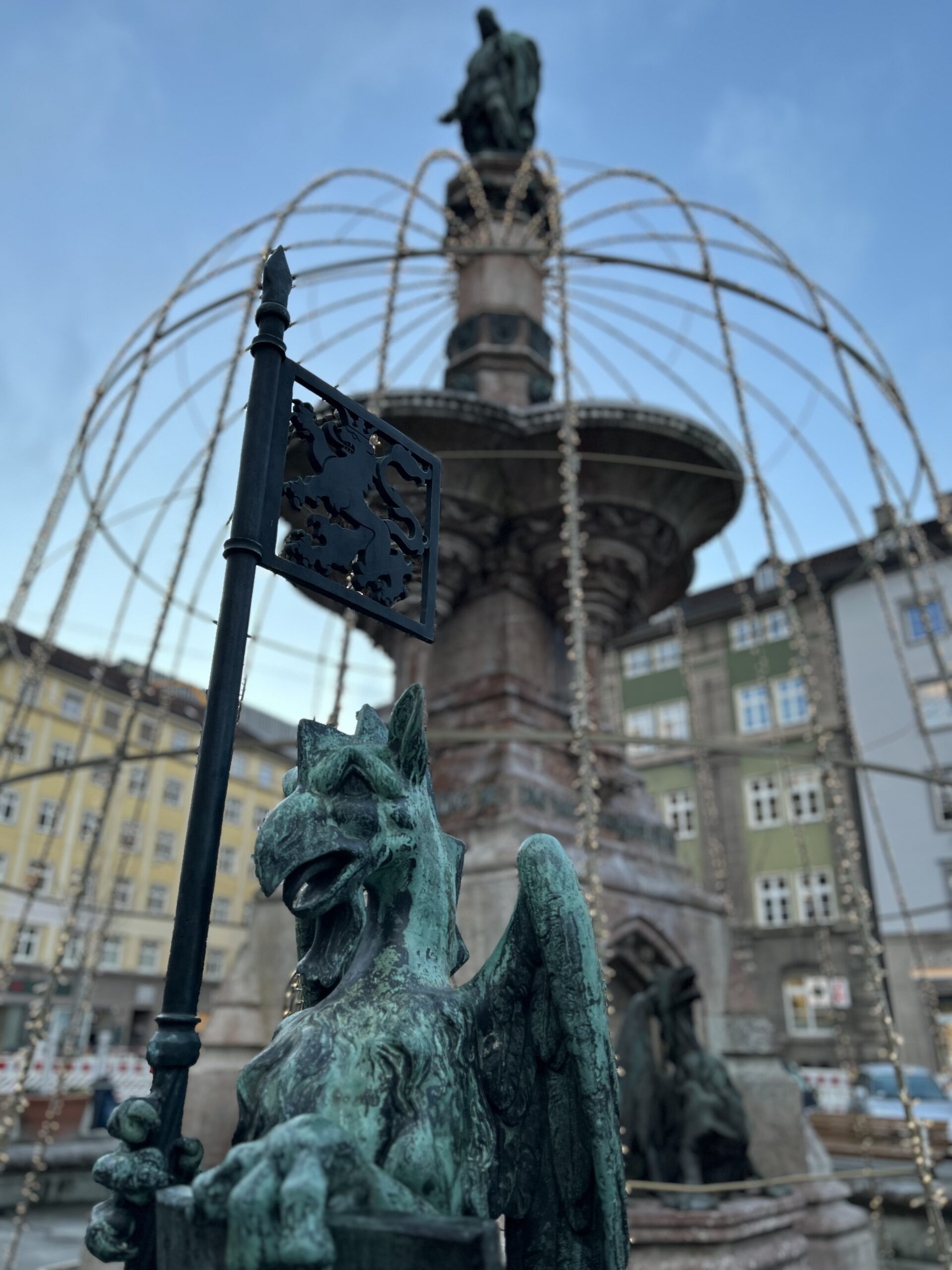
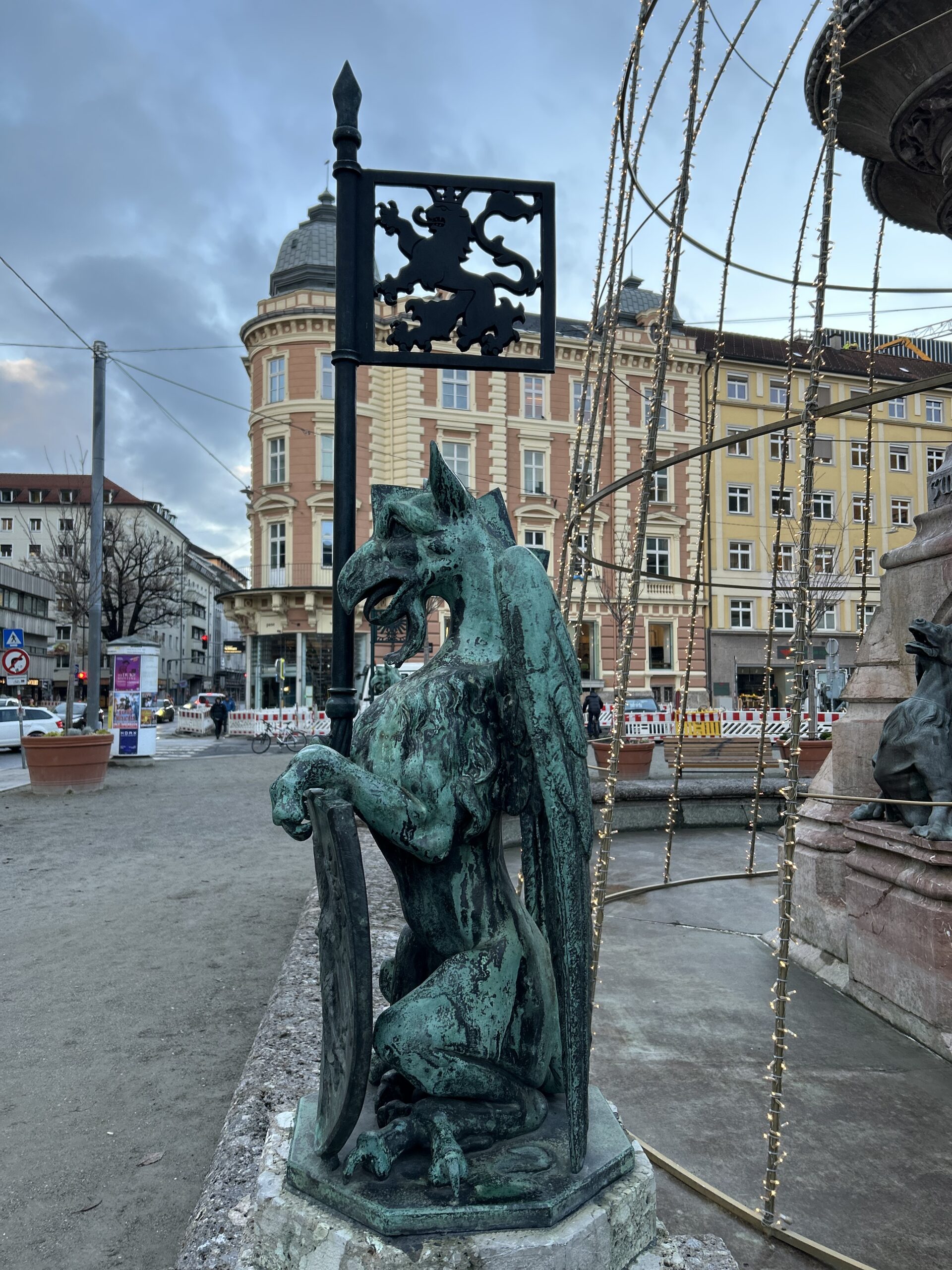
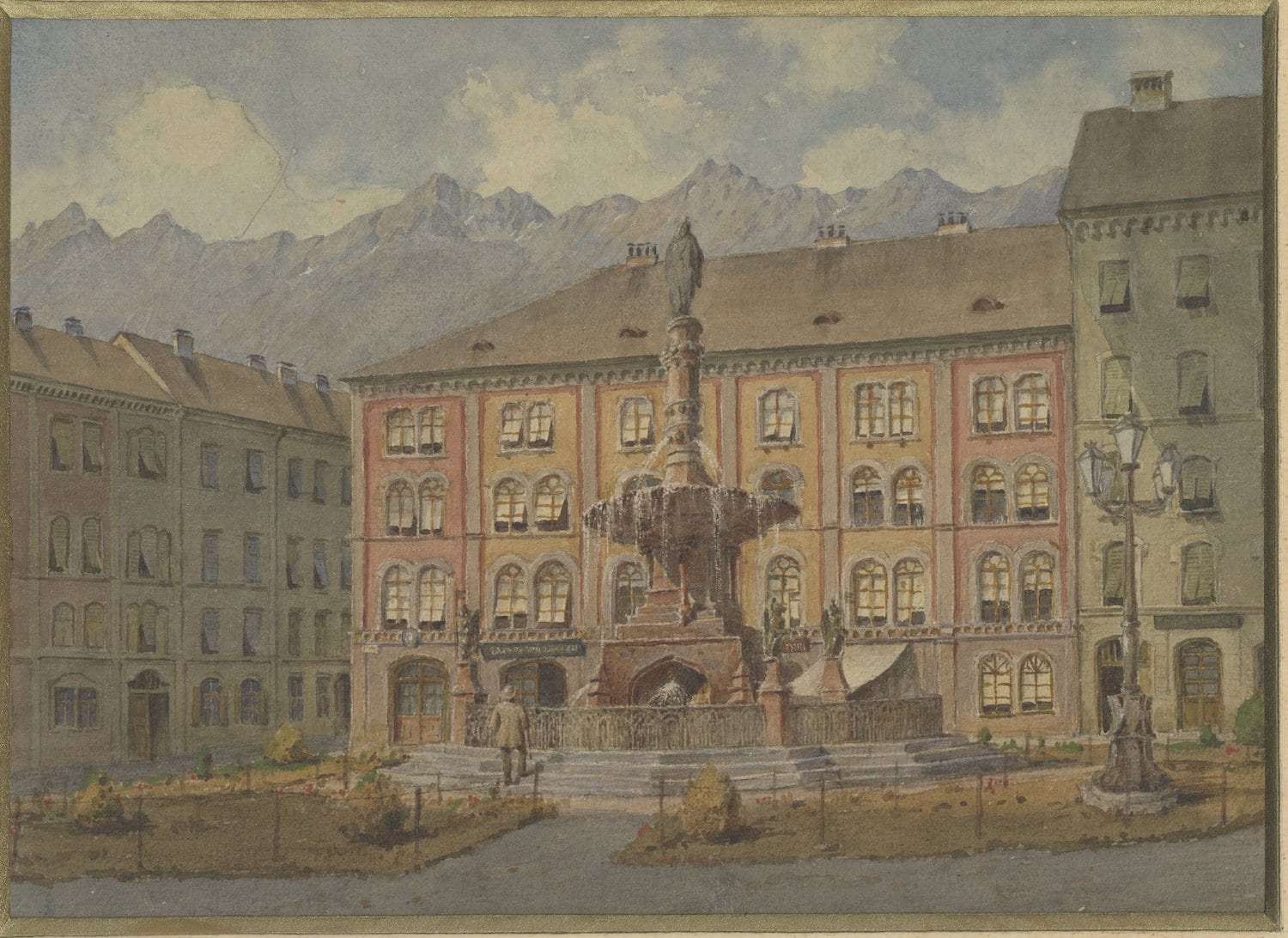
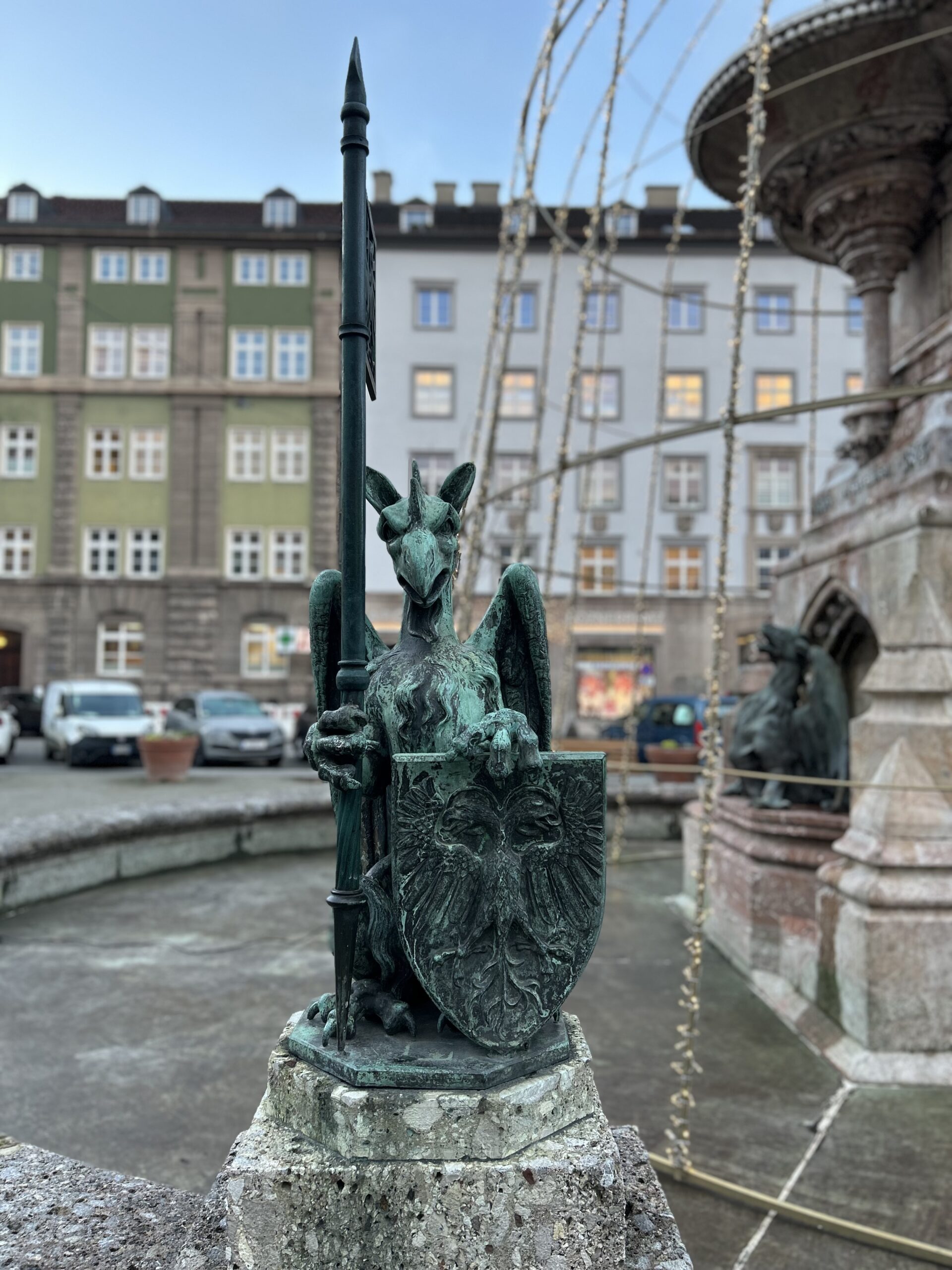
On September 29, 1877, the day of the unveiling of the Rudolfsbrunnen, the editorial team of the Innsbrucker Tagblatt seemed fairly pleased with the result of the city’s newest attraction. The small park was surrounded by Gründerzeit houses like a little inner-city oasis and appeared contemporary and modern. The 12-meter-high figure on the fountain represents Duke Rudolf IV. The lower basin is flanked by griffins bearing coats of arms with the Tyrolean eagle and the imperial double-headed eagle. Friedrich Schmidt was commissioned for the design. The later cathedral master builder of Vienna would become one of the most important architects of the Neo-Gothic style in the Austro-Hungarian monarchy. Between Bolzano, Bohemia, and Ruthenia, he realized many striking buildings, including the reconstruction of the south tower of St. Stephen’s Cathedral and St. Nicholas Church in Innsbruck. He is not only an honorary citizen of Innsbruck but also has a magnificent honorary grave at Vienna’s Central Cemetery. After World War II, the fountain, damaged in an air raid, was renovated under Franz Baumann.
However, the design of the square had been preceded by heated debates between liberal and conservative politicians and newspapers. Construction of the fountain began in 1863 to mark 500 years of Tyrol’s affiliation with the Habsburg Empire. The question was: How should Tyrol position itself within Habsburg politics? The namesake first Tyrolean sovereign from the ruling dynasty was an ambivalent figure. Thanks to a presumably forged inheritance contract, the County of Tyrol became part of the Habsburg Empire. Historians gave Rudolf IV the epithet “The Founder” because of his contributions to Vienna, today’s Austrian capital. At the time of his reign, the center of the Holy Roman Empire was in Prague. With the founding of the University of Vienna and St. Stephen’s Cathedral as a metropolitan chapter and burial site for the Habsburgs under Rudolf, the first step toward Vienna becoming the new center of the Holy Roman Empire was taken. Rudolf’s most sensational coup came in 1358: the Privilegium maius, a document granting the House of Habsburg numerous special rights over all other German princes, was also a forgery. Even Emperor Charles IV, a bitter opponent of the Habsburgs, was convinced the collection of documents was fake. The great scholar Francesco Petrarch likewise concluded that the Privilegium maius could not be genuine. Nevertheless, the special rights of archducal status, hereditary succession, and independent jurisdiction in their territories were granted to the Austrians. Anyone standing before the Rudolfsbrunnen at Boznerplatz today should not forget that the man honored with a fountain was not only a pious founder but above all a gifted fraudster.
Fraud or not, the unity of Austria and Tyrol was a reason to celebrate. The 19th century was the great age of nationalism. Across Europe, traditions and commonalities were sought to give people a sense of national identity. Buildings, literature, and monuments were intended to strengthen the sense of belonging to the Habsburg Empire and national pride among the population. The fountain was a manifestation of the unity and affiliation of the crown land Tyrol with the Habsburg monarchy. Depending on political stance and perspective, different ideas of national thought emerged. The German-national liberal politicians of the city were keen to emphasize the unity of Tyrol and Austria. They saw Innsbruck as part of a strong Habsburg Empire under German dominance over the other peoples of the multiethnic state. The conservative version of Tyrolean identity was oriented toward a Catholic, Tyrolean-national identity, complete with the Sacred Heart cult, which found its monument in the Andreas Hofer memorial at Bergisel. While liberal Crown Prince Rudolf attended the unveiling of the Rudolfsbrunnen, conservative Franz Joseph I was present at the inauguration of the Bergisel monument.
Nearly 150 years after its construction, Boznerplatz was once again the focus of lively debate in the city council. Looking at old pictures, one sees an attractive inner-city square. In reality, it had long been bleak. Boznerplatz was choked by traffic and hardly invited people to linger. Opinions differed on whether and how the square around the Rudolfsbrunnen should be transformed from a traffic hub back into a pedestrian-friendly zone. The discussions no longer revolved around Tyrolean identity; climate and mobility brought Boznerplatz into the spotlight of a modern cultural struggle. After a long battle, proponents of the traffic-calmed solution prevailed. Thirty-one trees were planted, and the square was visually expanded through redesign. Boznerplatz was liberated from the car-centered traffic concept of the 1970s and now forms a successful, modern link between the city center and the train station.
Of Maultasch, Habsburgs and the Black Death
Between the last Count of Andechs and the first Tyrolean territorial prince from the House of Habsburg lay 115 eventful years in the history of the city of Innsbruck. After the extinction of the Andechs line, the Counts of Tyrol guided the fortunes of the region for about a hundred years and thus also largely shaped the development of the city of Innsbruck. Meinhard II of Tyrol (1239–1295) succeeded, through skillful politics and a measure of good fortune, in expanding his territory. From his ancestral seat in Merano, he managed to unite what had previously been a patchwork of lands into a coherent county. Alongside the Prince-Bishops of Brixen and Trent—who were not politically disempowered until the 19th century—the Counts of Tyrol were the most powerful territorial lords in the region that today encompasses Trentino as well as North and South Tyrol. Meinhard’s more modern and tightly administered territories were politically and economically closer to the pulse of the times. His advisers included Florentine merchants and bankers, who at the time represented the most advanced financial and commercial expertise in Europe. Under his rule, a codified territorial law was created, granting estates, entrepreneurs, and subjects a certain degree of legal security. For the first time, all possessions in Tyrol were uniformly recorded in a land register (Urbar). Financial matters were also brought under centralized control. Meinhard broke the bishops’ monopoly on coinage and had coins minted bearing the Tyrolean eagle, following Italian models. This significantly curtailed the de facto power of the Church. Although the bishops of Brixen and Trent remained landowners and feudal lords, their imperial immediacy had become largely formal, as their ties and dependencies on the County of Tyrol had grown too close. In 1254, the territory was no longer referred to merely as the “land in the mountains,” but officially as the Dominium Tirolis—the Lordship of Tyrol. Innsbruck also grew under Meinhard’s rule, with approximately 1,500 inhabitants settling there. Beyond the city walls, the Neustadt began to develop in the area where Maria-Theresien-Straße today invites leisurely strolling. Meinhard found his final resting place at Stams Abbey, which today is known as a training center for Tyrol’s winter sports elite.
His son and successor as Tyrolean territorial prince, Duke Henry of Carinthia (1265–1335), ranked among the most important nobles in the Holy Roman Empire as King of Bohemia. Owing to his extensive possessions in southeastern Europe, Henry was one of the most powerful princes of his time. He was a strong supporter of cities, recognizing their growing importance. In Innsbruck, he promoted the construction of the civic hospital in the Neustadt. However, Henry had no male heir. Before his death, he ensured that his daughter Margaret of Tyrol-Gorizia (1318–1369) could succeed him. She assumed power as territorial princess at the age of seventeen. This placed the young ruler at the center of power struggles among the leading dynasties of the age: the Habsburgs, the Wittelsbachs, and the Luxembourgs. She entered marital alliances with two of these houses; the third would ultimately inherit the County of Tyrol and thus the city of Innsbruck. After her father’s death, Margaret was married to John Henry of Luxembourg, the son of the new King of Bohemia. John Henry was even younger than his wife and primarily served as a political foothold for his father in Tyrol. He was opposed by the Habsburgs and Wittelsbachs as well as by the local nobility. His rule proved disastrous. In the Hall saltworks—leased to Florentine financiers and, alongside customs duties, the backbone of Tyrol’s economy—labor unrest broke out. Despite severe financial difficulties, the court of John Henry was reportedly conducted in an extravagant manner. In 1341, with the support of Emperor Louis of Bavaria, a Wittelsbach, the Tyrolean estates expelled John Henry from the country in a coup planned together with Margaret. Contemporary sources hostile to Margaret portrayed her in highly polemical and defamatory terms. [Here, contemporary scandalous descriptions and explicit allegations are omitted or neutralized.] An imperial chronicler sympathetic to the emperor described John Henry as incapable of fulfilling marital duties, allegedly due to immaturity. These rumors were deliberately circulated throughout the empire to enable the emperor to install his son, Louis of Brandenburg, as Margaret’s new husband and thus as ruler of the strategically important transit territory of Tyrol. This coup, which entered history as the “Tyrolean marital scandal,” triggered a far-reaching crisis. Even the philosopher and critic of papal authority William of Ockham commented on the affair. The issue was not merely the separation itself, but the fact that Margaret had not been formally divorced from her first husband at the time of her second marriage. The emperor and his supporters regarded the marriage between John Henry and Margaret as unconsummated and therefore invalid. The fourth major political power of Central Europe at the time, the papacy, took a different view. Pope Benedict XII excommunicated the emperor and his son because of what he considered an unlawful union between Margaret and Louis of Brandenburg. Beyond moral concerns, the pope also had political motives. Both the papacy and the Habsburgs were in armed conflict with the Wittelsbach emperor and sought to weaken his influence. For medieval society, such an interdict was among the harshest of punishments, as it prohibited the celebration of Mass and the administration of communion throughout the land. It was likely during this period that Margaret acquired the popular nickname “Maultasch” and was described as particularly unattractive. No contemporary portraits exist that would indicate any physical deformity. The images of Margaret Maultasch known today date at the earliest from the late 15th century, when the medieval scandal was first reinterpreted by later historians.
Margaret’s reign was marked by crises for which she bore little responsibility, yet for which she was often blamed. The 14th century brought a period of climatic warming that led to severe locust plagues, including in Innsbruck. Crop failures and famine followed. In addition, after the fire of 1333 in Anbruggen, another major blaze devastated Wilten and Innsbruck seven years later, destroying the parish church of St. James. From 1348 to 1350, the plague swept across Europe. Arriving from Venice via Trent and the Adige Valley, the Black Death reached Innsbruck and dramatically reduced the population. In some parts of Tyrol, more than half of the inhabitants perished. The horrifying manner in which victims died left a deep impression on the deeply religious population. Archival sources provide little detailed information on the outbreak of the plague in Innsbruck itself, but its consequences were devastating, as elsewhere in Europe. In her will, a woman from Innsbruck afflicted by the plague spoke of the “common dying that goes through the land.” Many people interpreted famine and pestilence as divine punishment and as consequences of the papal ban, blaming Margaret and her husband Louis. In reality, the causes of disease and suffering lay far beyond ecclesiastical sanctions and propaganda. Like many medieval cities, Innsbruck lacked paved streets, sewage systems, and reliable drinking water supplies. Humans and animals shared the confined space within the city walls, resulting in highly unhygienic living conditions. Advances in medical knowledge came primarily from Italy. In Salerno, the first medical school had emerged in the 11th century. Under Emperor Frederick II, the professions of physician and apothecary were formally separated and regulated in 1241. In Innsbruck, a pharmacy was first mentioned in 1303 and officially founded in 1326. Located in the Schöpferhaus at today’s Herzog-Friedrich-Straße 19, it served as both court and city pharmacy and is now considered the oldest still-existing pharmacy in Austria.
After the Wittelsbachs, Luxembourgers and Habsburgs had fought over Tyrol for decades, a happy ending was finally reached. Rudolf IV of the House of Habsburg intervened with the Pope and was able to negotiate the lifting of the interdict in 1359 in exchange for considerable financial compensation at the expense of Margaret and Louis. At the same time, a document is said to have been drawn up that is now considered a forgery: in this document, Margaret bequeathed the land of Tyrol to Rudolf IV and the Habsburg family.
Soon thereafter, this transfer of power took effect. One year after the death of Margaret’s husband Louis in 1361, her son Meinhard III also died. According to the account of Filippo Villani, written around 1400, Margaret was rumored to have been involved in both deaths—an allegation that remains historically unproven. In 1363, with the consent of the Tyrolean nobility, Margaret formally transferred the governance of Tyrol to Rudolf IV of Habsburg. Tyrol thus became part of the Habsburg dominions, which already included the Duchy of Austria. The Dukes of Bavaria from the House of Wittelsbach refused to recognize this inheritance treaty and attempted to assert their claims by force of arms. In 1363, they marched toward Innsbruck. Rudolf IV, however, had secured the support of key local nobles and the cities of Innsbruck and Hall. The fortified city successfully withstood the attack. After consolidating power, Rudolf confirmed the city hospital and granted temporary customs exemptions as well as the right to levy major tolls.
With the acquisition of Tyrol, the Habsburg family was able to close an important geographical gap within its sphere of influence. Although there were repeated incursions by Bavarian troops, for example the abbot of Wilten Abbey was abducted and taken hostage, the Inn Valley and Innsbruck were gladly part of the Habsburg lands. The incorporation of the city into the much larger territory of the Habsburgs meant that Innsbruck became even more important, while the actual capital Merano was further marginalised. In addition to the north-south transport of goods, the city on the Inn had now also become a west-east transport hub between the eastern Austrian lands and the old Habsburg possessions in the west. For the survivors of the great plague wave of 1348 and the political turmoil, there was an economic upswing. Labour had become scarce due to the shrinking population, but greater resources were available per capita. For those Innsbruck residents who had survived the turbulent first half of the 14th century, better times were to come.
Little remains in Innsbruck’s cityscape from the era of Margaret Maultasch and her husbands. Political and economic hardship, warfare, plague, fires, earthquakes, and later building activity erased much of the medieval city. Yet the memory of Margaret endures in legend. She remains one of the most famous female figures in Tyrolean history. Conflicting accounts written even during her lifetime allow room for interpretation. Her biography could easily serve as the template for a character in a modern historical drama. Whether she was a ruthless schemer or an innocent pawn of greater powers remains an open question. Margaret and her successor Rudolf IV of Habsburg are commemorated in stone at the fountain on Bozner Platz, formerly known as Margarethenplatz.
Crown Prince Rudolf & the mores of the upper class
The smart and liberal Crown Prince Rudolf (1858–1889) was considered the favorite of the peoples of the Habsburg Empire. In many respects, his life can be read as exemplary for the period between 1848 and the outbreak of the First World War—a time when technical ideas developed at a breakneck pace, newspapers distributed the political ideas of various factions in unprecedented circulation, and yet Catholicism, superstition, and spiritism were commonplace. The vast majority of Innsbruck's citizens did not possess the material means or status of a Habsburg, but the fashions and trends under which they lived were the same. The bourgeoisie aspired to the same ideals as the Crown Prince, just as Rudolf always saw himself as part of this bourgeoisie. He was regarded as a well-read, educated humanist and, completely in tune with the spirit of the times, was interested in a wide spectrum of topics. In his role as a member of the ruling house of a multinational empire, he spoke French, Hungarian, Czech, and Croatian in addition to Greek and Latin. As a private individual, he dedicated himself to science and traveling through the lands of the monarchy. Rudolf initiated the publication of the Kronprinzenwerk (The Crown Prince's Work), a scientific encyclopedia; Volume 13, which covered the crown land of Tyrol, was published in 1893. He also authored liberal articles in the Neues Wiener Tagblatt under a pseudonym. Among other things, he wished to push forward land reforms by heavily taxing large landowners, and he wanted to grant more rights to the individual nationalities within the Habsburg Empire. He was extremely unpopular, particularly in conservative, rural Tyrol and among the military. Conversely, among the liberal-minded citizens of Innsbruck, he was seen as the hope for a renewal of the monarchy in the sense of a modern, federal state. Although the Rudolfsbrunnen (Rudolf's Fountain) on Boznerplatz in Innsbruck does not actually commemorate the Crown Prince, he was present at its inauguration. As a champion of rationalism and the Enlightenment, Rudolf despised the widespread belief in supernatural beings and spirits, even as new churches sprouted like mushrooms all around him and the upper class indulged in seances and spiritist superstition. The popular piety of the late monarchy led to major projects such as the parish churches of St. Nikolaus and Hötting.
Despite, or perhaps because of his aristocratic background, Rudolf's private life was turbulent, but not atypical of the time, in which parents and teachers were less approachable educators and more distant figures of respect. Children were brought up strictly. Neither teachers nor parents shied away from corporal punishment, even if there were limits, laws and rules for the use of domestic violence. Militarism and a focus on future gainful employment prevented the kind of childhood and youth we know today. Young men from the upper classes lived out their soldierly daydreams as armed and uniformed members of student fraternities. It is no wonder that the enthusiasm for war, God, Emperor and Fatherland was great in the birth cohorts of the last decades of the 19th century. Rudolf's early years, when he had to undergo a military education under General Gondrecourt at the request of Emperor Franz Josef, were also less than luxurious. It was only after his mother Elisabeth intervened that harassment such as water cures, drill in the rain and snow and being woken up with pistol shots were removed from the six-year-old crown prince's daily programme.
Like many of his contemporaries, Rudolf found himself as a member of the upper class trapped in an unhappy, arranged marriage. The 19th century was not the age of love matches, even if the Romantic and Biedermeier eras are often fondly glorified as such. Marriages among farming folk were frequently concluded based on financial considerations. Aristocrats and members of the high bourgeoisie married out of class snobbery and with the goal of preserving the dynasty. In upper-class circles, wives were often mere ornaments to their husbands and heads of the household. Only after the—often older—husband had passed away could widows enjoy their lives outside of this role. For a long time, servants, housemaids, farmhands, and maids were forbidden from marrying. The danger that those without assets would be unable to feed their children, thereby becoming a burden on the public, was deemed too great by the municipalities. This double standard held by the aristocracy and bourgeoisie toward the common folk (Pofl) meant that illegal abortions, full orphanages, and children growing up with relatives in the countryside instead of with their parents were a part of everyday reality. Throughout his life, Rudolf was also not averse to the fair sex outside of marriage. In the final months of his life, he maintained an affair with Mary Vetsera, a girl of only 17 from the wealthy Hungarian nobility who was considered exceptionally beautiful. Many of his subjects acted just as Rudolf did. Granted, hardly anyone could boast of claiming a Hungarian aristocrat as a mistress. Yet, even in Innsbruck's high society, it was common practice to listen to the priest’s sermon from the pulpit on Sundays while simultaneously maintaining an extramarital relationship or visiting a brothel.
Rudolf's life ended tragically. On January 30, 1889, deeply depressed and ravaged by alcohol, morphine, and gonorrhea, Rudolf met with Vetsera, having spent the previous night with his long-term mistress, the prostitute Maria "Mizzi" Kaspar. Under circumstances that have never been fully cleared up, he first killed the young woman and then himself with a shot to the head. The suicide was never recognized by the Habsburg family. Zita (1892–1989), the widow of the last Emperor Karl, was still speaking of an assassination plot as late as the 1980s. The debate surrounding the burial of the heir to the throne and his mistress exposed the double standards of society. Suicide was considered a grave sin and technically precluded a Christian burial. Vetsera was buried discreetly in a small grave by the cemetery wall at the cemetery in Heiligenkreuz near Mayerling, whereas Rudolf, following imperial intervention with the Pope, received a state funeral and was laid to his final rest in the Imperial Crypt (Kapuzinergruft) in Vienna.
Innsbruck and the House of Habsburg
Innsbrucks Innenstadt wird bis heute von Gebäuden und Denkmälern geprägt, die an die Familie Habsburg erinnern. Unzählige Touristen bewundern die stummen Hinterlassenschaften der Dynastie, die als mindestens ebenso ur-österreichisch gilt wie Schnitzel, Mozartkugeln und Mehlspeisen. Diese Darstellung ist allerdings nicht korrekt, auch wenn die Habsburger die Landesgeschichte über Jahrhunderte mitprägten. Sie waren ein europäisches Herrscherhaus, zu dessen Einflussbereich verschiedenste Territorien gehörten. Am Zenit ihrer Macht waren ihre Mitglieder die Herrscher über ein „Reich, in dem die Sonne nie untergeht“. Durch Kriege und geschickte Heirats- und Machtpolitik saßen sie in verschiedenen Epochen an den Schalthebeln der Macht zwischen Südamerika und der Ukraine. Ob der internationalen Ausrichtung des Hauses Habsburg verwundert es nicht, dass so mancher CEO der Grafschaft Tirol aus dieser Dynastie zumindest am Anfang etwas fremdelte mit der alpinen Provinz und ihren Einwohnern. Einige der Tiroler Landesfürsten hatten weder eine besondere Beziehung zu Tirol noch brachten sie diesem deutschen Land besondere Zuneigung entgegen. Ferdinand I. (1503 – 1564) wurde am spanischen Hof erzogen. Maximilians Enkel Karl V. war in Burgund aufgewachsen. Als er mit 17 Jahren zum ersten Mal spanischen Boden betrat, um das Erbe seiner Mutter Johanna über die Reiche Kastilien und Aragorn anzutreten, sprach er kein Wort spanisch. Als er 1519 zum Deutschen Kaiser gewählt wurde, sprach er kein Wort Deutsch. Es waren auch nicht alle Habsburger glücklich in Innsbruck sein zu „dürfen“. Angeheiratete Prinzen und Prinzessinnen wie Maximilians zweite Frau Bianca Maria Sforza oder Ferdinand II. zweite Frau Anna Caterina Gonzaga strandeten ungefragt nach der Hochzeit in der rauen, deutschsprachigen Bergwelt. Stellt man sich zudem vor, was ein Umzug samt Heirat von Italien nach Tirol zu einem fremden Mann für einen Teenager bedeutet, kann man erahnen, wie schwer das Leben der Prinzessinnen war. Kinder der Aristokratie wurden bis ins 20. Jahrhundert vor allem dazu erzogen, politisch verheiratet zu werden. Widerspruch dagegen gab es keinen. Man mag sich das höfische Leben als prunkvoll vorstellen, Privatsphäre war in all dem Luxus nicht vorgesehen.
Innsbruck repeatedly became a place of destiny for this ruling dynasty. Thanks to its strategically favorable location between Italian cities and German centers such as Augsburg and Regensburg, Innsbruck gained a special status within the empire at the latest after being elevated to a residence city under Emperor Maximilian. Innsbruck experienced its Habsburg heyday when it served as the main residence of the Tyrolean sovereigns. Ferdinand II, Maximilian III, and Leopold V, together with their wives, shaped the city during their reigns. When Sigismund Franz of Habsburg (1630–1665) died childless as the last provincial ruler, Innsbruck also lost its status as a residence city, and Tyrol was governed by a governor. Tyrolean mining had lost much of its importance and no longer required special attention. Shortly thereafter, the Habsburgs lost their possessions in Western Europe, including Spain and Burgundy, which pushed Innsbruck from the center to the periphery of the empire.
Despite this decline in favor and the increasing centralization of government affairs, Tyrol, as a conservative region, generally remained loyal to the dynasty. Even after the period as a residence city, the births of new members of the ruling family were dutifully celebrated with parades and processions; deaths were mourned with memorial masses; and archdukes, kings, and emperors were immortalized in public spaces with statues and paintings. In the nineteenth century, the Jesuit Hartmann Grisar wrote the following about the celebrations marking the birth of Archduke Leopold in 1716:
„But what an imposing sight it was when, as night fell, the Abbot of Wilten held the final religious function in front of St Anne's Column, which had been consecrated by the blood of the country, surrounded by rows of students and the packed crowd; when, by the light of thousands of burning lights and torches, the whole town, together with the studying youth, the hope of the country, implored heaven for a blessing for the Emperor's newborn first son.“
The Habsburgs valued the Nibelung-like loyalty of their alpine subjects. The region’s difficult accessibility made it a perfect refuge in turbulent and crisis-ridden times. Charles V (1500–1558) fled to Innsbruck for a time during a conflict with the Protestant Schmalkaldic League. Ferdinand I (1793–1875) had his family stay in Innsbruck to keep them far from the Ottoman threat in eastern Austria. Shortly before his coronation, Franz Joseph I enjoyed the seclusion of Innsbruck during the turbulent summer of the 1848 revolution together with his brother Maximilian, who was later executed by nationalist insurgents as Emperor of Mexico. A plaque at the Alpine inn Heiligwasser above Igls commemorates the fact that the monarch spent the night there during his ascent of the Patscherkofel. In the Austro-Hungarian Monarchy of the nineteenth century, Innsbruck was the western outpost of a vast empire that extended as far as present-day Ukraine. Franz Joseph I (1830–1916) ruled a multiethnic empire between 1848 and 1916. His neo-absolutist understanding of rule, however, was outdated. Although Austria had had a parliament and a constitution since 1867, the emperor regarded this government as “his.” Ministers were accountable to the emperor, who stood above the government.
In the second half of the nineteenth century, the ailing empire began to crumble increasingly. On October 28, 1918, the Republic of Czechoslovakia was proclaimed; on October 29, Croats, Slovenes, and Serbs withdrew from the monarchy. The last emperor, Charles, abdicated on November 11. On November 12, “German-Austria declared itself a democratic republic in which all power emanates from the people.” The Habsburg chapter had come to an end. Even though only very few Austrians today can imagine a monarchy as a form of government, the view of the ruling family remains ambivalent. Despite all the national, economic, and democratic problems that existed in the multiethnic states that— in various forms and configurations—were subject to the Habsburgs, the successor nation-states in some cases proved far less successful at reconciling minority interests and cultural differences within their territories. Since the EU’s eastward enlargement, the Habsburg Monarchy has not infrequently been portrayed by well-meaning historians as a precursor to the European Union. The list of Habsburg legacies in Innsbruck is long. Together with the Catholic Church, the Habsburgs shaped public space through architecture, art, and culture. The Golden Roof, the Imperial Palace, the Triumphal Arch, Ambras Castle, the Leopold Fountain, and many other structures still bear witness today to the presence of what was arguably the most significant ruling dynasty in European history in Innsbruck.
The Tyrolean nation, "democracy" and the heart of Jesus
Many Tyroleans still like to see themselves as a nation of their own. With “Tirol isch lei oans,” “Zu Mantua in Banden,” and “Dem Land Tirol die Treue,” the federal state has no fewer than three more or less official anthems. This pronounced local patriotism, as in other Austrian provinces, has historical roots. Tyrolean freedom and independence are frequently invoked almost as local sacred relics to substantiate this self-image. People also like to speak of the first democracy on mainland Europe—an assertion that is clearly an exaggeration when one considers the feudal, hierarchy-driven history of the region well into the twentieth century. Nevertheless, a certain distinctiveness in Tyrol’s historical development cannot be denied, even if this involved less the participation of broad sections of the population than the curtailment of the sovereign’s power by local elites. Tyrolean princes were already minting coins bearing their likenesses at an early stage, yet their relationship with the clergy, the estates, and the population was subject to constant fluctuation. The first act of what might be called proto-democratic Tyrolean historiography was what the Innsbruck historian Otto Stolz (1881–1957) enthusiastically celebrated in the 1950s—drawing on English history—as a Magna Charta Libertatum. Following the marriage of the Bavarian Ludwig of Wittelsbach to the Tyrolean sovereign Margaret of Tyrol-Gorizia, the Bavarian Wittelsbach dynasty briefly ruled Tyrol. In order to win over the Tyrolean population, Ludwig decided in the fourteenth century to offer the estates a concession. In the Great Charter of Freedom of 1342, he promised the Tyroleans that no laws would be enacted and no taxes raised without prior consultation with the estates. However, this was by no means a democratic constitution in the modern, twenty-first-century sense, as the estates consisted primarily of the landed nobility, who naturally represented their own interests. Although one version of the document mentioned the inclusion of peasants as an estate in the regional assembly, this version was never officially implemented.
The second act followed with Habsburg involvement. As cities and the bourgeoisie gained greater political weight in the fifteenth century due to their economic importance, a counterbalance to the nobility emerged within the estates. At the Landtag of 1423 under Frederick IV, eighteen members of the nobility met for the first time with eighteen representatives of towns and the peasantry. Over time, a fixed composition developed in the regional assemblies of the fifteenth and sixteenth centuries. Represented were the bishops of Brixen and Trient, the abbots of Tyrolean monasteries, the nobility, delegates from the towns, and representatives of the peasantry. The Landeshauptmann presided over the assembly. Naturally, the resolutions and wishes of the Landtag were not binding on the prince; nevertheless, it was surely reassuring for a ruler to know that representatives of the population stood behind him or supported difficult decisions.
Another important document for the region was the Tyrolean Landlibell. In 1511, Maximilian stipulated, among other things, that Tyrolean soldiers were to be deployed only for the defense of their own land. The reason for Maximilian’s apparent generosity lay less in affection for the Tyroleans than in the necessity of keeping the Tyrolean mines operational instead of sacrificing valuable workers and the peasantry that supported them on Europe’s battlefields. What is often overlooked is that the Landlibell also imposed significant restrictions on the population and increased financial burdens. In addition to regulating troop contingents, it defined special taxes. The nobility and clergy were required to use the income from their estates as the tax base, which often amounted to a rough estimate. Towns, by contrast, were taxed according to the number of hearths in their houses—a figure that could be recorded quite accurately. The highly sought-after mining workers were exempt from these taxes and were only conscripted for military service in cases of extreme emergency. This special regulation of territorial defense laid down in the Landlibell was one of the causes of the uprising of 1809, when young Tyroleans were conscripted during mobilization under universal military service. To this day, the Napoleonic Wars—during which the Catholic crown land was threatened by the “godless French” and the revolutionary social order—continue to shape Tyrolean self-perception. During this defensive struggle, a bond formed between Catholicism and Tyrol. Before a decisive battle against Napoleon’s armies in June 1796, the Tyrolean riflemen entrusted their fate to the Sacred Heart of Jesus and entered into a personal covenant with God to protect the Holy Land of Tyrol. Another identity-forming legend from 1796 centers on a young woman from the village of Spinges. Katharina Lanz, who entered regional history as the “Virgin of Spinges,” is said to have motivated the nearly defeated Tyrolean troops through her commanding presence in battle, ultimately enabling them to overcome the French superiority. Depending on the account, she is said to have wielded a pitchfork, a flail, or a scythe—much like the French maiden Joan of Arc—striking fear into Napoleon’s troops. Legends and traditions surrounding the riflemen and the notion of being an independent, God-chosen nation accidentally attached to the Republic of Austria stem from these narratives. The government in Vienna under Maria Theresa viewed this identity with skepticism. Distinct identities of individual crown lands did not align with enlightened concepts of a modern state. In the nineteenth century, too, efforts were made to strengthen identification with the monarchy and foster a new national consciousness. Subjects were meant to feel allegiance not to Tyrol, but to the House of Habsburg. The press, visits by the ruling family, monuments such as the Rudolf Fountain, and the opening of Bergisel with Hofer portrayed as a loyal Tyrolean were intended to help transform the population into faithful imperial subjects. Over the centuries, Innsbruck’s inhabitants saw themselves as Tyroleans, Germans, Catholics, and subjects of the emperor—but hardly anyone identified as Austrian before 1945. Only after the Second World War did a sense of belonging to Austria slowly begin to develop in Tyrol as well.
The end of the monarchy further strengthened Tyrolean national sentiment. When the Habsburg Empire collapsed after the First World War, the crown land of Tyrol also fell apart. What had been known as South Tyrol until 1918—the Italian-speaking region between Riva on Lake Garda and Salurn in the Adige Valley—became Trentino with its capital in Trento. Liberals and conservatives, otherwise divided on almost every issue, were united in their hostility toward the unwanted division of the province and the founding of the Republic of German-Austria. Even today, many Tyroleans take particular pride in their local identity and readily distinguish themselves from residents of other federal states. For many Tyroleans, the Brenner Pass still represents an unjust border more than a century later, even though political cross-border cooperation takes place at the EU level within the framework of a “Europe of the Regions.” The legend of the Holy Land, the independent Tyrolean nation, and the first mainland democracy persists to this day. The saying “bisch a Tiroler bisch a Mensch, bisch koana, bisch a Oasch” (“If you’re a Tyrolean, you’re a human being; if you’re not, you’re an arse”) succinctly captures Tyrolean nationalism. The fact that the historical crown land of Tyrol was a multiethnic construct—including Italians, Ladins, Cimbrians, and Rhaeto-Romans—is often deliberately ignored in right-wing circles. Laws from the federal capital Vienna or even from Brussels are viewed with unreflective skepticism. Nationalists on both sides of the Brenner still draw on figures such as the Virgin of Spinges, the Sacred Heart of Jesus, and Andreas Hofer to present their causes in a way that resonates with the public.
Franz Baumann and Tyrolean modernism
The First World War not only brought states and ruling dynasties to an end; it also marked a turning point for art, music, literature, and architecture. In Innsbruck, a handful of planners transformed the cityscape during the two decades of the First Republic. Inspired by new design movements such as the Bauhaus style from Germany, skyscrapers from the United States, Italian Futurism, and Soviet Modernism from the revolutionary USSR, remarkable architectural projects emerged in Innsbruck. The best-known representatives of the avant-garde who introduced this new approach to shaping public space in Tyrol were Lois Welzenbacher, Siegfried Mazagg, Theodor Prachensky, and Clemens Holzmeister. Each of these architects had distinct characteristics, making the Tyrolean Modern Movement (Tiroler Moderne) difficult to define precisely. Their common feature was a departure from the classical architecture of the pre-war era while retaining typical Alpine materials and architectural elements, following the principle of “Form Follows Function.” In a 1920 article for the magazine Tiroler Hochland, Lois Welzenbacher wrote about the architecture of his time:
"As far as we can judge today, it is clear that the 19th century lacked the strength to create its own distinct style. It is the age of stillness... Thus details were reproduced with historical accuracy, mostly without any particular meaning or purpose, and without a harmonious overall picture that would have arisen from factual or artistic necessity."
The most prominent and visually influential representative of the so-called Tyrolean Modern Movement in Innsbruck was Franz Baumann (1892–1974). Unlike Holzmeister or Welzenbacher, he never received an academic education. Baumann was born in Innsbruck in 1892, the son of a postal official. His religious education teacher, the now controversial theologian and writer Anton Müller, known by the pseudonym Brother Willram, recognized the young Franz Baumann’s talent for drawing and enabled him to attend the Imperial-Royal State Trade School (k.k. Staatsgewerbeschule) at the age of fourteen. There he met his future brother-in-law Theodor Prachensky, who would also play a significant role in his professional life. During his school years, Baumann gained practical experience as a bricklayer with the construction company Huter & Söhne and began producing landscape drawings around Innsbruck together with his sister Maria and Prachensky. In 1910, Baumann followed his friend to Merano to take up employment with the renowned construction firm Musch & Lun. The former Tyrolean capital was then the most important tourist destination in Tyrol, attracting an international clientele of spa visitors. Under Adalbert Erlebach, who would later play a key role in the development of Hungerburg, Baumann gained his first experience in planning large-scale projects such as hotels and cable cars. Important for his later career was not only his technical education but also his first encounters with the Tyrolean Heritage Protection Association (Tiroler Heimatschutzverband). Kunibert Zimmeter had founded this organization together with Gotthard Graf Trapp. Since building regulations were a provincial matter, the Tyrolean Heritage Protection Association, together with the district authorities, acted as the final authority responsible for evaluating and approving construction projects. In many Tyrolean villages, hotels had replaced churches as the largest buildings in the local skyline. The aim was to prevent tourism and industrial developments from overwhelming traditional village character. In Our Tyrol: A Homeland Protection Book, Zimmeter wrote:
"Let us look at the flattening of our private lives, our amusements, at the centre of which, significantly, is the cinema, at the literary ephemera of our newspaper reading, at the hopeless and costly excesses of fashion in the field of women's clothing, let us take a look at our homes with the miserable factory furniture and all the dreadful products of our so-called gallantry goods industry, Things that thousands of people work to produce, creating worthless bric-a-brac in the process, or let us look at our apartment blocks and villas with their cement façades simulating palaces, countless superfluous towers and gables, our hotels with their pompous façades, what a waste of the people's wealth, what an abundance of tastelessness we must find there."
After four years, Baumann’s career was abruptly interrupted. Like most of his generation, the First World War tore him away from both work and everyday life. While serving on the Italian Front, he suffered a gunshot wound to the abdomen and recovered in a military hospital in Prague. During this otherwise inactive period, he painted cityscapes depicting buildings in and around Prague. These urban views, which later helped him visualize architectural designs, were exhibited at his only exhibition in 1919. His breakthrough in construction came the following year. Baumann unexpectedly won the competitions for the renovation of the Weinhaus Happ in Innsbruck’s Old Town and for the Nordkette Cable Railway. Besides his creativity, his success stemmed from the alignment between his architectural philosophy and the requirements of both the Tyrolean Heritage Protection Association and the public tenders issued by the young First Republic. In the economic upswing of the late 1920s, a new class of customers and visitors emerged in tourism. The aristocratic distance toward the mountains had given way to a middle-class enthusiasm for sports. No longer were grand hotels built at elevations of 1,500 meters for health resorts; instead, functional infrastructure for skiers in high alpine terrain, such as on the Nordkette, was constructed. Buildings were expected to blend harmoniously into their surroundings while remaining attractive and practical. Despite the social and artistic innovations of the era, architects still had to take regional character into account. This was precisely where Baumann’s approach to holistic building in a Tyrolean context excelled. From exterior lighting to furniture, Baumann designed even the smallest details and integrated them into his overall concept of the Tyrolean Modern Movement. Every technical function and detail, as well as environmental conditions, topography, and sunlight, played a role for him. Although he was officially not permitted to use the professional title of architect, he followed the principles outlined by architect Adolf Loos (1870–1933) in his essay Rules for the Person Building in the Mountains:
Don't build picturesquely. Leave such effects to the walls, the mountains and the sun. The man who dresses picturesquely is not picturesque, but a buffoon. The farmer does not dress picturesquely. But he is...
Pay attention to the forms in which the farmer builds. For they are ancestral wisdom, congealed substance. But seek out the reason for the mould. If advances in technology have made it possible to improve the mould, then this improvement should always be used. The flail will be replaced by the threshing machine."
Beginning in 1927, Baumann operated his own studio on Schöpfstraße in the Wilten district. At the height of its success, his office employed fourteen staff members. Time and again, his professional path crossed with that of his friend and brother-in-law Theodor Prachensky. Together, beginning in 1929, they planned the new secondary school in Hötting on Fürstenweg. Although separate wings for boys and girls still had to be included according to contemporary conventions, the building otherwise fully embodied the style of New Objectivity (Neue Sachlichkeit) and the principle of “Light, Air, and Sun.” Thanks to his modern approach, which combined functionality, aesthetics, tradition, and economical construction, Baumann weathered the economic crisis that began in the late 1920s relatively well. It was only the 1,000-Mark Blockade, imposed by Hitler on Austria in 1933 in an attempt to place financial pressure on the Republic, that caused serious problems for his architectural practice. Not only did unemployment in the tourism sector triple within a short period of time, but the construction industry also entered a severe downturn. In 1935, Baumann became head of the Central Association of Architects, after receiving a special exemption allowing him to use the professional title of architect despite lacking a formal academic qualification. With Austria’s annexation by Germany in 1938, he quickly joined the National Socialist German Workers’ Party (NSDAP). On the one hand, like his colleague Lois Welzenbacher, he may have been sympathetic to certain ideas of National Socialism. On the other hand, membership enabled him to advance his career as chairman of the Reich Chamber of Fine Arts in Tyrol. In this position, however, he repeatedly opposed the radical alterations to Innsbruck’s cityscape that the Nazi authorities wished to implement. Innsbruck’s mayor, Egon Denz, wanted the Triumphal Arch and St. Anne’s Column removed in order to create more space for traffic in Maria-Theresien-Straße. At that time, the city center still served as the principal traffic route connecting the Brenner Pass in the south with the federal highway leading east and west along what is now the Innrain. A statue of Adolf Hitler was intended to replace St. Anne’s Column. Gauleiter Franz Hofer also planned to have the towers of the Court Church blown up. In his official capacity, Baumann assessed both projects negatively. When the matter eventually reached the desk of Albert Speer, Speer agreed with Baumann’s assessment. From that point onward, Gauleiter Hofer no longer awarded Baumann any public projects. However, this courageous stance probably spared him more serious consequences after the war. After being questioned during the denazification process following the war, Baumann began working in the municipal building department, likely also on the recommendation of his brother-in-law Theodor Prachensky. Although Baumann was fully exonerated, partly due to testimony from the abbot of Wilten, whose church towers he had helped save, his reputation as an architect could no longer be fully restored. Another setback was the destruction of his studio on Schöpfstraße, which was hit by a bomb in 1944. In his postwar career, Baumann became responsible for the restoration of buildings damaged during the war. Under his supervision, the Boznerplatz and its Rudolf Fountain were rebuilt, while the Burggraben area and the New City Halls (Neue Stadtsäle) behind the Tyrolean State Theatre were redesigned. Franz Baumann died in 1974. Today, his paintings, sketches, and drawings are highly sought after and command substantial prices on the art market. Anyone who carefully examines more recent large-scale projects in Innsbruck, such as the City Library, the PEMA Towers, and many of the city’s residential developments, can still recognize elements of the Tyrolean Modern Movement today.