Servitenkirche
Maria-Theresienstrasse 42
Worth knowing
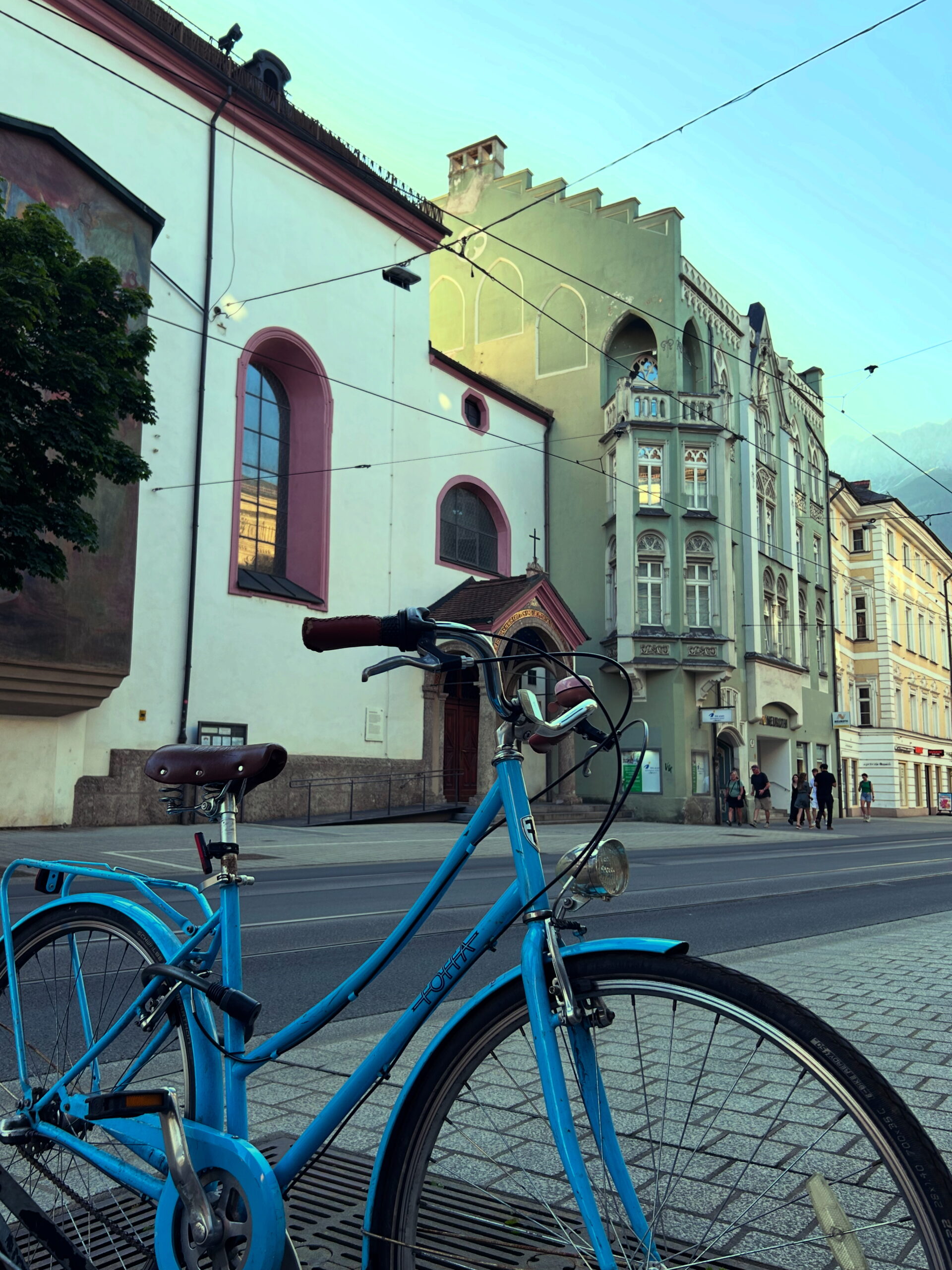
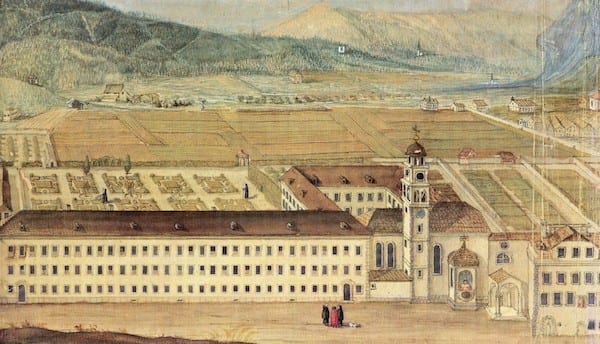
The history of the Servite Church is more fascinating than its modest appearance suggests. Anna Catarina Gonzaga (1566–1621), the second wife of Archduke Ferdinand II, founded the first establishment of the “Ordo Servorum Mariae” (Order of the Servants of Mary) in Innsbruck in 1612 with the Servite Monastery. At that time, the monastery was the only convent north of the Alps dedicated to Saint Joseph. The mosaic in the colorful entrance vault displays the coat of arms of the Duchy of Mantua with its four black eagles and red lion, alongside the coat of arms of the Archduchy of Austria. It symbolizes the union of Ferdinand and Anna Catarina Gonzaga and their dynasties. Although the Italian city-states had already passed their prime, they still possessed the means to marry into the highest circles of European aristocracy. During this era of church division, the northern Italian principalities and the Habsburgs formed the Catholic stronghold of Europe. Establishing this strict order was a major concern for the devout rulers from northern Italy. As a mendicant order, the Servites initially devoted themselves to caring for the poor. During the Reformation, the Servite Order, which originated in Tuscany, was completely dissolved in German-speaking regions and only began to spread again from Innsbruck in the 17th century.
The Servite Order faced many challenges in Innsbruck. Just a few years after the church was consecrated, the first building largely burned down in 1620. The Gothic entrance area of the original church with its distinctive columns survived. The founder’s plan to be buried in the church she had endowed had to be postponed. Johann Martin and Georg Anton Gumpp designed the new building in Baroque style in 1626. By then, Anna Caterina Gonzaga had already passed away. Instead of being buried in the Servite Church as planned, she was first interred in the Servite nuns’ convent and later in the Jesuit Church. It was not until 1693 that she was reburied in the Servite Church alongside her daughter. In the 20th century, the Servite Monastery once again faced dissolution. On November 3, 1938, the National Socialists dissolved the Servite Order as the first monastery in Innsbruck “for the protection of the people.” In Catholic Tyrol, actions against the Church had to be carefully planned and communicated. Often, the most outrageous stories were fabricated for this purpose. The Austrian edition of the “Völkischer Beobachter” on November 4, 1938 stated the reason as follows:
“State police investigations in the Servite Monastery in Innsbruck revealed such immoral conditions that it is impossible to present them publicly. The monastery in question is a den of vice of the highest order, behind which the anti-state behavior, evidenced by discovered writings, fades into the background.”
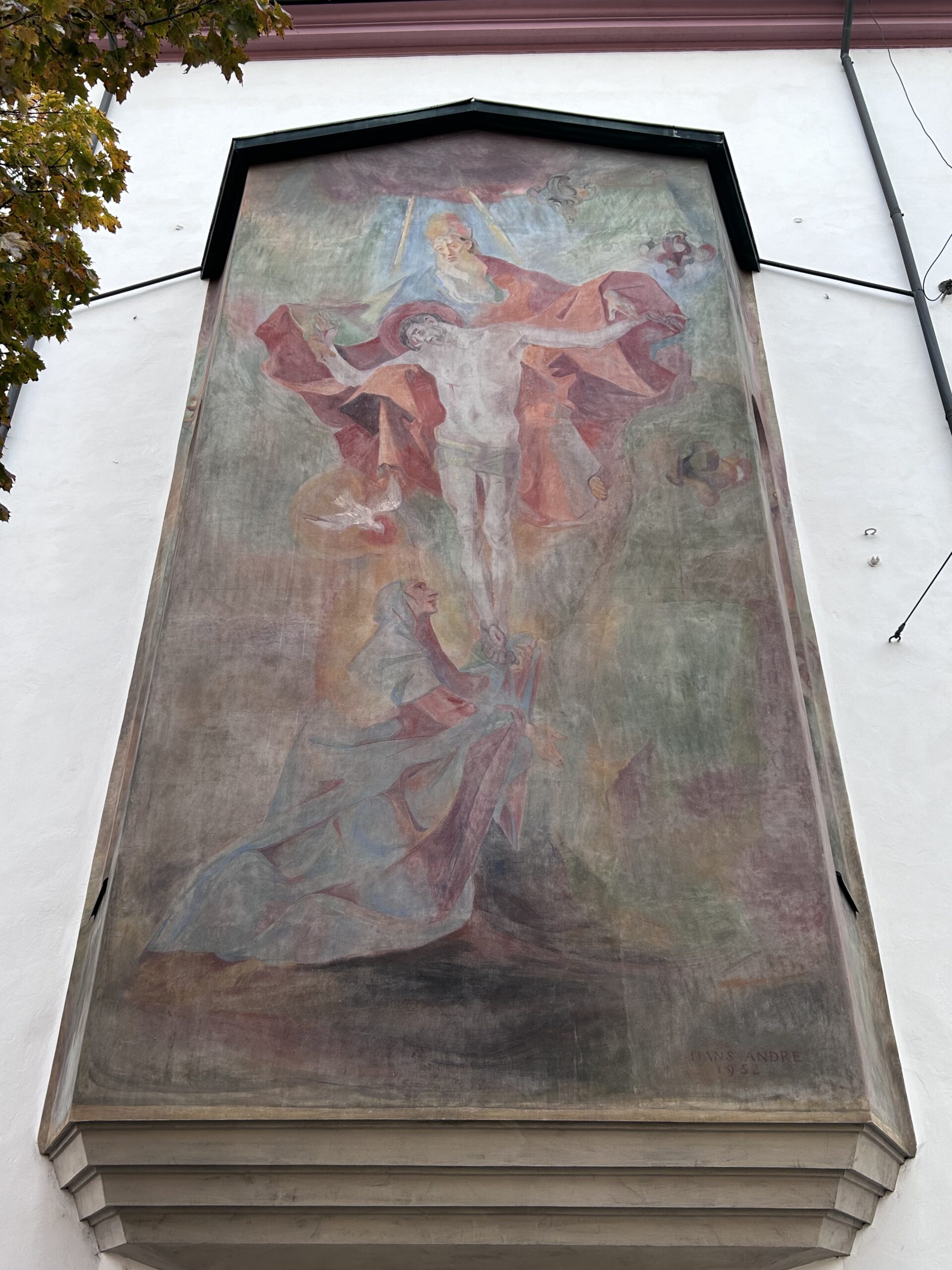
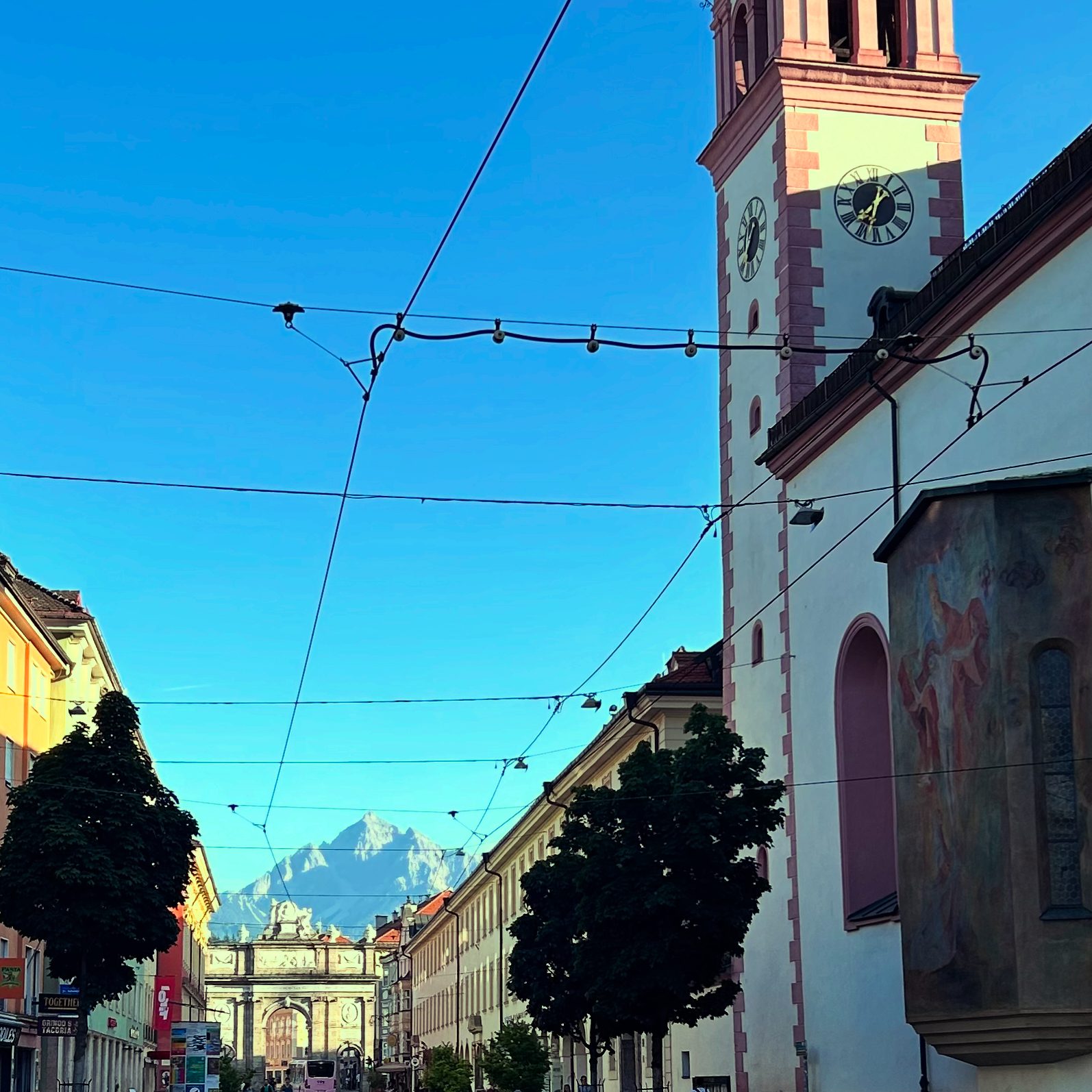
On December 15, 1943, the Servite Church was destroyed during the first air raid on Innsbruck. Only small parts of the historic structure and some paintings and relics in the art chamber and monastery museum remained intact. The striking painting on the exterior was recreated after 1945 during reconstruction by Hans Andre (1902–1991), who also restored the damaged Hospital Church after the war. Born in Innsbruck, Andre attended the trade school—today’s HTL—like many Tyrolean artists of the 20th century. After five years at the University of Applied Arts and a brief collaboration with Clemens Holzmeister, he returned to Innsbruck. After World War II, he focused on restoring churches damaged by the war. His interpretation of the Crucifixion scene on the exterior façade, simultaneously baroque and modern, reflects the subdued mood of the post-war era. Andre also created the paintings inside the church.
Anna Caterina Gonzaga - die fromme Landesfürstin
Innsbruck’s inhabitants like to see themselves as something of a northern outpost of Italy, a blend of Italian joie de vivre and German thoroughness. Besides an equal fondness for wine and beer and other cultural influences, this self‑image may also stem from the Tyrolean princes’ preference for daughters of the Italian high aristocracy and the resulting impact on the city. Between the House of Habsburg and the wealthy dynasties of the South, a lively marriage market developed—one in which practical considerations mattered far more than the search for true love. Anna Caterina Gonzaga (1566–1621), born a Principessa of Mantua, was married at the age of sixteen to Ferdinand II, the Tyrolean sovereign prince known for his libertine lifestyle. He had sought her hand while his first wife, Philippine Welser, was still alive, though already gravely ill. At the time, Mantua was one of the wealthiest princely courts in Europe and a major centre of the Renaissance. Ferdinand was already fifty‑three at the time of the wedding. Moreover, owing to unfortunate entanglements arising from the marriage politics of previous decades, he was Anna Caterina’s uncle: her father, Guglielmo Gonzaga, was married to a daughter of Emperor Ferdinand I. To make the marriage possible, a papal dispensation was required. The marriage became necessary because Ferdinand had been unable to produce an eligible heir from his first marriage. His union with Anna Caterina likewise resulted in “only” three daughters. For the House of Habsburg, the marriage brought a substantial dowry from Mantua to Tyrol. In return, Anna Caterina Gonzaga’s father was granted the title of Highness by Emperor Rudolf II, himself a Habsburg like Ferdinand.
The devout Mantuan woman sought refuge in Tyrol in her faith. In doing so, she left behind a legacy whose substance continues to shape Innsbruck’s cityscape to this day. After the Jesuits under Ferdinand I and the Franciscans, the Capuchins settled in Innsbruck in 1593 under Anna Caterina Gonzaga’s patronage. A convent was established in Silbergasse at the eastern end of the Hofgarten, enabling the sovereign princess to practise her faith in quiet contemplation without having to submit fully to the rigours of monastic life. On the site now known as the Seven Chapels area, she had the Church of the Holy Sepulchre built. After Ferdinand’s death in 1595, the widowed sovereign princess of Tyrol—now a deeply devout woman—founded the Servite monastery in Innsbruck. The Servites were very popular among the populace, as they provided food for the poor. Generous donations to the Church were by no means unusual. Alongside a life pleasing to God, gifts to the Church and prayers after death were considered a means of securing salvation. Members of the House of Habsburg in particular had long practised this custom and thereby contributed significantly to public welfare in their territories. In 1612, Anna Caterina Gonzaga entered the open convent for women, which followed somewhat more lenient rules, together with her daughter Maria, and devoted herself to her faith there for the remainder of her life. She was initially buried in the crypt of the Servite convent alongside her daughter. In 1693, the earthly remains of the two women were transferred to the Jesuit church. Only in 1906 did they find their final resting place in the Servite convent on Maria‑Theresien‑Straße.
Risen from the ruins
Following the end of the war, US troops controlled Tyrol for two months starting in May 1945, before administration of the occupied territory was handed over to France. While the end of the war meant the air raids were over and the danger of a destructive final battle in the streets of Innsbruck was averted, hardship and anxiety persisted. During the first three postwar years, hunger was the greatest enemy. Fiorello La Guardia, head of UNRRA (*United Nations Relief and Rehabilitation Administration*)—which supplied war-devastated areas with basic necessities—counted Austria "...among those nations of the world closest to starvation." May 1945 was less a "month of bliss" and more freezing cold, with snow reaching all the way into the valleys. The winter of 1946/47 went down in Tyrolean climate history as particularly cold and long, followed by a summer that was exceptionally hot and dry. Crop failures reached up to 50%. The supply situation was catastrophic, especially in the city. Obtaining daily food became a life-threatening, everyday worry for the people of Innsbruck. In addition to its own citizens, thousands of Displaced Persons, liberated forced laborers, and occupation soldiers had to be fed. Milk, bread, eggs, sugar, flour, fat—there was a shortage of everything. The Tyrolean state government and the French occupation forces could not cover the required per capita kilocalorie intake. To improve the logistics for incoming supplies, the French laid the foundation for the new airport on the *Ulfiswiese* in Höttinger Au as early as 1946, which replaced the airbase in Reichenau (opened 20 years earlier) after two years of construction. Contemporary witnesses remember with horror the flown-in food cans and their far-from-tasty contents, such as whale meat, that were allocated to them. Food supply was managed through ration cards. Adults had to present confirmation from the employment office to receive these cards. Rations varied depending on the worker category: heavy laborers, pregnant women, and nursing mothers received food worth 2,700 calories. Craftsmen with light jobs, civil servants, and freelancers received 1,850 kilocalories, while office workers received 1,450 calories. Housewives and other "ordinary consumers" (*Normalverbraucher*) received 1,200 calories. Foreign relief organizations ran charitable initiatives such as soup kitchens and school feeding programs. The American welfare organization CARE (*Cooperative for American Remittances to Europe*) sent CARE packages. Many children were sent to foster households in Switzerland during the summer to regain their strength and put a few extra pounds on their bones. However, these measures were not enough for everyone. Housewives and other "ordinary consumers" in particular suffered under the low allocations. Despite the risk of being arrested, many Innsbruck residents set out for the surrounding villages to forage for food (*hamstern*). Those with money paid astronomical prices to the farmers; those without had to beg for food. In extreme cases, women whose husbands had fallen in battle, were prisoners of war, or were missing saw no other way out than prostitution. Women who became pregnant as a result faced severe verbal abuse targeted at both themselves and their offspring. Decriminalized abortion in Austria was still 30 years away. For the most part, politicians were powerless in the face of this. Satisfying all interests was impossible even in normal times. Many decisions made between the parliament in Vienna, the Tyrolean state parliament (*Landtag*), and Innsbruck City Hall were incomprehensible to the public. Office buildings and commercial enterprises were given free rein by the Innsbruck municipal electric company, while private households faced repeated restrictions on power access starting in October 1945. This disadvantage of households compared to the economy also applied to the coal supply. While children suffered from malnutrition, some enterprising farmers legally distilled profitable schnapps from fruit. The old divides between city and countryside grew larger and more bitter. Innsbruck residents accused the surrounding rural population of deliberately withholding food for the black market. Raids, thefts, and illegal logging occurred. Transports at the train station were guarded by armed units. Appropriating food from a warehouse was both illegal and an everyday reality. Hungry children and teenagers roamed the city, seizing any opportunity to get food or fuel. The first Governor of Tyrol, Karl Gruber—who had himself been part of the illegal resistance during the war—understood the situation of people rebelling against the system, but could do nothing to change it. Innsbruck Mayor Anton Melzer's hands were tied as well. It was not only difficult to reconcile the needs of all interest groups; time and again, cases of corruption and favors for relatives and acquaintances surfaced among the civil service. Gruber's successor in the governor's chair, Alfons Weißgatterer, had to weather several minor uprisings when public anger boiled over and stones were thrown at the *Landhaus* (state parliament building). The state government's response came via the *Tiroler Tageszeitung*.
„Are the broken windows that clattered from the country house into the street yesterday suitable arguments to prove our will to rebuild? Shouldn't we remember that economic difficulties have never been resolved by demonstrations and rallies in any country?“
The newspaper had been founded in 1945 under the administration of the US armed forces to promote democratization and denazification. Its first editor-in-chief, Anton Klotz (1889–1961), had worked for the conservative *Allgemeiner Tiroler Anzeiger* before being sent to the Buchenwald concentration camp by the National Socialists. After just one year, the daily newspaper was transferred to *Schlüssel GmbH* under the leadership of ÖVP politician Joseph Moser. In the first few months after the war, a paper shortage made it the only available newspaper in the region. The second paper, the *Tiroler Nachrichten*, which began publication in late 1945, was under the direct administration of the ÖVP. Thanks to high circulation and almost direct control over the content, the Tyrolean state government was able to shape public sentiment. However, this dominance over public opinion did nothing to change reality, such as the precarious housing situation. An estimated 30,000 Innsbruck residents were homeless, living in cramped conditions with relatives, or residing in temporary barracks settlements. These included the former labor camp in Reichenau, the settlement colloquially known as the "*Ausländerlager*" (foreigners' camp) for displaced persons from formerly German areas of Europe, and the *Bocksiedlung*. Maria-Theresien-Straße, Museumstraße, the railway station district, Wilten, and Pradlerstraße would likely be much more visually appealing today had officials not been forced to quickly plug the gaps in the cityscape to create housing as fast as possible for the many homeless residents and returning soldiers. Aesthetics, however, was a luxury that no one could afford in this situation. Tens of thousands of citizens pitched in to clear the rubble and debris left behind on the streets by air raids. The exhausted population urgently needed new living space to escape the unhealthy living conditions, in which large extended families were sometimes squeezed into single-room apartments.
"The emergency situation jeopardises the comfort of the home. It eats away at the roots of joie de vivre. No one suffers more than the woman whose happiness is to see a contented, cosy family circle around her. What a strain on mental strength is required by the daily gruelling struggle for a little shopping, the hardship of queuing, the disappointment of rejections and refusals and the look of discouragement on the faces of loved ones tormented by deprivation."
What could be read in the *Tiroler Tageszeitung* was only part of the harsh everyday reality. Just as after the First World War, when the Spanish Flu claimed many victims, 1945 also saw a surge in dangerous infections. Vaccines against tuberculosis could not be delivered during the first winter, and hospital beds were in short supply.
Even though the situation eased after 1947, living conditions in Tyrol remained precarious. It took years before noticeable improvements occurred. Food rationing was finally discontinued on July 1, 1953. In the same year, Mayor Greiter was able to announce that all buildings destroyed during the air raids had been fully restored. This was also thanks to the occupying forces. The French troops under Émile Béthouart behaved very leniently and cooperatively toward their former enemy, treating the Tyrolean culture and population with friendliness and an open mind. Although people were initially hostile toward the occupying power—yet another war had been lost—the skepticism of Innsbruck's residents faded over time. Thanks to the soldiers of the *4th Moroccan Mountain Division*, many Tyroleans saw Black people for the very first time. The soldiers were especially popular among children because of the chocolates and sweets they handed out. Many locals also found employment within the French administration. The French Monument on Landhausplatz commemorates the era of the French occupation. On the *Émile-Béthouart-Steg*—the footbridge connecting St. Nikolaus and the inner city across the Inn River—a commemorative plaque encapsulates the relationship between the occupying forces and the local population:
"Came as a victor
Remained as a protector.
Returned home as a friend."
In addition to material hardship, a collective war trauma shaped society. The adults of the 1950s were products of interwar upbringing and National Socialism. Men who had fought at the front could only speak of their horrifying experiences as losers of the war within certain circles, while women usually had no platform at all to process their fears and anxieties. Domestic violence and alcoholism were widespread. Teachers, police officers, politicians, and civil servants had frequently been part of the National Socialist follower base—a demographic that did not simply vanish with the end of the war, but was merely met with a wall of silence in public life. Although a large number of proceedings against National Socialists took place at the Innsbruck People's Court under the direction of the Allied powers, the number of convictions failed to reflect the true extent of what had occurred. The vast majority of the accused went free. Particularly implicated representatives of the system were imprisoned for a time or lost their public service positions, but after serving their sentences, they were able to return to their old lives relatively unmolested—at least professionally. People not only wanted to draw a line under the past decades; the perpetrators of yesterday were needed to keep the society of today running. At the latest with the growing tensions between the superpowers and the USSR, former Nazis were viewed as the lesser evil compared to socialists and communists. The problem with this strategy of suppression was that no one took responsibility for what had happened, even though enthusiasm and support for National Socialism had been widespread, especially at the beginning. There was hardly a family without at least one member who had an inglorious history between 1933 and 1945. Shame over what had transpired since 1938 and during those years in Austrian politics blended with the fear of being treated as war culprits by the occupying powers—the USA, Great Britain, France, and the USSR—much like in 1918. An atmosphere emerged in which no one—neither the generation that took part nor the one that followed—spoke about what had taken place. This attitude long prevented any critical examination of the events since 1933. The myth of Austria as the "first victim" of National Socialism—which only slowly began to crumble with the Waldheim affair in the 1980s—was born. Police officers, teachers, judges—they were all left in their positions despite their political stance. Society needed them to keep functioning. A prime example of this generously spread blanket of forgetting, with strong ties to Innsbruck, is the biography of the physician Burghard Breitner (1884–1956). Breitner grew up in a wealthy upper-middle-class household. The Villa Breitner at Mattsee housed a museum dedicated to the German nationalist poet Josef Viktor Scheffel, who was revered by Breitner's father. After passing his school-leaving exams (Matura), Breitner decided against a career in literature in favor of studying medicine. He subsequently completed his military service and launched his medical career. In 1912/13, he served as a military doctor in the Balkan War. In 1914, he was deployed to the Eastern Front, where he was taken prisoner by Russian forces. As a physician, he selflessly cared for his comrades in the prisoner-of-war camp. It was not until 1920 that he returned to Austria from the POW camp, celebrated as a hero and the "Angel of Siberia." In 1932, his career at the University of Innsbruck began. By 1938, Breitner faced the problem that he could not provide the "Greater Aryan Certificate" (Großer Ariernachweis) due to the Jewish background of his paternal grandmother. However, thanks to his good relationship with the rector of the University of Innsbruck and key National Socialists, he was ultimately able to continue working at the university clinic. During the Nazi regime, Breitner—as head of the Innsbruck Clinic—was responsible for forced sterilizations and "voluntary castrations," even if he likely did not perform any of the surgeries personally. After the war, the "Angel of Siberia" managed, with some effort, to maneuver his way through the denazification process. In 1951, he was nominated as a candidate for the federal presidential election by the VdU (Federation of Independents), a political collecting basin for staunch National Socialists. In 1952, Breitner became Rector of the University of Innsbruck. Following his death, the City of Innsbruck dedicated an honorary grave to him at the Westfriedhof (Western Cemetery). In the Reichenau district, a street is dedicated to him in the immediate vicinity of the site of the former concentration camp.
Glaube, Kirche und Obrigkeit
The abundance of churches, chapels, crucifixes, statues, and paintings in public spaces strikes many visitors to Innsbruck from other countries as unusual. Not only places of worship, but also many private houses are decorated with depictions of Jesus, Mary, saints, and biblical scenes. For centuries, the Christian faith and its institutions shaped everyday life throughout Europe, and Innsbruck—as a residence city of the strictly Catholic Habsburgs and the capital of the self-proclaimed Holy Land of Tyrol—was particularly richly endowed with ecclesiastical buildings. In terms of number and scale relative to the conditions of earlier times, churches appear as gigantic features in the cityscape. In the 16th century, Innsbruck, with its approximately 5,000 inhabitants, possessed several churches whose splendor and size surpassed every other building, including the palaces of the aristocracy. Wilten Abbey was a vast complex in the midst of a small farming village that had developed around it.
The spatial dimensions of these places of worship reflect their importance within the political and social structure. For many inhabitants of Innsbruck, the Church was not only a moral authority but also a secular landowner. The Bishop of Brixen was formally equal in rank to the territorial prince. Peasants worked on the bishop’s estates just as they did on those of a secular ruler. The clergy exercised both taxation and judicial authority over their subjects, and ecclesiastical landowners were often regarded as particularly demanding. At the same time, it was also the clergy in Innsbruck who were largely responsible for social welfare, healthcare, care for the poor and orphans, food distribution, and education. The Church’s influence extended into the material world in a way comparable to how the modern state operates today through tax offices, police, schools, and employment services. What democracy, parliament, and the market economy represent for us today, bishops, the Bible, Christian devotional literature, and parish priests represented for people of earlier centuries: a reality that maintained order.
It would be incorrect to believe that all clergymen were cynical power-hungry figures who exploited their uneducated subjects. The majority of both clergy and nobility were devout and God-fearing, albeit in a manner that is difficult to comprehend from today’s perspective. It was not the case that every superstition was blindly accepted or that people were arbitrarily executed based on anonymous accusations. In the early modern period, violations of religion and morals were tried before secular courts and punished severely. Charges were brought under the term heresy, which encompassed a wide range of offenses. Sodomy—meaning any sexual act not serving reproduction—sorcery, witchcraft, and blasphemy, in short any deviation from the correct faith, could be punished by burning. The act of burning was intended both to purify the condemned and to destroy them and their sinful behavior completely, thereby removing evil from the community. For a long time, the Church regulated everyday social life down to the smallest details. Church bells structured people’s daily schedules. Their sound called people to work or worship, or informed the community of a death through tolling. People were able to distinguish individual bell signals and their meanings. Sundays and holidays structured time. Fasting days regulated diet. Family life, sexuality, and individual behavior were expected to conform to Church-prescribed morality. For many people, salvation in the afterlife was more important than happiness on earth, which was seen as predetermined by the course of time and divine will. Purgatory, the Last Judgment, and the torments of hell were real and served to frighten and discipline even adults.
While parts of Innsbruck’s bourgeoisie were at least gently awakened by the ideas of the Enlightenment after the Napoleonic Wars, the majority of the population remained deeply attached to a blend of conservative Catholicism and superstitious folk piety. Religiosity was not necessarily a question of background and social status, as the social, media, and political debates along the fault line between liberals and conservatives repeatedly demonstrated. Although the freedom of religious practice had been legally enshrined since the December Constitution (Dezemberverfassung) of 1867, state and religion remained closely intertwined. Thanks to the 1855 concordat between the Pope and the Emperor, marriage law and the school system were under the control of the Catholic Church. It was only under pressure from liberals in parliament that these bastions of everyday social life began to crumble, yet particularly in Tyrol, the pastor's word remained sacrosanct. In the First Republic, a conservative backlash occurred. Ignaz Seipel, a Christian Social politician who went down in history as the Iron Prelate (Eiserner Prälat), rose to the highest office of the state in the 1920s. Federal Chancellor Engelbert Dollfuß saw his Corporate State (Ständestaat)—a construct built on a Catholic foundation—as a bulwark against socialism. In 1933, the concordat with the Vatican was renewed. Even after World War II, church and politics in Tyrol formed a powerful double act in the persons of Bishop Rusch and Governor Wallnöfer. In 1957, the government of the Second Republic reconfirmed the agreement, which formally remains valid to this day. A genuine separation of church and state did not begin until the 1970s. Although people leaving the church in recent decades have dented official membership figures and recreational events draw larger crowds than Sunday masses, faith and the church still hold a fixed place in the daily lives of Innsbruck’s residents, even if often unnoticed. The Roman Catholic Church still owns a vast amount of land in and around Innsbruck, even beyond the walls of its monasteries and educational institutions. A number of schools in and around Innsbruck also remain under the influence of conservative forces and the church. And whoever enjoys a public holiday, cracks Easter eggs against one another, or lights a candle on a Christmas tree does not have to be a Christian to act in the name of Jesus—disguised as tradition.
Baroque: art movement and art of living
Anyone traveling through Austria is familiar with the domes and onion-shaped towers of churches in towns and villages. They are the characteristic hallmark of the Baroque architectural style, which reached its peak during the Counter-Reformation and continues to shape the cityscape of Innsbruck to this day. The most prominent churches—such as the Cathedral, St. John’s Church, or the Jesuit Church—are built in the Baroque style. Places of worship were meant to be splendid and magnificent, symbols of the triumph of the true faith. The exuberant, all-encompassing piety of elites and subjects alike was reflected in art and culture: great drama, pathos, suffering, splendor, and glory combined to form the Baroque—a style that left a lasting imprint on the entire Catholic sphere of influence of the Habsburgs and their allies between Spain and Hungary. From the seventeenth century onward, the Gumpp family of master builders and Johann Georg Fischer fundamentally transformed Innsbruck’s cityscape. The Old Provincial Government Building in the Old Town, the New Provincial Government Building on Maria-Theresien-Strasse, countless palazzi, paintings, and sculptures—the Baroque was the defining stylistic force of the House of Habsburg in the seventeenth and eighteenth centuries and became embedded in everyday life. The bourgeoisie did not wish to lag behind the nobility and princes and therefore had their private residences built in the Baroque style as well. Farmhouses were adorned with images of saints, depictions of the Virgin Mary, and representations of the Sacred Heart of Jesus.
Yet the Baroque was more than an architectural style; it was a way of life that emerged in the aftermath of the Thirty Years’ War. The Ottoman threat from the east, culminating in the two sieges of Vienna, dominated the empire’s foreign policy, while the Reformation shaped domestic affairs. Baroque culture became a central element of Catholicism and its political self-representation in public space—a countermodel to the austere and rigorous way of life advocated by Calvin and Luther. Christian holidays were introduced to brighten everyday life. Architecture, music, and painting were rich, full, and exuberant. In theatres such as the Comedihaus in Innsbruck, dramas with religious themes were performed. Ways of the Cross with chapels and representations of the crucified Christ crisscrossed the landscape. Popular piety, expressed through pilgrimages and the veneration of Mary and the saints, became firmly embedded in everyday church life. Multiple crises shaped daily existence. In addition to war and famine, plague epidemics occurred particularly frequently in the seventeenth century. Baroque piety was used as a means of educating subjects, teaching them to interpret these calamities as expressions of God’s dissatisfaction—misfortunes that could be remedied through a devout and virtuous way of life. Although the sale of indulgences was no longer common practice in the Catholic Church after the sixteenth century, vivid notions of heaven and hell persisted. Through a virtuous life—that is, living in accordance with Catholic values and displaying proper conduct as a subject within the divine order—one could come significantly closer to paradise. So-called Christian devotional literature became the most popular reading material following the educational reforms of the eighteenth century and the rising literacy of the population. The suffering of the Crucified for humanity was regarded as a symbol of the hardship endured by subjects on earth within the feudal system. Through votive paintings, people sought assistance in times of hardship or expressed gratitude—most often to the Virgin Mary—for surviving dangers and illnesses. Particularly impressive votive paintings can be admired in the Wilten Basilica. The historian Ernst Hanisch described the Baroque and its influence on the Austrian way of life as follows:
“Austria emerged in its modern form as a crusading imperialism—externally against the Turks and internally against the Reformers. This brought bureaucracy and the military, and externally a multiethnic society. State and Church attempted to control the intimate sphere of citizens’ lives. Everyone had to reform themselves through the confessional; sexuality was restricted, norm-compliant sexuality enforced. People were systematically trained to dissemble.”
Rituals and submissive behavior toward authority left deep traces in everyday culture, distinguishing Catholic countries such as Austria and Italy to this day from Protestant-influenced regions such as Germany, England, or Scandinavia. Austrians’ passion for academic titles has its roots in Baroque hierarchies. The term Baroque prince refers to a particularly patriarchal and patronizing politician who knows how to captivate an audience with grand gestures. While political sobriety is valued in Germany, the style of Austrian politicians remains theatrical—entirely in keeping with the Austrian adage “Schaumamal” (“let’s see”).
The master builders Gumpp and the baroqueisation of Innsbruck
The works of the Gumpp family still strongly characterise the appearance of Innsbruck today. The baroque parts of the city in particular can be traced back to them. The founder of the dynasty in Tyrol, Christoph Gumpp (1600-1672), was actually a carpenter. However, his talent had chosen him for higher honours. The profession of architect or artist did not yet exist at that time; even Michelangelo and Leonardo da Vinci were considered craftsmen. After working on the Holy Trinity Church, the Swabian-born Gumpp followed in the footsteps of the Italian master builders who had set the tone under Ferdinand II. At the behest of Leopold V, Gumpp travelled to Italy to study theatre buildings and to learn from his contemporary style-setting colleagues his expertise for the planned royal palace. Comedihaus aufzupolieren. Seine offizielle Tätigkeit als Hofbaumeister begann 1633. Neue Zeiten bedurften eines neuen Designs, abseits des architektonisch von der Gotik geprägten Mittelalters und den Schrecken des Dreißigjährigen Krieges. Über die folgenden Jahrzehnte wurde Innsbruck unter der Regentschaft Claudia de Medicis einer kompletten Renovierung unterzogen. Gumpp vererbte seinen Titel an die nächsten beiden Generationen innerhalb der Familie weiter. Die Gumpps traten nicht nur als Baumeister in Erscheinung. Sie waren Tischler, Maler, Kupferstecher und Architekten, was ihnen erlaubte, ähnlich der Bewegung der Tiroler Moderne rund um Franz Baumann und Clemens Holzmeister Anfang des 20. Jahrhunderts, Projekte ganzheitlich umzusetzen. Auch bei der Errichtung der Schanzwerke zur Landesverteidigung während des Dreißigjährigen Krieges waren sie als Planer beteiligt. Christoph Gumpps Meisterstück aber war die Errichtung des Comedihaus im ehemaligen Ballhaus. Die überdimensionierten Maße des damals richtungsweisenden Theaters, das in Europa zu den ersten seiner Art überhaupt gehörte, erlaubte nicht nur die Aufführung von Theaterstücken, sondern auch Wasserspiele mit echten Schiffen und aufwändige Pferdeballettaufführungen. Das Comedihaus war ein Gesamtkunstwerk an und für sich, das in seiner damaligen Bedeutung wohl mit dem Festspielhaus in Bayreuth des 19. Jahrhunderts oder der Elbphilharmonie in Hamburg heute verglichen werden muss.
His descendants Johann Martin Gumpp the Elder, Georg Anton Gumpp and Johann Martin Gumpp the Younger were responsible for many of the buildings that still characterise the townscape today. The Wilten collegiate church, the Mariahilfkirche, the Johanneskirche and the Spitalskirche were all designed by the Gumpps. In addition to designing churches and their work as court architects, they also made a name for themselves as planners of secular buildings. Many of Innsbruck's town houses and city palaces, such as the Taxispalais or the Altes Landhaus in Maria-Theresien-Straße, were designed by them. With the loss of the city's status as a royal seat, the magnificent large-scale commissions declined and with them the fame of the Gumpp family. Their former home is now home to the Munding confectionery in the historic city centre. In the Pradl district, Gumppstraße commemorates the Innsbruck dynasty of master builders.
Air raids on Innsbruck
The appearance of a city is subject to constant change. Certain eras left particularly visible changes in Innsbruck's cityscape. The political, economic, and social upheavals from the 15th century onward, as well as in the second half of the 19th century, are also reflected in buildings and monuments. However, the most drastic event with the greatest impact on the cityscape was likely the air raids on the city during World War II, when the "home front" became an actual theater of war. For centuries, its location at the foot of the Brenner Pass had been a blessing for the city; now, it became its undoing. Innsbruck was an important supply station for reinforcements for the Italian front. On the night of December 15–16, 1943, the first Allied air raid struck the ill-prepared city. 269 people fell victim to the bombs, 500 were injured, and more than 1,500 were left homeless. Over 300 buildings, primarily in Wilten and the inner city, were destroyed and damaged. On Monday, December 18, the front page of the Innsbrucker Nachrichten—the predecessor to the Tiroler Tageszeitung—featured all kinds of propagandistic reports about the successful and heroic defensive struggle of the German Wehrmacht on all fronts against the alliance of the "Anglo-Americans" and "the Russian," but made no mention of the bombing raid on Innsbruck.
"Bombing Terror over Innsbruck"
December 16 will remain recorded in the history of Innsbruck as the day on which the air terror of the Anglo-Americans struck the Gau capital with all the severity of this mean and brutal method of warfare, which can no longer be called conduct of war. In several waves, enemy bomber formations approached the city and directed their attacks with numerous high-explosive and incendiary bombs against residential areas. Severe damage to residential buildings, hospitals, and other community facilities was the sad result—exceeding all previous damage—of this criminal assault, which brought severe suffering to numerous families in our city, a heavy burden on their way of life, the bitter fate of the destruction of cherished property, the destruction of hearth and home, and homelessness. Boundless hatred and the burning desire to retaliate against this inhuman atrocity with relentless severity are the sole sentiments moving all minds, alongside dealing with personal and community hardships. We all look upon our soldiers with complete trust and await with confidence the day on which the Führer will give the command to deploy their concentrated power with new weapons against the enemy in the West, who through his terror of murder and arson against the defenseless has once again proven that he differs in no way from the Asiatic beasts in the East—unless it be through greater cowardice. The city's air-raid protection facilities have proven their worth, as has the air-raid discipline of the population. Up to this hour, 26 fallen have been reported, a number that in all likelihood should not increase significantly. Relief measures began immediately and effectively under the leadership of the Party and with the active cooperation of the Wehrmacht.
This imaginatively crafted report barely made it onto page 3. The city's poor preparation for the foreseeable bombardment was likely something they preferred not to display too prominently, given the immense scale of the damage to the city and the tragic personal losses among the population. That the mortal remains of the victims of the December 15, 1943 air raid were laid out in state on what is today's Landhausplatz, directly in front of the newly constructed *Gauhaus*—the symbol of National Socialist power—carries a sad irony of fate. In January 1944, construction began on air-raid shelters and other protective measures. A large portion of the work was carried out by prisoners from the Reichenau concentration camp.
In total, Innsbruck was attacked twenty-two times between 1943 and 1945. In the process, nearly 3,833—almost 50%—of the buildings in the city were damaged, and 504 people died. In the final months of the war, any sense of normalcy had ceased to exist. The population lived in constant fear. Schools were closed as early as the morning hours. A regular daily routine was out of the question. Fortunately, the city was only subject to targeted attacks. German cities like Hamburg or Dresden were completely flattened by Allied firestorms within a matter of hours, leaving tens of thousands dead. Nevertheless, the toll was devastating. Many buildings, such as the Jesuit Church, Wilten Abbey, the Servite Church, and the public indoor pool on Amraserstraße, were hit. The attack on December 16, 1944—one year after the first strike—devastated the Cathedral and the Town Hall. Historical buildings and monuments in Innsbruck received special care and protection. The *Golden Roof* was protected with a specialized structure, as was Maximilian's sarcophagus in the Court Church (*Hofkirche*). The statues of the Court Church, the "*Schwarze Mander*" (Black Men), were relocated to Kundl. The painting of the Virgin of Succor by Lucas Cranach from the Innsbruck Cathedral was transferred to the Ötztal during the war.
Many years after the war, the city was still characterized by the rubble and damage of the air raids; today, very little remains to remind us of these events that were traumatic for so many Innsbruck residents. The air-raid shelter south of Innsbruck along the Brennerstraße and the markings on houses indicating air-raid cellars—with their black squares, white circles, and arrows—can still be seen today. Two of the anti-aircraft gun positions, now merely overgrown masonry ruins, can be visited on the *Lanser Köpfl* above Innsbruck. In Pradl, where along with Wilten most of the buildings were damaged, bronze plaques on the affected houses point to their post-war reconstruction. On the old Innsbruck Town Hall, a wall painting commemorates the direct bomb hit in December 1944.
Innsbruck and National Socialism
In den 1920er und 30er wuchs und gedieh die NSDAP auch in Tirol. Die erste Ortsgruppe Innsbrucks wurde bereits 1923 gegründet. Mit „Der Nationalsozialist - Combat Gazette for Tyrol and Vorarlberg“ erschien ein eigenes Wochenblatt. 1933 erlebte die NSDAP mit dem Rückenwind aus Deutschland auch in Innsbruck einen kometenhaften Aufstieg. Die Modernität der und die Aufstiegsmöglichkeiten, die sie bot, sprach junge, ambitionierte Menschen an. Das Neue, das Aufräumen mit alten Hierarchien und Strukturen wie der katholischen Kirche und der allgemeine Um- und Aufbruch in eine neue Zeit waren mächtige Anziehungsfaktoren. Arbeiter, Angestellte und Unternehmer gleichermaßen sehnten sich nach dem Wirtschaftsaufschwung auch für das schwächelnde Österreich, der in Deutschland die Arbeitslosenzahlen massiv reduziert hatte. Akademiker hingegen sahen sich in der großdeutschen Zukunft dem politischen Ziel ihrer Träume entgegengehen. Die demokratische Republik war konservativen Eliten ein Gräuel. Wer bereits oben war, sehnte sich nach den Zeiten vor dem allgemeinen Wahlrecht zurück, als Sozialdemokraten noch nichts zu melden hatten. Dazu versprach der neue „deutsche Volkskörper“ den vielen auf der Strecke gebliebenen Menschen eine glanzvolle Zukunft in einer egalitären Gemeinschaft ähnlich den Sozialdemokraten. Das Versprechen, die deutschsprachigen Südtiroler Home to the realm zu holen und damit das Unrecht der Brennergrenze auszumerzen wurde von allen gerne gehört. Konnten die Nationalsozialisten bei ihrem ersten Antreten bei der Innsbrucker Gemeinderatswahl 1921 nur 2,8% der Stimmen erringen, waren es bei den Wahlen 1933 bereits 41%. Nicht nur die Wahl Hitlers zum Reichskanzler in Deutschland, auch Kampagnen, Fackelzüge, Spendenaktionen und Events aller Art verhalfen der ab 1934 in Österreich verbotenen Partei zu diesem Ergebnis. Neun Mandatare, darunter der spätere Innsbrucker Bürgermeister Egon Denz und Gauleiter Franz Hofer, zogen in den Gemeinderat ein.
Als der Anschluss Österreichs an Deutschland im März 1938 erfolgte, kam es in Innsbruck zu bürgerkriegsähnlichen Szenen. Über 1800 Innsbrucker waren Mitglied der SA, die ihr Quartier in der Bürgerstraße 10 hatte. Bereits im Vorfeld des Einmarsches war es immer wieder zu Aufmärschen und Kundgebungen der Nationalsozialisten gekommen, nachdem das Verbot der Partei aufgehoben worden war. Noch bevor Bundeskanzler Schuschnigg seine letzte Rede an das Volk vor der Machtübergabe an die Nationalsozialisten mit den Worten „God bless Austria“ am 11. März 1938 geschlossen hatte, rotteten sich bereits die Nationalsozialisten in der Innenstadt zusammen um den Einmarsch der deutschen Truppen vorzufeiern. Die Polizei war dem Aufruhr der organisierten Manifestationen teils gewogen, teils stand sie dem Treiben machtlos gegenüber. Landhaus und Maria-Theresien-Straße wurden zwar abgeriegelt und mit Maschinengewehrständen gesichert, an ein Durchgreifen seitens der Exekutive war aber nicht zu denken. „One people - one empire - one leader“ und das Horst-Wessel-Lied hallten durch die Stadt. Die Bedrohung des deutschen Militärs und der Aufmarsch von SA-Truppen beseitigten die letzten Zweifel. Mehr und mehr schloss sich die begeisterte Bevölkerung an. Am Tiroler Landhaus, damals noch in der Maria-Theresienstraße, sowie im provisorischen Hauptquartier der Nationalsozialisten im Gasthaus Old Innsprugg, wurde die Hakenkreuzfahne gehisst. Der Putsch, samt Festnahme amtsbekannter Unruhestifter und offiziellem Wechsel politischer Amtsträger geschah über Nacht. Am 12. März empfingen Tausende Innsbrucker das deutsche Militär frenetisch. Um die demonstrative Gastfreundschaft gegenüber den Nationalsozialisten sicherzustellen, ließ der neue Bürgermeister Egon Denz jedem Arbeiter einen Wochenlohn auszahlen. Am 5. April besuchte Adolf Hitler persönlich Innsbruck, um sich von einer euphorischen Menschenmenge als heilsversprechender Führer feiern zu lassen. Auf der Nordkette wurden Bergfeuer in Hakenkreuzform entzündet. Die Volksbefragung am 10. April ergab eine Zustimmung von über 99% zum Anschluss Österreichs an Deutschland. Die Menschen waren nach der wirtschaftlichen Not der Zwischenkriegszeit, der Wirtschaftskrise und den Regierungen unter Dollfuß und Schuschnigg müde und wollten Veränderung. Welche Art von Veränderung, war im ersten Moment weniger wichtig als die Veränderung an und für sich. Wehrmacht und Industrie boten jungen Menschen eine Perspektive, auch denen, die mit der Ideologie des Nationalsozialismus an und für sich wenig anfangen konnten. Die Arbeitslosenquote sank nach dem Anschluss tatsächlich rapide von knapp 25 auf unter drei Prozent. Dass es immer wieder zu Gewaltausbrüchen kam, war für die Zwischenkriegszeit in Österreich ohnehin nicht unüblich. Anders als heute war Demokratie nichts, woran sich jemand in der kurzen, von politischen Extremen geprägten Zeit zwischen der Monarchie 1918 bis zur Ausschaltung des Parlaments unter Dollfuß 1933 hätte gewöhnen können. Was faktisch nicht in den Köpfen der Bevölkerung existiert, muss man nicht abschaffen.
Tirol und Vorarlberg wurden in einem Reichsgau zusammengefasst mit Innsbruck als Hauptstadt. Auch wenn der Nationalsozialismus von einem guten Teil der Bevölkerung mit der Zeit immer skeptischer gesehen wurde, gab es kaum organisierten oder gar bewaffneten Widerstand, dazu waren der katholische Widerstand OE5 und die Linke in Tirol nicht stark genug. Unorganisiertes subversives Verhalten der Bevölkerung, vor allem in den Landgemeinden rund um Innsbruck gab es vereinzelt. Zu allumfassend dominierte der Machtapparat den Alltag der Menschen. Viele Arbeitsstellen und sonstige Annehmlichkeiten des Lebens waren an eine zumindest äußerlich parteitreue Gesinnung gebunden. Eine Inhaftierung blieb dem größten Teil der Bevölkerung zwar erspart, die Angst davor war aber allgegenwärtig. Das Regime unter Hofer und Gestapochef Werner Hilliges leistete ganze Arbeit bei der Unterdrückung. Regimegegner Nummer eins war der Klerus, die katholische Kirche wurde deshalb auf allen Ebenen bekämpft. Katholische Schulen wurden umfunktioniert, Jugendorganisationen und Vereine verboten, Klöster geschlossen, der Religionsunterricht abgeschafft und eine Kirchensteuer eingeführt. Besonders hartnäckige Pfarrer wie Otto Neururer wurden in Konzentrationslager gebracht. Auch Lokalpolitiker wie die späteren Innsbrucker Bürgermeister Franz Greiter und Anton Melzer, der im Ersten Weltkrieg für Gott, Kaiser und Vaterland einen Arm verloren hatte, mussten flüchten oder wurden verhaftet. Gewalt und die Verbrechen an der jüdischen Bevölkerung, dem Klerus, politisch Verdächtigen, Zivilpersonen und Kriegsgefangenen auch nur überblicksmäßig zusammenzufassen würde den Rahmen sprengen. In der Klinik Innsbruck wurden Behinderte und vom System als nicht genehm empfundene Menschen wie Homosexuelle zwangssterilisiert. 1941 wurde in der Rossau in der Nähe des Bauhofs Innsbruck das Arbeitslager Reichenau errichtet. Etwa 120 Personen fanden in diesem Barackenlager den Tod durch Krankheit, die schlechten Bedingungen, Arbeitsunfälle oder Hinrichtungen. Die meist jüdischen, russischen oder italienischen Zwangsarbeiter wurden in den Messerschmitt Werken in Kematen und auf den vielen Baustellen wie der Errichtung der South Tyrolean settlements oder der Stollen zum Schutz vor den Luftangriffen im Süden Innsbrucks eingesetzt. Die Erinnerungsorte an die Zeit des Nationalsozialismus sind rar gesät. Das auffälligste Denkmal ist wohl das Tiroler Landhaus mit dem Befreiungsdenkmal. An der Alten Universität in der Herrengasse prangt eine Bronzetafel, die daran erinnert, dass die Gestapo hier einst ihr Hauptquartier hatte, wo Verdächtige unter Folter verhört, schwer misshandelt und teils mit Fäusten zu Tode geprügelt wurden. Der Vorplatz der Universität und eine kleine Säule am südlichen Eingang der Klinik wurden ebenfalls im Gedenken an das wohl dunkelste Kapitel Österreichs Geschichte gestaltet. In der Rossau wurde ein Gedenkort an das Arbeitslager Reichenau errichtet.